You are currently on the new version of our website. Access the old version .

Biology and Life Sciences Forum, Volume 14, Issue 1

7CIC/3CIC 2022 2022 - 49 articles

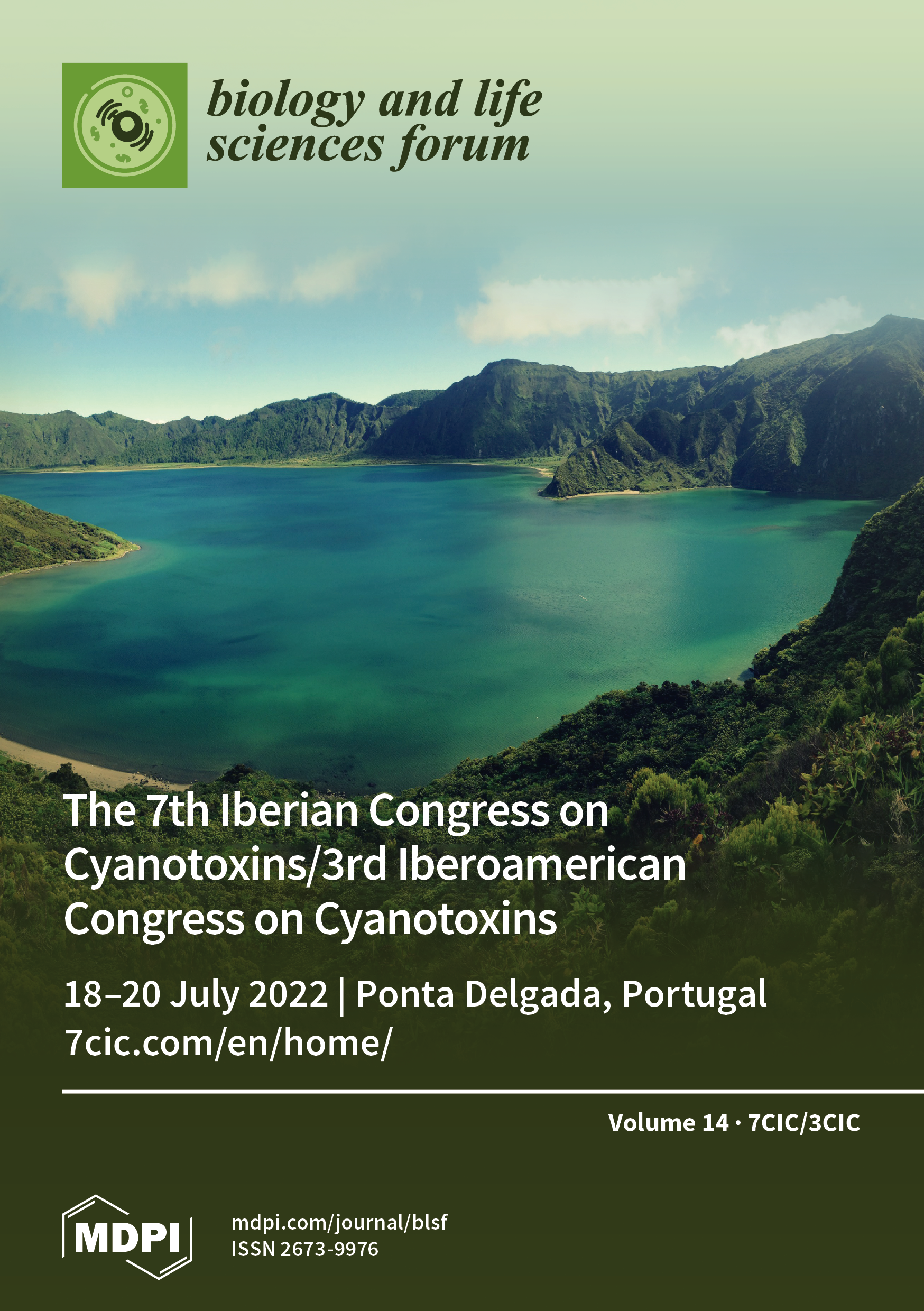
The 7th Iberian Congress on Cyanotoxins/3rd Iberoamerican Congress on Cyanotoxins

Ponta Delgada, Portugal | 18–20 July 2022

Volume Editors:
Vitor Gonçalves, Universidade dos Açores, Portugal
Rita Cordeiro, Universidade dos Açores, Portugal
Rúben Luz, Universidade dos Açores, Portugal
Amélia Fonseca, Universidade dos Açores, Portugal

Cover Story: The 7th Iberian Congress on Cyanotoxins/3rd Iberoamerican Congress on Cyanotoxins (7CIC) will be held in Ponta Delgada (Azores, Portugal) from 18 to 20 July 2022. Since its first edition in 2009, this congress has gathered Iberian researchers working on cyanobacteria toxins every two years to share their most recent findings. In 2017, this congress expanded its audience to Latin American researchers. This year's congress is organized by the Research Center in Biodiversity and Genetic Resources—Azores (CIBIO—Azores), based at the University of the Azores, constituting a research group of InBIO, the Research Network in Biodiversity and Evolutionary Biology. The 7CIC is the place to discover the most recent advances in cyanotoxins research, including their monitoring, mitigation and removal, detection methodologies, and biotechnological applications.
  • Issues are regarded as officially published after their release is announced to the table of contents alert mailing list .
  • You may sign up for email alerts to receive table of contents of newly released issues.
  • PDF is the official format for papers published in both, html and pdf forms. To view the papers in pdf format, click on the "PDF Full-text" link, and use the free Adobe Reader to open them.

Articles (49)

  • Abstract
  • Open Access
1,694 Views
2 Pages

Uncovering the Cyanobacterial Chemical Diversity: The Search for Novel Anticancer Compounds

  • Leonor Ferreira,
  • Maria Ligía Sousa,
  • Tiago Ribeiro,
  • João Morais,
  • Abel Forero,
  • Raquel Castelo-Branco,
  • Pedro N. Leão,
  • Marco Preto,
  • Ralph Urbatzka and
  • Mariana Reis
  • + 4 authors

Cancer has a tremendous negative socio-economic impact on our society. Thus, the discovery of new and more effective anticancer drugs is of utmost importance. To address this societal challenge, the main goal of the CYANCAN project was the discovery...

  • Abstract
  • Open Access
1,726 Views
2 Pages

IA-GES-BLOOM-CM: Towards a Comprehensive Warning and Management System for Cyanobacterial Blooms

  • José Antonio López-Orozco,
  • Jesús Chacón,
  • Elvira Perona,
  • Samuel Cirés,
  • Antonio Quesada and
  • Eva Besada-Portas

Cyanobacterial Blooms (CBs) are an ecological and public health problem since they may be followed by the production of secondary metabolites, which are toxic for humans and other animals. This threatens the life of multiple species and prevents the...

  • Abstract
  • Open Access
2 Citations
1,937 Views
2 Pages

Water Quality Assessment Using Sentinel-2 Imagery Estimating Chlorophyll A, Secchi Disk Depth, and Cyanobacteria Cell Number in Brazilian Reservoirs

  • Marcelo Pompêo,
  • Viviane Moschini-Carlos,
  • Marisa Dantas Bitencourt,
  • Xavier Sòria-Perpinyà,
  • Eduardo Vicente and
  • Jesus Delegido

Satellite images were used to assess surface water quality based on the concentration of chlorophyll a (chla), light penetration measured by the Secchi disk method (SD), and the Cyanobacteria cells number per mL (cyano). Nine reservoirs are studied i...

  • Abstract
  • Open Access
1,915 Views
2 Pages

Discovery of a Novel Potent Cytotoxic Compound from Leptothoe sp.

  • Leonor Ferreira,
  • João Morais,
  • Vitor Vasconcelos and
  • Mariana Reis

One of the top causes of worldwide mortality is cancer. In many cases, the effectiveness of traditional chemotherapy is hampered given the emergence of drug resistance alongside a wide range of unwanted side effects. To overcome this, it is essential...

  • Abstract
  • Open Access
1,423 Views
1 Page

The LEGE-CC- Blue Biotechnology and Ecotoxicology Culture Collection is a cyanobacteria and microalgae culture collection containing mainly Portuguese strains but with a biodiversity comprising strains from all over the world. It was started in 1991,...

  • Abstract
  • Open Access
1,492 Views
2 Pages

Exploring the Appetite Inhibition Potential of Bioactive Metabolites from Cyanobacterial Strains

  • Ana Fonseca,
  • Javier Sanz Moxó,
  • Vítor Vasconcelos,
  • Mariana Reis and
  • Ralph Urbatzka

Higher food intake promotes obesity, a critical public health challenge with increasing prevalence worldwide. Selective modulators of appetite can be applied as therapeutic intervention. Nevertheless, currently the appetite suppressant drugs trigger...

  • Abstract
  • Open Access
1,479 Views
2 Pages

How Intelligent ASVs Can Help Us to Support Cyanobacteria Blooms Detection, Predictions, and Early Warning?

  • José Antonio López-Orozco,
  • Gonzalo Carazo-Barbero,
  • Lia García-Pérez,
  • José María Girón-Sierra and
  • Eva Besada-Portas

The automation revolution provides access to robotized water-surface vehicles, which support behaviors of different autonomy and intelligence levels, ranging from those achieved by Remotely Piloted Surface Vehicle (RPSV) to those supported by Autonom...

  • Abstract
  • Open Access
1,218 Views
1 Page

Marine toxic microalgae frequently bloom on the Portuguese coast causing toxin accumulation in shellfish with the consequent harvesting interdiction in the affected production area. Likewise, freshwater cyanobacteria blooms are a constant in Portugue...

  • Abstract
  • Open Access
2 Citations
1,792 Views
2 Pages

Determination of Multiclass Cyanotoxins in Spirulina-Based Dietary Supplements Using a SLE-Tandem-SPE Procedure Followed by HILIC-MS/MS

  • Monsalud del Olmo-Iruela,
  • María del Mar Aparicio-Muriana,
  • Francisco J. Lara and
  • Ana M. García-Campaña

Cyanobacteria are a diverse group of oxygenic photosynthetic prokaryotes, which are believed to be one of the oldest life forms on Earth. They live in a wide range of ecosystems and withstand extreme environmental conditions. An important proportion...

  • Abstract
  • Open Access
1,934 Views
2 Pages

Machine Learning Approach towards the Early Warning of Cyanobacterial Blooms in Drinking Water Reservoirs

  • Claudia Fournier,
  • Antonio Quesada,
  • Ana Justel,
  • Agustín Pedro Monteoliva,
  • Jordi Cirera,
  • Carolina Solà,
  • Antoni Munné,
  • Juan Carlos Garcia,
  • José Javier Rodríguez and
  • Samuel Cirés

Cyanobacterial harmful algal blooms (CyanoHABs) are expanding globally, representing a major risk for lakes and reservoirs due to their toxicity and economic impacts. Therefore, anticipating their occurrence and understanding the main factors related...

of 5

Get Alerted

Add your email address to receive forthcoming issues of this journal.

XFacebookLinkedIn
Biol. Life Sci. Forum - ISSN 2673-9976