
Porphyra sensu lato Species as Source for Biological UV Photoprotectors and Antioxidants to Develop Cosmeceutical Products

 , , , and
Abstract
1. Introduction
2. Material and Methods
2.1. Samples
2.2. Phycobiliproteins
2.3. Phenolic Compounds
2.4. Mycosporine-like Amino Acids (MAAs)
2.5. Antioxidant Capacity (ABTS Assay)
2.6. Development of Cosmeceutical Formulations
2.7. Photoprotection Assay of the Creams
- Act.Sp (λ) = action spectra (normalized from 0 to 1);
- I (λ) = spectral irradiance of a sunny midday in summer in Malaga (W·m−2);
- d (λ) = wavelength step (1 nm);
- Abs (λ) = absorbance values (normalized from 0 to 1).
2.8. Statistical Analysis
3. Results
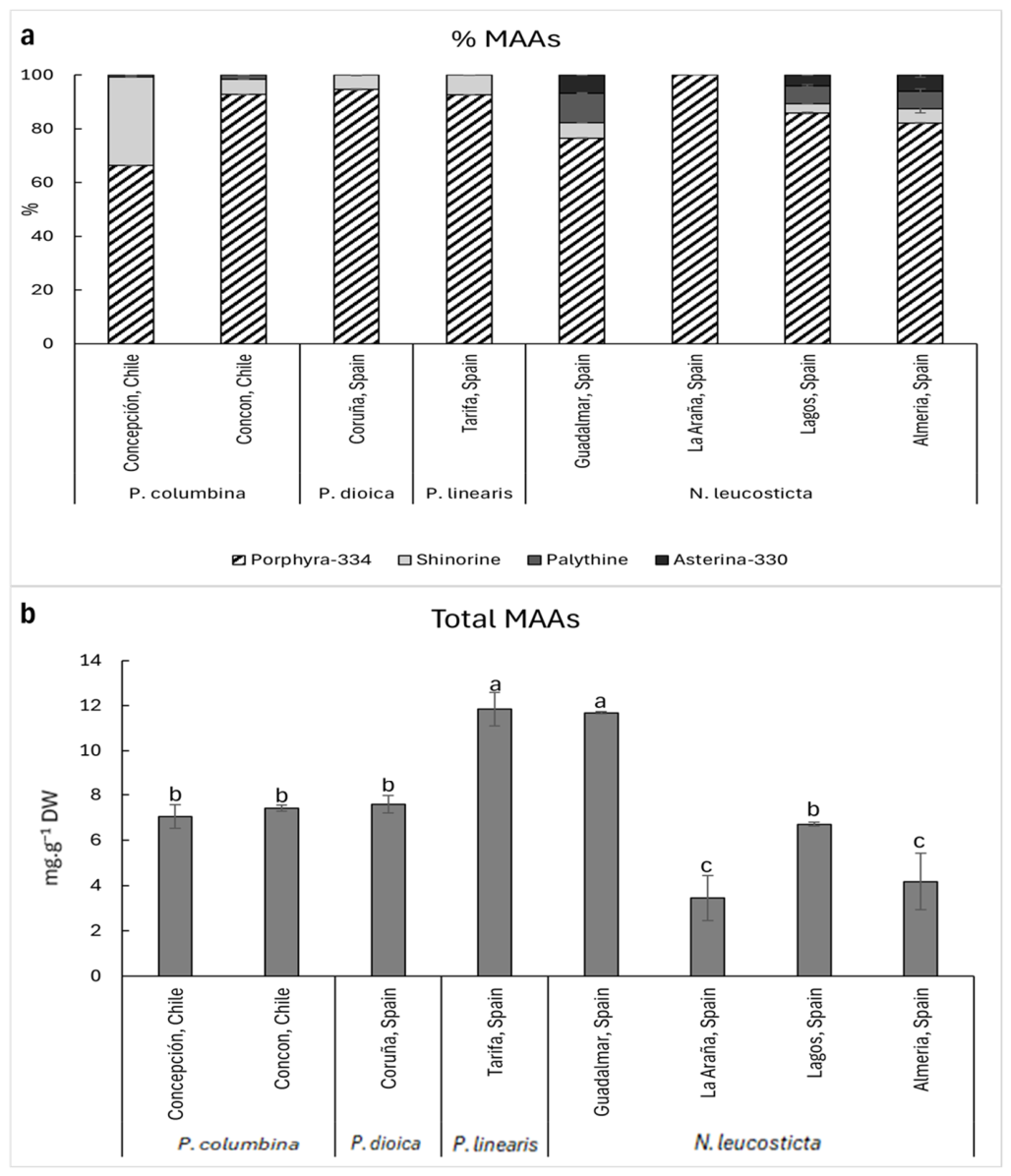
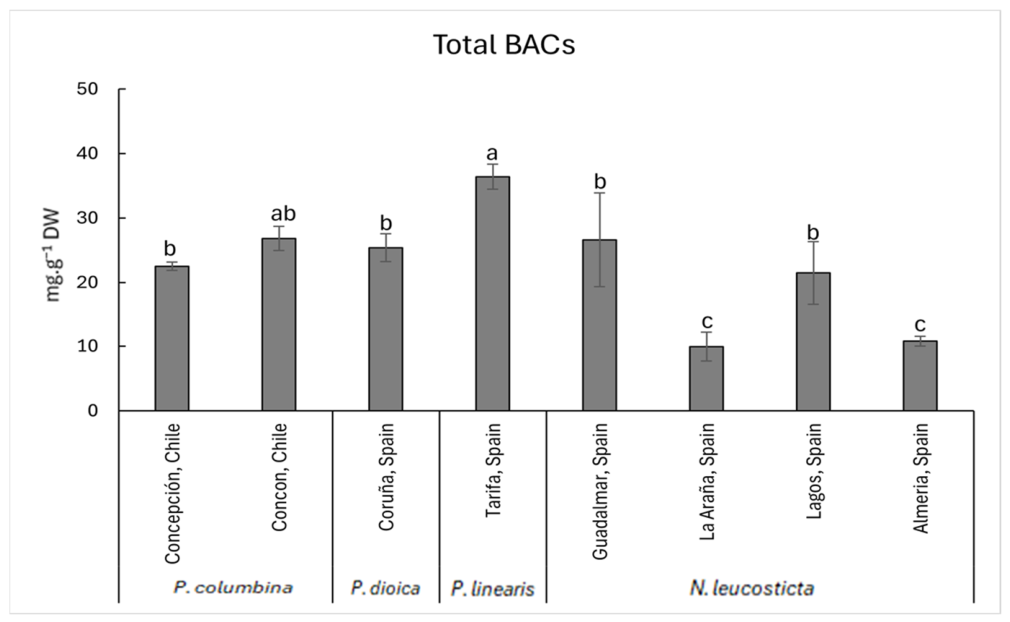
3.1. Comparison of Different Porphyra sensu lato Species
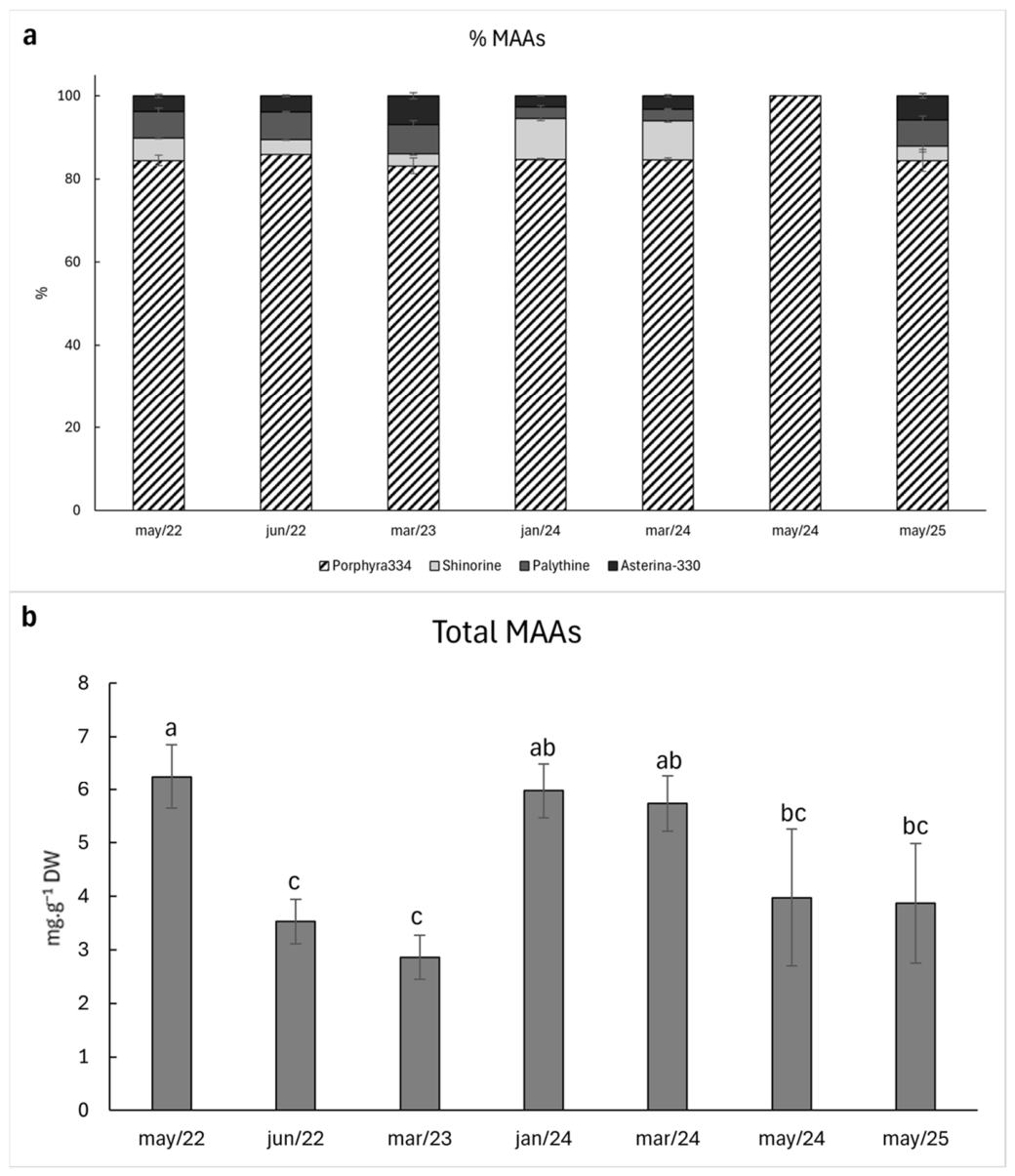
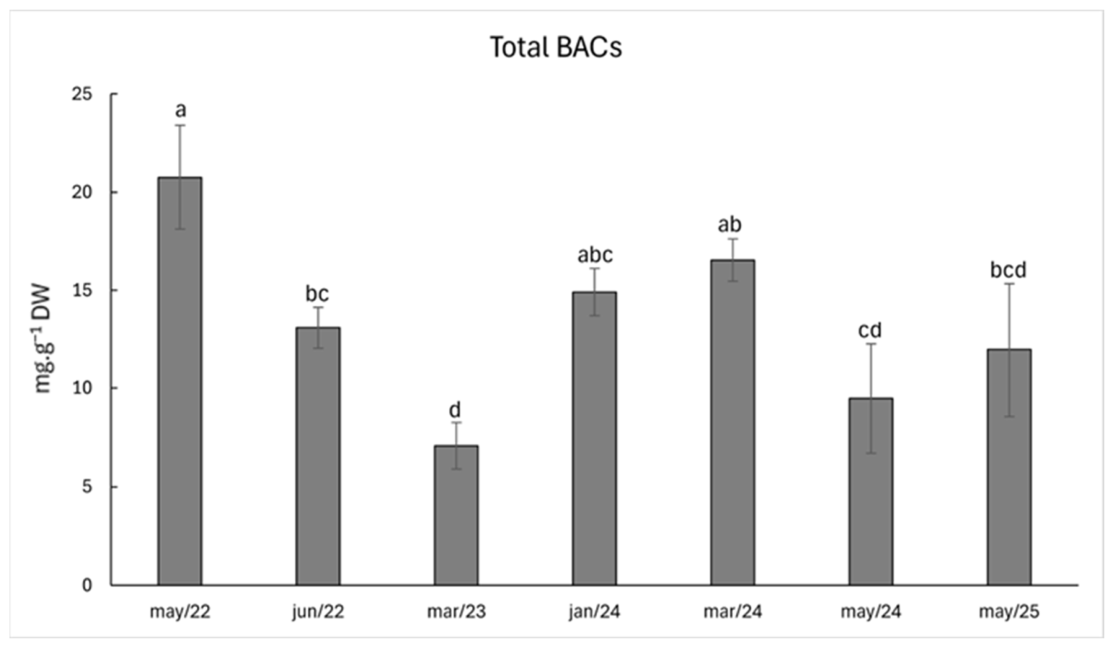
3.2. Temporal Variability of Pyropia elongata in Torre del Pino Beach, Malaga (Spain)
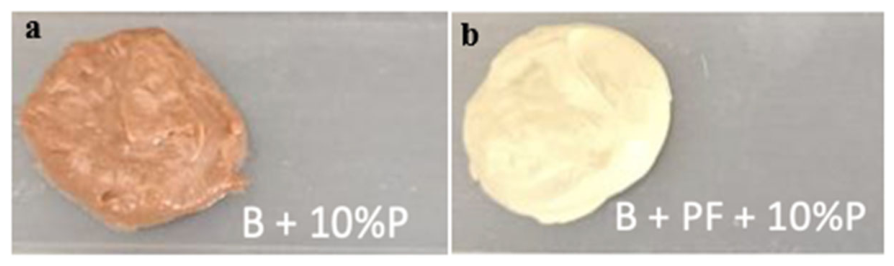
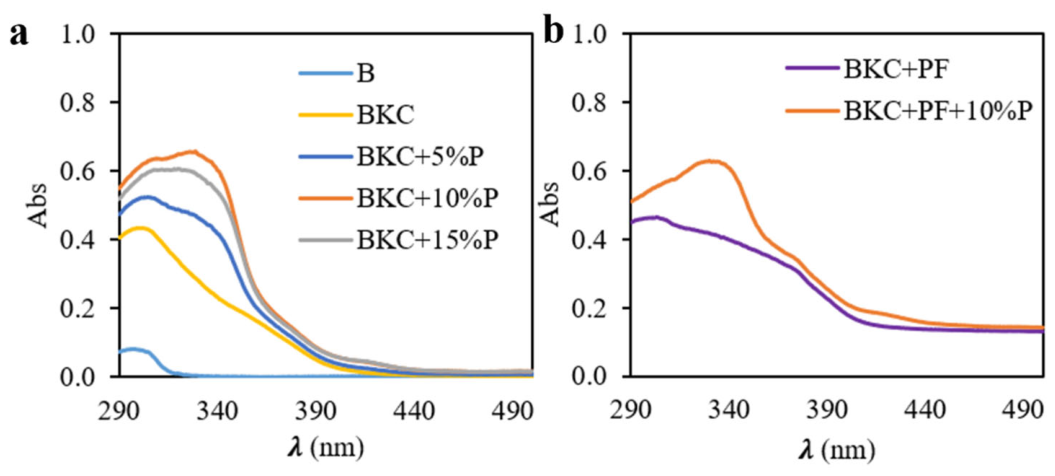
3.3. Development of Cosmeceutical Formulations
4. Discussion
Supplementary Materials
Author Contributions
Funding
Data Availability Statement
Acknowledgments
Conflicts of Interest
References
- Sahoo, D.; Tang, X.; Yarish, C. Porphyra–the economic seaweed as a new experimental system. Curr. Sci. 2002, 83, 1313–1316. [Google Scholar]
- Blouin, N.A.; Brodie, J.A.; Grossman, A.C.; Xu, P.; Brawley, S.H. Porphyra: A marine crop shaped by stress. Trends Plant Sci. 2011, 16, 29–37. [Google Scholar] [CrossRef] [Scilit]
- Cao, J.; Wang, J.; Wang, S.; Xu, X. Porphyra species: A mini-review of its pharmacological and nutritional properties. J. Med. Food 2016, 19, 111–119. [Google Scholar] [CrossRef] [Scilit] [PubMed]
- Venkatraman, K.L.; Mehta, A. Health benefits and pharmacological effects of Porphyra species. Plant Foods Hum. Nutr. 2019, 74, 10–17. [Google Scholar] [CrossRef] [Scilit] [PubMed]
- Milstein, D.; Medeiros, A.S.; Oliveira, E.C.; Oliveira, M.C. Native or introduced? A re-evaluation of Pyropia species (Bangiales, Rhodophyta) from Brazil based on molecular analyses. Eur. J. Phycol. 2015, 50, 37–45. [Google Scholar] [CrossRef] [Scilit]
- Blouin, N.; Xiugeng, F.; Peng, J.; Yarish, C.; Brawley, S.H. Seeding nets with neutral spores of the red alga Porphyra umbilicalis (L.) Kützing for use in integrated multi-trophic aquaculture (IMTA). Aquaculture 2007, 270, 77–91. [Google Scholar] [CrossRef] [Scilit]
- Bito, T.; Teng, F.; Watanabe, F. Bioactive compounds of edible purple laver Porphyra sp. (Nori). J. Agric. Food Chem. 2017, 65, 10685–10692. [Google Scholar] [CrossRef] [Scilit]
- Pereira, D.T.; Korbee, N.; Vega, J.; Figueroa, F.L. The role of nitrate supply in bioactive compound synthesis and antioxidant activity in the cultivation of Porphyra linearis (Rhodophyta, Bangiales) for future cosmeceutical and bioremediation applications. Mar. Drugs 2024, 22, 222. [Google Scholar] [CrossRef] [Scilit]
- Zhou, C.; Yu, X.; Zhang, Y.; He, R.; Ma, H. Ultrasonic degradation, purification and analysis of structure and antioxidant activity of polysaccharide from Porphyra yezoensis Udea. Carbohydr. Polym. 2012, 87, 2046–2051. [Google Scholar] [CrossRef] [Scilit]
- Guedes, É.A.; Silva, T.G.D.; Aguiar, J.S.; Barros, L.D.D.; Pinotti, L.M.; Sant’Ana, A.E. Cytotoxic activity of marine algae against cancerous cells. Ver. Bras. Farmacogn. 2013, 23, 668–673. [Google Scholar] [CrossRef] [Scilit]
- Mercurio, D.G.; Wagemaker, T.A.L.; Alves, V.M.; Benevenuto, C.G.; Gaspar, L.R.; Campos, P.M. In vivo photoprotective effects of cosmetic formulations containing UV filters, vitamins, Ginkgo biloba and red algae extracts. J. Photochem. Photobiol. B 2015, 153, 121–126. [Google Scholar] [CrossRef] [Scilit]
- Morais, T.; Cotas, J.; Pacheco, D.; Pereira, L. Seaweeds compounds: An ecosustainable source of cosmetic ingredients? Cosmetics 2021, 8, 8. [Google Scholar] [CrossRef] [Scilit]
- Shick, J.M.; Dunlap, W.C. Mycosporine-like amino acids and related gadusols: Biosynthesis, accumulation, and UV-protective functions in aquatic organisms. Ann. Rev. Physiol. 2002, 64, 223–262. [Google Scholar] [CrossRef] [Scilit]
- Raj, S.; Kuniyil, A.M.; Sreenikethanam, A.; Gugulothu, P.; Jeyakumar, R.B.; Bajhaiya, A.K. Microalgae as a source of mycosporine-like amino acids (MAAs); advances and future prospects. Int. J. Environ. Res. Public Health 2021, 18, 12402. [Google Scholar] [CrossRef] [Scilit]
- Sen, S.; Mallick, N. Mycosporine-like amino acids: Algal metabolites shaping the safety and sustainability profiles of commercial sunscreens. Algal Res. 2021, 58, 102425. [Google Scholar] [CrossRef] [Scilit]
- Figueroa, F.L.; Álvarez-Gómez, F.; Bonomi-Barufi, J.; Vega, J.; Massocato, T.F.; Gómez-Pinchetti, J.L.; Korbee, N. Interactive effects of solar radiation and inorganic nutrients on biofiltration, biomass production, photosynthetic activity and the accumulation of bioactive compounds in Gracilaria cornea (Rhodophyta). Algal Res. 2022, 68, 102890. [Google Scholar] [CrossRef] [Scilit]
- Rosic, N.; Climstein, M.; Boyle, G.M.; Thanh Nguyen, D.; Feng, Y. Exploring mycosporine-like amino acid UV-Absorbing natural products for a new generation of environmentally friendly sunscreens. Mar. Drugs 2023, 21, 253. [Google Scholar] [CrossRef] [Scilit]
- Chan, C.X.; Zäuner, S.; Wheeler, G.; Grossman, A.R.; Prochnik, S.E.; Blouin, N.A.; Zhuang, Y.; Benning, C.; Berg, G.M.; Yarish, C.; et al. Analysis of Porphyra membrane transporters demonstrates gene transfer among photosynthetic eukaryotes and numerous sodium-coupled transport systems. Plant Physiol. 2012, 158, 2001–2012. [Google Scholar] [CrossRef] [Scilit]
- Li, J.; Cui, G.; Liu, Y.; Wang, Q.; Gong, Q.; Gao, X. Effects of desiccation, water velocity, and nitrogen limitation on the growth and nutrient removal of Neoporphyra haitanensis and Neoporphyra dentata (Bangiales, Rhodophyta). Water 2021, 13, 2745. [Google Scholar] [CrossRef] [Scilit]
- Liu, C.; Zou, D. Effects of elevated CO2 on the photosynthesis and nitrate reductase activity of Pyropia haitanensis (Bangiales, Rhodophyta) grown at different nutrient levels. Chin. J. Oceanol. Limnol. 2015, 33, 419–429. [Google Scholar] [CrossRef] [Scilit]
- Pereira, D.T.; Moreu Badia, I.; Vega, J.; López Palica, F.; López Paniagua, D.; Korbee, N.; Figueroa, F.L. Effects of nitrate source (artificial and fishpond) and UV radiation on physiological, photosynthetic, and biochemical parameters of Porphyra dioica for sustainable integrated multitrophic aquaculture (IMTA). Nitrogen 2025, 6, 108. [Google Scholar] [CrossRef] [Scilit]
- Korbee, N.; Figueroa, F.L.; Aguilera, J. Effect of light quality on the accumulation of photosynthetic pigments, proteins and mycosporine-like amino acids in the red alga Porphyra leucosticta (Bangiales, Rhodophyta). J. Photochem. Photobiol. B Biol. 2005, 80, 71–78. [Google Scholar] [CrossRef] [Scilit] [PubMed]
- Korbee Peinado, N.; Abdala-Díaz, R.T.; Figueroa, F.L. Ammonium and UV radiation stimulate the accumulation of mycosporine-like amino acids in Porphyra columbina (Rhodophyta) from Patagonia, Argentina. J. Phycol. 2004, 40, 248–259. [Google Scholar] [CrossRef] [Scilit]
- Hoyer, K.; Karsten, U.; Sawall, T.; Wiencke, C. Photoprotective substances in Antarctic macroalgae and their variation with respect to depth distribution, different tissues and developmental stages. Mar. Ecol. Prog. Ser. 2001, 211, 117–129. [Google Scholar] [CrossRef] [Scilit]
- Pereira, D.T.; García-García, P.; Korbee, N.; Vega, J.; Señoráns, F.J.; Figueroa, F.L. Optimizing the extraction of bioactive compounds from Porphyra linearis (Rhodophyta): Evaluating alkaline and enzymatic hydrolysis for nutraceutical applications. Mar. Drugs 2024, 22, 284. [Google Scholar] [CrossRef] [Scilit] [PubMed]
- Beer, S.; Eshel, A. Determining phycoerythrin and phycocyanin concentrations in aqueous crude extracts of red algae. Aust. J. Mar. Freshw. Res. 1985, 36, 785–792. [Google Scholar] [CrossRef] [Scilit]
- Singleton, V.L.; Rossi, J.A. Colorimetry of total phenolics with phosphomolybdic-phosphotungstic acid reagents. Am. J. Enol. Vitic. 1965, 16, 144–158. [Google Scholar] [CrossRef] [Scilit]
- Chaves-Peña, P.; De La Coba, F.; Figueroa, F.L.; Korbee, N. Quantitative and qualitative HPLC analysis of mycosporine-like amino acids extracted in distilled water for cosmetical uses in four Rhodophyta. Mar. Drugs 2020, 18, 27. [Google Scholar] [CrossRef] [Scilit]
- Vega, J.; Bárcenas-Pérez, D.; Fuentes-Ríos, D.; López-Romero, J.M.; Hrouzek, P.; Figueroa, F.L.; Cheel, J. Isolation of mycosporine-like amino acids from red macroalgae and a marine lichen by high-performance countercurrent chromatography: A strategy to obtain biological UV-filters. Mar. Drugs 2023, 21, 357. [Google Scholar] [CrossRef] [Scilit]
- Karsten, U.; Sawall, T.; Hanelt, D.; Bischof, K.; Figueroa, F.L.; Flores-Moya, A.; Wiencke, C. An inventory of UV-absorbing mycosporine-like amino acids in macroalgae from polar to warm-temperate regions. Bot. Mar. 1998, 41, 443–453. [Google Scholar] [CrossRef] [Scilit]
- Re, R.; Pellegrini, N.; Proteggente, A.; Pannala, A.; Yang, M.; Rice-Evans, C. Antioxidant activity applying an improved ABTS radical cation decolorization assay. Free Radic. Biol. Med. 1999, 26, 1231–1237. [Google Scholar] [CrossRef] [Scilit]
- ISO 24443: 2012; Determination of Sunscreen UVA Photoprotection In Vitro. International Organization for Standardization: Geneva, Switzerland, 2012.
- McKinlay, A.F.; Diffey, B.L. A reference action spectrum for ultraviolet induced erythema in human skin. CIE J. 1987, 6, 17–22. [Google Scholar]
- Pissavini, M.; Tricaud, C.; Wiener, G.; Lauer, A.; Contier, M.; Kolbe, L.; Trullás Cabanas, C.; Boyer, F.; Nollent, V.; Meredith, E.; et al. Validation of an in vitro sun protection factor (SPF) method in blinded ring-testing. Int. J. Cosmet. Sci. 2018, 40, 263–268. [Google Scholar] [CrossRef] [Scilit]
- de la Coba, F.; Aguilera, J.; Korbee, N.; de Gálvez, M.V.; Herrera-Ceballos, E.; Álvarez-Gómez, F.; Figueroa, F.L. UVA and UVB photoprotective capabilities of topical formulations containing mycosporine-like amino acids (MAAs) through different biological effective protection factors (BEPFs). Mar. Drugs 2019, 17, 55. [Google Scholar] [CrossRef] [Scilit]
- de Gruijl, F.R.; Van der Leun, J.C. Estimate of the wavelength dependency of ultraviolet carcinogenesis in humans and its relevance to the risk assessment of a stratospheric ozone depletion. Health Phys. 1994, 67, 319–325. [Google Scholar] [CrossRef] [Scilit] [PubMed]
- De Fabo, E.C.; Kripke, M.L. Wavelength dependence and dose-rate independence of UV radiation-induced immunologic unresponsiveness of mice to a UV-induced fibrosarcoma. Photochem. Photobiol. 1980, 32, 183–188. [Google Scholar] [CrossRef] [Scilit]
- Wulf, H.C.; Poulsen, T.; Davies, R.E.; Urbach, F. Narrow-band UV radiation and induction of dermal elastosis and skin cancer. Photo-Dermatology 1989, 6, 44–51. [Google Scholar]
- Hanson, K.M.; Simon, J.D. Epidermal trans-urocanic acid and the UV-A-induced photoaging of the skin. Proc. Natl. Acad. Sci. USA 1998, 95, 10576–10578. [Google Scholar] [CrossRef] [Scilit]
- Bissett, D.L.; Hannon, D.P.; Orr, T.V. Wavelength dependence of histological, physical, and visible changes in chronically UV-irradiated hairless mouse skin. Photochem. Photobiol. 1989, 50, 763–769. [Google Scholar] [CrossRef] [Scilit]
- Diffey, B.L.; Tanner, P.R.; Matts, P.J.; Nash, J.F. In vitro assessment of the broad-spectrum ultraviolet protection of sunscreen products. J. Am. Acad. Dermatol. 2000, 43, 1024–1035. [Google Scholar] [CrossRef] [Scilit] [PubMed]
- Bonomi-Barufi, J.; Figueroa, F.L.; Korbee, N.; Momoli, M.M.; Martins, A.P.; Colepicolo, P.; Sluys, M.V.; Oliveira, M.C. How macroalgae can deal with radiation variability and photoacclimation capacity: The example of Gracilaria tenuistipitata (Rhodophyta) in laboratory. Algal Res. 2020, 50, 102007. [Google Scholar] [CrossRef] [Scilit]
- Vega, J.; Schneider, G.; Moreira, B.R.; Herrera, C.; Bonomi-Barufi, J.; Figueroa, F.L. Mycosporine-like amino acids from red macroalgae: UV-photoprotectors with potential cosmeceutical applications. Appl. Sci. 2021, 11, 5112. [Google Scholar] [CrossRef] [Scilit]
- Guihéneuf, F.; Gietl, A.; Stengel, D.B. Temporal and spatial variability of mycosporine-like amino acids and pigments in three edible red seaweeds from western Ireland. J. Appl. Phycol. 2018, 30, 2573–2586. [Google Scholar] [CrossRef] [Scilit]
- Gao, G.; Gao, Q.; Bao, M.; Xu, J.; Li, X. Nitrogen availability modulates the effects of ocean acidification on biomass yield and food quality of a marine crop Pyropia yezoensis. Food Chem. 2019, 271, 623–629. [Google Scholar] [CrossRef] [Scilit]
- Barufi, J.B.; Mata, M.T.; Oliveira, M.C.; Figueroa, F.L. Nitrate reduces the negative effect of UV radiation on photosynthesis and pigmentation in Gracilaria tenuistipitata (Rhodophyta): The photoprotection role of mycosporine-like amino acids. Phycologia 2012, 51, 636–648. [Google Scholar] [CrossRef] [Scilit]
- Mateos, R.; Pérez-Correa, J.R.; Domínguez, H. Bioactive properties of marine phenolics. Mar. Drugs 2020, 18, 501. [Google Scholar] [CrossRef] [Scilit] [PubMed]
- Zheng, H.; Zhao, Y.; Guo, L. A Bioactive substance derived from brown seaweeds: Phlorotannins. Mar. Drugs 2022, 20, 742. [Google Scholar] [CrossRef] [Scilit]
- Guinea, M.; Franco, V.; Araujo-Bazán, L.; Rodríguez-Martín, I.; González, S. In vivo UVB-photoprotective activity of extracts from commercial marine macroalgae. Food Chem. Toxicol. 2012, 5, 1109–1117. [Google Scholar] [CrossRef] [Scilit]
- Carpena, M.; Garcia-Perez, P.; Garcia-Oliveira, P.; Chamorro, F.; Otero, P.; Lourenço-Lopes, C.; Cao, H.; Simal-Gandara, J.; Prieto, M.A. Biological properties and potential of compounds extracted from red seaweeds. Phytochem. Rev. 2023, 22, 1509–1540. [Google Scholar] [CrossRef] [Scilit] [PubMed]
- Amsler, C.D.; Fairhead, V.A. Defensive and sensory chemical ecology of brown algae. Adv. Bot. Res. 2006, 43, 1–91. [Google Scholar] [CrossRef] [Scilit]
- Ramírez, T.; Cortés, D.; Mercado, J.M.; Vargas-Yáñez, M.; Sebastián, M.; Liger, E. Seasonal dynamics of inorganic nutrients and phytoplankton biomass in the NW Alboran Sea. Estuar. Coast. Shelf Sci. 2005, 65, 654–670. [Google Scholar] [CrossRef] [Scilit]
- Ballestín, S.S.; Bartolomé, M.J.L. Toxicity of different chemical components in sun cream filters and their impact on human health: A review. Appl. Sci. 2023, 13, 712. [Google Scholar] [CrossRef] [Scilit]
- Huovinen, P.; Gómez, I.; Figueroa, F.L.; Ulloa, N.; Morales, V.; Lovengreen, C. Ultraviolet-absorbing mycosporine-like aminoacids in red macroalgae from Chile. Bot. Mar. 2004, 47, 21–29. [Google Scholar] [CrossRef] [Scilit]
- Briani, B.; Sissini, M.N.; Lucena, L.A.; Batista, M.B.; Costa, I.O.; Nunes, J.M.C.; Schmitz, C.; Ramlov, F.; Maraschin, M.; Korbee, N.K.; et al. Mycosporine like amino acids (MAAs) in red marine algae and their relations with abiotic factors along southern Atlantic coast. J. Phycol. 2018, 50, 380–390. [Google Scholar] [CrossRef] [Scilit]
- Schneider, G.; Figueroa, F.L.; Vega, J.; Chaves, P.; Álvarez-Gómez, F.; Korbee, N.; Bonomi-Barufi, J. Photoprotection properties of marine photosynthetic organisms grown in high ultraviolet exposure areas: Cosmeceutical applications. Algal Res. 2020, 49, 101956. [Google Scholar] [CrossRef] [Scilit]
- Vega, J.; Bonomi-Barufi, J.; Gómez-Pinchetti, J.L.; Figueroa, F.L. Cyanobacteria and red macroalgae as potential source of antioxidants and UV radiation absorbing compounds for cosmeceutical applications. Mar. Drugs 2020, 18, 659. [Google Scholar] [CrossRef] [Scilit]
- Rastogi, R.P.; Sinha, R.P. Biotechnological and industrial significance of cyanobacterial secondary metabolites. Biotechnol. Adv. 2009, 27, 521–539. [Google Scholar] [CrossRef] [Scilit] [PubMed]
- Richa; Rastogi, R.P.; Kumari, S.; Singh, K.L.; Kannaujiya, V.K.; Singh, G.; Kesheri, M.; Sinha, R.P. Biotechnological potential of mycosporine-like amino acids and phycobiliproteins of cyanobacterial origin. Biotechnol. Bioinf. Bioeng. 2011, 1, 159–171. [Google Scholar]
- Wada, N.; Sakamoto, T.; Matsugo, S. Mycosporine-Like Amino Acids and their derivatives as natural antioxidants. Antioxidants 2015, 4, 603–646. [Google Scholar] [CrossRef] [Scilit] [PubMed]
- de la Coba, F.; Aguilera, J.; Figueroa, F.L.; de Gálvez, M.V.; Herrera, E. Antioxidant activity of mycosporine-like amino acids isolated from three red macroalgae and one marine lichen. J. Appl. Phycol. 2009, 21, 161–169. [Google Scholar] [CrossRef] [Scilit]
- Torres, P.; Santos, J.P.; Chow, F.; Ferreira, M.J.P.; Santos, D.Y.A.C. Comparative analysis of in vitro antioxidant capacities of mycosporine-like amino acids (MAAs). Algal Res. 2018, 34, 57–67. [Google Scholar] [CrossRef] [Scilit]
- Tashiro, Y.; Kameda, Y. Concentration of organic sun-blocking agents in seawater of beaches and coral reefs of Okinawa Island, Japan. Mar. Pollut. Bull. 2013, 77, 333–340. [Google Scholar] [CrossRef] [Scilit]
- Tsui, M.M.P.; Leung, H.W.; Wai, T.-C.; Yamashita, N.; Taniyasu, S.; Liu, W.; Lam, P.K.S.; Murphy, M.B. Occurrence, distribution and ecological risk assessment of multiple classes of UV filters in surface waters from different countries. Water Res. 2014, 67, 55–65. [Google Scholar] [CrossRef] [Scilit]
- Sánchez Rodríguez, A.; Rodrigo Sanz, M.; Betancort Rodríguez, J.R. Occurrence of eight UV filters in beaches of Gran Canaria (Canary Islands). An approach to environmental risk assessment. Chemosphere 2015, 131, 85–90. [Google Scholar] [CrossRef] [Scilit]
- Carve, M.; Nugegoda, D.; Allinson, G.; Shimeta, J. A systematic review and ecological risk assessment for organic ultraviolet filters in aquatic environments. Environ. Pollut. 2021, 268, 115894. [Google Scholar] [CrossRef] [Scilit]
- Gago-Ferrero, P.; Díaz-Cruz, M.S.; Barceló, D. An overview of UV-absorbing compounds (organic UV filters) in aquatic biota. Anal. Bioanal. Chem. 2012, 404, 2597–2610. [Google Scholar] [CrossRef] [Scilit] [PubMed]
- Vidal-Liñán, L.; Beiras, R. Ecotoxicological evaluation of the UV filters ethylhexyl dimethyl p-aminobenzoic acid and octocrylene using marine organisms Isochrysis galbana, Mytilus galloprovincialis and Paracentrotus lividus. Arch. Environ. Contam. Toxicol. 2017, 72, 606–611. [Google Scholar] [CrossRef] [Scilit] [PubMed]
- Prakash, V.; Anbumani, S. A systematic review on occurrence and ecotoxicity of organic UV filters in aquatic organisms. Rev. Environ. Contam. Toxicol. 2021, 257, 121–161. [Google Scholar] [CrossRef] [Scilit]
- Weisbrod, C.J.; Kunz, P.Y.; Zenker, A.K.; Fent, K. Effects of the UV filter benzophenone-2 on reproduction in fish. Toxicol. Appl. Pharmacol. 2007, 225, 255–266. [Google Scholar] [CrossRef] [Scilit] [PubMed]
- Blüthgen, N.; Zucchi, S.; Fent, K. Effects of the UV filter benzophenone-3 (oxybenzone) at low concentrations in zebrafish (Danio rerio). Toxicol. Appl. Pharmacol. 2012, 263, 184–194. [Google Scholar] [CrossRef] [Scilit]
- Downs, C.A.; Kramarsky-Winter, E.; Segal, R.; Fauth, J.; Knutson, S.; Bronstein, O.; Ciner, F.R.; Jeger, R.; Lichtenfeld, Y.; Woodley, C.M.; et al. Toxicopathological effects of the sunscreen UV filter, oxybenzone (benzophenone-3), on coral planulae and cultured primary cells and its environmental contamination in Hawaii and the U.S. Virgin Islands. Arch. Environ. Contam. Toxicol. 2016, 70, 265–288. [Google Scholar] [CrossRef] [Scilit]
- Tsui, M.M.P.; Lam, J.C.W.; Ng, T.Y.; Ang, P.O.; Murphy, M.B.; Lam, P.K.S. Occurrence, distribution, and fate of organic UV filters in coral communities. Environ. Sci. Technol. 2017, 51, 4182–4190. [Google Scholar] [CrossRef] [Scilit]
- Araújo, M.J.; Rocha, R.J.M.; Soares, A.M.V.M.; Benedé, J.L.; Chisvert, A.; Monteiro, M.S. Effects of UV filter 4-methylbenzylidene camphor during early development of Solea senegalensis Kaup, 1858. Sci. Total Environ. 2018, 628–629, 1395–1404. [Google Scholar] [CrossRef] [Scilit]
- Nataraj, B.; Maharajan, K.; Hemalatha, D.; Rangasamy, B.; Arul, N.; Ramesh, M. Comparative toxicity of UV-filter octyl methoxycinnamate and its photoproducts on zebrafish development. Sci. Total Environ. 2020, 718, 134546. [Google Scholar] [CrossRef] [Scilit]
- Thorel, E.; Clergeaud, F.; Jaugeon, L.; Rodrigues, A.M.S.; Lucas, J.; Stien, D.; Lebaron, P. Effect of 10 UV filters on the brine shrimp Artemia salina and the marine microalga Tetraselmis sp. Toxics 2020, 8, 29. [Google Scholar] [CrossRef] [Scilit]
- Moeller, M.; Pawlowski, S.; Petersen-Thiery, M.; Miller, I.B.; Nietzer, S.; Heisel-Sure, Y.; Kellermann, M.Y.; Schupp, P.J. Challenges in current coral reef protection—Possible impacts of UV filters used in sunscreens, a critical review. Front. Mar. Sci. 2021, 8, 665548. [Google Scholar] [CrossRef] [Scilit]
- Levine, A. Reducing the prevalence of chemical UV filters from sunscreen in aquatic environments: Regulatory, public awareness, and other considerations. Integr. Environ. Assess. Manag. 2021, 17, 982–988. [Google Scholar] [CrossRef] [Scilit]
- Vega, J.; Álvarez-Gómez, F.; Güenaga, L.; Figueroa, F.L.; Gómez-Pinchetti, J.L. Antioxidant activity of extracts from marine macroalgae, wild-collected and cultivated, in an integrated multi-trophic aquaculture system. Aquaculture 2020, 522, 735088. [Google Scholar] [CrossRef] [Scilit]
- Moreira, B.R.; Vega, J.; Sisa, A.D.A.; Bernal, J.S.B.; Abdala-Díaz, R.T.; Maraschin, M.; Figueroa, F.L.; Bonomi-Barufi, J. Antioxidant and anti-photoaging properties of red marine macroalgae: Screening of bioactive molecules for cosmeceutical applications. Algal Res. 2022, 68, 102893. [Google Scholar] [CrossRef] [Scilit]
- Gager, L.; Connan, S.; Molla, M.; Couteau, C.; Arbona, J.-F.; Coiffard, L.; Cérantola, S.; Stiger-Pouvreau, V. Active phlorotannins from seven brown seaweeds commercially harvested in Brittany (France) detected by ^1H NMR and in vitro assays: Temporal variation and potential valorization in cosmetic applications. J. Appl. Phycol. 2020, 32, 2375–2386. [Google Scholar] [CrossRef] [Scilit]
- Hermund, D.B.; Torsteinsen, H.; Vega, J.; Figueroa, F.L.; Jacobsen, C. Screening for new cosmeceuticals from brown algae Fucus vesiculosus with antioxidant and photo-protecting properties. Mar. Drugs 2022, 20, 687. [Google Scholar] [CrossRef] [Scilit]
- Al Muqarrabun, L.M.R.; Ahmat, N.; Ruzaina, S.A.S.; Ismail, N.H.; Sahidin, I. Medicinal uses, phytochemistry and pharmacology of Pongamia pinnata (L.) Pierre: A review. J. Ethnopharmacol. 2013, 150, 395–420. [Google Scholar] [CrossRef] [Scilit]
- Gupta, S.; Gupta, P. The genus Calophyllum: Review of ethnomedicinal uses, phytochemistry and pharmacology. In Bioactive Natural Products in Drug Discovery; Springer: Singapore, 2020; pp. 215–242. [Google Scholar] [CrossRef] [Scilit]
- Ácsová, A.; Hojerová, J.; Janotková, L.; Bendová, H.; Jedličková, L.; Hamranová, V.; Martiniaková, S. The real UVB photoprotective efficacy of vegetable oils: In vitro and in vivo studies. Photochem. Photobiol. Sci. 2021, 20, 139–151. [Google Scholar] [CrossRef] [Scilit]
- Grygier, A.; Chakradhari, S.; Ratusz, K.; Rudzińska, M.; Patel, K.S.; Lazdiņa, D.; Górnaś, P. Seven underutilized species of the Fabaceae family with high potential for industrial application as alternative sources of oil and lipophilic bioactive compounds. Ind. Crops Prod. 2022, 186, 115251. [Google Scholar] [CrossRef] [Scilit]
- Krutmann, J.; Brown, A.; Passeron, T.; Granger, C.; Gilaberte, Y.; Trullas, C.; Piquero-Casals, J.; Leone, G.; Schalka, S.; Lim, H.W. PINGing Sunshine: A review of the evidence for adding non-filtering photoprotective ingredients to sunscreens. Photodermatol. Photoimmunol. Photomed. 2025, 41, e70062. [Google Scholar] [CrossRef] [Scilit]
- González, S.; Gilaberte, Y.; Philips, N.; Juarranz, A. Fernblock, a nutriceutical with photoprotective properties and potential preventive agent for skin photoaging and photoinduced skin cancers. Int. J. Mol. Sci. 2011, 12, 8466–8475. [Google Scholar] [CrossRef] [Scilit]
- Parrado, C.; Mascaraque, M.; Gilaberte, Y.; Juarranz, A.; Gonzalez, S. Fernblock (Polypodium leucotomos Extract): Molecular mechanisms and pleiotropic effects in light-related skin conditions, photoaging and skin cancers, a review. Int. J. Mol. Sci. 2016, 17, 1026. [Google Scholar] [CrossRef] [Scilit]
- Aguilera, J.; Vicente-Manzanares, M.; de Gálvez, M.V.; Herrera-Ceballos, E.; Rodríguez-Luna, A.; González, S. Booster effect of a natural extract of Polypodium leucotomos (Fernblock®) that improves the UV barrier function and immune protection capability of sunscreen formulations. Front. Med. 2021, 8, 684665. [Google Scholar] [CrossRef] [Scilit]
- Parrado, C.; Philips, N.; Gilaberte, Y.; Juarranz, A.; González, S. Oral photoprotection: Effective agents and potential candidates. Front. Med. 2018, 5, 188. [Google Scholar] [CrossRef] [Scilit]



| Specie | Collection Site | Coordinates | Collection Date | Temperature (°C) | Global Radiation (KJ·m−2) |
|---|---|---|---|---|---|
| Porphyra columbina | Concepcion (CL) | 36°46′ S, 73°03′ W | March 2022 | 15.2 | 19,500 |
| Concon (CL) | 32°55′ S, 71°31′ W | March 2022 | 18.0 | 24,156 | |
| Porphyra dioica | Laxe, Coruña (ES) | 43°13′ N, 9°00′ W | May 2022 | 14.6 | 21,401 |
| Porphyra linearis | Tarifa, Cadiz (ES) | 36°01′ N, 5°37′ W | March 2022 | 13.9 | 13,448 |
| Neopyropia leucosticta | Guadalmar, Malaga (ES) | 36°39′ N, 4°27′ W | May 2022 | 19.3 | 24,021 |
| La Araña, Malaga (ES) | 36°42′ N, 4°19′ W | May 2024 | 18.9 | 25,504 | |
| Lagos, Malaga (ES) | 36°44′ N, 4°00′ W | May 2022 | 19.3 | 24,021 | |
| Almeria (ES) | 36°49′ N, 2°26′ W | February 2025 | 12.4 | 12,227 |
| Species | Collection Site | Coordinates | Collection Date | Temperature (°C) | Global Radiation (KJ·m−2) |
|---|---|---|---|---|---|
| Pyropia elongata | Nerja, Malaga (ES) | 36°44′ N, 3°47′ W | May 2022 | 19.3 | 24,021 |
| June 2022 | 22.7 | 27,608 | |||
| March 2023 | 13.9 | 16,816 | |||
| January 2024 | 12.2 | 9403 | |||
| March 2024 | 14.4 | 13,960 | |||
| May 2024 | 18.9 | 25,504 | |||
| May 2025 | 19.0 | 24,587 |
| Specie | Collection Site | Collection Date | ABTS (µmol TEAC·g−1 DW) | Polyphenols (mg·g−1 DW) | PE (mg·g−1 DW) | PC (mg·g−1 DW) | PE:PC |
|---|---|---|---|---|---|---|---|
| Porphyra columbina | Concepcion, Chile | March 2022 | 15.36 ± 0.83 ab | 12.43 ± 0.84 ab | 1.84 ± 0.60 de | 1.28 ± 0.45 c | 1.44 |
| Concon, Chile | March 2022 | 10.62 ± 0.51 de | 10.83 ± 0.58 b | 5.40 ± 0.82 b | 3.22 ± 0.44 ab | 1.68 | |
| Porphyra dioica | Coruña, Spain | May 2022 | 14.75 ± 1.89 abc | 14.56 ± 1.11 a | 3.04 ± 0.88 cd | 2.76 ± 0.79 ab | 1.10 |
| Porphyra linearis | Tarifa, Spain | March 2022 | 11.77 ± 2.02 cde | 13.10 ± 1.78 ab | 8.26 ± 0.09 a | 3.19 ± 0.24 ab | 2.60 |
| Neopyropia leucosticta | Guadalmar, Spain | May 2022 | 8.63 ± 1.06 e | 11.56 ± 1.93 ab | 4.72 ± 0.88 bc | 3.86 ± 0.43 a | 1.22 |
| La Araña, Spain | May 2024 | 3.60 ± 0.56 f | 4.78 ± 0.90 c | 1.24 ± 0.34 e | 0.46 ± 0.19 c | 2.70 | |
| Lagos, Spain | May 2022 | 16.82 ± 0.92 a | 11.74 ± 1.85 ab | 2.79 ± 0.31 de | 2.80 ± 0.25 ab | 1.00 | |
| Almeria, Spain | February 2025 | 12.44 ± 1.66 bcd | 5.15 ± 0.60 c | 1.23 ± 0.15 e | 0.21 ± 0.15 c | 5.86 |
| Collection Date | ABTS | Polyphenols | PE | PC | PE:PC |
|---|---|---|---|---|---|
| May 2022 | 12.78 ± 1.88 b | 10.25 ± 1.65 a | 1.92 ± 0.41 a | 2.13 ± 0.66 a | 0.90 |
| June 2022 | 13.35 ± 1.39 b | 7.59 ± 0.15 b | 0.70 ± 0.20 bc | 1.25 ± 0.45 b | 0.56 |
| March 2023 | 3.74 ± 0.07 d | 3.95 ± 1.04 c | 0.25 ± 0.02 c | 0.04 ± 0.001 d | 6.25 |
| January 2024 | 2.70 ± 1.61 d | 6.70 ± 0.40 b | 1.52 ± 0.36 ab | 0.72 ± 0.32 bcd | 2.11 |
| March 2024 | 2.50 ± 0.36 d | 7.53 ± 0.79 b | 2.19 ± 0.20 a | 1.08 ± 0.19 bc | 2.03 |
| May 2024 | 8.55 ± 0.93 c | 3.72 ± 0.73 c | 1.25 ± 0.77 abc | 0.52 ± 0.32 bcd | 2.40 |
| May 2025 | 16.53 ± 1.54 a | 4.71 ± 0.04 c | 0.71 ± 0.27 bc | 0.32 ± 0.17 cd | 2.22 |
| SPF | UVAPF | SPF/UVAPF | λc | |
|---|---|---|---|---|
| BK | 1.18 ± 0.01 e | 1.00 ± 0.00 f | 1.18 | 308 |
| BKC | 4.24 ± 0.64 d | 2.00 ± 0.15 e | 2.12 | 365 |
| BKC + PF | 5.83 ± 0.80 cd | 4.04 ± 0.48 b | 1.46 | 376 |
| BKC + 5% P | 6.87 ± 0.41 bc | 2.78 ± 0.11 d | 2.48 | 363 |
| BKC + 10% P | 8.64 ± 2.05 ab | 3.17 ± 0.37 cd | 2.83 | 363 |
| BKC + 15% P | 9.84 ± 2.30 a | 3.40 ± 0.37 c | 2.90 | 363 |
| BKC + PF + 10% P | 9.77 ± 1.59 a | 6.03 ± 0.76 a | 1.66 | 376 |
| ALGA MARIS SPF50 | 50.83 ± 11.39 | 9.87 ± 0.85 | 5.07 | 370 |
| Photocarinogenesis | Immunosuppression | Elastosis | Singlet Oxygen | Photoaging | |
|---|---|---|---|---|---|
| B | 1.34 ± 0.01 c | 1.28 ± 0.01 d | 1.02 ± 0.00 e | 1.00 ± 0.00 d | 1.00 ± 0.00 e |
| BKC | 5.44 ± 0.99 b | 5.10 ± 0.90 c | 2.05 ± 0.15 d | 2.33 ± 0.22 c | 2.15 ± 0.18 d |
| BKC + PF | 6.42 ± 0.88 b | 6.29 ± 0.86 cd | 4.00 ± 0.47 b | 4.73 ± 0.63 b | 4.42 ± 0.57 b |
| BKC + 5% P | 8.13 ± 0.57 ab | 8.13 ± 0.57 ab | 2.73 ± 0.10 c | 3.63 ± 0.20 b | 3.24 ± 0.16 bc |
| BKC + 10% P | 9.57 ± 2.38 a | 9.87 ± 2.55 a | 3.05 ± 0.33 c | 4.47 ± 0.79 b | 3.86 ± 0.59 b |
| BKC + 15% P | 10.72 ± 2.77 a | 11.02 ± 2.96 a | 3.27 ± 0.33 c | 4.43 ± 0.71 b | 4.22 ± 0.60 abcde |
| BKC + PF + 10% P | 9.32 ± 1.51 a | 9.52 ± 1.56 a | 5.72 ± 0.69 a | 8.83 ± 1.44 a | 7.13 ± 1.03 a |
Disclaimer/Publisher’s Note: The statements, opinions and data contained in all publications are solely those of the individual author(s) and contributor(s) and not of MDPI and/or the editor(s). MDPI and/or the editor(s) disclaim responsibility for any injury to people or property resulting from any ideas, methods, instructions or products referred to in the content. |
© 2026 by the authors. Licensee MDPI, Basel, Switzerland. This article is an open access article distributed under the terms and conditions of the Creative Commons Attribution (CC BY) license.
Share and Cite
Pereira, D.T.; Vega, J.; Barufi, J.B.; Korbee, N.; Figueroa, F.L. Porphyra sensu lato Species as Source for Biological UV Photoprotectors and Antioxidants to Develop Cosmeceutical Products. Phycology 2026, 6, 59. https://doi.org/10.3390/phycology6020059
Pereira DT, Vega J, Barufi JB, Korbee N, Figueroa FL. Porphyra sensu lato Species as Source for Biological UV Photoprotectors and Antioxidants to Develop Cosmeceutical Products. Phycology. 2026; 6(2):59. https://doi.org/10.3390/phycology6020059
Chicago/Turabian StylePereira, Débora Tomazi, Julia Vega, José Bonomi Barufi, Nathalie Korbee, and Félix L. Figueroa. 2026. "Porphyra sensu lato Species as Source for Biological UV Photoprotectors and Antioxidants to Develop Cosmeceutical Products" Phycology 6, no. 2: 59. https://doi.org/10.3390/phycology6020059
APA StylePereira, D. T., Vega, J., Barufi, J. B., Korbee, N., & Figueroa, F. L. (2026). Porphyra sensu lato Species as Source for Biological UV Photoprotectors and Antioxidants to Develop Cosmeceutical Products. Phycology, 6(2), 59. https://doi.org/10.3390/phycology6020059