
Article

Growth and Metals Uptake of Black Soldier Fly Larvae (Hermetia illucens L.) Reared on a Wastewater-Cultivated Microalgae Enriched Substrate

by
Tabitha J. Carr
1,
Maureen E. Wakefield
2 and
Gary S. Caldwell
1,*
1
School of Natural and Environmental Sciences, Newcastle University, Newcastle Upon Tyne NE1 7RU, UK
2
Fera Science Ltd., York YO41 1LZ, UK
*
Author to whom correspondence should be addressed.
Phycology 2026, 6(2), 54; https://doi.org/10.3390/phycology6020054
Submission received: 23 March 2026 / Revised: 4 May 2026 / Accepted: 8 May 2026 / Published: 19 May 2026
(This article belongs to the Special Issue Development of Algal Biotechnology, Second Edition)

Abstract

Augmenting aquaculture feeds with black soldier fly (Hermetia illucens L.) larvae is an emerging solution to the industry’s fishmeal and fish oil dependence. However, the larva’s nutritional plasticity often results in bioaccumulation of metals from the rearing substrates. Larvae can be nutritionally enriched with microalgae, but research investigating growth impacts and metals uptake are lacking. In this study, a Stichococcaceae algae strain that is used to phycoremediate effluent from commercial anaerobic digesters was investigated as a rearing substrate. Larvae were reared on chicken feed enriched with stepped ratios of algae and spent coffee grounds (a reference waste feed). Growth, survival and metals content (ICP-OES) were recorded when 10% of larvae were prepupal. Survival was >98.5% across all treatments with a trend of increased growth with microalgal inclusion, and no significant impact of metals on growth. Metals uptake as determined by a bioaccumulation factor was significantly lower in the highest algae treatment compared to the coffee-only treatment. Larvae consistently accumulated cadmium and lead whereas arsenic bioaccumulation was only observed in three treatments. Cadmium had the highest bioaccumulation factor (up to 4.06) and arsenic the lowest (down to 0.41). Larvae did not exceed current European Union maximum metal ions levels for inclusion into aquafeeds. These findings highlight the potential of using Stichococcaceae to enrich black soldier fly larvae, offering a dual sustainable solution for wastewater remediation and aquaculture feed provision.

1. Introduction

Global demand for marine protein continues to rise, with seafood products supplying 13,950 Kt of protein in 2018, and fish farms producing 94 million tonnes in 2022 [1]. A well-managed aquaculture sector is essential to ensure global food security given the depletion of wild fishery resources and rising demand for high-protein diets [1]. Formulated feeds, particularly those used to rear carnivorous species, remain heavily dependent on feeds high in polyunsaturated fatty acids (PUFAs) which are traditionally sourced from the reduction of pelagic fish into fishmeal and fish oil products (FMFOPs) [2].
This poses a long-standing sustainability challenge [3,4,5,6] with dependence on depleting wild fish stocks and removal of food-grade fish having deleterious impacts on pelagic ecosystem stability and food security [4,6,7]. Consequently, the aquafeed industry considers the substitution of FMFOPs with sustainable alternative ingredients such as plant-based products to be essential [8]. FMFOPs are increasingly blended with vegetable oils [9,10]; however, vegetable oils are lacking in key polyunsaturated fatty acids (PUFAs; docosahexaenoic acid, DHA; eicosapentaenoic acid, EPA), which many fish species are incapable of synthesising de novo [11]. Reduced PUFA intake significantly alters the nutritional profile of fish such as Atlantic salmon (Salmo salar), resulting in reduced feed utilisation, nutrient uptake, and lipid metabolism.
Alternative feedstuffs must be accessible (wide availability, ease of handling and storage) and nutritionally complete [8]. Insects currently augment the diets of 2 billion people [12] and there is growing interest in incorporating them in aquafeeds [13,14]. Insects are rich in crude protein and essential amino acids and are low in fibre and anti-nutritional factors. Crucially, insects can convert food waste to animal protein and fat [12,15], supporting a circular economy based on sustainable waste valorisation [14].
The black soldier fly (Hermetia illucens L.; Diptera: Stratiomyidae) has a similar essential amino acid profile to fishmeal and has been approved for aquafeed production under European Union (EU) legislation [13,16]. The black soldier fly is a polyphagous species and can be successfully reared on a range of organic waste streams, including manure, coffee silverskin, fruits, abattoir waste, and human faeces [17,18,19,20,21]. However, bioaccumulation of EU regulated metal ions (cadmium, lead, and arsenic) is well documented [22,23], posing a threat to their use as an aquafeed. The PUFA profile is also unfavourable, containing low levels of DHA and EPA [21,24]. The European Food Safety Authority has highlighted a lack of comprehensive understanding regarding both the presence of hazardous substances in insects for feed and the transmission of substances into insects from diets [25]. As a result, there is a need for research into substrates which could nutritionally enhance black soldier fly larvae whilst ensuring feed safety.
Microalgae remediation of municipal wastewater effluents is growing in scale and scope, offering a sustainable and cost-effective solution to contaminant removal [26,27]. Microalgae are effective at taking up metals from wastewater owing to the negatively charged functional groups in their cell walls [28]. The high content of water, salt, and carbohydrates in some algae can make them an unsuitable feed component [29]; however, they exhibit higher biomass production and protein content compared to terrestrial plants [30,31]. Black soldier fly larval growth positively correlates with high dietary protein [32,33]. Further, microalgae are especially rich in EPA and DHA [34], which black soldier fly can bioaccumulate [35], thereby modulating their fatty acid profile [19,20]. However, research into the growth and survival of black soldier fly larvae reared on wastewater-grown algae is scarce, and no study to date has assessed the feed safety of wastewater algae substrates in relation to metal bioaccumulation.
This study enriched a basal black soldier fly diet (chicken feed and spent coffee grounds) with microalgae biomass (F. Stichococcaceae) that was cultured on high ammonium content sludge liquor from commercial anaerobic digesters. This alga was selected based on its existing phycoremediation role at an operational municipal sewage treatment works in northeast England which, at full scale, will generate circa 80 tonnes of algae biomass per year [Northumbrian Water Group, unpublished]. Impacts on larval growth, survival, and metal ions bioaccumulation were determined relative to EU regulatory limits.

2. Materials and Methods

2.1. Algal Processing

A dense 43 L algal culture (circa 6 g/L) was obtained from a pilot-scale tubular photobioreactor at the Northumbrian Water Group Bran Sands Sewage Treatment Works, Middlesbrough, Cleveland, UK (54.6114 N, −1.12481 W). The photobioreactor was fed filtered raw effluent from anaerobic digesters operating on sewage sludge. CO2 off-gas from a generator was pulsed to improve biomass yield. The biomass was further concentrated using recirculating membrane harvesting (Membranology SM4000, Swansea, UK) in 9 L batches for 150 min. The concentrated biomass was transferred into 50 mL Falcon tubes (Fisher Scientific, Leicestershire, UK) and centrifuged at 2650× g for 20 min at 4 °C. The supernatant was discarded, and samples were stored frozen at −20 °C.

2.2. Larvae

Five-day old black soldier fly larvae were obtained from a stock colony maintained by Fera Science Ltd., York. Prior to the experiment, the larvae were reared on a commercial chicken crumb feed.

2.3. Experimental Setup

The experiment comprised six treatments (n = 3). Each replicate contained a total of 200 g of feed. The reference diet ‘Control’ followed Fera Science practices and consisted of Henergise Chick Crumb (Glasson Grain, Lancaster, UK) only. Five experimental treatments contained a base of 120 g of crumb and a total of 80 g of spent coffee grounds and algae (wet weight) in stepped ratios (Table 1). Coffee grounds were collected from a Newcastle University operated café and stored frozen at −20 °C.
The feeds were added to food grade plastic containers (7 cm × 14 cm × 4 cm), to which 200 larvae per replicate, counted by hand, were introduced and covered with muslin cloth secured by a lid. The lids were pierced with six holes (⌀ 2 cm) to facilitate gas exchange. Each treatment was tested in triplicate. Larvae were batch fed at the start of the experiment only, at an equivalent feeding rate of 100 mg per larva per day dry weight [22]. Containers were placed in a temperature-controlled room (28.1 °C) and inspected daily, during which the feed substrate was agitated with a plastic stirring rod to promote aeration and prevent quality degradation. On day 3, waterlogging of the muslin cloth was observed in the control treatments due to swelling of the feed. To prevent mortality from reduced gas exchange, all treatments were transferred into deeper food grade plastic containers (7 cm × 14 cm × 7 cm) and the muslin cloth was replaced. The experiment was terminated on day 8 when 10% of larvae were prepupal.
All larvae were separated from the frass with plastic forceps. All surviving larvae were counted. Larval survival rate (SR) was calculated as:
S R = N t N 0 100
where Nt = number of survived larvae and N0 = initial number of larvae.
Twenty-five randomly selected larvae from each replicate were rinsed with Milli-Q water, dried using kitchen paper, and weighed with a fine mass balance (KERN ABS 220-4N; KERN & Sohn GmbH, Balingen-Frommern, Germany). This was normalised to the mass of the control larvae. Larvae not destined for analysis were killed by freezing. Larval growth data were normalised to the percentage total protein composition (dry weight) of each feed blend (crumb = 19% (Glasson Grain 2025), algae = 42.78%, coffee = 19% [36]—normalisation factors are given in Table 1). Data for coffee were derived from the literature and was considered equivalent to crumb. The larval growth data were subsequently normalised to total dietary protein.

2.4. Inductively Coupled Plasma Optical Emission Spectroscopy (ICP-OES)

Five randomly selected larvae from each replicate were transferred to 5 mL Eppendorf tubes and freeze dried (lyophilised) for 24 h. After lyophilisation, samples were ground to <250 μm using a ceramic mortar and pestle. To prepare the samples for ICP-OES analysis, 50 mg of the ground material was digested in polytetrafluoroethylene beakers. The material was moistened with deionised water. Nine millilitres of concentrated HNO3 and 3 mL of HCl were added before the sample was heated in a microwave digester (Milestone ETHOS LEAN, Sorisole, Italy). The solution was made up to 50 mL with deionised water and analysed for aluminium (Al), arsenic (As), barium (Ba), cadmium (Cd), chromium (Cr), copper (Cu), iron (Fe), potassium (K), magnesium (Mg), manganese (Mn), sodium (Na), nickel (Ni), lead (Pb), sulphur (S), strontium (Sr), and zinc (Zn) content using an Agilent 5900 ICP-OES 5800 (Santa Clara, CA, USA). Samples (n = 3) of chick crumb, coffee, and algae feeds were analysed in the same way.
The metal Bioaccumulation Factor (BAF) [22] was calculated as:
B A F =   c o n c e n t r a t i o n   i n   o r g a n i s m   ( C i ) c o n c e n t r a t i o n   i n   f o o d   ( C o )
The metal concentration in each original treatment was calculated as:
C t r e a t m e n t =   C a l g a e   × M a l g a e + C c h i c k   × M c h i c k + ( C c o f f e e   × M c o f f e e ) M t o t a l
where Ctreatment = metals concentration (mg kg−1) in the combined feed mix of each experimental treatment; Calgae = metals concentration (mg kg−1) in the algae component of the feed, wet weight; Cchick = metals concentration (mg kg−1) in the chick crumb component of the feed, dry weight; Ccoffee = metals concentration (mg kg−1) in the spent coffee grounds component of the feed, dry weight; Mtotal = total mass (g, dry weight for crumb and coffee, wet weight for algae) of the feed for each treatment; Malgae = mass (g) of the algae component of the feed, wet weight; Mchick = mass (g) of the chick crumb component of the feed, dry weight; and Mcoffee = mass (g) of the spent coffee grounds component of the feed, dry weight.

2.5. Data Analysis

All statistical analyses were conducted in RStudio (Posit PBC, Version 4.3.3, Boston, MA, USA). To analyse differences in growth, a mixed-effects model was drafted with treatment as a fixed effect and replicate as a random effect. Based on Akaike Information Criterion (AIC) values, replicate was not adding explanatory power. It was therefore excluded, and an ANOVA was subsequently applied. Assumptions of normality were visually checked via histograms and homogeneity of variance by the Levene’s Test. Given high survival across all treatments, no statistical analyses were conducted on these data. A heatmap was created in RStudio using the heatmap ( ) function. Growth and metal interactions were analysed using principal component analysis to reduce the data dimensionality, followed by a principal component regression using the principal components as predictors and larval mass as response. For each metal in the original feeds, a Kruskal–Wallis Test was applied to analyse the difference in content due to small sample size (n = 3 per group) and violations of normality, followed by Dunn’s post hoc test for pairwise comparisons. To determine the overall effect of treatment on bioaccumulation factor, BAF data were log-transformed to meet assumptions of normality and an ANOVA was applied, followed by Tukey’s HSD test for pairwise comparisons.

3. Results

3.1. Larval Survival and Growth

Survival was high (>98.5%) across all treatments (Figure 1a). Individual larval mass was higher in treatments 1–4 compared to the control and treatment 5 (Figure 1a,b), although not significantly so (F (5, 12) = 0.7326, p > 0.05). The highest masses were observed in treatments 1 and 3 ( x ¯ = 244.749 ± 43.8 mg and 244.678 ± 44.8 mg, respectively), with both treatments 7.5% higher than the control. The control and treatment 5 were comparable, with <1% difference in larval mass. Treatment 2 had the lowest growth of the algae-enriched substrates.

3.2. Metals Content of Feeds

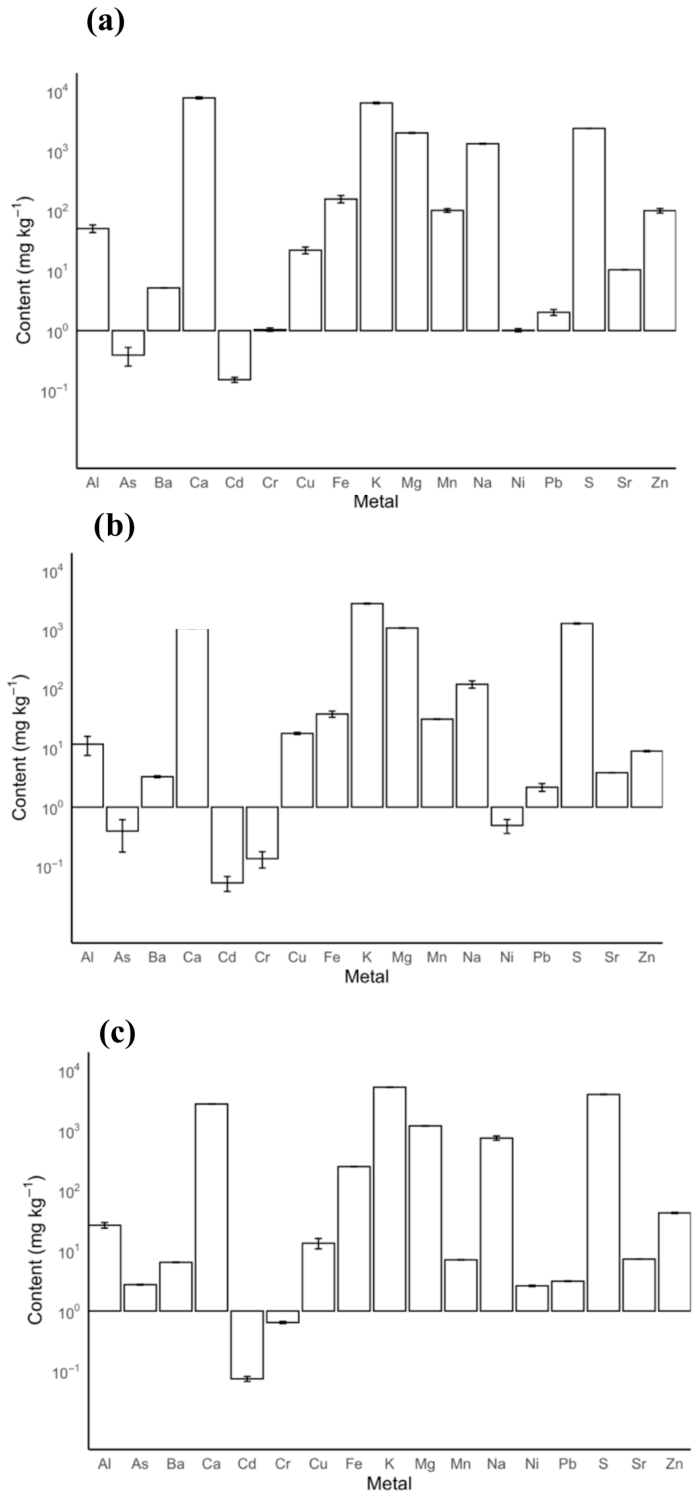
The content of most metals was significantly different between chick, algae, and coffee feeds (Figure 2), with coffee generally having the lowest and chick crumb the highest levels. Arsenic and lead were highest in algae (2.74 ± 0.0431 mg kg−1, 3.14 ± 0.0426 mg kg−1) and were comparable between chick crumb (0.389 ± 0.134 mg kg−1, 2.02 ± 0.229 mg kg−1) and coffee (0.393 ± 0.220 mg kg−1, 2.17 ± 0.328 mg kg−1). Cadmium was highest in chick crumb and was comparable between algae and coffee (0.0748 ± 0.00716 mg kg−1 and 0.0522 ± 0.0146 mg kg−1, respectively). Copper levels in coffee were not significantly different from either algae or chick crumb (Dunn’s Test, Z = −1.34, p > 0.05).

3.3. Metals Bioaccumulation

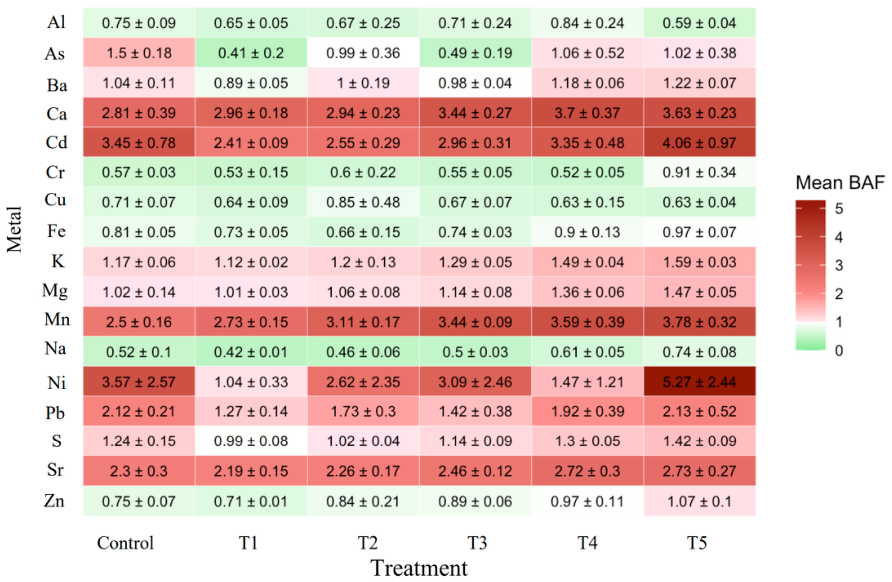
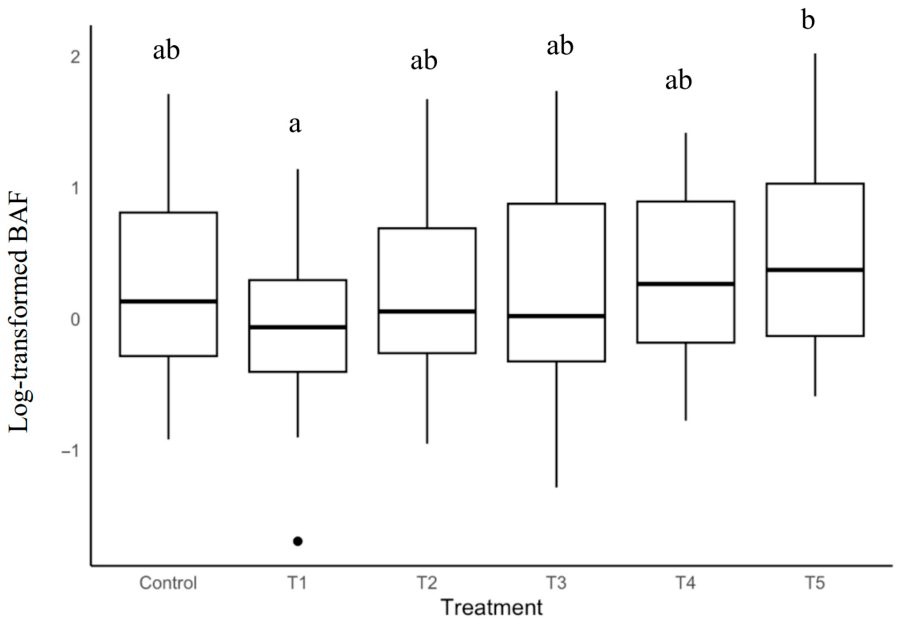
Black soldier fly larvae bioaccumulated Ni, Sr, Pb, Mn, Mg, Cd, K, and Ca across all treatments, whereas Na, Fe, Cu, Cr, and Al remained lower in larval tissue compared to initial feed content (Figure 3). The highest BAF was observed for Ni (5.27 ± 2.44), followed by Cd (4.06 ± 0.97) and Mn (3.78 ± 0.32). Zn only bioaccumulated in treatment 5, and As and Ba bioaccumulated in all treatments except for 1 and 3. Compared to the control, median BAF across metals was lower in treatments 1–3, and slightly higher in 4 and 5 (Figure 4). Variability in BAF was highest in treatment 3 and lowest in treatment 1; treatment 1 had an outlier. ANOVA revealed that the effect of Treatment on BAF was significant (F (5, 138) = 5.391, p < 0.001). Post hoc Tukey’s Test revealed that treatment 1 significantly reduced BAF compared to treatment 5 (p < 0.05).

3.4. Metals and Growth

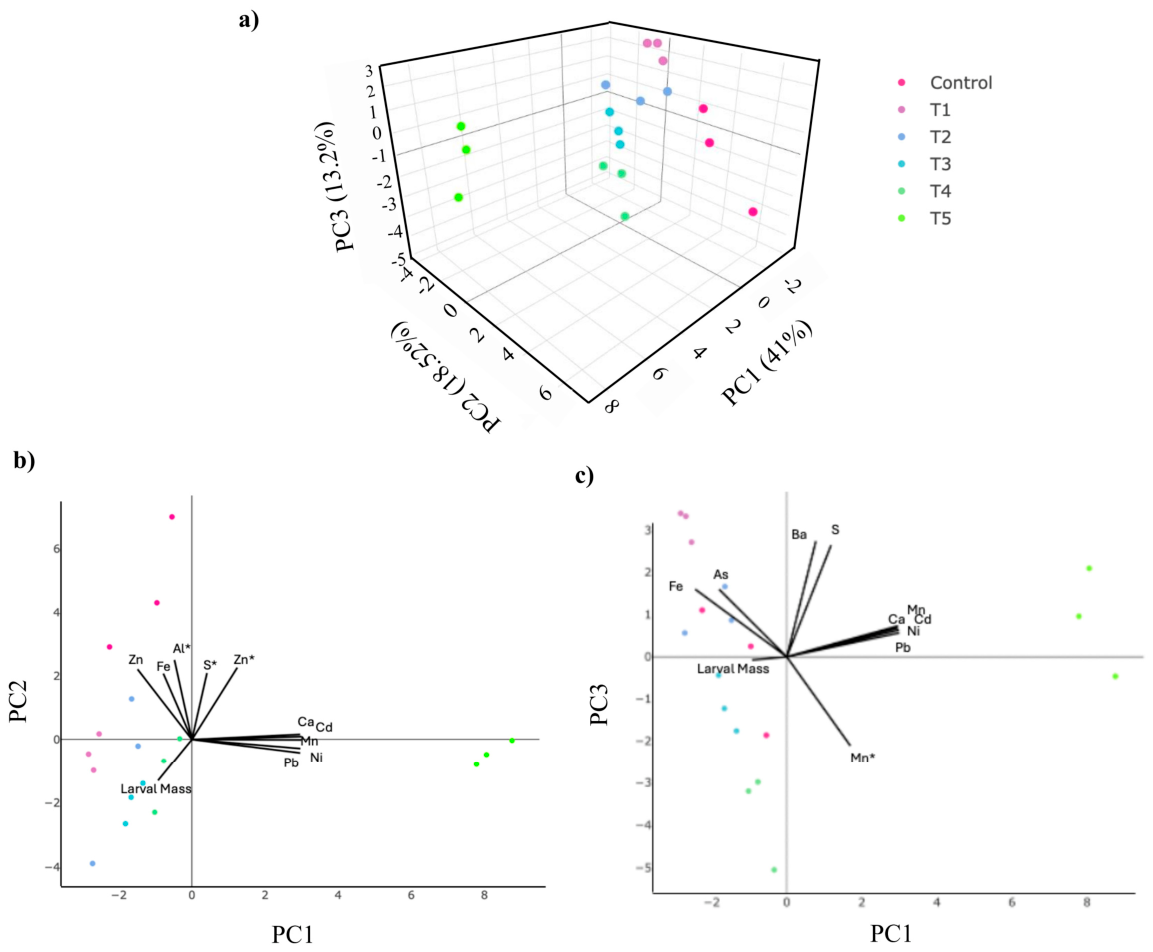
Three components with eigenvalues greater than 1 explained 72.72% of the variation of treatments. Replicates of treatments clustered together on the principal components whilst treatments occupied different spaces (Figure 5a). Treatment 5 was positioned the furthest away from other treatments, with a higher loading on PC1. Component 1, which contributed 41% of variance, was represented primarily by Mn, Cd, and Ni content in the feed. In the second component, contributing 18.52% of variance, Al, S, and Zn content in the larvae were the most important (Figure 5b), whilst component 3 (contributing 13.2% of variance) was primarily represented by Ba, S, and As contents in the feed (Figure 5c). Mean larval biomass had a weak negative loading on PC1 and PC3, and a moderate weak loading on PC2, indicating there may be a relationship with individual metals such as zinc, sodium, and aluminium and biomass. However, PCA regression analysis indicated biomass variability could not be significantly accounted for by the measured variables (F (5, 12) = 1.884, p >0.05, R2 = 0.2064) indicating no significant effect of the combined metals on larval biomass.

3.5. Cadmium

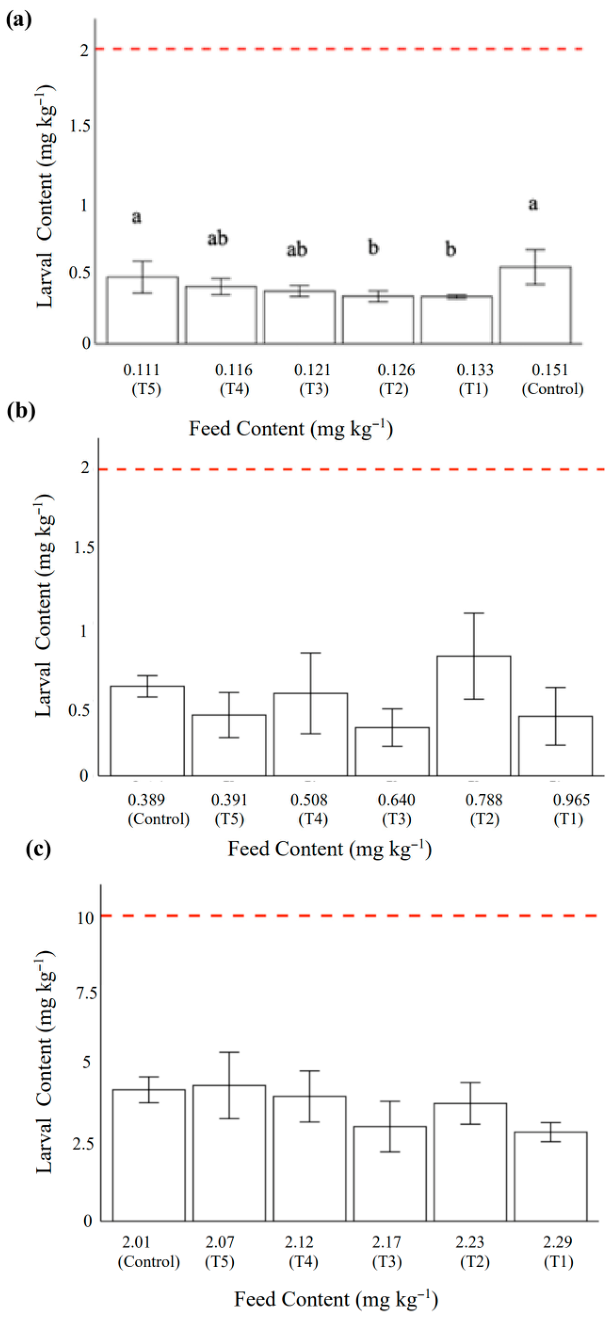
Cadmium in larval tissue was significantly different across treatments (Kruskal–Wallis Test, df = 5, p < 0.05), with post hoc Dunn’s Test revealing treatments 1 and 2 were significantly lower than the control and treatment 5. As cadmium increased in the feed, larval content generally decreased (Figure 6a) although the control was an outlier to this trend, with cadmium levels significantly higher than treatment 1 (Dunn’s Test, Z = 2.52, p < 0.05). Larval cadmium contents were similar between treatments 3 ( x ¯ = 0.38 ± 0.5 mg kg−1) and 4 ( x ¯ = 0.4 ± 0.7 mg kg−1).

3.6. Arsenic

Arsenic in larval tissue did not exhibit notable patterns (Figure 6b), with no significant difference between treatments (Kruskal–Wallis Test, df = 5, p > 0.05), although there was an observable spike of arsenic in larval tissues of treatment 2 ( x ¯ = 0.75 ± 0.6 mg kg−1).

3.7. Lead

Larval lead content generally decreased with increasing feed content (Figure 6c), although there was no significant difference in larval levels across treatments (Kruskal–Wallis Test, df = 5, p > 0.05). Larval content was highest in treatment 5 ( x ¯ = 4 ± 1 mg kg−1) and lowest in treatment 1 ( x ¯ = 2.25 ± 0.5 mg kg−1).

4. Discussion

This study investigated the effects on black soldier fly larval growth, survival, and metals bioaccumulation following the incorporation of wastewater-grown microalgae (Stichococcaceae) into the diet in stepped ratios with spent coffee grounds. The alga forms the basis of a phycoremediation process operational at a mid-sized municipal sewage treatment plant in northeast England and primarily remediates ammonium-rich effluent from anaerobic digesters but also has high affinities for phosphate and metals (Caldwell, unpublished). The biomass has a high protein content (>40%) and was therefore considered a potential candidate feedstock to raise black soldier fly larvae. Presently, the biomass is routed back through the anaerobic digestion process to generate biogas; hence the current study provides a tangible alternative use for the biomass. Members of the Stichococcaceae are known for their high affinities for metals and have been investigated as a biorefinery feedstock [38,39]. Survival rate was high across all experimental and control treatments, with growth remaining positive but no significant trend with increasing microalgae inclusion. These findings are broadly consistent with Ruschioni and co-workers [40], who reported high survival rates and significantly enhanced growth in larvae reared on diets supplemented with Schizochytrium limacinum and Isochrysis galbana microalgae. The extended duration of their study, which terminated when 40% of larvae reached the prepupal stage compared to 10% in the present study, suggests that a longer experimental period may have allowed for significant growth differences to emerge. The growth-promoting effects of microalgae are attributed to their antioxidant phenolic compounds and polyunsaturated fatty acids profile (PUFAs) which are critical for cellular function and larval development [41,42]. In contrast, spent coffee grounds are considered nutritionally poor for the larvae [43], evidencing the potential for microalgae to nutritionally enhance low-value waste streams. Microalgal PUFA composition varies by species and cultivation condition [20,44]. Characterisation of the lipid composition of larvae reared on Stichococcaceae would further our understanding of its suitability as a fishmeal replacement.
In contrast, several studies have reported diminished growth in algae-reared black soldier fly larvae. Lowery [45] reported reduced growth on a 100% wastewater-grown algae diet versus a maximum of 40% in the current study. Reductions in survival and biomass accumulation were also observed at 14% inclusion of Tetraselmis chui [46] (although clumping of algae in the substrate was cited as a confounding factor), and at 50% inclusion of Ascophyllum nodosum, a phenolic-rich macroalgae (seaweed) [29]. Differences in growth outcomes could be attributed to variations in anti-nutritional factors between algal species [47], highlighting the need for a systematic evaluation of the interaction between algal species, cultivation condition, and inclusion levels in influencing growth performance.
Principal component analysis revealed no significant effect of the combination of metals on growth performance. Tolerance to metals is well documented for black soldier fly larvae owing to metallothionein detoxification and granular storage in Malpighian tubules [22,48,49,50,51,52]. However, growth impairment was documented at 2 mg kg−1 arsenic, 1 mg kg−1 cadmium, and 10 mg kg−1 Pb, higher than this study’s maxima (0.9, 0.1, and 2.29 mg kg−1, respectively) [23]. Reduced larval mass has also been reported for 15–400 mg kg−1 Pb and 30.1–260 mg kg−1 Ni [53], suggesting metal-related growth inhibition occurs only above certain toxicity thresholds, likely when metallothionein binding sites become fully saturated [50]. Several studies have reported delayed development, lower feed conversion ratios, and reduced gut bacteria diversity on metal-contaminated substrates [22,49,51,54]. As larval mass and survival rate were the sole indicators of growth performance in this study, potential sublethal effects may have gone undetected. Incorporation of a broader range of performance metrics would better assess the physiological impacts of wastewater Stichococcaceae metal exposure.
Metal bioaccumulation was significantly lower in the treatment with the highest algae content compared to the coffee treatment. To our knowledge, no study has investigated the kinetics of metals uptake from microalgae on black soldier fly larvae. Similar reductions in metal mobility have been observed in microalgae-amended soils [55] and in aquatic systems where changes to metal speciation occur within the algal phycosphere [56,57] owing to algae-induced pH alterations. The Stichococcaceae culture used in this study had an alkaline pH 8.4, while spent coffee grounds and chicken feed are comparatively acidic, with reported pH values of ~5.0 and 5.2–7.3, respectively [58]. The treatment with the highest algae inclusion would therefore have represented the most alkaline environment. Alkalinity enhances metal precipitation, decreasing the pool of bioavailable ions for uptake by the larvae [59,60]. In contrast, under acidic conditions, spent coffee grounds can release organic acids capable of donating protons (H+) which displace metal ions from sorption sites and increase their solubility [61]. This hypothesis is potentially supported by the principal component analysis, which suggested larvae in the coffee treatment responded differently to metal content compared to the other treatments. However, a trial with controlled pH is needed to determine if this is a causal relationship, and if so, to elucidate uptake kinetics.
The biochemical properties of microalgae may offer a further explanation for reduced metal accumulation. Microalgae cell walls contain carboxyl (–COO), hydroxyl (–OH), and phosphate (–PO43−) functional groups which can rapidly bind ions from the surrounding matrix [62], potentially sequestering metals from other feed components and outcompeting slower absorption pathways in black soldier fly larvae. The metallothionein proteins produced by microalgae form large and stable metal complexes [63], which may be prevented from reaching absorptive epithelial cells due to the sieve-like peritrophic matrix that lines the larva’s midgut [64]. Microalgae also synthesise organic ligands which mediate metals intracellularly, binding them to insoluble molecules [63]. Whilst this metal-binding capacity may reduce the bioaccumulation of potentially harmful elements, it could also limit the bioavailability of essential trace metals, such as zinc or iron, which are required for larval development [65]. However, no adverse growth performance was observed in the present study. The potential of microalgae in mitigating the transfer of metals to black soldier fly larvae could therefore be valuable in increasing aquafeed safety.
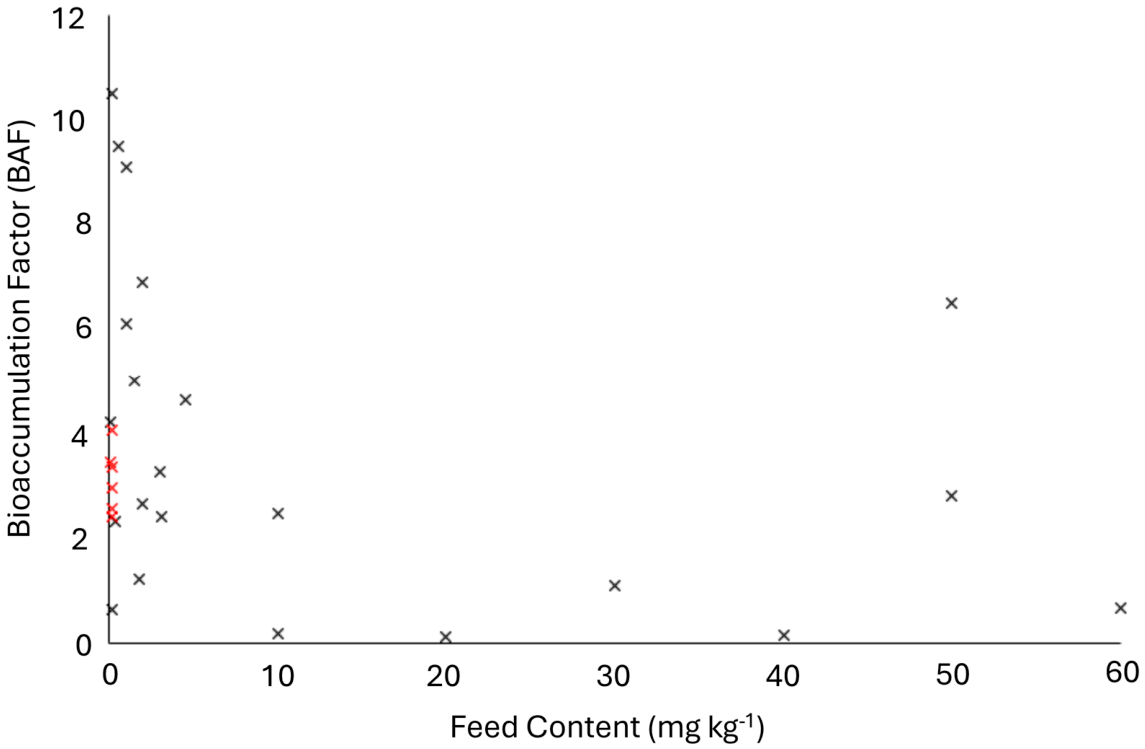
Given their regulatory limits in EU feed materials, this study also sought to quantify the bioaccumulation potential and larval contents of cadmium, lead, and arsenic ions. Cadmium had the highest bioaccumulation factor across all treatments. Cadmium bioaccumulates in black soldier fly larvae more than other metals due to its ionic mimicry of calcium, which allows it to bypass active transport via calcium-specific channels [66]. Cd-induced protein damage in dipterans is further mitigated by synthesis of HSP70 proteins [67], enabling it to be accumulated without adverse effects. Larval cadmium content was significantly lower in the two highest algae treatments compared to both the control and coffee treatments, despite the coffee treatment having lower cadmium content. This contrasts with previous studies which typically report a positive relationship between substrate and tissue content [22,48,54]. However, these studies used metal-spiked control feeds, whereas the introduction of algae likely induced biological interactions which altered cadmium availability, such as formation of insoluble hydroxide complexes under alkaline conditions. Reduced cadmium accumulation has been observed in black soldier fly larvae that were reared on macroalgae (A. nodosum) [68], suggesting a similar polysaccharide-mediated metal binding effect may have reduced bioavailability in the present study. The bioaccumulation factors for cadmium in the literature are wide-ranging across various substrates and feed contents (Figure 7), underlining the need for better understanding of the mechanistic drivers of cadmium bioavailability for black soldier fly larvae from a feed safety perspective.
There was no significant difference in arsenic content in the larvae between treatments despite increased overall content in the feed due to the microalgae inclusion. This disagrees with the previous literature, which report a linear relationship between feed and larval content [68,72]. One potential explanation for this is the speciation of arsenic in microalgae. Many microalgae employ arsenic detoxification mechanisms, including arsenite (As(III)) oxidation to arsenate (As(V)), which is less readily absorbed in black soldier fly larvae cells [73]. Microalgal chelation of As (III) with phytochelatins further reduce its mobility [63,74]. Arsenate competes with phosphate for uptake through shared transporters in biological systems [75] potentially explaining similarities in larval content as high-arsenic treatments corresponded to phosphate-rich wastewater algae conditions [76,77]. Bioaccumulation of arsenic was detected in three of the treatments, whereas some previous studies have observed no accumulation [54,78]. This difference may be attributed to the longer excretion time of arsenic, which may require two days following removal from the substrate [54]; therefore, the BAF in this study may reflect gut content rather than true tissue accumulation. Bioaccumulation of arsenic in black soldier fly larvae reared on vegetable waste and macroalgae, respectively, has been noted [68,72]. These findings highlight the importance of considering arsenic speciation in substrates alongside total arsenic to better understand its bioaccumulation potential.
Lead bioaccumulated across all treatments, which likely relates to its mimicry of Fe that enables intracellular transport by pinocytosis. BAFs for lead in the present study (1.2–2.1) are consistent with many of those reported in the literature across various diets (1.16 [68]; 1.74 [71]; 1.2 [54]; 2.3 [20]), suggesting substrate plays a less critical role in lead accumulation compared to arsenic and cadmium. This may be explained by black soldier fly larvae gut microbiota shifting lead to residual (F4) fractions [70] which are excreted, limiting further uptake and buffering against variations in feed-induced bioavailability. The preferential sequestration of lead in exuviae [22] may further explain the similar larval content observed across treatments. Larvae in the present study were in their sixth instar, therefore likely having excreted lead through successive moults. These consistent results suggest the content of lead in black soldier fly larvae feed substrates may be of less concern than cadmium and arsenic.
Black soldier fly larvae used in animal feed within the European Union must comply with the requirements set out in Directive 2002/32/EC and its subsequent amendments [37,79]. Across all experimental and control treatments, none of the larvae exceeded current maximum limits for lead, arsenic, or cadmium. This highlights the opportunity for a circular economy system based on revalorisation of readily available wastewater-cultivated microalgae to enrich low-value organic waste (spent coffee grounds) and reduce dependence on commercial chick crumb. Whilst the chemical safety profile of algae-fed black soldier fly larvae is promising, the potential for biological hazards, particularly pathogen transfer from wastewater cultivation conditions, remains poorly understood [25]. Nonetheless, this novel study has demonstrated that black soldier fly larvae can be produced with adequate growth performance and metal safety, making them a promising sustainable fishmeal alternative. To establish scalability of this strategy, future research to characterise the nutritional profile of larvae reared on Stichococcaceae microalgae is needed, and the risk of pathogenic transfer determined.

5. Conclusions

This study highlights the conditional feasibility of utilising wastewater-grown microalgae as a substrate for Hermetia illucens larvae, with important implications for sustainable feed production. While algae-derived substrates can support larval growth and contribute to nutrient recycling, the presence and behaviour of heavy metals remain a critical constraint. The findings demonstrate that bioaccumulation patterns differ depending on whether they are assessed on a concentration or mass basis, with the latter revealing substantial total metal retention in larval biomass despite low bioaccumulation factors. This has direct implications for feed safety, particularly where larvae are intended for incorporation into aquaculture diets.
From a systems perspective, integrating wastewater-grown algae into black soldier fly production offers clear advantages, including waste valorisation, reduced reliance on conventional feedstocks, and alignment with circular economy principles. However, the transfer of contaminants through the substrate–larvae–feed pathway presents a non-trivial risk that must be actively managed. The variability in metal uptake suggests that substrate composition, algal species, and rearing conditions will strongly influence outcomes, necessitating careful process control and monitoring.
For aquaculture applications, the results indicate that while insect-derived meals remain a promising alternative protein source, their safe deployment will depend on rigorous upstream quality control of feed substrates. Reliance on concentration-based bioaccumulation metrics alone may underestimate the true extent of metal transfer into edible biomass. A combined approach incorporating both concentration and mass balance assessments is therefore essential to ensure regulatory compliance and consumer safety.
Overall, wastewater-grown algae represent a viable but constrained input for black soldier fly production systems. Future work should focus on minimising contaminant uptake through substrate optimisation, selective breeding or conditioning of larvae, and post-harvest processing strategies. Only through such integrated approaches can the full potential of this system be realised within sustainable aquaculture feed supply chains.

Author Contributions

Conceptualisation, G.S.C.; methodology, T.J.C., M.E.W. and G.S.C.; formal analysis, T.J.C.; investigation, T.J.C.; writing—original draft preparation, T.J.C.; writing—review and editing, G.S.C. and M.E.W.; visualisation, T.J.C.; supervision, G.S.C. and M.E.W. All authors have read and agreed to the published version of the manuscript.

Funding

This research received no external funding.

Institutional Review Board Statement

Not applicable.

Informed Consent Statement

Not applicable.

Data Availability Statement

Datasets available on request from the authors.

Acknowledgments

We acknowledge the help of Esra Özcan in algal processing, Chi-Yen Hsieh in microwave digestion, and Hannah Newnham, Georgina Bligh, and John Hinton for laboratory support.

Conflicts of Interest

Author Maureen E. Wakefield was employed by the company Fera Science Ltd. The remaining authors declare that the research was conducted in the absence of any commercial or financial relationships that could be construed as a potential conflict of interest. The authors declare that this study received no external funding.

References

  1. FAO. The State of World Fisheries and Aquaculture 2024; FAO: Rome, Italy, 2024. [Google Scholar]
  2. Olsen, Y. Resources for fish feed in future mariculture. Aquac. Environ. Interact. 2011, 1, 187–200. [Google Scholar] [CrossRef] [Scilit]
  3. Boyd, C.E.; McNevin, A.A.; Davis, R.P. The contribution of fisheries and aquaculture to the global protein supply. Food Secur. 2022, 14, 805–827. [Google Scholar] [CrossRef] [Scilit]
  4. Cashion, T.; Le Manach, F.; Zeller, D.; Pauly, D. Most fish destined for fishmeal production are food-grade fish. Fish Fish. 2017, 18, 837–844. [Google Scholar] [CrossRef] [Scilit]
  5. Naylor, R.L.; Hardy, R.W.; Bureau, D.P.; Chiu, A.; Elliott, M.; Farrell, A.P.; Forster, I.; Gatlin, D.M.; Goldburg, R.J.; Hua, K.; et al. Feeding aquaculture in an era of finite resources. Proc. Natl. Acad. Sci. USA 2009, 106, 15103–15110. [Google Scholar] [CrossRef] [Scilit]
  6. Tacon, A.G.J.; Metian, M. Feed matters: Satisfying the feed demand of aquaculture. Rev. Fish. Sci. Aquac. 2015, 23, 1–10. [Google Scholar] [CrossRef] [Scilit]
  7. Asche, F.; Guttormsen, A.G.; Tveterås, R. Environmental problems, productivity and innovations in Norwegian salmon aquaculture. Aquac. Econ. Manag. 1999, 3, 19–29. [Google Scholar] [CrossRef] [Scilit]
  8. Gatlin, D.M., III; Barrows, F.T.; Brown, P.; Dabrowski, K.; Gaylord, T.G.; Hardy, R.W.; Herman, E.; Hu, G.; Krogdahl, A.; Nelson, R.; et al. Expanding the utilization of sustainable plant products in aquafeeds: A review. Aquac. Res. 2007, 38, 551–579. [Google Scholar] [CrossRef] [Scilit]
  9. Drew, M.D.; Ogunkoya, A.E.; Janz, D.M.; Van Kessel, A.G. Dietary influence of replacing fish meal and oil with canola protein concentrate and vegetable oils on growth performance, fatty acid composition and organochlorine residues in rainbow trout (Oncorhynchus mykiss). Aquaculture 2007, 267, 260–268. [Google Scholar] [CrossRef] [Scilit]
  10. Tocher, D.R. Omega-3 long-chain polyunsaturated fatty acids and aquaculture in perspective. Aquaculture 2015, 449, 94–107. [Google Scholar] [CrossRef] [Scilit]
  11. Huyben, D.; Grobler, T.; Matthew, C.; Bou, M.; Ruyter, B.; Glencross, B. Requirement for omega-3 long-chain polyunsaturated fatty acids by Atlantic salmon is relative to the dietary lipid level. Aquaculture 2021, 531, 735805. [Google Scholar] [CrossRef] [Scilit]
  12. Makkar, H.P.S.; Tran, G.; Heuzé, V.; Ankers, P. State-of-the-art on use of insects as animal feed. Anim. Feed Sci. Technol. 2014, 197, 1–33. [Google Scholar] [CrossRef] [Scilit]
  13. Alfiko, Y.; Xie, D.; Astuti, R.T.; Wong, J.; Wang, L. Insects as a feed ingredient for fish culture: Status and trends. Aquac. Fish. 2022, 7, 166–178. [Google Scholar] [CrossRef] [Scilit]
  14. Salter, A.M.; Lopez-Viso, C. Role of novel protein sources in sustainably meeting future global requirements. Proc. Nutr. Soc. 2021, 80, 186–194. [Google Scholar] [CrossRef] [Scilit] [PubMed]
  15. Lock, E.R.; Arsiwalla, T.; Waagbø, R. Insect larvae meal as an alternative source of nutrients in the diet of Atlantic salmon (Salmo salar) postsmolt. Aquac. Nutr. 2016, 22, 1202–1213. [Google Scholar] [CrossRef] [Scilit]
  16. Camperio, J.; Carroza-Meza, C.H.; Suárez, J.; Benetti, D. Global research trends of black soldier fly larvae (Hermetia illucens) meal in aquaculture from a scientometric perspective (2007–2025). Aquac. Nutr. 2026, 2026, 5560332. [Google Scholar] [CrossRef] [Scilit]
  17. Kroeckel, S.; Harjes, A.G.E.; Roth, I.; Katz, H.; Wuertz, S.; Susenbeth, A.; Schulz, C. When a turbot catches a fly: Evaluation of a pre-pupae meal of the black soldier fly (Hermetia illucens) as fish meal substitute—Growth performance and chitin degradation in juvenile turbot (Psetta maxima). Aquaculture 2012, 364–365, 345–352. [Google Scholar] [CrossRef] [Scilit]
  18. Lalander, C.; Diener, S.; Zurbrügg, C.; Vinnerås, B. Effects of feedstock on larval development and process efficiency in waste treatment with black soldier fly (Hermetia illucens). J. Clean. Prod. 2019, 208, 211–219. [Google Scholar] [CrossRef] [Scilit]
  19. Mohan, K.; Rajan, D.K.; Muralisankar, T.; Ganesan, A.R.; Sathishkumar, P.; Revathi, N. Use of black soldier fly (Hermetia illucens L.) larvae meal in aquafeeds for a sustainable aquaculture industry: A review of past and future needs. Aquaculture 2022, 553, 738095. [Google Scholar] [CrossRef] [Scilit]
  20. Truzzi, C.; Giorgini, E.; Annibaldi, A.; Antonucci, M.; Illuminati, S.; Scarponi, G.; Riolo, P.; Isidoro, N.; Conti, C.; Zarantoniello, M.; et al. Fatty acids profile of black soldier fly (Hermetia illucens): Influence of feeding substrate based on coffee-waste silverskin enriched with microalgae. Anim. Feed Sci. Technol. 2020, 259, 114305. [Google Scholar] [CrossRef] [Scilit]
  21. Zarantoniello, M.; Zimbelli, A.; Randazzo, B.; Compagni, M.D.; Truzzi, C.; Antonucci, M.; Riolo, P.; Loreto, N.; Osimani, A.; Milanović, V.; et al. Black soldier fly (Hermetia illucens) reared on roasted coffee by-product and Schizochytrium sp. As a sustainable terrestrial ingredient for aquafeeds production. Aquaculture 2020, 518, 734659. [Google Scholar] [CrossRef] [Scilit]
  22. Diener, S.; Zurbrügg, C.; Tockner, K. Bioaccumulation of heavy metals in the black soldier fly, Hermetia illucens and effects on its life cycle. J. Insects Food Feed 2015, 1, 261–270. [Google Scholar] [CrossRef] [Scilit]
  23. Purschke, B.; Scheibelberger, R.; Axmann, S.; Adler, A.; Jäger, H. Impact of substrate contamination with mycotoxins, heavy metals and pesticides on the growth performance and composition of black soldier fly larvae (Hermetia illucens) for use in the feed and food value chain. Food Addit. Contam. Part A Chem. Anal. Control Expo. Risk Assess. 2017, 34, 1410–1420. [Google Scholar] [CrossRef] [Scilit] [PubMed]
  24. St-Hilaire, S.; Sheppard, C.; Tomberlin, J.K.; Irving, S.; Newton, L.; McGuire, M.A.; Mosley, E.E.; Hardy, R.W.; Sealey, W. Fly prepupae as a feedstuff for rainbow trout, Oncorhynchus mykiss. J. World Aquac. Soc. 2007, 38, 59–67. [Google Scholar] [CrossRef] [Scilit]
  25. Committee, E.S. Risk profile related to production and consumption of insects as food and feed. EFSA J. 2015, 13, 4257. [Google Scholar] [CrossRef] [Scilit]
  26. Almomani, F.; Judd, S.; Bhosale, R.R.; Shurair, M.; Aljaml, K.; Khraisheh, M. Intergraded wastewater treatment and carbon bio-fixation from flue gases using Spirulina platensis and mixed algal culture. Process Saf. Environ. Prot. 2019, 124, 240–250. [Google Scholar] [CrossRef] [Scilit]
  27. Mohsenpour, S.F.; Hennige, S.; Willoughby, N.; Adeloye, A.; Gutierrez, T. Integrating micro-algae into wastewater treatment: A review. Sci. Total Environ. 2021, 752, 142168. [Google Scholar] [CrossRef] [Scilit] [PubMed]
  28. Monteiro, C.M.; Castro, P.M.L.; Malcata, F.X. Metal uptake by microalgae: Underlying mechanisms and practical applications. Biotechnol. Prog. 2012, 28, 299–311. [Google Scholar] [CrossRef] [Scilit]
  29. Liland, N.S.; Biancarosa, I.; Araujo, P.; Biemans, D.; Bruckner, C.G.; Waagbø, R.; Torstensen, B.E.; Lock, E.J. Modulation of nutrient composition of black soldier fly (Hermetia illucens) larvae by feeding seaweed-enriched media. PLoS ONE 2017, 12, e0183188. [Google Scholar] [CrossRef] [Scilit] [PubMed]
  30. Ji, Y.; Hu, W.; Li, X.; Ma, G.; Song, M.; Pei, H. Mixotrophic growth and biochemical analysis of Chlorella vulgaris cultivated with diluted monosodium glutamate wastewater. Bioresour. Technol. 2014, 152, 471–476. [Google Scholar] [CrossRef] [Scilit]
  31. Moheimani, N.R.; Vadiveloo, A.; Ayre, J.M.; Pluske, J.R. Nutritional profile and in vitro digestibility of microalgae grown in anaerobically digested piggery effluent. Algal Res. 2018, 35, 362–369. [Google Scholar] [CrossRef] [Scilit]
  32. Albalawneh, A.; Hasan, H.; Alarsan, S.F.; Diab, M.; Abu Znaimah, S.; Sweity, A.; Aladwan, M.M.; Sharman, B.; Alalwan, A.M.; AlBalawnah, Y.; et al. Evaluating the influence of nutrient-rich substrates on the growth and waste reduction efficiency of black soldier fly larvae. Sustainability 2024, 16, 9730. [Google Scholar] [CrossRef] [Scilit]
  33. Fuso, A.; Barbi, S.; Macavei, L.I.; Luparelli, A.V.; Maistrello, L.; Montorsi, M.; Sforza, S.; Caligiani, A. Effect of the rearing substrate on total protein and amino acid composition in black soldier fly. Foods 2021, 10, 1773. [Google Scholar] [CrossRef] [Scilit]
  34. Vidyashankar, S.; Sireesha, E.; Chauhan, V.S.; Sarada, R. Evaluation of microalgae as vegetarian source of dietary polyunsaturated fatty acids under autotrophic growth conditions. J. Food Sci. Technol. 2015, 52, 7070–7080. [Google Scholar] [CrossRef] [Scilit]
  35. Hoc, B.; Genva, M.; Fauconnier, M.L.; Lognay, G.; Francis, F.; Caparros Megido, R. About lipid metabolism in Hermetia illucens (L. 1758): On the origin of fatty acids in prepupae. Sci. Rep. 2020, 10, 11916. [Google Scholar] [CrossRef] [Scilit] [PubMed]
  36. Ballesteros, L.F.; Teixeira, J.A.; Mussatto, S.I. Chemical, functional, and structural properties of spent coffee grounds and coffee silverskin. Food Bioprocess Technol. 2014, 7, 3493–3503. [Google Scholar] [CrossRef] [Scilit]
  37. European Parliament; Council of the European Union. Directive 2002/32/EC of the European Parliament and of the Council of 7 May 2002 on Undesirable Substances in Animal Feed; European Parliament: Strasbourg, France; Council of the European Union: Brussels, Belgium, 2002; pp. 10–22. [Google Scholar]
  38. Sivakumar, G.; Jeong, K.; Lay, J.O. Bioprocessing of Stichococcus bacillaris strain siva2011. Biotechnol. Biofuels 2014, 7, 62. [Google Scholar] [CrossRef] [Scilit]
  39. Zhang, W.; Majidi, V. Monitoring the cellular response of Stichococcus bacillaris to exposure of several different metals using in vivo 31p NMR and other spectroscopic techniques. Environ. Sci. Technol. 1994, 28, 1577–1581. [Google Scholar] [CrossRef] [Scilit]
  40. Ruschioni, S.; Duca, D.; Tulli, F.; Zarantoniello, M.; Cardinaletti, G.; Corsi, L.; Olivotto, I.; Basili, D.; Naspetti, S.; Truzzi, C.; et al. Evaluation of growth performance and environmental impact of Hermetia illucens larvae reared on coffee silverskins enriched with Schizochytrium limacinum or Isochrysis galbana microalgae. Animals 2024, 14, 609. [Google Scholar] [CrossRef] [Scilit] [PubMed]
  41. Azizpor, P.; Okakpu, O.K.; Parks, S.C.; Chavez, D.; Eyabi, F.; Martinez-Beltran, S.; Nguyen, S.; Dillman, A.R. Polyunsaturated fatty acids stimulate immunity and eicosanoid production in Drosophila melanogaster. J. Lipid Res. 2024, 65, 100608. [Google Scholar] [CrossRef] [Scilit]
  42. Rice-Evans, C.A.; Miller, N.J.; Paganga, G. Antioxidant properties of phenolic compounds. Trends Plant Sci. 1997, 2, 152–159. [Google Scholar] [CrossRef] [Scilit]
  43. Khaekratoke, K.; Laksanawimol, P.; Thancharoen, A. Use of fermented spent coffee grounds as a substrate supplement for rearing black soldier fly larvae, Hermetia illucens (L), (Diptera: Stratiomyidae). PeerJ 2022, 10, e14340. [Google Scholar] [CrossRef] [Scilit] [PubMed]
  44. Yaakob, M.A.; Mohamed, R.M.S.R.; Al-Gheethi, A.; Ravishankar, G.A.; Ambati, R.R. Influence of nitrogen and phosphorus on microalgal growth, biomass, lipid, and fatty acid production: An overview. Cells 2021, 10, 393. [Google Scholar] [CrossRef] [Scilit]
  45. Lowery, M.C. Sustainability Practices in Aquaculture: Using Algae Turf Scrubber Biomass to Raise Black Soldier Flies as an Alternative Feed in Blue Tilapia, Oreochromis aureus, Culture; Georgia State University: Atlanta, GA, USA, 2024. [Google Scholar]
  46. Erbland, P.; Alyokhin, A.; Perkins, L.B.; Peterson, M. Dose-dependent retention of omega-3 fatty acids by black soldier fly larvae (Diptera: Stratiomyidae). J. Econ. Entomol. 2020, 113, 1221–1226. [Google Scholar] [CrossRef] [Scilit]
  47. Chen, F.; Qian, J.; He, Y.; Leng, Y.; Zhou, W. Could Chlorella pyrenoidosa be exploited as an alternative nutrition source in aquaculture feed? A study on the nutritional values and anti-nutritional factors. Front. Nutr. 2022, 9, 1069760. [Google Scholar] [CrossRef] [Scilit]
  48. Gao, Q.; Wang, X.; Wang, W.; Lei, C.; Zhu, F. Influences of chromium and cadmium on the development of black soldier fly larvae. Environ. Sci. Pollut. Res. 2017, 24, 8637–8644. [Google Scholar] [CrossRef] [Scilit]
  49. Wu, N.; Wang, X.; Xu, X.; Cai, R.; Xie, S. Effects of heavy metals on the bioaccumulation, excretion and gut microbiome of black soldier fly larvae (Hermetia illucens). Ecotoxicol. Environ. Saf. 2020, 192, 110323. [Google Scholar] [CrossRef] [Scilit] [PubMed]
  50. Zhang, X.; Zhang, J.; Jiang, L.; Yu, X.; Zhu, H.; Zhang, J.; Feng, Z.; Zhang, X.; Chen, G.; Zhang, Z. Black soldier fly (Hermetia illucens) larvae significantly change the microbial community in chicken manure. Curr. Microbiol. 2021, 78, 303–315. [Google Scholar] [CrossRef] [Scilit] [PubMed]
  51. Liu, S.; Lang, H.; Zhao, J.; Hao, J. Effect of heavy metal on growth of black soldier fly larvae (Hermetia illucens): Accumulation, excretion and gut microbiome. Entomol. Exp. Appl. 2025, 173, 129–139. [Google Scholar] [CrossRef] [Scilit]
  52. Zhang, J.; Xu, X.; Tang, C.; Shi, Z.; Wan, Y.; Qiu, H.; Feng, R.; Li, F.; Zhu, F. Toxicokinetics and tissue dynamics approaches to evaluate the accumulation and elimination of cadmium in black soldier fly larvae. Ecotoxicol. Environ. Saf. 2025, 289, 117481. [Google Scholar] [CrossRef] [Scilit]
  53. Cai, M.; Hu, R.; Zhang, K.; Ma, S.; Zheng, L.; Yu, Z.; Zhang, J. Resistance of black soldier fly (Diptera: Stratiomyidae) larvae to combined heavy metals and potential application in municipal sewage sludge treatment. Environ. Sci. Pollut. Res. 2018, 25, 1559–1567. [Google Scholar] [CrossRef] [Scilit] [PubMed]
  54. Van Der Fels-Klerx, H.J.; Camenzuli, L.; Van Der Lee, M.K.; Oonincx, D.G.A.B. Uptake of cadmium, lead and arsenic by Tenebrio molitor and Hermetia illucens from contaminated substrates. PLoS ONE 2016, 11, e0166186. [Google Scholar] [CrossRef] [Scilit]
  55. Naveed, S.; Dong, B.; Zhang, C.; Ge, Y. Microalgae and their effects on metal bioavailability in paddy fields. J. Soils Sediments 2018, 18, 936–945. [Google Scholar]
  56. Lavoie, M.; Duval, J.F.L.; Raven, J.A.; Maps, F.; Béjaoui, B.; Kieber, D.J.; Vincent, W.F. Carbonate disequilibrium in the external boundary layer of freshwater chrysophytes: Implications for contaminant uptake. Environ. Sci. Technol. 2018, 52, 9403–9411. [Google Scholar] [CrossRef] [Scilit]
  57. Liu, F.; Tan, Q.G.; Weiss, D.; Crémazy, A.; Fortin, C.; Campbell, P.G.C. Unravelling metal speciation in the microenvironment surrounding phytoplankton cells to improve predictions of metal bioavailability. Environ. Sci. Technol. 2020, 54, 8177–8185. [Google Scholar] [CrossRef] [Scilit]
  58. Tabib, Z.; Jones, F.T.; Hamilton, P.B. Microbiological quality of poultry feed and ingredients. Poult. Sci. 1981, 60, 1392–1397. [Google Scholar] [CrossRef] [Scilit]
  59. Adams, W.; Blust, R.; Dwyer, R.; Mount, D.; Nordheim, E.; Rodriguez, P.H.; Spry, D. Bioavailability assessment of metals in freshwater environments: A historical review. Environ. Toxicol. Chem. 2020, 39, 48–59. [Google Scholar]
  60. Remoudaki, E.; Hatzikioseyian, A.; Kousi, P.; Tsezos, M. The mechanism of metals precipitation by biologically generated alkalinity in biofilm reactors. Water Res. 2003, 37, 3843–3854. [Google Scholar] [CrossRef] [Scilit] [PubMed]
  61. Shahabi-Ghahfarokhi, S.; Rahmati-Abkenar, M.; Matson, J.G.; Karimi, H.; Yu, C.; Hogland, W.; Klavinš, M.; Ketzer, M. Removal and potential recovery of dissolved metals from acid sulfate soil drainage by spent coffee-grounds and dissolved organic carbon. Environ. Adv. 2022, 8, 100193. [Google Scholar] [CrossRef] [Scilit]
  62. Danouche, M.; El Ghachtouli, N.; El Arroussi, H. Phycoremediation mechanisms of heavy metals using living green microalgae: Physicochemical and molecular approaches for enhancing selectivity and removal capacity. Heliyon 2021, 7, e07609. [Google Scholar] [CrossRef] [Scilit] [PubMed]
  63. Balzano, S.; Sardo, A.; Blasio, M.; Chahine, T.B.; Dell’Anno, F.; Sansone, C.; Brunet, C. Microalgal metallothioneins and phytochelatins and their potential use in bioremediation. Front. Microbiol. 2020, 11, 517. [Google Scholar] [CrossRef] [Scilit]
  64. Hegedus, D.; Erlandson, M.; Gillott, C.; Toprak, U. New insights into peritrophic matrix synthesis, architecture, and function. In Annual Review of Entomology; Annual Reviews: San Mateo, CA, USA, 2009; Volume 54, pp. 285–302. [Google Scholar]
  65. Zulkifli, N.F.N.M.; Seok-Kian, A.Y.; Seng, L.L.; Mustafa, S.; Kim, Y.S.; Shapawi, R. Nutritional value of black soldier fly (Hermetia illucens) larvae processed by different methods. PLoS ONE 2022, 17, e0263924. [Google Scholar] [CrossRef] [Scilit]
  66. Craig, A.; Hare, L.; Tessier, A. Experimental evidence for cadmium uptake via calcium channels in the aquatic insect Chironomus staegeri. Aquat. Toxicol. 1999, 44, 255–262. [Google Scholar] [CrossRef] [Scilit]
  67. Hu, C.; Yang, L.; Wang, H.; Xiao, X.; Wang, Z.; Gong, X.; Liu, X.; Li, W. Analysis of heavy metals in the conversion of lake sediment and restaurant waste by black soldier fly (Hermetia illucens). Front. Bioeng. Biotechnol. 2023, 11, 1163057. [Google Scholar] [CrossRef] [Scilit] [PubMed]
  68. Biancarosa, I.; Liland, N.S.; Biemans, D.; Araujo, P.; Bruckner, C.G.; Waagbø, R.; Torstensen, B.E.; Lock, E.J.; Amlund, H. Uptake of heavy metals and arsenic in black soldier fly (Hermetia illucens) larvae grown on seaweed-enriched media. J. Sci. Food Agric. 2018, 98, 2176–2183. [Google Scholar] [CrossRef] [Scilit]
  69. Bulak, P.; Polakowski, C.; Nowak, K.; Waśko, A.; Wiącek, D.; Bieganowski, A. Hermetia illucens as a new and promising species for use in entomoremediation. Sci. Total Environ. 2018, 633, 912–919. [Google Scholar] [CrossRef] [Scilit]
  70. Deng, B.; Luo, J.; Xu, C.; Zhang, X.; Li, J.; Yuan, Q.; Cao, H. Biotransformation of Pb and as from sewage sludge and food waste by black soldier fly larvae: Migration mechanism of bacterial community and metalloregulatory protein scales. Water Res. 2024, 254, 121405. [Google Scholar] [CrossRef] [Scilit] [PubMed]
  71. Elechi, M.C.; Kemabonta, K.A.; Ogbogu, S.S.; Orabueze, I.C.; Adetoro, F.A.; Adebayo, H.A.; Obe, T.M. Heavy metal bioaccumulation in prepupae of black soldier fly Hermetia illucens (Diptera: Stratiomyidae) cultured with organic wastes and chicken feed. Int. J. Trop. Insect Sci. 2021, 41, 2125–2131. [Google Scholar] [CrossRef] [Scilit]
  72. Addeo, N.F.; Scivicco, M.; Vozzo, S.; Bovera, F.; Asiry, K.A.; Alqurashi, S.; Cacciola, N.A.; Severino, L. Mineral profile and heavy metals bioaccumulation in black soldier fly (Hermetia illucens, L.) larvae and frass across diverse organic substrates. Ital. J. Anim. Sci. 2024, 23, 179–188. [Google Scholar] [CrossRef] [Scilit]
  73. Pothier, M.P.; Hinz, A.J.; Poulain, A.J. Insights into arsenite and arsenate uptake pathways using a whole cell biosensor. Front. Microbiol. 2018, 9, 2310. [Google Scholar] [CrossRef] [Scilit]
  74. Wang, Y.; Wang, S.; Xu, P.; Liu, C.; Liu, M.; Wang, Y.; Wang, C.; Zhang, C.; Ge, Y. Review of arsenic speciation, toxicity and metabolism in microalgae. Rev. Environ. Sci. Biotechnol. 2015, 14, 427–451. [Google Scholar] [CrossRef] [Scilit]
  75. Violante, A.; Pigna, M. Competitive sorption of arsenate and phosphate on different clay minerals and soils. Soil Sci. Soc. Am. J. 2002, 66, 1788–1796. [Google Scholar] [CrossRef] [Scilit]
  76. Schaedig, E.; Cantrell, M.; Urban, C.; Zhao, X.; Greene, D.; Dancer, J.; Gross, M.; Sebesta, J.; Chou, K.J.; Grabowy, J.; et al. Isolation of phosphorus-hyperaccumulating microalgae from revolving algal biofilm (rab) wastewater treatment systems. Front. Microbiol. 2023, 14, 1219318. [Google Scholar] [CrossRef] [Scilit] [PubMed]
  77. Vazirzadeh, A.; Jafarifard, K.; Ajdari, A.; Chisti, Y. Removal of nitrate and phosphate from simulated agricultural runoff water by Chlorella vulgaris. Sci. Total Environ. 2022, 802, 149988. [Google Scholar] [CrossRef] [Scilit]
  78. Wang, X.B.; Wu, N.; Cai, R.J.; Geng, W.N.; Xu, X.Y. Changes in speciation, mobility and bioavailability of Cd, Cr and As during the transformation process of pig manure by black soldier fly larvae (Hermetia illucens). J. Integr. Agric. 2021, 20, 1157–1166. [Google Scholar] [CrossRef] [Scilit]
  79. Papin, M.; Pattier, M.; Davranche, M.; Borel, P.; Engel, E.; Planche, C. Chemical contamination of black soldier fly larvae raised on eu-authorized or unauthorized substrate. Waste Manag. 2026, 210, 115219. [Google Scholar] [CrossRef] [Scilit]
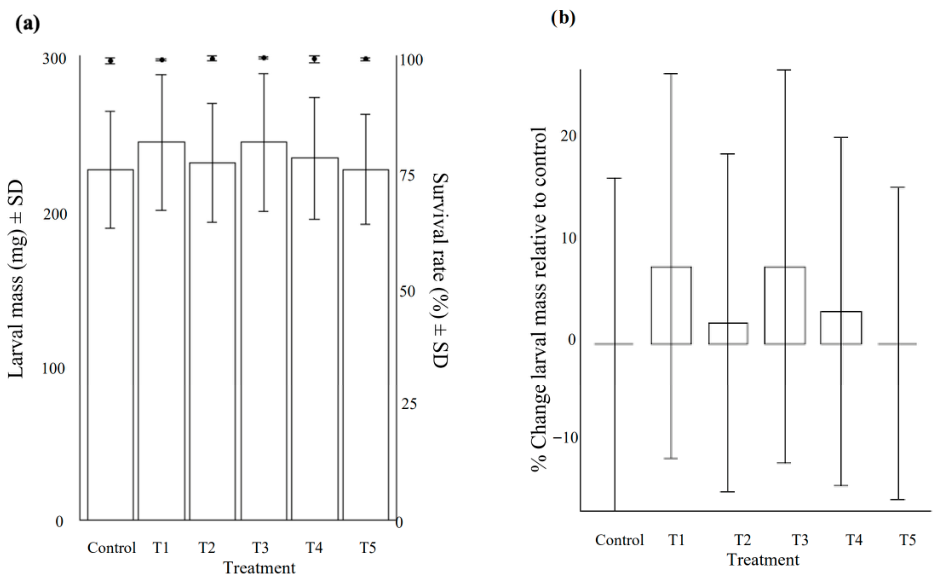
Figure 1. (a) Mean larval mass (bars) and percentage survival (dots) across different treatments. (b) Percentage change of mean larval mass relative to the control. Mean ± standard deviation of triplicate trials. Control = 100% chick crumb, T1 to T5 = 60% crumb with stepped ratios (100:0, 75:25, 50:50, 25:75, and 0:100) of algae to coffee comprising the remaining 40%. Larval mass data were normalised to the total percentage protein content of the diets.
Phycology 06 00054 g001
Figure 2. Metals content (mg kg−1) plotted on logarithmic scales in (a) chick crumb, (b) spent coffee grounds, and (c) algae feeds. Mean ± standard deviation of triplicate technical replicates. Note, 100 = 1 mg kg−1.
Phycology 06 00054 g002
Figure 3. Heatmap representing the bioaccumulation factor (BAF) of 17 metals in black soldier fly larvae across treatments. Squares represent mean ± standard deviation per treatment (n = 3). A BAF > 1 (pink to red) indicates higher content of the respective metal in larvae compared to initial feed, whereas BAF < 1 (green to white) indicates no bioaccumulation. Control = 100% chick crumb, T1 to T5 = 60% crumb with stepped ratios (100:0, 75:25, 50:50, 25:75, and 0:100) of algae to coffee comprising the remaining 40%.
Phycology 06 00054 g003
Figure 4. Distribution of log-transformed bioaccumulation factor (BAF) for all 17 metals combined by treatment (n = 3). Data were log-transformed to meet assumptions of normality for ANOVA testing. The boxplots span the interquartile range from the 25th to the 75th percentiles and the horizontal line inside represents the median. Whiskers extending above and below the boxplots indicate 10th and 90th percentiles, and individual points beyond these whiskers indicate outliers. Different letters above the boxplots indicate significant difference in log-transformed BAF among treatments at p < 0.05. Control = 100% chick crumb, T1 to T5 = 60% crumb with stepped ratios (100:0, 75:25, 50:50, 25:75, and 0:100) of algae to coffee comprising the remaining 40%.
Phycology 06 00054 g004
Figure 5. Principal component analysis based on 35 parameters (17 metals contents in feed and larval tissues (*), and Larval Mass). (a) 3D score plot of treatment (n = 3); (b,c) 2D loading biplots of the five strongest-loading metal parameters on PC1-PC2 and PC1-PC3 planes, with Larval Mass included for illustrative purposes. Control = 100% chick crumb, T1 to T5 = 60% crumb with stepped ratios (100:0, 75:25, 50:50, 25:75, and 0:100) of algae to coffee comprising the remaining 40%.
Phycology 06 00054 g005
Figure 6. Larval contents of (a) cadmium, (b) arsenic, and (c) lead ordered by increasing metal content in treatment (n = 3). Error bars represent standard deviation. Treatments sharing the same letter have no significant difference in larval metal content. Red dashed line indicates the maximum content of metal ions permitted in European Union feed materials [37]. Control = 100% chick crumb, T1 to T5 = 60% crumb with stepped ratios (100:0, 75:25, 50:50, 25:75, and 0:100) of algae to coffee comprising the remaining 40%.
Phycology 06 00054 g006
Figure 7. Bioaccumulation factor (BAF) of cadmium in black soldier fly larvae fed with cadmium-containing substrates in the present study red (x) and reported across various studies (x) [20,22,48,53,54,67,69,70,71].
Phycology 06 00054 g007
Table 1. Composition of the diets (dry weight for crumb and coffee, wet weight for algae) used to grow black soldier fly. A commercial chick crumb was used as the reference diet. Treatment diets contained a base of crumb (120 g, 60%) supplemented with stepped ratios (80 g in total) of algae and spent coffee grounds. Diets were normalised to percentage total protein based on 19% for crumb and coffee and 42.78% for algae. Larval growth data were normalised to total protein.
TreatmentDiet Composition (g)Diet Composition (%)Algae: Coffee GroundsTotal Protein Normalisation Factor
T1Crumb: 120
Algae: 80
Coffee: 0
Crumb: 60
Algae: 40
Coffee: 0
100:01
T2Crumb: 120
Algae: 60
Coffee: 20
Crumb: 60
Algae: 30
Coffee: 10
75:250.972
T3Crumb: 120
Algae: 40
Coffee: 40
Crumb: 60
Algae: 20
Coffee: 20
50:500.979
T4Crumb: 120
Algae: 20
Coffee: 60
Crumb: 60
Algae: 10
Coffee: 40
25:750.986
T5Crumb: 120
Algae: 0
Coffee: 80
Crumb: 60
Algae: 0
Coffee: 40
0:1000.993
ControlCrumb: 200
Algae: 0
Coffee: 0
Crumb: 100
Algae: 0
Coffee: 0
N/A1
Disclaimer/Publisher’s Note: The statements, opinions and data contained in all publications are solely those of the individual author(s) and contributor(s) and not of MDPI and/or the editor(s). MDPI and/or the editor(s) disclaim responsibility for any injury to people or property resulting from any ideas, methods, instructions or products referred to in the content.