Cyanobacteria from the Arabian Peninsula: A Comprehensive Review of Bioactive Compounds, Therapeutic Potential, and Biotechnological Applications

Abstract
1. Introduction
2. Species and Bioactive Compounds
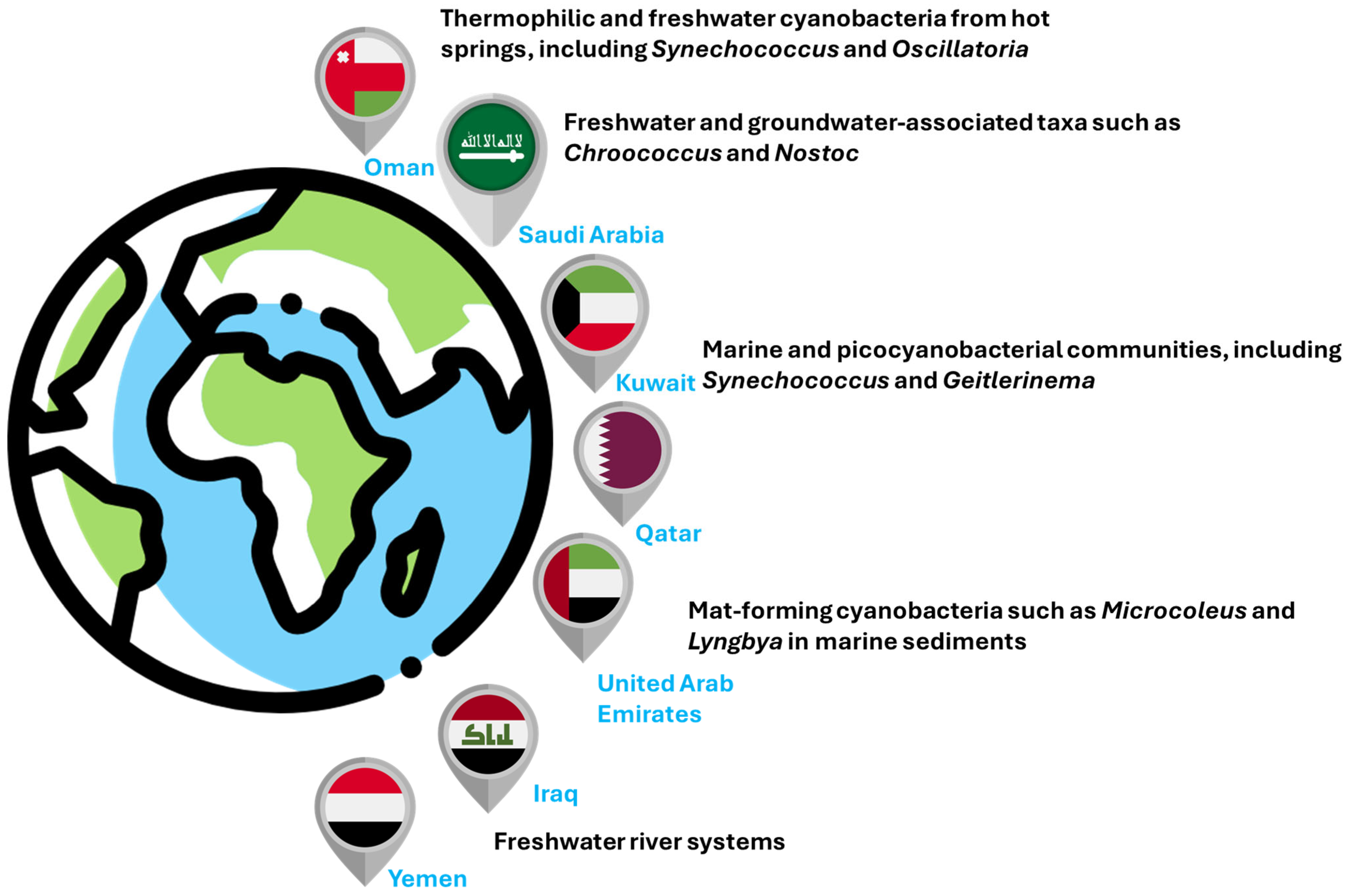
2.1. Species Found in Arabian Peninsula
2.2. Bioactive Compounds and Secondary Metabolites
2.3. Therapeutic Potential
2.3.1. Anti-Microbial Activity
2.3.2. Anti-Inflammatory Activity
2.3.3. Antioxidant Activity
2.3.4. Neuroprotective Activity
2.3.5. Immunomodulatory and Metabolic Effects
3. Applications
3.1. Cyanobacteria as Biohydrogen Source
| Species of Cyanobacteria | Pretreatment Condition | Maximum Hydrogen Yield | Reference |
|---|---|---|---|
| Oscillatoria acuminata | Biological pretreatment + Mg-Zn Fe2O4 NPs using coculture dark fermentation | 166.98 μmol H2 mg−1 Chl a h−1 | [77] |
| Anabaena variabilis | Dark fermentation | 8.67 μmol H2 mg−1 Chl a h−1 | [76] |
| Synechococcus elongatus | Dark fermentation of suspensions of nitrogen-depleted PAMCOD cells | 6.554 μmol H2 mg Chl a−1 h−1 | [78] |
| Synechococcus elongatus | Dark anaerobic fermentation | 0.00076 μmol H2 mg−1 Chl a h−1 | [79] |
| Synechococcus elongatus | Dark anaerobic fermentation | 0.002 μmol H2 mg−1 Chl a h−1 | |
| Phormidium keutzingianum | Co-culture with activated sludge bacteria and sorbitol as carbon substrates | 980 mL H2/L | [80] |
| Anabaena | Amylase followed by thermophilic fermentation for 24 h | 1600 mL L−1 | [81] |
| Nostoc linckia | 25 days by maintaining required anoxic conditions and carbohydrate supplement | 132 μmol H2 mg−1 Chl a h−1 | [82] |
3.2. Cyanobacteria for Bioremediation
| Species | Type of Pollution | Removal Efficiency (%) | References |
|---|---|---|---|
| Oscillatoria | Crude oil contamination in water systems | 83.5 | [85] |
| Synechococcus elongatus | Nutrient (NH4+, NO3−, and PO43−) for bioremediation of mixed wastewater (combination of sturgeon and swine wastewater) | 67.15 for orthophosphate, 93.39 for nitrate–nitrite, and 97.98 for ammonia | [87] |
| Synechococcus elongatus | Malachite green in fish tissues and freshwater | 99.5 | [92] |
| Anabaena aequalis | Industrial effluents (heavy metal) | BOD and COD recorded 91.18 and 82.54% | [93] |
| Phormidium mucicola | Industrial Effluents (suspended solids) | 53.23 | [93] |
| Microcystis aeruginosa | Heavy metals | 92 | [94] |
| Synechocystis sp. | Heavy metals | 86 | [95] |
| Synechocystis sp. | Heavy metals | 90 | [96] |
| N. muscorum | Heavy metals | 80.04 | [97] |
| S. platensis | Heavy metals | 87.69 | [98] |
| S. platensis | Heavy metals | 100 | [99] |
| S. platensis | Heavy metals | 37 | [100] |
| Synechocystis sp. PCC 7806 | Heavy metals | 75.4 | [101] |
| N. muscorum, Synechocystis sp. | Heavy metals | 96.3, 77% | [97,102] |
| M. aeruginosa | Heavy metals | 86 | [94] |
3.3. Cyanobacteria as Biofertilizers
3.4. Cyanobacteria as Bioplastic Source
| Cyanobacterial Strains | PHB Content (% DCW) | Substrate and Culture Conditions | PHA Composition | References |
|---|---|---|---|---|
| Nostoc muscorum Agardh | 60 | Acetate and valerate, N deficiency | PHB | [126] |
| Nostoc muscorum | 22 | CO2, P starvation | PHB | [127] |
| Synechococcus elongates | 17.2 | CO2, sucrose, N deficiency | Not specified | [128] |
| Synechococcus sp. | 1 | CO2 | PHB | [129] |
| Synechococcus sp. | ~4.5 | Light, CO2 (photoautotrophy) | P (3HB-co-4HV) | [130] |
| Microcystis aeruginosa | 0.0721 | Urea, 24 h light | PHB | [131] |
| Oscillatoria agardhii | 0.0006 | NaNO3, 24 h light | PHB | [132] |
| Spirulina | 7 | NaNO3, 24 h light | PHB | [132] |
| Spirulina | 3 | NaNO3, 24 h light | PHA | [132] |
| Anabaena constricta | 0.01495 | N deficiency, 24 h light | PHB | [132] |
| Microcystis aeruginosa | 0.04–0.05 | NaNO3, domestic wastewater | PHB | [132] |
| Anabaena sp. | 2.3 | NaNO3, photoautotrophic | PHB | [133] |
| Oscillatoria jasorvensis | 15.7 | Photoautotrophic, N deficiency | PHB | [133] |
| Spirulina platensis | 10.2 | NaNO3, photoautotrophic (open raceways) | PHB | [133] |
| Gleocapsa gelatinosa | 5.6 | NaNO3, photoautotrophic | PHB | [121] |
| Phormidium sp. | 14 | Photoautotrophic (in flask), N limitation | PHB | [134] |
3.5. Ecological Applications of Cyanobacteria
4. Research Gaps and Future Directions
5. Conclusions
Author Contributions
Funding
Institutional Review Board Statement
Informed Consent Statement
Data Availability Statement
Acknowledgments
Conflicts of Interest
References
- Bozieva, A.M.; Khasimov, M.K.; Voloshin, R.A.; Sinetova, M.A.; Kupriyanova, E.V.; Zharmukhamedov, S.K.; Dunikov, D.O.; Tsygankov, A.A.; Tomo, T.; Allakhverdiev, S.I. New cyanobacterial strains for biohydrogen production. Int. J. Hydrogen Energy 2023, 48, 7569–7581. [Google Scholar] [CrossRef]
- Bhuyan, P.P.; Nayak, R.; Jena, M.; Pradhan, B. Convoluted role of cyanobacteria as biofertilizer: An insight of sustainable agriculture. Vegetos 2022, 36, 309–321. [Google Scholar] [CrossRef]
- Fuertes, P.O.; Verma, D.K. Marine Molecules from Algae and Cyanobacteria: Extraction, Purification, Toxicology and Applications; Elsevier: Amsterdam, The Netherlands, 2024; 356p. [Google Scholar]
- Schipper, K.; Al-Jabri, H.M.S.J.; Wijffels, R.H.; Barbosa, M.J. Techno-economics of algae production in the Arabian Peninsula. Bioresour. Technol. 2021, 331, 125043. [Google Scholar] [CrossRef]
- Al-Khelaifi, F.; Yilmaz, M.; Saadaoui, I.; Ben-Hamadou, R. Phylogenetic diversity of cyanobacteria from Qatar coastal waters. QScience Proc. 2015, 2015, 28. [Google Scholar] [CrossRef]
- Widana Gamage, S.M.K. The 16S rRNA gene and cyanobacterial taxonomy; current problems and future prospects. J. Univ. Ruhuna 2020, 8, 60–66. [Google Scholar] [CrossRef]
- Hassan, F.M.; Mahdi, W.M.; Al-Haideri, H.H.; Kamil, D.W. Identification of new species record of Cyanophyceae in Diyala River, Iraq based on 16S rRNA sequence data. Biodiversitas J. Biol. Divers. 2022, 23, 10. [Google Scholar] [CrossRef]
- Abed, R.M.; Kohls, K.; Schoon, R.; Scherf, A.K.; Schacht, M.; Palinska, K.A.; Hamza, W.; Rullkötter, J.; Golubic, S. Lipid biomarkers, pigments and cyanobacterial diversity of microbial mats across intertidal flats of the arid coast of the Arabian Peninsula (Abu Dhabi, UAE): Cyanobacterial mats from arid tidal environment. FEMS Microbiol. Ecol. 2008, 65, 449–462. [Google Scholar] [CrossRef]
- Oman Environment Authority. 6th National Report to the Convention on Biological Diversity (CBD). 2021. Available online: https://climate-laws.org/documents/oman-national-report-nr6-2021_0dd9 (accessed on 1 March 2026).
- Favas, R.; Morone, J.; Martins, R.; Vasconcelos, V.; Lopes, G. Cyanobacteria Secondary Metabolites as Biotechnological Ingredients in Natural Anti-Aging Cosmetics: Potential to Overcome Hyperpigmentation. Loss of Skin Density and UV Radiation-Deleterious Effects. Mar. Drugs 2022, 20, 183. [Google Scholar] [CrossRef]
- Abed, R.M.M.; Dobretsov, S.; Sudesh, K. Applications of cyanobacteria in biotechnology. J. Appl. Microbiol. 2009, 106, 1–12. [Google Scholar] [CrossRef]
- Habib, M.A.B.; Parvin, M.; Huntington, T.C.; Hasan, M.R. A Review on Culture, Production and Use of Spirulina as Food for Humans and Feeds for Domestic Animals and Fish; FAO Fisheries and Aquaculture Circular No. 1034; Food and Agriculture Organization of the United Nations: Rome, Italy, 2008; p. 33. [Google Scholar]
- Nisha, R.; Kaushik, A.; Kaushik, C.P. Effect of indigenous cyanobacterial application on structural stability and productivity of an organically poor semi-arid soil. Geoderma 2007, 138, 49–56. [Google Scholar] [CrossRef]
- Muñoz, R.; Guieysse, B. Algal–bacterial processes for the treatment of hazardous contaminants: A review. Water Res. 2006, 40, 2799–2815. [Google Scholar] [CrossRef]
- Kamravamanesh, D.; Pflügl, S.; Nischkauer, W.; Limbeck, A.; Lackner, M.; Herwig, C. Photosynthetic poly-β-hydroxybutyrate accumulation in Synechocystis sp. PCC 6803 under nitrogen starvation: Insights into the regulatory network. Bioresour. Technol. 2017, 244, 1406–1414. [Google Scholar] [CrossRef]
- Davis, R.; Aden, A.; Pienkos, P.T. Techno-economic analysis of autotrophic microalgae for fuel production. Appl. Energy 2011, 88, 3524–3531. [Google Scholar] [CrossRef]
- Sherwani1, N.; Abed, R.M.M.; Dobretsov, S.; Mary, S. Antibacterial and Antifungal Activities of Cyanobacterial Strains Isolated from Hot Springs in Oman. Sultan Qaboos Univ. J. Sci. [SQUJS] 2015, 20, 11. [Google Scholar] [CrossRef]
- Mohamed, Z.; Al-Shehri, A. Cyanobacteria of Surface and Ground Waters in Asir Region with New Records to Kingdom of Saudi Arabia. J. King Abdulaziz Univ.-Sci. 2008, 20, 113–129. [Google Scholar] [CrossRef]
- Mohamed, Z.A.; Al Shehri, A.M. Microcystin-producing blooms of Anabaenopsis arnoldi in a potable mountain lake in Saudi Arabia: Toxic Anabaenopsis blooms in Saudi freshwaters. FEMS Microbiol. Ecol. 2009, 69, 98–105. [Google Scholar] [CrossRef]
- Ismail, N.; Almutairi, A. Bacterioplankton Community Profiling of the Surface Waters of Kuwait. Front. Mar. Sci. 2022, 9, 838101. [Google Scholar] [CrossRef]
- Golubic, S.; Abed, R.M.M. Entophysalis Mats as Environmental Regulators’. In Microbial Mats; Seckbach, J., Oren, A., Eds.; Cellular Origin, Life in Extreme Habitats and Astrobiology; Springer: Dordrecht, The Netherlands, 2010; pp. 237–251. [Google Scholar] [CrossRef]
- Saeed, S.S.; Ali, K.S. Study of cyanobacteria in Yemeni freshwater: Wadi Tuban/Lahj. Aden Univ. J. Nat. Appl. Sci. 2006, 10. Available online: https://www.researchgate.net/publication/263697800_Study_of_Cyanobacteria_in_YemeniFresh-Water_1_Tuban_Valley_Lahej_Governorate (accessed on 1 March 2026). (In Arabic)
- Hatem, M.T.; Al-Sultan, E.Y.A. Morphological and Molecular Identification of Four Blue-Green Algae Isolated from Some Water Bodies in Basrah Governorate. Southern Iraq. J. Aquat. Biol. Fish. 2023, 27, 661–675. [Google Scholar] [CrossRef]
- Albueajee, R.H.; Al-Saboonchi, A.A.; Al-Shawi, I.J.M. Phytoplankton species composition and biodiversity indices in Auda Marsh, Southern Iraq. Iraqi J. Agric. Sci. 2020, 51, 1122–1133. [Google Scholar] [CrossRef]
- Gummaa, N.R.; Dwaish, A.S.; Hamzah, I.H. Molecular detection of some toxogenic cyanobacteria in Tigris River in Baghdad–Iraq. Mol. Biol. Rep. 2021, 48, 5393–5397. [Google Scholar] [CrossRef]
- Hmoshi, R.M.; Mohammed, M.I. Cyanobacteria diversity in various waterbodies of Mosul, Iraq. Int. J. Aquat. Biol. 2022, 10, 537–542. [Google Scholar] [CrossRef]
- Jawad, L.A. (Ed.) Tigris and Euphrates Rivers: Their Environment from Headwaters to Mouth; Springer Nature: Cham, Switzerland, 2021. [Google Scholar] [CrossRef]
- Grindberg, R.V.; Coates, R.C.; Engene, N.; Jones, A.C.; Sorrels, C.M.; Gerwick, W.H.; Gerwick, L. Giant Marine Cyanobacteria Produce Exciting Potential Pharmaceuticals. Microbe Mag. 2008, 3, 277–284. [Google Scholar] [CrossRef]
- Burja, A.M.; Banaigs, B.; Abou-Mansour, E.; Grant Burgess, J.; Wright, P.C. Marine cyanobacteria—A prolific source of natural products. Tetrahedron 2001, 57, 9347–9377. [Google Scholar] [CrossRef]
- Hidhayati, N.; Agustini, N.W.S.; Widyagustina, D. Antimicrobial activity of ethanol fraction from cyanobacteria Chroococcus turgidus. IOP Conf. Ser. Earth Environ. Sci. 2020, 439, 012046. [Google Scholar] [CrossRef]
- Bortolini, D.G.; Maciel, G.M.; Fernandes, I.D.A.A.; Pedro, A.C.; Rubio, F.T.V.; Branco, I.G.; Haminiuk, C.W.I. Functional properties of bioactive compounds from Spirulina spp.: Current status and future trends. Food Chem. Mol. Sci. 2022, 5, 100134. [Google Scholar] [CrossRef]
- Ngatu, N.R.; Okajima, M.K.; Yokogawa, M.; Hirota, R.; Eitoku, M.; Muzembo, B.A.; Dumavibhat, N.; Takaishi, M.; Sano, S.; Kaneko, T.; et al. Anti-inflammatory effects of sacran. a novel polysaccharide from Aphanothece sacrum, on 2,4,6-trinitrochlorobenzene–induced allergic dermatitis in vivo. Ann. Allergy Asthma Immunol. 2012, 108, 117–122.e2. [Google Scholar] [CrossRef] [PubMed]
- Fuentes-Tristan, S.; Parra-Saldivar, R.; Iqbal, H.M.N.; Carrillo-Nieves, D. Bioinspired biomolecules: Mycosporine-like amino acids and scytonemin from Lyngbya sp. with UV-protection potentialities. J. Photochem. Photobiol. B Biol. 2019, 201, 111684. [Google Scholar] [CrossRef] [PubMed]
- Li, Z.; Guo, M. Healthy efficacy of Nostoc commune Vaucher. Oncotarget 2018, 9, 14669–14679. [Google Scholar] [CrossRef]
- Fidor, A.; Konkel, R.; Mazur-Marzec, H. Bioactive Peptides Produced by Cyanobacteria of the Genus Nostoc: A Review. Mar. Drugs 2019, 17, 561. [Google Scholar] [CrossRef] [PubMed]
- Souza, N.R.; Metcalf, J.S. Cyanobacterial toxins and their effects on human and animal health. In Handbook of Algal Science, Technology and Medicine; Elsevier: Amsterdam, The Netherlands, 2020; pp. 561–574. [Google Scholar] [CrossRef]
- Scoglio, G.D.; Jackson, H.O.; Purton, S. The commercial potential of Aphanizomenon flos-aquae. a nitrogen-fixing edible cyanobacterium. J. Appl. Phycol. 2024, 36, 1593–1617. [Google Scholar] [CrossRef]
- Reshef, V.; Mizrachi, E.; Maretzki, T.; Silberstein, C.; Loya, S.; Hizi, A.; Carmeli, S. New Acylated Sulfoglycolipids and Digalactolipids and Related Known Glycolipids from Cyanobacteria with a Potential To Inhibit the Reverse Transcriptase of HIV-1. J. Nat. Prod. 1997, 60, 1251–1260. [Google Scholar] [CrossRef]
- Bhuyar, P.; Rahim, M.H.A.; Maniam, G.P.; Ramaraj, R.; Govindan, N. Exploration of bioactive compounds and antibacterial activity of marine blue-green microalgae (Oscillatoria sp.) isolated from coastal region of west Malaysia. SN Appl. Sci. 2020, 2, 1906. [Google Scholar] [CrossRef]
- Nandagopal, P.; Steven, A.N.; Chan, L.-W.; Rahmat, Z.; Jamaluddin, H.; Mohd Noh, N.I. Bioactive Metabolites Produced by Cyanobacteria for Growth Adaptation and Their Pharmacological Properties. Biology 2021, 10, 1061. [Google Scholar] [CrossRef] [PubMed]
- Spínola, M.P.; Mendes, A.R.; Prates, J.A.M. Chemical Composition. Bioactivities, and Applications of Spirulina (Limnospira platensis) in Food, Feed, and Medicine. Foods 2024, 13, 3656. [Google Scholar] [CrossRef] [PubMed]
- Thangsiri, S.; Inthachat, W.; Temviriyanukul, P.; Sahasakul, Y.; Trisonthi, P.; Pan-utai, W.; Siriwan, D.; Suttisansanee, U. Bioactive compounds and in vitro biological properties of Arthrospira platensis and Athrospira maxima: A comparative study. Sci. Rep. 2024, 14, 23786. [Google Scholar] [CrossRef]
- Bendich, A.; Olson, J.A. Biological actions of carotenoids. FASEB J. Off. Publ. Fed. Am. Soc. Exp. Biol. 1989, 3, 1927–1932. [Google Scholar]
- Renugadevi, K.; Valli Nachiyar, C.; Sowmiya, P.; Sunkar, S. Antioxidant activity of phycocyanin pigment extracted from marine filamentous cyanobacteria Geitlerinema sp TRV57. Biocatal. Agric. Biotechnol. 2018, 16, 237–242. [Google Scholar] [CrossRef]
- Ruiz-Domínguez, M.C.; Fuentes, J.L.; Mendiola, J.A.; Cerezal-Mezquita, P.; Morales, J.; Vílchez, C.; Ibáñez, E. Bioprospecting of cyanobacterium in Chilean coastal desert, Geitlerinema sp. molecular identification and pressurized liquid extraction of bioactive compounds. Food Bioprod. Process. 2021, 128, 227–239. [Google Scholar] [CrossRef]
- Demay, J.; Bernard, C.; Reinhardt, A.; Marie, B. Natural Products from Cyanobacteria: Focus on Beneficial Activities. Marine Drugs 2019, 17, 320. [Google Scholar] [CrossRef]
- Sinzinger, K.; Bieringer, S.; Schieder, D.; Riepl, H.; Sieber, V. Biorefinery concept for Cylindrospermum alatosporum CCALA 988 extracting multiple high-value compounds and residue utilization by P. pastoris fermentation producing phytase. Algal Res. 2023, 76, 103302. [Google Scholar] [CrossRef]
- Fais, G.; Casula, M.; Sidorowicz, A.; Manca, A.; Margarita, V.; Fiori, P.L.; Pantaleo, A.; Caboni, P.; Cao, G.; Concas, A. Cultivation of Chroococcidiopsis thermalis Using Available In Situ Resources to Sustain Life on Mars. Life 2024, 14, 251. [Google Scholar] [CrossRef]
- McCarthy, B.; O’Neill, G.; Abu-Ghannam, N. Potential Psychoactive Effects of Microalgal Bioactive Compounds for the Case of Sleep and Mood Regulation: Opportunities and Challenges. Mar. Drugs 2022, 20, 493. [Google Scholar] [CrossRef]
- Lopes, V.R.; Vasconcelos, V.M. Bioactivity of Benthic and Picoplanktonic Estuarine Cyanobacteria on Growth of Photoautotrophs: Inhibition versus Stimulation. Mar. Drugs 2011, 9, 790–802. [Google Scholar] [CrossRef] [PubMed]
- Grubišić, M.; Šantek, B.; Zorić, Z.; Čošić, Z.; Vrana, I.; Gašparović, B.; Čož-Rakovac, R.; Ivančić Šantek, M. Bioprospecting of Microalgae Isolated from the Adriatic Sea: Characterization of Biomass, Pigment, Lipid and Fatty Acid Composition, and Antioxidant and Antimicrobial Activity. Molecules 2022, 27, 1248. [Google Scholar] [CrossRef]
- Hamouda, R.A.; Hussein, M.H.; Abo-elmagd, R.A.; Bawazir, S.S. Synthesis and biological characterization of silver nanoparticles derived from the cyanobacterium Oscillatoria limnetica. Sci. Rep. 2019, 9, 13071. [Google Scholar] [CrossRef]
- Perera, R.M.T.D.; Herath, K.H.I.N.M.; Sanjeewa, K.K.A.; Jayawardena, T.U. Recent Reports on Bioactive Compounds from Marine Cyanobacteria in Relation to Human Health Applications. Life 2023, 13, 1411. [Google Scholar] [CrossRef] [PubMed]
- Hamouda, R.A.; Al-Saman, M.A.; El-Sabbagh, S.M.; Abo El-Seoud, G.W.; Hendawy, A.N. Approach to improve the productivity of bioactive compounds of the cyanobacterium Anabaena oryzae using factorial design. Egypt. J. Basic Appl. Sci. 2017, 4, 190–195. [Google Scholar] [CrossRef]
- Gongi, W.; Gomez Pinchetti, J.L.; Cordeiro, N.; Ouada, H.B. Extracellular Polymeric Substances Produced by the Thermophilic Cyanobacterium Gloeocapsa gelatinosa: Characterization and Assessment of Their Antioxidant and Metal-Chelating Activities. Mar. Drugs 2022, 20, 227. [Google Scholar] [CrossRef]
- Phinyo, K.; Ruangrit, K.; Pekkoh, J.; Tragoolpua, Y.; Kaewkod, T.; Duangjan, K.; Pumas, C.; Suwannarach, N.; Kumla, J.; Pathom-Aree, W.; et al. Naturally Occurring Functional Ingredient from Filamentous Thermophilic Cyanobacterium Leptolyngbya sp. KC45: Phytochemical Characterizations and Their Multiple Bioactivities. Antioxidants 2022, 11, 2437. [Google Scholar] [CrossRef]
- Khan, Z.; Wan Maznah, W.O.; Faradina Merican, M.S.M.; Convey, P.; Najimudin, N.; Alias, S.A. A comparative study of phycobilliprotein production in two strains of Pseudanabaena isolated from Arctic and tropical regions in relation to different light wavelengths and photoperiods. Polar Sci. 2019, 20, 3–8. [Google Scholar] [CrossRef]
- Oufdou, K.; Mezrioui, N.; Oudra, B.; Loudiki, M.; Barakate, M.; Sbiyyâa, B. Bioactive compounds from Pseudanabaena species (Cyanobacteria). Microbios 2001, 106, 21–29. [Google Scholar]
- Pagliara, P.; De Benedetto, G.E.; Francavilla, M.; Barca, A.; Caroppo, C. Bioactive Potential of Two Marine Picocyanobacteria Belonging to Cyanobium and Synechococcus Genera. Microorganisms 2021, 9, 2048. [Google Scholar] [CrossRef]
- Sultan, Y.Y.; Ali, M.A.; Darwesh, O.M.; Embaby, M.A.; Marrez, D.A. Influence of nitrogen source in culture media on antimicrobial activity of Microcoleus lacustris and Oscillatoria rubescens. Res. J. Pharm. Biol. Chem. Sci. 2016, 7, 1444. [Google Scholar]
- Patipong, T.; Hibino, T.; Waditee-Sirisattha, R.; Kageyama, H. Induction of antioxidative activity and antioxidant molecules in the halotolerant cyanobacterium Halothece sp. PCC7418 by temperature shift. Nat. Prod. Commun. 2019, 14, 1934578X19865680. [Google Scholar] [CrossRef]
- Pergament, I.; Carmeli, S. Schizotrin A; a novel antimicrobial cyclic peptide from a cyanobacterium. Tetrahedron Lett. 1994, 35, 8473–8476. [Google Scholar] [CrossRef]
- Lin, J.Y.; Ng, I.S. Production, isolation and characterization of C-phycocyanin from a new halo-tolerant Cyanobacterium aponinum using seawater. Bioresour. Technol. 2021, 342, 125946. [Google Scholar]
- Costa, J.A.V.; Freitas, B.C.B.; Moraes, L.; Zaparoli, M.; Morais, M.G. Progress in the pharmaceutical applications of microalgae: From cultivation to clinical translation. Biotechnol. Adv. 2021, 46, 107678. [Google Scholar] [CrossRef]
- Petri, D.; Galey, C.; Taran, F. Microcystins: Toxicological profile and human health effects. Toxicon 2018, 151, 156–165. [Google Scholar] [CrossRef]
- Testai, E.; Buratti, F.M.; Funari, E.; Manganelli, M.; Vichi, S.; Arnich, N.; Biré, R.; Fessard, V.; Sialehaamoa, A. Review and analysis of occurrence, exposure and toxicity of cyanobacteria toxins in food. EFSA Support. Publ. 2016, 13, 998E. [Google Scholar] [CrossRef]
- Karkos, P.D.; Leong, S.C.; Karkos, C.D.; Sivaji, N.; Assimakopoulos, D.A. Spirulina in clinical practice: Evidence-based human applications. Evid. Based Complement. Altern. Med. 2011, 2011, 531053. [Google Scholar] [CrossRef]
- Grönberg, A.M.; Häder, D.P. Immunomodulation by microalgae and cyanobacteria: Potential risks in autoimmune diseases. Mar. Drugs 2021, 19, 422. [Google Scholar] [CrossRef]
- Tang, H.; Huang, J.; Yuan, Q.; Lv, K.; Ma, H.; Li, T.; Liu, Y.; Mi, S.; Zhao, L. A regular Chlorella mannogalactan and its sulfated derivative as a promising anticoagulant: Structural characterization and anticoagulant activity. Carbohydr. Polym. 2023, 314, 120956. [Google Scholar] [CrossRef]
- European Medicines Agency (EMA). Reflection Paper on Microalgae-Based Medicinal Products; EMA/HMPC/98721/2019; EMA: London, UK, 2020. Available online: https://www.ema.europa.eu (accessed on 10 May 2026).
- Zuorro, A.; Lavecchia, R.; Contreras-Ropero, J.E.; Martínez, J.B.G.; Barajas-Ferreira, C.; Barajas-Solano, A.F. Natural Antimicrobial Agents from Algae: Current Advances and Future Directions. Int. J. Mol. Sci. 2024, 25, 11826. [Google Scholar] [CrossRef]
- Puluhulawa, L.E.; Joni, I.M.; Mohammed, A.F.A.; Arima, H.; Wathoni, N. The Use of Megamolecular Polysaccharide Sacran in Food and Biomedical Applications. Molecules 2021, 26, 3362. [Google Scholar] [CrossRef]
- Rodrigues, F.; Reis, M.; Ferreira, L.; Grosso, C.; Ferraz, R.; Vieira, M.; Vasconcelos, V.; Martins, R. The Neuroprotective Role of Cyanobacteria with Focus on the Anti-Inflammatory and Antioxidant Potential: Current Status and Perspectives. Molecules 2024, 29, 4799. [Google Scholar] [CrossRef]
- Sukhikh, S.; Popov, V.; Kashinskikh, E.; Budenkova, E.; Ivanova, S.; Babich, O. Immunomodulatory properties of polysaccharide extract samples from Cyanobacterium sp. Rippka B-1200. Sci. Rep. 2024, 14, 30365. [Google Scholar] [CrossRef]
- Sadvakasova, A.K.; Kossalbayev, B.D.; Zayadan, B.K.; Bolatkhan, K.; Alwasel, S.; Najafpour, M.M.; Tomo, T.; Allakhverdiev, S.I. Bioprocesses of hydrogen production by cyanobacteria cells and possible ways to increase their productivity. Renew. Sustain. Energy Rev. 2020, 133, 110054. [Google Scholar] [CrossRef]
- Kossalbayev, B.D.; Tomo, T.; Zayadan, B.K.; Sadvakasova, A.K.; Bolatkhan, K.; Alwasel, S.; Allakhverdiev, S.I. Determination of the potential of cyanobacterial strains for hydrogen production. Int. J. Hydrogen Energy 2020, 45, 2627–2639. [Google Scholar] [CrossRef]
- El-Sheekh, M.M.; Hamouda, R.A.; Nizam, A.A. Biodegradation of crude oil by Scenedesmus obliquus and Chlorella vulgaris growing under heterotrophic conditions. Int. Biodeterior. Biodegrad. 2013, 82, 67–72. [Google Scholar] [CrossRef]
- Broussos, P.I.; Romanos, G.E.; Stamatakis, K. Salt and heat stress enhances hydrogen production in cyanobacteria. Photosynth. Res. 2024, 161, 117–125. [Google Scholar] [CrossRef]
- Vayenos, D.; Romanos, G.E.; Papageorgiou, G.C.; Stamatakis, K. Synechococcus elongatus PCC7942: A cyanobacterium cell factory for producing useful chemicals and fuels under abiotic stress conditions. Photosynth. Res. 2020, 146, 235–245. [Google Scholar] [CrossRef]
- Mohammed Al Nuaimi, M.; Javed, M.A.; El-Tarabily, K.A.; Hyoung Lee, W.; Aly Hassan, A. Biohydrogen production of a halophytic cyanobacteria Phormidium keutzingium and activated sludge co-culture using different carbon substrates and saline concentrations. Energy Convers. Manag. X 2023, 20, 100487. [Google Scholar] [CrossRef]
- Nayak, B.K.; Roy, S.; Das, D. Biohydrogen production from algal biomass (Anabaena sp. PCC 7120) cultivated in airlift photobioreactor. Int. J. Hydrogen Energy 2014, 39, 7553–7560. [Google Scholar] [CrossRef]
- Mona, S.; Kaushik, A.; Kaushik, C.P. Prolonged hydrogen production by Nostoc in photobioreactor and multi-stage use of the biological waste for column biosorption of some dyes and metals. Biomass Bioenergy 2013, 54, 27–35. [Google Scholar] [CrossRef]
- Nejidat, A.; Meshulam, M.; Diaz-Reck, D.; Ronen, Z. Emergence of hydrocarbon-degrading bacteria in crude oil-contaminated soil in a hyperacid ecosystem: Effect of phosphate addition and augmentation with nitrogen-fixing cyanobacteria on oil bioremediation. Int. Biodeterior. Biodegrad. 2023, 178, 105556. [Google Scholar] [CrossRef]
- Gupta, R.K.; Chaudhary, K.K.; Kumar, M.; Negi, A.; Rai, H. Bioremediation and cyanobacteria: An overview. BioNano Front. 2012, 9, 190–196. [Google Scholar] [CrossRef]
- Ugboma, C.J.; Sampson, T.; Tamunoiboroma, J.E. Bioremediation potentials of Halotolerant Oscillatoria sp. in the remediation of crude oil polluted water. J. Adv. Microbiol. Res. 2023, 4, 45–52. [Google Scholar]
- Narindri Rara Winayu, B.; Chuang, H.-P.; Hsueh, H.-T.; Chu, H. Elimination of inorganic carbon and nitrogen resided in swine wastewater using Thermosynechococcus sp. CL-1 enriched culture. Bioresour. Technol. 2021, 336, 125325. [Google Scholar] [CrossRef]
- Hasan, R.; Kasera, N.; Beck, A.E.; Hall, S.G. Potential of Synechococcus elongatus UTEX 2973 as a feedstock for sugar production during mixed aquaculture and swine wastewater bioremediation. Heliyon 2024, 10, e24646. [Google Scholar] [CrossRef]
- De Souza, P.O.; Sinhor, V.; Crizel, M.G.; Pires, N.; Sanches Filho, P.J.; Picoloto, R.S.; Duarte, F.A.; Pereira, C.M.P.; Mesko, M.F. Bioremediation of chromium and lead in wastewater from chemistry laboratories promotes by cyanobacteria. Bioresour. Technol. Rep. 2022, 19, 101161. [Google Scholar] [CrossRef]
- Idi, A.; Md Nor, M.H.; Abdul Wahab, M.F.; Ibrahim, Z. Photosynthetic bacteria: An eco-friendly and cheap tool for bioremediation. Rev. Environ. Sci. Bio/Technol. 2015, 14, 271–285. [Google Scholar] [CrossRef]
- Raungsomboon, S.; Chidthaisong, A.; Bunnag, B.; Inthorn, D.; Harvey, N.W. Removal of lead (Pb2+) by the Cyanobacterium Gloeocapsa sp. Bioresour. Technol. 2008, 99, 5650–5658. [Google Scholar] [CrossRef]
- Lourembam, J.; Haobam, B.; Singh, K.B.; Verma, S.; Rajan, J.P. The molecular insights of cyanobacterial bioremediations of heavy metals: The current and the future challenges. Front. Microbiol. 2024, 15, 1450992. [Google Scholar] [CrossRef]
- Han, S.; Han, W.; Chen, J.; Sun, Y.; Dai, M.; Zhao, G. Bioremediation of malachite green by cyanobacterium Synechococcus elongatus PCC 7942 engineered with a triphenylmethane reductase gene. Appl. Microbiol. Biotechnol. 2020, 104, 3193–3204. [Google Scholar] [CrossRef]
- Dubey, S.K.; Vyas, P.; Tiwari, P.; Viswas, A.J.; Bajpai, S.P. Bioremediation of Industrial Effluent using Cyanobacterial Species: Phormidium mucicola and Anabaena aequalis. Annu. Res. Rev. Biol. 2019, 31, 1–8. [Google Scholar] [CrossRef]
- Cheraghpour, M.; Etemadifar, Z.; Abbasi, A. Assessment of bioremediation potential of Microcystis aeruginosa for removal of cadmium and lead ions from aqueous matrices. Iran. J. Fish. Sci. 2020, 19, 1994–2009. [Google Scholar] [CrossRef]
- Shen, J.; Zhu, Y.; Pan, X.; Al-Misned, F.A. Extracellular polymeric substances (EPS) alter cell surface properties, toxicity and accumulation of arsenic in Synechocystis PCC6803. Environ. Pollut. 2018, 240, 864–870. [Google Scholar] [CrossRef]
- Ozturk, S.; Aslim, B.; Suludere, Z. Evaluation of chromium(VI) removal behaviour by two isolates of Synechocystis sp. in terms of exopolysaccharide (EPS) production and monomer composition. Bioresour. Technol. 2009, 100, 5588–5593. [Google Scholar] [CrossRef]
- Roy, A.S.; Hazarika, J.; Manikandan, N.A.; Pakshirajan, K.; Syiem, M.B. Heavy metal removal from multicomponent system by the cyanobacterium Nostoc muscorum: Kinetics and interaction study. Appl. Biochem. Biotechnol. 2015, 175, 3863–3874. [Google Scholar] [CrossRef]
- Al-Homaidan, A.A.; Alabdullatif, J.A.; Al-Hazzani, A.A.; Al-Ghanayem, A.A.; Alabbad, A.F. Adsorptive removal of cadmium ions by Spirulina platensis dry biomass. Saudi J. Biol. Sci. 2015, 22, 795–800. [Google Scholar] [CrossRef]
- Zinicovscaia, I.; Cepoi, L.; Chiriac, T.; Culicov, O.A.; Frontasyeva, M.; Pavlov, S.; Kirkesali, E.; Akshintsev, A.; Rodlovskaya, E. Spirulina platensis as biosorbent of chromium and nickel from industrial effluents. Desalin. Water Treat. 2015, 56, 2944–2952. [Google Scholar] [CrossRef]
- Cepoi, L.; Zinicovscaia, I.; Rudi, L.; Chiriac, T.; Miscu, V.; Djur, S.; Strelkova, L.; Vergel, K.; Nekhoroshkov, P. Growth and heavy metals accumulation by Spirulina platensis biomass from multicomponent copper containing synthetic effluents during repeated cultivation cycles. Ecol. Eng. 2020, 142, 105637. [Google Scholar] [CrossRef]
- Li, J.; Li, W.; Yan, J.; Wang, H.; Yan, H. Investigating trivalent chromium biosorption-driven variation of extracellular polymeric substances in Synechocystis sp. PCC 7806. Environ. Technol. Innov. 2019, 16, 100465. [Google Scholar]
- Hossain, M.S.; Okino, T. Cyanoremediation of heavy metals (As(V), Cd(II), Cr(VI), Pb(II)) by live cyanobacteria (Anabaena variabilis and Synechocystis sp.): An eco-sustainable technology. RSC Adv. 2024, 14, 10452–10463. [Google Scholar] [CrossRef]
- Rakibuzzaman, M.; Mahato, A.K.; Husna, M.A.; Maliha, M.; Jamal Uddin, A.F.M. Influence of natural hormone and neem oil on growth and yield of brinjal (Solanum melongena). J. Biosci. Agric. Res. 2019, 20, 1694–1699. [Google Scholar] [CrossRef]
- Sun, Z.; Liu, X.; Ugya, A.Y.; Liu, H.; Sun, L.; Luo, G. Microalgae and cyanobacteria as a tool for agricultural sustainability: A review of biofertilizer and biostimulant potential. Front. Plant Sci. 2026, 16, 1733394. [Google Scholar] [CrossRef]
- D’Acqui, L.P.; Maliondo, S.M.; Malam Issa, O.; Le Bissonnais, Y.; Ristori, G.G. Influence of indigenous strains of cyanobacteria on physical and biochemical properties of tropical soils. In Proceedings of the 4th International Symposium of the Working Group MO–ISMOM 2004, Wuhan, China, 20–23 September 2004; p. 110. [Google Scholar]
- Kuraganti, G.; Soni, S.; Sahoo, S.; Krishna, P. Role of cyanobacteria in soil fertility and sustainable agriculture. In Microorganisms in Sustainable Agriculture and Biotechnology; Giri, B., Varma, A., Eds.; Springer: Cham, Switzerland, 2020; pp. 119–138. [Google Scholar]
- Poveda, J. Cyanobacteria in plant health: Biological strategy against abiotic and biotic stresses. Crop Prot. 2021, 141, 105450. [Google Scholar] [CrossRef]
- Pereira, I.; Ortega, R.; Barrientos, L.; Moya, M.; Reyes, G.; Kramm, V. Development of a biofertilizer based on filamentous nitrogen-fixing cyanobacteria for rice crops in Chile. J. Appl. Phycol. 2009, 21, 135–144. [Google Scholar] [CrossRef]
- Younesi, O.; Moradi, A.; Rezayian, M. Improving germination and growth of maize (Zea mays L.) by Phormidium sp. ISC108 extract. J. Seed Sci. Technol. 2019, 8, 33–47. [Google Scholar]
- Alsherif, E.A.; Al-Shaikh, T.M. Effects of cyanobacteria and organic fertilizer on growth and yield of broad bean (Vicia faba L.). Int. J. Agric. Crop Sci. 2015, 8, 514–522. [Google Scholar]
- Uddin, J.; Islam, M.S.; Sarker, J.; Sarker, B.; Haque, M.E. Foliar application of Spirulina and Oscillatoria on growth and yield of okra as bio-fertilizer. J. Biosci. Agric. Res. 2019, 22, 1854–1861. [Google Scholar] [CrossRef]
- Naz, S.; Khan, M.Z.; Anuar, A.R.; Kassim, S. Improvement of yield potential of rice through combined application of biofertilizer and chemical nitrogen. Int. J. Agric. Biol. 2015, 17, 801–806. [Google Scholar]
- Go Oco, R.; Devanadera, M.K.; De Grano, R.V.R. Utilization of Nostoc piscinale as potential biofertilizer to the growth and development of Oryza sativa L. Caraka Tani J. Sustain. Agric. 2024, 39, 22–37. [Google Scholar] [CrossRef]
- Esch, C. A Native Cyanobacteria, Nostoc, as a Biofertilizer [Honors College Capstone Experience/Thesis]; Western Kentucky University: Bowling Green, KY, USA, 2014; Available online: https://digitalcommons.wku.edu/stu_hon_theses/460/ (accessed on 20 December 2024).
- Yadav, R.K.; Abraham, G.; Singh, Y.; Singh, P. Advancements in the Utilization of Azolla-Anabaena System in Relation to Sustainable Agricultural Practices. Proc. Indian Natl. Sci. Acad. 2014, 80, 301–313. [Google Scholar] [CrossRef]
- Bocchi, S.; Malgioglio, A. Azolla-Anabaena as a Biofertilizer for Rice Paddy Fields in the Po Valley, a Temperate Rice Area in Northern Italy. Int. J. Agron. 2010, 2010, 152158. [Google Scholar] [CrossRef]
- Fal, S.; Ammar, G.E.; Ennajeh, M.; Kchaou, H.; Ahmed, M.B. Aphanothece sp. as promising biostimulant to alleviate heavy metals stress in Solanum lycopersicum L. by enhancing physiological, biochemical, and metabolic responses. Sci. Rep. 2023, 13, 6875. [Google Scholar] [CrossRef]
- Gomes Gradíssimo, D.; Pereira Xavier, L.; Valadares Santos, A. Cyanobacterial Polyhydroxyalkanoates: A Sustainable Alternative in Circular Economy. Molecules 2020, 25, 4331. [Google Scholar] [CrossRef]
- Selvaraj, K.; Vishvanathan, N.; Dhandapani, R. Screening, optimization and characterization of poly hydroxy butyrate from fresh water microalgal isolates. Int. J. Biobased Plast. 2021, 3, 139–162. [Google Scholar] [CrossRef]
- Agarwal, M.; Prasad, R.; Meena, P.L.; Gupta, R. Polyhydroxyalkanoates, the bioplastics of microbial origin: Properties, biochemical synthesis, and their applications. Chemosphere 2022, 294, 133723. [Google Scholar] [CrossRef]
- Kaewbai-ngam, A.; Incharoensakdi, A.; Monshupanee, T. Increased accumulation of polyhydroxybutyrate in divergent cyanobacteria under nutrient-deprived photoautotrophy: An efficient conversion of solar energy and carbon dioxide to polyhydroxybutyrate by Calothrix scytonemicola TISTR 8095. Bioresour. Technol. 2016, 212, 342–347. [Google Scholar] [CrossRef] [PubMed]
- Mallick, N.; Sharma, L.; Kumar, S.A. Poly-beta-hydroxybutyrate accumulation in Nostoc muscorum: Effects of metabolic inhibitors. J. Plant Physiol. 2007, 164, 312–317. [Google Scholar] [CrossRef] [PubMed]
- Price, J.; Chatzifragkou, A.; Simmons, L.; Charalampides, G. Cyanobacterial polyhydroxybutyrate for sustainable bioplastic production: Critical review and perspectives. Rev. Environ. Sci. Bio/Technol. 2020, 19, 533–558. [Google Scholar] [CrossRef]
- Das, S.; Maiti, S.K. Recent progress and challenges in cyanobacterial autotrophic production of polyhydroxybutyrate (PHB), a bioplastic. J. Environ. Chem. Eng. 2021, 9, 105379. [Google Scholar] [CrossRef]
- Martins, R.G.; Severo Gonçalves, I.; de Morais, M.G.; Costa, J.A.V. Bioprocess engineering aspects of biopolymer production by the cyanobacterium Spirulina strain LEB 18. Int. J. Polym. Sci. 2014, 2014, 895237. [Google Scholar] [CrossRef]
- Bhati, R.; Mallick, N. Production and characterization of poly(3-hydroxybutyrate-co-3-hydroxyvalerate) co-polymer by a N2-fixing cyanobacterium Nostoc muscorum Agardh. J. Chem. Technol. Biotechnol. 2012, 87, 505–512. [Google Scholar] [CrossRef]
- Haase, S.M.; Huchzermeyer, B.; Rath, T. PHB accumulation in Nostoc muscorum under different carbon stress situations. J. Appl. Phycol. 2012, 24, 157–162. [Google Scholar] [CrossRef]
- Mendhulkar, V.D.; Shetye, L.A. Synthesis of biodegradable polymer polyhydroxyalkanoate (PHA) in cyanobacteria Synechococcus elongatus under mixotrophic nitrogen- and phosphate-mediated stress conditions. Ind. Biotechnol. 2017, 13, 80–87. [Google Scholar] [CrossRef]
- Aikawa, S.; Nishida, A.; Hasunuma, T.; Chang, J.S.; Kondo, A. Short-Term Temporal Metabolic Behavior in Halophilic Cyanobacterium Synechococcus sp. Strain PCC 7002 after Salt Shock. Metabolites 2019, 9, 297. [Google Scholar] [CrossRef]
- Zhang, S.; Bryant, D.A. Metabolic engineering of Synechococcus sp. PCC 7002 to produce poly-3-hydroxybutyrate and poly-3-hydroxybutyrate-co-4-hydroxybutyrate. Metab. Eng. 2015, 32, 174–183. [Google Scholar] [CrossRef]
- Mohamed, H.E.; Abdo, S.M.; Salah El Din, R.A. Biopolymer detection in Egyptian microalgae: A pathway to eco-friendly bioplastics. Bioresour. Technol. Rep. 2024, 28, 102002. [Google Scholar] [CrossRef]
- Abdo, S.M.; Ali, G.H. Analysis of polyhydroxybutrate and bioplastic production from microalgae. Bull. Natl. Res. Cent. 2019, 43, 97. [Google Scholar] [CrossRef]
- Ansari, S.; Fatma, T. Cyanobacterial Polyhydroxybutyrate (PHB): Screening, Optimization and Characterization. PLoS ONE 2016, 11, e0158168. [Google Scholar] [CrossRef]
- Singh, S.; Gopal, R.; Mohanty, L.K.; Kumar, A.; Panotra, N.; Kundal, S.; Upadhyay, L.; Tetwar, S. Sustainable agriculture practices: A way to enhance crop productivity and environmental health. Arch. Curr. Res. Int. 2025, 25, 276–292. [Google Scholar] [CrossRef]
- Zehr, J.P. Nitrogen fixation by marine cyanobacteria. Trends Microbiol. 2011, 19, 162–173. [Google Scholar] [CrossRef]
- Díez, B.; Ininbergs, K. Ecological importance of cyanobacteria. In Cyanobacteria: An Economic Perspective; Sharma, N.K., Rai, A.K., Stal, L.J., Eds.; John Wiley & Sons, Ltd.: Chichester, UK, 2014; pp. 41–63. [Google Scholar] [CrossRef]
- Wang, W.; Liu, Y.; Li, D.; Hu, C.; Rao, B. Feasibility of cyanobacterial inoculation for biological soil crusts formation in desert area. Soil. Biol. Biochem. 2009, 41, 926–929. [Google Scholar] [CrossRef]
- Wu, Y.; Rao, B.; Wu, P.; Liu, Y.; Li, G.; Li, D. Development of artificially induced biological soil crusts in fields and their effects on top soil. Plant Soil 2013, 370, 115–124. [Google Scholar] [CrossRef]
- Bibi, S.; Ahmad, N.; Nawaz, H.; Ullah, S. Cyanobacteria: Harnessing the power of microorganisms for plant growth promotion, stress alleviation, and phytoremediation in the era of sustainable agriculture. Plant Stress 2024, 11, 100399. [Google Scholar] [CrossRef]
- Pérez, G.; Krause, S.M.B.; Bodelier, P.L.E.; Meima-Franke, M.; Pitombo, L.; Irisarri, P. Interactions between Cyanobacteria and Methane Processing Microbes Mitigate Methane Emissions from Rice Soils. Microorganisms 2023, 11, 2830. [Google Scholar] [CrossRef]
- Zhang, Z.; Ouyang, Z.; Guenther, A.B.; Sellers, P.J.; Steiner, A.L. Paddy rice methane emissions across Monsoon Asia. Remote Sens. Environ. 2020, 246, 111833. [Google Scholar] [CrossRef]
- Prasanna, R.; Kumar, V.; Kumar, S.; Yadav, A.S.; Tripathi, A.K.; Singh, P.K. Methane production in rice soil is inhibited by cyanobacteria. Microbiol. Res. 2002, 157, 1–6. [Google Scholar] [CrossRef] [PubMed]
- Al-Dousari, A.; Al-Nassar, W.; Al-Hemoud, A. Regional cooperation for environmental research in the Arabian Peninsula: Challenges and opportunities. J. Arid Environ. 2020, 182, 104272. [Google Scholar]
- El-Sheekh, M.; Abomohra, A.E.F. Algal biotechnology in the Arab world: Status, challenges, and prospects. In Algae and Environmental Sustainability; Springer: Berlin/Heidelberg, Germany, 2015; pp. 131–144. [Google Scholar]
- Lelieveld, J.; Hadjinicolaou, P.; Zittis, G. Climate change and water scarcity in the Middle East: A review. Atmosphere 2020, 11, 729. [Google Scholar]
- Al-Jabri, H.; Das, P.; Khan, S.; Thaher, M.I.A. Microalgae cultivation in Qatar: Challenges and opportunities for sustainable biofuel production. Energy Procedia 2017, 142, 875–880. [Google Scholar]


| Country | Sample Source/Location | Key Species/Genera Identified | References |
|---|---|---|---|
| Oman | Five hot springs | Synechococcus, Leptolyngbya, Oscillatoria, Phormidium, Lyngbya | [17] |
| Saudi Arabia | Groundwater wells, surface water bodies, freshwater lakes | Chroococcus minutus, Hydrococcus rivularis, Merismopedia punctata, Aphanothece clatharta, Cylindrospermopsis raciborskii, Nostoc sphaericum, Anabaenopsis arnoldi, Oscillatoria limnetica, Pseudanabaena catenata | [18,19] |
| Kuwait | Kuwait Bay and four offshore sites (summer and winter) | Synechococcus, Picocyanobacteria | [20] |
| Qatar | Coastal regions | Geitlerinema, Euhalothece, Geminocystis, Chroococcidiopsis | [5] |
| UAE (Abu Dhabi) | Marine environments (southeastern coast), mat-forming | Microcoleus chthonoplastes, Lyngbya aestuarii, Phormidium, Entophysalis major, Oscillatoria, Aphanothece, Chroococcus, Aphanocapsa | [8,21] |
| Yemen | Freshwater (Aqan and Al-Anad bridges) | Spirulina, Oscillatoria, Phormidium, Anabaena, Cylindrospermum | [22] |
| Iraq | Mosul (various water bodies), Tigris River, Basrah (southern Iraq), Diyala River | Gloeocapsa calcarea (first GenBank-registered), Arthrospira platensis, Limnospira fusiformis, Gloeocapsa nigrescens, Microcystis robusta, M. flos-aquae, M. fosaquae, Oscillatoria, Schizothrix, Plectonema tomasinianum, Anabaena circinalis, Nostoc commune | [7,23,24,25,26] |
| Species of Cyanobacteria | Bioactive Compounds | Biological Activity | References |
|---|---|---|---|
| Synechococcus | Bioactive lipopeptides | Anti-inflammatory | [53] |
| Anabeana | Anatoxin-a | Neurotoxin (inflammatory), antioxidant | [54] |
| Gloeocapsa | Uronic acids (galacturonic and glucuronic) | Antioxidant, metal-chelating | [55] |
| Chroococcus | Bioactive lipopeptides, biosurfactant, vitamin, chlorophyll, and phycobiliprotein | Anti-microbial | [30] |
| Aphanizomenon | C-phycocyanin, β-phenylethylamine, omega-3 PUFAs | Anti-inflammatory | [37] |
| Leptolyngbya | Chlorophylls, carotenoids, phenolics, and flavonoids | Antioxidant, anti-carcinogenic | [56] |
| Oscillatoria | Acetylated sulfoglyco-lipids Methanolic compounds | Anti-viral, anti-bacterial | [38,39] |
| Phormidium | C-phycocyanin | Hepatoprotective | [53] |
| Spirulina | Unsaturated fatty acids, amino acids, carotenoids, and phenolic compounds | Antioxidant, anti-carcinogenic, neuroprotective | [31] |
| Nostoc | Cyanovirin-N Nostocyclopeptides | Anti-viral, anti-toxic, antioxidant, anti-carcinogenic | [35,34] |
| Cylindrospermopsisraciborskii | Cylindrospermopsin Saxitoxin | Hepatotoxic and genotoxic effects Neurotoxin | [36] |
| Aphanothece clatharta | Sacran (sulfated polysaccharide) | Anti-inflammatory | [32] |
| Oscillatoria limnetica | Aqueous extract of Oscillatoria limnetica fresh biomass was used for the green synthesis of Ag-NPs | Anti-bacterial, nanoparticles as anticancer drug | [52] |
| Pseudanabaena catenata | Phycoerythrins, methanolic compounds | Pigment, anti-bacterial, anti-fungal | [57,58] |
| Anabaenopsis arnoldi | Microcystin | Cyanoginosin | [19] |
| Synechococcus (Picocyanobacteria) | β-N-methylamino-l-alanine microcystin | Neurotoxin (inflammatory), cyanoginosin | [59] |
| Geitlerinema | Phycocyanin | Anti-cancer drug (cytotoxic response to human lung tumor cells) | [5] |
| Euhalothece | Methanolic extract (glycolipids and phospholipids) | Anti-bacterial, anti-fungal, anti-oxidant | [51] |
| Geminocystis | Phycobiliproteins (C-phycocyanin, phycoerythrin, allophycocyanin), methyl palmitate | Antioxidant, anti-lipid peroxidation capacity | [44,45] |
| Chroococcidiopsis | Chlorophyll-a, total carotenoids, phycocyanin, and allophycocyanin | Enhance immune response, reduce nuclear damage | [43] |
| Microcoleus | Methanol and hexane extracts | Anti-bacterial, anti-fungal | [60] |
| Lyngbya aestuarii | Dragonamide C, 2,5-dimethyldodecanoic acid, | Anti-bacterial, anti-fungal, herbicidal activity | [33] |
| Entophysalis major Ercegovi | Scytonemin | Anti-inflammatory, enzyme inhibition | [46] |
| Microcoleus chthonoplastes | Aqueous and methanolic extracts | Anti-bacterial | [50] |
| Aphanothece (Halothece) | Phenolic compounds Phycobiliproteins | Antioxidant | [59,61] |
| Cylindrospermum | Cyclic lipopeptides puwainaphycins | Anti-fungal | [47] |
| Schizothrix | Schizotrin A | Anti-bacterial, anti-fungal | [62] |
| Westiellopsis prolifca | Quercetin | Improvement in cognitive function, neuroprotective and anti-neuroinflammatory | [49] |
| Cyanobacterium aponinum | C-phycocyanin | Antioxidant, anti-bacterial, anti-cancer, anti-inflammatory | [63] |
| Leptolyngbya halophile | Luteolin-7-glucoside and naringenin | Antioxidant, nephroprotective, neuroprotective, anti-cancer, anti-atherosclerotic | [40] |
| Chroococcidiopsis cubana | Capric acid | Anti-bacterial, anti-fungal, anti-viral, anti-inflammatory | [48] |
| Arthrospira indica/ Arthrospira platensis | Phycocyanin, allophycocyanin, phycobiliproteins, chlorophyll a, chlorophyll b | Antioxidant, anti-diabetic, anti-microbial, anti-neoplastic, anti-inflammatory | [42] |
| Limnospira fusiformis | Phycocyanin, polysaccharides, and carotenoids | Antioxidant, anti-inflammatory, immunomodulatory, Anti-viral, anti-cancer, anti-diabetic, lipid-lowering | [41] |
| Genus/Species | Type of Plant | Results | References |
|---|---|---|---|
| Oscillatoria | Okra | 19.3% of yield increment | [111] |
| Rice plants | Combination with other fertilizers (not nitrogen) resulted in healthier growth, and increase in straw and grain yield | [112] | |
| Nostoc | Rice crops | Nostoc piscinale increased chlorophyll a, matched commercial fertilizer in promoting rice growth, and lowered soil pH before planting, making it a promising nitrogen source. | [113] |
| Corn | Addition of Nostoc increased plant height and leaf number of plants | [114] | |
| Anabena | Rice plants | Using 10 tons ha−1 of fresh Anabaena azollae on rice plants is as efficient as basal application of 30 kg of N | [115] |
| Flooded rice fields | Three of five Anabeana Azolla strains survived winter, producing 30–40 kg/ha nitrogen. The “Milan” strain was the most herbicide-resistant and productive | [116] | |
| Phormidium sp. | Corn | 100% seed germination | [109] |
| Nostoc minutum and Anabaena spiroides | broad bean | Treatment with mixtures of cyanobacteria and organic fertilizer significantly increased dry weight of broad bean more than full chemical and organic fertilizers doses by 41% and 103%, respectively | [110] |
| Aphanothece sp. | Tomato plant | Boosts biomass, reduces heavy metal uptake, and enhances growth, nutrient absorption, and biochemical responses | [117] |
Disclaimer/Publisher’s Note: The statements, opinions and data contained in all publications are solely those of the individual author(s) and contributor(s) and not of MDPI and/or the editor(s). MDPI and/or the editor(s) disclaim responsibility for any injury to people or property resulting from any ideas, methods, instructions or products referred to in the content. |
© 2026 by the authors. Licensee MDPI, Basel, Switzerland. This article is an open access article distributed under the terms and conditions of the Creative Commons Attribution (CC BY) license.
Share and Cite
Al Shmali, S.; Zadjali, R.; Al Hashimi, K.; Al Khalili, M.; Ariful Haque, S.; Al Habsi, N. Cyanobacteria from the Arabian Peninsula: A Comprehensive Review of Bioactive Compounds, Therapeutic Potential, and Biotechnological Applications. Phycology 2026, 6, 57. https://doi.org/10.3390/phycology6020057
Al Shmali S, Zadjali R, Al Hashimi K, Al Khalili M, Ariful Haque S, Al Habsi N. Cyanobacteria from the Arabian Peninsula: A Comprehensive Review of Bioactive Compounds, Therapeutic Potential, and Biotechnological Applications. Phycology. 2026; 6(2):57. https://doi.org/10.3390/phycology6020057
Chicago/Turabian StyleAl Shmali, Safiya, Razan Zadjali, Khalid Al Hashimi, Maha Al Khalili, Syed Ariful Haque, and Nasser Al Habsi. 2026. "Cyanobacteria from the Arabian Peninsula: A Comprehensive Review of Bioactive Compounds, Therapeutic Potential, and Biotechnological Applications" Phycology 6, no. 2: 57. https://doi.org/10.3390/phycology6020057
APA StyleAl Shmali, S., Zadjali, R., Al Hashimi, K., Al Khalili, M., Ariful Haque, S., & Al Habsi, N. (2026). Cyanobacteria from the Arabian Peninsula: A Comprehensive Review of Bioactive Compounds, Therapeutic Potential, and Biotechnological Applications. Phycology, 6(2), 57. https://doi.org/10.3390/phycology6020057