Forage-Free Diets with Reduced Corn Meal for Feedlot Beef Cattle: Impacts on Performance and Metabolic Adaptations
by
 , , , ,
Jefferson R. Gandra
1,2,3,4,* ,
,
Cibeli A. Pedrini
2 ,
,
Rafael H. T. B. Goes
2 ,
,
Carolina M. C. Araújo
2,
Vinicius Almeida
3,
Tiago C. Tavone
3,
Mayana P. S. Costa
4,
Kálita P. Rosa
4 and
Wanderson da S. Lopes
1 1
Instituto de Estudos do trópico Umido, Faculdade de Medicina Veterinária e Zootecnia, Universidade Federal do Sul e Sudeste do Pará, Xinguara 68507-590, Pará, Brazil
2
Faculty of Agricultural Sciences, Federal University of Grande Dourados, Dourados 79804-970, Mato Grosso do Sul, Brazil
3
Postgraduate Program in Sustainable Production and Animal Health, Universidade Estadual de Maringá, Campus de Umuarama, Umuarama 87508-210, Paraná, Brazil
4
Integrated Postgraduate Program in Animal Science in the Tropics, Universidade federal rural do Amazonas, Campus de Parauapebas, Parauapebas 68515-000, Pará, Brazil
*
Author to whom correspondence should be addressed.
Ruminants 2026, 6(2), 23; https://doi.org/10.3390/ruminants6020023
Submission received: 12 February 2026
/
Revised: 23 March 2026
/
Accepted: 26 March 2026
/
Published: 7 April 2026
Simple Summary
This study was conducted with the objective of evaluating the effects of varying levels of ground corn inclusion in forage-free diets supplemented with fermentable fiber sources from fibrous byproducts and their impact on the performance and carcass quality of feedlot beef cattle. The results obtained demonstrate that forage-free diets based on fibrous byproducts can be used as a substitute for high-forage diets for finishing beef cattle, provided that starch levels are included at 25–30% of the diet’s dry matter. In addition, further research is needed to improve the understanding and use of forage-free diets in commercial production.
Abstract
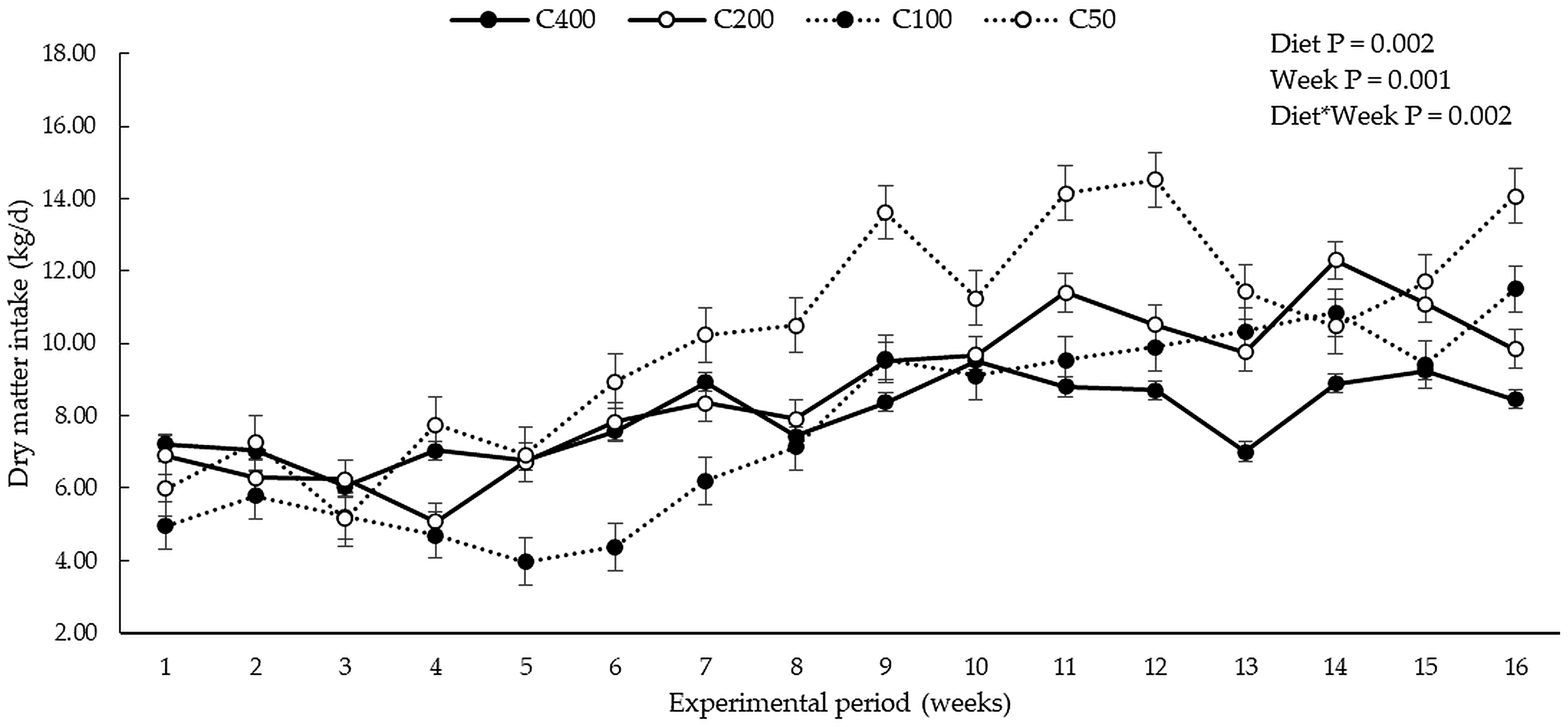
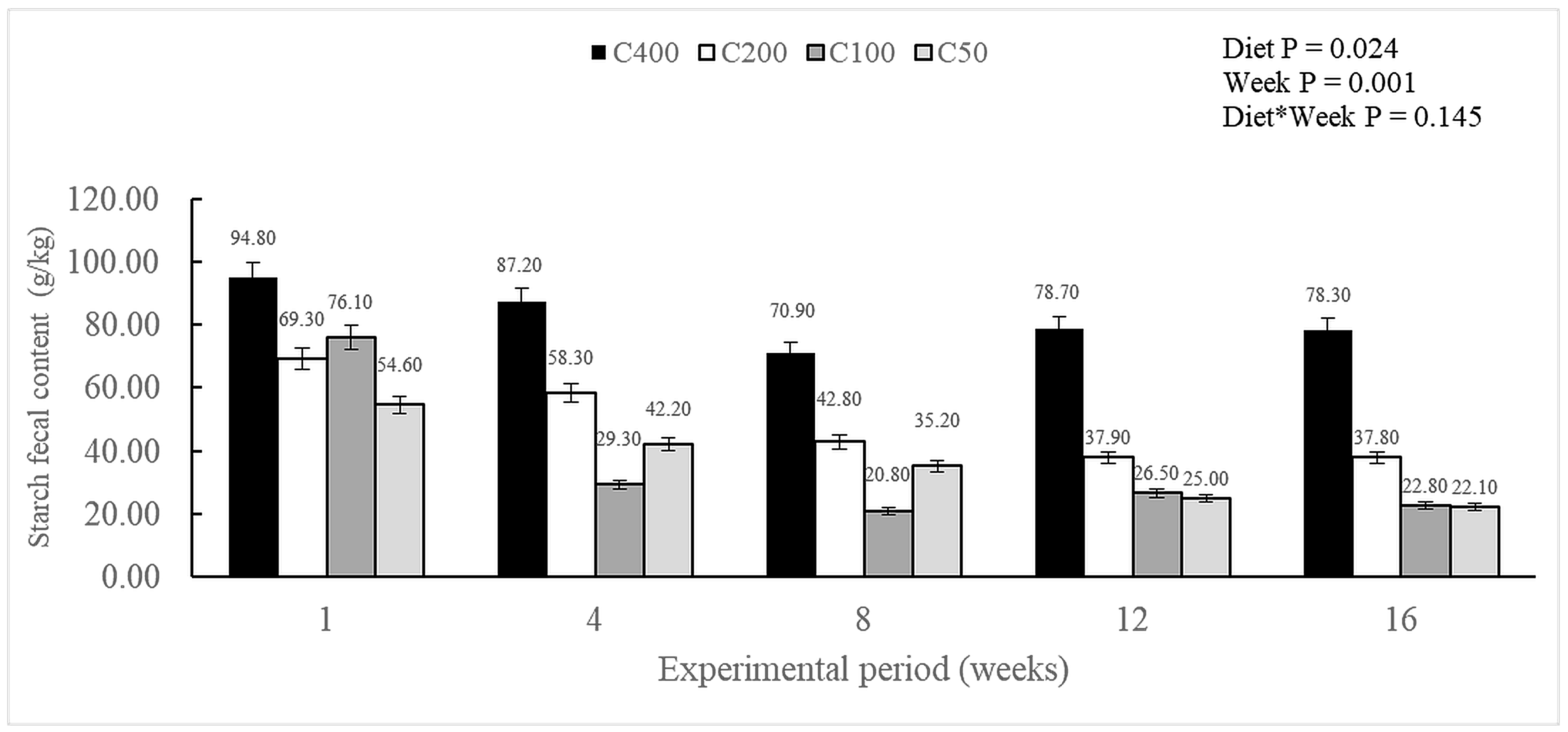
This study evaluated the effects of forage-free diets with reduced starch levels on the productive performance, metabolism, ruminal fermentation, nutrient digestibility, and meat quality of feedlot beef cattle. Two experiments were conducted. In Experiment 1, forty uncastrated Nellore steers were distributed into 20 pens in a completely randomized design, receiving diets with increasing inclusion levels of ground corn in the total diet: C400 (400 g kg−1), C200 (200 g kg−1), C100 (100 g kg−1), and C50 (50 g kg−1), formulated without forage and based on fibrous co-products. Increasing ground corn inclusion promoted linear improvements in final body weight and average daily gain, while dry matter intake and feed efficiency showed quadratic responses. Meat quality parameters were not affected by dietary treatments. In Experiment 2, eight crossbred steers were assigned to a double 4 × 4 Latin square design and fed the same experimental diets. Higher corn inclusion increased starch and fat intake, whereas dry matter, organic matter, and protein intake showed quadratic responses. Apparent total-tract digestibility of dry matter, organic matter, and starch also followed a quadratic pattern. Ruminal fermentation parameters were affected by dietary treatments, with greater ammoniacal nitrogen concentrations at higher corn levels and quadratic responses for propionate, butyrate, and methane production. Nitrogen metabolism indicated increased urinary nitrogen and uric acid excretion with increasing dietary corn inclusion. These results demonstrate that forage-free diets based on citrus pulp and soybean hulls with different levels of ground corn can be effectively used in finishing beef cattle, improving performance without impairing meat quality while modulating ruminal fermentation and nutrient utilization.
Keywords:
byproducts; carcass; co-products; effective fiber; energy density; fermentation; meat quality; non-forage