


Abstract
Some characteristics of stationary flows of the Sawada–Kotera system lend themselves to generalization, producing a large class of separable Lagrangian systems with two degrees of freedom. All of these systems come in couples that have the same equations of motion, although they are not related by a gauge transform. Some nonpolynomial examples are provided.
1. Introduction
The authors have long been interested in constants of motion for Lagrangian systems with finite degrees of freedom, and, as a special case, in integrable systems. We have recently come across some such system, which had been introduced in the field of solitons and of a chaotic dynamical system. As a result of our investigation into their integrability, we found that it can be generalized to a wider class, which may be of some interest for possible future applications in PDE settings.
Our most direct motivation was the study of the Lagrangian
which we call the Sawada–Kotera system. It is integrable, by means of the energy and the supplementary first integral
This case is also separable in the coordinates , and its solution can be expressed through elliptic functions. This result was obtained by Aizawa and Saito [1], but their names did not stick, and the system is found associated with Sawada and Kotera, and is connected with soliton theory [2,3,4].
Modern theories of integrable systems introduce the fundamental concept of the soliton to study completely integrable systems having an infinite number of degrees of freedom [5]. Examples of soliton equations are the Korteweg–de Vries (KdV) equation [6], the nonlinear Schrödinger (NLS) equation [7], and the Sine-Gordon (SG) equation [8]. Generally, soliton solutions represent stable solutions of nonlinear PDEs, where nonlinearity and dispersion are balanced [9]. With reference to the scope of our work, we report two relevant results. A method developed by Blaszak [10] constructs Lagrangian and Hamiltonian functions for stationary flows of some well-known soliton equations, including Sawada–Kotera hierarchies. In [11], a new parametrization for higher-order nonlinear equations is applied to stationary flows of soliton solutions. Interestingly, the dynamics of such systems comes out in the form of Newton equations of motion.
The Sawada–Kotera Lagrangian system is a special case of the following family of Lagrangian functions, depending on the parameter :
See, for instance, the larger family of Hamiltonian functions marked as (1) in [12] (p. 277), which we restricted with the choice . Since these Lagrangians are autonomous, the associated Lagrange equations have the first integral of energy
The special case of is the influential Hénon–Heiles system that was introduced in [13] in order to model a Newtonian axially symmetric galactic system. Such a model has no analytic first integral independent of energy as proved by Ito [14], and its chaotic dynamic behavior has been extensively studied [15,16,17]. Note that Wojciechowski calls after Hénon–Heiles the whole family in his formula (1) quoted above.
By contrast, two other members of the family are known to be integrable. One is the case studied by Dorizzi, Grammaticos, and Ramani [18], and independently integrated by Wojciechowski [12].
The case is precisely the Sawada–Kotera system, which is integrable too as we mentioned above. In the same spirit of solitons, the case is called Korteweg–de Vries.
Let us mention a recent paper by Sottocornola [19], which deals with the separation of variables for seven integrable systems related to Hénon–Heiles, and presents some open questions.
2. Main Result
Theorem 1.
The two smooth Lagrangians in two degrees of freedom
have the same Lagrange equations and, hence, share the two energy first integrals
if and only if there exist two smooth functions of one variable such that
If this happens, the change in variables separates the Lagrange equations into
In Equation (8), each of the two separated differential equations has its own energy as a conserved quantity, which helps when solving with numerical methods [20].
3. Two Lagrangians for the Sawada–Kotera Equations
Consider again the Sawada–Kotera cubic Lagrangian
The associated Sawada–Kotera Lagrange equations are
The energy first integral is
and there is one more first integral, which is quadratic in the velocities
Let us change a sign in the formula for and make it into a second Lagrangian function
It happens that
so that the Euler–Lagrange equation for the two system are exactly the same:
The first integral of energy for happens to coincide with of (12) above
(the central dot is the scalar product). The relationship between and is very close.
4. Proof of the Main Theorem
Suppose we have a Lagrangian of the form
where the potential U is smooth but it is not necessarily a polynomial function. The associated Euler–Lagrange equations are
Inspired by the Sawada–Kotera results of the previous Section, let us consider a second Lagrangian of the form
whose equations of motions are
Let us impose that the equations (19) coincide with those in (21):
We claim that this occurs if and only if
for some smooth functions .
To prove this, let us make a change in the dependent variables through a rotation in the plane, introducing new variables :
that is to say,
In terms of the new variables, the differential Equation (22) becomes
which means that there exist one-variable functions such that
that is,
which are equivalent to (23).
The Euler–Lagrange Equation (19) has the first integral of energy
while the first integral of energy for (21) is
Whenever conditions (22) hold, the Euler–Lagrange equations coincide, and E and are the first integrals for both. In this case, in terms of the new variables (just a little simpler than above), the Lagrangian function L becomes
for which the Euler–Lagrange equations are separated:
Similarly, the Lagrangian becomes
Given a Lagrangian function , , it is easy to build other Lagrangians which have the same motions: simply take an arbitrary smooth scalar function , and define
Then we say that L and are related by a gauge transform. Our Lagrangian functions L in (18) and in (20) are not related by a gauge transform, because their difference is quadratic in the velocities.
5. Examples
Here are some some sample systems that are covered by our results.
Example 1.
(Recovering Sawada–Kotera). The functions
give the Sawada–Kotera :
Hence, from (19), the separated Euler–Lagrange equations for , are
Example 2.
The class of system to which our result applies is not limited to the polynomial potential. Let us consider the following Lagrangian, which is a variation on Calogero’s potential [21] for n-bodies constrained on a line with inversely quadratic pair potentials:
The equations of motion are
The functions
give the potential in (42) and satisfy the hypotheses of Theorem 1. Hence, from (19), the separated Euler–Lagrange equations are
that have simple solutions.
Incidentally, to this system, we can apply the following result ([22] Section 3): for general Lagrangian functions , , with U homogeneous of degree , we have that for each motion, , where E is the energy and are constants depending on the motion. In the present case, and the relation becomes
Example 3.
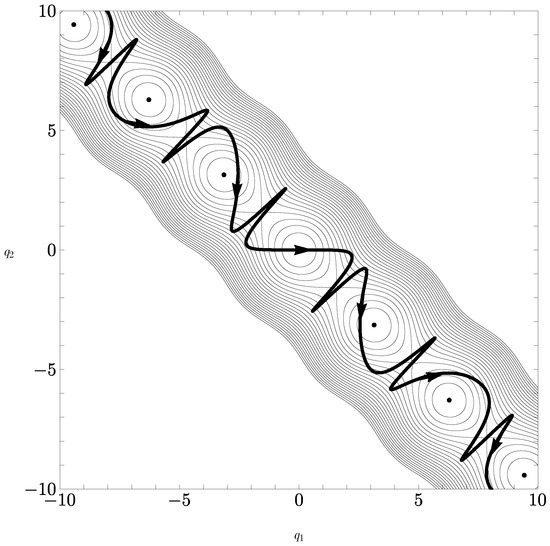
One more nonpolynomial system is this Lagrangian:
which has infinitely many potential wells along the line . The separated system with , is
The motion with , , visits all the potential wells in turn (Figure 1).
Figure 1.
The trajectory of a motion of system (48), over the backdrop of the level curves and the minimum points of the potential. This kind of dynamics is not possible with polynomial potentials. The picture was made with Wolfram Mathematica.
6. Conclusions
A possible direction for future research could be a search for a new soliton equation whose stationary flows are separable in the sense described above. We would be very glad if our theory could lead to experimental and numerical analysis work too.
Author Contributions
Conceptualization, G.Z. and G.G.; methodology, G.Z.; writing and visualization, G.G.; investigation, M.S. All authors have read and agreed to the published version of the manuscript.
Funding
This research received no external funding.
Data Availability Statement
No new data were created or analyzed in this study. Data sharing is not applicable to this article.
Conflicts of Interest
The authors declare no conflicts of interest.
Abbreviations
The following abbreviations are used in this manuscript:
| PDE | Partial Differential Equation |
References
- Aizawa, Y.; Saito, N. On the stability of isolating integrals. Effect of the perturbation in the potential function. J. Phys. Soc. Jpn. 1972, 32, 1636–1640. [Google Scholar] [CrossRef]
- Ballesteros, A.; Blasco, A. Integrable Hénon-Heiles Hamiltonians: A Poisson algebra approach. Ann. Phys. 2010, 325, 2787–2799. [Google Scholar] [CrossRef][Green Version]
- Fordy, A.P. The Hénon-Heile system revisited. Phys. D 1991, 52, 204–210. [Google Scholar] [CrossRef]
- Sawada, K.; Kotera, T. A method for finding N-soliton solutions of the K.d.V. equation and K.d.V.-Like equation. Prog. Theor. Phys. 1974, 51, 1355. [Google Scholar] [CrossRef]
- Gu, C. Soliton Theory and Its Applications, 1st ed.; Springer: Berlin/Heidelberg, Germany, 1995. [Google Scholar]
- Miura, R.M.; Gardner, C.S.; Kruskal, M.D. Korteweg-de Vries equation and generalizations. II. Existence of conservation laws and constants of motion. J. Math. Phys. 1968, 9, 1204–1209. [Google Scholar] [CrossRef]
- Kato, T. On nonlinear Schrödinger equations. Ann. Henri Poincaré 1987, 46, 113–129. [Google Scholar]
- Rubinstein, J. Sine-Gordon Equation. J. Math. Phys. 1970, 11, 258–266. [Google Scholar] [CrossRef]
- Muhammad, B.R.; Faiza, N.; Muhammad, A.; Magda, A.E.; Tahir, N.; Choon, K.C. Solitary wave solutions of Sawada-Kotera equation using two efficient analytical methods. AIMS Math. 2023, 12, 31268–31292. [Google Scholar]
- Blaszak, M. Lagrangian-Hamiltonian formulation for stationary flows of some class of nonlinear dynamical system. J. Phys. A Math. Gen. 1993, 26, L263. [Google Scholar] [CrossRef]
- Blaszak, M. Newton representation for stationary flows of some class of nonlinear dynamical systems. Phys. A Stat. Mech. Its Appl. 1995, 215, 201–208. [Google Scholar] [CrossRef]
- Wojciechowski, S. Separability of an integrable case of the Hénon-Heiles system. Phys. Lett. A 1984, 100, 277–278. [Google Scholar] [CrossRef]
- Hénon, M.; Heiles, C. The applicability of the third integral of motion: Some numerical experiments. Astron. J. 1964, 69, 73. [Google Scholar] [CrossRef]
- Ito, H. Non-integrability of Hénon-Heiles system and theorem of Ziglin. Kodai Math. J. 1985, 8, 120–138. [Google Scholar] [CrossRef][Green Version]
- Boccaletti, D.; Pucacco, G. Theory of Orbits, 1st ed.; Springer: Berlin/Heidelberg, Germany, 2004. [Google Scholar]
- Churchill, R.C.; Rod, D.L. Geometrical aspects of Ziglin’s non-integrability theorem for complex Hamiltonian systems. J. Diff. Eqns. 1988, 76, 91–114. [Google Scholar] [CrossRef][Green Version]
- Tabor, M. Chaos and Integrability in Nonlinear Dynamics, 1st ed.; Wiley: New York, NY, USA, 1989. [Google Scholar]
- Dorizzi, B.; Grammaticos, B.; Ramani, A. Integrability of Hamiltonians with third and fourth degree polynomial potentials. J. Math. Phys. 1983, 24, 2289–2295. [Google Scholar]
- Sottocornola, N. Separation coordinates in Hénon-Heiles systems. Phys. Lett. A 2019, 383, 126027. [Google Scholar] [CrossRef]
- Shampine, L.F. Conservation laws and the numerical solution of ODEs. Comput. Math. Appl. 1986, 12, 1287–1296. [Google Scholar] [CrossRef]
- Calogero, F. Solution of the one-dimensional N-body problems with quadratic and/or inversely quadratic pair potentials. J. Math. Phys. 1971, 12, 419–436. [Google Scholar] [CrossRef]
- Gorni, G.; Zampieri, G. Lagrangian dynamics by nonlocal constants of motion. Discrete Contin. Dyn. Syst. Ser. S 2020, 13, 2751–2759. [Google Scholar] [CrossRef]
Disclaimer/Publisher’s Note: The statements, opinions and data contained in all publications are solely those of the individual author(s) and contributor(s) and not of MDPI and/or the editor(s). MDPI and/or the editor(s) disclaim responsibility for any injury to people or property resulting from any ideas, methods, instructions or products referred to in the content. |
© 2024 by the authors. Licensee MDPI, Basel, Switzerland. This article is an open access article distributed under the terms and conditions of the Creative Commons Attribution (CC BY) license (https://creativecommons.org/licenses/by/4.0/).