


Abstract
This paper introduces a constraint-aware optimization framework for designing spherical multi-camera rigs that achieve complete panorama coverage while adhering to physical and field-of-view limitations. The approach assesses coverage using solid-angle geometry and calculates the sampling density in pixels per steradian, providing a measurable, traceable basis for panoramic optical measurement. By viewing panoramic imaging as a directional measurement challenge, the framework aligns with principles of optical metrology and guarantees uniform, non-contact optical sensing around the sphere. The optimization process includes capsule-based collision constraints, soft coverage losses, and field-of-view intersection modeling to produce physically feasible rig configurations. Experiments show that the optimized rigs provide improved coverage uniformity and less redundancy, with validation through Blender-generated synthetic panoramas confirming the practical performance of the designed optical systems. The proposed approach allows for systematic, measurement-driven design of spherical camera rigs for use in immersive imaging, robotic perception, and structural inspection.
1. Introduction
The demand for high-resolution spherical imaging systems is accelerating across a wide range of industries, including virtual and augmented reality, autonomous navigation, cultural heritage documentation, and urban digital twin construction. Market forecasts estimate that the global 360-degree camera market will expand from USD 1.3 billion in 2023 to nearly USD 8 billion by 2032 [1], with ultra-high-definition (UHD) systems accounting for over 65% of recent revenue [1]. This increase is, in part, due to the expectation for seamless, high-quality panoramic capture, especially in applications that benefit from spatial awareness, immersive visualization, or photogrammetry. There are currently spherical camera rigs on the market that range from consumer-grade products to complex multi-sensor calibration systems designed for rigorous use. Examples of these camera rigs include the Teledyne Ladybug6 (72 MP) [2], Mosaic’s 51 and Viking systems (up to 186 MP) [3], and the DJI Osmo 360, which is capable of capturing 8K/50 fps spherical video [4]. These camera systems aim to provide maximum coverage and resolution within the constraints of what is physically feasible. However, the combination of higher sensor resolutions and smaller camera rig forms presents design challenges to achieving completely seamless capture and design where there is no physical collision between some or all of the camera elements.
Figure 1 shows some examples of spherical camera systems, either using fisheye or frame lenses.
Figure 1.
Examples of spherical camera systems using fisheye or multi-frame lenses.
Prior research has explored several design strategies, including Voronoi-based layouts [5], catadioptric mirror configurations [6], spherical lenses [7], and simulation-based tools such as iset360 [8]. More recent approaches integrate bio-inspired multi-view rigs, Mazhar, et al. [9], calibration-aware models. An, et al. [10], and hybrid systems for photogrammetry and SLAM [11,12,13,14], and performance evaluations of commercial multi-camera rigs [15], as well as spherical cameras in surveillance applications [16]. Despite these contributions, many existing methods either analyze fixed configurations, optimize only geometric aspects, or neglect physical feasibility altogether.
To address these limitations, a constraint-aware optimization framework is proposed in this paper for spherical multi-camera rigs that jointly considers coverage, resolution, and collision constraints. Each camera is modeled using its effective field of view and body dimensions, with coverage defined on the unit sphere and collisions prevented using capsule-clearance constraints adapted from robotics [17]. Optimization is performed via Sequential Quadratic Programming (SQP), combining a soft coverage loss with a repulsion term that prevents clustering. The result is a minimal, feasible constellation of cameras optimized for uniform panoramic imaging. Unlike casual panoramic photography, metrological spherical imaging requires fixed, calibrated camera positions and a precise sampling geometry to ensure repeatability, traceability, and predictable measurement uncertainty. The framework presented in the paper meets these needs by optimizing camera setups offline before deployment.
The following research questions guide this study:
- How can the minimum number of cameras required for full-sphere coverage at a target resolution be systematically determined?
- What optimization strategy promotes uniform pixel density without unnecessary overlap?
- How can camera body dimensions and collision avoidance be incorporated into rig design?
- What distribution of camera facings and rolls achieves optimal spatial separation and coverage?
By answering these questions, this study offers a principled approach to spherical rig optimization for repeatable and traceable optical measurement systems. The study generalizes across lens models and sensor classes, with implications relevant to robotic vision, immersive content capture, and geospatial data collection.
The paper is structured as follows. Section 2 establishes the optimization problem, defines camera models, coverage metrics, and physical constraints. Section 3 describes the proposed methodology that entails soft coverage loss, a repulsion term, and an SQP strategy for solving the placement problem. Section 4 presents experimental results using frame and fisheye cameras to demonstrate the framework’s ability to create minimal feasible rigs for producing datasets while satisfying resolution and clearance constraints. Section 5 discusses the implications of the findings and potential extensions to anisotropic and application-specific designs. Finally, Section 6 concludes the paper and presents directions for future investigations.
2. Problem Formulation
The rig is modeled as a set of cameras mounted on a virtual sphere of radius R. Each camera is characterized by its effective horizontal and vertical fields of view (Heff, Veff), from which we derive a solid angle . From the sensor resolution, the per-camera sampling density (Megapixel (Mpx)/steradian (sr)) is computed. The design requirement specifies a target density , which in turn imposes a lower bound on . Additional constraints stem from spherical cap coverage and total pixel budget, ensuring no gaps and sufficient resolution. Similar capsule-clearance models have been applied in robotic arm design [17], which we adapt here for camera collision avoidance
2.1. Optical Measurement Model
The optimization problem is defined by a set of known camera and system parameters:
- Effective Field of view. The horizontal and vertical field-of-view angles () are specified from the camera’s intrinsic calibration. To account for lens distortions and to ensure robust stitching, the effective angles are reduced to trimmed values. We define the half-angles and . All formulas below (e.g., , and the footprint tests) are written in terms of these half-angles. Trigonometric functions use radians unless stated otherwise. The corresponding effective solid angle is denoted by . For a rectangular pinhole model, this is:
- This is used to translate per-camera pixels into pixels per steradian using frame cameras. For fisheye cameras, the rectangular pinhole model above is no longer appropriate, since the effective footprint is circular rather than polygonal. In this case, the field of view is modeled as a spherical cap of half-angle . The corresponding solid angle is
- Per-camera and required sampling density.
From the sensor resolution, the per-camera density is
- where is the pixel count of a single image. This formulation of naturally accounts for the circular fisheye footprint, where many of the sensor pixels fall outside the inscribed circle and do not contribute to coverage.
- The design requirement specifies the minimum density . The implied number of required overlapping layers is
- This represents the average number of cameras that should cover each direction on the sphere. The corresponding lower bound on the number of cameras is
- Target density. A global design requirement specifies the minimum density that should be achieved uniformly across the sphere.
Worth mentioning, it is assumed that per-camera FOVs are derived from intrinsic calibration; tolerances in FOV and resolution can be propagated to an uncertainty in pixels-per-steradian, providing an uncertainty budget for the coverage metric.
2.2. Coverage Bounds and Pixel Budget Constraints
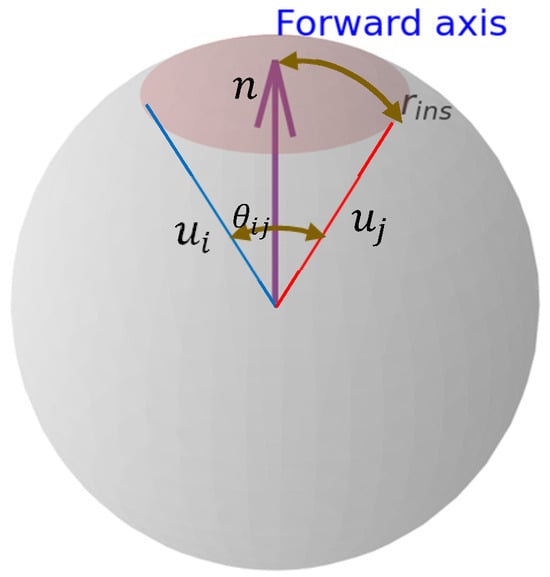
Two further criteria are enforced (Figure 2):
Figure 2.
Illustration of the spherical-cap bound. A single camera can guarantee coverage of at most one inscribed spherical cap of radius .
- i.
- A spherical cap bound,
The cap area is
This implies a lower bound on the number of cameras.
Ensuring that no spherical cap is left uncovered (Figure 2).
- ii.
- A pixel budget bound,
- where is the total required pixel budget. The practical search, therefore, begins from
- The solver doubles until feasibility is detected, then bisects to the minimal feasible , warm-starting from the last possible solution.
2.3. Physical Rig Parameters and Design Variables
Camera body geometry. Each camera has known physical dimensions: width , height , and depth . An additional clearance is included to avoid overlaps when cameras are placed in close proximity. These quantities are used in the capsule-clearance constraint introduced later. In Equation (11), is the capsule radius used for clearance checking, which is half the diagonal of the camera’s body cross-section, plus the safety clearance .
Sphere radius. The cameras are assumed to be mounted on a virtual sphere of radius . During optimization, a probe radius is used for clearance evaluation, while the final recommended mounting radius is computed post-optimization.
Together, these quantities define the problem setting: the effective fields of view, the per-camera contribution to image density, the physical body dimensions, and the target coverage requirements. They serve as fixed inputs to the optimization methodology described in the following sections.
For a fixed number of cameras , the optimization variables are the orientations of each camera on the sphere. Each camera i is parameterized by its facing direction (azimuth , elevation and roll , which together define the optical axis and full rotation .
The solid-angle coverage and sampling density defined above represent fundamental optical measurement quantities. Each pixel corresponds to a measurable viewing ray on the unit sphere, linking coverage completeness and uniformity directly to angular measurement resolution. Expressing these quantities in steradians and pixels per steradian provides a traceable and quantifiable basis consistent with optical-metrology practice. This interpretation frames the spherical rig as a directional optical-measurement instrument rather than solely as an imaging configuration.
2.4. Parameterization of Camera Orientations
Per-Camera Spherical Footprint: Each camera defines a forward axis on the unit sphere and is associated with a rectangular field of view (FOV). The footprint of the camera can therefore be represented as the set of spherical directions whose azimuthal and elevational offsets from the forward axis are bounded by the horizontal and vertical half-angles ( as shown in Figure 2 In other words, a direction belongs to the footprint if, when expressed in the local camera frame, the normalized coordinates satisfy
This discrete footprint model links the per-camera geometry to the global coverage problem. By taking the union of all individual footprints, we can evaluate how well the constellation of cameras covers the sphere. In practice, however, such rigid boundaries are not convenient for gradient-based optimization.
In the next section, we introduce smooth gate functions that relax these rigid footprint boundaries and combine them into an optimization objective that balances coverage completeness with repulsion between cameras.
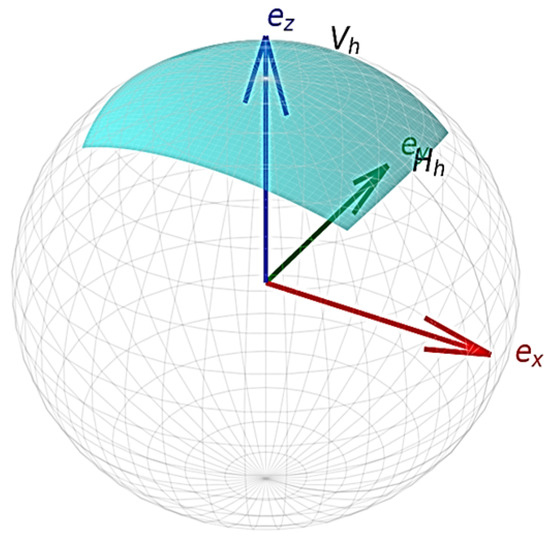
Camera visibility model: Each camera is described by a rotation matrix that orients its local coordinate frame relative to the world. The camera’s forward axis is given by , where are the canonical unit basis vectors as shown in Figure 3. The right and up axes are similarly defined as and .
Figure 3.
Per-camera spherical footprint and visibility model. The cyan patch represents the portion of the unit sphere visible to the camera, bounded by the horizontal () and vertical () half-field-of-view angles. The local camera coordinate axes are shown as forward (blue), right (red), and up (green). A spherical wireframe provides context for the projected footprint.
A world direction lies within the footprint of the camera if its horizontal and vertical angular offsets from the forward axis are bounded by the horizontal and vertical half-fields of view (, ). In hard form, this condition can be expressed as
with the additional requirement that if the direction is in the footprint and otherwise.
This definition yields a spherical polygonal region on representing each camera’s visibility. While precise, such complex inclusion tests are not differentiable and thus unsuitable for gradient-based optimization.
The visibility and footprint definitions above enable the rig to function as a calibrated optical measurement system. The mapping from image pixels to solid-angle units creates a metrologically traceable link between sensor resolution, angular accuracy, and scene sampling. This approach aligns with established practices in non-contact optical metrology, where system performance is assessed through measurable angular resolution and uncertainty. Incorporating these principles into the design ensures that the optimized rig meets not only geometric coverage requirements but also quantifiable measurement quality standards relevant to structural inspection, robotic perception, and panoramic optical sensing.
3. Materials and Methods
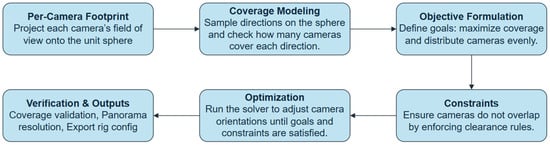
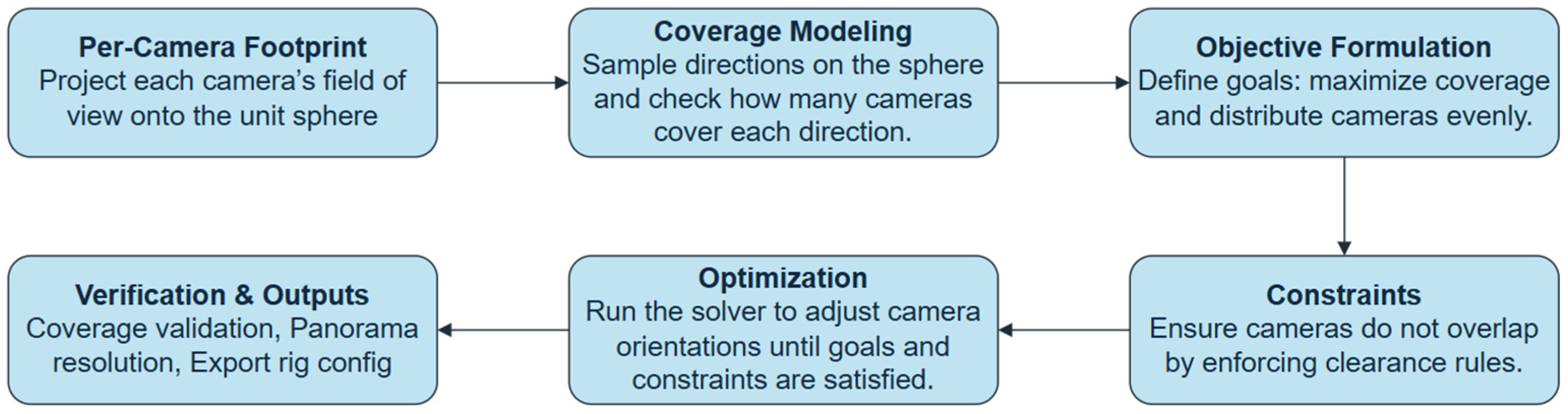
An overview of the proposed methodology and its main processing stages is shown in Figure 4.
Figure 4.
Generic Methodology workflow.
3.1. Facing Distribution Preference
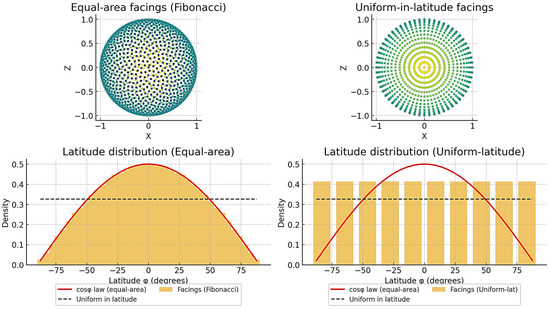
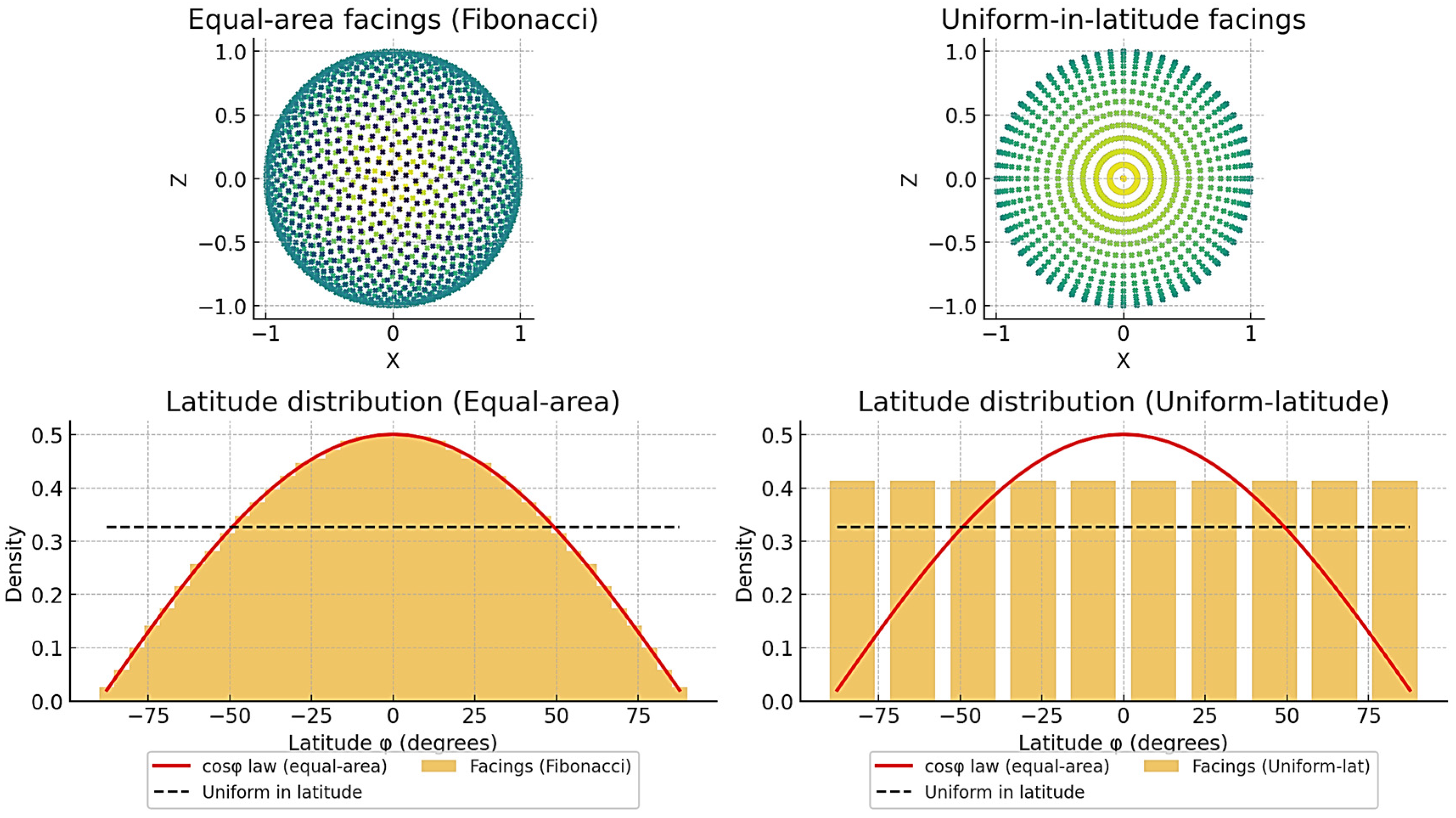
Because coverage is evaluated on a uniform Fibonacci grid of directions (equal-area in steradians), the optimizer implicitly “prefers” to distribute camera facings uniformly on the sphere in solid angle. This causes the forward axes to spread like a Poisson-disc pattern on the sphere, with more facings near the equator and fewer near the poles (since solid-angle density scales with ).
In spherical camera optimization, the distribution of camera forward directions (“facings”) strongly affects coverage. Because our coverage loss is evaluated on a uniform Fibonacci grid of directions, which samples the sphere uniformly in solid angle, the optimizer naturally prefers facings that are uniform in steradians. This distribution follows the law in latitude: the equator is denser, the poles sparser (Figure 5).
Figure 5.
Comparison of facing distributions. (Top): simulated camera facings projected onto the X–Z plane. (Bottom): corresponding latitude histograms. (Left): equal-area facings generated by Fibonacci sampling, which follow the theoretical law (red curve), distributing more cameras near the equator and fewer near the poles. (Right): facings chosen uniformly in latitude, which deviate from and overweight the poles (dashed black curve).
This choice is motivated by geometry: equal-area distribution ensures that every steradian of the sphere receives (approximately) the same coverage. If one instead enforced uniformity in latitude, the result would be an overweight of polar regions, leading to redundant coverage in those areas and gaps elsewhere. Since most panoramic imaging pipelines and quality metrics are defined per unit solid angle, the equal-area preference is the most natural and effective.
Each facing is parameterized by two angles (e.g., azimuth elevation
Given and roll , the camera rotation (world → camera) is built by any orthonormal completion with , then rolling about by .
Worth mentioning that the pairwise separation angles are not optimized directly, they are computed implicitly from the facings . Accordingly, the optimization variables are:
- Azimuth () and Elevation () of each camera facing direction . Together, these define the camera’s forward axis.
- Roll () around that forward axis. This matters because the rectangular corners depend on roll orientation.
From these optimized variables, the actual 3D camera centers are obtained in a post-hoc step as with being the suggested mounting radius. So, the final outputs include both camera orientations (angles/rolls or quaternions) and their positions on the spherical rig.
3.2. Objective Function (Coverage + Repulsion)
The total objective is a balance of two complementary goals in spherical rig design. The coverage loss ensures that every world direction is seen by cameras at the very least, using a smooth softplus penalty to handle under-coverage without discontinuities. This encourages completeness and robustness in the panorama. The repulsion loss discourages cameras from clustering by penalizing slight angular separations . Without this repulsion term, the optimizer might satisfy coverage requirements by placing many cameras in overlapping regions. Together, these terms drive the solver towards uniformly spread camera orientations that provide the required coverage with minimal redundancy, resulting in an efficient and balanced spherical constellation.
3.2.1. Coverage Objective
We evaluate a corner-guided test set : a uniform Fibonacci background plus the four corner rays of every camera (to sharpen the penalty near boundaries). For a world direction , each camera contributes a smooth “in-” gate computed in camera coordinates. In the optimization, the only variables are the camera orientations, which determine pairwise separation angles and coverage directions . Let’s formulate the problem as follows:
where
and are the coordinates of a world direction expressed in the camera frame.
is a world direction (point on the Fibonacci grid or a corner ray).
is the rotation of the camera.
is to transform this world direction into the camera’s own coordinate system.
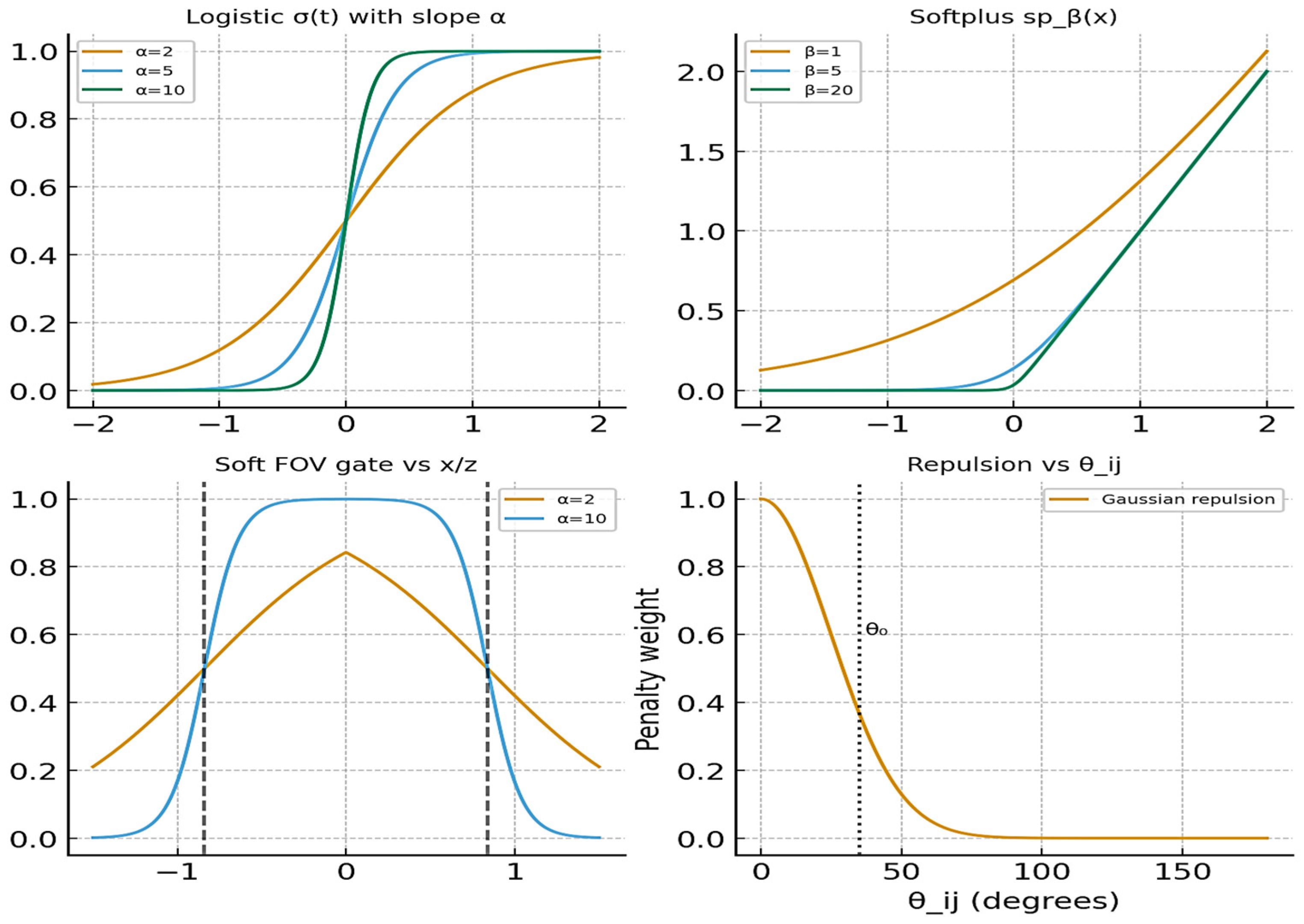
Once transformed into the local camera frame, the forward axis is just the z-axis. The inequalities that define are now more straightforward and easier than testing in world coordinates (Equation (12)). Those conditions of Equation (12) are turned into soft logistic gates as follows:
is the final soft in-FOV function, which is a product of all three logistic terms:
→ gate in horizontal direction
→ gate in vertical direction
→ gate in forward depth direction
With the logistics of
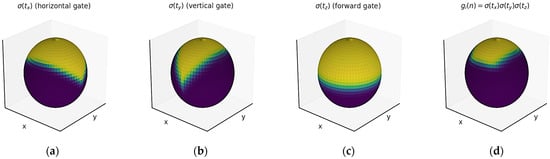
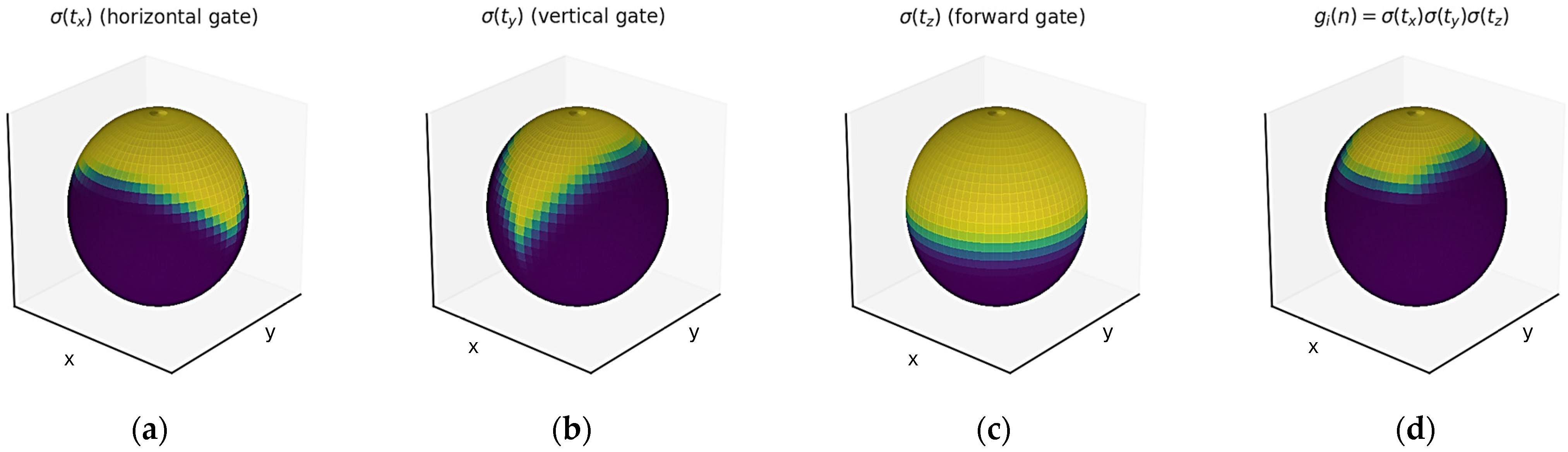
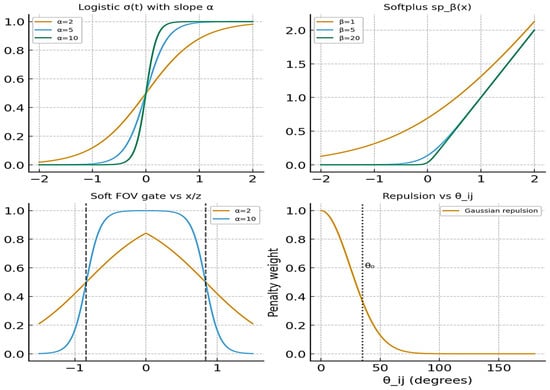
where the argument is always scaled by the slope parameter as shown in Equation (16). Figure 6 illustrates each gate on the unit sphere and its combined effect.
Figure 6.
Logistic gating functions on the unit sphere, where colors represent the number of cameras covering each direction, with warmer colors indicating higher overlap.: (a) horizontal gate , (b) vertical gate , (c) forward gate , and (d) their product which forms the soft in-FOV indicator.
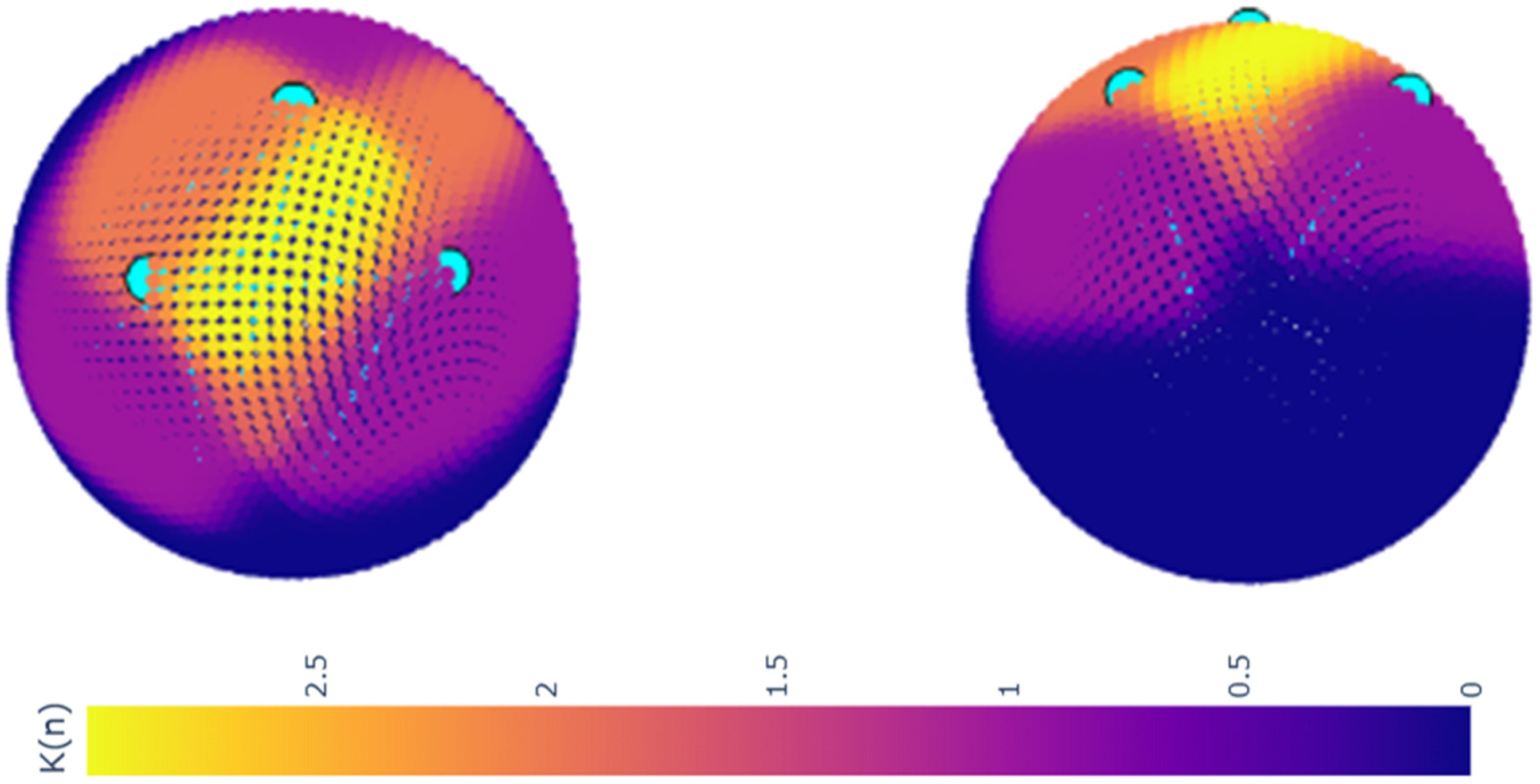
To quantify how many cameras contribute to the coverage of a given background direction , a soft layer count is introduced (Equation (18)). Instead of a hard in/out test, each camera contributes a fractional weight given by the product of logistic gates along its local axes.
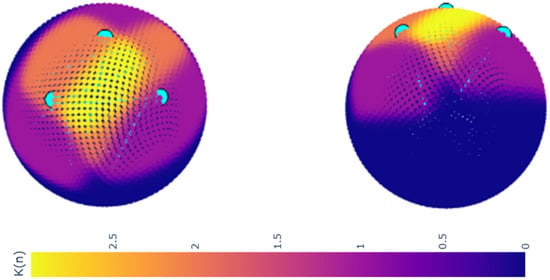
is for making a smooth transition across the field-of-view boundaries. Higher values correspond to directions covered by multiple cameras, while lower values highlight under-covered regions. This behavior is illustrated in Figure 7, where a Fibonacci grid of world directions is evaluated with soft in-FOV gates .
Figure 7.
Soft layer count on a Fibonacci grid of world directions. Warm colors indicate overlap (multiple cameras), while cool colors highlight under-coverage. Cyan points mark the forward directions (optical axes) of the optimized camera orientations.
Accordingly, coverage loss at is penalized by a softplus with slope , squared and averaged as follows:
- Softplus: To measure coverage deficits smoothly, we use the softplus function with a slope parameter It behaves like a differentiable version of the positive part, ensuring that deficits contribute smoothly to the loss:
- 2.
- Coverage loss: Coverage is enforced by comparing the soft layer count along each background direction to the required redundancy . The coverage loss penalizes directions that fall short, while leaving well-covered regions unpenalized:
Here
If ≥: little or no penalty.
If The squared penalty grows smoothly.
Accordingly, encourages every direction on the sphere to be covered by enough cameras .
To summarize, the parameters involved are defined as:
- controls the sharpness of the logistic gates , smoothing the frustum boundary from a hard cut-off to a gradual transition.
- is the logistic gate itself, mapping local camera coordinates into a soft in- score.
- sets the steepness of the softplus penalty, turning under-coverage into either a gentle or harsh loss.
- is the angular distance between cameras, computed from orientations; it appears both in the capsule-clearance constraint and in the repulsion term.
- The repulsion function is a Gaussian in , not optimized but applied as a regularizer to spread cameras apart.
Figure 8 illustrates the main optimization parameters: the camera axes , their angular separation , and a world direction evaluated for soft layer count . The logistic function with slope softens FOV boundaries, the softplus function with slope penalizes coverage deficits, and the Gaussian repulsion term discourages small values between cameras. Together, these terms shape coverage and spacing across the sphere.
Figure 8.
Interpretation of optimization parameters. The geometry on the sphere shows the interpretation of optimization parameters. Logistic, softplus, and Gaussian terms act on camera facings to control coverage and spacing.
3.2.2. Repulsion Objective
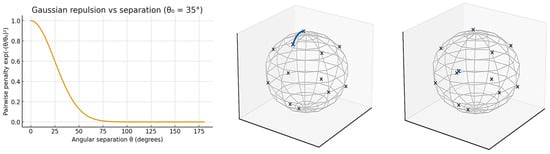
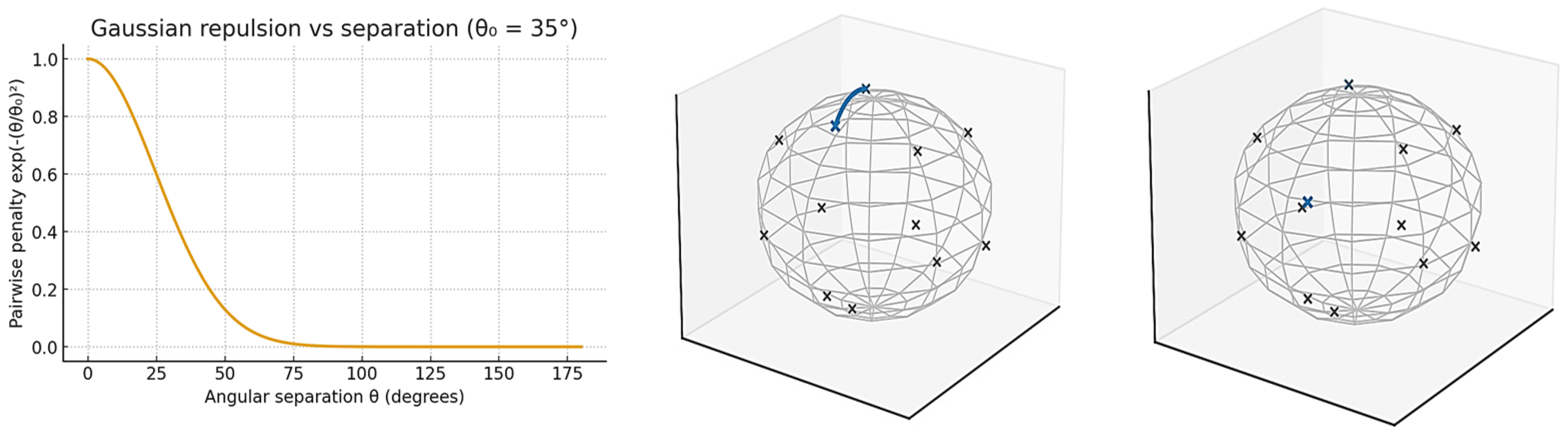
To avoid clustering of cameras in overlapping regions, we introduce a repulsion loss that penalizes small angular separations between camera facings. This term is modeled as a Gaussian function of the pairwise angle , encouraging the constellation to spread more uniformly across the sphere. Equation (21) shows the repulsion loss (Gaussian in separation):
This term penalizes cameras that are too closely aligned. It averages Gaussian penalties of pairwise separation angles , with the width parameter of the Gaussian .
controls how minimal angular separations are penalized. If , the exponent is close to zero, so exponent ≈ 1, meaning a high penalty. While means that the exponent is large, so distant cameras don’t interact much in the repulsion. The width parameter was set to ≈ 35°, chosen heuristically as roughly one-third of the trimmed camera FOV (~80–110°), ensuring cameras repel each other when spaced too closely while still permitting the necessary overlap for seamless stitching.
The weighting coefficient balances the repulsion term against the coverage loss.
Thus, is not a binary flag, but a continuous penalty weight that must be tuned depending on how much uniformity is desired in the spherical rig. Accordingly, spreads cameras out to avoid clustering, resulting in more uniform coverage, as illustrated in Figure 9.
Figure 9.
Illustration of the repulsion objective. (Left) Gaussian penalty function with width ≈ 35°, assigning high cost to small angular separations. (Right) Two constellations with the same = 12: an evenly spaced arrangement (low repulsion cost) and a clustered pair (high repulsion cost). The highlighted pair shows how small yields maximum penalty.
3.2.3. Total Objective
The total objective combines the coverage and repulsion terms into a single optimization problem:
subject to the angle bounds, unit-norm implied by the parameterization, and the clearance inequalities . This formulation balances two goals:
Coverage completeness, enforced by , which penalizes under-covered directions through the softplus function.
Uniform spacing, promoted by , which uses a Gaussian penalty to discourage small angular separations (width ).
The trade-off is controlled by : small values emphasize filling gaps at the cost of clustering, while larger values spread cameras more evenly at the risk of leaving some directions under-covered. Together with the clearance and optional symmetrical priors, this objective drives the solver toward minimal, physically feasible camera constellations.
3.2.4. Antipodal Symmetry Prior
Optionally, to regularize the search and promote visually balanced rigs, we impose an antipodal symmetry prior to the constellation. Let be even and . The prior pairs every camera with a partner whose forward axis is exactly opposite:
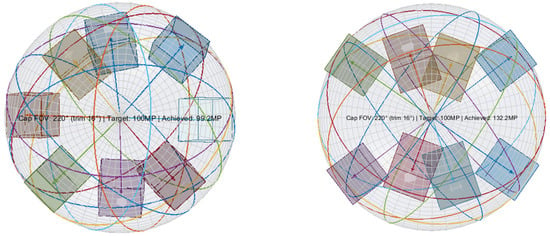
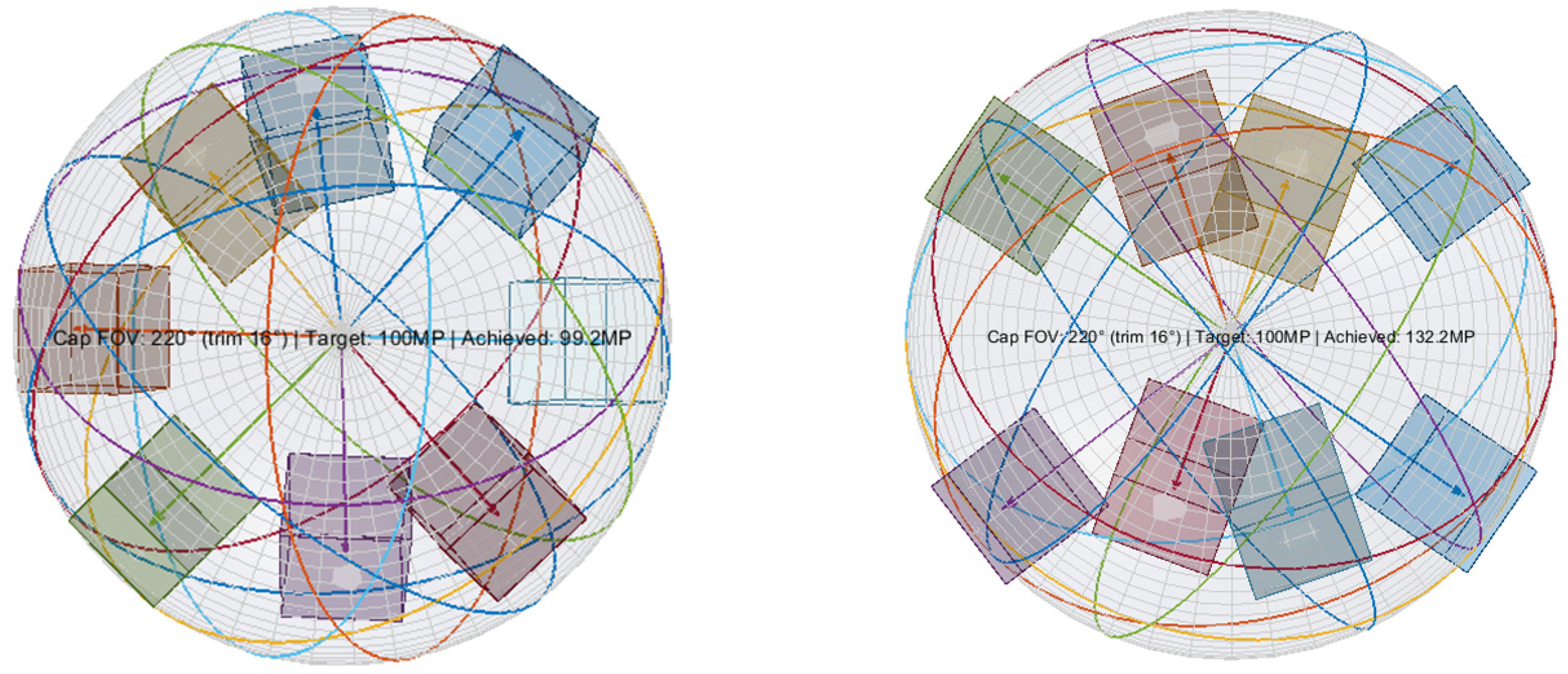
This condition effectively reduces the number of free orientation variables by one-half because only the first M camera orientations are explicitly optimized. The second half is obtained deterministically via antipodal projection. By imposing this type of symmetry, the search space is significantly reduced, improper asymmetric minima are avoided, and the resulting rigs are more uniformly and aesthetically consistent (Figure 10).
Figure 10.
Optimal spherical rig top view. (Left), without antipodal symmetry; (Right), with antipodal symmetry.
Importantly, the antipodal symmetry does not compromise the intrinsic goals or constraints of the optimization problem. Both the coverage loss () and the repulsion loss () are evaluated on the symmetrized set of camera directions . Likewise, the capsule-clearance inequalities remain unchanged, as each pair of cameras is tested on this projected constellation. Rather than introducing an additional nonlinear constraint into the SQP solver, we implement symmetry through a projection step at every evaluation of the objective and constraints.
This symmetrical projection strategy has two practical advantages. First, it doesn’t add complexity to the optimization problem with additional hard constraints, which can slow convergence. Second, it has numerical stability guarantees since all iterates remain on the symmetric manifold regardless of the choice of random seed.
In the overall pipeline, the antipodal prior acts as a structural regularizer:
- At initialization, only M camera orientations are sampled or optimized.
- At each SQP iteration, M remaining cameras will be automatically generated via antipodal projection.
- The symmetrized arrangement is then sent to coverage gates, repulsion terms, and capsule clearance checks.
- Final outputs (optimized facings, rolls, and derived camera positions) will respect the imposed symmetry.
Empirically, this formulation produces symmetric solutions that are at least as good as those made without constraints, while remaining easier to compute and more robust.
3.2.5. Constraint
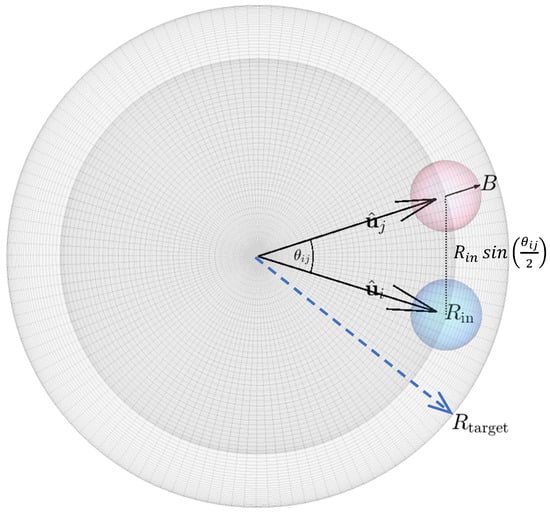
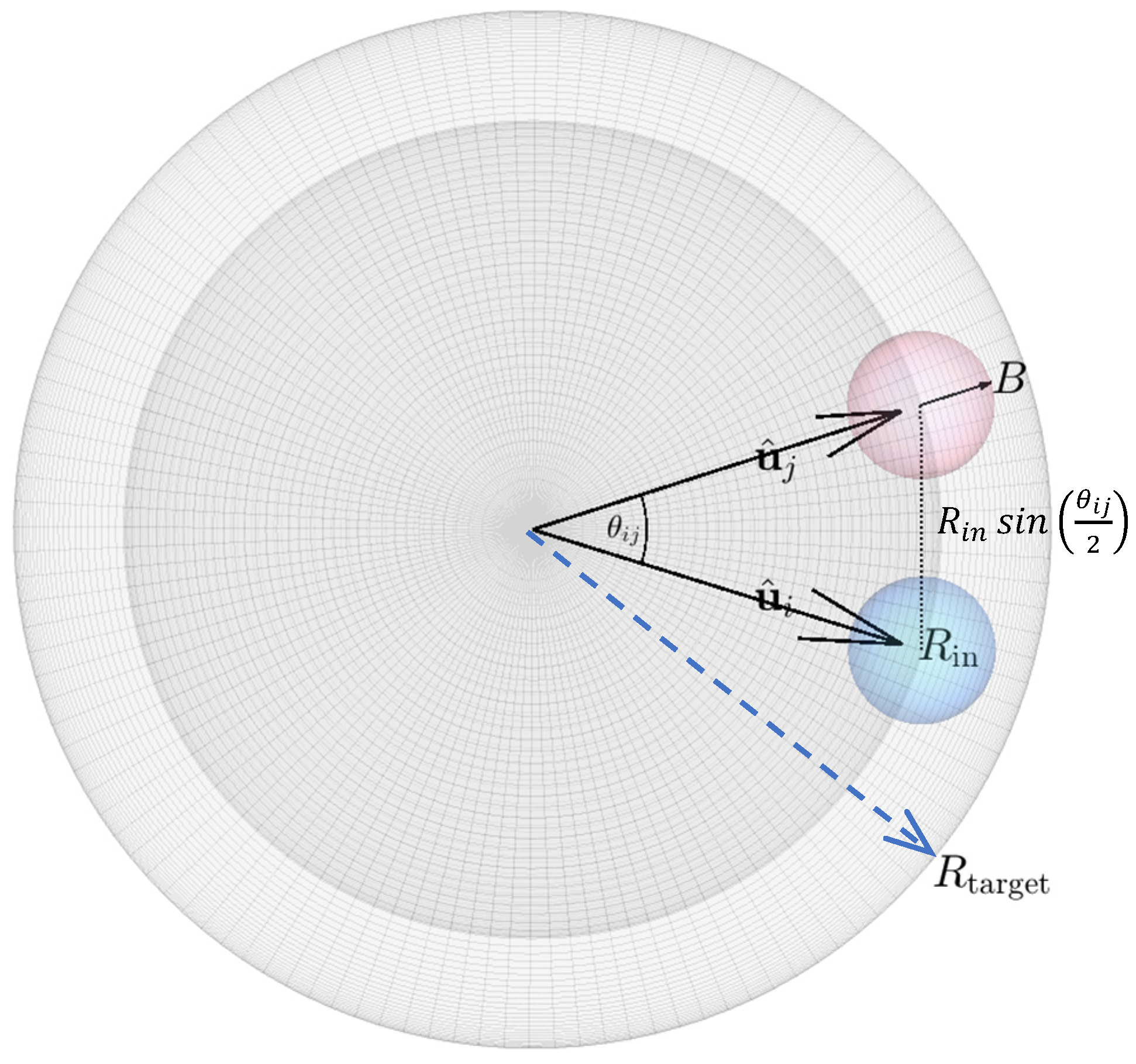
During optimization, a pairwise capsule-clearance constraint is enabled. The capsule radius is used with body width W, height H, depth L, and extra clearance . is a safety buffer that ensures the clearance check is conservative. Let’s first define the constraint parameters (Figure 11):
Figure 11.
3D schematic of the capsule-clearance constraint with , , , and . Blue and red spheres indicate the camera bodies, with the associated clearance region.
- (big circle in the plot) = the radius from the rig center to the front tip of each camera body, along with its viewing direction. This radius is computed from the current seed before the SQP optimization implementation.
- = the axial depth (length) of the camera body + clearance capsule along its viewing direction.
- = the capsule radius (defined in Equation (11)) to model each camera body in the clearance condition.
- (where the small circles live) = the radius to the inner base of the body (closest to the rig center):
Then
Therefore, the capsule runs from to and enforce, for every pair
Here denotes the clearance function between two neighboring camera bodies along directions . It measures how much the capsule radius exceeds the available gap between them. The inequality enforces a non-overlap condition.
If , the two capsules fit without overlap.
If , the two bodies would intersect.
So, it depends on the current angles (from optimization) and the inner clearance radius .
To illustrate the geometric clearance condition, Figure 11 shows two neighboring cameras modeled as capsules on a spherical rig.
After optimizing, a suggested mounting radius is computed.
With
where is the minimum pairwise angular separation, and as above. (No bisection in against a per-ray constraint is performed.)
To summarize, the problem is solved using sequential quadratic programming (SQP), which iteratively refines camera orientations until coverage and repulsion converge. Nonlinear constraints (e.g., physical camera size and occlusion) are enforced through capsule-based collision checks.
Finally, a verification and panorama estimation step is followed after optimization. Results are validated against a finer grid to ensure coverage. Additionally, the effective panorama resolution is estimated by computing both the conservative “uniform” megapixel count and the adaptive “expected” megapixel count, accounting for uncovered regions.
- 1-
- On a fine Fibonacci grid, compute per-direction “hard” coverage and .
- 2-
- 3-
- Panorama estimates: ,
- 4-
- For a 2:1 equirectangular canvas, we suggest
4. Results
To evaluate the suggested optimization framework, experiments were conducted using two example camera set-ups: a typical frame-based sensor (GoPro Hero 13 Black -GoPro, Inc., San Mateo, CA, USA) and a wide-angle fisheye system (Sony IMX183 with Entaniya lens - Entaniya Co., Ltd., Tokyo, Japan). In each case, the solver was initialized with the camera geometry, resolution, and target panorama density. The minimum feasible constellation was found while respecting the coverage, repulsion, and capsule-clearance requirements. Results are presented in Section 4.1 and Section 4.2, including optimized rig layouts, panorama resolution estimates, and Blender-based validation.
4.1. Experiment 1—GoPro 13 Black
For the first experiment, we evaluated the proposed spherical camera optimization framework using the specifications of a GoPro Hero 13 Black camera. The camera has a native image size of 5568 × 4872 pixels (27.6 MP), and an effective horizontal field-of-view (HFOV) of 113° and vertical field-of-view (VFOV) of 87°. These values were taken as the input parameters to the optimization, along with a desired target panorama resolution of 150 MP. The camera dimensions are 71.0 × 55.0 × 33.6 cm.
From these inputs, the framework computes the effective solid angle per camera, the per-camera sampling density in pixels per steradian, and the required density for the panorama. The analytical lower bounds (spherical cap and pixel budget) were then used to initialize the minimum candidate number of cameras, .
The optimization was run for increasing values of , using the fixed- SQP routine. Each run optimized the azimuth, elevation, and roll of all cameras, while enforcing the capsule clearance constraint and applying the coverage and repulsion objectives. The search strategy (doubling + bisection) determined the minimal feasible constellation size.
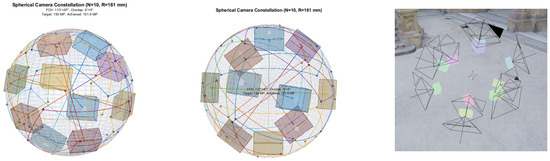
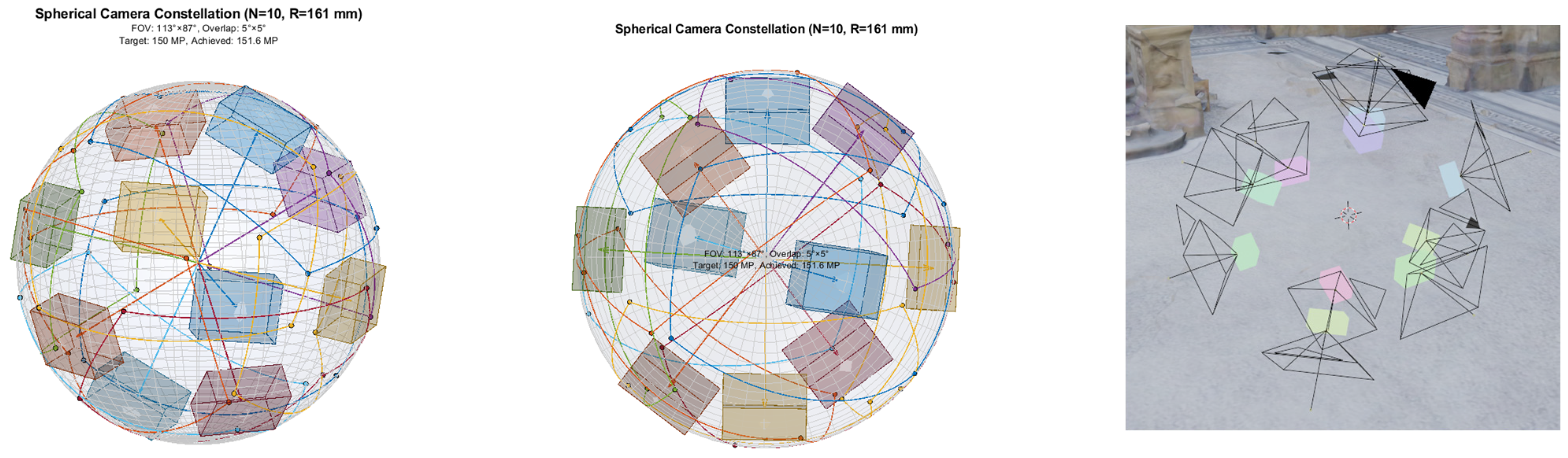
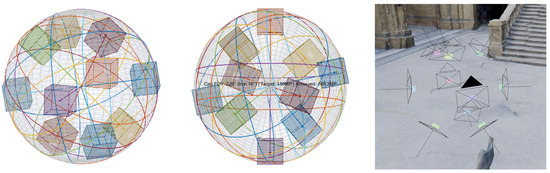
The result of this experiment was a camera rig design based on GoPro sensors that achieves full spherical coverage at the desired resolution. The output includes both the camera facings and roll angles, as well as the 3D positions () of the cameras on the optimized spherical rig. The spatial distribution and orientations of the optimized camera constellation are shown in Figure 12. These results were exported to CSV and visualized in Blender 4.0 for verification, including coverage maps and the corresponding equirectangular panorama size.
Figure 12.
Optimized spherical camera constellation with = 10, R = 16.1 cm. (Left, Middle) MATLAB (version R2024b) visualization. (Right) Blender simulation of the same rig, used for panorama stitching and verification.
Setup. We instantiate the optimizer with GoPro HERO13-class photo geometry and the pano target used in our pipeline.
- TRUE lens FOV = 113° × 87°; for optimization we trim 5° per axis to ensure stitching overlap.
- Effective per-camera FOV = 108° × 82° → solid angle = 2.238 sr.
- Target pano density = 11.94 MPx/sr;
- per-camera sampling density = 12.06 MPx/sr.
- Lower bound and search policy. The pixel/steradian budget gives a lower bound lβ = 10. We run an outer search: start at 10, then use doubling/bisection to identify the minimal feasible N that satisfies coverage/overlap and constraints.
Results.
- N = 10: SQP converges with all constraints satisfied and achieves density 12.06 MPx/sr ≥ 11.94 MPx/sr (✓). Coverage fraction = 100%.
- Larger N (tested) also converge, but 10 is already feasible and above the target density.
Optimization details.
For each tested N, we optimize yaw/azimuth pitch/elevation , and roll per camera (the facings ), under:
- Coverage term with softened FOV edges (logistic ) and soft layer count
- The repulsion term discourages small pairwise angles,
- Capsule clearance (no self-occlusion/collision).
All runs terminated with “local minimum possible; constraints satisfied” (SQP step and feasibility tolerances met). Objective values settled in the 10−3–10−4 range, consistent with good angular separation and smooth coverage.
Outputs. For * = 10, we export:
- Optimized facings (from ) and roll ,
- 3D unit-sphere positions () of camera optical axes (used to place cameras on the rig),
- Per-view FOV corner directions (affected by ) for coverage auditing.
The optimized rig yields a uniform 2:1 panorama of 151.6 MP (17413 × 8707 pixels), or 275.0 MP in adaptive mode, with a suggested rig radius of 16.1 cm.
In summary, with HERO13-class effective FOV, the framework selects 10 cameras as the minimal constellation that achieves symmetrical full-sphere coverage while satisfying overlap and separation constraints.
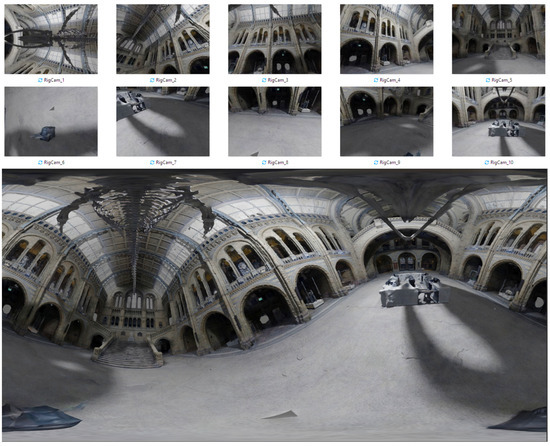
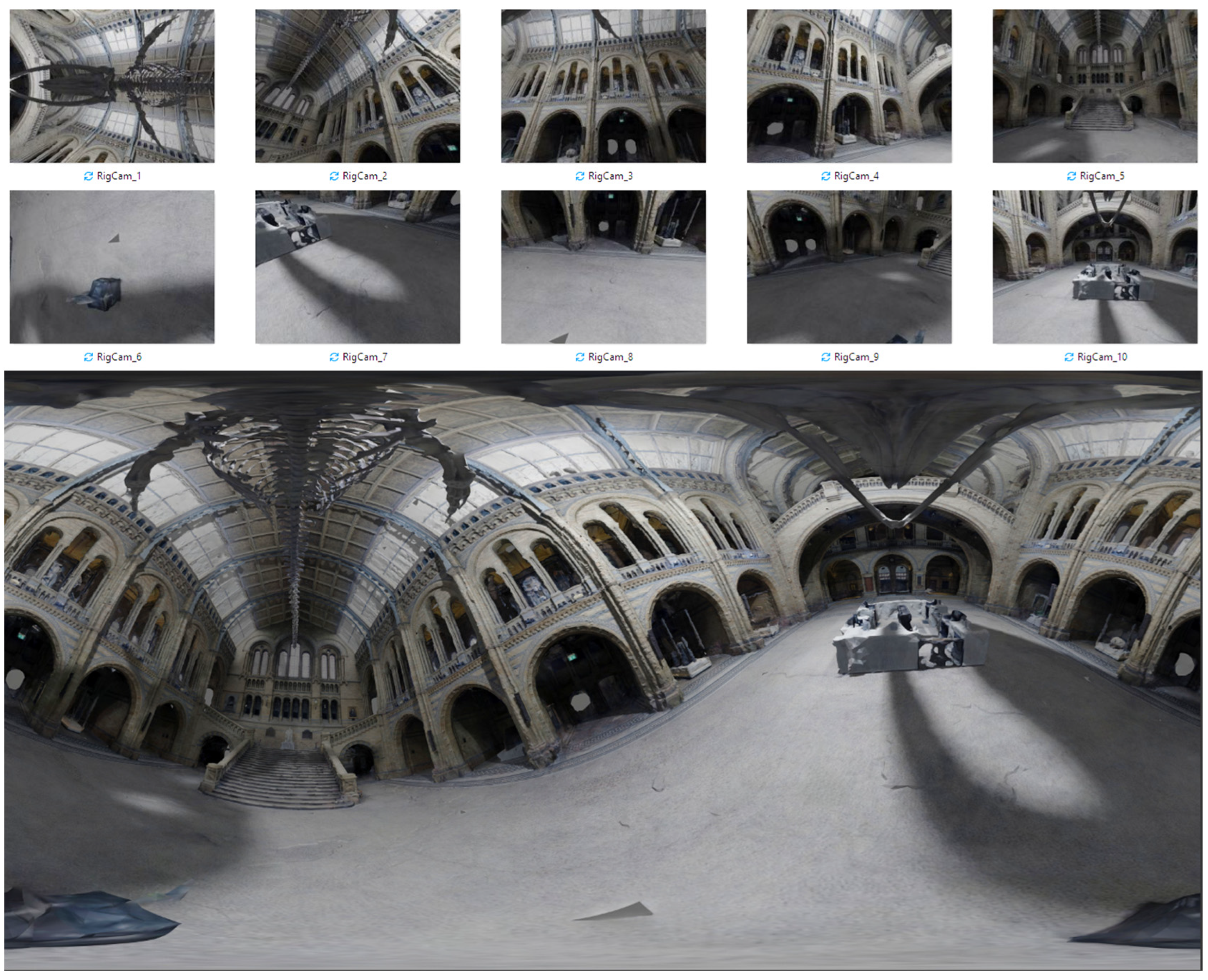
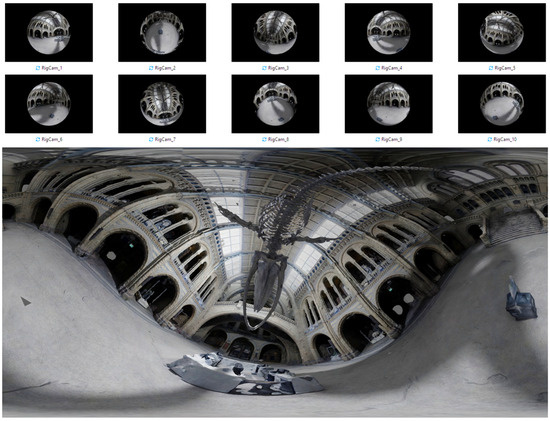
To complete the verification workflow, the synthetic images rendered in Blender were processed in Agisoft Metashape Version 2.0.2. Figure 13 shows a subset of the individual camera views at the nominal 27.6 MP resolution, and the resulting stitched equirectangular panorama. This demonstrates that the optimized rig achieves seamless full-sphere coverage, with overlaps consistent with the analytical design. For validation, ten virtual cameras were set up in Blender, each corresponding to one optimized camera pose in the spherical rig. All cameras were rendered simultaneously, and the resulting images were stitched together into an equirectangular panorama. No sequential repositioning of a single camera was done.
Figure 13.
Verification of the optimized rig using GoPro. (Top) Subset of synthetic camera images rendered in Blender at 27.6 MP each. (Bottom) Stitched equirectangular panorama, used to confirm full-sphere coverage and overlap consistency.
4.2. Experiment 2—Fisheye Lens
For the second experiment, we evaluated the framework in fisheye-cap mode using the same scene with a Sony IMX183 sensor (20 MP, 1″ format) paired with an Entaniya M12 fisheye lens (220° nominal FOV). The lens was modeled as a spherical cap with an effective cap FOV of 204° (half-angle 102°). As before, the target panorama resolution was 150 MP. These inputs drove the computation of per-camera solid angle, per-camera sampling density (pixels/steradian), and the required panorama density, followed by analytical lower bounds to initialize the search over the number of cameras.
Setup. We instantiate the optimizer with cap FOV = 204° → = 7.590 sr, = 11.94 MPx/sr, and the Sony fisheye configuration gives = 2.63 MPx/sr. From these, the framework estimates a required layer count = 5 (rounded up from ) and an initial lower bound = 10.
Lower bound and search policy. We start the outer search at = 10 and use the standard doubling-and-bisection strategy to identify the minimal feasible constellation that satisfies the coverage, overlap, and clearance constraints.
Results.
: SQP converges to a feasible solution with coverage meeting the target; the achieved minimum density is 13.15 MPx/sr ≥ 11.94 MPx/sr. This satisfies the resolution requirement, so is selected as optimal.
Optimization details. For each tested , we optimized the yaw (), pitch (), and roll () of all cameras (the directions ), with:
- a coverage term using softened FOV boundaries and a soft layer count K(n),
- a repulsion term to discourage clustering, and
- a capsule-clearance constraint to avoid inter-camera intersections.
- All runs terminated as local minima with constraints satisfied, consistent with stable separation and smooth coverage (objective values on the order of 10−3–10−4 across iterations).
Outputs (* = 10).
- Suggested rig radius: 146.7 mm
- Coverage fraction: 100%
- Uniform panorama: 165.3 MP (2:1 size 18,180 × 9090)
- Adaptive panorama: 201.0 MP
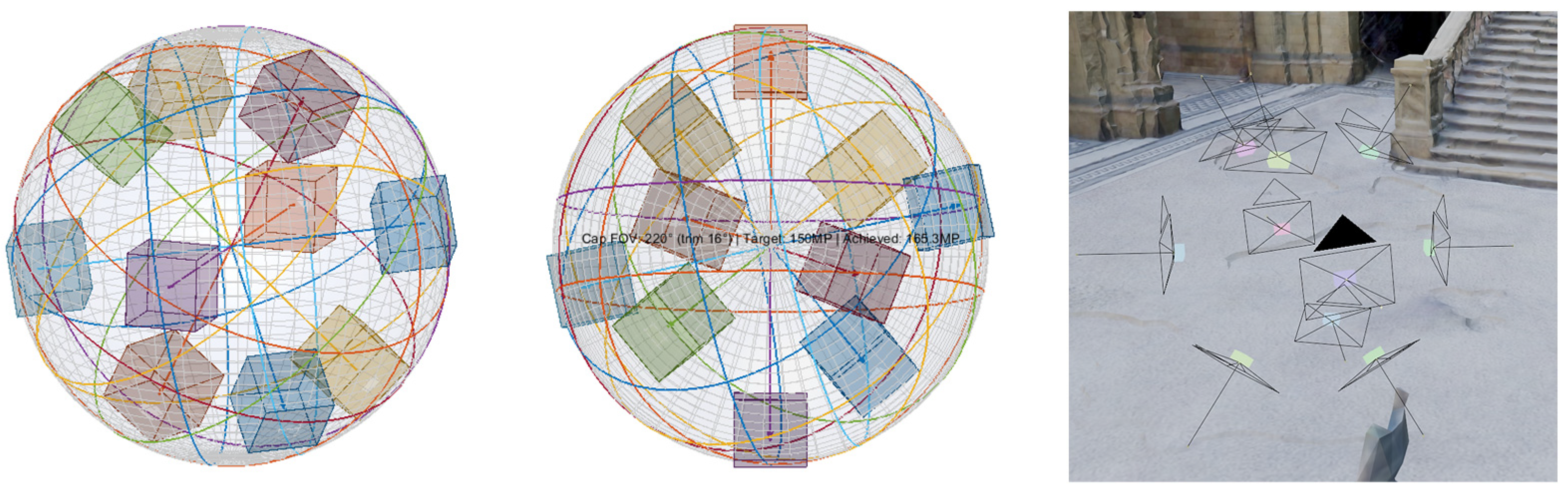
Summary. With a 204° fisheye cap on a Sony sensor and a target density of 11.94 MPx/sr, the optimizer selects 10 cameras (Figure 14) as the minimal constellation achieving full-sphere coverage while meeting overlap and clearance constraints, delivering a uniform 165.3 MP panorama at the suggested radius.
Figure 14.
Optimized spherical camera constellation of fisheye lenses with = 10, R = 14.7 cm. (Left), Middle MATLAB visualization. (Right) Blender simulation of the same rig, used for panorama stitching and verification.
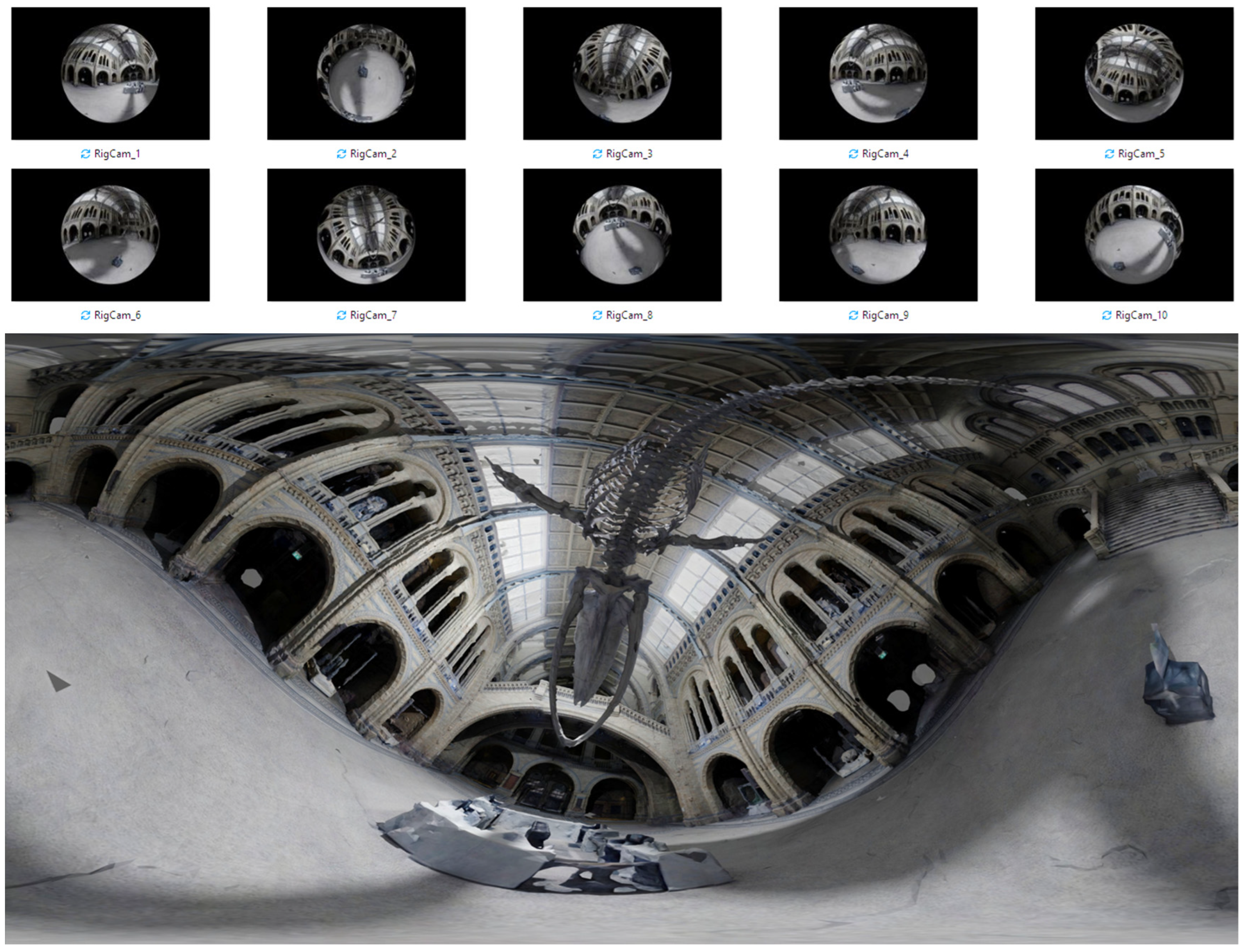
To finalize the verification workflow, the synthetic fisheye images generated in Blender were imported into Agisoft Metashape for processing. Figure 15 illustrates a selection of the individual camera views at their nominal 20-MP resolution, alongside the stitched equirectangular panorama. These results confirm that the optimized rig delivers seamless full-sphere coverage, with overlaps in line with the analytical design expectations. As in the previous experiment, the fisheye validation involved rendering 10 camera views simultaneously in Blender, each set to its optimized pose. The resulting stitched panorama in Figure 15 illustrates the output of a multi-camera spherical rig rather than a sequence of images from a single camera.
Figure 15.
Verification of the optimized rig using the Fisheye lens. (Top) A subset of synthetic camera images rendered in Blender at 20 MP each. (Bottom) Stitched equirectangular panorama, used to confirm full-sphere coverage and overlap consistency.
Supplementary Materials, including a summary video and additional rendered panoramas and images produced by the optimized camera rigs, are available online.
5. Discussion
The proposed optimization is essential for metrology uses, where camera orientations must stay fixed and known during acquisition. In these cases, capturing many extra images is undesirable because it adds to calibration efforts, uncertainty, and data management issues.
The results from experiments with the two camera types, namely the GoPro Hero 13 Black and the Sony IMX183 with a fisheye lens, have demonstrated both the reliability and generalizability of the proposed optimization framework. The solver’s consistency, which achieves full-sphere coverage with a minimized camera count while adhering to a strict physical constraint, demonstrates that the methodological choices made in the design process were valid and corroborate aspects of the experimental framework.
An essential outcome of the experimental setups was the value of simultaneous modeling of both optical and physical constraints. Typical rig designs prioritize either field-of-view overlap for full-sphere coverage or maximize convenience for calibration. In this modification, the capsule-clearance condition is used to optimize the constraint to create a more level optimization across all conditions. The experimental outcomes clearly demonstrated the benefits of incorporating this type of constraint, as ignoring this constraint, along with the others, would likely produce a redundant coverage area, fail to account for the available sensor count efficiently, or simply be physically infeasible for rig models.
Another critical finding is the role of the coverage–repulsion balance in determining optimal configurations. The repulsion term, based on Gaussian penalties for small angular separations, successfully prevents clustering and promotes even sensor distribution. This leads to constellations with greater angular diversity and a more uniform pixel density across the sphere, which is essential for consistent panorama quality.
A key discovery is how the coverage–repulsion balance influences optimal configurations. The repulsion component, based on Gaussian penalties for minimal angular separations, effectively prevents clustering and promotes uniform sensor spread. This leads to constellations with greater angular diversity and a more even pixel density across the sphere, essential for maintaining consistent quality in multi-directional panoramas.
Furthermore, the inclusion of soft coverage loss with logistic gates and softplus penalties enables stable gradient optimization while preserving geometric interpretability. In contrast to complex inclusion tests, which can cause steep discontinuities in the landscape of loss, the proposed soft formulation leads to superior convergence properties within the SQP solver.
The inclusion of an antipodal symmetry prior for specific configurations further demonstrates how structural constraints can simplify the optimization landscape while maintaining or even improving solution quality. This regularization is particularly useful for ensuring both aesthetic and functional balance in dual-sided or mirrored imaging systems. While the framework performed well relative to the conditions tested in this work, limitations still exist. The current formulation assumes uniform target resolution across the sphere and does not yet support anisotropic or region-prioritized coverage goals. However, the framework can be easily extended by adding a spatially varying target density or weighting function on the unit sphere, which allows the coverage loss to more heavily penalize undersampling in task-relevant directions. For instance, facades, horizons, or regions of interest can be assigned higher target densities, while less critical areas are given lower weights. This extension maintains the core optimization structure while enabling application-specific sensor focus configurations.
Furthermore, the computational complexity of the SQP solver increases as the number of cameras and coverage directions grows. This can limit scalability for very high-resolution rigs or real-time design tasks. In practice, the framework is designed for offline rig design, where optimization is performed once and reused across multiple acquisitions. To manage larger camera counts, scalability can be improved by using multi-resolution or adaptive sampling of the sphere, reducing sampling density during early optimization stages, and parallelizing coverage evaluation, such as through GPU acceleration. Alternative or hybrid optimization methods may also be considered for extremely large-scale setups.
While the proposed framework primarily targets geometric rig design, the resulting camera setups also impact downstream tasks. Uniform angular sampling and controlled camera spacing ease multi-camera calibration by enhancing parameter conditioning and minimizing degeneracies. Furthermore, having viewing directions more evenly distributed can improve photometric consistency and overlap regularity in image stitching, which may reduce seam artifacts and radiometric discontinuities. These overall advantages support future efforts to combine geometric optimization with calibration and image-processing strategies.
Finally, the Blender-based validation pipeline confirmed that the analytical coverage estimates align closely with the rendered panoramas, both in uniform- and adaptive-resolution metrics. This supports the framework’s practical utility in real-world design tasks, from robotic mapping to immersive content generation.
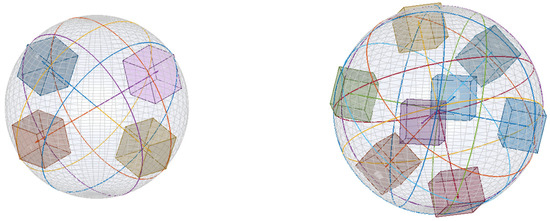
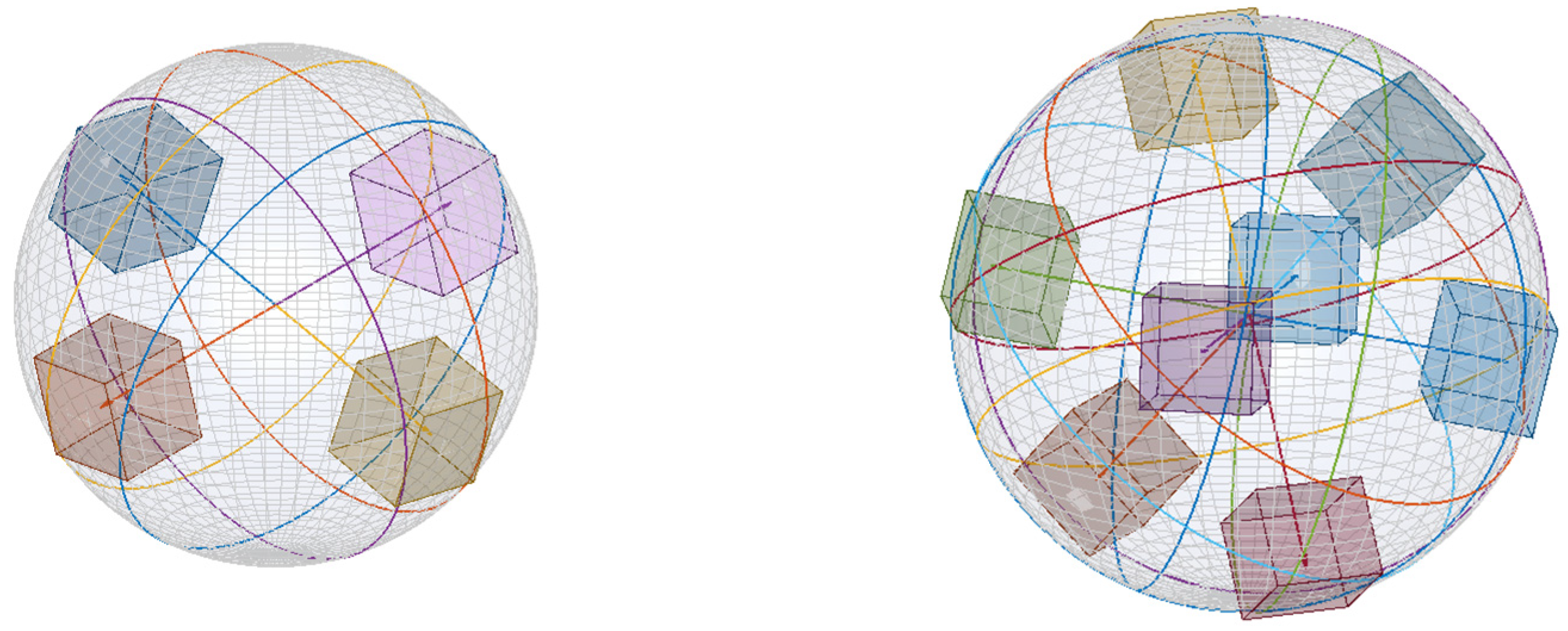
Table 1 summarizes the effect of increasing the panorama target from 50→100 MP, which doubles the required layering (: 2→4), which in turn doubles the optimal camera count () and the achieved uniform/adaptive panorama MP; the suggested rig radius grows slightly due to capsule-clearance constraints. As illustrated in Figure 16, increasing the target panorama resolution leads to a higher optimal number of cameras and a modest increase in rig radius due to the capsule-clearance constraints.
Table 1.
Illustration of doubling the target resolution and its impact on the design parameters.
Figure 16.
Doubling the panorama pixel target doubles the optimal constellation from 4 to 8 cameras, and the rig radius increases slightly due to capsule clearance constraints.
6. Conclusions
In this paper, a complete optimization framework is presented for designing spherical multi-camera rigs that satisfy uniform coverage, resolution, and physical feasibility constraints. The proposed framework combines soft coverage modeling, inter-camera repulsion, and a capsule model to constrain collision avoidance in a minimally feasible nodal constellation that is functionally robust and practically deployable.
In three distinct experimental scenarios, using both conventional frame cameras (GoPro) and wide-angle fisheye configurations, the framework consistently determined the optimal camera count and distribution to achieve full-sphere coverage with minimal redundancy. Efficient sequential quadratic programming was used to explore the non-convex design space, while validation steps confirmed agreement between analytical predictions and rendered panoramas.
Key contributions of this work include:
- A mathematically rigorous framework for spherical coverage based on solid angles.
- A soft, differentiable loss function that can provide efficient gradient-based optimization.
- A geometric collision-avoidance model based on capsule-clearance constraints.
- An adaptive search strategy that reliably identifies the minimal feasible rig configuration.
Future work will expand the framework to incorporate support for directional-resolution weighting, multi-objective trade-offs, such as ease of calibration versus coverage redundancy, and opportunities for integration with photometrically-based error models or optimization that are aware of image stitching.
Supplementary Materials
The following supporting information is available at: Photogrammetry-Topics/spherical-camera-rig-metrology: Constraint-Aware Design of Spherical Camera Rigs for Full-Panorama Coverage (https://github.com/Photogrammetry-Topics/spherical-camera-rig-metrology/tree/main (accessed on 19 December 2025)).
Author Contributions
Conceptualization, B.A. and H.A.H.; methodology, B.A.; software, B.A.; validation, H.A.H., A.N.A. and H.R.M.; formal analysis, H.A.H.; investigation, A.N.A. and H.R.M.; resources, B.A.; data curation, B.A.; writing—original draft preparation, B.A., A.N.A. and H.R.M.; writing—review and editing, H.A.H., A.N.A. and H.R.M.; visualization, A.N.A. and H.R.M.; supervision, B.A. and H.A.H.; All authors have read and agreed to the published version of the manuscript.
Funding
This research received no external funding.
Data Availability Statement
The data are available upon request from the corresponding author.
Conflicts of Interest
The authors declare no conflicts of interest.
Abbreviations
The following abbreviations are used in this manuscript:
| Symbol | Definition | Notes |
| Camera body width, height, depth | Physical dimensions | |
| Clearance buffer | Safety margin in the capsule model | |
| Used in clearance constraints | ||
| Probe radius to camera tip | Used during optimization | |
| Closest to the rig center | ||
| Final suggested mounting radius | Post-optimization | |
| Radius from FOV geometry | Equation (27) | |
| Radius from collision constraint | Equation (27) | |
| Azimuth, elevation, roll | Optimization variables | |
| Unit vector | ||
| Used in repulsion and clearance | ||
| Effective solid angles (frame/fisheye) | Coverage metrics | |
| Sampling density (pixels/sr) | Per camera | |
| Required sampling density | Global target | |
| Required overlap layer count | Equations (4)–(5) | |
| Lower bounds on camera count | Equations (8)–(10) |
References
- Grand View Research, Inc. 360-Degree Camera Market Size, Share & Trends Analysis Report; Grand View Research, Inc.: San Francisco, CA, USA, 2023; p. 150. Available online: https://www.grandviewresearch.com/industry-analysis/360-degree-camera-market-report (accessed on 18 November 2025).
- Teledyne. Ladybug6. Available online: https://www.teledynevisionsolutions.com/products/ladybug6/?segment=iis&vertical=machine%20vision (accessed on 8 September 2025).
- Mosaic. Mosaic 360° Mobile Mapping Camera Systems. Available online: https://www.mosaic51.com/?utm_source=chatgpt.com (accessed on 8 September 2025).
- DJI. OSMO 360. Available online: https://www.dji.com/nl?from=site-nav (accessed on 8 September 2025).
- Afshari, H.; Seyid, K.; Schmid, A.; Leblebici, Y. Design and Implementation of Multi-Camera Systems Distributed over a Spherical Geometry; Springer: Berlin/Heidelberg, Germany, 2012; pp. 297–299. [Google Scholar]
- Labutov, I.; Jaramillo, C.; Xiao, J. Generating near-spherical range panoramas by fusing optical flow and stereo from a single-camera folded catadioptric rig. Mach. Vis. Appl. 2011, 24, 133–144. [Google Scholar] [CrossRef] [Scilit]
- Krishnan, G.; Nayar, S. Towards a True Spherical Camera; SPIE: Bellingham, WA, USA, 2009; Volume 7240. [Google Scholar]
- Lian, T.; Farrell, J.; Wandell, B. Image Systems Simulation for 360° Camera Rigs. Electron. Imaging 2018, 30, 1–5. [Google Scholar] [CrossRef] [Scilit]
- Mazhar, O.; Jamaluddin, A.Z.; Jiang, C.; Fofi, D.; Seulin, R.; Morel, O. Design and Calibration of a Specialized Polydioptric Camera Rig. Front. ICT 2017, 4, 19. [Google Scholar] [CrossRef] [Scilit]
- An, P.; Liu, Q.; Abedi, F.; Yang, Y. Novel calibration method for camera array in spherical arrangement. Signal Process. Image Commun. 2020, 80, 115682. [Google Scholar] [CrossRef] [Scilit]
- Perfetti, L.; Bruno, N.; Roncella, R. Multi-Camera Rig and Spherical Camera Assessment for Indoor Surveys in Complex Spaces. Remote Sens. 2024, 16, 4505. [Google Scholar] [CrossRef] [Scilit]
- Bruno, N.; Perfetti, L.; Fassi, F.; Roncella, R. Photogrammetric survey of narrow spaces in cultural heritage: Comparison of two multi-camera approaches. Int. Arch. Photogramm. Remote Sens. Spat. Inf. Sci. 2024, XLVIII-2/W, 87–94. [Google Scholar] [CrossRef] [Scilit]
- Pagani, A.; Stricker, D. Structure from Motion using full spherical panoramic cameras. In Proceedings of the 2011 IEEE International Conference on Computer Vision Workshops (ICCV Workshops), Barcelona, Spain, 6–13 November 2011; pp. 375–382. [Google Scholar] [CrossRef] [Scilit]
- Penshin, I.N. Application of a spherical camera model for solving photogrammetric tasks. Geod. Cartogr. 2023, 997, 38–46. [Google Scholar] [CrossRef] [Scilit]
- Teppati Losè, L.; Chiabrando, F.; Spanò, A. Preliminary Evaluation of A Commercial 360 Multi-Camera Rig for Photogrammetric Purposes. Int. Arch. Photogramm. Remote Sens. Spatial Inf. Sci. 2018, XLII-2, 1113–1120. [Google Scholar] [CrossRef] [Scilit]
- Priyadharshini, S.; Mahapatra, A. MOHASA: A Dynamic Video Synopsis Approach for Consumer-Based Spherical Surveillance Video. IEEE Trans. Consum. Electron. 2024, 70, 290–298. [Google Scholar] [CrossRef] [Scilit]
- Safeea, M.; Neto, P.; Bearee, R. Efficient Calculation of Minimum Distance Between Capsules and Its Use in Robotics. IEEE Access 2019, 7, 5368–5373. [Google Scholar] [CrossRef] [Scilit]



Disclaimer/Publisher’s Note: The statements, opinions and data contained in all publications are solely those of the individual author(s) and contributor(s) and not of MDPI and/or the editor(s). MDPI and/or the editor(s) disclaim responsibility for any injury to people or property resulting from any ideas, methods, instructions or products referred to in the content. |
© 2026 by the authors. Licensee MDPI, Basel, Switzerland. This article is an open access article distributed under the terms and conditions of the Creative Commons Attribution (CC BY) license.