


Abstract
Health systems challenges that emerged during the COVID-19 pandemic, such as a lack of resources and medical staff, are forcing solutions which optimize healthcare performance. One of the solutions is the development of clinical decision support systems (CDSS) based on artificial intelligence (AI). We classified AI-based clinical decision-supporting systems used during the pandemic and evaluated the mathematical algorithms present in these systems. Materials and methods: we searched for articles relevant to the aim of the study in the Scopus publication database. Results: depending on the purpose of the development a clinical decision support system based on artificial intelligence during pandemic, we identified three groups of tasks: organizational, scientific and diagnostic. Tasks such as predicting of pandemic parameters, searching of analogies in pandemic progression, prioritization of patients, use of telemedicine are solved for the purposes of healthcare organization. Artificial intelligence in drugs and vaccine development, alongside personalized treatment programs, apply to new scientific knowledge acquisition. Diagnostic tasks include the development of mathematical models for assessing COVID-19 outcomes, prediction of disease severity, analysis of factors influencing COVID-19 complications. Conclusion: artificial intelligence methods can be effectively implemented for decision support systems in solving tasks that face healthcare during pandemic.
1. Introduction
In the context of the spread of COVID-19, national health systems around the world are under serious pressure. Most countries face the same challenges: lack of medical staff, overcrowding of hospitals, shortage of equipment and facilities for diagnosis and treatment, forced suspension of routine services, etc. According to the World Health Organization, about 40% of patients have a mild disease and do not require hospitalization, 40% of patients have moderate symptoms that may require hospitalization, 15% of patients have a severe disease requiring oxygen therapy and other medical treatment events in the hospital, and 5% of patients develop extremely severe pathologies requiring mechanical ventilation [1].
Another important aspect in the development of the pandemic is the high risk of infection for healthcare workers in primary healthcare centers and hospitals. Up to 10% of reported disease cases in China and up to 9% of all disease cases in Italy are among healthcare workers. In some EU countries, this rate reaches 26% [1,2].
With a sharp increase in the number of patients with coronavirus, a high incidence among medical workers has revealed the unpreparedness (unreadiness) of healthcare systems in many countries to work in a pandemic. In this situation, the introduction of artificial intelligence (AI) methods in the organization of medical care will significantly reduce the burden on medical personnel and help optimize resources.
Currently, there is a technological potential for the introduction of modern information technologies in the work of medical facilities in order to improve the quality of medical care. The aim of this study was to identify the possibilities of using artificial intelligence for clinical decision supporting systems (CDSS) during a pandemic.
2. Materials and Methods
The relevance of CDSS is evidenced by the results of search queries to the Scopus publication indexing system. Thus, the clinical decision supporting system query procured a total of 56,738 articles. Further, within the framework of the obtained search results, an additional search was carried out for information related to the application of machine learning and artificial intelligence methods within the framework of the CDSS. Based on the additional phrase “machine learning”, 7825 articles were filtered. Further, a pair of synonyms was added to the search query, describing belonging to research within the COVID-19 and SARS-CoV-2 pandemics with additional filtering by 2020 and 2022 publication years. After submitting a request to the indexing systems, we received 724 articles that were analyzed to determine the goal relevance for the review. Finally, only 92 original research articles were included finally to the review paper.
The artificial intelligence methods found during the search were classified depending on the direction of the practical problem being solved within the construction and application of the COVID-19-related CDSS.
The citation indexes of the journals were not taken into account when searching for the original research papers. This could be the possible limitation of the study.
3. Results and Discussion
Automation of processes aimed at solving the problems of medicine and healthcare during a pandemic has been investigated in hundreds of works. At the same time, a variety of publications can be summarized for solving organizational, scientific and diagnostic problems (Figure 1).
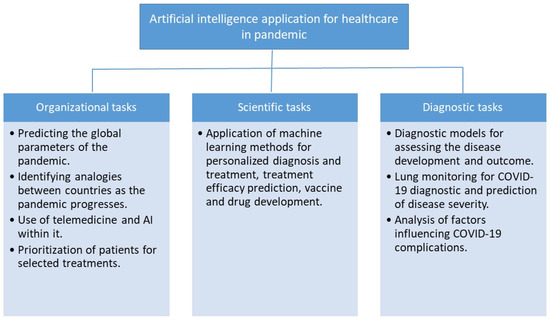
Figure 1.
The problems solved with AI-based decision support systems during pandemic.
3.1. Organizational Task
AI-based CDSS, solving the problems of medical care organizing.
The first group included tasks related to the organization of medical care in a pandemic, namely patient routing, resource administration (drugs, bed resources, medical devices), predicting the number of cases, and the prediction of recovery. It is for this group of tasks that the use of AI methods is the most promising. An analysis of the publications made it possible to identify the following areas of AI application:
3.1.1. Predicting the Global Parameters of the Pandemic
The aim of such system is to make decisions in the field of planning the load on the medical infrastructure and to make decisions on its adjustment, taking into account changing predicted values. It is not a classical AI-based CDSS for the management of individual patients, however, it serves to plan and administer global health parameters in a pandemic. These predictions make it possible to reserve the need to create medical resources to counter a pandemic and prevent situations in which the existing healthcare system is unable to accept patients in the quantities that arise during the development of a pandemic.
Actually, almost all of these methods are aimed at analyzing the time series of morbidity/recovery/mortality parameters to construct predictive models. Another specific task is to discover the country regions with similar parameters of pandemic development via clusterization methods [3]; DNN and decision trees [4] describe such areas by some common features and build analogies for the pandemic development prognosis.
Moreover, we include in this group a method of monitoring the local environment to detect violations of the regime and the presence of symptoms, which also allow us to monitor the overall situation, deal with violations of the regime and predict their extent and consequences. The local environment (humidity, temperature, wind) influence on the number of COVID-19 cases also can be analyzed by AI methods [5].
Methods of regression analysis including support vector regression are used to make a continuous prediction [6,7,8,9,10,11], while SVM [7,8], fuzzy inference system [12], varieties of recurrent neural networks [13,14,15,16,17] are used to build predictive models with discreet output. ANN model [18], Genetic Programming (GP) algorithm [19], Susceptible-Exposed-Infectious-Removed model (SEIR) combined with the AI model [20], statistical Auto-Regressive Integrated Moving Average (ARIMA) method [21] and Naïve Bayes [22] are also suitable in predicting the number of confirmed, deceased, and recovered cases and the estimation of epidemiology curve.
3.1.2. Research Identifies Similar Variants of the Disease Development When Comparing the Dynamics of Patients’ Treatment
Based on these, data comparison is made between countries in terms of the course of the disease in infected individuals.
For solving this task, clustering methods are applied, such as K-means, or Fuzzy PROMETHEE (Preference Ranking Organization METHod for Enrichment of Evaluations) and VIKOR (from Serbian: VIseKriterijumska Optimizacija I Kompromisno Resenje, that means: Multicriteria Optimization and Compromise Solution) methods. The input parameters are tied to the problem being solved (depending on the type of searched analogy and the parameters of the region or patients) [3,8].
3.1.3. General Review Papers on the Use of Telemedicine and AI within It Contain a Minimum of Specific Information on Solutions within the AI-Based CDSS
These papers are the most significant ones in terms of the number of works, therefore they are mentioned as a part of this review. This section included a number of works that, with some specifics (algorithms, results), could be attributed to other methods [23,24,25] as well as specific software solutions without describing their content and implementation [26]. These works confirm the applicability of AI methods for data analysis, but they are not allowed to be compared with similar tasks. There is the task of diet correction or disease monitoring using telemedicine when the in-person treatment is impossible under the restrictions associated with COVID-19 [24,26].
3.1.4. The Task to Prioritize Patients for Selected Treatments Based on Their Individual Characteristics (e.g., Blood Types) and the Severity of the Current Condition [27,28,29]
The input data mainly includes diagnostic parameters (laboratory, X-ray data). Due to high workload of clinical laboratories an automated methods are needed even for such a trivial task as blood type analysis and machine learning methods have a great potential in this field. In paper [28], a deep convolutional neural network was trained to classify images of a blood test samples after applying specific antigens to determine the blood types [28]. An estimation of risk factors of COVID-19 severity allows us to prioritize patients providing them a better treatment. Machine learning methods such as regression, random forests (RF), support vector machines (SVM), and artificial neural networks (ANN), which can solve feature importance problem along with predictive model construction are used [27,29].
We include in this group methods that allow us to predict disease severity thus aiding us in better resource planning and allocation. Fusion modeling using medical history and current treatment data can forecast the need for hospitalization for patients infected with COVID-19 at the time of the RT-PCR test [30]. Accurate prediction of COVID-19 severity is possible after analyzing clinical data with 5-layer deep neural network (DNN) [31]. Deep learning models with an autoencoder-based approach estimate the spread of the disease and predict the survival possibilities of the quarantined patients in isolation [32].
3.2. Research Tasks
The second group includes research tasks aimed at obtaining new knowledge through the analysis of complexly structured data, a large amount of heterogeneous data and intended to predictive assessment of health status, improving the quality of medical care. We included the following subtasks in this group:
Application of Machine Learning Methods in DNA Analysis for Mutation Detection, Personalized Diagnosis and Treatment, Treatment Efficacy Prediction [33,34], Vaccine Development [35] and Drug Development [36]
The input data are either a sequence of genes [37,38] or the structural chemical composition of the studied substances in the form of a sequence [36]. For example, in [39] 3C-like protease inhibitors were created by a novel generative adversarial network. For gene analysis, statistical methods such as Markov models or Monte Carlo methods is used to build sequences from available samples [34,39].
The output is possible for the next elements of the gene sequence, genomic biomarkers that affect the course of diseases, or options for potentially effective drugs.
3.3. Diagnostics Tasks
This group includes approaches aimed at assisting the physician in making a diagnosis, prescribing drugs, and providing hardware assistance. Despite the objective importance of diagnostic tasks, we left them only the third place in our classification, since the decision about the patient’s condition, the conclusion about treatment administration, in any case, should be made by the physician. There are following subsections within the framework of AI participation in diseases diagnostics.
3.3.1. Diagnostic Models Aimed at Assessing the Likelihood of Any Manifestation of the Disease, Its Development and Outcome
The best performance was observed in models based on clinical, laboratory and radiological variables [40]. Within the pandemic, these approaches have been used to predict the outcome of COVID-19 and have shown similar results. However, most of these studies do not include continuous physiological signals (e.g., ventilator parameters, vital signals) for prediction and do not work in real-time. Such information would significantly improve the characteristics of predicting in terms of expanding the classes of problems being solved (not only a single prediction, but also monitoring in dynamics) [41]. A subspecies of diagnostic application is an approach for predicting the development of a disease and developing personalized patient management and treatment plans based on the success of previous patients with a similar prognosis [42].
An analysis of the solutions found showed that the created systems are mainly aimed at predicting survival/death (the metric of belonging to a class can be used to assess the risk of death). In the framework of solving these problems, statistical regression methods and their modifications are most often encountered [27,41,42,43,44,45,46,47,48]. There are also decision trees [10,27,49], K nearest neighbors (KNN) [50], and SVM [46,48]. Neural network algorithms are found, but relatively infrequently due to small amount of annotated data [27]. Methods for constructing decision-making systems based on several classifiers and combining their decisions (ensemble methods [46]) have a mean F1 score of more than 0.8. At the same time, within the framework of the study, both for this one and for other classes, the data sets differ greatly. Standard datasets used simultaneously in many significant works have not been identified. This leads to the fact that quality metrics can be used for comparison within the same work but are poorly applicable for comparison within different works on different data. This makes it possible to assess the general applicability of solutions, but it does not allow us to clearly identify the best ones.
In addition, the analysis showed the predominance of systems for constructing a predictive model for a patient without real-time monitoring of his condition. This can be seen from the prevailing use of input data such as age, gender, chronic diseases (clearly static parameters within the disease), blood test results (not monitored in real time, although it is possible to conduct repeated studies and track dynamics).
The latest works show that AI-based analysis of data from wearable devices (with LTSM-based autoencoder) [51], biosensors (with Fuzzy-based decision tree) [52] and audio data (with Deep learning–enabled tracking tool using gated recurrent units) [53] can accurately differentiate between healthy and COVID-19 infected people and predict recovery mode. Furthermore, custom gradient boosting ensemble learning method makes it possible to predict infection in real time after analyzing the data from wearable devices [54].
3.3.2. One of the Diagnostic Use of CDSS Is Lung Monitoring Based on Classical X-ray and CT Image Analysis Both for Direct Diagnosis of COVID-19 [55] and for Separating Pneumonia into Bacterial and Disease-Induced COVID-19 [56]
This category of tasks uses image analysis methods almost always associated with the use of deep learning methods, namely convolutional neural networks [55,57,58,59,60,61,62,63,64,65,66,67,68,69,70] and its combination with other methods: SVM [71], U-net [72], Feed-Forward and Neural Network [73], random survival forest [74], belief function-based CNN [75]. Extreme learning machine (ELM) method [76] and SVM [57] are also encountered. The use of SVM to extract parameters according to the encoder principle with subsequent application of other methods (KNN, RF, SVM for decision making [56]) seems promising.
The input parameters are the results of radiographs or computed tomography. The output results within the solutions found are the classification results for the absence of pneumonia/non-COVID-19 pneumonia/COVID-19 associated pneumonia. A solution has been found, which allows for a full cycle of diagnostics and monitoring of patient treatment [64]. However, the analysis of CT results is described without a detailed description of other aspects. For this reason, this work is assigned to this class, and not allocated to an independent class.
Adding more information to CT scans such as acoustic data or results of RT-PCR tests gives high diagnostic accuracy after analyzing with Deep Learning-assisted Multi-modal Data Analysis [77] and EfficientNet-B0 initialized on ImageNet pretrained weights [78], respectively.
3.3.3. Analysis of Factors in the Diagnosis of COVID-19 and Complications [79]
CT results are used as input data. Data are manually processed to extract parameters for subsequent analysis and predictive model construction. The outputs of the system are not a mortality prediction, but a metric describing the severity of the disease and the possibility of complications.
The widest data analysis methods are used, such as neural networks [80,81,82], KNN [80,83], regression methods [79,84,85,86], Bayes classifier and its modifications [80,81,87,88], fuzzy systems [89,90], RF [80], SVM [80,82]. There are also approaches based on the ensemble of different methods [91,92,93].
In addition, a system for predicting complications during treatment (the occurrence of acute respiratory distress syndrome (ARDS)) [92] is singled out separately. Initially, the work was included in the review as an example of a system for monitoring the patient’s condition and controlling the ventilation system, however, after a detailed study, it was found that it was aimed rather at identifying a dangerous complication and signaling about its occurrence. For this reason, the work is moved to the existing class. Works directly related to the management of systems for the treatment and monitoring of patients with COVID-19 are not found in the leading indexed publications.
We make a comparative table on the basis of the identified classes of application of AI methods in the construction of CDSS (Table 1), illustrating the applicability of individual methods within the designated classes of problems, the input parameters used in the solution, and the achieved accuracy indicators of the obtained models. The list of indicators below contains the exact metrics used in the review, and not a complete list of them:

Table 1.
Applicability of AI methods in the framework of tasks relatedto the COVID-19 pandemic, input parameters used in their solutions and achievable indicators of the resulting models.
- -
- Accuracy—the proportion of correctly defined examples. It is easy to understand and interpret. However, with unbalanced data sets it is not indicative and cannot be used as a quality criterion, because the less represented class, within which the greatest number of errors are made when targeting with a given metric, as a rule, is more important;
- -
- AUC (area under curve) is the area under the curve of the proportion of correct positive predictions versus the false positive predictions proportion;
- -
- Sensitivity and Specificity—the proportion of correctly predicted positive labels (true positives) and correctly predicted negative labels (true negative);
- -
- Coefficient of determination (R2)—proportion of the variance of the dependent variable, explained by the model under consideration;
- -
- Precision—shows what proportion of objects recognized as objects of a positive class is predicted correctly;
- -
- Recall—shows what proportion of objects that actually belong to the positive class is predicted correctly;
- -
- F1 is a metric that combines precision and recall with equal priority.
4. Conclusions
The current state of science makes it possible to adapt existing AI methods for solving new problems quickly, in particular those that have arisen during the COVID-19 pandemic. There are three areas of AI application for making medical decisions of the most diverse focus on work, from an individual patient to obtaining predictions on a global scale.
The most applicable mathematical algorithms for solving the organizational problems during a pandemic include: simple recurrent neural network, long-term short-term memory, gated repeating units, variational autoencoder, support vector regression, linear regression, K-means, logistic regression, neural networks, etc.
Variations of hidden Markov models, Monte Carlo method, GAN network are the best analytical methods for scientific problems.
Clinical decision-supporting systems based on logistic regression, support vector machine, nearest K neighbors, random forest, gradient boosting, ensembles, Gaussian process, linear models, naive Bayes, nearest neighbors, decision tree, discriminant analysis, etc. are used for diagnostic purposes.
Despite the overall positive trend, a number of shortcomings can be identified that can be considered the promising areas in the framework of the creation of AI-compiled CDSS in the context of counteracting COVID-19 and in a more general sense:
The vast majority of the found solutions are not aimed at processing the patient’s current indicators in real time. The papers consider the analysis of the patient’s input indicators, which, as a rule, are static in the context of a pandemic—age, gender, the presence of chronic diseases. On the basis of the static information, a single prognosis/diagnosis is given, on which basis a decision is made on hospitalization/severity of the condition; however, the results of continuous monitoring were not found in the works.
The analyzed works do not present CDSS aimed at managing patient support systems. The work only makes it possible to monitor the operation of the ventilator system, however, data on the management of this system depending on the patient’s condition, adaptation to them are not presented. This shows the prospects of research in the development of such systems that would reduce the burden on physicians, allowing them to monitor the patient’s condition and take part in the validation of decisions made by the system and to launchA appropriate treatment.
Author Contributions
Conceptualization I.T.; supervision I.T.; visualization I.K.; administration I.K.; D.V. writing—original draft preparation D.V. and E.K.; writing—review and editing E.S.; formal analysis I.S.; investigation E.K. All authors have read and agreed to the published version of the manuscript.
Funding
This research received no external funding.
Institutional Review Board Statement
Not applicable.
Informed Consent Statement
Not applicable.
Data Availability Statement
Not applicable.
Conflicts of Interest
The authors declare no conflict of interest.
References
- ECDC. Rapid Risk Assessment: Novel Coronavirus Disease 2019 (COVID-19) Pandemic: Increased Transmission in the EU/EEA and the UK—Sixth Update. Available online: https://www.ecdc.europa.eu/en/publications-data/rapid-risk-assessment-novel-coronavirus-disease-2019-covid-19-pandemic-increased (accessed on 20 May 2022).
- WHO. Strengthening the Health Systems Response to COVID-19. Available online: https://apps.who.int/iris/handle/10665/332783?locale-attribute=pt& (accessed on 20 May 2022).
- Zubair, M. An Efficient K-Means Clustering Algorithm for Analysing COVID-19. Available online: http://arxiv.org/abs/2101.03140 (accessed on 20 May 2022).
- Indumathi, N.; Eswari, S.M.; Salau, A.O.; Ramalakshmi, R.; Revathy, R. Prediction of COVID-19 Outbreak with Current Substantiation Using Machine Learning Algorithms; Springer: Singapore, 2021; pp. 171–190. [Google Scholar]
- Mahmoud, K.; Bebiş, H.; Usman, A.G.; Salihu, A.N.; Gaya, M.S.; Dalhat, U.F.; Abdulkadir, R.A.; Jibril, M.B.; Abba, S.I. Prediction of the effects of environmental factors towards COVID-19 outbreak using AI-based models. IAES Int. J. Artif. Intell. (IJ-AI) 2021, 10, 35–42. [Google Scholar] [CrossRef]
- Ayyoubzadeh, S.M.; Zahedi, H.; Ahmadi, M.; Kalhori, S.R.N. Predicting COVID-19 Incidence Through Analysis of Google Trends Data in Iran: Data Mining and Deep Learning Pilot Study. JMIR Public Health Surveill. 2020, 6, e18828. [Google Scholar] [CrossRef] [PubMed]
- Bhat, M.; Suvarna, B.; Nandipati, B.L. Nirupama Support vector regression for predicting COVID-19 cases. Eur. J. Mol. Clin. Med. 2020, 7, 4882–4893. [Google Scholar]
- Khan, F.; Saeed, A.; Ali, S. Modelling and forecasting of new cases, deaths and recover cases of COVID-19 by using Vector Autoregressive model in Pakistan. Chaos Solitons Fractals. 2020, 140, 110189. [Google Scholar] [CrossRef]
- Dumitras, A. Forecasting the Stability of COVID-19 on Indian Dataset with Prophet Logistic Growth Model. Available online: https://www.researchsquare.com (accessed on 17 May 2022).
- Gupta, A.; Gharehgozli, A. Developing a Machine Learning Framework to Determine the Spread of COVID-19. Int. J. Data Min. Model. Manag. 2022, 14, 89–109. [Google Scholar] [CrossRef]
- Gupta, M.; Jain, R.; Arora, S.; Gupta, A.; Javed Awan, M.; Chaudhary, G.; Nobanee, H. AI-enabled COVID-9 Outbreak Analysis and Prediction: Indian States vs. Union Territories. Comput. Mater. Contin. 2021, 67, 933–950. [Google Scholar] [CrossRef]
- Behnood, A.; Golafshani, E.M.; Hosseini, S.M. Determinants of the infection rate of the COVID-19 in the U.S. using ANFIS and virus optimization algorithm (VOA). Chaos Solitons Fractals 2020, 139, 110051. [Google Scholar] [CrossRef]
- Uddin, M.I.; Shah, S.A.A.; Al-Khasawneh, M.A. A Novel Deep Convolutional Neural Network Model to Monitor People following Guidelines to Avoid COVID-19. J. Sens. 2020, 2020, 8856801. [Google Scholar] [CrossRef]
- Zeroual, A.; Harrou, F.; Abdelkader, D.; Sun, Y. Deep Learning Methods for Forecasting COVID-19 Time-Series Data: A Comparative Study. Chaos Solitons Fractals 2020, 140, 110121. [Google Scholar] [CrossRef]
- Farooq, J.; Bazaz, A. A novel adaptive deep learning model of Covid-19 with focus on mortality reduction strategies. Chaos Solitons Fractals 2020, 138, 110148. [Google Scholar] [CrossRef]
- Car, Z.; Baressi Šegota, S.; Anđelić, N.; Lorencin, I.; Mrzljak, V. Modeling the Spread of COVID-19 Infection Using a Multilayer Perceptron. Comput. Math. Methods Med. 2020, 2020, 5714714. [Google Scholar] [CrossRef] [PubMed]
- Pandianchery, M.S.; Ravi, V. Explainable AI Framework for COVID-19 Prediction in Different Provinces of India. arXiv 2022, arXiv:2201.06997. [Google Scholar]
- Guo, Q.; He, Z. Prediction of the confirmed cases and deaths of global COVID-19 using artificial intelligence. Environ. Sci. Pollut. Res. 2021, 28, 11672–11682. [Google Scholar] [CrossRef] [PubMed]
- Anđelić, N.; Baressi Šegota, S.; Lorencin, I.; Mrzljak, V.; Car, Z. Estimation of COVID-19 epidemic curves using genetic programming algorithm. Health Inform. J. 2021, 27, 1460458220976728. [Google Scholar] [CrossRef] [PubMed]
- Feng, S.; Feng, Z.; Ling, C.; Chang, C.; Feng, Z. Prediction of the COVID-19 epidemic trends based on SEIR and AI models. PLoS ONE 2021, 16, e0245101. [Google Scholar] [CrossRef]
- Hasan, I.; Dhawan, P.; Rizvi, S.A.; Dhir, S. Data analytics and knowledge management approach for COVID-19 prediction and control. Int. J. Inf. Technol. 2022, 11, 1–18. [Google Scholar] [CrossRef]
- Tiwari, D.; Bhati, B.S.; Al-Turjman, F.; Nagpal, B. Pandemic coronavirus disease (Covid-19): World effects analysis and prediction using machine-learning techniques. Expert Syst. 2022, 39, e12714. [Google Scholar] [CrossRef]
- Chatterjee, P.; Tesis, A.; Cymberknop, L.J.; Armentano, R.L. Internet of Things and Artificial Intelligence in Healthcare During COVID-19 Pandemic—A South American Perspective. Front. Public Health 2020, 8, 600213. [Google Scholar] [CrossRef]
- Jesmin, S.; Kaiser, M.S.; Mahmud, M. Artificial and Internet of Healthcare Things Based Alzheimer Care During COVID 19. In International Conference on Brain Informatics; Springer International Publishing: Manhattan, NY, USA, 2020; pp. 263–274. [Google Scholar]
- Almallah, Y.Z.; Doyle, D.J. Telehealth in the time of Corona: ‘doctor in the house’. Intern. Med. J. 2020, 50, 1578–1583. [Google Scholar] [CrossRef]
- Albert, L.; Capel, I.; García-Sáez, G.; Martín-Redondo, P.; Hernando, M.E.; Rigla, M. Managing gestational diabetes mellitus using a smartphone application with artificial intelligence (SineDie) during the COVID-19 pandemic: Much more than just telemedicine. Diabetes Res. Clin. Pract. 2020, 169, 108396. [Google Scholar] [CrossRef]
- Xu, W.; Sun, N.N.; Gao, H.N.; Chen, Z.Y.; Yang, Y.; Ju, B.; Tang, L.L. Risk factors analysis of COVID-19 patients with ARDS and prediction based on machine learning. Sci. Rep. 2021, 11, 2933. [Google Scholar] [CrossRef] [PubMed]
- Albahri, O.S.; Al-Obaidi, J.R.; Zaidan, A.A.; Albahri, A.S.; Zaidan, B.B.; Salih, M.M.; Qays, A.; Dawood, K.A.; Mohammed, R.T.; Abdulkareem, K.H.; et al. Helping doctors hasten COVID-19 treatment: Towards a rescue framework for the transfusion of best convalescent plasma to the most critical patients based on biological requirements via ml and novel MCDM methods. Comput. Methods Programs Biomed. 2020, 196, 105617. [Google Scholar] [CrossRef] [PubMed]
- Schwab, P.; Schütte, A.D.; Dietz, B.; Bauer, S. Clinical Predictive Models for COVID-19: Systematic Study. J. Med. Internet Res. 2020, 22, e21439, ISSN 1438-8871. [Google Scholar] [CrossRef]
- Tariq, A.; Celi, L.A.; Newsome, J.M.; Purkayastha, S.; Bhatia, N.K.; Trivedi, H.; Gichoya, J.W.; Banerjee, I. Patient-specific COVID-19 resource utilization prediction using fusion AI model. Npj Digit. Med. 2021, 4, 1–9. [Google Scholar] [CrossRef] [PubMed]
- Chung, H.; Ko, H.; Kang, W.S.; Kim, K.W.; Lee, H.; Park, C.; Song, H.-O.; Choi, T.-Y.; Seo, J.H.; Lee, J. Prediction and Feature Importance Analysis for Severity of COVID-19 in South Korea Using Artificial Intelligence: Model Development and Validation. J. Med. Internet Res. 2021, 23, e27060. [Google Scholar] [CrossRef] [PubMed]
- Sinha, A.; Rathi, M. COVID-19 prediction using AI analytics for South Korea. Appl. Intell. 2021, 51, 8579–8597. [Google Scholar] [CrossRef] [PubMed]
- Forkan, A.R.M.; Khalil, I.; Atiquzzaman, M. ViSiBiD: A learning model for early discovery and real-time prediction of severe clinical events using vital signs as big data. Comput. Netw. 2017, 113, 244–257. [Google Scholar] [CrossRef]
- Nawaz, M.S.; Fournier-Viger, P.; Shojaee, A.; Fujita, H. Using artificial intelligence techniques for COVID-19 genome analysis. Appl. Intell. 2021, 51, 3086–3103. [Google Scholar] [CrossRef]
- Arshadi, A.K.; Webb, J.; Salem, M.; Cruz, E.; Calad-Thomson, S.; Ghadirian, N.; Collins, J.; Diez-Cecilia, E.; Kelly, B.; Goodarzi, H.; et al. Artificial Intelligence for COVID-19 Drug Discovery and Vaccine Development. Front. Artif. Intell. 2020, 3, 65. [Google Scholar] [CrossRef]
- Huang, G. Potential COVID-2019 3C-like Protease Inhibitors Designed Using Generative Deep Learning Approaches. Neurocomputing. ChemRxiv, 2020; preprint. [Google Scholar]
- Malone, B. Potential 2019-nCoV 3C-like Protease Inhibitors designed using generative deep learning approaches. ChemRxiv, 2020; preprint. [Google Scholar]
- Zhavoronkov, A.; Zagribelnyy, B.; Zhebrak, A.; Aladinskiy, V.; Terentiev, V.; Vanhaelen, Q.; Ivanenkov, Y. Potential non-covalent SARS-CoV-2 3C-like protease inhibitors designed using generative deep learning approaches and reviewed by human medicinal chemist in virtual reality. ChemRxiv, 2020; preprint. [Google Scholar] [CrossRef]
- Malone, B.; Simovski, B.; Moliné, C. Artificial intelligence predicts the immunogenic landscape of SARS-CoV-2 leading to universal blueprints for vaccine designs. Sci. Rep. 2020, 10, 2237. [Google Scholar] [CrossRef] [PubMed]
- Kwok, C.S.; Loke, Y.K.; Woo, K.; Myint, P.K. Risk Prediction Models for Mortality in Community-Acquired Pneumonia: A Systematic Review. BioMed Res. Int. 2013, 2013, e0181448. [Google Scholar] [CrossRef]
- Nan, S. A Prognostic Model for Death in COVID-19 Patients Presenting to the Emergency Room: The Added Value of Computed Tomography. Available online: https://www.researchsquare.com/article/rs-100749/v1 (accessed on 17 May 2022).
- Das, A.K.; Mishra, S.; Gopalan, S.S. Predicting CoVID-19 community mortality risk using machine learning and development of an online prognostic tool. PeerJ. 2020, 8, e10083. [Google Scholar] [CrossRef]
- Campbell, T.W. Predicting Prognosis in COVID-19 Patients using Machine Learning and Readily Available Clinical Data. medRxiv, 2021; preprint. [Google Scholar] [CrossRef]
- Shang, Y.; Liu, T.; Wei, Y.; Li, J.; Shao, L.; Liu, M.; Zhang, Y.; Zhao, Z.; Xu, H.; Peng, Z.; et al. Scoring systems for predicting mortality for severe patients with COVID-19. EClinicalMedicine 2020, 24, 100426, ISSN 2589-5370. [Google Scholar] [CrossRef]
- McRae, M.P.; Simmons, G.W.; Christodoulides, N.J.; Lu, Z.; Kang, S.K.; Fenyo, D.; Alcorn, T.; Dapkins, I.P.; Sharif, I.; Vurmaz, D.; et al. Clinical decision support tool and rapid point-of-care platform for determining disease severity in patients with COVID-19. Lab Chip 2020, 20, 2075–2085. [Google Scholar] [CrossRef]
- Subudhi, S. Comparing Machine Learning Algorithms for Predicting ICU Admission and Mortality in COVID-19. medRxiv, 2020; preprint. [Google Scholar] [CrossRef]
- Wu, G.; Zhou, S.; Wang, Y.; Lv, W.; Wang, S.; Wang, T.; Li, X. A prediction model of outcome of SARS-CoV-2 pneumonia based on laboratory findings. Sci. Rep. 2020, 10, 14042. [Google Scholar] [CrossRef]
- Wu, G.; Yang, P.; Xie, Y.; Woodruff, H.C.; Rao, X.; Guiot, J.; Frix, A.N.; Louis, R.; Moutschen, M.; Li, J.; et al. Development of a Clinical Decision Support System for Severity Risk Prediction and Triage of COVID-19 Patients at Hospital Admission: An International Multicenter Study. Eur. Respir. J. 2020, 56, 2001104. [Google Scholar] [CrossRef] [PubMed]
- Wang, J.; Yu, H.; Hua, Q.; Jing, S.; Liu, Z.; Peng, X.; Luo, Y. A descriptive study of random forest algorithm for predicting COVID-19 patients outcome. PeerJ 2020, 8, e9945. [Google Scholar] [CrossRef] [PubMed]
- Karthikeyan, A.; Garg, A.; Vinod, P.K.; Priyakumar, U.D. Machine Learning Based Clinical Decision Support System for Early COVID-19 Mortality Prediction. Front Public Health 2021, 9, 626697. [Google Scholar] [CrossRef] [PubMed]
- Bogu, G.K.; Snyder, M.P. Deep learning-based detection of COVID-19 using wearables data. medRxiv 2021. [Google Scholar] [CrossRef]
- Maheshwari, V.; Mahmood, R.; Sravanthi, S.; Arivazhagan, N.; ParimalaGandhi, A.; Srihari, K.; Sagayaraj, R.; Udayakumar, E.; Natarajan, Y.; Bachanna, P.; et al. Nanotechnology-Based Sensitive Biosensors for COVID-19 Prediction Using Fuzzy Logic Control. J. Nanomater. 2021, 2021, 3383146. [Google Scholar] [CrossRef]
- Dang, T.; Han, J.; Xia, T.; Spathis, D.; Bondareva, E.; Siegele-Brown, C.; Chauhan, J.; Grammenos, A.; Hasthanasombat, A.; Floto, R.A.; et al. Exploring Longitudinal Cough, Breath, and Voice Data for COVID-19 Progression Prediction via Sequential Deep Learning: Model Development and Validation. J. Med. Internet Res. 2022, 24, e37004. [Google Scholar] [CrossRef]
- Conroy, B.; Silva, I.; Mehraei, G.; Damiano, R.; Gross, B.; Salvati, E.; Feng, T.; Schneider, J.; Olson, N.; Rizzo, A.G.; et al. Real-time infection prediction with wearable physiological monitoring and AI to aid military workforce readiness during COVID-19. Sci. Rep. 2022, 12, 3797. [Google Scholar] [CrossRef]
- Raajan, N.R.; Lakshmi, V.R.; Prabaharan, N. Non-Invasive Technique-Based Novel Corona (COVID-19) Virus Detection Using CNN. Natl. Acad. Sci. Lett. 2020, 44, 347–350. [Google Scholar] [CrossRef]
- Xu, M.; Ouyang, L.; Han, L.; Sun, K.; Yu, T.; Li, Q.; Tian, H.; Safarnejad, L.; Zhang, H.; Gao, Y.; et al. Accurately Differentiating between Patients with COVID-19, Patients with Other Viral Infections, and Healthy Individuals: Multimodal Late Fusion Learning Approach. J. Med. Internet Res. 2021, 23, e2553. [Google Scholar] [CrossRef]
- Sethy, R.K.; Behera, S.K.; Ratha, P.K.; Biswas, P. Detection of coronavirus Disease (COVID-19) based on Deep Features and Support Vector Machine. Int. J. Math. Eng. Manag. Sci. 2020, 5, 643–651. [Google Scholar] [CrossRef]
- Müller, D. Automated Chest CT Image Segmentation of COVID-19 Lung Infection based on 3D U-Net. arXiv 2020, arXiv:2007.04774. [Google Scholar]
- Nagifa, I.P.; Hossain, M.S.; Andersson, K.A. Deep Transfer Learning Approach to Diagnose Covid-19 using X-ray Images. In Proceedings of the IEEE 2020 International Women in Engineering (WIE) Conference on Electrical and Computer Engineering (WIECON-ECE), Bhubaneswar, India, 26–27 December 2020; pp. 177–182. [Google Scholar]
- Qjidaa, M.; Ben-Fares, A.; Mechbal, Y.; Amakdouf, H.; Maaroufi, M.; Alami, B.; Qjidaa, H. Development of a clinical decision support system for the early detection of COVID-19 using deep learning based on chest radiographic images. In Proceedings of the 2020 International Conference on Intelligent Systems and Computer Vision (ISCV), Fez, Morocco, 9–11 June 2020; pp. 1–6. [Google Scholar]
- He, K.; Zhao, W.; Xie, X.; Ji, W.; Liu, M.; Tang, Z.; Shi, Y.; Shi, F.; Gao, Y.; Liu, J. Synergistic learning of lung lobe segmentation and hierarchical multi-instance classification for automated severity assessment of COVID-19. Pattern Recognit. 2021, 113, 107828. [Google Scholar] [CrossRef] [PubMed]
- Osorno-Castillo, K.; Fonnegra, R.D.; Díaz, G.M. Integration of Machine Learning Models in PACS Systems to Support Diagnostic in Radiology Services. In Applied Computer Sciences in Engineering; Springer International Publishing: Manhattan, NY, USA, 2020; pp. 233–244. [Google Scholar]
- Rajkumar, S.; Rajaraman, P.V.; Meganathan, H.S.; Sapthagirivasan, V.; Tejaswinee, K.; Ashwin, R. COVID-detect: Adeep learning approach for classification of COVID-19 pneumonia from lung segmented chest X-rays. Biomed. Eng. Appl. Basis Commun. 2021, 33, 2150010. [Google Scholar] [CrossRef]
- El-Rashidy, N.; El-Sappagh, S.; Islam, S.M.; El-Bakry, H.M.; Abdelrazek, S. End-To-End Deep Learning Framework for Coronavirus (COVID-19) Detection and Monitoring. Electronics 2020, 9, 1439. [Google Scholar] [CrossRef]
- Karthik, R.; Menaka, R.; Hariharan, M. Learning distinctive filters for COVID-19 detection from chest X-ray using shuffled residual CNN. Appl. Soft Comput. 2020, 99, 106744. [Google Scholar] [CrossRef]
- Liang, S.; Liu, H.; Gu, Y.; Guo, X.; Li, H.; Li, L.; Wu, Z.; Liu, M.; Tao, L. Fast automated detection of COVID-19 from medical images using convolutional neural networks. Commun. Biol. 2021, 4, 35. [Google Scholar] [CrossRef]
- Lorencin, I.; Šegota, S.B.; Anđelić, N.; Blagojević, A.; Šušteršić, T.; Protić, A.; Arsenijević, M.; Ćabov, T.; Filipović, N.; Car, Z. Automatic Evaluation of the Lung Condition of COVID-19 Patients Using X-ray Images and Convolutional Neural Networks. J. Pers. Med. 2021, 11, 28. [Google Scholar] [CrossRef]
- Ahrabi, S.S.; Scarpiniti, M.; Baccarelli, E.; Momenzadeh, A. An Accuracy vs. Complexity Comparison of Deep Learning Architectures for the Detection of COVID-19 Disease. Computation 2021, 9, 3. [Google Scholar] [CrossRef]
- Sheykhivand, S.; Mousavi, Z.; Mojtahedi, S.; Rezaii, T.Y.; Farzamnia, A.; Meshgini, S.; Saad, I. Developing an efficient deep neural network for automatic detection of COVID-19 using chest X-ray images. Alex. Eng. J. 2021, 60, 2885–2903. [Google Scholar] [CrossRef]
- Zhang, Y.-D.; Satapathy, S.C.; Liu, S.; Li, G.-R. A five-layer deep convolutional neural network with stochastic pooling for chest CT-based COVID-19 diagnosis. Mach. Vis. Appl. 2020, 32, 1. [Google Scholar] [CrossRef]
- Ismael, A.M.; Şengür, A. Deep learning approaches for COVID-19 detection based on chest X-ray images. Expert Syst. Appl. 2020, 164, 114054. [Google Scholar] [CrossRef] [PubMed]
- Pan, F.; Li, L.; Liu, B.; Ye, T.; Li, L.; Liu, D.; Ding, Z.; Chen, G.; Liang, B.; Yang, L.; et al. A novel deep learning-based quantification of serial chest computed tomography in Coronavirus Disease 2019 (COVID-19). Sci. Rep. 2021, 11, 417. [Google Scholar] [CrossRef] [PubMed]
- Varela-Santos, S.; Melin, P. A new approach for classifying coronavirus COVID-19 based on its manifestation on chest X-rays using texture features and neural networks. Inf. Sci. 2020, 545, 403–414. [Google Scholar] [CrossRef] [PubMed]
- Wang, R.; Jiao, Z.; Yang, L.; Choi, J.W.; Xiong, Z.; Halsey, K.; Tran, T.M.L.; Pan, I.; Collins, S.A.; Feng, X.; et al. Artificial intelligence for prediction of COVID-19 progression using CT imaging and clinical data. Eur. Radiol. 2021, 32, 205–212. [Google Scholar] [CrossRef]
- Huang, L.; Ruan, S.; Denoeux, T. Covid-19 Classification with Deep Neural Network and Belief Functions. In Proceedings of the the Fifth International Conference on Biological Information and Biomedical Engineering, Hangzhou, China, 20–22 July 2021. [Google Scholar] [CrossRef]
- Rajpal, S.; Agarwal, M.; Rajpal, A.; Lakhyani, N.; Saggar, A.; Kumar, N. COV-ELM classifier: An Extreme Learning Machine based identification of COVID-19 using Chest X-ray Images. arXiv 2020, arXiv:2007.08637. [Google Scholar] [CrossRef]
- Manocha, A.; Bhatia, M. A novel deep fusion strategy for COVID-19 prediction using multimodality approach. Comput. Electr. Eng. 2022, 103. [Google Scholar] [CrossRef]
- Kim, C.K.; Choi, J.W.; Jiao, Z.; Wang, D.; Wu, J.; Yi, T.Y.; Halsey, K.C.; Eweje, F.; Tran, T.M.L.; Liu, C.; et al. An automated COVID-19 triage pipeline using artificial intelligence based on chest radiographs and clinical data. Npj Digit. Med. 2022, 5, 5. [Google Scholar] [CrossRef]
- Shi, W.; Peng, X.; Liu, T.; Cheng, Z.; Lu, H.; Yang, S.; Zhang, J.; Wang, M.; Gao, Y.; Shi, Y.; et al. A deep learning-based quantitative computed tomography model for predicting the severity of COVID-19: A retrospective study of 196 patients. Ann. Transl. Med. 2021, 9, 216. [Google Scholar] [CrossRef]
- Chen, C.; Lin, W.; Yang, H. Diagnosis of ventilator-associated pneumonia using electronic nose sensor array signals: Solutions to improve the application of machine learning in respiratory research. Respir. Res. 2020, 21, 45. [Google Scholar] [CrossRef]
- D’Ambrosia, C.; Christensen, H.; Aronoff-Spencer, E. Computing SARS-CoV-2 Infection Risk from Symptoms, Imaging, and Test Data: Diagnostic Model Development. J. Med. Internet Res. 2020, 22, e24478. [Google Scholar] [CrossRef]
- Rawson, T.M.; Hernandez, B.; Wilson, R.C.; Ming, D.; Herrero, P.; Ranganathan, N.; Skolimowska, K.; Gilchrist, M.; Satta, G.; Georgiou, P.; et al. Supervised machine learning to support the diagnosis of bacterial infection in the context of COVID-19. JAC-Antimicrob. Resist. 2021, 3, dlab002. [Google Scholar] [CrossRef] [PubMed]
- Shaban, W.M.; Rabie, A.H.; Saleh, A.I.; Abo-Elsoud, M.A. A new COVID-19 Patients Detection Strategy (CPDS) based on hybrid feature selection and enhanced KNN classifier. Knowl.-Based Syst. 2020, 205, 106270. [Google Scholar] [CrossRef] [PubMed]
- Dugdale, C.M.; Rubins, D.M.; Lee, H.; McCluskey, S.M. COVID-19 Diagnostic Clinical Decision Support: A Pre-Post Implementation Study of CORAL (COvid Risk cALculator). Clin. Infect. Dis. Off. Publ. Infect. Dis. Soc. Am. 2021, 73, 2248–2256. [Google Scholar] [CrossRef] [PubMed]
- Halilaj, I.; Chatterjee, A.; van Wijk, Y.; Wu, G.; van Eeckhout, B.; Oberije, C.; Lambin, P. Covid19Risk. ai: An open source repository and online calculator of prediction models for early diagnosis and prognosis of COVID-19. BioMed 2021, 1, 41–49. [Google Scholar] [CrossRef]
- Shanbehzadeh, M.; Nopour, R.; Kazemi-Arpanahi, H. Determination of the Most Important Diagnostic Criteria for COVID-19: A Step forward to Design an Intelligent Clinical Decision Support System. J. Adv. Med. Biomed. Res. 2021, 29, 176–182. [Google Scholar] [CrossRef]
- Mansour, N.A.; Saleh, A.I.; Badawy, M.; Ali, H.A. Accurate detection of Covid-19 patients based on Feature Correlated Naïve Bayes (FCNB) classification strategy. J. Ambient Intell. Humaniz. Comput. 2021, 13, 41–73. [Google Scholar] [CrossRef]
- Silahudin, D.; Holidin, A. Model Expert System for Diagnosis of Covid-19 Using Naïve Bayes Classifier. In IOP Conference Series: Materials Science and Engineering; IOP Publishing: Bristol, UK, 2020; Volume 1007. [Google Scholar]
- Orozco-del-Castillo, M.G.; Novelo-Cruz, R.A.; Hernández-Gómez, J.J.; Mena-Zapata, P.A.; Brito-Borges, E.; Álvarez-Pacheco, A.E.; García-Gutiérrez, A.E.; Yáñez-Casas, G.A. Fuzzy Logic-Based COVID-19 and Other Respiratory Conditions Pre-clinical Diagnosis System. In Telematics and Computing Cham; Springer International Publishing: Manhattan, NY, USA, 2020; pp. 402–419. [Google Scholar]
- Nan, S.; Tang, T.; Feng, H.; Wang, Y.; Li, M.; Lu, X.; Duan, H. A Computer-Interpretable Guideline for COVID-19: Rapid Development and Dissemination. JMIR Med. Inform. 2020, 8, e21628. [Google Scholar] [CrossRef]
- AlJame, M.; Ahmad, I.; Imtiaz, A.; Mohammed, A. Ensemble learning model for diagnosing COVID-19 from routine blood tests. Inform. Med. Unlocked 2020, 21, 100449. [Google Scholar] [CrossRef]
- Rehm, G.B.; Woo, S.H.; Chen, X.L. Leveraging IoTs and Machine Learning for Patient Diagnosis and Ventilation Management in the Intensive Care Unit. IEEE Pervasive Comput. 2020, 19, 68–78. [Google Scholar] [CrossRef]
- Abdulkareem, K.H.; Mohammed, M.A.; Salim, A.; Arif, M.; Geman, O.; Gupta, D.; Khanna, A. Realizing an Effective COVID-19 Diagnosis System Based on Machine Learning and IOT in Smart Hospital Environment. IEEE Internet Things J. 2021, 8, 15919–15928. [Google Scholar] [CrossRef]
Publisher’s Note: MDPI stays neutral with regard to jurisdictional claims in published maps and institutional affiliations. |
© 2022 by the authors. Licensee MDPI, Basel, Switzerland. This article is an open access article distributed under the terms and conditions of the Creative Commons Attribution (CC BY) license (https://creativecommons.org/licenses/by/4.0/).