
Coaxial Electrospun PCL/PLA-CA Polymeric Membranes for pH-Responsive Acyclovir Delivery in Antiviral Scaffolds
 , , ,
, , ,  and
and
Abstract
1. Introduction
2. Materials and Methods
2.1. Materials
2.2. Membrane Preparation
2.3. Morphological Analysis
2.4. Confocal Laser Scanning Microscopy (CLSM) Characterization
2.5. Fourier Transform Infrared Spectroscopy (FTIR)
2.6. Proton Nuclear Magnetic Resonance (1H NMR) and Quantification of ACV Loading and Encapsulation Efficiency
2.7. Wettability Characteristics by Contact Angle Analysis
2.8. Stress−Strain Mechanical Test
2.9. Thermogravimetric Analysis (TGA)
2.10. Differential Scanning Calorimetry (DSC)
2.11. Drug Release Assay
2.11.1. Zero-Order Model
2.11.2. First-Order Model
2.11.3. Higuchi Model
2.11.4. Korsmeyer-Peppas Model
2.12. Cell Culture
2.13. Cytotoxicity Assay
2.14. Statistical Analysis
3. Results and Discussion
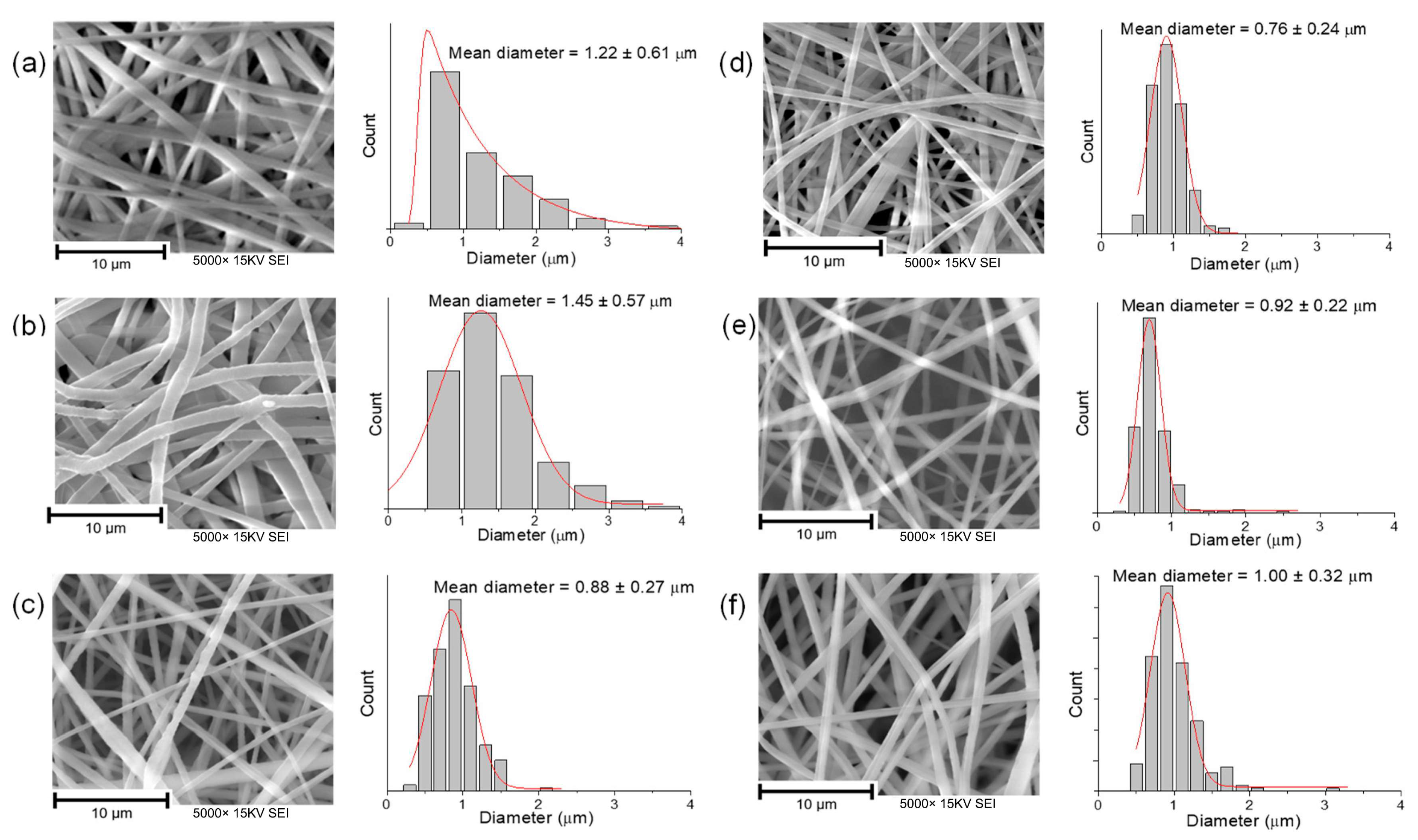
3.1. Morphological Analysis by Scanning Electron Microscopy (SEM)
3.2. Structural Validation of Coaxial Fibers by CLSM
3.3. Fourier Transform Infrared Spectroscopy (FTIR) Analysis
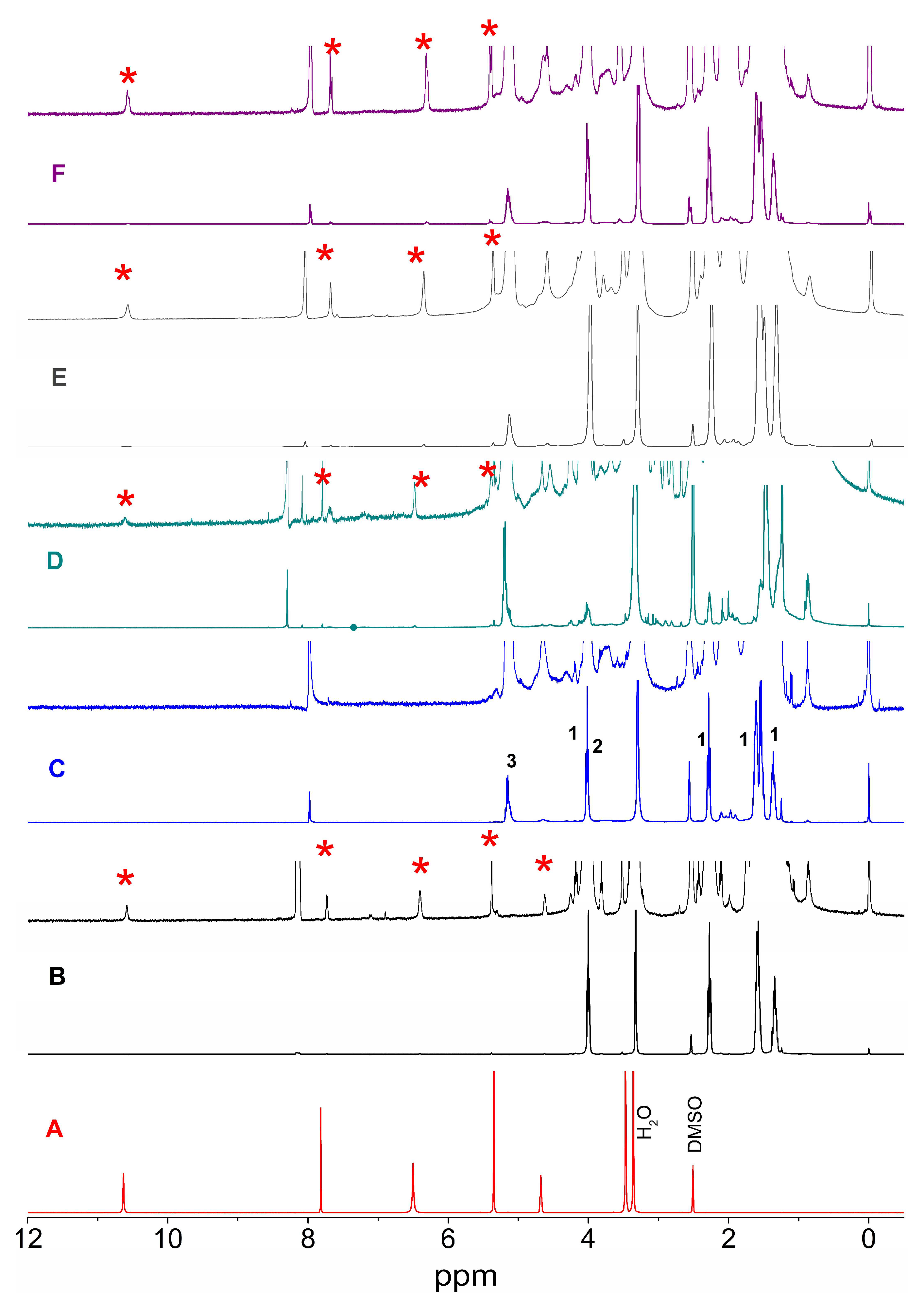
3.4. 1H NMR Analysis and Quantification of ACV Loading
3.5. Mechanical Properties
3.6. Wettability Analysis
3.7. Thermal Properties of Membranes
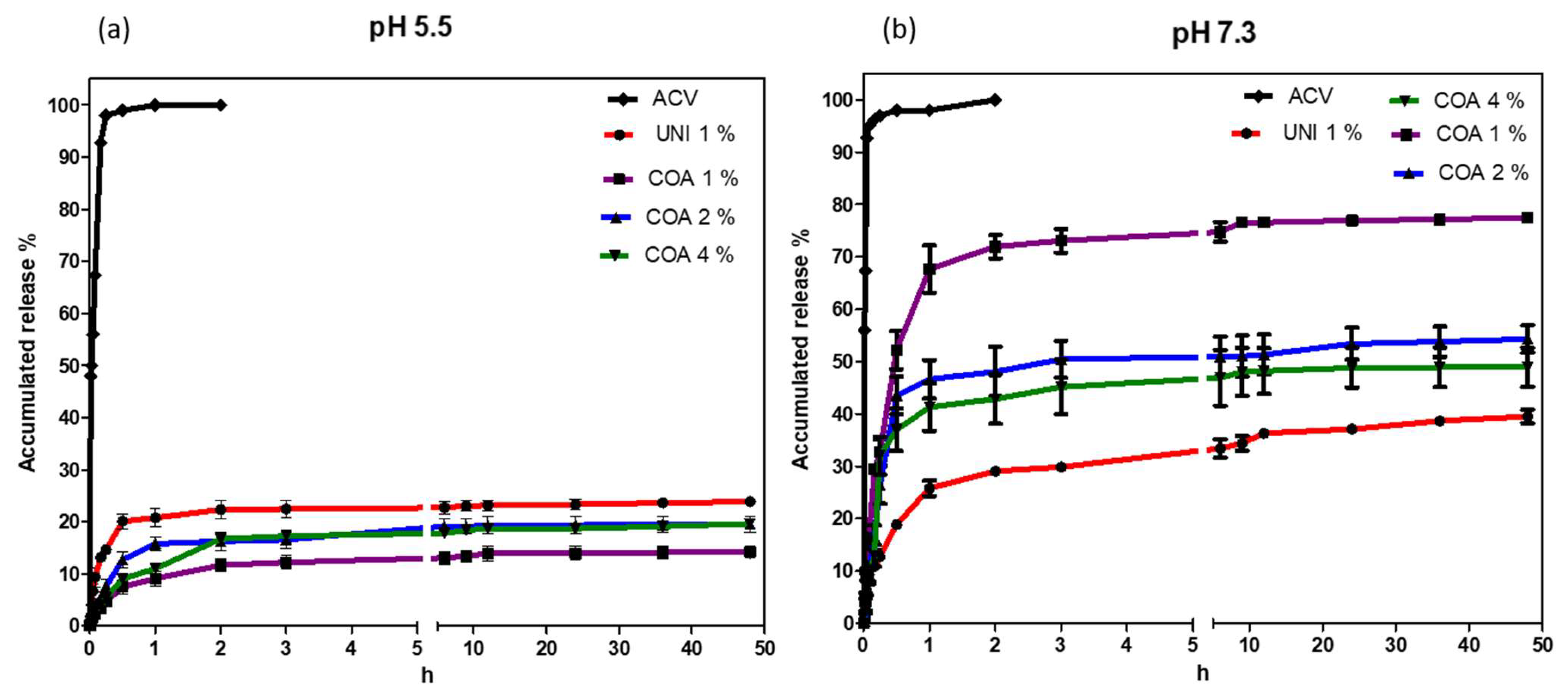
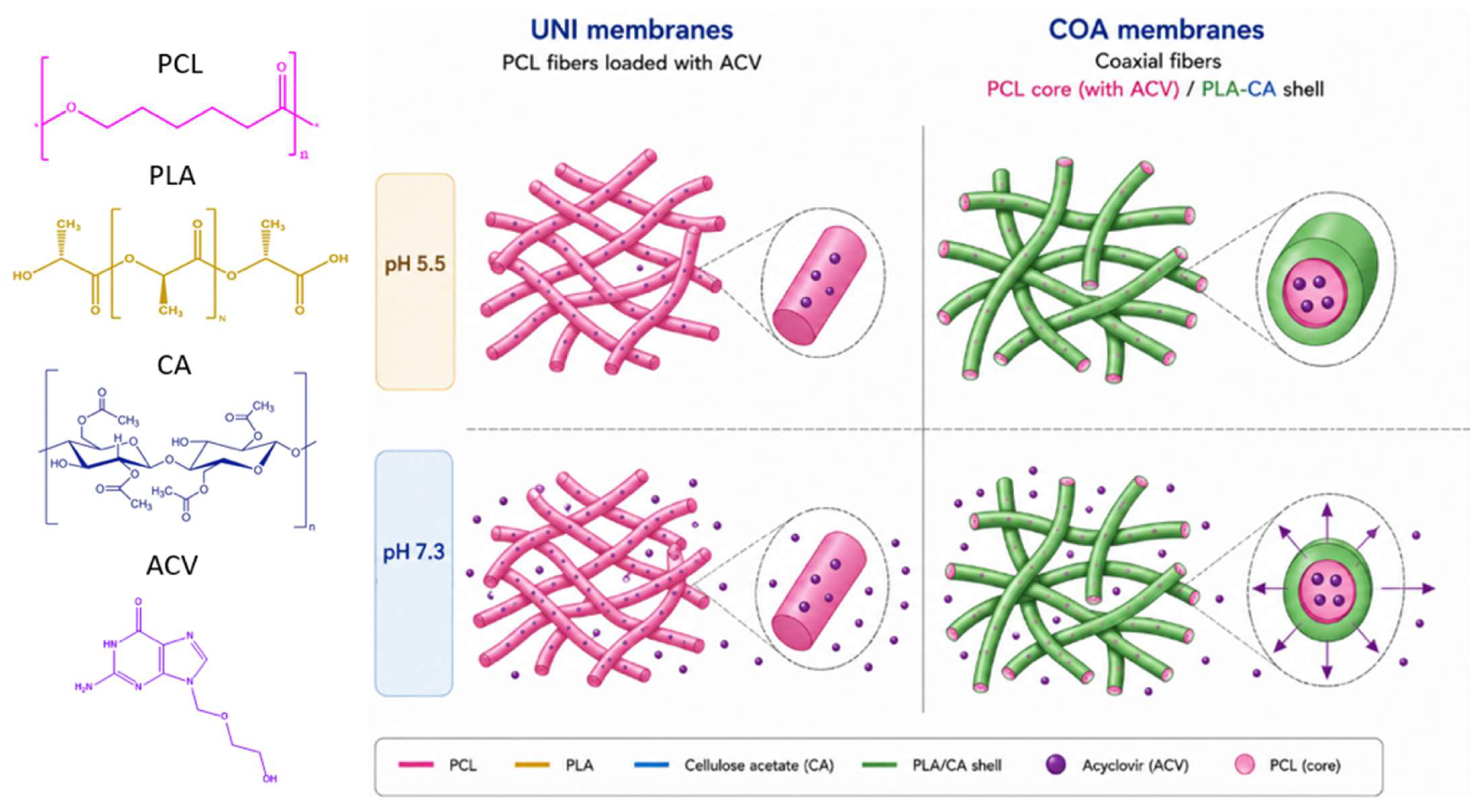
3.8. Acyclovir Release Behavior
3.9. Cytotoxicity Evaluation
4. Conclusions
Supplementary Materials
Author Contributions
Funding
Data Availability Statement
Acknowledgments
Conflicts of Interest
References
- WHO. Herpes Simplex Virus. 2024. Available online: https://www.who.int/news-room/fact-sheets/detail/herpes-simplex-virus (accessed on 15 March 2025).
- Sadowski, L.A.; Upadhyay, R.; Greeley, Z.W.; Margulies, B.J. Current drugs to treat infections with herpes simplex viruses-1 and-2. Viruses 2021, 13, 1228. [Google Scholar] [CrossRef] [Scilit] [PubMed]
- Ahani, E.; Mianehro, A. Electrospun scaffold based on poly (ethylene oxide)/poly (ε-caprolactone) for prolonged intravaginal antiviral drug release. J. Drug Deliv. Sci. Technol. 2023, 88, 104856. [Google Scholar] [CrossRef] [Scilit]
- Costa, T.; Ribeiro, A.; Machado, R.; Ribeiro, C.; Lanceros-Mendez, S.; Cavaco-Paulo, A.; Almeida, A.; Das Neves, J.; Lúcio, M.; Viseu, T. Polymeric electrospun fibrous dressings for topical co-delivery of acyclovir and omega-3 fatty acids. Front. Bioeng. Biotechnol. 2019, 7, 390. [Google Scholar] [CrossRef] [Scilit] [PubMed]
- Greiner, A.W.; Joachim, H. Electrospinning: A fascinating method for the preparation of ultrathin fibers. Angew. Chem. Int. Ed. 2007, 46, 5670–5703. [Google Scholar] [CrossRef] [Scilit] [PubMed]
- Bölgen, N.; Demir, D.; Aşık, M.; Sakım, B.; Vaseashta, A. Introduction and fundamentals of electrospinning. In Electrospun Nanofibers: Principles, Technology and Novel Applications; Springer: Berlin/Heidelberg, Germany, 2022; pp. 3–34. [Google Scholar]
- Castillo-Ortega, M.; López-Peña, I.; Rodríguez-Félix, D.; Del Castillo-Castro, T.; Encinas-Encinas, J.; Santacruz-Ortega, H.; Cauich-Rodríguez, J.; Quiroz-Castillo, J.; Chan-Chan, L.; Lagarda-Diaz, I. Clindamycin-loaded nanofibers of polylactic acid, elastin and gelatin for use in tissue engineering. Polym. Bull. 2022, 79, 5495–5513. [Google Scholar] [CrossRef] [Scilit]
- Gutiérrez-Sánchez, M.; Escobar-Barrios, V.A.; Pozos-Guillén, A.; Escobar-García, D.M. RGD-functionalization of PLA/starch scaffolds obtained by electrospinning and evaluated in vitro for potential bone regeneration. Mater. Sci. Eng. C 2019, 96, 798–806. [Google Scholar] [CrossRef] [Scilit] [PubMed]
- Oztemur, J.; Yalcin-Enis, I. Development of biodegradable webs of PLA/PCL blends prepared via electrospinning: Morphological, chemical, and thermal characterization. J. Biomed. Mater. Res. Part B Appl. Biomater. 2021, 109, 1844–1856. [Google Scholar] [CrossRef] [Scilit] [PubMed]
- Wsoo, M.A.; Shahir, S.; Bohari, S.P.M.; Nayan, N.H.M.; Abd Razak, S.I. A review on the properties of electrospun cellulose acetate and its application in drug delivery systems: A new perspective. Carbohydr. Res. 2020, 491, 107978. [Google Scholar] [CrossRef] [Scilit] [PubMed]
- Ferreira, K.N.; Oliveira, R.R.; Castellano, L.R.; Bonan, P.R.; Carvalho, O.V.; Pena, L.; Souza, J.R.; Oliveira, J.E.; Medeiros, E.S. Controlled release and antiviral activity of acyclovir-loaded PLA/PEG nanofibers produced by solution blow spinning. Biomater. Adv. 2022, 136, 212785. [Google Scholar] [CrossRef] [Scilit] [PubMed]
- Wang, M.; Hou, J.; Yu, D.-G.; Li, S.; Zhu, J.; Chen, Z. Electrospun tri-layer nanodepots for sustained release of acyclovir. J. Alloys 2020, 846, 156471. [Google Scholar] [CrossRef] [Scilit]
- Jiang, H.; Wang, L.; Zhu, K. Coaxial electrospinning for encapsulation and controlled release of fragile water-soluble bioactive agents. J. Control. Release 2014, 193, 296–303. [Google Scholar] [CrossRef] [Scilit] [PubMed]
- Sun, Y.; Cheng, S.; Lu, W.; Wang, Y.; Zhang, P.; Yao, Q. Electrospun fibers and their application in drug controlled release, biological dressings, tissue repair, and enzyme immobilization. RSC Adv. 2019, 9, 25712–25729. [Google Scholar] [CrossRef] [Scilit] [PubMed]
- Pant, B.; Park, M.; Park, S.-J. Drug delivery applications of core-sheath nanofibers prepared by coaxial electrospinning: A review. Pharmaceutics 2019, 11, 305. [Google Scholar] [CrossRef] [Scilit] [PubMed]
- Rohde, F.; Walther, M.; Baur, F.; Windbergs, M. A Dual-Function Electrospun Matrix for the Prevention of Herpes Simplex Virus-1 Infections after Corneal Transplantation. Adv. nanoBiomed Res. 2023, 3, 2200098. [Google Scholar] [CrossRef] [Scilit]
- Baskakova, A.; Awwad, S.; Jimenez, J.Q.; Gill, H.; Novikov, O.; Khaw, P.T.; Brocchini, S.; Zhilyakova, E.; Williams, G.R. Electrospun formulations of acyclovir, ciprofloxacin and cyanocobalamin for ocular drug delivery. J. Int. J. Pharm. 2016, 502, 208–218. [Google Scholar] [CrossRef] [Scilit] [PubMed]
- Rodríguez-Félix, D.; Castillo-Ortega, M.; Nájera-Luna, A.; Montaño-Figueroa, A.; López-Peña, I.; Del Castillo-Castro, T.; Rodríguez-Félix, F.; Quiroz-Castilloc, J.; Herrera-Franco, P. Preparation and characterization of coaxial electrospun fibers containing triclosan for comparative study of release properties with amoxicillin and epicatechin. Curr. Drug Deliv. 2016, 13, 49–56. [Google Scholar] [CrossRef] [Scilit] [PubMed]
- Holzgrabe, U.; Deubner, R.; Schollmayer, C.; Waibel, B. Quantitative NMR spectroscopy—Applications in drug analysis. J. Pharm. Biomed. Anal. 2005, 38, 806–812. [Google Scholar] [CrossRef] [Scilit] [PubMed]
- Arrieta, M.P.; Leonés Gil, A.; Yusef, M.; Kenny, J.M.; Peponi, L.M. Electrospinning of PCL-based blends: Processing optimization for their scalable production. Materials 2020, 13, 3853. [Google Scholar] [CrossRef] [Scilit] [PubMed]
- Abelson, M.B.; Udell, I.J.; Weston, J.H. Normal human tear pH by direct measurement. Arch. Ophthalmol. 1981, 99, 301. [Google Scholar] [CrossRef] [Scilit] [PubMed]
- Lambers, H.; Piessens, S.; Bloem, A.; Pronk, H.; Finkel, P.J.I. Natural skin surface pH is on average below 5, which is beneficial for its resident flora. Int. J. Cosmet. Sci. 2006, 28, 359–370. [Google Scholar] [CrossRef] [Scilit] [PubMed]
- Plascencia Martinez, D.F.; Quiroz Castillo, J.S.M.; Ospina Orejarena, A.; Pérez Gallardo, A.; Méndez Merino, E.; Trimmer López, G.A.; López Peña, I.Y.; Hernández Martínez, D.; López Gastelum, K.A.; Leyva Verduzco, A.A. Comparative Study of Single and Coaxial Electrospun Antimicrobial Cross-Linked Scaffolds Enriched with Aloe Vera: Characterization, Antimicrobial Activity, Drug Delivery, Cytotoxicity, and Cell Proliferation on Adipose Stem Cells and Human Skin Fibroblast. ACS Omega 2024, 9, 41157–41170. [Google Scholar] [CrossRef] [Scilit] [PubMed]
- Dash, S.; Murthy, P.N.; Nath, L.; Chowdhury, P. Kinetic modeling on drug release from controlled drug delivery systems. Acta Pol. Pharm. 2010, 67, 217–223. [Google Scholar] [PubMed]
- Wagner, J.G. Interpretation of percent dissolved-time plots derived from in vitro testing of conventional tablets and capsules. J. Pharm. Sci. 1969, 58, 1253–1257. [Google Scholar] [CrossRef] [Scilit] [PubMed]
- Higuchi, T. Rate of release of medicaments from ointment bases containing drugs in suspension. J. Pharm. Sci. 1961, 50, 874–875. [Google Scholar] [CrossRef] [Scilit] [PubMed]
- Korsmeyer, R.W.; Gurny, R.; Doelker, E.; Buri, P.; Peppas, N.A. Mechanisms of solute release from porous hydrophilic polymers. Int. J. Pharm. 1983, 15, 25–35. [Google Scholar] [CrossRef] [Scilit]
- Henrique Lima, T.; Fernandes-Cunha, G.M.; Jensen, C.E.D.M.; Oréfice, R.L.; Junior, A.D.S.-C.; Zhao, M.; Behar-Cohen, F.; da Silva, G.R. Bioactive Glass Nanoparticles-Loaded Poly (ɛ-caprolactone) Nanofiber as Substrate for ARPE-19 Cells. J. Nanomater. 2016, 2016, 4360659. [Google Scholar] [CrossRef] [Scilit]
- Liu, C.; Yi, K.; Zhang, Z.; Li, Q.; Li, H.; Qu, C.; Chen, M.; Jin, K.; Meng, E. Electrospun mini-MiSp spidroin/poly (L-lactide-co-ε-caprolactone) nanofibrous scaffolds for ARPE-19 cells. Biotechnol. Biotechnol. Equip. 2023, 37, 2219764. [Google Scholar] [CrossRef] [Scilit]
- Cipitria, A.; Skelton, A.; Dargaville, T.; Dalton, P.; Hutmacher, D. Design, fabrication and characterization of PCL electrospun scaffolds—A review. J. Mater. Chem. 2011, 21, 9419–9453. [Google Scholar] [CrossRef] [Scilit]
- Casasola, R.; Thomas, N.L.; Trybala, A.; Georgiadou, S. Electrospun poly lactic acid (PLA) fibres: Effect of different solvent systems on fibre morphology and diameter. Polymer 2014, 55, 4728–4737. [Google Scholar] [CrossRef] [Scilit]
- Fridrikh, S.V.; Yu, J.H.; Brenner, M.P.; Rutledge, G.C. Controlling the fiber diameter during electrospinning. Phys. Rev. Lett. 2003, 90, 144502. [Google Scholar] [CrossRef] [Scilit] [PubMed]
- Hou, J.-Z.; Sun, X.-P.; Zhang, W.-X.; Li, L.-L.; Teng, H. Preparation and characterization of electrospun fibers based on poly (L-lactic acid)/cellulose acetate. Chin. J. Polym. Sci. 2012, 30, 916–922. [Google Scholar] [CrossRef] [Scilit]
- Bosworth, L.; Downes, S. Electrospinning for Tissue Regeneration; Elsevier: Amsterdam, The Netherlands, 2011. [Google Scholar]
- Leyva-Verduzco, A.A.; Castillo-Ortega, M.M.; Chan-Chan, L.H.; Silva-Campa, E.; Galaz-Méndez, R.; Vera-Graziano, R.; Encinas-Encinas, J.C.; Del Castillo-Castro, T.; Rodríguez-Félix, D.E.; Santacruz-Ortega, H.D.C. Electrospun tubes based on PLA, gelatin and genipin in different arrangements for blood vessel tissue engineering. Polym. Bull. 2020, 77, 5985–6003. [Google Scholar] [CrossRef] [Scilit]
- Wu, X.; Liu, C.; Jiang, Y.; Dai, T.; Zhang, L.; Wang, J.; Zhao, H. Coaxial electrospun Polycaprolactone/Gelatin nanofiber membrane loaded with salidroside and cryptotanshinone synergistically promotes vascularization and osteogenesis. Int. J. Nanomed. 2024, 19, 6519–6546. [Google Scholar] [CrossRef] [Scilit] [PubMed]
- Romano, L.; Camposeo, A.; Manco, R.; Moffa, M.; Pisignano, D. Core–shell electrospun fibers encapsulating chromophores or luminescent proteins for microscopically controlled molecular release. Mol. Pharm. 2016, 13, 729–736. [Google Scholar] [CrossRef] [Scilit] [PubMed]
- Zhu, J.; Huang, W.; Zhang, Q.; Ling, S.; Chen, Y.; Kaplan, D.L. Aqueous-Based Coaxial Electrospinning of Genetically Engineered Silk Elastin Core-Shell Nanofibers. Materials 2016, 9, 221. [Google Scholar] [CrossRef] [Scilit] [PubMed]
- Woodruff, M.A.; Hutmacher, D.W. The return of a forgotten polymer—Polycaprolactone in the 21st century. Prog. Polym. Sci. 2010, 35, 1217–1256. [Google Scholar] [CrossRef] [Scilit]
- Silverstein, R.; Webster, F.; Kiemle, D.; Bryce, D.J.I. Spectrometric Identification of Organic Compounds, 8th ed.; John Willey & Sons: Hoboken, NJ, USA, 2014. [Google Scholar]
- Auras, R.; Harte, B.; Selke, S. An overview of polylactides as packaging materials. Macromol. Biosci. 2004, 4, 835–864. [Google Scholar] [CrossRef] [Scilit] [PubMed]
- Edgar, K.J.; Buchanan, C.M.; Debenham, J.S.; Rundquist, P.A.; Seiler, B.D.; Shelton, M.C.; Tindall, D. Advances in cellulose ester performance and application. Prog. Polym. Sci. 2001, 26, 1605–1688. [Google Scholar] [CrossRef] [Scilit]
- Vallejos, M.E.; Peresin, M.S.; Rojas, O.J. All-cellulose composite fibers obtained by electrospinning dispersions of cellulose acetate and cellulose nanocrystals. J. Polym. 2012, 20, 1075–1083. [Google Scholar] [CrossRef] [Scilit]
- Hiep, N.T.; Lee, B.-T. Electro-spinning of PLGA/PCL blends for tissue engineering and their biocompatibility. J. Mater. Sci. Mater. Med. 2010, 21, 1969–1978. [Google Scholar] [CrossRef] [Scilit] [PubMed]
- Chen, Y.; Lin, J.; Fei, Y.; Wang, H.; Gao, W. Preparation and characterization of electrospinning PLA/curcumin composite membranes. Fibers Polym. 2010, 11, 1128–1131. [Google Scholar] [CrossRef] [Scilit]
- Przybysz-Romatowska, M.; Haponiuk, J.; Formela, K. Poly (ε-caprolactone)/poly (lactic acid) blends compatibilized by peroxide initiators: Comparison of two strategies. Polym. Adv. Technol. 2020, 12, 228. [Google Scholar] [CrossRef] [Scilit] [PubMed]
- Benahmed, A.; Azzaoui, K.; El Idrissi, A.; Belkheir, H.; Said Hassane, S.O.; Touzani, R.; Rhazi, L. Cellulose acetate-g-polycaprolactone copolymerization using diisocyanate intermediates and the effect of polymer chain length on surface, thermal, and antibacterial properties. Molecules 2022, 27, 1408. [Google Scholar] [CrossRef] [Scilit] [PubMed]
- Liao, N.; Unnithan, A.R.; Joshi, M.K.; Tiwari, A.P.; Hong, S.T.; Park, C.-H.; Kim, C.S. Electrospun bioactive poly (ɛ-caprolactone)–cellulose acetate–dextran antibacterial composite mats for wound dressing applications. Colloids Surf. A Physicochem. Eng. Asp. 2015, 469, 194–201. [Google Scholar] [CrossRef] [Scilit]
- Herrero-Herrero, M.; Gómez-Tejedor, J.A.; Vallés-Lluch, A. PLA/PCL electrospun membranes of tailored fibres diameter as drug delivery systems. Eur. Polym. J. 2018, 99, 445–455. [Google Scholar] [CrossRef] [Scilit]
- Inai, R.; Kotaki, M.; Ramakrishna, S. Structure and properties of electrospun PLLA single nanofibres. J. Nanotechnol. 2005, 16, 208–213. [Google Scholar] [CrossRef] [Scilit] [PubMed]
- Haroosh, H.J.; Chaudhary, D.S.; Dong, Y. Electrospun PLA/PCL fibers with tubular nanoclay: Morphological and structural analysis. J. Appl. Polym. Sci. 2012, 124, 3930–3939. [Google Scholar] [CrossRef] [Scilit]
- Viscusi, G.; Lamberti, E.; Vittoria, V.; Gorrasi, G. Coaxial electrospun membranes of poly (ε-caprolactone)/poly (lactic acid) with reverse core-shell structures loaded with curcumin as tunable drug delivery systems. Polym. Adv. Technol. 2021, 32, 4005–4013. [Google Scholar] [CrossRef] [Scilit]
- Güneş Çimen, C.; Dundar, M.A.; Demirel Kars, M.; Avcı, A. Enhancement of PCL/PLA electrospun nanocomposite fibers comprising silver nanoparticles encapsulated with Thymus vulgaris L. molecules for antibacterial and anticancer activities. ACS Biomater. Sci. Eng. 2022, 8, 3717–3732. [Google Scholar] [CrossRef] [Scilit] [PubMed]
- Cabrera Gonzalez, A.D.; Flores León, J.R.; Ramirez Mendoza, C.G.; Rodríguez Félix, D.E.; Castillo Ortega, M.M.; Santacruz Ortega, H.; Rodríguez Félix, F.; Madera Santana, T.J.; Quiroz Castillo, J.M. Preparation and Characterization of Poly (lactic acid) Membranes and Films Coated with Polyaniline for Potential Use in Environmental Remediation. ACS Omega 2024, 9, 4439–4446. [Google Scholar] [CrossRef] [Scilit] [PubMed]
- Ma, M.; Hill, R.M. Superhydrophobic surfaces. Curr. Opin. Colloid Interface Sci. 2006, 11, 193–202. [Google Scholar] [CrossRef] [Scilit]
- Ghasemi-Mobarakeh, L.; Prabhakaran, M.P.; Morshed, M.; Nasr-Esfahani, M.H.; Ramakrishna, S. Bio-functionalized PCL nanofibrous scaffolds for nerve tissue engineering. Mater. Sci. Eng. C 2010, 30, 1129–1136. [Google Scholar] [CrossRef] [Scilit]
- Esmaeili, E.; Eslami-Arshaghi, T.; Hosseinzadeh, S.; Elahirad, E.; Jamalpoor, Z.; Hatamie, S.; Soleimani, M. The biomedical potential of cellulose acetate/polyurethane nanofibrous mats containing reduced graphene oxide/silver nanocomposites and curcumin: Antimicrobial performance and cutaneous wound healing. Int. J. Biol. Macromol. 2020, 152, 418–427. [Google Scholar] [CrossRef] [Scilit] [PubMed]
- Pisani, S.; Dorati, R.; Conti, B.; Modena, T.; Bruni, G.; Genta, I.J.R.; Polymers, F. Design of copolymer PLA-PCL electrospun matrix for biomedical applications. React. Funct. Polym. 2018, 124, 77–89. [Google Scholar] [CrossRef] [Scilit]
- Wang, X.; Zhao, H.; Turng, L.-S.; Li, Q. Crystalline morphology of electrospun poly (ε-caprolactone)(PCL) nanofibers. Ind. Eng. Chem. Res. 2013, 52, 4939–4949. [Google Scholar] [CrossRef] [Scilit]
- Shamsipur, M.; Pourmortazavi, S.M.; Beigi, A.A.M.; Heydari, R.; Khatibi, M. Thermal stability and decomposition kinetic studies of acyclovir and zidovudine drug compounds. Aaps Pharmscitech 2013, 14, 287–293. [Google Scholar] [CrossRef] [Scilit] [PubMed]
- Hu, X.; Liu, S.; Zhou, G.; Huang, Y.; Xie, Z.; Jing, X. Electrospinning of polymeric nanofibers for drug delivery applications. J. Control. Release 2014, 185, 12–21. [Google Scholar] [CrossRef] [Scilit] [PubMed]
- Hoffman, A.S. Hydrogels for biomedical applications. Adv. Drug Deliv. Rev. 2012, 64, 18–23. [Google Scholar] [CrossRef] [Scilit]
- Siepmann, J.; Peppas, N.A. Modeling of drug release from delivery systems based on hydroxypropyl methylcellulose (HPMC). Adv. Drug Deliv. Rev. 2012, 64, 163–174. [Google Scholar] [CrossRef] [Scilit]
- Kenawy, E.-R.; Bowlin, G.L.; Mansfield, K.; Layman, J.; Simpson, D.G.; Sanders, E.H.; Wnek, G.E. Release of tetracycline hydrochloride from electrospun poly (ethylene-co-vinylacetate), poly (lactic acid), and a blend. J. Control. Release 2002, 81, 57–64. [Google Scholar] [CrossRef] [Scilit] [PubMed]
- Zhang, Y.; Wang, X.; Feng, Y.; Li, J.; Lim, C.; Ramakrishna, S. Coaxial electrospinning of (fluorescein isothiocyanate-conjugated bovine serum albumin)-encapsulated poly (ε-caprolactone) nanofibers for sustained release. Biomacromolecules 2006, 7, 1049–1057. [Google Scholar] [CrossRef] [Scilit] [PubMed]
- Siepmann, J.; Siepmann, F. Modeling of diffusion controlled drug delivery. J. Control. Release 2012, 161, 351–362. [Google Scholar] [CrossRef] [Scilit] [PubMed]
- Huang, Z.-M.; Zhang, Y.-Z.; Kotaki, M.; Ramakrishna, S. A review on polymer nanofibers by electrospinning and their applications in nanocomposites. Compos. Sci. Technol. 2003, 63, 2223–2253. [Google Scholar] [CrossRef] [Scilit]
- Costa, P.; Lobo, J.M.S. Modeling and comparison of dissolution profiles. Eur. J. Pharm. Sci. 2001, 13, 123–133. [Google Scholar] [CrossRef] [Scilit] [PubMed]
- Peppas, N.A.; Sahlin, J.J. A simple equation for the description of solute release. III. Coupling of diffusion and relaxation. Int. J. Pharm. 1989, 57, 169–172. [Google Scholar] [CrossRef] [Scilit]
- Yu, D.-G.; Zhu, L.-M.; Branford-White, C.J.; Yang, J.-H.; Wang, X.; Li, Y.; Qian, W. Solid dispersions in the form of electrospun core-sheath nanofibers. Int. J. Nanomed. 2011, 6, 3271–3280. [Google Scholar] [CrossRef] [Scilit] [PubMed]
- Peppas, N.A.; Huang, Y.; Torres-Lugo, M.; Ward, J.; Zhang, J. Physicochemical foundations and structural design of hydrogels in medicine and biology. Annu. Rev. Biomed. Eng. 2000, 2, 9–29. [Google Scholar] [CrossRef] [Scilit] [PubMed]
- ISO 10993-1:2009; Biological Evaluation of Medical Devices. International Organization for Standardization: Geneva, Switzerland, 2009.
- Riss, T.L.; Moravec, R.A.; Niles, A.L.; Duellman, S.; Benink, H.A.; Worzella, T.J.; Minor, L. Cell viability assays. In Assay Guidance Manual; Markossian, S., Grossman, A., Brimacombe, K., et al., Eds.; Eli Lilly & Company and the National Center for Advancing Translational Sciences: Bethesda, MD, USA, 2016. [Google Scholar]

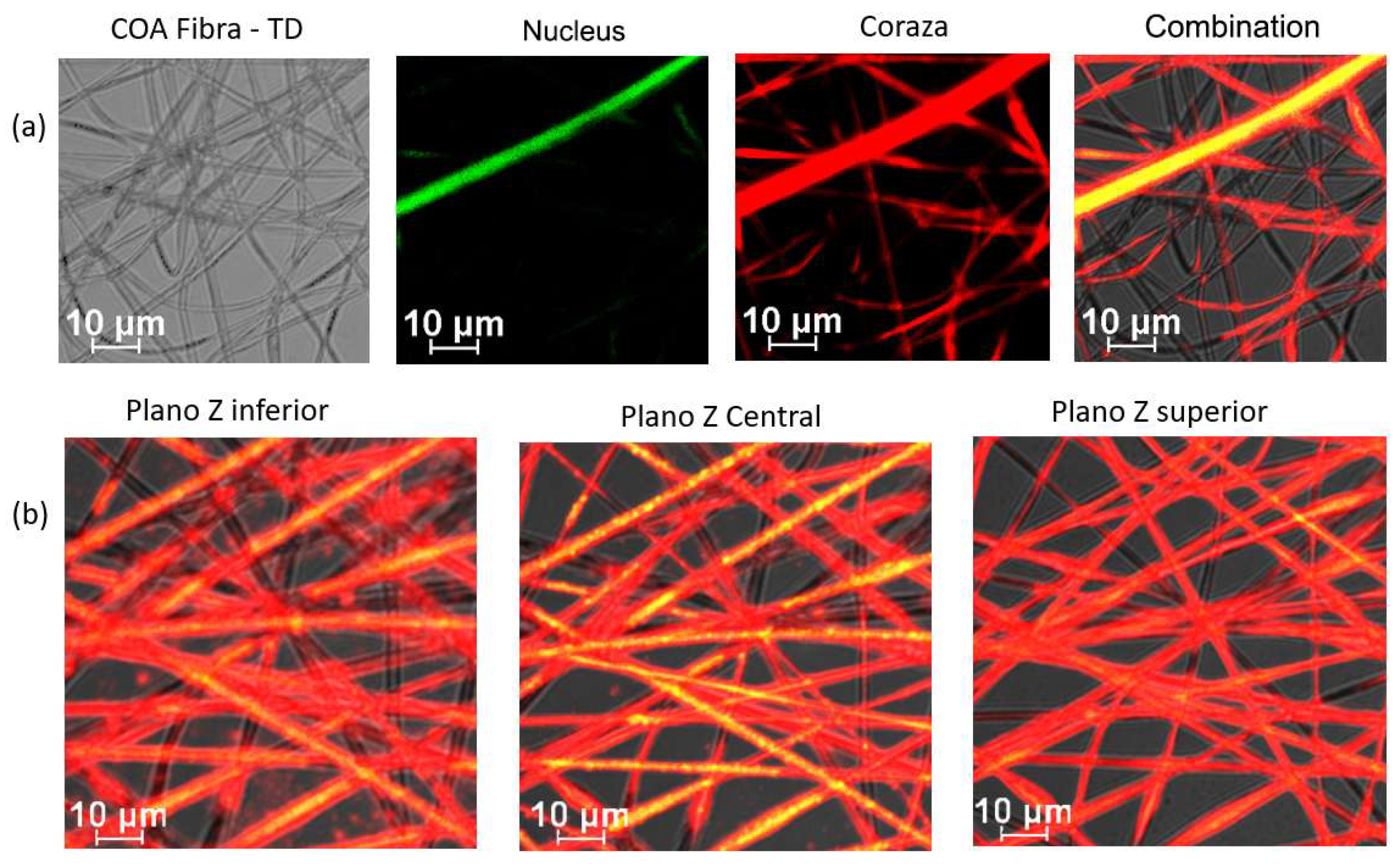
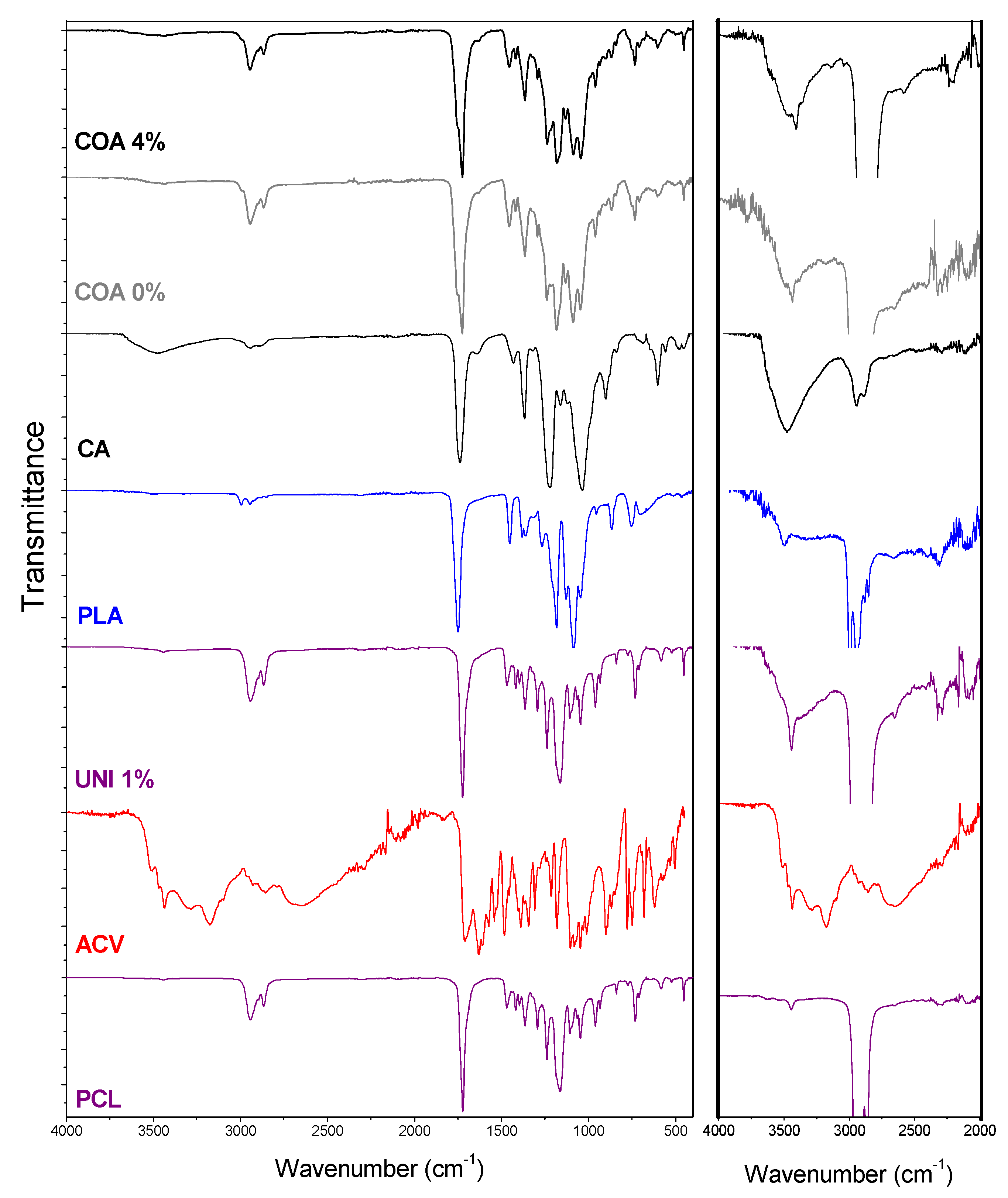

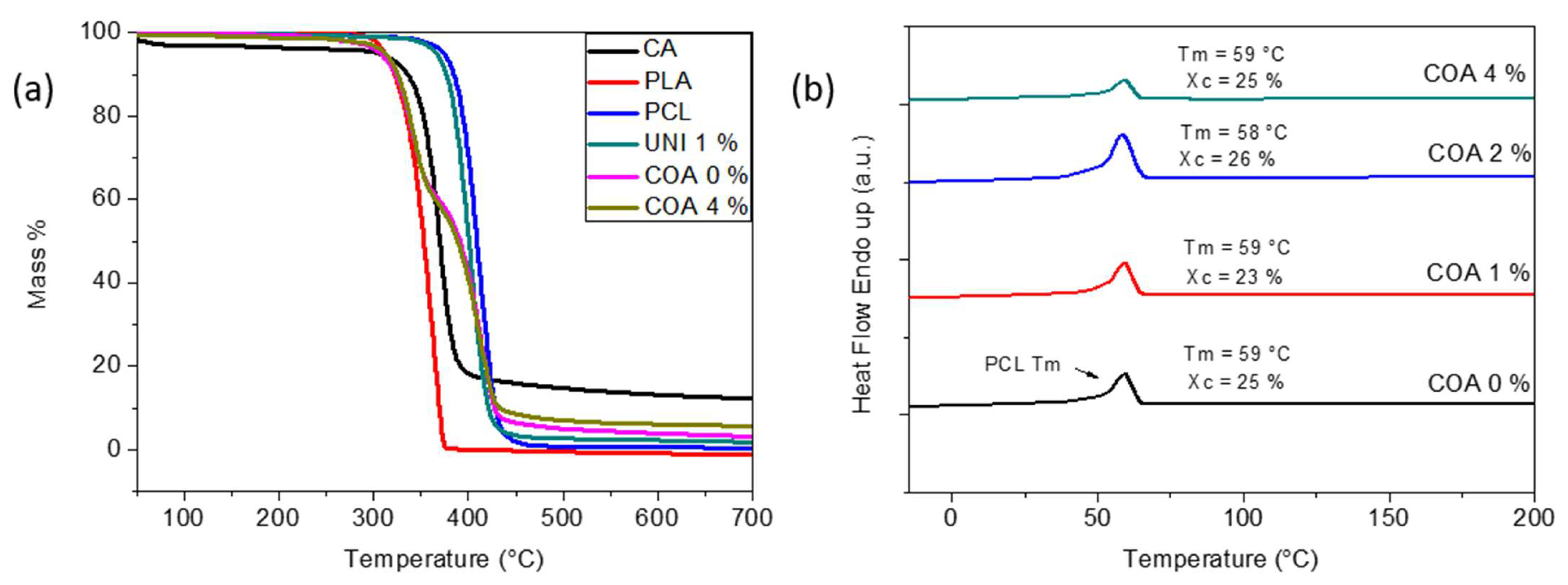


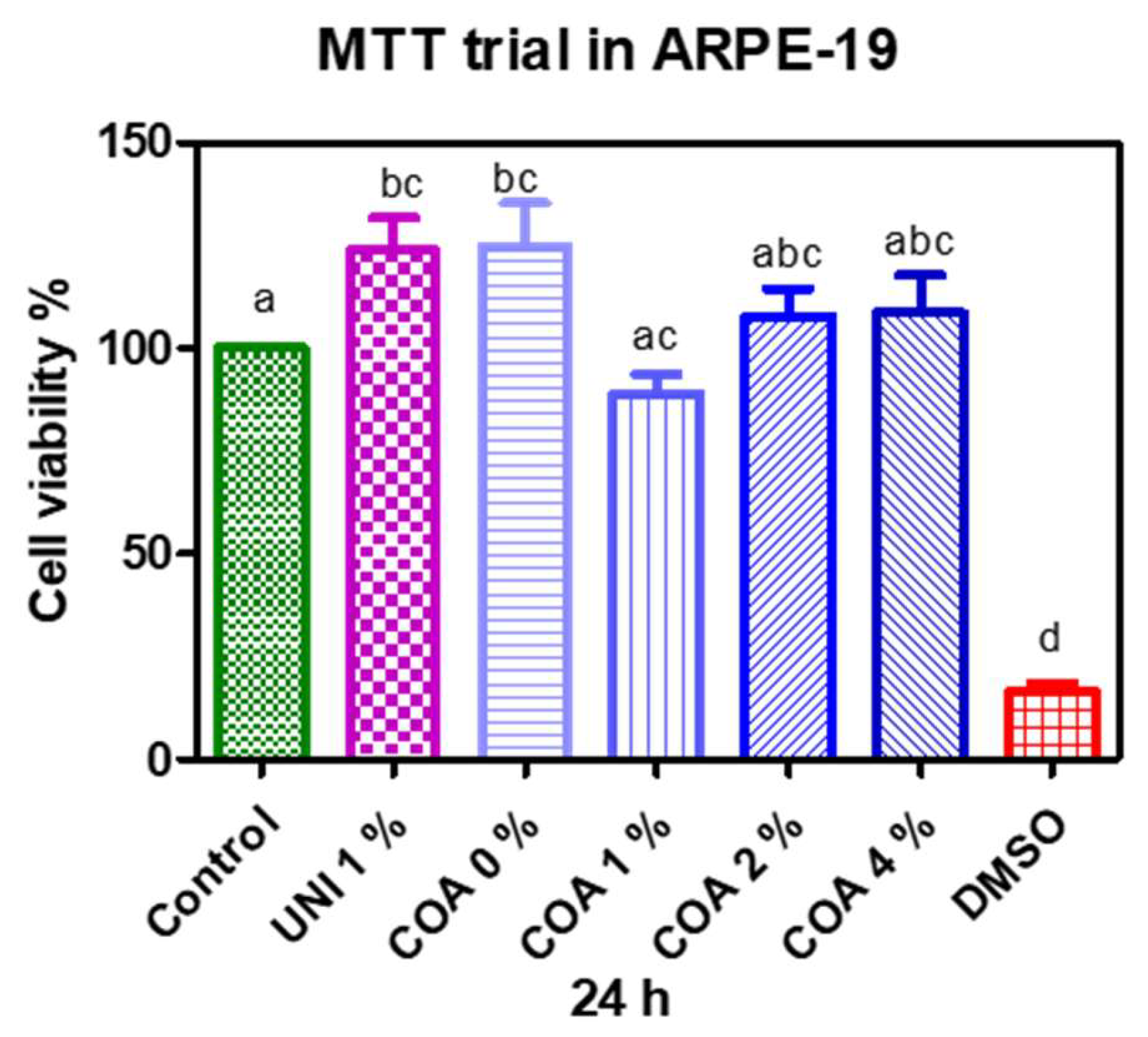

| Sample | Configuration (Uniaxial, Coaxial) | Shell Composition (w/v) | Core Composition (w/v) | ACV (% w/w *) | Voltage (kV) | Distance (cm) | Flow Rate (mL·h−1) |
|---|---|---|---|---|---|---|---|
| PCL | U | — | PCL 12% | 0 | 15 | 12 | 2.5 |
| UNI 1% | U | — | PCL 12% | 1 | 15 | 12 | 2.5 |
| PLA | U | — | PLA 10% | 0 | 15 | 12 | 3.0 |
| CA | U | — | CA 8% | 0 | 11 | 12 | 3.0 |
| PLA/CA | U | — | PLA/CA (70/30), 10% | 0 | 15 | 15 | 1.5 |
| COA 0% | C | PLA/CA (70/30), 10% | PCL 12% | 0 | 17 | 12 | 1.5 |
| COA 1% | C | PLA/CA (70/30), 10% | PCL 12% | 1 | 17 | 12 | 1.5 |
| COA 2% | C | PLA/CA (70/30), 10% | PCL 12% | 2 | 17 | 12 | 1.5 |
| COA 4% | C | PLA/CA (70/30), 10% | PCL 12% | 4 | 17 | 12 | 1.5 |
| System | % ACV Theoretical (w/w) | I ACV 7.81 ppm | I PCL 4.01 ppm | I PLA 5.16 ppm | I CA 2.01 ppm | % ACV (NMR, w/w) | % Efficiency |
|---|---|---|---|---|---|---|---|
| UNI 1% | 1 | 1 | 408 | 0.96 | 96 | ||
| COA 1% | 1 | 1 | 229 | 109 | 30 | 0.95 | 95 |
| COA 2% | 2 | 1 | 132 | 32 | 11 | 2.05 | 103 |
| COA 4% | 4 | 1 | 54 | 28 | 7 | 3.75 | 94 |
| Sample | Tensile Strength (MPa) | Elongation at Break (%) | Elastic Modulus (MPa) |
|---|---|---|---|
| PCL | 6.41 ± 1.44 ab | 276.7 ± 40.8 a | 11.6 ± 3.3 a |
| PLA | 1.27 ± 0.24 c | 66.8 ± 6.9 c | 4.4 ± 1.5 a |
| PLA/CA | 2.11 ± 0.49 c | 91.3 ± 8.3 c | 14.9 ± 8.9 a |
| UNI 1% | 9.15 ± 4.78 a | 287.1 ± 17.1 a | 14.3 ± 6.0 a |
| COA 0% | 3.66 ± 1.11 bc | 28.6 ± 3.8 b | 45.1 ± 14.1 b |
| COA 1% | 7.02 ± 1.72 ab | 26.0 ± 2.7 b | 66.8 ± 18.4 b |
| COA 2% | 4.26 ± 0.63 bc | 24.4 ± 4.5 b | 53.5 ± 11.5 b |
| COA 4% | 8.48 ± 2.63 a | 16.7 ± 2.8 b | 111.8 ± 19.1 c |
| Sample | Water Contact Angle (º) |
|---|---|
| PLA/CA | 107.4 ± 2.8 a |
| PCL | 100.8 ± 4.9 b |
| UNI 1% | 103.2 ± 3.1 ab |
| COA 0% | 104 ± 0.2 ab |
| COA 1% | 104 ± 3.2 ab |
| COA 2% | 106 ± 7.7 a |
| COA 4% | 105.8 ± 2.8 ab |
| System | pH 5.5 (%) | pH 7.3 (%) |
|---|---|---|
| UNI 1% | 23.87 ± 1.52 | 39.50 ± 2.21 |
| COA 1% | 14.20 ± 2.06 | 75.90 ± 1.30 |
| COA 2% | 18.50 ± 0.90 | 54.27 ± 4.72 |
| COA 4% | 19.63 ± 1.02 | 48.90 ± 6.22 |
| Sample | Model | Parameter | Value | R2 | Proposed Mechanism |
|---|---|---|---|---|---|
| UNI 1% | Zero-order | k0 | 0.82 | 0.65 | Predominantly diffusion-controlled transport |
| First-order | k1 | 0.12 | 0.92 | ||
| Higuchi | kH | 3.77 | 0.91 | ||
| Korsmeyer–Peppas | kP | 3.63 | 0.92 | ||
| 0.51 | |||||
| COA 1% | Zero-order | k0 | 0.27 | 0.81 | Barrier-controlled transport |
| First-order | k1 | 0.04 | 0.86 | ||
| Higuchi | kH | 1.20 | 0.82 | ||
| Korsmeyer–Peppas | kP | 0.68 | 0.87 | ||
| 0.08 | |||||
| COA 2% | Zero-order | k0 | 0.46 | 0.85 | Anomalous transport |
| First-order | k1 | 0.04 | 0.89 | ||
| Higuchi | kH | 2.01 | 0.84 | ||
| Korsmeyer–Peppas | kP | 1.06 | 0.89 | ||
| 0.73 | |||||
| COA 4% | Zero-order | k0 | 0.33 | 0.91 | Anomalous transport |
| First-order | k1 | 0.04 | 0.95 | ||
| Higuchi | kH | 1.43 | 0.90 | ||
| Korsmeyer–Peppas | kP | 0.76 | 0.96 | ||
| 0.73 |
| Sample | Model | Parameter | Value | R2 | Proposed Mechanism |
|---|---|---|---|---|---|
| UNI 1% | Zero-order | k0 | 0.74 | 0.68 | Predominantly diffusion-controlled transport |
| First-order | k1 | 0.10 | 0.92 | ||
| Higuchi | kH | 3.41 | 0.93 | ||
| Korsmeyer–Peppas | kP | 3.23 | 0.94 | ||
| 0.52 | |||||
| COA 1% | Zero-order | k0 | 1.95 | 0.89 | Anomalous transport |
| First-order | k1 | 0.05 | 0.97 | ||
| Higuchi | kH | 8.56 | 0.90 | ||
| Korsmeyer–Peppas | kP | 4.77 | 0.96 | ||
| 0.71 | |||||
| COA 2% | Zero-order | k0 | 1.54 | 0.94 | Anomalous transport approaching Case II transport |
| First-order | k1 | 0.02 | 0.96 | ||
| Higuchi | kH | 6.54 | 0.84 | ||
| Korsmeyer–Peppas | kP | 2.41 | 0.96 | ||
| 0.85 | |||||
| COA 4% | Zero-order | k0 | 1.42 | 0.82 | Anomalous transport |
| First-order | k1 | 0.05 | 0.88 | ||
| Higuchi | kH | 6.20 | 0.81 | ||
| Korsmeyer–Peppas | kP | 3.20 | 0.87 | ||
| 0.74 |
Disclaimer/Publisher’s Note: The statements, opinions and data contained in all publications are solely those of the individual author(s) and contributor(s) and not of MDPI and/or the editor(s). MDPI and/or the editor(s) disclaim responsibility for any injury to people or property resulting from any ideas, methods, instructions or products referred to in the content. |
© 2026 by the authors. Licensee MDPI, Basel, Switzerland. This article is an open access article distributed under the terms and conditions of the Creative Commons Attribution (CC BY) license.
Share and Cite
Bustamante-Armenta, H.G.; Rodríguez-Félix, D.E.; Castillo-Ortega, M.M.; Soberanes-Duarte, Y.; Silva-Campa, E.; Chan-Chan, L.H.; Zizumbo-López, A.; Santacruz-Ortega, H.d.C. Coaxial Electrospun PCL/PLA-CA Polymeric Membranes for pH-Responsive Acyclovir Delivery in Antiviral Scaffolds. Micro 2026, 6, 61. https://doi.org/10.3390/micro6030061
Bustamante-Armenta HG, Rodríguez-Félix DE, Castillo-Ortega MM, Soberanes-Duarte Y, Silva-Campa E, Chan-Chan LH, Zizumbo-López A, Santacruz-Ortega HdC. Coaxial Electrospun PCL/PLA-CA Polymeric Membranes for pH-Responsive Acyclovir Delivery in Antiviral Scaffolds. Micro. 2026; 6(3):61. https://doi.org/10.3390/micro6030061
Chicago/Turabian StyleBustamante-Armenta, Héctor Guillermo, Dora Evelia Rodríguez-Félix, María Mónica Castillo-Ortega, Yedith Soberanes-Duarte, Erika Silva-Campa, Lerma Hanaiy Chan-Chan, Arturo Zizumbo-López, and Hisila del Carmen Santacruz-Ortega. 2026. "Coaxial Electrospun PCL/PLA-CA Polymeric Membranes for pH-Responsive Acyclovir Delivery in Antiviral Scaffolds" Micro 6, no. 3: 61. https://doi.org/10.3390/micro6030061
APA StyleBustamante-Armenta, H. G., Rodríguez-Félix, D. E., Castillo-Ortega, M. M., Soberanes-Duarte, Y., Silva-Campa, E., Chan-Chan, L. H., Zizumbo-López, A., & Santacruz-Ortega, H. d. C. (2026). Coaxial Electrospun PCL/PLA-CA Polymeric Membranes for pH-Responsive Acyclovir Delivery in Antiviral Scaffolds. Micro, 6(3), 61. https://doi.org/10.3390/micro6030061