
Article

Microwave-Driven Upcycling of Biomass and Soft Slaughterhouse Waste into Activated Carbon for Efficient Cr(VI) Removal


by
Maria Baikousi
*,
Foteini Tsiogka
,
Alexandros Parodos
,
Nikolaos Pantiskas
,
Constantinos E. Salmas
and
Michael A. Karakassides
*
Department of Materials Science and Engineering, University of Ioannina, GR-45110 Ioannina, Greece
*
Authors to whom correspondence should be addressed.
Micro 2026, 6(3), 60; https://doi.org/10.3390/micro6030060
Submission received: 4 June 2026 / Revised: 28 June 2026 / Accepted: 1 July 2026 / Published: 3 August 2026
(This article belongs to the Section Microscale Materials Science)

Abstract

This study demonstrates the rapid microwave-assisted upcycling of diverse bio-wastes—including aloe vera industrial leaf waste (av), corn cob agricultural residues (cc), and soft slaughterhouse (sh) by-products (pork liver, lung, and heart) into high-surface-area activated carbons for efficient hexavalent chromium removal via ZnCl2-activated microwave pyrolysis. To process the challenging high-moisture animal organs, a hybrid approach combining microwave-assisted hydrothermal pre-treatment with subsequent ZnCl2-activated microwave pyrolysis was developed to promote chemical dehydration and aromatic network development. Structural characterization by N2 porosimetry, FT-IR, Raman, and XRD confirmed the formation of stable, amorphous porous networks, with surface development strongly dependent on both precursor type and pyrolysis temperature. The materials exhibited high specific surface areas (BET) of 1442, 1120, and 775 m2/g for cc, av, and sh, respectively, and they also demonstrated high water dispersibility. Cr(VI) adsorption data were best described by the Langmuir isotherm model, while thermodynamic analysis confirmed the spontaneous and endothermic adsorption process. The maximum adsorption capacities (qmax) at pH 3 were 157, 112, and 71 mg/g for the activated carbons derived from cc, av, and sh, respectively. Agricultural-derived carbons exhibited superior adsorption performance, whereas all materials remained competitive, demonstrating a potential sustainable circular-economy strategy for waste valorization.

1. Introduction

The growing environmental crisis in recent years has intensified the need for sustainable waste management, driving research toward innovative technologies that convert waste into high value-added materials. Agricultural residues and slaughterhouse wastes constitute significant sources of organic matter that are frequently disposed of in environmentally harmful ways. Repurposing these resources within a circular economy framework represents an attractive strategy [1,2].
Agricultural waste biomass originates from the by-products and residues of farming, livestock rearing, and food processing operations. This residue biomass creates important environmental, economic, and social issues worldwide as a considerable fraction of produced wastes [1]. However, instead of being discarded or burned, this renewable organic material also constitutes a resource that can be valorized for bioenergy generation, compost production, soil mulching, and the development of high-value products such as biochar, bioplastics, single-cell protein, and bio-based chemical building blocks [1,3,4].
Moreover, slaughterhouse residues present a more complex challenge. This is another category of wastes which is primarily composed of residues originating from the rumen, stomach, and intestinal contents. Large quantities of such by-products are generated annually, particularly by poultry processing industries, driven by the high consumption of poultry meat [2,5]. If discharged without proper treatment into municipal wastewater systems, these wastes can create serious environmental concerns because they contain numerous toxic and persistent organic contaminants, including refractory and difficult-to-degrade compounds, as well as elevated concentrations of organic matter, fats, proteins, detergents, blood residues, and pathogenic microorganisms [5,6,7,8,9]. Therefore, the efficient treatment of slaughterhouse wastewater is essential for minimizing environmental impacts and promoting sustainable waste management practices.
Porous carbon materials with extensive specific surface areas find widespread utility in energy storage (supercapacitors, batteries), catalyst support, and environmental remediation via pollutant adsorption [10]. Especially, biomass-derived activated carbons are particularly promising due to their origin from abundant renewable waste resources, well-developed surface areas, favorable pore size distributions, and tailorable surface chemistry [11,12,13,14,15]. Traditionally, these matrices are synthesized through conventional thermal pyrolysis, which requires prolonged processing times and substantial energy inputs [12,16,17,18,19,20]. To resolve these limitations, microwave-assisted heating has emerged as a rapid and uniform alternative for carbonization. Microwave heating offers rapid and uniform energy transfer, enabling more efficient conversion of raw materials [13,21,22]. Many biomass wastes such as corn cob [21], macadamia nuts [23], orange peel [24], straw maize [25], almond shells [26], rubber seed pericarp [22], wood [27], oil palm biodiesel solid residue [28], etc., have been used as precursors for producing activated carbons via microwave-assisted pyrolysis, showing high surface area and advanced sorption properties in removal of dyes, phenols, NO2, H2S, and heavy metals [20,29].
From a structural point of view, unlike lignocellulosic biomass or animal bones, which possess an innate structural matrix favorable for direct carbonization, soft slaughterhouse organs (such as liver, lung, and heart) present unique processing challenges due to their high moisture, volatile matter, and elevated lipid/protein ratios. Direct carbonization thermal treatment of such wet tissues often induces uncontrolled thermal decomposition and pore clogging. To overcome these limitations, structural stabilization and alternative carbonization pathways are required. Formaldehyde pre-treatment cross-links polypeptide chains against thermal collapse [30]. Furthermore, microwave-assisted hydrothermal treatment (HT) efficiently transforms high-moisture animal tissues into stable hydrochar intermediates without the energy-intensive pre-drying stages [31]. When sequentially combined with microwave-assisted ZnCl2 chemical activation, this hybrid approach offers a rapid, low-energy pathway to transform complex soft structures into functional porous carbons.
Utilizing these frameworks is highly effective for targeting critical aquatic contaminants such as hexavalent chromium (Cr(VI)). Derived from chemical and metallurgical industries, Cr(VI) is highly mobile and toxic, leading the World Health Organization (WHO) to establish a strict permissible threshold of 0.05 mg/L in drinking water [32]. Typical industrial effluents, however, exhibit drastically elevated loads (0.5 to 270 mg/L), rendering effective decontamination a matter of critical urgency [33]. Compared to conventional remediation methods that suffer from high operational costs and hazardous sludge generation, adsorption onto adsorbent materials offers operational simplicity, economic viability, and high efficiency [32,34,35,36]. To this end, innovative strategies have been developed to synthesize high-capacity adsorbents from biomass constituents. For instance, recent research demonstrated the potential of modified biomass matrices for aquatic purification, achieving ultrahigh Cr(VI) uptake capacities while elucidating the critical role of surface chemistry in this application [37]. Biomass-derived activated carbons, prepared via conventional thermal pyrolysis, also serve as effective adsorbents for this purpose [17,18,33,38,39,40,41,42,43]. However, only a few studies in the literature include the production of porous carbons via microwave-assisted activation specifically tested for hexavalent chromium removal, with most works using standard lignocellulosic precursors [44,45,46,47,48,49]. In addition, there is still an obvious gap in the literature regarding the utilization of microwave-assisted pyrolysis for transforming highly challenging, high-moisture animal by-products into carbonaceous adsorbents for heavy metal remediation.
In this context, the present study explores the microwave-assisted ZnCl2 activation process of aloe vera leaf industrial wastes, agricultural corn cob residues, and soft slaughterhouse waste to produce porous carbon materials with enhanced textural and adsorption properties. The relationship between precursor type, physicochemical properties, and adsorption performance is evaluated, highlighting the potential of these waste-derived carbons as effective adsorbents for environmental remediation applications. The novelty of this work lies in the comparative valorization of different waste matrices (lignocellulosic-rich precursors and protein/lipid-rich slaughterhouse organs) upcycled under the same rapid microwave process for hexavalent chromium removal. To the best of our knowledge, this is the first time these three different regional biowaste streams are systematically studied together to find out how the precursor nature affects the physicochemical and structural properties under microwave pyrolysis conditions in combination with their heavy metal affinity. Additionally, from an economic and environmental view, the utilization of these specific zero-cost biowastes offers advantages in waste management while converting different organic matrices (lignocellulosic and protein/lipid-rich) into valuable carbon materials for heavy metal uptake.

2. Materials and Methods

The experimental design of this study follows a structured six-step workflow: first, the procurement of raw materials and reagents (Section 2.1); second, the chemical activation and microwave-assisted pyrolysis of agricultural biomass (Section 2.2); third, the hybrid processing of slaughterhouse wastes using a microwave hydrothermal pre-treatment prior to activation and pyrolysis (Section 2.3); fourth, the evaluation of the materials’ water dispersibility and stability (Section 2.4); fifth, the systemic batch adsorption experiments for hexavalent chromium removal (Section 2.5); and sixth, the multi-technique characterization of the developed materials (Section 2.6).

2.1. Materials

Aloe vera waste leaves (av) were provided from the Greek Industrial Company Hellenic Aloe, Ethnikis Antistaseos 21, Heraklion, Crete, 71306, Greece, whereas Corn cob wastes (cc) were supplied by Agricultural Cooperative Agrinio Union, Agrinio, 30100, Greece. The specific av wastes consist of the outer peel of the leaf and some residues from the inner gel. These biomass wastes av and cc were washed several times with tap and deionized water, dried in 80 °C for 48 h, and were ground into fine powder using a household grinder. Slaughterhouse wastes, including pork liver, heart, and lung, were obtained from the City Slaughterhouse of the Municipality of Amfilochia, Western Greece, Greece. The samples were washed with tap and deionized water, wiped with paper towels, and air-dried. Zinc chloride (ZnCl2, 98%), ethanol (C2H6O, 99,8%), hydrochloric acid (HCl, 37%), and formaldehyde solution (CH2OH, 37%) were purchased from Merck (Darmstadt, Germany) and used without further purification.

2.2. Preparation of Biomass-Derived (Aloe Vera Leaves and Corn Cob Wastes) Porous Carbon Materials

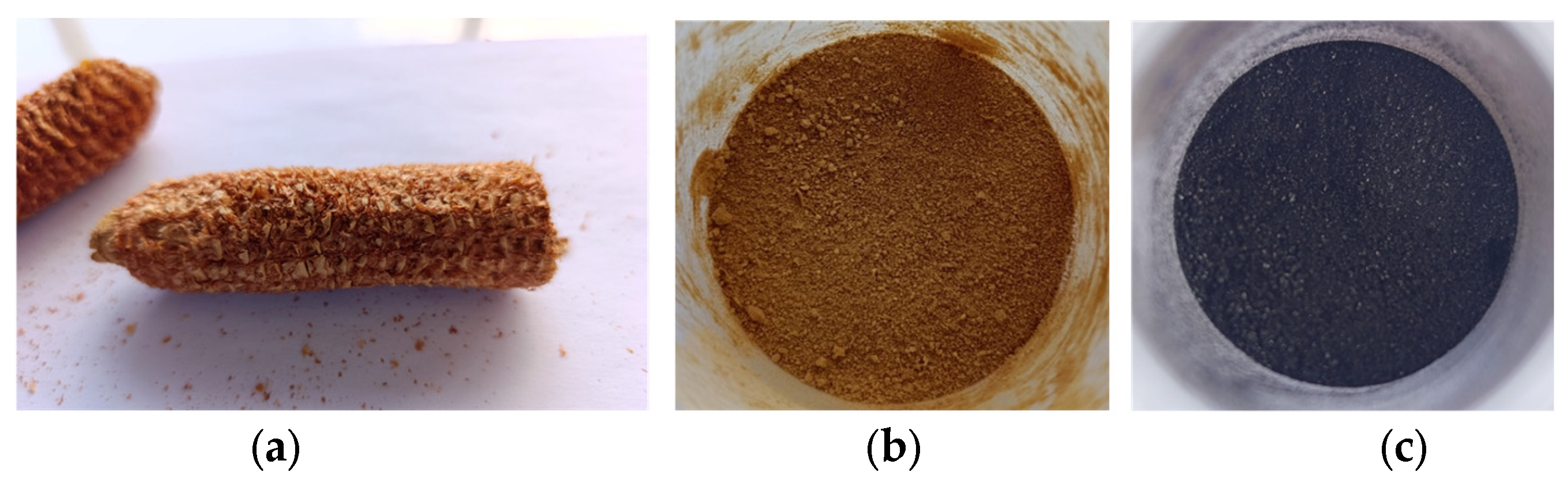
Activated carbons, denoted as ACav and ACcc, derived from aloe vera leaf wastes and corn cob residues, respectively, were produced using a chemical activation procedure combined with microwave-assisted pyrolysis. The biomass precursors were wet impregnated with ZnCl2 aqueous solution at a mass ratio of biomass:ZnCl2 = 1:2 and semidried at 80 °C for 30 min. The resulting mixture, in the form of a sludge, was pyrolyzed in a microwave furnace (PYRO Advanced Microwave Muffle, Milestone) at temperatures ranging from 300 to 600 °C under argon flow. Each sample was heated until the target temperature was reached; subsequently, the microwave irradiation was switched off and the sample allowed to cool down naturally under argon flow. The solid products were washed with 1N HCl solution under stirring for 24 h, followed by several washings with deionized water and subsequently drying at 80 °C for 24 h. The resulting carbon materials were designed as ACav-X and ACcc-X, where X corresponds to the pyrolysis temperature of each sample. The microwave irradiation time was 3, 5, 10, 15, 18 min for X: 253, 300, 400, 500, and 600 °C, respectively. Figure 1 and Figure 2 show the materials ACav and ACcc, respectively, at different stages of the synthesis process.

2.3. Preparation of Slaughterhouse-Derived Porous Carbon Materials

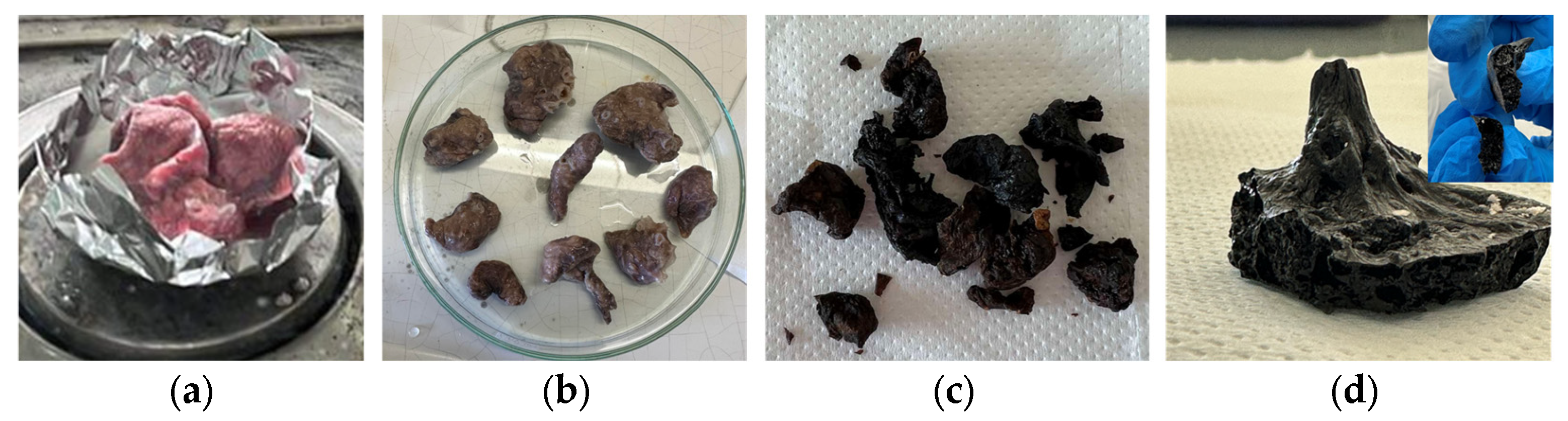
For the synthesis of porous carbon using slaughterhouse wastes, the appropriate piece of the precursor was immersed in formaldehyde solution for 30 min, followed by air drying. Then, the chemical-modified precursor was transferred to a Teflon autoclave container (100 mL), filled with 30 mL distilled water at a volumetric ratio of precursor:H2O 1:1, and treated hydrothermally at 200 °C for 30 min in a microwave reactor (Milestone FlexiWAVE, Sorisole, Italy) at 1800 watt maximum power. After that, the hydrothermally treated precursor piece (sh-HT) was separated from the liquid and dried in air. Then, the air dried sh-HT turned into porous carbon using a chemical activation procedure combined with microwave-assisted pyrolysis, following the same procedure that described Section 2.2. The resulting carbon materials were designed as ACsh-X, where X corresponds to the pyrolysis temperature of each sample. The microwave irradiation time was 10, 15, 18 min for X: 400, 500, and 600 °C, respectively. Figure 3 shows the material at different stages of the synthesis process.

2.4. Water Dispersibility/Stability

The dispersibility/stability of the activated carbons was evaluated by suspension tests in water. The samples were dispersed in water (0.025 g AC/10 mL H2O) using ultrasonication for 30 min and subsequently left undisturbed for periods ranging from 1 to 24 h in a dark room under constant overhead artificial lighting. Photographs were taken at specific time intervals to monitor sedimentation behavior and phase separation using a smartphone camera (Xiaomi Redmi Note 13 Pro, operating at a high-resolution setting of 200 MP with the camera flash disabled). To eliminate variations in ambient lighting and camera positioning between consecutive measurements, a control sample containing pure water was photographed simultaneously inside the same frame as the carbon dispersions.
Image processing was performed using the ImageJ software v1.53e. The images were converted to 8-bit grayscale format, and identical regions of interest were defined for both the carbon dispersions and the pure water control. The Dispersibility Index (DI%) for each time interval (t) was calculated according to the following equation:
DI %   =   M e a n w a t e r ( t ) M e a n C a r b o n t M e a n w a t e r 0 M e a n C a r b o n 0
where MeanCarbon(t) and Meanwater(t) represent the mean gray values of the carbon dispersion and the pure water control at time (t), respectively, while MeanCarbon(0) and Meanwater(0) represent the corresponding initial values at (t = 0). Based on this normalization, a DI% value of 100% indicates maximum, homogeneous dispersion (after sonication), whereas a decrease toward 0% shows progressive sedimentation.

2.5. Adsorption Experiments for Hexavalent Chromium Removal

In order to study adsorption properties of the produced activated carbons, the highest surface area materials from the ACav-X, ACcc-X, and ACsh-X series were used for the removal of hexavalent chromium from 100 mL aqueous solutions with different initial concentrations (i.e., ppm) at pH 3. The amount of the absorbent material was 18 mg, and it was stirred for 24 h in the Cr(VI) solution at 25 °C. The sampling and measuring were carried out according to the method described in our previous works [17,18,50]. All adsorption experiments were conducted under rigorous quality control guidelines. Instrument calibrations were performed prior to each analytical batch (R2 > 0.999), with random quality control samples analyzed to ensure that analytical and experimental precision remained strictly below 5%.

2.6. Characterization Techniques

The physicochemical and structural properties of the synthesized materials were investigated using X-ray diffraction (XRD), Fourier transform infrared and Raman spectroscopies (FT-IR and Raman), and nitrogen adsorption–desorption porosimetry.
XRD measurements were carried out using a D8 Advance Bruker diffractometer (Bruker AXS GmbH, Karlsruhe, Germany) equipped with Cu Kα radiation (λ = 1.54178 Å), operating at 40 kV and 40 mA, and fitted with a graphite monochromator on the secondary beam. Diffraction patterns were recorded over a 2θ range of 2–80°, with a step size of 0.02° and a counting time of 2 s per step.
FT-IR spectra were obtained using a JASCO FT/IR-6000 spectrometer (JASCO Corporation, Tokyo, Japan) within the wavenumber range of 4000–400 cm−1 at a resolution of 4 cm−1. The samples, in powder form, were mixed with KBr and pressed into pellets prior to analysis.
Raman spectroscopy measurements were performed using a Renishaw RM 1000 micro-Raman spectrometer (Renishaw, Wotton-Under-Edge, UK), employing a 532 nm excitation laser (Nd:YAG source).
Textural characteristics were evaluated by nitrogen adsorption–desorption isotherms measured at 77 K using a Quantachrome Autosorb iQ analyzer (Quantachrome Instruments, Boynton Beach, FL, USA). Prior to measurements, the samples were degassed at 150 °C for 20 h under high vacuum (10−6 mbar). The specific surface area was determined using the Brunauer–Emmett–Teller (BET) theory.
Pore size distribution was derived using Density Functional Theory (DFT). The total pore volume was estimated from the amount of nitrogen adsorbed at relative pressure close to unity (P/P0 ≈ 0.998), assuming complete pore filling.
Finally, the chromium ion concentration in solution was determined from UV–Vis absorption spectra. The measurements were carried out using a UV-2401(PC) Shimadzu spectrophotometer (Shimadzu Corporation, Kyoto, Japan) equipped with a halogen lamp and a quartz cuvette. Spectra were recorded over a wavelength range of 400–700 nm with a step size of 0.5 nm.

3. Results and Discussion

This section presents the results of the physicochemical and structural characterization of the prepared activated carbons. The materials were analyzed using nitrogen adsorption–desorption measurements, X-ray diffraction (XRD), Fourier transform infrared (FT-IR), and Raman spectroscopies. The findings from each technique are discussed in the following subsections.

3.1. Nitrogen Adsorption–Desorption Results

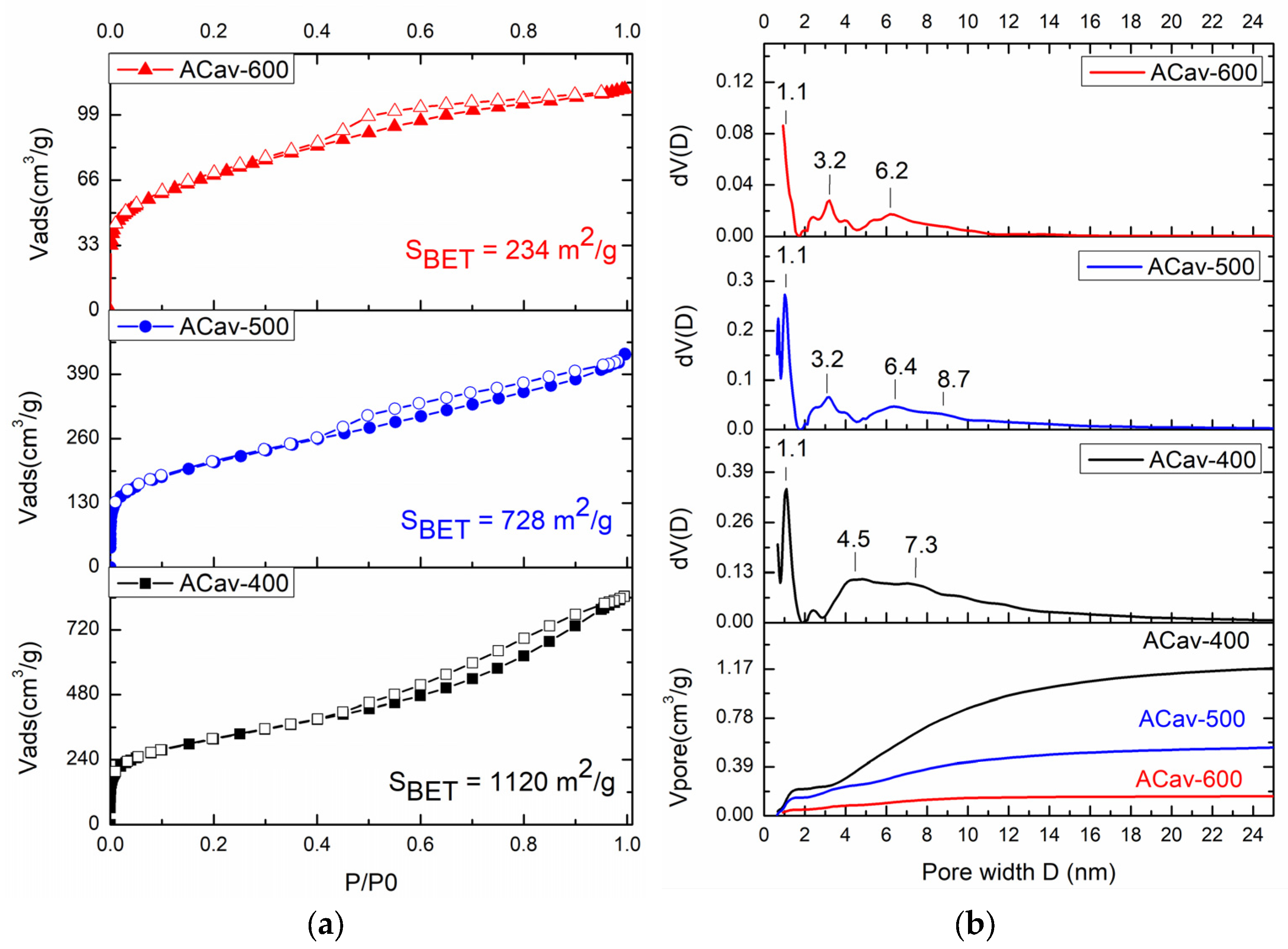
Figure 4 presents the nitrogen adsorption–desorption isotherms (Figure 4a) and pore size distributions (Figure 4b) of activated carbons derived from aloe vera leaf wastes in varied pyrolysis temperatures (400, 500, and 600 °C). In all cases, the adsorption–desorption isotherms correspond to type IV according to IUPAC classification, exhibiting a hysteresis loop and indicating the presence of both micropores and mesopores. The SBET specific surface area was determined to be 1120, 728, and 234 m2/g for ACav-400, ACav-500, and ACav-600, respectively. This finding can be attributed to structural shrinkage and partial collapse or widening of the pore network at elevated temperatures. The pore size distribution analysis using DFT calculations reveals the presence of micropores with diameter 1.1 nm and mesopores with mean diameters ranging from 3 to 8 nm. Also, a significant reduction in cumulative pore volume is observed with increasing pyrolysis temperature, decreasing from 1.21 cm3/g for ACav-400 to 0.59 cm3/g for ACav-500 and 0.16 cm3/g for ACav-600. For the sample ACav-253, the adsorption–desorption isotherms indicate a nonporous or microporous material.
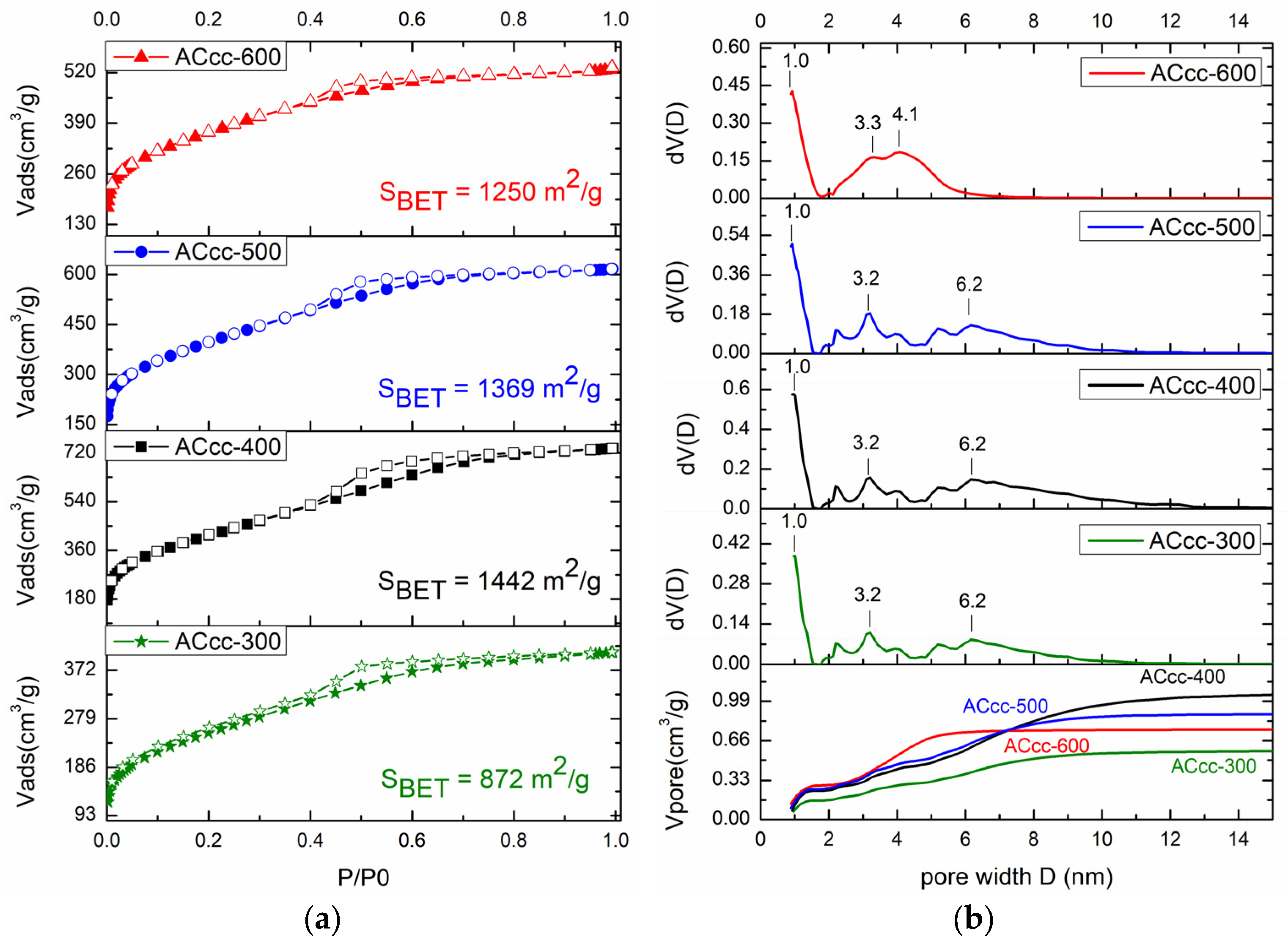
Similar results were obtained also from the nitrogen adsorption–desorption isotherms (Figure 5a) and pore size distributions (Figure 5b) of the activated carbons derived from corn cob wastes in varied pyrolysis temperatures (300, 400, 500, and 600 °C). All isotherms are type IV, exhibiting a hysteresis loop with microporous and mesoporous features. The specific surface area of the materials is increasing from 872 m2/g for ACcc-300 to a maximum of 1442 m2/g for ACcc-400, followed by a slight decrease to 1369 m2/g and 1250 m2/g for ACcc-500 and ACcc-600, respectively. A similar trend is observed for the cumulative pore volume (Table 1), as determined by DFT analysis. Pore size distribution results confirm the coexistence of micropores with diameter 1 nm and mesopores with sizes ranging from 3 to 7 nm.
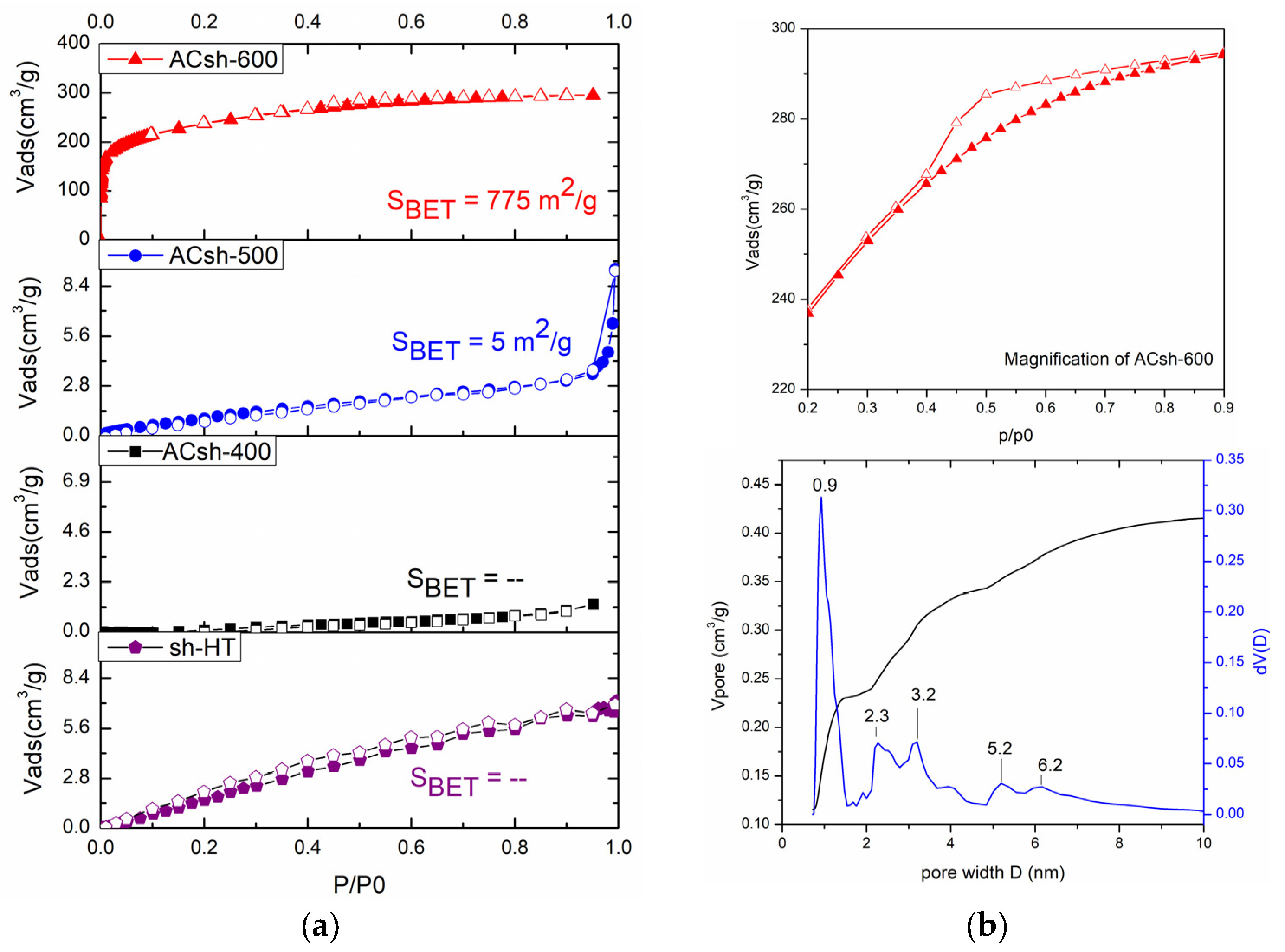
In the case of the carbon materials that are produced from slaughterhouse wastes (Figure 6a), the adsorption–desorption isotherms at lower pyrolysis temperatures (ACsh-400 and ACsh-500) as well as the product sh-HT derived from hydrothermal treatment at 200 °C show characteristics of nonporous or macroporous materials. Only the material produced at 600 °C (ACsh-600) exhibits isotherms corresponding to type I according to IUPAC classification, which is characteristic for microporous materials and surface area 775 m2/g. However, a more careful examination of these isotherms (Figure 6b) shows the existence of a hysteresis loop that reveals the coexistence of mesopores. Also, the DFT pore size distribution analysis confirms these findings showing the presence of 0.9 nm micropores and mesopores in the average size of 2 to 7 nm. This pronounced pore development for the slaughterhouse waste (where SBET increases from 5 m2/g at 500 °C to 775 m2/g at 600 °C) can be attributed to the temperature-dependent thermal degradation of animal fats and protein complexes. Below 600 °C, residual lipid fractions and undecomposed carbonaceous volatile matter probably remain trapped within the carbon matrix, completely blocking the microporous network, suggesting that as the microwave pyrolysis temperature reaches 600 °C, intensive volatilization and sudden release of these trapped decomposition products occur.
It is observed that the textural properties of all AC samples are strongly influenced by the pyrolysis temperature. Comparing the materials produced from different precursor sources (av, cc, sh), we conclude that the significantly higher BET surface area was observed for ACcc-400 (1442 m2/g1), followed by ACav-400 (1120 m2/g) and finally ACsh-600 (775 m2/g). The chemical activation with ZnCl2 and microwave pyrolysis effectively creates micropore/mesopore structures through dehydration and volatilization processes. The DFT results further confirm the presence of this dual porosity, which is advantageous for applications requiring both high surface area and efficient mass transport. Overall, the results suggest that, in the case of biomass av and cc precursors, the lower pyrolysis temperatures (400 °C) are more favorable for producing activated carbons with enhanced textural properties, while for slaughterhouse waste at pyrolysis temperature lower than 600 °C, it is not possible to form a porous structure.

3.2. Infrared Spectra

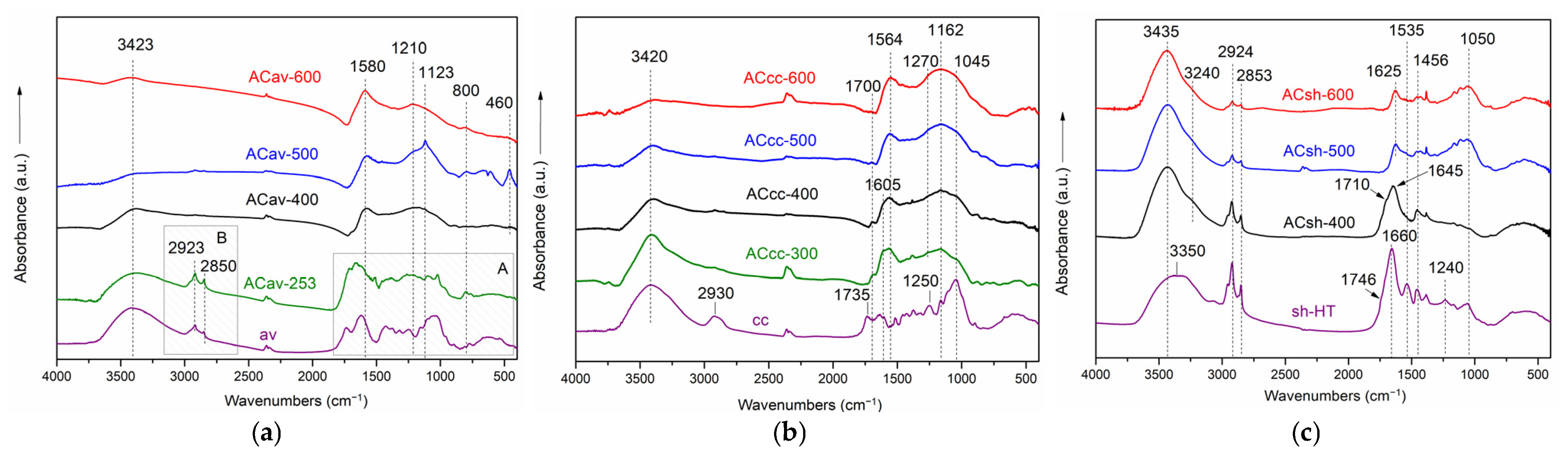
Infrared spectra of the produced carbon materials in comparison with the corresponding initial biomass and hydrothermally treated slaughterhouse wastes are presented in Figure 7a, b, and c, respectively. In all cases, the precursor materials exhibit the characteristic absorption bands of lignocellulosic and organic biomass structures, including -OH stretching vibrations (in the region ~3420–3350 cm−1), aliphatic C-H stretching vibrations (at ~2930 and 2850 cm−1), carbonyl related bands (in the region ~1735–1660 cm−1), and C-O/C-O-C vibrations in the region ~1250–1000 cm−1 [5,51,52]. These bands progressively decrease in intensity with increasing pyrolysis temperature, indicating the thermal decomposition of cellulose, hemicellulose, lipids, proteins, and other oxygenated surface functionalities, accompanied by the gradual formation of aromatic carbon structures.
In the case of aloe vera leaf waste biomass (Figure 7a), the precursor’s (av) bands are flattening as the pyrolysis temperature increases, indicating the transformation of these groups into an aromatic carbon structure. More specifically, in the spectra of ACav-400, 500, and 600, new bands are observed at 1580, 1210, 1123, and 800 cm−1, which are characteristics in activated carbon’s infrared spectrum [17,18,50]. The bands at 1580 cm−1 and 1123 cm−1 contribute to the stretching vibrations of C=C and C-H bonds in aromatic carbon rings, respectively [53], whereas the band at 1210 cm−1 corresponds to stretching vibration modes of C–O bonds [18,54]. The band at 800 cm−1 is typically related to the aromatic structure (C-H out-of-plane bending or deformation modes) of the activated carbon skeleton, specifically the hydrogen atoms attached to the rings [54].
Similar results are also observed for the case of carbon materials derived from corn cob biomass (Figure 7b), where the intensity of the precursor’s (cc) bands decreases significantly, confirming also the thermal degradation of hemicellulose, cellulose, and lignin components. As the pyrolysis temperature increases, these spectra become progressively simpler and are dominated by bands (1564, 1270, and 1162 cm−1) related to the aromatic carbon structures. The persistence of weak oxygen-containing functional group bands at 1700 and 1605 cm−1 (C=O in COOH and COO groups, respectively [55]) suggests that a limited number of surface oxygen functionalities remain on the activated carbon surface, which may contribute positively to adsorption-related applications.
The spectra of the slaughterhouse-derived carbons (Figure 7c) exhibit a more pronounced transformation due to the combined hydrothermal treatment and activation process. The Sh-HT precursor displays characteristic bands associated with residual fats, lipids, proteins, and nitrogen-containing compounds, including aliphatic C–H vibrations (2924 and 2853 cm−1), carbonyl and aromatic-related bands (~1660 cm−1), and C=N vibrations (~1535 cm−1) [5]. Following pyrolysis, these bands progressively flatten, while a broad absorption band centered around 1050 cm−1 develops, corresponding to C–O and C–O–C stretching vibrations typically observed in activated carbons [18,53,54]. Moreover, the band at 1660 cm−1 shifts toward lower wavenumbers (1645 cm−1 for ACsh-400 and 1625 cm−1 for ACsh-500 and ACsh-600), suggesting the transformation of amide, ketone, and quinone groups into COO functionalities. The gradual decrement of the aliphatic C-H bands further confirms the thermal degradation of fatty chains and the development of a more aromatic carbon framework at higher pyrolysis temperatures.
Overall, the FT-IR results demonstrate that aloe vera and corn cob biomasses as well as slaughterhouse waste undergo substantial structural transformation during microwave-assisted pyrolysis, leading to the formation of activated carbons with predominantly aromatic character and reduced oxygen-containing functionalities.

3.3. Raman Spectra

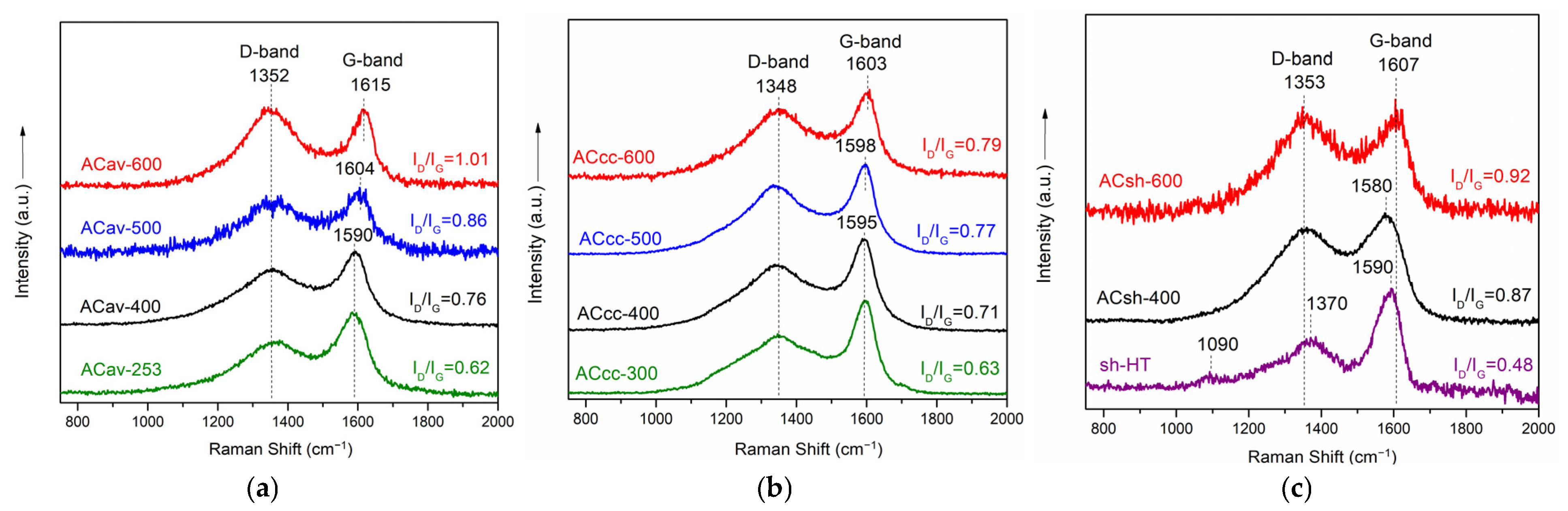
The Raman spectra of the porous carbons derived from aloe vera leaf waste (ACav-X), corn cob waste (ACcc-X), and slaughterhouse residues (ACsh-X) are presented in Figure 8. All samples exhibit the characteristic D- and G-bands of carbonaceous materials, confirming the formation of partially graphitized porous carbons after ZnCl2 activation and microwave pyrolysis at various temperatures (X). The D-band, located at 1348–1353 cm−1, is associated with sp2 hybridized carbon bonded with structural defects, whereas the G-band appearing at 1590–1615 cm−1 corresponds to the in-plane vibration of sp2 bonded crystalline carbon atoms [39,40,41]. The presence of these two bands indicates that the materials exhibit a mixed amorphous/graphitic structure typical of activated carbons produced from biomass precursors. The intensity ratio of these bands, ID/IG, as well as the position of the G-band are some of the Raman features that characterize the changes in the graphitization degree of the carbon materials derived from biomass [56,57,58,59,60,61,62,63,64].
An increase in the ID/IG ratio suggests the progressive development and lateral expansion of graphene-like aromatic domains within the carbon matrix. This behavior indicates the growth and structural organization of polyaromatic clusters toward larger nanostructured carbon regions. In parallel, the shift of the G-band from 1500 cm−1 to 1600 cm−1 indicates the enhancement of structural ordering of the aromatic carbon framework. This shift may be related to the formation of larger aromatic carbon structures and changes in the carbon bonding environment [58].
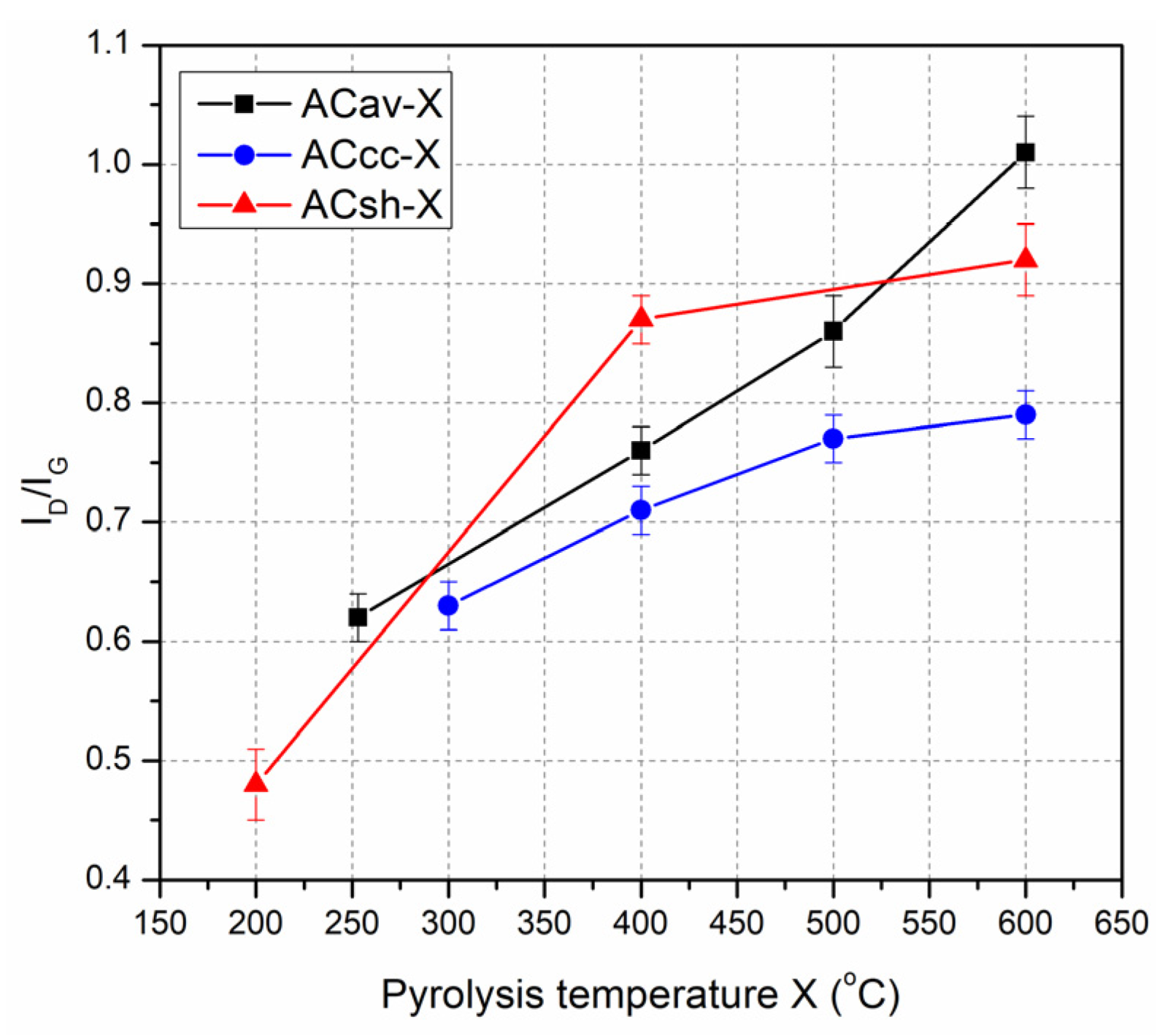
In all cases of ACav-X, ACcc-X, and ACsh-X materials, it is observed that the ID/IG ratio is increased by increasing the pyrolysis temperature, indicating the progressive formation and structural ordering of larger graphene-like aromatic carbon domains within the carbon matrix. In addition, the shift of the G-band from 1590 to 1615 cm−1, 1595 to 1603 cm−1, and 1580 to 1607 cm−1 at higher pyrolysis temperatures, for ACav-X, ACcc-X, and ACsh-X, respectively, also indicates structural rearrangement and partial graphitization of the carbon framework.
Figure 9 summarizes the effect of pyrolysis temperature on the ID/IG ratio for all prepared carbons, where it is clearly observed that, in all cases, increasing temperature resulted in higher ID/IG values. Overall, the Raman analysis demonstrates the significant role of both precursor type and pyrolysis temperature in affecting the structural ordering and defect density of the produced activated carbons, which represent critical parameters for their adsorption and electrochemical properties.

3.4. X-Ray Results

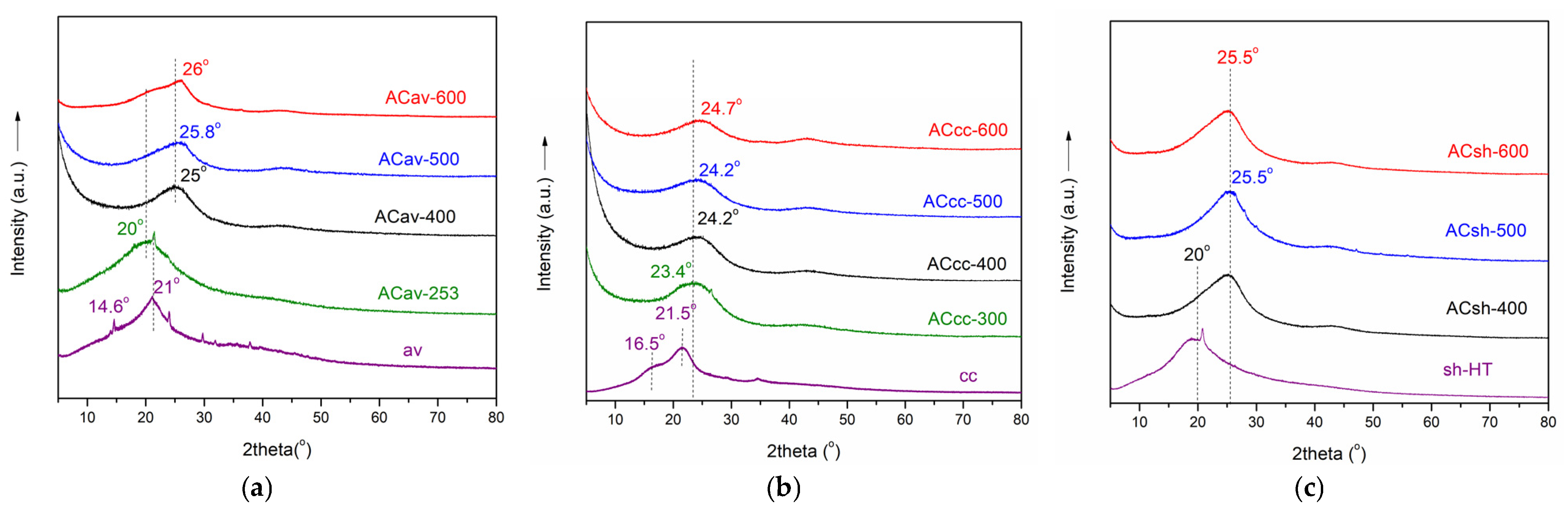
Figure 10 presents the XRD patterns of the porous carbons prepared from aloe vera waste leaves (ACav-X), corn cob biomass (ACcc-X), and slaughterhouse residues (ACsh-X). All samples exhibit broad diffraction peaks centered approximately between 20° and 26° (2θ), which are characteristic for amorphous lignocellulosic structures and disordered graphitic carbon domains, respectively [57,65,66]. Amorphous lignocellulosic structures exhibit broad diffraction peaks centered at ~15 and 21° [66], whereas a broad diffraction peak in the area near 26° corresponds to the (002) reflection of low crystallinity carbon structures [61]. In all cases of AC carbons, the absence of sharp crystalline reflections indicates that the activation process promoted the formation of disordered porous carbons.
Specifically, in the case of ACav-X materials (Figure 10a), it is observed that there is a shift of the peak from 20° to 26° as the temperature treatment increased from 253 to 600 °C, indicating the pronounced transformation of the lignocellulosic precursor av to amorphous carbon structures. Moreover, the slightly enhanced intensity and definition of the peak at 26° that is observed for the higher pyrolysis temperature (600 °C) probably indicates the development of more condensed aromatic carbon structures due to increased carbonization under microwave irradiation. However, the persistence of broad peaks confirms that the material remained largely amorphous.
For the ACcc-X samples, the diffraction patterns (Figure 10b) exhibit the main diffraction peak centered at 23.4° for ACcc-300 and shifted toward 24.7° for ACcc-600. This slight shifting toward higher diffraction angles indicates slightly improved structural ordering and partial graphitization with increasing pyrolysis temperature. Also, in this case, the broad nature of the peaks demonstrates that the carbon framework still consisted mainly of disordered graphitic layers with limited crystallite growth.
For the slaughterhouse-derived carbons (Figure 10c), the hydrothermally treated precursor (Sh-HT) displayed a broad and weak diffraction pattern at ~20° typical of poorly carbonized organic precursor. After activation and microwave treatment, all the ACsh-X samples exhibit broad peak shifted at 25.5°, indicating the formation of amorphous graphitic carbon domains. This peak position shifting demonstrates the increased aromatic condensation and structural organization, which appear to be less dependent on pyrolysis temperature than in the ACav-X and ACcc-X materials.
Overall, the XRD analysis demonstrates the subtle influence of both the precursor type and pyrolysis temperature in affecting the graphitic structure of the produced porous carbons. In all cases, microwave-assisted ZnCl2 activation resulted in predominantly amorphous carbon materials with poorly ordered graphitic domains, as confirmed by the broad diffraction peaks in the 20–26° (2θ) region and the absence of sharp crystalline reflections. Increasing pyrolysis temperature led to the gradual transformation of lignocellulosic structures into more condensed aromatic carbon frameworks.

3.5. Dispersion/Stability in Water

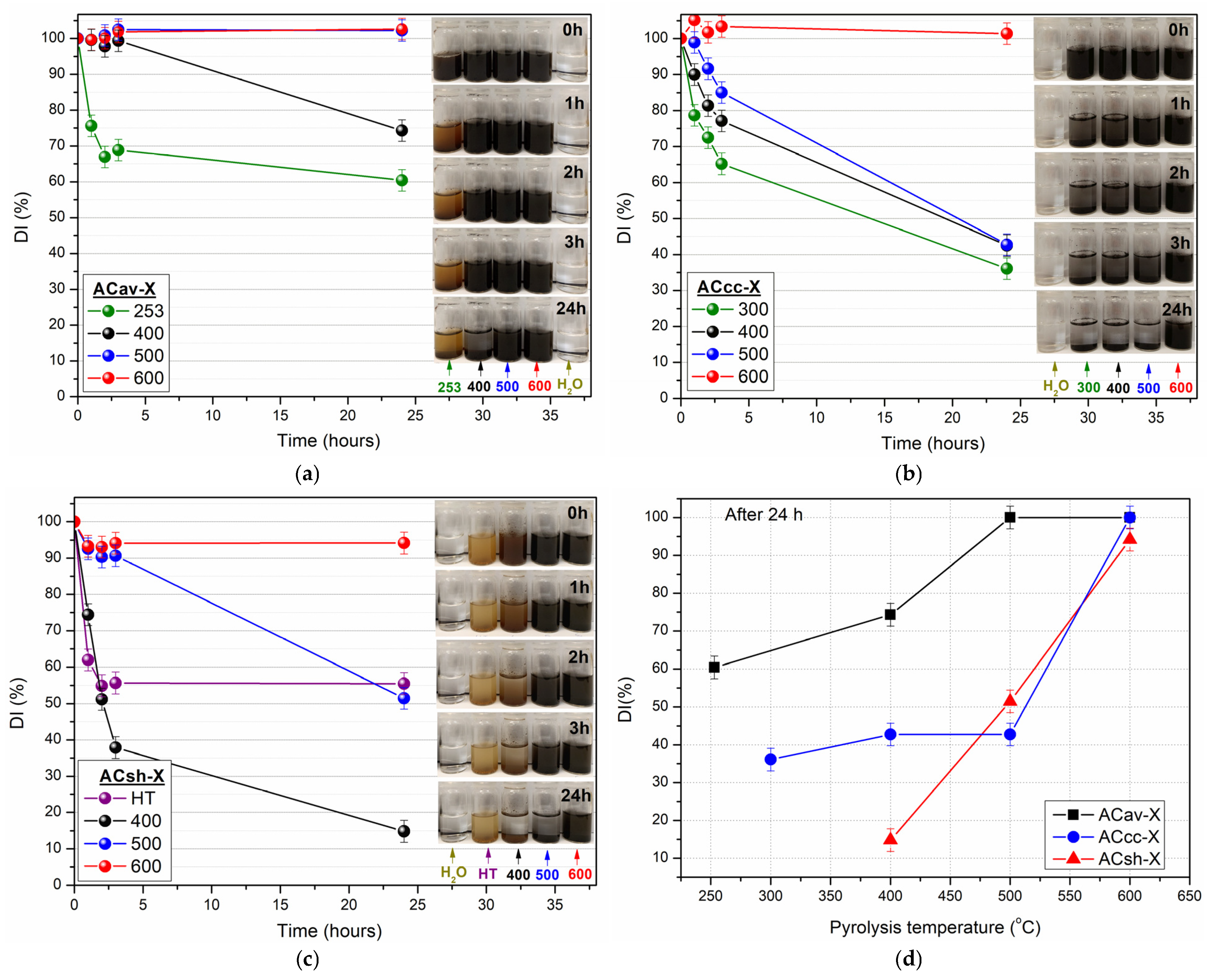
The water dispersibility behavior of the produced activated carbons was monitored (inset photos in Figure 11) after sonication in water and left undisturbed for 24 h. Initially, all samples formed homogeneous suspensions. The gradual phase separation, which was observed with increasing standing time, accompanied by the formation of sediment at the bottom of the containers, was studied by calculating the dispersibility index (DI%) as described in the experimental section. Samples exhibiting delayed sediment formation likely possess higher dispersibility in water. Figure 11a–c presents the DI% for the different materials as a function of standing time.
In all cases, the homogeneous suspensions that were initially (0 h) obtained after sonication were referred to 100% DI. It is also observed that all the materials which are produced at the higher temperature (600 °C) exhibited the highest dispersibility, 95–100% DI, even after 24 h standing time. At a little bit lower pyrolysis temperature (500 °C), only the material from aloe vera precursor (ACav-500) exhibited the same behavior (100% DI after 24 h), whereas DI gradually decreased with increasing standing time, reaching 43 and 52% for the materials ACcc and ACsh, respectively, indicating progressive particle sedimentation. By further decreasing the pyrolysis temperature to 400 °C, the ACav-400 shows stable dispersion in water for the first 3 h standing, with 100% DI, which reduced to 74% after 24 h (Figure 11a), whereas the lower DI value of 60% was observed for 253 °C pyrolysis temperature. For ACcc materials, the DI slightly decreased (~10%) by decreasing the pyrolysis temperature from 500 to 400 and 300 °C, reaching 36% DI after 24 h for ACcc-300 (Figure 11b). In the case of ACsh-400, the DI value dramatically decreased to 38% after 3 h, reaching only 15% after 24 h (Figure 11c).
Figure 11d shows the comparison of dispersibility index, after 24 h standing, for materials produced using the three different precursors (av, cc, and sh) as a function of the pyrolysis temperature. In all cases, it is observed that increasing pyrolysis temperature generally enhanced dispersion stability, whereas ACav-X materials exhibited the highest dispersion stability. Even the samples prepared at pyrolysis temperatures 300–500 °C retained high DI values (60–75%) after 24 h. Corn cob-derived carbons (ACcc-X) showed a similar trend at pyrolysis temperatures 300–500 °C, with ~40% DI after 24 h standing, which excitingly increased to 100% at 600 °C. In contrast, the slaughterhouse-derived carbons (ACsh-X) displayed the lower dispersion stability (15%) at pyrolysis temperature 400 °C, with faster sedimentation and lower DI values after 24 h, which also impressively reached 95% for the material produced at 600 °C.
The observed higher dispersion stability in all cases at higher pyrolysis temperatures cannot be only explained by surface chemistry effects, since FT-IR results indicate a decrease in hydrophilic surface functional groups with increasing temperature. In addition to changes in oxygen-containing functional groups, variations in particle size induced by microwave-assisted pyrolysis may also contribute to the observed behavior. Smaller particles are expected to exhibit lower sedimentation rates, resulting in enhanced suspension stability. Taken together, these findings suggest that increasing the microwave-assisted pyrolysis temperature may promote the formation of smaller particles. This could explain the improved dispersion stability despite the decrease in hydrophilic surface functionalities, as smaller particles are expected to exhibit lower sedimentation rates and remain suspended for longer periods.

3.6. Cr(VI) Removal Efficiency

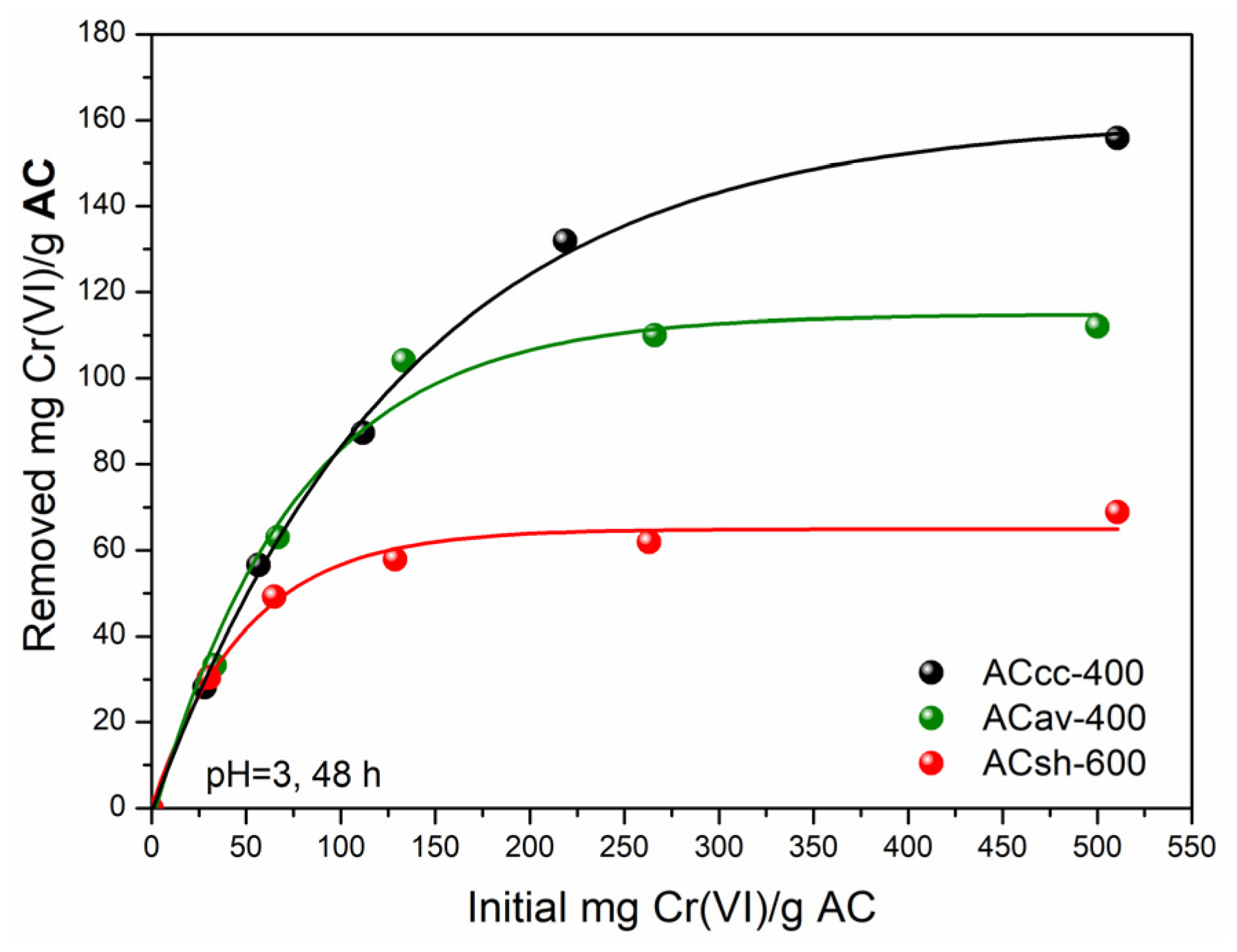
Based on the total results from multicharacterization techniques presented in Section 3.1, the specific surface area is nonlinearly related with pyrolysis temperature, and it is highly dependent on the precursor type. The highest porosity was achieved at 400 °C for cc and av, and at 600 °C for sh, with higher temperatures leading to a decline in surface area due to structural pore shrinkage, as well as reduced surface oxygen functional groups (such as hydroxyl and carbonyl groups identified via FT-IR). Consequently, the adsorption capacity is governed by a fine trade-off between the available physical surface area and the density of active chemical binding sites remaining on the carbon matrix. Therefore, the three activated carbons, ACcc-400, ACav-400, and ACsh-600, seem to present a balance of structural and chemical properties and for this reason were selected and evaluated for Cr(VI) wastewater treatment. In order to evaluate the adsorption performance of the microwave-produced activated carbons, the samples ACcc-400, ACav-400, and ACsh-600 were contacted with aqueous Cr(VI) solutions of different initial concentrations at pH 3 for 48 h at room temperature. Figure 12 presents the experimental isotherm results in the amount of Cr(VI) removed in each case. It is observed that specific surface area is affected the adsorption capacity of the materials, and the ACcc-400 material, which exhibited the highest surface area (1442 m2/g), shows also the highest adsorption capacity, followed by ACav-400 (1120 m2/g) and ACsh-600 (775 m2/g).
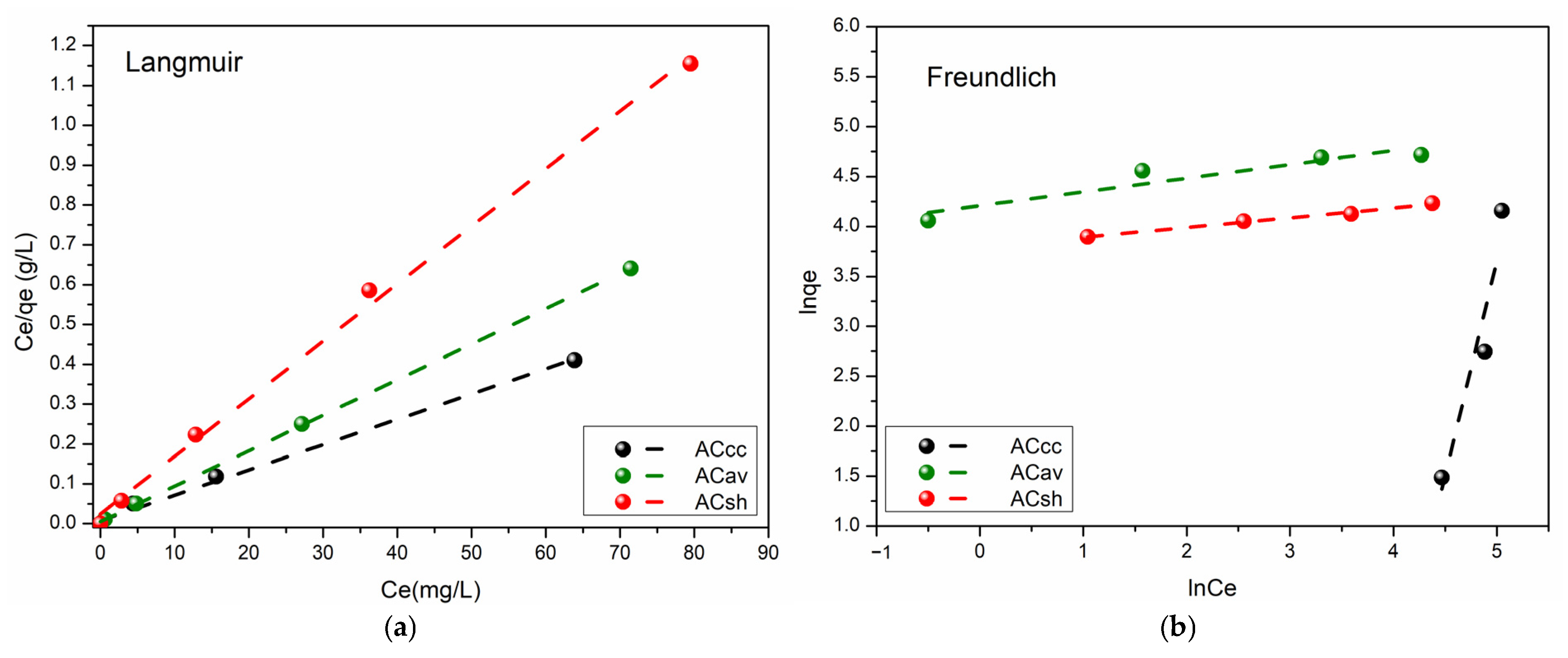
The Langmuir and Freundlich models (Equations (2) and (3), respectively) [67,68] were used in order to explore the Cr(VI) removal trends by ACav-400, ACcc-400, and ACsh-600 materials, and the results are presented in Figure 13.
Langmuir : C e q e = C e q m a x + 1 q m a x K L
Freundlich : l n q e = l n K F + 1 n l n C e
where Ce (mg/L) is the equilibrium concentration of the liquid phase, qe (mg/g) is the absorbed amount in equilibrium, qmax represents the maximum adsorption capacity, KL is the Langmuir energy constant, KF is the Freundlich constant, and n is the adsorption intensity.
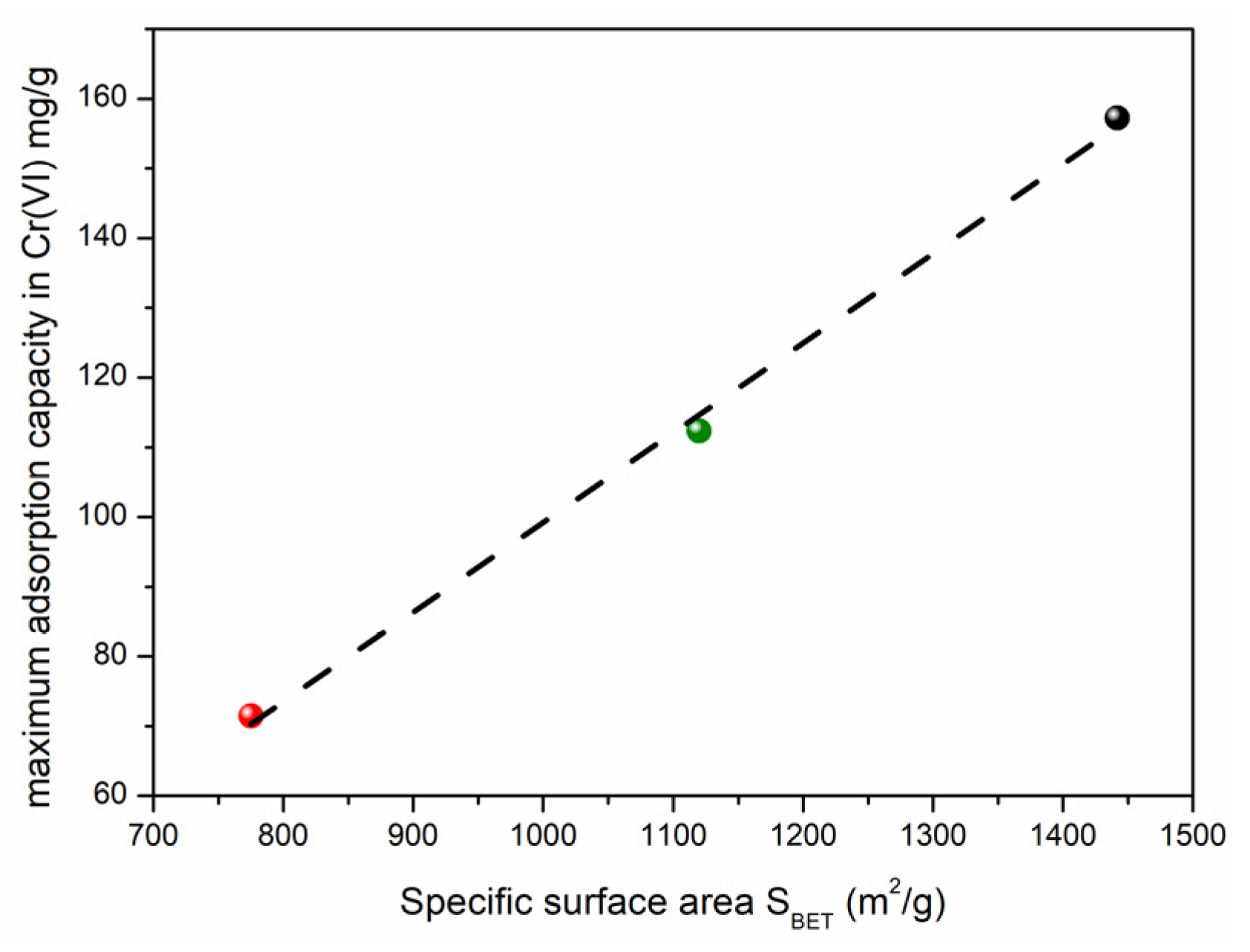
The parameter values obtained from the fitting of the two models are summarized in Table 2. Based on the correlation coefficients (R2), the Langmuir model provides a better description of the Cr(VI) removal isotherm. The Langmuir model supposes that the adsorption sites on the adsorbent surface are uniformly distributed, energetically identical, and equally accessible for adsorption. In addition, the model considers that no interactions occur between the adsorbed molecules or ions. According to the Langmuir model, the maximum adsorption capacity was estimated to be ~112, 157, and 71 mg/g for ACav-400, ACcc-400, and ACsh-600, respectively. The maximum adsorption capacity appears to be linearly correlated with the specific surface area (Figure 14).
The adsorption capacity of the materials is much higher than other values that have been reported in the literature for biomass-derived AC, which has been also produced via microwave-assisted pyrolysis (Table 3). In addition, these values are among the highest for biomass-derived activated carbons prepared using conventional pyrolysis [40,69].
The Gibbs free energy ΔG° was also calculated for the different initial concentrations using Equation (4), and the results are presented in Table 4.
ΔG° = −RT ln(K)
where R is the gas constant (8.134 J/mol K), T the temperature in Kelvin, and K a thermodynamic equilibrium constant equal to qe/Ce [70]. In all cases, Gibbs free energy has a negative value that confirms the spontaneous nature of the adsorption process. In addition, ΔG° values within the range of −20 to −80 kJ mol−1 suggest a transition from physical adsorption to chemical adsorption mechanisms [71,72]. This implies that both physisorption and chemisorption contributed to the overall adsorption process. The operation at pH 3 is highly favorable for this synergistic mechanism due to hexavalent chromium speciation, as the metal exists predominantly as negatively charged HCrO4 ions. Although the point of zero charge (pHpzc) was not experimentally determined, the literature benchmarks for similar activated carbons indicate that, at pH 3, surface functionalities undergo extensive protonation, rendering the carbon matrix positively charged [73,74]. More specifically, the thermodynamic synergy suggests that the initial removal stage is governed by physisorption via electrostatic attraction between the protonated surface oxygen groups (positively charged at pH 3) and the negatively charged hexavalent chromium anions [17,18,37,75]. Concurrently, chemisorption possibly occurs through subsequent surface complexation mechanisms involving the oxygen functionalities identified in the FT-IR spectra [37,76,77].
Although the obtained adsorption capacities demonstrate the strong potential of the produced activated carbons for Cr(VI) removal, the environmental footprint of the overall process was not evaluated in the present study. Therefore, comprehensive life-cycle assessment, regeneration studies, and ecotoxicological evaluation of the produced materials should be considered in future investigations to further assess their practical environmental sustainability.

4. Conclusions

In the present work, high surface area micro/mesoporous activated carbons were successfully synthesized from aloe vera industrial waste, corn cob agricultural residues, and soft slaughterhouse wastes (pork’s liver, heart, and lung). Using a rapid and energy-efficient microwave-assisted pyrolysis process combined with ZnCl2 chemical activation, the carbonization and activation time was drastically reduced to less than 20 min, demonstrating a potential sustainable route for biomass valorization.
The experimental findings demonstrate that the structural characteristics, surface chemistry, water dispersibility, and heavy metal adsorption efficiency are influenced by both the precursor type and the final pyrolysis temperature.
Nitrogen adsorption–desorption analysis revealed the formation of well-developed porous networks. Lower microwave pyrolysis temperatures (400 °C) were found to be optimal for agricultural biomass precursors, yielding specific surface areas of 1442 m2/g for corn cob and 1120 m2/g for aloe vera leaves. Conversely, soft slaughterhouse waste required a higher pyrolysis temperature of 600 °C, following a microwave-assisted hydrothermal carbonization (HT) pre-treatment, to efficiently unblock the porous network and achieve a significant surface area of 775 m2/g.
FT-IR, Raman, and XRD characterizations confirmed the progressive thermal decomposition of cellulose, hemicellulose, proteins, and lipids into predominantly amorphous aromatic carbon frameworks containing partially graphitized domains with low crystallinity.
Water dispersibility tests demonstrated that samples pyrolyzed at the highest temperature (600 °C) exhibited exceptional long-term stability (95–100% Dispersibility Index after 24 h). This behavior indicates that higher microwave-assisted temperatures may promote particle size reduction, decreasing sedimentation rates despite the thermal reduction of hydrophilic surface functional groups.
The synthesized porous carbons displayed outstanding efficiency for the removal of toxic hexavalent chromium from aqueous solutions. The adsorption data perfectly fitted the Langmuir isotherm model, calculating maximum adsorption capacities of 157.23 mg/g, 112.35 mg/g, and 71.43 mg/g for corn cob-, aloe vera-, and slaughterhouse-derived carbons, respectively. Thermodynamic evaluation yielded negative Gibbs free energy values, confirming the spontaneous nature of the adsorption process via combined physical and chemical uptake mechanisms.
From an application perspective, upcycling locally abundant, zero-value biowastes directly eliminates precursor cost and industrial waste disposal issues. Also, the rapid microwave synthesis reduces processing times to less than 20 min, offering energy savings and drastically shortening the required inert gas purging period compared to conventional pyrolysis. Consequently, all these factors enhance the economic viability of the process for sustainable industrial scale-up.
In conclusion, this comparative study proposes a highly energy-efficient and low-cost upcycling route for toxic heavy metal remediation. Also, the novel two-step hybrid approach (microwave-assisted hydrothermal treatment followed by microwave pyrolysis) developed for high-moisture slaughterhouse waste provides a promising and scalable route for the management of challenging animal by-products. While this work presents the possibility of converting diverse regional waste streams into high-value adsorbents, future studies involving chemical regeneration/reusability cycles, environmental impact assessments, and life-cycle analysis (LCA) are recommended to fully evaluate and scale up the industrial sustainability of the proposed process.

Author Contributions

Conceptualization, M.A.K.; methodology, M.A.K., M.B. and C.E.S.; formal analysis, M.A.K., M.B. and C.E.S.; investigation, M.B., F.T., A.P. and N.P.; resources, M.A.K.; data curation, M.B.; writing—original draft preparation, M.A.K. and M.B.; writing—review and editing, M.A.K., C.E.S. and M.B.; supervision, M.A.K. and M.B.; project administration, M.A.K.; funding acquisition, M.A.K. All authors have read and agreed to the published version of the manuscript.

Funding

This work was carried out within the framework of the Action ‘Flagship Research Projects in challenging interdisciplinary sectors with practical applications in Greek industry’, implemented through the National Recovery and Resilience Plan Greece 2.0 and funded by the European Union—NextGenerationEU (project code: TAEDR-0535821).

Data Availability Statement

The original contributions presented in this study are included in the article. Further inquiries can be directed to the corresponding author.

Acknowledgments

The authors would like to acknowledge Odyssea Papageorgiou for his contribution in hexavalent chromium batch experiments. During the preparation of this manuscript/study, the authors used ChatGPT free version for the purposes of English language improvement. The authors have reviewed and edited the output and take full responsibility for the content of this publication.

Conflicts of Interest

The authors declare no conflicts of interest.

Abbreviations

The following abbreviations are used in this manuscript:
ACActivated carbon
ccCorn cob
avAloe vera
shSlaughterhouse
DIDispersibility index
MWMicrowave
HTHydrothermal treatment

References

  1. Lackner, M.; Besharati, M. Agricultural Waste: Challenges and Solutions, a Review. Waste 2025, 3, 18. [Google Scholar] [CrossRef] [Scilit]
  2. Ashilenje, D.; Ashour, F.; Barz, M.; Belandria, V.; Borello, A.; Bostyn, S.; Boushaki, T.; Branciari, R.; Bwapwa, J.K.; Cerza, E.; et al. A Literature Review of Slaughterhouse Waste Valorisation: Techniques, Environmental, and Economic Implications. Resour. Conserv. Recycl. 2026, 224, 108571. [Google Scholar] [CrossRef] [Scilit]
  3. Almeida, B.P.; Pavão, L.F.S.; de Farias, M.S.; Nicolodi, N.M.; Petry, M.T.; Leal, M.M.; Coradi, P.C.; de Souza, V.L.; Queirós, M.d.S.; Furtado, G.d.F.; et al. Agricultural Biomass as a Resource for Biomaterials, Biofertilizers, and Bioproducts: A Systematic Review. Agrochemicals 2025, 4, 23. [Google Scholar] [CrossRef] [Scilit]
  4. Kumar, J.A.; Sathish, S.; Prabu, D.; Renita, A.A.; Saravanan, A.; Deivayanai, V.C.; Anish, M.; Jayaprabakar, J.; Baigenzhenov, O.; Hosseini-Bandegharaei, A. Agricultural Waste Biomass for Sustainable Bioenergy Production: Feedstock, Characterization and Pre-Treatment Methodologies. Chemosphere 2023, 331, 138680. [Google Scholar] [CrossRef] [Scilit] [PubMed]
  5. Cuetos, M.J.; Gómez, X.; Otero, M.; Morán, A. Anaerobic Digestion of Solid Slaughterhouse Waste: Study of Biological Stabilization by Fourier Transform Infrared Spectroscopy and Thermogravimetry Combined with Mass Spectrometry. Biodegradation 2010, 21, 543–556. [Google Scholar] [CrossRef] [Scilit] [PubMed]
  6. Ullah, H.; Elahi, I.; Saleem, S.; Nawaz, R.; Ullah, S.; Qadeer, S.; Kabeer, B.; Anjum, M.; Liu, Y.; Shahab, A.; et al. Bacterial Inactivation and Organic Pollutant Degradation in Slaughterhouse Wastewater Using Ag2O/Ba/TiO2 Nanocomposite. Catalysts 2025, 15, 411. [Google Scholar] [CrossRef] [Scilit]
  7. Sandoval, M.A.; Coreño, O.; García, V.; Salazar-González, R. Enhancing Industrial Swine Slaughterhouse Wastewater Treatment: Optimization of Electrocoagulation Technique and Operating Mode. J. Environ. Manag. 2024, 349, 119556. [Google Scholar] [CrossRef] [Scilit] [PubMed]
  8. Aziz, A.; Basheer, F.; Sengar, A.; Irfanullah; Khan, S.U.; Farooqi, I.H. Biological Wastewater Treatment (Anaerobic-Aerobic) Technologies for Safe Discharge of Treated Slaughterhouse and Meat Processing Wastewater. Sci. Total Environ. 2019, 686, 681–708. [Google Scholar] [CrossRef] [Scilit] [PubMed]
  9. Zanol, M.B.; Lima, J.P.P.; Assemany, P.; Aguiar, A. Assessment of Characteristics and Treatment Processes of Wastewater from Slaughterhouses in the State of Minas Gerais, Brazil. J. Environ. Manag. 2024, 358, 120862. [Google Scholar] [CrossRef] [Scilit] [PubMed]
  10. Ni, M.; Zhou, L.; Liu, Y.; Ni, R. Advances in the Synthesis and Applications of Porous Carbon Materials. Front. Chem. 2023, 11, 1205280. [Google Scholar] [CrossRef] [Scilit] [PubMed]
  11. Wei, H.; Wang, H.; Li, A.; Li, H.; Cui, D.; Dong, M.; Lin, J.; Fan, J.; Zhang, J.; Hou, H.; et al. Advanced Porous Hierarchical Activated Carbon Derived from Agricultural Wastes toward High Performance Supercapacitors. J. Alloys Compd. 2020, 820, 153111. [Google Scholar] [CrossRef] [Scilit]
  12. Chew, T.W.; H’Ng, P.S.; Luqman Chuah Abdullah, B.C.T.G.; Chin, K.L.; Lee, C.L.; Mohd Nor Hafizuddin, B.M.S.; TaungMai, L. A Review of Bio-Based Activated Carbon Properties Produced from Different Activating Chemicals during Chemicals Activation Process on Biomass and Its Potential for Malaysia. Materials 2023, 16, 7365. [Google Scholar] [CrossRef] [Scilit] [PubMed]
  13. Kumar Mishra, R.; Singh, B.; Acharya, B. A Comprehensive Review on Activated Carbon from Pyrolysis of Lignocellulosic Biomass: An Application for Energy and the Environment. Carbon Resour. Convers. 2024, 7, 100228. [Google Scholar] [CrossRef] [Scilit]
  14. Gan, Y.X. Activated Carbon from Biomass Sustainable Sources. C 2021, 7, 39. [Google Scholar] [CrossRef] [Scilit]
  15. Jjagwe, J.; Olupot, P.; Menya, E.; Kalibbala, H. Synthesis and Application of Granular Activated Carbon from Biomass Waste Materials for Water Treatment: A Review. J. Bioresour. Bioprod. 2021, 6, 292–322. [Google Scholar] [CrossRef] [Scilit]
  16. Baikousi, M.; Gantzoudi, A.; Gioti, C.; Moschovas, D.; Giannakas, A.E.; Avgeropoulos, A.; Salmas, C.E.; Karakassides, M.A. Hydrogen Sulfide Removal via Sorption Process on Activated Carbon–Metal Oxide Composites Derived from Different Biomass Sources. Molecules 2023, 28, 7418. [Google Scholar] [CrossRef] [Scilit] [PubMed]
  17. Asimakopoulos, G.; Baikousi, M.; Kostas, V.; Papantoniou, M.; Bourlinos, A.B.; Zbořil, R.; Karakassides, M.A.; Salmas, C.E. Nanoporous Activated Carbon Derived via Pyrolysis Process of Spent Coffee: Structural Characterization. Investigation of Its Use for Hexavalent Chromium Removal. Appl. Sci. 2020, 10, 8812. [Google Scholar] [CrossRef] [Scilit]
  18. Asimakopoulos, G.; Baikousi, M.; Salmas, C.; Bourlinos, A.B.; Zboril, R.; Karakassides, M.A. Advanced Cr(VI) Sorption Properties of Activated Carbon Produced via Pyrolysis of the “Posidonia Oceanica” Seagrass. J. Hazard. Mater. 2021, 405, 124274. [Google Scholar] [CrossRef] [Scilit] [PubMed]
  19. Spyrou, A.V.; Tantis, I.; Baikousi, M.; Bourlinos, A.B.; Salmas, C.E.; Zboril, R.; Karakassides, M.A. The Use of Activated Bio-Carbon Derived from “Posidonia Oceanica” Sea-Waste for Lithium-Sulfur Batteries Development. Sustain. Energy Technol. Assess. 2022, 53, 102748. [Google Scholar] [CrossRef] [Scilit]
  20. Hoang, A.T.; Kumar, S.; Lichtfouse, E.; Cheng, C.K.; Varma, R.S.; Senthilkumar, N.; Phong Nguyen, P.Q.; Nguyen, X.P. Remediation of Heavy Metal Polluted Waters Using Activated Carbon from Lignocellulosic Biomass: An Update of Recent Trends. Chemosphere 2022, 302, 134825. [Google Scholar] [CrossRef] [Scilit] [PubMed]
  21. Zhou, D.; Li, D.; Li, A.; Qi, M.; Cui, D.; Wang, H.; Wei, H. Activated Carbons Prepared via Reflux-Microwave-Assisted Activation Approach with High Adsorption Capability for Methylene Blue. J. Environ. Chem. Eng. 2021, 9, 104671. [Google Scholar] [CrossRef] [Scilit]
  22. Anis, D.; Ishak, M.A.M.; Zaidi, A.G.; Khudzir, I.; Iqbaldin, M.N.; Osman, U.M.; Nawawi, W.I. Production of Rubber Seed Pericarp Based Activated Carbon Using Microwave-Induced Different Chemical Activating Agent. Int. J. Sci. Res. Publ. 2014, 4, 1–8. [Google Scholar]
  23. Pezoti Junior, O.; Cazetta, A.L.; Gomes, R.C.; Barizão, É.O.; Souza, I.P.A.F.; Martins, A.C.; Asefa, T.; Almeida, V.C. Synthesis of ZnCl2-Activated Carbon from Macadamia Nut Endocarp (Macadamia Integrifolia) by Microwave-Assisted Pyrolysis: Optimization Using RSM and Methylene Blue Adsorption. J. Anal. Appl. Pyrolysis 2014, 105, 166–176. [Google Scholar] [CrossRef] [Scilit]
  24. Lam, S.S.; Liew, R.K.; Wong, Y.M.; Yek, P.N.Y.; Ma, N.L.; Lee, C.L.; Chase, H.A. Microwave-Assisted Pyrolysis with Chemical Activation, an Innovative Method to Convert Orange Peel into Activated Carbon with Improved Properties as Dye Adsorbent. J. Clean. Prod. 2017, 162, 1376–1387. [Google Scholar] [CrossRef] [Scilit]
  25. Liu, Z.; Zhou, X.; Wu, F.; Liu, Z. Microwave-Assisted Preparation of Activated Carbon Modified by Zinc Chloride as a Packing Material for Column Separation of Saccharides. ACS Omega 2020, 5, 10106–10114. [Google Scholar] [CrossRef] [Scilit] [PubMed]
  26. Bicil, Z.; Doğan, M. Characterization of Activated Carbons Prepared from Almond Shells and Their Hydrogen Storage Properties. Energy Fuels 2021, 35, 10227–10240. [Google Scholar] [CrossRef] [Scilit]
  27. Wang, T.; Tan, S.; Liang, C. Preparation and Characterization of Activated Carbon from Wood via Microwave-Induced ZnCl2 Activation. Carbon 2009, 47, 1880–1883. [Google Scholar] [CrossRef] [Scilit]
  28. Foo, K.Y.; Hameed, B.H. Utilization of Oil Palm Biodiesel Solid Residue as Renewable Sources for Preparation of Granular Activated Carbon by Microwave Induced KOH Activation. Bioresour. Technol. 2013, 130, 696–702. [Google Scholar] [CrossRef] [Scilit] [PubMed]
  29. Ao, W.; Fu, J.; Mao, X.; Kang, Q.; Ran, C.; Liu, Y.; Zhang, H.; Gao, Z.; Li, J.; Liu, G.; et al. Microwave Assisted Preparation of Activated Carbon from Biomass: A Review. Renew. Sustain. Energy Rev. 2018, 92, 958–979. [Google Scholar] [CrossRef] [Scilit]
  30. Howat, W.J.; Wilson, B.A. Tissue Fixation and the Effect of Molecular Fixatives on Downstream Staining Procedures. Methods 2014, 70, 12–19. [Google Scholar] [CrossRef] [Scilit] [PubMed]
  31. Kannan, S.; Gariepy, Y.; Raghavan, G.S.V. Optimization and Characterization of Hydrochar Produced from Microwave Hydrothermal Carbonization of Fish Waste. Waste Manag. 2017, 65, 159–168. [Google Scholar] [CrossRef] [Scilit] [PubMed]
  32. GracePavithra, K.; Jaikumar, V.; Kumar, P.S.; SundarRajan, P. A Review on Cleaner Strategies for Chromium Industrial Wastewater: Present Research and Future Perspective. J. Clean. Prod. 2019, 228, 580–593. [Google Scholar] [CrossRef] [Scilit]
  33. Ghosh, P.K. Hexavalent Chromium [Cr(VI)] Removal by Acid Modified Waste Activated Carbons. J. Hazard. Mater. 2009, 171, 116–122. [Google Scholar] [CrossRef] [Scilit] [PubMed]
  34. Aroua, M.K.; Zuki, F.M.; Sulaiman, N.M. Removal of Chromium Ions from Aqueous Solutions by Polymer-Enhanced Ultrafiltration. J. Hazard. Mater. 2007, 147, 752–758. [Google Scholar] [CrossRef] [Scilit] [PubMed]
  35. Pehlivan, E.; Cetin, S. Sorption of Cr(VI) Ions on Two Lewatit-Anion Exchange Resins and Their Quantitative Determination Using UV-Visible Spectrophotometer. J. Hazard. Mater. 2009, 163, 448–453. [Google Scholar] [CrossRef] [Scilit] [PubMed]
  36. Al-Othman, Z.A.; Ali, R.; Naushad, M. Hexavalent Chromium Removal from Aqueous Medium by Activated Carbon Prepared from Peanut Shell: Adsorption Kinetics, Equilibrium and Thermodynamic Studies. Chem. Eng. J. 2012, 184, 238–247. [Google Scholar] [CrossRef] [Scilit]
  37. Dang, X.; Yu, Z.; Yang, M.; Woo, M.W.; Song, Y.; Wang, X.; Zhang, H. Sustainable Electrochemical Synthesis of Natural Starch-Based Biomass Adsorbent with Ultrahigh Adsorption Capacity for Cr(VI) and Dyes Removal. Sep. Purif. Technol. 2022, 288, 120668. [Google Scholar] [CrossRef] [Scilit]
  38. Babel, S.; Kurniawan, T.A. Cr(VI) Removal from Synthetic Wastewater Using Coconut Shell Charcoal and Commercial Activated Carbon Modified with Oxidizing Agents and/or Chitosan. Chemosphere 2004, 54, 951–967. [Google Scholar] [CrossRef] [Scilit] [PubMed]
  39. Mohamed, S.M.I.; Güner, E.K.; Yılmaz, M.; El Nemr, A. Removal of Cr6+ Ions and Mordant Violet 40 Dye from Liquid Media Using Pterocladia Capillacea Red Algae Derived Activated Carbon-Iron Oxides. Sci. Rep. 2023, 13, 18306. [Google Scholar] [CrossRef] [Scilit] [PubMed]
  40. Putra, N.R.; Zaini, M.A.A.; Kusuma, H.S.; Darmokoesoemo, H.; Faizal, A.N.M. Advances in Chromium Removal Using Biomass-derived Activated Carbon: A Comprehensive Review and Bibliometric Analysis. Environ. Prog. Sustain. Energy 2025, 44, e14598. [Google Scholar] [CrossRef] [Scilit]
  41. Rai, M.K.; Shahi, G.; Meena, V.; Meena, R.; Chakraborty, S.; Singh, R.S.; Rai, B.N. Removal of Hexavalent Chromium Cr (VI) Using Activated Carbon Prepared from Mango Kernel Activated with H3PO4. Resour.-Effic. Technol. 2016, 2, S63–S70. [Google Scholar] [CrossRef] [Scilit]
  42. Rai, R.; Karki, D.R.; Bhattarai, K.P.; Pahari, B.; Shrestha, N.; Adhikari, S.; Gautam, S.K.; Poudel, B.R. Recent Advances in Biomass-Based Waste Materials for the Removal of Chromium (VI) from Wastewater: A Review. Amrit Res. J. 2021, 2, 37–50. [Google Scholar] [CrossRef] [Scilit]
  43. Ugwu, E.I.; Agunwamba, J.C. A Review on the Applicability of Activated Carbon Derived from Plant Biomass in Adsorption of Chromium, Copper, and Zinc from Industrial Wastewater. Environ. Monit. Assess. 2020, 192, 240. [Google Scholar] [CrossRef] [Scilit] [PubMed]
  44. Sun, Y.; Yue, Q.; Mao, Y.; Gao, B.; Gao, Y.; Huang, L. Enhanced Adsorption of Chromium onto Activated Carbon by Microwave-Assisted H3PO4 Mixed with Fe/Al/Mn Activation. J. Hazard. Mater. 2014, 265, 191–200. [Google Scholar] [CrossRef] [Scilit] [PubMed]
  45. Shanmugalingam, A.; Athimoolam, M. Removal of Hexavalent Chromium by Adsorption on Microwave Assisted Activated Carbon Prepared from Stems of Leucas Aspera. Z. Für Phys. Chem. 2018, 232, 489–506. [Google Scholar] [CrossRef] [Scilit]
  46. Kundu, A.; Redzwan, G.; Sahu, J.N.; Mukherjee, S.; Sen Gupta, B.; Hashim, M.A. Hexavalent Chromium Adsorption by a Novel Activated Carbon Prepared by Microwave Activation. BioResources 2014, 9, 1498–1518. [Google Scholar] [CrossRef] [Scilit]
  47. Chen, C.; Zhao, P.; Li, Z.; Tong, Z. Adsorption Behavior of Chromium(VI) on Activated Carbon from Eucalyptus Sawdust Prepared by Microwave-Assisted Activation with ZnCl2. Desalinat. Water Treat. 2016, 57, 12572–12584. [Google Scholar] [CrossRef] [Scilit]
  48. Wahi, R.; Senghie, H. The Use of Microwave Derived Activated Carbon for Removal of Heavy Metal in Aqueous Solution. J. Sci. Technol. 2010, 3, 97–108. [Google Scholar]
  49. Gupta, V.K.; Pathania, D.; Sharma, S.; Singh, P. Preparation of Bio-Based Porous Carbon by Microwave Assisted Phosphoric Acid Activation and Its Use for Adsorption of Cr(VI). J. Colloid Interface Sci. 2013, 401, 125–132. [Google Scholar] [CrossRef] [Scilit] [PubMed]
  50. Baikousi, M.; Bourlinos, A.B.; Douvalis, A.; Bakas, T.; Anagnostopoulos, D.F.; Tuček, J.; Safářová, K.; Zboril, R.; Karakassides, M.A. Synthesis and Characterization of γ-Fe2O3/Carbon Hybrids and Their Application in Removal of Hexavalent Chromium Ions from Aqueous Solutions. Langmuir ACS J. Surf. Colloids 2012, 28, 3918–3930. [Google Scholar] [CrossRef] [Scilit] [PubMed]
  51. Lim, Z.X.; Cheong, K.Y. Effects of Drying Temperature and Ethanol Concentration on Bipolar Switching Characteristics of Natural Aloe Vera-Based Memory Devices. Phys. Chem. Chem. Phys. PCCP 2015, 17, 26833–26853. [Google Scholar] [CrossRef] [Scilit] [PubMed]
  52. Ng, Y.; Ooi, Z.; Teoh, Y.; Ooi, M.L.; Hoo, P.Y. Optimization of Purified Cellulose Extraction from Corn Cob and Characterization of the Isolated Product. Cellul. Chem. Technol. 2024, 58, 467–479. [Google Scholar] [CrossRef] [Scilit]
  53. Dandekar, A.; Baker, R.T.K.; Vannice, M.A. Characterization of Activated Carbon, Graphitized Carbon Fibers and Synthetic Diamond Powder Using TPD and DRIFTS. Carbon 1998, 36, 1821–1831. [Google Scholar] [CrossRef] [Scilit]
  54. Ngofa, O.; Liakos, E.; Papadopoulos, A.; Kyzas, G. Activated Carbon from Bamboo and Banana Wood Fibers as Adsorbent Materials for the Removal of Oil Samples. Biointerface Res. Appl. Chem. 2022, 12, 2701–2714. [Google Scholar] [CrossRef] [Scilit]
  55. Baikousi, M.; Daikopoulos, C.; Georgiou, Y.; Bourlinos, A.; Zboril, R.; Deligiannakis, Y.; Karakassides, M. Novel Ordered Mesoporous Carbon with Innate Functionalities and Superior Heavy Metal Uptake. J. Phys. Chem. C 2013, 117, 16961–16971. [Google Scholar] [CrossRef] [Scilit]
  56. Mun, S.P.; Cai, Z.; Watanabe, F.; Agarwal, U.P.; Zhang, J. Thermal Conversion of Pine Wood Char to Carbon Nanomaterials in the Presence of Iron Nanoparticles. For. Prod. J. 2012, 62, 462–466. [Google Scholar] [CrossRef] [Scilit]
  57. Lazzarini, A.; Piovano, A.; Pellegrini, R.; Agostini, G.; Rudić, S.; Lamberti, C.; Groppo, E. Graphitization of Activated Carbons: A Molecular-Level Investigation by INS, DRIFT, XRD and Raman Techniques. Phys. Procedia 2016, 85, 20–26. [Google Scholar] [CrossRef] [Scilit]
  58. McDonald-Wharry, J. 2013–2014 Survey of Chars Using Raman Spectroscopy. C 2021, 7, 63. [Google Scholar] [CrossRef] [Scilit]
  59. Lei, B.; Xie, H.; Chen, S.; Liu, B.; Zhou, G. Control of Pore Structure and Surface Chemistry of Activated Carbon Derived from Waste Zanthoxylum Bungeanum Branches for Toluene Removal in Air. Environ. Sci. Pollut. Res. 2020, 27, 27072–27092. [Google Scholar] [CrossRef] [Scilit] [PubMed]
  60. Vali, I.P.; Anusha, B.S.; Pruthvija, M.; Savitha, S.; Ravindra, S.; Nagaveni, M.; Poojitha, P.S.; Swathi, N. Bamboo and Coconut Shell Based Activated Carbon: A Raman Spectroscopic Study. Mater. Chem. Phys. 2024, 318, 129240. [Google Scholar] [CrossRef] [Scilit]
  61. Keppetipola, N.M.; Dissanayake, M.; Dissanayake, P.; Karunarathne, B.; Dourges, M.A.; Talaga, D.; Servant, L.; Olivier, C.; Toupance, T.; Uchida, S.; et al. Graphite-Type Activated Carbon from Coconut Shell: A Natural Source for Eco-Friendly Non-Volatile Storage Devices. RSC Adv. 2021, 11, 2854–2865. [Google Scholar] [CrossRef] [Scilit] [PubMed]
  62. Ishimaru, K.; Hata, T.; Bronsveld, P.; Meier, D.; Imamura, Y. Spectroscopic Analysis of Carbonization Behavior of Wood, Cellulose and Lignin. J. Mater. Sci. 2007, 42, 122–129. [Google Scholar] [CrossRef] [Scilit]
  63. Ishimaru, K.; Hata, T.; Bronsveld, P.; Nishizawa, T.; Imamura, Y. Characterization of Sp2- and Sp3-Bonded Carbon in Wood Charcoal. J. Wood Sci. 2007, 53, 442–448. [Google Scholar] [CrossRef] [Scilit]
  64. Ishimaru, K.; Vystavel, T.; Bronsveld, P.; Hata, T.; Imamura, Y.; Hosson, J.D. Diamond and Pore Structure Observed in Wood Charcoal. J. Wood Sci. 2001, 47, 414–416. [Google Scholar] [CrossRef] [Scilit]
  65. Suhas; Chaudhary, M.; Chaudhary, S.; Chaubey, S.; da Paixão Cansado, I.P.; Dehghani, M.H.; Tyagi, I.; Gaur, R. Transforming Biomass Waste into Hydrochars and Porous Activated Carbon: A Characterization Study. Resources 2025, 14, 34. [Google Scholar] [CrossRef] [Scilit]
  66. Zhang, M.; Li, M.; Yu, N.; Su, S.; Zhang, X. Fabrication of AgCl@tannic Acid-Cellulose Hydrogels for NaBH4-Mediated Reduction of 4-Nitrophenol. Cellulose 2021, 28, 3515–3529. [Google Scholar] [CrossRef] [Scilit]
  67. Langmuir, I. The Adsorption of Gases on Plane Surfaces of Glass, Mica and Platinum. J. Am. Chem. Soc. 1918, 40, 1361–1403. [Google Scholar] [CrossRef] [Scilit]
  68. Freundlich, H. Über die Adsorption in Lösungen. Z. Für Phys. Chem. 1907, 57U, 385–470. [Google Scholar] [CrossRef] [Scilit]
  69. Tripathi, M.; Pathak, S.; Singh, R.; Singh, P.; Singh, P.K.; Shukla, A.K.; Maurya, S.; Kaur, S.; Thakur, B. A Comprehensive Review of Lab-Scale Studies on Removing Hexavalent Chromium from Aqueous Solutions by Using Unmodified and Modified Waste Biomass as Adsorbents. Toxics 2024, 12, 657. [Google Scholar] [CrossRef] [Scilit] [PubMed]
  70. Shao, Y.; Zhou, L.; Bao, C.; Ma, J.; Liu, M.; Wang, F. Magnetic Responsive Metal–Organic Frameworks Nanosphere with Core–Shell Structure for Highly Efficient Removal of Methylene Blue. Chem. Eng. J. 2016, 283, 1127–1136. [Google Scholar] [CrossRef] [Scilit]
  71. Jaycock, M.J.; Parfitt, G.D. Chemistry of Interfaces; Ellis Horwood Ltd.: Onichester, UK, 1981; ISBN 0005-9021. [Google Scholar]
  72. Chen, H.; Dai, G.; Zhao, J.; Zhong, A.; Wu, J.; Yan, H. Removal of Copper(II) Ions by a Biosorbent—Cinnamomum Camphora Leaves Powder. J. Hazard. Mater. 2009, 177, 228–236. [Google Scholar] [CrossRef] [Scilit] [PubMed]
  73. Kra, D.; Allou, N.B.; Atheba, P.; Drogui, P.; Trokourey, A. Preparation and Characterization of Activated Carbon Based on Wood (Acacia Auriculeaformis, Côte d’Ivoire). J. Encapsulat. Adsorpt. Sci. 2019, 09, 63–82. [Google Scholar] [CrossRef]
  74. Michałek, T.; Wojtaszek, K.; Małecki, S.; Kornaus, K.; Wandor, S.; Druciarek, J.; Fitzner, K.; Wojnicki, M. Recovery of Pd(II) Ions from Aqueous Solutions Using Activated Carbon Obtained in a Single-Stage Synthesis from Cherry Seeds. C 2023, 9, 46. [Google Scholar] [CrossRef] [Scilit]
  75. Huang, C.P.; Wu, M.H. The Removal of Chromium(VI) from Dilute Aqueous Solution by Activated Carbon. Water Res. 1977, 11, 673–679. [Google Scholar] [CrossRef] [Scilit]
  76. Guo, X.; Liu, A.; Lu, J.; Niu, X.; Jiang, M.; Ma, Y.; Liu, X.; Li, M. Adsorption Mechanism of Hexavalent Chromium on Biochar: Kinetic, Thermodynamic, and Characterization Studies. ACS Omega 2020, 5, 27323–27331. [Google Scholar] [CrossRef] [Scilit] [PubMed]
  77. Valentín-Reyes, J.; García-Reyes, R.B.; García-González, A.; Soto-Regalado, E.; Cerino-Córdova, F. Adsorption Mechanisms of Hexavalent Chromium from Aqueous Solutions on Modified Activated Carbons. J. Environ. Manag. 2019, 236, 815–822. [Google Scholar] [CrossRef] [Scilit] [PubMed]
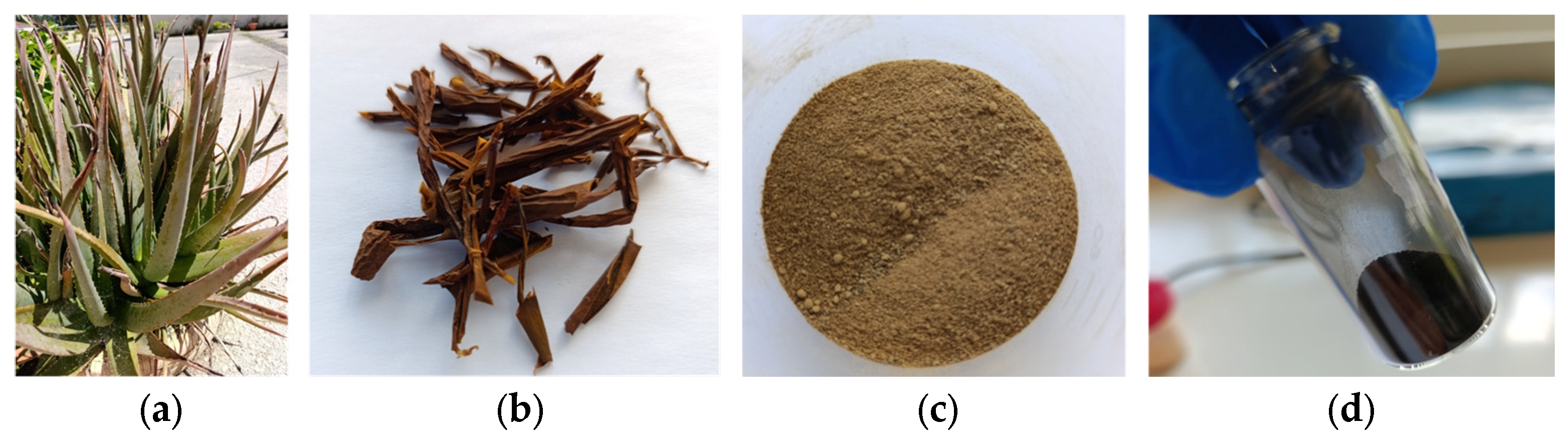
Figure 1. Aloe vera plant (a), aloe vera leaf wastes after drying (b), after grounding into fine powder (c), and after activation and microwave-assisted pyrolysis (ACav) (d).
Micro 06 00060 g001
Figure 2. Corn cob wastes (cc) after drying (a), after grounding into fine powder (b), and after activation and microwave-assisted pyrolysis (ACcc) (c).
Micro 06 00060 g002
Figure 3. Slaughterhouse wastes (sh) as received (a), after immersion in formaldehyde solution and air drying (b), after hydrothermal treatment (sh-HT) (c), and after activation and microwave-assisted pyrolysis (ACsh) (d).
Micro 06 00060 g003
Figure 4. (a) Nitrogen adsorption–desorption isotherms and (b) pore size distributions derived from the DFT method for porous carbons ACav-X. The adsorption and desorption isotherms are indicated by filled and open symbols, respectively.
Micro 06 00060 g004
Figure 5. (a) Nitrogen adsorption–desorption isotherms and (b) pore size distributions derived from the DFT method for porous carbons ACcc-X. The adsorption and desorption isotherms are indicated by filled and open symbols, respectively.
Micro 06 00060 g005
Figure 6. (a) Nitrogen adsorption–desorption isotherms and (b) magnification of isotherms and pore size distribution derived from the DFT method for porous carbon ACcc-600. The adsorption and desorption isotherms are indicated by filled and open symbols, respectively.
Micro 06 00060 g006
Figure 7. Structural and chemical transformation of the materials before and after modification (raw biowastes vs. activated carbons): FT-IR spectra of activated carbons (a) ACav-X in comparison with the spectra of initial biomass source av, (b) ACcc-X in comparison with the spectra of initial biomass source cc, and (c) ACsh-X carbons in comparison with the spectra of hydrothermally treatment initial biomass source sh-HT.
Micro 06 00060 g007
Figure 8. Raman spectra of activated carbons (a) ACav-X, (b) ACcc-X, and (c) ACsh-X.
Micro 06 00060 g008
Figure 9. Comparison of pyrolysis temperature effect on ID/IG for the different materials ACav-X, ACcc-X, and ACsh-X.
Micro 06 00060 g009
Figure 10. Crystalline structural evolution before and after modification: XRD patterns of the synthesized activated carbons (a) ACav-X, (b) ACcc-X, and (c) ACsh-X, illustrating the transformation of raw biomass and hydrothermally treated slaughterhouse precursors into amorphous carbon frameworks.
Micro 06 00060 g010
Figure 11. Dispersibility index (DI%) for (a) ACav-X, (b) ACcc-X, and (c) ACsh-X as a function of standing time. Pyrolysis temperature dependance of dispersibility index (DI%) for ACav-X, ACcc-X, and ACsh-X after 24 h (d).
Micro 06 00060 g011
Figure 12. The experimental isotherm results for Cr(VI) uptake capacity of ACcc-400, ACav-400, and ACsh-600 carbons at different initial Cr(VI) concentrations. (Conditions: 180 mg/L of adsorbent, pH 3, 48 h reaction.).
Micro 06 00060 g012
Figure 13. (a) Langmuir and (b) Freundlich isotherms for the Cr(VI) removal obtained using ACav-400, ACcc-400, and ACsh-600 materials.
Micro 06 00060 g013
Figure 14. Correlation of the specific surface area SBET with the obtained maximum adsorption capacity in Cr(VI).
Micro 06 00060 g014
Table 1. Surface area (SBET) and total pore volume Vpore as calculated from nitrogen adsorption–desorption isotherms.
SampleSBET (m2/g)Total Vpore (cm3/g)
ACav-40011201.21
ACav-5007280.59
ACav-6002340.16
ACcc-3008720.59
ACcc-40014421.07
ACcc-50013690.89
ACcc-60012500.76
ACsh-5005-
ACsh-6007750.43
Table 2. Surface area and total pore volume as calculated from nitrogen adsorption–desorption isotherms.
Langmuir
SampleR2qmax (mg/g)KL
ACav-4000.999112.351.89
ACcc-4000.995157.230.84
ACsh-6000.99671.430.58
Freundlich
SampleR2nKF
ACav-4000.8307.2867.2
ACcc-4000.8540.231.72 × 10−8
ACsh-6000.98610.2544.4
Table 3. Adsorption capacity (qmax) in Cr(VI) for various activated carbons produced via microwave-assisted pyrolysis activation in the literature.
AbsorbentSurface Area (m2/g)pHqmax (mg/g)Reference
ACArundo donax Linn13325.315.07[44]
ACLeucas aspera916230.3[45]
ACpalm kernel12563 (50 °C)19.1[46]
ACEucalyptus sawdust14293 11.5[47]
ACpalm oil kernel shell192.64.540.6[48]
ACFicus carica-344.84[49]
ACav-40011203112This work
ACcc-40014423157This work
ACsh-600775371This work
Table 4. Gibbs free energy ΔG° for the different initial Cr(VI) concentrations.
AbsorbentInitial Cr(VI) (mg/g)ΔG° (kJ/mol)
ACav-40066.7−27.789
133.3−23.981
266.0−20.106
500.0−17.823
ACcc-400111.8−23.972
218.6−21.920
510.6−18.905
ACsh-60065.0−23.658
128.8−20.378
263.1−18.042
510.7−16.395
Disclaimer/Publisher’s Note: The statements, opinions and data contained in all publications are solely those of the individual author(s) and contributor(s) and not of MDPI and/or the editor(s). MDPI and/or the editor(s) disclaim responsibility for any injury to people or property resulting from any ideas, methods, instructions or products referred to in the content.