

You are currently viewing a new version of our website. To view the old version click .

Photochem, Volume 4, Issue 2

June 2024 - 8 articles

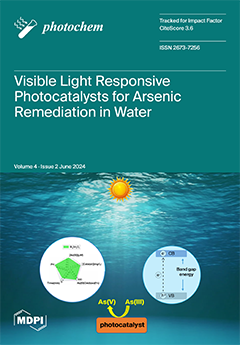
Cover Story: Arsenic is mainly present in water in two oxidation states: As(III) and As(V), of which the first is more toxic and more difficult to remove. Before applying remediation methods, such as adsorption, oxidizing As(III) to As(V) is usually required. The paper is focused on As(III) oxidation by semiconductor catalysts activated by visible light; these are often coupled with highly adsorbent materials for As(V) removal. For photocatalysis technology to be used in small low-resource communities, the photocatalyst must be robust, inexpensive and effective even in interfering species. Among the materials with the best performance are variously doped TiO2 and doped metal oxides such as Pt/WO3, Cu/ZnO, and Bi2Sn2O7View this paper
  • Issues are regarded as officially published after their release is announced to the table of contents alert mailing list .
  • You may sign up for email alerts to receive table of contents of newly released issues.
  • PDF is the official format for papers published in both, html and pdf forms. To view the papers in pdf format, click on the "PDF Full-text" link, and use the free Adobe Reader to open them.

Articles (8)

  • Feature Paper
  • Review
  • Open Access
4 Citations
2,856 Views
14 Pages

12 June 2024

The global demand for sustainable energy sources has led to extensive research regarding (green) hydrogen production technologies, with water splitting emerging as a promising avenue. In the near future the calculated hydrogen demand is expected to b...

  • Article
  • Open Access
4 Citations
1,930 Views
11 Pages

Titanium Nanostructures: Advancing Photocatalysis in Complex Systems

  • Alondra A. Lugo-Ruiz and
  • Sonia J. Bailón-Ruiz

6 May 2024

The use of semiconductor materials, specifically TiO2, for photocatalysis of organic pollutants has gained global interest as an effective method for contaminant removal from wastewater. Titanium dioxide (TiO2) is a widely studied photocatalyst and i...

  • Review
  • Open Access
2 Citations
2,374 Views
21 Pages

A Review of Visible Light Responsive Photocatalysts for Arsenic Remediation in Water

  • Isabella Natali Sora,
  • Francesca Fontana,
  • Renato Pelosato and
  • Benedetta Bertolotti

17 April 2024

This review summarizes the progress over the last fifteen years in visible light reactive photocatalysts for environmental arsenic remediation. The design and performance of several materials including (1) doped and surface functionalized TiO2, (2) b...

  • Article
  • Open Access
4 Citations
2,218 Views
19 Pages

Excited-State Dynamics of Carbazole and tert-Butyl-Carbazole in Thin Films

  • Konstantin Moritz Knötig,
  • Domenic Gust,
  • Kawon Oum and
  • Thomas Lenzer

9 April 2024

Thin films of carbazole (Cz) derivatives are frequently used in organic electronics, such as organic light-emitting diodes (OLEDs). Because of the proximity of the Cz units, the excited-state relaxation in such films is complicated, as intermolecular...

  • Article
  • Open Access
7 Citations
3,240 Views
16 Pages

Excited-State Dynamics of Carbazole and tert-Butyl-Carbazole in Organic Solvents

  • Konstantin Moritz Knötig,
  • Domenic Gust,
  • Thomas Lenzer and
  • Kawon Oum

30 March 2024

Carbazole-based molecular units are ubiquitous in organic optoelectronic materials; however, the excited-state relaxation of these compounds is still underexplored. Here, we provide a detailed investigation of carbazole (Cz) and 3,6-di-tert-butylcarb...

  • Article
  • Open Access
2,003 Views
12 Pages

Charge-Selective Photocatalytic Degradation of Organic Dyes Driven by Naturally Occurring Halloysite Nanotubes

  • Ashim Pramanik,
  • Martina Maria Calvino,
  • Luisa Sciortino,
  • Pooria Pasbakhsh,
  • Giuseppe Cavallaro,
  • Giuseppe Lazzara,
  • Fabrizio Messina and
  • Alice Sciortino

28 March 2024

This study explores the use of Halloysite NanoTubes (HNTs) as photocatalysts capable of decomposing organic dyes under exposure to visible or ultraviolet light. Through a systematic series of photocatalytic experiments, we unveil that the photodegrad...

Get Alerted

Add your email address to receive forthcoming issues of this journal.

XFacebookLinkedIn
Photochem - ISSN 2673-7256