Article

Changes in the Soluble Carbohydrate Profile During Fenugreek (Trigonella foenum-graecum L.) Germination and in the Response of Sprouts to Desiccation and Cold Stress


by
Lesław Bernard Lahuta
1,
Joanna Szablińska-Piernik
2 and
Marcin Horbowicz
1,*
1
Department of Plant Physiology, Genetics and Biotechnology, University of Warmia and Mazury in Olsztyn, 10-719 Olsztyn, Poland
2
Department of Botany and Evolutionary Ecology, University of Warmia and Mazury in Olsztyn, 10-721 Olsztyn, Poland
*
Author to whom correspondence should be addressed.
Stresses 2026, 6(2), 28; https://doi.org/10.3390/stresses6020028
Submission received: 17 April 2026 / Revised: 10 May 2026 / Accepted: 14 May 2026 / Published: 20 May 2026
(This article belongs to the Collection Feature Papers in Plant and Photoautotrophic Stresses)

Abstract

Germination of fenugreek (Trigonella foenum-graecum L.) seeds causes degradation of some antinutritional compounds. At the same time, the content of dietary important compounds, including some carbohydrates, in the sprouts increases. The aim of this study was to investigate changes in the soluble carbohydrate profile during germination and growth of fenugreek sprouts in the roots, hypocotyl and cotyledons. Furthermore, we assessed the effect of cold stress and desiccation on the carbohydrate profile in the main parts of the sprouts. Gas chromatography analyses of soluble carbohydrates showed that fenugreek seeds and sprouts contained sixteen soluble carbohydrates. In dry seeds, the main saccharides were raffinose family oligosaccharides (RFOs), sucrose and d-pinitol. During fenugreek germination, the drastic decomposition of RFOs and galactosides of cyclitols occurred faster in the embryonic axis than in the cotyledons. This was accompanied by an increase in the concentrations of monosaccharides and sucrose, as well as d-pinitol and myo-inositol in the developing hypocotyl and roots. Both examined stresses increased sucrose and raffinose concentration in cotyledons and roots, but in the hypocotyl similar changes were observed only under desiccation. The process of desiccation did not affect the d-pinitol content in the cotyledons of fenugreek sprouts, slightly reduced the content in the hypocotyl, but increased its level in the roots. Applied cold stress did not affect the content of d-pinitol and myo-inositol in the cotyledons and hypocotyl of fenugreek sprouts and only slightly reduced their level in the roots. The obtained results indicate different responses of fenugreek sprout organs to vegetation conditions caused by cold and/or desiccation stress. The practically insignificant effect of cold storage and desiccation on the level of d-pinitol and myo-inositol in fenugreek sprouts is new information that will probably be important for consumers.

Graphical Abstract

1. Introduction

Fenugreek (Trigonella foenum-graecum L.) is one of the oldest cultivated plants used for food and medicinal purposes [1,2]. India is a leading producer of fenugreek, and its seeds are widely used in spice blends, as well as in herbal teas and cosmetics [3]. Fenugreek leaves are also consumed fresh in various regional dishes. Seeds of fenugreek are a rich source of protein, carbohydrates, both dietary fiber and non-fibrous carbohydrates [4,5], and several bioactive compounds [6], indicating therapeutic and medicinal properties [7,8,9,10]. Owing to the presence of pyridine alkaloids, 4-hydroxyisoleucine, antioxidants, flavonoids and volatile compounds, seeds of fenugreek are used to prepare powders routinely consumed as a spice and employed for medicinal purposes [10,11,12].
The chemical composition of fenugreek changes during germination due to the degradation of proteins and polysaccharides, and changes in primary and secondary metabolism [5,13,14,15]. Germination also causes degradation of some antinutritional compounds: trypsin inhibitors, raffinose family oligosaccharides (RFOs), tannins and phytic acid [1,15,16,17]. Moreover, during germination antioxidant activity increases, and the biosynthesis of biologically active secondary metabolites occurs, which exhibit antidiabetic, anti-inflammatory, antibacterial, antioxidant and anticancer properties [13,18,19,20]. Thus, fenugreek sprouts can serve as valuable sources of nutrition and functional benefits.
The health-promoting/therapeutic properties of fenugreek may be partly due to the presence of some cyclitols, myo-inositol and d-pinitol, which show similar biological activity in vitro or in animal or cell line studies [21,22,23,24,25]. There is increasing interest in their therapeutic use for the treatment of metabolic diseases, including type II diabetes, some neurodegenerative changes and cancer [26,27,28,29]. Data on the occurrence and changes in the content of cyclitols in germinating fenugreek seeds and sprouts are scarce. Earlier, myo-inositol and d-pinitol were detected in all parts of fenugreek plants [30,31], while their α-d-galactosides were present in mature seeds [30,32].
A common phenomenon in plants subjected to desiccation or drought stress is the accumulation of RFOs, which play an important role in the protection and stabilization of proteins [33,34]. An example is Arabidopsis plants, which accumulate raffinose and galactinol, although these carbohydrates were not present in unstressed plants [35]. These results indicate that galactosides may act as osmoprotectants in plant resistance to this type of stress. Some plant species may also accumulate cyclitols and/or their galactosides in response to desiccation [36,37,38,39].
During vegetation, plants may also be exposed to cold stress [40]. Saccharides play an important role in the response of plants to these conditions [40,41,42]. It has been shown that a common metabolic response to this type of stress is an increase in the level of mono- and oligosaccharides [43,44]. Cyclitols (d-pinitol and myo-inositol) and RFOs are also involved in the plant’s response to such environmental stress [41,42,43]. For example, an increase in RFO content was found in rice seedlings grown at low temperatures [44]. The accumulation of raffinose and sucrose also turned out to be an important indicator of the response of buckwheat seedlings to cold stress [45]. Refrigerated vehicles are the most important means of food transportation, which can reduce respiration and metabolism and reduce the loss of nutrients and water in fresh food such as sprouts [46,47]. However, sprouts can change nutritional value because they are susceptible to various factors, like long-lasting cold conditions. Moreover, long-term transport and storage in a store and/or at home may lead to water loss or the process of slow desiccation [23,46,47].
The details of changes in carbohydrate and other polar metabolite profiles in particular organs during fenugreek germination, as well as the effects of mild desiccation under natural environmental conditions and cold stress on fenugreek sprouts, are unknown. Therefore, the main objective of this study was to investigate the soluble carbohydrate profile in the main organs of fenugreek sprouts during germination and growth, as well as the effect of desiccation and cold stress on this profile in the cotyledons, hypocotyl and roots.

2. Results

2.1. Germination and Growth of Fenugreek Sprouts

Fenugreek seeds completed germination 24 h after water imbibition when the water content increased from 7.31% to 55.22 and 63.66% of the fresh weight in the cotyledons and embryonic axis, respectively (Table S1). The seed FW increased from 12.99 to 17.46 mg. Over the next 6 days, the water content in the cotyledons gradually increased to 76.57% FW, while in the sprouts it reached 90.99% after 4 days and then slightly increased to 91.20 and 96.83% in the hypocotyl and root, respectively, after 7 days of germination. The hypocotyl reached significantly higher dry weight than the root (3.15 and 1.80 mg), respectively (Table S1, Figure S1). Dry mass allocation from the cotyledons to the growing seedling was observed, and the total dry mass of the cotyledons and shoots (hypocotyl and root, 6.12 and 3.46 mg, respectively) at day 4 of germination was equal to the total dry mass of the cotyledons, hypocotyl, and root (4.32, 3.46, and 1.80 mg) at day 7 of germination. Furthermore, after day 4–5, chlorophylls are synthesized in the cotyledons, leading to a change in the color of the cotyledons from yellow to green (Table S1, Figure S1).

2.2. Changes in the Carbohydrate Profile During Germination and Growth of Fenugreek Sprouts

In dry and germinating fenugreek seeds, 16 soluble carbohydrates, cyclitols and their galactosides were found (Table 1, Table 2 and Table 3, Figure 1). The saccharide composition of dry fenugreek seeds is dominated by raffinose family oligosaccharides (RFOs: raffinose, stachyose and verbascose) as their level accounted for 74% of the total amount of soluble carbohydrates (Table 1). Among them, the major oligosaccharide was stachyose (49.58 mg/g dry weight). Fenugreek seeds also contained a considerable amount of sucrose (5.38 mg/g DW), as well as d-pinitol (4.00 mg/g DW) and its mono-, di- and tri-galactosides (galactosyl pinitols, GPs).
After the first day of seed germination, the concentration of sucrose, stachyose, verbascose and GPs in the cotyledons increased, and then gradually decreased in the following days. However, this process was not accompanied by an increase in the concentration of galactose or d-pinitol. Fluctuations in the fructose and glucose content were also observed, while the sucrose concentration increased approximately 15-fold until the third day of germination (up to 75.56 mg/g DW) and during the next four days decreased drastically (more than 10-fold) to a level similar to that found in the initial seeds. It was accompanied by the gradual decrease in the concentration of α-d-galactosides of myo-inositol—galactinol and di-galactosyl myo-inositol (DGMI).
In the embryonic axis, the level of RFOs decreased dramatically between the first and second days of seed germination, and after the 3rd day, while only traces of stachyose were found in the hypocotyl and root tissues (Table 2). In contrast to the changes in cotyledons, fructose and glucose concentrations increased dramatically in both the embryonic axis and hypocotyl of fenugreek sprout. As a result, in 7-day-old sprouts, fructose and glucose constituted 94% of the soluble carbohydrates in the hypocotyl, while in the root it was 88%. It should be noted, however, that the glucose concentration in the roots was three-to-over-10-times higher than that of fructose. The pattern of changes in sucrose content in the roots was similar to that observed in the cotyledons.
Galactose appeared at much lower levels than other monosaccharides and temporarily increased (until the 3rd day of germination) in both cotyledons (Table 1) and the embryonic axis (Table 2). Additionally, maltose, not detectable in dry seeds, was present at lower levels compared to galactose. In cotyledons it increased temporarily (between the 2nd and 5th day, Table 1), whereas in the growing hypocotyl and root it fluctuated (Table 3).
In the growing sprouts, the concentration of galactosyl cyclitols decreased gradually and this process was accompanied by an increase in the concentration of d-pinitol (Table 3; Figure 1). In practice, galactinol, ciceritol and TGPA contents were trace or below the detection limit in the roots and hypocotyl of 5-, 6- and 7-day-old fenugreek sprouts.
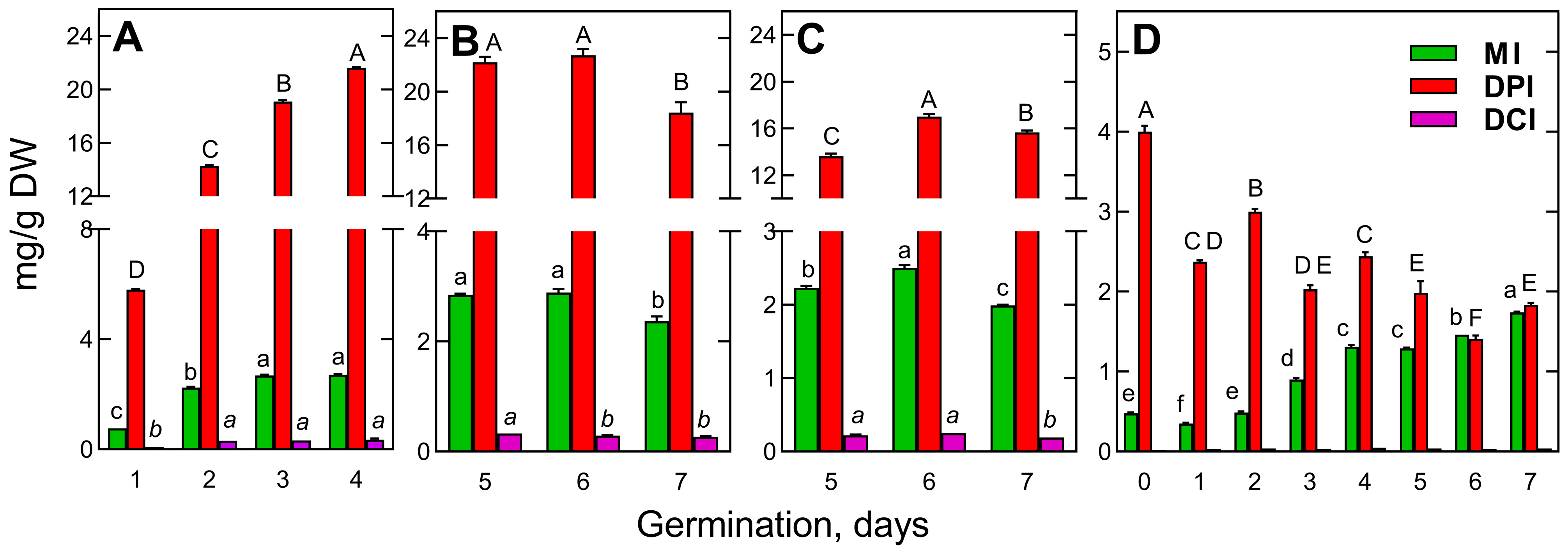
Among the cyclitols, d-pinitol was the most quantitatively dominant in the fenugreek sprout organs (Figure 1A, DPI). After the germination process began, a significant (several-fold) increase in its content occurred. The d-pinitol level in 4-day-old embryonic axes reached 22 mg/g DW. The second most abundant cyclitol was myo-inositol (MI), whose content in 4-day-old embryonic axes reached 3.5 mg/g DW. In the roots of 5- and 6-day-old fenugreek sprouts, the DPI content was similar to the level of this cyclitol in embryonic axes, but in 7-day-old roots there was a slight decrease (Figure 1B). In the hypocotyl of 5-, 6-, and 7-day-old fenugreek sprouts, the DPI content varied slightly and ranged from 14 to 17 mg/g DW (Figure 1C). The fenugreek sprout cotyledons contained several times less DPI than the other sprout organs (Figure 1D). Furthermore, the DPI level in the cotyledons decreased significantly with sprout age. The level of myo-inositol in embryonic axes, cotyledons, and roots of fenugreek sprouts was similar and changed slightly during sprout development (Figure 1A–C). However, in the cotyledons, the level of MI was lower than in the roots and hypocotyl, but a gradual increase in its content was noted, which reached 1.9 mg/g DW. Among the cyclitols, the content of d-chiro-inositol (DCI) was the lowest and ranged from 0.1 to 0.3 mg/g DW (Figure 1A–D).

2.3. Changes in the Soluble Carbohydrate Profile as a Result of Desiccation or Cold Stress

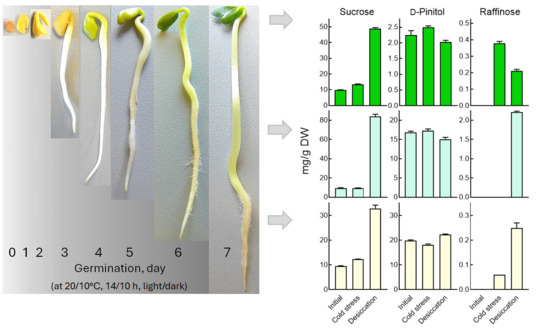
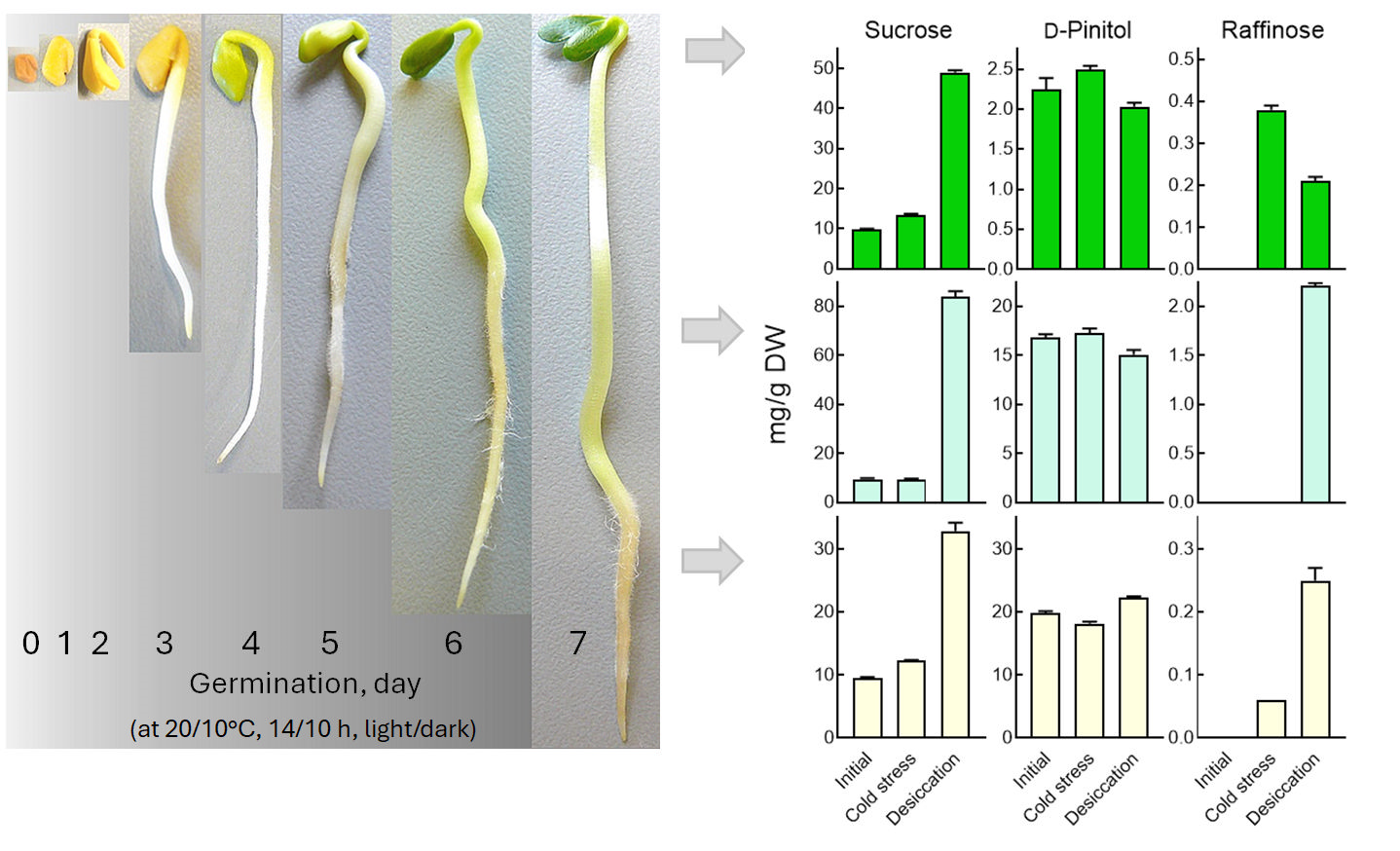
The exposition of 7-day-old seedlings to desiccation or cold stress significantly affected concentrations of most soluble carbohydrates (Table 4). A common response of the cotyledons, hypocotyls, and roots to desiccation was the accumulation of sucrose, maltose, and raffinose. In the cotyledons, the reduction in sugar content was accompanied by a reduction in glucose and fructose levels, and in the hypocotyls and roots by a reduction in galactose levels.
Cold stress induced the accumulation of sucrose and raffinose in the cotyledons and roots, as well as a decrease in maltose levels. Furthermore, the concentrations of myo-inositol and d-pinitol in the roots significantly decreased (Table 4).
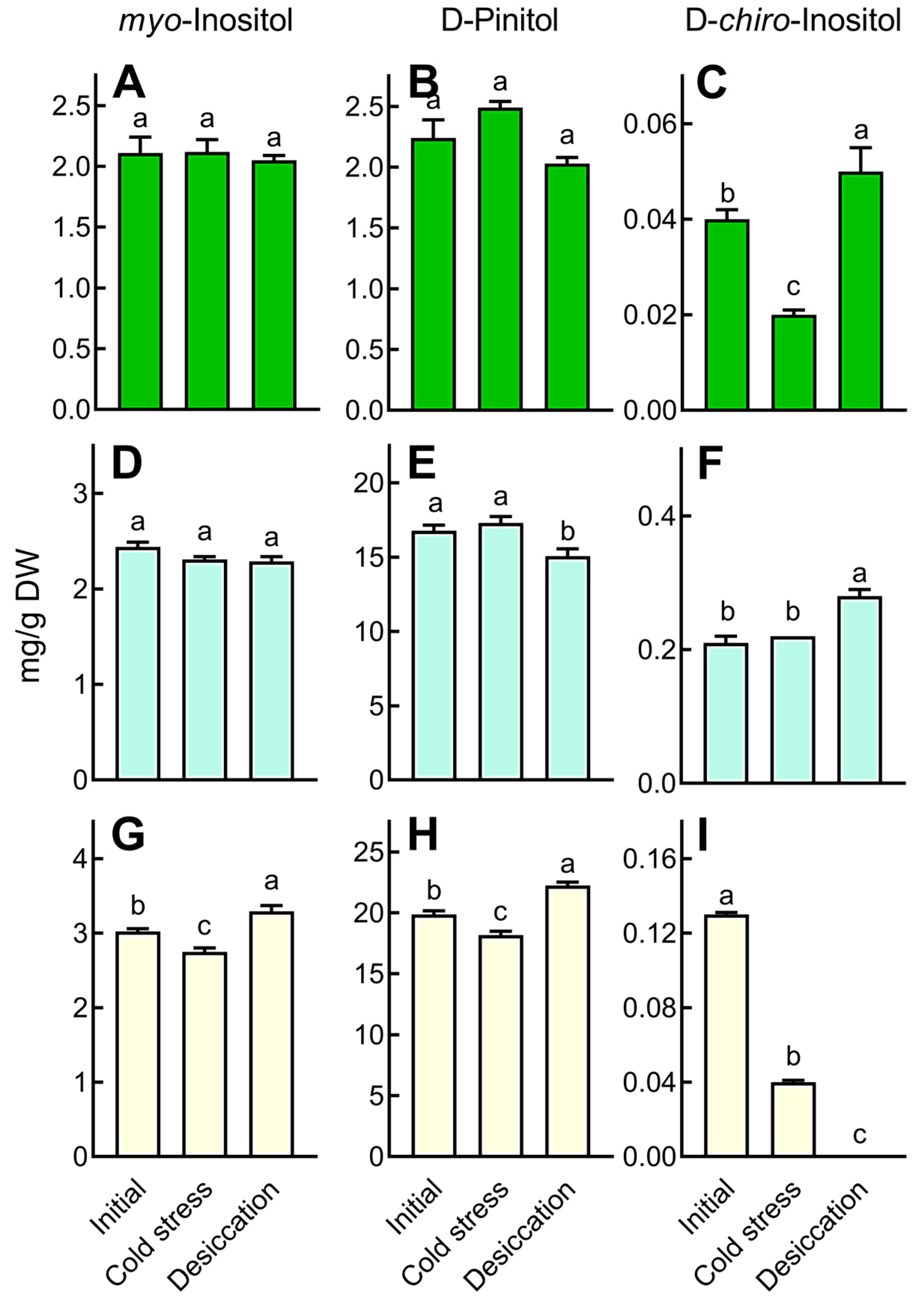
The applied cold stress conditions did not affect the content of the main cyclitol, i.e., d-pinitol, in the cotyledons and hypocotyl of fenugreek sprouts (Figure 2B,E). As a result of cold stress, only a slight reduction in the level of this cyclitol was noted in the roots of fenugreek sprouts (Figure 2H). Similarly to d-pinitol, cold stress did not affect myo-inositol content in the cotyledons and hypocotyl of fenugreek sprouts (Figure 2A,D) and slightly reduced its level in the roots (Figure 2G). Cold stress decreased the content of d-chiro-inositol in the cotyledons and roots of fenugreek sprouts (Figure 2A,D) and had no effect on its level in the hypocotyl.
The applied mild conditions of desiccation slightly reduced the d-pinitol content in the hypocotyl of fenugreek sprouts, but increased its level in the roots (Figure 2B,E,H). At the same time, no significant effect of desiccation conditions on the d-pinitol content in the cotyledons was noted. The desiccation process of fenugreek sprouts did not affect the myo-inositol content in the cotyledons and hypocotyl, but slightly increased its level in the roots (Figure 2A,D,G). In the case of d-chiro-inositol, the desiccation process increased its content in the cotyledons and hypocotyl, but reduced its level to traces in the fenugreek roots (Figure 2C,F,I).

3. Discussion

Fenugreek seeds contain valuable proteins, high content of carbohydrates, dietary fiber, galactomannans and non-fibrous carbohydrates [4,5,6,7,8,9,10,11]. In addition, fenugreek contains substantial levels of bioactive compounds indicating its therapeutic and medicinal properties [7,9,10,22,30]. During sprouting, the chemical composition of fenugreek changes significantly due to the degradation of proteins and polysaccharides and changes in primary and secondary metabolism [5,13,14]. As a result, the nutritional value of fenugreek sprouts increases while reducing the level of compounds that are nutritionally unfavorable for consumers [1,15,16]. As a result, this leads to the creation of sprouts that are valuable for consumers [15].

3.1. Changes in Carbohydrate Profile During Germination and Growth of Fenugreek Sprouts

Germination and sprouting of legumes is an inexpensive and effective method for improving their quality by removing most of their antinutritional factors, including raffinose family oligosaccharides (RFOs) [35,36,37,48,49]. Our study showed that fenugreek seeds contain a rich and diverse set of sixteen saccharides, and among them, the predominant ones were RFOs and mono-, di-, and tri-galactosides of d-pinitol (Table 1). The rapid degradation of RFOs during fenugreek seed germination observed in experiments (Table 1 and Table 2) confirms our previous data [30]. RFOs as well as d-pinitol galactosides and myo-inositol galactosides disappeared almost completely after 2–3 days of germination, earlier in the embryonic axis (Table 2) than in the cotyledons (Table 1). The rapid increase in sucrose content in all organs of fenugreek sprouts during the first three days of germination is probably caused by the hydrolysis of RFOs (i.e., sucrose galactosides). The earlier utilization of RFOs in the embryonic axis than in the cotyledons is characteristic of germinating legume seeds [38,39,40,41,42]. This confirms the important role of these carbohydrates as the main carbon sources and substrates for resumption of respiration and metabolism in the initial phases of sprout development [43]. RFO degradation was accompanied by an increase in fructose and glucose content in the embryonic axis and hypocotyl, but not in the cotyledons (Table 1 and Table 2). Moreover, myo-inositol galactosides (galactinol and DGMI) and d-pinitol galactosides (GPA, GPB, DGPA and TGPA) were also rapidly degraded.
It would be expected that the degradation of RFOs and cyclitol galactosides would lead to a significant increase in galactose content, but this was not shown in our study. Galactose was probably immediately utilized in respiratory and/or other metabolic processes. Similarly to our findings, Dirk et al. [50] did not find galactose accumulation during germination of fenugreek seeds. According to their detailed studies, during fenugreek germination, sucrose galactosides were transported to the embryonic axis and cotyledons and then mobilized within 2–4 h from uptake. The low level of galactose found in our study can be explained by its rapid metabolic conversion to UDP-glucose and fructose-6-phosphate, which can be used for the synthesis of sucrose and cell wall components of growing seedlings [48]. In starchless fenugreek seeds, the main carbohydrate reserves are galactomannans, which constitute a significant part of the dry seed mass [11,51,52]. Earlier it was found that galactomannans of fenugreek seeds are hydrolyzed during germination and absorbed by the cotyledons, where the content of sugars increases and starch is formed [51,52]. The increased galactose content in the embryonic axis during the first three days of fenugreek germination shown in our study suggests that the axis may be a metabolic sink for this sugar after hydrolysis of RFOs and/or cyclitol galactosides.
The rapid decrease in the content of d-pinitol galactosides and myo-inositol galactosides was accompanied by a gradual increase in the content of d-pinitol and myo-inositol in the embryonic axis during the first four days of fenugreek germination (Table 3, Figure 1). This indicates that the increase in the content of the mentioned cyclitols is the result of hydrolytic decomposition of their galactosides. However, the concentrations of myo-inositol and d-pinitol did not change significantly in the hypocotyl and roots of fenugreek sprouts after 5, 6 and 7 days of germination (Figure 1). This may mean that as a result of the disappearance of cyclitol galactosides, the sources of cyclitol biosynthesis have been exhausted. Furthermore, this may also show that both cyclitols are not used in respiration processes and their stable content indicates a role other than being a source of metabolic energy.
Inositol isomers, including myo-inositol, and d-chiro-inositol, are naturally occurring cyclitols in animal cells that participate in insulin signaling pathways by stimulating glucose transport [21,27,28]. d-Pinitol (3-O-methyl-d-chiro-inositol) is structurally related to phosphatidylinositol phosphates, which mediate insulin action and stimulate glucose transport via the phosphatidylinositol 3-kinase/protein kinase B pathway [28]. In plants, it serves as a physiological cellular modulator and participates in defense against unfavorable environmental conditions, such as water deficiency or high salinity [30]. High content of d-pinitol in the hypocotyl and roots of fenugreek sprouts is a valuable feature. d-Pinitol and other cyclitols demonstrate biological activity in vitro or in animal or cell line studies [21,22,23,24,25,26,27,28,29]. Recently published data suggest that d-pinitol has important biological and pharmacological activities [27,53,54]. d-Pinitol from food affects overall glucose tolerance and insulin sensitivity in healthy individuals [55]. d-Pinitol, myo-inositol, and other cyclitols interact with specific proteins, participating in intracellular signaling. Furthermore, they contribute to the proper functioning of the body, particularly the cardiovascular system, immunity, reproductive function, connective tissue structure, the central nervous system, and sugar metabolism. These properties make them an important dietary component [54,55,56]. Therefore, plants rich in d-pinitol, such as fenugreek sprouts, are used in traditional medicine to treat diabetes, inflammation, cancer and infections [20,22,25,27,28,54].

3.2. The Effect of Desiccation on the Carbohydrate Profile of Fenugreek Sprouts

Osmolytes are low-molecular-weight organic compounds such as amino acids, carbohydrates (sucrose, cyclitols, RFOs and others) [41,42,43]. In plants, the distribution of these compounds is species-specific [36,37,38,39]. It is known that under conditions of water deficiency, their function is to prevent cell dehydration by participating in osmotic regulation and stabilizing the quaternary structure of proteins and cell membranes [57,58]. Abundant evidence indicates that the induction of RFOs’ biosynthetic gene expression and the accumulation of these saccharides are common plant responses to stress conditions, as described in detail by Shijuan et al. [59]. Furthermore, RFOs play an important role in seed vigor as well as in plant growth and development, indicating the importance of these saccharides in plants [59,60].
During desiccation of plant tissues, polyols and other carbohydrates can partially replace the water lost during this process, protecting important macromolecules and biological membranes from damage or destruction. Among them, RFOs and cyclitol galactosides are of particular importance [37,38]. It is hypothesized that polyols can act as osmoprotectants because, under conditions of low osmotic potential, the hydroxyl groups of polyols can form a type of hydration around macromolecules, thus preventing their metabolic inactivation [33,34,35]. At the metabolic level, osmotic adjustment by synthesis of molecular osmolytes can counteract cellular dehydration and turgor loss [40]. In addition to their role in osmoregulation, osmolytes play a key role in the protection of subcellular structures and their basic physiological functions, as well as in the removal of reactive oxygen species [47,48].
Our results show that the accumulation of RFOs is a common phenomenon in fenugreek sprouts subjected to desiccation (Table 4). The present and previous results indicate that RFOs may have a protective effect in plant tissues subjected to desiccation [36,37,38,39,41,42,43]. However, our current results indicate different responses to desiccation in the cotyledons, hypocotyl, and roots of fenugreek sprouts. Raffinose concentration was much higher in the hypocotyl of desiccated sprouts than in the cotyledons and roots. Sucrose concentrations were also higher in the hypocotyl than in the cotyledons and roots. This may indicate that the hypocotyl is the organ in the fenugreek sprout that is particularly susceptible to the stress conditions induced by desiccation. New information obtained in our study includes the small effect of mild desiccation conditions on the content of dietarily important cyclitols, i.e., d-pinitol and myo-inositol (Figure 2).

3.3. The Effect of Cold Stress on the Carbohydrate Profile of Fenugreek Sprouts

Accumulation of RFOs and other osmoprotective compounds in response to cold stress appears to be a common phenomenon. Such response was found in Arabidopsis [61] and in tomato leaves [62]. In addition, elevated RFOs levels increased cold tolerance in maize [63], Poncirus trifoliata L. [64], barrel clover (Medicago truncatula) [65] and Ajuga reptans [66]. RFOs accumulated during cold stress could be catabolized in situ by galactosidases after the cold stress disappeared, as has been found in cucumber leaves [67].
Our studies on fenugreek sprouts showed that cold stress caused an increase in raffinose and sucrose content in the cotyledons and root of fenugreek sprouts (Table 4). In the hypocotyl, the contents of both saccharides were not affected by this factor. Furthermore, this stress caused a significant increase in glucose and fructose content in the cotyledons, as well as in total saccharide content. However, the total sugar content in the roots was significantly lower than the initial value. Earlier, a significant increase in the level of raffinose was also observed in rice seedlings subjected to cold stress [44]. Raffinose in rice leaf blades increased from trace amounts to about 9 mg/g of dry matter after cold stress, and gene expression analysis showed that transcript levels of raffinose synthase increased in rice leaf blades [44]. Also, during cold acclimation of Ajuga reptans, a high accumulation of RFOs occurred [68]. It was shown that weekly chilling of plants at 10/3 °C (day/night) increased the total level of non-structural carbohydrates in leaves approximately tenfold, mainly due to the increase in RFOs content [69]. Later studies showed that cold stress caused high accumulation of raffinose and galactinol, but not stachyose, in Arabidopsis leaves, but both compounds were not present in measurable levels in unstressed tissues [35]. The authors of this study identified three stress-sensitive galactionol synthesis (GolS) genes among the seven GolS genes in Arabidopsis. The AtGolS 1 and AtGolS 2 genes were induced by drought and high-salinity stress, but not by cold stress. In contrast, the AtGolS 3 gene was induced by cold stress, but not by drought or salinity stress [35].
The slight effect of cold stress on the content of dietarily important d-pinitol and myo-inositol in fenugreek sprouts is important new information (Figure 2). The cold stress conditions (7 days at 0–5 °C) used for the sprouts are similar to those in a home refrigerator. Such storage of sprouts does not change the content of dietarily positive cyclitols.

4. Materials and Methods

4.1. Materials

Seeds of fenugreek (Trigonella foenum-graecum L.) were obtained from Breeding and Seed Company Ltd. “W. Legutko” (Jutrosin, Poland). In the initial studies, the content of monosaccharides, disaccharides, raffinose oligosaccharides, cyclitols and cyclitol galactosides were measured in individual parts of fenugreek sprouts within 7 days of germination. Seeds were germinated in rolls of moist germination paper (Eurochem BGD, Tarnów, Poland) in a germination chamber (ILW 115-T STD, Pol-Eko Aparatura, Koszalin, Poland) for 7 days in a 14 h/10 h light/dark photoperiod at 20 °C in the day and 10 °C at night. During the first four days of germination, the obtained sprouts were divided into cotyledons and embryonic axes (3 replicates of 40 seeds/sprouts each), while 5-, 6- and 7-day-old sprouts were divided into the cotyledons, hypocotyls and roots (in 3 replicates, 30 sprouts each).
Seven-day-old sprouts were subjected to a natural desiccation process for 7 days at 22–23 °C, 40–50% relative humidity, and with natural air circulation. To achieve cold stress, paper rolls with 7-day-old sprouts were stored in a temperature-controlled chamber for 7 days at 5 °C during the day and 0 °C at night. Thirty sprouts were subjected to both desiccation and cold stress in each of the 3 replicates.
The samples obtained were weighed, frozen in liquid nitrogen and stored in an ultra-refrigerator at −80 °C for a week. Then samples were freeze-dried (freeze dryer Alpha 1-2LD, Martin Christ Gefriertrocknungsanlagen GmbH, Osterode am Harz, Germany) and ground in a mixer mill (MM200, Retsch, Utrecht, The Netherlands).

4.2. Analysis of Soluble Carbohydrates

The methods applied for the extraction and analysis of soluble carbohydrates from fenugreek sprouts were described earlier [30]. Briefly, soluble carbohydrates were extracted from freeze-dried and powdered tissues (30–40 mg) by heating for 30 min at 90 °C using a 1:1 ethanol–water solution, and then, after centrifugation and deionization, the extracts were dried in a rotary vacuum evaporator (JW Electronics, Warsaw, Poland). The dry residues were derivatized with a TMSI/pyridine mixture and the TMS derivatives were analyzed by high-resolution gas chromatography. Analyses were performed using gas chromatography (GC2010, Shimadzu, Kyoto, Japan) equipped with an RTx-1 capillary column (Restek, Bellefonte, PA, USA). The internal standard method, which was xylitol, was used to calculate the carbohydrate content. Standards of fructose, glucose, galactose, sucrose, maltose, raffinose, stachyose, verbascose, xylitol, myo-inositol, d-pinitol and d-chiro-inositol, as well as pyridine and 1-(trimethylsilyl)imidazole (TMSI), were purchased from Sigma-Aldrich (St. Louis, MO, USA). Standard of galactinol was purchased from Wako Pure Chemicals Industries Ltd. (Chuo-ku, Osaka, Japan). Standards of mono-, di- and tri-galactosyl pinitol and di-galactosyl myo-inositol (DGMI), commercially unavailable, were extracted from seeds of winter vetch (Vicia villosa Roth.) and purified as described previously [69].

4.3. Statistical Analysis

The results (means of three to four independent replicates) were subjected to one-way ANOVA with a post hoc test (Tukey, if overall p < 0.05) or Student’s t-test using Statistica software (version 12.0; Stat-Soft, Tulsa, OK, USA). Graphs were prepared using GraphPad Prism (version 8.0; GraphPad Software, San Diego, CA, USA).

5. Conclusions

The level of raffinose family oligosaccharides (RFOs) decreased dramatically during the first two days of fenugreek seed germination, and after three days of this process only traces of stachyose were found in the hypocotyl and root tissues of developing sprouts. Also, the concentration of galactosyl cyclitols decreased gradually and this process was accompanied by an increase in the concentration of d-pinitol. In addition, contents of d-pinitol galactosides were very low or below the detection limit in the roots and hypocotyl of 5-, 6- and 7-day-old fenugreek sprouts. It can be concluded that several-day-old fenugreek sprouts contain a relatively high level of d-pinitol and almost no antinutritional compounds. Therefore, fenugreek sprouts appear to be a valuable health-promoting component in our diet. The current study demonstrated the value of fenugreek sprouts as a functional and nutritional food ingredient.
During the process of fenugreek sprout desiccation, the concentrations of sucrose and raffinose in the hypocotyl increased, as well as sucrose content in roots and cotyledons. The accumulation of sucrose and raffinose confirms the contribution of these carbohydrates to the osmotic regulation of cells during dehydration and/or the osmoprotective role in this process. However, differences in saccharide accumulation in response to desiccation stress between the main organs of fenugreek sprouts indicate their different sensitivities to this stress. The applied desiccation conditions did not affect the d-pinitol content in the cotyledons of fenugreek sprouts, slightly reduced the content in the hypocotyl, but increased its level in the roots. Furthermore, this process did not affect the myo-inositol content in the cotyledons and hypocotyl, but slightly increased its level in the roots.
Cold stress induced the accumulation of sucrose and raffinose in the cotyledons and roots of fenugreek sprouts. Furthermore, this stress caused significant increases in the content of monosaccharides, as well as total saccharides in cotyledons, but decreased their content in roots. The obtained results indicate different responses of fenugreek sprout organs to vegetation conditions caused by cold and/or desiccation stress. The cold stress conditions used did not affect the content of d-pinitol and myo-inositol in the cotyledons and hypocotyl of fenugreek sprouts and only slightly reduced their level in the roots.
The practically insignificant effect of cold storage and desiccation on the level of d-pinitol and myo-inositol in fenugreek sprouts is new information that will probably be important for consumers. Fenugreek sprouts, after seven days of cold storage or mild desiccation, are still rich in pharmacologically important cyclitols and can be used in traditional medicine.

Supplementary Materials

The following supporting information can be downloaded at: https://www.mdpi.com/article/10.3390/stresses6020028/s1, Figure S1: The morphology of germinating seeds and growth of fenugreek sprouts; Table S1: Changes in fresh weight (mg ± SD), dry weight (mg ± SD), and water content (%) during fenugreek germination and the growth of its sprout organs.

Author Contributions

Conceptualization, L.B.L.; methodology, L.B.L.; software, L.B.L. and M.H.; investigation, J.S.-P.; data curation, L.B.L. and J.S.-P.; writing—original draft preparation, M.H.; writing—review and editing, L.B.L. and M.H.; visualization, L.B.L. and M.H.; project administration, L.B.L.; funding acquisition, L.B.L. All authors have read and agreed to the published version of the manuscript.

Funding

The research was financially supported by a grant entitled “Cultivated plants and natural products as a source of biologically active substances destined for the production of cosmetic and pharmaceutical products as well as diet supplements” (No BIOSTRATEG2/298205/9/NCBR/2016) from the National Center for Research and Development, Poland.

Institutional Review Board Statement

Not applicable.

Informed Consent Statement

Not applicable.

Data Availability Statement

All the data of this study are included in this article and the Supplementary Materials.

Conflicts of Interest

The authors declare no conflicts of interest. The funders had no role in the design of the study; in the collection, analyses, or interpretation of data; in the writing of the manuscript; or in the decision to publish the results.

Abbreviations

The following abbreviations are used in this manuscript:
SDstandard deviation
bdlbelow the detection limit
ANOVAanalysis of variance
DGMIdi-galactosyl-myo-inositol
GPAgalactosyl pinitol A
GPBgalactosyl pinitol B
DGPAdi-galactosyl pinitol A
TGPA tri-galactosyl pinitol A

References

  1. Hooda, S.; Jood, S. Effect of soaking and germination on nutrient and antinutrient contents of fenugreek (Trigonella foenum-graecum L.). J. Food Biochem. 2007, 27, 165–176. [Google Scholar] [CrossRef]
  2. Nelson, K.; Stojanovska, L.; Vasiljevic, T.; Mathai, M. Germinated grains: A superior whole grain functional food? Can. J. Physiol. Pharm. 2013, 91, 429–441. [Google Scholar] [CrossRef]
  3. Shakuntala, S.; Naik, J.P.; Jeyarani, T.; Naidu, M.M.; Srinivas, P. Characterisation of germinated fenugreek (Trigonella foenum-graecum L.) seed fractions. Int. J. Food Sci. Technol. 2011, 46, 2337–2343. [Google Scholar] [CrossRef]
  4. Snehlata, H.S.; Payal, D.R. Fenugreek (Trigonella foenum-graecum L.): An overview. Int. J. Curr. Pharm. Rev. Res. 2012, 2, 169–187. Available online: https://sid.ir/paper/676599/en (accessed on 13 May 2026).
  5. Mabrouki, S.; Omri, B.; Abdouli, H. Chemical, functional and nutritional characteristics raw, autoclaved and germinated fenugreek seeds. J. New Sci. Agric. Biotech. 2015, 16, 541–551. [Google Scholar]
  6. Farag, M.A.; Rasheed, D.M.; Kropf, M.; Heiss, A.G. Metabolite profiling in Trigonella seeds via UPLC-MS and GC-MS analyzed using multivariate data analyses. Anal. Bioanal. Chem. 2016, 408, 8065–8078. [Google Scholar] [CrossRef]
  7. Yadav, U.C.S.; Baquer, N.Z. Pharmacological effects of Trigonella foenum-graecum L. in health and disease. Pharm. Biol. 2014, 52, 243–254. [Google Scholar] [CrossRef] [PubMed]
  8. Visuvanathan, T.; Than, L.T.L.; Stanslas, J.; Chew, S.Y.; Vellasamy, S. Revisiting Trigonella foenum-graecum L.: Pharmacology and therapeutic potentialities. Plants 2022, 11, 1450. [Google Scholar] [CrossRef] [PubMed]
  9. Tewari, A.; Singh, R.; Brar, J.K. Pharmacological and therapeutic properties of Fenugreek (Trigonella foenum-graecum) seed: A review. J. Phytopharm. 2024, 13, 97–104. [Google Scholar] [CrossRef]
  10. Hina, S.; Mustafa, S.; Ismail, A.M.; Mahmood, S.; Matar, A.; Alharbi, A.S.; Saleh, H.A.F.; Ge, W. Therapeutic and protective valuation of Fenugreek (Trigonella foenum-graecum). Ital. J. Food Sci. 2025, 37, 1–17. [Google Scholar] [CrossRef]
  11. Zandi, P.; Basu, S.K.; Khatibani, L.B.; Balogun, M.O.; Aremu, M.O.; Sharma, M.; Kumar, A.; Sengupta, R.; Li, X.; Li, Y.; et al. Fenugreek (Trigonella foenum-graecum L.) seed: A review of physiological and biochemical properties and their genetic improvement. Acta Physiol. Plant. 2015, 37, 1714. [Google Scholar] [CrossRef]
  12. Naika, M.B.N.; Sathyanarayanan, N.; Sajeevan, R.S.; Bhattacharyya, T.; Ghosh, P.; Lyer, M.S.; Jarjapu, M.; Joshi, A.G.; Harini, K.; Shafi, K.M.; et al. Exploring the medicinally important secondary metabolites landscape through the lens of transcriptome data in Fenugreek (Trigonella foenum graecum L.). Sci. Rep. 2024, 12, 13534. [Google Scholar] [CrossRef] [PubMed]
  13. Gonda, S.; Szűcs, Z.; Plaszkó, T.; Cziáky, Z.; Kiss-Szikszai, D.S.; Bácskay, I.; Vasas, G. Quality-controlled LC-ESI-MS food metabolomics of fenugreek (Trigonella foenum-graecum) sprouts: Insights into changes in primary and specialized metabolites. Food Res. Inter. 2023, 164, 112347. [Google Scholar] [CrossRef]
  14. Pencheva, D.; Teneva, D.; Todorova, Z.; Ognyanov, M.; Petrova, A.; Georgiev, V.; Pimpilova, M.; Denev, P. Germination triggers substantial changes in GABA, polyphenol, sugar, and organic acid content of commonly consumed legumes. Plants 2026, 15, 242. [Google Scholar] [CrossRef]
  15. Sharara, M.S. Effect of germination and heat treatment on chemical composition and bioactive components of fenugreek seeds. World J. Dairy Food Sci. 2017, 12, 33–41. [Google Scholar] [CrossRef]
  16. Akhtar, H.; Ali, Y.A.; Wei, C.R.; Albassam, R.S.; Ahmed, F.; Yasmin, A.; Rasheed, M.; Naseer, M.S.; Islam, F.; Zahra, S.M.; et al. Bioactive potential and health benefits of Trigonella foenum-graecum L.: A comprehensive review. Food Sci. Nutr. 2025, 13, e70887. [Google Scholar] [CrossRef]
  17. El-Adawy, T.A.; Rahma, E.H.; El-Bedawey, A.A.; El-Beltagy, A.E. Nutritional potential and functional properties of germinated mung bean, pea and lentil seeds. Plant Foods Hum. Nutr. 2003, 58, 1–13. [Google Scholar] [CrossRef]
  18. Silva Comilo, G.; Barbosa Abrantes, K.K.; Miyuki Retamiro, K.; Santos Junior, O.d.O.; Martins Moreira, W.; Machado Giufrida, W.; Vataru Nakamura, C.; Barão, C.E.; dos Santos Freitas, L.; da Silva, C.; et al. Pressurized liquid extraction of bioactive compounds from seeds and sprouts Trigonella foenum-graecum L. (Fenugreek): Enhanced antioxidant and anti-hyperglycemic activities. Foods 2025, 14, 2021. [Google Scholar] [CrossRef]
  19. Vasudevan, V.; Kartikeyan, A.; Madhavan, I.; Kanagaraja, A.; Krishnan, N.; Sakthivelu, M.; Dhanbalan, A.K.; Devadasan, V.; Gopinath, S.C.B.; Raman, P. Profiling of differentially expressed bioactive metabolites during the germination of Fenugreek (Trigonella foenum-graecum L.) seeds. J. Food Meas. Character. 2025, 19, 4173–4190. [Google Scholar] [CrossRef]
  20. Wiśniewski, K.; Jóźwik, M.; Wojtkiewicz, J. Cancer prevention by natural products introduced into the diet—Selected cyclitols. Int. J. Mol. Sci. 2020, 21, 8988. [Google Scholar] [CrossRef] [PubMed]
  21. Croze, M.L.; Soulage, C.O. Potential role and therapeutic interests of myo-inositol in metabolic diseases. Biochimie 2013, 95, 1811–1827. [Google Scholar] [CrossRef]
  22. Aher, R.R.; Belge, S.A.; Kadam, S.R.; Kharade, S.S.; Misal, A.V.; Yeole, P.T. Therapeutic importance of fenugreek (Trigonella foenum-graecum L.): A review. J. Plant. Sci. Res. 2016, 3, 149. [Google Scholar]
  23. Çoban, F. Fenugreek sprouts around the world: Exploring therapeutic and nutritional benefits. Food Sci. Nutr. 2025, 13, e4668. [Google Scholar] [CrossRef]
  24. Muscogiuri, G.; Palomba, S.; Laganà, A.S.; Orio, F. Inositols in the treatment of insulin-mediated diseases. Int. J. Endocrinol. 2016, 3058393, Erratum in Int. J. Endocrinol. 2016, 6189820. https://doi.org/10.1155/2016/6189820.. [Google Scholar] [CrossRef]
  25. Antonowski, T.; Osowski, A.; Lahuta, L.; Górecki, R.; Rynkiewicz, A.; Wojtkiewicz, J. Health-Promoting Properties of Selected Cyclitols for Metabolic Syndrome and Diabetes. Nutrients 2019, 11, 2314. [Google Scholar] [CrossRef]
  26. Chhetri, D.R. Myo-Inositol and its derivatives: Their emerging role in the treatment of human diseases. Front. Pharmacol. 2019, 10, 1172. [Google Scholar] [CrossRef]
  27. Sanchez-Hiladgo, M.; Leon-Gonzalez, A.J.; Galvez-Peralta, M.; Gonzalez-Mauraza, N.H.; Martin-Cordero, C. d-Pinitol: A cyclitol with versatile biological and pharmacological activities. Phytochem. Rev. 2021, 20, 211–224, Correction in Phytochem. Rev. 2021, 20, 225–226. https://doi.org/10.1007/s11101-020-09732-2.. [Google Scholar] [CrossRef]
  28. Kuş, N.S. Biological properties of cyclitols and their derivatives. Chem. Biodivers. 2024, 21, e202301064. [Google Scholar] [CrossRef]
  29. Yadav, P.S.; Singh, M.; Vinayagam, R.; Shukla, P. Therapies and delivery systems for diabetic wound care: Current insights and future directions. Front. Pharmacol. 2025, 16, 1628252. [Google Scholar] [CrossRef]
  30. Lahuta, L.B.; Szablińska, J.; Ciak, M.; Górecki, R.J. The occurrence and accumulation of d-pinitol in f enugreek (Trigonella foenum-graecum L.). Acta Physiol. Plant. 2018, 40, 155. [Google Scholar] [CrossRef]
  31. Ayvazyan, A.; Stegemann, T.; Galarza Pérez, M.; Pramsohler, M.; Çiçek, S.S. Phytochemical profile of Trigonella caerulea (Blue Fenugreek) herb and quantification of aroma-determining constituents. Plants 2023, 12, 1154. [Google Scholar] [CrossRef]
  32. Olennikov, D.E. New galactopinitol from seeds of Trigonella caerulea. Chem. Natur. Comp. 2023, 59, 1038–1041. [Google Scholar] [CrossRef]
  33. Williamson, J.D.; Jennings, D.B.; Guo, W.-W.; Pharr, D.M.; Ehrenshaft, M. Sugar alcohols, salt stress, and fungal resistance: Polyols-multifunctional plant protection? J. Amer. Soc. Hort. Sci. 2002, 127, 467–473. [Google Scholar] [CrossRef]
  34. Pilon, C.; Loka, D.; Snider, J.L.; Oosterhuis, D.M. Drought-induced osmotic adjustment and changes in carbohydrate distribution in leaves and flowers of cotton (Gossypium hirsutum L.). J. Agric. Crop Sci. 2019, 205, 168–178. [Google Scholar] [CrossRef]
  35. Taji, T.; Ohsumi, C.; Iuchi, S.; Seki, M.; Kasuga, M.; Kobayashi, M.; Yamaguchi-Shinozaki, K.; Shinozaki, K. Important roles of drought- and cold-inducible genes for galactinol synthase in stress tolerance in Arabidopsis thaliana. Plant J. 2002, 29, 417–426. [Google Scholar] [CrossRef]
  36. Ishitani, M.; Majumder, A.L.; Bornhouser, A.; Michalowski, C.B.; Jensen, R.G.; Bohnert, H.J. Coordinate transcriptional induction of myo-inositol metabolism during environmental stress. Plant J. 1996, 9, 537–548. [Google Scholar] [CrossRef]
  37. Sheveleva, E.; Chmara, W.; Bohnert, H.J.; Jensen, R.G. Increased Salt and Drought Tolerance by d-Ononitol Production in Transgenic Nicotiana tabacum L. Plant Physiol. 1997, 115, 1211–1219. [Google Scholar] [CrossRef]
  38. Sengupta, S.; Mukherjee, S.; Basak, P.; Majumder, A.L. Significance of galactinol and raffinose family oligosaccharide synthesis in plants. Front. Plant Sci. 2015, 6, 656. [Google Scholar] [CrossRef]
  39. Lahuta, L.B.; Szablińska-Piernik, J.; Górecki, R.J.; Mitrus, J.; Horbowicz, M. Changes in the content of d-chiro-inositol and its galactosides during vegetation and desiccation of common buckwheat (Fagopyrum esculentum Moench). Agron. Sci. 2023, 78, 83–97. [Google Scholar] [CrossRef]
  40. Beck, E.H.; Fettig, S.; Knake, C.; Hartig, K.; Bhattarai, T. Specific and unspecific responses of plants to cold and drought stress. J. Biosci. 2007, 32, 501–510. [Google Scholar] [CrossRef]
  41. Burg, M.B.; Ferraris, J.D. Intracellular organic osmolytes: Function and regulation. J. Biol. Chem. 2008, 283, 7309–7313. [Google Scholar] [CrossRef]
  42. Slama, I.; Abdelly, C.; Bouchereau, A.; Flowers, T.; Savouré, A. Diversity, distribution and roles of osmoprotective compounds accumulated in halophytes under abiotic stress. Ann. Bot. 2015, 115, 433–447. [Google Scholar] [CrossRef] [PubMed]
  43. Bohnert, H.J.; Nelson, D.E.; Jensen, R.G. Adaptations to environmental stresses. Plant Cell 1995, 7, 1099–1111. [Google Scholar] [CrossRef]
  44. Saito, M.; Yoshida, M. Expression analysis of the gene family associated with raffinose accumulation in rice seedlings under cold stress. J. Plant Physiol. 2011, 168, 2268–2271. [Google Scholar] [CrossRef]
  45. Lahuta, L.B.; Górecki, R.J.; Szablińska-Piernik, J.; Horbowicz, M. Changes in the carbohydrate profile in common buckwheat (Fagopyrum esculentum Moench) seedlings induced by cold stress and dehydration. Metabolites 2023, 13, 672. [Google Scholar] [CrossRef]
  46. Di Gioia, F.; Renna, M.; Santamaria, P. Sprouts, Microgreens and “Baby Leaf” Vegetables. In Minimally Processed Refrigerated Fruits and Vegetables; Yildiz, F., Wiley, R., Eds.; Food Engineering Series; Springer: Boston, MA, USA, 2017; pp. 403–432. [Google Scholar] [CrossRef]
  47. Ezeike, G.; Hung, Y.C. Refrigeration of fresh produce from field to home: Refrigeration systems and logistics. In Postharvest Handling: A Systems Approach; Florkowski, W.J., Shewfelt, R.L., Brueckner, B., Prussia, S.E., Eds.; Academic Press: Cambridge, MA, USA, 2009; Chapter 19; pp. 513–537. [Google Scholar] [CrossRef]
  48. Buckeridge, M.S.; Dietrich, S.M.C. Mobilisation of the raffinose family oligosaccharides and galactomannan in germinating seeds of Sesbania marginata Benth. (Leguminosae-Faboidae). Plant Sci. 1996, 17, 33–43. [Google Scholar] [CrossRef]
  49. Bera, I.; O’Sullivan, M.; Flynn, D.; Shields, D.C. Relationship between protein digestibility and the proteolysis of legume proteins during seed germination. Molecules 2023, 28, 3204. [Google Scholar] [CrossRef]
  50. Dirk, L.M.; van der Krol, A.R.; Vreugdenhil, D.; Hilhors, H.W.; Bewley, J.D. Galactomannan, soluble sugar and starch mobilization following germination of Trigonella foenum-graecum seeds. Plant Physiol. Bioch. 1999, 37, 41–50. [Google Scholar] [CrossRef]
  51. Reid, J.S.G. Reserve carbohydrate metabolism in germinating seeds of Trigonella foenum-graecum L. (Leguminosae). Planta 1971, 100, 131–142. [Google Scholar] [CrossRef]
  52. Sharma, A.; Shahzad, B.; Rehman, A.; Bhardwaj, R.; Landi, M.; Zheng, B. Response of phenylpropanoid pathway and the role of polyphenols in plants under abiotic stress. Molecules 2019, 24, 2452. [Google Scholar] [CrossRef]
  53. Kim, J.Y.; Kong, C.H.; Kim, D.Y.; Min, J.W.; Park, K.; Jeon, M.; Kang, W.C.; Jung, S.Y.; Ryu, J.H. Effect of d-pinitol on MK-801-induced schizophrenia-like behaviors in mice. Phytother. Res. 2023, 37, 5904–5915. [Google Scholar] [CrossRef]
  54. Owczarczyk-Saczonek, A.; Lahuta, L.B.; Ligor, M.; Placek, W.; Górecki, R.J.; Buszewski, B. The healing-promoting properties of selected cyclitols—A review. Nutrients 2018, 10, 1891. [Google Scholar] [CrossRef]
  55. Hernández-Mijares, A.; Bañuls, C.; Peris, J.E.; Monzó, N.; Jover, A.; Bellod, L.; Victor, V.M.; Rocha, M. A single acute dose of pinitol from a naturally-occurring food ingredient decreases hyperglycaemia and circulating insulin levels in healthy subjects. Food Chem. 2013, 141, 1267–1272. [Google Scholar] [CrossRef]
  56. Al-Suod, H.; Ligor, M.; Ratiu, I.-A.; Rafinska, K.; Górecki, R.; Buszewski, B. A window on cyclitols: Characterization and analytics of inositols. Phytochem. Lett. 2017, 20, 507–519. [Google Scholar] [CrossRef]
  57. Yancey, P.H. Organic osmolytes as compatible, metabolic and counteracting cytoprotectants in high osmolarity and other stresses. J. Exp. Bot. 2005, 208, 2819–2830. [Google Scholar] [CrossRef]
  58. Shijuan, Y.; Qing, L.; Wenyan, L.; Jianbing, Y.; Fernie, A.R. Raffinose Family Oligosaccharides: Crucial Regulators of Plant Development and Stress Responses. Crit. Rev. Plant Sci. 2022, 41, 286–303. [Google Scholar] [CrossRef]
  59. Arunraj, R.; Skori, L.; Kumar, A.; Hickerson, N.M.N.; Shoma, N.; Vairamani, M.; Samuel, M.A. Spatial regulation of alpha-galactosidase activity and its influence on raffinose family oligosaccharides during seed maturation and germination in Cicer arietinum. Plant Signal. Behav. 2020, 15, 1709707. [Google Scholar] [CrossRef]
  60. Elango, D.; Rajendran, K.; van der Laan, L.; Sebastiar, S.; Raigne, J.; Thaiparambil, N.A.; El Haddad, N.; Raja, B.; Wang, W.; Ferela, A.; et al. Raffinose family oligosaccharides: Friend or foe for human and plant health? Front. Plant Sci. 2022, 13, 829118. [Google Scholar] [CrossRef]
  61. Gilmour, S.J.; Sebolt, A.M.; Salazar, M.P.; Everard, J.D.; Thomashow, M.F. Overexpression of the arabidopsis CBF3 transcriptional activator mimics multiple biochemical changes associated with cold acclimation. Plant Physiol. 2000, 124, 1854–1865. [Google Scholar] [CrossRef]
  62. Nishizawa, A.; Yabuta, Y.; Shigeoka, S. Galactinol and raffinose constitute a novel function to protect plants from oxidative damage. Plant Physiol. 2008, 147, 1251. [Google Scholar] [CrossRef]
  63. Han, Q.; Qi, J.; Hao, G.; Zhang, C.; Wang, C.; Dirk, L.M.A.; Downie, A.B.; Zhao, T. ZmDREB1A regulates raffinose synthase controlling raffinose accumulation and plant chilling stress tolerance in maize. Plant Cell Physiol. 2020, 61, 331–341. [Google Scholar] [CrossRef]
  64. Khan, M.; Hu, J.; Dahro, B.; Ming, R.; Zhang, Y.; Wang, Y.; Alhag, A.; Li, C.; Liu, J. ERF108 from Poncirus trifoliata (L.) raf. functions in cold tolerance by modulating raffinose synthesis through transcriptional regulation of PtrRafS. Plant J. 2021, 108, 705–724. [Google Scholar] [CrossRef]
  65. Sun, X.; Matus, J.T.; Wong, D.C.J.; Wang, Z.; Chai, F.; Zhang, L.; Fang, T.; Zhao, L.; Wang, Y.; Han, Y.; et al. The GARP/MYB-related grape transcription factor AQUILO improves cold tolerance and promotes the accumulation of raffinose family oligosaccharides. J. Exp. Bot. 2018, 69, 1749–1764. [Google Scholar] [CrossRef]
  66. Peters, S.; Keller, F. Frost tolerance in excised leaves of the common bugle (Ajuga reptans L.) correlates positively with the concentrations of raffinose family oligosaccharides (RFOs). Plant Cell Environ. 2009, 32, 1099–1107. [Google Scholar] [CrossRef]
  67. Gu, H.; Lu, M.; Zhang, Z.; Xu, J.; Cao, W.; Miao, M. Metabolic process of raffinose family oligosaccharides during cold stress and recovery in cucumber leaves. J. Plant Physiol. 2018, 224, 112–120. [Google Scholar] [CrossRef]
  68. Bachmann, M.; Matile, P.; Keller, F. Metabolism of the raffinose family oligosaccharides in leaves of Ajuga reptans L. Cold acclimation, translocation, sink to source transition: Discovery of chain elongation enzyme. Plant Physiol. 1994, 105, 1335–1345. [Google Scholar] [CrossRef]
  69. Szczeciński, P.; Gryff-Keller, A.; Horbowicz, M.; Lahuta, L.B. Galactosylpinitols isolated from vetch (Vicia villosa Roth.) seeds. J. Agric. Food. Chem. 2000, 48, 2717–2720. [Google Scholar] [CrossRef]
Figure 1. Changes in the concentration of myo-inositol (MI), d-pinitol (DPI) and d-chiro-inositol (DCI) embryonic axes (A), roots (B), hypocotyls (C) and cotyledons (D) during fenugreek germination and sprout growth.
Stresses 06 00028 g001
Figure 2. The effect of cold stress or desiccation on the concentration of myo-inositol (A,D,G), d-pinitol (B,E,H) and d-chiro-inositol (C,F,I) in cotyledons (AC), hypocotyl (DF) and root (GI) of 7-day-old fenugreek (Trigonella foenum-graecum L.) sprouts. The same letters (a–c) above the bars indicate no significant differences (p < 0.05) after ANOVA and Tukey’s post hoc test.
Stresses 06 00028 g002
Table 1. Concentration (mg/g DW ± SD) of mono- and oligosaccharides in dry seeds and cotyledons during growth of fenugreek (Trigonella foenum-graecum L.) sprouts. The results marked with the same letters (compared separately in rows) indicate no significant differences (p < 0.05) after ANOVA and Tukey’s post hoc test.
Analyzed CarbohydrateGermination Time (Days)
0 (Dry Seeds)1234567
Fructose0.23 ± 0.00 c0.52 ± 0.08 b0.49 ± 0.03 b0.47 ± 0.03 b0.63 ± 0.09 a0.40 ± 0.09 bc0.21 ± 0.01 c0.54 ± 0.16 ab
Glucose0.05 ± 0.01 e0.04 ± 0.01 e0.11 ± 0.01 cd0.36 ± 0.03 c1.51 ± 0.22 a0.84 ±.0.16 b0.39 ± 0.01 c1.47 ± 0.29 a
Galactose0.03 ± 0.01 d0.10 ± 0.01 b0.10 ± 0.00 b0.21 ± 0.01 a0.09 ± 0.00 b0.08 ± 0.00 bc0.07 ± 0.00 c0.03 ± 0.00 d
Sucrose5.38 ± 0.12 f12.08 ± 0.63 e37.97 ± 0.55 b75.56 ± 2.15 a22.58 ± 0.07 c21.05 ± 1.43 c16.10 ± 1.04 d6.63 ± 0.27 f
Maltosebdl bdl 0.24 ± 0.03 d0.57 ± 0.04 c1.02 ± 0.12 a1.06 ± 0.03 a0.84 ± 0.04 b0.93 ± 0.12 ab
Raffinose5.37 ± 0.27 a3.95 ± 0.31 b2.19 ± 0.04 c0.44 ± 0.02 d0.04 ± 0.00 d0.03 ± 0.02 d0.03 ± 0.01 dbdl
Stachyose49.58 ± 2.98 b67.86 ± 4.47 a19.29 ± 0.57 c0.76 ± 0.06 d0.08 ± 0.01 d0.10 ± 0.02 d0.10 ± 0.02 dbdl
Verbascose5.01 ± 0.29 b8.19 ± 0.71 a2.46 ± 0.11 c0.25 ± 0.04 dbdl bdl bdlbdl
Galactinol1.05 ± 0.04 a1.12 ± 0.08 a0.52 ± 0.01 b0.05 ± 0.00 c0.02 ± 0.00 c0.02 ± 0.00 c0.02 ± 0.00 cbdl
DGMI0.61 ± 0.03 b0.79 ± 0.07 a0.40 ± 0.02 c0.04 ± 0.00 dbdlbdlbdlbdl
GPA4.66 ± 0.16 b5.34 ± 0.22 a3.54 ± 0.00 c0.44 ± 0.02 d0.08 ± 0.00 e0.06 ± 0.00 e0.05 ± 0.00 ebdl
GPB0.77 ± 0.03 a0.70 ± 0.03 b0.52 ± 0.01 c0.10 ± 0.01 d0.06 ± 0.00 de0.05 ± 0.00 e0.04 ± 0.00 e0.04 ± 0.00 e
DGPA2.23 ± 0.09 b2.85 ± 0.19 a1.13 ± 0.04 c0.16 ± 0.01 dbdlbdlbdlbdl
TGPA0.36 ± 0.03 b0.60 ± 0.07 a0.28 ± 0.03 c0.09 ± 0.03 d0.10 ± 0.00 dbdlbdlbdl
Total75.33 ± 3.95 b104.13 ± 6.75 a69.25 ± 0.99 b79.50 ± 2.28 b26.23 ± 0.33 c23.69 ± 1.22 cd17.85 ± 0.99 d9.65 ± 0.44 d
Abbreviations: bdl—below the detection limit; DGMI—di-galactosyl myo-inositol; GPA—galactosyl pinitol A; GPB—galactosyl pinitol B; DGPA—di-galactosyl pinitol A (ciceritol); TGPA—tri-galactosyl pinitol A.
Table 2. Changes in the concentration (mg/g DW ± SD) of mono- and oligosaccharides in the embryonic axis/sprout, hypocotyl and roots during germination and growth of fenugreek (Trigonella foenum-graecum L.) sprouts. The results marked with the same letters (compared separately in columns for each part of sprout) indicate no significant differences (p < 0.05) after ANOVA and Tukey’s post hoc test.
Germination Time (Days)FructoseGlucoseGalactoseSucroseMaltoseRaffinoseStachyoseVerbascoseTotal
Embryonic axis/sprout
10.91 ± 0.02 c0.36 ± 0.00 d 0.14 ± 0.00 c19.41 ± 0.48 bbdl4.23 ± 0.01 a56.82 ± 1.87 a4.51 ± 0.1386.39 ± 4.40 b
212.39 ± 0.08 b12.50 ± 0.10 c0.94 ± 0.01 b17.42 ± 0.46 b0.84 ± 0.01 a0.99 ± 0.02 b3.03 ± 0.09 b0.77 ± 0.0348.88 ± 1.05 c
324.44 ± 1.30 a42.44 ± 1.64 b2.11 ± 0.08 a28.29 ± 0.58 a0.46 ± 0.04 b0.11 ± 0.00 c0.24 ± 0.01 cbdl98.09 ± 5.19 b
424.51 ± 1.10 a79.70 ± 2.67 a0.72 ± 0.03 b14.49 ± 0.03 b0.31 ± 0.04 c0.01 ± 0.00 d0.04 ± 0.00 dbdl119.79 ± 6.61 a
Hypocotyl
531.75 ± 0.78 b43.60 ± 1.55 c1.80 ± 0.03 a21.59 ± 0.24 a0.35 ± 0.04 b0.03 ± 0.000.08 ± 0.00 abdl99.20 ± 3.82 c
635.38 ± 0.53 a67.92 ± 0.89 b0.94 ± 0.01 b14.88 ± 0.27 b0.63 ± 0.02 abdl0.03 ± 0.00 bbdl119.78 ± 2.86 b
730.97 ± 0.27 b93.41 ± 0.30 a0.73 ± 0.00 b6.59 ± 0.11 c0.12 ± 0.00 cbdl0.02 ± 0.00 bbdl131.84 ± 0.76 a
Roots
534.34 ± 3.50 a89.57 ± 4.73 a0.90 ± 0.03 a10.52 ± 0.12 a0.59 ± 0.06 b0.01 ± 0.000.02 ± 0.00bdl135.95 ± 14.3 a
613.12 ± 0.29 b91.23 ± 2.54 a0.45 ± 0.03 b10.35 ± 0.28 a0.46 ± 0.05 bbdlbdlbdl115.61 ± 5.26 a
75.00 ± 0.27 c59.53 ± 1.55 b0.87 ± 0.04 a7.09 ± 0.30 b0.73 ± 0.13 abdlbdlbdl73.22 ± 3.73 b
bdl—below the detection limit.
Table 3. Changes in the concentration (mg/g DW ± SD) of α-d-galactosides of cyclitols in the embryonic axis/sprout, hypocotyl and roots during germination and growth of fenugreek (Trigonella foenum-graecum L.) sprouts. The results marked with the same letters (compared separately in columns for each part of sprout) indicate no significant differences (p < 0.05) after ANOVA and Tukey’s post hoc test. Abbreviations: bdl—below the detection limit; GPA—galactosyl pinitol A; DGPA—di-galactosyl pinitol A; TGPA—tri-galactosyl pinitol A.
Germination (Days)GalactinolGPADGPATGPATotal
Embryonic axis/sprout
11.10 ± 0.05 b5.17 ± 0.04 a1.32 ± 0.09 a0.10 ± 0.02 a7.68 ± 0.19 a
20.35 ± 0.02 a3.63 ± 0.11 b0.35 ± 0.01 b0.09 ± 0.01 a4.41 ± 0.13 b
30.12 ± 0.01 b2.54 ± 0.12 cbdlbdl2.66 ± 0.13 c
40.03 ± 0.01 c0.81 ± 0.01 dbdlbdl0.85 ± 0.01 d
Hypocotyl
5bdl0.47 ± 0.03 abdlbdl0.47 ± 0.05 a
6bdl0.24 ± 0.01 bbdlbdl0.28 ± 0.02 b
7bdl0.06 ± 0.01 cbdlbdl0.08 ± 0.01 c
Root
50.03 ± 0.00 a0.62 ± 0.00 abdlbdl0.65 ± 0.01 a
60.03 ± 0.00 a0.35 ± 0.01 bbdlbdl0.38 ± 0.02 b
70.02 ± 0.00 a0.09 ± 0.01 cbdlbdl0.11 ± 0.01 c
Table 4. Changes in the concentration (mg/g DW ± SD) of mono- and oligosaccharides in cotyledons, hypocotyl and root of 7-day-old sprouts of fenugreek (Trigonella foenum-graecum L.) before (initial, control) and after cold stress or desiccation. The results marked with the same letters (compared separately in columns for each part of sprout) indicate no significant differences (p < 0.05) after ANOVA and Tukey’s post hoc test. Abbreviation: bdl—below the detection limit.
Analyzed SampleFructoseGlucoseGalactoseSucroseMaltoseRaffinoseTotal
Cotyledons
Initial 0.49 ± 0.05 b1.94 ± 0.19 bbdl9.85 ± 0.86 c1.72 ± 0.12 bbdl14.00 ± 0.62 c
Cold stress1.53 ± 0.10 a4.23 ± 0.21 abdl13.50 ± 0.55 b0.55 ± 0.05 c0.38 ± 0.06 a20.18 ± 0.44 b
Desiccation0.59 ± 0.04 b1.12 ± 0.25 bbdl48.98 ± 2.01 a2.49 ± 0.10 a0.21 ± 0.09 a53.40 ± 0.67 a
Hypocotyl
Initial49.99 ± 1.25 a119.3 ± 2.51 a1.24 ± 0.09 a9.49 ± 0.52 b0.41 ± 0.05 bbdl180.41 ± 7.50 a
Cold stress43.58 ± 2.01 a114.2 ± 1.95 a1.13 ± 0.03 a9.50 ± 0.25 b0.10 ± 0.01 cbdl168.52 ± 4.23 a
Desiccation10.98 ± 0.75 b31.32 ± 0.98 bbdl83.86 ± 2.22 a1.07 ± 0.05 a2.21 ± 0.15129.44 ± 3.74 b
Root
Initial8.55 ± 0.13 a81.73 ± 2.67 a0.55 ± 0.05 a9.57 ± 0.28 c0.87 ± 0.03 bbdl101.28 ± 4.92 a
Cold stress7.44 ± 0.21 b61.13 ± 1.97 b0.41 ± 0.04 a12.30 ± 0.55 bbdl0.06 ± 0.01 b81.35 ± 4.40 b
Desiccation5.73 ± 0.19 c44.18 ± 1.45 c0.25 ± 0.01 b32.86 ± 1.25 a1.14 ± 0.04 a0.25 ± 0.01 a84.41 ± 2.38 c
Disclaimer/Publisher’s Note: The statements, opinions and data contained in all publications are solely those of the individual author(s) and contributor(s) and not of MDPI and/or the editor(s). MDPI and/or the editor(s) disclaim responsibility for any injury to people or property resulting from any ideas, methods, instructions or products referred to in the content.