


Abstract
Harsh environments and climate change hamper industrial hemp productivity. Under stress conditions, uniform germination and vigorous seedlings are key to sustaining crop establishment and performance. Trichoderma spp. are beneficial micromycetes, able to colonize plant roots and promote plant development even under abiotic stress conditions. Thus, the seed treatment with specifically selected Trichoderma isolates could be a useful strategy to enhance hemp seed germination and plantlet growth. In this view, a preliminary screening was performed with ‘Eletta campana’ cv. Nine out of 20 Trichoderma isolates enhanced the radicle growth (+66–111%); most of them resulted in good root colonization, but only four isolates significantly enhanced the shoot DW (+18–22%). Three isolates were selected for a pot experiment, compared to T. afroharzianum T22, to evaluate the effect on plant growth, root architecture, accumulation of photosynthetic pigments and stress-related compounds, and variation in antioxidant activity in 20-day-old plantlets. T. afroharzianum OR4 significantly promoted plantlet growth (+9% shoot DW and +11% leaf DW). The seed treatment had a low impact on the other variables studied, except in the case of foliar proline content, a marker of stress tolerance, that was greatly increased with T. afroharzianum T22 and T. atrobrunneum X44 (+32% and +17% DW).
1. Introduction
Hemp (Cannabis sativa L.) has long been utilized for fiber, food, feed, and medicinal purposes [1]. Currently, industrial hemp, characterized by <0.3% Δ9-tetrahydrocannabinol, is cultivated for fiber or for both fiber and seeds [2]. Hemp seeds are increasingly valued as functional food ingredients due to their high-quality proteins, essential amino acids, polyunsaturated fatty acids, and antioxidant constituents [1]. More recently, hemp sprouts and baby leaves have been proposed as superfoods rich in bioactive phytochemicals [3,4]. Beyond nutritional uses, hemp contributes to agronomic practices such as crop rotation and phytoremediation, and supports applications across pharmaceutical, cosmetic, textile, bioenergy, paper, and biobased material sectors [2,5].
Hemp is a thermophilic crop with a wide geographical range of cultivation and relatively low production input requirements, as it has a low nitrogen demand and does not require pesticides. Although hemp is generally considered able to grow in harsh environmental conditions, some soil traits (heavy clay, coarse sand or shallowness) and dry climates can stress the crop and reduce productivity [6]. Seed quality, including viability, vigor, and dormancy, is another important hemp production issue. Seeds that develop in the inflorescence at the top of the female plants present maturation scalarity. Moreover, environmental conditions during seed development and maturation, harvest methods, post-harvest techniques like cleaning and drying, and storage conditions affect seed physiological quality [7]. Reduced germination in hemp diminishes plant density, reducing biomass yield and quality; a delay in emergence can reduce the length of the vegetative phase and hamper crop growth [8]. Heterogeneous germination can affect the homogeneity of development, lowering the yield, increasing seed shattering, and leading to inefficient stems/inflorescences separation at harvest in the case of dual-purpose production [8]. Thus, high-quality seeds are a key factor, since rapid and uniform germination and vigorous seedlings ensure proper crop establishment and performance in industrial hemp. Moreover, treatments with beneficial microorganisms, such as bacteria or fungi, can represent a sustainable tool to stimulate germination and early stages of plant development [9]. In particular, the micromycete Trichoderma spp. has shown biostimulating effects on plant growth and responses to biotic and abiotic stresses in several cultivated species [10].
Trichoderma spp. are non-pathogenic filamentous fungi widely distributed in soil and root ecosystems, with a saprophytic habit [11]. They are considered beneficial plant symbionts, as they can colonize the root epidermis and the cells below, establishing a dialog with the plant that favors the plant’s uptake of nutrients and its development, even under abiotic stress conditions [11]. Trichoderma spp. can induce an adaptive physiological response to abiotic stress in plants by reprogramming and/or activating pathways commonly modulated by hormone-like compounds [12]. Moreover, Trichoderma spp. can improve the plant response to biotic stress by protecting the plant from pathogen attack through direct mechanisms, like mycoparasitism, based on the release of lytic enzymes, or like antibiosis, by producing secondary metabolites with antifungal properties. Furthermore, Trichoderma can indirectly counteract pathogens by inducing localized or systemic resistance responses in the host plant, modifying plant metabolism through the accumulation of antioxidant compounds, and activating transcriptional memory that primes the plant against future biotic and abiotic stresses [11].
Several commercial products containing Trichoderma sp. conidia or mycelium are sold worldwide as growth promoters, biofertilizers, resistance stimulators, or biopesticides [13]. These formulations are based on single Trichoderma strains or a mixture of isolates that are mainly applied by soil drenching or irrigation to favor rhizosphere colonization, promote root growth, and protect plants from soilborne diseases caused by fungal species like Pythium (spinach) Rhizoctonia (rice, cotton, potato, soybean, cowpea, bean spinach), Sclerotinia (bean, chickpea), Sclerotium (cotton, soybean, chickpea), Fusarium (rice, soybean, pigeon pea, sesame, spinach), etc. [13]. Initially, most of these products contained T. harzianum (now classified as T. afroharzianum), but more recently, formulations based on T. viride, T. asperellum, T. virens, T. polysporum, or T. gamsii have been registered [13].
Seed treatment represents an alternative method for applying these beneficial micromycetes, offering advantages over drenching or irrigation such as precise localization at the target site, reduced product volume, and lower application costs [9]. In this way, Trichoderma conidia or mycelium fragments can grow together with the developing rootlets, providing an advantage in colonizing the root epidermis and the rhizosphere compared to other competing pathogenic or non-pathogenic microorganisms [14]. After colonizing the seed surface and the rhizosphere and establishing a close relationship with the developing plant, this beneficial microorganism can promote plant growth, increase nutrient uptake, and improve plant resilience to biotic and abiotic stresses [9].
Although several studies have demonstrated the effectiveness of Trichoderma spp. in improving the performance of different crops, the effects on hemp have only recently been investigated. Pot experiments have shown that the application of T. afroharzianum has positive impacts on hemp root growth and plant development during the early stages [15,16]. Other research conducted under white light confirmed the stimulation of hemp morphological parameters [17]. Additionally, the use of T. atroviride as a seed treatment reduced hemp damping-off caused by Pythium spp., improving field establishment [18]. Finally, fungal species other than Trichoderma, such as Metarhizium and Pochonia, were able to colonize hemp roots and promote growth (shoot length, stem weight, and root weight) during early colonization stages [19]. However, plant-beneficial activities depend on specific interactions between each Trichoderma isolate and the host plant species [20]; thus, the selection among different Trichoderma isolates is a key factor in identifying the best-performing isolates for a specific plant species like hemp.
Trichoderma application to seeds or root systems can stimulate secondary metabolism and induce the accumulation of antioxidant and stress-related compounds to protect plants from abiotic stress [21]. In hemp, pot experiments have shown that the application of T. afroharzianum positively impacted the polyphenol content and the antioxidant activity of plants at early growth stages [16]. Like phenolics, carotenoids are excellent antioxidants, and their abundance is also associated with greater tolerance to the deleterious effects of ROS accumulation [22]. Together with chlorophylls, carotenoids affect the plant fitness by being involved in the photosynthetic process, and their derivatives act as signaling molecules in response to abiotic stresses [23]. Among stress-related compounds, proline is a well-known marker of stress tolerance involved in protecting higher plants under diverse abiotic stress conditions [24]. This multifaceted amino acid plays an important role in maintaining the metabolism and growth of plants under abiotic stress conditions. Because of its metal chelating properties, it acts as a molecular chaperone, a scavenger of reactive oxygen species, and a signaling molecule activating specific genes involved in plant recovery from stress. Proline also acts as a source of nitrogen and carbon, and it contributes to maintaining water uptake, osmotic adjustment, cellular homeostasis, and redox balance to protect the cell structures from oxidative damage [25]. Little information is currently available about proline accumulation in hemp, and few studies have reported the effect of Trichoderma applications on proline accumulation in plants [8]; thus, as far as we are concerned, this is the first study reporting the effect of seed treatment with selected Trichoderma isolates on proline accumulation in hemp.
The present study aims at identifying Trichoderma spp. isolates that are able to improve the hemp seed germination process and early plantlet growth through seed treatments. Enhancing early developmental stages will help achieve better crop establishment and performance, which is becoming even more important in harsh environments and under the pressure of climate change. In addition, this study aimes at assessing the effect of selected Trichoderma spp. isolates on the content of foliar compounds, which may play a role in protecting hemp plants from abiotic stress.
The novelty of this study lies in the fact that, despite the increasing agronomic interest in industrial hemp, information on its interaction with Trichoderma remains scarce, and no systematic screening of multiple isolates has previously been reported for this crop.
The experimental design comprised a preliminary screening of 20 Trichoderma spp. isolates, through a germination test followed by a bioassay in a growth chamber, to select the Trichoderma spp. isolates capable of enhancing the germination process and promoting plant growth. The selected isolates, including the reference strain T. afroharzianum T22, were further tested in a pot experiment under natural conditions to verify their impact on plant growth parameters and the foliar content of stress-related compounds, such as photosynthetic pigments, carotenoids, phenolics, and proline.
2. Results
2.1. Germination Test
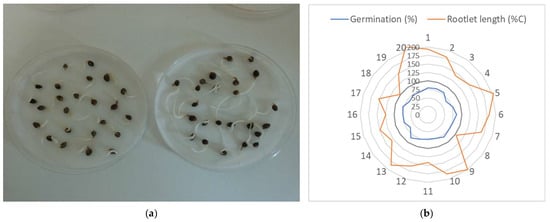
The germination test revealed an effect of some of the Trichoderma isolates in promoting the radicle growth of the treated seeds, but not on the germination rate, as shown in the radar chart in Figure 1.
Figure 1.
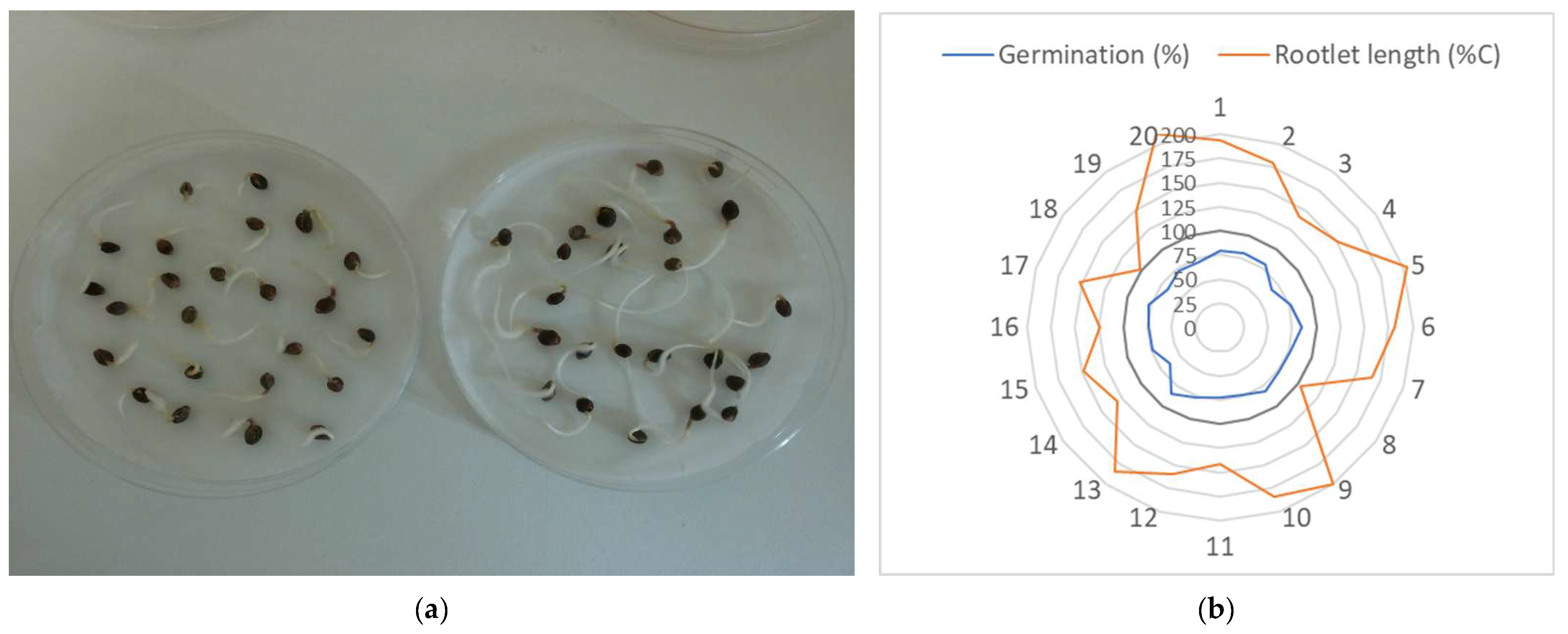
Germination test. (a) Hemp seeds (‘Eletta campana’ cv) treated with potato broth (control), on the left, or Trichoderma afroharzianum T22 liquid culture (on the right) after 72 h incubation at 22 °C. (b) Radar chart showing the germination rate (%) and the radicle length as a percentage of the control (%C, potato broth) measured 72 h after the seed treatment with the different Trichoderma sp. isolates (n. 1–20) as listed in Table 1. The isolate n. 20 is T. afroharzianum T22, included as a reference.
The germination rate of the treated seeds showed values in the 64–85% range, which were not statistically different from those of the control treated with potato broth, PB, or T22 (80 and 71%, respectively; Table 1).
Table 1.
Mean values of the seed germination rate (%) and radicle length (cm) of ‘Eletta campana’ seedlings measured 72 h after the seed treatment with the different Trichoderma sp. isolates (n. 1–20) in comparison to the control treated with potato broth (PB). T. afroharzianum T22 is included as a reference. Means in columns sharing common letters do not differ statistically at p < 0.05 according to Tukey’s test, after ANOVA. In bold, values higher than the control (PB).
Nine out of the 20 isolates tested greatly stimulated radicle growth with statistically significant increases of 66–111% compared to PB, and did not differ from the reference strain T. afroharzianum T22 (Table 1).
2.2. Bioassay in Growth Chamber
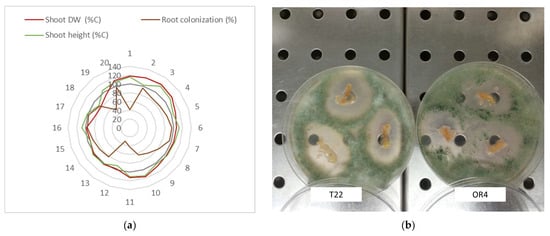
The Trichoderma sp. isolates applied as seed treatment differentially affected plantlet growth and root colonization percentage. Generally, compared to the control (PB), stronger effects were found for the root colonization ability than for the shoot growth promotion, as shown in Figure 2a.
Figure 2.
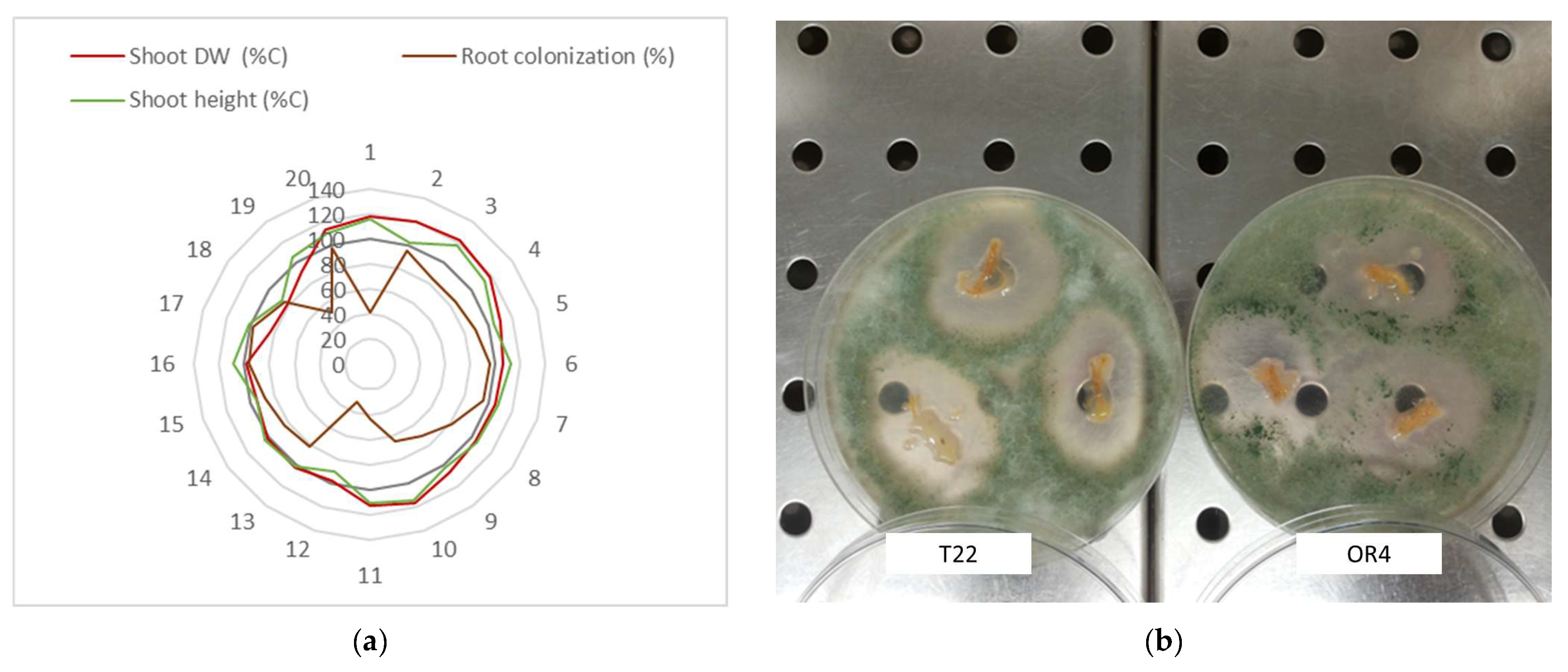
(a) Radar chart showing the shoot dry weight and the shoot height, as a percentage of the control (%C, potato broth), and the root colonization degree (%) of ‘Eletta campana’ plantlets obtained from seeds treated with the Trichoderma sp. isolates (n. 1–20). The isolate n. 20 is T. afroharzianum T22, included as a reference. (b) Root colonization test showing complete colonization of root fragments by different T. afroharzianum isolates: T22 on the left and OR4 on the right.
Only a few isolates significantly enhanced shoot growth: compared to the control (PB), IMO5 (n. 1), OR4 (n. 2), LE3 (n. 3), and B41 (n. 4) increased the shoot DW by 18–22%, with IMO5 and LE3 also enhancing shoot height by 16–18%. They were more effective than T22, which did not affect plantlet growth (Table 2). Most of the isolates demonstrated a strong ability to colonize nearly the entire root apparatus, with colonization percentages exceeding 80%, including T22. At the same time, a few isolates, namely IMO5, P5, and N3, appeared to be the worst colonizers, showing values of only 32–44% (Figure 2, Table 2). It should be noted that the control (PB) displayed a 20% colonization value due to the presence of endogenous Trichoderma already present in the potting mix (Table 2).
Table 2.
Mean values of shoot dry weight, shoot height, and root colonization percentage measured in ‘Eletta campana’ plantlets obtained from seeds treated with the different Trichoderma sp. liquid cultures. Means in columns sharing common letters do not differ statistically at p < 0.05 according to Tukey’s test, after ANOVA. In bold, values higher than the control (PB).
2.3. Experiment in Open-Air Conditions
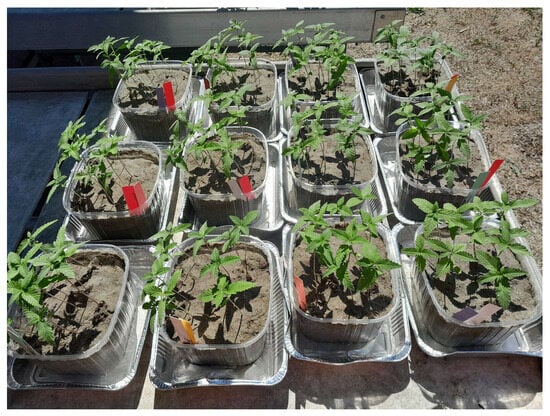
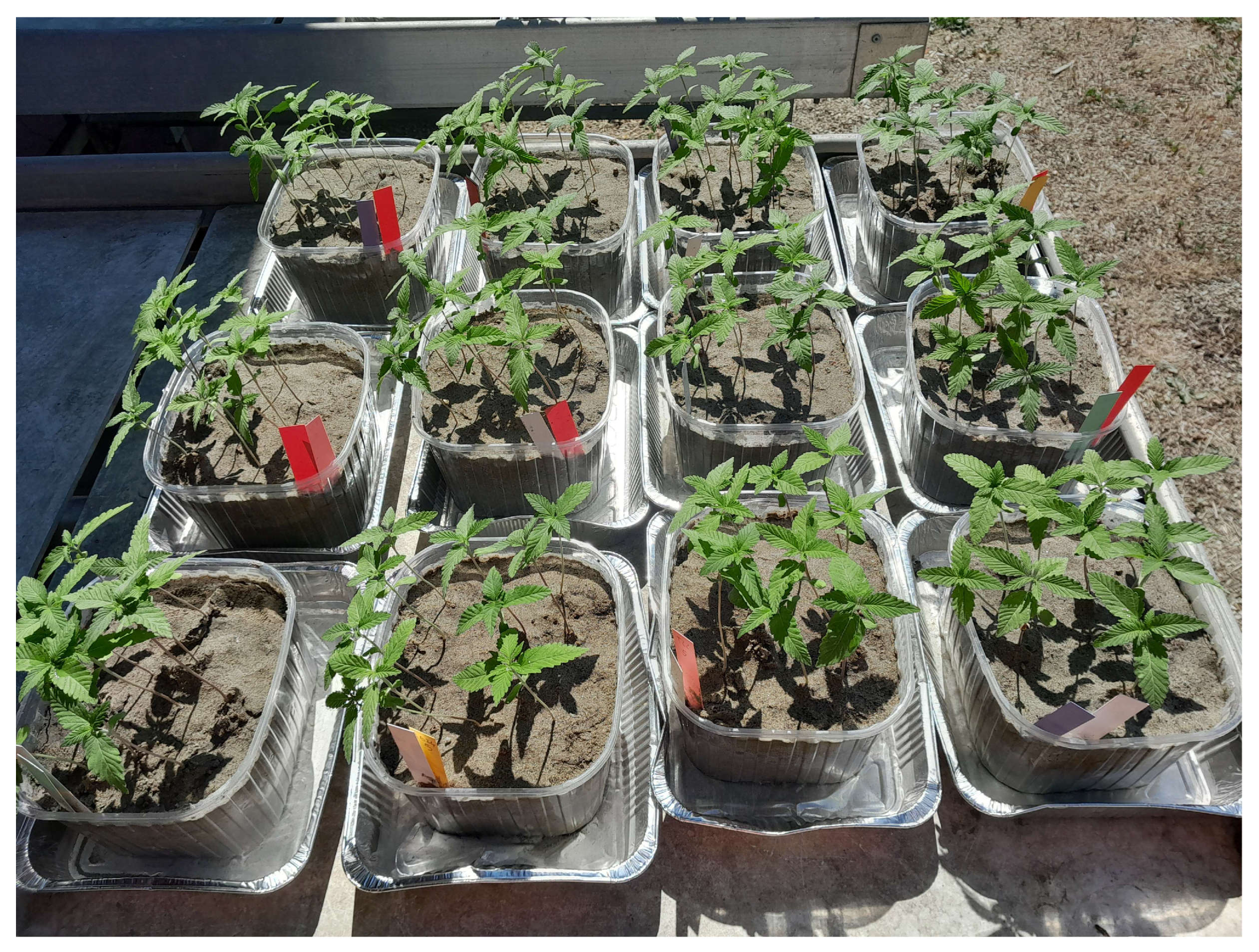
Based on the screening results reported in Table 2, three of the 20 Trichoderma sp. Isolates, namely OR4, 3B24, and X44, were selected for the experiment in open-air pots, compared to the reference isolate T. afroharziamum T22. Selection criteria are reported in Section Materials and Methods. The selected isolates were identified at the species level by molecular and morphological methods, resulting in T. afroharziamum OR4, T. viride 3B24, and T. atrobrunneum X44. Figure 3 shows the hemp plants after 20 days of growth in the open-air pot experiment.
Figure 3.
Plantlets of ‘Eletta campana’ after seed treatment with selected Trichoderma sp. isolates, after 20 days of growth in pots under open-air conditions.
2.3.1. Effects on Plant Growth
The ANOVA revealed that the factor “seed treatment” significantly impacted some of the plant growth parameters, specifically the dry weight of the leaves, above-ground biomass, below-ground biomass, and whole plant biomass (Table 3). Conversely, the factor “experiment” and the interaction “experiment × seed treatment” were not statistically significant for all the studied variables (Table 3). For this reason, Table 3 presents the parameter values as the means over the two experiments. Compared to the control (PB), OR4 showed a statistically significant increase in the above-ground biomass per plant (+8.7%) by increasing the total leaf weight (+10.8%), performing better than T22, which did not affect these parameters (Table 3). On the contrary, T22 negatively affected the below-ground biomass compared to the control (−12.5%), whereas 3B24 tended to increase it compared to PB (+6%) or T22 (+22%) (Table 3). Considering the whole plant biomass (above + below-ground), OR4 and 3B24 performed better than T22 (+20%). Generally, the seed treatments did not affect the plant height (Table 3) or the fresh weight of the different parameters (Table S1).
Table 3.
Effect of the seed treatment with selected Trichoderma sp. isolates on ‘Eletta campana’ plant heights and dry weights of leaves (A), stems (B), above-ground biomass (A + B), below-ground biomass (C), and whole plant biomass (A + B + C) after 20 days of growth in pots under open-air conditions, compared to potato broth (PB) treatment (control). The reported values are the means of two experiments ± standard deviations (n = 2 × 5 = 10). Means in columns sharing common letters do not differ statistically at p < 0.05 according to the Least Significant Difference test, after ANOVA. In bold, values higher than the control.
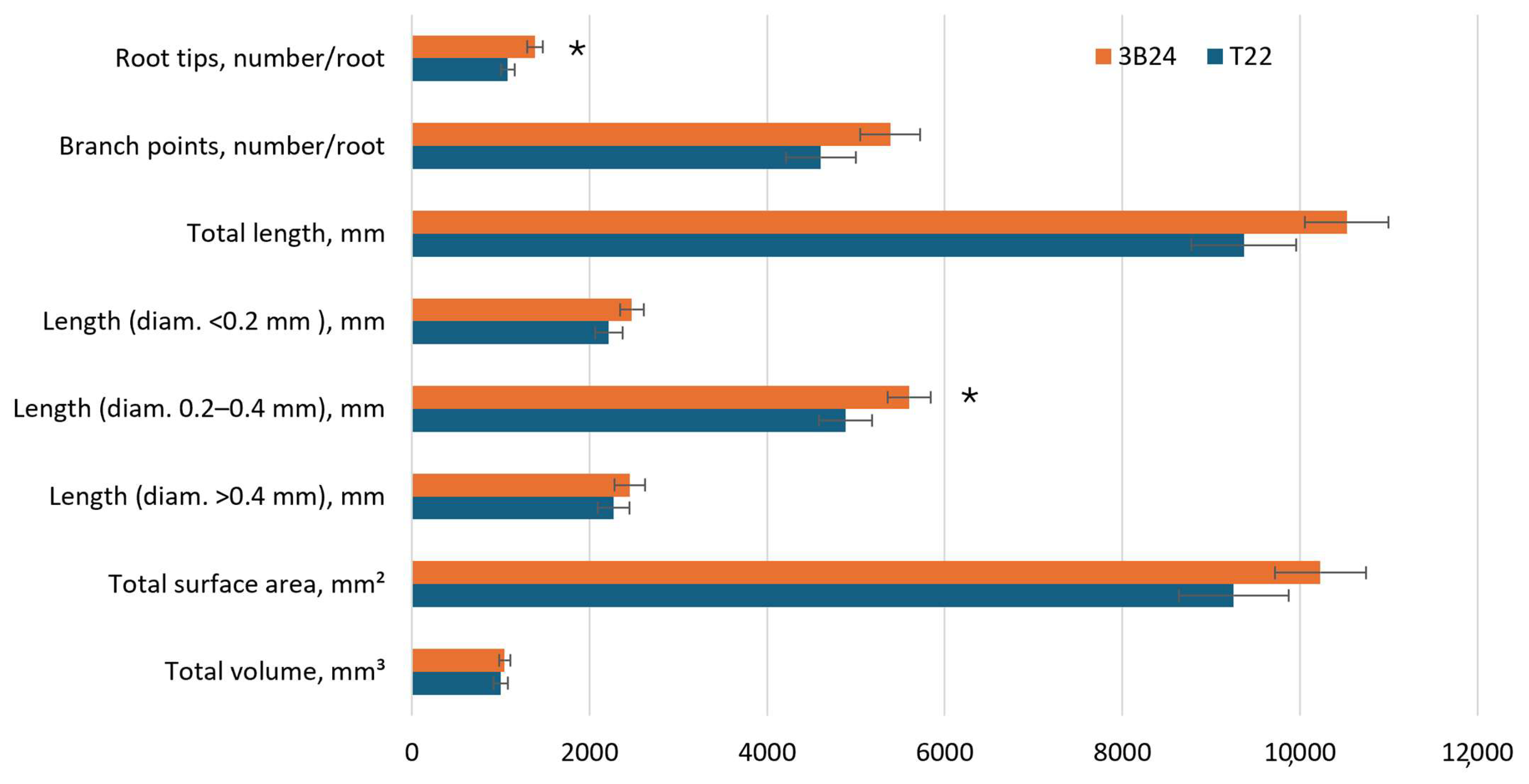
The architectural analysis of the root apparatus was conducted with 3B24 and T22 treatments only, as these treatments significantly differed in the below-ground biomass per plant (41.0 vs. 33.7 mg DW plant−1, respectively, Table 3). The statistical analysis revealed high coefficients of variation (24–47%) for all root traits. The treatment with T. viride 3B4 showed statistically significant higher numbers of root tips and a greater length of roots with intermediate diameters (0.2–0.4 mm) than T. afroharzianum T22 (Figure 4). In addition, on average, the other root parameters, i.e., the number of branch points, total length, total surface area, and total volume, showed absolute values that were higher for 3B24 than for T22, although not statistically significant (Figure 4). The average and median root diameters showed, instead, absolute values (0.31 and 0.28 mm, respectively) identical for both Trichoderma treatments and were not included in the graph.
Figure 4.
Effect of the seed treatment with T. viride 3B24 compared to T. afroharzianum T22 isolate on the number of root tips and branch points, total length, total surface area, and total volume of ‘Eletta campana’ roots of 20-day-old plants in open-air pots (n = 30). Bars are the standard error of the mean. The asterisks (*) indicate statistically significant differences between treatments according to the Mann–Whitney U test (p < 0.05).
2.3.2. Effects on Leaf Chemical Compounds
According to the ANOVA results, the factor “seed treatment” affected some of the studied variables, whereas the factor “experiment” and the interaction “ST × E” were never significant; thus, Table 4 and Table 5 present the mean values of the different treatments over the two experiments for all variables.
Table 4.
Effect of the seed treatment with selected Trichoderma sp. isolates on the content of chlorophyll a and b, carotenoids and phenolics, and the antioxidant activity, measured as DPPH, of ‘Eletta campana’ leaves, on a dry weight basis, after 20 days of growth in pots under open-air conditions, compared to the potato broth (PB) treatment (control). The reported values are the means of two experiments. (n = 2 × 5 = 10). Means in the columns sharing common letters do not differ statistically at p < 0.05 according to the Least Significant Difference test, after ANOVA.
Table 5.
Effect of the seed treatment with selected Trichoderma sp. isolates on the nitrogen and proline content of ‘Eletta campana’ leaves and roots, on a dry weight basis, after 20 days of growth in pots under open-air conditions, compared to the potato broth (PB) treatment (control). The reported values are the means of two experiments. (n = 2 × 5 = 10). Means in the columns sharing common letters do not differ statistically at p < 0.05 according to the Least Significant Difference test, after ANOVA. In bold, values higher than the control.
The seed treatment did not affect the leaf content of chlorophyll a and carotenoids, whereas it differentially affected the content of chlorophyll b, total phenolics, and the antioxidant activity, depending on the isolate; however, in general, no statistically significant increases were observed for the different treatments compared to the control (PB), or T22. The total phenolic content and the antioxidant activity (DPPH) were decreased after seed treatment with T. afroharzianum OR4 compared to the PB (Table 4).
The nitrogen content of leaves and roots at the end of the experiment was, on average, 2.9% and 2.3% DW, respectively, with no significant differences among all treatments (Table 5). On the contrary, leaf proline content was significantly increased by the seed treatment with T. atrobrunneum X44 (+16.7%) compared to the control, even though T. afroharzianum T22 was more effective (+31.7%). In contrast, the root content was not affected (Table 5).
3. Discussion
3.1. Growth Promotion
The efficacy of microbial seed treatment in improving seed germination, seedling growth, and crop performance in many plant species is well documented [26,27,28]. However, little information is available on the seed treatment of industrial hemp with beneficial microorganisms. Moreover, seed treatments, including Trichoderma-based ones, are most effective in improving seed performance and crop establishment and combating early-season pests when they are targeted and crop-specific [20,29]. Thus, in this work, several Trichoderma isolates were first screened for their effect on hemp seed germination and plantlet growth under controlled conditions before testing a few selected ones in a final experiment in open-air pots.
The germination test results excluded the eventual toxicity of metabolites accumulated in the 7-day-old homogenates of the tested Trichoderma liquid cultures since a general absence of significant reductions in germination rates was observed (Table 1). A recent study compared different hemp seed treatments, including a commercial product based on T. atroviride, to manage damping-off disease in the field, without finding a negative effect on the germination rate for any of the tested treatments [18]. In another study, seed treatment with culture filtrates from different Trichoderma species applied to maize and vegetables had a differential effect on the germination rate, depending on the filtrate and the plant species; in most cases, the germination speed was differentially influenced [30]. Our study revealed a significant boost in radicle growth obtained with some Trichoderma liquid cultures compared to the control (Table 1). Similarly, in another study on cocoa (Theobroma cacao), the seed treatment with several Trichoderma spp. did not influence germination speed but increased radicle length compared to the control [31]. This is an interesting effect because it could reduce the time from sowing to emergence, a crucial period when seeds may be subjected to a wide range of abiotic and biotic stresses that hamper stand performance [29]. In this view, the seed treatment with selected Trichoderma isolates can protect hemp seedlings and improve plant stand and crop establishment, which are prerequisites for a successful crop yield. Seedlings that emerge fast and vigorously have a high ability for nutrient uptake, cope better with pathogens and weeds, and tolerate suboptimal environmental conditions, enhancing plant growth [32].
Although shoot DW increases in seedlings after seed treatment with Trichoderma spp. have been widely reported in the literature for many crop species [26,27], only a few of the isolates screened here gave significant shoot DW increases (18–22%) compared to the control (Table 1). Interestingly, the four isolates obtained from hemp stems and roots (CAN1, CAN2, CAN3, and CAN4) neither outperformed the control in the germination test nor in the growth chamber experiments (Table 1 and Table 2), meaning that the origin of an isolate does not guarantee a superior effect when used on the same plant species. Moreover, although most of the isolates were good colonizers of the hemp root apparatus, only a few could be considered rhizosphere-competent, as they colonized almost the entire root surface (>95%) (Table 2). This is a fundamental and generally long-lasting prerequisite for establishing a biochemical dialog between Trichoderma and plants, which underlies all the positive effects exerted on the plant, from growth promotion to protection against diseases [33].
The experiment under open-air conditions with selected isolates confirmed the effectiveness of T. afroharzianum OR4 in promoting shoot growth, as observed during the preliminary screening, although to a lesser extent (+9% shoot DW instead of +20%, Table 2 and Table 3). The analysis of the different plant parts allowed us to highlight that the increase in above-ground DW biomass observed with OR4 was mainly due to the stimulation of the vegetative apex to produce heavier young leaves, as shown by the increase in leaf DW compared to the control (+11%, Table 3). This stimulatory effect could be linked to the production of phytohormones, such as indole-3-acetic acid, which modulates auxin transport and activity in plants. The literature supports the association between the production of such compounds by Trichoderma species and the growth promotion of plants, including tomato, sorghum, bean, wheat, and pepper [34,35,36]. However, Trichoderma species produce many other volatile or diffusible metabolites with hormone-like activity, like sesquiterpene, ethylene, cytokinins, gibberellins, and abscisic acid, which may alter endogenous plant signaling mechanisms and affect plant growth [34]. The synthesis of such phytohormones and phytoregulators, including the 1-aminocyclopropane-1-carboxylic acid deaminase enzyme, which regulates the ethylene biosynthetic pathway, is considered one of the main mechanisms at the basis of plant growth promotion exerted by Trichoderma, by affecting the hormonal balance of plants [36].
Indole-3-acetic acid and other metabolites produced by Trichoderma spp. can also promote root growth by stimulating root branching, inducing lateral, secondary, or adventitious roots, and increasing the number and length of hairs, as reported for some crops, like maize, rice, melon, and cabbage [34]. This allows for better plant anchorage and exploration of soil and higher water and nutrient uptake effectiveness, contributing to plant development [35]. These are well-recognized indirect mechanisms of growth promotion exerted by Trichoderma, along with the improved solubilization of commonly unavailable nutrients like phosphorus and iron [35]. However, despite positive reports, contrasting results have been published on the effect of different Trichoderma spp. on Arabidopsis thaliana growth, going from promotion to inhibition, depending on the Trichoderma species and the environmental conditions [37]. In our study, the beneficial effect of the seed treatment was less marked on the root apparatus than on the shoot; however, a tendency of T. viride 3B24 to increase root DW was noted (+6% and +22% compared to the control and T22, respectively, Table 3). The root architectural study supported the better performance of 3B24 compared to T22 and revealed a tendency towards higher values for all root parameters, including root branching, although these were not statistically significant (Figure 4).
There are a few reports on the effect of Trichoderma treatment on the growth promotion of industrial hemp: one experiment was conducted in a greenhouse with a commercial product based on T. afroharzianum T22 applied 10 and 30 days after transplanting. At maturity, the root density, plant height, plant DW, and CBD bud content of both hemp varieties (‘Felina’ and ‘Fedora 17’) were significantly increased, whereas bud DW did not improve [15]. Recently, another experiment was conducted in pots to evaluate the effect of the seed treatment with two isolates of T. afroharzianum, T22 and T-AA, on plants of ‘Eletta campana’ at two different early growth stages over two years [16]. The different environmental conditions in the two years impacted the results. However, in general, the shoot and root DW, and several root parameters, like branching, total length, and total volume, were significantly increased with T22.
3.2. Chemical Variation and Proline Accumulation in Leaves
It was recently reported that the polyphenol content and antioxidant activity in the leaves of ‘Eletta campana’ cv increased after seed treatment with two T. afroharzianum (T22 and T-AA) isolates [16]. In contrast, in our experiment, the seed treatment with the selected Trichoderma isolates did not increase the leaf content of antioxidant compounds like carotenoids and phenolics in 20-day-old plants, and the same was observed for the antioxidant activity. However, this is consistent with results obtained by Varga and coauthors [17], who reported that seed and/or substrate treatment with a biopreparation of Trichoderma sp. stimulated hemp morphological parameters such as stem, root, and plant length but did not affect antioxidant compounds under white light.
More interesting are the results obtained in our study regarding the leaf accumulation of proline, which is a common physiological response of plants to several abiotic stresses, such as salinity, drought, water stress, heavy metals, cold, hypoxia, UV irradiation, and pathogen infection, and it is an indicator of the physiological status or stress tolerance of higher plants [24]. Due to climate change, these abiotic stresses represent big challenges in agriculture, altering physiological processes and reducing yields, especially where extreme temperatures and scarce rainfall occur more frequently.
Some authors reported that hemp plants under osmotic stress accumulated proline to a lesser extent compared to other plant species, without showing significant differences among the cultivars [8]. In this work, carried out under non-stressed conditions, hemp plantlet of ‘Eletta campana’ strongly responded to both T. afroharzianum T22 and T. atrobrunneum X44 seed treatment, with a significant accumulation of proline in the foliar apparatus compared to the control (+32% and +17% on a dry weight basis, respectively, Table 5). These results are consistent with other studies reporting proline accumulation in plants after treatment with T. harzianum under non-stress conditions. For instance, tomato plants inoculated with T. harzianum at transplanting showed a 32% increase in proline on a fresh weight basis compared to non-inoculated controls [38]. Similarly, the inoculation of soybean seeds with T. harzianum induced a significant increase in the proline content of seedling leaves and roots under non-stressed conditions, compared to non-treated seedlings. Furthermore, a low-vigor seed lot exhibited a 24% greater leaf proline content compared to a high-vigor one, after inoculation [39]. Another study reported that Cucurbita pepo seeds inoculated with T. harzianum, T. viride, or a combination thereof exhibited an increase in proline content under normal growth conditions [40]. Other authors working on cucumber plants treated with T. harzianum reported a tendency towards the upregulation of the production of this compound under non-stressed conditions [41]. In all cases, as expected, proline accumulation was enhanced even more under stress conditions [38,39,40,41]. The effect observed here in hemp plants, i.e., the accumulation of proline in non-stressed conditions after seed treatment with certain Trichoderma isolates, can be explained by the well-known phenomenon of “priming”, i.e., inducing a plant physiological state that consists of a modification of plant metabolism with the accumulation of protective compounds and the activation of transcriptional memory, preparing the plant to respond to subsequent stress conditions [11]. This phenomenon can be exerted by certain beneficial microbes (biotic priming), including Trichoderma spp., after colonization of the host roots, or by treatment of plants with various natural and synthetic compounds or physical agents (abiotic priming) [11,42,43]. Priming stimulates early germinative processes and initiates molecular mechanisms that involve gene-level regulation, changes in metabolites, and enzymatic and non-enzymatic antioxidant production, and affects stress-responsive gene regulation [43]. As a consequence, primed plants show faster and/or stronger activation of the different cellular defense mechanisms when subjected to additional abiotic stress or to attack by pathogens or insects [42]. Seed priming is considered a cost-effective strategy, which combines improvements in the germination process and the induction of tolerance to stress conditions, leading to better crop establishment and higher crop yield [43]. This work shows that hemp is responsive to seed treatment with selected Trichoderma spp. isolates, as demonstrated by the growth stimulation and proline accumulation, suggesting a possible priming effect against future stress.
4. Materials and Methods
A pre-selected set of 20 isolates out of a large collection of wild-type Trichoderma sp. isolates was preliminarily screened to evaluate the effect of the seed treatment on germination and plantlet growth under controlled conditions. A final experiment was performed with 3 selected isolates in pots under natural conditions to verify the effects of the seed treatment on plant growth and proline accumulation.
4.1. Materials
Hemp seeds belonging to the dioecious cv. ‘Eletta Campana’ were kindly provided by the Research Centre for Cereals and Industrial Crops of Bologna. Intact seeds were surface-sanitized with a 1% NaClO solution for 1 min, rinsed twice in sterile distilled water, and dried under a sterile air flow until use in all the experiments.
The Trichoderma spp. isolates utilized in the screening belong to a collection of more than 300 wild-type isolates maintained at our Research Centre. The isolates selected for screening are listed in Table 6, along with the characteristics that led to their selection, as determined by previous experiments. T. afroharzianum T22, an isolate of commercial origin, was included as a reference, for a total of n. 20 Trichoderma sp. isolates.
Table 6.
List of the selected Trichoderma spp. isolates utilized in the screening and the characteristics considered for their selection.
4.2. Methods
Seed treatment. The sanitized hemp seeds were treated with the liquid cultures of the 20 Trichoderma spp. isolates listed in Table 1, prepared as follows: two mycelium plugs from actively growing colonies on potato dextrose agar (PDA) were used to inoculate 30 mL of potato dextrose broth (PDB) in 250 mL Erlenmeyer flasks plugged with cotton wool, previously sterilized (120 °C, 20 min). The Trichoderma cultures were incubated for 7 days at 27 °C under static conditions, then collected and homogenized for 1 min in a blender, obtaining a suspension of fragmented mycelium and spores. Spore concentration was checked with a Burker camera and ranged from 1 × 10⁸ to 2 × 10⁸ spore per mL. These suspensions were used to treat the hemp seeds (homogenate:seeds 1:4 w/w), thus the theoretical infection rate was 2–5 × 10⁷ spores per gram of seeds. Control seeds were treated with potato broth (PB) instead of PDB because dextrose was almost absent in the culture homogenate used for seed treatment, as it was consumed by Trichoderma during growth. The sugar content in the homogenates was lower than 1 mg mL−1, as it was checked using the 3,5-dinitrosalicylic acid (DNS) method [48] as previously described [49]. For this reason, dextrose was not added when preparing potato broth to treat control seeds. The treated seeds were placed under a vertical hood to dry for 5 h until they reached a constant weight. They were then collected and stored in paper bags at 4 °C until use.
Germination test. The seeds treated as described above with the liquid culture homogenates of the 20 Trichoderma sp. isolates or PB (control) were distributed on filter paper imbibed with 2 mL of sterile distilled water in polystyrene Petri plates (94 mm diameter,16 mm depth, triple-vented, Greiner Bio-One GmbH, Kremsmünster, Austria), using 4 replicates × 24 seeds. After 72 h of incubation at 22 °C, the number of seeds that produced normal seedlings with a radicle length >2 mm was counted and the germination rate was determined; the radicle length was measured and reported as a percentage of the control.
Bioassay in growth chamber. Hemp seeds treated with the different 20 Trichoderma isolates or PB (control) were pre-germinated in Petri plates (48 h, room temperature) and seeded at 2 cm depth in 50 mL bottom-holed plastic tubes, 2.5 cm diam, filled with commercial growth substrate (Floradur® raised-bog-peat, Floragard Vertriebs-GmbH, Oldenburg, Lower Saxony, Germany), one seed per tube, 20 tubes per isolate. The tubes were watered and incubated for 18 days at 25 °C, 70% R.H., 16 h:8 h light/dark, in a growth chamber (Percival®AR-36LC8, Percival Scientific, Inc. Perry, IA, USA). The growth substrate was previously pasteurized at 60 °C for 30 min, to lower possible endogenous contamination. On the 18th day, the plantlets were gently removed from the tubes, and, for each treatment, the shoot height (SH) was measured (n = 20). Then, the root apparatus of 10 plants was thoroughly washed under tap water and finally rinsed with sterilized distilled water. Under a sterile air flow cabinet, each root apparatus was cut into 6 portions and plated in 9 cm diameter Petri plates on PDA, added with streptomycin and ampicillin. Plates were incubated for 8 days at room temperature, and then the mean percentage of root colonization by Trichoderma was recorded for each of the 10 plantlets (n = 10). Finally, the shoot dry weight (DW) was determined after oven-drying to constant mass (10 shoots × 2 replicates) at 105 °C for 48 h (n = 2). The shoot height and DW are also reported as a percentage of the control.
Experiment in pots in open-air conditions. The three most interesting Trichoderma isolates resulting from the screening, namely OR4, 3B24, and X44, were selected for a pot experiment under natural conditions. Colonization ability was considered a primary criterion; thus, IMO5 was excluded. Among the few isolates that significantly enhanced shoot DW, OR4 was selected for its further excellent performance in colonizing roots. Among similarly ranked isolates, preference was given to those antagonistic to soilborne pathogens (Table 1). Thus, 3B24 and X44 were selected as they were good root colonizers. They were preferred to B41, LT31, and LE3 as they were also antagonistic to soilborne pathogens as observed in previous experiments [46]. The selected isolates were kindly identified at the species level through sequence analysis of ITS1/2, tef1a, and rbp2, and by morphological comparison, by John Bissett, Agriculture and Agri-Food Canada, Ottawa, and by Antonio Prodi, University of Bologna, Italy, resulting in T. afroharzianum OR4, T. viride 3B24, and T. atrobrunneum X44. The T22 isolate (T. afroharzianum) of commercial origin, and a non-treated control (treated with PB only) were included in the experiment; thus, 5 treatments were compared, with 5 replicates (pots), each containing 10 plants. The experiment was repeated (n = 2). At the beginning of June 2024, sanitized hemp seeds were treated with the homogenate of liquid culture, or PB (control), as described above (2–5 × 10⁷ spores g−1 seed). Then n. 10 pre-germinated seeds were sown at a 2 cm depth in plastic pots (13.5 × 11.5 × 7.5 cm) filled with pasteurized (70 °C, 72 h) sandy soil, collected near the shore of the Reno river, Bologna, Italy, and fertilized with Hoagland’s solution. After sowing, pots were distributed on shielded tables outside the Research Centre located in Bologna, Italy (lat. 44°29′ N, long. 11°20′ E, 54 m a.s.l.) under open-air conditions and natural lightning, according to a completely randomized block design. The necessary water and NPK nutrients (Basis A and B, Mills nutrients, Aalsmer, The Netherlands) were provided. Twenty days after sowing, the plant stand percentage and height were recorded. During the period, the average minimum temperature was 18.3 ± 2.3 °C, and the average maximum temperature was 28.3 ± 3.1 °C. The plants were then gently removed from the pots, and the root apparatus was carefully washed under running water to eliminate any substrate residue. Distilled water was then used for the final rinsing of the roots. Three randomly chosen entire plants from each pot were stored in tubes in 70% ethyl alcohol at 4 °C for further digital measurements of the root apparatus (see below). The remaining plants from each pot were cut at the crown level to separate the above- from the below-ground apparatus; then the leaves were separated from the stems, and the fresh weight (FW) of each fraction (leaves, stems, and roots) per pot was recorded. Leaf samples of 1.0–1.1 g FW were withdrawn from each replicate and extracted in absolute methanol (25 mg FW mL−1, 1.0–1.1 g in 40–44 mL) using an Ultra-turrax homogenizer for 2 min at room temperature. The extracts were left in the dark overnight and then stored at −20 °C for subsequent analyses as detailed below. The plant pooled fractions (i.e., stems, leaves, and roots) were separately oven-dried at 40 °C until constant weight to determine the corresponding DW per pot of each fraction. Finally, the FW and DW per plant were calculated and reported. The dried materials were stored in paper bags within a sealed plastic bag at −20 °C for several weeks until used for the subsequent analyses.
Digital measurements of the root apparatus. Root morphology was assessed only on the subset of treatments displaying statistically significant differences in root DW. Thirty roots per selected treatment (3 roots × 5 pots × 2 experiments) were scanned (model: Epson Perfection 4990 Photo; producer: Seikō Epuson Kabushiki-gaisha, Suwa, Nagano, Japan), and each image was analyzed using RhizoVision Explorer v2.0.3 [50] using the described algorithms [51]. In detail, each root was spread with tweezers in a thin layer of water in a transparent plastic tray (19 × 24 cm) and then scanned at a resolution of 1200 DPI (dots per inch). Images, acquired in a grayscale 8-bit format, were stored in JPEG format with a compression level of four. Software settings in pixels were as follows: thresholding 200, filtering 800, edge smoothing threshold 4, and root pruning threshold 4. The diameter classes in pixels were: 0–9; 9–18; and >18, corresponding to 0–0.2 mm; 0.2–0.4 mm; and >0.4 mm. The following traits were recorded: total root length, total root surface area, root median diameter, root average diameter, total root volume, number of root tips, and number of branch points. The total root length was also classified into three classes based on the root diameter (<0.2 mm, 0.2–0.4 mm, and >0.4 mm).
Chemical analyses. Total nitrogen content was determined in finely ground samples of 0.100 g of dry leaves or roots loaded into tin foil cups and analyzed with LECO Truspec® CHN Analyzer (LECO Corporation, St. Joseph, MI, USA).
Proline analysis was performed according to Lee and coworkers [52] with minor modifications. Briefly, for each sample, 30 mg of dry leaf powder obtained by mortar and pestle and sieved to pass a 250 μm screen, was thoroughly mixed in 1 mL of sulphosalicylic acid (1% w/w) and vortexed 4 times for 1 min at 10 min intervals. Samples of 67 μL of clear supernatant (10,000 rcf, 5 min) were mixed with 133 μL of acid ninhydrin solution (1.25% w/w ninhydrin in 80% v/v acetic acid) and kept at 96 °C for 30 min. Differently from the published method [52], the incubation was performed in 96-well polypropylene PCR microplates (Thermowell, Product Number 6551, Corning Inc., Corning, NY, USA) with an aluminum cover (adhesive aluminum foil for microplates VWR 60941-112, VWR International, Radnor, PA, USA) in a PCR DNA thermal-cycler (T3 DNA thermal-cycler, Biometra GmbH, Göttingen, Germany). This procedure allows better time and temperature control and minimizes evaporative losses. After cooling (15 °C), 180 μL of each sample were transferred into a 96-well flat-bottom polystyrene microplate (Costar 3595, Corning Inc.), and the absorbance at 510 nm was measured by a spectrophotometer (Infinite 200 PRO series, Tecan, Männedorf, Switzerland). The same protocol was used to analyze root proline content, using 50 mg of finely milled dry roots (ultra-centrifugal mill ZM200, Retsch GMBH, Haan, Germany) per mL of sulphosalicylic acid (1% w/w).
Chlorophyll a and b, and carotenoid foliar content were determined as follows. For each replicate, two mL samples of the methanolic extract (25 mg FW mL−1) were centrifuged (10,000 rcf, 30 min) and supernatant aliquots (200 μL) in duplicate were analyzed in a multiwell-microplate (96-well flat-bottom polystyrene Costar 3595, Corning Inc.) by a spectrophotometer (Infinite 200 PRO series, Tecan) at 665, 652, and 470 nm to determine chlorophyll a, chlorophyll b, and carotenoids according to Equation (1), Equation (2), and Equation (3), respectively [53]:
Chlorophyll a (Chla) (μg/mL FL) = (16.72 × A665 − 9.16 × A652)/0.5
Chlorophyll b (Chlb) (μg/mL FL) = (34.09 × A652 − 15.28 ×A665)/0.5
Carotenoids (μg/mL FL) = (1000 × A470/0.5 − 1.63 × Chla − 104.9 × Chlb)/221
Note that the equations reported by Wellburn et al. [53] were modified here to take into account the actual pathlength in the microplate [54]. The pathlength of a 200 μL sample in a 96-well flat-bottom polystyrene microplate (Costar 3595, Corning Inc.) was half of that used in the original formulas (thus, a correction factor of 0.5 was introduced). Data were then converted and reported as μg g−1 FW.
The total phenolic content and antioxidant activity of the methanolic extracts (25 mg FW mL−1) were quantified following the methods proposed by Quitadamo et al. [55] adapted to a 96-well plate format (flat-bottom polystyrene microplate, Costar 3595, Corning Inc.), with minor modifications. For the total phenolic content, 10 μL of the methanolic extract were mixed with 10 μL of distilled water and 90 μL of Folin–Ciocalteu reagent (diluted 1:10). After 5 min, 90 μL of 6% Na2CO3 were added. The mixture was incubated at room temperature in the dark for 1 h, and the absorbance was measured at 725 nm using a spectrophotometer (Infinite 200 PRO series, Tecan). Gallic acid (Sigma, St. Louis, MO, USA) served as the standard, and results were expressed as mg of gallic acid equivalents (GAE) per gram FW.
The total antioxidant activity was assessed using the 2,2-diphenyl-1-picrylhydrazyl (DPPH) radical scavenging assay [55]. A solution was prepared by dissolving 2 mg of DPPH in 40 mL of methanol. For each reaction, 20 μL of methanolic extract were mixed with 280 μL of the DPPH solution. The mixture was incubated at room temperature in the dark for 30 min, and the absorbance was measured at 525 nm using a spectrophotometer (Infinite 200 PRO series, Tecan). The results were expressed as mg of trolox equivalents (TE) per gram FW. All measurements were performed in triplicate.
Statistical analysis. After checking the homogeneity of variance and arcsine transforming percentage data, all data, except root architectural parameters, were analyzed by ANOVA. Means were separated by Tukey’s or the Least Significant Difference test (p < 0.05), depending on the experiment. These analyses were performed using the M–STATC 2.11 statistical program (Michigan State University, USA). Regarding root architectural parameters, the non-parametric Mann–Whitney U test (p < 0.05) was performed to highlight differences between the treatments, as the Shapiro–Wilk test indicated significant deviations from normality for most variables. The analyses were performed through PAST 4.17 statistical program (University of Oslo, Norway).
5. Conclusions
Treating hemp seeds with selected Trichoderma spp. can be a strategy to enhance the germination process and early growth, both of which are critical for successful crop establishment and performance, especially under stress conditions. The preliminary screening of several Trichoderma isolates, and the pot experiment under natural conditions with a restricted selection of isolates highlighted the ability of T. afroharzianum OR4 to stimulate the radicle growth during germination and increase the above-ground biomass of hemp (mainly leaves) at the early growth stages, on a dry weight basis. Moreover, the study highlighted the capacity of T. atrobrunneum X44 and the reference strain T. afroharzianum T22 to induce proline accumulation in leaves, which is a physiological response associated with enhanced stress preparedness that may prime the plant to face upcoming abiotic stress conditions. Further experiments under controlled abiotic stress conditions are needed to validate whether the isolates that showed promising effects under optimal conditions can indeed confer improved stress resilience in hemp.
To finally confirm the effectiveness of this approach, these promising isolates need to be further tested in larger-scale experiments, up to the field level, with different hemp varieties, and under challenging environmental conditions. These isolates warrant further evaluation both individually and in combination, as well as in comparison with existing commercial Trichoderma formulations. If their efficacy is confirmed, they could provide farmers with a sustainable and effective tool to enhance hemp seed germination and early seedling vigor, thereby contributing to improved crop establishment and performance.
Moreover, assessing their potential as biological control agents against major hemp pathogens would broaden the understanding of their agronomic relevance. Future studies should focus on elucidating the mechanisms underlying the observed effects at both the biochemical and gene-expression levels, in the isolates themselves as well as in the plant.
Supplementary Materials
The following supporting information can be downloaded at: https://www.mdpi.com/article/10.3390/stresses6020017/s1, Table S1: Effect of the seed treatment with selected Trichoderma sp. isolates on ‘Eletta campana’ fresh weights of leaves (A), stems (B), above-ground biomass (A + B), below-ground biomass (C), and whole plant biomass (A + B + C) after 20 days of growth in pots in open-air conditions, compared to potato broth (PB) treatment (control). The reported values are the means of two experiments ± standard deviations (n = 2 × 5 = 10). Means in the columns sharing common letters do not differ statistically at p < 0.05 according to the Least Significant Difference test, after ANOVA.
Author Contributions
Conceptualization, S.G. and S.C.; methodology, S.G. and S.C.; software, S.G. and S.C.; validation, S.G. and S.C.; formal analysis, S.G. and S.C.; investigation, S.G. and S.C.; resources, S.G.; data curation, S.G. and S.C.; writing—original draft preparation, S.G. and S.C.; writing—review and editing, S.G. and S.C.; visualization, S.G. and S.C.; supervision, S.G.; project administration, S.G.; funding acquisition, S.G. All authors have read and agreed to the published version of the manuscript.
Funding
This research was funded by The Italian Ministry of Agriculture, Food Sovereignty and Forests, under the “Canapa e Ricerca Filiera ITaliana 2022—CaRiFIT 2022” project, D.D. 0667575, 30 December 2022.
Institutional Review Board Statement
Not applicable.
Informed Consent Statement
Not applicable.
Data Availability Statement
The original contributions presented in this study are included in the article/Supplementary Material. Further inquiries can be directed to the corresponding author.
Acknowledgments
Roberta Paris and Massimo Montanari are acknowledged for the donation of “Eletta campana” seeds. John Bissett and Antonio Prodi are acknowledged for the identification of Trichoderma isolates.
Conflicts of Interest
The authors declare no conflicts of interest. The funders had no role in the study’s design; in the collection, analyses, or interpretation of data; in the writing of the manuscript; or in the decision to publish the results.
References
- Rupasinghe, H.V.; Davis, A.; Kumar, S.K.; Murray, B.; Zheljazkov, V.D. Industrial hemp (Cannabis sativa subsp. sativa) as an emerging source for value-added functional food ingredients and nutraceuticals. Molecules 2020, 25, 4078. [Google Scholar] [CrossRef] [Scilit] [PubMed]
- Visković, J.; Zheljazkov, V.D.; Sikora, V.; Noller, J.; Latković, D.; Ocamb, C.M.; Koren, A. Industrial hemp (Cannabis sativa L.) agronomy and utilization: A review. Agronomy 2023, 13, 931. [Google Scholar] [CrossRef] [Scilit]
- Mi, R.; Taylor, A.G.; Smart, L.B.; Mattson, N.S. Developing production guidelines for baby leaf hemp (Cannabis sativa L.) as an edible salad green: Cultivar, sowing density and seed size. Agriculture 2020, 10, 617. [Google Scholar] [CrossRef] [Scilit]
- Moon, Y.H.; Cha, Y.L.; Lee, J.E.; Kim, K.S.; Kwon, D.E.; Kang, Y.K. Investigation of suitable seed sizes, segregation of ripe seeds, and improved germination rate for the commercial production of hemp sprouts (Cannabis sativa L.). J. Sci. Food Agric. 2020, 100, 2819–2827. [Google Scholar] [CrossRef] [Scilit] [PubMed]
- Yilbaşi, Z.; Yesilyurt, M.K.; Arslan, M. The production of methyl ester from industrial grade hemp (Cannabis sativa L.) seed oil: A perspective of Turkey—The optimization study using the Taguchi method. Biomass Convers. Biorefinery 2021, 13, 9955–9975. [Google Scholar] [CrossRef] [Scilit]
- Blandinières, H.; Amaducci, S. Adapting the cultivation of industrial hemp (Cannabis sativa L.) to marginal lands: A review. GCB Bioenergy 2022, 14, 1004–1022. [Google Scholar] [CrossRef] [Scilit]
- Elias, S.G.; Wu, Y.C.; Stimpson, D.C. Seed quality and dormancy of hemp (Cannabis sativa L.). J. Agric. Hemp Res. 2020, 2, 2. [Google Scholar] [CrossRef] [Scilit]
- Blandinieres, H.; Leoni, M.; Ferrarini, A.; Amaducci, S. Ranking 26 European hemp (Cannabis sativa L.) cultivars for osmotic stress tolerance and transpiration efficiency. Ind. Crops Prod. 2021, 170, 113774. [Google Scholar] [CrossRef] [Scilit]
- Cardarelli, M.; Woo, S.L.; Rouphael, Y.; Colla, G. Seed treatments with microorganisms can have a biostimulant effect by influencing germination and seedling growth of crops. Plants 2022, 11, 259. [Google Scholar] [CrossRef] [Scilit]
- Zin, N.A.; Badaluddin, N.A. Biological functions of Trichoderma spp. for agriculture applications. Ann. Agric. Sci. 2020, 65, 168–178. [Google Scholar] [CrossRef] [Scilit]
- Woo, S.L.; Hermosa, R.; Lorito, M.; Monte, E. Trichoderma: A multipurpose, plant-beneficial microorganism for eco-sustainable agriculture. Nat. Rev. Microbiol. 2023, 21, 312–326. [Google Scholar] [CrossRef] [Scilit] [PubMed]
- Contreras-Cornejo, H.A.; Schmoll, M.; Esquivel-Ayala, B.A.; González-Esquivel, C.E.; Rocha-Ramírez, V.; Larsen, J. Abiotic plant stress mitigation by Trichoderma species. Soil Ecol. Lett. 2024, 6, 240240. [Google Scholar] [CrossRef] [Scilit]
- Asad, S.A. Mechanisms of action and biocontrol potential of Trichoderma against fungal plant diseases—A review. Ecol. Complex. 2022, 49, 100978. [Google Scholar] [CrossRef] [Scilit]
- Harman, G.E. Seed treatments for biological control of plant disease. Crop Prot. 1991, 10, 166–171. [Google Scholar] [CrossRef] [Scilit]
- Kakabouki, I.; Tataridas, A.; Mavroeidis, A.; Kousta, A.; Karydogianni, S.; Zisi, C.; Kouneli, V.; Konstantinou, A.; Folina, A.; Konstantas, A.; et al. Effect of colonization of Trichoderma harzianum on growth development and CBD content of hemp (Cannabis sativa L.). Microorganisms 2021, 9, 518. [Google Scholar] [CrossRef] [Scilit]
- Iannucci, A.; Beleggia, R.; Galletti, S.; Pecchioni, N.; Trono, D. Impact of Seed Inoculation with Trichoderma afroharzianum Strains on Plant Growth, Root Morphology, and Leaf Phenolic Content in Hemp (Cannabis sativa L.) at Early Growth Stages. Agriculture 2024, 14, 511. [Google Scholar] [CrossRef] [Scilit]
- Varga, I.; Kristić, M.; Lisjak, M.; Tkalec Kojić, M.; Iljkić, D.; Jović, J.; Kristek, S.; Markulj Kulundžić, A.; Antunović, M. Antioxidative Response and Phenolic Content of Young Industrial Hemp Leaves at Different Light and Mycorrhiza. Plants 2024, 13, 840. [Google Scholar] [CrossRef] [Scilit]
- Mayton, H.; Amirkhani, M.; Loos, M.; Johnson, B.; Fike, J.; Johnson, C.; Myers, K.; Starr, J.; Bergstrom, G.C.; Taylor, A. Evaluation of industrial hemp seed treatments for management of damping-off for enhanced stand establishment. Agriculture 2022, 12, 591. [Google Scholar] [CrossRef] [Scilit]
- Hu, S.; Mojahid, M.S.; Bidochka, M.J. Root colonization of industrial hemp (Cannabis sativa L.) by the endophytic fungi Metarhizium and Pochonia improves growth. Ind. Crops Prod. 2023, 198, 116716. [Google Scholar] [CrossRef] [Scilit]
- Cripps-Guazzone, N.; Ridgway, H.J.; Condron, L.M.; McLean, K.L.; Stewart, A.; Jones, E.E. Isolate and plant host specificity of rhizosphere competence in Trichoderma species. Fungal Biol. 2025, 129, 101554. [Google Scholar] [CrossRef] [Scilit]
- Zhao, M.; Zhao, H.; Wang, P.; Jin, L.; Yue, Y.; Zhang, D. Research Progress on the Application of Trichoderma in Plant Abiotic Stress. Horticulturae 2026, 12, 29. [Google Scholar] [CrossRef] [Scilit]
- Paes de Melo, B.; Carpinetti, P.D.A.; Fraga, O.T.; Rodrigues-Silva, P.L.; Fioresi, V.S.; de Camargos, L.F.; Ferreira, M.F.D.S. Abiotic stresses in plants and their markers: A practice view of plant stress responses and programmed cell death mechanisms. Plants 2022, 11, 1100. [Google Scholar] [CrossRef] [Scilit] [PubMed]
- Uarrota, V.G.; Stefen, D.L.V.; Leolato, L.S.; Gindri, D.M.; Nerling, D. Revisiting Carotenoids and Their Role in Plant Stress Responses: From Biosynthesis to Plant Signaling Mechanisms During Stress. In Antioxidants and Antioxidant Enzymes in Higher Plants; Gupta, D., Palma, J., Corpas, F., Eds.; Springer: Cham, Switzerland, 2018; pp. 207–232. [Google Scholar] [CrossRef] [Scilit]
- Ábrahám, E.; Hourton-Cabassa, C.; Erdei, L.; Szabados, L. Methods for determination of proline in plants. In Plant Stress Tolerance: Methods and Protocols; Springer: Berlin/Heidelberg, Germany, 2010; pp. 317–331. [Google Scholar] [CrossRef] [Scilit]
- Ghosh, U.K.; Islam, M.N.; Siddiqui, M.N.; Cao, X.; Khan, M.A.R. Proline, a multifaceted signalling molecule in plant responses to abiotic stress: Understanding the physiological mechanisms. Plant Biol. 2022, 24, 227–239. [Google Scholar] [CrossRef] [Scilit] [PubMed]
- Ma, Y. Seed coating with beneficial microorganisms for precision agriculture. Biotechnol. Adv. 2019, 37, 107423. [Google Scholar] [CrossRef] [Scilit]
- O’Callaghan, M. Microbial inoculation of seed for improved crop performance: Issues and opportunities. Appl. Microbiol. Biotechnol. 2016, 100, 5729–5746. [Google Scholar] [CrossRef] [Scilit]
- Rocha, I.; Ma, Y.; Souza-Alonso, P.; Vosátka, M.; Freitas, H.; Oliveira, R.S. Seed coating: A tool for delivering beneficial microbes to agricultural crops. Front. Plant Sci. 2019, 10, 1357. [Google Scholar] [CrossRef] [Scilit]
- Afzal, I.; Javed, T.; Amirkhani, M.; Taylor, A.G. Modern seed technology: Seed coating delivery systems for enhancing seed and crop performance. Agriculture 2020, 10, 526. [Google Scholar] [CrossRef] [Scilit]
- Celar, F.; Valic, N. Effects of Trichoderma spp. and Gliocladium roseum culture filtrates on seed germination of vegetables and maize. J. Plant Dis. Prot. 2005, 112, 343–350. [Google Scholar]
- de Sousa, W.N.; Brito, N.F.; Felsemburgh, C.A.; Vieira, T.A.; Lustosa, D.C. Evaluation of Trichoderma spp. isolates in cocoa seed treatment and seedling production. Plants 2021, 10, 1964. [Google Scholar] [CrossRef] [Scilit]
- Damalas, C.A.; Koutroubas, S.D.; Fotiadis, S. Hydro-priming effects on seed germination and field performance of faba bean in spring sowing. Agriculture 2019, 9, 201. [Google Scholar] [CrossRef] [Scilit]
- Harman, G.E.; Howell, C.R.; Viterbo, A.; Chet, I.; Lorito, M. Trichoderma species—Opportunistic, avirulent plant symbionts. Nat. Rev. Microbiol. 2004, 2, 43–56. [Google Scholar] [CrossRef] [Scilit] [PubMed]
- Contreras-Cornejo, H.A.; Schmoll, M.; Esquivel-Ayala, B.A.; González-Esquivel, C.E.; Rocha-Ramírez, V.; Larsen, J. Mechanisms for plant growth promotion activated by Trichoderma in natural and managed terrestrial ecosystems. Microbiol. Res. 2024, 281, 127621. [Google Scholar] [CrossRef] [Scilit]
- Khan, R.A.A.; Najeeb, S.; Chen, J.; Wang, R.; Zhang, J.; Hou, J.; Liu, T. Insights into the molecular mechanism of Trichoderma stimulating plant growth and immunity against phytopathogens. Physiol. Plant. 2023, 175, e14133. [Google Scholar] [CrossRef] [Scilit] [PubMed]
- Tyśkiewicz, R.; Nowak, A.; Ozimek, E.; Jaroszuk-Ściseł, J. Trichoderma: The current status of its application in agriculture for the biocontrol of fungal phytopathogens and stimulation of plant growth. Int. J. Mol. Sci. 2022, 23, 2329. [Google Scholar] [CrossRef] [Scilit] [PubMed]
- Nieto-Jacobo, M.F.; Steyaert, J.M.; Salazar-Badillo, F.B.; Nguyen, D.V.; Rostás, M.; Braithwaite, M.; De Souza, J.T.; Jimenez-Bremont, J.F.; Ohkura, M.; Stewart, A.; et al. Environmental growth conditions of Trichoderma spp. affects indole acetic acid derivatives, volatile organic compounds, and plant growth promotion. Front. Plant Sci. 2017, 8, 102. [Google Scholar] [CrossRef] [Scilit]
- Mona, S.A.; Hashem, A.; Abd_Allah, E.F.; Alqarawi, A.A.; Soliman, D.W.K.; Wirth, S.; Egamberdieva, D. Increased resistance of drought by Trichoderma harzianum fungal treatment correlates with increased secondary metabolites and proline content. J. Integr. Agric. 2017, 16, 1751–1757. [Google Scholar] [CrossRef] [Scilit]
- Khomari, S.; Golshan-Doust, S.; Seyed-Sharifi, R.; Davari, M. Improvement of soybean seedling growth under salinity stress by biopriming of high-vigour seeds with salt-tolerant isolate of Trichoderma harzianum. N. Z. J. Crop Hortic. Sci. 2018, 46, 117–132. [Google Scholar] [CrossRef] [Scilit]
- Soliman, M.H.; Alnusaire, T.S.; Abdelbaky, N.F.; Alayafi, A.A.; Hasanuzzaman, M.; Rowezak, M.M.; El-Esawi, M.; Elkelish, A. Trichoderma-induced improvement in growth, photosynthetic pigments, proline, and glutathione levels in Cucurbita pepo seedlings under salt stress. Phyton 2020, 89, 473. [Google Scholar] [CrossRef] [Scilit]
- Zhang, F.; Wang, Y.; Liu, C.; Chen, F.; Ge, H.; Tian, F.; Yang, T.; Ma, K.; Zhang, Y. Trichoderma harzianum mitigates salt stress in cucumber via multiple responses. Ecotoxicol. Environ. Saf. 2019, 170, 436–445. [Google Scholar] [CrossRef] [Scilit]
- Conrath, U.; Beckers, G.J.; Flors, V.; García-Agustín, P.; Jakab, G.; Mauch, F.; Newman, M.-A.; Pieterse, C.M.J.; Poinssot, B.; Pozo, M.J.; et al. Priming: Getting ready for battle. Mol. Plant-Microbe Interact. 2006, 19, 1062–1071. [Google Scholar] [CrossRef] [Scilit]
- Sen, A.; Johnson, R.; Puthur, J.T. Seed Priming: A Cost-effective Strategy to Impart Abiotic Stress Tolerance. In Plant Performance Under Environmental Stress; Husen, A., Ed.; Springer: Cham, Switzerland, 2021. [Google Scholar] [CrossRef] [Scilit]
- Galletti, S.; Paris, R.; Cianchetta, S. Selected isolates of Trichoderma gamsii induce different pathways of systemic resistance in maize upon Fusarium verticillioides challenge. Microbiol. Res. 2020, 233, 126406. [Google Scholar] [CrossRef] [Scilit]
- Sala, E.; Burzi, P.L.; Marinello, S.; Galletti, S.; Cerato, C. Multiple effects of Trichoderma spp. applied to sugar beet against soil-borne pathogens. IOBC Wprs Bull. 2007, 30, 199–202. [Google Scholar]
- Galletti, S.; Sala, E.; Leoni, O.; Burzi, P.L.; Cerato, C. Trichoderma spp. tolerance to Brassica carinata seed meal for a combined use in biofumigation. Biol. Control 2008, 45, 319–327. [Google Scholar] [CrossRef] [Scilit]
- Galletti, S.; Burzi, P.L.; Cerato, C.; Marinello, S.; Lazzeri, L. Colonisation of Brassicaceae rhyzosphere by selected Trichoderma spp. First International Symposium “Biofumigation: A possible alternative to methyl bromide?” Firenze, 31 marzo-1 aprile 2004. Agroindustria 2004, 3, 375–378. [Google Scholar]
- Miller, G.L. Use of dinitrosalicylic acid reagent for determination of reducing sugar. Anal. Chem. 1959, 31, 426–428. [Google Scholar] [CrossRef] [Scilit]
- Cianchetta, S.; Galletti, S.; Burzi, P.L.; Cerato, C. A novel microplate-based screening strategy to assess the cellulolytic potential of Trichoderma strains. Biotechnol. Bioeng. 2010, 107, 461–468. [Google Scholar] [CrossRef] [Scilit]
- Seethepalli, A.; York, L.M. RhizoVision Explorer, Version 2.0.3; RhizoVision Explorer—Interactive Software for Generalized Root Image Analysis Designed for Everyone; Zenodo: Geneva, Switzerland, 2020. [CrossRef] [Scilit]
- Seethepalli, A.; Dhakal, K.; Griffiths, M.; Guo, H.; Freschet, G.T.; York, L.M. RhizoVision Explorer: Open-source software for root image analysis and measurement standardization. AoB Plants 2021, 13, plab056. [Google Scholar] [CrossRef] [Scilit]
- Lee, M.R.; Kim, C.S.; Park, T.; Choi, Y.S.; Lee, K.H. Optimization of the ninhydrin reaction and development of a multiwell plate-based high-throughput proline detection assay. Anal. Biochem. 2018, 556, 57–62. [Google Scholar] [CrossRef] [Scilit]
- Wellburn, A.R. The spectral determination of chlorophylls a and b, as well as total carotenoids, using various solvents with spectrophotometers of different resolution. J. Plant Physiol. 1994, 144, 307–313. [Google Scholar] [CrossRef] [Scilit]
- Warren, C.R. Rapid measurement of chlorophylls with a microplate reader. J. Plant Nutr. 2008, 31, 1321–1332. [Google Scholar] [CrossRef] [Scilit]
- Quitadamo, F.; De Simone, V.; Beleggia, R.; Trono, D. Chitosan-induced activation of the antioxidant defense system counteracts the adverse effects of salinity in durum wheat. Plants 2021, 10, 1365. [Google Scholar] [CrossRef] [Scilit]

Disclaimer/Publisher’s Note: The statements, opinions and data contained in all publications are solely those of the individual author(s) and contributor(s) and not of MDPI and/or the editor(s). MDPI and/or the editor(s) disclaim responsibility for any injury to people or property resulting from any ideas, methods, instructions or products referred to in the content. |
© 2026 by the authors. Licensee MDPI, Basel, Switzerland. This article is an open access article distributed under the terms and conditions of the Creative Commons Attribution (CC BY) license.