Article

Leaf Anatomical Traits as Candidate Biomarkers for Salt Tolerance Screening in Rice (Oryza sativa L.) ‘Tubtim Chumphae’ Identified by Discriminant Analysis


by
Chaichan Maneerattanarungroj
1,
Narisa Kunpratum
1,
Ploinapat Mahatthanaphatcharakun
2 and
Worasitikulya Taratima
2,*
1
Department of Biology, Faculty of Science, Naresuan University, Phitsanulok 65000, Thailand
2
Department of Biology, Faculty of Science, Khon Kaen University, Khon Kaen 40002, Thailand
*
Author to whom correspondence should be addressed.
Stresses 2026, 6(2), 27; https://doi.org/10.3390/stresses6020027
Submission received: 6 April 2026 / Revised: 7 May 2026 / Accepted: 8 May 2026 / Published: 10 May 2026
(This article belongs to the Section Plant and Photoautotrophic Stresses)

Abstract

Rice cultivation faces major environmental challenges due to climate change, particularly soil salinity, which limits plant growth and productivity. Salt tolerance in rice is typically evaluated using physiological and biochemical traits, whereas leaf anatomical traits combined with advanced statistical analyses remain underexplored. This study investigated leaf anatomical characteristics of the rice cultivar Tubtim Chumphae at the seedling stage under different salinity levels (0, 25, 50, 75, and 100 mM NaCl). Seedlings were cultivated in a soil-based pot system for 42 days prior to treatment, and salinity stress was applied for 4 weeks. Data were analyzed using the Kruskal–Wallis test and multivariate approaches, including Discriminant Analysis of Principal Components (DAPC) and Partial Least Squares Discriminant Analysis (PLS-DA). The results revealed that several anatomical traits significantly varied with salinity, including vertical epidermal cell size of long cells (Epi-VL-LC), major vascular bundle size in the lamina (MVB-la-HL), major vascular bundle size in the midrib (MVB-mid-HL and MVB-mid-VL), as well as stomatal size (St-HL and St-VL) and stomatal density (StD) (p < 0.01). DAPC effectively distinguished salinity levels based on leaf anatomical traits, and the PLS-DA results further supported the robustness of the classification. Epidermal cell size, cell wall and cuticle thickness, stomatal traits, and vascular bundle dimensions were identified as key candidate anatomical biomarkers of salt tolerance. S75 (75 mM NaCl treatment) was suitable as a screening level and S100 (100 mM NaCl treatment) as a confirmation level. The findings provide a useful reference for evaluating salt tolerance in this rice cultivar and may be integrated with morphological, physiological, and biochemical traits to support future rice breeding programs. These findings provide a reference for evaluating salt tolerance in this cultivar and may complement morphological, physiological, and biochemical traits in future rice breeding programs.

1. Introduction

Rice (Oryza sativa L.) is a major staple food crop that sustains a large proportion of the global population, particularly in Asia where it is both a primary source of calories and a key agricultural commodity. Recent assessments indicate that rice yield and productivity are closely tied to food security in many developing regions [1]. Currently, rice cultivation faces escalating environmental challenges due to climate change, including drought and soil salinity, the latter of which is one of the most pervasive abiotic stresses in agricultural systems. Soil salinization affects a substantial proportion of global cropland, with more than 1.4 billion hectares already impacted and yields of staple crops such as rice significantly reduced under saline conditions [2,3]. Salinity stress primarily arises from the accumulation of soluble salts, particularly sodium (Na+) and chloride (Cl) ions, in the root zone, leading to ionic toxicity, osmotic imbalance, and the generation of reactive oxygen species (ROS), which together disrupt physiological and metabolic processes in plants [1,4]. Oxidative stress induced by salinity disrupts fundamental cellular structures through the excessive accumulation of ROS beyond the capacity of the plant’s antioxidant defense system. This imbalance leads to oxidative damage to proteins, lipids, and nucleic acids, particularly through lipid peroxidation of membrane lipids, resulting in membrane deterioration and increased electrolyte leakage [5]. The extent of membrane damage can be evaluated by measuring malondialdehyde (MDA), a key end-product of lipid peroxidation, together with electrolyte leakage levels, both of which are widely recognized indicators of oxidative injury in plants under stress conditions. In response, plants typically activate enzymatic antioxidant defenses, including superoxide dismutase (SOD), catalase (CAT), and peroxidase (POD), which function cooperatively to detoxify ROS and mitigate cellular damage [6,7,8].
Plant responses to environmental stress are commonly evaluated using physiological traits; however, leaf anatomical characteristics provide an additional and complementary approach for assessing plant adaptation to adverse conditions. Structural features such as leaf thickness, cuticle development, mesophyll organization, vascular bundle dimensions, and stomatal traits play crucial roles in photosynthesis, water transport, and transpiration regulation—key processes underlying plant acclimation to changing environments [9,10]. Under salinity stress, plants frequently exhibit anatomical adjustments, including increased leaf thickness, enhanced cuticle formation, modifications in vascular tissues, and altered stomatal size and density, which collectively contribute to maintaining water balance and minimizing transpirational water loss [11,12]. Although several studies have examined structural responses of rice leaves to abiotic stress, information on anatomical plasticity in specific cultivars remains limited, highlighting the need for cultivar-level investigations.
Tubtim Chumphae rice is a nutritionally valuable cultivar characterized by high antioxidant content and cholesterol-lowering properties, making it suitable for health-conscious consumers [13]. This cultivar, distinguished by its red seed coat, has been gaining increasing popularity in Thailand [14]. It is widely cultivated in northeastern Thailand, a region where saline soils are extensively distributed across the Khorat Plateau and pose a major constraint to agricultural productivity [15]. Therefore, evaluating salt tolerance using leaf anatomical traits may help identify salinity levels suitable for optimal growth of Tubtim Chumphae rice. Previous studies on the rice cultivar Tubtim Chumphae have mainly investigated growth and physiological responses to abiotic stresses, including salinity at the seedling stage [16] and drought in callus cultures [17]. However, anatomical responses of seedlings to salinity stress remain unexplored. Moreover, the application of multivariate analysis to anatomical data in rice remains relatively limited. Therefore, this study aimed to investigate the leaf anatomical characteristics of Tubtim Chumphae rice seedlings under different salinity levels using both univariate and multivariate analytical approaches. The findings are expected to provide reference information for evaluating the salt tolerance potential of this cultivar and to serve as baseline data for integration with morphological, physiological, and biochemical traits in rice breeding programs. In addition, the results may facilitate comparisons with other rice cultivars or different stress conditions, thereby supporting future cultivation planning and breeding strategies.

2. Results

2.1. Anatomical Analysis

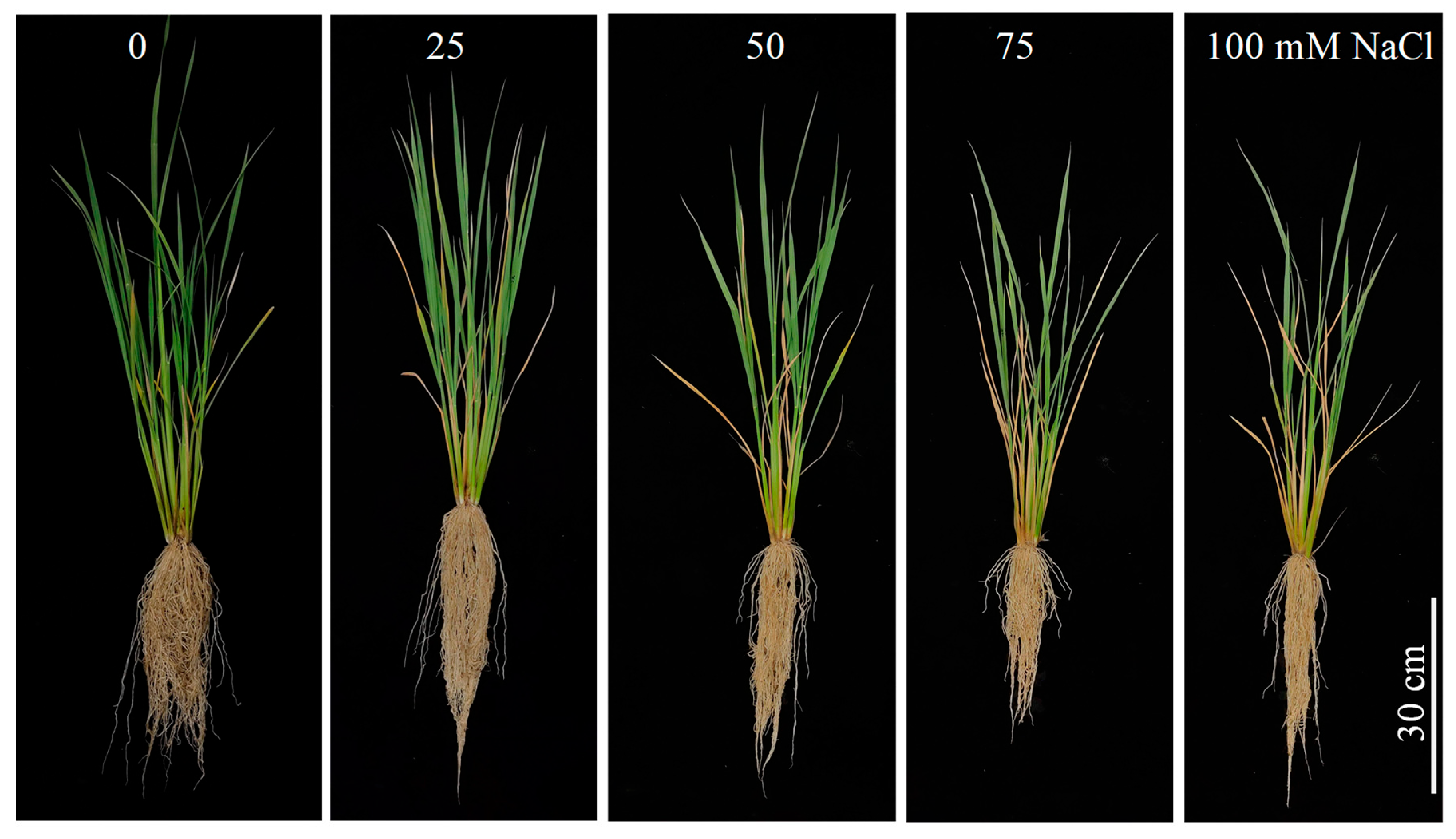
Prior to anatomical observations, seedlings subjected to higher salinity levels exhibited mild visual symptoms, including slight chlorosis and reduced growth, whereas no severe necrosis was observed (Figure 1). These observations are consistent with our previous report on the physiological responses of this cultivar under salinity stress [16]. The anatomical characteristics described below were therefore examined to further elucidate structural adaptations associated with these responses.
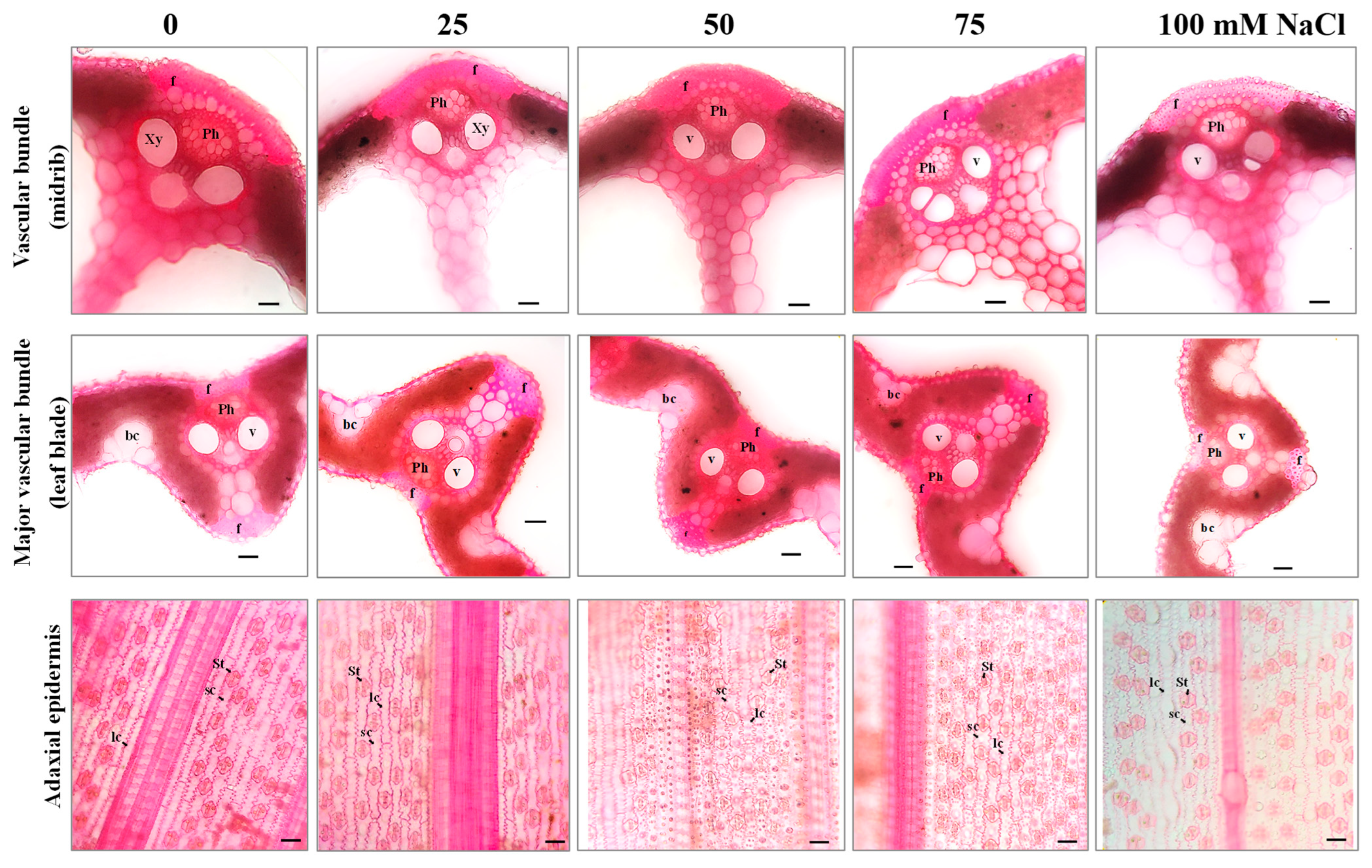
Leaf anatomical characteristics of the rice cultivar Tubtim Chumphae grown under different salinity levels were investigated. All treatments exhibited a similar fundamental anatomical organization. Leaves were amphistomatic, bearing stomata on both adaxial and abaxial surfaces. The epidermis comprised both long and short cells, the mesophyll was homogeneous, and vascular bundles were surrounded by parenchymatous bundle sheath cells (Figure 2). Despite the conserved structural pattern, quantitative anatomical traits varied among treatments, including the control and plants exposed to NaCl concentrations of 25 mM (S25), 50 mM (S50), 75 mM (S75), and 100 mM (S100) (Table 1). Average data as mean with standard error of anatomical characteristics analyzed using Kruskal–Wallis test was exhibited in Table 1, while an overview of anatomical variation across salinity treatments is presented in Appendix A Table A1, which summarizes descriptive statistics (range, mean ± SD, and median) for all measured variables. Several anatomical traits, including epidermal cell dimensions, vascular bundle components, and stomatal characteristics, exhibited variation among treatments, with multiple parameters showing statistically significant differences based on the Kruskal–Wallis test (**).
Overall, several anatomical variables showed pronounced responses to salinity, including Epi-VL-LC, MVB-la-HL, MVB-mid-HL, MVB-mid-VL, St-HL, St-VL, and StD, indicating significant effects on vertical epidermal cell size, vascular bundle dimensions, and stomatal traits (p < 0.01) (Table 1). In contrast, parameters such as horizontal epidermal cell width and certain phloem measurements exhibited non-significant trends. Epi-VL-LC differed significantly among treatments, with the highest values observed under S100, whereas S25 and S75 showed markedly reduced values and S50 displayed intermediate values. Vascular bundle size also varied significantly, particularly in the midrib, where control plants exhibited the largest dimensions compared with all salinity treatments, suggesting a strong inhibitory effect of salinity on vascular development. Stomatal traits showed coordinated responses: stomatal size was generally reduced under moderate salinity (especially S75), whereas stomatal density increased, with the highest values at S75 and the lowest in the control. Several other variables showed overlapping distributions among treatments, likely due to high within-group variability and relatively large standard deviations, which broadened confidence intervals of the means. Collectively, the descriptive statistics indicate that salinity markedly alters rice leaf anatomy in three major components: epidermal structure (particularly Epi-VL-LC), vascular bundle architecture, and stomatal size and density. These significant traits therefore represent potential candidate anatomical biomarkers for evaluating salinity responses in the Tubtim Chumphae rice cultivar and were subsequently used in multivariate analyses to confirm group discrimination and identify key variables contributing to salinity classification.

2.2. Multivariate Analysis

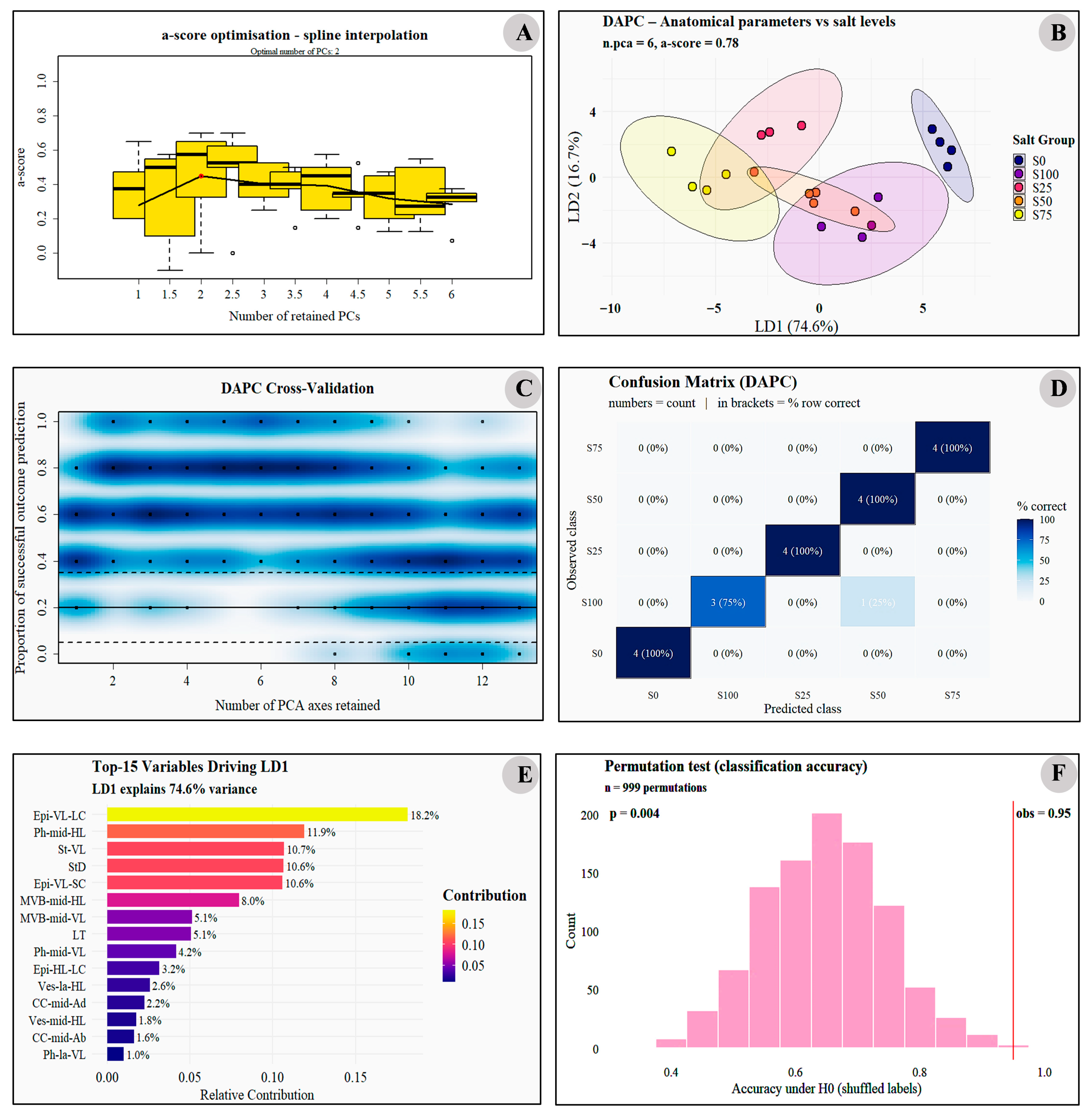
This integrative multivariate framework enabled the selection of candidate rice leaf anatomical biomarkers associated with salinity responses. DAPC results revealed clear and efficient separation among salinity treatments (Figure 3). The a-score indicated strong model performance with minimal overfitting and guided the selection of the optimal number of principal components. Two principal components provided the highest a-score based on the optimization curve (Figure 3A), enabling effective dimensionality reduction and group discrimination. However, cross-validation analysis indicated that retaining six principal components yielded a reliable a-score of 0.78. The resulting scatterplot demonstrated distinct clustering of samples according to salinity levels (Figure 3B). Using six retained PCA axes, DAPC achieved clear group separation, with the first two linear discriminants (LD1 and LD2) explaining 74.6% and 16.7% of the variance, respectively (Figure 3B,C), significantly discriminating among S0, S25, S50, S75, and S100 treatments. Leave-one-out cross-validation further indicated high predictive performance, with classification accuracy reaching approximately 95% when retaining 2–6 PCA axes, demonstrating consistent and robust model performance (Figure 3C). Evaluation of the classification model using a confusion matrix (Figure 3D) showed that prediction accuracy for the S0, S25, S50, and S75 salinity groups reached 100%. In contrast, accuracy for the S100 group decreased to 75%, likely due to overlap in several anatomical variables with the S25 group, resulting in partial misclassification. Nevertheless, no severe cross-group misprediction was observed, and the model maintained consistently high precision and specificity across all classes.
Analysis of variable contributions to the first linear discriminant (LD1), which explained 74.6% of the total variance, identified the most influential traits as epidermal cell size (vertical length–long cell; Epi-VL-LC, 18.2%), phloem size (horizontal length; Ph-HL, 11.9%), stomatal size (vertical length; St-VL, 10.7%), stomatal density (StD, 10.6%), and epidermal cell size (vertical length–short cell; Epi-VL-SC, 10.6%) (Figure 3E). These traits are closely associated with key structural and physiological features of rice leaves, including cell wall and cuticle characteristics, stomatal dimensions and density, and the vascular bundle architecture along the midrib. Therefore, these variables may serve as effective candidate anatomical biomarkers for assessing rice responses to salinity stress. Permutation testing further confirmed that the DAPC model performed significantly better than random classification (p = 0.004 < 0.05). Under the null hypothesis that leaf anatomical traits are unrelated to salinity levels, the probability of achieving very high accuracy (accuracy ≥ 0.95) by chance alone was only 0.4%. This result indicates that the high classification accuracy of the DAPC model is unlikely to be due to random effects and instead reflects genuine discriminatory signals in rice leaf anatomical data for predicting salinity stress levels (Figure 3F).
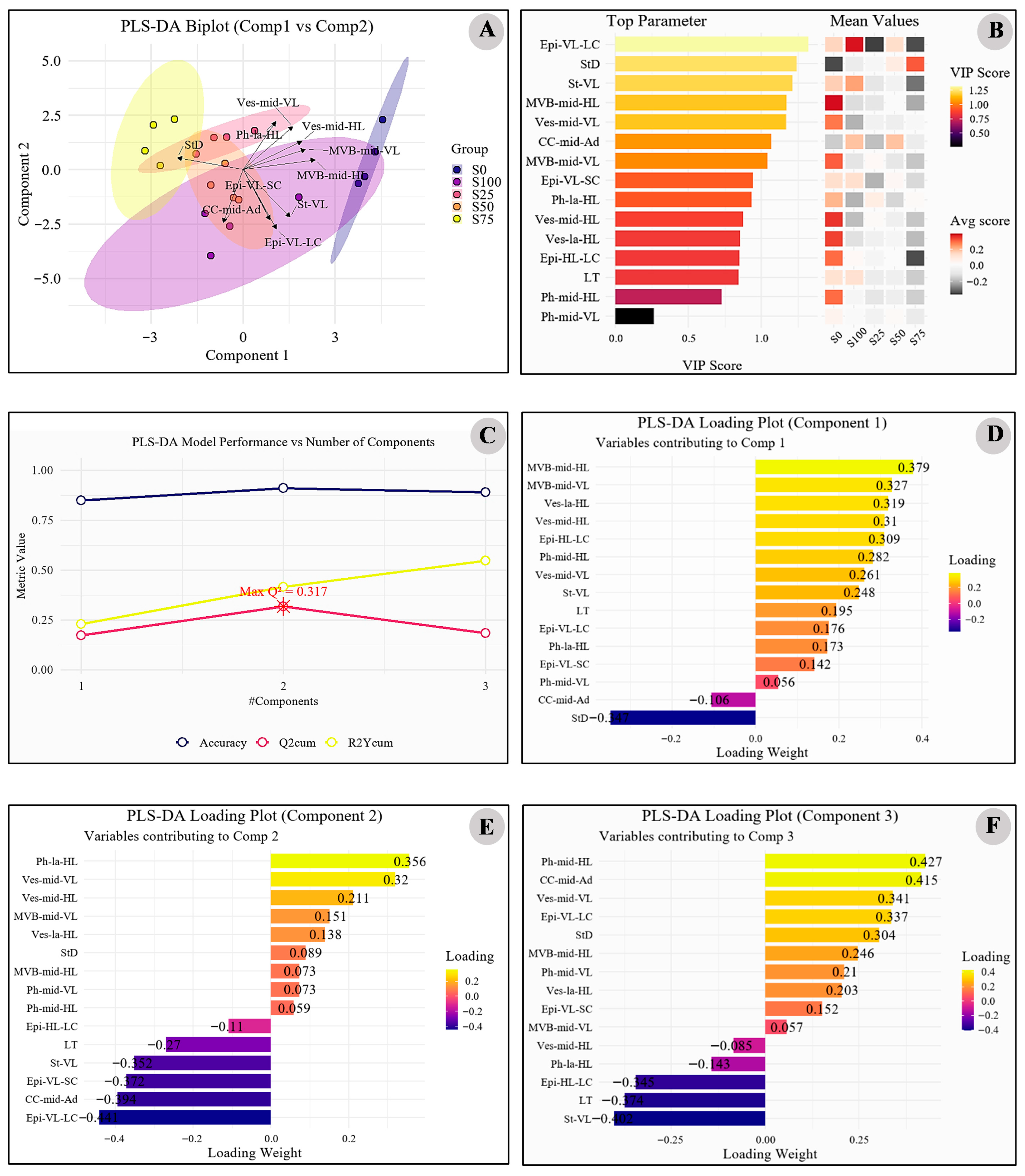
Partial Least Squares Discriminant Analysis (PLS-DA) was performed to identify salinity tolerance potential across the S0, S25, S50, S75, and S100 treatments (Figure 4A–E). Overall, several rice leaf anatomical traits exhibited Variable Importance in Projection (VIP) scores greater than 1, indicating their suitability as crucial candidate anatomical biomarkers of salinity response. These included epidermal cell size (vertical length–long cell; Epi-VL-LC), stomatal density (StD), stomatal size (vertical length; St-VL), major vascular bundle size at the midrib (horizontal length; MVB-mid-HL), vessel cell size at the midrib (vertical length; Ves-mid-VL), and cuticle and cell wall thickness at the adaxial midrib region (CC-mid-Ad) (Figure 4B). Collectively, these traits effectively discriminated the salinity tolerance capacity of Tubtim Chumphae rice, particularly under high salinity levels (S75 and S100), which exhibited pronounced anatomical divergence compared with the control (Figure 3E). Model performance evaluation indicated that the two-component PLS-DA model achieved the highest classification accuracy (~0.86) and the highest cumulative predictive ability (Q2cum = 0.317), values considered acceptable for modeling complex anatomical datasets within a salt-tolerant rice genotype. Six anatomical traits showed VIP scores exceeding 1 and were therefore identified as key salinity-responsive anatomical indicators: Epi-VL-LC (VIP ≈ 1.31), StD (VIP ≈ 1.25), St-VL (VIP ≈ 1.21), MVB-mid-HL (VIP ≈ 1.16), Ves-mid-VL (VIP ≈ 1.13), and CC-mid-Ad (VIP ≈ 1.09) (Figure 4B). These traits highlight strong associations between leaf anatomical structure and salinity adaptation mechanisms, particularly modifications in vascular architecture and stomatal traits that influence transpiration regulation and internal transport processes.
Biplot analysis further revealed distinct relationships between treatment groups and anatomical variables. The control group (S0) showed negative associations with StD and CC-mid-Ad, whereas the S100 group was positively associated with Epi-VL-LC, St-VL, and Ph-HL, consistent with adaptive structural adjustments involving enlargement of stomatal and phloem dimensions as well as modifications in stomatal density and cuticle thickness to mitigate salinity stress. Intermediate treatments (S25–S75) exhibited a progressive shift along the salinity gradient, with the S75 group showing pronounced separation along Component 2 (Figure 4A), suggesting a sequential and directional anatomical response to increasing salinity. Loading analysis of Components 1–3 (Figure 4D–F) indicated that Component 1 was strongly and positively influenced by MVB-mid-HL, MVB-mid-VL, and Ves-la-HL, whereas Component 2 showed the strongest positive loadings for Ph-HL and Ves-mid-VL but negative loadings for Epi-VL-LC and CC-mid-Ad. Component 3 also displayed strong positive contributions from Ph-HL, CC-mid-Ad, and Ves-mid-VL. These findings suggest that phloem-related structures and mesophyll-associated tissues play central roles in explaining anatomical variation and may reflect key mechanisms underlying rice leaf adaptation to salinity stress.

3. Discussion

The present study demonstrates that several leaf anatomical traits of Tubtim Chumphae rice vary significantly across salinity levels, particularly those associated with the epidermis (Epi-VL-LC), stomatal characteristics (St-HL, St-VL, StD), and vascular bundles (MVB-la-HL, MVB-mid-HL, MVB-mid-VL). These three anatomical domains—epidermis, stomata, and vascular tissues—are functionally linked to water homeostasis, gas exchange, and internal transport, which are critical processes governing plant performance under salt stress [1]. Their coordinated modification therefore suggests an integrated structural response of rice leaves to salinity.
Among these traits, the vertical length of long epidermal cells (Epi-VL-LC) showed pronounced variation among salinity treatments, indicating that epidermal tissues are highly responsive to salt intensity. Epidermal cell size decreased under low to moderate salinity but markedly increased under severe salinity (S100), revealing a biphasic response pattern. The reduction in cell size at lower stress levels likely reflects inhibition of cell expansion due to decreased turgor pressure and constrained cell wall extensibility [18,19], representing an adaptive adjustment to limit leaf surface area and water loss. In contrast, the enlargement of epidermal cells under severe salinity may indicate stress-induced structural disruption associated with ion toxicity, osmotic imbalance, and loss of cellular homeostasis [20], resulting in abnormal swelling rather than normal growth [19]. Such a shift from controlled acclimation to damage-related anatomical alteration suggests a transition from adaptive to maladaptive responses as stress severity increases.
This biphasic response is consistent with previous reports describing reduced cell expansion under moderate salt stress and excessive growth or tissue injury under severe conditions in rice and other cereal crops. Similar patterns have been documented in colored rice cultivars and salt-sensitive species, where moderate salinity restricts growth processes while extreme salinity induces structural abnormalities and cellular damage [21,22,23]. Collectively, these findings highlight the epidermis as a sensitive anatomical indicator of salinity stress and underscore the importance of structural plasticity in mediating rice adaptation to saline environments.
Regarding stomatal traits, stomatal size (St-HL and St-VL) was relatively large across most treatments, except under S75 salinity, whereas stomatal density (StD) reached its maximum at S75 and was lowest in the control. This pattern suggests that although stomata under S75 were smaller in size, they occurred at the highest density, suggesting that Tubtim Chumphae rice may exhibit optimal structural acclimation at this salinity level. However, exposure to more severe salinity appeared to negatively affect stomatal size, implying that excessive salt stress may impair normal stomatal development. Such adjustments may reflect a functional trade-off between water conservation and gas exchange [24]. In general, smaller and more numerous stomata can respond more rapidly to environmental stress and enhance the efficiency of transpiration control [25], whereas larger but fewer stomata facilitate higher gas exchange capacity but increase the risk of water loss [26]. The inverse relationship observed between stomatal size and density is a well-documented adaptive feature in rice and has been reported to play a crucial role in tolerance to environmental stresses, including salinity [27,28,29]. Therefore, the S75 treatment may represent a threshold at which stomatal structural optimization maximizes regulatory efficiency under salt stress before detrimental effects become dominant at higher salinity. In contrast, several traits that did not show statistical significance—such as bulliform cell number (BCN) and variables related to cuticle and cell wall thickness (CC-la-Ab, CC-la-Ad, CC-mid-Ab, CC-mid-Ad)—exhibited substantial overlap in mean and median values among treatments, together with relatively high within-group variability. Elevated SD and SE values in some salinity levels likely reduced statistical power, thereby obscuring potential differences among groups. Consequently, these traits may function as supportive or secondary indicators contributing to the overall pattern of salinity response rather than as primary discriminative candidate anatomical biomarkers, particularly when compared with traits that exhibited clear statistical significance. It should be noted that these interpretations are inferred from anatomical observations and supported by previous studies, as physiological parameters such as gas exchange and water balance were not directly measured in the present study.
The present study revealed pronounced differences in vascular bundle size in both the leaf blade and midrib regions. The major vascular bundles in the leaf blade (MVB-la-HL) exhibited the largest mean size in the control group (18.00 ± 0.00), followed by a progressive reduction under salinity treatments (e.g., S25 = 16.40 ± 0.80; S100 = 14.50 ± 1.15). Similarly, vascular bundles in the midrib (MVB-mid-HL and MVB-mid-VL) were substantially larger in the control group compared with salt-treated plants. These findings indicate that midrib vascular architecture is particularly sensitive to salinity stress and may serve as a key anatomical indicator for discriminating against salt levels.
The reduction in vascular bundle size under saline conditions likely reflects structural adjustments associated with impaired hydraulic conductivity and assimilation transport [30]. The midrib functions as the principal conduit for water and nutrient distribution within the leaf [31,32]; thus, its anatomical modification under salinity may represent a protective response to osmotic stress and ion toxicity [33]. This interpretation is consistent with previous reports showing that the size and organization of major vascular bundles and phloem-associated tissues in rice leaves are altered under salt stress (e.g., 100 mM NaCl) compared with non-stressed controls [22]. Moreover, changes in vascular bundle dimensions may be linked to limitations in water transport caused by embolism or cavitation formation within xylem vessels under saline conditions. Such hydraulic failure can induce secondary structural modifications in vascular tissues as plants attempt to maintain water balance and transport efficiency [34]. Therefore, the observed anatomical alterations in vascular bundles likely represent an integrated response to both osmotic and hydraulic constraints imposed by salinity stress. It should be noted that although free-hand sectioning may introduce some degree of variability compared to resin-embedded samples, careful selection of well-preserved sections and consistent sample handling were applied to minimize potential artifacts. Therefore, the observed differences among treatments are considered to reflect true biological variation rather than methodological bias.
The DAPC results demonstrated a clear separation of samples across salinity levels (S0–S100), with LD1 and LD2 explaining the majority of total variance (74.6% and 16.7%, respectively). This finding indicates that leaf anatomical traits of Tubtim Chumphae rice change in a structured and salinity-dependent manner rather than reflecting random variation. The high predictive accuracy obtained from leave-one-out cross-validation (approximately 95% with retention of 2–6 PCA axes) suggests strong model generalizability and supports the appropriateness of the selected number of retained components for dimensionality reduction without substantial loss of biological signal. This methodological approach aligns with current recommendations for DAPC, which emphasize controlling overfitting through careful selection of retained axes and validation of classification stability via cross-validation [35]. Furthermore, the permutation test yielded a very low probability under the null hypothesis of no association (p = 0.004), providing robust statistical evidence that the observed group separation did not arise by chance. Therefore, it is reasonable to conclude that rice leaf anatomical traits are strongly associated with salinity levels and hold predictive potential for classifying salt tolerance in Tubtim Chumphae rice.
Despite the overall high classification performance, prediction accuracy for the S100 group declined to 75%, with partial misclassification toward the S25 group. This pattern has important biological implications, suggesting that anatomical responses to salinity may not follow a strictly linear trajectory. Certain traits may respond rapidly under mild stress but subsequently plateau or become disrupted under severe stress. As a result, some anatomical characteristics in the S100 group may converge toward those observed under lower salinity (S25), particularly traits closely linked to physiological regulation. However, under severe salinity (S100), such convergence is more likely to reflect stress-induced damage rather than a transition to an alternative adaptive state. This interpretation is supported by previous findings in the same cultivar, where elevated malondialdehyde (MDA) content and electrolyte leakage were observed under S100, indicating oxidative damage and loss of membrane integrity [16]. Similar non-linear anatomical responses under high salinity have also been reported in rice leaves, particularly in vascular bundle organization and leaf structure [33].
Stomatal traits exhibit considerable plasticity, adjusting both size and density to optimize the balance between transpiration control and CO2 uptake under stress conditions [27]. In addition, salinity imposes both osmotic and ionic stress, which disrupts water relations and cellular metabolism. Plants may therefore deploy multiple coordinated responses, including reduced transpiration via stomatal and cuticular adjustments and modification of vascular transport capacity in the midrib to maintain water, mineral, and photoassimilate transport [1]. Collectively, these findings reinforce the view that salt tolerance in rice is governed by a multifactorial response involving integrated anatomical, physiological, and hydraulic adjustments rather than any single determinant trait.
Analysis of variable contributions to the first linear discriminant axis (LD1) identified Epi-VL-LC, Ph-HL, St-VL, StD, and Epi-VL-SC as the most influential traits underlying salinity responses in this study. These variables can be functionally grouped into three major categories: leaf surface protection, transpiration regulation, and vascular transport capacity. First, the leaf surface protection group comprises epidermal tissue traits, particularly the size of long and short epidermal cells (Epi-VL-LC and Epi-VL-SC). Anatomical modifications in this category are closely associated with reducing non-stomatal water loss and enhancing tolerance to dehydration and salinity-induced declines in water potential [36]. Previous studies on cuticular metabolism emphasize that adjustment of cuticle composition is a key structural strategy enabling plants to withstand physical stresses, including salinity [37]. Molecular evidence further indicates that regulation of cuticular wax biosynthesis is directly linked to salt tolerance, highlighting epidermal characteristics as critical anatomical determinants of stress adaptation [38,39]. Second, the transpiration regulation group includes stomatal size and density (St-VL and StD), traits that exhibit substantial plasticity under stress conditions. Because stomata serve as the primary gateway controlling water vapor flux and CO2 uptake, modulation of stomatal dimensions and density represents a central mechanism by which plants maintain water balance while sustaining photosynthetic performance under salinity stress [36]. Third, the vascular transport group encompasses phloem size (Ph-HL) and related vascular traits identified in the PLS-DA analysis, including major vascular bundle size (MVB-mid-HL) and vessel dimensions in the midrib (Ves-mid-VL). Structural adjustments in these tissues likely enhance hydraulic conductivity and assimilate transport, thereby supporting survival under high salinity conditions. Such vascular reinforcement has been reported as a common adaptive feature among salt-tolerant plant species [40]. In rice, variation in leaf and vein anatomical traits has also been proposed as a useful biomarker-based criterion for selecting salt-tolerant genotypes in breeding programs [41].
In this study, biomarker validation and selection based on leaf anatomical traits of the Tubtim Chumphae rice cultivar using a VIP score threshold (>1) identified several key features, including Epi-VL-LC, StD, St-VL, MVB-mid-VL, MVB-mid-HL, and Ves-mid-VL. The consistency of these variables with the results obtained from the DAPC analysis further strengthens their reliability as candidate anatomical biomarkers. Collectively, these findings indicate that the detected anatomical signatures reflect genuine salinity responses in Tubtim Chumphae rice rather than analytical artifacts. This conclusion is particularly supported by the S75 and S100 treatments, in which multiple anatomical parameters exhibited pronounced deviations from the control group, highlighting stress-intensity-dependent structural adjustments.
The PLS-DA analysis further demonstrated that a two-component model achieved the highest predictive performance (accuracy ≈ 0.86; Q2cum ≈ 0.317), indicating an acceptable level of predictive capacity despite the complexity of the biological dataset, which comprised multiple interrelated variables and a limited sample size. In biological studies, especially those involving high-dimensional traits with shared underlying signals and substantial within-group variability (biological heterogeneity), moderate Q2 values are commonly observed and do not necessarily imply poor model performance. This perspective aligns with machine learning and omics research emphasizing that dimensionality reduction and variable selection should prioritize model generalizability while minimizing the risk of overfitting, particularly when sample sizes are constrained [42,43].
The sequential response pattern and its biological interpretation derived from the biplot analysis in this study indicate that rice plants exposed to salinity levels of S25–S75 exhibited a gradual acclimation process. Notably, the S75 group showed a pronounced distribution along Component 2, suggesting that certain leaf anatomical traits began to shift under mild salt stress and accumulated progressively as salinity intensified, reflecting a process of progressive anatomical acclimation. This pattern of change supports the concept that leaf adaptation to salinity is not confined to two-dimensional adjustments (e.g., adaxial–abaxial or longitudinal–transverse axes), but also involves modifications in leaf thickness and internal structural organization in response to salt stress [44]. Furthermore, such anatomical adjustments are closely associated with physiological performance, particularly gas exchange capacity and light-use efficiency [38].
The current results indicated that rice plants exposed to salinity at the S75 level were predominantly distributed along Component 2, suggesting that this salinity level may be optimal for anatomical screening using multivariate approaches. At S75, structural acclimation signals were clearly detectable while maintaining strong discriminatory power among groups. In contrast, the highest salinity level (S100) showed partial overlap with lower salinity groups for certain traits, possibly reflecting nonlinear stress responses or increased within-group variability. Therefore, employing S75 as a screening level and S100 as an extreme validation level could enhance experimental efficiency and improve the reliability of candidate anatomical biomarker selection.
The roles of transpiration control and transport regulation were further elucidated by the loading patterns of Components 1–3. Component 1 was primarily driven by vascular-related traits, including MVB-mid-HL, MVB-mid-VL, and Ves-la-HL. Component 2 was positively associated with vascular parameters (Ph-HL and Ves-mid-VL) and negatively associated with traits related to the cuticle and epidermal tissues (Epi-VL-LC and CC-mid-Ad). Component 3 reflected combined contributions from vascular, cuticular, and epidermal features (Ph-HL, CC-mid-Ad, and Ves-mid-VL). Collectively, the PLS-DA analysis separated the transport-related axis from the cuticle–epidermal axis, consistent with established mechanisms of salt tolerance in plants, which require both minimizing water loss through transpiration control and maintaining efficient transport and ion/water homeostasis within leaves [1]. Structural changes involving stomata and vascular bundles are frequently invoked to explain the coordination between leaf structure and function under abiotic stresses, including drought [14,36] and salinity [40].

4. Materials and Methods

4.1. Plant Materials and Salinity Stress Treatment

Well-filled and visually uniform seeds of the rice cultivar ‘Tubtim Chumphae’, obtained from the Chumphae Rice Research Center, Thailand, were selected for the experiment. Seeds were soaked in distilled water for 24 h and subsequently germinated on moist filter paper in Petri dishes under dark conditions at room temperature for 48 h. Germinated seeds were then transplanted into seedling trays filled with peat moss and grown for 7 days before being transferred to 10-inch culture pots. Each pot contained 2 kg of a substrate composed of peat moss and semi-loamy clay soil at a 2:1 (v/v) ratio. Seedlings were irrigated daily for 35 days to ensure establishment, after which one plant per pot was subjected to salinity treatments. The plants were treated every other day for 4 weeks with 100 mL of NaCl (RCI Labscan, Bangkok, Thailand) solutions at different concentrations (0, 25, 50, 75, and 100 mM) instead of water. Seedlings were grown under natural light conditions in a greenhouse, with photosynthetically active radiation (PAR) estimated to fall within the typical range for nursery conditions (approximately 300–800 µmol m−2 s−1). The experiments were performed with a total of three repetitions for each treatment. The findings regarding growth, physiology, and biochemistry have been previously reported in Taratima et al. [16].

4.2. Anatomical Analysis

Anatomical analysis in this study was conducted using two techniques: free-hand sectioning and the peeling technique. Fully expanded leaves of ‘Tubtim Chumphae’ rice were collected from all five experimental groups. Leaves selected for analysis were mature but neither too young nor senescent. At least three biological replicates were sampled, with one leaf per replicate. Leaf blades approximately 25–30 cm in length were selected, and both the basal and apical portions were removed to obtain an approximately 8-cm segment from the middle region of the leaf. This method was modified from Zhang et al. [8]. Samples were immediately fixed in 70% ethanol (RCI Labscan, Bangkok, Thailand), which provided sufficient preservation of cellular and tissue structure for anatomical observation.
Leaf segments were then transversely sectioned using the free-hand technique, focusing on two regions: the midrib and the lamina. Free-hand sectioning was used for rapid sample preparation while minimizing potential structural alterations from fixation and embedding. To ensure reliability, multiple sections per sample were examined, and only well-preserved sections with clear cellular structures were selected. All samples were processed under identical conditions to ensure valid comparisons among treatments. Sections were stained with 1% safranin (Sigma-Aldrich, Burlington, MA, USA) prepared in 95% ethanol for 4 min, followed by dehydration through an ethanol series of 70%, 90%, 95%, and 100%, each for 3 min. Samples were subsequently immersed in a 1:1 mixture of absolute ethanol and xylene (Merck, Darmstadt, Germany) for 5 min, cleared in xylene twice for 3–5 min each, and finally mounted on slides using DePeX (Merck, Darmstadt, Germany) mounting medium [45].
The epidermis was isolated using the peeling method. Leaf samples previously fixed in 70% ethanol were immersed in 15% sodium hypochlorite solution (commercial Clorox, Oakland, CA, USA) for 24 h until the tissues became decolorized. The epidermis was then obtained by gently scraping away the unwanted epidermis and mesophyll tissues with a razor blade until only the desired side epidermal layer remained. The peeled tissues were rinsed three times with distilled water for 5 min each to remove residual sodium hypochlorite. The cleaned epidermal tissues were placed on glass slides and stained with 1% safranin prepared in 95% ethanol for 4 min, followed by dehydration through an ethanol series of 70%, 90%, 95%, and 100%, each for 3 min. Samples were subsequently immersed in a 1:1 mixture of absolute ethanol and xylene for 5 min, cleared in xylene twice for 3–5 min each, and permanently mounted using DePeX mounting medium.
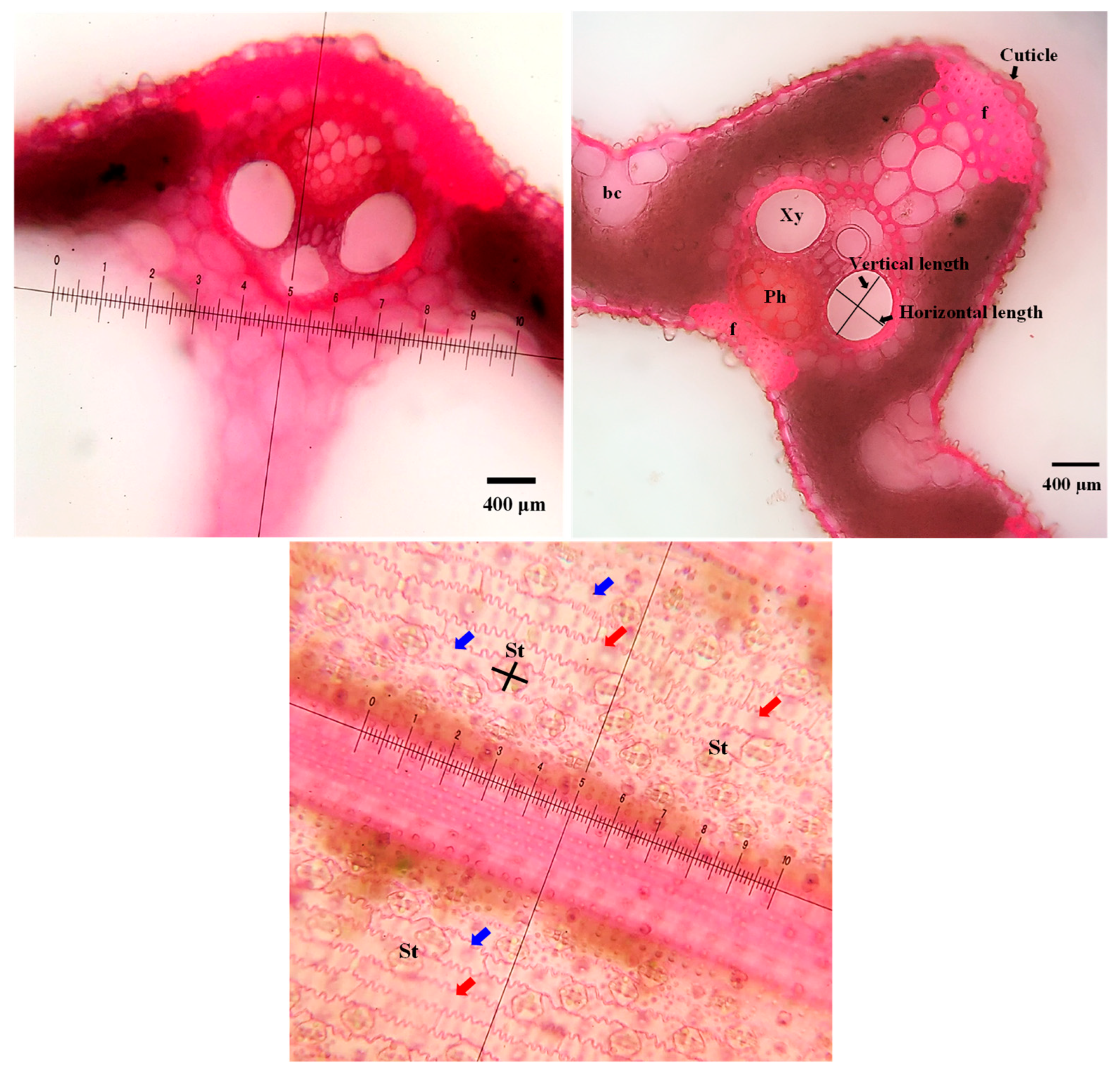
All permanent slides were examined to investigate leaf anatomical characteristics using a light microscope (Olympus CH30, Olympus Corporation, Tokyo, Japan). A total of 27 anatomical traits were measured from transverse sections and epidermal tissues, including bulliform cell number (BCN); cuticle and cell wall thickness at the midrib (adaxial: CC-mid-Ad; abaxial: CC-mid-Ab) and lamina (adaxial: CC-la-Ad; abaxial: CC-la-Ab); epidermal long and short cell dimensions (horizontal length: Epi-HL-LC, Epi-HL-SC; vertical length: Epi-VL-LC, Epi-VL-SC); leaf thickness (LT); major vascular bundle size in the lamina (horizontal length: MVB-la-HL; vertical length: MVB-la-VL; fiber length: MVB-la-F) and midrib (fiber length: MVB-mid-F; horizontal length: MVB-mid-HL; vertical length: MVB-mid-VL); phloem size in the midrib (horizontal length: Ph-mid-HL; vertical length: Ph-mid-VL) and lamina (Ph-la-HL; Ph-la-VL); stomatal size (horizontal length: St-HL; vertical length: St-VL) and stomatal density (StD); and vessel size in the midrib (Ves-mid-HL; Ves-mid-VL) and lamina (Ves-la-HL; Ves-la-VL) [14,46,47,48]. Cells and tissues were photographed from the permanent slides using the Olympus CH30 light microscope equipped with a Zeiss digital camera. Images were captured under standardized conditions, and scale calibration in micrometers was performed using the MB2004 configuration–AxioVision software version 4.8 (Carl Zeiss, Oberkochen, Germany). The micromorphometric measurements are illustrated in Appendix A Figure A1. Micromorphometric measurements of anatomical traits were performed under a light microscope using an ocular micrometer. The ocular scale was calibrated at each magnification with a stage micrometer, and all measurements were recorded in micrometers (µm).

4.3. Data Analysis

Comparisons of median values of leaf anatomical traits among salinity treatments (S0, S25, S50, S75, and S100) were conducted using the nonparametric Kruskal–Wallis test, with a significance threshold of p < 0.01. The Kruskal–Wallis test was used to assess overall differences among salinity groups. Post hoc pairwise comparisons were not performed, as the primary objective of this study was to evaluate overall variation and multivariate patterns across treatments using DAPC and PLS-DA. Multivariate analyses were performed using Discriminant Analysis of Principal Components (DAPC) and Partial Least Squares Discriminant Analysis (PLS-DA). DAPC was used to classify samples according to salinity levels and to assess group separation, with model robustness evaluated by cross-validation and permutation tests. PLS-DA was subsequently applied to confirm classification patterns and to identify the anatomical traits contributing most strongly to group discrimination based on variable importance in projection (VIP) scores. All analyses were implemented in R (version 4.3.3) within the RStudio interface (version 2023.12.1).

5. Conclusions

This study demonstrates that multivariate analysis using DAPC of leaf anatomical traits in ‘Tubtim Chumphae’ rice can effectively discriminate among salinity tolerance levels, with high classification performance across treatments. The complementary PLS-DA analysis further supported these findings by identifying key contributing variables based on VIP scores. Key anatomical traits associated with salinity responses included epidermal cell dimensions, cell wall and cuticle thickness, stomatal size and density, and vascular bundle dimensions. For instance, stomatal density reached its maximum at S75, whereas classification accuracy declined to 75% at S100, indicating structural disruption under severe salinity. These features may therefore serve as candidate anatomical biomarkers for assessing salt-stress responses and tolerance potential in this cultivar. The results suggest that S75 represents an appropriate screening level, while S100 may serve as an extreme stress condition for validation. The knowledge gained from this study may support cultivation planning of ‘Tubtim Chumphae’ rice in saline soils with varying salinity levels. It should be noted that this study was conducted on a single rice cultivar. Given the genetic diversity among rice varieties, anatomical responses to salinity may vary considerably. Therefore, these findings should not be generalized to all cultivars, and further research involving multiple genotypes with contrasting salinity tolerance, together with physiological validation, is recommended.

Author Contributions

Conceptualization, C.M., N.K. and W.T.; methodology, C.M., N.K., P.M. and W.T.; software, P.M.; validation, C.M., N.K. and W.T.; formal analysis, P.M. and W.T.; investigation, C.M., P.M. and W.T.; data curation, C.M., N.K., P.M. and W.T.; writing—original draft preparation, C.M. and W.T.; writing—review and editing, C.M. and W.T.; supervision, C.M.; funding acquisition, C.M. and N.K. All authors have read and agreed to the published version of the manuscript.

Funding

This research was financially supported by the Faculty of Science, Naresuan University (R2569E009).

Institutional Review Board Statement

Not applicable.

Informed Consent Statement

Not applicable.

Data Availability Statement

The raw data supporting the conclusions of this article will be made available by the authors on request.

Acknowledgments

The authors gratefully acknowledge the Salt-tolerant Rice Research Group, Department of Biology, Faculty of Science, Khon Kaen University, Thailand, for providing plant materials. The authors also thank the Department of Biology, Faculty of Science, Naresuan University, for their support in providing research facilities.

Conflicts of Interest

The authors declare no conflicts of interest.

Abbreviations

The following abbreviations are used in this manuscript:
LTLeaf thickness
Epi-HL-LCEpidermal long cell (horizontal length)
Epi-HL-SCEpidermal short cell (horizontal length)
Epi-VL-LCEpidermal long cell (vertical length)
Epi-VL-SCEpidermal short cell (vertical length)
CC-la-AdCuticle & cell wall thickness (lamina-adaxial)
CC-la-AbCuticle & cell wall thickness (lamina-abaxial)
CC-mid-AdCuticle & cell wall thickness (midrib-adaxial)
CC-mid-AbCuticle & cell wall thickness (midrib-abaxial)
BCNBulliform cell number
MVB-la-FMajor vascular bundle (lamina-fiber length)
MVB-la-HLMajor vascular bundle (lamina-horizontal length)
MVB-la-VLMajor vascular bundle (lamina-vertical length)
MVB-mid-FMajor vascular bundle (midrib-fiber length)
MVB-mid-HLMajor vascular bundle (midrib-horizontal length)
MVB-mid-VLMajor vascular bundle (midrib-vertical length)
Ph-la-HLPhloem (lamina-horizontal length)
Ph-la-VLPhloem (lamina-vertical length)
Ph-mid-HLPhloem (midrib-horizontal length)
Ph-mid-VLPhloem (midrib-vertical length)
Ves-la-HLVessel (lamina-horizontal length)
Ves-la-VLVessel (lamina-vertical length)
Ves-mid-HLVessel (midrib-horizontal length)
Ves-mid-VLVessel (midrib-vertical length)
St-HLStomatal size (horizontal length)
St-VLStomatal size (vertical length)
StDStomatal density

Appendix A

This appendix contains descriptive statistics and results of the Kruskal–Wallis test for all measured leaf anatomical variables across salinity treatments in rice cultivar ‘Tubtim Chumphae’.
Table A1. Descriptive statistics of leaf anatomical variables and Kruskal–Wallis test results comparing median values among salinity treatments in rice cultivar ‘Tubtim Chumphae’.
Variable (um)IndicesControlS25S50S75S100Chi Squaredp-Value
BCNMin4.004.005.005.004.0013.06-
Max4.005.005.005.005.00
Mean ± SD4.00 ± 0.004.25 ± 0.505.00 ± 0.005.00 ± 0.004.75 ± 0.50
Mean ± SE4.00 ± 0.004.25 ± 0.255.00 ± 0.005.00 ± 0.004.75 ± 0.25
Median4.004.005.005.005.00
CC-la-AbMin0.800.800.801.201.203.97-
Max2.001.601.601.602.00
Mean ± SD1.50 ± 0.601.20 ± 0.331.20 ± 0.331.50 ± 0.201.60 ± 0.33
Mean ± SE1.50 ± 0.301.20 ± 0.161.20 ± 0.161.50 ± 0.101.60 ± 0.16
Median1.601.201.201.601.60
CC-la-AdMin1.201.600.801.201.207.87-
Max2.001.601.201.602.00
Mean ± SD1.60 ± 0.331.60 ± 0.001.10 ± 0.201.40 ± 0.231.50 ± 0.38
Mean ± SE1.60 ± 0.161.60 ± 0.001.10 ± 0.101.40 ± 0.121.50 ± 0.19
Median1.601.601.201.401.40
CC-mid-AbMin1.201.201.201.601.203.37-
Max2.001.602.002.001.60
Mean ± SD1.50 ± 0.381.50 ± 0.201.40 ± 0.401.70 ± 0.201.40 ± 0.23
Mean ± SE1.50 ± 0.191.50 ± 0.101.40 ± 0.201.70 ± 0.101.40 ± 0.12
Median1.401.601.201.601.40
CC-mid-AdMin1.601.201.601.601.607.42-
Max1.602.002.402.002.40
Mean ± SD1.60 ± 0.001.60 ± 0.332.00 ± 0.331.70 ± 0.202.00 ± 0.33
Mean ± SE1.60 ± 0.001.60 ± 0.162.00 ± 0.161.70 ± 0.102.00 ± 0.16
Median1.601.602.001.602.00
Epi-HL-LCMin14.3011.2010.408.6011.1010.12-
Max17.0013.6016.0011.8015.00
Mean ± SD15.28 ± 1.2312.47 ± 0.9912.85 ± 2.3310.22 ± 1.7612.90 ± 1.61
Mean ± SE15.28 ± 0.6112.47 ± 0.5012.85 ± 1.1610.22 ± 0.8812.90 ± 0.81
Median14.9012.5512.5010.2512.75
Epi-HL-SCMin7.006.006.705.805.806.61-
Max7.608.107.307.007.60
Mean ± SD7.25 ± 0.307.22 ± 0.916.95 ± 0.266.33 ± 0.546.53 ± 0.77
Mean ± SE7.25 ± 0.157.22 ± 0.466.95 ± 0.136.33 ± 0.276.53 ± 0.39
Median7.207.406.906.256.35
Epi-VL-LCMin2.201.702.701.503.3014.83**
Max3.802.103.202.303.70
Mean ± SD2.98 ± 0.711.92 ± 0.172.88 ± 0.221.98 ± 0.343.50 ± 0.18
Mean ± SE2.98 ± 0.361.92 ± 0.092.88 ± 0.111.98 ± 0.173.50 ± 0.09
Median2.951.952.802.053.50
Epi-VL-SCMin2.602.002.502.202.606.34-
Max3.102.903.002.803.10
Mean ± SD2.88 ± 0.222.42 ± 0.402.73 ± 0.222.50 ± 0.292.88 ± 0.21
Mean ± SE2.88 ± 0.112.42 ± 0.202.73 ± 0.112.50 ± 0.152.88 ± 0.10
Median2.902.402.702.502.90
LTMin16.0016.0013.6014.8016.008.06-
Max20.0016.0017.6016.0018.00
Mean ± SD17.50 ± 1.9116.00 ± 0.0016.20 ± 1.7715.40 ± 0.6917.50 ± 1.00
Mean ± SE17.50 ± 0.9616.00 ± 0.0016.20 ± 0.8915.40 ± 0.3517.50 ± 0.50
Median17.0016.0016.8015.4018.00
MVB-la-FMin6.806.007.206.005.2010.61-
Max9.608.408.407.206.80
Mean ± SD8.10 ± 1.156.90 ± 1.057.60 ± 0.576.70 ± 0.505.90 ± 0.68
Mean ± SE8.10 ± 0.576.90 ± 0.537.60 ± 0.286.70 ± 0.255.90 ± 0.34
Median8.006.607.406.805.80
MVB-la-HLMin18.0015.2014.4015.2013.2013.76**
Max18.0016.8016.0016.0016.00
Mean ± SD18.00 ± 0.0016.40 ± 0.8015.30 ± 0.8215.40 ± 0.4014.50 ± 1.15
Mean ± SE18.00 ± 0.0016.40 ± 0.4015.30 ± 0.4115.40 ± 0.2014.50 ± 0.57
Median18.0016.8015.4015.2014.40
MVB-la-VLMin16.0012.0013.2012.8012.0010.04-
Max18.0016.8014.8014.8014.40
Mean ± SD16.50 ± 1.0014.20 ± 2.0813.60 ± 0.8013.40 ± 0.9512.80 ± 1.13
Mean ± SE16.50 ± 0.5014.20 ± 1.0413.60 ± 0.4013.40 ± 0.4812.80 ± 0.57
Median16.0014.0013.2013.0012.40
MVB-mid-FMin2.402.802.802.802.406.80-
Max3.203.604.002.804.00
Mean ± SD2.80 ± 0.333.20 ± 0.333.60 ± 0.572.80 ± 0.003.40 ± 0.77
Mean ± SE2.80 ± 0.163.20 ± 0.163.60 ± 0.282.80 ± 0.003.40 ± 0.38
Median2.803.203.802.803.60
Minimum, maximum, mean ± standard deviation, mean ± standard error and median of the 9 quantitative variables, with Kruskal–Wallis test results showing Chi-squared and p-value. **: p < 0.01. Abbreviations: BCN: Bulliform cell number, CC-mid-Ad: Cuticle & cell wall thickness (midrib; adaxial), CC-mid-Ab: Cuticle & cell wall thickness (midrib; abaxial), CC-la-Ad: Cuticle & cell wall thickness (lamina; adaxial), CC-la-Ab: Cuticle & cell wall thickness (lamina; abaxial), Epi-HL-LC: Epidermal long cell (horizontal length), Epi-HL-SC: Epidermal short cell (horizontal length), Epi-VL-LC: Epidermal long cell (vertical length), Epi-VL-SC: Epidermal short cell (vertical length), LT: Leaf thickness, MVB-la-HL: Major vascular bundle (midrib; horizontal length), MVB-la-VL: Major vascular bundle (midrib; vertical length), MVB-la-F: Major vascular bundle (lamina; fiber length), MVB-la-HL: Major vascular bundle (lamina; horizontal length), MVB-la-VL: Major vascular bundle (lamina; vertical length), MVB-mid-F: Major vascular bundle (midrib; fiber length).
Figure A1. Representative image illustrating the micromorphometric analysis and measurement of anatomical traits. Abbreviations: bc = bulliform cell; f = fiber; Xy = xylem; Ph = phloem; St = stomata. Red arrows indicate epidermal long cells, and blue arrows indicate epidermal short cells.
Stresses 06 00027 g0a1

References

  1. Sackey, O.K.; Feng, N.; Mohammed, Y.Z.; Dzou, C.F.; Zheng, D.; Zhao, L.; Shen, X. A comprehensive review on rice responses and tolerance to salt stress. Front. Plant Sci. 2025, 16, 1561280. [Google Scholar] [CrossRef]
  2. FAO. FAO launches first major global assessment of salt-affected soils in 50 years. In Food and Agriculture Organization of the United Nations; FAO: Rome, Italy, 2024; Available online: https://www.fao.org/newsroom/detail/fao-launches-first-major-global-assessment-of-salt-affected-soils-in-50-years/ (accessed on 20 January 2026).
  3. Pan, J.; Xue, X.; Huang, C.; You, Q.; Guo, P.; Yang, R.; Da, F.; Duan, Z.W.; Peng, F. Effect of salinization on soil properties and mechanisms beneficial to microorganisms in salinized soil remediation: A review. Res. Cold Arid Reg. 2024, 16, 121–128. [Google Scholar] [CrossRef]
  4. Hao, S.; Wang, Y.; Yan, Y.; Liu, Y.; Wang, J.; Chen, S. A review on plant responses to salt stress and their mechanisms of salt resistance. Horticulturae 2021, 7, 132. [Google Scholar] [CrossRef]
  5. Alché, J.D. A concise appraisal of lipid oxidation and lipoxidation in higher plants. Redox Biol. 2019, 23, 101136. [Google Scholar] [CrossRef]
  6. Aazami, M.A.; Rasouli, F.; Ebrahimzadeh, A. Oxidative damage, antioxidant mechanism and gene expression in tomato re sponding to salinity stress under in vitro conditions and application of iron and zinc oxide nanoparticles on callus induction and plant regeneration. BMC Plant Biol. 2021, 21, 597. [Google Scholar] [CrossRef] [PubMed]
  7. Azeem, M.; Pirjan, K.; Qasim, M.; Mahmood, A.; Javed, T.; Muhammad, H.; Yang, S.; Dong, R.; Ali, B.; Rahimi, M. Salinity stress improves antioxidant potential by modulating physio-biochemical responses in Moringa oleifera Lam. Sci. Rep. 2023, 13, 2895. [Google Scholar] [CrossRef] [PubMed]
  8. Zhang, R.; Wang, Y.; Wang, X.; Jiao, S.; Lu, Y.; Du, Y.; Zhang, W.; Kang, Y.; Liu, Y.; Qin, S. Differential responses of microstructure, antioxidant defense, and plant hormone signaling regulation in potato (Solanum tuberosum L.) under drought, alkaline salt, and combined stresses. Sci. Hortic. 2025, 341, 114014. [Google Scholar] [CrossRef]
  9. Acosta-Motos, J.R.; Ortuño, M.F.; Bernal-Vicente, A.; Diaz-Vivancos, P.; Sanchez-Blanco, M.J.; Hernandez, J.A. Plant responses to salt stress: Adaptive mechanisms. Agronomy 2017, 7, 18. [Google Scholar] [CrossRef]
  10. Aradea, B. Physiological and anatomy responses of plants to various abiotic stresses: A comprehensive review. J. Sci. Agrotechnol. 2025, 3, 11–28. [Google Scholar] [CrossRef]
  11. Liu, C.; Jiang, X.; Yuan, Z. Plant responses and adaptations to salt stress: A review. Horticulturae 2024, 10, 1221. [Google Scholar] [CrossRef]
  12. Othman, A.Y.; A’Saf, S.T.; Ayad, Y.J.; Al-Ajlouni, G.M. Comparative analysis of lily responses to elevated salinity in irrigation water: Effects on physiology, anatomy, and postharvest flower quality. Not. Bot. Horti Agrobot. Cluj-Napoca 2024, 52, 14102. [Google Scholar] [CrossRef]
  13. Srinang, P.; Khotasena, S.; Sanitchon, J.; Chankaew, S.; Jogloy, S.; Monkham, T. New source of rice with a low amylose content and slow in vitro digestion for improved health benefits. Agronomy 2023, 13, 2622. [Google Scholar] [CrossRef]
  14. Kunpratum, N.; Trunjaruen, A.; Kungla, C.; Maneerattanarungroj, P.; Mahatthanaphatcharakun, P.; Taratima, W. Physiological and anatomical adaptations of rice (Oryza sativa L.) grown under drought stress. Not. Bot. Horti Agrobot. Cluj-Napoca 2025, 53, 14060. [Google Scholar] [CrossRef]
  15. Kroeksakul, P.; Sutthisaksopon, P.; Ngamniyom, A.; Kanjanajongkol, P.; Chantagol, C. Unveiling soil salinity and heavy metal patterns in the Khorat Plateau, Thailand: Implications for sustainable development goals (SDGs) monitoring. Indones. J. Sci. Technol. 2025, 10, 469–486. [Google Scholar] [CrossRef]
  16. Taratima, W.; Chaisuwan, S.; Plaikhuntod, K.; Maneerattanarungroj, P.; Kunpratum, N.; Trunjaruen, A. Salinity tolerance evaluation of rice (Oryza sativa L.) ‘Tubtim Chumphae’ seedling and early vegetative stage. Asian J. Plant Sci. 2023, 22, 250–259. [Google Scholar] [CrossRef]
  17. Taratima, W.; Wichachai, C.; Plaikhuntod, K.; Maneerattanarungroj, P. In vitro drought tolerance performance assessment of rice (Oryza sativa L.) ‘Tubtim Chumphae’ callus, valuable rice of Thailand. Sci. Technol. Asia 2023, 28, 217–228. Available online: https://ph02.tci-thaijo.org/index.php/SciTechAsia/article/view/248895 (accessed on 15 March 2026).
  18. Fu, H.; Yang, Y. How plants tolerate salt stress. Curr. Issues Mol. Biol. 2023, 45, 5914–5934. [Google Scholar] [CrossRef] [PubMed]
  19. Tariq, F.; Ma, C.; Zhao, S. Integrative dynamics of cell wall architecture and plant growth under salt stress. Front. Plant Sci. 2025, 16, 1644412. [Google Scholar] [CrossRef]
  20. Waheed, A.; Zhuo, L.; Wang, M.; Xu, H.; Tong, Z.; Wang, C.; Aili, A. Integrative mechanisms of plant salt tolerance: Biological pathways, phytohormonal regulation, and technological innovations. Plant Stress 2024, 14, 100652. [Google Scholar] [CrossRef]
  21. Seleiman, M.F.; Aslam, M.T.; Alhammad, B.A.; Hassan, M.U.; Maqbool, R.; Chattha, M.U.; Khan, I.; Gitari, H.I.; Uslu, O.S.; Roy, R.; et al. Salinity stress in wheat: Effects, mechanisms and management strategies. Phyton (Int. J. Exp. Bot.) 2021, 91, 667–694. [Google Scholar] [CrossRef]
  22. Taratima, W.; Samattha, C.; Maneerattanarungroj, P.; Trunjaruen, A. Physiological and anatomical response of rice (Oryza sativa L.) ‘Hom Mali Daeng’ at different salinity stress levels. Acta Agrobot. 2023, 76, 764. [Google Scholar] [CrossRef]
  23. Zhao, C.; Zhang, H.; Song, C.; Zhu, J.K.; Shabala, S. Mechanisms of plant responses and adaptation to soil salinity. Innovation 2020, 1, 100017. [Google Scholar] [CrossRef] [PubMed]
  24. Rahman, A.A.S.; Rahman, M.; Shimanto, M.H.; Kibria, G.M.; Islam, M. Stomatal size and density trade-off varies with leaf phenology and species shade tolerance in a South Asian moist tropical forest. Funct. Plant Biol. 2022, 49, 307–318. [Google Scholar] [CrossRef]
  25. Hasanuzzaman, M.; Zhou, M.; Shabala, S. How does stomatal density and residual transpiration contribute to osmotic stress tolerance? Plants 2023, 12, 494. [Google Scholar] [CrossRef]
  26. Sultana, S.N.; Jo, H.; Song, J.T.; Kim, K.; Lee, J.-D. Stomatal density variation within and among different soybean cultivars across various growth stages. Agriculture 2024, 14, 2028. [Google Scholar] [CrossRef]
  27. Caine, R.S.; Harrison, E.L.; Sloan, J.; Flis, P.M.; Fischer, S.; Khan, M.S.; Nguyen, P.T.; Nguyen, L.T.; Gray, J.E.; Croft, H. The influences of stomatal size and density on rice abiotic stress resilience. New Phytol. 2023, 237, 2180–2195. [Google Scholar] [CrossRef]
  28. Phunthong, C.; Pitaloka, M.K.; Chutteang, C.; Ruengphayak, S.; Arikit, S.; Vanavichit, A. Rice mutants selected under severe drought stress show reduced stomatal density and improved water use efficiency under restricted water conditions. Front. Plant Sci. 2024, 15, 1307653. [Google Scholar] [CrossRef]
  29. Rathnasamy, S.A.; Kambale, R.; Elangovan, A.; Mohanavel, W.; Shanmugavel, P.; Ramasamy, G.; Alagarsamy, S.; Marimuthu, R.; Rajagopalan, V.R.; Manickam, S.; et al. Altering stomatal density for manipulating transpiration and photosynthetic traits in rice through CRISPR/Cas9 mutagenesis. Curr. Issues Mol. Biol. 2023, 45, 3801–3814. [Google Scholar] [CrossRef] [PubMed]
  30. Sharipova, G.; Ivanov, R.; Veselov, D.; Akhiyarova, G.; Seldimirova, O.; Galin, I.; Fricke, W.; Vysotskaya, L.; Kudoyarova, G. Effect of salinity on stomatal conductance, leaf hydraulic conductance, HvPIP2 aquaporin, and abscisic acid abundance in barley leaf cells. Int. J. Mol. Sci. 2022, 23, 14282. [Google Scholar] [CrossRef]
  31. Hong, S.; Park, C.J.; Lee, H.A.; Kim, H.Y.; Jensen, K.H.; Park, K. A trade-off between transport and mechanics determines plant leaf vein architecture. npj Sci. Plants 2025, 1, 8. [Google Scholar] [CrossRef]
  32. Yaaran, A.; Erez, E.; Procko, C.; Moshelion, M. Leaf hydraulic maze: Abscisic acid effects on bundle sheath, palisade, and spongy mesophyll conductance. Plant Physiol. 2023, 193, 1349–1364. [Google Scholar] [CrossRef]
  33. An, Y.-D.; Roddy, A.B.; Zhang, T.-H.; Jiang, G.-F. Hydraulic differences between flowers and leaves are driven primarily by pressure-volume traits and water loss. Front. Plant Sci. 2023, 14, 1130724. [Google Scholar] [CrossRef]
  34. Li, Y.; Wang, Q.; Gao, S.; Han, Y.; Li, H. Vulnerability of xylem embolism in maize cultivars with different drought tolerance under water and salt stress. Agronomy 2024, 14, 438. [Google Scholar] [CrossRef]
  35. Thia, J.A. Guidelines for standardizing the application of discriminant analysis of principal components to genotype data. Mol. Ecol. Resour. 2023, 23, 523–538. [Google Scholar] [CrossRef]
  36. Fernando, Y.; Adams, M.; Kuhlmann, M.; Jr, V.B. Stomatal and non-stomatal leaf traits for enhanced water use efficiency in rice. Biology 2025, 14, 843. [Google Scholar] [CrossRef]
  37. Zhao, P.; Li, Q.; Lei, Y.; Zou, J.; Li, Q. Adaptation of cuticle metabolism to abiotic stress in plants. Crop Environ. 2025, 4, 38–44. [Google Scholar] [CrossRef]
  38. Liu, L.; Campoli, C.; McKim, S.M. Transcriptional control of cuticle formation during development. J. Exp. Bot. 2025, eraf521. [Google Scholar] [CrossRef] [PubMed]
  39. Miao, R.; Yang, Q.; Xiang, W.; Yang, H.; Zou, H.; Yan, X.; Pang, Q.; Zhang, A. Boundary of ROP domain3 modulates salt tolerance by mediating cuticle wax synthesis. Plant Cell Environ. 2026, 49, 1264–1280. [Google Scholar] [CrossRef]
  40. Kaleem, M.; Hameed, M.; Ahmad, M.S.A.; Ahmad, F.; Iqbal, U.; Asghar, N.; Ameer, A.; Mehmood, A.; Shehzadi, N.; Chishti, M.S.; et al. Role of leaf micro-structural modifications in modulation of growth and photosynthetic performance of aquatic halophyte Fimbristylis complanata (Retz.) under temporal salinity regimes. Sci. Rep. 2024, 14, 26442. [Google Scholar] [CrossRef]
  41. Narawatthana, S.; Phansenee, Y.; Thammasamisorn, B.-O.; Vejchasarn, P. Multi-model genome-wide association studies of leaf anatomical traits and vein architecture in rice. Front. Plant Sci. 2023, 14, 1107718. [Google Scholar] [CrossRef] [PubMed]
  42. Labory, J.; Njomgue-Fotso, E.; Bottini, S. Benchmarking feature selection and feature extraction methods to improve the per formances of machine-learning algorithms for patient classification using metabolomics biomedical data. Comput. Struct. Biotechnol. J. 2024, 23, 1274–1287. [Google Scholar] [CrossRef] [PubMed]
  43. Mukherjee, A.; Abraham, S.; Singh, A.; Balaji, S.; Mukunthan, K.S. From data to cure: A comprehensive exploration of multi-omics data analysis for targeted therapies. Mol. Biotechnol. 2025, 67, 1269–1289. [Google Scholar] [CrossRef]
  44. Ouk, R.; Oi, T.; Sugiura, D.; Taniguchi, M. Structural changes of mesophyll cells in the rice leaf tissue in response to salinity stress based on the three-dimensional analysis. AoB Plants 2024, 16, plae016. [Google Scholar] [CrossRef]
  45. Taratima, W.; Ritmaha, T.; Jongrungklang, N.; Maneerattanarungroj, P.; Kunpratum, N. Effect of stress on the leaf anatomy of sugarcane cultivars with different drought tolerance (Saccharum officinarum, Poaceae). Rev. Biol. Trop. 2020, 68, 1159–1170. [Google Scholar] [CrossRef]
  46. Zhang, F.; Zhang, K.; Du, C.; Li, J.; Xing, Y.X.; Yang, L.; Li, Y.L. Effect of drought stress on anatomical structure and chloroplast ultrastructure in leaves of sugar cane. Sugar Tech 2015, 17, 41–48. [Google Scholar] [CrossRef]
  47. Nawazish, S.; Hameed, M.; Naurin, S. Leaf anatomical adaptations of Cenchrus ciliaris L. from the Salt Range, Pakistan against drought stress. Pak. J. Bot. 2006, 38, 1723–1730. Available online: https://www.pakbs.org/pjbot/PDFs/38(5)/PJB38(5)1723.pdf (accessed on 15 March 2026).
  48. Taratima, W.; Ritmaha, T.; Jongrungklang, N.; Maneerattanarungroj, P. Leaf anatomical adaptation under early drought stress of sugarcane cultivars KKU-1999-02 and KKU-1999-03. Acta Agrobot. 2021, 74, 7419. [Google Scholar] [CrossRef]
Figure 1. Representative seedlings of rice cultivar Tubtim Chumphae subjected to different salinity levels (0–100 mM NaCl) for 4 weeks. Visual differences in growth and leaf coloration can be observed at higher salinity levels.
Stresses 06 00027 g001
Figure 2. Vascular bundle located on midrib, major vascular bundles located on leaf blade and adaxial epidermis features of control and treatment under various salinity stress conditions Abbreviations: bc: bulliform cell, f: fiber, Ph: phloem, Xy: xylem, v: vessel, St: stomata, sc: short cell and lc: long cell, scale bar = 400 µM).
Stresses 06 00027 g002
Figure 3. Discriminant Analysis of Principal Components (DAPC) based on anatomical parameters under different salinity levels; (A) a-score optimization to determine the ideal number of principal components (PCs). (B) A DAPC scatter plot of sample distribution along LD1 and LD2 across salt groups. (C) Cross-validation heatmap of prediction success across a range of PCs. (D) The confusion matrix compares predicted and observed classifications. (E) The top 15 contributing variables to LD1. (F) The permutation test confirms model accuracy (obs = 0.95). Abbreviations: Epi-VL-LC: Epidermal cell size (vertical length-long cell), Ph-HL: Phloem size (horizontal length), St-VL: Stomatal size (vertical length), StD: Stomatal density, Epi-VL-SC: Epidermal cell size (vertical length-short cell), MVB-mid-HL: Major vascular bundle size (midrib-horizontal length), MVB-mid-VL: Major vascular bundle size (midrib-vertical length), LT: Lamina thickness, Ph-mid-VL: Phloem size (midrib-vertical length), Epi-HL-LC: Epidermal cell size (horizontal length-long cell), Ves-la-HL: Vessel cell size (lamina-horizontal length), CC-mid-Ad: Cuticle and cell wall thickness (midrib-adaxial), Ves-mid-HL: Vessel cell size (midrib-horizontal length), CC-mid-Ab: Cuticle and cell wall thickness (midrib-abaxial) and Ph-VL: Phloem size (lamina-vertical length).
Stresses 06 00027 g003
Figure 4. Partial Least Squares Discriminant Analysis (PLS-DA) of the anatomical traits of rice leaves that were treated with salt. (A) The score plot of PLS-DA showing the separation of samples along Component 1 and Component 2 by salinity groups (S0–S100). (B) The Variable Importance in Projection (VIP) scores indicating the top contributing anatomical parameters. (C) The heatmap shows mean values of each variable and their corresponding VIP scores across salt groups. (D) The loading plots for component 1, component 2, and component 3, showing variables with the highest discriminative power. (E) The PLS-DA model performance metrics (Accuracy, R2cum, Q2cum) across different numbers of components; the model achieves the highest Q2cum at 2 components. (F) The biplot illustrates relationships between the samples and key variables; arrows indicate the direction and influence of anatomical traits on the group separation. Abbreviations: Ph-HL: Phloem size (horizontal length), CC-mid-Ad: Cuticle and cell wall thickness (midrib-adaxial), Epi-VL-LC: Epidermal cell size (vertical length-long cell), StD: Stomatal density, MVB-mid-HL: Major vascular bundle size (midrib-horizontal length), Ph-mid-VL: Phloem size (midrib-vertical length), Ves-la-HL: Vessel cell size (lamina-horizontal length), Epi-VL-SC: Epidermal cell size (vertical length-short cell), MVB-mid-VL: Major vascular bundle size (midrib-vertical length), Ves-mid-HL: Vessel cell size (midrib-horizontal length), Ves-mid-VL: Vessel cell size (midrib-vertical length), Ph-HL: Phloem size (lamina-horizontal length), Epi-HL-LC: Epidermal cell size (horizontal length-long cell), LT: Lamina thickness, St-VL: Stomatal size (vertical length).
Stresses 06 00027 g004
Table 1. Mean with standard error of leaf anatomical variables and some Kruskal–Wallis test results comparing among salinity treatments in Tubtim Chumphae rice.
Variable (µm)ControlS25S50S75S100Chi Squaredp-Value
LT17.50 ± 0.9616.00 ± 0.0016.20 ± 0.8915.40 ± 0.3517.50 ± 0.508.06-
Epi-HL-LC15.28 ± 0.6112.47 ± 0.5012.85 ± 1.1610.22 ± 0.8812.90 ± 0.8110.12-
Epi-HL-SC7.25 ± 0.157.22 ± 0.466.95 ± 0.136.33 ± 0.276.53 ± 0.396.61-
Epi-VL-LC2.98 ± 0.361.92 ± 0.092.88 ± 0.111.98 ± 0.173.50 ± 0.0914.83**
Epi-VL-SC2.88 ± 0.112.42 ± 0.202.73 ± 0.112.50 ± 0.152.88 ± 0.106.34-
CC-la-Ab1.50 ± 0.301.20 ± 0.161.20 ± 0.161.50 ± 0.101.60 ± 0.163.97-
CC-la-Ad1.60 ± 0.161.60 ± 0.001.10 ± 0.101.40 ± 0.121.50 ± 0.197.87-
CC-mid-Ab1.50 ± 0.191.50 ± 0.101.40 ± 0.201.70 ± 0.101.40 ± 0.123.37-
CC-mid-Ad1.60 ± 0.001.60 ± 0.162.00 ± 0.161.70 ± 0.102.00 ± 0.167.42-
BCN4.00 ± 0.004.25 ± 0.255.00 ± 0.005.00 ± 0.004.75 ± 0.2513.06-
MVB-la-F8.10 ± 0.576.90 ± 0.537.60 ± 0.286.70 ± 0.255.90 ± 0.3410.61**
MVB-la-HL18.00 ± 0.0016.40 ± 0.4015.30 ± 0.4115.40 ± 0.2014.50 ± 0.5713.76-
MVB-la-VL16.50 ± 0.5014.20 ± 1.0413.60 ± 0.4013.40 ± 0.4812.80 ± 0.5710.04-
MVB-mid-F2.80 ± 0.163.20 ± 0.163.60 ± 0.282.80 ± 0.003.40 ± 0.386.80-
MVB-mid-HL24.70 ± 1.0018.80 ± 0.3320.00 ± 0.0017.60 ± 0.1618.60 ± 1.1514.46**
MVB-mid-VL21.20 ± 0.7118.60 ± 0.2017.60 ± 0.4017.00 ± 0.5017.50 ± 0.3813.81**
Ph-la-HL7.70 ± 0.447.20 ± 0.436.40 ± 0.167.00 ± 0.426.20 ± 0.207.98-
Ph-la-VL5.70 ± 0.605.70 ± 0.415.20 ± 0.284.70 ± 0.476.20 ± 0.355.59-
Ph-mid-HL10.90 ± 0.348.70 ± 0.258.90 ± 0.388.60 ± 1.099.10 ± 0.347.33-
Ph-mid-VL7.90 ± 0.417.60 ± 0.407.80 ± 0.357.50 ± 0.707.70 ± 0.300.77-
Ves-la-HL6.40 ± 0.235.10 ± 0.255.20 ± 0.374.70 ± 0.304.90 ± 0.349.90-
Ves-la-VL7.40 ± 0.356.20 ± 0.425.80 ± 0.126.40 ± 0.465.50 ± 0.309.38-
Ves-mid-HL7.60 ± 0.166.20 ± 0.125.90 ± 0.105.60 ± 0.635.50 ± 0.4410.76-
Ves-mid-VL8.70 ± 0.417.40 ± 0.427.30 ± 0.197.50 ± 0.256.80 ± 0.2810.07-
St-HL3.80 ± 0.233.88 ± 0.063.15 ± 0.042.93 ± 0.063.36 ± 0.1214.21**
St-VL3.30 ± 0.232.84 ± 0.072.94 ± 0.042.57 ± 0.083.40 ± 0.1214.49**
StD1.52 ± 0.041.83 ± 0.061.92 ± 0.042.19 ± 0.051.77 ± 0.0815.29**
**: p < 0.01. Abbreviations: Leaf structural traits (LT: Leaf thickness); Epidermal traits (Epi-HL-LC: Epidermal long cell (horizontal length), Epi-HL-SC: Epidermal short cell (horizontal length), Epi-VL-LC: Epidermal long cell (vertical length), Epi-VL-SC: Epidermal short cell (vertical length), CC-la-Ad: Cuticle & cell wall thickness (lamina-adaxial), CC-la-Ab: Cuticle & cell wall thickness (lamina-abaxial), CC-mid-Ad: Cuticle & cell wall thickness (midrib-adaxial), CC-mid-Ab: Cuticle & cell wall thickness (midrib-abaxial), BCN: Bulliform cell number); Vascular bundle traits (MVB-la-F: Major vascular bundle (lamina-fiber length), MVB-la-HL: Major vascular bundle (lamina-horizontal length), MVB-la-VL: Major vascular bundle (lamina-vertical length), MVB-mid-F: Major vascular bundle (midrib-fiber length), MVB-mid-HL: Major vascular bundle (midrib-horizontal length), MVB-mid-VL: Major vascular bundle (midrib-vertical length); Xylem and phloem traits (Ph-la-HL: Phloem (lamina-horizontal length), Ph-la-VL: Phloem (lamina-vertical length), Ph-mid-HL: Phloem (midrib-horizontal length), Ph-mid-VL: Phloem (midrib-vertical length), Ves-la-HL: Vessel (lamina-horizontal length), Ves-la-VL: Vessel (lamina-vertical length), Ves-mid-HL: Vessel (midrib-horizontal length), Ves-mid-VL: Vessel (midrib-vertical length); Stomatal traits (St-HL: Stomatal size (horizontal length), St-VL: Stomatal size (vertical length), StD: Stomatal density).
Disclaimer/Publisher’s Note: The statements, opinions and data contained in all publications are solely those of the individual author(s) and contributor(s) and not of MDPI and/or the editor(s). MDPI and/or the editor(s) disclaim responsibility for any injury to people or property resulting from any ideas, methods, instructions or products referred to in the content.