1. Introduction
Increased public awareness of environmental issues, particularly the harmful use of toxic chemicals with considerable negative environmental impacts, primarily leads to the development of ecological preservatives and impregnants, and, on the other hand, to the cultivation and use of naturally resistant wood as an alternative to impregnated or coated wood. The idea of using wood preservatives, which are often powerful poisons, seems to counter the effort to promote the use of naturally durable wood that has sustainable characteristics and an excellent environmental profile [
1]. The aim of restricting chemical preservatives is to promote the use of naturally durable wood, thus maintaining the lifespan of wooden constructions [
2] and simultaneously eliminating costly and potentially hazardous chemical treatments that pose risks to human health and the environment.
The natural durability of wood, determined by its intrinsic resistance resistibility [
3], varies between and within forest species, across different origins, and among trees of varying ages within the same species [
4,
5]. One of the key factors in determining the natural durability of wood is the presence of extractives, whose quality and quantity affect the wood’s susceptibility to decay [
4,
6,
7]. Moreover, the microdistribution of extractives influences their effectiveness, with cell-wall-impregnated extractives providing greater protection against microorganisms than those confined to the cell lumen [
4]. The significance of heartwood extractives for natural durability has long been recognized [
8] and has been repeatedly discussed [
9,
10,
11,
12,
13,
14]. As a result, there are notable differences in natural durability between heartwood and sapwood.
Extractives consist of an enormous variety of individual compounds, including both lipophilic and hydrophilic types, and are considered nonstructural wood constituents, e.g., terpenoids, steroids, fats, waxes, and phenols. These are almost entirely extracellular and low-molecular-weight compounds [
15]. Notably, polyphenolic extracts, such as stilbenes, function either as chemical (mycotoxic) agents [
16] or as physical barriers [
17] against microorganisms, significantly influencing the quality of softwoods [
18] and hardwoods [
19]. Additionally, resin acids, which are components of oleoresin, are exuded in response to mechanical wounds or biotic attacks, serving as a defense mechanism in living trees [
4]. This demonstrates that several types of extractives have highly heritable heartwood properties [
20,
21]. The formation of stilbenes, such as pinosylvins, in typical pine species is driven by the rapid activation or catalysis of multiple genes [
22,
23,
24,
25]. Similarly, the production of resin acids is regulated by genes encoding diterpene synthase and related enzymes responsible for diterpene acid synthesis [
26].
The significant wood biodegradation variability, partly driven by genetic factors, indicates that this trait could be improved through selection [
27]. The genetic variation in natural durability has been studied in a number of softwood species such as
Pinus sylvestris (L.) [
20,
21,
28,
29,
30,
31,
32],
Pinus taeda (L.) [
33],
Pinus pinea (L.) [
34],
Picea abies (L.) H. Karst. [
35],
Picea glauca (Moench) Voss [
36],
Hesperocyparis lusitanica (Mill.) Bartel [
16] and
Larix spp. (Mill.) [
18,
37,
38].
In our previous studies, the Peloponnesian
P. nigra heartwood was found to be the richest source of stilbenes [
39] and resin acids [
40] identified to date, making it the best natural source for the production of such bioactive extracts. These differences in biologically active compounds between the studied populations of Greek
P. nigra and the previously reported
P. nigra or other Pine species might be explained as a genetic adaptation of the studied population to the environmental conditions of the Southern Greek forests. These results indicate high potential for effective selection and advanced breeding of pharmaceutical and high-value bioactive substances from
P. nigra clones [
41].
Based on the above-mentioned research, this work highlights the crucial role that high concentrations of such substances play in enhancing wood protection and natural resistance against decay fungi. Specifically, the objective of this study was to assess the relationship between the fungitoxic total acetone extractive content (TAE) and heartwood decay resistance. We focused particularly on specific stilbenes, i.e., pinosylvin (P) and its mono- (PMME) and dimethyl ether (PDME) derivatives, as well as on some abietane acids, i.e., abietic acid (AA), dehydroabietic acid (DAA), neoabietic acid (NAA), palustric acid (PLA), and levopimaric acid (LPA), and on pimarane-type resin acids of
Pinus nigra L., i.e., pimaric acid (PMA), sandaracopimaric acid (SPA), and isopimaric acid (IPA). The Black pine is silviculturally considered a very important coniferous species in Greece and other European countries, as well as in countries outside its natural range where it has been planted, such as North America, South America, Australia, and New Zealand. It is regarded as one of the primary timber-producing species in Greece, with significant efforts made towards its genetic improvement [
41]. Promoting the cultivation and use of naturally resistant Black pine wood provides an eco-friendly and sustainable alternative to chemically treated wood, extending the lifespan of wooden structures while avoiding the environmental and health risks linked to chemical preservatives.
2. Materials and Methods
2.1. Plant Material
The plant material was sampled from a 10 ha
P. nigra Arn. clonal seed orchard (CSO), established in the western part of the Peloponnese, near the city of Amaliada, Greece, in 1978. The CSO comprises fifty-two clones and a total of
2700 grafts, which were derived from intensively selected plus trees that originated from four marginal provenances (Zarouhla, Feneos, Parnonas, and Taigetos) of the natural Black pine forest of the Peloponnese peninsula. Clones (one ramet/clone) were randomly assigned at 6 m × 6 m spacing within replications (single tree plot design) without blocking, with the only restriction that no grafts of the same clone were planted closer than 30 m [
42].
Sampling, coring, heartwood discrimination and orientation, the extraction protocol,
1H-NMR spectra analysis, and qualitative–quantitative determination of stilbenes and resin acids were extensively described in previous studies [
39,
40].
2.2. Sampling and Extraction Protocol
In brief, the P. nigra heartwood samples, consisting of 12 mm diameter increment cores, were extracted in a north–south orientation from an average sampling height of 30 cm above ground. In total, 260 healthy individuals were sampled, covering all 52 clones participating in the CSO, regardless of their trunk and canopy form, and 260 increment cores were extracted, e.g., five ramets per clone. The cores were sampled during October and November and stored in darkness at −76 °C. Heartwood was separated from the rest of the core using the benzidine discrimination method and milled to produce ≤0.75 mm particles, which were freeze-dried for 48 h at −52 °C under 0.03 mbar pressure to ensure almost complete removal of moisture and volatile compounds. Half, in radial orientation, of each heartwood core was subjected to extraction, while the other half was used for the decay test described below.
In short, resin acids were extracted with acetone from 200 mg (±0.1 mg) of freeze-dried ground heartwood. The mixture was first placed in an orbital shaker at 350 rpm (Edmund Bühler GmbH, Bodelshausen, Germany) in darkness at room temperature for 24 h, followed by its transfer to an ultrasonic bath (Semat, London, UK) for 1 h to complete the extraction process. The liquid phase was separated by centrifuging (3075× g for 15 min) (Eppendorf 5810R, Hamburg, Germany), and the solvent was evaporated in a heated vacuum rotary evaporator (Buchi, Flawil, Switzerland) at 40 °C to determine the weight of the extracted resin acids.
2.3. 1H-NMR Spectral Analysis
The dried extractives were dissolved in 600 μL of deuterated chloroform (CDCl3, Euriso-Top, Saint-Aubin, France) and submitted to chemical analysis by 1H-NMR, (Bruker DRX400, Bruker, Billerica, MA, USA), using syringaldehyde (Acros Organics, Geel, Belgium) as the internal standard. Typically, 16 scans were collected into 32 K data points over a spectral width of 0–16 ppm with a relaxation delay of 1 s and an acquisition time of 1.7 s. Prior to Fourier transformation, an exponential weighting factor corresponding to a line broadening of 0.3 Hz was applied. The spectra were phase corrected and integrated automatically using the Topspin v. 3.2 software (Bruker, Billerica, MA, USA). For the peaks of interest, precise manual integration was carried out, and the resulting values were used to quantify the studied chemical by comparing the areas of the selected signals to those of the internal standard.
The studied chemicals were the total acetone extractive content (TAE) with a particular focus on specific stilbenes, i.e., pinosylvin (P) and its mono- (PMME) and dimethyl ether (PDME) derivatives; some abietane acids, i.e., abietic acid (AA), dehydroabietic acid (DAA), neoabietic acid (NAA), palustric acid (PLA), and levopimaric acid (LPA); and pimarane-type resin acids of P. nigra, i.e., pimaric acid (PMA), sandaracopimaric acid (SPA), and isopimaric acid (IPA). Concentrations are based on freeze-dried heartwood (dhw) and expressed in mg gdhw−1. All measurements were conducted at the Department of Pharmacognosy and Natural Products Chemistry, Faculty of Pharmacy, National and Kapodistrian University of Athens.
2.4. Decay Tests
The remaining half of each non-extracted increment heartwood core, oriented radially, was further divided into two radial sections. Each section was then used to assess decay resistance against two fungal species, the brown-rot fungus
C. puteana (Schumach.) P. Karst. (1865) (BAM, Eberswalde, Germany) and the white-rot fungus
P. pini (Brot.) Murrill (1905) (collected from a natural stand of
P. nigra (Sparta, Greece) and is deposited in the Laboratory of Forest Pathology, Institute of Mediterranean and Forest Ecosystems, ELGO-DIMITRA, Athens, Greece). The selection of
P. pini and
C. puteana was based on their ecological relevance, high degradative capacity in softwoods, and their complementary roles in wood durability research.
P. pini was chosen due to its high abundance in Greek forests, where it is a primary pathogen specifically attacking
Pinus species, thus adding high local and ecological significance to the study. In contrast,
C. puteana was selected as a standardized reference species widely used in European wood durability experiments (e.g., attacking
P. sylvestris across Central and Northern Europe). Utilizing both species allowed us to compare the virulence of a region-specific pathogen against a globally recognized test strain. The decay tests followed a similar approach to that described by Mohareb et al. [
16], Harju et al. [
30], Venäläinen et al. [
38], and Viitanen et al. [
43], who used modified versions of the standardized European Standards (EN 113-1 test) [
44], too.
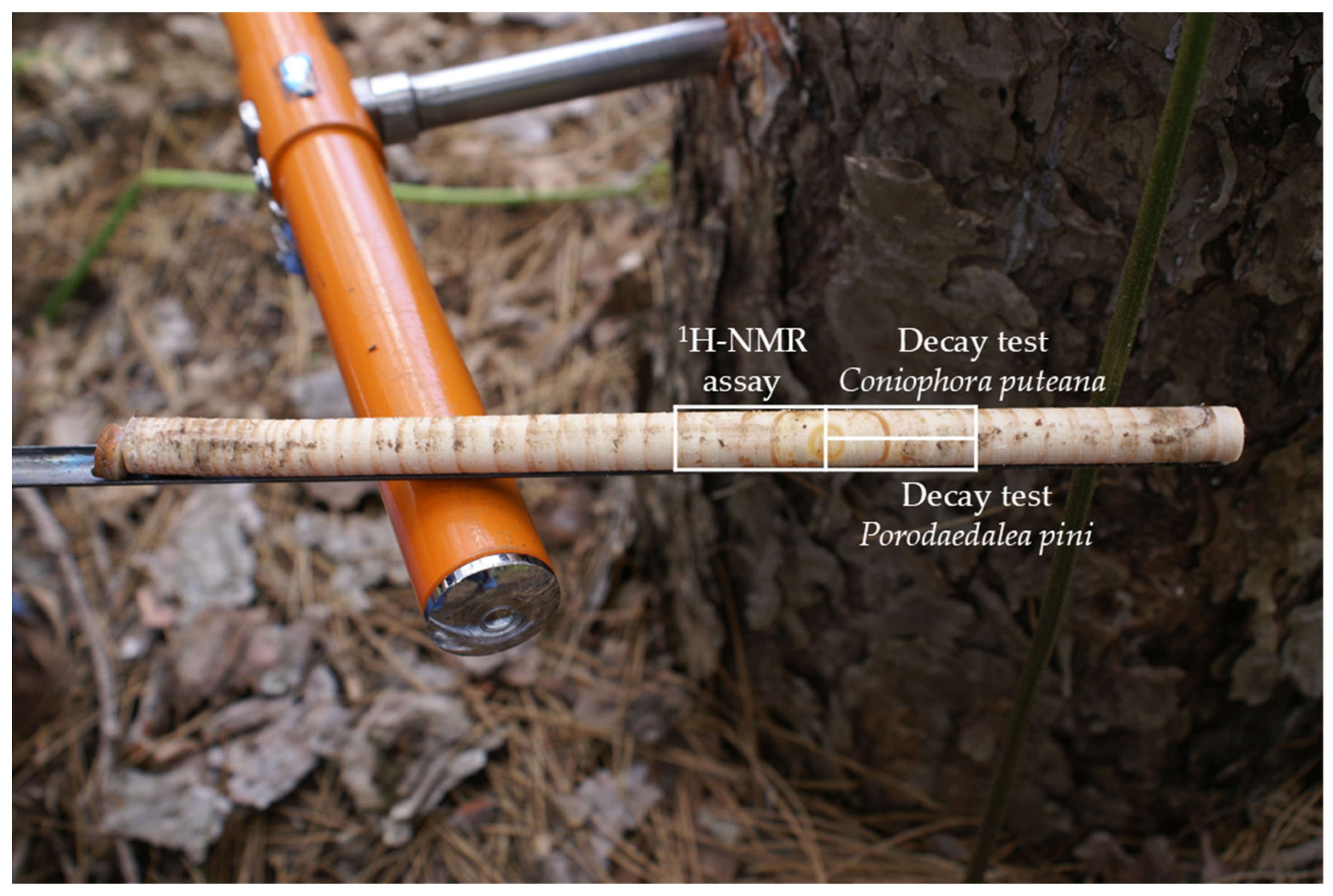
The modified decay test was based on EN 113-1 using the above-mentioned specimens, whose dimensions were 12 mm in diameter and approximately the size of the heartwood in the radial dimension (approx. 3–5 cm,
Figure 1). The heartwood samples for the decay tests were placed on pure cultures of
C.
puteana (strain: BAM Ebw. 15, collection number: DSM 3085) and
P. pini (Institute of Mediterranean and Forest Ecosystems collection Pp 13) growing on agar in 12 mm Petri dishes at 23 ± 1 °C. Fungal colonies of the species used were stored and sub-cultured at the Laboratory of Forest Pathology, Institute of Mediterranean and Forest Ecosystems, Hellenic Agricultural Organization DIMITRA. Prior to the weight loss test, the heartwood samples were not leached. The samples were placed on a stainless-steel rack to avoid contact with the fungi’s culture media. The incubation time lasted 24 weeks. After the decay test, the samples were gently brushed to remove adhered mycelium and then finally dried at 60 ± 2 °C for 48 h (or until constant weight) and reweighed to determine their decayed weight. The oven-dry heartwood weight loss (WL) during the experiment was used as an inverse measure of decay resistance and was expressed in relative terms. Weight loss was determined gravimetrically and calculated according to Equation (1):
where m
b and m
a is the oven-dry mass of the wood block before and after incubation (g), respectively (g) [
16,
37,
45,
46,
47,
48,
49].
2.5. Statistical Analysis
2.5.1. Simple Linear Regression Model
Firstly, a simple linear regression model (Model 1) was applied following the approach by Gierlinger et al. [
18], Venäläinen et al. [
32], and Harju and Venäläinen [
50] to examine whether weight loss depended on chemical heartwood characteristics, specifically, total acetone extractives, total resin acids, and total stilbenes, which were determined as
where WL = the weight loss in relative terms (%); b
0 = the intercept; b
1 = the coefficient of the predictor C, which is an independent variable; C = the total acetone extractives (TAEs), the total stilbenes (TSs), the total resin acids (TRAs), or every single stilbene substance, i.e., the P, PMME, and PDME of the heartwood; and e = the residuals.
2.5.2. Multiple Linear Regression Model
Subsequently, a multiple regression analysis (Model 2) was conducted to examine whether weight loss was influenced by the contents of stilbenes (TSs) and resin acids (TRAs), both of which are known for their protective roles in wood. The aim was to evaluate the relative contribution of each group to antimicrobial activity. The model was determined as
where WL = the weight loss in relative terms (%), b
0 = the intercept, TS = the total stilbene content, TRA = the total resin acid content, b
1 = the coefficient of the variable TS, b
2 = the coefficients of the variable TRA, and e = the residuals.
Following the above model, a new multiple regression analysis (also called Model 2) was conducted to examine whether weight loss was influenced by the contents of the different stilbenes, which were noted for their contribution to the defense mechanisms of wood. The aim was to evaluate the relative contribution of each stilbene substance to antimicrobial activity. The model was determined as
where WL = the weight loss in relative terms (%), b
0 = the intercept, S
1 = one of the stilbene substance, S
2 = another stilbene substance, b
1 = the coefficient of the variable S
1, b
2 = the coefficients of the variable S
2, and e = the residuals.
Finally, a multiple regression analysis (Model 3) was performed to examine whether weight loss depended on the different types of stilbenes (TSs) and resin acids (TRAs), with the aim of assessing the antimicrobial contribution of each individual compound, which was determined as
where WL = the weight loss in relative terms (%); a
0 = the intercept; b
1 … b
3 = coefficients of variables of different stilbenes, i.e., P, PMME, and PDME; c
1 … c
8 = coefficients of variables of different resin acids, i.e., AA, DAA, NAA, PLA, LPA, PMA, SPA, and IPA; e = the residuals; TAE = total acetone extractive; P = pinosylvin; PMME = pinosylvin monomethyl ether; PDME = pinosylvin dimethyl ether; AA = abietic acid; DAA = dehydroabietic acid; NAA = neoabietic acid; PLA = palustric acid; LPA = levopimaric acid; PMA = pimaric acid; SPA = sandaracopimaric acid; and IPA = isopimaric acid.
Descriptive statistics and simple and multiple regressions were performed on the percentage (%) of weight loss. Weight loss data were subjected to the appropriate log or arcsine transformation before statistical analysis to meet the assumptions of parametric tests and were re-transformed to be added to tables and graphs.
The residuals were assessed for normality and homoscedasticity, and no noteworthy deviations from the underlying assumptions were observed. In multiple linear regression models, multicollinearity was assessed by estimating the variance inflation factor (VIF), a quantitative measure of multicollinearity. Model selection for regression analysis was based on the two most well-known statistical model selection rules, namely the AIC (Akaike Information Criterion) and the BIC (Bayesian Information Criterion), quantitative measures used to evaluate and compare different models [
51]. The effect sizes for ANOVA/regression models were estimated using Cohen’s f
2 index [
52]. All statistical analyses were performed using the SPSS v.20 software for Windows (IBM SPSS Statistics 2011, IBM Corp., Armonk, NY, USA). In all statistical hypothesis testing procedures, the significance level was predetermined at
p ≤ 0.05.
3. Results
The heartwood of the studied trees exhibited exceptionally high acetone extractive content (TAE = 304.15 mg g
dhw−1) [range: 81.79–480.28 mg g
dhw−1] (
Table 1), which contained significant amounts of stilbenes (TS = 59.92 mg g
dhw−1; range: 10.99–128.22 mg g
dhw−1) (
Table 1) [
39] and resin acids (TRA = 219.98 mg g
dhw−1; range: 32.20–456.56 mg g
dhw−1) (
Table 1) [
40].
The resin acid fraction constituted 68.26% of the total extractive content, while stilbenes were present in substantial quantities, accounting for 22.31% (
Table 2). The remaining 9.43% corresponds to other substances present in the TAEs, i.e., flavonoids, fatty acids, minor unidentified resin acids, other phenols, waxes, sterols, unsaponifiables, and others.
Significant amounts of pinosylvin and its derivatives were found in the heartwood of Black pine trees from the Peloponnese (
Table 3). Pinosylvin monomethyl ether (PMME) was the main component of stilbenes (67.28%), followed by pinosylvin (P) (28.48%) and pinosylvin dimethyl ether (PDME) (4.24%).
Abietic acid was the most abundant acid (
Table 4), followed by palustric acid and neoabietic acid, all of which are classified as abietane-type resin acids. The most abundant pimarane-type resin acid was pimaric acid. Dehydroabietic acid was found at moderate levels, while the rest, i.e., levopimaric acid, isopimaric acid, and sandaracopimaric acid, were observed in lower concentrations (
Table 4).
The evaluation of
P. nigra heartwood weight loss demonstrated notable differences in decay intensity between the two fungal species examined (
Table 5).
P. pini induced a substantially higher mean weight loss, indicating considerable variability in its degradative activity. In contrast,
C. puteana caused a lower mean weight loss, with a narrower range and a smaller standard deviation, suggesting more uniform but less aggressive decay. The markedly greater mean and variability associated with
P. pini confirm its stronger and less consistent deteriorative effect on
P. nigra heartwood compared with
C. puteana under the tested conditions.
3.1. Simple Regression Model
The values of the dependent variable was modeled on the logarithmic scale to satisfy the assumptions of linearity and homoscedasticity and to linearize the relationship with the independent variables. The simple regression model (Equation (2)) statistically significantly predicts the outcome variable for most of the independent chemical variables for both tested fungi (
Table 6 and
Table 7). Among the predictor variables tested in Equation (2), for
P. pini, the TAE accounted for the greatest proportion of variance in weight loss, and it significantly predicted that the explanatory variable, TRA, was proved to be the next best weight loss predictor variable. Conversely, PDME explained only a negligible fraction of the variance (
p = 0.015, R
2adj = 0.019, and f
2 = 0.023), indicating that it is a relatively weak predictor (
Table 6). In contrast, when TS was included as the predictor variable, the model failed to explain a significant proportion of the variance in weight loss (
p = 0.193, R
2adj = 0.007, f
2 = 0.007). Similarly, when P and PMME were included as independent variables, the model did not significantly predict weight loss (
p = 0.209, R
2adj = 0.006, and f
2 = 0.006 and
p = 0.169, R
2adj = 0.007, and f
2 = 0.007, respectively). The data about TS, P, and PMME are omitted from the tables due to non-significant regression models.
The regression analyses summarized in
Table 7 assess the influence of total stilbenes (TSs), pinosylvin (P), and pinosylvin monomethyl ester (PMME) on the weight loss of wood caused by
C. puteana. All three predictor variables showed negative regression coefficients, indicating that increasing concentrations of these stilbene compounds were associated with reduced fungal degradation. Among them, pinosylvin (P) demonstrated the strongest predictive ability, as reflected by its lowest
p-value and highest adjusted coefficient of determination. In contrast, TSs and PMME exhibited weaker associations, with higher
p-values (0.001 and 0.009, respectively) and lower R
2adj values (0.033 and 0.022, respectively). Although the adjusted R
2 and Cohen’s f
2 values suggest that the overall effect sizes are small, the statistical significance of the models indicates that stilbenes, particularly pinosylvin, contribute meaningfully to wood resistance against
C. puteana. The negative regression coefficients across all models suggest an inverse relationship between stilbene content and fungal degradation. The AIC and BIC values further support the relative adequacy of the pinosylvin model compared to those of TS and PMME, reinforcing its role as a key chemical indicator of decay resistance.
3.2. Multiple Regression Model
Regression models based on Equation (3) revealed differences in the predictive ability of the tested variables to induce weight loss (
Table 8 and
Table 9). Regarding
P. pini, the combined model including total stilbenes (TSs) and total resin acids (TRAs) explained the greatest proportion of the variance, with a statistically significant effect. In contrast, models including stilbenes, i.e., pinosylvin (P) with pinosylvin dimethyl ether (PDME) or pinosylvin monomethyl ether (PMME) with pinosylvin dimethyl ether (PDME), accounted for only a small fraction of the variance, despite statistical significance. Overall, TSs combined with TRAs outperformed the other predictor sets, whereas models including P, PMME, or PDME alone or in combination provided only weak explanatory power.
The regression analyses (Equation (3)) evaluating the combined effects of total stilbenes (TSs), total resin acids (TRAs), pinosylvin (P), pinosylvin monomethyl ether (PMME), and pinosylvin dimethyl ether (PDME) on weight loss caused by
C. puteana are presented on
Table 9. All regression models yielded negative coefficients for stilbenes, indicating that higher concentrations of these compounds were associated with reduced fungal degradation. Among the models, the combination of pinosylvin and its dimethyl ester (P + PDME) demonstrated the strongest predictive performance, along with the lowest
p-value, the highest adjusted coefficient of determination, and the largest Cohen’s f
2. The P + PMME prediction also showed a significant relationship, while the TS + TRA and PMME + PDME models exhibited weaker associations. The variance inflation factor (VIF) values for all predictors were close to or below 2.5, indicating no serious multicollinearity issues. Although the overall R
2adj values were modest, the data suggest that combinations of pinosylvin derivatives, particularly P and PDME, are more effective predictors of resistance to
P. pini-induced weight loss than total stilbenes or resin acids alone. These findings emphasize the importance of specific stilbene derivatives in the defense mechanisms of wood against brown-rot decay caused by
C. puteana.
The results of the regression model predicting weight loss based on Equation (4) are shown in
Table 10 and
Table 11. Regarding
P. pini, the model incorporating only stilbenes (P, PMME, and PDME) was statistically significant but exhibited very limited explanatory power. In contrast, the model containing only resin acids (AA, DAA, NAA, PLA, LPA, PMA, SPA, and IPA) was statistically significant and accounted for a substantially greater proportion of the variance. The combined model, including all stilbenes and resin acids, was the most significant and provided the best overall fit to the data, explaining the highest amount of variance. However, the slight improvements in AIC and BIC values from the resin acid model to the combined model indicate that resin acids are the main contributors to predictive power, with stilbenes adding little additional explanatory value. Notably, the high variance inflation factor (VIF) values observed for several predictors (e.g., DAA and PLA) indicate potential multicollinearity within the resin acid and combined models (
Table 10).
The results of the regression models (Equation (4)) used to evaluate the predictive effect of selected stilbenes and resin acids on weight loss caused by
C. puteana are presented in
Table 11. Across all models, individual predictors displayed small regression coefficients, indicating limited influence on weight loss, although some, such as IPA (0.026) and PDME (0.0237), had slightly higher contributions. The variance inflation factors (VIFs) suggest minimal multicollinearity in the stilbene-only model, while the resin acid and combined models exhibited higher VIFs for certain predictors, particularly DAA (16.483) and PMME (3.521), thus indicating potential multicollinearity concerns. Adjusted R
2 values were low for all models (0.031–0.094), suggesting that the predictors explained only a small portion of the variability in weight loss. Model comparison using the AIC and BIC further supports modest model performance, with the combined model showing the best fit (AIC = −45.276 and BIC = −41.762). Overall, the results indicate that while some stilbenes and resin acids may influence weight loss, their predictive power individually and collectively remains limited.
4. Discussion
The natural durability of wood is largely determined by the presence and activity of extractives in the heartwood. These secondary metabolites provide chemical defense against fungal colonization and contribute to the long-term stability of the wood being used [
4,
6,
7,
45,
53,
54,
55]. Evidence supporting their key role comes from studies showing that removing extractives renders otherwise durable wood susceptible to decay [
7,
56], while adding heartwood extractives to non-durable species can significantly increase decay resistance [
56,
57,
58]. The exceptionally high levels of resin acids and stilbenes identified in the sampled clones from the Peloponnese underscore the strong defensive potential of this species against wood-decaying fungi. Extractive contents reported for
P. nigra in earlier studies are generally lower than those observed here, reflecting differences in solvents, extraction protocols, and tissue selection. Reported values include 161–197 mg g
−1 for methanol heartwood extractives [
59], 31.9–33.0 mg g
−1 for petroleum ether extractives following acetone pre-extraction [
60], and 44.7–47.3 mg g
−1 for acetone extractives in two
P. nigra varieties excluding heartwood [
61]. In contrast, the present results align with those by Alvarez-Nóvoa et al. [
62], who reported 310 mg g
−1 in air-dried wood using ether.
Among the compounds in pine heartwood, stilbenes and resin acids have received particular attention. The antifungal action of heartwood extractives is linked to multiple mechanisms, while the relative contributions of different extractive groups remain unresolved. These include the toxicity of resin components, antioxidant activity, and hydrophobic effects that reduce water penetration [
63,
64]. Extractives do not act solely through bulk accumulation but rather through the biological efficacy of individual compounds [
46]. By contrast, in our analyses, the total acetone extractive content was the strongest single predictor for weight loss.
Phenolics have been consistently linked with decay resistance due to both antifungal properties and their role in limiting wood hygroscopicity [
31,
50]. Particularly, stilbenes, i.e., pinosylvin and its derivatives, exhibit strong antifungal activity across multiple species but are also vulnerable to oxidative degradation, reducing their long-term effectiveness [
65,
66,
67]. Pinosylvin alone does not fully explain decay resistance [
49,
68]. Also, in our study, stilbenes, despite their abundance, have hardly contributed to improving the predictive power for weight loss. Resin acids, by contrast, primarily contribute through water repellency rather than direct toxicity [
69,
70,
71,
72]. Notably, beyond their general water-repellent function, certain abietane-type resin acids, particularly abietic acid, have been correlated with increased durability [
73]. Micales et al. [
69] found that abietane-type resin acids exhibited greater fungitoxicity than pimarane-type acids in agar-medium cultures. According to our results, multiple regression analyses unequivocally demonstrated that resin acids are the main chemical drivers associated with reduced weight loss. Within this group, abietane-type compounds, particularly abietic acid, had the greatest impact on this response variable, highlighting their importance in decay resistance.
Decay resistance varies greatly across tree species, fungal taxa (reflecting differences in their ability to overcome heartwood defenses), and experimental conditions. Scots pine (
Pinus sylvestris) heartwood typically demonstrates greater resistance than sapwood, a difference attributed to higher levels of stilbenes and resin acids [
65,
66,
74]. For example, Brischke et al. [
74] observed that Scots pine sapwood experienced much greater weight loss than heartwood when exposed to decay fungi. Belt et al. [
65] reported that
C. puteana caused limited weight loss in pine heartwood, while
Rhodonia placenta (Fr.) Niemelä, K.H. Larss. and Schigel (2005) was far more destructive, with losses ranging from 5.8 to 36.4%. This difference was attributed to their differential capacity to degrade stilbenes:
R. placenta showed much higher efficiency than
C. puteana [
66,
75,
76].
The extended variation in
P. sylvestris L. heartwood weight loss was reported by Leinonen et al. [
77]. They found a strong negative correlation (r = −0.85,
p < 0.0001) between heartwood extractive concentration and weight loss (ranged between 0.87 and 49.28% with an average of 22.43%) caused by
C. puteana, thus confirming the protective role of extractives. Harju et al. [
29] found higher phenolic concentrations in decay-resistant Scots pine heartwood compared to susceptible trees. The same research group once again reported a strong, negative, and statistically significant correlation (−0.82,
p < 0.001) between weight loss of
P. sylvestris heartwood subjected to
C. puteana and the concentration of total phenolics during the decay tests [
50]. Heijari et al. [
78] found similar high correlations between the total phenolic concentration in the heartwood of Scots pine and weight loss in the decay test. Gref et al. [
68] found that weight losses caused by
Phanerochaete chrysosporium Burds (1974) and
R. placenta for the
P. sylvestris heartwood ranged up to 3.2% (avg 2.9%) and 8.6% (avg 6.3%), respectively.
Mixed results were also found by De Angelis et al. [
34], who reported that
Trametes versicolor (L.) Lloyd (1920) and two brown-rot fungi (
Fibroporia vaillantii (DC.) Parmasto (1968) and
Gloeophyllum trabeum (Pers.) Murrill (1908)) were able to degrade 0.5%, 8.6%, and 1.0% of
P. pinea heartwood, respectively. Similarly, Hassan et al. [
79] observed in
Pinus elliottii Engelm. and
Pinus caribaea Morelet that blocks with higher resin contents exhibited far lower weight losses (6%) than those with low resin contents (21%) when exposed to
Fomitopsis ostreiformis (Berk.) T. Hatt. Weight loss was reduced (0–3%) as the resin level in wood increased. A similar variation was reported for
Pinus heldreichii H. Christ, where heartwood with four times the extractive content of sapwood exhibited correspondingly close weight loss values, i.e., 30.65% and 34.68%, respectively, against
C. puteana [
80].
Other species also show strong links between extractive content and decay resistance. In Norway spruce,
T. versicolor caused modest losses (~10%), whereas
C. puteana and
R. placenta caused up to a 34% weight loss. Extractives were found to inhibit brown rot of
R. placenta in
H. lusitanica [
16], while in western red cedar (
Thuja plicata Donn ex D. Don), the variability in decay resistance near the pith was directly linked to the presence of chemoprotective compounds [
81]. Windeisen et al. [
55] found that larch heartwood with high extractive levels lost ~30% of its mass under fungal exposure, compared to 55–60% for low-extractive heartwood. Gierlinger et al. [
18] reported strong positive and significant correlations (up to 0.87,
p < 0.01) between phenolic content and decay resistance in various larch species. In Siberian larch, Venäläinen et al. [
37] likewise showed significant negative correlations (r = −0.677,
p = 0.006) between phenolic concentration and weight losses of 20%, 28%, and 17%, respectively, caused by the brown-rot fungi
C. puteana,
R. placenta, and
G. trabeum, respectively. However, significant phenotypic variation exists: some cores showed no weight loss despite fungal exposure, while others were highly susceptible [
73]. Between the
P. pini and
C. puteana strains tested in our research, the former caused significantly greater weight loss, highlighting that fungal identity dictates, to an extent, degradation severity.
Ultimately, decay resistance emerges from a complex interplay of extractive chemistry, distribution, wood structure, and fungal physiology. Despite abundant supporting evidence, the precise role of extractives remains debated. Some studies show weak or inconsistent correlations between extractive concentration and decay resistance [
4,
81]. For example, certain larch species produce high extractive content without improved durability [
82].
Moreover, extractives may act synergistically, with multiple low-toxicity compounds working together to protect the wood [
13,
83]. The present study demonstrates that the natural decay resistance of
P. nigra heartwood is strongly influenced by its chemical composition, particularly the content and composition of extractives. The micro-distribution of extractives within wood tissue is also critical but difficult to measure. Taylor et al. [
5] emphasized that an uneven distribution, rather than absolute content, may explain observed differences in decay performance. Even within a single tree, differences between inner and outer heartwood or between samples can yield widely different outcomes [
73,
74].
Furthermore, extractive efficiency varies not only among tree species but also within species due to genetic differences, environmental influences, and age-related changes [
4,
28,
84,
85]. Moreover, variability in decay resistance occurs not only among fungi but also within the same fungal group, depending on their enzymatic ability to metabolize extractives [
79]. The natural durability of
P. nigra heartwood was influenced by the fungi species involved in the decay process, as their diverse decay capabilities can significantly affect both the extent and pattern of wood degradation. Such complexity highlights the potential for conflicting results and the limitations of observed correlations. As Hart and Shrimpton [
54] cautioned, findings should be interpreted carefully, since fungal-extractive interactions are species-specific and context-dependent.
5. Conclusions
This study demonstrates that the natural decay resistance of P. nigra heartwood is largely determined by its extractives and also by the fungal species involved in its decay. This research advances the field of natural wood preservatives by shifting the focus from total extractive content, and particularly stilbenes, to specific chemical drivers. Statistical analyses indicated that acetone extractive content constituted the most robust single predictor. Multiple regression analyses demonstrated that resin acids represent the primary chemical determinants associated with reduced weight loss. Within this class, abietane-type resin acids, especially abietic acid, were the strongest predictor of the response variable, thereby emphasizing their central role in conferring decay resistance (durability). In contrast, stilbenes, despite their high abundance, provided only limited contribution to enhancing the model’s explanatory capacity in both single and multiple regression analyses. Moreover, P. pini caused significantly greater weight loss than C. puteana, highlighting that fungal identity partially determines the severity of wood degradation. Variation in extractive content and decay resistance among clones indicates a significant genetic component, along with the high heritability of these traits, underscoring the potential for selective breeding to enhance durability traits in Black pine.
The cultivation and utilization of extractive-rich P. nigra clones as a naturally durable material enables the construction industry to develop eco-friendly outdoor structures, such as decking, fencing, and cladding. This naturally durable wood ensures high resilience against environmental exposure while supporting sustainable forestry goals and reducing public health risks. In addition, prioritizing wooden products with naturally greater durability allows the industry to extend service life, minimize replacements, and enhance resource efficiency. Lastly, within a climate-smart forestry framework, implementing wood-use strategies based on naturally durable P. nigra varieties enables the forest product sector to reduce its carbon footprint and environmental impact by minimizing reliance on hazardous chemical treatments and energy-intensive preservation processes.




 ,
,