1. Introduction
Watching films and television (TV) series is one of the most common leisure activities worldwide, offering audiences entertainment, escapism, and emotional engagement (
Irimiás et al., 2021). As viewers immerse themselves in fictional narratives, they develop strong connections with the characters and the settings depicted on screen (
Aguilar-Rivero et al., 2023). This emotional connection often translates into a desire to visit the destinations featured in their favorite films or TV series, contributing to the rise of film tourism (
D. Shi et al., 2024). Film tourism occurs when audiences extend their media consumption into travel experiences, visiting real-world destinations that have been depicted in audio–visual media as a form of leisure engagement (
Teng & Chen, 2020). With the expansion of streaming platforms, audiences are repeatedly exposed to on-screen characters and locations, strengthening their emotional attachment and influencing their travel choices (
Aguilar-Rivero et al., 2023). This constant exposure enhances their familiarity with on-screen destinations, increasing the likelihood of translating their virtual engagement into actual visitation (
Vila et al., 2021). Consequently, film tourism has become an increasingly significant sector within the tourism industry, offering destinations new opportunities for place marketing and economic growth (
Wu & Lai, 2023). Many destinations have capitalized on this trend by promoting film-related sites, creating guided tours, and integrating cinematic themes into their marketing campaigns (
St-James et al., 2018;
Li et al., 2021).
According to
Yao and Yang (
2024), the release of popular films and TV series often leads to a significant surge in tourist arrivals and online search activity related to the filming locations. However, once audience enthusiasm fades, maintaining the destination’s reputation and sustaining tourist interest become critical challenges for film-related destinations. Therefore, it is essential to identify the key determinants that shape film tourists’ post-visit behaviors, particularly their revisit and word-of-mouth (WOM) intentions. Understanding these factors will enable tourism stakeholders to formulate strategies that improve film tourists’ experiences and foster long-term engagement with film-related destinations (
Aguilar-Rivero et al., 2023).
Among the key elements influencing film tourists’ perceptions and evaluations, authenticity plays a crucial role in shaping their cognitive and emotional responses to film-related destinations (
Li et al., 2021;
Teng & Chen, 2020). Perceived authenticity refers to the extent to which a destination or site is seen as genuine (
Kolar & Zabkar, 2010). It serves as a powerful motivator for tourists seeking meaningful experiences (
Wareebor et al., 2025). Prior studies in cultural and heritage tourism have consistently identified authenticity as a critical determinant of perceived value (e.g.,
Atasoy & Eren, 2023), tourist satisfaction (e.g.,
Yildiz et al., 2024), and behavioral intentions (e.g.,
Park et al., 2019). However, despite the growing academic and practical interest in film tourism as a form of cultural tourism (
Marin et al., 2021), limited research has examined how authenticity shapes film tourists’ perceived value, satisfaction, revisit intentions, and WOM intentions. This gap calls for a deeper understanding of how perceived authenticity affects the film tourists’ post-visit behavioral intentions.
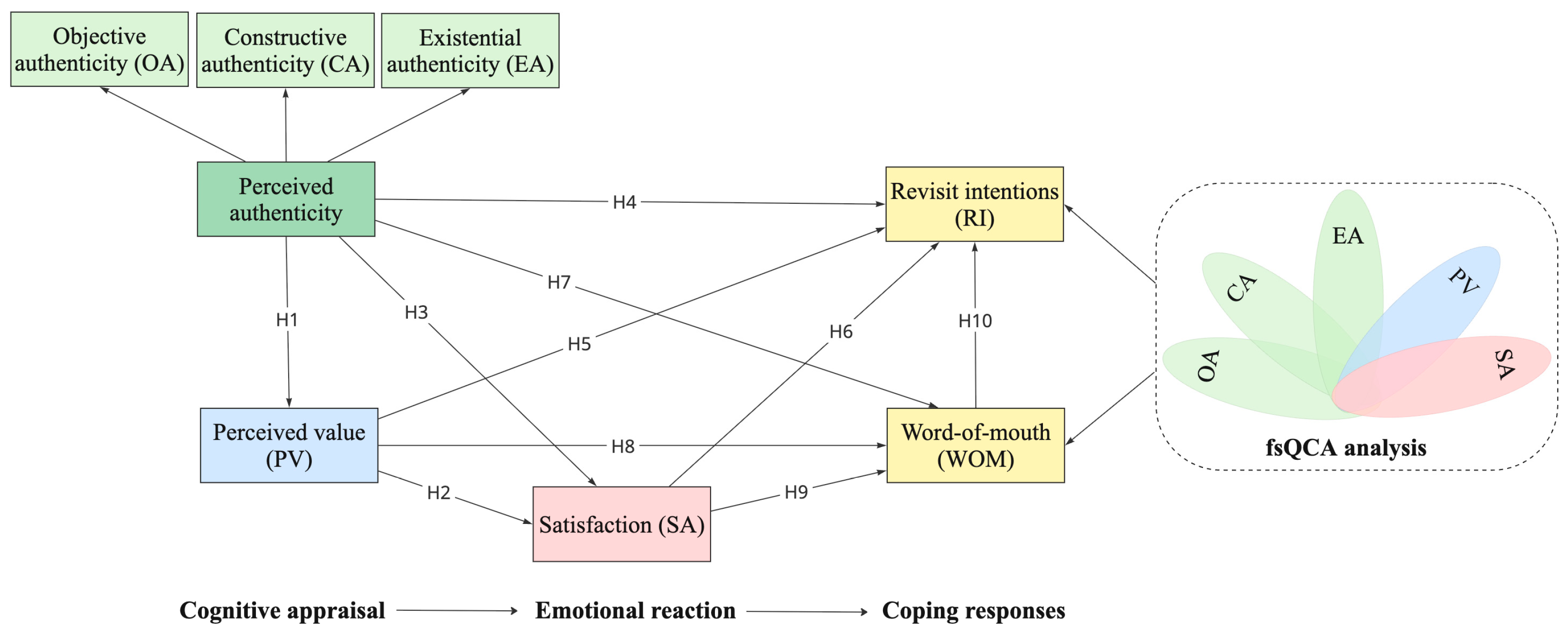
To address the research gap, this study applies cognitive appraisal theory (CAT) as its theoretical foundation (
Lazarus & Folkman, 1984). CAT posits that individuals evaluate experiences through a cognitive appraisal process, which elicits emotional responses and ultimately shapes behavioral reactions (
Bagozzi, 1992). Applying CAT in the context of film tourism allows for a comprehensive understanding of how tourists’ cognitive evaluations of authenticity shape their emotional responses and behavioral reactions, including revisit and WOM intentions.
Moreover, previous film tourism research has predominantly employed symmetrical analytical methods, such as structural equation modeling (SEM), to investigate direct and linear relationships between variables (e.g.,
Teng & Chen, 2020;
Li et al., 2021). While these approaches are useful for identifying net effects, they often overlook the complex and configurational nature of tourist behavior, where multiple combinations of factors can result in the same outcome (
Han et al., 2025). To overcome this limitation, this study applies fuzzy-set qualitative comparative analysis (fsQCA), an asymmetric method that identifies both necessary and sufficient conditions for outcomes (
Rasoolimanesh et al., 2022). fsQCA complements traditional quantitative techniques by capturing the causal complexity inherent in tourism behavior and identifying multiple pathways that can lead to similar post-visit intentions (
Cifci et al., 2023).
Accordingly, this research aims to investigate how perceived authenticity, perceived value, and satisfaction influence film tourists’ revisit and WOM intentions. In particular, it aims to address the following research questions:
- (1)
Does perceived authenticity influence film tourists’ perceived value and satisfaction?
- (2)
Do perceived authenticity, perceived value, and satisfaction significantly influence film tourists’ revisit and WOM intentions?
- (3)
What combinations of factors lead to high levels of revisit and WOM intentions?
By applying CAT to develop a conceptual framework and integrating SEM with fsQCA, the study advances the theoretical understanding of film tourism behavior and provides empirical evidence of the complex interrelationships among perceived authenticity, perceived value, satisfaction, and post-visit intentions. The findings offer theoretical contributions to the film tourism research and practical guidance for destination managers and marketers seeking to improve authenticity-based experiences and foster long-term tourist engagement.
5. Discussion
This study aimed to examine the influence of perceived authenticity, overall perceived value, and satisfaction on film tourists’ revisit and WOM intentions, utilizing CAT as the theoretical framework. By integrating SEM and fsQCA, the empirical findings provide valuable insights into the psychological mechanisms underlying film tourists’ post-visit behaviors.
The SEM results confirm that perceived authenticity plays a fundamental role in enhancing perceived value and satisfaction among film tourists, thereby supporting H1 and H3. The significant positive effect of perceived authenticity on perceived value aligns with previous studies in cultural heritage tourism, which identify authenticity as a fundamental antecedent shaping tourists’ evaluations of the worth of their travel experiences (
Atasoy & Eren, 2023;
Kolar & Zabkar, 2010). This finding suggests that in the film tourism context, tourists perceive higher value when they regard film-related destinations as authentic, reinforcing the importance of authenticity in their overall evaluation. Likewise, perceived authenticity was found to significantly enhance satisfaction, supporting the notion that authenticity contributes to tourists’ emotional fulfillment and enjoyment of their visits (
Zhou et al., 2023;
J.-H. Kim et al., 2020). Furthermore, perceived value exerted a significant positive effect on satisfaction, supporting H2 and aligning with existing literature suggesting that higher perceived value often translates into more positive affective evaluations of the tourism experience (
Phi et al., 2024;
Luo et al., 2022).
Regarding the role of perceived authenticity, perceived value, and satisfaction in revisit intentions, the SEM findings indicate that perceived authenticity exerted a significant positive effect on revisit intentions, thereby supporting H4. This finding implies that when film tourists perceive a film-related destination as authentic, their likelihood of returning increases. This result is consistent with prior studies emphasizing the importance of perceived authenticity in fostering destination loyalty among film tourists (
Aguilar-Rivero et al., 2023;
Li et al., 2021;
Teng & Chen, 2020). Unexpectedly, perceived value and satisfaction were found to have no significant effect on revisit intentions, resulting in the rejection of H5 and H6. This result contrasts with traditional tourism literature, which often identifies satisfaction and perceived value as key drivers of repeat visits (
Baghirov et al., 2025;
Phi et al., 2024). A possible explanation for this divergence is that film tourists differ fundamentally from general leisure tourists. Prior research suggests that many film tourists travel with a sense of symbolic pilgrimage, where the desire to connect with narratives, characters, and filmic settings surpasses functional evaluations of service quality or value (
Aguilar-Rivero et al., 2023;
Gómez-Morales et al., 2022;
Hao et al., 2024). As a result, even when tourists perceive the trip as valuable and satisfying, these utilitarian assessments may play a limited role in shaping revisit decisions. Instead, revisit intentions appear more strongly grounded in whether the destination continues to evoke narrative immersion, emotional meaning, and a sense of being “true” to the film text (
St-James et al., 2018). This aligns with evidence that film tourists prioritize emotional resonance and narrative authenticity over cognitive or utilitarian evaluations when forming behavioral intentions (
Hao et al., 2024). Additionally, some film tourists exhibit novelty-seeking tendencies, using their visit to verify whether the real filming site aligns with its on-screen representation (
Bolan et al., 2011). For these tourists, perceived authenticity becomes the dominant factor shaping revisit intention, as confirming and re-experiencing that authenticity holds more motivational weight than perceived value or satisfaction.
In contrast, perceived authenticity, perceived value, and satisfaction were found to significantly influence WOM intentions, supporting H7, H8, and H9. These findings align with prior research emphasizing the role of perceived value and satisfaction in motivating tourists to share positive experiences (
Andersen et al., 2025). In film tourism context, tourists who perceive a destination as highly authentic are more inclined to recommend it to others. This underscores the importance of destination marketers in enhancing perceived authenticity, value, and satisfaction to stimulate positive WOM, which can attract potential visitors and reinforce the destination’s appeal. Additionally, this study discovered that WOM intentions were a powerful indicator of revisit intentions, supporting H10. This supports existing literature suggesting that tourists who engage in positive WOM may develop a stronger emotional connection with the location, raising their likelihood of returning (
Abubakar et al., 2017;
Nazarian et al., 2024). Notably, although perceived value and satisfaction did not directly influence revisit intentions, the strong effect of WOM suggests that sharing positive experiences may prompt tourists to reflect on their film-related experiences and relive their emotional connections to the location, ultimately triggering their intention to revisit.
Beyond the symmetrical SEM findings, the fsQCA results provide complementary insights by uncovering how different combinations of multidimensional authenticity, perceived value, and satisfaction jointly lead to high revisit and WOM intentions. Four causal configurations were identified for high revisit intentions, confirming that multiple pathways can produce the same behavioral outcome (
Han et al., 2025;
J. J. Kim et al., 2023;
Pappas & Woodside, 2021). Configurations 1 and 4 highlight the joint presence of objective and constructive authenticity as core conditions, even when perceived value and satisfaction are absent. This finding suggests that authenticity, whether grounded in tangible film settings or constructed through tourists’ interpretive engagement, can independently motivate revisit intentions, reinforcing its symbolic and experiential significance in film tourism (
Hao et al., 2024;
Li et al., 2021). Although the SEM findings indicated that perceived value and satisfaction did not significantly influence revisit intentions when examined individually, Configurations 2 and 3 reveal that when film tourists perceive high value and experience overall satisfaction with their trip, these factors can still lead to strong revisit intentions. This highlights that satisfaction and perceived value may act as alternative pathways that compensate for weaker perceptions of authenticity, demonstrating the multifaceted nature of post-visit behavioral formation among film tourists.
Similarly, three causal pathways were found for high WOM intentions. Configuration 1 suggests that the coexistence of objective, constructive, and existential authenticity can foster strong WOM, even in the absence of satisfaction, emphasizing the persuasive power of authentic film experiences. Configuration 2 combines constructive and existential authenticity with satisfaction, highlighting the emotional basis of recommendation behavior. Configuration 3 indicates that perceived value and high satisfaction can still generate WOM even when authenticity is weak, suggesting that tourists may promote destinations based on hedonic or service-related experiences (
Baghirov et al., 2025;
Jeong & Kim, 2020).
Overall, these fsQCA findings complement SEM results, revealing that while authenticity remains a dominant driver, satisfaction and value can reinforce or substitute it under certain conditions. The integrated SEM–fsQCA approach thus uncovers the configurational complexity of film tourists’ post-visit behaviors, advancing theoretical understanding of authenticity-driven experiences and behavioral heterogeneity in film tourism.
5.1. Theoretical and Managerial Implications
The present study advances theoretical understanding in film tourism by integrating CAT with a combined SEM–fsQCA approach to examine the complex mechanisms driving film tourists’ post-visit behaviors. The findings reinforce the pivotal role of perceived authenticity in shaping tourists’ cognitive and emotional appraisals, thereby influencing their revisit and WOM intentions. The results extend existing research by demonstrating that authenticity not only enhances perceived value and satisfaction but also directly stimulates revisit intentions—highlighting its centrality in film tourism experiences. Notably, while perceived value and satisfaction did not significantly predict revisit intentions in the symmetrical SEM model, the configurational analysis revealed that these factors, when combined with high authenticity perceptions or with each other, can still lead to strong revisit intentions. This underscores the value of adopting an asymmetric perspective to capture the multifaceted and interdependent nature of tourists’ behavioral motivations. Furthermore, the strong relationship between WOM and revisit intentions illustrates WOM as a key reinforcing mechanism that sustains tourists’ psychological engagement with film destinations over time.
From a managerial standpoint, this study provides practical guidance for destination marketers and tourism planners seeking to enhance the appeal and sustainability of film-related destinations. Given the dominant influence of authenticity, destination managers should focus on preserving the original essence of filming sites, maintaining accurate representations of cinematic settings, and embedding storytelling elements that strengthen visitors’ emotional and symbolic connection to the film narrative. In addition, destination marketers should leverage WOM as a strategic communication channel by encouraging visitor-generated content, fostering online engagement, and designing campaigns that inspire film tourists to share their experiences. Such efforts not only amplify the destination’s visibility but also cultivate a self-sustaining cycle of engagement and loyalty among film tourists.
5.2. Limitations and Future Research
Although this research provides important implications, several limitations should be acknowledged. First, the study focused solely on Chinese film tourists visiting Thailand, which may limit the findings’ applicability in other cultural and geographic contexts. Future research could apply the proposed framework to different destinations or tourist groups to examine whether the observed relationships hold across diverse settings. Second, while the quantitative approach effectively identified both linear and configurational relationships, it may not fully capture the deeper motivations and emotional meanings underlying film tourists’ experiences. Future studies could employ qualitative or mixed-method designs to explore these psychological and experiential dimensions in greater depth. Finally, this study highlighted the importance of WOM in shaping revisit intentions but did not distinguish between communication channels such as social media, online reviews, or personal recommendations. Future studies could examine how these different forms of WOM influence destination loyalty and long-term engagement.