


Abstract
Soil salinity and drought are the two major challenges agriculture is facing in marginal environments, such as desert areas, which limit the growth and productivity of traditional cultivated crop species. In the Sahara Desert of the southern region of Morocco, livestock is the major agricultural activity, and forage supply is severely affecting livestock production. Blue panicum (Panicum antidotale Retz.) is an alternative salt-tolerant crop recently introduced to Morocco’s Sahara to enhance forage availability for livestock. The aim of this study was to increase the productivity and nutritional quality of blue panicum through the use of integrated agronomic practices, such as planting methods (bed or flat), crop establishment (direct seeding, transplantation, and rhizome propagation), organic and/or mineral amendments, and grass–legumes intercropping. The preliminary results showed that in the highly saline conditions, the combined application of organic amendments, seedling transplanting, and bed planting method gave the highest production (56 t/ha/year) of fresh biomass, which is higher than 50% compared to the control. This study suggests that in the southern region of Morocco and the Sahara Desert, the adoption of the blue panicum with integrated agronomic practices sustains livestock production.
1. Introduction
Increasing soil salinity and declining irrigation quality are global challenges, especially in semi-arid, arid, and desert climatic conditions. Worldwide, 37% of the salt-affected soils are located in the arid and desert regions [1]. In Morocco, most of the southern and eastern territories are salt affected, which covers approximately 67% of the total area of the country. These regions are characterized by harsh environmental conditions manifested by water scarcity, soil and groundwater salinity, high temperature variability, low or no rainfall, high wind speed, poor soil quality, and low soil organic carbon content. The impact of climate change has further worsened the situation, leading to an increased accumulation of salt in the topsoil. All these factors are affecting forage productivity in the regions.
Morocco’s Sahara region is mainly used as rangeland for extensive livestock production of dromedary (camel), goats, and sheep. In the past, a few rehabilitation initiatives were launched to improve forage crop’s productivity, but they had little success due to the vastness of the territory with major challenges [2]. To meet the increasing forage demand, the introduction and adoption of alternative crops could be a judicious choice [3]. Blue panicum (Panicum antidotale Retz.) is a newly introduced grass in the Sahara region, and the initial results show promising performance in terms of productivity and quality compared to traditional forage crops [4]. Additionally, earlier studies recommended the application of organic amendments to improve agricultural production in salt-affected lands [5]. This study aims at forage productivity enhancement of blue panicum through the adoption of integrated agronomic practices in contrasting environments in the southern region of Morocco.
2. Materials and Methods
2.1. Experimental Sites
On-farm experiments were conducted in five contrasting locations of the southern region of Morocco (Table 1). The experimental sites had the maximum temperature ranging from 30 to 40 °C, minimum temperature 8–11 °C, and annual rainfall of 26–53 mm.

Table 1.
Climate and soil characteristics of the experimental sites/platform.
2.2. Crop Management and Experimental Design
Four agronomic practices were compared in this study: (a) planting methods (bed or flat), (b) crop establishment (direct seeding, transplantation, and rhizome propagation), (c) organic and/or mineral amendments, and (d) grass–legumes intercropping. Experiments were conducted for the first year during 2020–2021 cropping season and implemented in a randomized complete block design with four replications in each site/platform. Plant material consisted of a public variety of blue panicum, while Siriver variety of alfalfa (Medicago sativa) and ILRI 15077 sesbania (Sesbania sesban) accession were used for the intercropping trial. Before plantation, the soil was plowed, and the crop was established. Amendments were incorporated at a level of 30 and 5 t/ha for farmyard manure and commercial compost, respectively, while NPK (10-30-10) fertilizer was applied at a rate of 100 kg/ha. Irrigation water was supplied using a drip irrigation system with 50 cm spacing. A leaching fraction was considered regarding the site’s characteristics. Irrigation water quality parameters for each site are shown in Table 2. Experimental units were harvested manually at 40 days cutting intervals. The yield is for the cumulative harvest results for the entire year.
Table 2.
Irrigation water quality in different platforms.
2.3. Plant and Soil Analysis
Several agro-morphological parameters were monitored during the crop growing period and at harvest. The major parameters measured include plant height, number of tillers, number of leaves, panicle length, plant fresh weight, and fresh biomass. Harvested plants were oven dried at 60 °C for three days to determine the dry matter. Dry biomass for each treatment was ground to investigate the nutritional quality of the forage. Fresh leaves sampling was conducted to assess chlorophyll and proline content. Soil samples were collected after harvest to monitor soil salinity and organic carbon stock.
3. Results
Figure 1 represents the effect of agronomic practices on yield under different salinity levels. Preliminary results showed no significant difference between practices at a low salinity level. However, the bed plantation improved the fresh biomass production by 90% compared to the control (direct seeding or transplantation) under a medium salinity range. The use of organic amendment doubled blue panicum’s annual fresh biomass production at high salinity conditions to reach 62 T·ha−1.
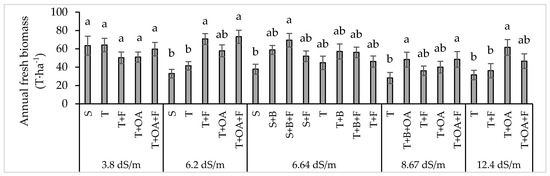
Figure 1.
Annual fresh biomass of blue panicum regarding several cropping practices and salinity. (S: Seeding/T: Transplantation/OA: Organic amendment/F: Fertilization/B: Bed plantation). Error bars indicate the standard deviation. a and b present Tuckey’s test at p = 0.05.
Results of the intercropping trial indicate that the performance of blue panicum was better under the intercropping system with legumes compared to sole crop. However, annual fresh biomass production was increased by 46% (to reach 58 T·ha−1) with 4 alfalfa:1 blue panicum planting ratio. Furthermore, the land equivalent ratio was more than 3 in combination with alfalfa and approximately two times better than in combination with sesbania (Figure 2).
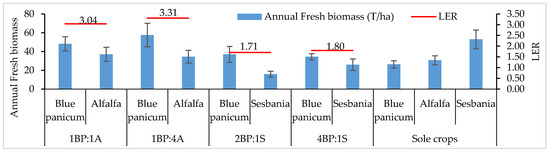
Figure 2.
Fresh biomass production and land equivalent ratio of blue panicum as affected by intercropping combination. Error bars indicate the standard deviation.
4. Discussion
Preliminary results of the experiment indicate a significant positive effect of different agronomic practices on the productivity of blue panicum except for low salinity conditions. However, the combined effect of organic amendments, transplantation, and bed planting method increased annual biomass production by more than 50% under high salinity and drought conditions. Our result is consistent with the results by Cuevas et al. [5]. They also found amendments and bed planting methods improved crop yield by 50% in saline soil conditions. Similarly, consistent with Al-Shareef et al. [6], intercropping of blue panicum with alfalfa has a significant advantage over sole cropping.
Author Contributions
Conceptualization, A.H.; methodology, A.H., A.N., A.E.M. and I.M.; software, A.E.M.; validation, A.H., A.N. and K.P.D.; formal analysis, A.E.M., D.A. and E.A.; investigation, A.E.M., D.A., E.A., M.B., M.I., K.L. and I.M.; resources, A.H.; data curation, A.H.; writing—original draft preparation, A.H., A.E.M. and I.M.; writing—review and editing, A.H., A.N., L.K. and K.P.D.; visualization, A.E.M.; supervision, A.H.; project administration, A.H.; funding acquisition, A.H. All authors have read and agreed to the published version of the manuscript.
Funding
This research was funded by OCP Phosboucraa Foundation within the project titled “Scaling up the cultivation of alternative crops in salt-affected farms in southern provinces of Morocco (N° AS03)”.
Institutional Review Board Statement
Not applicable.
Informed Consent Statement
Not applicable.
Data Availability Statement
Not applicable.
Acknowledgments
The authors gratefully appreciate the efforts of the farmers to provide us with farmlands to carry out the trials.
Conflicts of Interest
The authors declare no conflict of interest.
References
- FAO. The State of the World’s Land and Water Resources for Food and Agriculture—Systems at Breaking Point; Synthesis Report; FAO: Rome, Italy, 2021. [Google Scholar] [CrossRef]
- Aït Houssa, A.; Drissi, S.; Asehraou, A.; Asfers, A.; Oubaki, L.; Chraibi, H. Changements climatiques au Maroc: Quels systèmes de culture et quelles biotechnologies pour s’y adapter? Rev. Mar. Sci. Agron. Vét. 2017, 5, 210–221. [Google Scholar]
- Ismail, S.; Rao, N.K.; Dagar, J.C. Identification, Evaluation, and Domestication of Alternative Crops for Saline Environments. In Research Developments in Saline Agriculture; Dagar, J., Yadav, R., Sharma, P., Eds.; Springer: Singapore, 2019. [Google Scholar] [CrossRef]
- Hirich, A.; Choukr-Allah, R.; Ezzaiar, R.; Shahid, A.S.; Lyamani, A. Introduction of alternative crops as a solution to groundwater and soil salinization in the Laayoune area, South Morocco. Euro-Mediterr. J. Environ. Integr. 2020, 6, 52. [Google Scholar] [CrossRef]
- Cuevas, J.; Daliakopoulos, I.N.; del Moral, F.; Hueso, J.J.; Tsanis, I.K. A Review of Soil-Improving Cropping Systems for Soil Salinization. Agronomy 2019, 9, 295. [Google Scholar] [CrossRef] [Green Version]
- Al-Shareef, A.R.; Ismail, S.M.; El-Nakhlawy, F.S. Blue panic-alfalfa combination as affected by irrigation water regimes and forage mixing ratio under subsurface drip irrigation in arid regions. Grassl. Sci. 2018, 64, 234–244. [Google Scholar] [CrossRef]
Publisher’s Note: MDPI stays neutral with regard to jurisdictional claims in published maps and institutional affiliations. |
© 2022 by the authors. Licensee MDPI, Basel, Switzerland. This article is an open access article distributed under the terms and conditions of the Creative Commons Attribution (CC BY) license (https://creativecommons.org/licenses/by/4.0/).