
You are currently viewing a new version of our website. To view the old version click .
Materials Proceedings
  • Proceeding Paper
  • Open Access

11 November 2020

Biocompatibility and Cellular Uptake of Fluorescent Chitosan Nanohydrogels in Murine Macrophages and B Lymphocytes †
,
,
,
,
,
,
,
and
1
Department of Biochemistry and Molecular Biology, Faculty of Biology, University of Bucharest, 91-95 Splaiul Independentei, 050095 Bucharest, Romania
2
Institute of Molecular Chemistry of Reims, UMR CNRS 7312, University of Reims Champagne Ardenne, 51100 Reims, France
*
Authors to whom correspondence should be addressed.
Presented at the 2nd International Online-Conference on Nanomaterials, 15–30 November 2020; Available online: https://iocn2020.sciforum.net/.
This article belongs to the Proceedings The 2nd International Online-Conference on Nanomaterials

Abstract

Due to their intrinsic viscosity and hydrophilicity, nanohydrogel systems are used to significantly increase the efficiency of commercial contrast agents for MRI and thus effectively improve the sensitivity of the MRI technique. Since chitosan (CS) is a biocompatible polysaccharide frequently used in biomedical applications, we aimed to prepare chitosan nanohydrogels (NGs) by ionic gelation, the polysaccharide being further grafted with rhodamine (RBITC) and fluorescein isothiocyanate (FITC). In this way, the cytotoxic effect of different concentrations (5, 15, 30, 60, and 120 µg/mL) of the fluorescent CS-FITC and CS-RBITC NGs was investigated by assessing the plasma membrane integrity and the metabolic activity of RAW 264.7 murine macrophages and A20 mouse lymphoma B cells following exposure for 6 and 24 h. The cell viability (MTT assay) and lactate dehydrogenase activity were analyzed by spectrophotometric methods, while cellular uptake was observed by fluorescence microscopy. Our results showed that the exposure to CS-FITC and CS-RBITC NGs for 6 and 24 h did not induce significant changes to RAW 264.7 and A20 cells compared to control, proving a good nanogel biocompatibility for both cell lines. In addition, the fluorescence microscopy showed that cellular uptake was quite rapid and efficient for the NGs tested. Taking all of these into consideration, we can conclude that all types of nanohydrogels were biocompatible, being internalized in both cell types with predominantly cytoplasmic localization.

1. Introduction

Due to their intrinsic viscosity and hydrophilicity, nanohydrogel systems are used to significantly increase the efficiency of commercial contrast agents for MRI and thus effectively improve the sensitivity of the MRI technique. Since chitosan (CS) is a biocompatible polysaccharide frequently used in biomedical applications, we aimed to prepare chitosan nanohydrogels (NGs) by ionic gelation, the polysaccharide being further grafted with rhodamine (RBITC) and fluorescein isothiocyanate (FITC).

2. Materials and Methods

The cytotoxic effect of different concentrations (5, 15, 30, 60, and 120 µg/mL) of the fluorescent CS-FITC and CS-RBITC NGs was investigated by assessing the plasma membrane integrity and the metabolic activity of RAW 264.7 murine macrophages and A20 mouse lymphoma B cells following exposure for 6 and 24 h.

3. Results

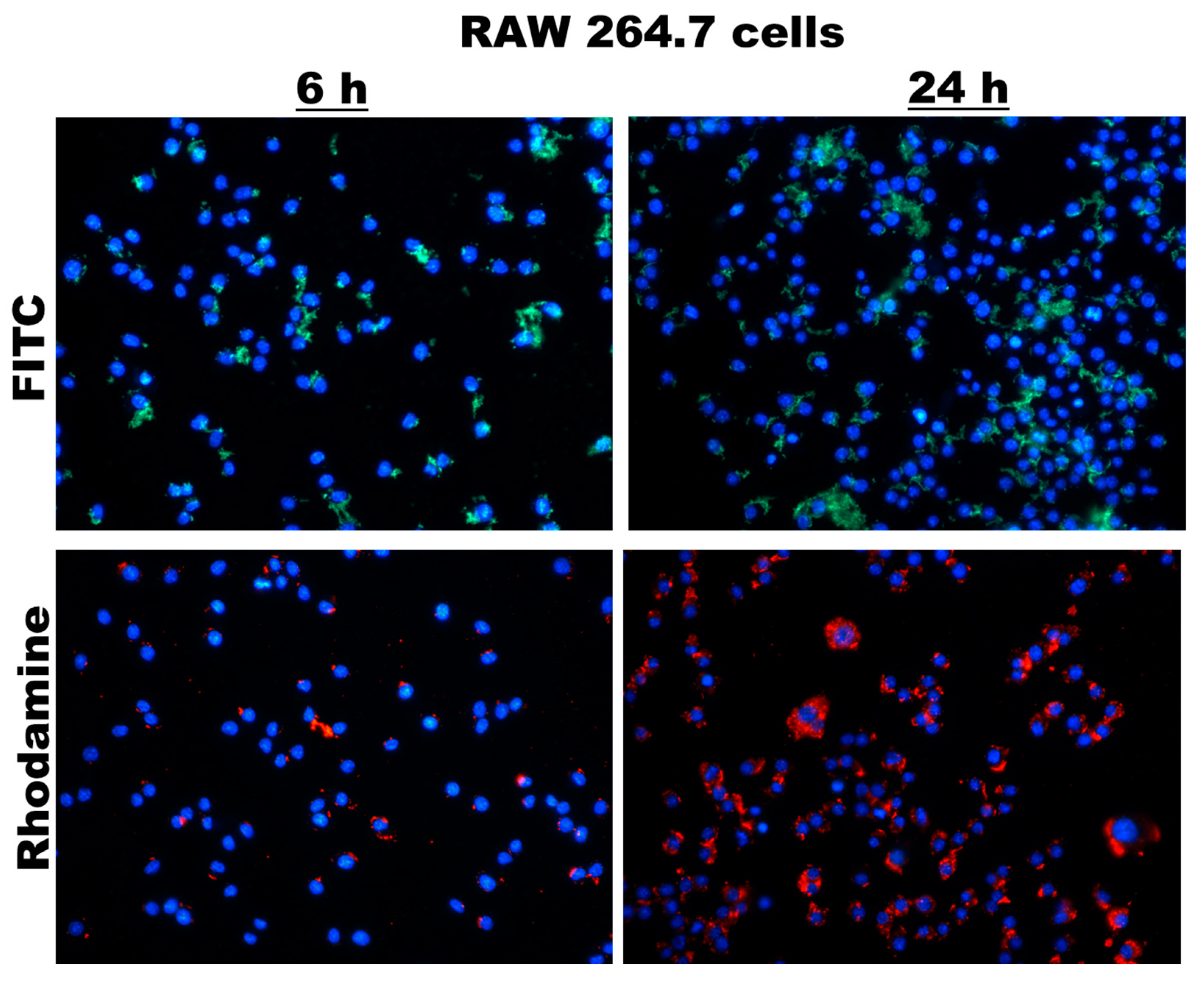
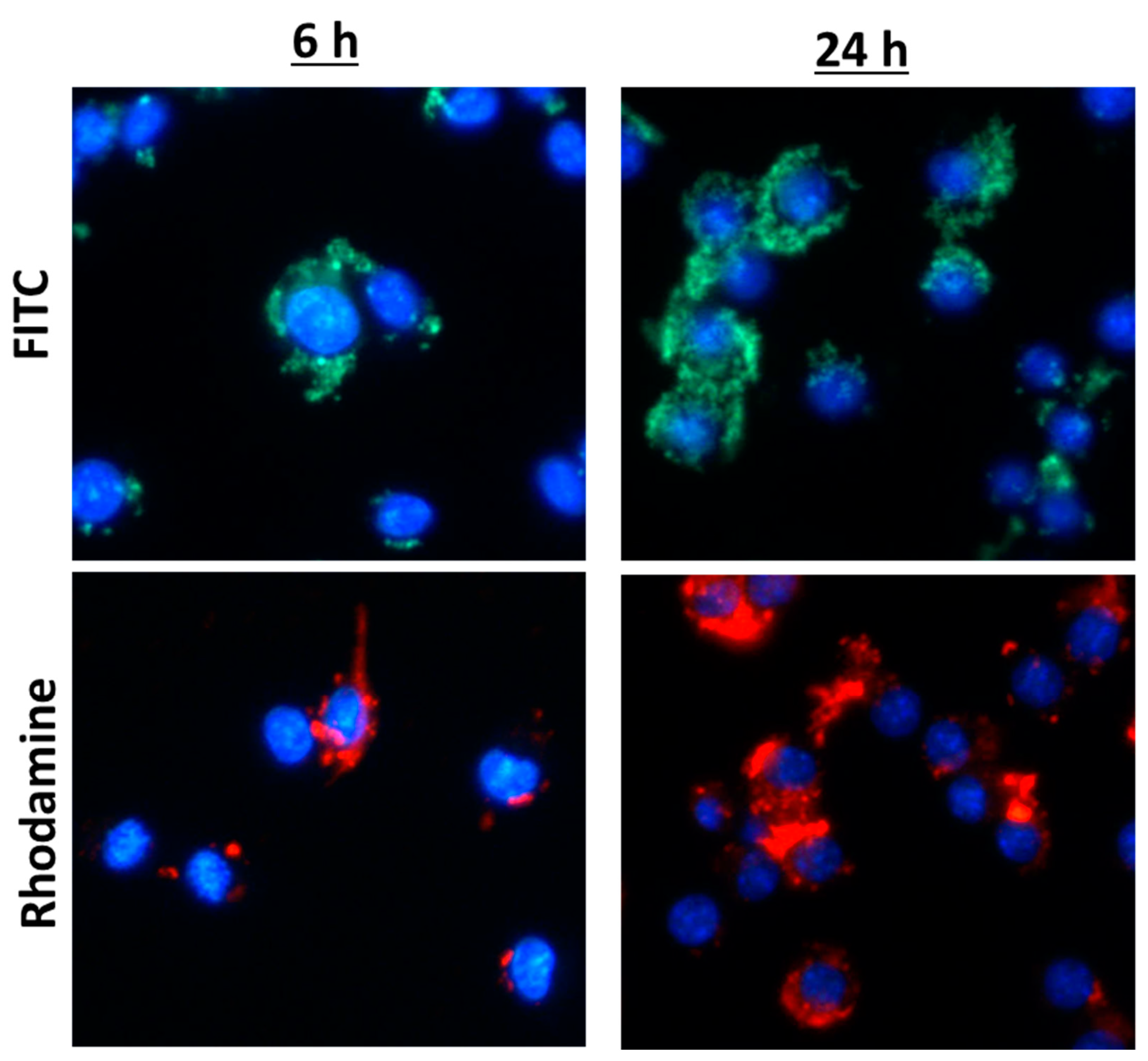
The cell viability (MTT assay) and lactate dehydrogenase activity were analyzed by spectrophotometric methods, while cellular uptake was observed by fluorescence microscopy. Our results showed that the exposure to CS-FITC and CS-RBITC NGs for 6 and 24 h did not induce significant changes to RAW 264.7 and A20 cells compared to control, proving a good nanogel biocompatibility for both cell lines. In addition, the fluorescence microscopy showed that cellular uptake was quite rapid and efficient for the NGs tested (Figure 1).
Figure 1. Fluorescence images showing the nuclei of RAW 264.7 cells stained in blue with DAPI solution and the nanogels having rhodamine or fluorescein isothiocyanate (FITC) molecules grafted on chitosan backbone.

4. Conclusions

Taking all of these into consideration, we can conclude that all types of nanohydrogels were biocompatible, being internalized in both cell types with predominantly cytoplasmic localization.

Funding

This work was supported by a grant of the Romanian Ministry of Research and Innovation, CCCDI—UEFISCDI, project number PN-III-P3-3.1-PM-RO-FR-2019-0204/6 BM/2019, within PNCDI III.

Conflicts of Interest

The authors declare no conflict of interest. The funders had no role in the design of the study; in the collection, analyses, or interpretation of data; in the writing of the manuscript, or in the decision to publish the results.
Publisher’s Note: MDPI stays neutral with regard to jurisdictional claims in published maps and institutional affiliations.

Article Metrics

Citations

Article Access Statistics

Multiple requests from the same IP address are counted as one view.