Abstract
Utility management demands two basic functions for an optimal automation scenario, which are monitoring and control. Here, we report a novel approach utilizing free spectrum communication technology and the Internet of Things (IoT) framework for Water Distribution Network (WDN) management. We make use of an architecture combining the free spectrum protocols included in the ISM (Industrial, Scientific, and Medical) radio band, along with cloud-based data management. The main aspects of the developed system are user-friendly operation and control, along with reliable and fault-free operation. In this paper, we discuss, in detail, the architecture, hardware design, and software applications associated with the IoT-based wireless monitoring and control of WDNs.
1. Introduction
Water Distribution Networks need to be monitored continuously for maintaining the efficient operation of water supply systems. For this, we need to observe and analyze the critical parameters within the WDN, such as the flow, pressure, and water levels in reservoirs. Efficient monitoring helps in identifying leaks in the system, which can lead to water loss and contamination, where the end user will be denied a reliable and safe water supply. A proper monitoring system can also prevent major system failures to some extent. In addition, real-time data from the monitoring system can help produce effective and swift responses in case of failures. The exact extent of monitoring is still not widespread globally, especially in low- and middle-income countries, while developed nations have already implemented advanced technologies for WDN monitoring [1,2].
Control systems for WDNs are also essential as they regulate and optimize the operations of the water network. Proper flow ensures efficient distribution, while pressure control helps in preventing damage to the pipelines. Proper control mechanisms also help in optimizing energy usage by regulating pump operations based on the demand. Maintenance and repairs also rely greatly on proper control mechanisms as they help in isolating faults and minimizing disruptions.
2. Related Work
There have been many studies related to IoT-based WDN monitoring. Radhika et.al. [3] proposed a system which monitors the level and flow in a water network along with quality parameters, like the pH, turbidity, and temperature. The paper focused on taking measures to avoid issues arising from water leakage and pipe breakage. There have also been many studies using IoT-based quality monitoring in water networks. Zulkifli et al. [4] developed a real-time automated water quality monitoring system for measuring the pH, temperature, ammonia, and nitrate level of water. We have demonstrated technologies which are focused on IoT-based WDN monitoring technologies, implemented for ensuring equitable supply and the estimation of unknown parameters from non-intrusive measurements [5].
3. Proposed Framework
3.1. Architecture of WDN Monitoring and Control System
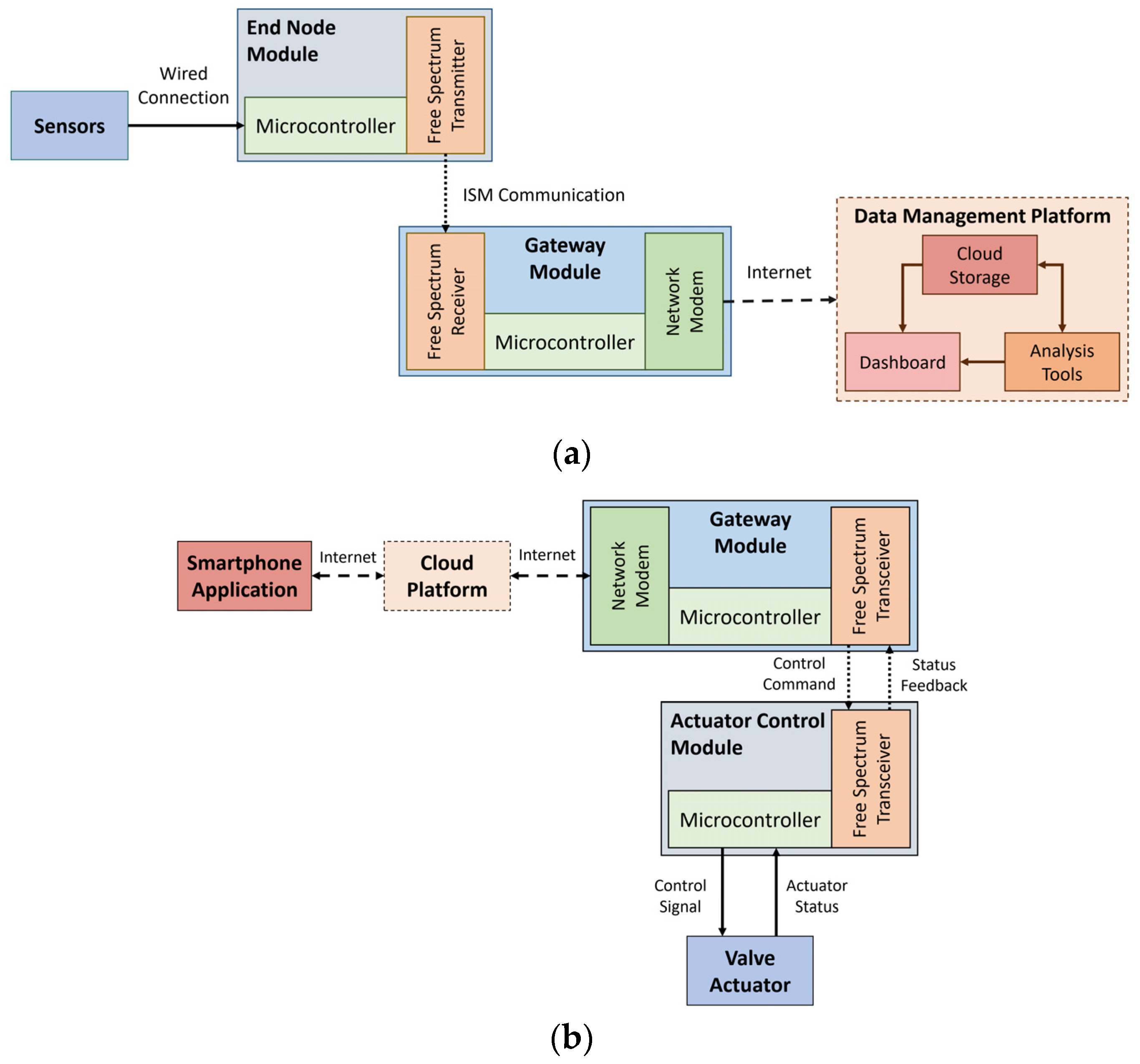
The WDN monitoring system shown in Figure 1a consists of a microcontroller interfaced with sensors measuring parameters like the water level. The free spectrum transmitter transmits the measured data to the receiver gateway, which updates the cloud-based data management platform using a network modem. The data management platform consists of cloud storage, a dashboard, and real-time data analysis tools for managing the received data. Figure 1b shows the architecture used for the WDN control scenario, which performs valve operations for controlling the flow of water into various sections of the network. Here, we make use of an android-based application for controlling the opening and closing of the valve, along with observing the status of the valve.
Figure 1.
Architecture: (a) WDN monitoring system; (b) WDN control system.
The application was made by using the MIT App Inventor tool by Massachusetts Institute of Technology, USA. The application communicates directly with the cloud platform, which, in turn, sends the control command to the gateway through the internet. The gateway sends the control signal to the actuator control module through the free spectrum transceiver module, which open or close the valves using an electrical motor connected to the valve. The valve position or status is sent back through the control module to the gateway, which, in turn, is updated at the cloud platform. The end user application reads the status from the cloud platform and displays the same for the user.
3.2. Hardware and Software Designs
The monitoring system mainly consists of sensors for monitoring the level of water in the tanks and sumps. MB Series Ultrasonic sensors (Maxbotix Inc., Brainerd, MN, USA, sourced locally from vendors in India) and hydrostatic pressure-based sensors (DFRobot, Shanghai, China, sourced locally from vendors in India) were used for the level readings. The microcontrollers used for the end nodes were based on ATMega328 (Atmel Corporation, San Jose, CA, USA, sourced locally from vendors in India) and ESP8266 (Espressif Systems, Shanghai, China, sourced locally from vendors in India) boards. Arduino IDE (Version 2.3.2, Arduino, Ivrea, Italy, first introduced in 2005) was used for all hardware programming. An HC-12 free spectrum communication module (Huicheng Technology, Guangdong, China, sourced locally from vendors in India) was used for data telemetry from the end node devices to the gateway. Data management was performed using the ThingSpeak data management platform (Mathworks Inc., Natick, MA, USA, originally launched in 2010 by ioBridge Inc., Gainesville, FL, USA). ThingSpeak takes care of data storage, has an integrated dashboard for visualization, and includes different data analysis tools like the MATLAB analysis tool (inbuild feature in ThingSpeak) for real-time data analysis. ThingSpeak also support data export and import using API keys, which help in viewing the data using custom build web and mobile applications.
4. Field Implementation and Results
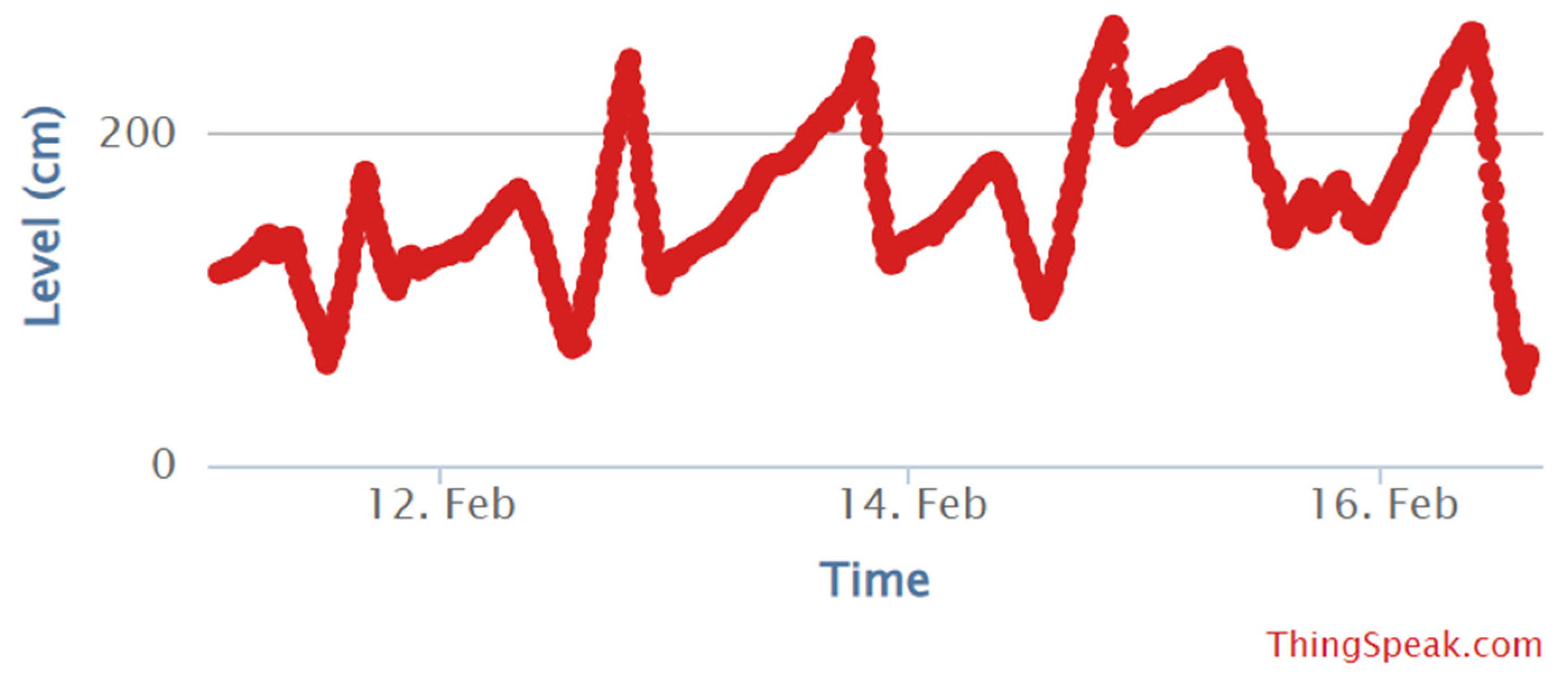
The WDN monitoring system has been implemented in the IIT Madras academic campus at various locations, which includes overhead tanks on buildings, groundwater sumps, domestic households, etc. Real-time level data are being recorded using ThingSpeak, and the data are used to identify patterns in the system. The level data along with vibration data from the pipelines are used to estimate and quantify the flow of water without using the traditional flow sensors. Figure 2 shows a data dashboard field in ThingSpeak platform showing real-time level data. The vibration data acquired from pipes using gyroscope sensors were found to be effective in determining the flow through the pipelines when used in association with the level data from reservoirs.
Figure 2.
Dashboard showing variation in groundwater sump level using hydrostatic level sensor.
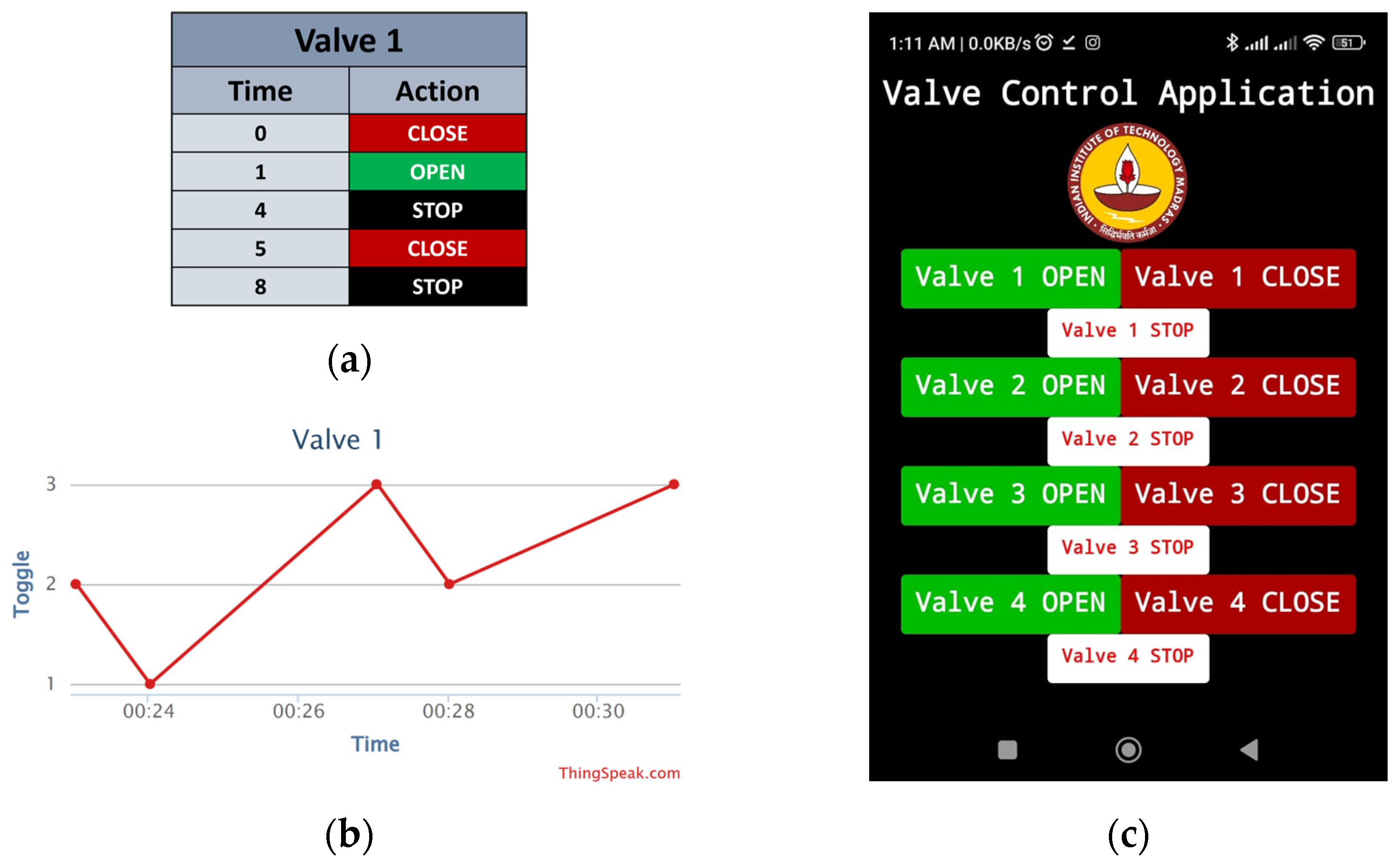
The WDN control system was implemented on the IIT Madras water supply network, where the existing valves were retrofitted with electrical actuators. An android application, as shown in Figure 3c, was developed for the end user, which contains the on-screen buttons for the opening and closing of the valves. It also has an emergency stop button to shut off any valve operation. Figure 3a shows a schedule for valve operation with the corresponding change in the values in the cloud data platform. We assigned a particular toggle value for each state of the valve, like ‘1’ for ‘OPEN’, ‘2’ for ‘CLOSE’, and ‘3’ for ‘STOP’. According to button pressing in the android application, the toggle values change in the ThingSpeak field corresponding to the valve, as shown in Figure 3b, and this, in turn, triggers the actuator control module to take the respective control action.
Figure 3.
(a) Valve control schedule. (b) Valve status toggle graph in ThingSpeak. (c) Android application for valve control.
5. Conclusions
In this work, we proposed and implemented an IoT-based WDN monitoring and control system using free spectrum communication technologies. Unlike monitoring systems, which have been studied widely, there are few IoT-based control strategies developed for WDNs. The cloud-based valve control system was found to be effective and user-friendly, thus making it a suitable alternative for the traditional practices. The reasonably wide range of HC-12 free spectrum communication, along with the support for multiple channels, makes the system robust and applicable over a larger geographical area. The system is also scalable in a manner which is feasible technically and economically.
Author Contributions
Conceptualization, R.R. and S.N.; methodology, R.R.; software, R.R.; validation, R.R. and S.N.; formal analysis, R.R.; investigation, R.R. and S.H.P.R.; resources, R.R. and S.N.; data curation, R.R.; writing—original draft preparation, R.R.; writing—review and editing, S.N.; visualization, R.R.; supervision, S.N.; project administration, R.R. and S.N.; funding acquisition, S.N. All authors have read and agreed to the published version of the manuscript.
Funding
This research was supported by the Robert Bosch Center for Data Science and Artificial Intelligence, IIT Madras, project number CR1920CH1061RBCX008328, and the Department of Science and Technology, Water Technology Initiative, Government of India, grant number DST/TM/WTI/2K17/39.
Institutional Review Board Statement
Not applicable.
Informed Consent Statement
Not applicable.
Data Availability Statement
Data are not available publicly since the database is maintained privately by the Indian Institute of Technology Madras, Chennai.
Acknowledgments
We acknowledge the support provided by IIT Madras.
Conflicts of Interest
Author Sri Hari Prasath R. was employed by the company IITM Pravartak Technologies. The remaining authors declare that the research was conducted in the absence of any commercial or financial relationships that could be construed as a potential conflict of interest.
References
- The United Nations World Water Development Report 2021: Valuing Water—UNESCO Digital Library. Available online: https://unesdoc.unesco.org/ark:/48223/pf0000375724 (accessed on 26 March 2024).
- The United Nations World Water Development Report 2023: Partnerships and Cooperation for Water—UNESCO Digital Library. Available online: https://unesdoc.unesco.org/ark:/48223/pf0000384655 (accessed on 26 March 2024).
- Radhika, V.; Srinivasa, K.; Ramya, R.; Sharmila, B.B. IoT-Based Water Quality and Quantity Monitoring System for Domestic Usage. In Immersive Technology in Smart Cities Augmented and Virtual Reality in IoT; Aurelia, S., Paiva, S., Eds.; EAI/Springer Innovations in Communication and Computing; Springer: Cham, Switzerland, 2021; pp. 205–227. ISBN 978-3-030-66607-1. [Google Scholar]
- Zulkifli, C.Z.; Garfan, S.; Talal, M.; Alamoodi, A.H.; Alamleh, A.; Ahmaro, I.Y.Y.; Sulaiman, S.; Ibrahim, A.B.; Zaidan, B.B.; Ismail, A.R.; et al. IoT-Based Water Monitoring Systems: A Systematic Review. Water 2022, 14, 3621. [Google Scholar] [CrossRef]
- Raphael, R.; Narasimhan, S. Data Driven Monitoring of IOT Enabled Water Distribution Networks. In Proceedings of the 2nd WDSA/CCWI Joint Conference, Valencia, Spain, 7 June 2022. [Google Scholar]
Disclaimer/Publisher’s Note: The statements, opinions and data contained in all publications are solely those of the individual author(s) and contributor(s) and not of MDPI and/or the editor(s). MDPI and/or the editor(s) disclaim responsibility for any injury to people or property resulting from any ideas, methods, instructions or products referred to in the content. |
© 2024 by the authors. Licensee MDPI, Basel, Switzerland. This article is an open access article distributed under the terms and conditions of the Creative Commons Attribution (CC BY) license (https://creativecommons.org/licenses/by/4.0/).