


Abstract
Brunei aims to achieve 600 of renewable energy by 2035. Since the country has high solar radiance throughout the year, solar energy is the most feasible. However, the high cost of producing solar farms remains an obstacle and caused the country’s progress towards the goal to fall behind schedule. Thus, this study aims to show the beneficial costs of investing in residential rooftop solar farms instead. This study calculated the optimal PV system sizes based on the residential load profiles (at only 10% of total consumption) and the available detached housing plans. After that, the costs of the optimal PV system sizes are estimated and then projected to the number of detached houses nationwide, which is 49,872 houses. The research found that the optimal rooftop off-grid PV system size for the average resident is 15.3 , with an inverter of 12.0 and a nominal battery size of 20 . The net present cost of one optimal PV system is BND49,108 for 20 years of lifetime. If all the detached houses in the country are utilized to install solar panels, the total solar capacity is 763 , costing BND2.4 billion without involving the homeowners’ funds. Comparing this budget to conventional solar farms such as Tenaga Suria Brunei, the country can save BND10.3 billion. The study shows that Brunei may need to consider the benefits of investing more in residential rooftop solar farms due to savings in potential costs and only using the readily available rooftop space.
1. Introduction
According to [1], about 59.5% of Bruneian households live in detached houses. The houses in Brunei are typically spacious, and the roofs are typically gable styles, the most common roofs having two sections slanting downwards. The roofs of these houses can be utilized to install solar panels. It may bother the residents; however, due to the high electricity consumption of the residential sector [2,3,4], the residents may need to adapt to using solar PV systems to meet at least a fraction of the high electricity consumption. Furthermore, the country’s electricity is primarily generated by natural gas, negatively affecting the environment [5]. However, due to the high investment costs demonstrated in [6], Brunei may need to step up to catalyze the implementation of residential rooftop PV systems. Since the country is targeting achieving 200 by 2025, 600 by 2035, and 1200 by 2050 [7], Brunei should investigate financing in residential rooftop solar farms due to the available rooftop area and how no land would need to be cleared to install the solar farms. Hence, this study investigated the potential cost benefits of investing in residential rooftop solar farms. There were a few research questions that needed to be answered, which are as follows:
- What total solar capacity can be installed by utilizing the residential rooftop area?
- Compared with conventional solar farms, what is the impression of the total costs of utilizing all the detached houses in the country?
2. Methodology
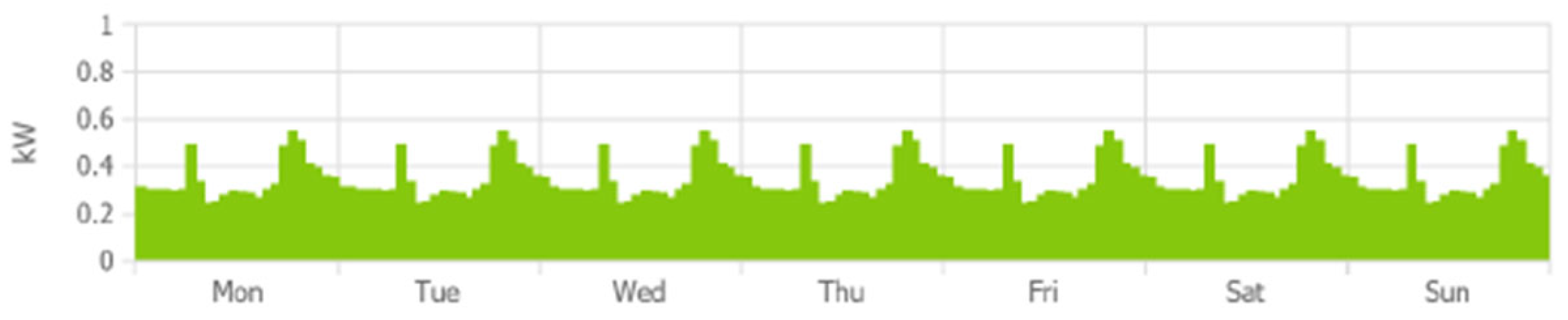
This study used the free software Sunny Design [8] to calculate the optimal PV system sizing based on the residential load profiles [9]—only 10% of the total load was considered due to the high consumption. Since the building plans from the Rancangan Perumahan Negara (National Housing Scheme) are available [8], this research used the measurements to estimate the maximum number of panels installed on the roofs. This study only considered detached houses. Figure 1 shows the average residential load profile used on Sunny Design at a 10% fraction of the total daily load.
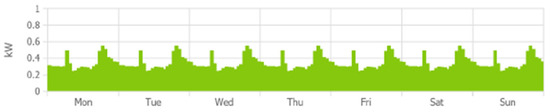
Figure 1.
Average Bruneian residential 10% load in a week.
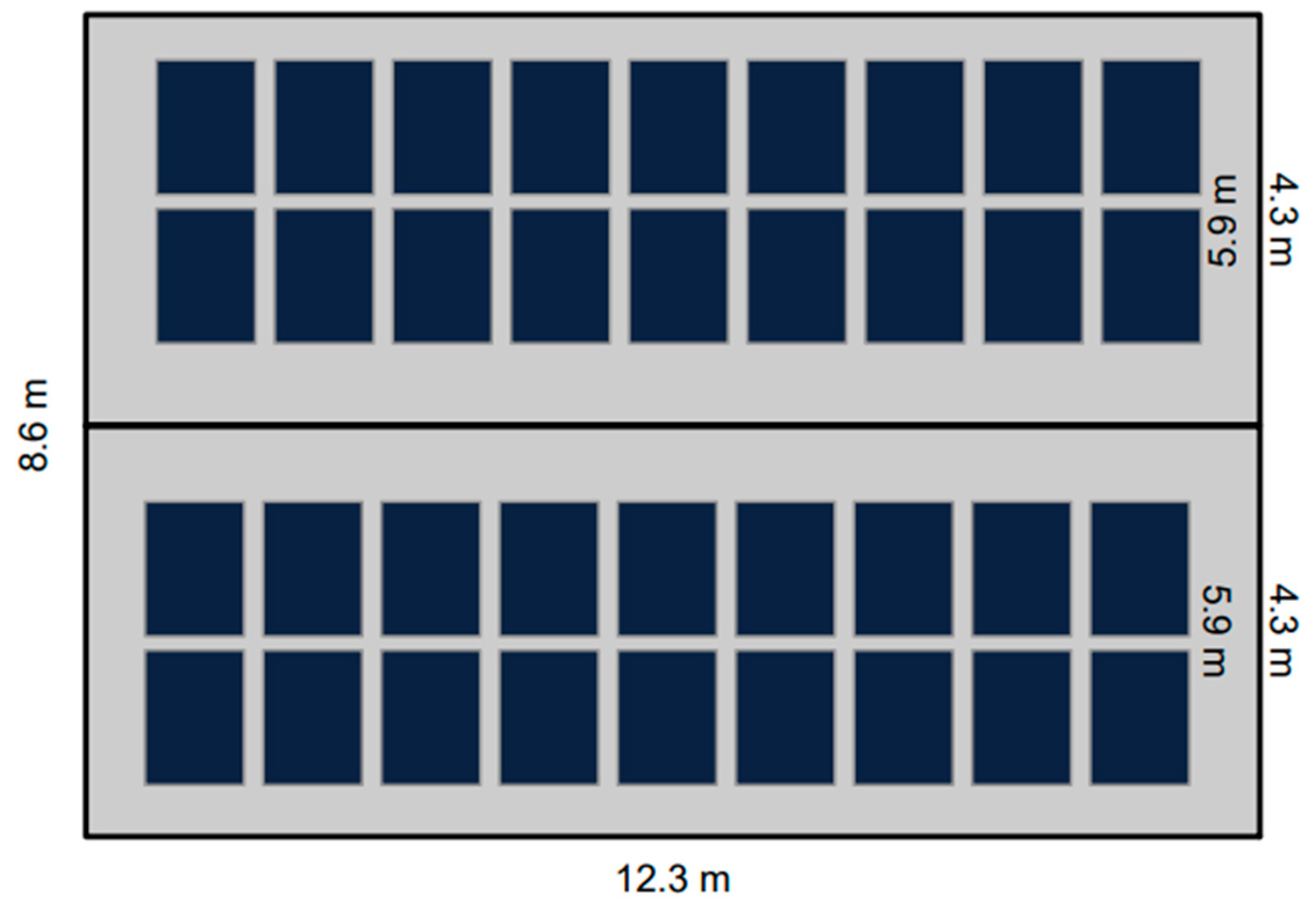
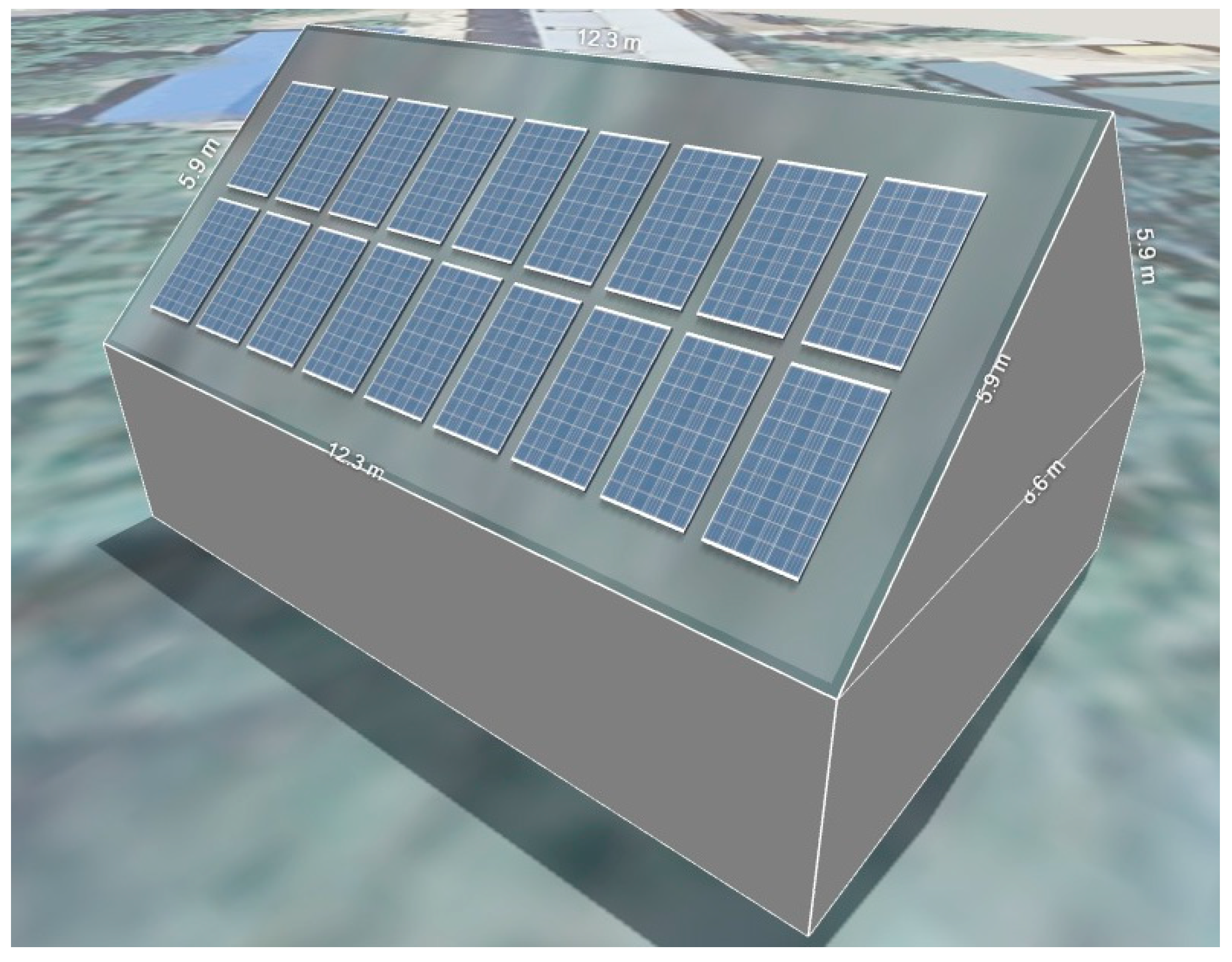
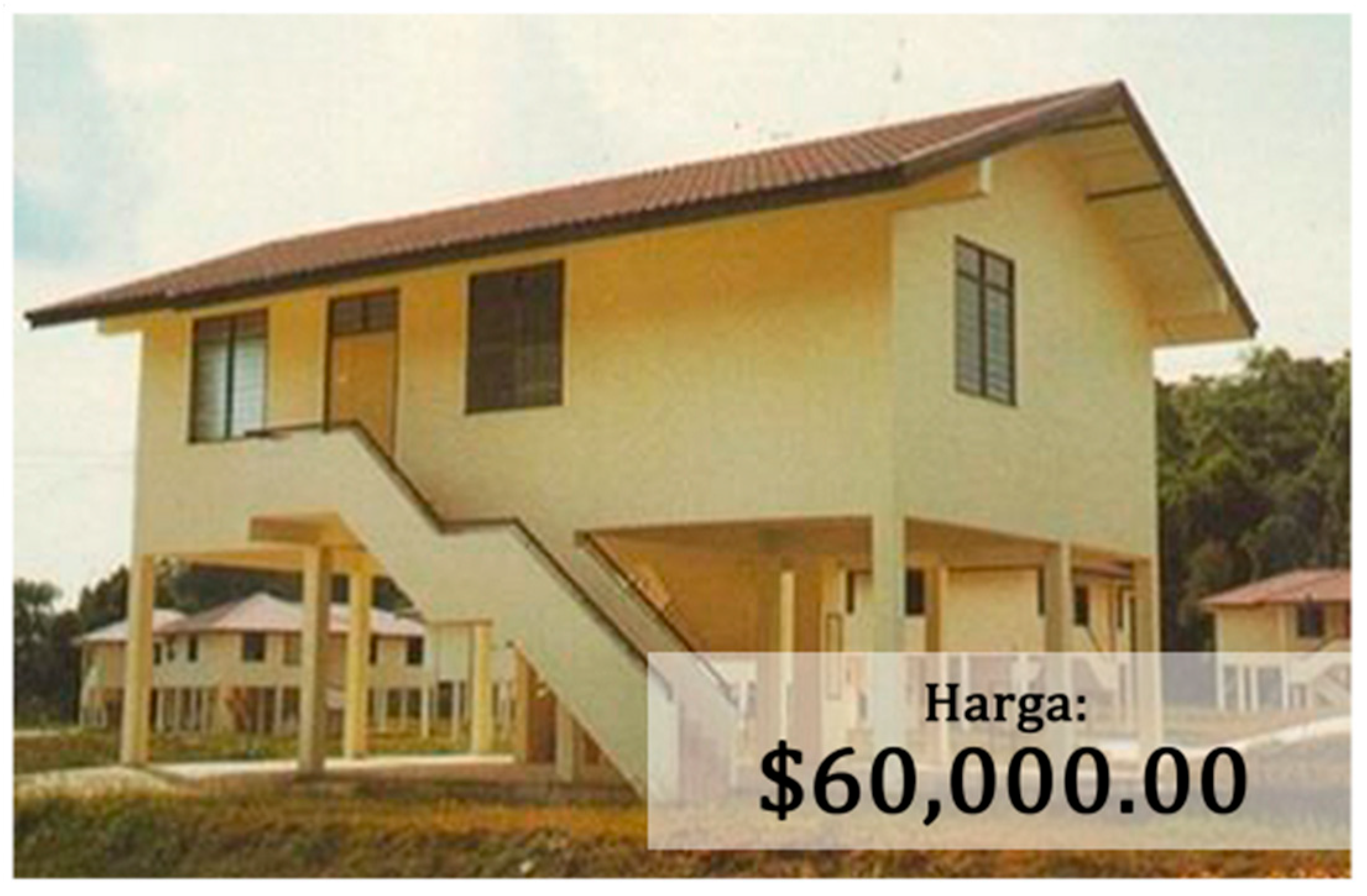
After keying in the load profiles, the next step was to create a residential building to visualize the placements of the solar panels. Then, the total solar capacity was calculated while placing the optimal number of PV panels on the roofs. Both sides of the roofs were used to support the panels, as shown in Figure 2 and Figure 3. Figure 4 shows the example of a detached house from the National Housing Scheme based in a housing area called Lambak Kanan.
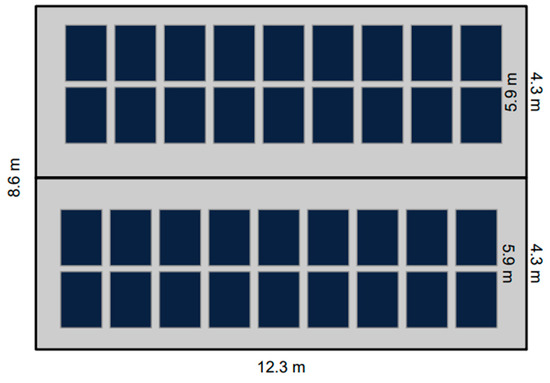
Figure 2.
Top-view of the solar panels’ placements.
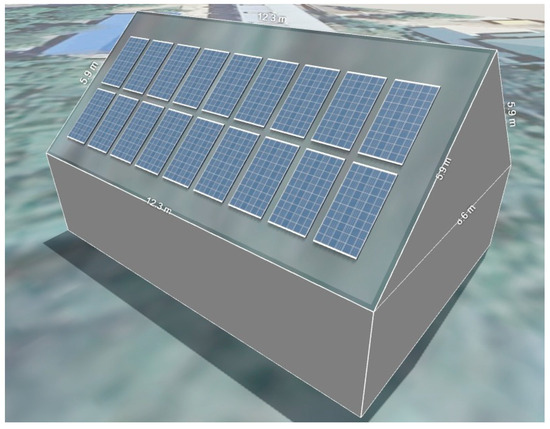
Figure 3.
Placements of the solar panels on the roofs in 3D view.
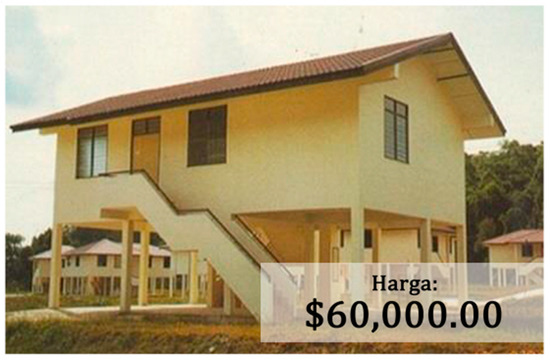
Figure 4.
An example of a detached house from Lambak Kanan [8].
After calculating the maximum available solar panels that can be placed on the rooftops, the software calculated the optimal inverter and battery sizes. Table 1 shows the PV components’ specifications used in the calculations performed on Sunny Design. The estimated lifetime of the system is 20 years. Since solar panels usually last 20–25 years, the replacement cost will be zero in this study. Meanwhile, the inverter must be replaced every 10 years, so in this study, the inverter will be replaced once.
On the other hand, this study’s lead–acid battery has an estimated lifetime of 5 years [10]. Therefore, the batteries would need to be replaced 3 times during the system’s lifetime. An additional cost is added to the software, about BND4500 [6]. After the optimal PV system sizes are calculated, the results are projected to the number of detached households in 2021 [11]. Tenaga Suria Brunei, with a capacity of 1.2 and a cost of BND20 million [12], was used a reference for how much Brunei can save by installing residential solar farms.

Table 1.
Summary of the PV components’ specifications and estimated cost.
Table 1.
Summary of the PV components’ specifications and estimated cost.
| Component | Model | Specifications | Cost (BND) | |
|---|---|---|---|---|
| PV Panel | SMA Demo Poly 5-425W [13] | Material Module Efficiency Maximum Power, Maximum Power Point Voltage, Maximum Power Point Current, Lifetime | Polycrystalline 16.6% 425 20 years | 153 |
| Inverter | SMA SB 2.0-1VL-40 [14] | Maximum PV Output, Maximum Efficiency Lifetime | 97.2% 10 years | 1150 |
| Lead–Acid Battery | SMA Sunny Island 4548- US [10] | Nominal Capacity Maximum Capacity Nominal Voltage Roundtrip Efficiency Lifetime | 96% 5 years | 200 |
3. Results
3.1. Optimal Residential Rooftop PV System Size and Costs
After all the calculations were completed on Sunny Design, the optimal sizes’ costs were estimated using the costs from [6,10,13,14,15]. Table 2 shows the optimal PV system sizes. Based on the average residential load profile and at a 10% consumption level, the optimal PV panel is 15.3 . According to the simulation design, all these panels can fit on the roofs of the average detached houses in Brunei. The costs of the solar panels are estimated to be BND5508, including the additional installation cost [6]. The calculated optimal size for the inverter is 12 which costs BND13,800. Since its replacement occurs only once, the replacement cost is also BND13,800, including the installation cost estimated in [6]. The optimal battery size is calculated to be 20 , which has an initial cost of BND4000. Since the replacement needs to be carried out thrice during the system’s lifetime, the total replacement cost is BND12,000, as shown in Table 2.
Table 2.
Optimal PV system sizes and costs.
The software also calculated the output of the optimal PV system, and the results are shown in Table 3. The maximum output energy of the system is 18,702 per year. However, only 3711 of the generated electricity can be used by a household. The household may consume about 1239 kWh directly from the system in a year, and about 2472 can be stored. The total usable energy by the system is calculated to exceed the annual consumption of the household, 2971 . Hence, it can be assumed that the calculated optimal PV system size is feasible for the average household.
Table 3.
Energy distribution as calculated by Sunny Design.
3.2. Projection of Residential Solar Capacity Nationwide
After calculating the optimal PV system size for the average Bruneian household that lives in detached houses, the capacity and the costs were then projected to the total number of detached occupied houses in the country. Brunei has four districts: Brunei-Maura, Tutong, Belait, and Temburong. The optimal PV system’s capacity and costs were projected using the number of households in each district. Table 4 shows the costs and the projection of solar capacity for each district and the total costs and capacity nationwide. The total solar capacity that can be generated for Brunei-Muara, Belait, Tutong, and Temburong are 527 , 121 , 94 , and 20 , respectively, which cost BND1.7 billion, BND0.4 billion, BND0.3 billion, and BND0.06 billion for each district. The total solar capacity nationwide is 763 which costs BND2.4 billion. If Brunei wants to invest in the same solar capacity but in conventional solar farms, the cost would be around BND12.7 billion. Investing in residential rooftop solar farms would save Brunei around BND10.3 billion.
Table 4.
Projection of total residential PV systems and net present costs nationwide.
4. Conclusions
This study investigated the costs and benefits of investing in residential solar farms. The optimal residential rooftop PV system size for one household was 15.3 , with an inverter of 12.0 and batter size of 20 , calculated using Sunny Design. As found in the study, the calculated optimal PV system size is feasible for a household as the usable energy from the PV system, 3711 , exceeds the annual consumption of the average household, 2971 . The net present cost of the PV system was found to be BND49,108 for 20 years. By projecting the capacity and costs of one optimal PV system to the total detached houses in the country, 49,872, the study calculated that the total capacity of the residential rooftop solar farms would be 763 , achieving 163 more than the national target of 600 by 2035. The cost to achieve this capacity is BND2.4 billion. However, suppose the country invests in rooftop solar farms instead of conventional ones. The nation can save a budget of BND10.3 billion. This study concluded that investing in residential rooftop solar farms is worth considering.
Author Contributions
Conceptualization, N.H. and N.A.M.; methodology, N.H.; software, N.H.; formal analysis, N.H. and N.A.M.; investigation, N.H.; resources, N.H.; data curation, N.H.; writing—original draft preparation, N.H.; writing—review and editing, N.H. and N.A.M.; visualization, N.H.; supervision, N.A.M. and R.P.; project administration, N.A.M. and R.P. All authors have read and agreed to the published version of the manuscript.
Funding
This research received no external funding.
Institutional Review Board Statement
Not applicable.
Informed Consent Statement
Not applicable.
Data Availability Statement
Data are unavailable due to privacy or ethical restrictions.
Conflicts of Interest
The authors declare no conflict of interest.
References
- The Population and Housing Census Report (BPP) 2021: Demographic, Household and Housing Characteristics. Available online: https://deps.mofe.gov.bn/DEPD%20Documents%20Library/DOS/POP/2021/RPT.pdf (accessed on 23 September 2023).
- ERIA and BNERI. Brunei Darussalam Energy Consumption Survey: Residential and Commercial and Public Sectors. 2020. Available online: https://www.eria.org/publications/brunei-darussalam-energy-consumption-survey-residential-and-commercial-and-public-sectors/ (accessed on 14 September 2023).
- Electric Power Consumption (kWh per Capita)—Brunei Darussalam|Data. Available online: https://data.worldbank.org/indicator/EG.USE.ELEC.KH.PC?locations=BN (accessed on 6 June 2022).
- Energy Efficiency Measures to Decarbonize Brunei’s Building Environment. ASEAN Centre for Energy, 22 April 2022. Available online: https://aseanenergy.org/energy-efficiency-measures-to-decarbonise-bruneis-building-environment/(accessed on 14 September 2023).
- Brunei Darussalam Energy Sector. ASEAN-German Energy Programme (AGEP). Available online: https://agep.aseanenergy.org/country-profiles/brunei-darussalam/brunei-energy-sector/ (accessed on 23 September 2023).
- GUIDEBOOK—SOLAR PV ROOFTOP and Net-metering Programme. March 2022. Available online: https://www.energy.gov.bn/Shared%20Documents/Resources/SOLAR%20PV%20GUIDEBOOK%20ENG.pdf (accessed on 19 September 2023).
- ACE Co-hosted Brunei Mid-Year Conference and Exhibition (MYCE) 2023—Energy Seminar. ASEAN Centre for Energy, 26 July 2023. Available online: https://aseanenergy.org/ace-co-hosted-brunei-mid-year-conference-and-exhibition-myce-2023-energy-seminar/(accessed on 7 September 2023).
- SUNNY DESIGN. Available online: https://www.sunnydesignweb.com/sdweb/#/ (accessed on 22 September 2023).
- Hamdani, N.; Muhamad, N.A.; Petra, R.; Peng, A.S. Study on the Residential Load Profiles in Brunei Darussalam Based on Income and Location. Energy Rep. 2022, 9, 737–747. [Google Scholar] [CrossRef]
- Sunny Island 4548-US/6048-US|SMA Solar. Available online: https://www.sma.de/en/products/battery-inverters/sunny-island-4548-us-6048-us (accessed on 23 September 2023).
- Brunei Darussalam Statistical Yearbook 2022. [Online]. Available online: https://deps.mofe.gov.bn/DEPD%20Documents%20Library/DOS/BDSYB/2022/RPT.pdf (accessed on 23 September 2023).
- ‘Tenaga Suria Brunei—Brunei’s Very Own Solar Farm|SolarBrunei.com’. Available online: https://solarbrunei.com/2015/11/19/tenaga-suria-brunei-bruneis-very-own-solar-farm/ (accessed on 24 December 2022).
- ENF Ltd. Available online: https://www.enfsolar.com/pv/panel-datasheet/crystalline/42214 (accessed on 23 September 2023).
- SUNNY BOY 1.5/2.0/2.5—The best standard for small PV systems. Available online: https://www.europe-solarstore.com/download/sma/sunnyboy/SMA-Sunny-Boy-1.5-2.0-2.5-Data-Sheet.pdf (accessed on 23 September 2023).
- Kebede, A.A.; Coosemans, T.; Messagie, M.; Jemal, T.; Behabtu, H.A.; Van Mierlo, J.; Berecibar, M. Techno-economic analysis of lithium-ion and lead-acid batteries in stationary energy storage application. J. Energy Storage 2021, 40, 102748. [Google Scholar] [CrossRef]
Disclaimer/Publisher’s Note: The statements, opinions and data contained in all publications are solely those of the individual author(s) and contributor(s) and not of MDPI and/or the editor(s). MDPI and/or the editor(s) disclaim responsibility for any injury to people or property resulting from any ideas, methods, instructions or products referred to in the content. |
© 2023 by the authors. Licensee MDPI, Basel, Switzerland. This article is an open access article distributed under the terms and conditions of the Creative Commons Attribution (CC BY) license (https://creativecommons.org/licenses/by/4.0/).