


Abstract
Based on the blueprint for bilingual education as a national policy, teachers in technical and vocational schools are preparing, in full swing, to teach subjects in English. However, most teachers in the institutions do not have the skills and backgrounds to implement English-mediated instruction (EMI). Therefore, it is necessary to cultivate talents and popularize programs in technical and vocational education and educate talents to have bilingual ability. In addition, international mobility and internship experience in English is also required. The current environment needs to be improved for bilingual education, promoting that bilingual teaching is beneficial to students and teachers. Even though thus puts pressure on them for learning and teaching in technical and vocational schools, bilingual education is the future direction of education in Taiwan.
1. Introduction
In globalization and internationalization [1], communication skills and global perspectives are necessary to enhance a country’s competitiveness. Thus, the Taiwanese government instituted and implemented the National Policy for Bilingual Education in 2017. The purpose is to bolster bilingual education, improve the English proficiency of people through demand-driven learning, and eventually enhance the overall national competitiveness. To construct an English–Chinese bilingual country, the following goals are proposed: (1) “Comprehensively strengthen the English proficiency of Chinese people from the demand side”, (2) “Use digital technology to shorten the resource gap between urban and rural areas”, (3) “Take the bilingual policy and the development of mother tongue culture”, and (4) “Create the competitive edge of the younger generation”.
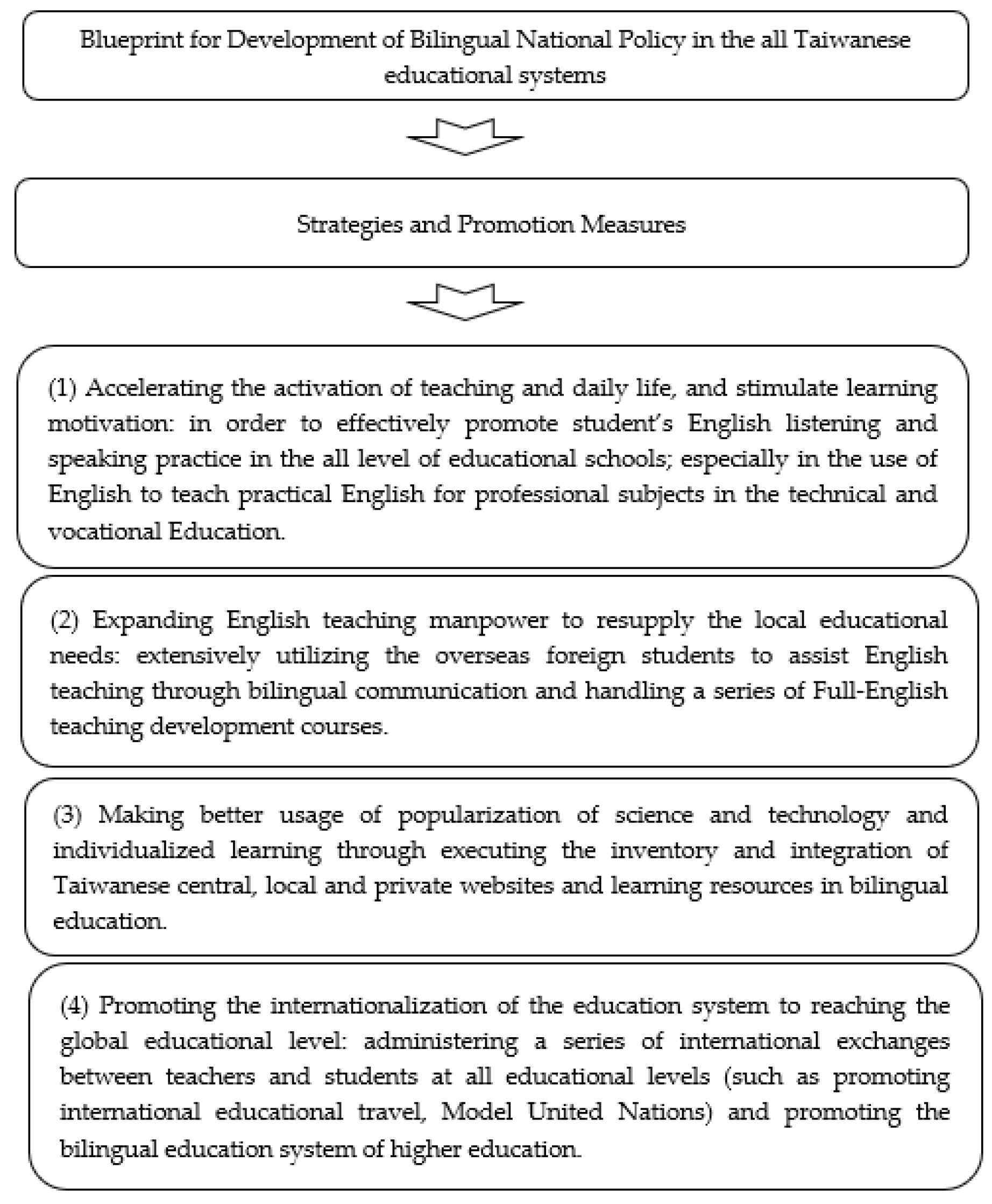
The difference between the previous bilingual policy and the new blueprint is to raise the overall competitiveness of the country and to improve the English proficiency of all Taiwanese. To achieve these goals, the educational environment needs to be constructed to promote the atmosphere of learning English for the whole Taiwanese population, especially students [2]. The government considers the demand and supply for bilingual education and realizes that creating high-quality employment opportunities on the demand side and cultivating talents and connecting them to the global society on the supply is critical for the success of the policy. Then, by connecting Taiwan’s industries and workforce to the global market, global business opportunities can be created, and global enterprises will invest in Taiwan to provide more employment opportunities [3]. For the policy, the Ministry of Education proposed five strategies and promotion measures, as shown in Figure 1.
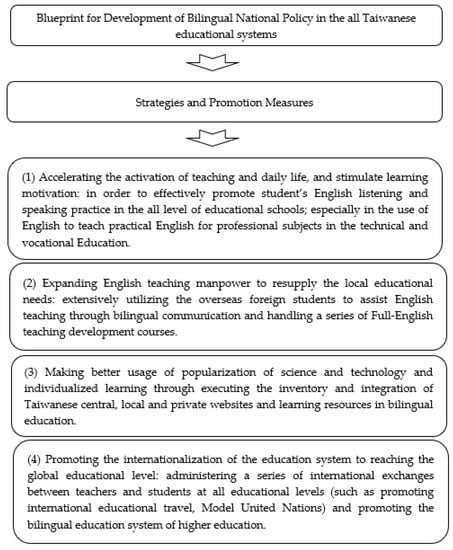
Figure 1.
Five strategies and promotion measures for bilingual education of the Taiwanese Ministry of Education.
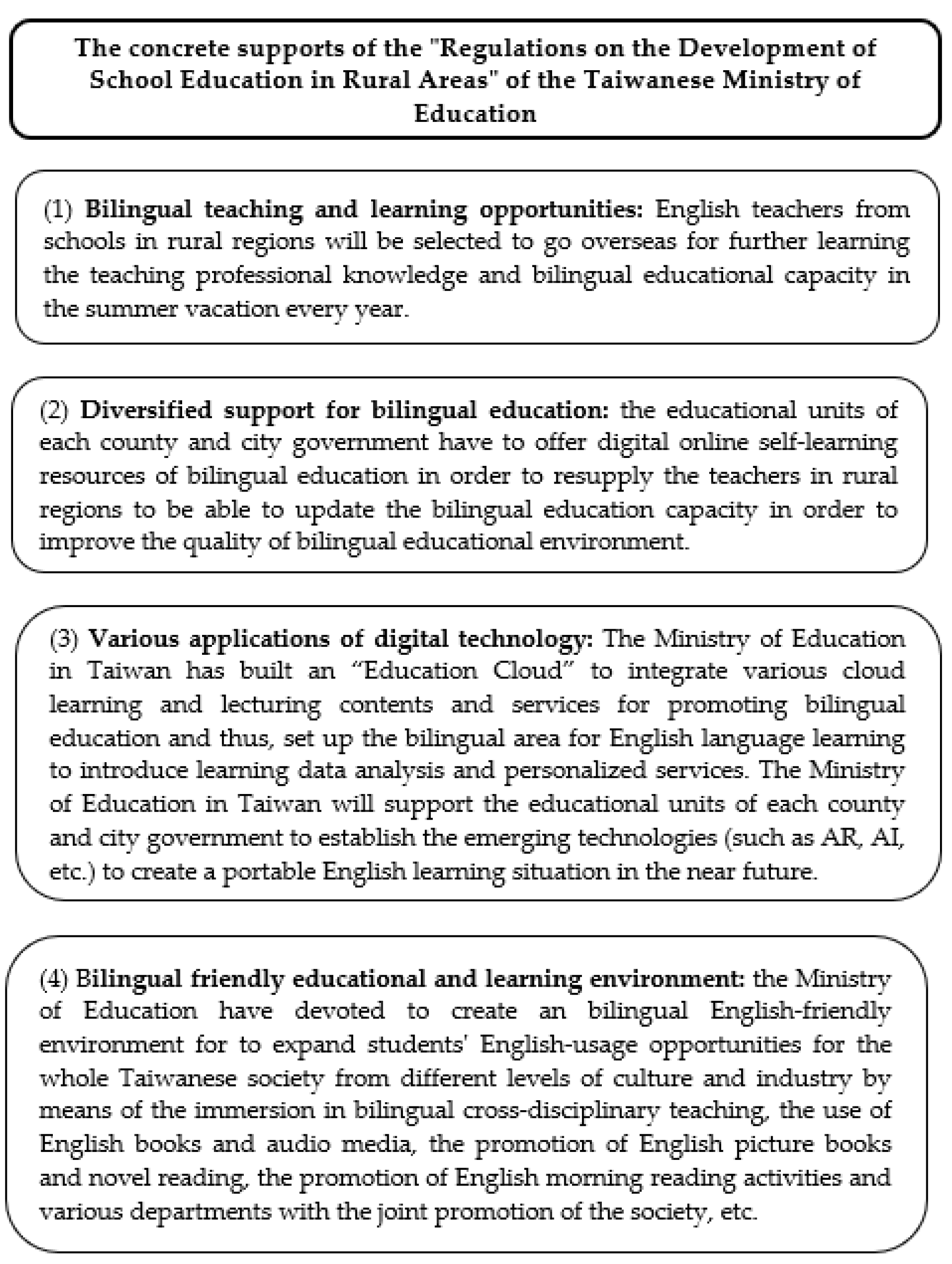
To diminish the urban–rural gap in English education for teachers and students [4], the Ministry of Education in Taiwan also presented the “Regulations on the Development of School Education in Rural Areas” to stabilize the source of teachers in rural regions, as shown in Figure 2.
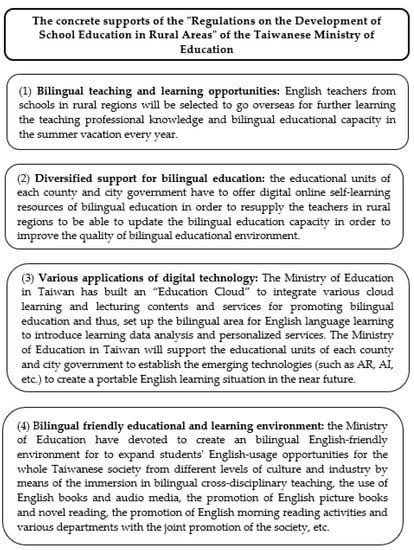
Figure 2.
Regulations on the development of school education in rural areas.
Based on the Blueprint for the Development of Bilingual National Policy, the Ministry of Education instituted the “Implementation Plan for All-English Teaching Teacher Training” in 2017 for enhancing the teachers’ capability of bilingual education in pre-service and in-service training at all levels of the education system, including elementary school, junior, and senior high schools, technical and vocation, and higher education [5]. By 2020, 21 higher education institutes operated bilingual education and training programs. Up to 2000 students were educated in a bilingual environment in four years. The number will increase to 3000 in eight years and to 5000 in twelve years. In English education, there must be a gap between urban and rural schools. To increase the number of students in bilingual education and narrow the gap between urban and rural schools, the Ministry of Education has put efforts to improve students’ abilities and strengthen their English skills by cooperating with ministries and departments so that students can use their bilingual ability in life and the workplace [6].
In Taiwan, technical and vocational education is relatively less supported than other higher education programs, as the majority of people think that a college diploma is mandatory for their children and technicians do not need higher degrees. Since 2021, the Ministry of Education allowed community colleges to award Bachelor’s degrees and waive military service for students to study abroad before the age of 30 years old. However, technical and vocational schools are not included in such benefits [7,8,9]. According to the statistics from the Ministry of Education in 2020, there were around 960,000 technical and vocational students in Taiwan, accounting for 62% of the total number of students. Unfortunately, the resources and funds from the Ministry of Education allocated to each technical and vocational student are only half of that of high school students. The resources for technical and vocational school students are only one-third of that of college or university students. The dominance of the government resource use for higher education is caused by distorted social values, while industries are not willing to support technical and vocational schools. The benefit of higher education drives students to lose interest in going to technical and vocational schools. In addition, only 1924 companies cooperated with institutions in 2020 [10].
Due to the lack of detailed planning, the establishment of standards in technical and vocational education was not strictly regulated, and the “Private School Law” was promulgated and implemented in 1985 to allow donations to start schools. The establishment of private schools is based on the concept of “investing in education”, but without enough resources and poor teaching quality and capacity. Under the influence of higher education on students, utilitarianism in educational administrators and the declining birth rate makes the enrollment quota of the technical and vocational schools exceed the total number of applicants since 2016. This situation caused criticism of the establishment of private technical and vocational schools [11,12,13,14,15]. However, the majority of students in the technical and vocational schools cannot enjoy the benefits of the Blueprint for the Development of Bilingual National Policy, as the schools have accepted students with lower academic performance due to academicism and utilitarianism. Nowadays, under the Blueprint for the Development of Bilingual National Policy, technical and vocational schools are facing their biggest challenge, which is bilingual teaching. The policy required teachers and students in the schools to have more English teaching and learning [16,17,18]. Teachers and students have to have professional knowledge of the original technical and vocational majors and continuously improve their English skills. Therefore, teachers must try bilingual teaching of subjects and English.
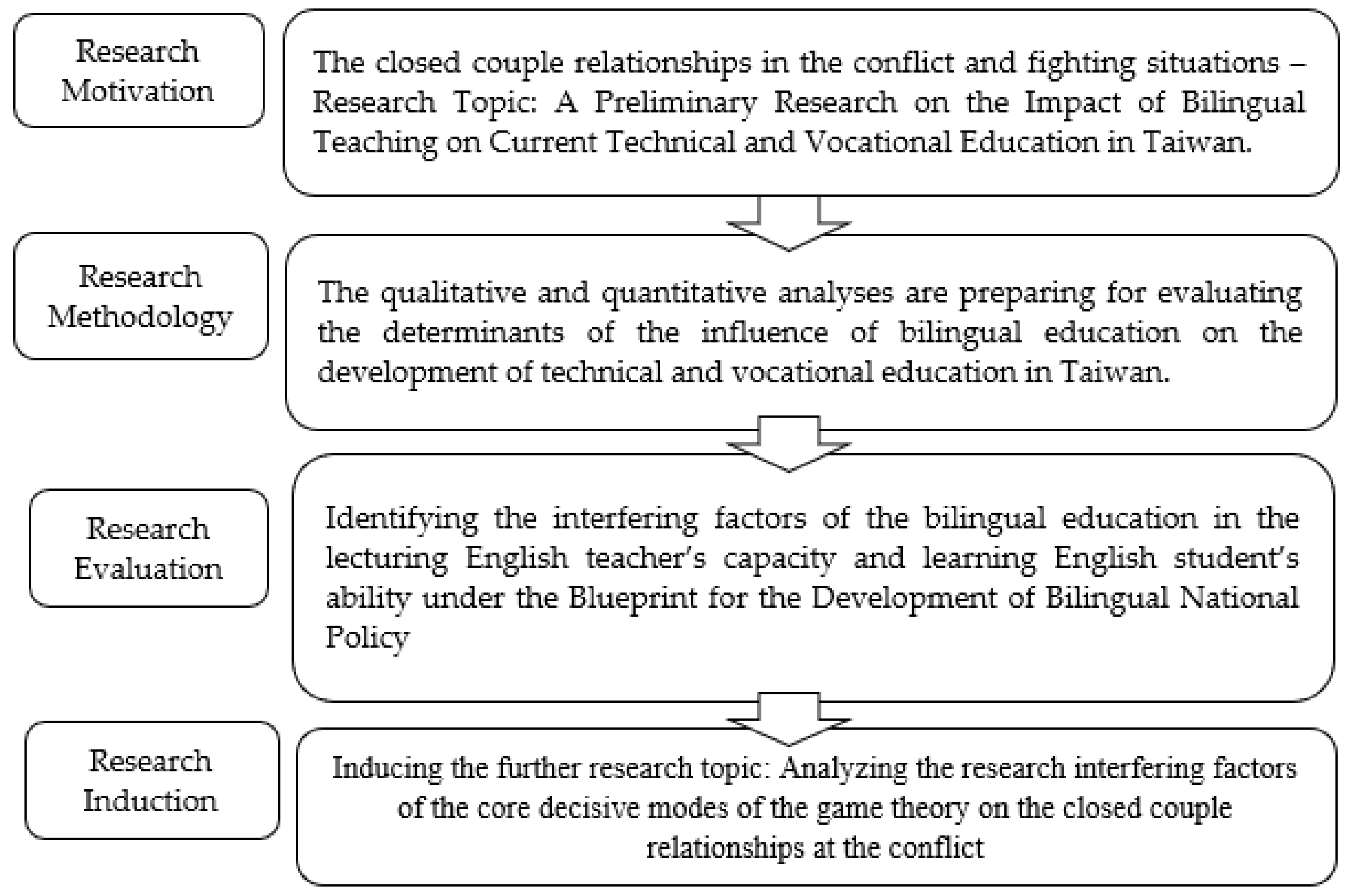
However, bilingual education will provide an advantage in job finding and international competitiveness with self-worth [19,20,21,22]. Therefore, it is worth exploring the impact of bilingual education in technical and vocational schools. For the exploration, we determined a research motivation and found the research methodology for the evaluation of the research result (Figure 3).
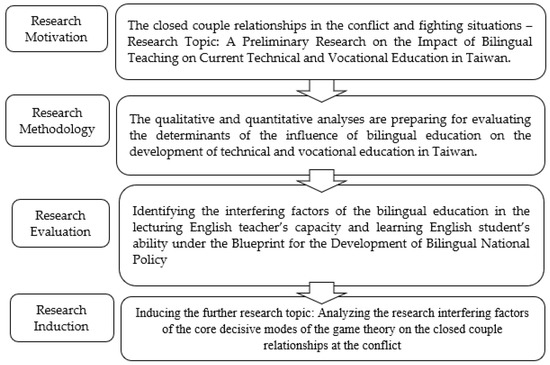
Figure 3.
Process of this research.
2. Conclusions and Future Direction
According to the Blueprint for the Development of Bilingual National Policy, all teachers in Taiwan’s education system are supposed to teach students in English and Chinese. Since its implementation, teachers in technical and vocational schools have had difficulties because they lack the professional backgrounds to execute EMI. Most students in the schools also have limited English ability, which causes difficulties in learning. Therefore, it is necessary to improve the teaching and learning abilities of teachers and students in technical and vocational schools in the new bilingual education model. Especially, teaching subjects in English requires integrating subject contents and language and continuously adjusting teaching methods to meet the needs of students. The most urgent thing is to focus on talent cultivation and popularize programs. In addition to promoting and cultivating language ability, it is required to increase international mobility and internship experience in English for the competitiveness of teachers and students. The current environment for the schools is not appropriate for bilingual education. In English, students may not learn professional knowledge and skills properly. If there is no appropriate teaching method, bilingual education only brings negative effects on students. However, the final goal of bilingual education in technical and vocational schools is to improve professional work skills and English ability so that students can have better capabilities. Thus, continuous efforts to teach such skills and abilities help overcome the lack of an appropriate environment for bilingual education.
Technical and vocational education in Taiwan has been practiced and implemented for many years. Such education provides the training of practical skills, which have global competitiveness. Numerous high-level technical talents have been raised and contributed to the success and outcome of Taiwan. According to the Blueprint, the implementation of bilingual education pressures teachers and students and affects the quality of the education of technical and vocational schools. However, since bilingual education is especially beneficial for students, the educational system must be improved for appropriate bilingual education.
Author Contributions
Conceptualization, C.-L.W. and M.-Y.H.; methodology, C.-Y.D. and M.-Y.H.; validation, J.-C.M.L. and C.-Y.D.; formal analysis, M.-Y.H.; investigation, C.-Y.D.; resources, J.-C.M.L. and C.-L.W.; writing—original draft preparation, M.-Y.H. and C.-L.W.; writing—review and editing, M.-Y.H.; visualization, C.-Y.D. and C.-Y.D.; supervision, M.-Y.H.; project administration, M.-Y.H.; funding acquisition, and C.-L.W. All authors have read and agreed to the published version of the manuscript.
Funding
This research was supported by the research supporting research projects (MOST 110-2420-H-002-003-MY3-Y11209) of the Ministry of Science and Technology and (NTCU111103) from the National Taichung University of Education.
Institutional Review Board Statement
This research did not execute the questionnaires and interview and hence, this research did not require ethical approval.
Informed Consent Statement
Not applicable because this research did not involve any humans.
Data Availability Statement
No new data were created.
Conflicts of Interest
The authors declare no conflict of interest.
References
- Azzam, Z. Dubai’s private K-12 education sector: In search of bilingual education. J. Res. Int. Educ. 2019, 18, 227. [Google Scholar] [CrossRef]
- Beardsmore, H.B. European models of bilingual education: Practice, theory, and development. J. Multiling. Multicult. Dev. 1993, 14, 103–120. [Google Scholar] [CrossRef]
- De Wilde, V.; Brysbaert, M.; Eyckmans, J. Learning English through Out-of-School Exposure: Which Levels of Language Proficiency are Attained and Which Types of Input are Important? Biling. Lang. Cogn. 2020, 23, 171–185. [Google Scholar] [CrossRef]
- Babino, A.; Stewart, M.A. Remodeling dual language programs: Teachers enact agency as critically conscious language policy makers. Biling. Res. J. 2018, 41, 272–297. [Google Scholar] [CrossRef]
- Grcia, E.E.; Curry-Rodríguez, J.E. The education of limited English proficient students in California schools: An assessment of the influence of Proposition 227 in selected districts and schools. Biling. Res. J. 2000, 24, 15–35. [Google Scholar] [CrossRef]
- Gurney, L.; Liyanage, I. EAL teacher agency: Implications for participation in professional development. Int. J. Pedagog. Learn. 2016, 11, 49–59. [Google Scholar] [CrossRef]
- Haneda, M.; Sherman, B. ESL teachers’ acting agentively through job crafting. J. Lang. Identity Educ. 2018, 17, 402–415. [Google Scholar] [CrossRef]
- Katz, S.R. Does NCLB leave the US behind in bilingual teacher education? Engl. Educ. 2004, 36, 141–152. [Google Scholar]
- Leijen, Ä.; Pedaste, M.; Lepp, L. Teacher agency following the ecological model: How it is achieved and how it could be strengthened by different types of reflection. Br. J. Educ. Stud. 2000, 68, 295–310. [Google Scholar] [CrossRef]
- Palmer, D.; Henderson, K.; Wall, D.; Zúñiga, C.E.; Berthelsen, S. Team teaching among mixed messages: Implementing two-way dual language bilingual education at third grade in Texas. Lang. Policy 2016, 15, 393–413. [Google Scholar] [CrossRef]
- Wong, J.W.; Athanases, S.Z.; Banes, L.C. Developing as an agentive bilingual teacher: Self-reflexive and student-learning inquiry as teacher education resources. Int. J. Biling. Educ. Biling. 2020, 23, 153. [Google Scholar] [CrossRef]
- Duran, M.; Usak, M.; Hsieh, M.-Y.; Uygun, H. A New Perspective on Pedagogical Content Knowledge: Intellectual and Emotional Characteristics of Science Teachers. Rev. Cercet. Interv. Soc. 2021, 72, 9. [Google Scholar] [CrossRef]
- Wu, T.-L.; Hsieh, M.-Y.; Min, K.-W.; Yu, M.-T.; Ho, C.-T. Use of Sensor Technologies in Online Courses in Post-COVID-19 Era. Sens. Mater. 2021, 33, 2045–2062. [Google Scholar]
- Usak, M.; Hsieh, Y.M.; Chan, Y.-K. A Concertizing Research on Making Higher Education Sustainability Count. Sustainability 2021, 13, 2724. [Google Scholar] [CrossRef]
- Huang, C.C.; Chan, Y.-K.; Hsieh, M.Y. The Determinants of ESG for Community LOHASism Sustainable Development Strategy. Sustainability 2022, 14, 11429. [Google Scholar] [CrossRef]
- Chan, Y.-K.; Hsieh, M.Y. An Empirical Study on Higher Education C-ESG Sustainable Development Strategy in Lower-Birth-Rate Era. Sustainability 2022, 14, 12629. [Google Scholar] [CrossRef]
- Hsieh, Y.-M. Online learning era: Exploring the most decisive determinants of MOOCs in Taiwanese higher education. Eurasia J. Math. Sci. Technol. Educ. 2016, 12, 1163. [Google Scholar] [CrossRef]
- Hsieh, Y.-M. Employing MCDM methodology to verify correlationship between social media and service quality in the dynamic m-commerce era. J. Internet Technol. 2018, 19, 225. [Google Scholar]
- Hsieh, Y.-M.; Usak, M. High Education Radical Transformation Era: How Teachers’ Competency can Enhance the Students’ Employability. Rev. Cercet. Interv. Soc. 2020, 68, 95. [Google Scholar] [CrossRef]
- Huang, Y.-M.; Hsieh, Y.M. An Interdisciplinary Research on Students’ Employability in Technology Education to Advance Higher Education Enrollment Sustainability. Sustainability 2020, 12, 1806. [Google Scholar] [CrossRef]
- Hsieh, M.Y. The Sustainable Development and Strategic Approaches for Contemporary Higher Education. Sustainability 2022, 14, 12925. [Google Scholar] [CrossRef]
- Huang, C.-C.; Chan, Y.-K.; Hsieh, M.-Y. Preliminary Research on the Sustainable Determinants of Taiwanese Ecotourism with the International Standards. Int. J. Environ. Res. Public Health 2022, 19, 14489. [Google Scholar] [CrossRef] [PubMed]
Disclaimer/Publisher’s Note: The statements, opinions and data contained in all publications are solely those of the individual author(s) and contributor(s) and not of MDPI and/or the editor(s). MDPI and/or the editor(s) disclaim responsibility for any injury to people or property resulting from any ideas, methods, instructions or products referred to in the content. |
© 2023 by the authors. Licensee MDPI, Basel, Switzerland. This article is an open access article distributed under the terms and conditions of the Creative Commons Attribution (CC BY) license (https://creativecommons.org/licenses/by/4.0/).