Proceeding Paper

Life Cycle Assessment of Epitaxy of GaN-on-SiC High-Electron-Mobility Transistors for Advanced Radio Frequency Applications †
1
Fritz-Hüttinger Chair for Energy-Efficient High-Frequency Electronics (EEH), Department for Sustainable Systems Engineering (INATECH), University of Freiburg, 79098 Freiburg, Germany
2
Fraunhofer Institute of Applied Solid-State Physics (IAF) Freiburg, 79108 Freiburg, Germany
*
Author to whom correspondence should be addressed.
Presented at the International Conference on Responsible Electronics and Circular Technologies (REACT 2025), Glasgow, UK, 11–12 November 2025.
Eng. Proc. 2026, 127(1), 2; https://doi.org/10.3390/engproc2026127002
Published: 24 February 2026

Abstract

From 4G to 5G to 6G, every few years, a new generation of data transmission technology emerges to meet the growing demand for faster and more efficient communication. Artificial intelligence, the Internet of Things and the increasing need for global connectivity are the key drivers of this evolution, pushing both research and industry toward ever-higher data rates. These advanced technologies already consume vast amounts of resources and energy, relying on high-tech nano-fabrication processes such as metal–organic chemical vapor deposition, dry etching, deposition and lithography, all of which typically occur in energy-intensive cleanroom environments. This study evaluates the epitaxy process of GaN on SiC for high-electron-mobility transistor (HEMT) devices and integrated circuits using life cycle assessment. GaN HEMTs offer high efficiency and excellent thermal conductivity, paving the way for reduced chip footprints for lower energy consumption. This analysis enables informed decision-making regarding sustainability by providing detailed data and interpretation of Fraunhofer IAF’s GaN-on-SiC HEMT technology.

1. Introduction

Artificial intelligence, the Internet of Things, and the increasing demand for global connectivity are just a few of the drivers behind the need for higher bandwidths. The primary approach to achieving this is by increasing frequency into the millimeter-wave regime. GaN-based HEMTs are among the most promising candidates for enabling the next generation of power amplifiers for data transmission such as 6G and have proven their performance in power devices [1,2,3]. Despite their demonstrated high efficiency and technological potential, the production of these devices consumes a substantial amount of resources and energy. Due to the limited number of competitors and the lack of incentives to disclose manufacturing information, there is an incomplete understanding of the environmental sustainability of semiconductor production in general, a problem meanwhile understood by national and European policymakers. A multitude of projects which also assess the sustainability of semiconductor production have been initiated. Notable examples include ChipsJU, European Chips Act, IPCEI ME/CT and GENESIS.
To support informed decision-making, high-quality data are essential. Life cycle assessment (LCA) is a well-established method for evaluating the sustainability of a product throughout its entire life cycle. While previous efforts have been made in the field of logic devices [4,5,6,7] and GaN-on-Si power electronics [8,9], little detailed data is currently available for GaN on SiC for radio frequency (RF) applications, particularly not for individual process steps. Despite being more holistic, LCA models covering the whole product life cycle are difficult to adapt to different products. For an electronic device, e.g., a smartphone, one of the main impact drivers is found to be the production of integrated circuits (ICs) [10,11,12,13], and therefore, this is strongly dependent on the specific components and parts used, with a variety not seen anywhere else. To allow for the precise modeling of new electronic systems, detailed process data is necessary, especially with the increasing demand of wide-bandgap devices.
This work aims to address this knowledge gap by providing an in-detail gate-to-gate assessment of one of the most important processes in group III-V semiconductors: epitaxy using metal–organic chemical vapor deposition (MOCVD). After epitaxially growing GaN on a typically semi-insulating SiC substrate, the wafer can be further processed into a HEMT device. MOCVD is inherently a big contributor due to the required high temperatures, rotating components and long runtimes. The other main front-end processes are deposition, photolithography (coating and stripping), (wet and dry) etching, wet cleaning and chemical–mechanical planarization. Depending on the technology, the number of individual process steps, mainly driven by the number of mask layers, can range from around 100 to over 1000 [5,9].
An AIXTRON 2800 G4 HT IC 11x4-inch wafer planetary reactor, from AIXTRON SE, 52134 Herzogenrath, Germany, is assessed. The growth temperature reaches up to 1100 °C, and growth rates of up to 5 Å/s are achieved [14]. Figure 1a shows the grown layers: AlN Nucleation, an insulating GaN buffer and channel, an AlGaN barrier and a GaN cap and, optionally, SiNx cap passivation. The biggest layer is the GaN buffer layer, at around 1.5 µm. Trimethylgallium, TMGa; Trimethylaluminum, TMAl; and Ammonia, NH3, are used as precursors for the growth of AlGaN/GaN HEMT structures on semi-insulating SiC. Hydrogen, H2, and Nitrogen, N2, are used as carrier gases to transport the species to the reactor chamber. All precursors and gases must have very high purity to allow for high-quality crystal layers. Additional sources may be used, e.g., SH4, for doping, depending on the device requirements. Unreacted gases are burned in an abatement system to handle highly volatile metal organics.

2. Methodology

This study follows ISO 14040 and 14044 standards [15,16] for conducting the LCA: Goal and scope definition, Life Cycle Inventory (LCI), Life Cycle Impact Assessment (LCIA) and Interpretation.
The goal of this study is to provide detailed data for one important process of semiconductor manufacturing. Therefore, the scope is chosen to be gate-to-gate, as can be seen in Figure 1b, from introducing the substrates to the finished epitaxial wafer. The substrate upstream itself is not considered, to allow for process-specific data. The functional unit is 1 cm2 of the AlGaN/GaN heterostructure grown on a SiC wafer, suitable to be further processed into GaN HEMTs for RF devices.
LCI data is mainly collected using in-line measurements or machine-logged records. Data for most chemical inputs is not readily available. A combination of ecoinvent 3.10 [17] for upstream chemicals and the Research, Reaction, Energy, Model method by Huber et al. [18] is used for missing data on chemicals. For the infrastructure, e.g., cleanroom conditioning, the annual consumption of energy is scaled down to the footprint and processing time, as well as cleanroom class following Lian et al. [19] and a hybrid approach from Krishnan et al. [20]. Process cooling water is modeled additionally using energy conversion factors (ECFs) following the SEMI S23 [21].
The LCIA allows us to analyze the impact of the different inputs collected in the inventory in different categories. The Environmental Footprint (EF 3.1) [22] impact assessment method is used, as recommended by the European Commission, which is in line with the increasing demand for Environmental Product Declarations, as stated in ISO 14025. The complete EF 3.1 impact results can be found in Table 1. Additionally, the cumulative energy and exergy demand by VDI 4600 is assessed to reflect the total energy required.

3. LCI and LCIA Results

The inventory is carried out at the laboratory level with an industrial MOCVD system. Electrical consumption is measured using a clamp-on power meter over 24 h. On average, five 100 mm SiC substrates are loaded into the reactor for a runtime of 2.5 h, which requires 580 kWh of electrical energy. The consumed materials are measured by the system and are considered as averages over all successful runs over one year. The machine is situated in a semi-clean laboratory with a footprint of 25 m2, and the demand for heating, ventilation and air conditioning is determined using the annual consumption of the facility and the approach from Lian et al. [19], at 519 kWh/m2a, where 80% can be attributed to heating and cooling demand for air conditioning. The demand for process cooling water of the MOCVD and abatement system is determined using the SEMI S23 ECF and the machines’ datasheets. Missing inventory data on chemicals is determined using the RREM method. Other steps considered are the regeneration of the glovebox and the cleaning of the reactor, which are done when required.
A burden global warming potential of 0.65 kg CO2-Eq can be attributed to the epitaxy of 1 cm2. Furthermore, a non-renewable energy consumption of 10.20 MJ or 2.83 kWh and a water usage of 233 L can be attributed to this process alone. With a given runtime and a crystal thickness of around 1.5 µm, this results in a growth time intensity of 0.26 kg CO2-Eq/h and thickness intensity of 0.43 kg CO2-Eq/µm.
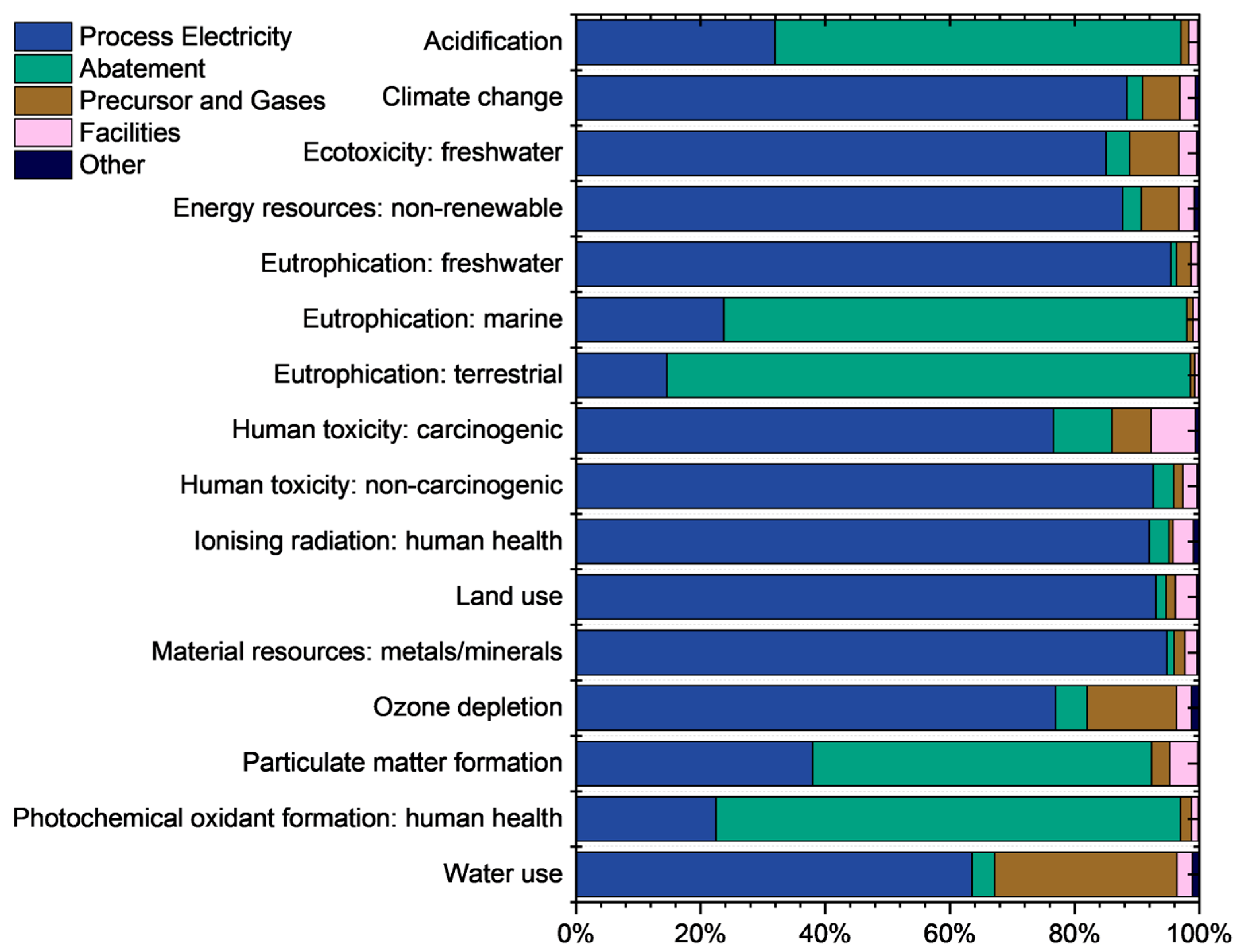
Further impacts are summarized in Table 1. As can be seen in Figure 2, the main contributor is the electricity consumption of the process, which can mainly be attributed to the heating and spinning of the reactor and substrates, as well as the cooling demand. During the abatement of exhaust gases, NH3 gets burned together with added H2. Nitrogen oxides, NOx, are formed, explaining the high eutrophication, matter and photochemical oxidant formation impact. To verify this high impact, in-line measurements should be conducted. Former studies found the high impact of materials used in semiconductor production, while data on chemicals with high purity especially is not available. Additionally, the electricity provider should be modeled with an improved regional electric mix, contrary to the general German electric mix used.

4. Discussion

Compared to other studies, which found that the facilities’ impacts is around 1/3 of the value of the total impacts [8,20], the contribution in this study is well below 8% in all categories, mainly due to the MOCVD system not being in a high-class cleanroom but in an energy-optimized machine hall.
Vauche et al. [8] analyzed the complete production of a GaN-on-Si MOSc-HEMT power device. They found that epitaxial growth contributes almost 25% to the fossil resource use of the whole production process, mainly due to its high electrical energy usage. Around 0.095 kg CO2-Eq is attributed to this process, which is around 5 times lower than that in this study. Since the process is driven heavily by electric consumption, one explanation for this is the difference in the German and French electricity mixes. In Table 2, a comparison of the LCA results can be seen. With the French electricity market chosen, the climate change potential was halved. Using higher-diameter wafers, as well as increasing machine loading, additionally increases the processed area and will therefore reduce impacts. Process optimization, as suggested by Byeon et al. [23], can save up to 15% in a CVD system, enabling even more energy savings. However, an exergy of 18.1 MJ is required, which should be supplied by renewables to lower climate burdens.

5. Conclusions

To enable informed decision-making in sustainability, it is essential that detailed data is available. An LCA of the epitaxy process for GaN-on-SiC HEMTs revealed a climate change potential of 0.65 kg CO2-Eq per processed cm2. A significant portion of this impact is attributed to upstream processes, especially electrical energy generation, resulting in a total fossil energy and water consumption of 2.83 kWh and 233 L, respectively. Since the primary contributor is the required electrical energy, a straightforward improvement would result from the switch to renewable energy sources. To further enhance data availability, additional GaN-specific processes should be assessed. In general, greater transparency is needed, particularly regarding manufacturing, material production and purification, to gain a holistic perspective on IC production.

Author Contributions

Conceptualization, M.M.; methodology, M.M.; validation, M.M.; formal analysis, M.M.; investigation, M.M.; resources, M.M. and S.M.; data curation, M.M. and S.M.; writing—original draft preparation, M.M.; writing—review and editing, S.M. and R.Q.; visualization, M.M.; supervision, R.Q.; project administration, R.Q.; funding acquisition, R.Q. All authors have read and agreed to the published version of the manuscript.

Funding

This work was partially funded by the German Federal Ministry of Research, Technology and Space (Bundesministerium für Forschung, Technologie und Raumfahrt, BMFTR) under contracts 16ME0495 (GreenICT@FMD).

Institutional Review Board Statement

Not applicable.

Informed Consent Statement

Not applicable.

Data Availability Statement

The data presented in this study are available on request from the corresponding author due to confidentiality requirements.

Acknowledgments

The authors would like to thank the Fritz-Hüttinger Stiftung and the Fraunhofer IAF Epitaxy and Technology Departments for their support and great contributions.

Conflicts of Interest

The authors declare no conflicts of interest.

References

  1. Neininger, P.; Mikulla, M.; Döring, P.; Dammann, M.; Thome, F.; Krause, S.; Schwantuschke, D.; Brückner, P.; Friesicke, C.; Quay, R. Advances in GaN Devices and Circuits at Higher mm-Wave Frequencies. e-Prime—Adv. Electr. Eng. Electron. Energy 2023, 4, 100177. [Google Scholar] [CrossRef]
  2. Basler, M.; Reiner, R.; Moench, S.; Benkhelifa, F.; Doring, P.; Waltereit, P.; Quay, R.; Ambacher, O. Building Blocks for GaN Power Integration. IEEE Access 2021, 9, 163122–163137. [Google Scholar] [CrossRef]
  3. Quay, R. Gallium Nitride Electronics; Springer: Berlin/Heidelberg, Germany, 2008; ISBN 9783540718925. [Google Scholar]
  4. Pirson, T.; Delhaye, T.P.; Pip, A.G.; Le Brun, G.; Raskin, J.-P.; Bol, D. The Environmental Footprint of IC Production: Review, Analysis, and Lessons From Historical Trends. IEEE Trans. Semicond. Manuf. 2023, 36, 56–67. [Google Scholar] [CrossRef]
  5. Boakes, L.; Garcia Bardon, M.; Schellekens, V.; Liu, I.-Y.; Vanhouche, B.; Mirabelli, G.; Sebaai, F.; van Winckel, L.; Gallagher, E.; Rolin, C.; et al. Cradle-to-gate Life Cycle Assessment of CMOS Logic Technologies. In 2023 International Electron Devices Meeting (IEDM); IEEE: New York, NY, USA, 2023; pp. 1–4. [Google Scholar]
  6. Taiariol, F.; Fea, P.; Papuzza, C.; Casalino, R.; Galbiati, E.; Zappa, S. Life cycle assessment of an integrated circuit product. In Proceedings of the 2001 IEEE International Symposium on Electronics and the Environment. 2001 IEEE ISEE (Cat. No.01CH37190), Denver, CO, USA, 7–9 May 2001; IEEE: New York, NY, USA, 2001; pp. 128–133. ISBN 0-7803-6655-7. [Google Scholar]
  7. Boyd, S.B. Life-Cycle Assessment of Semiconductors; Springer: New York, NY, USA, 2012; ISBN 9781441999887. [Google Scholar]
  8. Vauche, L.; Guillemaud, G.; Lopes Barbosa, J.-C.; Di Cioccio, L. Cradle-to-Gate Life Cycle Assessment (LCA) of GaN Power Semiconductor Device. Sustainability 2024, 16, 901. [Google Scholar] [CrossRef]
  9. Diaz Triana, A.; Schmidt, S.; Glaser, S.; Makoschitz, M.L. A “life cycle thinking” approach to assess differences in the energy use of SiC vs. Si power semiconductors. In Proceedings of the e.nova 2021 Conference “Green Deal, Energy—Building—Environment”, Pinkafeld, Austria, 25–26 November 2021. [Google Scholar]
  10. Ercan, M.; Malmodin, J.; Bergmark, P.; Kimfalk, E.; Nilsson, E. Life Cycle Assessment of a Smartphone. In Proceedings of ICT for Sustainability 2016, Amsterdam, the Netherlands, 30 August–1 September 2016; Atlantis Press: Paris, France, 2016; ISBN 978-94-6252-224-4. [Google Scholar]
  11. Proske, M.; Poppe, E.; Jaeger-Erben, M. The smartphone evolution—An analysis of the design evolution and environmental impact of smartphones. In Proceedings of the Electronics Goes Green 2020+, Berlin, Germany, 1 September 2020. [Google Scholar]
  12. Billaud, M.; Clemm, C.; Sánchez, D.; Proske, M.; Jügel, M.; Stobbe, L.; Nissen, N.; Schneider-Ramelow, M. ICs as drivers of ICT carbon footprint: An approach to more accurate die size assessment. In Proceedings of the International Symposium and Environmental Exhibition “Going Green—CARE INNOVATION” 2023, Vienna, Austria, 9–11 May 2023. [Google Scholar]
  13. Bol, D.; Pirson, T.; Dekimpe, R. Moore’s Law and ICT Innovation in the Anthropocene. In 2021 Design, Automation & Test in Europe Conference & Exhibition (DATE); IEEE: New York, NY, USA, 2021; pp. 19–24. [Google Scholar]
  14. Godejohann, B.-J.; Ture, E.; Müller, S.; Prescher, M.; Kirste, L.; Aidam, R.; Polyakov, V.; Brückner, P.; Breuer, S.; Köhler, K.; et al. AlN/GaN HEMTs grown by MBE and MOCVD: Impact of Al distribution. Phys. Status Solidi (b) 2017, 254, 1600715. [Google Scholar] [CrossRef]
  15. ISO 14040:2006; Environmental Management—Life Cycle Assessment—Principles and Framework. Edition 1; International Organization for Standardization: Geneva, Switzerland, 2006.
  16. ISO 14044:2006; Environmental Management—Life Cycle Assessment—Requirements and Guidelines. Edition 2; International Organization for Standardization: Geneva, Switzerland, 2006.
  17. Wernet, G.; Bauer, C.; Steubing, B.; Reinhard, J.; Moreno-Ruiz, E.; Weidema, B. The ecoinvent database version 3 (part I): Overview and methodology. Int. J. Life Cycle Assess. 2016, 21, 1218–1230. [Google Scholar] [CrossRef]
  18. Huber, E.; Bach, V.; Holzapfel, P.; Blizniukova, D.; Finkbeiner, M. An Approach to Determine Missing Life Cycle Inventory Data for Chemicals (RREM). Sustainability 2022, 14, 3161. [Google Scholar] [CrossRef]
  19. Lian, J.Z.; Siebler, F.; Steubing, B.R.; Jesorka, A.; Barbarossa, V.; Wang, R.; Leo, K.; Sen, I.; Cucurachi, S. Quantifying the present and future environmental sustainability of cleanrooms. Cell Rep. Sustain. 2024, 1, 100219. [Google Scholar] [CrossRef] [PubMed]
  20. Krishnan, N.; Boyd, S.; Somani, A.; Raoux, S.; Clark, D.; Dornfeld, D. A Hybrid Life Cycle Inventory of Nano-Scale Semiconductor Manufacturing. Environ. Sci. Technol. 2008, 42, 3069–3075. [Google Scholar] [CrossRef] [PubMed]
  21. Hu, S.-C.; Tsai, Y.-W.; Fu, B.-R.; Chang, C.-K. Assessment of the SEMI energy conversion factor and its application for semiconductor and LCD fabs. Appl. Therm. Eng. 2017, 121, 39–47. [Google Scholar] [CrossRef]
  22. European Commission; Joint Research Centre. Updated Characterisation and Normalisation Factors for the Environmental Footprint 3.1 Method; Publications Office of the European Union: Luxembourg, 2023. [Google Scholar] [CrossRef]
  23. Byeon, M.; Park, J.; Kim, J.-H.; Kyung, S.; Lee, M.W.; Kim, J.; Lee, C.; Choi, C. Decarbonization Strategies in Semiconductor Manufacturing: Reducing Greenhouse Gas Emission and Energy Consumption in the CVD Process. Int. J. Precis. Eng. Manuf.-Green Tech. 2025. [Google Scholar] [CrossRef]
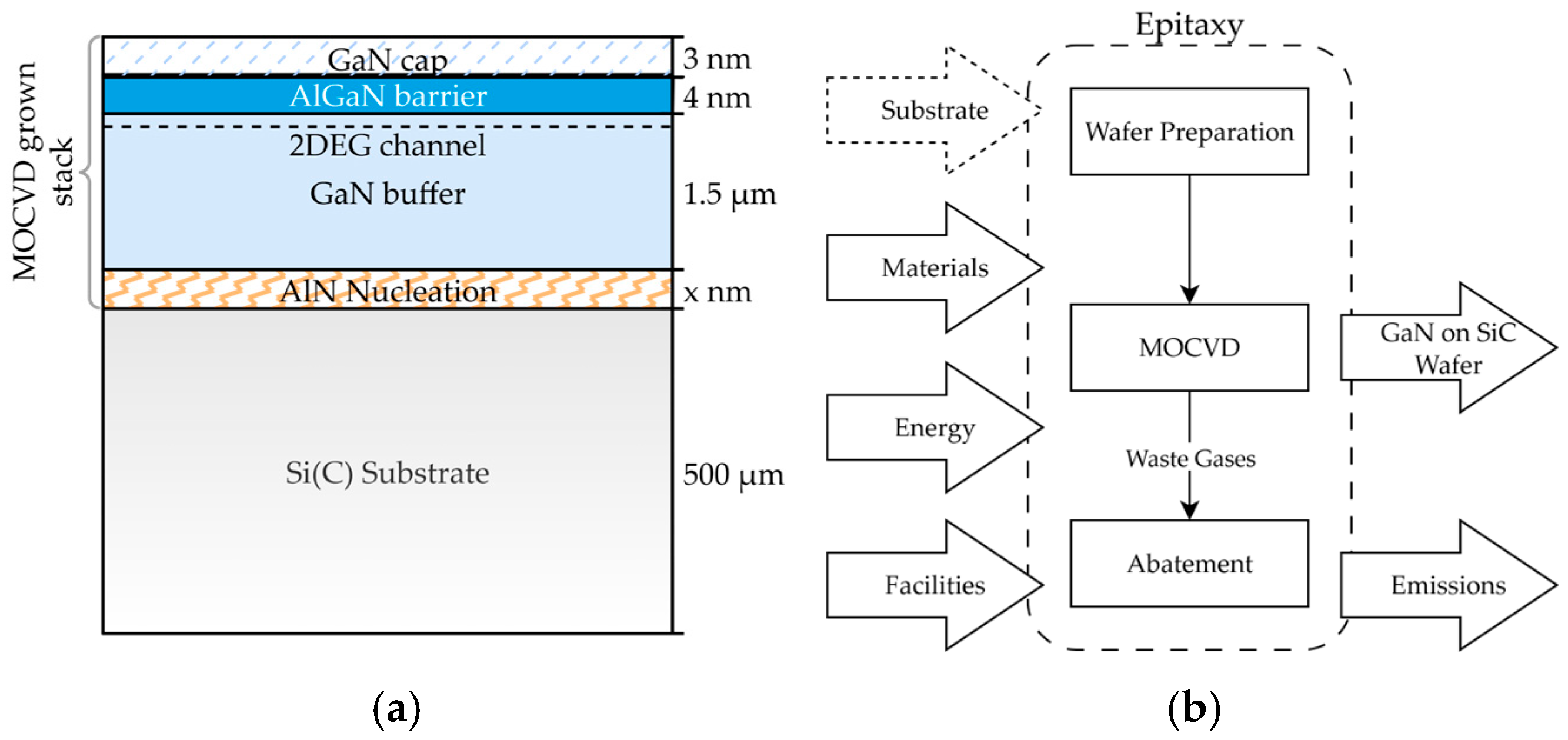
Figure 1. (a) Layer stack grown by MOCVD and their respective exemplary thicknesses, adapted from [14]; (b) gate-to-gate system diagram of LCA. Substrates’ contribution is not considered.
Engproc 127 00002 g001
Figure 2. Normalized EF 3.1 LCIA results, by section.
Engproc 127 00002 g002
Table 1. EF3.1 and VDI LCIA categories and results.
Impact CategoryResultUnit
Acidification5.20 × 10−3mol H+-Eq
Climate change6.55 × 10−1kg CO2-Eq
Ecotoxicity: freshwater3.10 × 10+0CTUe
Energy resources: non-renewable1.02 × 10+1MJ, net calorific value
Eutrophication: freshwater8.22 × 10−4kg P-Eq
Eutrophication: marine1.80 × 10−3kg N-Eq
Eutrophication: terrestrial2.17 × 10−2mol N-Eq
Human toxicity: carcinogenic1.65 × 10−9CTUh
Human toxicity: non-carcinogenic9.52 × 10−9CTUh
Ionizing radiation: human health1.46 × 10−1kBq U235-Eq
Land use2.74 × 10+0dimensionless
Material resources: metals/minerals7.71 × 10−6kg Sb-Eq
Ozone depletion9.58 × 10−9kg CFC-11-Eq
Particulate matter formation2.16 × 10−8disease incidence
Photochemical oxidant formation: human health4.53 × 10−3kg NMVOC-Eq
Water use2.33 × 10−1m3 world Eq deprived
VDI cumulative energy demand1.40 × 10+1MJ-Eq
VDI cumulative exergy demand1.81 × 10+1MJ-Eq
Table 2. Comparison of GaN epitaxy LCA.
UnitThis StudyVauche et al. [8]
Technology-GaN on SiCGaN on Si
Wafer Diametermm100200
Energy Resources: FossilskWh/cm22.833 (4.990 a)2.564
Climate Changekg CO2-Eq/cm20.650 (0.204 a)0.095
a Using French market for electricity.
Disclaimer/Publisher’s Note: The statements, opinions and data contained in all publications are solely those of the individual author(s) and contributor(s) and not of MDPI and/or the editor(s). MDPI and/or the editor(s) disclaim responsibility for any injury to people or property resulting from any ideas, methods, instructions or products referred to in the content.