Integrated Linear Transformer-Based Diode Bridge Rectifier for Improved Power Quality in Electric Vehicle Charging Stations †



Abstract
1. Introduction
- ▪
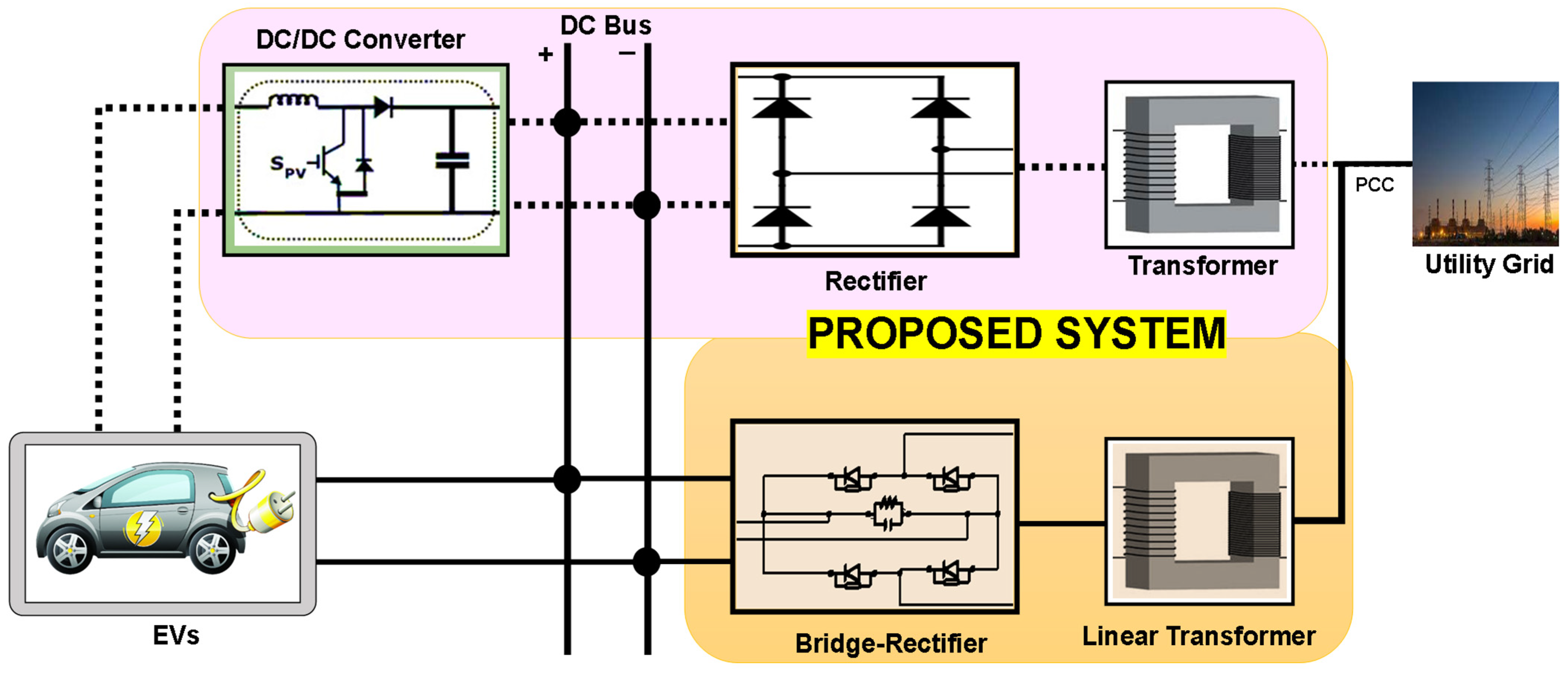
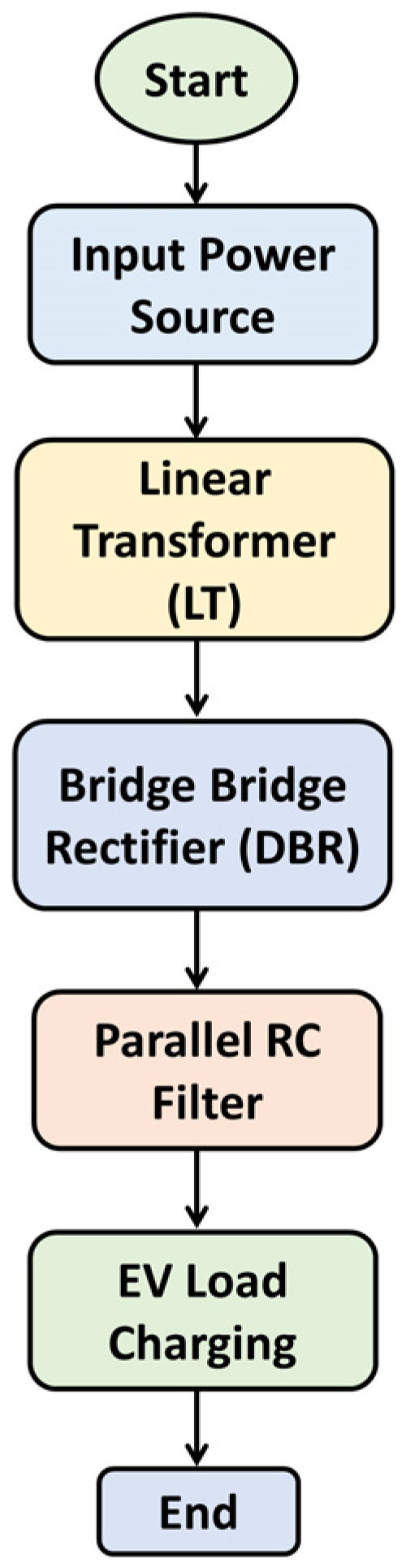
- An integrated linear transformer-diode bridge rectifier (LT + DBR) topology is proposed to enhance the quality of the input power to the EV charging.
- ▪
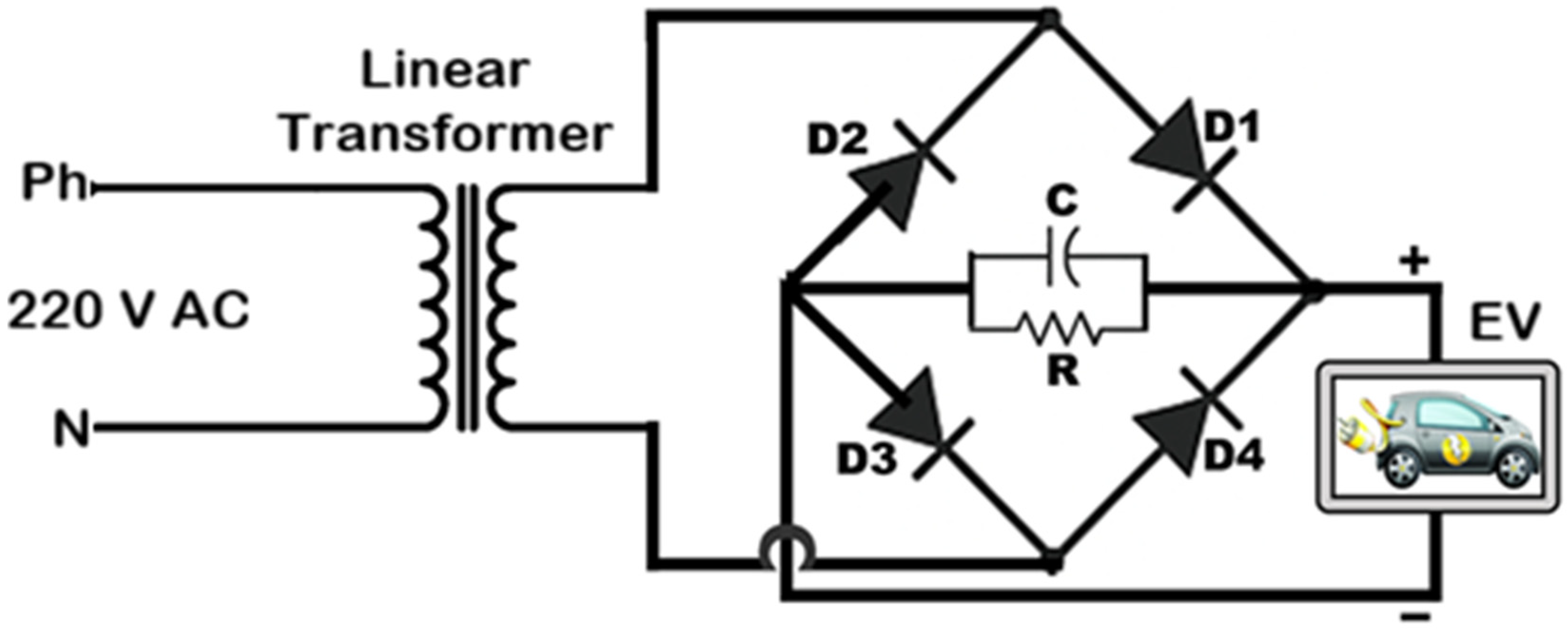
- The inherent input current shaping and partial harmonic mitigation of the proposed system is achieved using the leakage inductance properties of linear transformers with no active switching device and control mechanism.
- ▪
- The parallel RC passive filter is applied across the DC-bus (between the rectifier output and EV voltage) to reduce DC-link ripple and stabilize the output voltage supplied to the EV battery.
- ▪
- Simulation findings confirm that the proposed system brings lower THD, better power factor, and smoother DC output, which is a simple and cost-effective alternative to traditional and actively controlled charging topology.
2. Design and Implementation of an Integrated LT + DBR Charging Station
3. Results and Discussion
3.1. Voltage Characteristics
3.2. EV Battery Characteristics
3.3. Frequency Characteristics
3.4. Power Factor and Efficiency Characteristics
3.5. THD Analysis
- ▪
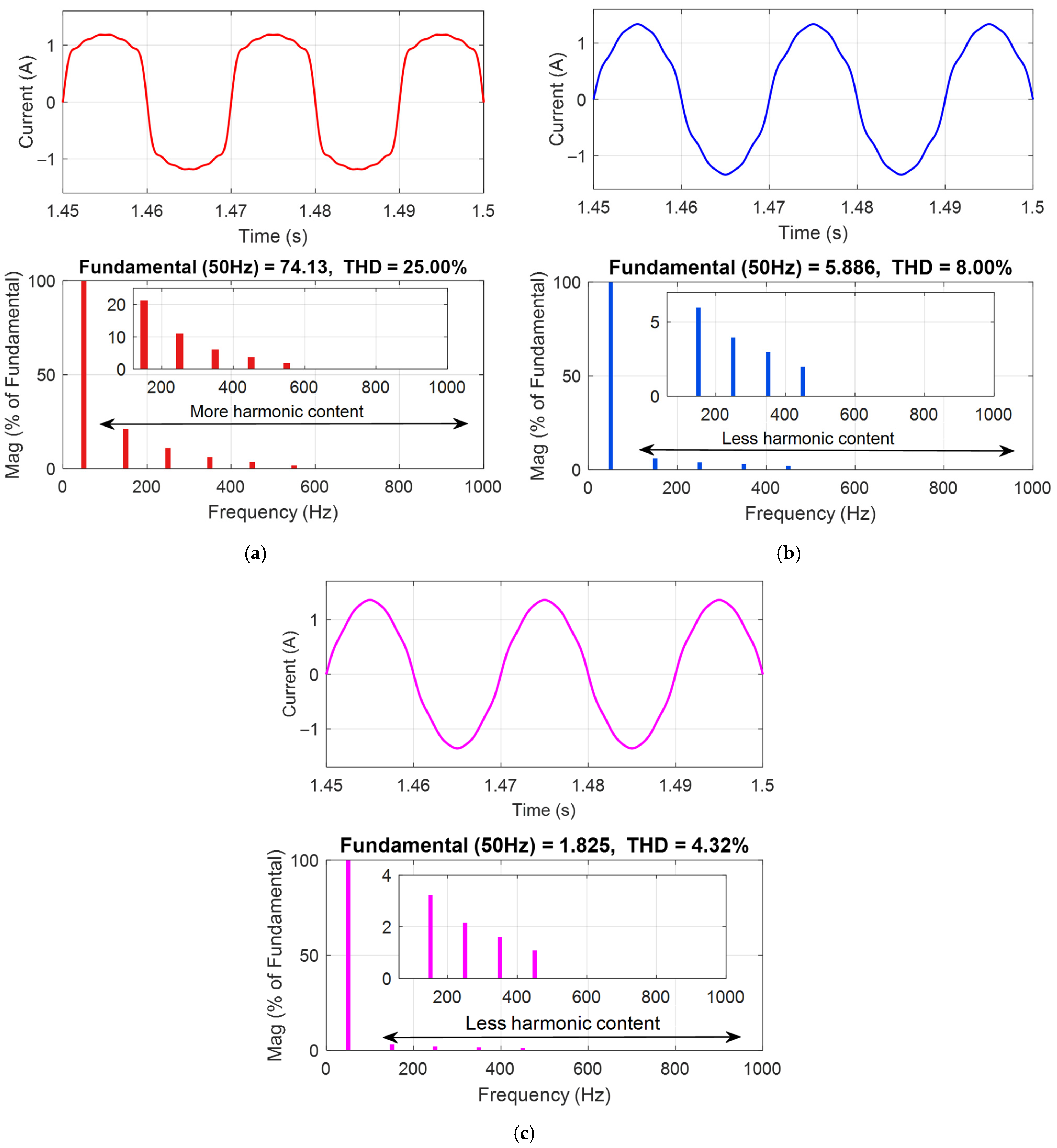
- The current THD of the AC bus when the charging stations are designed with conventional DBR and conventional DBR + DC–DC converter is measured as 25% and 8%, respectively. With the proposed integrated LT + DBR charging station, the current THD is significantly reduced to 4.32%, which adheres to the permissible limit of 8% that is defined by the IEEE 519 standard. From these results, it is observed that there is a significant improvement in THD with the proposed charging station when compared to conventional methods.
4. Conclusions and Future Scope
- ▪
- The AC bus current THD computed from the results is 25% with the conventional DBR charging station and 8% with the conventional DBR + DC–DC converter charging station. In contrast, it is notably reduced and adheres to the standard limit with the proposed integrated LT + DBR charging station, which recorded a current THD of 4.32%.
- ▪
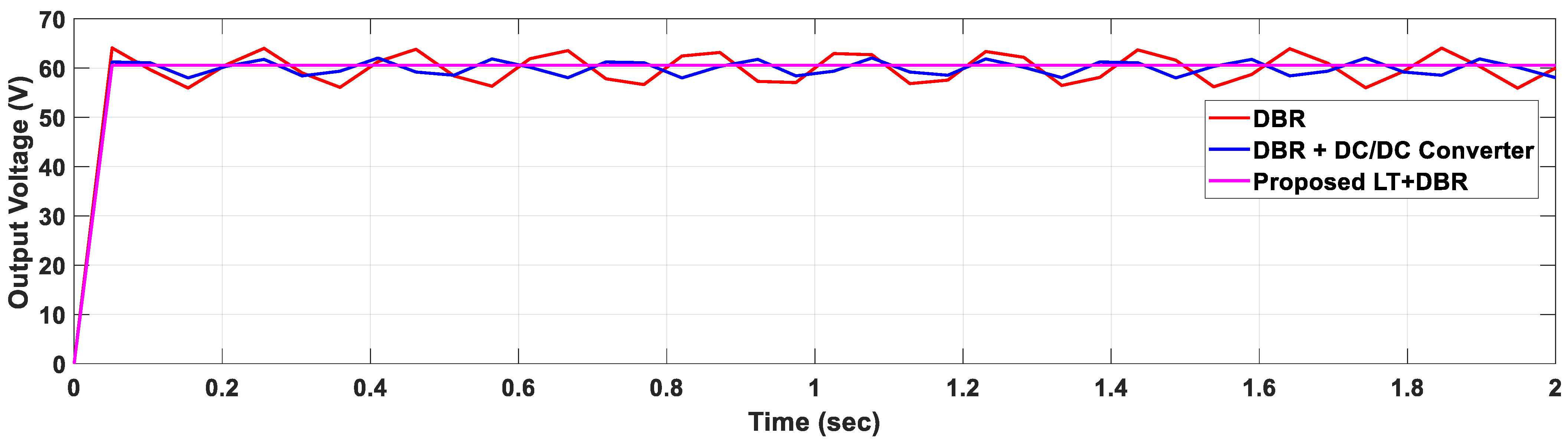
- The DC output voltage ripple content computed from the results is 4.8% with the conventional DBR charging station and 3.4% with the conventional DBR + DC–DC converter charging station. In contrast, it is notably reduced and adheres to the standard limit with the proposed integrated LT + DBR charging station, which recorded an output voltage ripple content of 0.7%.
- ▪
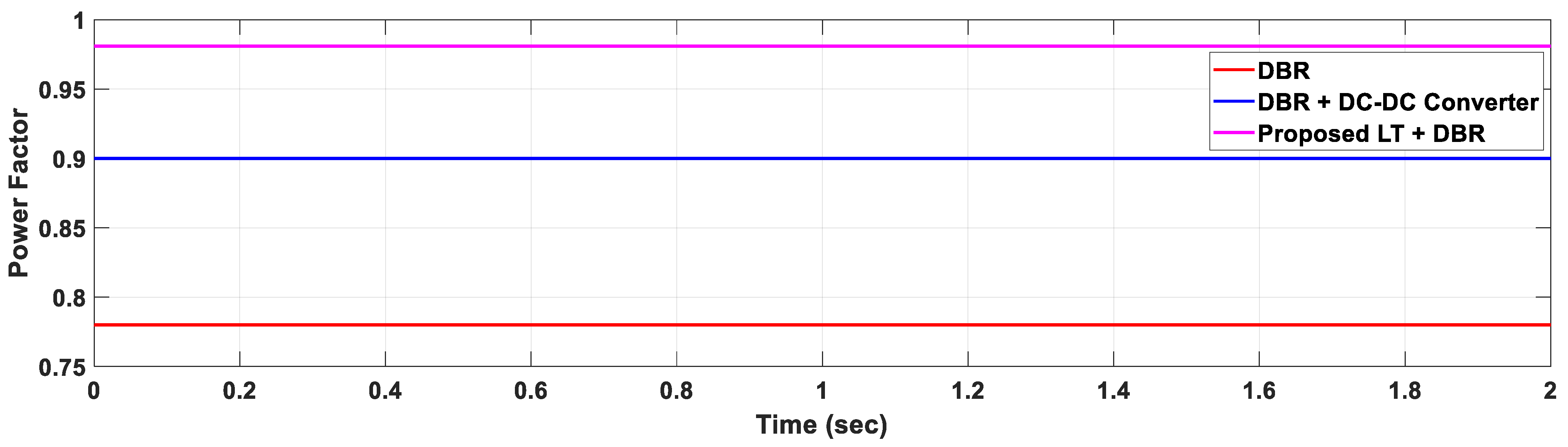
- The power factor computed from the results is 0.78 with the conventional DBR charging station and 0.90 with the conventional DBR + DC–DC converter charging station. While in the proposed integrated LT + DBR charging station, it is greatly improved to 0.98.
- ▪
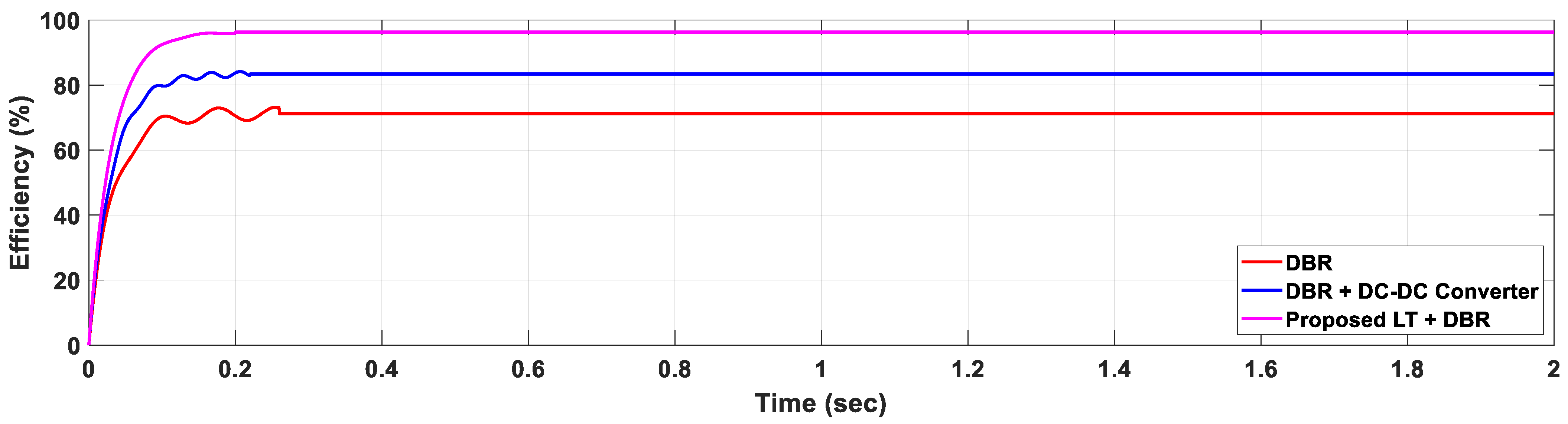
- The efficiency computed from the results is 71.2% with the conventional DBR charging station and 83.4% with the conventional DBR + DC–DC converter charging station. While in the proposed integrated LT + DBR charging station, it is slightly improved to 96.3%.
- ▪
- Though the current research involves a simulation-based analysis with consideration of parasitic effects, thermal variations, and component tolerances, experimental or prototype validation will be reflected in future research to expand on the proposed system in the real operating environment.
- ▪
- Further research into higher power ratings, variable voltage levels, and three-phase implementations, along with how well these fast-charging EV stations fit, will be taken into account in subsequent work.
- ▪
- The evaluation of cost, volume, weight, and efficiency will be analyzed clearly in future work by using hardware implementation and experimental validation of the proposed system.
- ▪
- The selection of the specific core material and nonlinear magnetic properties will be discussed in the future in terms of hardware implementation and experimental validation.
- ▪
- The hardware implementation and experimental evaluation will be conducted in the future to explore such practical issues as transformer feasibility, losses, EMI, inrush current, and thermal performance of the diodes.
- ▪
- The proposed system will be further extended to vehicle-to-grid (V2G) operation in future work, in which the discharging properties and two-way power flow will be examined.
- ▪
- The sensitivity and robustness analysis will be considered in future work to determine the performance in the variation in parameters and grid perturbations.
Author Contributions
Funding
Institutional Review Board Statement
Informed Consent Statement
Data Availability Statement
Conflicts of Interest
References
- Shariff, S.M. Single-Phase Robust Charger with High Power Quality for Electric Vehicle Application. Eur. J. Electr. Eng. Comput. Sci. 2024, 8, 50–70. [Google Scholar] [CrossRef]
- Rana, M.M.; Alam, S.M.M.; Rafi, F.A.; Deb, S.B.; Agili, B.; He, M.; Ali, M.H. Comprehensive Review on the Charging Technologies of Electric Vehicles (EV) and Their Impact on Power Grid. IEEE Access 2025, 13, 35124–35156. [Google Scholar] [CrossRef]
- Srivastava, A.; Manas, M.; Dubey, R.K. Electric Vehicle Integration’s Impacts on Power Quality in Distribution Networks and Associated Mitigation Measures: A Review. J. Eng. Appl. Sci. 2023, 70, 32. [Google Scholar] [CrossRef]
- Kim, I.; Park, J.-W. Integration of DC–DC Converters for OBC, LDC, and TC in Electric Vehicles. IEEE Trans. Transp. Electrif. 2024, 10, 5533–5543. [Google Scholar] [CrossRef]
- Mamidala, S.; Prajapati, A.K. Grid-Integrated EV Charging Infrastructure. In Recent Advances in Power Electronics and Drives—Select Proceedings of EPREC 2023; Lecture Notes in Electrical Engineering; Springer: Singapore, 2024; Volume 1139, pp. 297–323. [Google Scholar] [CrossRef]
- Bhati, N.; Kalla, U.K. Power Factor Corrected Y-Cell Modified Boost Converter Fed Battery Charger for EV Applications. e-Prime-Adv. Electr. Eng. Electron. Energy 2024, 8, 100550. [Google Scholar] [CrossRef]
- Mamidala, S.; Kumar, Y.V.P. Critical Review of Key DC/DC Converters for Maximum Power Extraction in Solar-Powered Electric Vehicle Charging Stations. Int. J. Renew. Energy Res. 2026, 16. [Google Scholar] [CrossRef]
- Neupane, R.; Magar, S.T.; Pandey, M.; Simkhada, A.; Bhattarai, B.R. Mitigation of Harmonics Due to Electric Vehicle Charging. J. Eng. Sci. 2024, 3, 101–105. [Google Scholar] [CrossRef]
- Mamidala, S.; Venkata Pavan Kumar, Y.; Mallipeddi, R. Revolutionizing Electric Vehicle Charging Stations with Efficient Deep Q Networks Powered by Multimodal Bioinspired Analysis for Improved Performance. Energies 2025, 18, 1750. [Google Scholar] [CrossRef]
- Mehmood, A.; Yang, F. Improvement of Power Quality of Grid-Connected EV Charging Station Using Grid-Component Based Harmonic Mitigation Technique. Energies 2025, 18, 2876. [Google Scholar] [CrossRef]
- Kilicoglu, H.; Tricoli, P. Technical Review and Survey of Future Trends of Power Converters for Fast-Charging Stations of Electric Vehicles. Energies 2023, 16, 5204. [Google Scholar] [CrossRef]
- Elazim, S.M.A.; Elkholy, M.H.; Elgarhy, A.; Senjyu, T.; Gamil, M.M.; Song, D.; Ali, E.S.; Ludin, G.A.; Irshad, A.S.; Lotfy, M.E. Enhancing Stability and Power Quality in Electric Vehicle Charging Stations Powered by Hybrid Energy Sources Through Harmonic Mitigation and Load Management. Sci. Rep. 2025, 15, 28077. [Google Scholar] [CrossRef]
- Srivastava, A.; Manas, M.; Dubey, R.K. Integration of Power Systems with Electric Vehicles: A Comprehensive Review of Impacts on Power Quality and Relevant Enhancements. Electr. Power Syst. Res. 2024, 234, 110572. [Google Scholar] [CrossRef]
- Gauswami, A.R.; Shah, H.A.; Gohil, S.N. Designing and Analyzing an EV Battery Charger with Enhanced Power Quality. J. Electr. Syst. 2024, 20, 983–991. [Google Scholar] [CrossRef]
- Govardhan, S. Design and Implementation of Power Quality Management in EV Chargers Using Power Charge Pro Converter. Int. J. Intell. Syst. Appl. Eng. 2024, 12, 2274–2285. [Google Scholar]
- Gupta, J.; Maurya, R.; Arya, S.R. On-Board Electric Vehicle Battery Charger with Improved Power Quality and Reduced Switching Stress. IET Power Electron. 2020, 13, 2885–2894. [Google Scholar] [CrossRef]
- Papamanolis, P.; Bortis, D.; Krismer, F.; Menzi, D.; Kolar, J.W. New EV Battery Charger PFC Rectifier Front-End Allowing Full Power Delivery in 3-Phase and 1-Phase Operation. Electronics 2021, 10, 2069. [Google Scholar] [CrossRef]
- Tiwari, A.K.; Sahu, L.K.; Barwar, M.K. Reliability Analysis of Multi-Level PFC Converter-Based Charger for Light EV Charging Application. Electr. Power Compon. Syst. 2024, 52, 292–307. [Google Scholar] [CrossRef]
- Zhou, Y.; Li, H.; Ravey, A.; Péra, M.C. An Integrated Predictive Energy Management for Light-Duty Range-Extended Plug-in Fuel Cell Electric Vehicle. J. Power Sources 2020, 451, 227780. [Google Scholar] [CrossRef]
- Maurya, R.; Arya, S.R.; Saini, R.K.; Gupta, J. On-Board Power Quality Charger for Electric Vehicles with Minimized Switching Stresses. Electr. Eng. 2022, 104, 1667–1680. [Google Scholar] [CrossRef]
- Mamidala, S.; Kumar, Y.V.P. Zeta Converter Integration for Improved Power Quality in Bidirectional V2G Energy Charging Stations. Results Eng. 2025, 28, 107346. [Google Scholar] [CrossRef]
- Rajkumar, S.; Balasubramanian, R.; Kathirvelu, K.P. A Comparative Analysis of Supraharmonic Emission by DC Fast Chargers Used for Electric Vehicle Charging. Sci. Rep. 2025, 15, 7992. [Google Scholar] [CrossRef]
- Mamidala, S.; Pavan Kumar, Y.V. Closed-Loop Battery Current-Controlled Zeta Converter for Improved Power Quality in Electric Vehicle Charging Stations. Trans. Energy Syst. Eng. Appl. 2024, 5, 1–19. [Google Scholar] [CrossRef]
- Cheepati, K.R.; Parimalasundar, E.; Suresh, K.; Reddy, C.R.; Alqahtani, M.M.; Khalid, M. Design of triple tuned passive harmonic power filter—A novel approach. IEEE Can. J. Electr. Comput. Eng. 2023, 46, 270–277. [Google Scholar] [CrossRef]
- Alfalahi, S.T.Y.; Mansor, M.B.; Nouh, A.; Abdrabba, S.I.; Mohamed, F. Sizing passive filters for mitigation of harmonics in a low voltage network containing solar PV units. Frankl. Open 2025, 10, 100220. [Google Scholar] [CrossRef]
- Harahap, P.; Hamid, M.I.; Hazmi, A. Comprehensive review of advanced multi-pulse rectifier technology and its application in electric vehicle fast charging systems. Andalasian Int. J. Appl. Sci. Eng. Technol. 2025, 5, 45–54. [Google Scholar] [CrossRef]
- Munoz, C.A.; Baier, C.R.; Hernández, J.C.; Marciel, E.I.; Melin, P.E. Series compensated low frequency transformers emulating multipulse rectifiers for harmonic current content minimization in electrical grids. IEEE Access 2025, 13, 107455–107466. [Google Scholar] [CrossRef]
- Yilmaz, M.; Krein, P.T. Review of battery charger topologies, charging power levels, and infrastructure for plug-in electric and hybrid vehicles. IEEE Trans. Power Electron. 2013, 28, 2151–2169. [Google Scholar] [CrossRef]
- Tayri, A.; Ma, X. Grid Impacts of Electric Vehicle Charging: A Review of Challenges and Mitigation Strategies. Energies 2025, 18, 3807. [Google Scholar] [CrossRef]
- Etanya, T.F.; Tsafack, P.; Ngwashi, D.K. Grid-Connected Distributed Renewable Energy Generation Systems: Power Quality Issues and Mitigation Techniques—A Review. Energy Rep. 2025, 13, 3181–3203. [Google Scholar] [CrossRef]
- Ugwuagbo, E.; Ray, B.; Balogun, A.; Okafor, F.; Sul, J.; Nabi, N.; Datta, U. Power quality assessment and harmonic mitigation at the point of common coupling of industrial load. J. Control Autom. Electr. Syst. 2026, 37, 397–410. [Google Scholar] [CrossRef]






| Category | Parameter | Value |
|---|---|---|
| Simulation Settings | Version | MATLAB/Simulink R2021a |
| Sampling time | 5 µs | |
| Simulation time | 2 s | |
| Simulation solver type | ode3 (bogacki-shampine) | |
| Configuration of PowerGUI | Discrete mode | |
| Grid Parameters | Voltage | 220 V (RMS) |
| Frequency | 50 Hz | |
| Source resistance | 0.2 Ω | |
| Source inductance | 1 mH | |
| Transformer Parameters | Voltage ratio | 220:48 V |
| DBR Parameters | Diode forward voltage drops | 0.7 V |
| Filter Parameters | Filter capacitor (C) | 6800 µF |
| Damping resistor (R) | 47 Ω | |
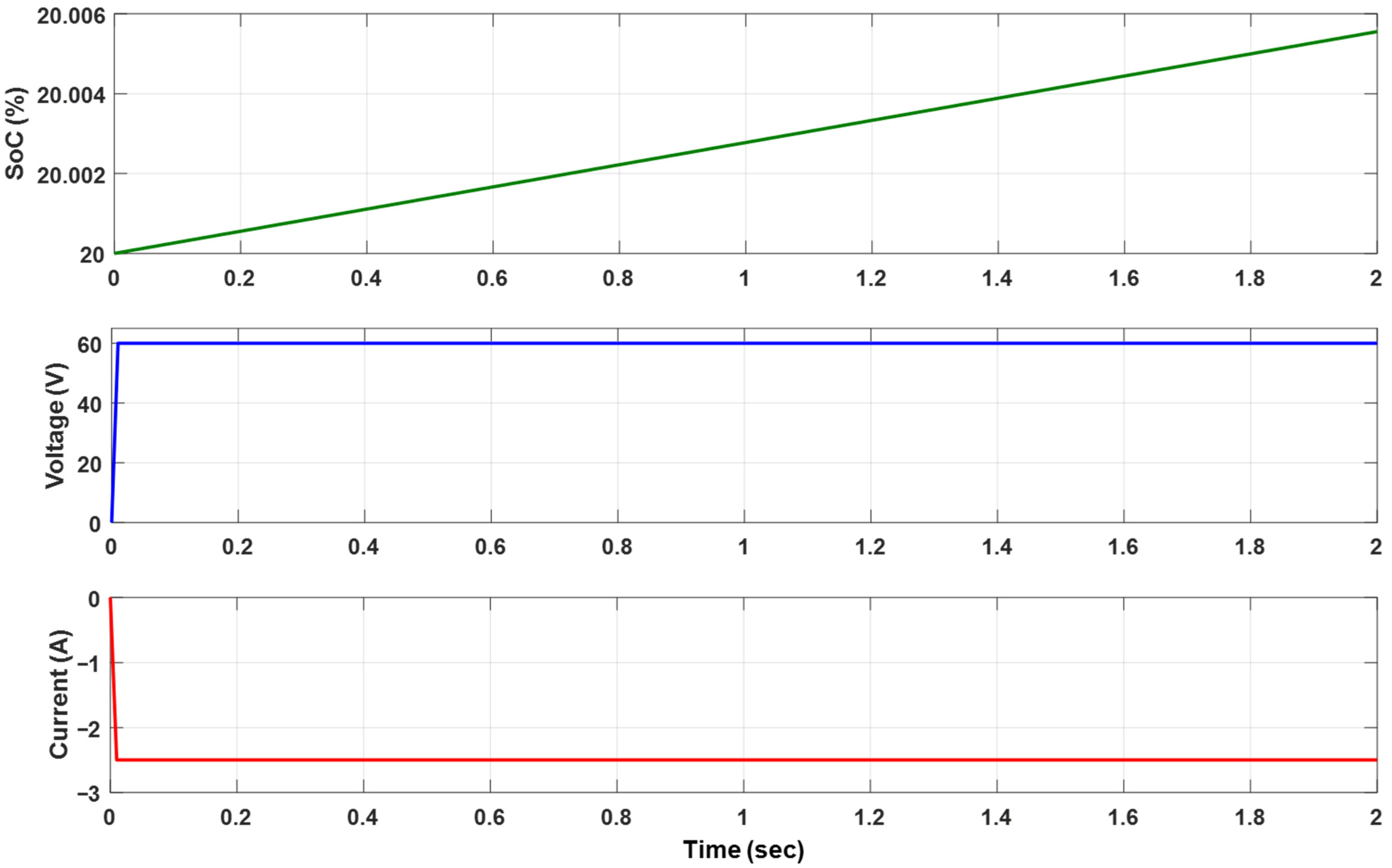
| EV Battery Parameters | Battery nominal voltage | 60 V |
| Battery capacity | 25 Ah | |
| Charging current | 2.5 A |
| Published Work (Ref.) | Topology Type | Power Factor | Current THD (%) | Voltage Ripple (%) | Efficiency (%) | Control Requirement |
|---|---|---|---|---|---|---|
| [1] | Single-Phase AC–DC PFC Converter | 99.79% | 3.79 | - | - | Yes |
| [6] | Y-Cell Modified Boost (YCMB) Converter | >0.99 | 1–3.86 | 3–4 | up to 95 | Yes |
| [10] | Advanced Converter-Based Systems | - | 0.88 | - | 97.4 | Yes |
| [14] | PFC boost converter | nearly unity | 6.94 | <10 | 90 | Yes |
| [15] | Power Charge Pro converter | - | 2.78 | 97.75 | Yes | |
| [16] | Diode bridge rectifier Integrated three-level DC–DC SEPIC converter | 0.98 | 2.1 | - | 97 | Yes |
| [21] | ZETA converter-based bi-directional charging station | - | - | <1.25 | 98.82 | Yes |
| [23] | Closed-loop battery current-controlled zeta converter | 0.96 | 1.9 | - | 91.8 | Yes |
| Proposed Work | LT–DBR + RC Passive Filter | 0.98 | 4.32 | 0.7 | 96.3 | No |
| Performance Metric | Conventional DBR | Conventional DBR + DC–DC Converter | Proposed LT + DBR |
|---|---|---|---|
| THD (%) | >25% | 8% | 4.32% (IEEE 519 std) |
| Power factor | 0.78 | 0.90 | 0.98 |
| Efficiency (%) | 71.2% | 83.4% | 96.3% |
| DC output Voltage Ripple (%) | 4.8% | 3.4% | 0.7% |
| Voltage Deviation Reduction | Baseline | Reduced | 9.1% better regulation than DBR |
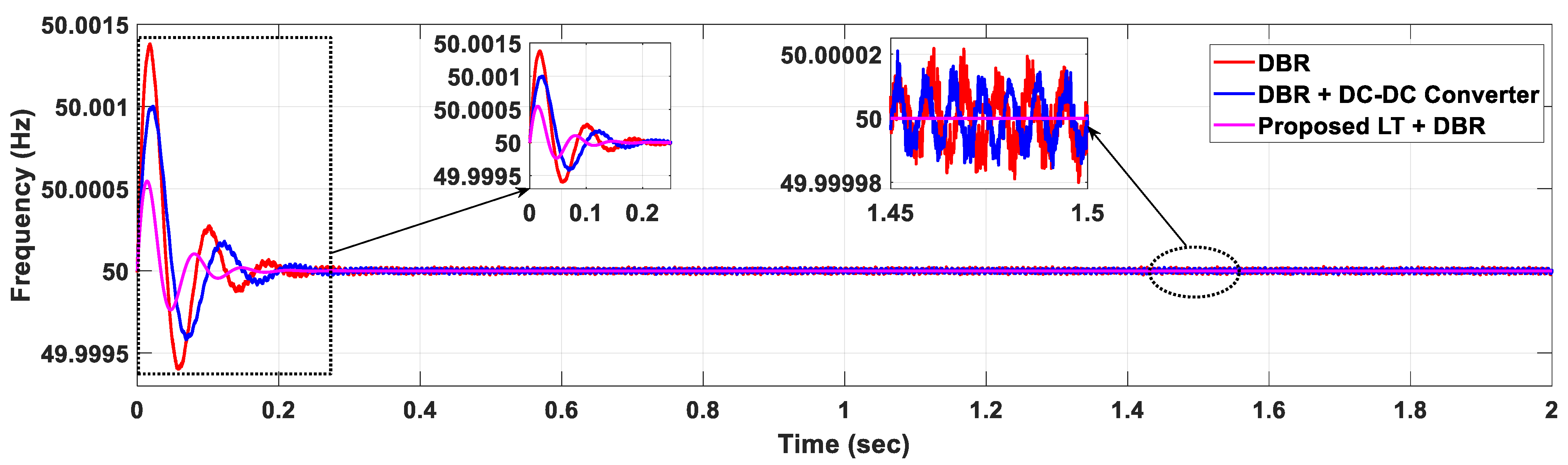
| Transient Overshoot (Hz) | 50.0015 Hz | 50.0010 Hz | 50.00051 Hz (lowest) |
| Transient Settling Time | 0.25 s | 0.25 s | 0.12 s (fastest) |
| Steady-State Frequency Ripple | ±2 × 10⁻⁵ Hz | ±1.5 × 10⁻⁵ Hz | Negligible; closest to 50 Hz |
| Reactive Power Consumption | High | Moderate | Very low |
| IEEE 519 Compliance | Fails | Partially meets | Fully compliant |
| Grid Compatibility | Poor | Acceptable | Excellent |
Disclaimer/Publisher’s Note: The statements, opinions and data contained in all publications are solely those of the individual author(s) and contributor(s) and not of MDPI and/or the editor(s). MDPI and/or the editor(s) disclaim responsibility for any injury to people or property resulting from any ideas, methods, instructions or products referred to in the content. |
© 2026 by the authors. Licensee MDPI, Basel, Switzerland. This article is an open access article distributed under the terms and conditions of the Creative Commons Attribution (CC BY) license.
Share and Cite
Mamidala, S.; Venkata Pavan Kumar, Y. Integrated Linear Transformer-Based Diode Bridge Rectifier for Improved Power Quality in Electric Vehicle Charging Stations. Eng. Proc. 2026, 124, 117. https://doi.org/10.3390/engproc2026124117
Mamidala S, Venkata Pavan Kumar Y. Integrated Linear Transformer-Based Diode Bridge Rectifier for Improved Power Quality in Electric Vehicle Charging Stations. Engineering Proceedings. 2026; 124(1):117. https://doi.org/10.3390/engproc2026124117
Chicago/Turabian StyleMamidala, Sugunakar, and Yellapragada Venkata Pavan Kumar. 2026. "Integrated Linear Transformer-Based Diode Bridge Rectifier for Improved Power Quality in Electric Vehicle Charging Stations" Engineering Proceedings 124, no. 1: 117. https://doi.org/10.3390/engproc2026124117
APA StyleMamidala, S., & Venkata Pavan Kumar, Y. (2026). Integrated Linear Transformer-Based Diode Bridge Rectifier for Improved Power Quality in Electric Vehicle Charging Stations. Engineering Proceedings, 124(1), 117. https://doi.org/10.3390/engproc2026124117