Proceeding Paper

Numerical Investigation of Unsteady Fluid Flow Inside Air Cooling Ducts with Tilted Heat Exchanger for Electrified Aero Engines †
1
Institute of Electrified Aero Engines, German Aerospace Centre (DLR), 03046 Cottbus, Germany
2
Institute of Aerodynamics and Flow Technology, German Aerospace Centre (DLR), 38108 Braunschweig, Germany
*
Author to whom correspondence should be addressed.
Presented at the 15th EASN International Conference, Madrid, Spain, 14–17 October 2025.
Eng. Proc. 2026, 133(1), 161; https://doi.org/10.3390/engproc2026133161 (registering DOI)
Published: 20 May 2026

Abstract

Integrating a heat exchanger (HEX) into the cooling duct of a high-power fuel-cell-based aircraft presents a critical trade-off between thermal performance and aerodynamic penalties. The present study addresses this challenge through the design and system-level analysis of a HEX integrated into the cooling duct. Developed as part of the Clean Aviation project FAME, the design features a rectangular inlet, a circular outlet, and a tilted HEX. The evaluation is performed using high-fidelity Large Eddy Simulations (LESs). The HEX is modeled with a porous media approach based on the Darcy–Forchheimer equation, while the simulations are carried out using a self-adapted version of the pisoFoam solver, termed pisoTempFoam, to account for heat transfer. The study reveals that while component-level design choices, such as a straight inlet and tilted HEX configuration, successfully mitigate local flow separation and duct-induced losses, a critical system-level performance issue emerges. The analysis demonstrates that the cooling duct design, when subjected to realistic operational conditions, generates the high pressure head to overcome the resistance of the HEX. The external aerodynamic analysis also indicates that the HEX resistance is a critical factor, and without overcoming it the system fails to capture the required air mass flow rate, compromising thermal management. The findings highlight the necessity to optimize the design, by an adapted duct shape or an auxiliary fan, to overcome the HEX-induced pressure drop. The porous media approach is thereby validated as an effective tool for rapid system-level design analysis, despite its inherent limitation in capturing detailed downstream turbulence.

1. Introduction

The cooling duct is a critical subsystem in a high-power fuel-cell-based propulsion system for the next generation of aircraft. The major challenge in designing these systems lies in integrating compact, high-performance heat exchangers (HEXs) into a duct. Meanwhile, HEXs, which are essential for thermal management, also induce significant aerodynamic drag. And hence, there is a trade-off between maximizing heat dissipation and substantial pressure loss, which can be critical especially during flight take-off phases.
Accurately capturing fluid flow with a full-scale simulation and resolving the HEX is computationally very expensive and there is a need to adopt a simplified modeling approach to get the global pressure drop and study such a system. The study focuses on capturing the unsteady flow behavior and pressure characteristics using a three-dimensional Large Eddy Simulation (LES). The heat exchanger is simulated as a porous media governed by the Darcy–Forchheimer formulation [1]. To capture thermal effects alongside fluid flow, we utilize a modified version of the standard pisoFoam solver, known as pisoTempFoam [2]. The flow is examined along three key regions, upstream, within, and downstream of the HEX, enabling end-to-end pressure loss evaluation. The credibility of the method in predicting thermo-fluid behavior has been demonstrated by numerous studies. For instance, non-adiabatic, anisotropic porosity models have been successfully validated against experimental data [3], and thermal models using this approach show favorable agreement with established Nusselt and NTU correlations [4]. The underlying physics are typically described by the Darcy–Forchheimer law, for which power-law functions have been developed to characterize the flow transition regime, a key aspect of predicting pressure drop accurately [1]. Furthermore, the porous-continuum model has been proven to be a computationally inexpensive tool that adequately captures macroscopic transport phenomena in complex geometries [5].
While these studies establish the credibility of the porous media model for component-level analysis, a critical gap remains in understanding its system-level implications within a complete, three-dimensional duct designed under realistic aircraft integration constraints. Building on a previous 2D investigation, which highlighted the importance of duct curvature in mitigating flow separation downstream of a tilted HEX [2], this study elevates the analysis to a full 3D geometry. As part of the Clean Aviation Joint Undertaking project FAME (Fuel Cell Propulsion System for Aircraft Megawatt Engines) [6], this study presents the design and analysis of a cooling duct geometry developed in conjunction with the overall aircraft design, featuring a rounded rectangular inlet, a circular outlet, and an integrated tilted HEX pre-selected from an in-house design configuration. The primary objective is to carry out end-to-end analysis of a cooling duct with high-fidelity LES with a porous media model to quantify the critical pressure penalty and to assess the viability of the design developed in the FAME project.

2. Background and Methodology

2.1. Nacelle and Duct Design

Building on the top-level aircraft requirements (TLARs) summarized in Table 1, di Stasio et al. [7] conducted a parametric design study to develop a baseline concept aircraft. On the basis of this preliminary design, the FAME full-scale reference aircraft was designed by Schmidt et al. [8]. Within this context, a parametric CATIA model was created as shown in Figure 1. The parametric CATIA model was the starting point for the design studies using CFD simulations with a focus on the engine including the cooling duct with an integrated HEX. Within this context, the isolated engine configuration was studied including the cooling duct with the integrated HEX highlighted in red in Figure 1.
To evaluate this design, the present paper investigates the aerodynamic performance of the cooling duct integrated within the FAME engine of the reference aircraft. The analysis was carried out with two approaches, the external aerodynamics of the nacelle with a running propeller and the internal flow dynamics through the duct integrating the HEX, while the current investigation focuses on the second approach. The design of the integrated cooling duct was initially evaluated using RANS-based TAU [9] simulations in order to investigate the aerodynamic interaction between the engine and the wing, as well as the internal flow field within the duct. The HEX design is based on a multi-objective optimization framework [10], which used a genetic algorithm to find the optimal trade-off between maximizing thermal performance and minimizing mass, volume, and pressure drop. The boundary conditions for the HEX design originate from the preliminary design of the full aircraft described within the work of di Stasio et al. [7]. The most important assumptions and specifications of the heat exchanger are listed in Table 2.
The HEX design results in a total required cross-section of 2.75 m 2 . In order to better integrate the HEX within the nacelle, two HEXs were used with a cross-section of 1.375 m 2 and an air mass flow rate of 20 kg s 1 each. As shown in Figure 1, the HEXs are tilted in order to integrate them behind the propeller. To guide the air flow through the HEXs, an inlet and an outlet have been designed for each HEX and integrated into the nacelle. In the course of the investigations, a primary design constraint for the internal duct was to counteract blockage of the flow within the duct. To satisfy this, the outlet-to-inlet area ratio was maintained above 0.5 . As depicted in Figure 1, the geometry of the duct is complex, featuring a rectangular intake that transitions to a circular outlet. This rectangular inlet is smoothly integrated with the external shape of the nacelle, while the circular outlet is designed to accommodate the potential future installation of, for instance, a fan. To mitigate flow separation and reduce pressure losses associated with sharp edges, the corners of both the inlet and outlet sections are rounded. The outlet duct section position and its length are designed for proper fit within the nacelle structure.
The HEX is positioned in a tilted arrangement within the duct, a configuration which helps minimize pressure losses as shown in [2]. This placement effectively segments the duct into three distinct regions for analysis: an upstream section, a downstream section, and the region containing the HEX core. In the preliminary design an offset strip-fin HEX (1/8-15.61 configuration [11]) was selected based on a system mass flow rate of 20 kg s 1 per side, resulting in a mean velocity at the duct inlet of 53.6 m s 1 and inlet static pressure of 4555 Pa . Within the porous media region, the local velocity is 12.5 m s 1 resulting in a pressure loss of 2725 Pa . The heat rejected elevates the temperature from 303 K to 336 K . Consequently, the total heat dissipated by the airflow is calculated as Q ˙ = m ˙ air C p , avg , air ( T avg , out T avg , in ) .
The preliminary design analysis indicates that a significant pressure head is required to drive the target mass flow rate of 20 kg s 1 (Table 2) through the system. To investigate whether the external flow environment around the nacelle provides the required pressure, a full-scale external aerodynamic analysis using RANS-based simulations with the help of the DLR TAU code [9] was performed, modeling the duct integrated behind the propeller, and is described in detail in Schmidt et al. [8].

2.2. Internal Cooling Duct

2.2.1. Numerical Method

The internal cooling duct simulations were performed using an LES approach to resolve the turbulent flow structures within the duct. Therefore, the pisoTempFoam solver was employed by Singh et al. [2], a transient solver designed for thermal-fluid problems, to handle both fluid dynamics and heat transfer. Heat transfer is managed via a temperature equation that balances heat conduction, convection, and any volumetric heat sources [2]. The solver computes the equations of continuity, momentum, and the passive temperature transport. To model the sub-grid-scale turbulence, the dynamic k-equation model was used [12]. This model is particularly well-suited for wall-bounded flows as it dynamically adjusts the model coefficient to account for small-scale turbulence near solid surfaces. The near-wall region was handled using a wall-modeling approach [13], with the nutUWallFunction and alphatJayatillekeWallFunction providing the link between the wall and the fully turbulent core flow.
To model the pressure drop across the HEX computationally without resolving every geometric detail, a simplified Darcy–Forchheimer porous media approach is used. The Darcy and Forchheimer coefficients for this model were derived [2] based on established experimental data and empirical correlations [14,15]. Iterative regression is used to determine key two coefficients, producing pressure drop predictions that closely match validated experimental findings [2]. This method uses the fundamental geometric properties of the HEX, such as porosity, to define the flow regime and accurately calculate the pressure loss via the Darcy–Forchheimer equation [16,17,18,19]. From a methodological perspective, this work validates the porous media approach as a highly effective tool for rapid, system-level design studies. It successfully captured the global performance metrics, including system pressure drop, mass flow rate, and heat dissipation, while significantly reducing the computational expense required for a fully resolved geometric simulation. However, a key limitation of the model is that it artificially laminarizes the flow downstream of the porous zone, hence failing to capture the turbulent wake expected from a physical HEX. While this simplification was sufficient for the global analysis performed here, it underscores a open research question.

2.2.2. Simulation Setup

A multi-block, unstructured grid was generated using the NETGEN3D tool, partitioning the computational domain into three distinct regions: the upstream duct, the porous HEX core, and the downstream duct.
A grid independence study was performed on a series of meshes with cell counts ranging approximately from 1 × 10 6 to 50 × 10 6 cells. Based on that, a mesh of approximately 20 million cells was selected. This mesh provided a stable solution for key quantities of interest, such as the total mass flow rate, while maintaining a wall-adjacent grid spacing that satisfied the requirements of the wall model ( y t a r g e t + 30 ). For all simulations, convergence was declared when the scaled residuals for all variables dropped by an order of 10 7 and the mass flow rate at the outlet reached a steady, constant value. Across all transient simulations, the time step was maintained with a Courant–Friedrichs–Lewy (CFL) number below 0.2 , ensuring both numerical stability and high temporal resolution.
At the domain inlet, a uniform velocity profile, ( U , 0 , 0 ) , was specified with inlet Reynolds number R e = U · L / ν = 4 · 10 5 , where ‘L’ is the characteristic length chosen based on the HEX thickness. A zero-pressure gradient condition was applied at the outlet. A no-slip boundary condition was enforced on all solid walls.

3. Results and Discussion

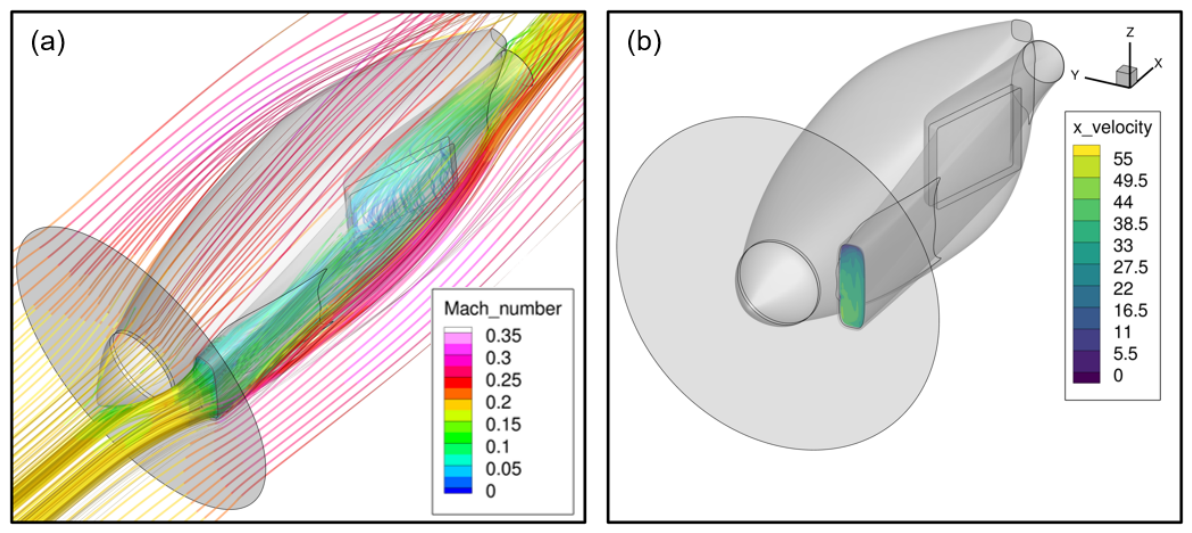
The results of the external aerodynamic studies are summarized in detail in Schmidt et al. [8]. Two different scenarios were simulated to analyze how much heat is dissipated for different conditions: one case with a standard atmosphere (ISA, 288.15 K) and the hot-day case (ISA+15, 303.15 K) depicted in Figure 2. At an ambient temperature of T = 288.15 K, a heat flux of 1.04 MW is dissipated via the HEX, due to the comparably low air temperature. Hence, for standard atmosphere conditions, the HEX reaches the necessary dissipation of heat for take-off conditions as given by the pre-design (1.027 MW), whereas in the case of T = 303.15 K, significantly less heat can be dissipated, because of the comparably high air temperature combined with the low Mach number within the cooling duct as depicted in Figure 2a. As the extreme case with T = 303.15 K needs to be taken into account in the design, the cooling duct needs further adjustment to increase the local flow velocity in front of the HEX and therefore increase the heat transfer. Future design iterations must therefore focus on increasing mass flow rate by using an adapted duct shaping with a resized inlet and outlet or by incorporating a fan. This critical finding impacts the internal fluid flow of the cooling duct. Therefore, the present study focuses on deeper investigations to characterize the internal flow, ensuring a uniform flow through the HEX region as a basis for upcoming duct shape design optimizations.
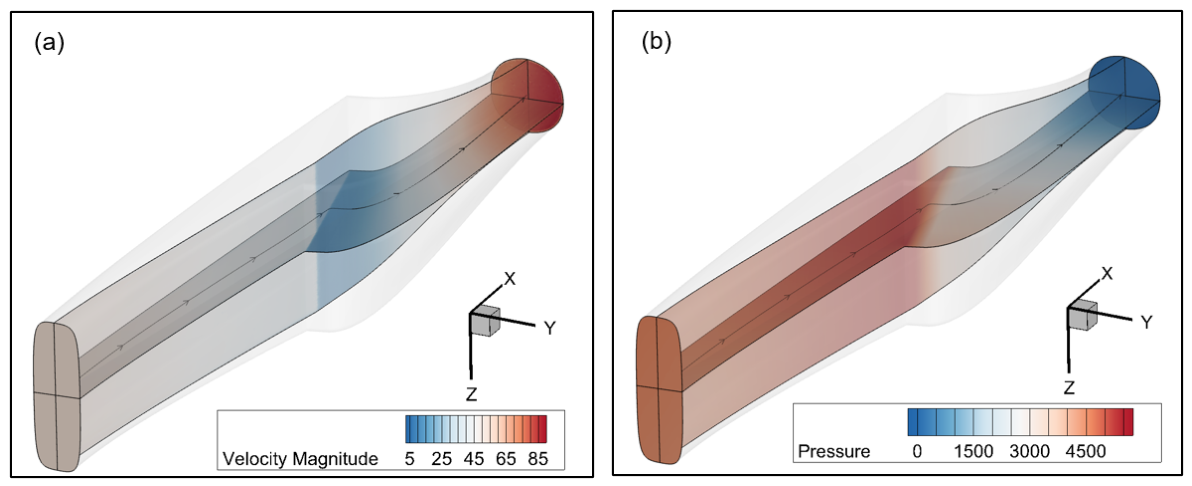
To achieve this, cooling duct LES results are qualitatively analyzed via the flow field visualizations in Figure 3, which displays pressure and velocity contours on horizontal and vertical planes sliced through the duct. Figure 3a demonstrates a uniform velocity profile at the inlet. However, as the flow approaches the resistance of the HEX core, it significantly decelerates, causing a local rise in static pressure upstream. This is followed by the pressure drop across the HEX shown in Figure 3b, which acts as the main source of additional drag in the system. Downstream of the HEX, the flow begins to re-accelerate as it moves towards the outlet, followed by a further drop in static pressure. This behavior confirms that the duct geometry effectively manages the airflow under uniform velocity inlet conditions, successfully driving the flow against the resistance of the HEX.
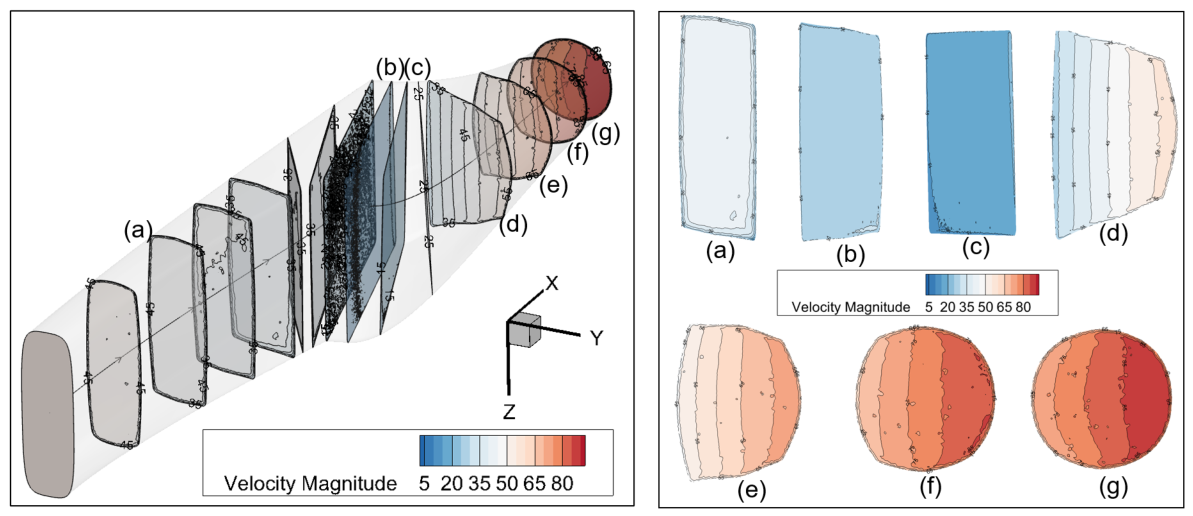
A detailed analysis of the flow field, visualized in the cross-sectional plots of Figure 4, reveals the complex flow pattern under the influence of the HEX. The most important flow characteristic is the static pressure increase immediately upstream of the HEX. This is a direct consequence of the flow decelerating as it approaches the high-resistance porous core within the divergent section. While this pressure increase helps to stabilize the flow before it enters the HEX, the major losses within the duct are from the HEX and, to a lesser extent, from the path downstream. This is consistent with fundamental fluid dynamics principles, where a decrease in flow velocity in a divergent section leads to an increase in static pressure. Later on, downstream of the HEX, the duct geometry becomes convergent, causing the flow to accelerate towards the outlet. This acceleration caused drop in static pressure, as illustrated by the pressure and velocity trends across the slices in Figure 4 and summarized in Figure 3. Thus, the internal duct geometry can guide the flow to provide uniform flow to the HEX for the case of uniform inflow. Finally, the simulation confirms the thermal performance, with the air being heated to an average outlet temperature of 336 K, successfully achieving the required heat rejection for the hot-day take-off condition (ISA+15).
The porous media approach successfully predicts global pressure drop and flow alignment. However, it does not reproduce the downstream turbulence observed in physical heat exchangers, as the model artificially laminarizes the flow. Additionally, heat transfer occurs downstream of the HEX, resulting in an outlet air temperature of 336 K. The analysis of the losses of the whole duct and the evaluation of the performance of the duct integrating the HEX are achieved. The simulations show its capabilities to analyze the cooling duct flows in complex geometries. In connection with the external aerodynamic simulations [8] the effect of non-uniform inlet conditions can be investigated. Within this context, simulations of the cooling duct with a velocity distribution as inlet boundary condition are currently ongoing, which are extracted from the external aerodynamic simulation via a slice at the duct inlet, as presented in Figure 2b.

4. Conclusions

This study presents a system-level performance analysis of a HEX integrated into a fuel-cell-based electric aircraft engine cooling duct. It utilizes the computationally efficient porous media approach to get global pressure drop with heat dissipation and allows for analysis of the HEX’s performance. While the HEX design is thermally capable of dissipating the required heat load, the pressure drop due to the HEX imposes a significant pressure penalty by choking the flow. The analysis of the external aerodynamics highlights that the current cooling system requires optimization to meet the requirements especially under demanding conditions such as hot-day take-off. To address this, two potential solutions are recommended: adapting the cooling duct shape by changing the size of the inlet and outlet to capture more air or integrating an auxiliary fan to boost airflow. By implementing one of these solutions, the performance of the cooling system can be significantly improved and ensure reliable operation during take-off. For the internal flow the duct geometry is confirmed to effectively manage airflow under the influence of the HEX, overcoming resistance and achieving uniform flow to the heat exchanger. The thermal performance was demonstrated to successfully achieve the required heat rejection for the hot-day take-off condition, with the air being heated to an average outlet temperature of 336 K.
Although the simulations captured the global performance metrics, the model lacked the capability to capture unsteady flow features in the duct. Consequently, experimental validation is imperative to validate these numerical predictions and performance characteristics for real-world applications.

Author Contributions

The author contributions are as follows: P.S., S.M. and S.d.G. were responsible for the internal flow dynamics through the duct integrating the HEX. F.N.S. and R.R. were responsible for the external aerodynamics over the nacelle with the propeller-on configuration. All authors contributed to the writing and review of the manuscript. All authors have read and agreed to the published version of the manuscript.

Funding

This research was funded the funding of the project FAME (Grant Agreement No. 101140559) by the European Union. Views and opinions expressed are, however, those of the author(s) only and do not necessarily reflect those of the European Union or Clean Aviation Joint Undertaking. Neither the European Union nor the granting authority can be held responsible for them.

Institutional Review Board Statement

Not applicable.

Informed Consent Statement

Not applicable.

Data Availability Statement

The original contributions presented in this study are included in the article.

Acknowledgments

The authors would like to thank Sahil Bhabkar for sizing the heat exchanger used in this study.

Conflicts of Interest

The authors declare no conflicts of interest.

References

  1. Wang, L.; Cardenas, M.B.; Wang, T.; Zhou, J.Q.; Zheng, L.; Chen, Y.F.; Chen, X. The effect of permeability on Darcy-to-Forchheimer flow transition. J. Hydrol. 2022, 610, 127836. [Google Scholar] [CrossRef]
  2. Singh, P.; Merbold, S.; Graaf, S.D. Numerical investigation of wall curvature effect on air cooling ducts with tilted heat exchanger for electrified aero engines. In 24th DGLR STAB Symposium Abstracts; Part of the Notes on Numerical Fluid Mechanics and Multidisciplinary Design Book Series; Springer: Cham, Switzerland, 2024; pp. 108–109. [Google Scholar]
  3. Missirlis, D.; Donnerhack, S.; Seite, O.; Albanakis, C.; Sideridis, A.; Yakinthos, K.; Goulas, A. Numerical development of a heat transfer and pressure drop porosity model for a heat exchanger for aero engine applications. Appl. Therm. Eng. 2010, 30, 1341–1350. [Google Scholar] [CrossRef]
  4. Hayes, A.M.; Khan, J.A.; Shaaban, A.H.; Spearing, I.G. The thermal modeling of a matrix heat exchanger using a porous medium and the thermal non-equilibrium model. Int. J. Therm. Sci. 2008, 47, 1306–1315. [Google Scholar] [CrossRef]
  5. Alshare, A.A.; Simon, T.W.; Strykowski, P.J. Simulations of flow and heat transfer in a serpentine heat exchanger having dispersed resistance with porous-continuum and continuum models. Int. J. Heat Mass Transf. 2010, 53, 1088–1099. [Google Scholar] [CrossRef]
  6. Clean Aviation—Project FAME: Fuel Cell Propulsion System for Aircraft Megawatt Engines. Clean Aviation Joint Undertaking Projects. Available online: https://www.clean-aviation.eu/ (accessed on 11 May 2026).
  7. Di Stasio, M.; Nicolosi, F.; Melone, G.; Cusati, V. Conceptual Design and Technology Sensitivity Analysis of a Fuel Cell Short-Range Aircraft. In Proceedings of the AIAA AVIATION FORUM AND ASCEND 2025, Las Vegas, NV, USA, 21–25 July 2025; p. 3370. [Google Scholar]
  8. Schmidt, F.N.; Rudnik, R.; Singh, P. CFD studies of an all-electric fuel cell based aircraft with integrated cooling design. In Proceedings of the 60th 3AF International Applied Aerodynamics Conference (AERO2026), Paris, France, 23–25 February 2026. [Google Scholar]
  9. Schwamborn, D.; Gerhold, T.; Kessler, R. DLR-TAU code—An overview. In Proceedings of the 1st ONERA/DLR Aerospace Symposium, Paris, France, 21–24 June 1999. [Google Scholar]
  10. Bhapkar, S.; Sain, C.; Kazula, S. Design of heat exchangers with cooling fins in fuel cell-powered electric aircraft: Genetic optimization approach with CFD validation. In Proceedings of the 2025 IEEE/AIAA Transportation Electrification Conference and Electric Aircraft Technologies Symposium (ITEC+ EATS), Anaheim, CA, USA, 18–20 June 2025; pp. 1–8. [Google Scholar]
  11. Kays, W.M.; London, A.L. Compact Heat Exchangers; McGraw-Hill: New York, NY, USA, 1984. [Google Scholar]
  12. Janke, D.; Swaminathan, S.; Hempel, S.; Kasper, R.; Amon, T. Particulate matter dispersion modeling in agricultural applications: Investigation of a transient open source solver. Agronomy 2021, 11, 2246. [Google Scholar] [CrossRef]
  13. Mukha, T.; Rezaeiravesh, S.; Liefvendahl, M. A library for wall-modelled large-eddy simulation based on OpenFOAM technology. Comput. Phys. Commun. 2019, 239, 204–224. [Google Scholar] [CrossRef]
  14. Dong, J.; Chen, J.; Chen, Z.; Zhou, Y. Air-side thermal hydraulic performance of offset strip fin aluminum heat exchangers. Appl. Therm. Eng. 2007, 27, 306–313. [Google Scholar] [CrossRef]
  15. Kim, D.U.; Son, J.Y.; Kim, T.K.; Kim, Y.W. Friction correlation of an offset strip fin modeled as porous medium for application to a geothermal heat exchanger. Geothermics 2020, 87, 101873. [Google Scholar] [CrossRef]
  16. Marquillie, M.; Laval, J.P.; Dolganov, R. Direct numerical simulation of a separated channel flow with a smooth profile. J. Turbul. 2008, 9, N1. [Google Scholar] [CrossRef]
  17. Dutta, P.; Nandi, N. Numerical study on turbulent separation reattachment flow in pipe bends with different small curvature ratio. J. Inst. Eng. India Ser. C 2019, 100, 995–1004. [Google Scholar] [CrossRef]
  18. Rahmani Firozjaei, M.; Neyshabouri, S.A.A.S.; Sola, S.A.; Mohajeri, S.H. Numerical simulation on the performance improvement of a lateral intake using submerged vanes. Iran. J. Sci. Technol. Trans. Civ. Eng. 2019, 43, 167–177. [Google Scholar] [CrossRef]
  19. Kajishima, T.; Miyake, Y.; Inaba, T. Numerical simulation of laminar flow in curved ducts of rectangular cross section. JSME Int. J. Ser. Fluids Eng. Heat Transf. Power Combust. Thermophys. Prop. 1989, 32, 516–522. [Google Scholar] [CrossRef]
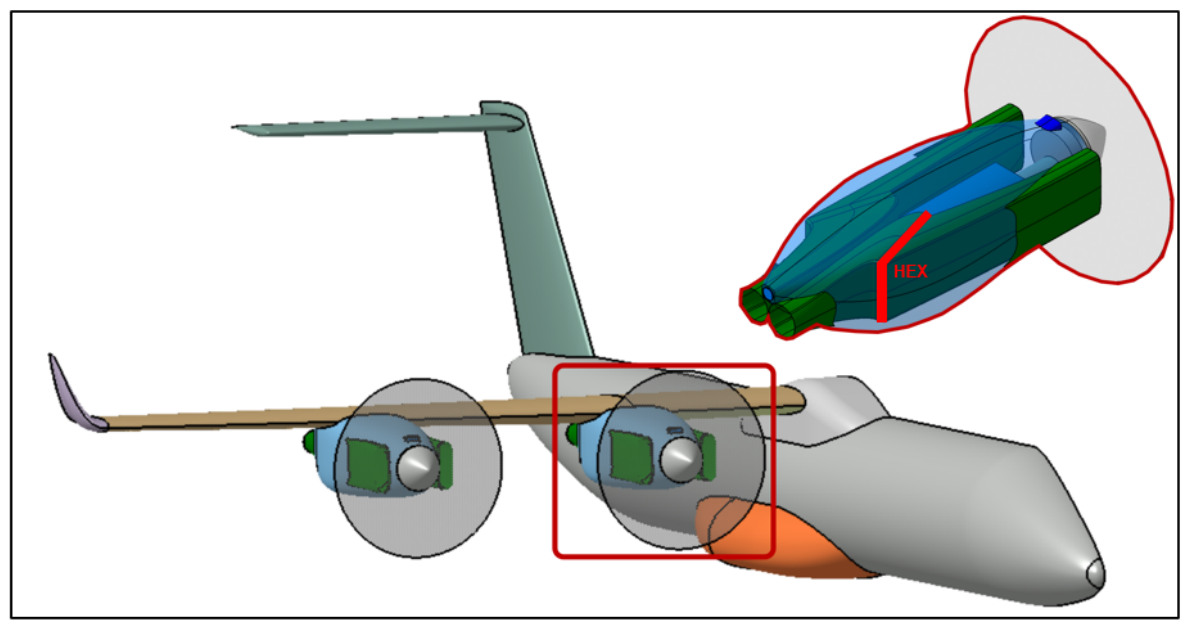
Figure 1. FAME full-scale aircraft with a focus on the engine’s cooling duct including the heat exchanger.
Engproc 133 00161 g001
Figure 2. RANS-based simulation results for hot-day (303.15 K) take-off case. (a) Stream line visualization of the fluid flow including local Mach number. (b) Resulting inlet velocity distribution.
Engproc 133 00161 g002
Figure 3. (a) Velocity and (b) static pressure contour along horizontal and vertical slices of cooling duct.
Engproc 133 00161 g003
Figure 4. Color contours of velocity magnitude for different cross-sections located along cooling duct. (Left): Cooling duct with various cross-sections selected as perpendicular to bulk flow velocity. (Right): Representation of selected cross-sections extracted at positions (ag).
Engproc 133 00161 g004
Table 1. Top-level aircraft requirements (TLARs) for the FAME full-scale reference aircraft.
TLARValue
Entry into service2035
Design range1000 nm
PAX101
Cruise Mach number0.55
Initial cruise altitude capability (ICAC)Up to 27,000 ft
Aircraft design group (ADG)Group III
Approach categoryCategory C
Table 2. Specifications of the heat exchanger per engine.
ParameterValue
Heat to be dissipated (take-off, one engine inoperative)2.053 MW
Total Cross-section per engine (sum of 2 HEX) 2.75 m 2
Necessary massflow of air 40 kg s 1
Design inflow velocity (inside of HEX inlet) 20 m s 1
Disclaimer/Publisher’s Note: The statements, opinions and data contained in all publications are solely those of the individual author(s) and contributor(s) and not of MDPI and/or the editor(s). MDPI and/or the editor(s) disclaim responsibility for any injury to people or property resulting from any ideas, methods, instructions or products referred to in the content.