


Building Information Models (BIMs) as a Source of Data for Spatial Evidence in Facility Management †

Abstract
1. Introduction
2. Standards and IFC Classification
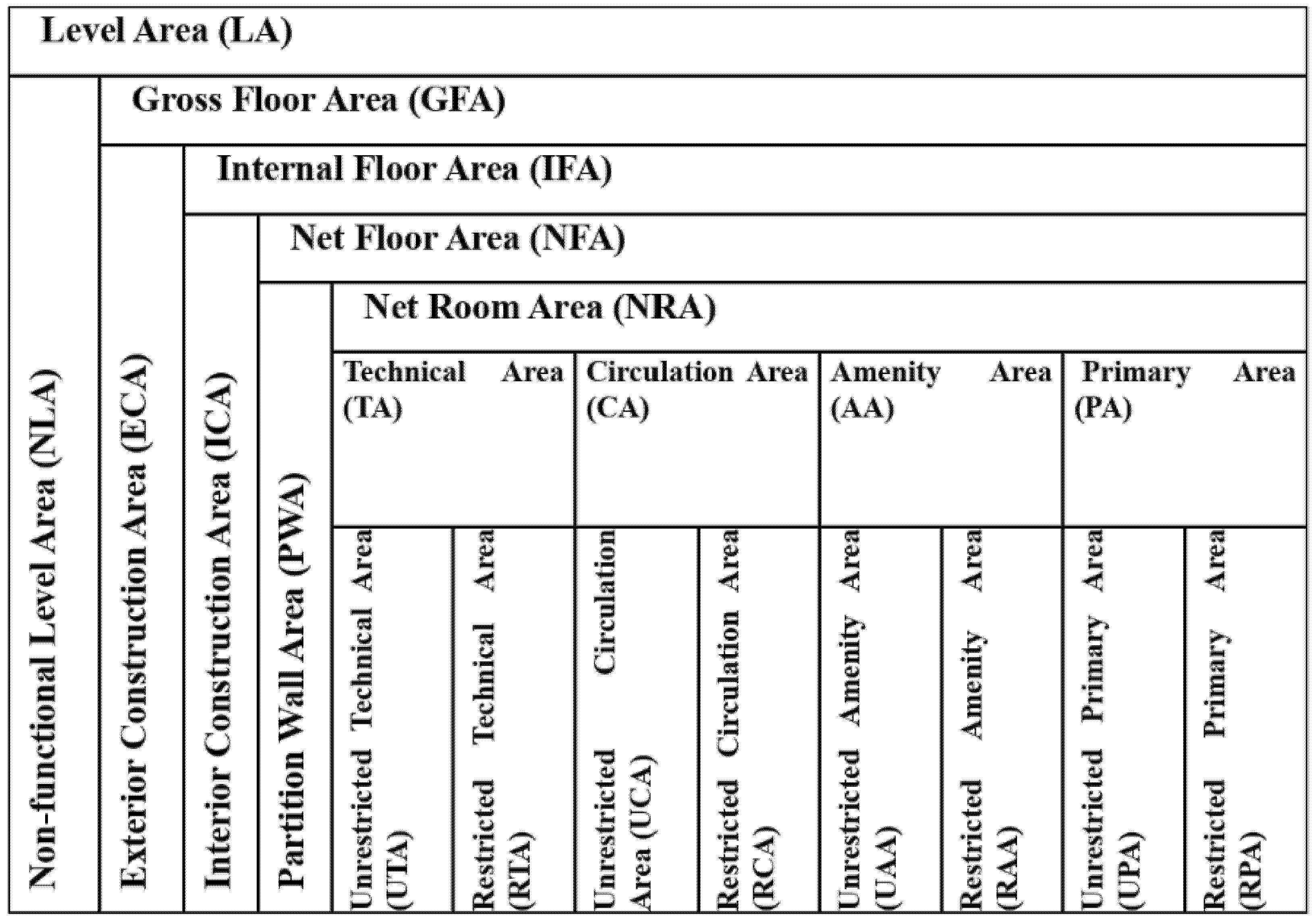
2.1. EN 15221-6:2011 Facility Management—Part 6: Area and Space Measurement in Facility Management
- Floor: generally, the lower horizontal structure of a room which constitutes the bounding element of a building or part thereof;
- Wall: generally a vertical structure that constitutes the bounding elements of a building.
2.2. IFC Classification
3. Digital Model—Working with Data
4. Conclusions
Author Contributions
Funding
Institutional Review Board Statement
Informed Consent Statement
Data Availability Statement
Acknowledgments
Conflicts of Interest
Abbreviations
| BIM | Building Information Models |
| CDE | Common Data Environment |
| IFC | Industry Foundation Classes |
| MEP | Mechanical, Electrical, Plumbing |
References
- Hardin, B.; McCool, D. BIM and Construction Management: Proven Tools, Methods, and Workflows; Wiley: Indianapolis, IN, USA, 2015. [Google Scholar]
- Lederer, L.; Ellingerová, H.; Ďubek, S.; Bočkaj, J.; Ďubek, M. Construction price forecasting models in the construction industry: A comparative analysis. Buildings 2024, 14, 1325. [Google Scholar] [CrossRef]
- Švajlenka, J.; Kozlovská, M. The potential of timber-based buildings in terms of energy efficiency. MATEC Web Conf. 2020, 322, 01002. [Google Scholar] [CrossRef]
- EN 15221-6:2011; Facility Management—Part 6: Area and Space Measurement in Facility Management. European Committee for Standardization (CEN): Brussels, Belgium, 2011.
- buildingSMART International. Industry Foundation Classes (IFC). 2025. Available online: https://www.buildingsmart.org/standards/bsi-standards/industry-foundation-classes/ (accessed on 26 February 2025).
- Konovalov, D.; Švajlenka, J.; Katunsky, D. Information model of the building and its application in selected phases of the life cycle. In E3S Web Conferences, Proceedings of the 16th International Scientific Conference of Civil and Environmental Engineering for the PhD. Students and Young Scientists—Young Scientist 2024 (YS24), Hight Tatras, Slovakia, 17–19 April 2024; Katunský, D., Safaei, B., Kotrasová, K., Zeleňáková, M., Eds.; EDP Sciences: Les Ulis, France, 2024; Volume 550, p. 01008. [Google Scholar] [CrossRef]
- ISO 16739-1:2024; Industry Foundation Classes (IFC) for Data Sharing in the Construction and Facility Management Industries—Part 1: Data Schema. 2. vyd. International Organisation for Standardization: Genève, Switzerland, 2024.

| Name | Data Type | Description |
|---|---|---|
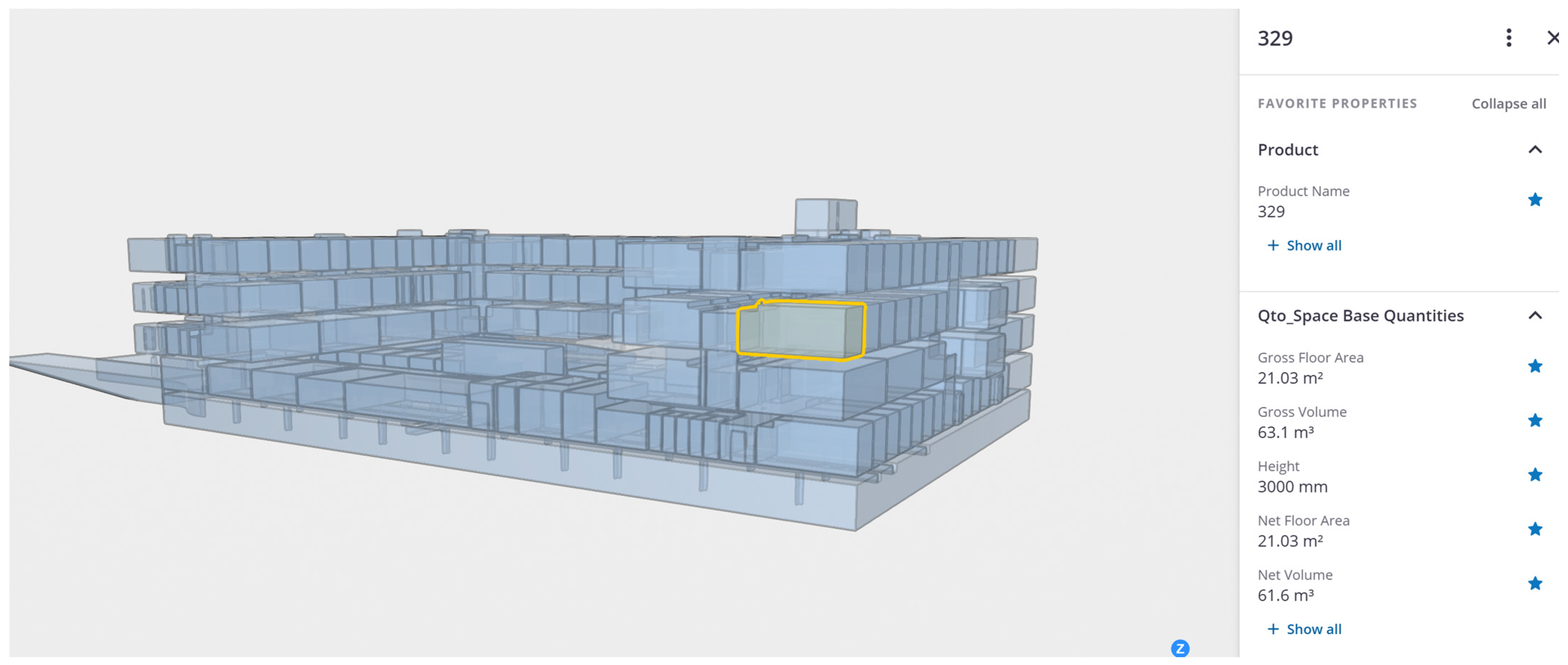
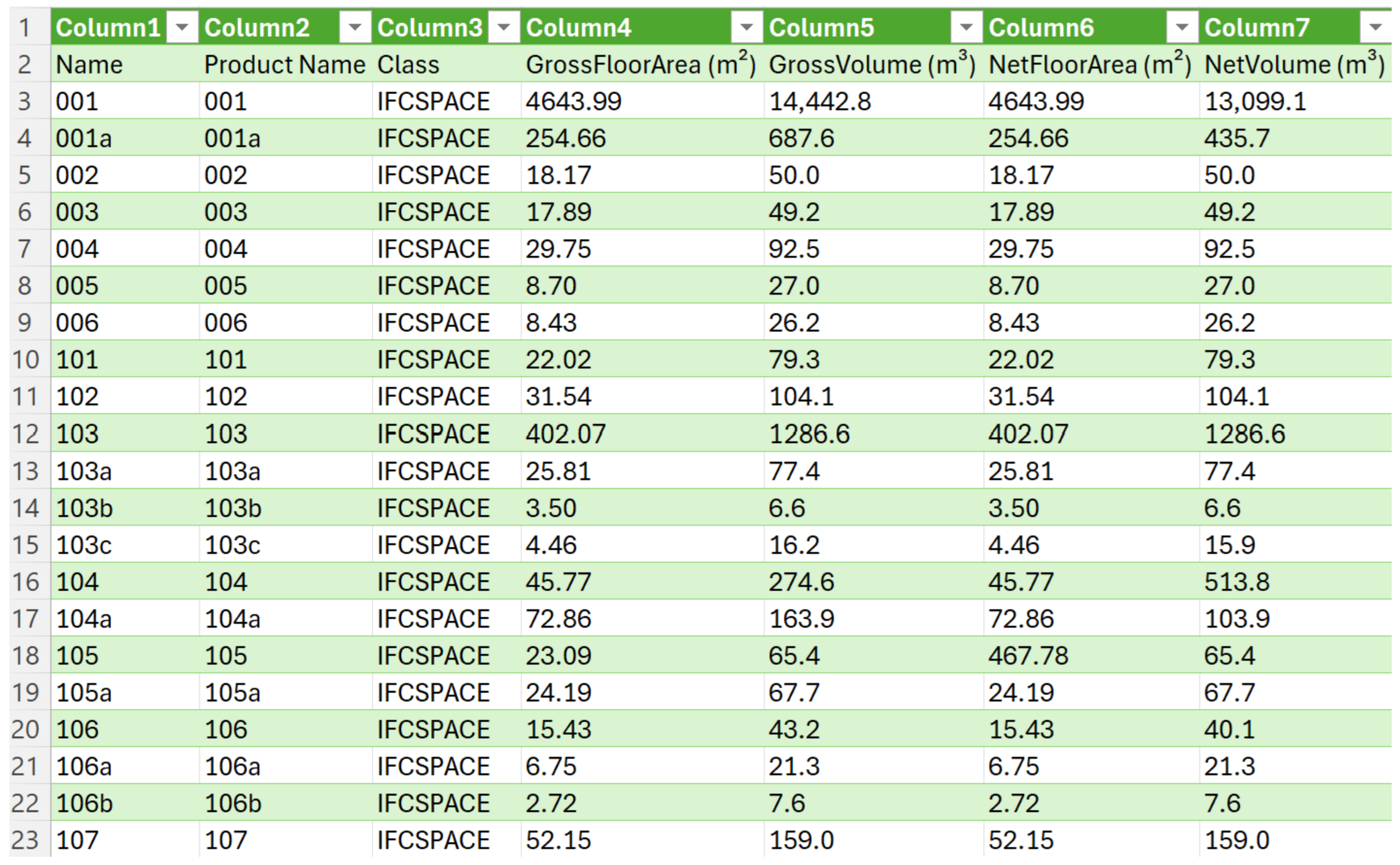
| Height | IfcQuantityLength | Measured from the top surface of the structural slab below (excluding any flooring finishes) to the underside of the slab above (excluding suspended ceilings). This value is given only when the space maintains a uniform height. |
| GrossFloorArea | IfcQuantityArea | Represents the combined floor area of all spaces it contains. It counts surfaces occupied by internal features such as columns or partition walls but does not include any area taken up by wall finishes or claddings. |
| NetFloorArea | IfcQuantityArea | The combined area of all usable spaces, excluding any surfaces occupied by internal features such as columns, interior walls, built-ins, floor openings, or other intrusions. Differences in ceiling height are not considered; areas remain counted even if the headroom is below a minimum height. |
| GrossVolume | IfcQuantityVolume | Calculated as the complete enclosed volume, without considering any openings, recesses, built-in elements, or projections. |
| NetVolume | IfcQuantityVolume | The overall enclosed volume of the space after accounting for cut-outs, recesses, openings, and similar features. It excludes the volume occupied by any structural or built-in elements within the space. |
Disclaimer/Publisher’s Note: The statements, opinions and data contained in all publications are solely those of the individual author(s) and contributor(s) and not of MDPI and/or the editor(s). MDPI and/or the editor(s) disclaim responsibility for any injury to people or property resulting from any ideas, methods, instructions or products referred to in the content. |
© 2025 by the authors. Licensee MDPI, Basel, Switzerland. This article is an open access article distributed under the terms and conditions of the Creative Commons Attribution (CC BY) license (https://creativecommons.org/licenses/by/4.0/).
Share and Cite
Wernerová, E.; Mičan, V.; Faltejsek, M. Building Information Models (BIMs) as a Source of Data for Spatial Evidence in Facility Management. Eng. Proc. 2025, 116, 4. https://doi.org/10.3390/engproc2025116004
Wernerová E, Mičan V, Faltejsek M. Building Information Models (BIMs) as a Source of Data for Spatial Evidence in Facility Management. Engineering Proceedings. 2025; 116(1):4. https://doi.org/10.3390/engproc2025116004
Chicago/Turabian StyleWernerová, Eva, Viktor Mičan, and Michal Faltejsek. 2025. "Building Information Models (BIMs) as a Source of Data for Spatial Evidence in Facility Management" Engineering Proceedings 116, no. 1: 4. https://doi.org/10.3390/engproc2025116004
APA StyleWernerová, E., Mičan, V., & Faltejsek, M. (2025). Building Information Models (BIMs) as a Source of Data for Spatial Evidence in Facility Management. Engineering Proceedings, 116(1), 4. https://doi.org/10.3390/engproc2025116004

