
Article

Dual Modification of Red Lentil Starch: Enhancing Functionality for Environmental and Pharmaceutical Applications


1
AET’s St. John Institute of Pharmacy and Research, Palghar 401404, Maharashtra, India
2
Office of Research Administration, Chaing Mai University, Chiang Mai 50200, Thailand
3
Faculty of Pharmacy, Chaing Mai University, Chiang Mai 50200, Thailand
*
Authors to whom correspondence should be addressed.
Polysaccharides 2026, 7(1), 37; https://doi.org/10.3390/polysaccharides7010037
Submission received: 1 January 2026 / Revised: 12 March 2026 / Accepted: 17 March 2026 / Published: 20 March 2026

Abstract

This study explored the dual chemical modification of starch isolated from red lentils (Lens culinaris) to develop a biodegradable polymer with enhanced functionality for multifaceted applications. Native starch was isolated via combined salt–alkali treatment and sequentially modified through epichlorohydrin-mediated crosslinking, followed by cationization using glycidyl trimethylammonium chloride (GTAC). Utilizing a Quality by Design (QbD) strategy through Response Surface Methodology (RSM), the cationization endured fine-tuning to reach an optimal degree of substitution (DS = 0.572) under foremost conditions (GTAC: 2.1 mol, NaOH: 0.09 mol, reaction time: 18 h). Structural and functional characterization using FTIR, XRD, TGA, SEM, and zeta potential analysis confirmed the successful modification, indicating enhanced thermal stability, a transition to a more amorphous structure, and a moderately positive surface charge (+7.24 mV). The dual modified cationic lentil starch (CLS) demonstrated effective flocculation of kaolin suspensions, achieving a transmittance of up to 94%. Additionally, CLS showed significantly improved emulsion stability, maintaining over 70% stability after 24 h, compared to native starch, which dropped below 30%. These results emphasize the promising potential of CLS as an eco-friendly and high-performance alternative to synthetic polymers for water treatment and stabilization of emulsion-based formulations.

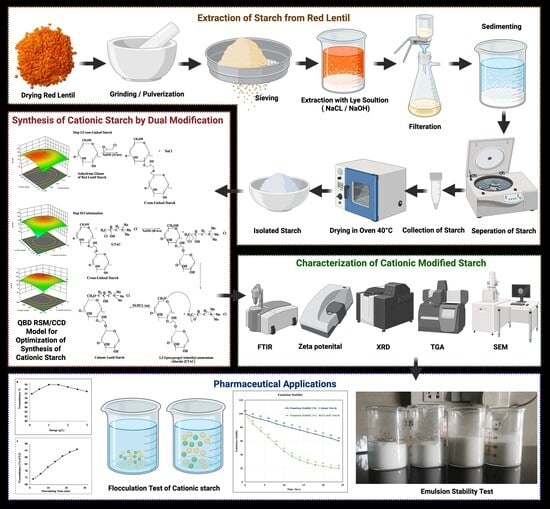
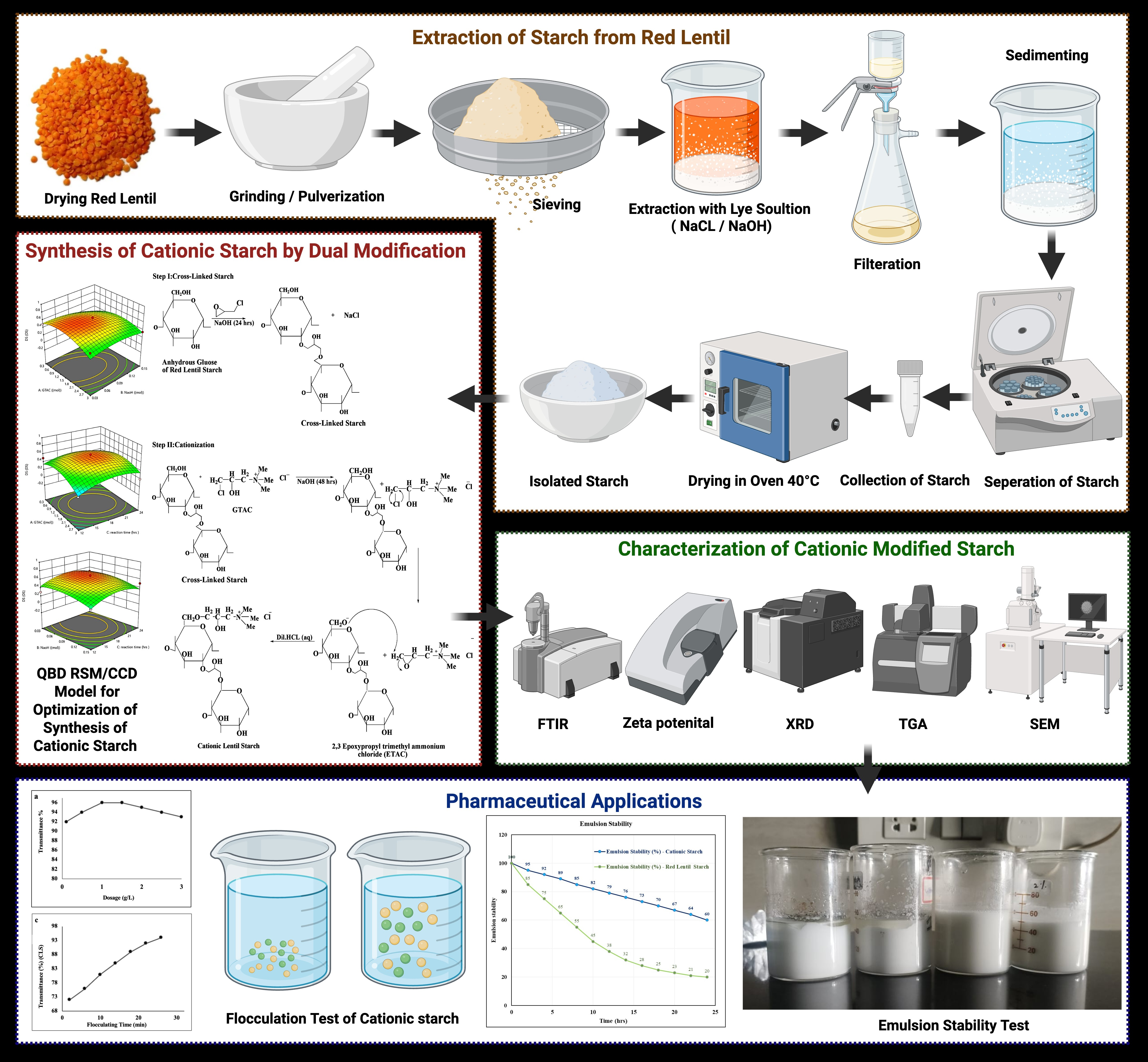
Graphical Abstract

1. Introduction

Starch ranks among the most plentiful natural polymers and finds extensive application across numerous industries due to its biodegradable nature, renewability, and cost-effectiveness [1]. The structural nature of starch is primarily composed of two polysaccharides: amylose, which is predominantly linear in configuration, and amylopectin, which is extensively branched [2]. Although native starch is widely accessible and adaptable, it has several drawbacks, including limited resistance to heat, acid, and mechanical stress, as well as a propensity for retrogradation. These shortcomings often restrict their direct applications, which require high functional stability or performance under processing conditions [3]. Starch modification involves a range of techniques designed to alter the physicochemical nature of native starch to carter requirements of various industrial applications. Physical modifications, such as heat-moisture treatment, annealing, pre-gelatinization, and extrusion, alter the structure of starch without changing its chemical composition. Enzymatic modifications employ precise enzymes to selectively degrade starch molecules, thereby customizing their molecular weight and branching [4]. Chemical methods introduce new functional groups or crosslinks through reactions such as oxidation and grafting, resulting in greater changes in solubility and stability compared to physical or enzymatic approaches. Chemical modifications of starch are commonly performed to address these limitations. Among the several modification techniques available, crosslinking and cationization are particularly effective for enhancing the structural and functional properties [5]. Crosslinking introduces covalent bonds between adjacent starch molecules, reinforcing the internal structure and improving resistance to breakdown during heating, shearing, or exposure to acidic environments. It increases resistance to shear, heat, and acid, making crosslinked starches valuable in stable applications like food production, pharmaceuticals, and bioplastics. Additionally, it reduces retrogradation, improves paste viscosity and clarity, and allows starch to maintain its texture under demanding conditions. These features make crosslinked starches highly favorable for uses where conventional starch may fail [6]. Epichlorohydrin (EPI) is frequently employed as a crosslinking agent due to ether bonds formation property between the hydroxyl groups on the starch backbone under alkaline conditions. The degree of crosslinking can be managed by altering the molar ratio of EPI to starch that had a direct impact on the gel’s strength, solubility, and viscosity properties. Cationization represents a chemical process that alters the surface properties of starch by adding positively charged groups. This change affects its interactions with other materials and imparts multiple characteristics [7]. It enhances engagement with negatively charged materials, rendering cationic starch vital in sectors such as paper production (as a retention aid), water treatment, and biomedicine. It also improves binding, adhesion, and flocculation properties, which allows for a wider range of functional applications. There is increased solubility in cold water and enhanced effectiveness in moist conditions.
Cationic starches are chosen for their adaptability and functional advancements in product formulation and environmental uses [8]. Dual modification of starch through crosslinking and cationization leads to enhanced functional properties that exceed what either method can achieve alone. This combination develops a robust and interactive polymeric material, which is suitable for multifaceted applications like food processing, papermaking, textile sizing, water treatment, and pharmaceutical biphasic dosage form stabilization. The resulting starches maintain viscosity and texture under stress while improving their ability to bind and interact with various materials. This approach expands the versatility of starch for use in extreme processing environments and advanced formulations [9]. Glycidyl trimethylammonium chloride (GTAC), a commonly used cationic reagent, reacts with starch hydroxyl groups under mildly alkaline conditions to form stable ether linkages. This results in starch molecules carrying quaternary ammonium groups, which enhances their ability to interact with negatively charged materials. Cationic starches have been used in various industrial sectors, such as papermaking [10], textiles [11], and wastewater treatment [12], owing to their improved adhesion, thickening ability, and charge-based binding capabilities [13]. Although starch from conventional sources such as maize and potatoes has been well studied, starch extracted from legumes, particularly red lentils, remains underexplored. Red lentils (RL: Lens culinaris) are widely cultivated and known for their high starch content. Lentil starch is typically characterized by a small granule size and relatively high amylose content, which may offer distinct advantages for gel formation and film development when modified [14]. Red lentil starch was selected for modification through crosslinking and cationization due to its optimal amylose and resistant starch content, which enhances gel strength, thermal stability, and gut health. Its rich protein and fiber content improves water retention and gelling ability. This starch performs better in food processing than other legumes, making it suitable for harsh conditions. Additionally, RL is a sustainable, cost-effective crop that aligns with eco-friendly food trends. The dual modification enhances the starch’s stability and properties without losing nutritional value, broadening its industrial applications, compared to more common starches [15]. The present study explored two main application areas for cationic starch: flocculation and emulsion stability. In flocculation, cationic starch aggregates negatively charged particles, such as suspended solids in wastewater, making it an eco-friendly flocculent. For emulsion stability, modified starch acts as a stabilizing agent in oil-in-water systems by utilizing crosslinking and electrostatic interactions to prevent phase separation. Furthermore, this research investigated how varying molar ratios of reagents impacted starch modification and evaluated its physical, structural, and functional properties using various analytical methods. This work aims to advance starch-based materials as sustainable alternatives to synthetic polymers for water treatment and emulsion systems.

2. Materials and Methods

2.1. Materials

Red lentils (Lens culinaris) were obtained from a local market in Palghar. Sodium chloride (NaCl), methanol, sodium hydroxide (NaOH), ethanol, hydrochloric acid (HCl), isopropanol, and kaolin were sourced from Loba Chemie Pvt. Ltd. (Mumbai, India) Castor oil was acquired from Yucca Enterprises Ltd. (Mumbai, India) Epichlorohydrin (EPI) was purchased from Antares Chem Private Ltd. (Mumbai, India), Glycidyltrimethylammonium chloride (GTAC) was procured from BLD Pharmatech (Mumbai, India) Pvt Ltd. (Hyderabad, India). To evaluate the performance of CLS, a commercial flocculant, cationic Magnafloc LT 22, was obtained from Kryton Chemicals (Hyderabad, India).

2.2. Isolation of Starch

Starch was isolated from RL using a combined salt and alkali treatment method designed to separate starch from proteins and other fibrous materials effectively. The RL were pulverized and converted to flour, which was initially mixed with distilled water to form a slurry. A 1% (w/v) NaCl solution was introduced and stirred to loosen the protein structures and disrupt the cellular matrix [16]. The mixture was then passed through a fine mesh to eliminate coarse residues, and the collected filtrate was rinsed with the same salt solution to remove any remaining soluble proteins. Subsequently, the filtrate was treated with a 1M NaOH solution under continuous stirring to facilitate the breakdown of residual protein–polysaccharide complexes and to release the starch granules more efficiently [17]. The produced slurry was subjected to filtration, and the retained starch underwent multiple washes with an alkaline solution to thoroughly remove non-starch components. Following each washing, sedimentation or centrifugation (Remi Bench Top C-854/4, Mumbai, India) was employed to collect the starch-rich layer [18]. To further purify the starch, the sediment was thoroughly rinsed with distilled water in multiple steps to remove salt, alkali, and other soluble contaminants. The final starch was dried in a hot air oven (Labline LSC-35A, Mumbai, India) at 45 °C for 6–7 h, until it reached a constant weight. It was then gently ground and sieved to ensure uniformity. The processed starch was stored in an airtight container to prevent moisture absorption before further analysis [19].

2.3. Synthesis of Cationic Starch

One gram of RL starch was dispersed in 150 mL of distilled water and stirred continuously at room temperature for an hour to ensure even distribution. To initiate the crosslinking process, 1 M NaOH was added gradually over 15–20 min to develop an alkaline environment, thereby activating the hydroxyl groups on the starch. Epichlorohydrin was then introduced, and the mixture was maintained at a temperature of 45–50 °C with constant stirring for 24 h using a Digital Heating Mantle with Magnetic Stirrer (DAN Logitech 1221.DNEU, Haryana, India).This process led to the formation of ether bonds between adjacent anhydro-glucose units through nucleophilic substitution reactions, resulting in a cross-linked starch structure. The final product was separated by centrifugation (Remi Bench Top C-854/4, Mumbai, India) at 3000 rpm for 10 min, thoroughly washed with distilled water, and dried in a hot-air oven (PLOV, ProLab, Mumbai, India) at 45 °C [20]. A molar ratio of anhydro glucose unit AGU:EPI:NaOH:H2O at 1:0.005:0.06:10 was selected to ensure stability and an appropriate gel texture. For cationic modification, the crosslinked starch was dispersed in 150 mL of distilled water and stirred for 1 h. The pH was adjusted to approximately 10 using 1 M NaOH. Glycidyltrimethylammonium chloride (GTAC) was added as a cationic reagent, and the reaction was maintained at 45–50 °C for 24 h using Digital Heating Mantle with Stirrer (DAN Logitech 1221.DNEU, Haryana, India). Sodium hydroxide catalyzed the epoxide ring-opening of GTAC, enabling its attachment to starch via ether bonds through a substitution reaction. Upon completion, the pH was lowered to 8 using a dilute hydrochloric acid solution. The final product was isolated by centrifugation, washed with water, and dried at 45 °C. The molar ratio employed for this step was AGU:GTAC:NaOH:H2O = 1:0.2:0.04:3.5, aiming for moderate substitution without compromising starch integrity [21].

2.4. Statistical Analysis and Model Validation

The experimental data obtained from the Central Composite Design (CCD) underwent an extensive statistical evaluation using Response Surface Methodology (RSM) via Design Expert® Software Version 10.0 (Stat-Ease Inc., Minneapolis, MN, USA). This multivariate optimization approach was utilized to investigate the combined impacts of three independent variables: GTAC concentration (mol/L), NaOH concentration (mol/L), and reaction time (h.) on the DS of CLS during the cationization process, as detailed in Table 1. To assess the model’s suitability, an Analysis of Variance (ANOVA) was performed. The model proved to be statistically significant (p < 0.05), effectively capturing the relationship between the independent variables and the response. The F-value obtained from ANOVA highlighted the regression model’s relative importance, and the lack of a significant lack of fit (p > 0.05) suggested that the model fit the experimental data well. The model’s performance was further confirmed through multiple regression parameters, such as the coefficient of determination (R2), adjusted R2 (Adj-R2), and predicted R2 (Pred-R2). The high R2 value indicates that the model accounts for a substantial portion of the variability in the DS response. The close agreement between the Adj-R2 and Pred-R2 values implies minimal model overfitting and excellent agreement between the predicted and experimental values. Moreover, the adequate precision ratio, which quantifies the signal-to-noise ratio, exceeded the recommended threshold of 4, indicating that the model possesses an adequate signal and is suitable for navigating the design space. Independent variables tested included GTAC concentration (0.3–3.0 moL), NaOH concentration (0.03–0.15 moL), and reaction time (12–24 h).
The proposed experiment included 17 trials, spread across three factors identified by the RSM/CCD. The resulting data were examined through analysis of variance (ANOVA). The DS value derived from the proposed experiments was expressed using a polynomial regression equation, leading to the creation of a model, as illustrated in the following equation:
Υ = β 0 + i = 1 k β i i X i + i = 1 k β i i X i 2 + i = 1 k 1 j > j k β i j X j
In the equation, the variables are described as follows: Υ stands for the expected responses, β0 is the coefficient constant term, βi is the linear coefficient term for the ith factor, βii is the quadratic coefficient term, βij is the interaction coefficient term between the ith and jth factors, and xi and xj represent the factors.

2.5. Degree of Substitution of Synthesized Cationic Lentil Starch

The degree of substitution is related to the AGUs, which replace the hydroxyl groups per glucose unit [22]. An elemental analyzer (Vario EL III; Elementar Analysensysteme GmbH, Langenselbold, Germany) was used to determine the DS. The estimation process employed only three elements: carbon, nitrogen, and hydrogen [23]. The nitrogen percentage was determined by analyzing three sample replicates [24], with particular emphasis on achieving a subdivided standard deviation (<0.5) using the following formula:
D e g r e e   o f   s u b s t i t u t i o n = 162 N ( 1400 C A × N )
where 162 = anhydrous glucose unit molecular weight, AGU; N = nitrogen percentage; and GTAC (Cationic Agent) = 151.

2.6. Characterization of LS, GTAC and CLS

The vibrational and structural properties of LS, GTAC, and CLS were assessed using a Fourier-transform infrared spectrometer (Jasco ATR-FT/IR-4600, Tokyo, Japan) over a range of 4000 to 600 cm−1 with a scan duration of 1 s. Thermal analysis was conducted with a TG-DSC (NETZSCH STA 449 F3 Jupiter, Selb, Germany) under nitrogen gas, spanning temperatures from 25 to 600 °C. X-ray diffraction of the samples was performed using a Shimadzu XRD-6000, Kyoto, Japan, diffractometer with Cu Kα (λ = 1.5418 Å) radiation at room temperature. The instrument operated at 30 kV and 30 mA, with a detection angle of 2θ and a scanning range of 2° to 30°. An elemental analyzer (Vario EL III Elementar Analysensysteme GmbH, Langenselbold, Germany) was employed to measure the nitrogen content, with scanning performed at 2°/min in continuous scan mode. The granular morphologies and surface structures of LS and CLS (from −200V to 30 kV) were captured using a field-emission scanning electron microscope (FE-SEM QUANTA 200 FEG microscope, Eindhoven, Netherlands) at various magnifications. The zeta potential of the samples was measured using a Malvern V.2.3 zeta potential analyzer to assess the surface charge and colloidal stability of the modified starch in aqueous dispersion. Measurements were taken within a voltage range of −200 mV to +200 mV to evaluate electrostatic interactions.

2.7. Pharmaceutical Application of Modified Cationic Lentil Starch

2.7.1. Flocculation Tests of Kaolin Suspension

The flocculation capability of cationic lentil starch (CLS) was assessed using a standard kaolin suspension system, relevant to both pharmaceutical and environmental contexts. A 0.1% (w/v) kaolin suspension was created by dispersing 1 g of kaolin clay in 1000 mL of deionized water, ensuring even distribution through continuous stirring. After adding CLS, each mixture underwent rapid mixing at 120 rpm for 1 min, followed by gentle stirring at 40 rpm for 20 min to facilitate floc formation via charge neutralization and bridging. The suspension was then allowed to settle undisturbed for 15 min to enable sedimentation. Flocculation performance was determined by measuring transmittance at 620 nm using a UV-Vis spectrophotometer (UV/Vis-1800, Shimadzu, Kyoto, Japan) [25].

2.7.2. Cationic Starch as Emulsion Stabilizer

Cationic starch extracted from RL was assessed for its effectiveness as a natural emulsifier in stabilizing oil-in-water (O/W) emulsions, which is crucial for pharmaceutical and cosmetic applications. The introduction of quaternary ammonium groups during the cationization process confers surface activity to the starch molecules, enabling them to adsorb at the oil–water interface and prevent droplet coalescence through electrostatic repulsion. The oil-in-water emulsions were created with a fixed oil phase of 7% (v/v) and an aqueous phase of 93% (v/v), composed of phosphate buffer (pH 7.0) and varying concentrations of cationic starch (0.1, 0.3, 0.5, and 1.0% w/v). Cationic starch solutions were prepared by dispersing the required amounts of starch in phosphate buffer, followed by heating at 85 °C for 30 min with continuous stirring to ensure complete gelatinization. After cooling to room temperature, 7 mL of oil was added to 93 mL of the prepared starch solution, resulting in a total volume of 100 mL for each emulsion sample. Pre-emulsification was conducted using a magnetic stirrer for 5 min, followed by homogenization at 12,000 rpm for 3 min with a high-speed homogenizer to ensure even dispersion of the oil droplets. A control emulsion without starch was prepared under the same conditions. All emulsion samples were stored at room temperature, and their stability was evaluated at specified intervals. Visual observations were used to monitor phase separation and creaming behavior. The creaming index was determined by centrifuging 10 mL of each emulsion at 3000 rpm (Remi Bench Top C-854/4, Mumbai, India) for 15 min, and the extent of creaming was calculated as a percentage of the total height of the emulsion. Turbidity was measured spectrophotometrically (UV/Vis-1800, Shimadzu, Kyoto, Japan) at 600 nm to evaluate droplet dispersion, and droplet size distribution was analyzed using optical microscopy [26,27].

3. Results and Discussion

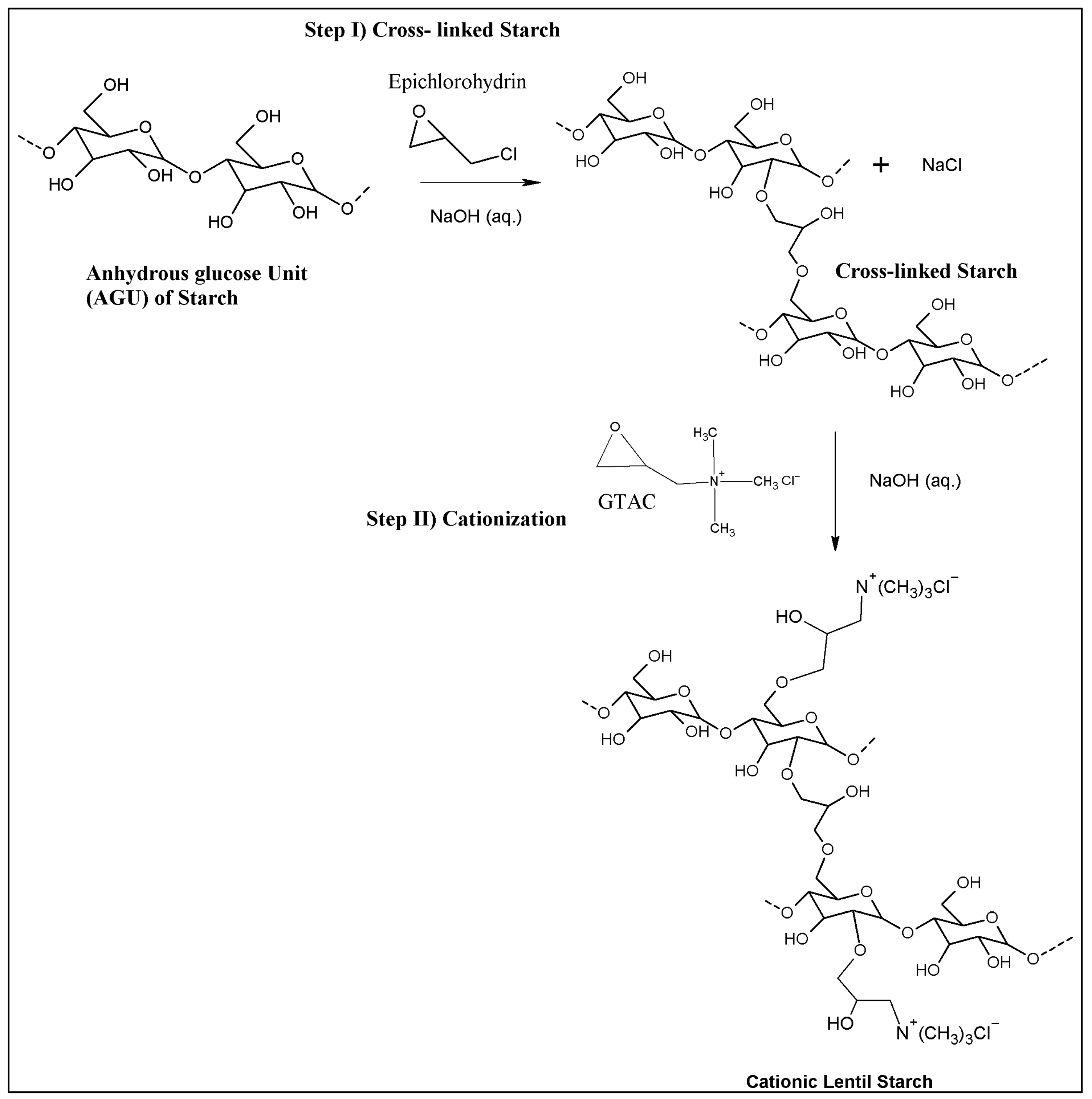
Starch was isolated from RL using an alkaline solution, which facilitated the effective separation of starch granules while minimizing interference from proteins and other non-starch components present in the red lentils. The starch underwent crosslinking with epichlorohydrin in the presence of sodium hydroxide. This reaction encouraged the formation of ether bonds between the hydroxyl groups of adjacent glucose units, resulting in a structurally enhanced starch network. The starch was further modified to introduce cationic properties by reacting it with GTAC. Under mildly alkaline conditions, sodium hydroxide assisted in the ring-opening of the GTAC epoxide group, enabling the attachment of quaternary ammonium groups to the starch backbone as depicted in Figure 1. This modification imparted a positive surface charge, enhancing the interaction with negatively charged particles, a crucial feature for applications such as flocculation. The cationic starch was used to stabilize oil-in-water emulsions. The presence of charged groups on the starch surface enhances its ability to adsorb at the oil–water interface, thereby reducing droplet coalescence and contributing to improved emulsion stability. The entire modification process was optimized to preserve structural integrity while achieving sufficient incorporation of functional groups, confirming the potential of the developed starch for use in both environmental and formulation-based applications. The goal was to achieve an ideal balance that would maximize the incorporation of quaternary ammonium groups without causing starch degradation. Under optimized conditions, the modified starch exhibited an increased degree of substitution (DS), indicating the extent of cationic group attachment to the starch backbone. This enhanced DS signifies successful modification, contributing to improved functional properties, such as charge density and interaction potential with negatively charged particles in suspensions and emulsions. The synthesis process was optimized using the QBD approach, concentrating on the levels of GTAC, the concentration of the NaOH catalyst, and the duration of the reaction. Through QBD, a high DS for CLS was achieved, which is a crucial measure of its modification degree, reaching a peak DS of 0.572 under the best conditions.

3.1. Model Data Analysis and Evaluation for Cationic Starch Synthesis

Constructing the Equation for the Regression Model

CLS was synthesized via etherification by grafting GTAC onto a starch backbone, resulting in cationic properties essential for flocculation. The experimentally obtained degree of substitution (DS) values ranged from 0.12 to 0.28. Based on the sequential sum of squares analysis, a quadratic model was identified as the most appropriate for describing this response. The final empirical equation representing the relationship between DS and the coded variables is as follows,
DS = 0.62600 − 0.0263A − 0.0663B + 0.0300C + 0.0575AB + 0.0400AC + 0.0300BC − 0.1742A2 − 0.0842B2 − 0.1418C2
where A, B, and C refer to the GTAC concentration, NaOH concentration, and reaction time, respectively. The model’s performance was assessed using the standard deviation (SD) and the correlation coefficient (R2). The model exhibited a relatively low standard deviation of 0.1563 and a correlation coefficient of 0.7654, indicating a reasonable level of predictive accuracy. A correlation coefficient approaching one reflects a strong alignment between the predicted and actual values. Statistical analysis revealed that the selected experimental factors accounted for approximately 95.62% of the total variation observed in the DS. These high values, close to unity, confirm the model’s reliability and suggest minimal deviation between the predicted and observed DS outcomes [28,29].

3.2. Analysis of Variance

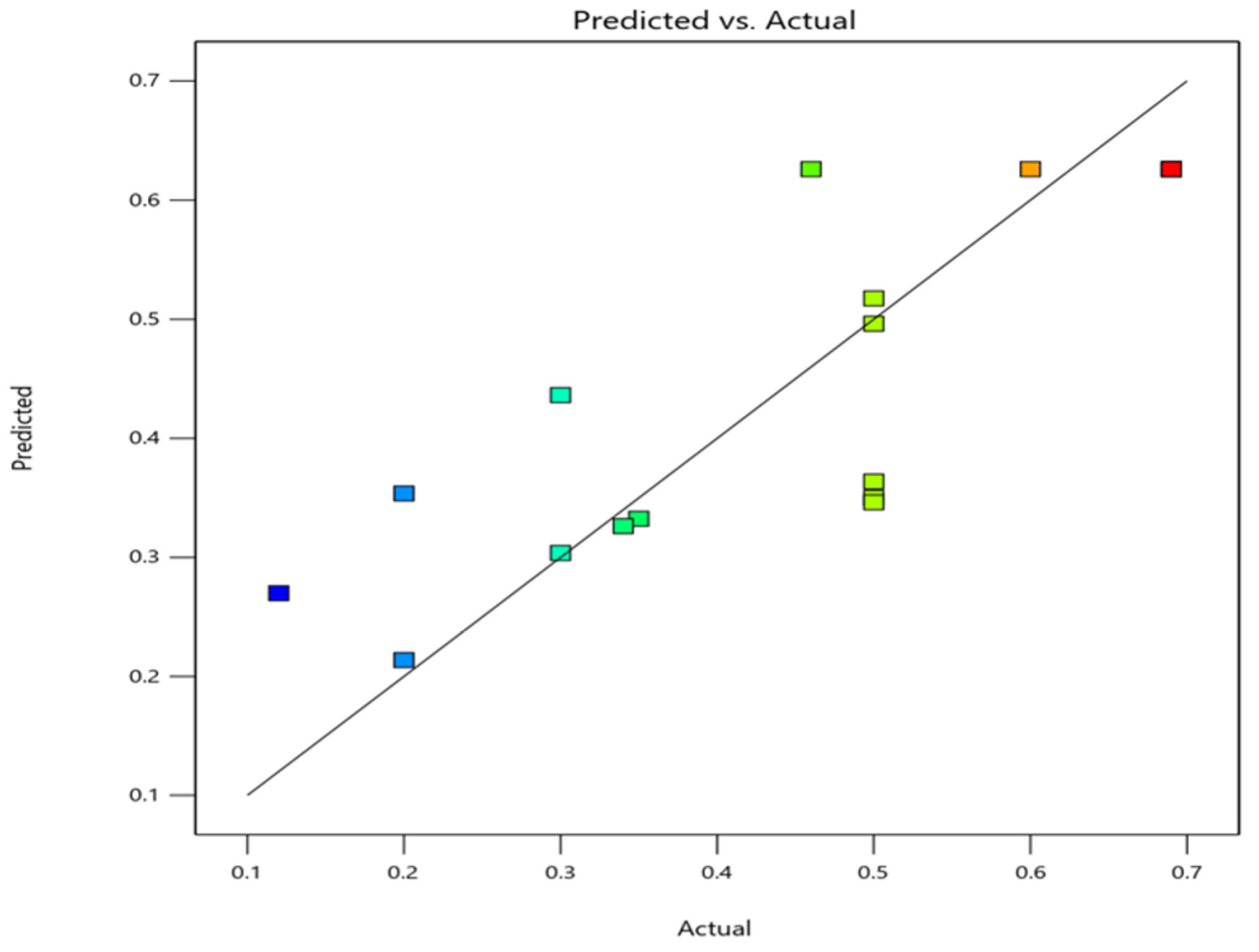
ANOVA was conducted using Design Expert 10.0, and the model’s statistical significance was evaluated through the F-value and its corresponding p-value (Prob > F). The F-value is derived by dividing the mean square of the model by the mean square of the residual error, indicating how well the model accounts for the variability in the data. A model is deemed statistically significant if the p-value is less than 0.05, suggesting that the observed effects are unlikely to be due to random chance. A larger F-value generally indicates a stronger correlation between the independent variables and the responses. These criteria were used to assess the ANOVA results for the quadratic model developed for the degree of substitution, as shown in Table 2. The F-value and Prob > F for this model were 6.12 and 0.0173, respectively, indicating the model’s significance. Model terms A, B, C, A2, B2, C2, and BC were significant, while terms AB and AC were not statistically significant concerning the response. The lack-of-fit analysis revealed no significant difference between the model and the experimental data, as indicated by a p-value of 0.1846, which exceeds the typical threshold of 0.05. This indicates that the variation in the residuals is mainly due to random error rather than any inadequacy in the model. The absence of a notable lack of fit suggests that the model possesses strong predictive capabilities, as illustrated in Figure 2. Furthermore, the model’s predicted values for DS closely matched the observed responses, confirming its effectiveness in representing the relationship between the variables.

3.3. Effect of Independent Variables on Degree of Substitution

The process of starch cationization involves a series of chemical reactions. Initially, the chlorohydrin group in GTAC is transformed into an epoxy intermediate. In an alkaline environment, this reactive epoxy group engages with the hydroxyl groups of the starch molecule. If it remains unreacted, the epoxy group can undergo hydrolysis, resulting in the formation of a non-reactive 2,3-dihydroxypropyl derivative.

3.3.1. Response Surface Curve for the Impact of NaOH and GTAC Concentration (moL)

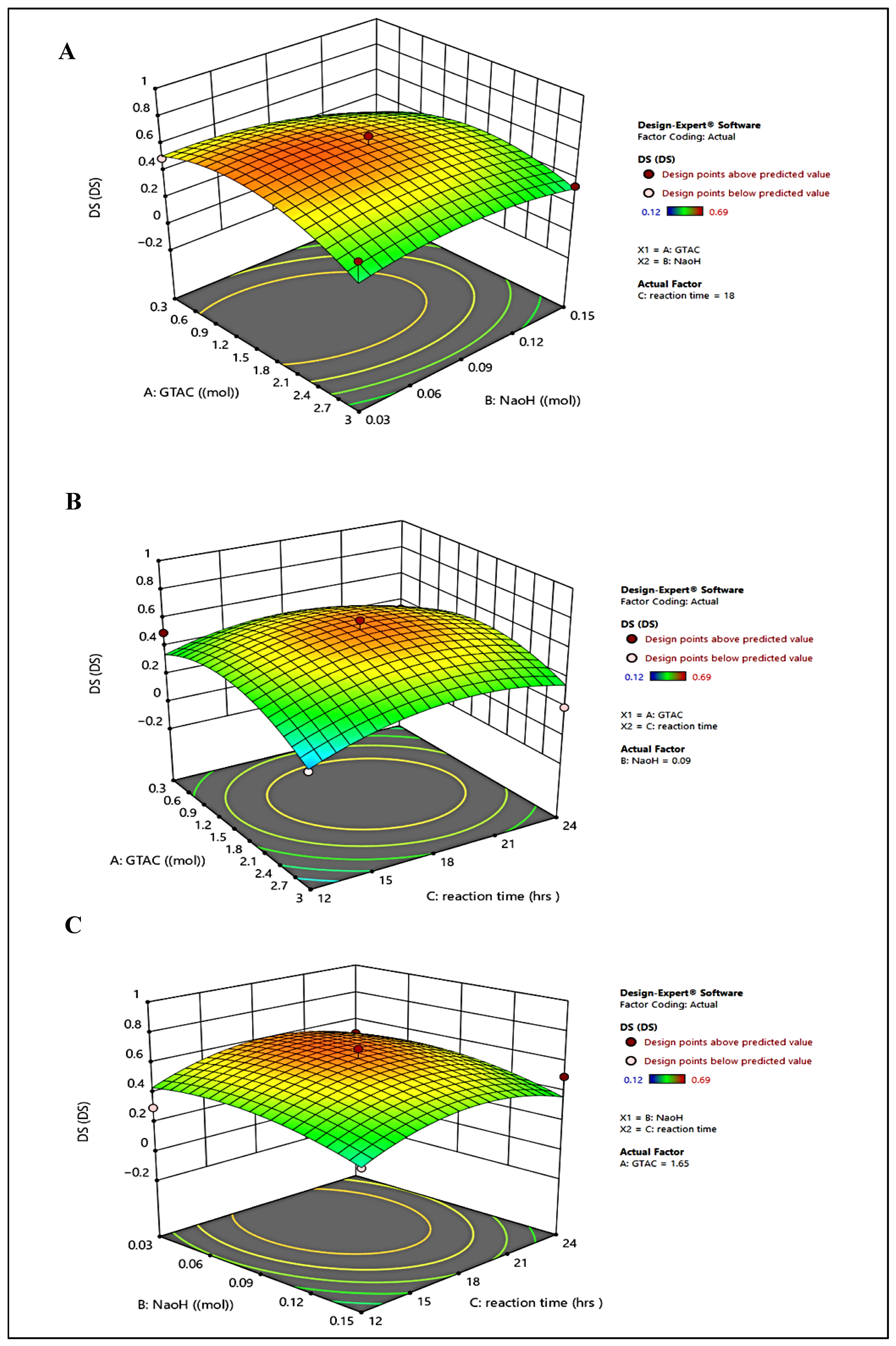
As the molar ratio of GTAC increased progressively, there was a consistent rise in the degree of substitution (DS) for CLS, peaking at a GTAC concentration of approximately 2.1 moL, as illustrated in Figure 3A. This positive correlation between the GTAC concentration and DS can be attributed to the increased availability of reactive quaternary ammonium groups, which actively participate in etherification with hydroxyl groups present on the starch backbone. The epoxidation of GTAC facilitates its interaction with starch chains, and a higher concentration improves the accessibility and proximity of the reagent to the reaction sites, thereby increasing the substitution efficiency. However, beyond the 2.1 moL threshold, the DS value exhibited only marginal variation or reached a plateau. This suggests that the starch matrix reached a saturation point, where further increases in the GTAC concentration did not significantly enhance the substitution. Under these near-optimal conditions, the reaction reached equilibrium, and excessive GTAC did not contribute to further etherification but did not hinder the process, maintaining a relatively stable DS value. In contrast, the effect of sodium hydroxide (NaOH) concentration was more pronounced. DS increased sharply with increasing NaOH concentration, peaking at approximately 0.12 mol NaOH. This concentration likely provides the ideal alkaline environment necessary to deprotonate starch hydroxyl groups and catalyze the formation of the epoxide intermediate from GTAC. However, further increases in NaOH concentration beyond this point led to a gradual decline in DS. This decrease can be ascribed to several factors, including the hydrolytic degradation of GTAC under highly alkaline conditions and the possible breakdown of the starch structure itself. Excess NaOH may also favor competing side reactions that divert reagents from the etherification process. Therefore, maintaining a balanced concentration of GTAC and NaOH is essential for optimizing the DS and ensuring effective cationic modification of starch [28,30].

3.3.2. Effect of GTAC Concentration and Reaction Time on DS

The 3D response surface plot (Figure 3B) illustrates the relationship between GTAC concentration (ranging from 0.3 to 3.0 mmoL) and reaction time (12–24 h). The findings indicate that as the concentration of GTAC increases, there is a corresponding rise in the degree of substitution. This suggests that the presence of more quaternary ammonium groups facilitates the greater integration of cationic functionalities into the starch structure. This observation underscores the crucial role of GTAC in determining the extent of cationization. On the other hand, the effect of reaction time presents a more intricate pattern [31]. Initially, moderate extensions in reaction time enhance DS due to improved diffusion and interaction of GTAC with starch granules; however, excessively long reaction times do not necessarily lead to higher substitution levels. This is likely due to the depletion and hydrolysis of the GTAC reagent over prolonged periods in alkaline aqueous environments. As the reaction proceeds, side reactions, such as the breakdown of epoxide intermediates and competition from water molecules, become more dominant, which can hinder the etherification mechanism. Thus, there exists an optimal reaction time window that maximizes DS before undesirable reactions reduce the efficiency [32].

3.3.3. Effect of NaOH Concentration and Reaction Time on DS

NaOH concentration (0.03–0.15 moL) and reaction time (12–24 h) on the degree of substitution. Sodium hydroxide acts as a crucial catalyst by enabling two key steps: the generation of a reactive epoxide intermediate from GTAC and the activation of starch hydroxyl groups through deprotonation. NaOH efficiently promoted the formation of ether bonds between GTAC and starch molecules at lower concentrations [33]. An increase in DS was noted rapidly until it reached an optimal level of about 0.09 M. This can be understood as follows: in basic conditions, the hydroxyl groups in the anhydroglucose units of starch may participate in nucleophilic reactions with the etherification agent, similar to the well-known Williamson ether synthesis.
Beyond this point, however, further addition of NaOH led to a gradual decline in DS. This decrease is primarily due to the hydrolytic degradation of GTAC under strongly alkaline conditions, where the epoxide ring opens to form diol by-products that do not participate in the substitution, as shown in Figure 3C. Additionally, excess NaOH may partially degrade the starch structure, thereby further reducing its reactivity. Reaction time also plays a secondary role; although it allows sufficient contact time for reactions to proceed, excessively long durations in highly alkaline media exacerbate side reactions. Therefore, maintaining a controlled and balanced concentration of NaOH is essential to maximize the efficiency of cationic substitution and minimize undesired secondary pathways [24].

3.4. Validation of the Model and the Degree of Substitution Value Optimization

The model underwent validation through three investigative series using Design-Expert software. This validation process involved comparing predicted values with experimental results. The optimization aimed to maximize the DS value response by integrating the desired criteria, while adjusting other factors within a specified range, as outlined in the methodology section. Experimental analysis revealed that all DS values were below the SD of 0.053, supporting the model’s validity. The desirability functions such as concentration of GTAC, NaOH Reaction time are used to evaluate, and optimize multiple responses or attributes [34]. These functions indicate how well a favorable combination of input variables achieves desired outcomes, combining multiple responses into a single desirability score to identify optimal operating conditions. However, minor variations in input values in QbD can influence desirability values, affecting overall performance. The experiments demonstrated a prediction accuracy of 95.62% for the model. Based on the RSM software analysis, Experiment 1 in Table 3 was identified as the optimal condition. Notably, the experiment suggested by RSM resulted in a slightly higher DS value of 0.572.

3.5. Elemental, Functional, Thermal Analysis, X-Ray Diffraction, Surface Morphology and Application

The elemental analysis results for lentil starch and its modified form (Table 4) provide insights into the efficiency of cationic modification using GTAC. Native lentil starch (LS) exhibited a negligible nitrogen content (N %), indicating the absence of significant protein residues, which aligns with its natural composition, which is predominantly polysaccharides. However, minor traces of nitrogen in LS can be attributed to residual proteins inherent to plant-based materials. In contrast, GTAC-modified lentil starch (CLS) exhibited a substantial increase in nitrogen content, with a measured nitrogen percentage (N %) of 3.39. This notable increase confirmed the successful grafting of GTAC onto the starch backbone, resulting in the incorporation of nitrogen-rich functional groups into the structure. GTAC, a quaternary ammonium compound, introduced amine functionalities during the modification process, contributing to the nitrogen content observed in the modified starch. The effectiveness of cationization is further influenced by the concentration of GTAC employed during synthesis; higher concentrations typically enhance the degree of grafting and, consequently, increase the nitrogen content in the final product. The interaction between GTAC and starch involves covalent bonding, primarily between the epoxy group of GTAC and the hydroxyl groups (–OH) in the starch molecule. These covalent linkages stabilize the incorporation of cationic moieties, thereby altering the physicochemical properties of starch. The Degree of Substitution (DS) measures the extent of this modification by indicating the average number of functional groups linked to each anhydroglucose unit (AGU) within the starch structure. The DS value was calculated based on the nitrogen content (N %), the molecular weights of AGU (162 g/moL) and GTAC (151 g/moL), and a standard molar weight reference of 1400 for ten AGUs. GTAC-modified lentil starch (CLS) exhibited a DS of 0.67, suggesting moderate but adequate cationic substitution (Table 4). In contrast, native starch showed no detectable substitutions. The higher nitrogen and DS values in CLS reflect the efficiency of GTAC in introducing cationic functionalities, rendering starch more suitable for applications requiring charge-modified polymers, such as wastewater treatment or emulsion stabilization [16].

3.6. Fourier-Transformed Infrared Spectrum

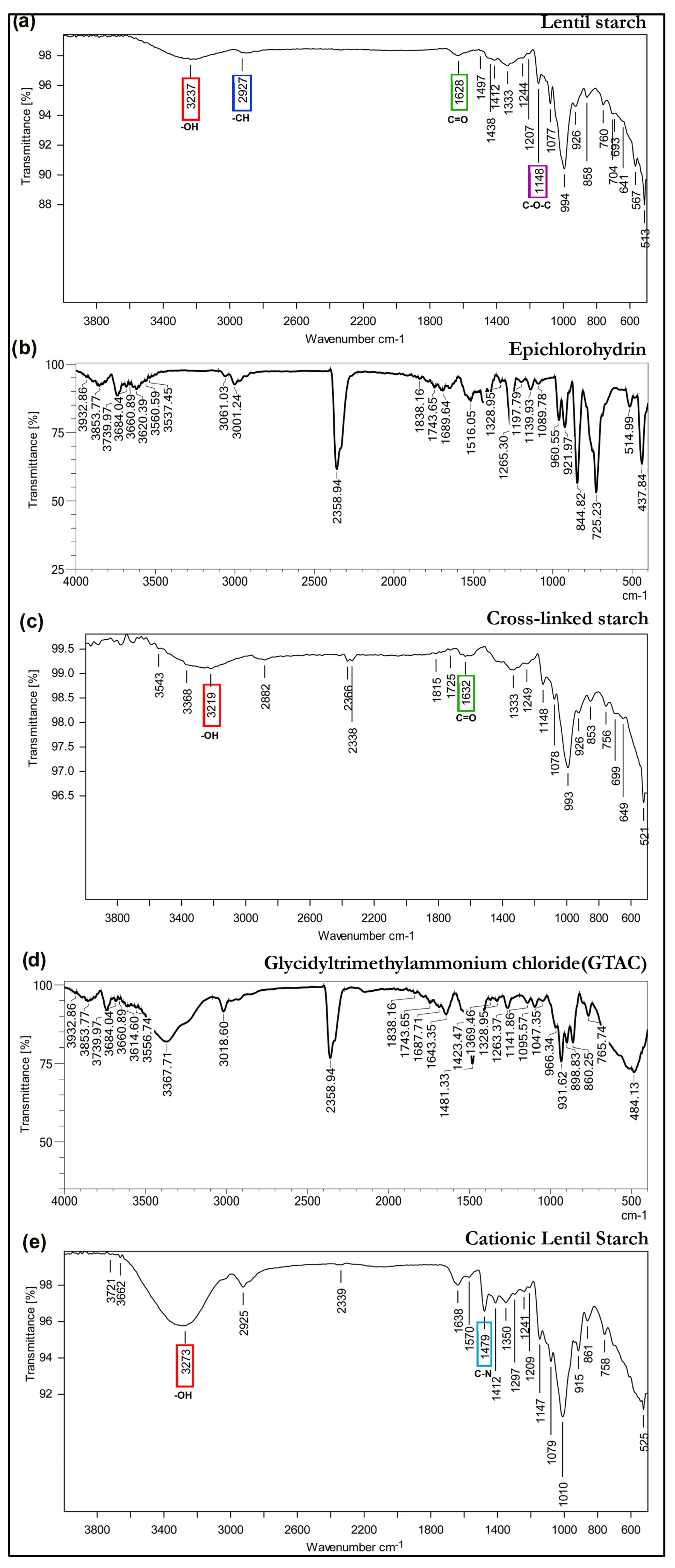
FTIR spectroscopy was employed to examine the structural changes in the lentil starch before and after chemical modification (Figure 4). The spectrum of native RL starch displayed prominent peaks at 3237 cm−1, 2927 cm−1, and 1628 cm−1, which are associated with O–H, C–H, and C=O stretching vibrations, respectively. These are typical polysaccharide features. Additionally, signals between 1148 cm−1 and 994 cm−1 correspond to C–O–C and C–O stretching, indicating the presence of glycosidic linkages in the starch backbone. After EPI treatment, noticeable shifts in the absorption bands were observed for all the samples. The broad O–H peak shifted to a slightly lower wavelength (3219 cm−1), and a new peak near 1632 cm−1 appeared, suggesting changes in the hydrogen bonding network and possible formation of cross-linked starch (CS). These alterations are consistent with the introduction of ether bonds between the starch chains, resulting from the action of the crosslinking agent. The FTIR spectrum of GTAC used for cationization exhibited a broad band at 3273 cm−1 (O–H stretching) and a distinctive peak at 1479 cm−1, which is characteristic of C–N stretching in quaternary ammonium compounds. These key functional groups were also detected in the modified CLS sample, confirming the successful incorporation of cationic groups. Moreover, the O–H peak in CLS showed lower intensity and was slightly shifted, indicating the partial substitution of hydroxyl groups. A minor but notable peak at approximately 599 cm−1 may be associated with C–Cl stretching, possibly due to residual epichlorohydrin, suggesting that cross-linking and cationic reactions occurred [35]. The overall shifts and appearance of new absorption bands in the FTIR spectra validated the chemical transformation of the lentil starch.

3.7. Thermogravimetry Studies

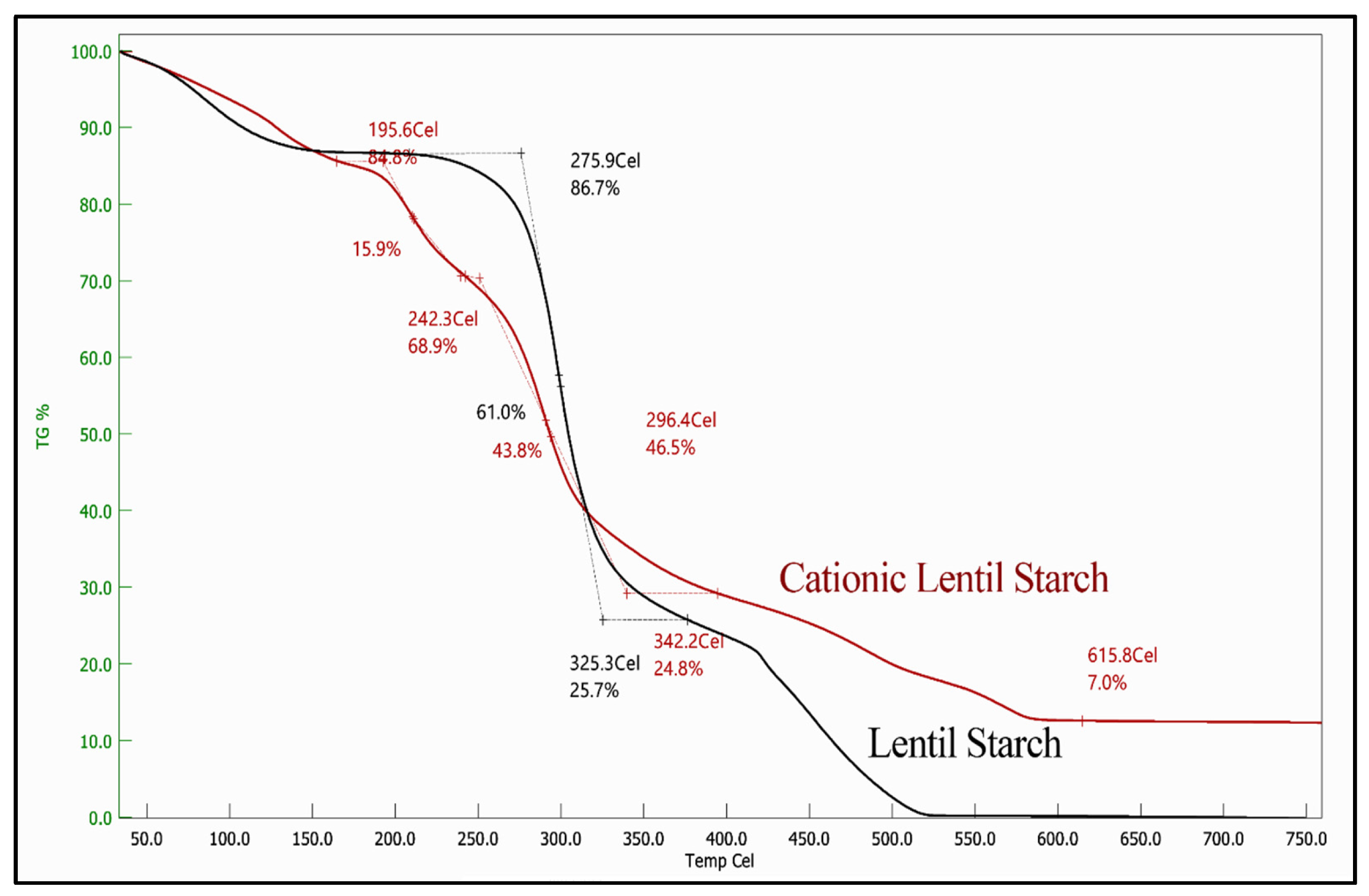
Thermogravimetric analysis showed the presence of graft CLS (Figure 5), indicating a unique thermal behavior compared to that of red lentil starch. The TGA profiles indicated distinct phases of weight loss: an initial reduction in mass between 50 °C and 100 °C due to absorbed and bound water, followed by further loss from 266 °C to 400 °C as starch began to break down. The initial decrease in mass was linked to the water-induced melting of starch crystallites and the subsequent removal of starch chains from the swollen amorphous regions. The second phase of mass loss was attributed to polymer degradation, as evidenced by the weight reduction. Cationic lentil starch exhibited a two-stage polymer breakdown process [36]. Initially, both LS and the cationic agent GTAC disintegrated, marking the first stage of breakdown. However, a distinct second breakdown occurred during the cyclization of the product. Thermogravimetric analysis revealed key differences between native and cationic red lentil starch. The initial weight loss (100–200 °C) was higher in cationic starch (15.9%) owing to its greater moisture retention. Native starch showed a single degradation step at 275.9 °C, whereas cationic starch exhibited multiple stages (195.6 °C, 242.3 °C, 296.4 °C), confirming structural modifications. The higher residual mass of cationic starch (7.0% at 615.8 °C) compared to native starch (25.7% at 325.3 °C) indicates improved thermal stability but also an earlier onset of degradation.

3.8. X-Ray Diffraction

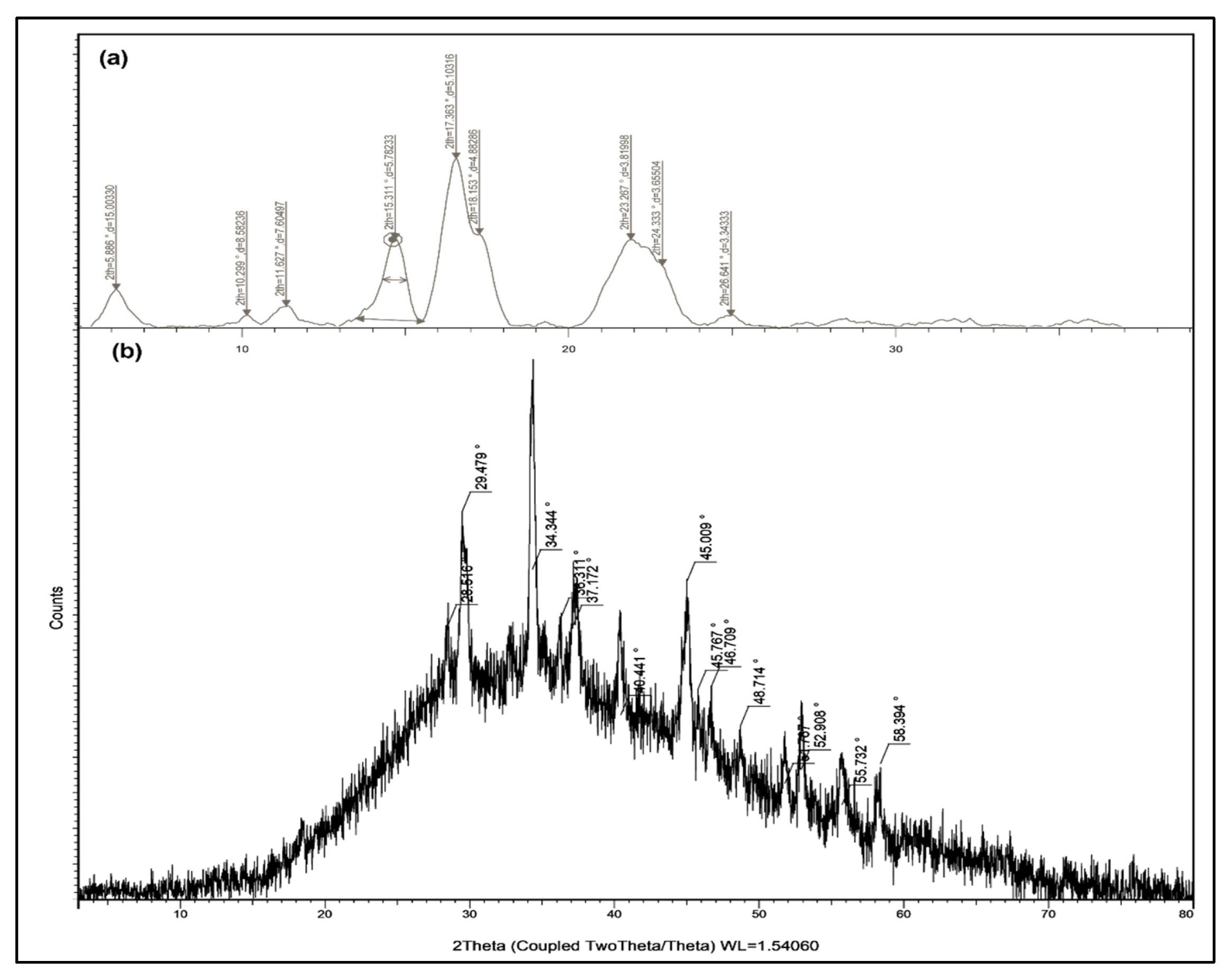
X-ray diffraction (XRD) analysis revealed that LS exhibited sharp and well-defined crystalline peaks, indicating an ordered molecular structure. In contrast, CLS showed peak broadening and reduced intensity. XRD analysis was conducted to compare the crystallinities of the native and cationic starches. Native starch exhibited sharp and intense peaks at 15°, 17°, 18°, and 23° (2θ values), characteristic of a C-type crystalline structure, indicating a well-ordered molecular arrangement as seen in Figure 6a. In contrast, cationic starch displayed a broad peak at approximately 20° (2θ), signifying a loss of crystallinity and a transition to a more amorphous structure, as shown in Figure 6b. This change is attributed to cationization, which disrupts hydrogen bonding and introduces structural modifications. Reduced crystallinity enhances water absorption, swelling, and solubility, making cationic starch more suitable for applications such as wastewater treatment and soil remediation. The incorporation of GTAC into the starch backbone led to a reduction in crystallinity, suggesting a disruption of the original ordered structure [37]. These structural alterations are due to the bulkiness of the quaternary ammonium groups, which hinder the alignment of the starch chains, especially within the crystalline lamellae. Overall, the XRD results confirmed that cationic modification affected the internal structure of lentil starch, supporting the successful grafting of GTAC onto the starch matrix [38].

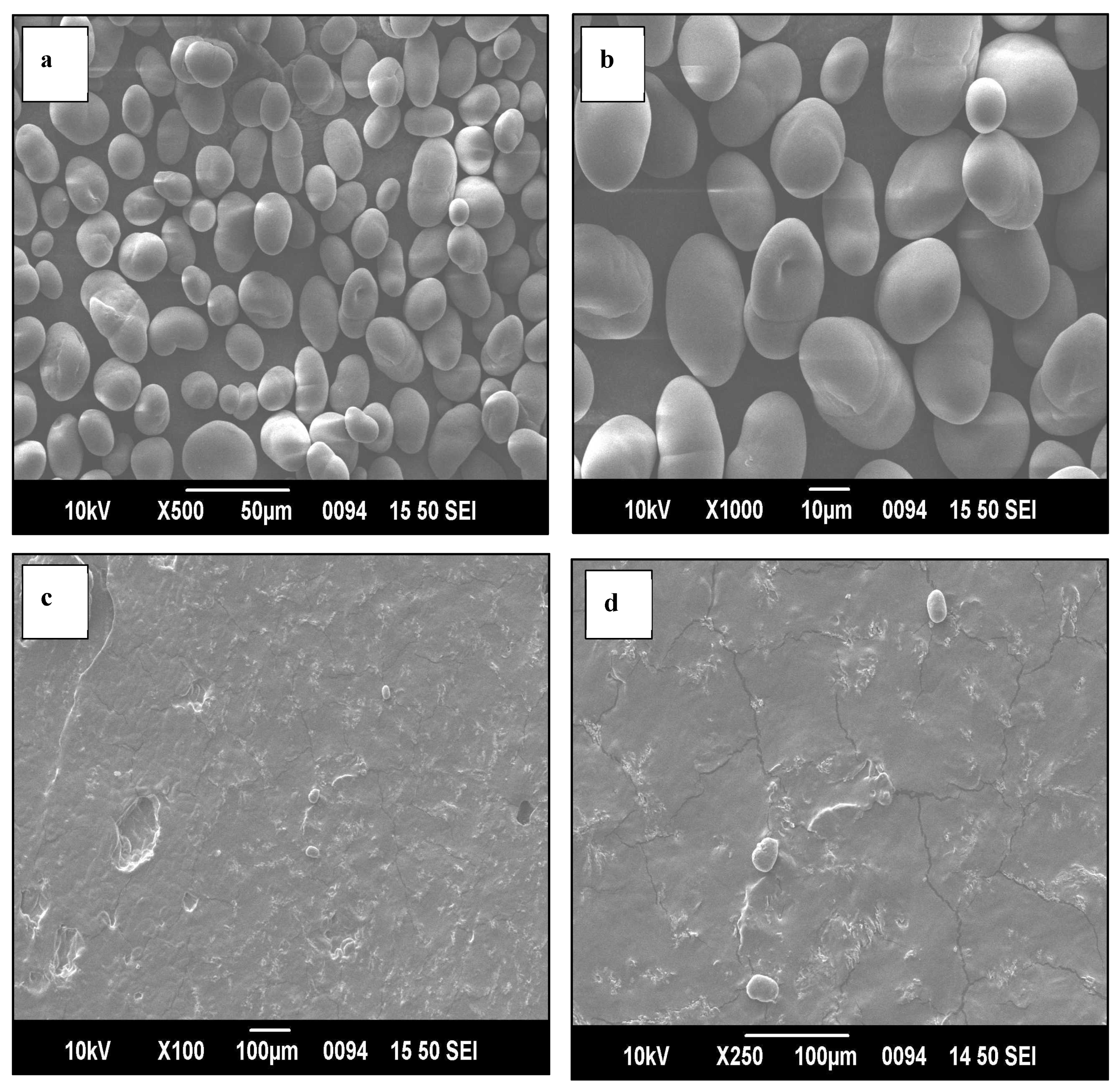
3.9. Scanning Electron Microscopy

The SEM micrographs illustrate the surface morphology of the lentil starch at different magnifications, emphasizing the granules and their modifications. The SEM images [Figure 7a–d] provide a visual insight into the surface characteristics of the red lentil starch before and after chemical modification. Native starch [Figure 7a,b] showed smooth, oval to spherical granules with slight size variations and overall uniformity [38]. In contrast, chemically modified starches [Figure 7c,d] exhibit rough textures, cracks, and irregular granule shapes. These morphological changes indicate structural alterations due to the treatments, such as cationization (with GTAC) and cross-linking (using epichlorohydrin). Fissures and uneven surfaces are often associated with chemical interactions that occur during modification and drying. Minor deposits on the granule surfaces may represent unreacted residues or byproducts. The differences between the native and modified samples illustrate transformations consistent with the expected chemical changes from these treatments [39].

3.10. Zeta Potential

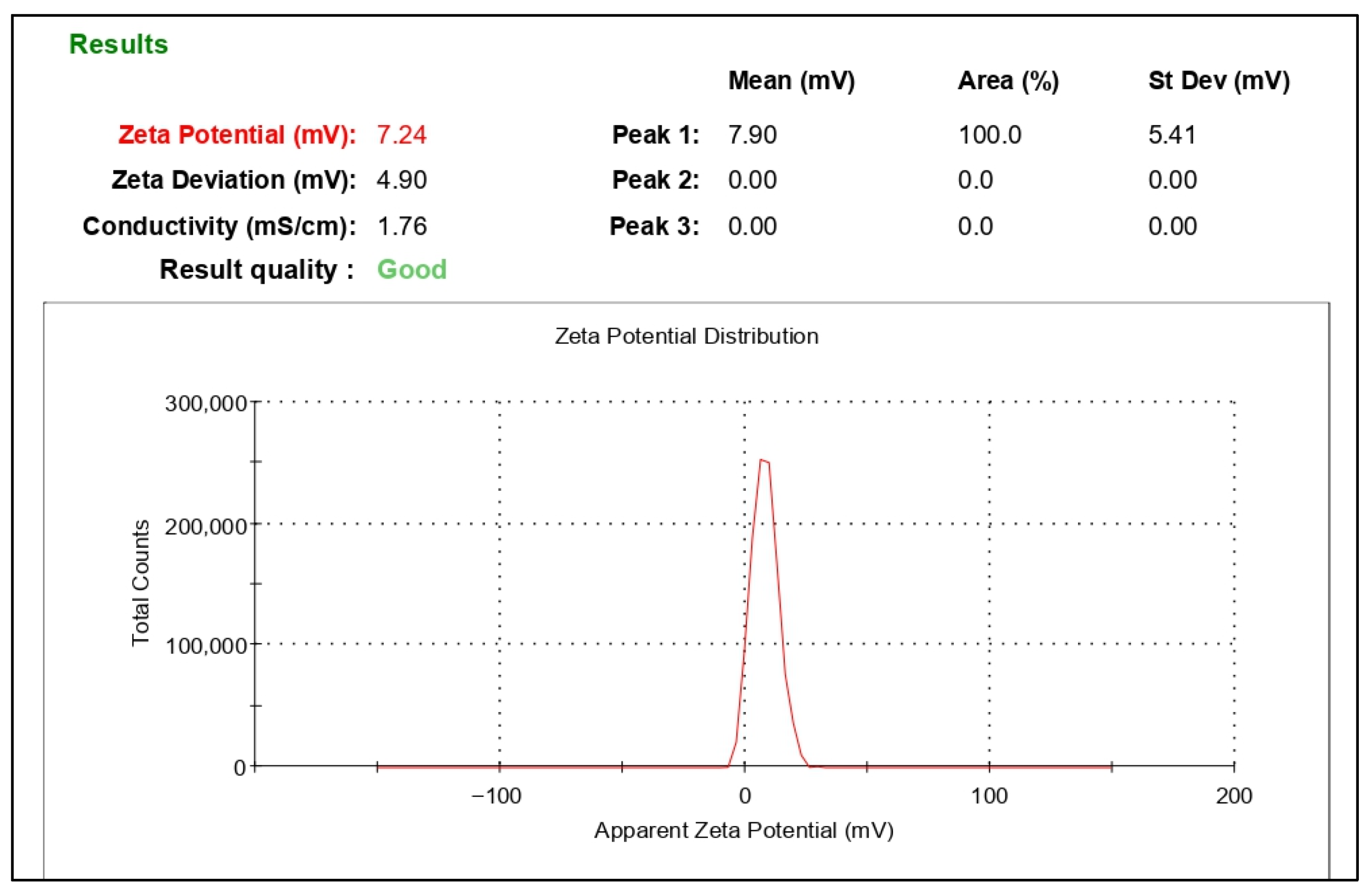
The recorded zeta potential value for the sample was +7.24 mV, with a standard deviation of 4.90 mV, indicating a moderately positive surface charge, as shown in Figure 8. The analysis revealed a single peak centered at +7.90 mV, encompassing 100% of the particle population, confirming the sample’s homogeneity in terms of charge distribution. The zeta potential of cationic starch derived from RL was measured at +7.24 mV, indicating a moderately positive surface charge owing to the quaternary ammonium groups introduced during the cationization process. This positive charge plays a critical role in enhancing the functional behavior of starch in emulsion stabilization and flocculation applications. In oil-in-water emulsions, positively charged starch molecules are attracted to the negatively charged surfaces of oil droplets, promoting interfacial adsorption and forming a stabilizing layer that helps prevent droplet coalescence [40]. In contrast, for flocculation in wastewater treatment, the same positive surface charge facilitates electrostatic interactions with negatively charged colloidal impurities. This results in charge neutralization and the subsequent aggregation of suspended particles into larger flocs, enhancing sedimentation and removal efficiency. Thus, the moderate zeta potential observed in cationic starch not only improves its emulsifying capacity but also makes it an effective biodegradable flocculant suitable for environmental applications [41].

3.11. Pharmaceutical Applications

3.11.1. Flocculation Property of CLS

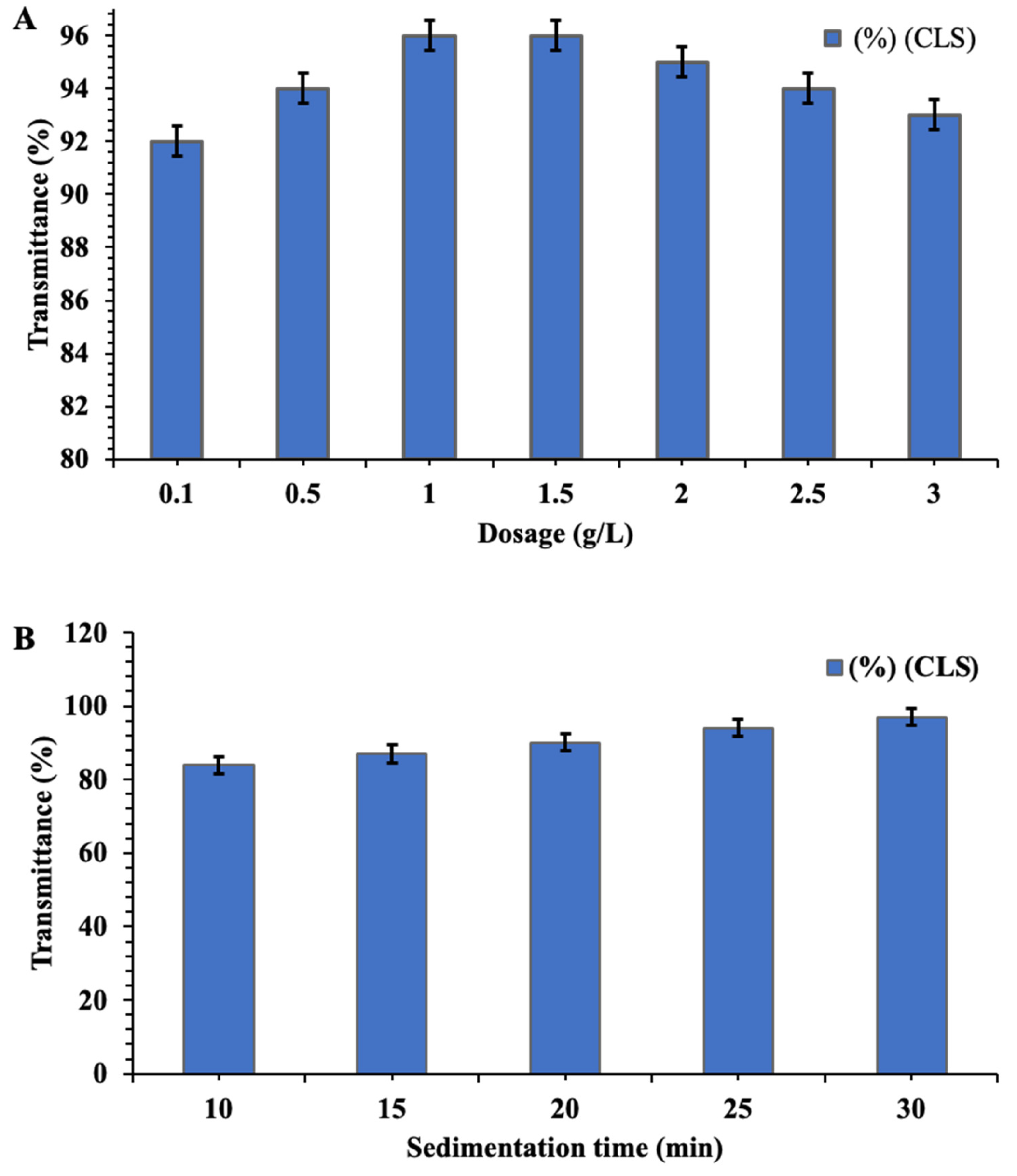
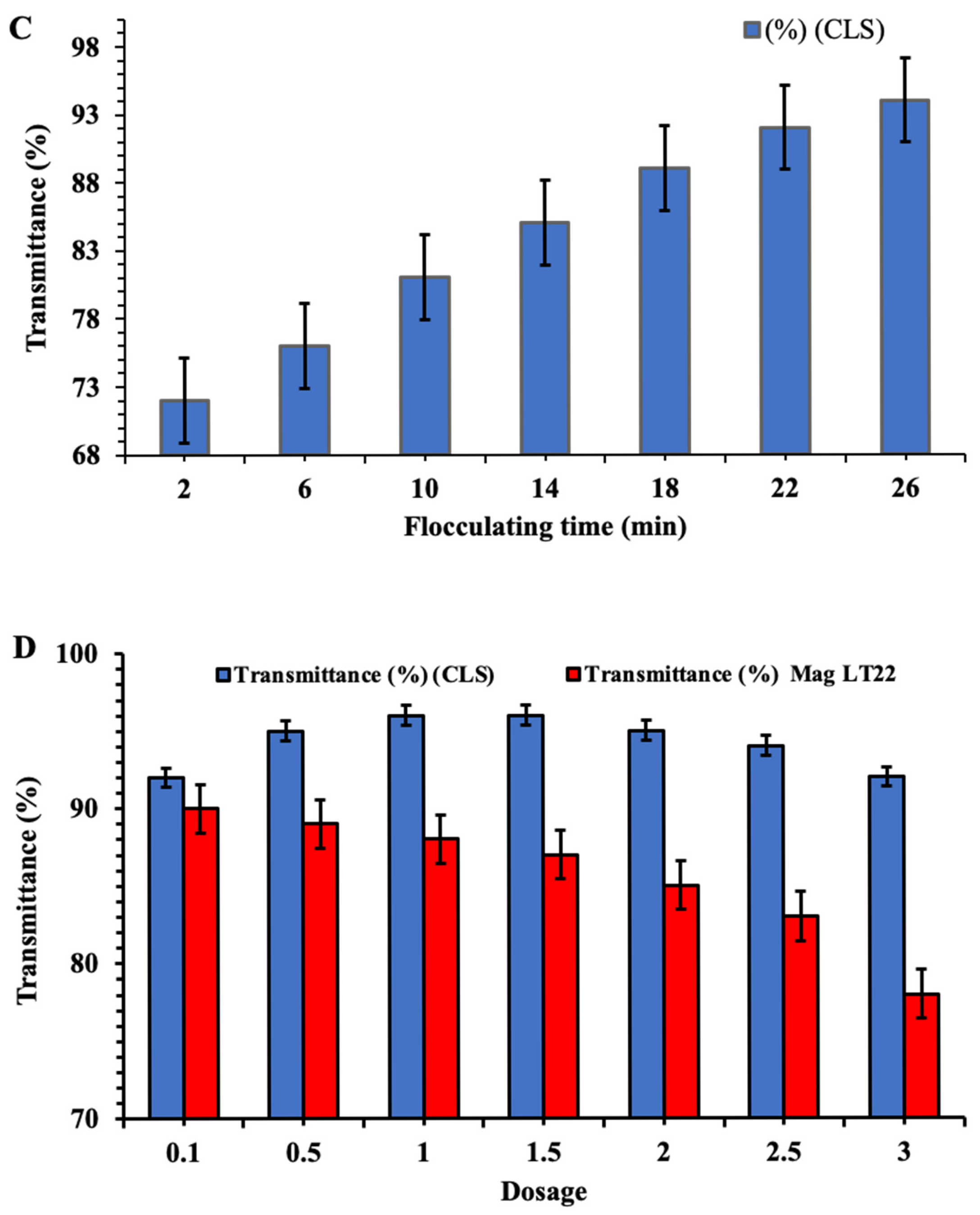
According to the test results, a comparison was made between CLS and commercially available flocculants to assess their flocculation properties using 0.25% (w/v) kaolin suspensions. CLS shows favorable characteristics for use as a flocculant over a broad pH range, eliminating the necessity for pH adjustment, similar to the capabilities of aluminum chloride. CLS demonstrated similar effectiveness in flocculating negatively charged kaolin particles under various pH conditions, comparable to other commercially available flocculants, such as aluminum chloride. Due to its cationic nature and branched structure, GTAC seems to offer a notable advantage. The performance was assessed by measuring the transmittance of the supernatant, with higher transmittance indicating a more effective flocculating agent. The effectiveness of the flocculating agent can be deduced from the transmittance of the supernatant; higher transmittance indicates stronger flocculation performance [42]. These results indicate that CLS, with its longer alkyl chains, is more effective as a flocculant in kaolin suspension. The electrostatic attraction between CLS derivatives and anionic kaolin suspensions facilitates the easy adsorption of the former onto the colloid surface. When polymers are adsorbed, they tend to form loops that extend from the particle surface into the aqueous phase. The loose ends of these loops then attach to the surface of another particle, creating a bridge between them. The effectiveness of polymer chains in bridging the gap between particle surfaces depends on their length. Longer polymer chains have a greater ability to span the distance between particles, promoting effective bridging and aggregation. Initially, the transparency of the liquid above the sediment improved as the dosage increased. When the dosage reached 0.20 g/L, the peak transmittance value was 94.0%. After reaching this peak, the transmittance value remained stable and slightly decreased with further increases in dosage, as shown in Figure 9A. The clarity of the liquid above the sediment improved as the sedimentation and flocculation time increased, as shown in Figure 9B and Figure 9C, respectively. At lower dosages, there was an insufficient amount of polymer present. When there is an excessive amount of polymer, there is not enough exposed particle surface for segments to attach, causing the particles to become unstable, potentially leading to steric repulsion. Extending the sedimentation and flocculation periods positively impacted the adsorption of polymers onto particle surfaces, facilitating their bridging. Figure 9D shows the effect of dosage on the transmittance (%) of CLS and Mag LT22. CLS initially increased transmittance, peaking at approximately 1–2 dosage units, indicating efficient flocculation and improved clarity. However, the transmittance decreased for both samples at higher dosages, likely due to overdosing, which led to particle re-suspension or destabilization. This suggests that CLS is a more effective flocculant than Mag LT22 at optimal dosages.

3.11.2. Cationic Starch as Emulsion Stability

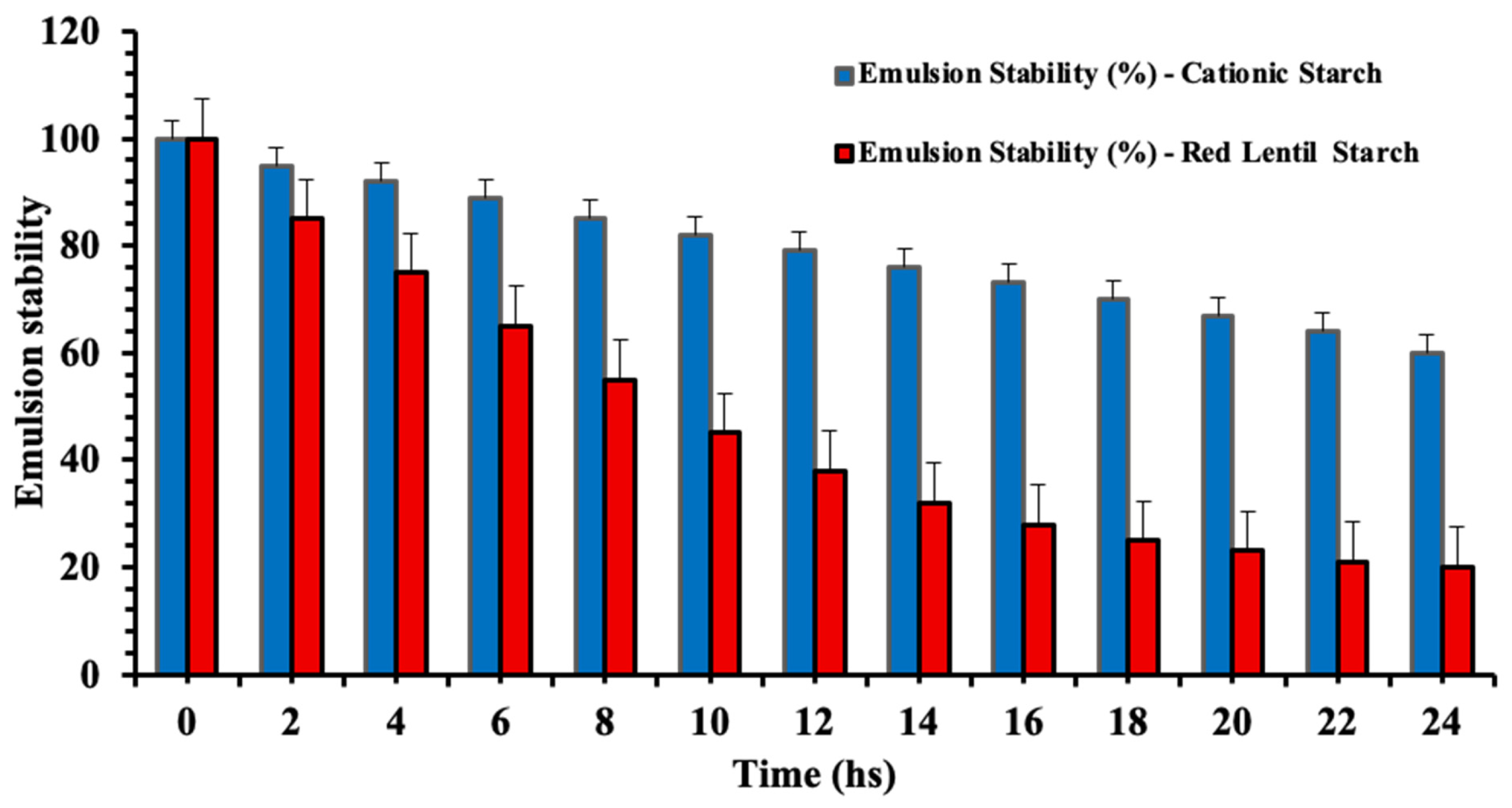
The graph compares the emulsion stability of cationic and red lentil starch over 24 h. Native starch-based emulsions exhibited significant phase separation and creaming, with a clear aqueous layer formed within 24 h. In contrast, emulsions stabilized with cationic starch, especially at higher concentrations, remained visually homogeneous with minimal phase separation, even after 24 h. This demonstrates that cationic modification significantly improves emulsion stability by enhancing electrostatic interactions and interfacial adsorption, thereby preventing droplet coalescence and creaming over time. The horizontal axis indicates time in hours, while the vertical axis shows emulsion stability as a percentage. There are two separate curves: a solid blue line with circular markers for cationic starch and a dashed red line with square markers for red lentil starch. Initially, both starch types showed 100% emulsion stability, but over time, a decline was observed in both cases, with red lentil starch showing a significantly steeper decrease. The graph illustrates the emulsion stability of the cationic and red lentil starches throughout the 24 h period. Cationic starch maintained a higher stability, gradually decreasing but remaining at approximately 70%. In contrast, red lentil starch declined rapidly, dropping below 50% in 10 h and approaching 30% in 24 h (Figure 10). The excellent performance of cationic starch is due to its positive charge, which boosts electrostatic interactions and prevents phase separation. On the other hand, red lentil starch does not demonstrate this level of stability. Therefore, cationic starch is a better emulsifier for applications requiring prolonged emulsion stability, such as in food, pharmaceuticals, and wastewater treatment. This electrostatic interaction established a more stable network, preventing the phase separation and coalescence of the droplets. Conversely, red lentil starch, which lacks charge modifications, is less effective in stabilizing emulsions, resulting in a faster breakdown over time [43].
Table 5 presents a comparative analysis of various starch sources that have been modified for use in flocculation and emulsion stability applications. It enumerates each starch type, the Cationizing agent used (such as GTAC or CHPTAC), the synthesis methods, the degree of substitution (DS), the intended application, and the resultant reaction efficiency. Red lentil starch (CLS, current study) achieves a high DS of 0.625. It integrates crosslinking with etherification, resulting in reaction efficiencies of 94% for flocculation and 90% for emulsion stability, which are among the highest reported. Other starches, including corn, potato, cassava, waxy maize, and sago, generally exhibit either very high efficiency at lower DS or moderate DS with varying efficiencies. For example, corn starch (GTAC) demonstrates 97% efficiency at a DS of 0.5, while cassava achieves up to 98% for emulsion stability at a DS of 0.35. The table highlights the balance achieved in the current CLS: a relatively high DS coupled with very high effectiveness in both flocculation and emulsion stabilization, distinguishing it from previously reported materials.

4. Conclusions

This study demonstrates that red lentil starch is a promising and sustainable raw material for the development of functional cationic starch derivatives. The optimized GTAC-modified starch exhibited desirable surface charge, structural transformation, and enhanced thermal and application performance, confirming the effectiveness of the modification strategy. Despite moderate statistical significance, the predictive model reliably guided process optimization and enabled the production of a material with consistent functional properties. The superior flocculation efficiency and emulsion stability achieved without pH adjustment highlight the practical relevance of the developed starch as an eco-friendly alternative to conventional chemical agents. Overall, the findings support the potential of cationic red lentil starch as a value-added biomaterial for environmental and pharmaceutical applications, while also emphasizing its scope for further scale-up and formulation-based studies.

Author Contributions

A.P. and S.S.: Conceptualization; A.P. S.P. and A.R.: Methodology; P.M.: Validation; A.R., K.B., S.P. and S.V.: Investigation; A.P.: Resources; A.R.: Data curation; A.P. and S.S.: Writing, Original draft preparation; A.R. and P.M.: Writing, review, and editing; S.S., A.R., K.B. and S.V.: Formal analysis, Visualization; A.P. S.P. and P.M.: Supervision; A.P. and S.S.: Project administration. All authors have read and agreed to the published version of the manuscript.

Funding

This research received no external funding.

Institutional Review Board Statement

Not applicable.

Data Availability Statement

The original contributions presented in this study are included in the article. Further inquiries can be directed to the corresponding authors.

Acknowledgments

The authors are grateful to the administration and management of AETs St. John Institute of Pharmacy and Research, Palghar, Maharashtra 401404, India. Moreover, this study received partial funding from the Chiang Mai University CMU Proactive Researcher Scheme (2023) for Sudarshan Singh. The graphical abstract was created in BioRender. Kant, R. (2026) https://BioRender.com/bchxbgg, accessed on 4 January 2026.

Conflicts of Interest

The authors declare no conflicts of interest.

Abbreviations

AGU: Anhydrous glucose unit molecular weight LS Lentil Starch; CCD: Central composite design; C: Carbon; CLS: Cationic Lentil Starch; CS: Cross-Linked Starch; DS: Degree of substitution; GTAC: Glycidyltrimethylammonium chloride; EPI: Epichlorohydrin; FT-IR: Fourier-transform infrared spectroscopy; H: Hydrogen; LS Lentil Starch; Mag LT 22 Magnafloc LT 22 mV Millivolt; NaOH Sodium Hydroxide; N Nitrogen; OH hydroxyl groups; QBD Quality by Design; RSM: Response surface methodology; SEM Scanning Electron Microscopes; SD Standard deviation; TGA Thermogravimetric analysis; UV Ultraviolet; XRD X-ray diffraction

References

  1. Jiang, T.; Duan, Q.; Zhu, J.; Liu, H.; Yu, L. Starch-based biodegradable materials: Challenges and opportunities. Adv. Ind. Eng. Polym. Res. 2020, 3, 8–18. [Google Scholar] [CrossRef]
  2. Schutz, G.F.; de Ávila Gonçalves, S.; Alves, R.M.V.; Vieira, R.P. A review of starch-based biocomposites reinforced with plant fibers. Int. J. Biol. Macromol. 2024, 261, 129916. [Google Scholar] [CrossRef] [PubMed]
  3. Suri, S.; Singh, A. Modification of Starch by Novel and Traditional Ways: Influence on the Structure and Functional Properties. Sustain. Food Technol. 2023, 1, 348–362. [Google Scholar] [CrossRef]
  4. Compart, J.; Singh, A.; Fettke, J.; Apriyanto, A. Customizing Starch Properties: A Review of Starch Modifications and Their Applications. Polymers 2023, 15, 3491. [Google Scholar] [CrossRef]
  5. Chen, Q.; Yu, H.; Wang, L.; Abdin, Z.U.; Chen, Y.; Wang, J.; Zhou, W.; Yang, X.; Khan, R.U.; Zhang, H.; et al. Recent Progress in Chemical Modification of Starch and Its Applications. RSC Adv. 2015, 5, 67459–67474. [Google Scholar] [CrossRef]
  6. Amaraweera, S.M.; Gunathilake, C.; Gunawardene, O.H.P.; Fernando, N.M.L.; Wanninayaka, D.B.; Dassanayake, R.S.; Rajapaksha, S.M.; Manamperi, A.; Fernando, C.A.N.; Kulatunga, A.K.; et al. Development of Starch-Based Materials Using Current Modification Techniques and Their Applications: A Review. Molecules 2021, 26, 6880. [Google Scholar] [CrossRef]
  7. Malik, M.K.; Kumar, V.; Sharma, P.P.; Singh, J.; Fuloria, S.; Subrimanyan, V.; Fuloria, N.K.; Kumar, P. Improvement in Digestion Resistibility of Mandua Starch (Eleusine coracana) after Cross-Linking with Epichlorohydrin. ACS Omega 2022, 7, 27334–27346. [Google Scholar] [CrossRef]
  8. Chatterjee, S.; Mahmood, S.; Hilles, A.R.; Thomas, S.; Roy, S.; Provaznik, V.; Romero, E.L.; Ghosal, K. Cationic Starch: A functionalized Polysaccharide Based Polymer for Advancement of Drug Delivery and Health Care System—A review. Int. J. Biol. Macromol. 2023, 248, 125757. [Google Scholar] [CrossRef]
  9. Golshahi, M.; Taslikh, M.; Nayebzadeh, K.; Arjeh, E. Dual Modification of Normal Corn Starch by Cross-Linking and Annealing: Investigation of Physicochemical, Thermal, Pasting, and Morphological Properties. J. Food Meas. Charact. 2023, 17, 2719–2729. [Google Scholar] [CrossRef]
  10. Sharma, M.; Aguado, R.; Murtinho, D.; Valente, A.J.; De Sousa, A.P.M.; Ferreira, P.J. A Review on Cationic Starch and Nanocellulose as Paper Coating Components. Int. J. Biol. Macromol. 2020, 162, 578–598. [Google Scholar] [CrossRef]
  11. Ali, S.; Mughal, M.A.; Shoukat, U.; Baloch, M.A.; Kim, S.H. Cationic Starch (Q-TAC) Pre-Treatment of Cotton Fabric: Influence on Dyeing with Reactive Dye. Carbohydr. Polym. 2015, 117, 271–278. [Google Scholar] [CrossRef] [PubMed]
  12. Wang, X.; Luo, Y.; Ying, H.; Lin, J. Study on the Preparation and Application of a Novel Functionalized Starch-Grafted-APTAC Flocculant. New J. Chem. 2025, 49, 11170–11179. [Google Scholar] [CrossRef]
  13. Thanyapanich, N.; Jimtaisong, A.; Rawdkuen, S. Functional Properties of Banana Starch (Musa spp.) and Its Utilization in Cosmetics. Molecules 2021, 26, 3637. [Google Scholar] [CrossRef] [PubMed]
  14. Rema, R.R.; Jyothi, A. A Comparative Study on the Resistant Starch Content from Different Botanical Sources in Relation to Their Physicochemical Properties. J. Root Crops 2015, 41, 37–47. [Google Scholar]
  15. Nahar, N.; Rahman, H.; Hazra, S.; Ahmed, J. Structural and Pasting Properties of Lentil Starch: A Comprehensive Review. Legum. Sci. 2024, 6, e70013. [Google Scholar] [CrossRef]
  16. Puri, A.; Syukri, D.M.; Silvia, E.; Ladyani, F.; Mohite, P.; Ade, N.; Munde, S.; Chidrawar, V.R.; Singh, S.; Shafi, S. Waste-to-Value-Added Customized Cationic Banana Starch for Potential Flocculant Application. J. Polym. Environ. 2024, 32, 6096–6113. [Google Scholar] [CrossRef]
  17. Puri, A.V.; Vrushali, N.G. Isolation, Characterization of Banana Starch and Its Evaluation as a Disintegrating Agent in Dispersible Lornoxicam Tablet. Drug Deliv. Lett. 2022, 12, 276–286. [Google Scholar] [CrossRef]
  18. Haleem, N.; Osabutey, A.; Albert, K.; Zhang, C.; Min, K.; Anderson, G.; Yang, X. Flocculation of Livestock Wastewater Using cationic Starch Prepared from Potato Peels. Environ. Sci. Water Res. Technol. 2023, 9, 1690–1700. [Google Scholar] [CrossRef]
  19. Makroo, H.; Naqash, S.; Saxena, J.; Sharma, S.; Majid, D.; Dar, B. Recovery and Characteristics of Starches from Unconventional Sources and Their Potential Applications: A Review. Appl. Food Res. 2021, 1, 100001. [Google Scholar] [CrossRef]
  20. Sandhu, K.S.; Siroha, A.K.; Punia, S.; Sangwan, L.; Nehra, M.; Purewal, S.S. Effect of Degree of Cross Linking on Physicochemical, Rheological and Morphological Properties of Sorghum Starch. Carbohydr. Polym. Technol. Appl. 2021, 2, 100073. [Google Scholar] [CrossRef]
  21. Lekniute-Kyzike, E.; Bendoraitiene, J.; Navikaite-Snipaitiene, V.; Peciulyte, L.; Rutkaite, R. Production of Cationic Starch-Based Flocculants and Their Application in Thickening and Dewatering of the Municipal Sewage Sludge. Materials 2023, 16, 2621. [Google Scholar] [CrossRef]
  22. Elomaa, M.; Asplund, T.; Soininen, P.; Laatikainen, R.; Peltonen, S.; Hyvärinen, S.; Urtti, A. Determination of the Degree of Substitution of Acetylated Starch by Hydrolysis, 1H NMR and TGA/IR. Carbohyd. Polym. 2004, 57, 261–267. [Google Scholar] [CrossRef]
  23. Kuo, W.-Y.; Lai, H.-M. Effects of Reaction Conditions on the Physicochemical Properties of Cationic Starch Studied by RSM. Carbohydr. Polym. 2009, 75, 627–635. [Google Scholar] [CrossRef]
  24. Wang, Y.; Xie, W. Synthesis of Cationic Starch with a High Degree of Substitution in an Ionic Liquid. Carbohydr. Polym. 2010, 80, 1172–1177. [Google Scholar] [CrossRef]
  25. Singh, R.P.; Pal, S.; Ali, S.A. Novel Biodegradable Polymeric Flocculants Based on Cationic Polysaccharides. Adv. Mater. Lett. 2014, 5, 24–30. [Google Scholar] [CrossRef]
  26. Apostolidis, E.; Stoforos, G.N.; Mandala, I. Starch Physical Treatment, Emulsion Formation, Stability, and Their Applications. Carbohydr. Polym. 2023, 305, 120554. [Google Scholar] [CrossRef]
  27. Ashish, K.; Bhardwaj, N.K.; Singh, S.P. Cationic Starch and Polyacrylamides for Alkenyl Succinic Anhydride (ASA) Emulsification for Sizing of Cellulosic Fibers. Cellulose 2019, 26, 9901–9915. [Google Scholar] [CrossRef]
  28. Razali, M.A.A.; Sanusi, N.; Ismail, H.; Othman, N.; Ariffin, A. Application of Response Surface Methodology (RSM) for Optimization of Cassava Starch Grafted Polydadmac Synthesis for Cationic Properties. Starch-Starke 2012, 64, 935–943. [Google Scholar] [CrossRef]
  29. Jiang, X.; Kuang, F.; Kong, F.; Yan, C. Prediction of the Antiglycation Activity of Polysaccharides from Benincasa hispida using a Response Surface Methodology. Carbohydr. Polym. 2016, 151, 358–363. [Google Scholar] [CrossRef]
  30. Nasir, N.M.; Abdulmalek, E.; Zainuddin, N. Preparation and Optimization of Water-Soluble Cationic Sago Starch with a High Degree of Substitution Using Response Surface Methodology. Polymers 2020, 12, 2614. [Google Scholar] [CrossRef]
  31. Abiddin, N.F.; Yusoff, A.; Ahmad, N. Optimisation of Reaction Conditions of Octenyl Succinic Anhydride (OSA) Modified Sago Starch Using Response Surface Methodology (RSM). Int. Food Res. J. 2015, 22, 930–935. [Google Scholar]
  32. Han, S.Y.; Zhu, X.; Zhang, B. Optimization of Reaction Conditions of Octenyl Succinic Anhydride Potato Starch and its Morphology, Crystalline Structure and Thermal Characterization. Adv. Mater. Res. 2011, 236–238, 2279–2289. [Google Scholar] [CrossRef]
  33. Hebeish, A.; Aly, A.A.; El-Shafei, A.; Zaghloul, S. Synthesis and Characterization of Cationized Starches for Application in Flocculation, Finishing and Sizing. Egypt. J. Chem. 2009, 52, 73–89. [Google Scholar]
  34. Pfeifer, A.; Hampe, R.; Heinze, T. Synthesis and Characterization of Novel Water-Soluble and Bactericidic Cationic Starch Esters. Starch-Stärke 2017, 69, 1700029. [Google Scholar] [CrossRef]
  35. Dahiru, M.; Zango, Z.; Haruna, M. Cationic Dyes Removal Using Low-Cost Banana Peel Biosorbent. Am. J. Mater. Sci. 2018, 8, 32–38. [Google Scholar]
  36. Ojogbo, E.; Ogunsona, E.; Mekonnen, T. Chemical and Physical Modifications of Starch for Renewable Polymeric Materials. Mater. Today Sustain. 2020, 7–8, 100028. [Google Scholar] [CrossRef]
  37. Wang, J.-P.; Yuan, S.-J.; Wang, Y.; Yu, H.-Q. Synthesis, Characterization and Application of a Novel Starch-Based Flocculant with High Flocculation and Dewatering Properties. Water Res. 2013, 47, 2643–2648. [Google Scholar] [CrossRef]
  38. Tuan Mohamood, N.F.A.-Z.; Zainuddin, N.; Ahmad@Ayob, M.; Tan, S.W. Preparation, Optimization and Swelling Study of Carboxymethyl Sago Starch (CMSS)–Acid Hydrogel. Chem. Cent. J. 2018, 12, 133. [Google Scholar] [CrossRef]
  39. Garcia, E.A.; Solorza-Feria, J.; Rendon, R.; Rodríguez-González, F.; Jiménez-Perez, A.; Huicochea, E. Properties of Edible Films Based on Oxidized Starch and Zein. Int. J. Polym. Sci. 2014, 2014, 292404. [Google Scholar] [CrossRef]
  40. Masoudipour, E.; Kashanian, S.; Azandaryani, A.H.; Omidfar, K.; Bazyar, E. Surfactant Effects on the Particle Size, Zeta Potential, and Stability of Starch Nanoparticles and Their Use in a Ph-Responsive Manner. Cellulose 2017, 24, 4217–4234. [Google Scholar] [CrossRef]
  41. Chang, Y.; Hu, Z.; Wang, P.; Zhou, J. Synthesis, Characterization, and Flocculation Performance of Cationic Starch Nanoparticles. Carbohydr. Polym. 2021, 269, 118337. [Google Scholar] [CrossRef]
  42. Matusiak, J.; Grządka, E. Cationic Starch as the Effective Flocculant of Silica in the Presence of Different Surfactants. Sep. Purif. Technol. 2020, 234, 116132. [Google Scholar] [CrossRef]
  43. Du, M.; Chen, Y.; Chen, L.; Din, Z.-U.; Chen, X.; Wang, Y.; Wang, G.; Zhu, L.; Ding, W. Synthesis of a Novel starch-Based Emulsion Gel with Remarkable Low-Temperature Stability via Esterification, Ozone-Oxidation and Ion Induction. Carbohydr. Polym. 2025, 352, 123165. [Google Scholar] [CrossRef] [PubMed]
  44. Mohseni, A.; Fan, L.; Roddick, F.; Li, H.; Gao, Y.; Liu, Z. Cationic Starch: An Effective Flocculant for Separating Algal Biomass from Wastewater RO Concentrate Treated by Microalgae. J. Appl. Phycol. 2021, 33, 917–928. [Google Scholar] [CrossRef]
  45. Sableviciene, D.; Klimaviciute, R.; Bendoraitiene, J.; Zemaitaitis, A. Flocculation Properties of High-Substituted Cationic Starches. Colloids Surf. A Physicochem. Eng. Asp. 2005, 259, 23–30. [Google Scholar] [CrossRef]
  46. Rahayu, S.; Wirjosentono, B.; Oktavia, E.; Zuhra, C.F.; Pasaribu, K.M.; Piliang, A.F.R.; Sihotang, N.S.; Tarigan, J.B.; Siow, J.; Goei, R.; et al. Temperature-Dependent Etherification of Cassava Starch with Chptac for Cationic Starch Production. Case Stud. Chem. Environ. Eng. 2024, 10, 100779. [Google Scholar] [CrossRef]
  47. Liu, M.; Wu, Z.; Meng, Y.; Wang, Z.; He, X.; Gu, J.; Zhang, Y.; Wang, L.; Qin, X. Cationic Etherification Modification of Corn Starch and Its Sizing Property. Text. Res. J. 2023, 93, 3680–3691. [Google Scholar] [CrossRef]
  48. Lu, K.; Zhu, J.; Bao, X.; Liu, H.; Yu, L.; Chen, L. Effect of Starch Microstructure on Microwave-Assisted Esterification. Int. J. Biol. Macromol. 2020, 164, 2550–2557. [Google Scholar] [CrossRef]
  49. Rahmat, S.; Othman, N.; Asharuddin, S.M.; Ahmad, S.N.; Din, M.F.M.; Sarani, N.A. Synthesis and Characterization of Etherified Cationic Starch Flocculant Derived from Manihot esculenta Peel with Varying Degrees of Substitution. Int. J. Biol. Macromol. 2024, 279, 135499. [Google Scholar] [CrossRef]
Figure 1. (Step I) Schematic representation of starch crosslinking via epichlorohydrin, forming ether linkages between starch molecules, (Step II) Schematic representation of cationic starch synthesis via etherification of starch with GTAC.
Polysaccharides 07 00037 g001
Figure 2. A graphical depiction of predicted DS values compared to the actual ones.
Polysaccharides 07 00037 g002
Figure 3. Response surface curve for the impact of NaOH concentration and GTAC concentration (moL) (A), Response surface Reaction time and GTAC concentration (moL) (B), Response surface curve Reaction time and NaOH concentration (moL) (C).
Polysaccharides 07 00037 g003
Figure 4. FTIR spectrum of lentil starch (a), epichlorohydrin (b), cross-linked starch (c), GTAC (d), and cationic lentil starch (e).
Polysaccharides 07 00037 g004
Figure 5. TGA curves displaying thermograms of red lentil starch and cationic lentil starch.
Polysaccharides 07 00037 g005
Figure 6. XRD spectra of (a) red lentil starch and (b) cationic lentil starch.
Polysaccharides 07 00037 g006
Figure 7. SEM of red lentil starch (a,b), cationic lentil starch (c,d).
Polysaccharides 07 00037 g007
Figure 8. Zeta potential of cationic lentil starch.
Polysaccharides 07 00037 g008
Figure 9. Influence of CLS dosages on Transmittance (%) (A), effect of sedimentation duration on flocculating efficiency (B), influence of flocculating duration on flocculating efficiency (C), flocculation performance in a Kaolin suspension using the Jar test with the addition of CLS and Magnafloc LT 22 (D).
Polysaccharides 07 00037 g009aPolysaccharides 07 00037 g009b
Figure 10. Emulsion stability between red lentil starch and cationic starch.
Polysaccharides 07 00037 g010
Table 1. The comprehensive design matrix outlining the preparation of CLS.
Factor 1Factor 2Factor 3Response 1
Std.RunA: GTAC
(mol/L)
B: NaOH
(mol/L)
C: Reaction Time
(h)
Degree of Substitution (DS)
4130.15180.35
1321.650.09180.6
130.30.03180.5
8430.09240.2
1451.650.09180.69
560.30.09120.5
6730.09120.2
1081.650.15120.3
1691.650.09180.69
12101.650.15240.5
7110.30.09240.34
15121.650.09180.46
17131.650.09180.69
21430.03180.5
3150.30.15180.12
11161.650.03240.5
9171.650.03120.3
Table 2. Variance analysis of the substitution degree and quadratic response surface model for substitution degree.
SourceSum of SquaresDOFMean SquareF-Valuep-ValueSignificance
Model0.735490.08176.120.0173Significant
A—GTAC0.105510.10557.910.0257*
B—NaOH0.085110.08516.380.0372*
C-Reaction Time0.067210.06725.030.0481*
AB0.043210.04323.240.1013
AC0.036410.03642.830.1354
BC0.021110.02111.780.2254
A20.127810.12789.550.0189*
B20.049910.04993.730.0880
C20.198610.198614.840.0064**
Residual0.093270.0133
Lack of Fit0.063430.02112.370.1846Not significant
Pure Error0.029840.0075
Model TypeQuadratic
R20.8874
Adjusted R20.7143
Predicted R20.6427
Adeq Precision7.3314
Standard Deviation0.1152
Note: * p < 0.05 (significant), ** p < 0.01 (highly significant).
Table 3. Predicted and experimentally observed responses for the optimized synthesis conditions of CLS obtained using RSM.
Exp.Conc. of
GTAC (mol)
Conc. of
NaOH (mol)
Reaction
Time (h)
Degree of SubstitutionDesirabilityStandard
Deviation
RE%
PredictedExperiment
12.0390.11319.7620.6250.5721.0000.05391.52
Table 4. Elemental composition of LS, GTAC and CLS.
Sample NameC %H %N %DS
Lentil Starch38.318.270.00-
Glycidyltrimethylammonium chloride44.3117.808.54-
Cationic Lentil starch35.6411.513.390.67
Table 5. Current study on cationic starch synthesis methods, substitution degrees, and applications across starch sources from literature reports.
Source of StarchCationizing
Reagent
Synthesis MethodDegree of
Substitution
Reaction
Efficiency
ApplicationRef.
Unripe bananaCHPTACEtherification0.62392.29%Flocculation[16]
Native potatoGTACEtherification0.1990%Flocculation[21]
SagoCHPTACEtherification0.45–1.1970–95%Flocculant wastewater treatment[30]
CornGTACGraft polymerization with etherification0.597%Flocculation[44]
PotatoCHPTAC
GTAC
Etherification0.13–0.8655–92%Flocculant emulsion stabilizer[41,45]
CassavaCHPTACEtherification0.3598%Emulsion stability[46]
CornGTACHydrolysis with etherification0.2670%Emulsion stability[47]
Waxy maizeCHPTAC, GTAC, Etherification (microwave-assisted)0.05–1.070–99%Papermaking
flocculants
[48]
CassavaCHPTACEtherification0.39–0.9968–93%Flocculant
dye removal
[49]
Red lentilGTACCrosslinking
(epichlorohydrin) with etherification
0.62594%Flocculation emulsion
stability
Current
Disclaimer/Publisher’s Note: The statements, opinions and data contained in all publications are solely those of the individual author(s) and contributor(s) and not of MDPI and/or the editor(s). MDPI and/or the editor(s) disclaim responsibility for any injury to people or property resulting from any ideas, methods, instructions or products referred to in the content.