

Article

Self-Assembly Multilayers Alginate/Chitosan Film Loaded with Alginate-Capped Silver Nanoparticles: A Promising Scaffold in Infected Skin Wound Scenarios

by
Nadina Aimé Usseglio
1,2,
Renée Onnainty
1,
Priscila Schilrreff
3,4,
Laura Valenti
5,
Juan Cruz Bonafé Allende
6,
Carla Giacomelli
5,
Dolores Carrer
7 and
Gladys Ester Granero
1,*
1
Unidad de Investigaciones y Desarrollo en Tecnología Farmacéutica (UNITEFA)-CONICET, Departamento de Ciencias Farmacéuticas, Facultad de Ciencias Químicas, Universidad Nacional de Córdoba, Córdoba X5000, Argentina
2
Advanced Biofabrication Laboratory-DNIETO LAB, Interdisciplinary Center for Chemical and Biology (CICA), Campus Elviña, Universidade da Coruña, 15071 A Coruña, Spain
3
Institut fur Experimentalphysik, Freie Universitat Berlin, Arnimallee 14, 14195 Berlin, Germany
4
Nanomedicine Research and Development Centre (NARD), Science and Technology Department, National University of Quilmes, Roque Saenz Peña 352, Bernal 1876, Argentina
5
Instituto de Investigaciones en Fisicoquímica de Córdoba (INFIQC)–CONICET-UNC, Departamento de Fisicoquímica, Facultad de Ciencias Químicas, Universidad Nacional de Córdoba, Córdoba X5000, Argentina
6
Departamento de Química Orgánica, Facultad de Ciencias Químicas, IPQA-CONICET, Universidad Nacional de Córdoba, Córdoba X5000, Argentina
7
Instituto de Investigación Médica Mercedes y Martin Ferreyra (INIMEC)-CONICET, Universidad Nacional de Córdoba, Córdoba X5000, Argentina
*
Author to whom correspondence should be addressed.
Polysaccharides 2026, 7(1), 34; https://doi.org/10.3390/polysaccharides7010034
Submission received: 24 September 2025 / Revised: 7 March 2026 / Accepted: 9 March 2026 / Published: 12 March 2026

Abstract

Cutaneous wound healing is a complex biological process often impaired by bacterial infections, especially by Staphylococcus aureus. To address this, alginate (ALG)/chitosan (CS) polyelectrolyte multilayer (PEM) films incorporating alginate-coated silver nanoparticles (ALG–AgNPs) were fabricated by layer-by-layer self-assembly. The films exhibited a porous, layered morphology with homogeneous distribution of ALG–AgNPs, hydrophilic surfaces (contact angle ≈ 55°), a high swelling degree (~175%), and a water vapor transmission rate of 1830 g m−2·day−1. Thermal analyses showed similar degradation profiles up to 600 °C, with the ALG–AgNP film displaying lower moisture loss and higher dehydration temperature, consistent with enhanced ionic and coordination crosslinking (–NH3+/–COO and Ag–O–C bonds). The release of Ag+ in PBS (pH 7.4) was ~3% after 24 h, following a Korsmeyer–Peppas mechanism (R2 = 0.97, n < 0.5), and degradation, with ~40% mass loss in 6 days, indicated gradual matrix disintegration. Cytocompatibility studies revealed >80% viability for fibroblasts, keratinocytes, macrophages, and <2% hemolysis of red blood cells. Immune assays showed a tendency towards reduced TNF-α and IL-1β and regulated IL-6/IL-8 release. Antibacterial evaluations demonstrated a 5-log reduction in planktonic bacterial viability and >2-log reduction in adhesion, and an 11 ± 1 mm inhibition zone for S. aureus. These results demonstrate that ALG/CS–AgNP PEM films combine biocompatibility, antibacterial efficacy, controlled degradation, and structural stability, making them promising multifunctional scaffolds for the regeneration of infected skin wounds.

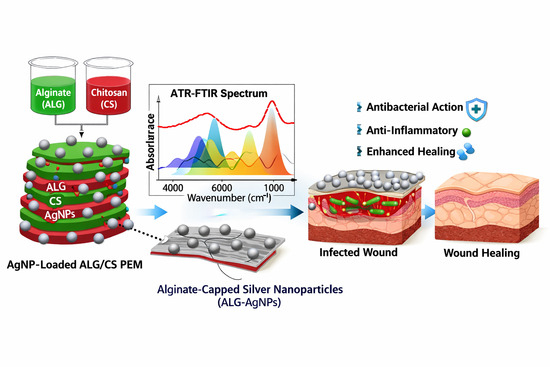
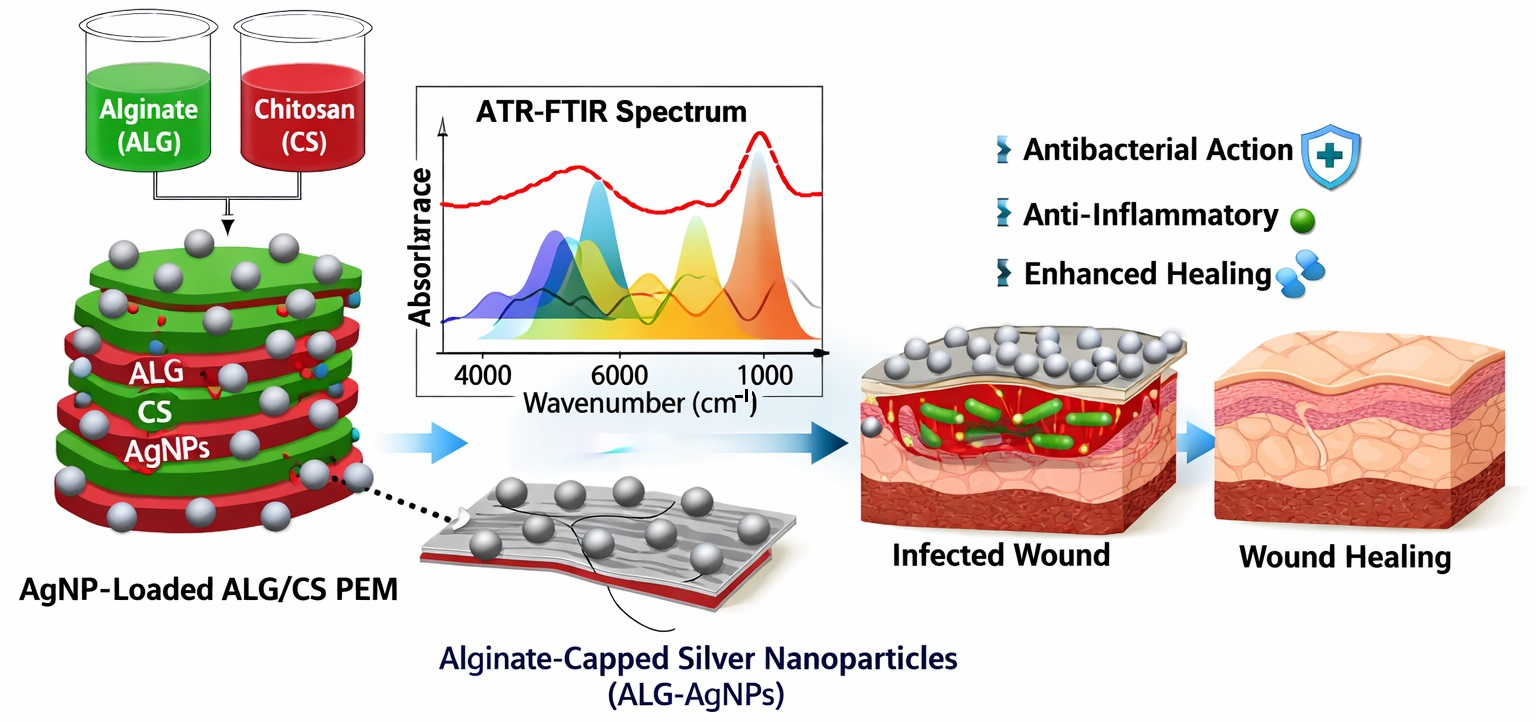
Graphical Abstract

1. Introduction

The skin is the first line of defense of the organism, and its regenerative capacity is crucial for homeostasis. The wound healing process is a highly complex mechanism that involves four overlapping phases: hemostasis, inflammation, proliferation, and tissue remodeling [1]. When this progression is altered by factors such as bacterial infections or chronic inflammation, healing slows, increasing the risk of complications and affecting patients’ quality of life [2].
Wound infections, such as those caused by Staphylococcus aureus, are one of the main pathogens responsible for skin and soft tissue infections [3], and are a critical challenge in regenerative medicine. Bacterial infections have shown increasing resistance to antibiotics, prompting the search for alternative strategies for microbial control. Among these strategies, silver nanoparticles (AgNPs) have recently gained relevance due to their considerable efficacy in controlling the growth of a wide range of pathogenic microorganisms and their low potential to generate resistance. The latter is possibly because the antimicrobial capacity of this metal involves multiple mechanisms of action such as: the inactivation of membrane proteins; the interaction of the metal with bacterial DNA, producing the disruption of its replication; the deterioration of the capacity of ribosomes to transcribe messenger RNA for proteins that are vital for cellular functioning; the inactivation of cytochrome b by the binding of Ag to sulfhydryl groups; and the deactivation of respiratory enzymes that lead to the generation of reactive oxygen species (ROS) that lead to the interruption of the production of adenosine triphosphate (ATP) [4,5,6,7,8]. However, designing biomedical scaffolds that combine antimicrobial properties with adequate support for tissue regeneration remains a challenge. Polyelectrolyte hydrogels and films have emerged as promising materials for wound healing applications due to their similarity to the extracellular matrix (ECM), biocompatibility, and biodegradability [9]. In particular, chitosan (CS) and alginate (ALG)-based systems offer significant advantages: CS, a well-known natural D-glucosamine hydrogel with a variable number of N-acetyl-D-glucosamine units, possesses remarkable properties such as non-immunogenicity, non-toxicity, and the ability to stimulate cell adhesion and growth, while ALG, a natural acidic hydrogel composed of β-d-mannuronic acid (M) and α-l-guluronic acid (G) residues linked by 1,4-linkages in different arrangements, has anti-inflammatory, antiapoptotic, antiproliferative, and antioxidant properties, in addition to being non-immunogenic and non-cytotoxic [10,11]. The combination of these polymers using layer-by-layer (LbL) self-assembly techniques allows the construction of films with controlled physicochemical properties that can influence cellular response and interactions with pathogenic microorganisms [12].
Building on previous research, this study aims to investigate the potential of layer-by-layer (LbL)-assembled alginate/chitosan (ALG/CS) multilayer films, with and without (control) alginate-coated silver nanoparticles (ALG-AgNPs), as biomaterials for wound-healing applications. The physicochemical properties of these films were characterized, and their biocompatibility with key wound-healing cells—fibroblasts, keratinocytes, and macrophages—was assessed. Additionally, their antibacterial activity and effects on pro-inflammatory cytokine secretion were evaluated. To further explore their potential, in vitro scratch assays were performed to analyze their impact on wound closure. The findings of this study contribute to the ongoing development of multifunctional wound dressings, offering insights into the role of multilayered biomaterials in promoting wound healing.

2. Materials and Methods

2.1. Materials

Low-viscosity Sodium Alginate was provided by Sigma-Aldrich (Buenos Aires, Argentina) (ALG; molecular weight (MW) 4500 kDa and α-L-guluronate/β-D-mannuronate (G/M) ratio 39%, according to the supplier). The G/M ratio experimentally measured by 1H NMR (Bruker Avance II 400 spectrometer, Billerica, MA, USA), was 50% for each component, and by ATR-FTIR spectrometry (Agilent Cary 630, Buenos Aires, Argentina), it was found to be 43% α-L-guluronate/57% β-D-mannuronate [13].
Chitosan’s low molecular weight was provided by Sigma-Aldrich (Buenos Aires, Argentina) (CS; MW 50–190 kDa, and degree of deacetylation (DD) 75–85%, according to the supplier). The DD values experimentally measured by 1H NMR (Bruker Avance II 400 spectrometer, Billerica, MA, USA), and ATR-FTIR (Agilent Cary 630, Buenos Aires, Argentina) were 93% and 82%, respectively [14,15].
A polypropylene membrane with 1.2 μm pores and 47 mm diameter was used as a disposable support to fabricate a free-standing, self-standing PEM provided by Maine Manufacturing, LCC (Sanford, ME, USA). Normal Human Dermal Fibroblast (NHDF) and Keratinocytes (NHDK) were isolated from foreskin (ethical approvals EA4/091/10 and EA1/081/13 by the Charité ethics committees—Universitätsmedizin Berlin). THP-1 cells were provided by DSMZ (Braunschweig, Germany). L929 fibroblast cells and RAW 264.7 macrophage cells were supplied by IMBICE (La Plata, Buenos Aires, Argentina). Cell Counting kit-8 (CCK-8), Phorbol-12-myristate-13-acetate (PMA), Epilife®, Roswell Park Memorial Institute 1640 medium (RPMI), and Dulbecco’s Modified Eagle Medium (DMEM) were provided by Sigma Aldrich. Fetal bovine serum (FBS), penicillin-streptomycin, glutamine, and IL-6, IL-8, IL-1β, and TNF-ELISA kits were supplied by Thermo Fisher Scientific, Thermo Ficher, Waltham, MA, USA). Staphylococcus aureus (ATCC 25923) and deionized water (18.2 mΩ, Milli-Q ultrapure water system, Millipore, Sigma Aldrich, Buenos Aires, Argentina) were used. All other reagents were of analytical grade or higher and were used without further purification.

2.2. Synthesis and Characterization of Alginate (ALG)-Capped Silver Nanoparticles (ALG-AgNPs)

ALG-AgNPs were synthesized by a one-step redox reaction assisted by ultraviolet (UV) light irradiation [16]. Briefly, a 0.5% w/v ALG aqueous solution was mixed with a 1% w/v AgNO3 aqueous solution under magnetic stirring at room temperature. Then the mixture was irradiated with a UV lamp (λ = 250–320 nm, 15 W) at a distance of 10 cm for 2 h. Surface plasmon resonance (SPR) measurements were carried out to characterize ALG-AgNPs using UV–vis absorption spectra on a Cary 60 UV–Vis® spectrophotometer (Agilent Technologies, Buenos Aires, Argentina), scanning from 200 to 800 nm. Also, the particle size (Z-average), polydispersity index (PDI), and zeta potential (ζ) values were measured by dynamic light scattering (Malvern Zetasizer 3600, Malvern Panalytical, Malvern, UK) at 25 °C with a scattering angle of 90°.

2.3. Fabrication of the Polyelectrolyte Multilayer Films (PEMs) with or Without ALG-AgNPs

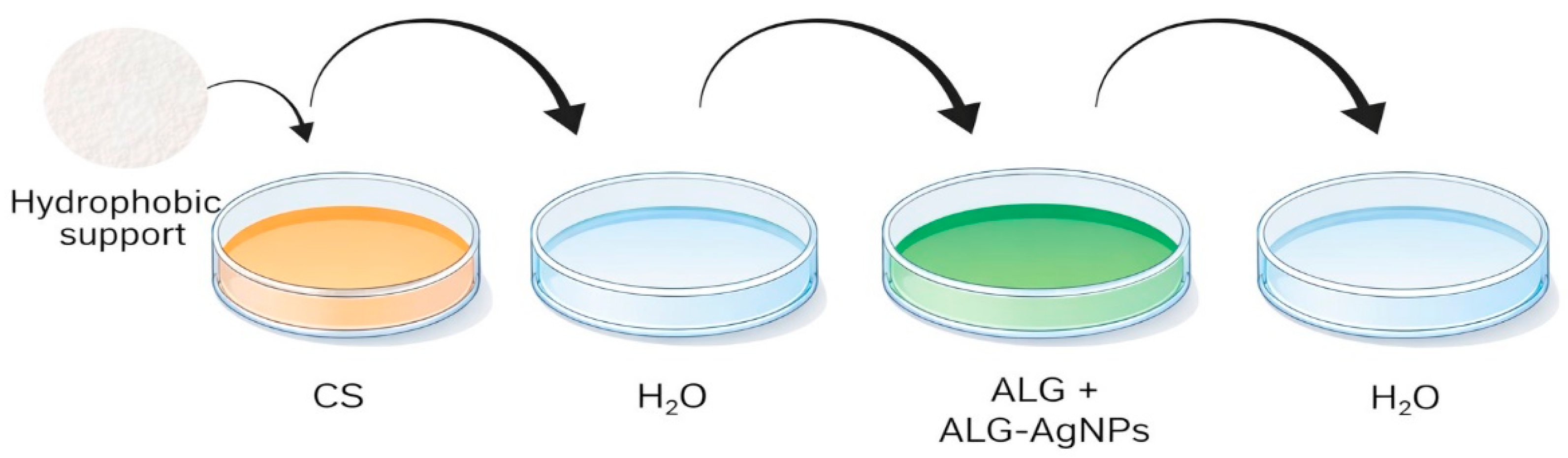
The scaffolds composed of intercalated layers of CS and ALG, loaded with ALG-AgNPs (ALG-AgNP PEM) or without ALG-AgNPs (PEM control), were built by the layer-by-layer self-assembly technique following the procedure described by Onnainty et al. [17] Briefly, the polyelectrolyte aqueous solutions were CS (2.5 mg/mL, pH = 5) in 1% (v/v) acetic acid, ALG (5 mg/mL, pH 5), and ALG (5 mg/mL, pH = 5) containing ALG-AgNPs (1 mg/mL). The hydrophobic support (GVS Filter Technology, Sanford, ME, USA) was alternately dipped in cationic and anionic polyelectrolyte aqueous solutions and in the washing solution (Milli-Q water). A total of 50 cycles were conducted. When the deposition of the layers was complete, the multilayer self-assembled films were dried using an oven at 37 °C until no further weight change occurred. The obtained multilayer films remained on the hydrophobic supports until use. Figure 1 summarizes the PEMs’ synthesis process. Based on the deposition solutions (ALG 5 mg·mL−1; CS 2.5 mg·mL−1; Ag 1 mg·mL−1 in the ALG–AgNPs formulation), the molar amounts per mL are approximately: ALG monomer = 2.84 × 10⁻⁵ mol, CS monomer = 1.55 × 10⁻⁵ mol, and Ag = 9.27 × 10⁻⁶ mol. Considering the degree of deacetylation of chitosan (DD = 93% or 82%), the ratio of carboxylate groups (ALG) to protonated amine groups (CS) is ~1.97:1 (DD = 93%) to ~2.23:1 (DD = 82%). Normalized to one ALG monomer, the relative molar composition for the Ag-loaded system is ALG: CS_NH3+: Ag ≈ 1: 0.51: 0.33 (using DD = 93%).

2.4. PEM Characterization

2.4.1. Fourier Transform Infrared Spectroscopy (ATR-FTIR)

The spectra were recorded using an Agilent Cary 630 spectrometer equipped with a universal attenuated total reflection (ATR) sampling accessory. ATR-FTIR analysis in the 4000–650 cm−1 range with a resolution of 4 cm−1 was performed to determine the chemical structure of the multilayer films. The absorbance peaks after baseline correction were fitted to the Gaussian function. The area of the deconvoluted bands was calculated.

2.4.2. Scanning Electron Microscopy (SEM) and Atomic Force Microscopy (AFM)

The surface and cross-section morphologies of multilayer films were determined in the LAMARX Laboratory using an FE-SEM Sigma (Carl Zeiss Sigma, Jena, Alemania) analytical scanning electron microscope at an accelerating voltage of 5 kV. Samples were fixed to a brass stub with double-sided adhesive tape and gold-coated under vacuum using a sputter coater, PELCO Model 3. The surface topography of the ALG-AgNP PEM was analyzed by atomic force microscopy (MFP-3D, Asylum Research, Oxford Instruments, High Wycombe, Buckinghamshire, UK) under ambient conditions. Five samples were evaluated in different regions of each film to assess surface homogeneity. The images were processed using Gwyddion software (v2.x, Czech Metrology Institute, Prague, Czech Republic) with plane and line leveling to remove background tilt. The arithmetic mean roughness (Ra) and root-mean-square roughness (Rq) were calculated from the corrected height maps to quantify surface roughness and assess nanoscale uniformity across films.

2.4.3. Wettability

The wettability of PEMs was determined using sessile drop contact angle measurements with a homemade contact angle goniometer, following the procedure reported by Onnainty et al. [17]. Briefly, a drop of (0.5 μL) distilled water was placed over the film surface, and measurements were conducted immediately after drop deposition at room temperature. Contact angles were analyzed using ImageJ 1.54g software.

2.4.4. Mechanical Properties

A puncture test of PEMs was performed using a universal tensile machine (Instron Emic 23-5s, Universal Testing Machine, Kanjur Marg, Mumbai, India). The piercing rate was set at 6 mm/min, and the films were tested at least 4 times. Both puncture strength (PS) and elongation-at-puncture (EP) were determined as the maximum strength and the maximum elongation before puncture, respectively. Young’s modulus was also measured as a parameter for the film’s stiffness. It was determined indirectly from the slope of the force vs. elongation graph [18].

2.4.5. Thermal Analysis

The thermal behavior of the PEMs was analyzed using simultaneously recorded thermogravimetric (TG) and differential thermal analysis (DTA) curves on a TG Discovery series (TA Instruments, New Castle, DE, USA) instrument. These analyses were conducted under nitrogen gas flow from room temperature to 600 °C at a 10 °C min−1 heating rate.

2.5. Swelling Behavior

The swelling degree of the PEMs was determined using the gravimetric method, which is widely used for hydrogel and polyelectrolyte systems to assess water uptake capacity [19]. PEMs were cut into a cylindrical shape with a diameter of 12 mm and weighed using an analytical balance (Sartorius). Samples were immersed in 10 mL phosphate-buffered saline (PBS), pH 7.4, at room temperature for 2 h. Afterward, PEMs were weighed after the excess buffer was removed.
The degree of swelling of PEMs was calculated by Equation (1).
Swelling degree (%) = (S1 − S0)/S0 × 100
where S1 and S0 are the weights of the swollen and dry PEMs, respectively.

2.6. In Vitro Silver Release Tests

The release of silver ions from ALG-AgNP PEM was determined by immersing a PEM disc of 20 mm in diameter in 20 mL of PBS pH 7.4 at room temperature. Samples were removed at certain intervals and replaced with fresh buffer solutions for 24 h. The amount of silver in the samples was measured using flame atomic absorption spectroscopy (AAS, Thermo Fisher iCE 3000, Thermo Ficher, Waltham, MA, USA) with a silver hollow-cathode lamp. Previously, a calibration curve was performed using known concentrations of AgNO3 prepared in 10% v/v nitric acid. An aliquot of 0.5 mL of 65% v/v nitric acid was added to 1.5 mL of the samples for analysis. The results are reported as the mean ± SD across three independent experiments. On the other hand, to quantify the initial amount of silver contained in the disks, an enzymatic degradation was carried out by incubating an ALG-AgNP PEM disk in 3 mL of TRIS-HCl buffer (10 mM, pH = 8) containing lysozyme (10,000 U/mL) at 37 °C for 24 h, following a silver determination by the same procedure described above.
To determine the silver kinetic release mechanisms, silver profiles were adjusted to the following mathematical models: Higuchi, Hixson–Crowell, and Korsmeyer–Peppas, and correlation coefficient (R2) and n values were estimated (Table 1) [17].

2.7. In Vitro Hydrolytic Degradation Studies

The hydrolytic degradation of PEMs was evaluated in phosphate-buffered saline (PBS, pH = 7.4) at room temperature. A disc of 12 mm diameter of each PEM sample was placed in 24-well plates after recording its initial weight (W0) and immersed in 2 mL PBS. PBS was replaced by freshly prepared PBS every 72 h to avoid system saturation for 6 days. PEM samples were taken out at each interval, washed with double-distilled water, dried at room temperature, and weighed (Wt). The percentage of mass remaining was determined by Equation (2):
% mass remanent = Wt/W0 × 100
where W0 is the weight of the PEM before degradation, Wt is the weight of the PEM after degradation at time t.

2.8. Water Vapor Transmission Rate (WVTR) Determination

The WVTR of PEMs was determined following the European Pharmacopoeia [20] by placing a disc of 40 mm diameter of ALG-AgNP PEM on the mouth of a bottle with an inner diameter of 22 mm containing 80 mL of Milli-Q water. After recording its initial weight, the bottle was placed in an oven at 35 °C for 24 h. Subsequently, the bottles were reweighed, and the WVTR was determined using Equation (3).
WVRT (Kg/m2 day) = (Wi − Wt)/A
where A is the area of the mouth of the bottle, and Wi and Wt are the initial and final weights of the bottles, respectively.

2.9. In Vitro Cytotoxicity Evaluation

The cytocompatibility of the PEMs was investigated using the Cell Counting Kit-8 (CCK-8) method. Normal Human Dermal Fibroblast (NHDF) and Normal Human Dermal Keratinocytes (NHDK) isolated from foreskin (ethical approvals EA4/091/10, EA1/081/13 by the Charité ethics committees of Universitätsmedizin Berlin) and THP-1 cells (DSMZ, Braunschweig, Germany), differentiated into macrophages (Mϕ) with phorbol-12-myristate-13-acetate (PMA) (25 ng/mL), were cultured in Dulbecco’s Modified Eagle Medium (DMEM) supplemented with 10% fetal bovine serum, 1% penicillin-streptomycin and 1% glutamine, Epilife®, and Roswell Park Memorial Institute 1640 medium (RPMI) respectively. 1 mL of cells with a density of 0.15 × 10⁶ cells/mL for NHDF and Mϕ and 0.2 × 10⁶ cells/mL for NHDK was seeded in 24-well plates. After 24 h, PEM discs measuring 19.6 mm2 were placed in Transwell inserts and co-cultured with cells that had previously been seeded at the bottom of a well plate. This setup enabled cell–film interactions via soluble factors, without direct contact. The co-culture was then maintained for a further 24 h. The samples and culture medium were removed, and each well was washed with PBS. Finally, 500 µL of 7% CCK-8 was added, and the mixture was incubated for 3 h. The optical density was measured at 450 nm using a multifunction microplate reader (Tecan Infinite 200 Pro). The assays were repeated using two different cell donors. Three batches of films were tested in duplicate. The cytocompatibility was calculated with Equation (4):
%viability = ABS(sample) × 100/ABS(control)

2.10. Hemolysis Test

Fresh human whole blood was obtained from a healthy donor. The donor provided informed consent following the recommendations of the WMA Declaration of Helsinki—Ethical Principles for Medical Research Involving Human Subjects. Fresh citrated human whole blood was centrifuged at 2000 rpm for 10 min to separate the red blood cells (RBCs). The pellet containing the RBCs was resuspended in PBS buffer (pH 7.4) to obtain a final concentration of 5% (w/v). Next, 1 mL of RBC suspension was incubated with 5 mm diameter disks of each PEM at 37 °C for 1 h. After incubation, the samples were centrifuged at 2500 rpm for 5 min, and hemolytic activity was measured spectrophotometrically at 540 nm with a microplate reader (Tecan Sunrise). The hemolysis percentage (%) was obtained by Equation (5):
Hemolysis (%) = (Test sample − Negative control)/(Positive Control − Negative control) × 100
where Test sample is the absorbance of the supernatant of the samples treated with the films, Negative control is the absorbance of the supernatant of the samples treated with the physiological solution, and Positive control is the absorbance of the supernatant of the samples treated with H2O as a hemolysis control.
PEMs were classified as non-hemolytic, slightly hemolytic, or hemolytic when the hemolysis index ranges between 0–2%, 2–5%, and >5%, respectively, by considering the ASTM F756–002000 standard [21].

2.11. Antibacterial Assays

The antibacterial performance of the ALG-AgNP PEM against Staphylococcus aureus ATCC 25923 (S. aureus) was tested by (1) an agar disk diffusion assay and by evaluating (2) the effects on the bacterial viability in planktonic cells and (3) the inhibition of bacterial adhesion on the films. For the agar disk diffusion assay (1), 100 µL of a bacterial suspension (~108 CFU/mL) was inoculated on the surface of an MH agar plate Petri dish with Müller–Hinton (MH) with a swab. Immediately thereafter, the ALG-AgNP PEM samples and the negative controls (PEM discs) with a 5 mm diameter were placed on the agar and incubated at 37 °C for 24 h. Afterward, the diameters of the inhibition zones were measured.
The remaining antibacterial experiments were conducted as follows. First, ALG-AgNP PEM and PEM discs, 14 mm in diameter, were placed in 24-well plates containing 400 µL of a bacterial suspension (103 CFU/mL) in tryptic soy broth (TSB) and incubated at 37 °C for 24 h. After that, the number of planktonic viable cells (2) and those adhered to the PEM surfaces (3) were quantified. To do that, 50 µL of bacterial culture was 10-fold serially diluted in TSB (100 to 106), seeded on TS agar, and incubated at 37 °C for 24 h. On the other hand, to quantify the adhered bacteria on PEM films, the discs were washed with 2 mL of sterile physiological saline to remove loosely bound bacteria, then sonicated in PBS for 5 min and vortexed for 20 sec. After that, 50 µL of PBS containing the bacteria from the film’s surface were 10-fold serially diluted in TSB (100 to 105), seeded on TS agar, and incubated at 37 °C for 24 h. At the end of the incubation, the number of CFUs in the bacterial culture was quantified (2) and those that were attached to the PEM discs (3). The results were expressed as the number of surviving colonies (CFU/mL) and logarithmic reduction of CFU compared to that of PEM discs.

2.12. Immunological Response

2.12.1. Co-Culture

In a 24-well plate, 0.15 × 10⁶ THP-1 cells were seeded in 500 µL of RPMI with PMA. After 48 h of incubation, the cells were differentiated into Mϕ, and the medium was changed to RPMI without PMA, and the cells were incubated for 24 h. Afterward, 0.15 × 10⁶ NHDF cells were seeded in the wells with Mϕ and incubated for 24 h in RPMI:DMEM (50:50) to form the co-culture.
To obtain the inflammatory co-culture and evaluate the effect of LbL films, all the plates with the co-culture were incubated with lipopolysaccharides (LPS) (1 µg/mL in RPMI: DMEM medium), and the PEM samples (5 mm diameter) were placed in each well and incubated for 24 h. Cell medium and dexamethasone were used as controls. After incubation, the supernatants were removed and stored at −20 °C until use.

2.12.2. Cytokine Profiles

The anti-inflammatory activity of PEMs was investigated using a sandwich enzyme-linked immunosorbent assay (ELISA). IL-8, IL-1β, and TNF-α ELISA kits (Thermo Fisher Scientific, Thermo Ficher, Waltham, MA, USA) were used to quantify interleukins in the supernatants of RPMI: DMEM (50:50) co-cultures. The absorbance was measured at 450 nm using a multifunction microplate reader (Tecan Infinite 200 Pro, Tecan, Männedorf, Switzerland).

2.13. Scratch-Wound Healing

To evaluate the cellular healing ability of PEMs, the scratch-wound healing assay was used. Briefly, a co-culture of L929 cells (Mouse fibroblast cell line, IMBICE, Argentina) and RAW 264.7 cells (Mouse macrophage cell line, IMBICE, Argentina) was obtained. To do this, L929 cells were seeded on 35 mm gridded plates at a concentration of 0.3 × 10⁶ cells/mL and cultured in DMEM supplemented with 10% fetal bovine serum (FBS), 1% penicillin-streptomycin (penstrep), and 1% glutamine (Glutamax), at 37 °C, 5% CO2 for 24 h. After that, 0.3 × 10⁶ cells/mL of Mϕ RAW 264.7 cells were added into the 35 mm plates containing the L929 cells and cultured at 37 °C, 5% CO2 for 24 h, where the co-cultured cells formed a confluent monolayer. They were scratched using a 200 µL sterile pipette tip to create a linear wound. Then, 1 mL of DMEM:RPMI (50:50) containing lipopolysaccharide (LPS, 1.0 µg/mL) and the corresponding PEM disc (5 mm in diameter) was added to the cell surface, and the cells were cultured at 37 °C and 5% CO2. The wound gap closure rate of co-culturing L929/Mϕ RAW 264.5 cells was recorded at time intervals of 0, 10, and 24 h by capturing images of the cells filling the gap with a microscope (Olympus CKX31, Olympus Corporation, Tokio, Japan) at 10×, and the wound surface area was calculated via ImageJ Software [22]. Co-cultured cells treated with LPS without PEM treatment were used as controls.

2.14. Statistical Analysis

The data collected in this work were presented as mean ± SD and statistically analyzed by one-way analysis of variance with GraphPad Prism 8. The differences were considered statistically significant when the p-values were less than 0.05. Similarity among in vitro scratch-wound profiles used to examine cellular migration was assessed using the similarity factor F2 [23].

3. Results and Discussion

3.1. ALG-AgNPs Obtention and Characterization

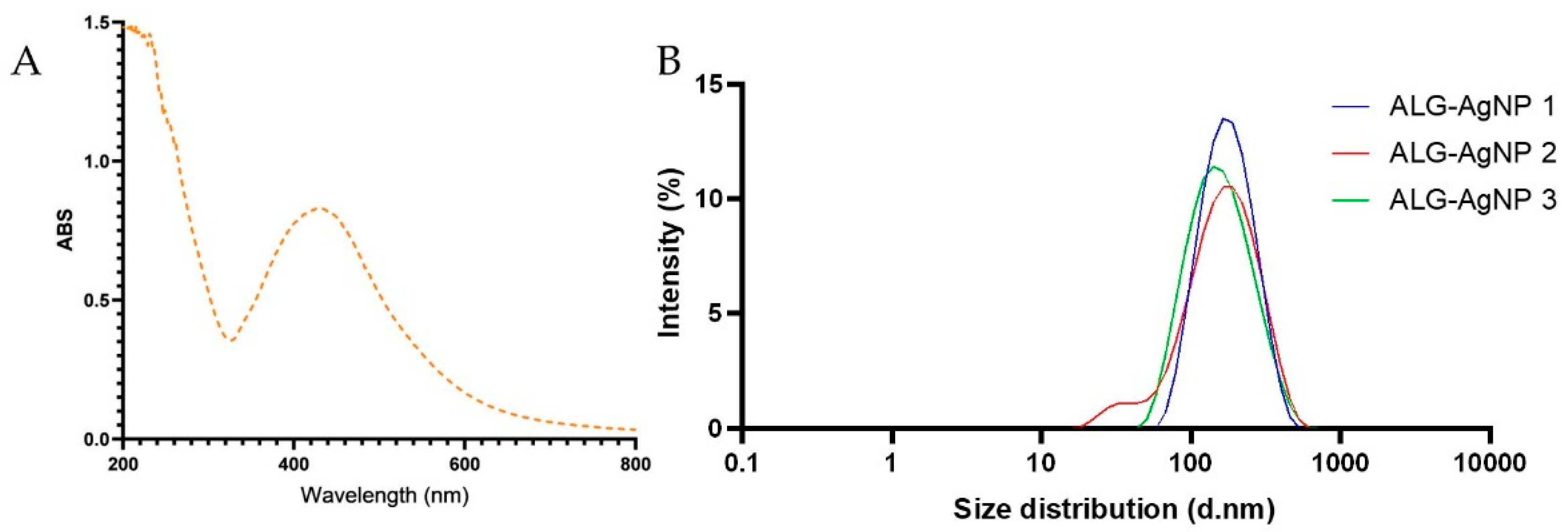
The UV-Vis spectrum confirmed the obtention of ALG-AgNPs due to the SPR around 410 nm (Figure 2A). SPR is an optical phenomenon that is characteristic of metallic nanoparticles [24]. Incident photons excite oscillations of the conduction electrons on the surface of the nanoparticles when the light energy matches the nanoparticles’ resonance energy. These oscillations generate an electric field on the surface that can exceed the incident light, inducing strong absorption, and are responsible for the observed coloration [25].
DLS measurements of ALG-AgNPs (Figure 2B) revealed that the average hydrodynamic size, PDI, and zeta potential were (126 ± 9) nm, 0.3, and −50 mV, respectively. The negative zeta potential indicated the presence of an electrically charged ligand on the particle surface, corresponding to ALG, a negatively charged polyelectrolyte. The larger hydrodynamic size of ALG-AgNP compared to that of AgNP reported by other authors [26] is also indicative of ALG coating, as ALG is a hydrophilic polysaccharide. On the other hand, the high negative value of the zeta potential could contribute to the colloidal stability of ALG-AgNP, forming a monodisperse colloidal suspension.

3.2. PEM Characterization

3.2.1. ATR-FTIR Spectroscopy

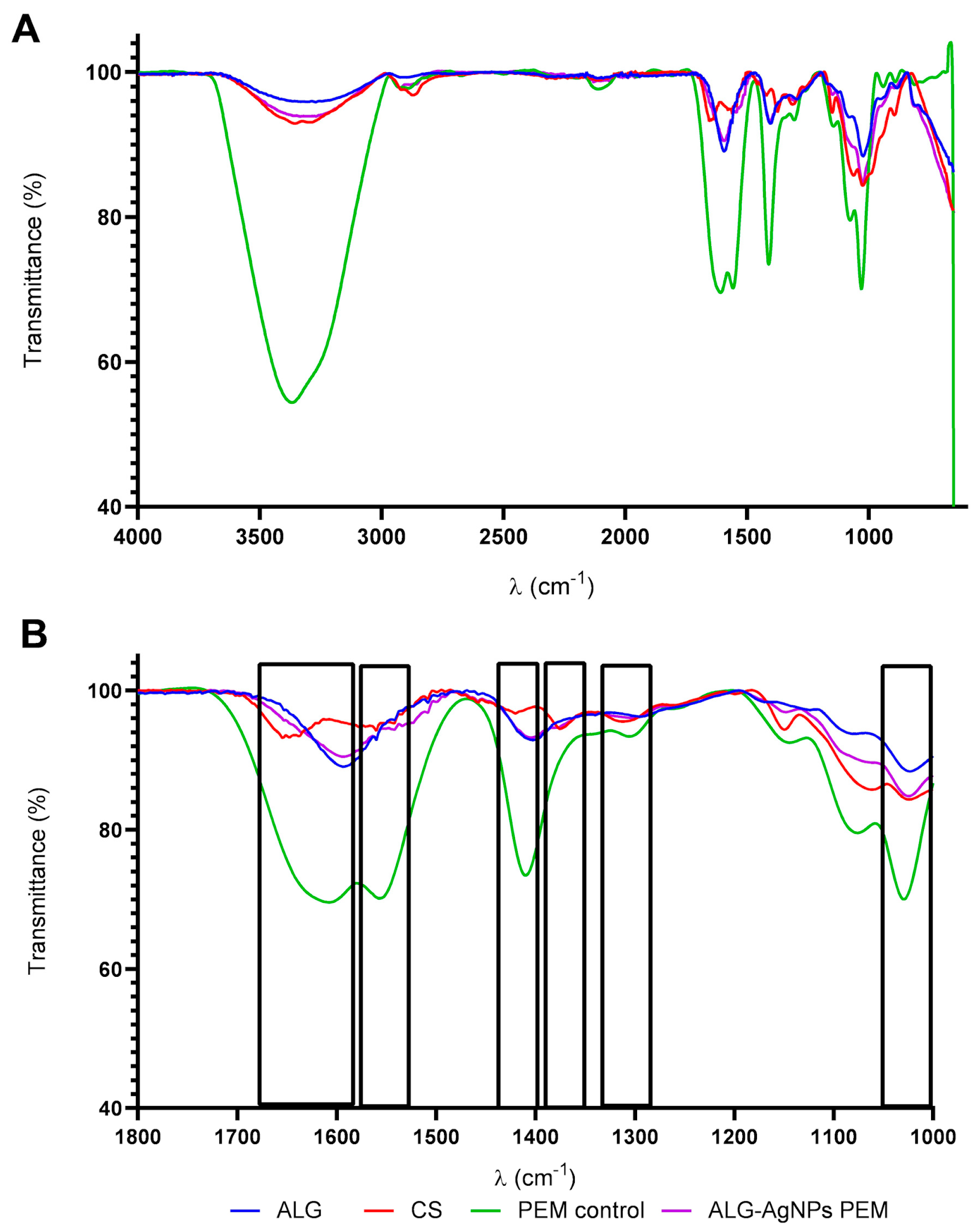
Figure 3 shows the ATR-FTIR spectra of chitosan (CS), sodium alginate (ALG), the control polyelectrolyte multilayer (PEM; ALG/CS), AgNP-loaded PEM (ALG-AgNP PEM), and alginate-coated AgNPs (ALG-AgNPs). These spectra were analysed to elucidate the intermolecular interactions and structural modifications within the assembled systems.
To improve spectral resolution and ensure accurate band assignment, all spectra were deconvoluted using FTIR-ATR in the 600–4000 cm−1 range. The deconvoluted spectra are shown in Figures S1–S5 (see Supplementary Materials). This approach resolved overlapping bands and facilitated a more reliable interpretation of functional group contributions.
As shown in Figure 3, the spectrum of pure chitosan exhibited a broad band in the 3200–3400 cm−1 region, which corresponds to overlapping O–H and N–H stretching vibrations. Following deconvolution (Figure S1), the band observed at around 1590–1605 cm−1 was attributed to the bending of protonated amine groups (–NH3+), and the band at approximately 1520–1550 cm−1 was attributed to amide II vibrations. These findings are consistent with previous reports [27].
The sodium alginate spectrum (Figure 3) displayed characteristic absorption bands at 1595–1600 and 1410–1445 cm−1, which correspond to the asymmetric and symmetric stretching vibrations of the carboxylate (–COO) groups, respectively [28]. A broad band centered at 3200–3400 cm−1 was attributed to O–H stretching vibrations [29]. The deconvolution shown in Figure S2 clearly differentiates the contributions of the asymmetric and symmetric carboxylate groups.
In the control PEM (ALG/CS), shifts in the bands to approximately 1603 cm−1 and 1538 cm−1 were observed (see Figure 3). Deconvolution (Figure S3) confirmed that the band near 1603 cm−1 is primarily associated with the asymmetric stretching of alginate carboxylate groups. In contrast, the band at 1538 cm−1 corresponds to contributions from protonated amine groups and amide II of chitosan. These shifts provide strong evidence of electrostatic interactions between the +NH3 groups of chitosan and the −COO groups of alginate, thereby confirming the formation of a polyelectrolyte complex [30].
For the AgNP-loaded PEM (Figure 3), subtle shifts in the bands were detected compared with the control PEM. Deconvolution (Figure S4) revealed weak features in the 1770–1859 cm−1 region. These bands may reflect alterations in the carbonyl chemical environment or possible coordination interactions between silver species and oxygen atoms from alginate carboxylate groups. However, due to a lack of consensus in the literature regarding strong absorptions in this region for comparable metal–polysaccharide systems, this assignment is tentative and requires confirmation using complementary analytical techniques, such as XPS.
Bands at 1533 and 1596 cm−1 were observed in alginate-coated AgNPs (Figure 3). Deconvolution (see Figure S5) confirmed that these bands are associated with alginate carboxylate groups interacting with the nanoparticle surface. After deconvolution, a weak band at 1982 cm−1 was resolved and may correspond to overtone or combination vibrations. However, its precise origin cannot be established with certainty from ATR-FTIR data and should therefore be interpreted cautiously.
Overall, the spectral modifications observed in Figure 3 and supported by the deconvoluted spectra in Figures S1–S5 confirm the electrostatic assembly of multilayers between alginate and chitosan. They also suggest interactions involving the adsorption of alginate functional groups onto silver nanoparticles. The main absorption bands and their assignments are summarized in Table 2.

3.2.2. Scanning Electron Microscopy (SEM) and Atomic Force Microscopy (AFM)

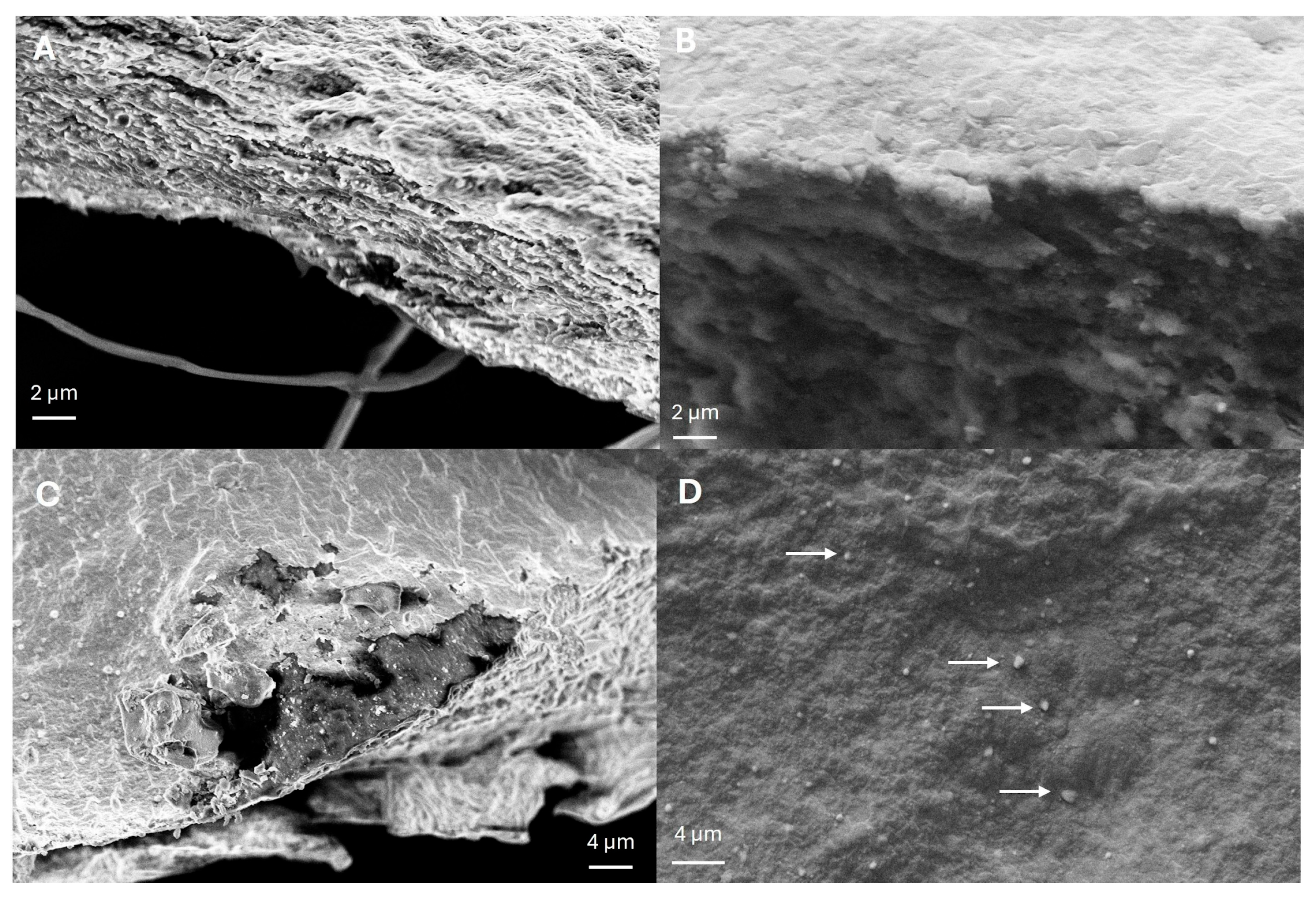
The surface morphology and cross-sectional view of the ALG-AgNP PEM were studied by SEM images (Figure 4).
The surface shows roughness and a homogeneous distribution of ALG-AgNPs, visible as white dots (Figure 4A,D). In the cross-section, the layered structures that form the PEM, the ALG-AgNPs distributed between layers, and the presence of pores and free spaces can be observed. These characteristics are highly relevant in tissue regeneration. In particular, the porous and hydrated structure of polyelectrolyte multilayers enhances their ability to absorb wound exudate and maintain a moist environment favorable for healing [31]. Additionally, surface roughness has been reported to influence cell adhesion and proliferation by modulating surface–cell interactions [32].
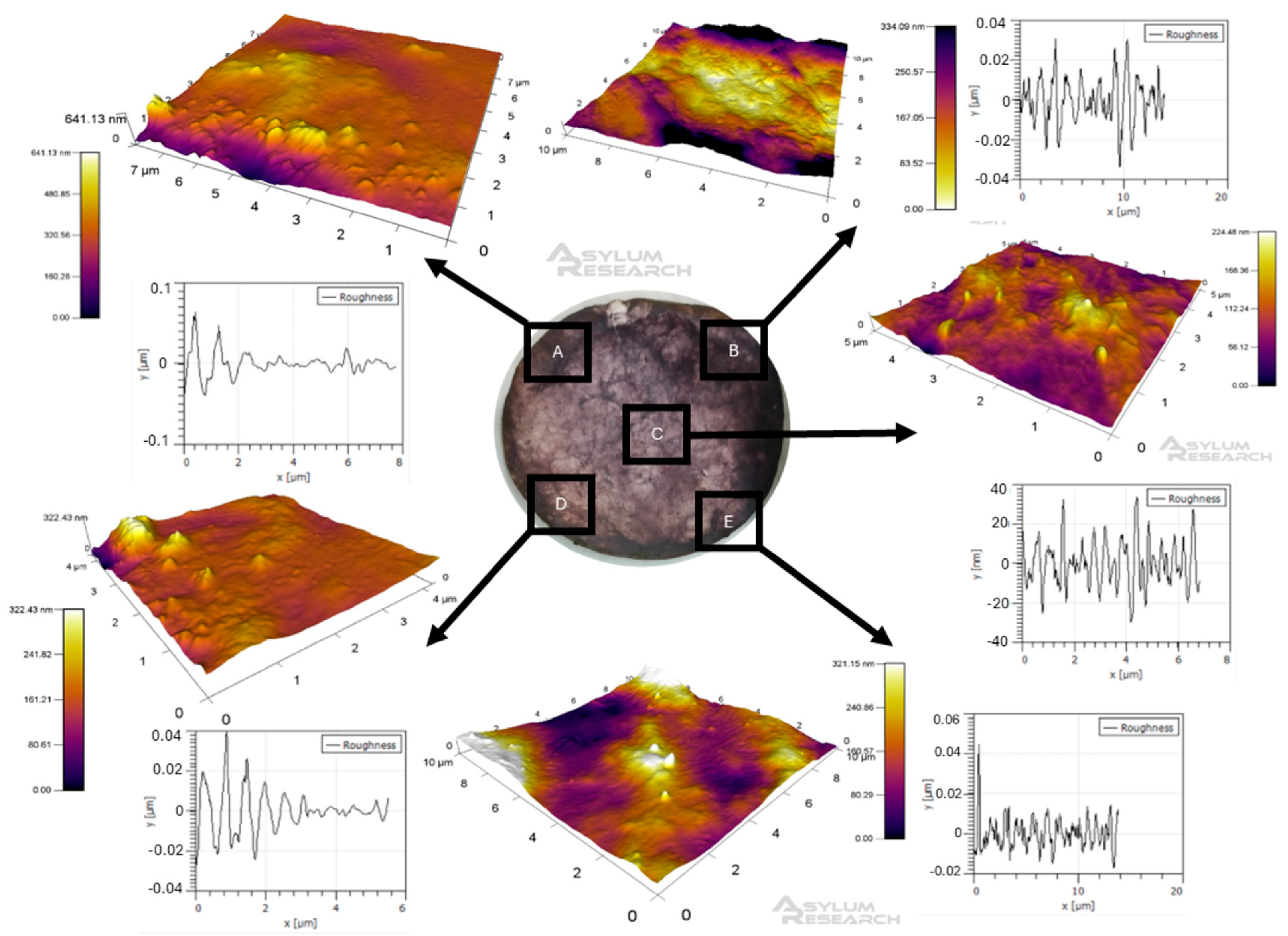
To further support the SEM observations, AFM analysis was performed on different regions of the film to quantify surface roughness and assess homogeneity (Figure 5). The average roughness (Ra) and root mean square roughness (Rq) were 6.9 ± 1.8 nm and 8.7 ± 2.4 nm, respectively (n = 5). The coefficients of variation (Ra = 26.9%, Rq = 28.2%) indicate moderate nanoscale heterogeneity due to the presence of AgNPs, which are detectable by AFM but not by SEM. These results correlate well with the SEM micrographs (Figure 4), which reveal a continuous and compact surface with well-distributed nanoparticles (indicated by arrows).
Together, the SEM and AFM analyses provide complementary information that supports our claims regarding the film’s surface uniformity and nanoparticle dispersion.

3.2.3. Wettability and Swelling Degree

In biomaterials for wound regeneration, surface hydrophilicity is a highly relevant characteristic due to its relationship with bacterial and cellular adhesion, as well as swelling characteristics.
The hydrophilicity of a material’s surface influences its ability to capture and retain liquids, as well as to facilitate cellular and bacterial contact and adhesion [33,34]. The latter is highly relevant, as antibacterial activity is strongly correlated with the hydrophilicity of the films’ surface [35].
Table 3 shows the water contact angles (WCAs) for the ALG-AgNP PEM and the PEM control films, both of which are less than 90°, indicating hydrophilicity [36]. This information corroborates that the outer layer of the films is composed of ALG, which contains -COOH and -OH functional groups that form hydrogen bonds with water, in contrast to CS, which contains nonpolar acetyl amide groups [17]. The incorporation of ALG-AgNPs into the PEM did not introduce significant changes in the hydrophilicity of the PEM.
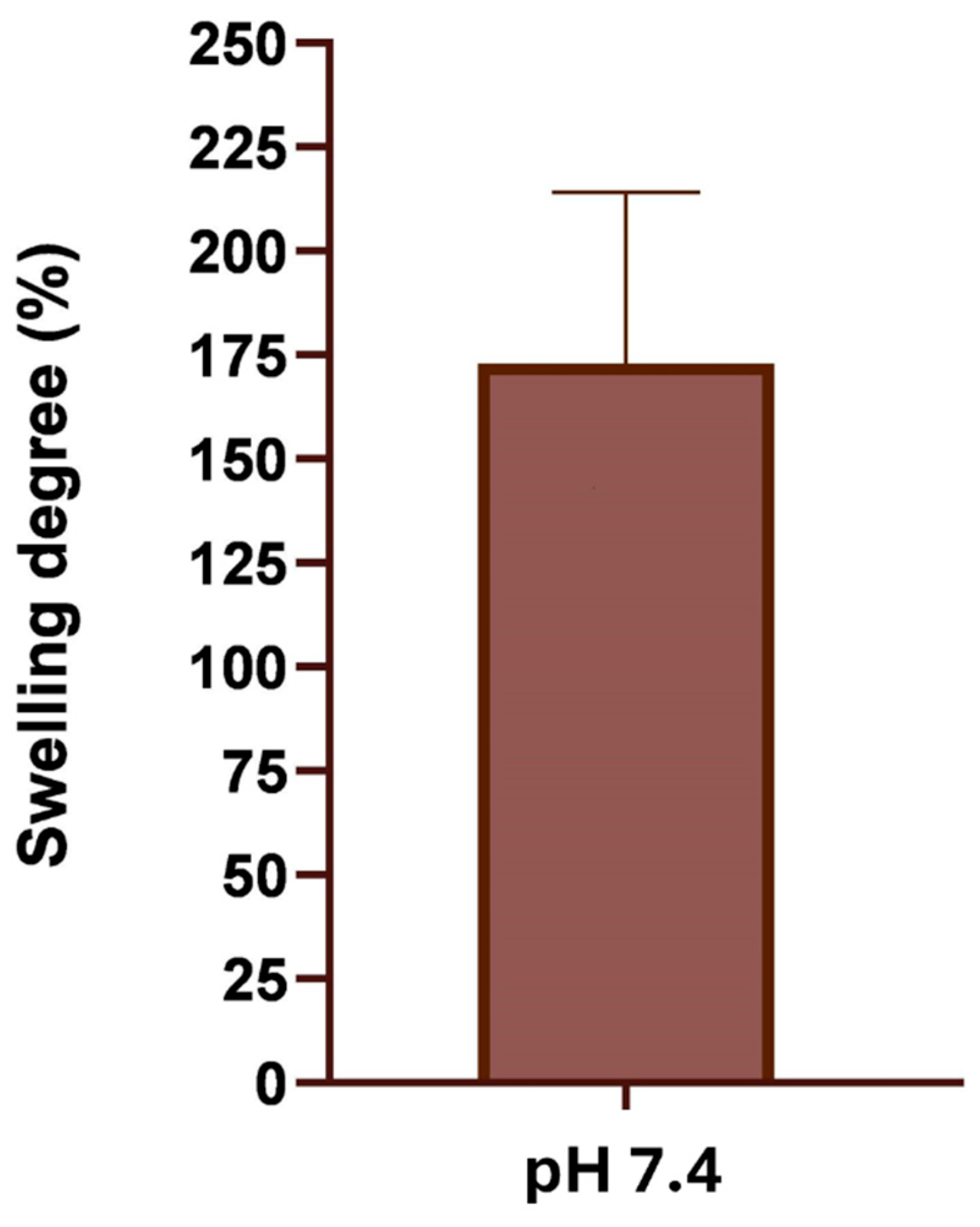
Closely related to hydrophilicity is the degree of film swelling, since if the matrix has a higher affinity for water molecules, it will be easier to retain them. The swelling degree of the ALG-AgNP PEM films was determined by measuring the change in their mass after incubation in PBS at pH 7.4 at room temperature for 2 h.
Figure 6 shows that the ALG-AgNP PEM film reached a swelling value of ~175%, which confirms the affinity for water and suggests that the PEM could absorb wound fluid, which is a desirable feature because an ideal wound scaffold should be able to absorb wound fluid and generate a moist environment to promote wound healing [37]. Excessive wound exudate often leads to severe infections and prolonged nonhealing [38].

3.3. Thermal Analysis

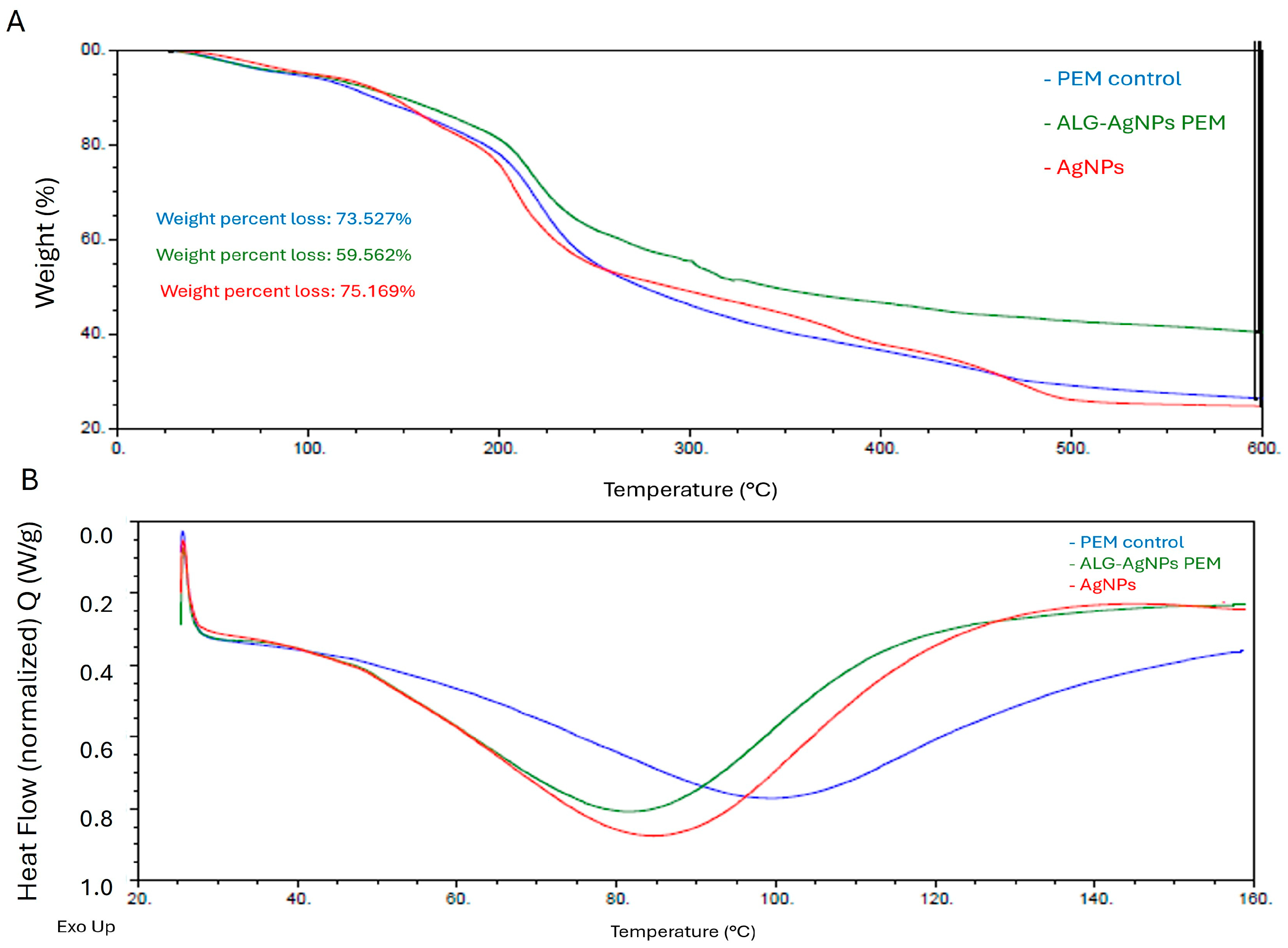
Figure 7 shows the thermal degradation patterns of the ALG-AgNP PEM and PEM control. In the TG curves of both PEMs (Figure 7A), a weight loss was observed between 60 and 120 °C, attributed to the loss of moisture content from the samples. However, the percentage of moisture loss was slightly higher in the PEM without ALG-AgNPs (10.899%) compared to the ALG-AgNPs-loaded PEM (7.549%). Also, as can be seen from the DSC curves in Figure 7B, the dehydration temperature of the PEM loaded with ALG-AgNPs was higher than that of the control PEM. This may be due to water exiting more difficultly due to greater crosslinking or structural rigidity. This is because the AgNPs act as anchoring points between the chitosan and alginate chains, strengthening the polymeric network. Figure 7B shows that the dehydration temperature of the ALG-AgNPs DSC curve is higher than that of both PEMs, with or without AgNPs. This can be attributed to interactions between alginate and AgNPs, which modify water retention in the polymeric layer and polymer mobility through interactions between functional groups and the silver surface. The –COO and –OH groups of the alginate can form ionic or dipole-metal bonds with the Ag0 atoms on the surface. This reduces the mobility of the polymer chains and reinforces the structure, making it more difficult to release trapped water, or ‘structural’ water, which has higher binding energy. This is because water can be retained more strongly by the functional groups close to the nanoparticles, and more energy is required to evaporate it (i.e., a higher temperature is needed). Alternatively, the dispersion of AgNPs within the polymer can create a barrier effect, making the diffusion of water vapor difficult.
The thermal degradation observed between 190 and 600 °C (Figure 7A) was ascribed to the thermal degradation of both PEMs, with the mass loss slightly higher (53.198%) in the ALG-AgNPs-loaded PEM compared to the PEM without ALG-AgNPs (50.418%). Neither PEM was completely degraded at 600 °C, with ~40–50% of the PEM mass remaining at 600 °C. The similarity in the degradation profiles of the two PEMs suggests that ALG-AgNPs did not affect the thermal stability of the PEM.

3.4. Silver Release Profiles and In Vitro Degradation Studies

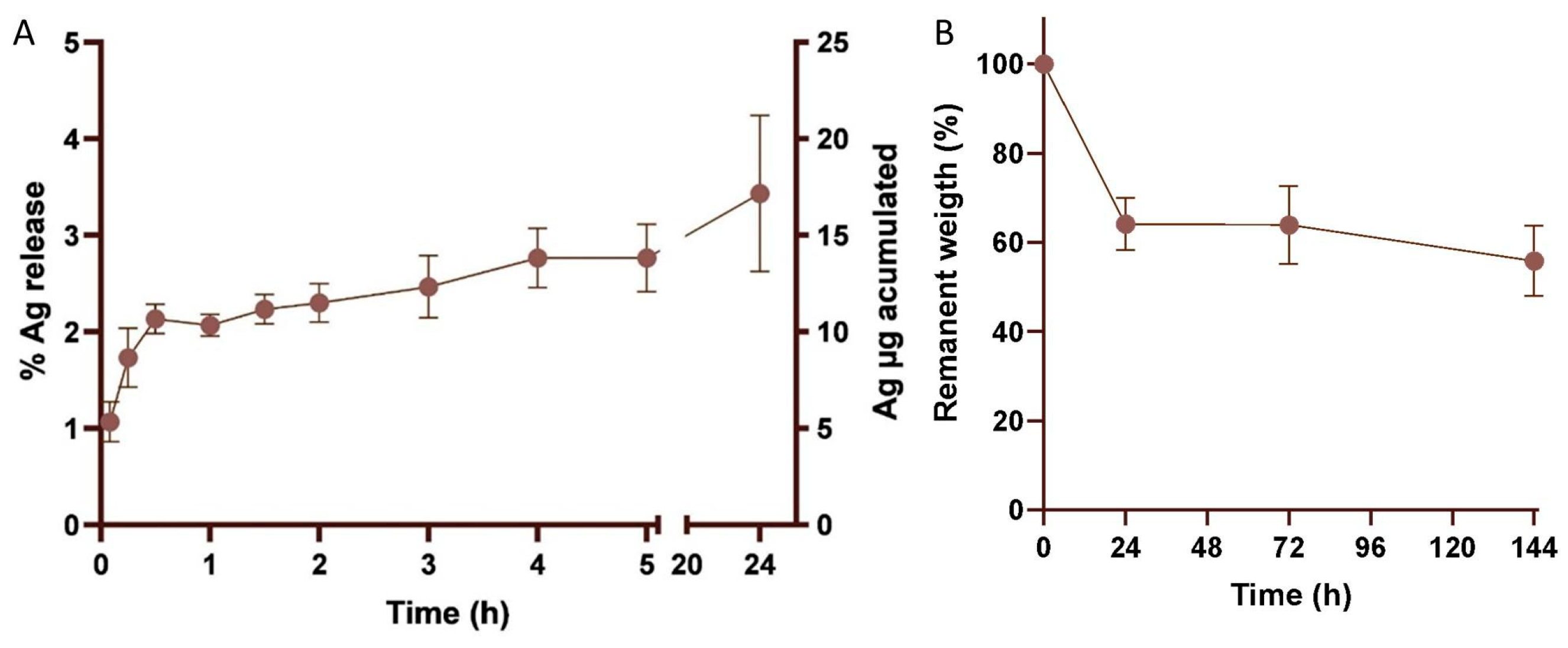
The release profile of silver ions (Ag+) in PBS (pH 7.4) at room temperature was investigated. As shown in Figure 8A, approximately 3% of the total Ag+ contained in the ALG-AgNP PEM was released after 24 h. The release profile was fitted to three mathematical models, Higuchi, Hixon–Crowell, and Korsmeyer–Peppas, to analyze the release mechanism of Ag+ from the film [39]. As shown in Table 4, the best fit for Ag+ release profile was with the Korsmeyer–Peppas model (R2 = 0.970). In this model, the diffusion exponent (n) defines the release mechanism of the active molecule. In this case, the value of n was lower than 0.5, indicating a predominantly Fickian diffusion-controlled release mechanism, as described by the Korsmeyer–Peppas model for hydrophilic polymeric systems [40,41].
On the other hand, the in vitro degradation kinetics of the film in PBS buffer pH 7.4 were determined by evaluating mass loss over time. Figure 8B shows a ~35% decrease in the film’s initial mass within the first 24 h, followed by a gradual loss, reaching a total of 40% after 6 days. The initial degradation observed can be correlated with the initial positive slope observed in the release profile. This may be due to the more superficial ALG-AgNPs being more easily released from the matrix by film degradation, followed by a swelling-driven release mechanism [42].

3.5. Water Vapor Transmission Rate (WVTR) Determination

The WVTR is an important parameter for assessing the suitability of the wound microenvironment for wound healing and susceptibility to infection. If this parameter is too high, the exudate will evaporate rapidly, leading to moisture loss and scarring, whereas a low WVTR value, on the other hand, leads to exudate accumulation and increased risk of bacterial growth, causing patient pain, reduced fibroblast proliferation, and granulation tissue formation. For healthy skin, first-degree wounds, and granulated wounds (i.e., in the healing process), WVTR values of 200, 300, and 5000 g/m2 day, respectively, have been reported. Based on this, an optimal WVTR value for dressings is estimated to be between 2000 and 2500 g/m2 [43,44,45]. For ALG-AgNP PEM, the measured WVTR was 1830 ± 60 g/m2/day, which is close to the optimal WVTR for dressing.

3.6. Evaluation of In-Vitro Cytocompatibility

In vitro cytocompatibility of ALG-AgNP PEM and PEM control was investigated with Normal Human Dermal Fibroblast (NHDF), Normal Human Dermal Keratinocytes (NHDK), and Macrophages (Mϕ), differentiated from THP-1, which were selected because they are the main cell types involved in the initial stages of wound healing and immune response in the skin [46]. Cellular viability was defined as the number of live cells relative to the control (cell group without treatment). The negative cytotoxicity control was cell medium, and the positive control was lysis buffer.
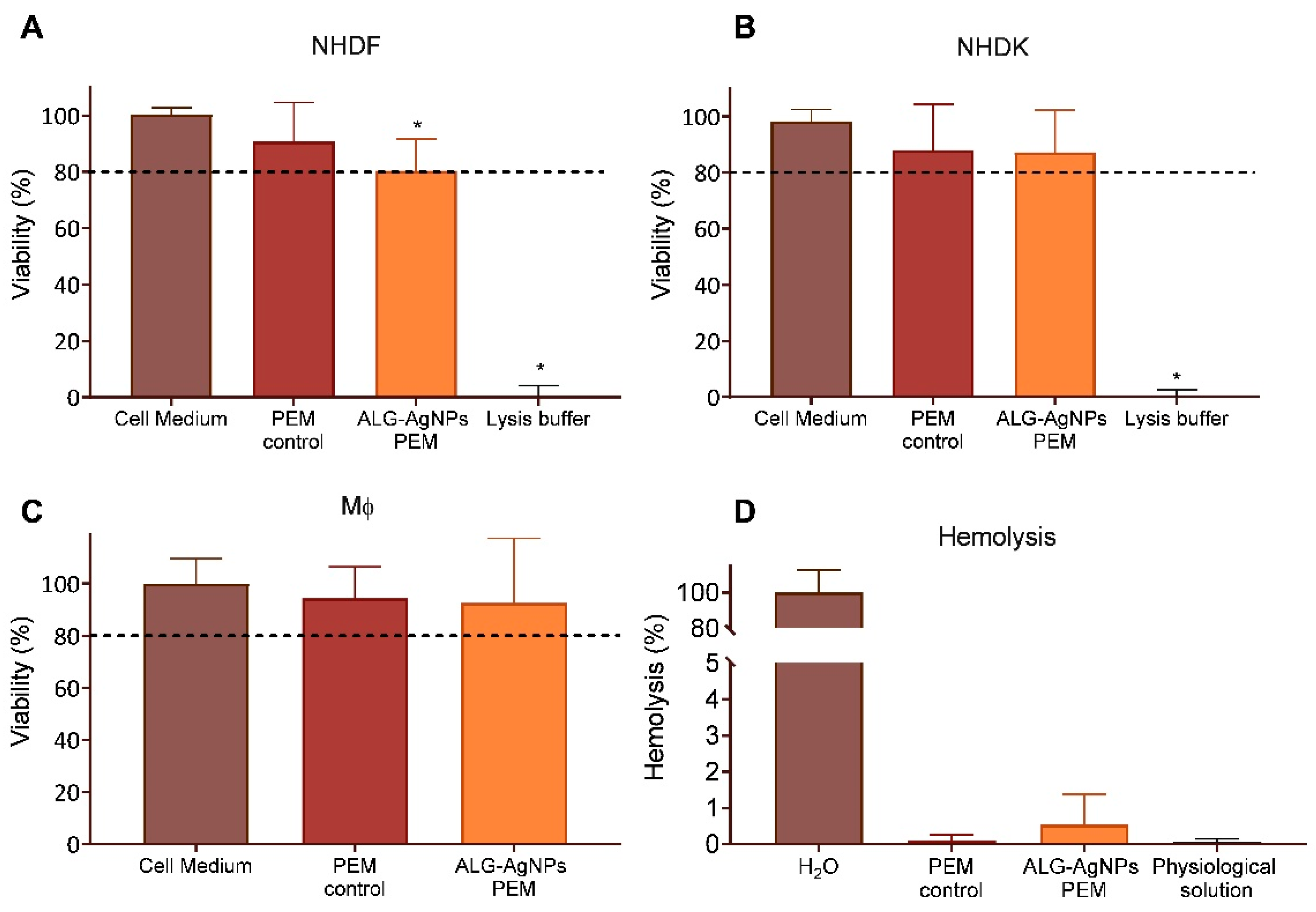
Figure 9 shows the cell viability percentages, with values over 80% across all cell types, allowing us to conclude that the films are cytocompatible with NHDF, NHDK, and Mϕ in in vitro studies.
Additionally, when evaluating the cytocompatibility of materials, it is crucial to assess their hemocompatibility. In this study, hemolysis of human RBCs was determined. Figure 9D shows the hemolysis percentages measured after exposing the RBCs to the films, which showed a hemolysis rate of less than 2% in comparison to the positive control of hemolytic activity determined with distilled water, indicating that the films can be considered hemocompatible according to the values suggested in the ASTM F756-00-200 [21]. On the other hand, the negative control using physiological solution showed no hemolytic activity.

3.7. Antibacterial Activity of ALG-AgNP PEM

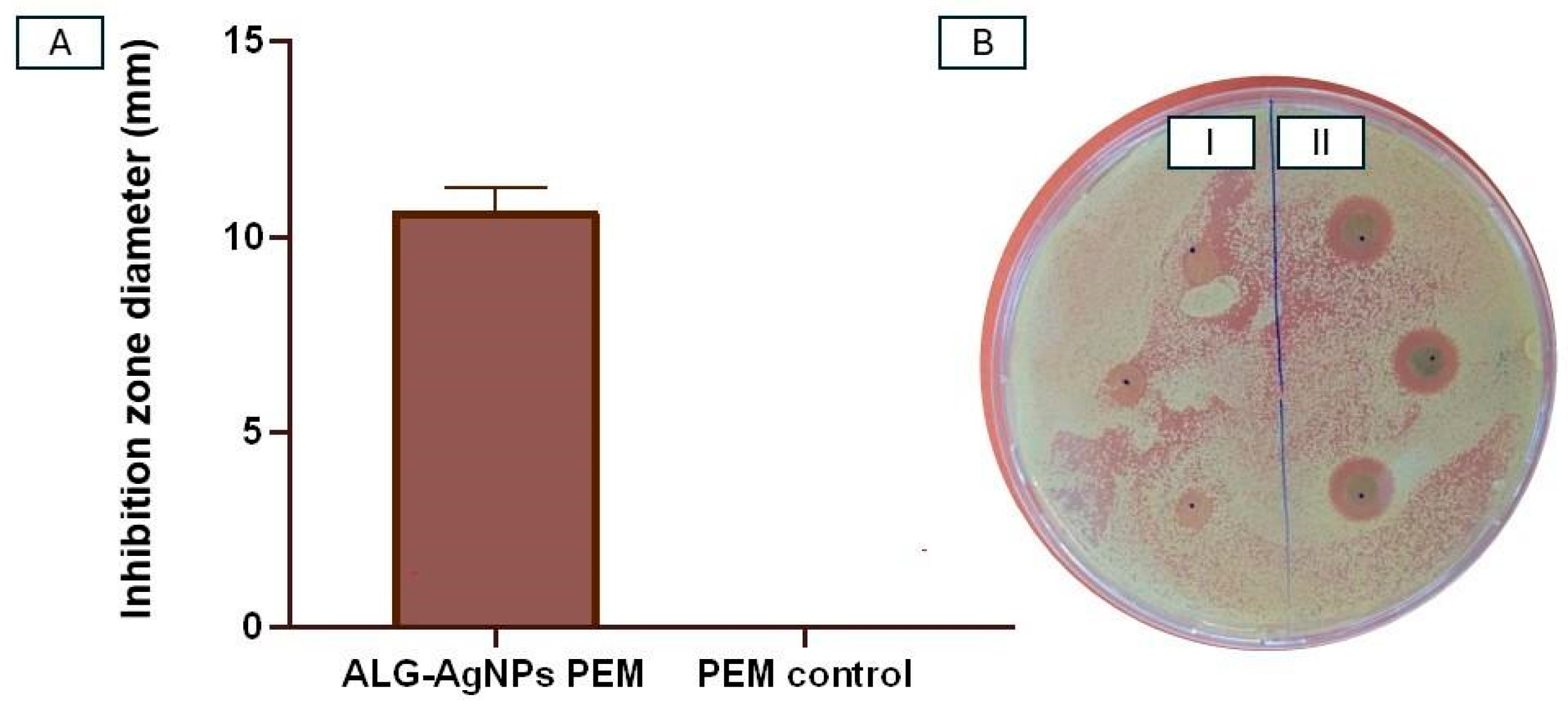
The antibacterial activity of PEM containing Ag-NPs was evaluated and compared with that of PEM. Figure 10 shows the results of the agar disk diffusion assay, which evaluated the films’ ability to inhibit S. aureus growth on agar culture plates. The inhibition zone diameters were (11 ± 1) mm for ALG-AgNP PEM discs, highlighting the inhibition of bacterial growth caused by AgNP incorporation into the film, since PEM films did not produce an inhibition zone.
Table 5 shows the effects of the evaluated PEM films on the bacterial viability of planktonic cells and the inhibition of bacterial adhesion to them. The incubation of the ALG-AgNP PEM film caused a five orders of magnitude decrease in the viable planktonic bacteria compared to the PEM control. The bacterial adhesion on the ALG-AgNP PEM film was significantly reduced compared to the PEM film. These results highlight the excellent antibacterial behavior of ALG-AAgNP PEM which affects bacterial viability in contact media and minimizes bacterial adhesion to them, thanks to the incorporation of AgNPs.

3.8. Immunological Response

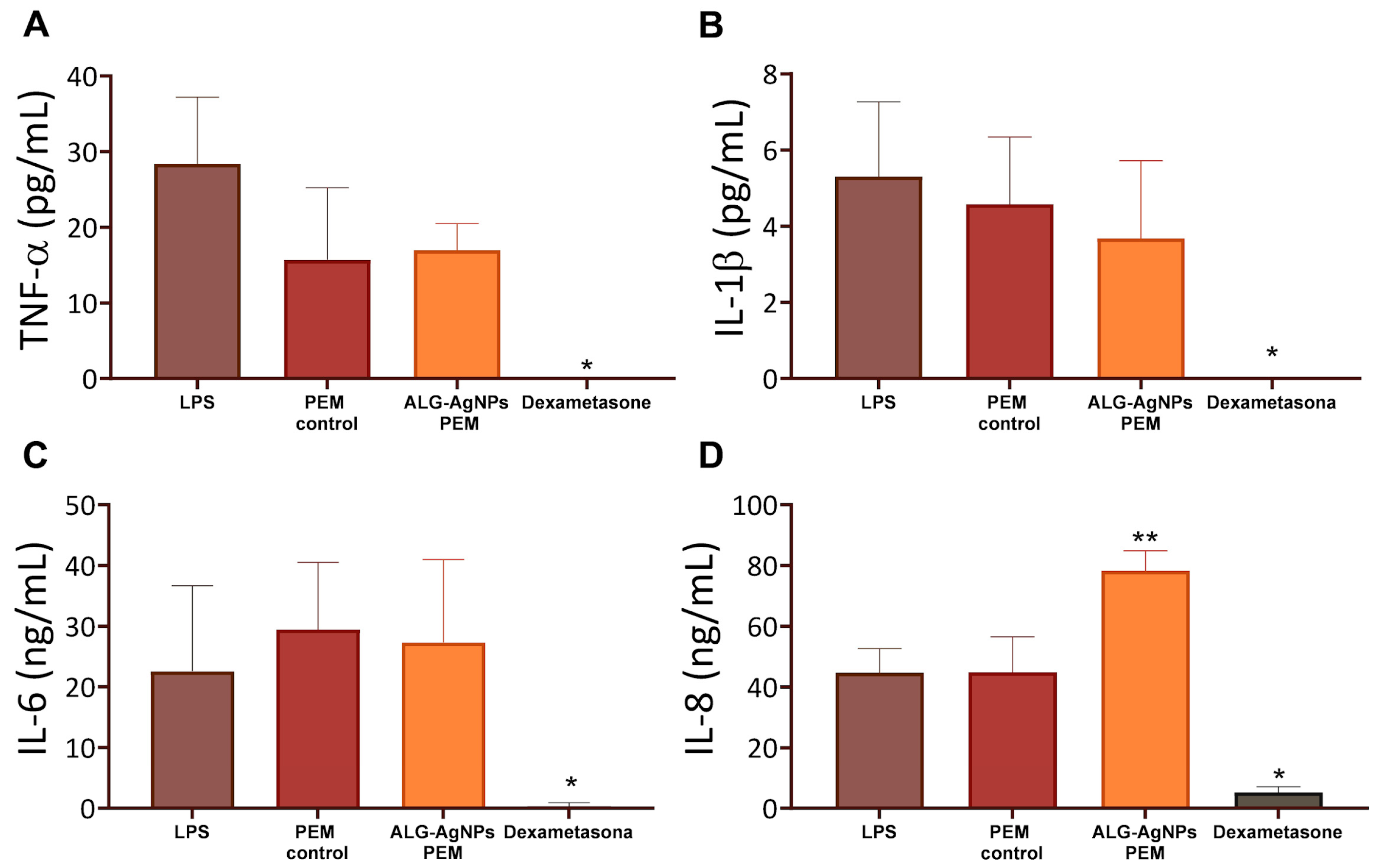
The performance of PEMs in modulating the immune response during the early pro-inflammatory stage of wound healing was investigated in vitro. To achieve this, the concentrations of pro-inflammatory cytokines TNF-α, IL-1β, IL-6, and IL-8 were measured in the supernatants of co-cultures of NHDF and Mϕ stimulated with LPS, after 24 h of treatment with the films (Figure 11). Stimulation of the cultures with LPS generates activated macrophages with a pro-inflammatory phenotype (M1) that secrete pro-inflammatory cytokines, which were quantified using the sandwich ELISA technique [47].
The concentrations of TNF-α and IL-1β tended to decrease when the co-cultures were treated with the films compared with LPS-stimulated co-culture cells without treatment (control group), although the results did not reach statistical significance. This lack of significance is likely due to the use of primary cells from human donors, which often results in substantial variability between samples, leading to fluctuations in results [48,49]. This result suggests that, even without incorporating ALG-AgNPs, the polymer matrix may be able to reduce these inflammatory mediators. Both cytokines are associated with wound chronicity, mainly by causing the infiltration of inflammatory cells into the area. Therefore, decreasing their concentrations is crucial for ensuring proper wound resolution without the formation of scars or new pathologies at the treated site [50,51,52]. The reduction in these mediators could be explained by a shift in macrophage polarization due to the physical properties of the films, such as porosity and surface topography [53]. These physical properties may lead to changes in cellular adhesion, cytoskeletal organization, integrin behavior, and intracellular signaling pathways, thereby promoting a phenotypic shift from pro-inflammatory (M1) to anti-inflammatory (M2) macrophages [54]. Okamoto et al. [55] reported that surface stiffness, via mechanotransduction mechanisms, modulates macrophage polarization, activation, and function. They found that a soft substrate, compared with a rigid one, attenuated the pro-inflammatory activity of LPS-activated THP-1 cells. Blakney et al. [56] reported that a poly(ethylene glycol)-based hydrogel with a stiffness value of 1.3 × 10² kPa shifted LPS-stimulated macrophages to a wound-healing phenotype more quickly than macrophages on stiffer substrates with stiffness values of 2.4 × 10² and 8.4 × 10² kPa, respectively. In our study, ALG-AgNP PEM exhibited puncture elongation (EP) and puncture strength (PS) values of (7 ± 1)% and (3.4 ± 0.3) × 102 kPa, respectively, whereas the control PEM showed values of EP and PS of (4 ± 14)% and (2.4 ± 0.5) × 102 kPa. Additionally, the Young modulus for ALG-AgNPs PEM and the control PEM was (1.4 ± 0.2) × 102 kPa and (1.5 ± 0.1) × 102 kPa, respectively. Considering the stiffness of the developed PEMs, they can be considered “soft” materials, with a substrate stiffness close to the softest hydrogel reported by Blakney et al. [56]. Therefore, it could be hypothesized that the films exhibited optimal stiffness, promoting a favorable immune response.
For IL-6, cytokine concentrations in co-cultures treated with the PEMs were higher than in untreated cells. This phenomenon should be considered positive, as IL-6 acts as both a pro-inflammatory and an anti-inflammatory cytokine [57]. Additionally, fibroblasts have been reported to promote IL-10 production by macrophages through an IL-6-mediated mechanism [58].
Finally, regarding IL-8, the ALG-AgNP PEM group showed a higher concentration than the control and PEM control groups, which had similar concentrations. Therefore, the increase in this cytokine could be attributed to the presence of ALG-AgNPs in the film. Lim et al. [59] proposed a relationship between AgNP size and IL-8 induction, in which only AgNPs smaller than 100 nm could stimulate IL-8 release in macrophages. Our ALG-AgNPs had an average hydrodynamic size of 125.8 ± 9.5 nm measured by DLS, but the size values obtained by DLS are expected to be larger than the actual size due to interference from the ALG coating the AgNPs.
Depending on their size, AgNPs can enter cells and interact with mitochondria, leading to oxidative stress and increased production of reactive oxygen species (ROS). Several studies have demonstrated that intracellular AgNPs promote ROS generation and oxidative damage, thereby triggering inflammatory signaling pathways.
Silver nanoparticles have been widely reported to induce oxidative stress-mediated cytotoxicity in mammalian systems. Increased intracellular reactive oxygen species (ROS) generation, apoptosis, and genotoxic effects have been described in various in vitro and in vivo models following AgNP exposure [60,61]. These findings highlight the importance of controlling silver release kinetics in biomedical coatings to minimize potential cytotoxic effects.
Silver nanoparticle-induced inflammatory responses have been associated with ROS-dependent signaling pathways. In human macrophages, AgNP exposure has been shown to stimulate IL-8 production, which can be attenuated by antioxidant treatment (e.g., N-acetylcysteine), supporting a ROS-mediated mechanism [62]. These findings further emphasize the importance of modulating silver release in biomedical coatings to balance antimicrobial efficacy and inflammatory response. It is important to note that IL-8 plays a crucial role in recruiting leukocytes, such as neutrophils, during acute inflammation.
The results suggest a favorable immune response characterized by modulation of the inflammatory profile and a tendency towards a pro-regenerative environment.
While the decrease in TNF-α and IL-1β was not statistically significant, the direction of the changes, alongside the controlled increases in IL-6 and IL-8, suggests that the films—especially those containing ALG-AgNPs—do not induce an adverse inflammatory response, but rather promote a balanced immune response that is compatible with healing and osseointegration.
In summary, the immune response elicited by the films can be considered positive (anti-inflammatory and pro-regenerative), as the materials reduce pro-inflammatory cytokines (TNF-α and IL-1β) while favorably modulating IL-6 and IL-8. There are no signs of chronic inflammation or adverse reactions.

3.9. In Vitro Wound Healing

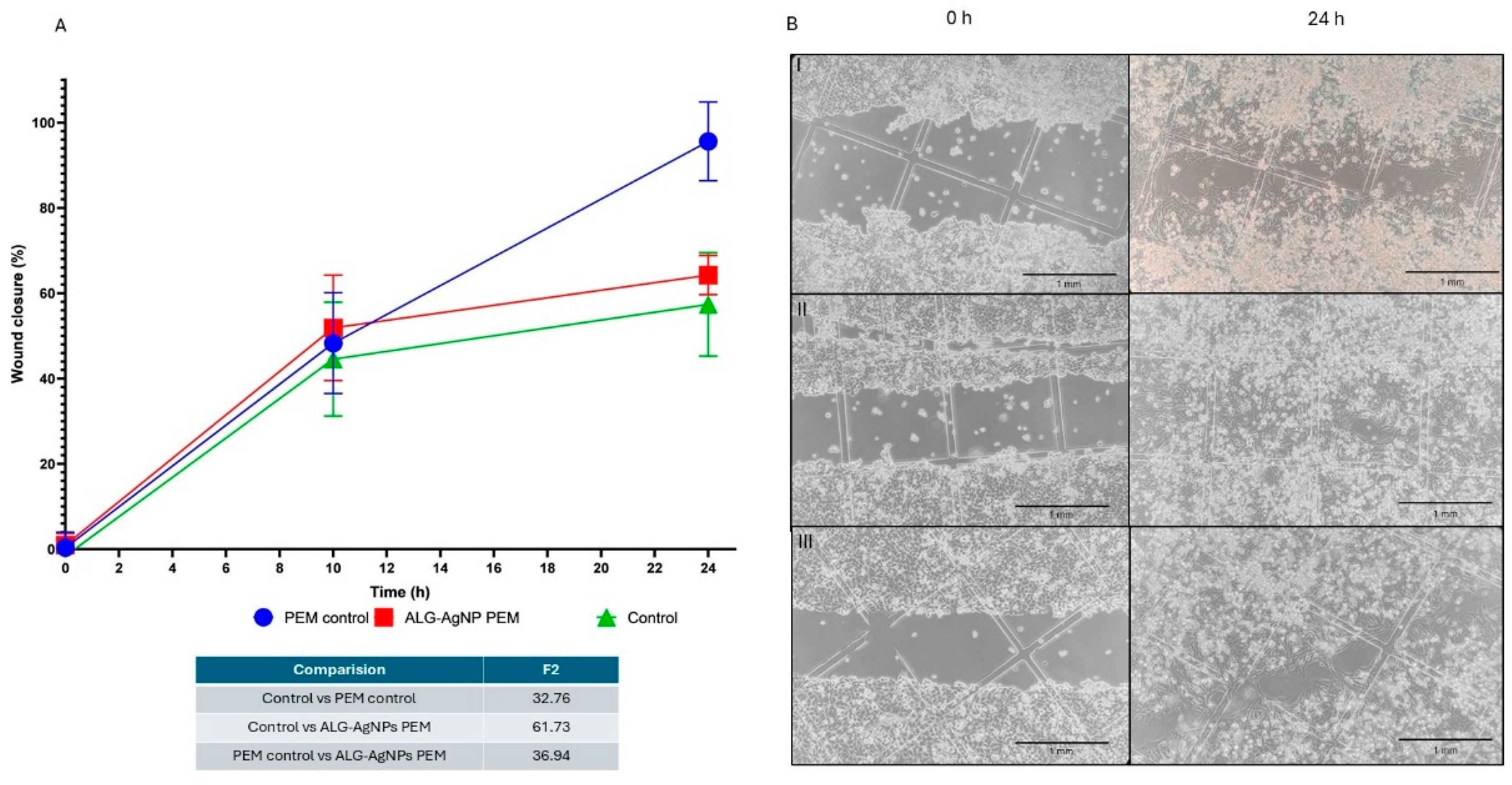
To evaluate the PEMs’ response during the wound-healing process, in vitro scratch assays were performed in co-cultures of L929/RAW264.5 cells, stimulated with LPS to more closely simulate an inflamed wound. Fibroblasts and macrophages are known to participate in local inflammation, cell recruitment, and fibrosis, communicating with each other through mediators such as cytokines, chemokines, and growth factors [63].
Figure 12A shows the wound closure percentage curve over time, while Figure 12B presents photographs of the cuts at the initial time and after 24 h. For ALG-AgNP PEM, the wound closure percentage at 24 h was slightly higher than that of the control group (co-cultures stimulated with LPS without treatment), although no statistical differences were observed when evaluating their F2 values. F2 values between 50 and 100 indicate that the curves are not statistically different.
On the other hand, when evaluating the PEM control, a significant improvement in wound closure was observed compared to both the ALG-AgNP-loaded film and the control, with nearly 100% closure achieved at 24 h. It has been reported that materials composed of a combination of CS and ALG facilitate tissue remodeling by promoting fibroblast proliferation and extracellular matrix synthesis, leading to increased collagen synthesis and fiber compaction [64,65].
The reduced migration in the ALG-AgNP PEM compared to the PEM control could be attributed to a slight decrease in fibroblast viability (Figure 12A). On the other hand, Vieira et al. [66] reported that AgNPs reduce fibroblast migration by increasing cell adhesion. Nevertheless, it is important to emphasize that films loaded with ALG-AgNPs do not show decreased wound closure compared to the control and can prevent bacterial proliferation in the wound. Therefore, loading with nanoparticles remains beneficial despite this difference with the pure matrix.

4. Conclusions

In this study, multilayer alginate/chitosan (ALG/CS) films incorporating alginate-coated silver nanoparticles (ALG–AgNPs) were successfully fabricated by electrostatic layer-by-layer self-assembly. The chemical stability of the PEM films was mainly attributed to ionic crosslinking between the protonated amino groups of chitosan (–NH3+) and the carboxylate groups of alginate (–COO), which maintained the structural integrity of the films under near-neutral conditions. In the ALG–AgNP-loaded PEM, additional stabilization occurred through Ag–O–C coordination bonds between AgNPs and alginate functional groups (–COO and –OH), enhancing crosslinking, rigidity, and water resistance, as confirmed by DSC and ATR-FTIR analyses.
The ALG–AgNP-loaded PEM showed a slower degradation rate than the control film, demonstrating improved structural stability. Moreover, the films exhibited excellent cytocompatibility with fibroblasts, keratinocytes, macrophages, and red blood cells, as well as suitable physicochemical properties for wound healing, including hydrophilicity, surface roughness, and fluid-retention capacity. The materials also showed a tendency to reduce pro-inflammatory cytokine secretion and promoted wound closure comparable to or superior to that of the control.
Overall, these findings demonstrate that the developed ALG/CS–AgNP multilayer films possess a balanced combination of antibacterial activity, biocompatibility, and immunomodulatory behavior, highlighting their strong potential as biomedical scaffolds for the treatment and regeneration of infected skin wounds

Supplementary Materials

The following supporting information can be downloaded at: https://www.mdpi.com/article/10.3390/polysaccharides7010034/s1, Figure S1: ATR-FTIR spectral deconvolution of chitosan (CS) in the wavenumber region 600–4000 cm−1 using Gaussian peak fitting. The red curve represents the fitted spectrum obtained after deconvolution, allowing identification of the main vibrational bands associated with chitosan functional groups; Figure S2: ATR-FTIR spectral deconvolution of sodium alginate (ALG) in the wavenumber region 600–4000 cm−1 using Gaussian peak fitting. The red curve represents the fitted spectrum, highlighting the principal absorption bands corresponding to alginate functional groups; Figure S3: ATR-FTIR spectral deconvolution of the control polyelectrolyte multilayer (ALG/CS PEM) in the wavenumber region 600–4000 cm−1 using Gaussian peak fitting. The fitted spectrum (red) highlights spectral shifts associated with electrostatic interactions between alginate (–COO) and chitosan (–NH3+); Figure S4: ATR-FTIR spectral deconvolution of the AgNP-loaded polyelectrolyte multilayer film (ALG/CS–AgNPs PEM) in the wavenumber region 600–4000 cm−1 using Gaussian peak fitting. The fitted spectrum (red) highlights spectral changes associated with the incorporation of silver nanoparticles within the multilayer structure. Figure S5: ATR-FTIR spectral deconvolution of alginate-capped silver nanoparticles (ALG-AgNPs) in the wavenumber region 600–4000 cm−1 using Gaussian peak fitting. The fitted spectrum (red) allows visualization of characteristic bands related to alginate functional groups interacting with the nanoparticle surface; Table S1: Peak positions obtained from Gaussian deconvolution of ATR-FTIR spectra and vibrational band assignments.

Author Contributions

N.A.U.: Investigation, Formal analysis, Methodology, Writing—original draft; R.O.: Investigation, Formal analysis, review & editing; P.S.: Formal analysis, Funding acquisition; L.V.: Formal analysis, Methodology, Resources; J.C.B.A.: Investigation, Formal analysis; C.G.: Methodology; D.C.: Funding acquisition, Resources, Supervision; G.E.G.: Conceptualization, Funding acquisition, Methodology, Resources, Supervision, Visualization, Writing—original draft. All authors have read and agreed to the published version of the manuscript.

Funding

The Authors acknowledge Consejo Nacional de Investigaciones Científicas y Técnicas (CONICET), Secretaría de Ciencia y Técnica-Universidad Nacional de Córdoba (SECyT-UNC), and Fondo para la Investigación Científica y Tecnológica (FONCYT) for providing the financing and facilitating this study. N. Usseglio thanks the Deutscher Akademischer Austauschdienst (DAAD) for funding the research internship in Alexiev’s group at the Freie Universität Berlin. We also acknowledge support from H2020 Marie Skłodowska-Curie Actions (H2020-MSCA-IF-2019), grant ID 896904 (P.S. and U.A.), and from the German Research Foundation (DFG, SFB 1449 project ID 431232613, A04 to U.A.).

Data Availability Statement

The data supporting this research are available upon request from the authors.

Acknowledgments

The Authors acknowledge Laboratorio de Microscopía Electrónica y Análisis (LAMARX FAMAF, UNC) for SEM images. We particularly thank Marcelo Romero for the contact angle goniometer. N. Usseglio acknowledges the University of A Coruña for the 10% contribution toward publication fees and for supporting the AFM studies.

Conflicts of Interest

There are no conflicts of interest to declare.

Abbreviations

The following abbreviations are used in this manuscript:
AgNPsSilver nanoparticles
PEMPolyelectrolyte multilayer
CSChitosan
ALGSodium alginate
ALG-AgNPsAlginate-coated silver nanoparticles
LbLLayer-by-layer

References

  1. Hu, D.; Wen, J.; Zhao, X.; Liu, K.; Zhang, Y.; Bu, Y.; Wang, K. A Wound-Friendly Antibacterial Hyaluronic Acid Dressing with on-Demand Removability for Infected Wound Healing. Biomater. Res. 2023, 27, 38. [Google Scholar] [CrossRef]
  2. Li, W.; Xie, H.; Gou, L.; Zhou, Y.; Wang, H.; Li, R.; Zhang, Y.; Liu, S.; Liu, J.; Lu, Y.; et al. DNA-Based Hydrogels with Multidrug Sequential Release for Promoting Diabetic Wound Regeneration. JACS Au 2023, 3, 2597–2608. [Google Scholar] [CrossRef]
  3. Hatlen, T.J.; Miller, L.G. Staphylococcal Skin and Soft Tissue Infections. Infect. Dis. Clin. N. Am. 2021, 35, 81–105. [Google Scholar] [CrossRef] [PubMed]
  4. Chudobova, D.; Nejdl, L.; Gumulec, J.; Krystofova, O.; Rodrigo, M.A.M.; Kynicky, J.; Ruttkay-Nedecky, B.; Kopel, P.; Babula, P.; Adam, V.; et al. Complexes of Silver(I) Ions and Silver Phosphate Nanoparticles with Hyaluronic Acid and/or Chitosan as Promising Antimicrobial Agents for Vascular Grafts. Int. J. Mol. Sci. 2013, 14, 13592–13614. [Google Scholar] [CrossRef]
  5. Sukdeb, P.; Kyung, T.Y.; Myong, S.J. Does the Antibacterial Activity of Silver Nanoparticles Depend on the Shape of the Nanoparticle? A Study of the Gram-Negative Bacterium Escherichia Coli. Appl. Environ. Microbiol. 2007, 73, 1712–1720. [Google Scholar] [CrossRef]
  6. Rai, M.; Yadav, A.; Gade, A. Silver Nanoparticles as a New Generation of Antimicrobials. Biotechnol. Adv. 2009, 27, 76–83. [Google Scholar] [CrossRef] [PubMed]
  7. Wang, Y.; Wu, Y.; Long, L.; Yang, L.; Fu, D.; Hu, C.; Kong, Q.; Wang, Y. Inflammation-Responsive Drug-Loaded Hydrogels with Sequential Hemostasis, Antibacterial, and Anti-Inflammatory Behavior for Chronically Infected Diabetic Wound Treatment. ACS Appl. Mater. Interfaces 2021, 13, 33584–33599. [Google Scholar] [CrossRef]
  8. Morena, A.G.; Stefanov, I.; Ivanova, K.; Pérez-Rafael, S.; Sánchez-Soto, M.; Tzanov, T. Antibacterial Polyurethane Foams with Incorporated Lignin-Capped Silver Nanoparticles for Chronic Wound Treatment. Ind. Eng. Chem. Res. 2020, 59, 4504–4514. [Google Scholar] [CrossRef]
  9. Tomar, S.; Pandey, R.; Surya, P.; Verma, R.; Mathur, R.; Gangenahalli, G.; Singh, S. Multifunctional, Adhesive, and PDA-Coated Bioactive Glass Reinforced Composite Hydrogel for Regenerative Wound Healing. ACS Biomater. Sci. Eng. 2023, 9, 1520–1540. [Google Scholar] [CrossRef] [PubMed]
  10. Sharifi, S.; Hajipour, M.J.; Gould, L.; Mahmoudi, M. Nanomedicine in Healing Chronic Wounds: Opportunities and Challenges. Mol. Pharm. 2021, 18, 550–575. [Google Scholar] [CrossRef]
  11. Geng, H.; Chen, M.; Guo, C.; Wang, W.; Chen, D. Marine Polysaccharides: Biological Activities and Applications in Drug Delivery Systems. Carbohydr. Res. 2024, 538, 109071. [Google Scholar] [CrossRef]
  12. Jeong, H.; Park, K.; Yoo, J.C.; Hong, J. Structural Heterogeneity in Polymeric Nitric Oxide Donor Nanoblended Coatings for Controlled Release Behaviors. RSC Adv. 2018, 8, 38792–38800. [Google Scholar] [CrossRef]
  13. Filippov, M.P.; Kohn, R. Determination of Composition of Alginates by Infrared Spectroscopic Method. Chem. Zvesti 1974, 28, 817–819. [Google Scholar]
  14. Lavertu, M.; Xia, Z.; Serreqi, A.N.; Berrada, M.; Rodrigues, A.; Wang, D.; Buschmann, M.D.; Gupta, A. A Validated 1H NMR Method for the Determination of the Degree of Deacetylation of Chitosan. J. Pharm. Biomed. Anal. 2003, 32, 1149–1158. [Google Scholar] [CrossRef]
  15. Domszya, J.G.; Roberts, G.A.F. Evaluation of Infrared Spectroscopic Techniques for Analysing Chitosan. Die Makromol. Chem. Macromol. Chem. Phys. 1985, 1677, 1671–1677. [Google Scholar] [CrossRef]
  16. Panda, S.K.; Chakraborti, S.; Basu, R.N. Size and Shape Dependences of the Colloidal Silver Nanoparticles on the Light Sources in Photo-Mediated Citrate Reduction Technique. Bull. Mater. Sci. 2018, 41, 90. [Google Scholar] [CrossRef]
  17. Onnainty, R.; Usseglio, N.; Bonafé Allende, J.C.; Granero, G.E. Exploring a New Free-Standing Polyelectrolyte (PEM) Thin Film as a Predictive Tool for Drug-Mucin Interactions: Insights on Drug Transport through Mucosal Surfaces. Int. J. Pharm. 2021, 604, 120764. [Google Scholar] [CrossRef]
  18. Radebaugh, G.W.; Murtha, J.L.; Julian, T.N.; Bondi, J.N. Methods for Evaluating the Puncture and Shear Properties of Pharmaceutical Polymeric Films. Int. J. Pharm. 1988, 45, 39–46. [Google Scholar] [CrossRef]
  19. Wu, S.; Chen, J.; Pan, S. Optimization of Fermentation Conditions for the Production of Pullulan by a New Strain of Aureobasidium Pullulans Isolated from Sea Mud and Its Characterization. Carbohydr. Polym. 2012, 87, 1696–1700. [Google Scholar] [CrossRef]
  20. Khorasani, M.T.; Joorabloo, A.; Adeli, H.; Mansoori-Moghadam, Z.; Moghaddam, A. Design and Optimization of Process Parameters of Polyvinyl (Alcohol)/Chitosan/Nano Zinc Oxide Hydrogels as Wound Healing Materials. Carbohydr. Polym. 2019, 207, 542–554. [Google Scholar] [CrossRef] [PubMed]
  21. ASTM F756-17; Standard Practice for Assessment of Hemolytic Properties of Materials. Annual Book of ASTM Standards R25; ASTM International: West Conshohocken, PA, USA, 2025.
  22. Grada, A.; Otero-Vinas, M.; Prieto-Castrillo, F.; Obagi, Z.; Falanga, V. Research Techniques Made Simple: Analysis of Collective Cell Migration Using the Wound Healing Assay. J. Investig. Dermatol. 2017, 137, e11–e16. [Google Scholar] [CrossRef] [PubMed]
  23. Stevens, R.E.; Gray, V.; Dorantes, A.; Gold, L.; Pham, L. Scientific and Regulatory Standards for Assessing Product Performance Using the Similarity Factor, F2. AAPS J. 2015, 17, 301–306. [Google Scholar] [CrossRef] [PubMed]
  24. Li, M.; Cushing, S.K.; Wu, N. Plasmon-Enhanced Optical Sensors: A Review. Analyst 2015, 140, 386–406. [Google Scholar] [CrossRef]
  25. Soliman, M.G.; del Pino, P.; Parak, W.J.; Pelaz, B. Synthesis and Surface Engineering of Gold Nanoparticles, and Their Potential Applications in Bionanotechnology. In Reference Module in Chemistry, Molecular Sciences and Chemical Engineering; Elsevier: Amsterdam, The Netherlands, 2017. [Google Scholar] [CrossRef]
  26. Vorobyev, S.A.; Novikova, G.V.; Demina, A.V.; Shidlovskiy, I.P.; Volochaev, M.N. Synthesis and Synergistic Effect of Antibacterial Composites Based on Concentrated Hydrosols of Silver Nanoparticles Combined with Cephalosporins Antibiotics. Inorg. Chem. Commun. 2022, 144, 109862. [Google Scholar] [CrossRef]
  27. Bekheit, M.M.; Nawar, N.; Addison, A.W.; Abdel-Latif, D.A.; Monier, M. Preparation and Characterization of Chitosan-Grafted-Poly(2-Amino-4,5-Pentamethylene-Thiophene-3-Carboxylic Acid N′-Acryloyl-Hydrazide) Chelating Resin for Removal of Cu(II), Co(II) and Ni(II) Metal Ions from Aqueous Solutions. Int. J. Biol. Macromol. 2011, 48, 558–565. [Google Scholar] [CrossRef]
  28. Lawrie, G.; Keen, I.; Drew, B.; Chandler-Temple, A.; Rintoul, L.; Fredericks, P.; Grøndahl, L. Interactions between Alginate and Chitosan Biopolymers Characterized Using FTIR and XPS. Biomacromolecules 2007, 8, 2533–2541. [Google Scholar] [CrossRef]
  29. Wilson, J.C.; Collins, P.M.; Klipic, Z.; Grice, I.D.; Peak, I.R. Identification of a Novel Glycosyltransferase Involved in LOS Biosynthesis of Moraxella Catarrhalis. Carbohydr. Res. 2006, 341, 2600–2606. [Google Scholar] [CrossRef]
  30. Ren, L.; Jiang, M.; Tong, J.; Bai, X.; Dong, X.; Zhou, J. Influence of Surface Esterification with Alkenyl Succinic Anhydrides on Mechanical Properties of Corn Starch Films. Carbohydr. Polym. 2010, 82, 1010–1013. [Google Scholar] [CrossRef]
  31. Sun, W.; Chen, G.; Wang, F.; Qin, Y.; Wang, Z.; Nie, J.; Ma, G. Polyelectrolyte-Complex Multilayer Membrane with Gradient Porous Structure Based on Natural Polymers for Wound Care. Carbohydr. Polym. 2018, 181, 183–190. [Google Scholar] [CrossRef]
  32. Mehrotra, S.; Lee, I.; Chan, C. Multilayer Mediated Forward and Patterned SiRNA Transfection Using Linear-PEI at Extended N/P Ratios. Acta Biomater. 2009, 5, 1474–1488. [Google Scholar] [CrossRef]
  33. Yu, B.; He, C.; Wang, W.; Ren, Y.; Yang, J.; Guo, S.; Zheng, Y.; Shi, X. Asymmetric Wettable Composite Wound Dressing Prepared by Electrospinning with Bioinspired Micropatterning Enhances Diabetic Wound Healing. ACS Appl. Bio Mater. 2020, 3, 5383–5394. [Google Scholar] [CrossRef] [PubMed]
  34. Maver, T.; Hribernik, S.; Mohan, T.; Smrke, D.M.; Maver, U.; Stana-Kleinschek, K. Functional Wound Dressing Materials with Highly Tunable Drug Release Properties. RSC Adv. 2015, 5, 77873–77884. [Google Scholar] [CrossRef]
  35. Hosseini Salekdeh, S.S.; Daemi, H.; Zare-Gachi, M.; Rajabi, S.; Bazgir, F.; Aghdami, N.; Nourbakhsh, M.S.; Baharvand, H. Assessment of the Efficacy of Tributylammonium Alginate Surface-Modified Polyurethane as an Antibacterial Elastomeric Wound Dressing for Both Noninfected and Infected Full-Thickness Wounds. ACS Appl. Mater. Interfaces 2020, 12, 3393–3406. [Google Scholar] [CrossRef]
  36. Khan, R.; Haider, S.; Khan, M.U.A.; Haider, A.; Razak, S.I.A.; Hasan, A.; Khan, R.; Wahit, M.U. Fabrication of Amine-Functionalized and Multi-Layered PAN-(TiO2)-Gelatin Nanofibrous Wound Dressing: In-Vitro Evaluation. Int. J. Biol. Macromol. 2023, 253, 127169. [Google Scholar] [CrossRef]
  37. Yang, C.; Ding, X.; Yang, C.; Shang, L.; Zhao, Y. Marine Polymers-Alginate/Chitosan Composited Microcapsules for Wound Healing. Chem. Eng. J. 2023, 456, 140886. [Google Scholar] [CrossRef]
  38. Zhang, H.; Chen, C.; Zhang, H.; Chen, G.; Wang, Y.; Zhao, Y. Janus Medical Sponge Dressings with Anisotropic Wettability for Wound Healing. Appl. Mater. Today 2021, 23, 101068. [Google Scholar] [CrossRef]
  39. 5-Mathematical Models of Drug Release. In Strategies to Modify the Drug Release from Pharmaceutical Systems; Bruschi, M.L., Ed.; Woodhead Publishing: Cambridge, UK, 2015; pp. 63–86. [Google Scholar] [CrossRef]
  40. Korsmeyer, R.W.; Gurny, R.; Doelker, E.; Buri, P.; Peppas, N.A. Mechanisms of Solute Release from Porous Hydrophilic Polymers. Int. J. Pharm. 1983, 15, 25–35. [Google Scholar] [CrossRef]
  41. Cilurzo, F.; Selmin, F.; Minghetti, P.; Gennari, C.G.M.; Demartin, F.; Montanari, L. Characterization and Physical Stability of Fast-Dissolving Microparticles Containing Nifedipine. Eur. J. Pharm. Biopharm. 2008, 68, 579–588. [Google Scholar] [CrossRef]
  42. Harting, R.; Johnston, K.; Petersen, S. Correlating in Vitro Degradation and Drug Release Kinetics of Biopolymer-Based Drug Delivery Systems. Int. J. Biobased Plast. 2019, 1, 8–21. [Google Scholar] [CrossRef]
  43. Phulmogare, G.; Rani, S.; Lodhi, S.; Patil, U.K.; Sinha, S.; Ajazuddin; Gupta, U. Fucoidan Loaded PVA/Dextran Blend Electrospun Nanofibers for the Effective Wound Healing. Int. J. Pharm. 2024, 650, 123722. [Google Scholar] [CrossRef]
  44. Khorasani, M.T.; Joorabloo, A.; Moghaddam, A.; Shamsi, H.; MansooriMoghadam, Z. Incorporation of ZnO Nanoparticles into Heparinised Polyvinyl Alcohol/Chitosan Hydrogels for Wound Dressing Application. Int. J. Biol. Macromol. 2018, 114, 1203–1215. [Google Scholar] [CrossRef] [PubMed]
  45. Morgado, P.I.; Aguiar-Ricardo, A.; Correia, I.J. Asymmetric Membranes as Ideal Wound Dressings: An Overview on Production Methods, Structure, Properties and Performance Relationship. J. Memb. Sci. 2015, 490, 139–151. [Google Scholar] [CrossRef]
  46. Watson, A.L.; Eckhart, K.E.; Wolf, M.E.; Sydlik, S.A. Hyaluronic Acid-Based Antibacterial Hydrogels for Use as Wound Dressings. ACS Appl. Bio Mater. 2022, 5, 5608–5616. [Google Scholar] [CrossRef]
  47. Li, Y.; Xu, Z.; Wang, J.; Pei, X.; Chen, J.; Wan, Q. Alginate-Based Biomaterial-Mediated Regulation of Macrophages in Bone Tissue Engineering. Int. J. Biol. Macromol. 2023, 230, 123246. [Google Scholar] [CrossRef]
  48. Gliga, A.R.; De Loma, J.; Di Bucchianico, S.; Skoglund, S.; Keshavan, S.; Odnevall Wallinder, I.; Karlsson, H.L.; Fadeel, B. Silver Nanoparticles Modulate Lipopolysaccharide-Triggered Toll-like Receptor Signaling in Immune-Competent Human Cell Lines. Nanoscale Adv. 2020, 2, 648–658. [Google Scholar] [CrossRef]
  49. Friedemann, M.; Kalbitzer, L.; Franz, S.; Moeller, S.; Schnabelrauch, M.; Simon, J.C.; Pompe, T.; Franke, K. Instructing Human Macrophage Polarization by Stiffness and Glycosaminoglycan Functionalization in 3D Collagen Networks. Adv. Healthc. Mater. 2017, 6, 1600967. [Google Scholar] [CrossRef]
  50. Nguyen, V.-L.; Truong, C.-T.; Nguyen, B.C.Q.; Vo, T.-N.V.; Dao, T.-T.; Nguyen, V.-D.; Trinh, D.-T.T.; Huynh, H.K.; Bui, C.-B. Anti-Inflammatory and Wound Healing Activities of Calophyllolide Isolated from Calophyllum Inophyllum Linn. PLoS ONE 2017, 12, e0185674. [Google Scholar] [CrossRef]
  51. Nirenjen, S.; Narayanan, J.; Tamilanban, T.; Subramaniyan, V.; Chitra, V.; Fuloria, N.K.; Wong, L.S.; Ramachawolran, G.; Sekar, M.; Gupta, G.; et al. Exploring the Contribution of Pro-Inflammatory Cytokines to Impaired Wound Healing in Diabetes. Front. Immunol. 2023, 14, 1216321. [Google Scholar] [CrossRef] [PubMed]
  52. Pellizzon, C.; Beserra, F.; Gushiken, L.F.S.; Hussni, M.F. Regulatory Mechanisms and Chemical Signaling of Mediators Involved in the Inflammatory Phase of Cutaneous Wound Healing. In Wound Healing-Current Perspectives; Dogan, K.H., Ed.; IntechOpen: London, UK, 2018. [Google Scholar] [CrossRef]
  53. Sridharan, R.; Cavanagh, B.; Cameron, A.R.; Kelly, D.J.; O’Brien, F.J. Material Stiffness Influences the Polarization State, Function and Migration Mode of Macrophages. Acta Biomater. 2019, 89, 47–59. [Google Scholar] [CrossRef]
  54. McWhorter, F.Y.; Wang, T.; Nguyen, P.; Chung, T.; Liu, W.F. Modulation of Macrophage Phenotype by Cell Shape. Proc. Natl. Acad. Sci. USA 2013, 110, 17253–17258. [Google Scholar] [CrossRef]
  55. Okamoto, T.; Takagi, Y.; Kawamoto, E.; Park, E.J.; Usuda, H.; Wada, K.; Shimaoka, M. Reduced Substrate Stiffness Promotes M2-like Macrophage Activation and Enhances Peroxisome Proliferator-Activated Receptor γ Expression. Exp. Cell Res. 2018, 367, 264–273. [Google Scholar] [CrossRef]
  56. Blakney, A.K.; Swartzlander, M.D.; Bryant, S.J. Student Award Winner in the Undergraduate Category for the Society of Biomaterials 9th World Biomaterials Congress, Chengdu, China, 1–5 June 2012: The Effects of Substrate Stiffness on the in Vitro Activation of Macrophages and in Vivo Host Response to Poly(Ethylene Glycol)-Based Hydrogels. J. Biomed. Mater. Res. A 2012, 100A, 1375–1386. [Google Scholar] [CrossRef]
  57. Bagheri-Josheghani, S.; Bakhshi, B. Formulation of Selenium Nanoparticles Encapsulated by Alginate-Chitosan for Controlled Delivery of Vibrio Cholerae LPS: A Novel Delivery System Candidate for Nanovaccine. Int. J. Biol. Macromol. 2022, 208, 494–508. [Google Scholar] [CrossRef]
  58. Hussein, H.; Kishen, A. Engineered Chitosan-Based Nanoparticles Modulate Macrophage–Periodontal Ligament Fibroblast Interactions in Biofilm-Mediated Inflammation. J. Endod. 2021, 47, 1435–1444. [Google Scholar] [CrossRef]
  59. Lim, D.-H.; Jang, J.; Kim, S.; Kang, T.; Lee, K.; Choi, I.-H. The Effects of Sub-Lethal Concentrations of Silver Nanoparticles on Inflammatory and Stress Genes in Human Macrophages Using CDNA Microarray Analysis. Biomaterials 2012, 33, 4690–4699. [Google Scholar] [CrossRef]
  60. Wijnhoven, S.W.P.; Peijnenburg, W.J.G.M.; Herberts, C.A.; Hagens, W.I.; Oomen, A.G.; Heugens, E.H.W.; Roszek, B.; Bisschops, J.; Gosens, I.; Van De Meent, D.; et al. Nano-Silver-A Review of Available Data and Knowledge Gaps in Human and Environmental Risk Assessment. Nanotoxicology 2009, 3, 109–138. [Google Scholar] [CrossRef]
  61. Jain, M.V.; Paczulla, A.M.; Klonisch, T.; Dimgba, F.N.; Rao, S.B.; Roberg, K.; Schweizer, F.; Lengerke, C.; Davoodpour, P.; Palicharla, V.R.; et al. Interconnections between Apoptotic, Autophagic and Necrotic Pathways: Implications for Cancer Therapy Development. J. Cell. Mol. Med. 2013, 17, 12–29. [Google Scholar] [CrossRef] [PubMed]
  62. Lenoir, J.; Claerhout, I.; Kestelyn, P.; Klomp, A.; Remon, J.-P.; Adriaens, E. The Slug Mucosal Irritation (SMI) Assay: Development of a Screening Tool for the Evaluation of Ocular Discomfort Caused by Shampoos. Toxicol. Vitr. 2011, 25, 1919–1925. [Google Scholar] [CrossRef] [PubMed]
  63. Zhou, G.; Loppnow, H.; Groth, T. A Macrophage/Fibroblast Co-Culture System Using a Cell Migration Chamber to Study Inflammatory Effects of Biomaterials. Acta Biomater. 2015, 26, 54–63. [Google Scholar] [CrossRef]
  64. Caetano, G.F.; Frade, M.A.C.; Andrade, T.A.M.; Leite, M.N.; Bueno, C.Z.; Moraes, Â.M.; Ribeiro-Paes, J.T. Chitosan-Alginate Membranes Accelerate Wound Healing. J. Biomed. Mater. Res. B Appl. Biomater. 2015, 103, 1013–1022. [Google Scholar] [CrossRef]
  65. Wang, L.; Khor, E.; Wee, A.; Lim, L.Y. Chitosan-Alginate PEC Membrane as a Wound Dressing: Assessment of Incisional Wound Healing. J. Biomed. Mater. Res. 2002, 63, 610–618. [Google Scholar] [CrossRef]
  66. Vieira, L.F.d.A.; Lins, M.P.; Viana, I.M.M.N.; dos Santos, J.E.; Smaniotto, S.; Reis, M.D.d.S. Metallic Nanoparticles Reduce the Migration of Human Fibroblasts in Vitro. Nanoscale Res. Lett. 2017, 12, 200. [Google Scholar] [CrossRef]
Figure 1. Scheme of the PEMs’ build-up process. The hydrophobic support was alternately immersed for 7 min in aqueous solutions of chitosan (CS) and alginate containing silver nanoparticles (ALG–AgNPs), with intermediate 1 min washes in Milli-Q water between each deposition to remove excess polymer. All steps were performed at room temperature.
Polysaccharides 07 00034 g001
Figure 2. (A) UV–Vis spectrum of ALG–AgNPs, exhibiting a distinct plasmon resonance band characteristic of silver nanoparticles embedded within the alginate matrix. (B) Dynamic light scattering (DLS) analysis of ALG–AgNP samples (1–3) showing consistent particle size distributions, confirming good colloidal stability.
Polysaccharides 07 00034 g002
Figure 3. FTIR-ATR spectra of sodium alginate (ALG), chitosan (CS), and PEM with and without ALG-AgNPs, (A) in the range of 600–4000 cm−1, and (B) an amplification zone between 1000 cm−1 and 1800 cm−1.
Polysaccharides 07 00034 g003
Figure 4. (AC) SEM images of the surface and cross-section of the ALG-AgNP PEM. (D) Shows an image of the film surface, and the arrows indicate some examples of where the ALG-AgNPs are located.
Polysaccharides 07 00034 g004
Figure 5. AFM analysis of the ALG–AgNP PEM film. The central image shows the PEM surface, with squares (AE) indicating the five regions selected for detailed AFM characterization. The corresponding 3D height maps and roughness profiles for each area are presented, revealing nanoscale variations in surface morphology consistent with the heterogeneous structure of the alginate–silver nanoparticle multilayer coating.
Polysaccharides 07 00034 g005
Figure 6. Swelling degree of ALG-AgNP PEM at 37 °C and pH 7.4.
Polysaccharides 07 00034 g006
Figure 7. Thermal behavior of PEM control, ALG–AgNP PEM, and AgNPs samples. (A) Thermogravimetric analysis (TGA) curves obtained in the temperature range of 25–600 °C at a heating rate of 10 °C min−1. (B) Differential scanning calorimetry (DSC) thermograms recorded in the temperature range of 25–160 °C (10 °C min−1).
Polysaccharides 07 00034 g007
Figure 8. (A) Silver release profile from ALG-AgNP-loaded PEM for 24 h. (B) In vitro hydrolytic degradation of ALG-AgNP PEM for 6 days.
Polysaccharides 07 00034 g008
Figure 9. In vitro viability percentages for cell types (A) NHDF, (B) NHDK, and (C) Mϕ after 24 h contact with multilayer films. Cells were treated with culture medium as a viability control and with lysis buffer as a kill control. The * indicates statistical differences (p > 0.05) with respect to the viability control. (D) Hemocompatibility of PEMs and physiological solution (non-hemolytic control). All the samples differ significantly from the hemolytic control (Water) (p > 0.05).
Polysaccharides 07 00034 g009
Figure 10. (A) Diameter of inhibition zones for ALG-AgNP PEM and PEM control. (B) Inhibition zone to S. aureus for (I) PEM control and (II) ALG-AgNP PEM.
Polysaccharides 07 00034 g010
Figure 11. Concentration of (A) TNF-α, (B) IL-1β, and (C) IL-6, (D) IL-8 after treatment with PEMs for 24 h. Cells were treated only with LPS as an inflammation control. * Means a significant difference between the dexamethasone and LPS (p < 0.05), and ** a significant difference between ALG-AgNP PEM with PEM and LPS (p < 0.001).
Polysaccharides 07 00034 g011
Figure 12. Wound healing assay. (A) Profile of wound closure at 24 h for PEM and ALG-AgNP-loaded PEM with F2 values for statistical analysis. (B) Microscopy images (10×) of wounds at initial time and 24 h for (I) Control group, (II) PEM, and (III) ALG-AgNP PEM.
Polysaccharides 07 00034 g012
Table 1. Kinetic mathematical models.
Mathematical ModelEquation *
Higuchi Q t = K h × t 0.5
Hixson–Crowell Q 1 / 3 0 = Q 1 / 3 t = K s × t
Korsmeyer–Peppas l n   l n Q t Q = l n   l n   K k + n × l n   l n   t
* t is time; Qt is the cumulative amount of drug released at time t; Q0 is the initial cumulative amount of silver released from films; Qt/Q is the fraction of silver released at time t; KH, KS, and KK are release constants for Higuchi, Hixson–Crowell, and Korsmeyer–Peppas, respectively; n is the release exponent for the Korsmeyer–Peppas models; n = 0.5 represents the Fickian diffusion, and a value of n > 0.5 represents anomalous (non-Fickian) diffusion.
Table 2. Main ATR-FTIR absorption bands identified in chitosan (CS), sodium alginate (ALG), control polyelectrolyte multilayers (PEM), AgNP-loaded PEM (ALG-AgNP PEM), and alginate-coated AgNPs (ALG-AgNPs). Band positions were determined after FTIR-ATR deconvolution (Figures S1–S5) to resolve overlapping contributions and allow accurate functional group assignment.
Wavenumber (cm−1)SampleAssignmentFunctional Group/Origin
3200–3400CS, ALGO–H/N–H stretchingHydroxyl groups and amine groups
1595–1600ALGAsymmetric stretching–COO (carboxylate)
1410–1445ALGSymmetric stretching–COO (carboxylate)
1590–1605CSN–H bendingProtonated amine (–NH3+)
1520–1550CSAmide II vibration–CONH–
~1603PEMShifted asymmetric –COOElectrostatic interaction (ALG)
~1538PEM–NH3+ bending/Amide IIChitosan contribution
1770–1859ALG-AgNP PEMWeak feature (tentative)Possible carbonyl environment modification
1533ALG-AgNPs–COO asymmetricAlginate–AgNP interaction
1596ALG-AgNPs–COO asymmetricAlginate–AgNP interaction
1982ALG-AgNPsOvertone/combination band (tentative)Not conclusively assigned
Table 3. Water contact angles of PEM films.
FilmContact Angle (θ, °)
ALG-AgNP PEM 55 ± 8
PEM control 55 ± 10
Table 4. Parameters obtained from the silver release profiles fitted to three mathematical kinetics models.
HiguchiHixon–CrowellKorsmeyer–Peppas
R2Kh (% h−1/2)R2Ks (% h−1)R2Kk (% h−n)n
0.9301.5320.857−0.0770.9702.1040.1609
Table 5. Bacterial viability and adhesion in the antibacterial evaluation of PEM films.
Viable Planktonic BacteriaAdhered Bacteria on Films
Number of
CFU/mL
Logarithmic reductionNumber of CFU/mm2Logarithmic reduction
ALG-AgNP PEM1.7 × 104 ± 1.5 × 10452.4 × 103 ± 1.7 × 10³>2
PEM control2.7 × 109 ± 1.5 × 10⁹<10
Disclaimer/Publisher’s Note: The statements, opinions and data contained in all publications are solely those of the individual author(s) and contributor(s) and not of MDPI and/or the editor(s). MDPI and/or the editor(s) disclaim responsibility for any injury to people or property resulting from any ideas, methods, instructions or products referred to in the content.