


Abstract
The valorization of agro-industrial byproducts as sources of functional polysaccharides is a promising strategy for developing sustainable materials. In this study, cellulose was extracted and purified from rice husk and apple pomace through sequential alkaline and bleaching treatments. Then it was chemically modified via TEMPO-mediated oxidation to obtain cellulose nanofibers (TOCNFs) with cellulose yields ranging from 23.8 to 32.4% for rice husk and 9.3–13.8% for apple pomace. Owing to its higher recovery and structural regularity, rice husk was selected for surface modification with 3-aminopropyltriethoxysilane (APTES). The resulting TOCNFs exhibited an average width of 8 nm and a carboxyl content of 0.48 mmol g−1. Fourier-transform infrared spectroscopy (FTIR), X-ray diffraction (XRD), and nitrogen determination (1.72 mg g−1) confirmed the presence of aminosilane functionalities. APTES-modified TOCNFs were incorporated as active components to develop hybrid poly(vinyl acetate) (PVA) adhesives synthesized via in situ heterogeneous water-based polymerization. The influence of TOCNF surface chemistry and sodium dodecyl sulfate (SDS) on latex particle size, rheological behavior, and adhesive performance was systematically investigated. Latex particle size increased from 193 nm (PVA-SDS) to 625 nm with TOCNF-APTES and decreased to 247 nm upon SDS addition. Rheological analysis revealed pronounced shear-thinning behavior associated with the formation of percolated nanofibrillar networks, with low-shear viscosity increasing up to 477 Pa·s for TOCNF–APTES and decreasing to 370 Pa·s with SDS. Lap-shear testing (ASTM D905) showed substantial improvements in adhesive strength, reaching up to 250 kPa compared to PVA-SDS. These results demonstrate that surface-modified CNFs act not only as mechanical reinforcements but also as interfacially active components governing polymerization behavior, rheology, and adhesive performance. This exploratory study provides a proof-of-concept for the development of sustainable wood adhesives from agro-industrial byproducts.
1. Introduction
The increasing generation of agro-industrial residues poses major environmental and economic challenges, particularly when inefficient processing and disposal practices lead to waste accumulation and pollution. However, these residues are rich in cellulose and represent an underutilized resource for producing high-value biobased materials. Cellulose is attractive because it is abundant, renewable, biocompatible, exhibits high aspect ratios, large surface areas, has high mechanical properties, and is easy to modify [1]. Furthermore, cellulose can be further processed into nano-sized materials, namely cellulose nanocrystals (CNCs) and cellulose nanofibers (CNFs), depending on the processing method.
A wide range of agro-industrial byproducts has been explored as feedstocks for the isolation of nanocellulose, including apple pomace [2]; beer bagasse [3], the most abundant by-product of the brewing process [4]; grape marc from red wine [5]; olive residues [6]; pear pomace [7]; pumpkin pomace [8]; rice husks [9]; and tomato pomace [10]. These materials combine high cellulose content with low economic value, making them promising substrates for developing high-performance biomaterials [11]. For instance, apple juice processing generates substantial quantities of pomace as a byproduct, accounting for 30–35% of the fruit [12], which represents a significant environmental challenge due to its high moisture content and rapid fermentability [13]. Similarly, global rice production exceeded 800 million tonnes in 2023 [14], producing approximately 160 million tonnes of rice husk annually, representing 20% of grain weight [15]. All these byproducts can be examined to produce high-value bioproducts through various processes aimed at their conversion into cellulose nanomaterials.
Several routes have been developed for producing cellulose nanofibers (CNFs), including mechanical grinding, ultrasonication, homogenization, and TEMPO-mediated oxidation [16]. Among these, TEMPO-mediated oxidation is recognized for its relative simplicity, scalability, and ability to generate nanofibers with controlled dimensions and high surface charge, which facilitates dispersion and further functionalization [17,18]. Reported TOCNF diameters typically range from 6 to 20 nm, depending on the cellulose source and processing conditions. Consequently, TEMPO-mediated oxidation stands out as an effective approach for CNF synthesis, offering a blend of operational simplicity and the introduction of anionic surface charges that enhance fiber dispersion and facilitate further functionalization [19].
The major difficulty limiting the widespread use of CNFs is their hydrophilic nature, which affects their compatibility with polymer matrices, particularly hydrophobic or partially hydrophobic systems; hence, surface modification is used to reduce their hydrophilicity [20]. Silylation is an important chemical modification process for cellulose, enabling its surface modification by incorporating hydrophobic alkyl silanes. This technique enhances cellulose’s compatibility with nonpolar matrices, distinguishing it from other modification methods. Notably, silylation employs silanol coupling agents that form covalent bonds with the hydroxyl groups present in the cellulose structure. Additionally, the silylation process is recognized for its environmentally friendly qualities, characterized by a low-waste approach that minimizes the generation of byproducts and unreacted intermediates [21]. There are several types of silylation agents, including 3-aminopropyltriethoxysilane (APTES), methacryloxypropyl-trimethoxysilane (MPS), and diethylenetriaminopropyltrimethoxysilane (TAS). Among these, APTES stands out as the most widely used option [22,23] due to its two reactive functional groups: amine and silanol. Moreover, the silane treatment using APTES is considered a green treatment [24] and has been shown to improve dispersion and mechanical performance when incorporated at the beginning of the polymerization reaction [25]. Nanocellulose has been investigated as a reinforcing additive in PVAc adhesives [26]. However, most studies rely on post-polymerization blending of CNFs into preformed latexes or polymer matrices, where nanofibers primarily act as passive mechanical fillers. These approaches often suffer from limited interfacial integration, aggregation issues, difficulties in scaling up to industrial levels, prolonged polymerization times when nanocellulose concentrations are below 1% (w/w), the formation of inhomogeneous films due to uneven dispersion of nanoparticles within the matrix, and the lack of covalent bonding between the nanocellulose and PVA [27]. More recently, dissolution-based strategies for cellulose nanomaterials have been proposed to improve molecular-level dispersion and composite homogeneity, but these approaches typically require aggressive solvents, compromise fibrillar morphology, and pose significant challenges in scalability and industrial implementation [28]. In contrast, heterogeneous water-based polymerization is a technology utilized to synthesize nanocellulose-based adhesives, involving the combination of two or more immiscible liquids, with one serving as the starting monomer for subsequent polymerization.
To the best of our knowledge, the systematic investigation of the combined use of TEMPO-oxidized and silane-functionalized CNFs derived from agro-industrial residues as active interfacial components during heterogeneous polymerization of PVAc adhesives, and the explicit correlation between CNF surface chemistry, rheological network formation, and adhesive performance, has not yet been comprehensively investigated.
Based on these considerations, this study is grounded on the hypothesis that CNFs can simultaneously serve as mechanical reinforcements and active interfacial components in wood adhesive systems. Specifically, we propose that incorporating APTES-modified CNFs promote the formation of percolated nanofibrillar networks and enhance polymer-fiber interactions during heterogeneous polymerization, thereby governing rheological behavior and adhesive strength. Furthermore, the incorporation of sodium dodecyl sulfate (SDS) is expected to primarily regulate colloidal stability and particle size distribution, enabling controlled latex formation while modulating the extent of CNF-mediated network structuring. To test these hypotheses, CNFs derived from an agro-industrial residue were functionalized with APTES and incorporated into PVAc adhesive formulations via in situ polymerization, and the resulting systems were evaluated in terms of particle morphology, rheology, and wood adhesion performance.
2. Materials and Methods
2.1. Materials
Apple pomace, beer bagasse, grape marc from red wine, olive waste, pear pomace, pumpkin pomace, rice husks, and tomato pomace were collected from various agro-industrial sources located in the Región Del Maule, Chile. Sodium bromide (NaBr, 99+%), sodium hydroxide (NaOH, 97+%), sodium chlorite (NaClO2, 80%), 2,2,6,6-Tetramethylpiperidine (TEMPO, >98%), (3-aminopropyl) triethoxysilane (APTES, 99%), vinyl acetate monomer (VAM, 99+%), sodium dodecyl sulfate (SDS), and potassium persulfate (KPS) were purchased from Sigma Aldrich (St. Louis, MO, USA) and utilized without any further purification. Prior to polymerization, VAM underwent treatment with NaOH to remove the inhibitor. The resulting monomer was then washed and subsequently stored in a flask with granular calcium chloride to remove residual moisture. This process allowed for a 24 h drying period before use. Spectroquant® Nitrogen Cell Test kits were purchased from Merck KGaA (Darmstadt, Germany) and used according to their specified analytical protocols.
2.2. Subproducts Preparation and Determination of Chemical Composition
All subproducts were thoroughly cleaned and air-dried before use and then ground to specific sizes in accordance with the prescribed methodology. To determine the chemical composition, we followed the protocols established by NREL (National Renewable Energy Laboratory, Golden, CO, USA). For ash content, we employed “Determination of Ash in Biomass” [29], for the determination of extractives, we used “Determination of Extractives in Biomass” [30], for lignin content, we used “Determination of Structural Carbohydrates and Lignin in Biomass” [31], and for alpha cellulose we used the ASTM D1103 [32] and ASTM D1104 [33] standards.
2.3. Cellulose Isolation via Alkaline Treatment and Bleaching
The process of isolating cellulose focused on subproducts that contained the highest concentrations of this valuable compound. Furthermore, this selection was made with careful consideration of the annual availability of these materials sourced from the Región del Maule in Chile, ensuring a sustainable approach to utilizing local resources. Data and information were collected systematically from national sources for review [34,35]. The alkaline treatment method was selected for cellulose isolation due to its widespread application and strong endorsement in the field for processing agricultural waste and extracting cellulose [36]. The experiment was designed to evaluate the effects of NaOH concentration, reaction time, and temperature on cellulose yield, as outlined in Table 1. Utilizing a 2k−1 experimental design, a total of four experiments were conducted to investigate the principal effects. The treatments were coded using the notation Ax-ty-Tz, where A denotes alkali concentration, t represents the reaction time, and T denotes the processing temperature. Each experiment was performed in at least three replicates.
Table 1.
Design of experiments for biomass alkaline treatment.
During the alkaline treatment, a solid-to-liquid ratio of 1:20 g/mL was utilized. Once the reaction was complete, the biomass was thoroughly washed with water until the pH neared neutral. The yield from this treatment was determined by calculating the ratio of the final dry mass to the initial dry mass and expressing it as a percentage.
The purification process involved a bleach treatment to remove residual lignin. This was accomplished through a two-step bleaching procedure that utilized a 2% (weight/volume) sodium chlorite (NaClO2) solution. The treatment was carried out for 60 min at 75 °C and pH 4.5, maintaining a solid-to-liquid ratio of 1:50 g/mL. Following the bleaching, the biomass was thoroughly washed to achieve a near-neutral pH. The yield from this bleached treatment was determined by calculating the ratio of the final dry mass to the initial dry mass and expressing it as a percentage. The cellulose content was then measured in accordance with the ASTM D 1103 and D1104 standards.
All data are presented as the mean ± standard error of the mean, along with the variation coefficient when applicable. An ANOVA was performed to compare the effect of the independent variables on yields at the 5% alpha level.
2.4. Production and Characterization of TOCNFs
The bleached biomass with the highest yield from each selected subproduct was utilized to produce cellulose nanofibers. This production involved an oxidation pretreatment with a TEMPO radical, followed by sonication. The oxidation process followed the protocol outlined by [37], with the following reaction conditions: a 1% w/v cellulose dispersion, 0.016 g of TEMPO catalyst (Sigma Aldrich, St. Louis, MO, USA) per gram of cellulose, and 0.1 g of NaBr per gram of cellulose. Sodium hypochlorite was used as the oxidizing agent, at a concentration of 5 mmol NaClO (Sigma Aldrich, St. Louis, MO, USA) per gram of cellulose. The reaction was conducted for 90 min with continuous agitation at 500 rpm and 25 °C, while the pH was carefully maintained at 10 by adding 0.5 M NaOH dropwise. Following the reaction, the resulting suspension was washed and centrifuged at 5000 rpm for 10 min until the pH of the liquid fraction approached neutral. The TEMPO-oxidized cellulose fiber suspensions were initially blended with an Ultraturrax T25 (IKA-Werke GmbH & Co. KG, Staufen, Germany) at 10,000 rpm for 6 min. Subsequently, the TEMPO-oxidized cellulose nanofibers (TOCNFs) were liberated through sonication using a Vibracell VCX750 ultrasonic processor (Sonics & Materials Inc., Newtown, CT, USA) equipped with a 13 mm stepped tip. Ultrasonication was conducted in an ice bath, employing a pulsed mode of 20 s on and 10 s off, until a cumulative ultrasonic energy output of 240,000 joules, as indicated by the instrument’s energy display, to minimize batch-to-batch variability.
The nanofibrillation yield was calculated in triplicate from the dry weights of TOCNFs suspensions before and after centrifugation at 4000 rpm for 10 min.
The surface charges of the TOCNFs from the two subproducts were measured using conductometric titration, as described previously [38]. To summarize, a 0.1% (w/v) suspension of TOCNFs was prepared in 0.01 M NaCl. While stirring with a magnetic stirrer, 0.1 M HCl was gradually added until the pH stabilized between 2.5 and 3. Then, 100 μL aliquots of 0.1 M NaOH were added every 60 s until the dispersion approached a pH value of 11. The addition of NaOH aimed to decrease conductivity and neutralize the acid. Once acid neutralization was achieved (recorded volume = V1, mL), the conductivity remained constant until the endpoint (recorded volume = V2, mL), which marked the neutralization of the carboxylic groups. After this point, further addition of NaOH increased the conductivity. The anionic charge density was calculated using Equation (1).
where C is the carboxyl group content (mmol/g sample), [NaOH] is the NaOH concentration (mol·L−1), V1 and V2 are the volumes of NaOH (mL) at the equivalence point, and w (g) is the solid weight of the TOCNF sample.
The fluidity of TOCNFS suspensions was assessed using a gravity-driven flow test at 25 °C. Briefly, 30 mL of each suspension (1 wt%) was loaded into a standard cup, and the time required for drainage was recorded with a stopwatch. Measurements were performed in triplicate following [39]. Fourier-transform infrared (FT-IR) spectroscopy was employed to assess the purity of the TOCNFs utilizing a PerkinElmer Spectrum 100 spectrometer (PerkinElmer Inc., Waltham, MA, USA) equipped with a horizontally mounted ATR device, with 32 scans collected in the mid-infrared region (4000–400 cm−1). All measurements were conducted under atmospheric pressure and at room temperature. The morphology, length, and width of the different CNFs were observed and measured using a transmission electron microscope (TEM, Libra 120 Plus, Carl Zeiss AG, Oberkochen, Germany) at 100 kV. The TOCNF samples were characterized by X-ray diffraction (XRD) using a Bruker D2 Phaser X-ray diffractometer (Bruker AXS GmbH, Karlsruhe, Germany) equipped with a Co Kα radiation source. Diffraction patterns were collected over a 2θ range of 10–40°, with a scanning speed of 0.025°/min. These measurements were conducted at atmospheric pressure and room temperature.
After characterizing the produced TOCNFs, we selected a specific feedstock based on key factors: enhanced process yield, superior structural regularity, and improved processing characteristics.
2.5. Preparation of TOCNF-Based Adhesives by In Situ Polymerization
The TOCNF surface was modified using (3-Aminopropyl)Triethoxysilane (APTES) (Sigma Aldrich, St. Louis, MO, USA) following a method reported by [23] with slight modifications. Briefly, the TOCNFs were dispersed in a 20% wt. ethanol (Sigma Aldrich, St. Louis, MO, USA) solution. In parallel, APTES was also dispersed in a 20% wt. ethanol solution, where it underwent pre-hydrolysis for 15 min at room temperature after adjusting the pH to 4 with the addition of glacial acetic acid. The TOCNF dispersion was then added to the APTES solution at a mass ratio of 1.8:1. The silylation reaction took place for 3 h at 80 °C, with continuous agitation at 800 rpm under an inert atmosphere. To separate unreacted APTES and solvent, three centrifugation washes (10,000 rpm, 20 min) were performed. The silylated TOCNF, abbreviated as TOCNF-APTES, was stored in glass containers prior to further use.
The performance of the APTES-modified TOCNF samples was evaluated qualitatively via ATR-FTIR spectroscopy, following the methodology established for the unmodified TOCNFs. Additionally, a quantitative analysis was performed to determine the nitrogen content in the modified samples using the Spectroquant® nitrogen cell tests from Merck Laboratories. The silanization reactions and the nitrogen determination were performed in triplicate.
The polymerization was performed via miniemulsion process using TOCNF-APTES in an in situ configuration. The vinyl acetate monomer (VAM) underwent purification with a 3% wt. NaOH solution to eliminate inhibitors. In a typical procedure, a 3% wt KPS aqueous solution, relative to VAM, was delivered over a 20 min interval using a syringe pump into a previously homogenized dispersion of VAM (15% w/v) and nanocellulose (5% wt based on VAM) contained in a two-neck round-bottom flask once the temperature reached 80 °C. Prior to the addition of KPS, SDS surfactant was added at a concentration of 3 mg/mL. A typical PVA adhesive was developed containing only SDS without the addition of nanocellulose. Other control groups included the polymerization of PVA-TOCNF with and without SDS. Throughout the polymerization phase, the reactor was continuously purged with nitrogen to maintain an inert atmosphere. The monomer conversion was assessed gravimetrically by oven-drying latex samples at 100 °C.
2.6. Characterizations of TOCNF-Based Adhesives
The recovery yield of latex dispersions was assessed using the gravimetric method. Initially, a known weight of the sample was placed in a container and dried at 100 °C for 24 h in a hot air oven. Once the drying process was complete, the sample was allowed to cool and then weighed again. Ultimately, the solid content of the latex was determined as the ratio of the recovered mass to the total solid mass used in the reaction. The overall monomer conversion was calculated as the ratio of the final dry mass to the initial total mass of the formulation, after subtracting the contributions of CNF, surfactant, and initiator [40].
Viscosity of the latexes was measured using a controlled-stress rheometer (Discovery HR-2, TA Instruments, New Castle, DE, USA) at 20 °C in a shear rate between 0.1 and 100 (1/s).
Particle size of the latexes was analyzed by dynamic light scattering using a Zetasizer ZS90 (Malvern Instruments Ltd., Malvern, UK). The latex particle sizes were measured after diluting the high-solid latexes at least 10-fold with deionized water.
Fourier-transform infrared (FT-IR) spectroscopy of the synthesized polymers was recorded using a PerkinElmer Spectrum 100 spectrometer (PerkinElmer Inc., Waltham, MA, USA) equipped with a horizontally mounted ATR device by scanning 32 times in the mid-infrared region (4000–400 cm−1).
Adhesion strength on wooden surfaces was measured in shear strength by complying with ASTM standard D905 [41]. For this evaluation, blocks measuring 50.8 mm in length, 44.4 mm in width, and 19 mm in thickness were cut from radiata pine (Pinus radiata) for adhesion testing. The surfaces of the pine radiata wood were thoroughly cleaned prior to the bonding process. To investigate the mechanical performance of the bonded wood specimens using PVAc adhesives containing TOCNFs and TOCNF-APTES, an Instron universal testing machine (Model 4411, Instron, Norwood, MA, USA) equipped with a 500 N load cell, was utilized. Compressive testing was conducted at a speed of 5 mm min−1, and the adhesive was applied at a density of approximately 0.05 g cm−2 to the wood surface. The bonded wood sample ensembles were maintained at ambient conditions (24 ± 1 °C and 30 ± 2% RH) for 24 h under a constant normal force of 40 N to ensure full curing. Shear strength (kPa) was determined by calculating the ratio of the maximum force at failure to the adhesive contact area. Each sample was replicated five times, and the mean values were subsequently reported.
3. Results and Discussion
3.1. Chemical Profiles and Resource Potential of Agro-Industrial Waste
The analysis of the chemical composition of the eight agro-industrial subproducts is presented in Table 2 and demonstrates significant variability across feedstocks, reflecting their diverse botanical origins and processing histories. Apple, pear, and pumpkin pomaces exhibited particularly high extractive contents, measuring 41.74%, 37.47%, and 49.80%, respectively. This indicates their rich presence of soluble compounds, including sugars, phenolics, and low-molecular-weight metabolites. In contrast, rice husks had the lowest extractive fraction at 7.47%, yet they were notable for their high lignin content (37.64%) and ash content (22.16%), which align with their well-documented recalcitrance and silica-rich nature. Among the residues studied, pear pomace and rice husks displayed the highest cellulose content at 33.81% and 30.88%, respectively. In comparison, grape marc exhibited lower cellulose levels of 10.31%, accompanied by a high lignin proportion of 35.48%. The highest lignin content was determined for tomato pomace at 45.30%. Olive waste featured high cellulose (22.78%) and lignin (25.87%) contents, along with a notably elevated ash content of 8.34%. Overall, these results underscore the heterogeneity of lignocellulosic residues and highlight the need to tailor valorization strategies to their distinct chemical profiles.
Table 2.
Chemical composition of byproducts expressed as a g/100 god.
3.2. Criteria-Based Selection of Biomass Subproducts
Following a comprehensive analysis of the chemical composition of these subproducts, two were selected for further investigation based on the following criteria: (i) cellulose content and (ii) seasonal availability within the Maule region. First, the subproducts were ranked according to their cellulose content, resulting in the following order from highest to lowest: pear pomace, rice husks, tomato pomace, olive waste, barley waste, apple pomace, pumpkin pomace, and grape marc from red wine. In terms of the second criterion, residue availability in the study area, previous studies have provided the following annual production volumes: approximately 22,000 tons of rice husk residues [34], 60,000 tons of apple residues, 27,000 tons of tomato residues, 24,000 tons of olive waste, 23,500 tons of grape marc from red wine, 36 tons of barley wastes, fewer than 5000 tons of pear residues [35], and fewer than 3000 tons of pumpkin residues [42]. As a result, integrating both criteria led to the selection of rice husk and apple pomace as subproducts for further methodological exploration. Although tomato residues are available in quantities approximately 5000 tons greater than those of rice husk, the latter was prioritized due to its higher cellulose content. Conversely, while pear pomace had the highest cellulose content among the subproducts, it was excluded due to its limited availability in the study area. As noted by [35], a significant portion of regional pear production is allocated for export, approximately 70%, with only about 10% processed by the agro-industrial sector. It is worth mentioning that the high extractive content of apple pomace (41.8%) was attributed to the presence of pectin and soluble sugars [43]. The cellulose content determined in this study was 17.5%, which has been reported to range from as low as 8% [44] to as high as 34% [45]. The lignin content was found within the range reported in the literature [43,45].
3.3. Effects of Alkaline Treatment and Purification Process
After the alkaline treatment, the yields were determined, and the results are presented in Table 3. Yields resulting from the alkaline treatment varied with both the specific byproduct and the treatment conditions. The responses of apple pomace and rice husks to alkaline treatment differed significantly, reflecting their distinct chemical compositions. It is noteworthy that the values obtained for rice husk are substantially higher than those for apple pomace, showing approximately 20% greater yield across all applied treatments.
Table 3.
Overall yields after the alkaline treatment and bleaching, expressed as a percentage.
Apple pomace, characterized by a high concentration of extractives and relatively low levels of lignin, achieved the highest yield of 27.31% under milder conditions, specifically, lower alkali concentration, extended reaction time, and elevated temperature (T4: 8% NaOH, 90 min, 80 °C). Conversely, more severe conditions (T3, involving 12% NaOH for 60 min at 80 °C) resulted in significant losses, reducing the yield to 13.98%. This decline is likely attributable to the degradation of cellulose along with the removal of hemicelluloses and soluble components. Variation in apple pomace yields can be attributed to intrinsic characteristics of this byproduct, such as the presence of secondary compounds that are easily removable under alkaline conditions. As presented in Table 2, the apple pomace contained 41.74% total extractables and 17.36% lignin. Consequently, the expected yields after alkaline treatment were anticipated to be below 30%. This expectation arises from the high concentration of extractables, which led to the alkaline treatment effectively removing most of these compounds. The statistical analysis, detailed in Appendix A, clearly identified two variables with p-values below 0.05: time and NaOH concentration. This finding confirms that both variables have a significant impact on performance outcomes.
Rice husk, characterized by higher lignin and silica content, exhibited higher yields at this stage, ranging from 35% for T2 to 57% for T3, with T3 yielding the highest yield. These values are likely influenced by the low extractive content in rice husk, as shown in Table 2. This subproduct contains only 7% total extractives and nearly 38% lignin, both of which are affected during the alkaline treatment step. This suggests that greater concentrations of NaOH and elevated temperatures are required to effectively dismantle the lignin-silica matrix and enhance cellulose recovery. In contrast, prolonged exposure to similar alkali concentrations at lower temperatures (T2) resulted in the lowest yield of 35.35%, likely due to excessive solubilization of the cell wall polysaccharides. Furthermore, both time and temperature have p-values < 0.05 (Appendix A), indicating that these factors significantly influence the observed outcomes.
These varied responses underscore the need to tailor alkaline treatment parameters to account for the unique structural and compositional traits of each residue type.
Following the alkaline treatment, the resulting pulps were subjected to a bleaching process to further remove residual lignin and enhance cellulose purity. Clear distinctions emerged between the two byproducts based on their prior alkaline treatments. For apple pomace, bleaching yields varied significantly, ranging from 46.06% (T4) to 72.93% (T1). The highest yield was achieved after the mildest alkaline conditions, indicating that a less aggressive alkaline treatment promotes better cellulose recovery during subsequent bleaching. In contrast, the lowest yield under T4 suggests that prolonged exposure to alkali at elevated temperatures may have led to excessive degradation of the polysaccharide fraction, thereby diminishing bleaching efficiency. In the case of rice husks, bleaching yields were more consistent across the treatments, ranging from 56.76% (T3) to 67.14% (T2). Interestingly, T2, which demonstrated the lowest yield after alkaline treatment, yielded the highest after bleaching. This finding suggests that moderate alkaline degradation may have facilitated delignification and enhanced cellulose retention in the subsequent step.
The overall yields, calculated as the mass fraction recovered after sequential alkaline treatment and bleaching, revealed distinct trends for apple pomace and rice husks. For apple pomace, the global recovery remained relatively low across all conditions, ranging from 9.33% (T3) to 13.79% (T1). This limitation reflects the considerable solubilization of extractives and hemicelluloses, which is typical of this residue [46]. In contrast, rice husks demonstrated notably higher overall yields, ranging from 23.80% (T2) to 32.44% (T3). This can be attributed to their more lignified and silica-rich structure, which provides enhanced resistance to degradation during processing. Interestingly, while T3 yielded the lowest overall recovery for apple pomace, it resulted in the highest recovery for rice husks, underscoring the significance of chemical composition in process optimization.
Additionally, the yield results were assessed based on the theoretical cellulose content available in the subproducts. According to Table 2, rice husks comprise 31% cellulose, which can potentially be isolated and transformed into nanomaterials. The processed yield surpassed 75%, demonstrating that over 75% of the theoretically available cellulose was recovered after all treatment stages, underscoring the effectiveness of the process in recovering and utilizing cellulose from this by-product. The maximum cellulose recovery was achieved by an alkaline treatment with 12% NaOH for 60 min at 80 °C, followed by two bleaching cycles. Additionally, an analysis of variance indicated that the time variable is the only factor that significantly influences performance, as its p-value is less than 0.05. For apple pomace, yields based on the theoretical cellulose content of this by-product were above 50%. Specifically, treatment 1 recovered nearly 76% of the theoretically available cellulose through an alkaline treatment (8% NaOH, 60 min, 70 °C) followed by two bleaching cycles. The analysis of variance revealed no significant differences. Other researchers have reported cellulose recovery as high as 86% [46].
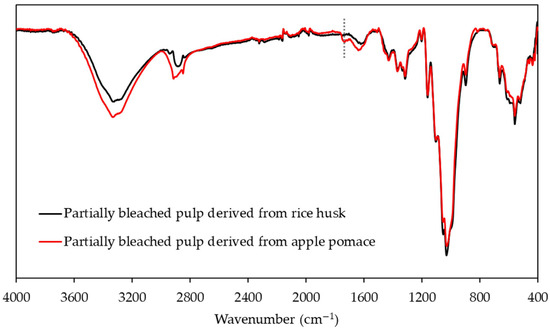
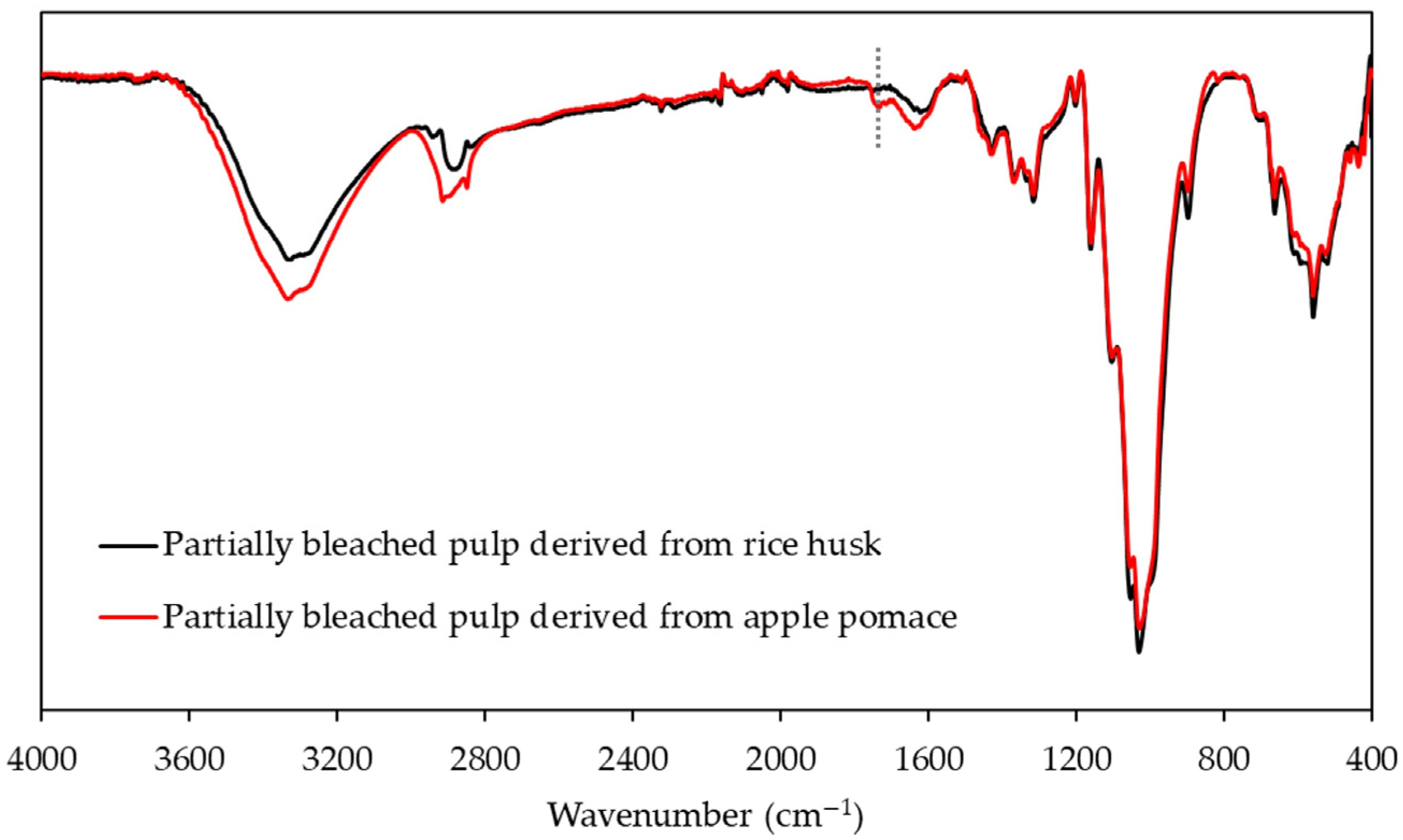
Ultimately, two of the eight potential treatments were selected for the synthesis of nanocellulose, one for each byproduct analyzed. Treatment 1 was designated for apple pomace, while treatment 3 was chosen for rice husk. This combination of variables achieved the highest final yields and facilitated the recovery of a substantial amount of the theoretically available cellulose. The pulps derived from the two selected treatments were evaluated for their alpha-cellulose and lignin content. The partially bleached rice husk pulp consisted of 61% cellulose and 7% lignin, while the partially bleached apple pomace pulp consisted of 71% cellulose and 12% lignin. The FTIR analysis also revealed the chemical changes that occurred during the processes (Figure 1). Both spectra exhibited typical absorption bands of lignocellulosic materials, with broad O–H stretching around 3400 cm−1, C–H stretching near 2900 cm−1, and C–O–C vibrations of polysaccharides in the 1200–1000 cm−1 region [47]. The apple pomace pulp shows more intense bands at ~1600–1700 cm−1, corresponding to the C=O stretching vibrations in carbonyl and carboxyl groups and the stretching vibrations in p-substituted aromatic ketones associated with lignin [47]. These features indicate a higher residual lignin content than in rice husk pulp. The FTIR spectra of both partially bleached pulps display characteristic cellulose absorption bands. The bands at 1430 cm−1 (CH2 scissoring) and 1370 cm−1 (C–H bending) are typical of crystalline cellulose and are accompanied by strong C–O–C stretching vibrations at 1160 cm−1 and 1030 cm−1, as well as the β-glycosidic linkage vibration at ~895 cm−1 [47]. The similarity in intensity and position of these cellulose-associated peaks between rice husk and apple pomace pulps indicates that the bleaching treatments preserved the main polysaccharide structure in both materials. Consequently, both pulps exhibited high cellulose content and were subsequently oxidized to synthesize nanofibers.
Figure 1.
FTIR spectra of bleached pulps derived from rice husks and apple pomace. The dotted line indicates the characteristic lignin absorption band.
3.4. Production, Characterization, and Silanization of TOCNFs
Following the application of TEMPO-mediated oxidation to the partially bleached pulps from apple pomace and rice husks, the suspensions were centrifuged to effectively separate the nanofibers present in the supernatant from the precipitated material. This approach enabled us to assess the nanofibrillation degree by using gravimetric analysis, followed by the determination of carboxyl (COOH) content and the size of the nanofibers. The results are presented in Table 4. The cellulose nanofibers obtained from the selected byproducts exhibited percentages of 65.6 ± 8.3% for rice husks and 87.5 ± 5.3% for apple pomace. The COOH content was similar in both cases, with values around 0.48 mmol/g. The width of these nanofibers was below 10 nm, with an average of 8 nm for nanofibers from rice husks and 7 nm for nanofibers from apple pomace.
Table 4.
Properties of TOCNFs derived from rice husks and apple pomace.
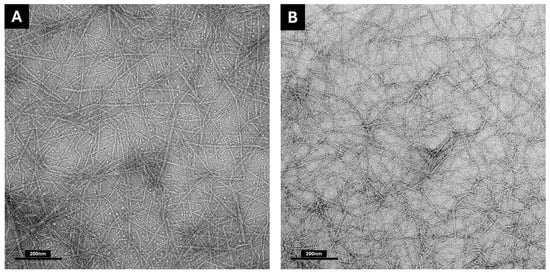
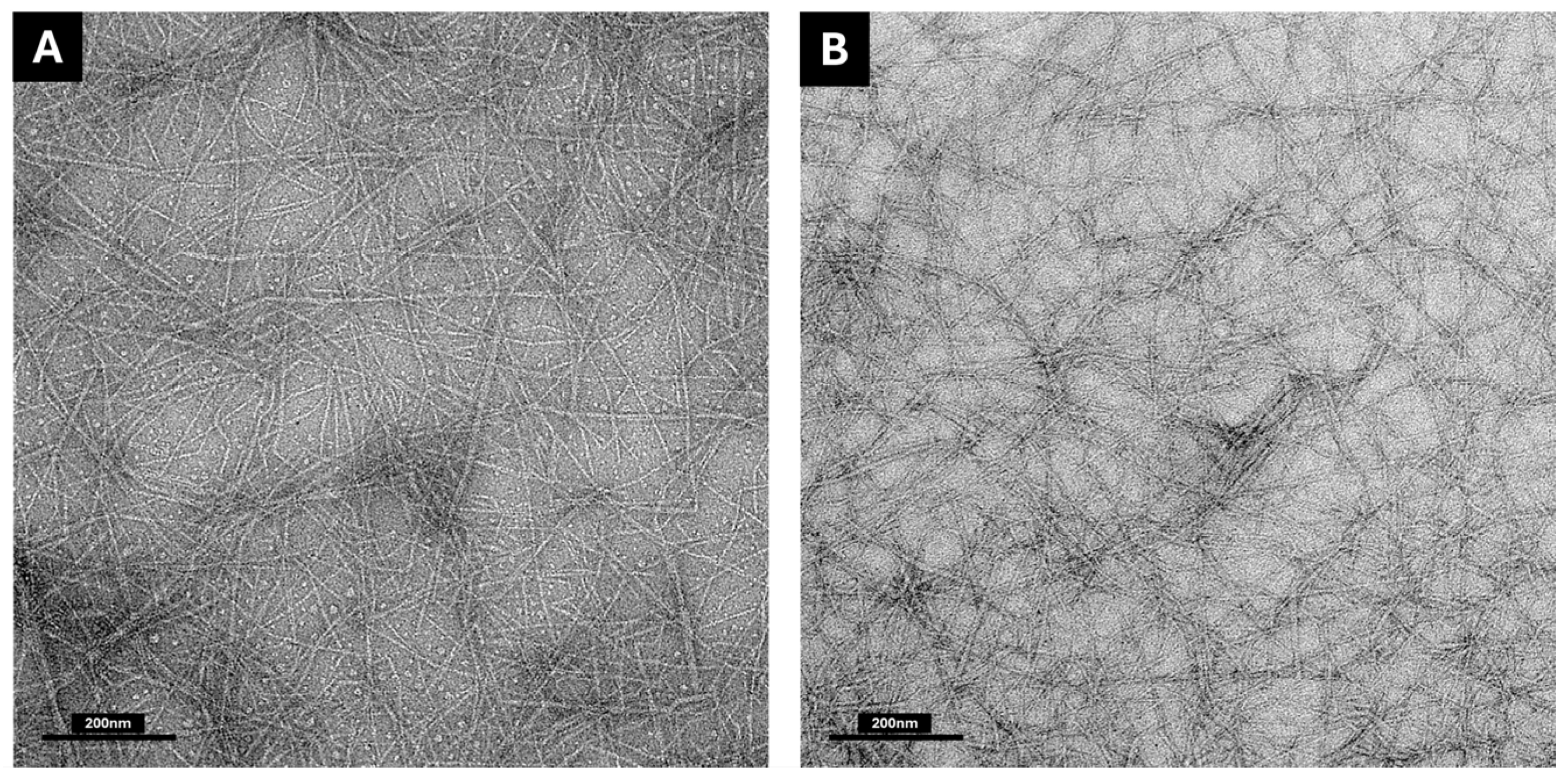
Transmission electron microscopy (TEM) confirmed the successful production of TOCNFs from both apple pomace and rice husks (Figure 2). The TOCNFs derived from apple pomace demonstrated a well-dispersed network of thin, elongated fibrils with minimal aggregation, indicating an effective fibrillation process. These fibers had an average width of 6.7 ± 1.3 nm and an average length of 958 ± 130 nm. In contrast, the TOCNFs obtained from rice husks formed a denser network with a width of 7.9 ± 1 nm and a length of 617 ± 64 nm. These observations highlight the influence of chemical composition on nanofibrillation efficiency, with apple pomace yielding more homogeneous nanofibers, whereas rice husks produced nanofibrils of similar dimensions but with a higher tendency to aggregate.
Figure 2.
TEM images of tempo-oxidized cellulose nanofibers (CNFs) derived from (A): apple pomace, and (B): rice husks.
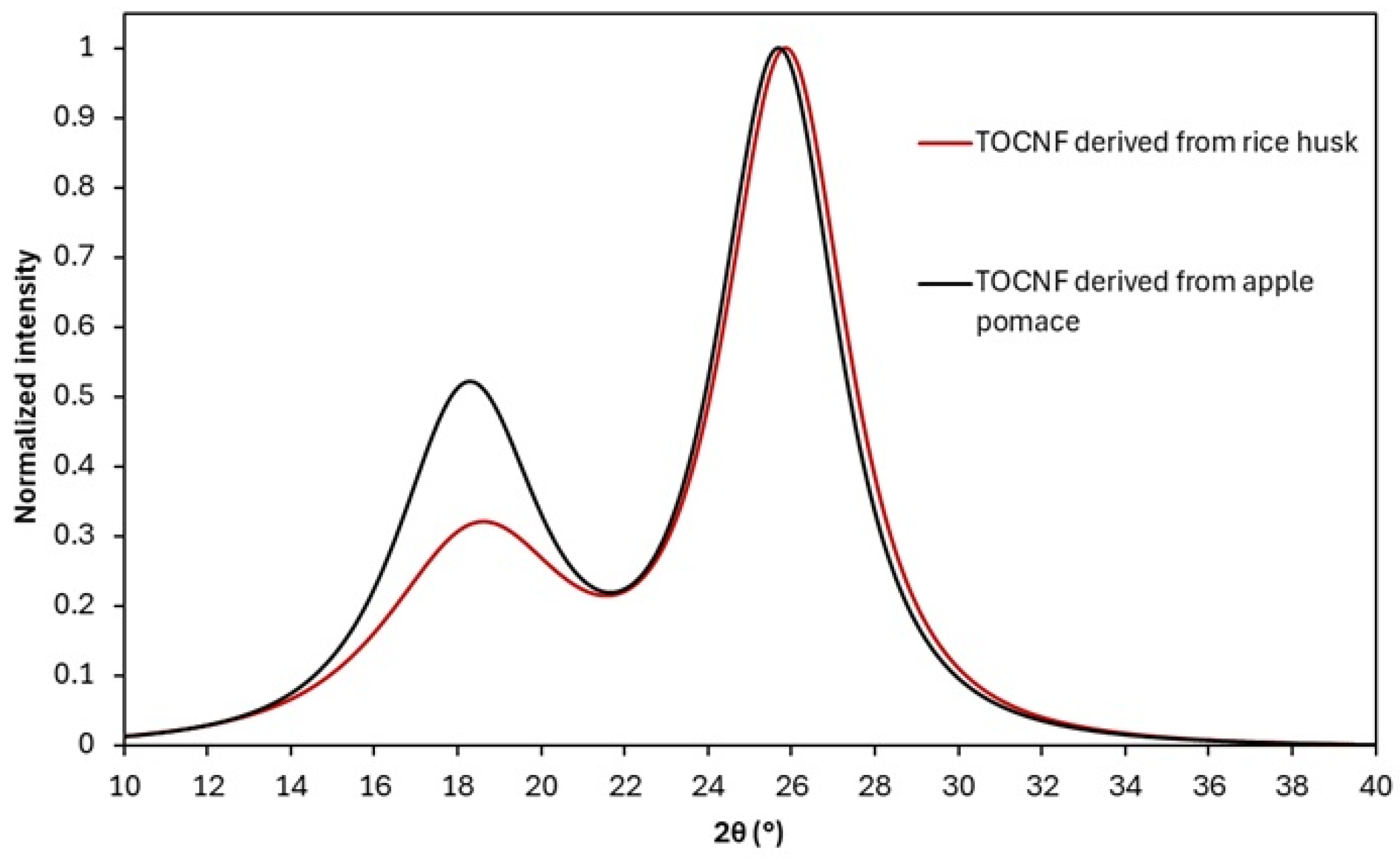
The degree of crystallinity in cellulose polymers is strongly associated with the hydrogen bonds and van der Waals interactions occurring between cellulose molecules within the crystallites of cellulose [48]. The crystalline characteristics and X-ray diffractograms of the TOCNFs extracted from rice husk and apple pomace are depicted in Figure A1 for comparative analysis. The TOCNF samples showed two distinct peaks at 2θ angles of approximately 18° and 26°, corresponding to the amorphous and crystalline fractions, respectively, indicating cellulose type Iβ [49], a characteristic of these lignocellulosic materials [5]. The relative crystallinity index, determined using Segal’s method [50], revealed that the TOCNF from rice husk exhibited a crystallinity of 69%, whereas the TOCNF sourced from apple pomace demonstrated a reduced crystallinity of 50%. The presence of non-cellulosic components, such as hemicelluloses and lignin, may contribute to its lower index [6]. As a result, we concluded that the lignocellulosic source influences the organization of TOCNF, with the rice husk being structurally more crystalline than apple pomace after oxidation.
Based on an evaluation of the comparative processing performance and physicochemical properties of the resulting nanofibers, rice husk was selected as the feedstock for subsequent APTES functionalization. Although apple pomace-derived TOCNFs exhibited a higher nanofibrillation yield (87.5 ± 5.3%) and comparable carboxyl content (~0.48 mmol g−1), their suspensions displayed substantially higher viscosity (approximately 2.5-fold higher than rice husk TOCNFs), which hindered handling, dispersion, and subsequent chemical modification. In addition, rice husks consistently achieved higher overall cellulose recoveries following alkaline and bleaching treatments (23.8–32.4%) compared to apple pomace (9.3–13.8%), reflecting greater process robustness in processing as a feedstock. Structural analysis further revealed a significantly higher crystallinity index for rice husk TOCNFs relative to apple pomace, suggesting a more organized cellulose structure that is advantageous for controlled surface functionalization. As a result, these factors substantiate the viability of rice husk as a promising feedstock for advanced functionalization applications.
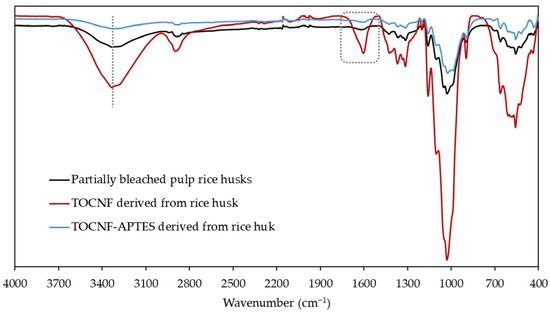
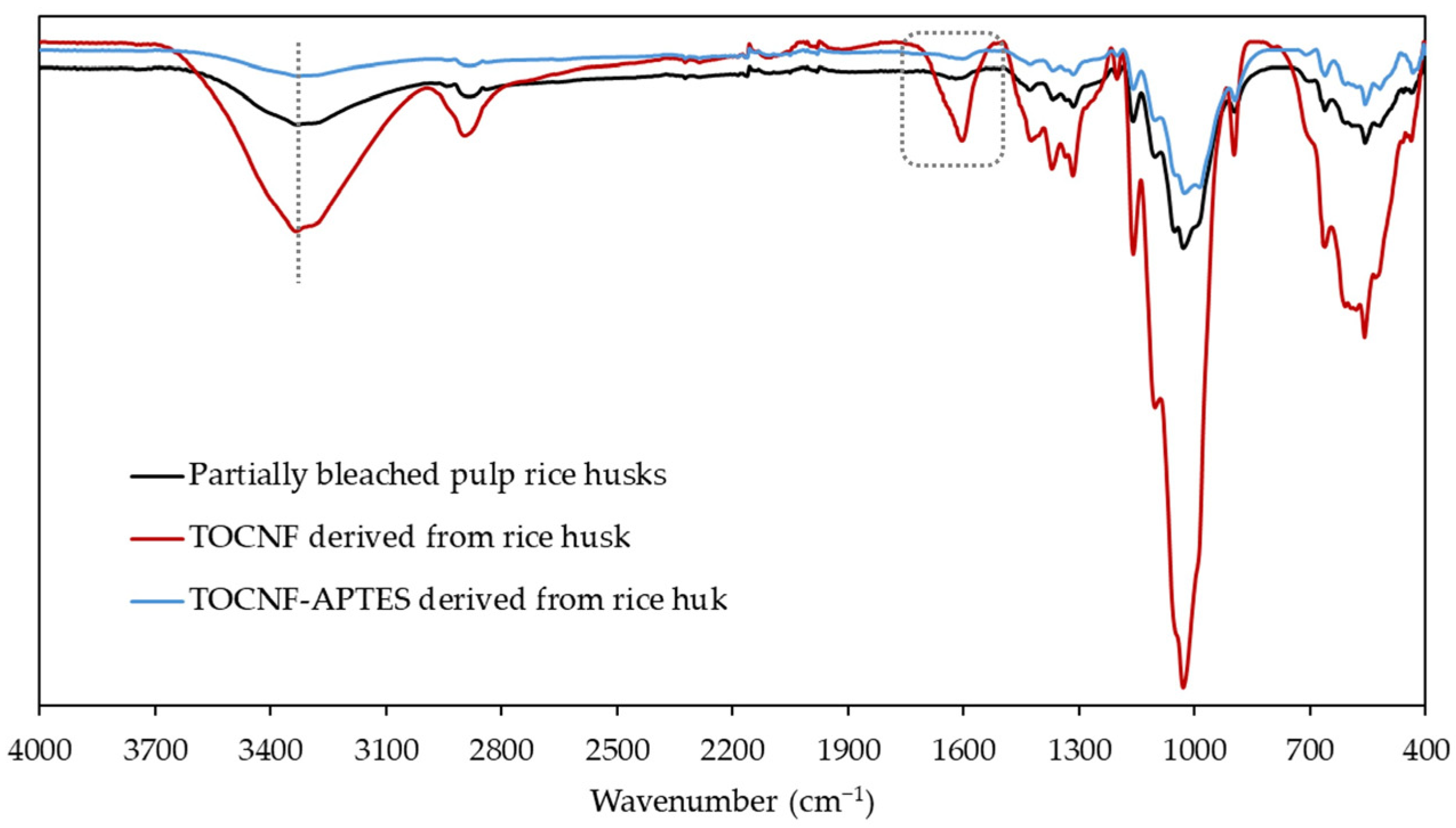
Following the silanization modification, the morphology of the nanofibers remained unchanged (images not provided). However, this modification introduced surface-level alterations to their chemical structure. The ATR-FTIR spectra of TOCNF and TOCNF-APTES, derived from partially bleached rice husk pulp, provided compelling evidence of the chemical changes that took place during the silanization process (Figure 3). The TOCNF spectrum exhibited a distinct absorption band at around 1600 cm−1, which can be attributed to the stretching vibration of carboxyl carbonyl groups (C=O) generated by the oxidation of primary hydroxyl groups located at the C6 position of cellulose [51]. The oxidation level was measured at 0.48 mmol COOH/g pulp, as indicated in Table 4. Additionally, a corresponding reduction in the broad O–H stretching band observed near 3400 cm−1 further indicates the partial conversion of hydroxyl groups to carboxyl functionalities [52]. The presence of APTES was qualitatively validated by the detection of the primary amine N-H stretching vibration, observed within the wavenumber range of 1650–1580 cm−1 [24,52], as illustrated in Figure 3. Moreover, after the APTES modification, there was a noticeable decrease in the intensity of the band attributed to C=O, indicating an interaction between the carboxylated groups of TOCNFs and the amine groups of APTES. This interaction occurs through a nucleophilic attack (SN2) mechanism, where the efficacy of the silylation reaction improves with better leaving groups containing active hydrogens [53], as it has been concluded that the carboxyl groups are more reactive than the hydroxyl groups in the context of silylation [54]. The spectral peaks corresponding to Si-CH3 (865–750 cm−1), Si-O-Si, Si-O-C (1028–1157 cm−1), and Si-CH2 (1228 cm−1) [55] were difficult to distinguish individually due to the considerable overlap with other components present in rice husk pulp. The peaks coincided with the significant and strong C–O–C vibration bands of cellulose within the same spectral range [56]. When TOCNF surfaces were treated with silane, the alkoxy groups of the silane reacted with water to form silanol (SiH3OH). This silanol group was then absorbed by the O–H bonds present in cellulose, leading to a condensation reaction. As a result, siloxane bridges (Si–O–Si) were formed and attached to TOCNF through Si–O–C bonds [24]. Moreover, the nitrogen content of the APTES-modified TOCNF was quantified following acid digestion. The TOCNF-APTES exhibited a nitrogen content of 1.72 mg/g cellulose ±0.12, corresponding to about 0.2%, which is in agreement with previous results [23].
Figure 3.
FTIR spectra of modified cellulose nanofibers derived from partially bleached pulp from rice husks. The dotted line indicates the characteristic O–H stretching band, and the dotted box highlights the decrease in band intensity associated with the amine functionalization.
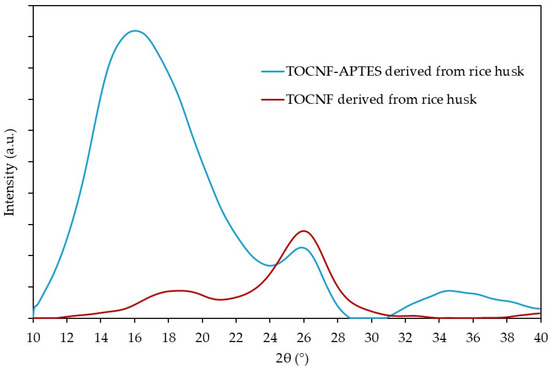
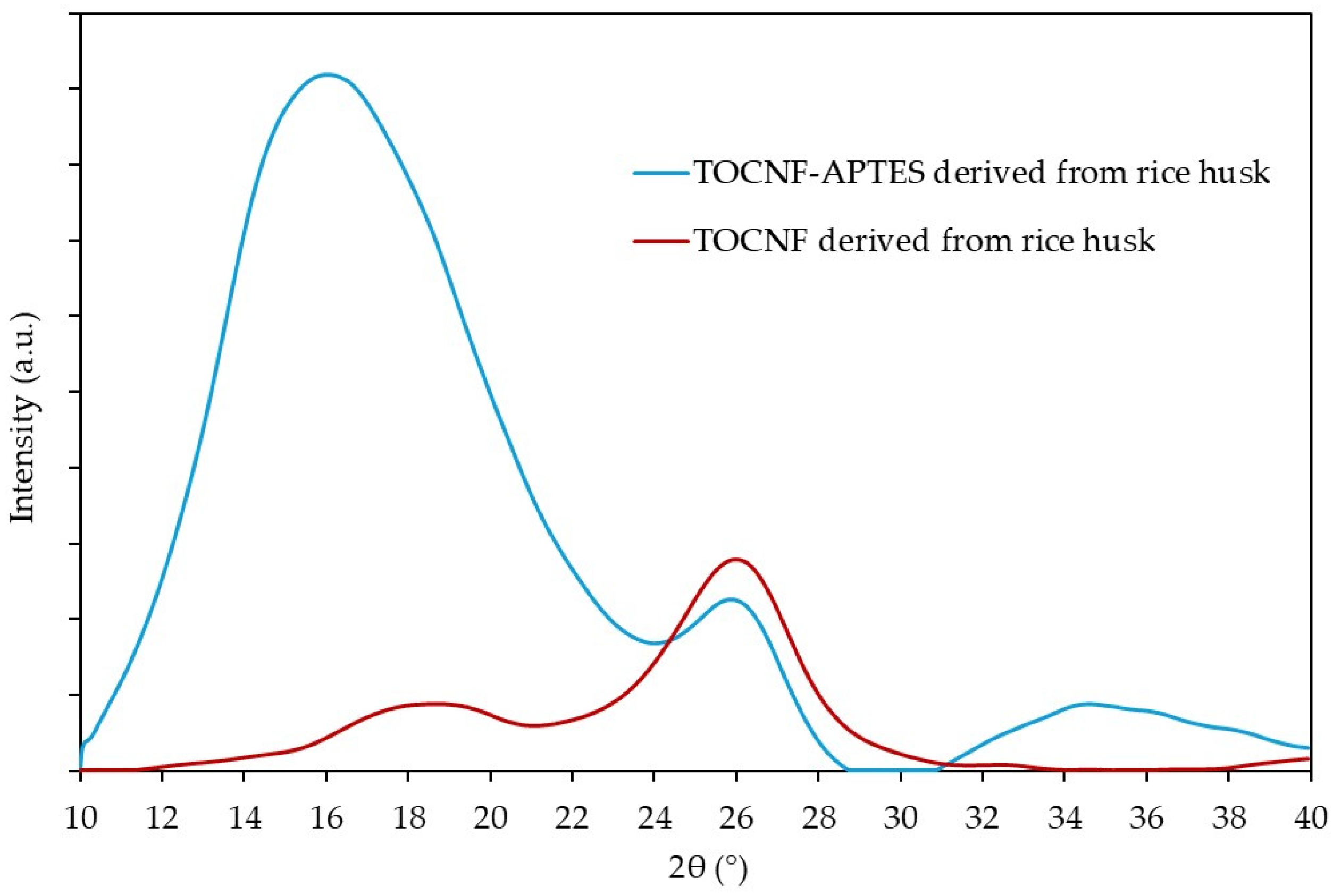
The X-ray diffractograms of the TOCNFs derived from rice husks before and after APTES modification are shown in Figure 4. After APTES functionalization, there was a marked decrease in the intensity of the (200) reflection and a significant increase in the amorphous region, suggesting a partial disruption of the crystalline order. The APTES-modified TOCNFs showed an additional broad peak at 2θ~15°, which confirms the presence of the siloxane lattice as an indication of the amorphous nature of silane [57]. Additionally, a new diffraction peak was observed at 2θ = 35°, which is generally low in intensity; this signal is attributed to the Si–O–C linkage between silane and cellulose [52]. Therefore, after silane modification, an amorphous siloxane phase formed on the CNF surface.
Figure 4.
XRD patterns of TOCNFs derived from rice husk and the APTES-modified TOCNFs.
3.5. Potential of TOCNF-APTES for the Development of Bio-Based Adhesives
The TOCNF-APTES derived from rice husk was utilized in an in situ polymerization to produce cellulose-based adhesives. The in situ process involves the activation of TOCNF-APTES by KPS at 80 °C, where free radicals were generated onto the cellulose surface [40]. The results obtained from ATR-FTIR and XRD provide qualitative evidence of successful silane grafting, consistent with previous reports on APTES-modified nanocellulose [23,58]. The addition of vinyl acetate monomer after TOCNF-APTES activation is expected to facilitate graft copolymerization onto the TOCNF surface. The characteristics of these polymers are shown in Table 5. The recovery yield was higher for the PVA control (~74%), whereas it was ~64% for PVA-TOCNF-APTES and ~57% for PVA-TOCNF-APTES-SDS. The polymerization conversion was determined by calculating the ratio of the mass of the polymer formed to the initial mass of the monomer. The results indicated values of 72.65% for the PVA control, 63.68% for the PVA system containing TOCNF-APTES, and 53.93% for the PVA-TOCNF-APTES-SDS formulation. The observed decrease in conversion rates upon the inclusion of TOCNF–APTES and SDS suggests an increase in interfacial and steric hindrance during polymerization. This phenomenon is likely attributable to the formation of dense nanofiber interfacial layers and partial steric hindrance introduced by APTES modification [59]. The particle sizes of the PVA and nanocellulose-based PVA measured by DLS are presented in Table 5. The average particle size of PVA-SDS was 193.15 nm. In contrast, the addition of cellulose nanofiber resulted in an increase in the particle size up to 625 nm (PVA-TOCNF-APTES). The incorporation of SDS stabilized the emulsion particles, leading to a reduced particle size of 247 nm. The observed increase in emulsion particle sizes compared to PVA-SDS can be attributed to the presence of cellulose nanofibers at the polymer–water interface, which partially adsorb onto the growing polymer particles and promote the formation of a hybrid organic–inorganic interfacial layer. The incorporation of TOCNF functionalized with APTES further increases the effective hydrodynamic diameter of the emulsion particles due to steric contributions and interparticle interactions mediated by the nanofibrillar network. In this scenario, SDS acts as a co-stabilizer, enhancing colloidal stability and limiting uncontrolled particle growth and aggregation, while the nanocellulose contributes to particle structuring rather than simple surfactant-based stabilization. Polymerizations conducted in the absence of SDS but in the presence of CNFs resulted in particle aggregation, precluding particle size analysis, highlighting the necessity of SDS for colloidal stabilization.
Table 5.
Characterization summary of polymers.
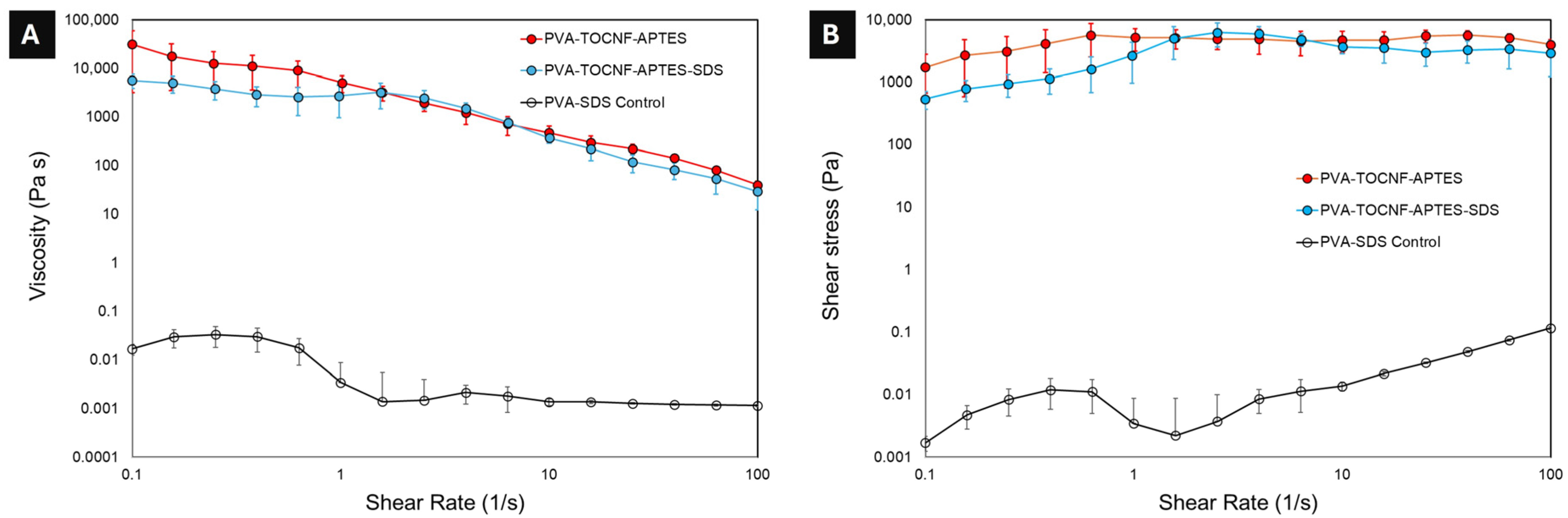
The rheological properties of the polymers were assessed and are detailed in Appendix A, which shows the steady-state viscosity as a function of the shear rate (Figure A2A) and the shear stress as a function of shear rate (Figure A2B). The rheological behavior is dependent on the particle size of the latexes, the dispersion of cellulose nanofibers in the matrix, and the intermolecular interactions [60]. The adhesives displayed characteristic shear-thinning behavior due to the entanglements and inter- and intra-molecular hydrogen bonds located at PVA-TOCNFs, similar to that observed in suspensions of TOCNF/PVA [61]. Notably, the viscosity of the PVA-SDS polymer used as a control was found to be lower than that of PVA polymerized alongside modified cellulose nanofibers, indicating that the presence of nanocellulose primarily influences the rheological characteristics, since these nanomaterials function as a rheological modifier [62]. This behavior reflects SDS’s primary role as a low-molecular-weight surfactant that enhances colloidal stability and reduces particle aggregation, thereby limiting the formation of extended physical networks in the aqueous phase. In contrast, incorporation of TOCNF–APTES led to a pronounced increase in zero-shear viscosity and the emergence of a more elastic-like response at low shear rates, indicating the formation of a percolated nanofibrillar network within the polymer matrix. The elevated viscosity observed in these samples may be attributed to the high aspect ratio of CNFs combined with surface amine functionalities introduced by APTES, which promote strong interfacial interactions with the growing PVAc chains and facilitate physical bridging between polymer particles. The resulting interconnected structure restricts polymer chain mobility and enhances resistance to deformation under low shear, leading to substantially higher viscosities compared to PVA–SDS systems. When SDS was introduced into the TOCNF–APTES-containing formulation, the overall viscosity decreased but remained significantly higher than that of PVA–SDS. This intermediate rheological behavior reflects the dual and partially competing roles of CNFs and surfactant. Thus, SDS enhanced emulsion stability and reduced particle size, likely limiting excessive aggregation and weakening long-range CNF-CNF contacts. At low shear rates (<1.5 s−1), the viscosities of the PVA polymerized by TOCNF-APTES were higher, which could be explained by the size of the emulsion latex (625 nm) since the addition of SDS during the polymerization reactions leads to a decrease in emulsion particle size (247 nm). When the shear rates increased (>1.5 s−1), the entanglement network broke, and the nanofibers tended to align with the shear directions, causing a decrease in viscosities with similar values for both PVA-TOCNF-APTES and PVA-TOCNF-APTES-SDS samples. This behavior can be attributed to the enhanced inter-fibrillar interactions facilitated by silane grafting, which involves hydrogen bonding and potential siloxane-mediated associations. These interactions effectively strengthen the CNF network and limit the mobility of the polymer chains.
The increase in particle size in the presence of TOCNF-APTES, together with enhanced low-shear viscosity and yield-like behavior, suggests that CNFs participate in interfacial structuring and particle bridging during polymerization rather than acting solely as post-polymerization fillers.
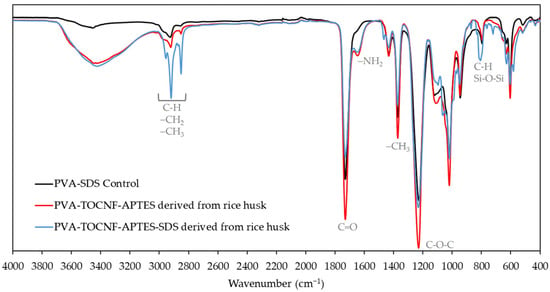
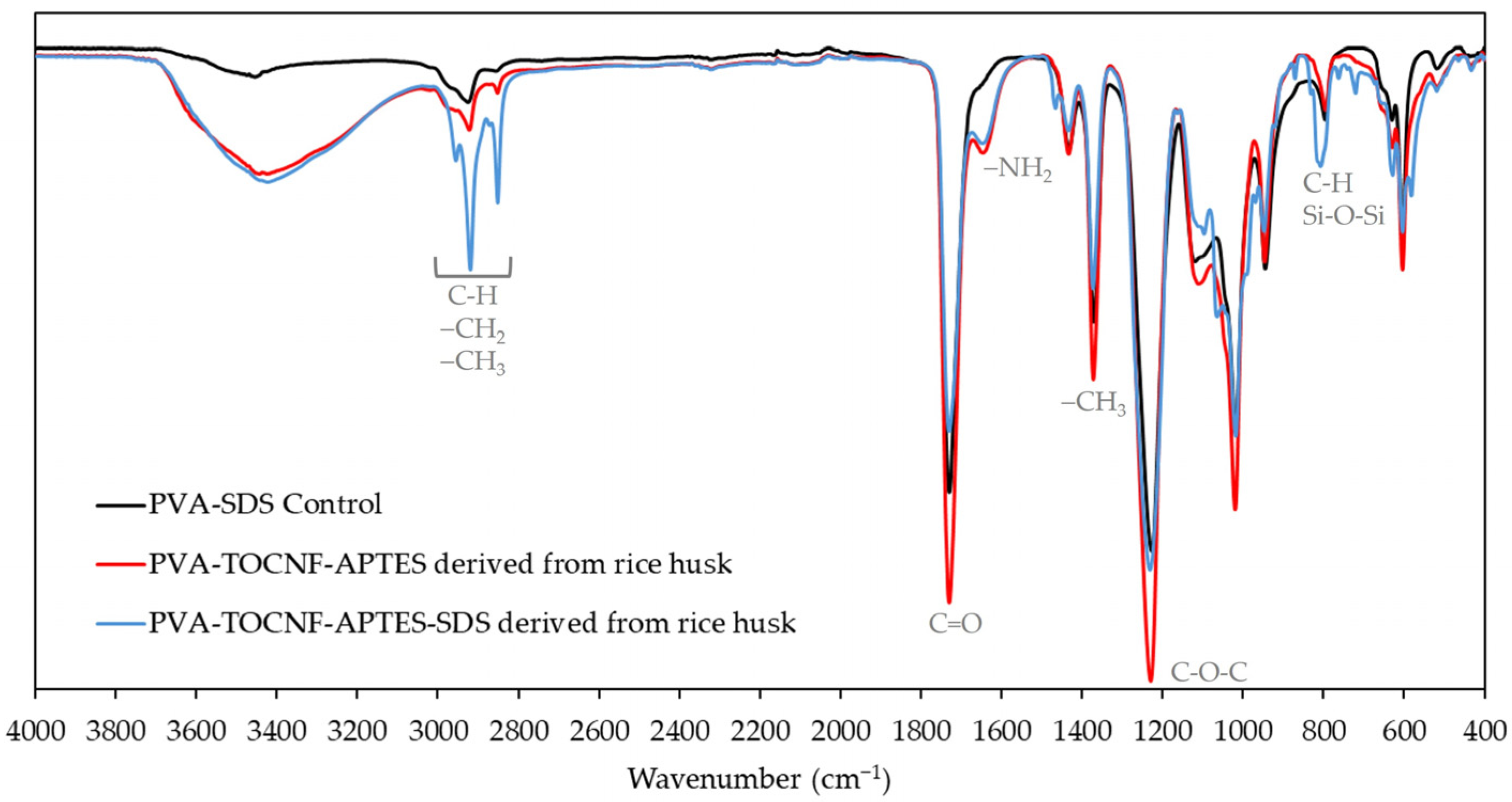
FTIR analysis was employed to evaluate the chemical structure of the fabricated PVA adhesives. ATR-FTIR transmittance spectra are shown in Figure 5. The wide peaks at 3400–3500 cm−1 in the spectra of PVA-TOCNF-APTES and PVA-TOCNF-APTES-SDS samples are attributed to the stretching vibration of the O-H bond related to the hydroxyl groups of TOCNFs and the existence of water molecules in the PVA matrix [63]. The peaks in the region 2950–2850 cm−1 are related to the asymmetric stretching of the C-H bond of -CH2 and -CH3 groups of the PVA chains [64]. The primary characteristic peaks at 1730 cm−1, corresponding to the stretching vibration of C=O in carbonyl groups; at 1372 cm−1, representing the asymmetric bending vibration of -CH3 in the PVA chains; and at 1230 cm−1, indicating the asymmetric stretching vibration of the C-O-C bond [65], were noted in the PVA and the nanocellulose-based PVA samples. The peak observed at 1640 cm−1 is attributed to -NH2 groups originating from the amino groups of APTES [66], whereas the peak at 790 cm−1 is attributed to the rocking vibration of the C-H bonds in PVA chains, which overlaps with the symmetric stretching of the Si-O-Si bond present in PVA produced by cellulose nanofibers modified with APTES [67].
Figure 5.
ATR-FTIR spectra of PVA, PVA-TOCNF-APTES, and PVA-TOCNF-APTES-SDS samples.
Recent dissolving-based approaches for cellulose nanomaterials enable homogeneous polymer matrices but require aggressive solvents and limit scalability. The present heterogeneous aqueous route preserves fibrillar morphology and exploits CNF surface chemistry to regulate polymerization and network formation without dissolution, offering a scalable and industrially compatible alternative [28].
3.6. Adhesive Performance Produced from PVA-TOCNF-APTES
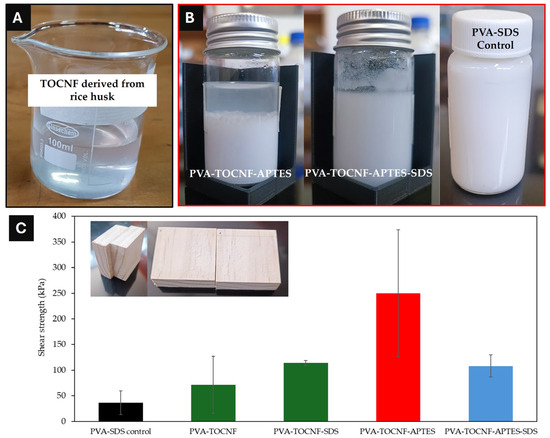
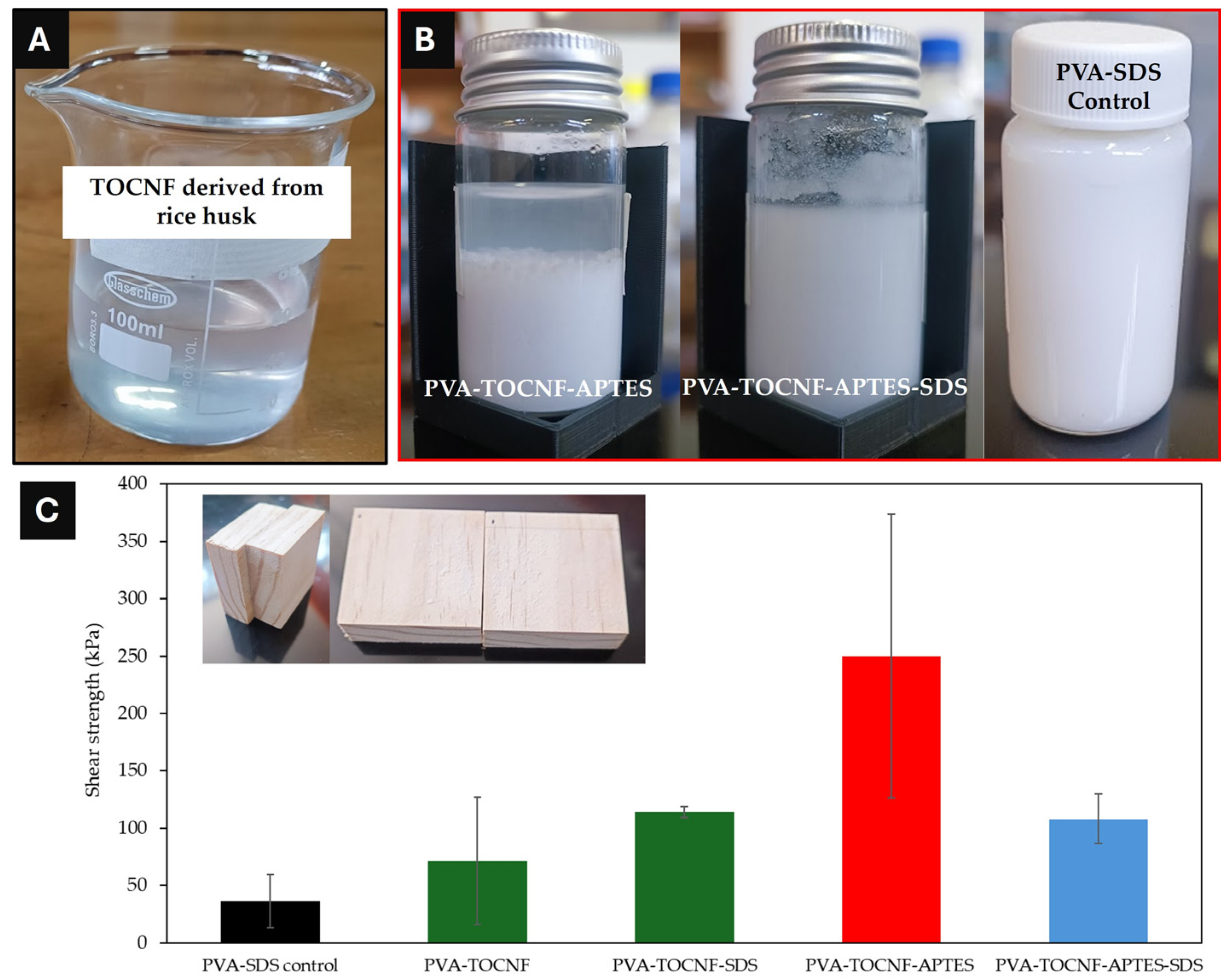
One potential application for the polymers synthesized in this study is as a wood adhesive. The adhesion characteristics of these synthesized adhesives were evaluated by creating wood joints according to standard protocols, with bond strength assessed using a tensile testing apparatus. Figure 6A illustrates the aqueous dispersion of cellulose nanofibers extracted from rice husk, while Figure 6B presents the various formulations of polyvinyl acetate (PVA) adhesives. Additionally, Figure 6C depicts the blocks used during shear-compressive testing and the results obtained. The PVA demonstrated stable emulsion characteristics, exhibiting no apparent phase separation. In contrast, the emulsion composed of PVA-TOCNF-APTES exhibited evidence of phase separation after a two-week storage period, likely due to the nanofibers’ inability to function effectively as stabilizers at the interface between the PVA polymer and water. Even though cellulose nanofibers have been known as Pickering emulsion stabilizers [68], the processing conditions used here are not intended to develop the PVA adhesive system under those conditions of high-energy homogenization. As expected, the emulsion formulated with the addition of SDS was a stable formulation, exhibiting no visible phase separation, due to the ability of SDS to promote stabilization in emulsions [69]. SDS primarily governs colloidal stability and particle size distribution, thereby improving dispersion and processing behavior, while partially attenuating long-range CNF–CNF interactions and bulk network connectivity.
Figure 6.
(A): aqueous suspension of TOCNFs derived from rice husk; (B): cellulose-based adhesives, PVA-TOCNF-APTES, PVA-TOCNF-APTES-SDS, and PVA-SDS; (C): shear strength performance, the inset images correspond to the wooden blocks used for bonding strength tests. The black bar corresponds to the PVA–SDS control; green bars represent adhesives prepared with unmodified TOCNF (without and with SDS); the red bar represents the adhesive with APTES-modified TOCNF; and the blue bar represents the adhesive with APTES-modified TOCNF and SDS.
One of the most common uses of PVA dispersions is as a primary ingredient in the creation of water-based adhesives for the wood industry. The excellent bonding capability of PVA to wood and lignocellulosic materials, the simplicity of processing PVA adhesives, the non-toxic nature of PVA, and the cost efficiency of VAM all contribute to the extensive application of PVA in adhesives and coatings. Consequently, CNFs derived from agricultural byproducts have been developed through a systematic chemical modification process, specifically by grafting silane onto their surfaces. This modification aims to improve compatibility and performance in various applications.
The shear strength results obtained according to ASTM D905 clearly demonstrate the reinforcing effect of TOCNF on the PVA-based adhesive system. The PVA-SDS exhibited a low average shear strength (36.56 kPa ± 23 kPa), whereas the incorporation of TOCNF in its unmodified form resulted in a slightly enhanced strength of 71.7 kPa ± 55.5 kPa. In contrast, the incorporation of TOCNF modified with APTES resulted in a significant increase in adhesion strength, reaching an average of 250 kPa ± 123 kPa. This corresponds to an improvement of over threefold compared to the control formulations. Moreover, the incorporation of SDS into the system containing TOCNF-APTES during in situ polymerization showed a shear strength of 108.32 kPa ± 21.38 kPa, similar to that for the unmodified TOCNF, 114.3 kPa ± 5 kPa. Although SDS addition promotes dispersion, it may hinder the formation of a percolated nanofibrillar network responsible for mechanical performance. APTES modification introduces amine functionalities that enhance polymer–fiber interactions and promote nanofibrillar network formation, as reflected in the increased low-shear viscosity and cohesive strength of the resulting adhesive formulations. We are further investigating the effect of modified nanocellulose on the in situ polymerization of waterborne adhesives to compare the effect of cellulose nanocrystals and nanofibers in depth. Therefore, this research is pivotal in advancing our understanding of both chemical modification strategies and the critical role of nanosized particles in emulsion stabilization for the development of cellulose-based adhesives, since, when cellulose nanocrystals are used, the behavior observed differs, as already reported [70].
The worldwide wood adhesives market is anticipated to expand at a compound annual growth rate (CAGR) of 3.4%, with projections indicating a market value of USD 4.9 billion by 2026, driven in part by the production of wooden items utilized in furniture and wood-based engineering panels. Concerns over the environment and sustainability are prompting the industry to seek biobased alternatives and transition to low-VOC products. Adopting less-harmful and renewable alternatives is a clear approach to facilitate greener emulsion polymerization. Numerous studies have investigated the potential of nanocellulose as a reinforcing filler in adhesives; however, its application in emulsion polymerization for the development of wood adhesives remains relatively nascent and has not been thoroughly explored. It is evident that various challenges persist in this domain that require attention, necessitating further research. Our current efforts are concentrated on elucidating the specific interfacial and polymerization mechanisms that govern cellulose nanofiber-stabilized systems. Additionally, we are focused on optimizing formulation parameters to enhance both long-term stability and application-specific adhesive performance.
4. Conclusions
This study demonstrates that rice husk-derived TEMPO-oxidized cellulose nanofibers (TOCNFs) can be effectively surface-functionalized with APTES and integrated as active components in waterborne poly(vinyl)acetate (PVA) adhesive systems produced by heterogeneous polymerization. Among the agro-industrial byproducts evaluated, rice husk was selected for its favorable processing yields, crystallinity, suspension processability, and regional availability, making it a representative and scalable lignocellulosic feedstock for the development of functional nanocellulose. Subsequent functionalization with APTES effectively modified the interfacial properties of these nanofibers. Quantitative nitrogen analysis confirmed successful APTES grafting, while rheological, morphological, and mechanical results demonstrated that surface-modified TOCNFs influence not only bulk reinforcement but also interfacial phenomena during polymerization and network formation. APTES-modified TOCNFs promoted the formation of percolated nanofibrillar networks, leading to increased low-shear viscosity and enhanced adhesive cohesion and lap-shear strength. The addition of SDS improved nanofiber stabilization, resulting in more homogeneous adhesive networks, although at the expense of reduced viscosity and slightly lower cohesive strength.
Author Contributions
Conceptualization, C.F. and J.F.O.; methodology, C.F., J.F.O. and B.M.; formal analysis and investigation, C.F.; writing—original draft preparation, C.F.; writing—review and editing, C.F., J.F.O., B.M. and P.D.-C.; visualization, C.F., J.F.O. and P.D.-C.; supervision, C.F.; project administration, C.F.; funding acquisition, C.F. All authors have read and agreed to the published version of the manuscript.
Funding
This research and the APC were funded by Agencia Nacional de Investigación y Desarrollo (ANID), Chile, through the FONDECYT Iniciación Grant No. 11231171.
Data Availability Statement
The original contributions presented in this study are included in the article. Further inquiries can be directed to the corresponding author.
Acknowledgments
The authors thank Alejandro Bozo for his support during the mechanical tests. The authors also thank the project INFRA 039/2024 funded by Vicerrectoria de Investigación y Desarrollo (VID) from Universidad de Chile, Chile.
Conflicts of Interest
The authors declare no conflicts of interest.
Appendix A
The statistical findings, as indicated by p-values, are presented in Table A1 for both subproducts that underwent alkaline and bleaching treatments.
Table A1.
Summary of p-values obtained after ANOVA.
The statistical results, in terms of p-values, are presented in Table A2 for the overall conversion of both subproducts.
Table A2.
Summary of p-values obtained for the overall yields after ANOVA.
The crystalline characteristics and X-ray diffractograms of the TOCNFs derived from rice husk and apple pomace are indicated in Figure A1 for comparative analysis.
Figure A1.
Normalized XRD of TOCNFs derived from rice husk and apple pomace.
The rheological characteristics of cellulose-based adhesives and polyvinyl acetate (PVA) are shown in Figure A2, which presents viscosity and shear stress as functions of shear rate.
Figure A2.
Rheological behavior of PVAc adhesive formulations containing TOCNF-based nanofillers as a function of shear rate. (A) Apparent viscosity and (B) shear stress of the adhesive systems: PVA–TOCNF–APTES, PVA–TOCNF–APTES–SDS, and the PVA–SDS control.
References
- Dufresne, A. Nanocellulose Processing Properties and Potential Applications. Curr. For. Rep. 2019, 5, 76–89. [Google Scholar] [CrossRef] [Scilit]
- Krysa, M.; Szymańska-Chargot, M.; Adamczuk, A.; Pertile, G.; Frąc, M.; Zdunek, A. Properties of Composites Based on Microfibrillar and Nanofibrillar Cellulose from Apple Pomace and Two Pairs of Flavonoids—Quercetin/Rutin and Naringin/Naringenin in Liposomal Form. Food Res. Int. 2025, 221, 117335. [Google Scholar] [CrossRef] [Scilit]
- Morales-Juárez, A.A.; Terrazas Armendáriz, L.D.; Alcocer-González, J.M.; Chávez-Guerrero, L. Potential of Nanocellulose as a Dietary Fiber Isolated from Brewer’s Spent Grain. Polymers 2023, 15, 3613. [Google Scholar] [CrossRef] [Scilit]
- Mussatto, S.I. Brewer’s Spent Grain: A Valuable Feedstock for Industrial Applications. J. Sci. Food Agric. 2014, 94, 1264–1275. [Google Scholar] [CrossRef] [Scilit] [PubMed]
- Taymaz, E.R.; Uslu, M.E. Innovations in Biocompatible Materials: Exploring the Potential of Cellulose Nanocrystals from Grape Pomace. Chem. Pap. 2024, 78, 5445–5455. [Google Scholar] [CrossRef] [Scilit]
- Amara, C.; Razzak, A.; Khiari, R.; Dufresne, A.; Khwaldia, K. Sustainable Production of Cellulose Nanofibers and Nanopaper Sheets from Olive Pomace Waste through Mechanical Defibrillation. Biomass Convers. Biorefin. 2025, 15, 16619–16631. [Google Scholar] [CrossRef] [Scilit]
- Chen, Y.W.; Hasanulbasori, M.A.; Chiat, P.F.; Lee, H.V. Pyrus Pyrifolia Fruit Peel as Sustainable Source for Spherical and Porous Network Based Nanocellulose Synthesis via One-Pot Hydrolysis System. Int. J. Biol. Macromol. 2019, 123, 1305–1319. [Google Scholar] [CrossRef] [Scilit]
- Valadez-Renteria, E.; Ibarra-Escamilla, L.; Robles-Gomez, L.; Robledo-Trujillo, G.; Rodriguez-Gonzalez, V. Characterization of Cellulose Extracted from Pumpkin Shell Waste. Mater. Lett. 2025, 406, 139985. [Google Scholar] [CrossRef] [Scilit]
- Madivoli, E.S.; Kareru, P.G.; Gachanja, A.N.; Mugo, S.M.; Sujee, D.M.; Fromm, K.M. Isolation of Cellulose Nanofibers from Oryza Sativa Residues via TEMPO Mediated Oxidation. J. Nat. Fibers 2022, 19, 1310–1322. [Google Scholar] [CrossRef] [Scilit]
- Pirozzi, A.; Olivieri, F.; Castaldo, R.; Gentile, G.; Donsì, F. Cellulose Isolation from Tomato Pomace: Part II—Integrating High-Pressure Homogenization in a Cascade Hydrolysis Process for the Recovery of Nanostructured Cellulose and Bioactive Molecules. Foods 2023, 12, 3221. [Google Scholar] [CrossRef] [Scilit]
- Castro-Criado, D.; Abdullah, J.A.A.; Romero, A.; Jiménez-Rosado, M. Stabilization and Valorization of Beer Bagasse to Obtain Bioplastics. Polymers 2023, 15, 1877. [Google Scholar] [CrossRef] [Scilit] [PubMed]
- Fidelis, M.; de Moura, C.; Kabbas Junior, T.; Pap, N.; Mattila, P.; Mäkinen, S.; Putnik, P.; Bursać Kovačević, D.; Tian, Y.; Yang, B. Fruit Seeds as Sources of Bioactive Compounds: Sustainable Production of High Value-Added Ingredients from by-Products within Circular Economy. Molecules 2019, 24, 3854. [Google Scholar] [CrossRef] [Scilit] [PubMed]
- Dhillon, G.S.; Kaur, S.; Brar, S.K. Perspective of Apple Processing Wastes as Low-Cost Substrates for Bioproduction of High Value Products: A Review. Renew. Sustain. Energy Rev. 2013, 27, 789–805. [Google Scholar] [CrossRef] [Scilit]
- FAO. Agricultural Production Statistics 2010–2023; Food and Agriculture Organization: Rome, Italy, 2024. [Google Scholar]
- Chandrasekhar, S.; Satyanarayana, K.G.; Pramada, P.N.; Raghavan, P.; Gupta, T.N. Review Processing, Properties and Applications of Reactive Silica from Rice Husk—An Overview. J. Mater. Sci. 2003, 38, 3159–3168. [Google Scholar] [CrossRef] [Scilit]
- Yi, T.; Zhao, H.; Mo, Q.; Pan, D.; Liu, Y.; Huang, L.; Xu, H.; Hu, B.; Song, H. From Cellulose to Cellulose Nanofibrils—A Comprehensive Review of the Preparation and Modification of Cellulose Nanofibrils. Materials 2020, 13, 5062. [Google Scholar] [CrossRef] [Scilit]
- Pradhan, D.; Jaiswal, A.K.; Jaiswal, S. Emerging Technologies for the Production of Nanocellulose from Lignocellulosic Biomass. Carbohydr. Polym. 2022, 285, 119258. [Google Scholar] [CrossRef] [Scilit]
- Sanchez-Salvador, J.L.; Blanco, A.; Duque, A.; Negro, M.J.; Manzanares, P.; Negro, C. Upscaling Cellulose Oxidation: Integrating TEMPO-Mediated Oxidation in a Pilot-Plant Twin-Screw Extruder for Cellulose Nanofibril Production. Carbohydr. Polym. Technol. Appl. 2024, 7, 100525. [Google Scholar] [CrossRef] [Scilit]
- Xu, H.; Sanchez-Salvador, J.L.; Balea, A.; Blanco, A.; Negro, C. Optimization of Reagent Consumption in TEMPO-Mediated Oxidation of Eucalyptus Cellulose to Obtain Cellulose Nanofibers. Cellulose 2022, 29, 6611–6627. [Google Scholar] [CrossRef] [Scilit]
- Fernandes, M.; Alves, C.; Melro, L.; Fernandes, R.D.V.; Padrão, J.; Salgado, A.J.; Zille, A. Modification of Nanocellulose. In Handbook of Biomass; Springer Nature: Singapore, 2023; pp. 1–39. [Google Scholar]
- Ghasemlou, M.; Daver, F.; Ivanova, E.P.; Habibi, Y.; Adhikari, B. Surface Modifications of Nanocellulose: From Synthesis to High-Performance Nanocomposites. Prog. Polym. Sci. 2021, 119, 101418. [Google Scholar] [CrossRef] [Scilit]
- Indarti, E.; Marwan; Rohaizu, R.; Wanrosli, W.D. Silylation of TEMPO Oxidized Nanocellulose from Oil Palm Empty Fruit Bunch by 3-Aminopropyltriethoxysilane. Int. J. Biol. Macromol. 2019, 135, 106–112. [Google Scholar] [CrossRef] [Scilit]
- Amit, S.K.; Gomez-Maldonado, D.; Bish, T.; Peresin, M.S.; Davis, V.A. Properties of APTES-Modified CNC Films. ACS Omega 2024, 9, 16572–16580. [Google Scholar] [CrossRef] [Scilit] [PubMed]
- Neves, R.M.; Ornaghi, H.L., Jr.; Zattera, A.J.; Amico, S.C. The Influence of Silane Surface Modification on Microcrystalline Cellulose Characteristics. Carbohydr. Polym. 2020, 230, 115595. [Google Scholar] [CrossRef] [Scilit] [PubMed]
- Fritz, C.; Olivera, J.F. Nanocellulose in Heterogeneous Water-Based Polymerization for Wood Adhesives. Polysaccharides 2022, 3, 219–235. [Google Scholar] [CrossRef] [Scilit]
- Rigg-Aguilar, P.; Moya, R.; Oporto-Velásquez, G.S.; Vega-Baudrit, J.; Starbird, R.; Puente-Urbina, A.; Méndez, D.; Potosme, L.D.; Esquivel, M. Micro- and Nanofibrillated Cellulose (MNFC) from Pineapple (Ananas comosus) Stems and Their Application on Polyvinyl Acetate (PVAc) and Urea-Formaldehyde (UF) Wood Adhesives. J. Nanomater. 2020, 2020, 1393160. [Google Scholar] [CrossRef] [Scilit]
- Ben Mabrouk, A.; Kaddami, H.; Magnin, A.; Belgacem, M.N.; Dufresne, A.; Boufi, S. Preparation of Nanocomposite Dispersions Based on Cellulose Whiskers and Acrylic Copolymer by Miniemulsion Polymerization: Effect of the Silane Content. Polym. Eng. Sci. 2011, 51, 62–70. [Google Scholar] [CrossRef] [Scilit]
- Liu, Y.; Jiang, D.; Xu, Q. Emerging Dissolving Strategy of Cellulose Nanomaterial for Flexible Electronics Sensors in Wearable Devices: A Review. Cellulose 2024, 31, 27–60. [Google Scholar] [CrossRef] [Scilit]
- Sluiter, A.; Hamer, B.; Ruiz, R.; Scarlata, J.; Sluiter, J.; Templeton, D. Determination of Ash in Biomass: Laboratory Analytical Procedure (LAP); Technical Report NREL/TP-510-42622; National Renewable Energy Laboratory (NREL): Golden, CO, USA, 2008. [Google Scholar]
- Sluiter, A.; Ruiz, R.; Scarlata, C.; Sluiter, J.; Templeton, D. Determination of Extractives in Biomass: Laboratory Analytical Procedure (LAP); Technical Report NREL/TP-510-42619; National Renewable Energy Laboratory (NREL): Golden, CO, USA, 2008. [Google Scholar]
- Sluiter, A.; Hames, B.; Ruiz, R.; Scarlata, C.; Sluiter, J.; Templeton, D.; Crocker, D. Determination of Structural Carbohydrates and Lignin in Biomass: Laboratory Analytical Procedure (LAP); Technical Report NREL/TP-510-42618; National Renewable Energy Laboratory (NREL): Golden, CO, USA, 2012. [Google Scholar]
- ASTM D1103-60; ASTM Standard Test Method for Alpha-Cellulose. ASTM International: West Conshohocken, PA, USA, 1978.
- ASTM D1104-56; ASTM Standard Test Method for Holocellulose in Wood. ASTM International: West Conshohocken, PA, USA, 1979.
- Espinoza, H.; Farías, P. La Cadena del Arroz en Chile; ODEPA-Oficina de Estudios y Políticas Agrarias: Santiago, Chile, 2017. [Google Scholar]
- Larrañaga, P.; Escobar, C.; Henríquez, G.; Beltrán, P.; Mendieta, B.; Peña, J.; Woywood, C.; Palomino, M.; Avendaño, A.; Berrios, L.; et al. Catastro Frutícola: Principales Resultados. Región del Maule/Septiembre 2022; CIREN: Santiago, Chile, 2022. [Google Scholar]
- Mateo, S.; Peinado, S.; Morillas-Gutiérrez, F.; La Rubia, M.D.; Moya, A.J. Nanocellulose from Agricultural Wastes: Products and Applications—A Review. Processes 2021, 9, 1594. [Google Scholar] [CrossRef] [Scilit]
- Saito, T.; Kimura, S.; Nishiyama, Y.; Isogai, A. Cellulose Nanofibers Prepared by TEMPO-Mediated Oxidation of Native Cellulose. Biomacromolecules 2007, 8, 2485–2491. [Google Scholar] [CrossRef] [Scilit]
- Fras, L.; Laine, J.; Stenius, P.; Stana-Kleinschek, K.; Ribitsch, V.; Doleček, V. Determination of Dissociable Groups in Natural and Regenerated Cellulose Fibers by Different Titration Methods. J. Appl. Polym. Sci. 2004, 92, 3186–3195. [Google Scholar] [CrossRef] [Scilit]
- ASTM:D1084; Standard Test Methods for Viscosity of Adhesives. ASTM: West Conshohocken, PA, USA, 1998.
- Dastjerdi, Z.; Cranston, E.D.; Dubé, M.A. Synthesis of Poly (N-butyl Acrylate/Methyl Methacrylate)/CNC Latex Nanocomposites via In Situ Emulsion Polymerization. Macromol. React. Eng. 2017, 11, 1700013. [Google Scholar] [CrossRef] [Scilit]
- ASTM D905-08; ASTM Standard Test Method for Strength Properties of Adhesive Bonds in Shear by Compression Loading. ASTM International: West Conshohocken, PA, USA, 2021.
- Eguillor, P. El Mercado del Zapallo: Producción, Precios y Perspectivas; Oficina de Estudios y Políticas Agrarias: Santiago, Chile, 2011. [Google Scholar]
- Szymańska-Chargot, M.; Chylińska, M.; Gdula, K.; Kozioł, A.; Zdunek, A. Isolation and Characterization of Cellulose from Different Fruit and Vegetable Pomaces. Polymers 2017, 9, 495. [Google Scholar] [CrossRef] [Scilit] [PubMed]
- Liu, H.; Kumar, V.; Jia, L.; Sarsaiya, S.; Kumar, D.; Juneja, A.; Zhang, Z.; Sindhu, R.; Binod, P.; Bhatia, S.K. Biopolymer Poly-Hydroxyalkanoates (PHA) Production from Apple Industrial Waste Residues: A Review. Chemosphere 2021, 284, 131427. [Google Scholar] [CrossRef] [Scilit]
- Melikoğlu, A.Y.; Bilek, S.E.; Cesur, S. Optimum Alkaline Treatment Parameters for the Extraction of Cellulose and Production of Cellulose Nanocrystals from Apple Pomace. Carbohydr. Polym. 2019, 215, 330–337. [Google Scholar] [CrossRef] [Scilit]
- Franco, L.A.; Stuart, T.D.; Hossain, M.S.; Ramarao, B.V.; VanLeuven, C.C.; Wriedt, M.; Satchwell, M.; Kumar, D. Apple Pomace-Derived Cationic Cellulose Nanocrystals for PFAS Removal from Contaminated Water. Processes 2024, 12, 297. [Google Scholar] [CrossRef] [Scilit]
- Kostryukov, S.G.; Matyakubov, H.B.; Masterova, Y.Y.; Kozlov, A.S.; Pryanichnikova, M.K.; Pynenkov, A.A.; Khluchina, N.A. Determination of Lignin, Cellulose, and Hemicellulose in Plant Materials by FTIR Spectroscopy. J. Anal. Chem. 2023, 78, 718–727. [Google Scholar] [CrossRef] [Scilit]
- Megashah, L.N.; Ariffin, H.; Zakaria, M.R.; Hassan, M.A.; Andou, Y.; Padzil, F.N.M. Modification of Cellulose Degree of Polymerization by Superheated Steam Treatment for Versatile Properties of Cellulose Nanofibril Film. Cellulose 2020, 27, 7417–7429. [Google Scholar] [CrossRef] [Scilit]
- Campano, C.; Miranda, R.; Merayo, N.; Negro, C.; Blanco, A. Direct Production of Cellulose Nanocrystals from Old Newspapers and Recycled Newsprint. Carbohydr. Polym. 2017, 173, 489–496. [Google Scholar] [CrossRef] [Scilit]
- Segal, L.; Creely, J.J.; Martin, A.E., Jr.; Conrad, C.M. An Empirical Method for Estimating the Degree of Crystallinity of Native Cellulose Using the X-Ray Diffractometer. Text. Res. J. 1959, 29, 786–794. [Google Scholar] [CrossRef] [Scilit]
- Coseri, S.; Biliuta, G.; Zemljič, L.F.; Srndovic, J.S.; Larsson, P.T.; Strnad, S.; Kreže, T.; Naderi, A.; Lindström, T. One-Shot Carboxylation of Microcrystalline Cellulose in the Presence of Nitroxyl Radicals and Sodium Periodate. RSC Adv. 2015, 5, 85889–85897. [Google Scholar] [CrossRef] [Scilit]
- Robles, E.; Csóka, L.; Labidi, J. Effect of Reaction Conditions on the Surface Modification of Cellulose Nanofibrils with Aminopropyl Triethoxysilane. Coatings 2018, 8, 139. [Google Scholar] [CrossRef] [Scilit]
- Knapp, D.R. Handbook of Analytical Derivatization Reactions; John Wiley & Sons: Hoboken, NJ, USA, 1979. [Google Scholar]
- Orata, F. Derivatization Reactions and Reagents for Gas Chromatography Analysis. In Advanced Gas Chromatography-Progress in Agricultural, Biomedical and Industrial Applications; Mohd, M.A., Ed.; InTech: Rijeka, Croatia, 2012. [Google Scholar]
- Goussé, C.; Chanzy, H.; Excoffier, G.; Soubeyrand, L.; Fleury, E. Stable Suspensions of Partially Silylated Cellulose Whiskers Dispersed in Organic Solvents. Polymer 2002, 43, 2645–2651. [Google Scholar] [CrossRef] [Scilit]
- Khanjanzadeh, H.; Behrooz, R.; Bahramifar, N.; Gindl-Altmutter, W.; Bacher, M.; Edler, M.; Griesser, T. Surface Chemical Functionalization of Cellulose Nanocrystals by 3-Aminopropyltriethoxysilane. Int. J. Biol. Macromol. 2018, 106, 1288–1296. [Google Scholar] [CrossRef] [Scilit] [PubMed]
- Dhali, K.; Daver, F.; Cass, P.; Adhikari, B. Surface Modification of the Cellulose Nanocrystals through Vinyl Silane Grafting. Int. J. Biol. Macromol. 2022, 200, 397–408. [Google Scholar] [CrossRef] [Scilit] [PubMed]
- Akshaya, S.; Nathanael, A.J. Influence of Amino Silane-Modified Nanocellulose on the Physico-Chemical and Mechanical Properties of Alginate Films. Mater. Adv. 2025, 6, 4313–4324. [Google Scholar] [CrossRef] [Scilit]
- Achalhi, N.; El Ouardi, Y.; El Yousfi, R.; Moumnassi, S.; El Barkany, S.; Asehraou, A.; El Idrissi, A. Single-Step Synthesis and Comprehensive Characterization of Hydroxyethyl Cellulose Grafted with (3-Aminopropyl)Triethoxysilane: Mechanistic Insights and Evaluation of Antimicrobial Properties. Carbohydr. Polym. 2025, 360, 123613. [Google Scholar] [CrossRef] [Scilit]
- Kovacevic, V.; Lucic, S.; Hace, D.; Glasnovic, A. Rheology and Morphology of Poly (Vinyl Acetate) + Calcite Films. Polym. Eng. Sci. 1996, 36, 1134–1139. [Google Scholar] [CrossRef] [Scilit]
- Zhou, L.; He, H.; Li, M.-C.; Song, K.; Cheng, H.N.; Wu, Q. Morphological Influence of Cellulose Nanoparticles (CNs) from Cottonseed Hulls on Rheological Properties of Polyvinyl Alcohol/CN Suspensions. Carbohydr. Polym. 2016, 153, 445–454. [Google Scholar] [CrossRef] [Scilit]
- Sirviö, J.A.; Rekinen, K.; Ämmälä, A. High-Yield Nanocellulose from Supramolecular Chemistry-Driven Delignified Softwood. Carbohydr. Polym. 2025, 366, 123873. [Google Scholar] [CrossRef] [Scilit]
- Ghazizadeh, A.; Haddadi, S.A.; Mahdavian, M. The Effect of Sol–Gel Surface Modified Silver Nanoparticles on the Protective Properties of the Epoxy Coating. RSC Adv. 2016, 6, 18996–19006. [Google Scholar] [CrossRef] [Scilit]
- Haddadi, S.A.; Kohlan, T.B.; Momeni, S.; SA, A.R.; Mahdavian, M. Synthesis and Application of Mesoporous Carbon Nanospheres Containing Walnut Extract for Fabrication of Active Protective Epoxy Coatings. Prog. Org. Coat. 2019, 133, 206–219. [Google Scholar] [CrossRef] [Scilit]
- Ulaganathan, M.; Rajendran, S. Preparation and Characterizations of PVAc/P (VdF-HFP)-Based Polymer Blend Electrolytes. Ionics 2010, 16, 515–521. [Google Scholar] [CrossRef] [Scilit]
- Pavia, D.L.; Lampman, G.M.; Kriz, G.S. Introduction to Spectroscopy, 3rd ed.; Harcourt Brace College Pub.: San Diego, CA, USA, 2001. [Google Scholar]
- Haddadi, S.A.; Ramazani, S.A.A.; Mahdavian, M.; Taheri, P.; Mol, J.M.C. Fabrication and Characterization of Graphene-Based Carbon Hollow Spheres for Encapsulation of Organic Corrosion Inhibitors. Chem. Eng. J. 2018, 352, 909–922. [Google Scholar] [CrossRef] [Scilit]
- Wu, J.; Gao, Y.; Shen, H.; Yan, S.; Zhao, R.; Wang, F.; Shen, X.; Li, Z.; Yao, X.; Wang, Y. Application Potential of Wheat Bran Cellulose Nanofibers as Pickering Emulsion Stabilizers and Stabilization Mechanisms. Food Chem. X 2024, 24, 101922. [Google Scholar] [CrossRef] [Scilit]
- Yanmaz, E.; Doğan, M.; Turhan, Y. Effect of Sodium Dodecyl Sulfate on Thermal Properties of Polyvinyl Alcohol (PVA)/Modified Single-Walled Carbon Nanotube (SWCNT) Nanocomposites. Diam. Relat. Mater. 2021, 115, 108359. [Google Scholar] [CrossRef] [Scilit]
- Mabrouk, A.B.; Dufresne, A.; Boufi, S. Cellulose Nanocrystal as Ecofriendly Stabilizer for Emulsion Polymerization and Its Application for Waterborne Adhesive. Carbohydr. Polym. 2020, 229, 115504. [Google Scholar] [CrossRef] [Scilit]

Disclaimer/Publisher’s Note: The statements, opinions and data contained in all publications are solely those of the individual author(s) and contributor(s) and not of MDPI and/or the editor(s). MDPI and/or the editor(s) disclaim responsibility for any injury to people or property resulting from any ideas, methods, instructions or products referred to in the content. |
© 2026 by the authors. Licensee MDPI, Basel, Switzerland. This article is an open access article distributed under the terms and conditions of the Creative Commons Attribution (CC BY) license.