
Article

Neuroregenerative Potential of Conductive Alginate-Graphene Oxide Scaffolds

by
Andreea-Isabela Lazăr
1,2,3,
Aida Șelaru
4,
Alexa-Maria Croitoru
1,2,
Ludmila Motelica
2,3,5,6,
Roxana-Doina Trușcă
1,2,3,
Denisa Ficai
2,3,5,7,
Ovidiu-Cristian Oprea
2,3,5,7,
Dănuț-Ionel Văireanu
5,7,8,
Anton Ficai
1,2,3,5,* and
Sorina Dinescu
4,9
1
Department of Science and Engineering of Oxide Materials and Nanomaterials, Faculty of Chemical Engineering and Biotechnologies, National University of Science and Technology Politehnica Bucharest, 1-7 Gh. Polizu St., 011061 Bucharest, Romania
2
National Centre for Micro- and Nanomaterials, National University of Science and Technology Politehnica Bucharest, 313 Independence Boulevard, 060042 Bucharest, Romania
3
National Centre for Food Safety, National University of Science and Technology Politehnica Bucharest, 313 Independence Boulevard, 060042 Bucharest, Romania
4
Department of Biochemistry and Molecular Biology, Faculty of Biology, University of Bucharest, 91-95 Independence Boulevard, 050095 Bucharest, Romania
5
Academy of Romanian Scientists, 3 Ilfov St., 050045 Bucharest, Romania
6
Research Center for Advanced Materials, Products and Processes, National University of Science and Technology Politehnica Bucharest, 313 Independence Boulevard, 060042 Bucharest, Romania
7
Department of Inorganic Chemistry, Physical Chemistry and Electrochemistry, Faculty of Chemical Engineering and Biotechnologies, National University of Science and Technology Politehnica Bucharest, 1-7 Gh. Polizu St., 011061 Bucharest, Romania
8
Technical Sciences Academy of Romania, 26 Dacia Boulevard, 030167 Bucharest, Romania
9
Research Institute of the University of Bucharest (ICUB), 90 Panduri Road, 050663 Bucharest, Romania
*
Author to whom correspondence should be addressed.
Polysaccharides 2026, 7(1), 33; https://doi.org/10.3390/polysaccharides7010033
Submission received: 9 January 2026 / Revised: 12 February 2026 / Accepted: 5 March 2026 / Published: 11 March 2026

Abstract

Neural regeneration requires an optimal environment, including structural, chemical, mechanical, and electrical properties. Alginate (Alg) and graphene oxide (GO) are promising biomaterials for nerve tissue engineering, as Alg provides biocompatibility and hydrogel formation, while GO enhances mechanical strength and conductivity. For this study, GO was synthesized using the modified Hummer’s method, and Alg–GO scaffolds with varying GO concentrations were developed. FTIR spectroscopy confirmed the successful incorporation of GO into the Alg matrix, while UV–Vis and photoluminescence analyses demonstrated GO-induced modifications of the optical properties. Thermal analysis revealed improved stability with increasing GO content, whereas swelling tests showed enhanced water uptake and retention. Conductivity measurements indicated a clear improvement in electrical conductivity, particularly at moderate GO concentrations. SEM imaging confirmed a homogeneous distribution of GO within the Alg matrix, with structural uniformity across all samples. Cytocompatibility was assessed using SH–SY5Y neuroblastoma cells through MTT, LDH, and LIVE/DEAD assays. All composites supported cell attachment, viability, and proliferation, with GO concentrations up to 6% promoting optimal cell growth without inducing cytotoxicity. In contrast, excessive GO content (9%) resulted in reduced proliferation, although biocompatibility was maintained. These results highlight the potential of Alg–GO scaffolds as promising candidates for neural tissue engineering. The findings demonstrate the potential of Alg–GO scaffolds as advanced biomaterials for regenerative medicine. Future research should focus on in vivo evaluations to confirm their therapeutic applicability.

1. Introduction

Tissue engineering and regenerative medicine (TE–RM) aim to develop biological substitutes that can support, restore, or regenerate damaged tissues and organs [1,2]. In the context of neural regeneration, several interrelated parameters–including structural organization, biochemical signaling, mechanical properties, and electrical activity–play pivotal roles in functional recovery. Biomaterial-based strategies have therefore attracted growing attention for the treatment of neural injuries, particularly in the peripheral nervous system (PNS) and spinal cord [3,4].
Unlike the central nervous system (CNS), the PNS retains a limited intrinsic capacity for regeneration. Nevertheless, in cases of severe injury associated with large nerve gaps, spontaneous repair is inadequate and autologous nerve grafting remains the clinical gold standard. Despite its effectiveness, this approach is hindered by serious drawbacks, including donor-site morbidity, limited tissue availability, and size mismatch, which have driven the exploration of alternative strategies such as neural guidance conduits (NGCs) and hydrogel-based delivery platforms [5].
An ideal biomaterial for neural regeneration must combine several essential characteristics: high biocompatibility, controlled biodegradability, low immunogenicity, and non-toxic, non-teratogenic, and non-carcinogenic behavior [6,7]. Over the past two decades, both synthetic and natural polymers have been extensively investigated as scaffolding materials. Synthetic polymers–including polyglycolic acid (PGA) [8,9], polylactic acid (PLA) [10], poly(lactide-co-glycolide) (PLGA) [11,12,13,14], poly(ε-caprolactone) (PCL) [15,16], and polyurethane (PU) [17]–offer tunable mechanical properties and processing versatility, yet often suffer from hydrophobicity and acidic degradation products. Natural biomaterials such as collagen [18,19], gelatin [20], silk fibroin [21], chitosan, and Alg have demonstrated superior biocompatibility and bioactivity, providing favorable environments for cell adhesion and proliferation [22,23,24,25]. In addition, extracellular matrix (ECM)-derived materials such as fibrin, laminin, and hyaluronic acid have been successfully applied in neural tissue engineering (NTE) [26,27,28].
Among natural biomaterials, Alg shows promising outcomes in PNS-TE when compared to other available options [29]. This polysaccharide occurs naturally and is composed of repeating units of (1,4)-α-L-guluronate (G) and (1,4)-β-D-mannuronate (M) [30]. Extracted from seaweed, Alg is widely used in the pharmaceutical and food industries due to its biocompatibility and biodegradability [31]. One of its key features is its ability to form porous gel matrices with mucoadhesive properties, making it useful for various biomedical applications [32,33]. A particularly important characteristic of Alg is its ability to interact with divalent cations such as Ba2+, Ca2+, and Sr2+, leading to gel formation. This process occurs through crosslinking, where the cations become embedded between polymer chains, creating a stable network structure.
In parallel, graphene (G) and its derivatives have been increasingly recognized as innovative materials for neural repair [34,35]. While G offers several advantages over other carbon-based materials, it does have some drawbacks, including an unstable chemical structure and a limited number of active sites, which reduce its ability to interact with biomolecules. Chemical modifications are often recommended to address these challenges. One of the most effective derivatives is GO, which can absorb biomolecules more easily. This is due to the presence of carboxyl (-COOH) groups at its edges, along with epoxy (-O-), carbonyl (=C=O) and hydroxyl (-OH) groups on its surface. Incorporating graphene-related materials (GRMs) has been shown to enhance the mechanical properties of bio-composites, with higher concentrations leading to improved and tunable characteristics suited for specific tissues [36,37,38]. Additionally, as the amount of G increases, the hydrophobicity of NTE structures rises, influencing nerve cell attachment, growth, and development. To maximize the therapeutic potential of GRMs, further research is needed to determine the optimal concentration for achieving the best possible outcomes [39,40,41].
Hybrid scaffolds that integrate Alg with GO represent a promising strategy to combine the hydrogel-forming, biocompatible nature of Alg with the conductive, mechanical, and antibacterial advantages of GO. Such composites have demonstrated superior mechanical strength [42], antimicrobial activity [43,44], support for cell proliferation [45,46], drug delivery capability [47,48], and confirmed cytocompatibility [49]. Despite these advances, systematic studies evaluating the interplay between GO concentration, scaffold physicochemical characteristics, and cellular responses in the context of neural tissue engineering remain limited.
Beyond demonstrating GO-enhanced conductivity in Alg matrices, this work establishes a quantitatively supported composition window, with up to 3, 6, and 9% GO homogeneously dispersed in the alginate matrix, where electrical functionality, hydration behavior, and neural cell compatibility are concurrently optimized. By integrating spectroscopic, structural, electrical, and neurobiological evaluation under controlled preparation conditions, the study delivers a design-oriented framework that extends prior Alg–GO scaffold reports from proof-of-concept materials toward application-relevant neural scaffold engineering with further possibilities to extend their applications in electric stimulation and even (triggered) drug delivery. The results show that an intermediate GO loading provides the most effective overall performance, delivering meaningful electrical functionality while maintaining scaffold stability and cellular viability.

2. Materials and Methods

2.1. Materials

The preparation of GO employed ultra-high purity graphite (99.99%) together with potassium permanganate (99.22%) obtained from Lach-ner, Neratovice, Czech Republic. Concentrated sulphuric acid (95–97%) from Merck (Darmstadt, Germany) and hydrochloric acid solutions (36.5–38%) supplied by Silal Trading (Bucharest, Romania) were also used in the oxidation process. Additional reagents included phosphorus pentoxide (≥98%) and potassium peroxodisulfate (≥98%) purchased from Sigma-Aldrich (Steinheim, Germany), as well as 35% hydrogen peroxide provided by Silal Trading. Sodium alginate was purchased from Fisher Scientific U.K. Ltd. (Redox Lab Supplies, Bucharest, Romania). Glycerol was obtained from Honeywell (Morris Plains, NJ, USA) (mol. wt: 92.09 g/mol, boiling pt: 290 °C, melting pt: 18 °C; density 1.26 g/cm3). Calcium chloride was supplied by Silal Trading, phosphate-buffered saline (PBS) was obtained from Sigma Aldrich (Redox LabSupplies, Bucharest, Romania) and Tween 80 was obtained from Sigma-Aldrich, Taufkirchen, Germany. All reagents were used without further purification.

2.2. Synthesis of GO: Hummer’s Method

GO was prepared using the modified version of the Hummer method [50]. The synthesis of GO was made in two stages: pre-oxidation of graphite and the oxidation of pre-oxidized graphite. In the first stage, 10 g of graphite were added to 30 mL of H2SO4, followed by 5 g of K2S2O8 and 5 g of P2O5. The mixture was heated at 80 °C, cooled to room temperature, and diluted with a large volume of deionised water. The resulting suspension was filtered and washed until a neutral pH value was reached. The solid product was dried at 80 °C for 24 h and used in the second stage. For oxidation, 10 g of the preoxidised graphite were dispersed in 230 mL concentrated H2SO4 under stirring in an ice bath (<5 °C). Subsequently, 30 g KMnO4 were slowly added, and the suspension was stirred until it developed a dark green color. The suspension was transferred to a flask and stirred at 35 °C for 2 h. Subsequently, 460 mL of distilled water was added to the mixture and stirred for 15 min, followed by the gradual addition of 1.4 L of distilled water and 25 mL of 30% H2O2 to remove excess KMnO4 and MnO2. The supernatant was discarded, and the solid was repeatedly washed with 5% HCl followed by distilled H2O until a neutral pH was achieved. The resulting GO suspension was dried at 60 °C for 24 h to get the GO powder. A total of 17 g of GO was collected using a watch glass [51,52,53].

2.3. Synthesis of Alg–GO Scaffolds

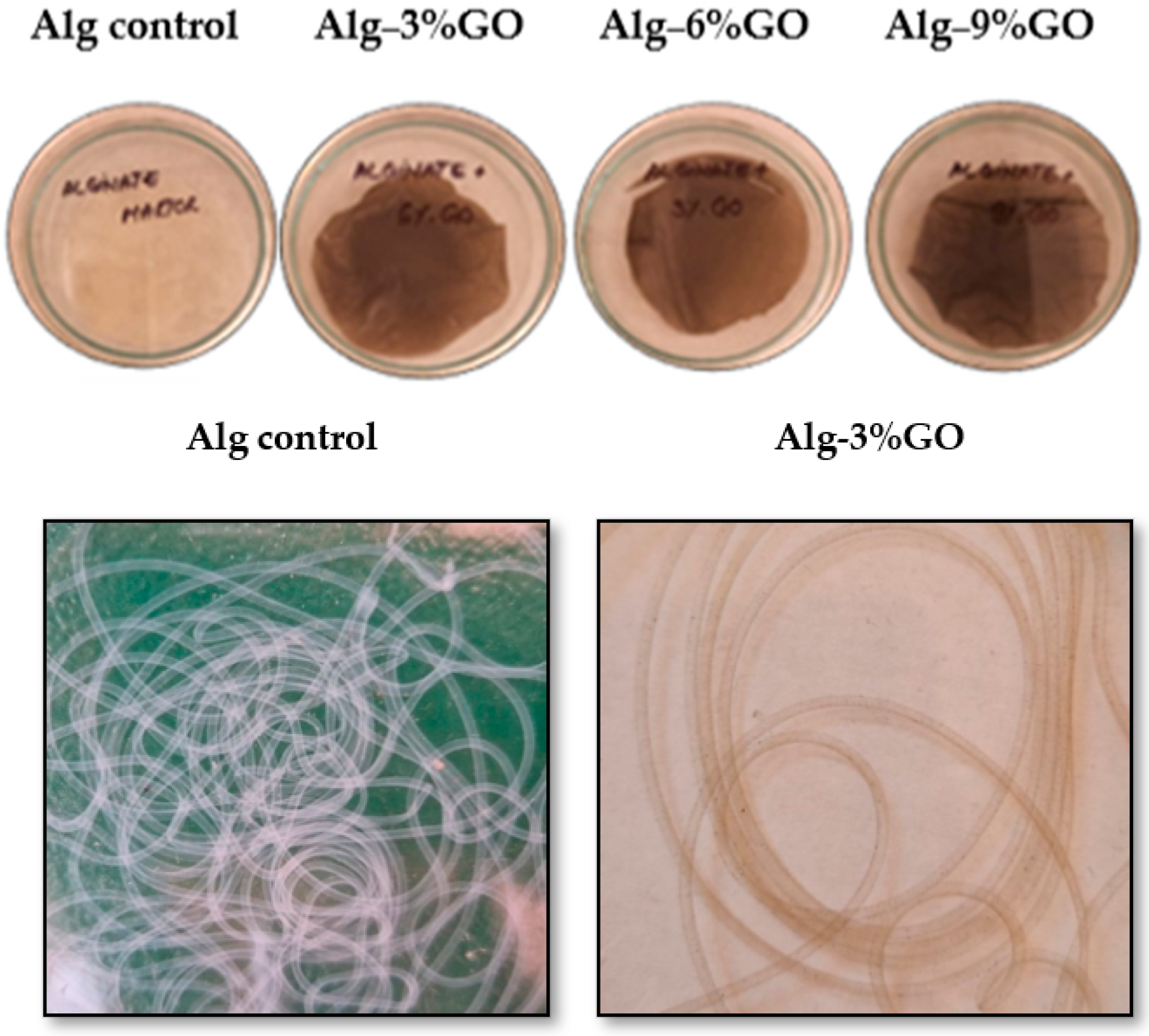
Upon mixing with water, the Alg particles gradually swelled and dissolved, forming a homogeneous solution. To ensure complete dissolution, the solution was continuously stirred for 24 h. Four films were prepared: a control sample and three films containing different amounts of GO, as shown in Figure 1. Both tubular and planar structures were obtained, the most evaluations being done on the planar sample, considering their suitability for analysis. The GO concentration was increased beyond 6% based on the conductivity tests described in the following sections. For the control film, 10 mL of the standard Alg solution was cast into a 9 cm Petri dish and cross-linked with 10 mL of 2 wt% CaCl2 solution. For the GO-containing films, GO was first ground in a mortar with 10 mL of 3 wt% Alg solution and 0.5 mL of a 1 wt% Tween 80 surfactant solution. The addition of Tween 80 facilitates a better homogenization of GO before deposition into Petri dishes. Subsequently, the samples were cross-linked with CaCl2 by spraying, ensuring the formation of uniform films. In this study, crosslinking was allowed to proceed for 15 min, after which the films were carefully washed with distilled water.
CaCl2 is widely used as a calcium ion source for ionic gelation of Alg [54,55]. Previous studies have demonstrated the effectiveness of this crosslinking method. Liling et al. [56] reported that immersing Alg films in a 2 wt% CaCl2 solution for 2 min resulted in complete ionic crosslinking, with significant improvements in mechanical properties compared to the un-crosslinked samples. Similarly, Ibrahim et al. [57] demonstrated that immersion for 2–8 min enhanced the tensile strength and modulus of Alg films.
Tubular Alg structures were investigated for their potential application in peripheral nerve system (PNS) repair (Figure 1). The tubes were fabricated using an automated syringe-based extrusion system equipped with a coaxial spinneret, enabling controlled gelation in a CaCl2 crosslinking bath. The spinneret consisted of a stainless-steel outer needle with an inner diameter of approximately 1.2–1.5 mm, while the inner needle diameter was 0.4–0.6 mm, allowing precise control over lumen formation. In both cases, planar or tubular experimental models, at the preliminary visual examination, it can be concluded that the Alg-GO composites are homogeneous, with the GO powder being well dispersed during the combined crushing and ultrasonation procedure.
As a control, a standard Alg solution supplemented with glycerin was used to fabricate non-conductive tubular scaffolds. To enhance electrical conductivity and promote neuronal regeneration, graphene oxide (GO) was incorporated into the Alg solution at varying concentrations.

2.4. Fourier Transform Infrared Spectroscopy

FTIR spectroscopy was employed to identify the functional groups present and to evaluate the interactions among the constituents of the composite films. Measurements were performed across the spectral interval of 4000–400 cm−1 using a Nicolet iS50 FTIR instrument (Nicolet, MA, Massachusetts, USA) fitted with a DTGS detector. Spectra were collected at 4 cm−1 resolution by averaging 32 consecutive scans. Data acquisition was carried out in attenuated total reflectance (ATR) configuration with a diamond crystal accessory.
In addition, two-dimensional FTIR chemical mapping was conducted to assess the spatial distribution of film components. These measurements were obtained using a Nicolet iS50R FTIR microscope (Nicolet, MA, USA) equipped with a DTGS detector, within the 4000–600 cm−1 spectral range.

2.5. UV-Vis Spectroscopy Measurements

UV–Vis absorption measurements were carried out using a JASCO V560 spectrophotometer (JASCO Inc., Easton, PA, USA) fitted with a 60 mm integrating sphere accessory (ISV-469) and a dedicated film sample holder. Spectral data were collected over the 200–900 nm wavelength interval at a scan rate of 200 nm·min−1.
Film opacity was determined from the relationship A600/x = −log(T600)/x, where A600 represents the absorbance measured at 600 nm, T600 corresponds to the transmittance fraction at the same wavelength, and x denotes the film thickness expressed in millimeters. Greater calculated opacity values correspond to reduced optical transparency of the films [58].

2.6. PL Spectrometry Measurements

Photoluminescence (PL) measurements were performed using a LS55 fluorescence spectrometer from PerkinElmer (Waltham, MA, USA). The excitation source was a xenon lamp operated under ambient conditions. Emission spectra were collected over the 350–600 nm wavelength range. Data acquisition was conducted at a scan rate of 200 nm·min−1, using both excitation and emission slit widths set to 10 nm, together with a 350 nm cut-off filter. The selected excitation wavelength for the measurements was 320 nm.

2.7. Thermal Analysis Measurements

Thermogravimetric and differential scanning calorimetry (TG–DSC) analyses were carried out using a Netzsch STA 449C Jupiter thermal analyzer (Netzsch, Selb, Germany). Approximately 10 mg of each specimen was weighed into an open alumina crucible prior to measurement. The temperature was increased from room temperature to 900 °C at a constant heating rate of 10 K·min−1. Measurements were performed under a flow of dried air maintained at 50 mL·min−1. An empty alumina crucible was used as the reference.

2.8. Swelling Behavior, pH, and Conductivity Measurements

Each specimen was initially weighed to obtain its dry mass (W0), then placed in 200 mL of phosphate-buffered saline solution (PBS, pH 7.4). Swelling ratio, pH, and electrical conductivity were monitored for every sample at fixed time points of 5, 10, 30, 45, and 60 min, as well as after 4, 6, 18, 24, and 48 h of immersion.
The swelling degree, S (%), was determined according to Equation (1):
S ( % ) = W t W 0 W 0 × 100
All measurements were performed in triplicate (n = 3), and the results are reported as mean ± standard deviation (SD). At each interval, the experimental formulations (Alg–3%GO, Alg–6%GO, and Alg–9%GO) were statistically compared with the Alg control using Welch’s two-sample t-test with Bonferroni correction. Statistical significance was considered at p < 0.05 (*), p < 0.01 (**), and p < 0.001 (***). Data analysis was conducted under the assumption of an approximately normal distribution, in accordance with established practices in biomaterials research.

2.9. Electrochemical Conductivity Measurements

Electrical conductivity of Alg–GO solutions was measured using a parallel-opposed dual-electrode cell (stainless steel cylindrical electrodes, 1.483 mm diameter × 4.823 mm length) used in conjunction with a calibrated (KCl 0.02 n solution was used) digital high resolution internal resistance/conductivity meter (RC3563, Xtester, Guangzhou, China) provided with separate paths for current injection and voltage measurements, to reduce electrode polarization and improve accuracy across a wide conductivity range [59]. By knowing the cell constant (determined during the calibration stage from the values of the known conductivity of a KCl 0.02 n solution and measured resistance) and measuring the sample’s resistance, one may now easily calculate the value of conductance and hence that of the conductivity.

2.10. SEM Analysis Measurements

The morphology and microstructural features of the specimens were examined by scanning electron microscopy using a QUANTA INSPECT F50 system fitted with a field emission gun (FEG) source (SEM images (50,000×), QUANTA INSPECT F50, FEI Company, Eindhoven, The Netherlands), offering a resolution of 1.2 nm. Elemental composition analysis was conducted with an attached energy-dispersive X-ray spectroscopy (EDS) detector with a MnK resolution of 133 eV.
Prior to imaging, both the surfaces and fractured cross-sections of the Alg-based samples were sputter-coated with a thin gold layer to improve electrical conductivity. The metallization step was performed for 60 s to obtain a uniform conductive coating.

2.11. Evaluation of Cytocompatibility of Alg–GO Scaffolds Using SH–SY5Y Cells

The human neuroblastoma cell line SH–SY5Y (CRL-2266, ATCC) was employed as an in vitro model to evaluate the cytocompatibility of Alg–GO scaffolds. A three-dimensional cell–scaffold construct was established by seeding cells onto the scaffold surface at a density of 3.5 × 10⁴ cells/cm2. Samples were cultured in a growth medium composed of Minimum Essential Medium Eagle (MEM) and F12 medium (1:1, v/v), supplemented with 10% fetal bovine serum (FBS) and 1% antibiotic mixture.
Cell–scaffold constructs were maintained under standard incubation conditions (37 °C, 5% CO2, and 95% relative humidity) for 7 days. Biocompatibility analyses were performed at 3 and 7 days after seeding. Pure Alg scaffolds were used as control samples in all biological assays.
Cell viability and proliferation were quantified using the MTT assay based on the metabolic reduction of 3-(4,5-dimethylthiazol-2-yl)-2,5-diphenyltetrazolium bromide. Samples were incubated with MTT solution (1 mg/mL) for 4 h under standard culture conditions to allow the formation of formazan crystals by metabolically active cells. The resulting crystals were dissolved in isopropyl alcohol, and absorbance was measured at 550 nm using a FlexStation3 spectrophotometer (Molecular Devices, San Jose, CA, USA).
Cytotoxicity was assessed by measuring lactate dehydrogenase (LDH) release in the culture medium using the LDH-based in vitro toxicology assay kit (TOX7, Sigma-Aldrich, Steinheim, Germany), following the manufacturer’s instructions. Absorbance values were recorded at 490 nm with the same spectrophotometric system.
Qualitative analysis of cell viability and distribution on the scaffolds was performed using a LIVE/DEAD viability/cytotoxicity kit (Invitrogen, Life Technologies, Foster City, CA, USA). Live cells were labeled with calcein AM (green fluorescence), while non-viable cells were stained with ethidium bromide (red fluorescence). Samples were examined using a laser scanning confocal microscope (Nikon A1/A1R Confocal System, Tokyo, Japan), and images were processed with the associated acquisition and analysis software.

3. Results and Discussion

3.1. FTIR Spectroscopy and Microscopy of Alg–GO Films

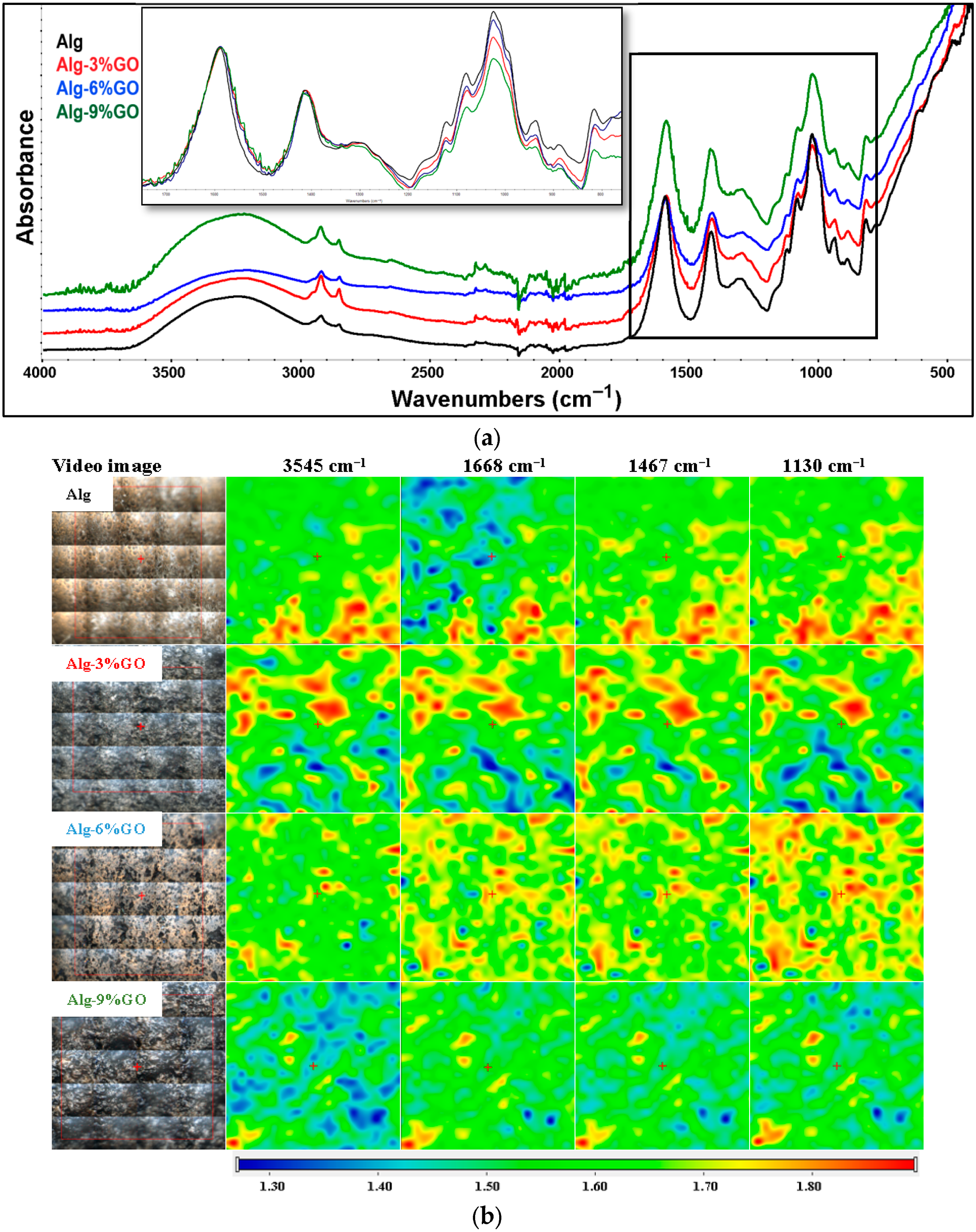
The FTIR spectra of the Alg and Alg–GO materials were recorded and compared (Figure 2). The IR spectrum of the Alg sample showed characteristic absorption bands. The spectral band at 3239 cm−1, along with the peak near 2900 cm−1, was attributed to –OH stretching and aliphatic –CH stretching vibrations, respectively. The peaks observed at 1549 and 1406 cm−1 corresponded to the asymmetric and symmetric stretching vibrations of carboxylate anions, respectively. The bands at 1151 and 1023 cm−1 were assigned to C–O stretching vibrations of the pyranose ring. In the fingerprint region, the peaks at 649 and 514 cm−1 were associated with the asymmetric ring vibration of α-L-glucopyranuronic acid [60,61]. Upon functionalization of Alg with GO, the FTIR spectra of the composites exhibited a noticeable shift in the peaks at 3239, 1549, and 1023 cm−1, attributed to the strong interactions that occur. This observation suggests that GO was successfully integrated into the Alg matrix, by strong interactions and not only by mechanical entrapment [62,63]. The most important shift is associated with the peak from 1406 cm−1, which appears at 1417 cm−1 in the case of Alg-9%GO. Considering the insert from Figure 2a, it can first be seen that the main band centered at ~1580 cm−1 became much larger once GO is added into the alginate matrix, meaning that a strong interaction between these components occurs. Similar important changes (shifts and peaks in intensity) are observed in the 900–1200 cm−1. These are especially visible at 3% GO, while the addition of more GO practically does not consistently change this behavior, which means that GO is starting to not interact with the Alg matrix and confer the premises for the development of bridges between graphene clusters, which is important to get improved electric capabilities.
FTIR microscopy was employed to evaluate the homogeneity of the films. Four characteristic wavelengths were selected for this purpose: 1130, 1467, 1668, and 3545 cm−1, corresponding to major absorption bands of the film components. The 3545 cm−1 band was associated with moisture and served as an indirect indicator of uniformity, since water was adsorbed from the air in a non-homogeneous manner depending on both the film’s density and its composition (because alginate and graphene oxide exhibit different hygroscopic behaviors).
By comparing the four spectral maps, it was observed that films of pure sodium alginate displayed slight heterogeneity in Ca2+ retention, likely due to the absence of the reinforcing agent (GO). Without GO, alginate chains were less easily displaced, which resulted in a more compact crosslinking structure, as evidenced by the calcium alginate distribution recorded at 1668 cm−1. In contrast, the Alg–3%GO sample exhibited a highly homogeneous structure, as all maps showed similar patterns regardless of the wavelength considered.
As the GO content increased, the maps obtained at 1130, 1467, and 1668 cm−1 remained consistent, indicating structural homogeneity; however, the maps recorded at 3545 cm−1 revealed proportional differences in moisture distribution. This suggested that at higher GO concentrations, slight heterogeneities appeared due to the differential adsorption of humidity.

3.2. UV-Vis Spectroscopy Results

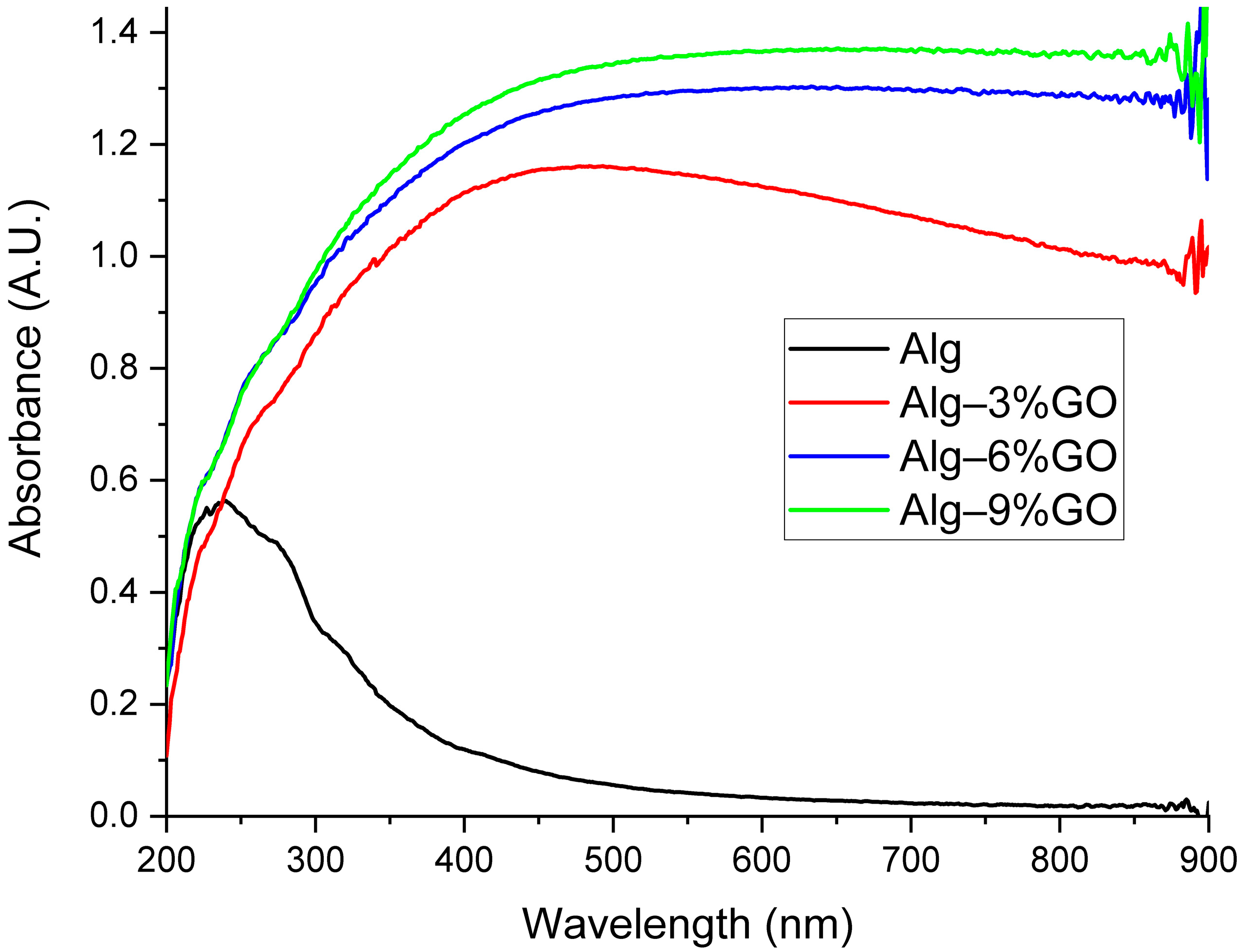
The yellowish-tinted Alg transparent films exhibited an absorption maximum around 450 nm, a characteristic feature of films made from this polymer [58].
The incorporation of GO into the polymer matrix changed the color to black, resulting in strong light absorption across the visible domain. The maximum absorption for the Alg films was observed at 9%GO content (Figure 3).
Table 1 presents the calculated values of opacity for the alginate and composite films, with higher values indicating greater opacity. The simple Alg film exhibited a low opacity value, consistent with its good transparency as previously reported [58,64]. The addition of 3%GO dramatically increased the opacity of the films, while further addition of GO up to 9% had only a marginal effect. At both 6 and 9% of GO, practically full absorption is obtained between 450 and 900 nm, while in the case of the sample with 3% GO, the absorption is not partial in this interval. Looking at the standard deviation of the samples, the relative standard deviation is ~17% for the composite samples, while in the case of the pure alginate, this is ~26%, which means that these samples exhibit lower heterogeneities (this factor being the most important leading to opacity).

3.3. PL Spectrometry Results

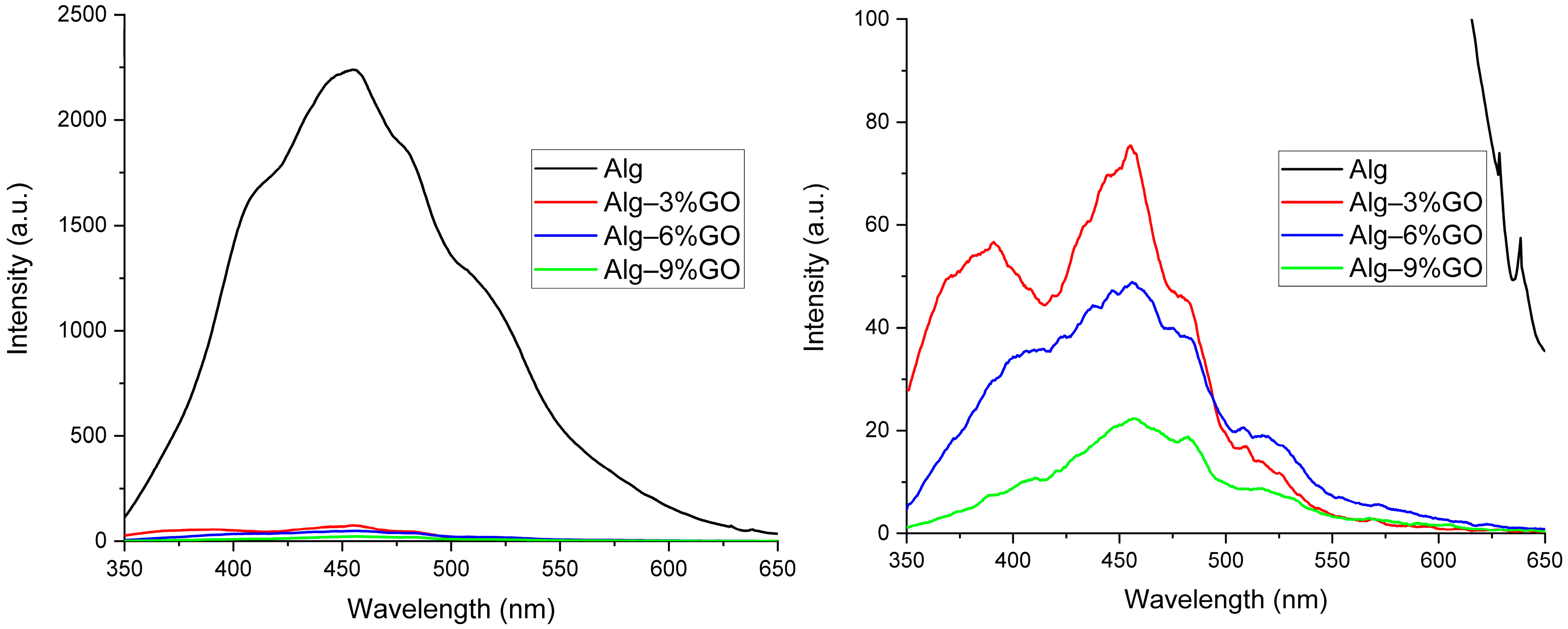
The photoluminescence (PL) spectra for Alg and Alg-based composite films are presented in Figure 4. The Alg film exhibited strong fluorescence, as is typical for polysaccharide [65,66]. The Alg fluorescence is quenched when GO was added into the composite film, due to interactions between the nanosheets and the polymer structure. The nanosheets blocked the fluorescent emission by interacting with the moieties responsible for the Alg fluorescent emission, indicating that the composite was more than a simple physical mixture. Furthermore, the fluorescence quenching could also have been attributed to the fact that GO introduced non-radiative pathways for the recombination of excited electrons and corresponding holes, likely through surface conduction.
As the percent of GO increased from 3% to 9%, the intensity of the fluorescent emission further decreased, particularly the peak at 391 nm, which nearly disappeared at Alg–9%GO sample. The other emission band in the visible spectrum (in the blue region, at 457 nm) was also strongly dependent on the GO percentage.

3.4. Thermal Analysis

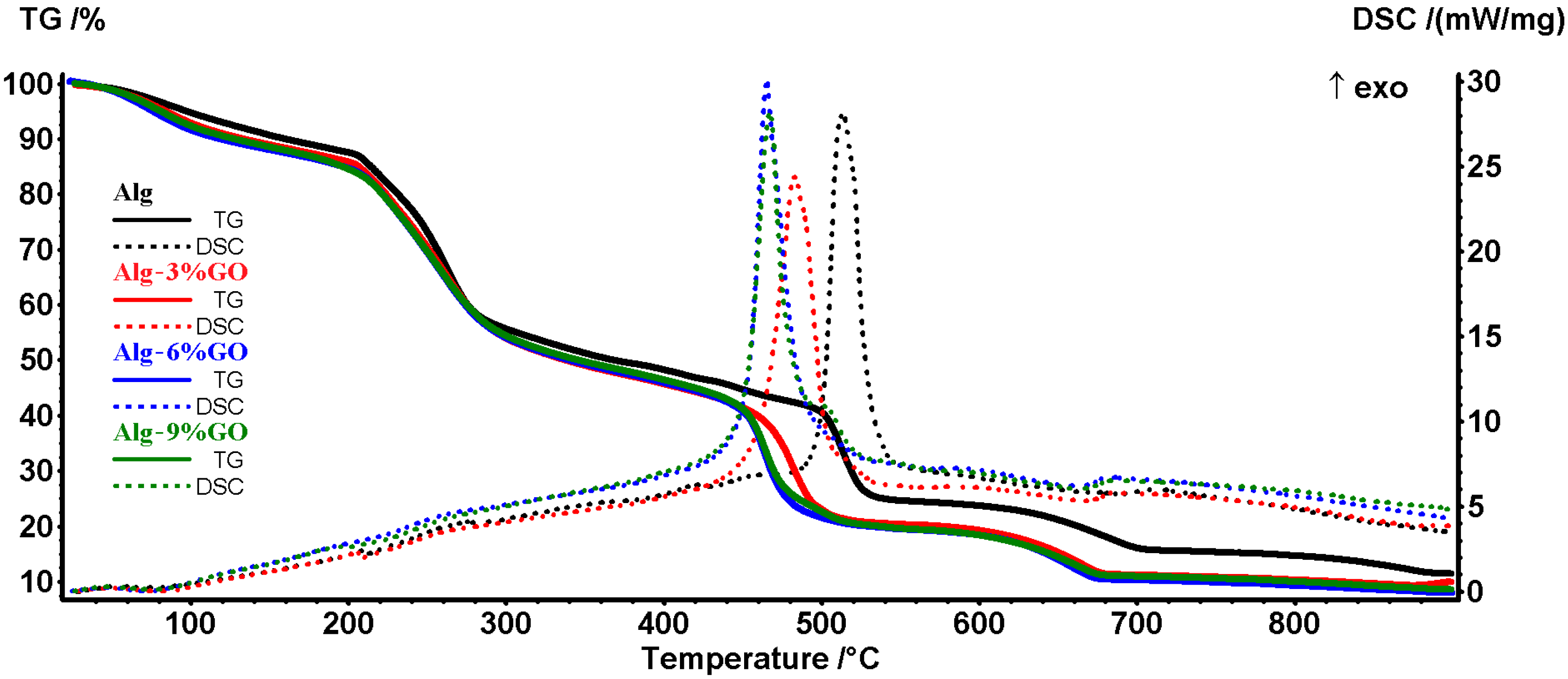
The thermal analysis results, TG and DSC curves, were presented in Figure 5. The main differences between Alg and the composite films were related to the amount of residual humidity, observed as mass loss up to 200 °C. All composite films exhibited a slightly higher mass loss in the temperature range 20–205 °C, as indicated by the values from Table 2. This mass loss increased with higher GO content, most likely due to water molecules remaining trapped between the GO sheets. Between 205 and 300 °C, the polymer chains fragmented and were partially oxidized, corresponding to the principal mass loss recorded for all samples (~29–32%). Complete oxidation of the carbonaceous mass occurred at different temperatures for Alg and the composite films, as evidenced by the strong and sharp exothermic effect observed on the DSC curves. For Alg, this peak appeared at 513.7 °C, whereas for Alg–3%GO it shifted to a lower temperature of 483.6 °C. With further increases in GO content, the exothermic peak shifted to 465–467 °C and was not significantly influenced. This means that the addition of the GO is favoring the degradation of the alginate matrix. The most important change is observed at the addition of 3% GO (the shift being ~27 °C), while practically for 6 and 9 percent, just ~16 °C shift was observed. Practically, the peaks associated with the samples with 6 and 9% GO appear at the same values.
The mass loss also increased for the composite samples compared to the Alg film during this oxidation process, indicating a direct relationship with the presence of GO. Therefore, it could be assumed that GO was completely oxidized between 450 and 500 °C [67], together with the residual carbonaceous mass originating from the Alg chains.
The final mass loss, occurring after 600 °C, was attributed to the decomposition of CaCO3 formed during the degradation of Alg chains that had been cross-linked with Ca2+ ions. The residual mass was lower for the composite films, as the Alg proportion was smaller.

3.5. Swelling Behavior

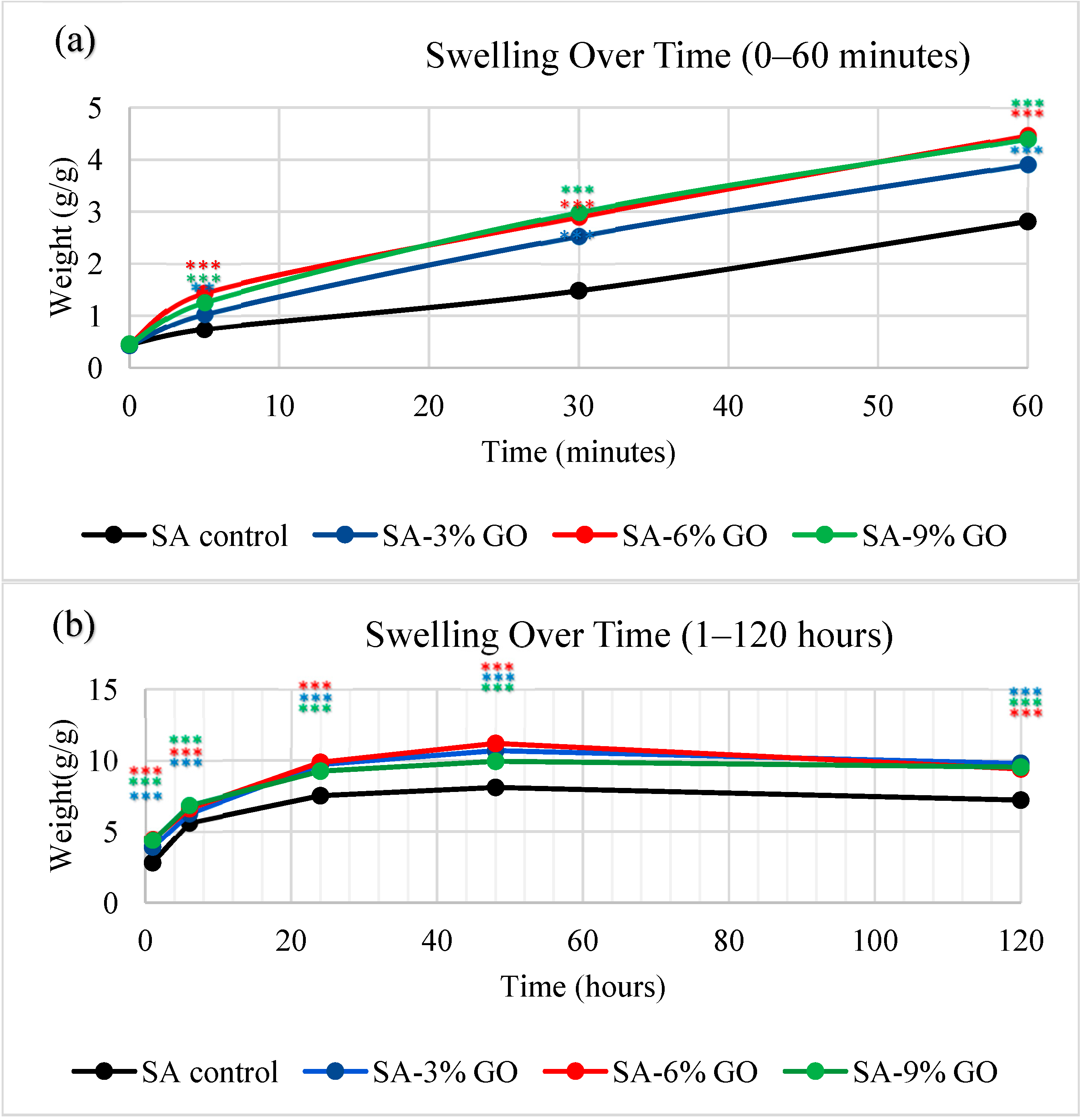
The swelling profile of Alg hydrogels containing different concentrations of GO was evaluated in Figure 6a,b over a short period of 60 min and extended periods up to 120 h. All formulations had identical starting swelling values (0%), ensuring comparable baseline measurements.
As shown in Figure 6a, the swelling ratio increased notably within the first 5 min, especially in the GO-loaded samples. Alg–6%GO exhibited the highest swelling ratio at 5 min (220%), followed by Alg–9%GO (180%), Alg–3%GO (139%), and the control (64%). This trend continued at 30 and 60 min, where the swelling ratios increased significantly with GO concentration. At 60 min, Alg–6%GO showed the highest swelling capacity (893%), followed closely by Alg–9%GO (878%), Alg–3%GO (809%), and the Alg control (524%).
To further investigate the hydrogel behavior over extended periods, the weight of the swollen hydrogels was monitored at 4 h, 6 h, 24 h, 48 h, and 5 days (Figure 6b).
All formulations demonstrated a rapid increase in weight during the first 24 h, indicating strong water absorption. This trend continued, and by 48 h, the Alg–6%GO hydrogel showed the greatest weight gain (2387%), outperforming all other samples. Interestingly, by day 5 (120 h), a slight decrease in weight was observed in all samples, potentially due to water loss or network degradation. Despite this, the Alg–6%GO hydrogel maintained high retention (1989%), while Alg–3%GO and Alg–9%GO retained 2177% and 2016%, respectively.
The findings demonstrated that the incorporation of GO into the Alg matrix enhanced water uptake and swelling behavior, attributable to the increased hydrophilicity and porosity introduced by GO. Among the formulations, Alg–6%GO exhibited the most favorable performance in both short- and long-term water absorption, which was attributed to improved matrix integrity and water-binding capacity conferred by GO.

3.6. pH Variation

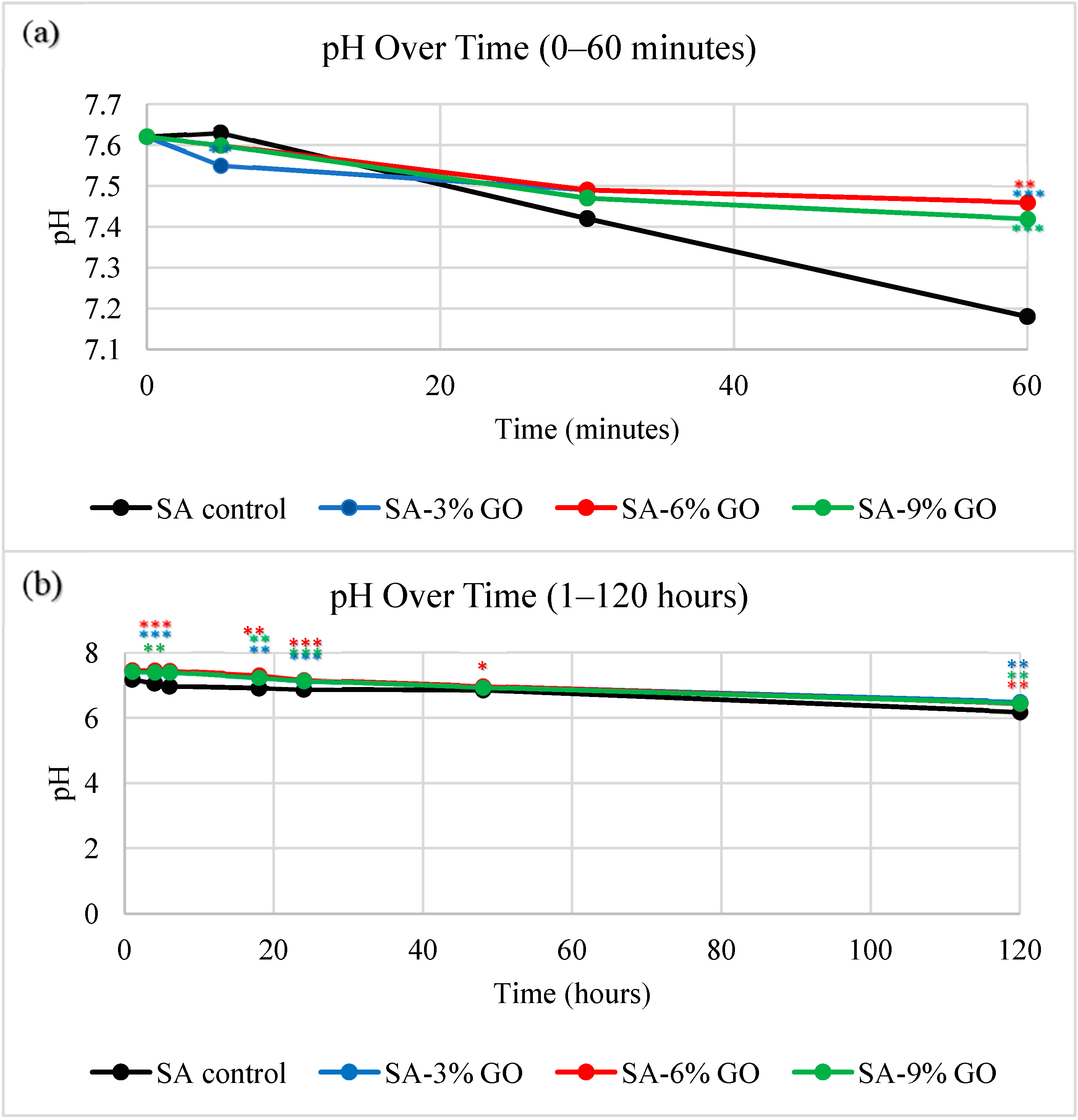
The pH of the PBS solutions started from ~7.6 and gradually decreased throughout the monitored period (Figure 7a,b). The decrease in pH over time suggests a noticeable acidification after introducing Alg matrices in PBS. During this process, calcium phosphates precipitate and alginic acid is released into the solution, slightly altering the pH [68,69].
During the first 60 min (Figure 7a), all samples showed a slight decline in pH. The Alg control showed the most pronounced drop, while the GO-containing scaffolds displayed improved stability.
Over the extended period of 120 h (Figure 7b), all samples continued to show a gradual decrease in pH. The Alg control sample experienced the most pronounced decline, indicating a significant acidification over time because the alginic acid was not adsorbed on the samples. In contrast, GO-loaded samples demonstrated improved pH stability, with alginic acid being better adsorbed on the GO by hydrogen bonds.
Overall, the addition of GO to Alg scaffolds slightly reduced the acidification over time. While all samples, including the control, experienced a gradual decrease in pH, the final values for GO-enhanced Alg remained slightly higher than the control. This suggested that the incorporation of GO, regardless of concentration, helped maintain a more stable pH environment compared to the pure Alg scaffold. These findings supported the potential use of GO-enhanced Alg scaffolds in biomedical applications where pH stability was important, even if some acidification occurred.

3.7. Conductivity Variation in Solution

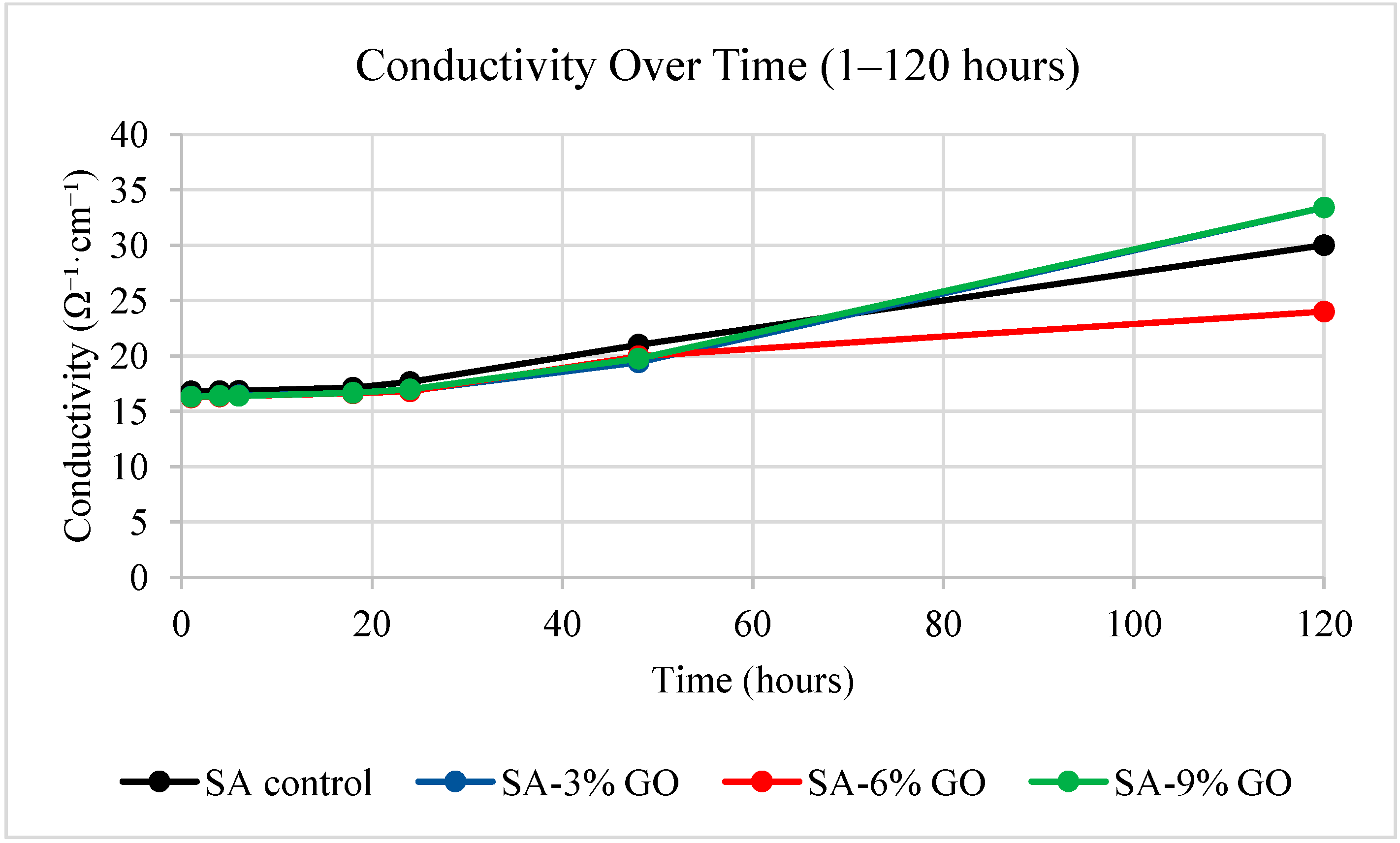
The initial conductivity of the PBS solution for all samples was 15.97 × 10⁻³ Ω−1⋅cm−1. By the first hour, the GO-containing samples displayed slightly lower conductivity compared to the control.
Over the extended period (Figure 8), conductivity increased steadily in all samples, indicating ongoing ion release. Alg–3%GO and Alg–9%GO reached the highest values, surpassing the control, whereas Alg–6%GO plateaued at a lower level, suggesting reduced ion release at this concentration, probably due to an optimal ratio between Alg and GO.
All GO groups showed statistically significant differences compared to the control, with most comparisons reaching *** (p < 0.001). These results indicated that the incorporation of GO strongly and consistently modified the conductivity of the solution over time. Statistical significance was not shown on the graph for clarity.
The overall rise in conductivity demonstrated that the scaffolds interacted with the PBS solution, likely through ion release or modification of the ionic environment. The enhancement in conductivity, particularly at higher GO concentrations, highlighted the potential of these scaffolds to improve the electrical environment and support neural cell communication and function.

3.8. Electrochemical Conductivity Results

The conductivity increased with the addition of GO. The Alg control sample (0%GO) exhibited minimal conductivity, while samples with 3%, 6%, and 9%GO showed a general increasing trend. The 3%GO sample displayed a conductivity in the range of 5.99 × 10⁻¹⁰ Ω−1·cm−1, which was relatively low compared to the other samples. The 6% GO sample showed a slight decrease in conductivity (4.22 × 10⁻¹⁰ Ω−1.cm−1), suggesting that at this concentration, GO may still have been dispersed within the insulating Alg matrix, thereby limiting charge transfer efficiency. Relative conductivity values (dimensionless), calculated as the ratio of each measured conductivity to the lowest average conductivity, were also determined (Table 3). The results showed that, for all GO concentrations, the values remained within one order of magnitude compared with the lowest conductivity but comparable with the native neural tissues, that is, according to the literature, from µS/cm to mS/cm [70].
The 6% GO scaffold provided a balanced combination of moderate conductivity and biocompatibility, reducing the risk of excessive current flow that could damage cells. In contrast, the 9% GO solution demonstrated a marked increase in conductivity, which made it more suitable for applications requiring enhanced electrical stimulation, such as neural regeneration or bioelectronic interfaces.
A significant jump in conductivity was observed in the 9%GO sample, which reached 3.38 × 10⁻⁹ Ω−1.cm−1 an order of magnitude higher than the 3% and 6%GO samples. This sharp rise indicated that at 9%GO, the percolation threshold for electrical pathways had been reached, enabling more effective charge transfer. According to percolation theory, conductivity in composite materials increases abruptly once the critical concentration of conductive filler (in this case, GO) is reached, enabling efficient electron transport across the network [71].

3.9. SEM Analysis Results

Alg materials often have a porous microstructure, which may be visible in SEM images. These pores can vary in size and distribution, influencing properties such as swelling behavior and permeability [72].
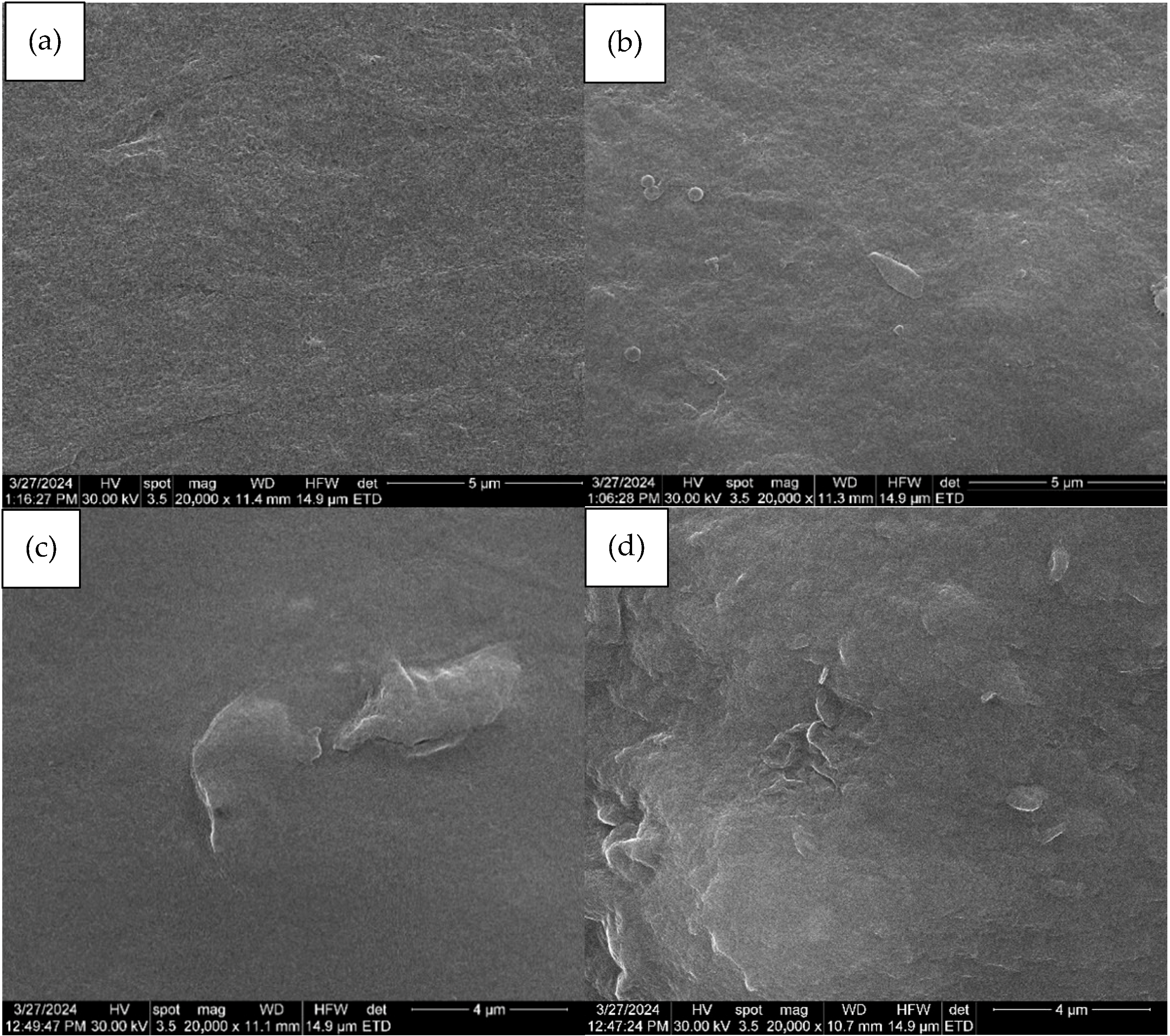
SEM analysis of the Alg control film revealed a granular-like surface morphology, resulting from the collapse and rearrangement of the Alg gel network during the drying process. The surface consisted of granules with heterogeneous size and morphology, ranging from small, nearly spherical particles to irregularly shaped aggregates. Higher-magnification images enabled a detailed examination of the microstructure, revealing polymer organization characterized by a subtle hill–valley topography, which can be attributed to the crosslinking-induced restructuring of the initially flowing gel (Figure 9a).
In contrast, the surface of Alg–GO films exhibited a rough and textured appearance due to the interaction with GO, which appeared as flakes or thin sheets with irregular shapes. The edges of the sheets seemed to be rough or crumpled due to the oxidation process and functional groups attached to the G layers (Figure 9b–d). Depending on the concentration and distribution of GO within the Alg matrix, the composite became more brittle, increasing the likelihood of crack formation in the Alg–GO composite. The distribution of GO throughout the Alg matrix was homogeneous, indicating the potential for enhanced electrical conductivity properties. Importantly, no crystals can be observed on the surface (CaCl2), resulting from the crystallization of the salts used in the gelation-crosslinking process.

3.10. Cytocompatibility Assessment of SH–SY5Y Cell Culture in Contact with Alg–GO Scaffolds

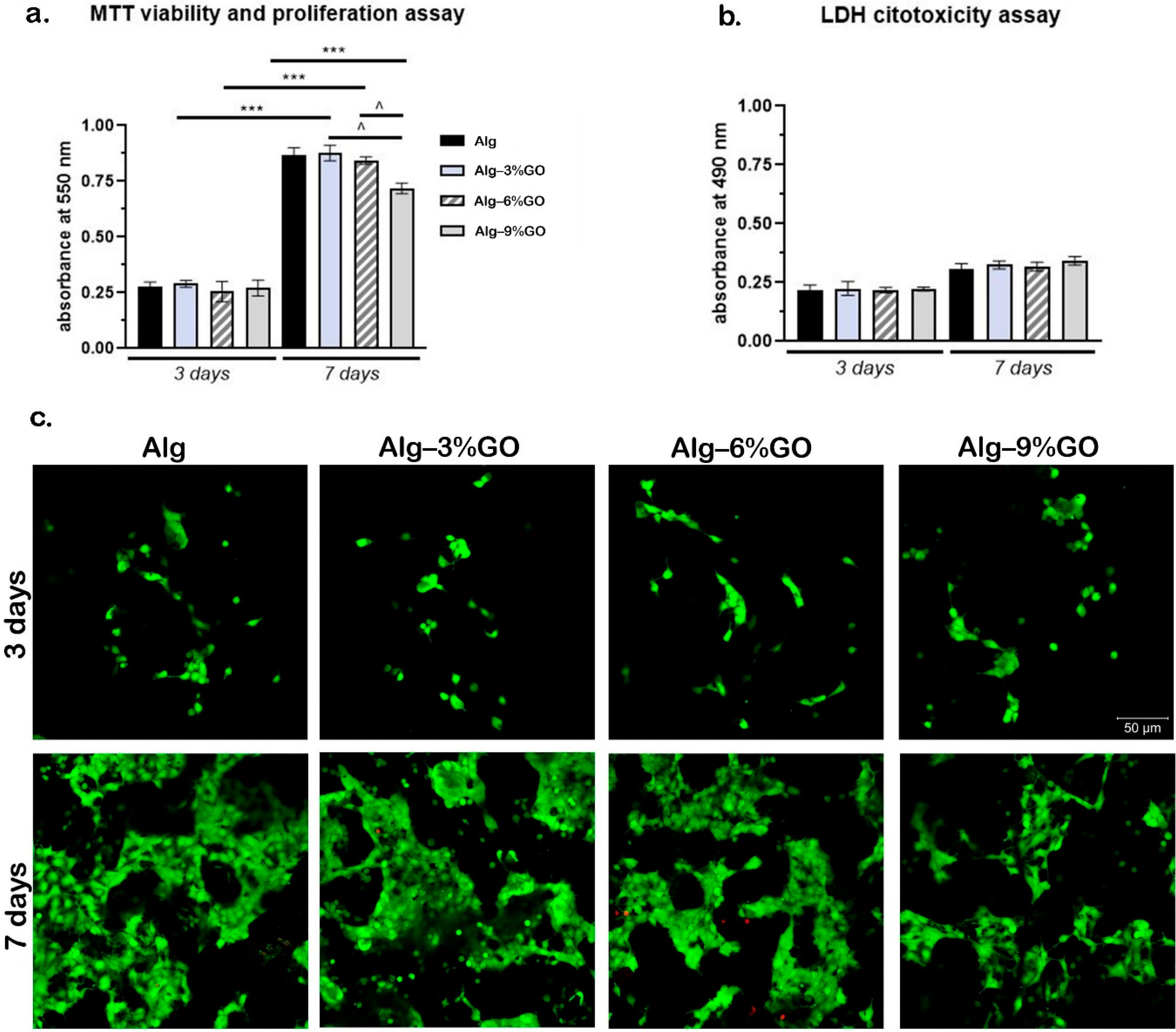
Cell viability and proliferation, evaluated via quantitative MTT assay (Figure 10a), indicated an overall good interaction between SH–SY5Y cell culture and the tested Alg–GO materials. At 3 days post-seeding, a normal rate of cell viability was registered across all tested materials, with no significant differences between the four composites. After 7 days of in vitro culture, the composites enriched with 3% and 6% GO showed similar viability values, with no significant changes between them. However, the addition of more GO up to 9% led to a significant decrease in cell viability, in comparison to plain Alg and the other GO-loaded Alg materials (p < 0.05). Interestingly, a significant (p < 0.001) proliferation rate was found on all tested composites from 3 to 7 days of cell culture.
LDH assay indicated the cytotoxic potential of Alg–GO enriched materials upon the SH–SY5Y cell culture (Figure 10b). After 3 days, relatively low LDH levels were detected in the culture medium, with no significant differences among the composites. These levels remained stable after 7 days post-seeding, without causing significant toxicity in the neuroblastoma cell line. Nonetheless, a slight increase in LDH release was observed as the GO content increased.
LIVE/DEAD confocal microscopy (Figure 10c) results were consistent with those obtained from MTT and LDH assays. At 3 days post-seeding, only a small number of cells adhered to the material surfaces. However, these cells exhibited an elongated shape and formed small groups of cells. All captured images revealed green-labeled viable cells in contact with the Alg–GO composites. After 7 days of in vitro culture, the LIVE/DEAD staining showed a significant increase in cell density, confirming that cells proliferated in the presence of Alg–GO composite materials. Nevertheless, proliferation on Alg–9%GO was less pronounced compared with the other samples, pure Alg or composite ones.
Overall, these findings indicate that the presence of GO, regardless of concentration in the 3–9%, supports proper cell development. However, incorporation of up to 6% GO appears to provide optimal stimulation for cell proliferation, without inducing cytotoxicity.

3.11. Structure–Property–Biological Correlations Defining an Optimal GO Loading

Relationships between electrical conductivity, swelling degree, and cell proliferation were examined across the entire composite series. Electrical conductivity increased nonlinearly with GO loading, with a marked rise at 9% GO (≈one order of magnitude higher than 3–6%), consistent with a percolation-type transition. In contrast, the swelling degree reached its maximum at 6% GO (≈2387% at 48 h), exceeding both 3% GO and 9% GO formulations. Cell proliferation (MTT, day 7) followed a different trend, showing the highest values for 3% and 6% GO, and a significant reduction at 9% GO (p < 0.05). A multi-parameter comparison matrix (Table 4) further illustrates that the 6% GO formulation provides the best combined performance across electrical, hydration, and biological criteria.
The 6% GO scaffold lies at the intersection of these trends, combining elevated conductivity with the highest swelling capacity and preserved cell proliferation, thereby quantitatively supporting its selection as the optimal compromise formulation. While this enhanced electrical permissiveness is advantageous for charge transfer at the cell–material interface, it does not by itself guarantee electrically driven neural regeneration. Active modulation of neurite outgrowth and functional maturation generally requires externally applied electrical stimulation with carefully controlled parameters, including field strength, frequency, and duration, tailored to the target neural tissue. Accordingly, in the present work, scaffold conductivity should be regarded as an enabling property that supports electrically active and stimulation-compatible environments, rather than a standalone regenerative stimulus.

4. Conclusions

The principal contribution of this work is the controlled, multi-parameter determination of an intermediate GO loading that balances electrical functionality, hydration behavior, and neuro-cytocompatibility under identical fabrication conditions. This approach provides a design-relevant composition window for conductive Alg-based neural scaffolds. An important milestone in developing composite materials loaded with graphene-related materials was achieved by developing highly loaded composites, where the inherent biocompatibility of Alg, combined with the distinct physicochemical characteristics of GO, provides a synergistic platform that promotes neural cell adhesion and electrical conductivity. FTIR spectroscopy confirmed the successful incorporation of GO into the Alg matrix and revealed strong intermolecular interactions between the two phases. UV–Vis and photoluminescence analyses further indicated GO-induced modifications in the optical behavior of the composites. Electrical conductivity measurements demonstrated a marked improvement in conductivity, a property of particular relevance for electrically active neural tissues.
Among the tested formulations, Alg–GO scaffolds containing 6% GO exhibited the most favorable balance between structural stability, swelling capacity, and conductivity, suggesting their suitability for neuroregenerative applications. FTIR microscopy and SEM analysis confirmed a homogeneous distribution of GO within the Alg network, ensuring structural uniformity. Biological assessments using SH–SY5Y neuroblastoma cells revealed robust viability and proliferation across all samples. While scaffolds with higher GO content (9%) remained non-cytotoxic, they exhibited slightly reduced proliferation compared to lower GO concentrations.
These findings highlight the biocompatibility and multifunctional performance of Alg–GO composites and support their potential use in peripheral nerve regeneration. Future work will focus on integrating electrical stimulation protocols with the proposed scaffold system and evaluating neuron-specific responses, including differentiation, network formation, and electrophysiological behavior, in order to fully assess its potential for neural tissue engineering applications.

Author Contributions

Conceptualization, A.-I.L. and A.F.; methodology, A.Ș., L.M., O.-C.O. and S.D.; software, L.M. and O.-C.O.; validation, A.F., A.-M.C. and D.F.; formal analysis, A.-I.L., L.M., O.-C.O., R.-D.T., D.-I.V. and A.Ș.; investigation, A.-I.L., A.Ș., D.F. and S.D.; re-sources, A.F., D.F., L.M., O.-C.O. and S.D.; data curation, A.-I.L.; A.-M.C., L.M. and O.-C.O.; writing—original draft preparation, A.-I.L., A.-M.C., A.Ș., L.M. and O.-C.O.; writing—review and editing, A.F., D.F., D.-I.V. and S.D.; visualization, D.F., L.M. and S.D.; supervision, A.F., D.F., D.-I.V. and S.D.; project administration, A.F.; funding acquisition, A.F. and S.D. All authors have read and agreed to the published version of the manuscript.

Funding

The authors acknowledge the financial support of the Smart2Graph—Smart nerve grafts based on graphene-related composite materials with electric-triggering capability for central and peripheral nervous system regeneration, funded within the Flag Era Call and co-founded by the Ministry of Research, Innovation and Digitization of Romania, CNCS/CCCDI-UEFISCDI, project number 28/17.05.2024. The APC was funded by the National University of Science and Technology POLITEHNICA Bucharest.

Institutional Review Board Statement

Not applicable.

Data Availability Statement

The original contributions presented in this study are included in the article. Further inquiries can be directed to the corresponding author.

Acknowledgments

The authors are grateful to the Romanian Government for providing access to the research infrastructure of the National Center for Micro and Nanomaterials through the National Program titled “Installations and Strategic Objectives of National Interest.

Conflicts of Interest

The authors declare no conflicts of interest.

References

  1. Farshidfar, N.; Tanideh, N.; Emami, Z.; Sari Aslani, F.; Sarafraz, N.; Khodabandeh, Z.; Zare, S.; Farshidfar, G.; Nikoofal-Sahlabadi, S.; Tayebi, L.; et al. Incorporation of curcumin into collagen-multiwalled carbon nanotubes nanocomposite scaffold: An in vitro and in vivo study. J. Mater. Res. Technol. 2022, 21, 4558–4576. [Google Scholar] [CrossRef]
  2. Hernández-González, A.C.; Téllez-Jurado, L.; Rodríguez-Lorenzo, L.M. Alginate hydrogels for bone tissue engineering, from injectables to bioprinting: A review. Carbohydr. Polym. 2020, 229, 115514. [Google Scholar] [CrossRef] [PubMed]
  3. Fornasari, B.E.; Carta, G.; Gambarotta, G.; Raimondo, S. Natural-Based Biomaterials for Peripheral Nerve Injury Repair. Front. Bioeng. Biotechnol. 2020, 8, 554257. [Google Scholar] [CrossRef] [PubMed]
  4. Yao, X.; Xue, T.; Chen, B.; Zhou, X.; Ji, Y.; Gao, Z.; Liu, B.; Yang, J.; Shen, Y.; Sun, H.; et al. Advances in biomaterial-based tissue engineering for peripheral nerve injury repair. Bioact. Mater. 2025, 46, 150–172. [Google Scholar] [CrossRef] [PubMed]
  5. Kornfeld, T.; Vogt, P.M.; Radtke, C. Nerve grafting for peripheral nerve injuries with extended defect sizes. Wien Med. Wochenschr. 2019, 169, 240–251. [Google Scholar] [CrossRef]
  6. Nectow, A.R.; Marra, K.G.; Kaplan, D.L. Biomaterials for the development of peripheral nerve guidance conduits. Tissue Eng. Part B Rev. 2012, 18, 40–50. [Google Scholar] [CrossRef] [PubMed]
  7. Fakhri, E.; Eslami, H.; Maroufi, P.; Pakdel, F.; Taghizadeh, S.; Ganbarov, K.; Yousefi, M.; Tanomand, A.; Yousefi, B.; Mahmoudi, S.; et al. Chitosan biomaterials application in dentistry. Int. J. Biol. Macromol. 2020, 162, 956–974. [Google Scholar] [CrossRef]
  8. Kusuhara, H.; Hirase, Y.; Isogai, N.; Sueyoshi, Y. A clinical multi center registry study on digital nerve repair using a biodegradable nerve conduit of PGA with external and internal collagen scaffolding. Microsurgery 2019, 39, 395–399. [Google Scholar] [CrossRef]
  9. Sayanagi, J.; Tanaka, H.; Ebara, M.; Okada, K.; Oka, K.; Murase, T.; Yoshikawa, H. Combination of electrospun nanofiber sheet incorporating methylcobalamin and PGA-collagen tube for treatment of a sciatic nerve defect in a rat model. J. Bone Jt. Surg. 2020, 102, 245–253. [Google Scholar] [CrossRef]
  10. Jahromi, H.K.; Farzin, A.; Hasanzadeh, E.; Barough, S.E.; Mahmoodi, N.; Najafabadi, M.R.H.; Farahani, M.S.; Mansoori, K.; Shirian, S.; Ai, J. Enhanced sciatic nerve regeneration by poly L-lactic acid/multi-wall carbon nanotube neural guidance conduit containing Schwann cells and curcumin encapsulated chitosan nanoparticles in rat. Mater. Sci. Eng. 2020, 109, 110564. [Google Scholar] [CrossRef]
  11. Xu, F.; Zhang, K.; Lv, P.; Lu, R.; Zheng, L.; Zhao, J. NECL1 coated PLGA as favorable conduits for repair of injured peripheral nerve. Mater. Sci. Eng. C 2017, 70, 1132–1140. [Google Scholar] [CrossRef] [PubMed]
  12. Dos Santos, F.P.; Peruch, T.; Katami, S.J.V.; Martini, A.P.R.; Crestani, T.A.; Quintiliano, K.; Maurmann, N.; Sanches, E.F.; Netto, C.A.; Pranke, P.; et al. Poly (lactide-co-glycolide) (PLGA) scaffold induces short-term nerve regeneration and functional recovery following sciatic nerve transection in rats. Neuroscience 2019, 396, 94–107. [Google Scholar] [CrossRef] [PubMed]
  13. Lu, P.; Wang, G.; Qian, T.; Cai, X.; Zhang, P.; Li, M.; Shen, Y.; Xue, C.; Wang, H. The balanced microenvironment regulated by the degradants of appropriate PLGA scaffolds and chitosan conduit promotes peripheral nerve regeneration. Mater. Today Bio 2021, 12, 100158. [Google Scholar] [CrossRef] [PubMed]
  14. Manto, K.M.; Govindappa, P.K.; Parisi, D.; Karuman, Z.; Martinazzi, B.; Hegarty, J.P.; Talukder, M.A.H.; Elfar, J.C. (4-Aminopyridine)-PLGA-PEG as a novel thermosensitive and locally injectable treatment for acute peripheral nerve injury. ACS Appl. Bio Mater. 2021, 4, 4140–4151. [Google Scholar] [CrossRef]
  15. Dong, R.; Liu, C.; Tian, S.; Bai, J.; Yu, K.; Liu, L.; Tian, D. Electrospun polycaprolactone (PCL)-amnion nanofibrous membrane prevents adhesions and promotes nerve repair in a rat model of sciatic nerve compression. PLoS ONE 2020, 15, e0244301. [Google Scholar] [CrossRef]
  16. Dursun Usal, T.; Yesiltepe, M.; Yucel, D.; Sara, Y.; Hasirci, V. Fabrication of a 3D printed PCL nerve guide: In vitro and in vivo testing. Macromol. Biosci. 2022, 22, 2100389. [Google Scholar] [CrossRef]
  17. Yang, H.; Li, Q.; Li, L.; Chen, S.; Zhao, Y.; Hu, Y.; Wang, L.; Lan, X.; Zhong, L.; Lu, D. Gastrodin modified polyurethane conduit promotes nerve repair via optimizing Schwann cells function. Bioact. Mater. 2022, 8, 355–367. [Google Scholar] [CrossRef]
  18. Boni, R.; Ali, A.; Shavandi, A.; Clarkson, A.N. Current and novel polymeric biomaterials for neural tissue engineering. J. Biomed. Sci. 2018, 25, 90. [Google Scholar] [CrossRef]
  19. Fang, F.; Wang, X.; Tao, Y.; Su, Y.; Dan, W.; Du, Z.; Guo, G.; Shen, Y. Collagen-based biomaterials in neural injury repair: Current advances and future perspectives. Collagen Leather 2025, 7, 27. [Google Scholar] [CrossRef]
  20. Viezuina, D.M.; Musa, I.; Aldea, M.; Matache, I.M.; Rotaru Zavaleanu, A.D.; Gresita, A.; Veronica, S.; Mitran, S.I. Gelatin-based hydrogels for peripheral nerve regeneration: A multifunctional vehicle for cellular, molecular, and pharmacological therapy. Gels 2025, 11, 490. [Google Scholar] [CrossRef]
  21. Madappura, A.P.; Madduri, S. A comprehensive review of silk-fibroin hydrogels for cell and drug delivery applications in tissue engineering and regenerative medicine. Comput. Struct. Biotechnol. J. 2023, 21, 4868–4886. [Google Scholar] [CrossRef]
  22. Yao, Z.A.; Chen, F.J.; Cui, H.L.; Lin, T.; Guo, N.; Wu, H.G. Efficacy of chitosan and sodium alginate scaffolds for repair of spinal cord injury in rats. Neural Regen. Res. 2018, 13, 502–509. [Google Scholar] [CrossRef]
  23. Farshidfar, N.; Iravani, S.; Varma, R.S. Alginate-Based Biomaterials in Tissue Engineering and Regenerative Medicine. Mar. Drugs 2023, 21, 189. [Google Scholar] [CrossRef] [PubMed]
  24. Naghieh, S.; Sarker, M.D.; Abelseth, E.; Chen, X. Indirect 3D bioprinting and characterization of alginate scaffolds for potential nerve tissue engineering applica tions. J. Mech. Behav. Biomed. Mater. 2019, 93, 183–193. [Google Scholar] [CrossRef] [PubMed]
  25. Baniasadi, H.; SA, A.R.; Mashayekhan, S. Fabrication and characterization of conductive chitosan/gelatin-based scaffolds for nerve tissue engineering. Int. J. Biol. Macromol. 2015, 74, 360–366. [Google Scholar] [CrossRef] [PubMed]
  26. Chen, S.; Liu, A.; Wu, C.; Chen, Y.; Liu, C.; Zhang, Y.; Wu, K.; Wei, D.; Sun, J.; Zhou, L.; et al. Static–Dynamic Profited Viscoelastic Hydrogels for Motor-Clutch-Regulated Neurogenesis. ACS Appl. Mater. Interfaces 2021, 13, 24463–24476. [Google Scholar] [CrossRef]
  27. Junka, R.; Valmikinathan, C.M.; Kalyon, D.M.; Yu, X. Laminin functionalized biomimetic nanofibers for nerve tissue engineering. J. Biomater. Tissue Eng. 2013, 3, 494–502. [Google Scholar] [CrossRef]
  28. Navaei-Nigjeh, M.; Amoabedini, G.; Noroozi, A.; Azami, M.; Asmani, M.N.; Ebrahimi-Barough, S.; Saberi, H.; Ai, A.; Ai, J. Enhancing neuronal growth from human endometrial stem cells derived neuron-like cells in three-dimensional fibrin gel for nerve tissue engineering. J. Biomed. Mater. 2014, 102, 2533–2543. [Google Scholar] [CrossRef]
  29. Abdelbasset, W.K.; Jasim, S.A.; Sharma, S.K.; Margiana, R.; Bokov, D.O.; Obaid, M.A.; Hussein, B.A.; Lafta, H.A.; Jasim, S.F.; Mustafa, Y.F. Alginate-Based Hydrogels and Tubes, as Biological Macromolecule-Based Platforms for Peripheral Nerve Tissue Engineering: A Review. Ann. Biomed. Eng. 2022, 50, 628–653. [Google Scholar] [CrossRef]
  30. Stevens, M.P. Polymer Chemistry: An Introduction, 3rd ed.; Oxford University Press: New York, NY, USA, 2009; 551p. [Google Scholar]
  31. Chan, L.W.; Lee, H.Y.; Heng, P.W.S. Production of alginate microspheres by internal gelation using an emulsification method. Int. J. Pharm. 2002, 242, 259–262. [Google Scholar] [CrossRef]
  32. Fan, L.; Du, Y.; Zhang, B.; Yang, J.; Zhou, J.; Kennedy, J.F. Preparation and properties of alginate/carboxymethyl chitosan blend fibers. Carbohydr. Polym. 2006, 65, 447–452. [Google Scholar] [CrossRef]
  33. Paul, W.; Sharma, C.P. Chitosan and alginate wound dressings: A short review. Trends Biomater. Artif. Organs 2004, 18, 18–23. [Google Scholar]
  34. Amani, H.; Mostafavi, E.; Arzaghi, H.; Davaran, S.; Akbarzadeh, A.; Akhavan, O.; Pazoki-Toroudi, H.; Webster, T.J. Three-dimensional graphene foams: Synthesis, properties, biocompatibility, biodegradability, and applications in tissue engineering. ACS Biomater. Sci. Eng. 2018, 5, 193–214. [Google Scholar] [CrossRef] [PubMed]
  35. Steel, E.M.; Sundararaghavan, H.G. Electrically conductive materials for nerve regeneration. In Neural Engineering; Springer: Berlin/Heidelberg, Germany, 2016; pp. 145–179. [Google Scholar]
  36. Shende, P.; Pathan, N. Potential of carbohydrate-conjugated graphene assemblies in biomedical applications. Carbohydr. Polym. 2021, 255, 117385. [Google Scholar] [CrossRef] [PubMed]
  37. Papi, M. Graphene-Based Materials: Biological and Biomedical Applications. Int. J. Mol. Sci. 2021, 22, 672. [Google Scholar] [CrossRef]
  38. Daneshmandi, L.; Barajaa, M.; Tahmasbi Rad, A.; Sydlik, S.A.; Laurencin, C.T. Graphene-Based Biomaterials for Bone Regenerative Engineering: A Comprehensive Review of the Field and Considerations Regarding Biocompatibility and Biodegradation. Adv. Healthc. Mater. 2021, 10, 2001414. [Google Scholar] [CrossRef]
  39. Zare, P.; Aleemardani, M.; Seifalian, A.; Bagher, Z.; Seifalian, A.M. Graphene Oxide: Opportunities and Challenges in Biomedicine. Nanomaterials 2021, 11, 1083. [Google Scholar] [CrossRef]
  40. Convertino, D.; Fabbri, F.; Mishra, N.; Mainardi, M.; Cappello, V.; Testa, G.; Capsoni, S.; Albertazzi, L.; Luin, S.; Marchetti, L. Graphene promotes axon elongation through local stall of Nerve Growth Factor signaling endosomes. Nano Lett. 2020, 20, 3633–3641. [Google Scholar] [CrossRef]
  41. Mohan, V.B.; Lau, K.; Hui, D.; Bhattacharyya, D. Graphene-based materials and their composites: A review on production, applications and product limitations. Compos. Part B Eng. 2018, 142, 200–220. [Google Scholar] [CrossRef]
  42. Ionita, M.; Pandele, M.A.; Iovu, H. Sodium alginate/graphene oxide composite films with enhanced thermal and mechanical properties. Carbohydr. Polym. 2013, 94, 339–344. [Google Scholar] [CrossRef]
  43. Frigols, B.; Marti, M.; Salesa, B.; Hernández-Oliver, C.; Aarstad, O.A.; Ulset, A.-S.T.; Sætrom, G.I.; Aachmann, F.L.; Serrano-Aroca, Á. Graphene oxide in zinc alginate films: Antibacterial activity, cytotoxicity, zinc release, water sorption/diffusion, wettability and opacity. PLoS ONE 2019, 14, e0212819. [Google Scholar] [CrossRef] [PubMed]
  44. Wang, Y.; Lu, Y.; Zhang, J.; Hu, X.; Yang, Z.; Guo, Y.; Wang, Y. A synergistic antibacterial effect between terbium ions and reduced graphene oxide in a poly(vinyl alcohol)-alginate hydrogel for treating infected chronic wounds. J. Mater. Chem. B. 2019, 7, 538–547. [Google Scholar] [CrossRef] [PubMed]
  45. Zhao, Y.; Wang, Y.; Niu, C.; Zhang, L.; Li, G.; Yang, Y. Construction of polyacrylamide/graphene oxide/gelatin/sodium alginate composite hydrogel with bioactivity for promoting Schwann cells growth. J. Biomed. Mater. Res. A. 2018, 106, 1951–1964. [Google Scholar] [CrossRef] [PubMed]
  46. Ciriza, J.; Saenz Del Burgo, L.; Gurruchaga, H.; Borras, F.E.; Franquesa, M.; Orive, G.; Hernández, R.M.; Pedraz, J.L. Graphene oxide enhances alginate encapsulated cells viability and functionality while not affecting the foreign body response. Drug Deliv. 2018, 25, 1147–1160. [Google Scholar] [CrossRef]
  47. Chen, K.; Ling, Y.; Cao, C.; Li, X.; Chen, X.; Wang, X. Chitosan derivatives/reduced graphene oxide/alginate beads for small-molecule drug delivery. Mater. Sci. Eng. C. Mater. Biol. Appl. 2016, 69, 1222–1228. [Google Scholar] [CrossRef]
  48. Fan, L.; Ge, H.; Zou, S.; Xiao, Y.; Wen, H.; Li, Y.; Feng, H.; Nie, M. Sodium alginate conjugated graphene oxide as a new carrier for drug delivery system. Int. J. Biol. Macromol. 2016, 93, 582–590. [Google Scholar] [CrossRef]
  49. Eivazzadeh-Keihan, R.; Radinekiyan, F.; Madanchi, H.; Aliabadi, H.A.M.; Maleki, A. Graphene oxide/alginate/silk fibroin composite as a novel bionanostructure with improved blood compatibility, less toxicity and enhanced mechanical properties. Carbohydr. Polym. 2020, 248, 116802. [Google Scholar] [CrossRef]
  50. Zaaba, N.I.; Foo, K.L.; Hashim, U.; Tan, S.J.; Liu, W.W.; Voon, C.H. Synthesis of Graphene Oxide using Modified Hummers Method: Solvent Influence. Adv. Mater. Process. Technol. Conf. 2017, 184, 469–477. [Google Scholar] [CrossRef]
  51. Croitoru, A.-M.; Ficai, A.; Ficai, D.; Trusca, R.; Dolete, G.; Andronescu, E.; Turculet, S.C. Chitosan/Graphene Oxide Nanocomposite Membranes as Adsorbents with Applications in Water Purification. Materials 2020, 13, 1687. [Google Scholar] [CrossRef]
  52. Croitoru, A.; Oprea, O.; Nicoara, A.; Trusca, R.; Radu, M.; Neacsu, I.; Ficai, D.; Ficai, A.; Andronescu, E. Multifunctional Platforms Based on Graphene Oxide and Natural Products. Med. Lith. 2019, 55, 230. [Google Scholar] [CrossRef]
  53. Pareek, A.; Shanthi Sravan, J.; Venkata Mohan, S. Graphene modified electrodes for bioelectricity generation in mediator-less microbial fuel cell. J. Mater. Sci. 2019, 54, 11604–11617. [Google Scholar] [CrossRef]
  54. Grant, G.; Morris, E.; Rees, D.; Smith, P.; Thom, D. Biological interactions between polysaccharides and divalent cations: The egg-box model. FEBS Lett. 1973, 32, 195–198. [Google Scholar] [CrossRef]
  55. He, X.; Liu, Y.; Li, H.; Li, H. Single-stranded structure of alginate and its conformation evolvement after an interaction with calcium ions as revealed by electron microscopy. RSC Adv. 2016, 6, 114779–114782. [Google Scholar] [CrossRef]
  56. Liling, G.; Di, Z.; Jiachao, X.; Xin, G.; Xiaoting, F.; Qing, Z. Effects of ionic crosslinking on physical and mechanical properties of alginate mulching films. Carbohydr. Polym. 2016, 136, 259–265. [Google Scholar] [CrossRef]
  57. Bt Ibrahim, S.F.; Azam, N.A.N.M.; Amin, K.A.M. Sodium alginate film: The effect of crosslinker on physical and mechanical properties. IOP Conf. Ser. Mater. Sci. Eng. 2019, 509, 012063. [Google Scholar] [CrossRef]
  58. Motelica, L.; Ficai, D.; Oprea, O.; Ficai, A.; Truşcă, R.; Andronescu, E.; Holban, A.M. Biodegradable alginate films with ZnO nanoparticles and citronella essential oil—A novel antimicrobial structure. Pharmaceutics 2021, 13, 1020. [Google Scholar] [CrossRef] [PubMed]
  59. Ali, A.A.A.; Fadhil, H.A.; Yousif, E.; Zageer, D. An Insight Into Measuring Conductivity of Solutions with Ease: A Review. Res. J. Pharm. Biol. Chem. Sci. 2017, 8, 2033–2037. [Google Scholar]
  60. Rao, K.M.; Rao, K.S.V.K.; Sudhakar, P.; Rao, K.C.; Subha, M.C.S. Synthesis and Characterization of biodegradable Poly (Vinyl caprolactam) grafted on to sodium alginate and its microgels for controlled release studies of an anticancer drug. J. App. Pharm. Sci. 2013, 3, 61–69. [Google Scholar]
  61. Daemi, H.; Barikani, M. Synthesis and characterization of calcium alginate nanoparticles, sodium homopolymannuronate salt and its calcium nanoparticles. Sci. Iran. 2012, 19, 2023–2028. [Google Scholar] [CrossRef]
  62. Sharif, A.; Khorasani, M.; Shemirani, F. Nanocomposite bead (NCB) based on bio-polymer alginate caged magnetic graphene oxide synthesized for adsorption and preconcentration of lead(ii) and copper(ii) ions from urine, saliva and water samples. J. Inorg. Organomet. Polym. Mater. 2018, 28, 2375–2387. [Google Scholar] [CrossRef]
  63. Febrianastuti, S.; Fadillah, G.; Putri, E.N.K.; Apriani, U.W.; Wahyuningsih, S. Effect of ph cacl2 solution on graphene oxide encapsulated alginate (go-al) for removing methylene blue dyes. IOP Conf. Ser. Mater. Sci. Eng. 2019, 509, 012143. [Google Scholar] [CrossRef]
  64. Motelica, L.; Ficai, D.; Oprea, O.-C.; Ficai, A.; Ene, V.-L.; Vasile, B.-S.; Andronescu, E.; Holban, A.-M. Antibacterial Biodegradable Films Based on Alginate with Silver Nanoparticles and Lemongrass Essential Oil–Innovative Packaging for Cheese. Nanomaterials 2021, 11, 2377. [Google Scholar] [CrossRef] [PubMed]
  65. Motelica, L.; Ficai, D.; Petrisor, G.; Oprea, O.-C.; Trușcǎ, R.-D.; Ficai, A.; Andronescu, E.; Hudita, A.; Holban, A.M. Antimicrobial Hydroxyethyl-Cellulose-Based Composite Films with Zinc Oxide and Mesoporous Silica Loaded with Cinnamon Essential Oil. Pharmaceutics 2024, 16, 1225. [Google Scholar] [CrossRef] [PubMed]
  66. Dumitru, C.D.; Ilie, C.-I.; Neacsu, I.A.; Motelica, L.; Oprea, O.C.; Ripszky, A.; Pițuru, S.M.; Voicu Bălașea, B.; Marinescu, F.; Andronescu, E. Antimicrobial Composite Films Based on Alginate–Chitosan with Honey, Propolis, Royal Jelly and Green-Synthesized Silver Nanoparticles. Int. J. Mol. Sci. 2025, 26, 6809. [Google Scholar] [CrossRef] [PubMed]
  67. Farivar, F.; Lay Yap, P.; Karunagaran, R.U.; Losic, D. Thermogravimetric Analysis (TGA) of Graphene Materials: Effect of Particle Size of Graphene, Graphene Oxide and Graphite on Thermal Parameters. C 2021, 7, 41. [Google Scholar] [CrossRef]
  68. Souza, A.; Parnell, M.; Rodriguez, B.J.; Reynaud, E.G. Role of pH and Crosslinking Ions on Cell Viability and Metabolic Activity in Alginate–Gelatin 3D Prints. Gels 2023, 9, 853. [Google Scholar] [CrossRef]
  69. Lee, K.Y.; Mooney, D.J. Alginate: Properties and biomedical applications. Prog. Polym. Sci. 2012, 37, 106–126. [Google Scholar] [CrossRef]
  70. Wang, S.; Guan, S.; Li, W.; Ge, D.; Xu, J.; Sun, C.; Liu, T.; Ma, X. 3D culture of neural stem cells within conductive PEDOT layer-assembled chitosan/gelatin scaffolds for neural tissue engineering. Mater. Sci. Eng. C 2018, 93, 890–901. [Google Scholar] [CrossRef]
  71. Rahaman, M.; Aldalbahi, A.; Govindasami, P.; Khanam, N.P.; Bhandari, S.; Feng, P.; Altalhi, T. A New Insight in Determining the Percolation Threshold of Electrical Conductivity for Extrinsically Conducting Polymer Composites through Different Sigmoidal Models. Polymers 2017, 9, 527. [Google Scholar] [CrossRef]
  72. Beltran-Vargas, N.E.; Peña-Mercado, E.; Sánchez-Gómez, C.; Garcia-Lorenzana, M.; Ruiz, J.C.; Arroyo-Maya, I.; Huerta-Yepez, S.; Campos-Terán, J. Sodium Alginate/Chitosan Scaffolds for Cardiac Tissue Engineering: The Influence of Its Three-Dimensional Material Preparation and the Use of Gold Nanoparticles. Polymers 2022, 14, 3233. [Google Scholar] [CrossRef]
Figure 1. Fabricated Alg structures. Both tubular and planar structures were obtained, the most evaluations being done on the planar sample, considering their suitability for analysis. The tubular Alg structures were fabricated to mimic the geometry of nerve guidance conduits and demonstrate the feasibility of producing scaffold architectures suitable for directional neural regeneration.
Polysaccharides 07 00033 g001
Figure 2. (a) FTIR spectra and FTIR microscopy maps of Alg and Alg–GO composite films (Alg, Alg–3%GO, Alg–6%GO, Alg–9%GO); the insert represents a higher magnification of the 800–1800 cm−1 zone of the spectra. (b) Maps are shown at 3545, 1668, 1467 and 1130 cm−1 over a 1500 µm × 1500 µm field of view; red indicates high absorbance and blue indicates low absorbance.
Polysaccharides 07 00033 g002
Figure 3. UV–Vis spectra of Alg–based films.
Polysaccharides 07 00033 g003
Figure 4. The fluorescence (PL) spectra of Alg–based films with a detailed zoomed-in view.
Polysaccharides 07 00033 g004
Figure 5. The thermal analysis (TG and DSC curves) for Alg and Alg–GO samples.
Polysaccharides 07 00033 g005
Figure 6. The swelling degree of Alg-based films. (a) swelling of Alg and Alg–GO scaffolds during the first 60 min of immersion in PBS. (b) swelling variation in the same samples over extended immersion periods (1 to 120 h). Data were presented as mean ± SD from three independent measurements. Statistical comparisons were performed between each GO-containing group and the Alg control using Welch’s t-test with Bonferroni correction. Significance levels were indicated above the corresponding data points: p < 0.01 (**), and p < 0.001 (***).
Polysaccharides 07 00033 g006
Figure 7. The pH variation in Alg–based films. (a) pH variation in Alg and Alg–GO scaffolds during the first 60 min of immersion in PBS. (b) pH variation in the same samples over extended immersion periods (1 to 120 h). Data were presented as mean ± SD from three independent measurements. Statistical comparisons were performed between each GO-containing group and the Alg control using Welch’s t-test with Bonferroni correction. Significance levels were indicated above the corresponding data points p < 0.05 (*), p < 0.01 (**), and p < 0.001 (***).
Polysaccharides 07 00033 g007
Figure 8. Ionic conductivity of Alg and Alg–GO scaffolds in PBS over 1–120 h. Data were presented as mean ± SD from three independent measurements. Statistical comparisons were performed between each GO-containing group and the Alg control using Welch’s t-test with Bonferroni correction. Statistical significance was not shown on the graph for clarity.
Polysaccharides 07 00033 g008
Figure 9. SEM analysis. (a) Alg–control (b) Alg–3%GO (c) Alg–6%GO (d) Alg–9%GO.
Polysaccharides 07 00033 g009
Figure 10. In vitro biocompatibility investigations of Alg–GO scaffolds in contact with SH–SY5Y cells after 7 days of culture under standard conditions. (a) MTT assay profile showing cell viability and proliferation in contact with Alg–GO scaffolds; Statistical significance: ^ p < 0.05, and *** p < 0.001; (^) indicates comparisons between different composites at the same time point of testing, while (*) was used to compare the same material at different time points during the experiment. (b) Cytotoxicity of Alg–GO scaffolds evaluated by LDH assay. (c) Confocal microscopy assessment of both live (calcein AM label in green) and dead cells (ethidium bromide cell nuclei revealed in red). Scale bar = 50 µm.
Polysaccharides 07 00033 g010
Table 1. Calculated opacity for the Alg and composite Alg–GO films.
Sample CodeThickness (mm)Opacity
Alg0.04 ± 0.010.826 ± 0.220
Alg–3%GO0.06 ± 0.0118.741 ± 3.212
Alg–6%GO0.06 ± 0.0121.654 ± 3.712
Alg–9%GO0.06 ± 0.0122.748 ± 3.899
Table 2. The principal data from the thermal analysis.
SampleΔm (20–205 °C)Δm (205–300 °C)Residual Mass (900 °C)T5%
°C
T10%
°C
T15%
°C
Alg12.92%31.53%11.49%97.5159.5214.4
Alg–3%GO14.11%31.88%9.98%84.5133.7206.8
Alg–6%GO15.88%30.10%7.89%76.2118.3196.3
Alg–9%GO16.14%29.50%8.52%80.7126.7195.8
Table 3. Conductivity values of Alg–GO solutions with varying GO concentrations. The relationship between GO content and conductivity was analyzed.
No.GO Content
(%)
Conductivity
−1.cm−1
Average
Conductivity
Relative Standard DeviationRelative
Conductivity
136.05 × 10−105.99 × 10−103.541.42
6.16 × 10⁻¹⁰
5.75 × 10⁻¹⁰
264.50 × 10−104.22 × 10−105.981.00
4.15 × 10⁻¹⁰
4.01 × 10⁻¹⁰
393.45 × 10−93.38 × 10−93.448.01
3.44 × 10⁻⁹
3.25 × 10⁻⁹
Table 4. Multi-parameter comparison used for the Alg-GO formulations.
SampleConductivitySwelling 48 hMTT Day 7Rank
Alglowmediummedium
Alg–3%GOmediumhighhigh
Alg–6%GOmedium+highesthigh
Alg–9%GOhighesthighlower
Disclaimer/Publisher’s Note: The statements, opinions and data contained in all publications are solely those of the individual author(s) and contributor(s) and not of MDPI and/or the editor(s). MDPI and/or the editor(s) disclaim responsibility for any injury to people or property resulting from any ideas, methods, instructions or products referred to in the content.