1. Introduction
The Russian government’s Concept for the Development of Hydrogen Energy in the Russian Federation (approved 5 August 2021) identifies hydrogen demand stimulation as a central element of Russia’s long-term energy strategy. This policy document complements the Energy Strategy of the Russian Federation to 2035 and subsequent federal initiatives on “Clean Energy (renewables and hydrogen),” which together seek to preserve Russia’s position in global energy markets under tightening decarbonization constraints while diversifying export structures away from conventional hydrocarbons [
1,
2].
Global decarbonization trajectories and net-zero commitments are reshaping energy-intensive industries and transport systems, creating prospective markets for low-carbon hydrogen [
3]. International institutions and industry associations project five- to seven-fold growth in hydrogen demand by mid-century, with industrial applications (refining, chemicals, steel, cement) and long-distance transport expected to dominate consumption [
4,
5]. According to the International Energy Agency assessments, the most promising economic sectors for hydrogen application include metallurgy, transport, refining, utilities, and others. In metallurgy, hydrogen can serve as a reducing agent in steel production, replacing coal and coke, thereby substantially reducing the carbon footprint of this industrial sector. In the transport sector, hydrogen fuel cells can be applied almost universally, though currently the most industrially mature technologies involve fuel cell applications in road transport—passenger cars, trucks, and buses. Hydrogen-based direct reduction of iron ore (H
2-DRI) and fuel cell electric vehicles (FCEVs) in heavy-duty road transport are consistently identified as early “no-regret” applications [
6].
Russia’s hydrogen development strategy faces several structural constraints that differentiate it from European and East Asian initiatives. First, the domestic market for low-carbon hydrogen is relatively small and fragmented, limiting the potential to achieve cost reductions through scale and learning effects solely via internal demand. Second, geopolitical tensions and sanctions restrict access to high-income export markets, increase financing costs, and complicate infrastructure development for cross-border hydrogen trade [
1,
7]. Third, Russia lacks an established electrolyzer manufacturing industry and large-scale operational hydrogen infrastructure (pipelines, refueling stations, storage facilities), which implies higher initial capital expenditures and slower diffusion of technological know-how [
8]. At the same time, Russia retains substantial advantages in terms of resource endowment (natural gas, nuclear, and large renewable potential) and existing energy export infrastructure that could be repurposed [
1].
Against this backdrop, rigorous quantitative assessment of hydrogen demand realization pathways is needed to inform strategic choices. The International Energy Agency and other organizations have developed a range of global and regional hydrogen scenarios, but these often treat costs as exogenous, assume smoothly functioning markets, and focus on OECD economies [
3]. Russia’s specific context—isolated domestic market, infrastructure gaps, and uncertain export opportunities—requires tailored analysis that links sectoral demand dynamics, policy support, and endogenous cost trajectories via learning-by-doing.
This paper addresses two interconnected research questions:
RQ1. Which hydrogen demand realization pathways across the steel production and road transport sectors are feasible for Russia under differentiated policy support and infrastructure development scenarios over the next hundred years?
RQ2. How do alternative demand trajectories influence green hydrogen cost competitiveness through learning-by-doing effects, and which combinations of demand scenarios and learning rates can bring green hydrogen costs close to parity with incumbent fossil-based options?
The study focuses on two critical economic sectors: (i) primary steel production, where hydrogen-based direct reduction (H
2-DRI) offers a technologically mature decarbonization pathway, and (ii) road transport, including heavy-duty trucks, buses, and light-duty vehicles powered by fuel cells. These sectors are widely recognized as priority application domains for hydrogen due to limited direct electrification options (steel, heavy-duty freight) or long-term decarbonization requirements exceeding battery-only solutions [
3,
4,
9].
This study makes a key contribution to the literature by developing an integrated analytical framework for assessing the potential of Russian hydrogen demand. This framework combines three core elements: first, a bottom-up estimation of hydrogen demand in the steel and road transport sectors; second, scenario-based forecasting of demand realization under three different policy and infrastructure support regimes; and third, learning curve modeling of green hydrogen costs, utilizing learning rates calibrated to recent meta-analyses of electrolyzer technologies. Unlike most existing studies, which treat hydrogen production costs as exogenous time-dependent trajectories, the framework explicitly links cumulative demand to endogenous cost reductions. This integration is especially relevant for countries with constrained domestic markets and limited export opportunities, where achieving sufficient scale for competitive green hydrogen is non-trivial.
The remainder of the paper is structured as follows.
Section 2 reviews the literature on hydrogen demand estimation, scenario-based forecasting, and learning curve applications to energy technologies, with emphasis on methodological gaps for Russia.
Section 3 describes the methodology, including data sources, demand estimation procedures, scenario design, and learning curve parameterization.
Section 4 presents results for three demand scenarios and associated green hydrogen cost trajectories.
Section 5 discusses policy implications, benchmarks the results against international projections, highlights limitations, and outlines directions for future research.
3. Materials and Methods
This study focuses on assessing the potential demand for hydrogen in the metallurgical and transport sectors. Our analytical approach integrates three methodological components:
- (1)
Empirical assessment of hydrogen demand potential in Russia’s steel and road transport sectors using recent statistical data and technology-specific consumption coefficients.
- (2)
Scenario-based forecasting of demand realization under three policy and infrastructure support regimes (pessimistic, realistic, optimistic), calibrated partly to European hydrogen and alternative fuel vehicle diffusion patterns.
- (3)
Learning curve analysis to project green hydrogen cost trajectories under alternative learning rates, with cumulative demand from the scenarios serving as the driver of learning-by-doing.
The combination of bottom-up demand estimation, scenario analysis, and learning curves allows us to examine how different policy choices and technology diffusion pathways translate into cumulative production volumes and cost outcomes, under Russia-specific constraints.
The analysis focuses on two sectors. Steel production (metallurgical industry): primary crude steel output and its potential conversion to hydrogen-based direct reduction (H2-DRI). Road transport: heavy-duty freight trucks, buses (urban, suburban, intercity), and light-duty passenger vehicles.
3.1. Hydrogen Demand Potential Estimation
To assess the potential hydrogen demand in metallurgy, the most recent statistical data (for 2023–2024) were used, presented in
Table 1.
Russian crude steel production was approximately 70 million tons in 2023 according to official statistics. Hydrogen-based direct reduction of iron ore (H
2-DRI) is estimated to require 50 kg of hydrogen per ton of steel, depending on process configuration and efficiency [
12,
13]. This consumption rate reflects hydrogen requirements for ore reduction combined with process inefficiencies and represents the technological standard for commercial H
2-DRI installations currently operating in Europe and the Middle East.
The theoretical maximum hydrogen demand for full conversion of Russian steel production to H
2-DRI is:
This value represents an upper bound under complete sector transition. Practical realization will be lower due to capital stock inertia, investment constraints, technology risks, and competition from other decarbonization options (e.g., CCS on blast furnaces). Technical literature indicates that H2-DRI plants require capital investment of USD 50–80 per ton annual capacity, necessitating establishment of 3–5 pilot facilities (150,000–500,000 ton/year capacity) by 2030–2035 to enable commercial viability and supply chain maturation.
Road transport comprises three technologically distinct segments amenable to hydrogen fuel cell electrification: heavy-duty freight transport, bus transit systems, and light-duty passenger vehicles. Each segment exhibits distinct hydrogen consumption profiles reflecting vehicle weight, operational duty cycles, and fuel cell efficiency characteristics.
To assess the potential hydrogen demand in the transport sector, statistical data presented in
Table 2 were used.
Freight trucks. Russian road freight transport amounted to 362 billion ton-kilometers in 2023. A fully loaded 27-ton hydrogen fuel cell truck with typical duty cycles consumes approximately 10.62 kg H
2 per 100 km. Assuming average payload utilization close to full capacity, the hydrogen demand potential is:
Buses. Total bus passenger turnover (urban, suburban, and intercity) reached 72.2 billion passenger-kilometers in 2023 (13.6 + 21.4 + 37.2 = 72.2). Assuming an average bus capacity of 50 passengers and hydrogen consumption of 7.0 kg H
2 per 100 km, we obtain:
Light-duty passenger vehicles. Russia had approximately 51.554 million registered private vehicles in 2023, with an average annual mileage of 18,700 km. Hydrogen fuel cell passenger cars typically consume 0.76–1.0 kg H
2 per 100 km. We adopt 0.85 kg H
2/100 km as a representative value. The demand potential is:
Total transport sector potential equals:
Combining steel and transport yields an aggregate theoretical hydrogen demand potential:
Currently, hydrogen production in Russia is estimated by experts to be 5.5 million tons per year. These volumes are consumed mainly by the gas-chemical industry (ammonia production). Production is carried out predominantly by steam methane reforming. Green hydrogen production volumes are currently negligibly small, estimated at about 4–5 thousand tons per year. Thus, if the full potential of hydrogen consumption by the steel production sector and the road transport sector is realized, and assuming that all required hydrogen will be produced by electrolysis, green hydrogen production volumes must increase approximately 4500 times. Such rapid production growth should fully trigger the learning-by-doing effect characteristic of high-tech industries.
3.2. Scenario Design
However, full realization of hydrogen demand potential is unlikely in practice. Demand growth rates may vary significantly depending on many factors: government support measures, development of supporting infrastructure (e.g., refueling stations for fuel cell vehicles), environmental and climate legislation, introduction of new standards, varying levels of public acceptance of new technologies, etc. Building a comprehensive forecasting model accounting for all these factor groups is currently not feasible due to insufficient historical data. Therefore, this study employs a scenario approach to forecasting the dynamics of hydrogen demand potential realization in Russia’s domestic market.
Three scenarios are considered, described in
Table 3.
Scenario 1 (BaU) assumes the continuation of current policy conditions, characterized by the absence of dedicated hydrogen demand-side support instruments, no binding targets for renewable or low-carbon hydrogen use in industry or transport, and infrastructure development limited to isolated pilot projects. Under this scenario, hydrogen adoption is driven solely by voluntary corporate initiatives and niche demonstration programs, with no coordinated refueling network deployment or pipeline repurposing for hydrogen transport. Penetration rates of 0.5–1.0% per year reflect organic technology diffusion without policy acceleration.
Scenario 2 (EU-Analogous Policy) assumes the introduction of a policy support package broadly comparable in scope and ambition to the European Union’s hydrogen-related legislation. The EU policy framework, developed under the Fit for 55 package and the EU Hydrogen Strategy (COM/2020/301), comprises several key instruments: (i) binding renewable fuel of non-biological origin (RFNBO) quotas under the revised Renewable Energy Directive (RED III), requiring that at least 42% of industrial hydrogen consumption be met by RFNBOs by 2030 and 60% by 2035; (ii) carbon contracts for difference (CCfDs) to bridge the cost gap between green hydrogen and fossil-based alternatives in hard-to-abate sectors such as steel; (iii) the Alternative Fuels Infrastructure Regulation (AFIR), mandating minimum deployment of publicly accessible hydrogen refueling stations; and (iv) coordinated infrastructure planning through the Hydrogen and Decarbonised Gas Market Package, which establishes rules for dedicated hydrogen pipelines, storage, and network development planning. Adapting this framework to the Russian context would require substituting the EU ETS-based carbon pricing with a domestic carbon regulation mechanism (e.g., an industry-specific carbon fee or contractual instrument analogous to CCfDs), establishing RFNBO-equivalent mandates for green hydrogen shares in metallurgical production, and deploying a coordinated refueling network program linked to federal transport infrastructure plans. In this scenario, steel sector penetration follows a logistic growth trajectory at approximately 3% per year in early phases, reaching full sectoral conversion by year 33, while transport sector dynamics are calibrated to the observed FCEV diffusion trend in EU countries.
Scenario 3 (Green Hydrogen Focused Policy) builds on the EU-Analogous Policy instruments but assumes an exclusive policy focus on hydrogen as the primary decarbonization vector, without parallel subsidies for competing technologies (e.g., battery electric vehicles, CCS on blast furnaces). This corresponds to a hypothetical policy regime in which the government channels all clean energy transport and industrial subsidies towards hydrogen and fuel cell technologies, akin to—but more aggressive than—Germany’s approach of extending RFNBO transport quotas to 12% by 2040. Infrastructure assumptions include rapid deployment of a nationwide hydrogen refueling network (covering federal highways and major urban centers within 10–15 years), accelerated pipeline repurposing, and establishment of dedicated electrolyzer manufacturing capacity targeting 1–2 GW by 2035. Steel sector penetration reaches 5% per year, achieving full conversion by year 20; transport sector dynamics follow the accelerated all-alternative-fuel diffusion trajectory observed in EU markets.
To assess the dynamics of green hydrogen demand growth by analogy with the dynamics of fuel cell vehicle diffusion in EU countries, time series analysis of historical data for the European Union was conducted. The European Alternative Fuels Observatory statistics were used as the data source [
30].
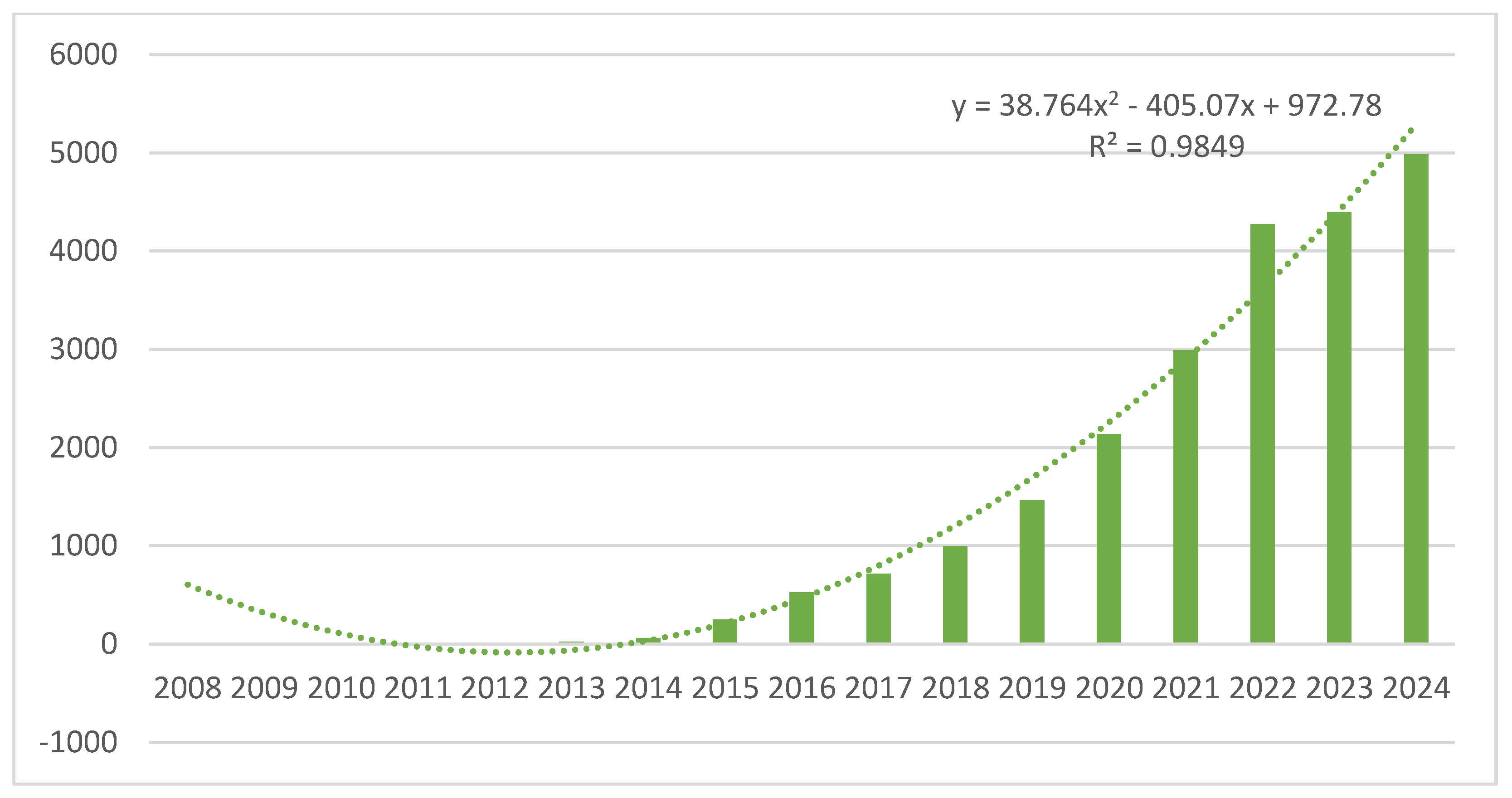
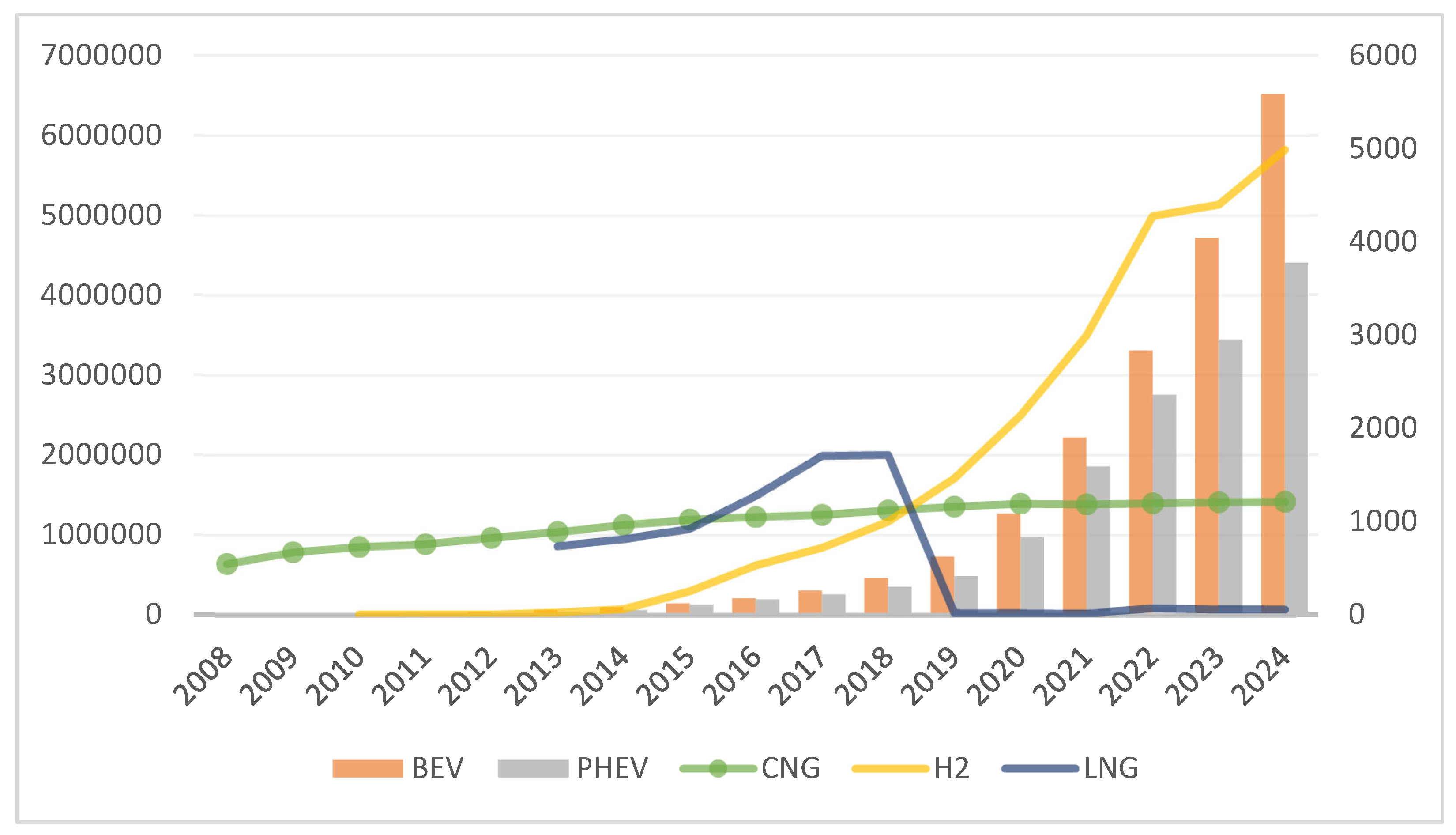
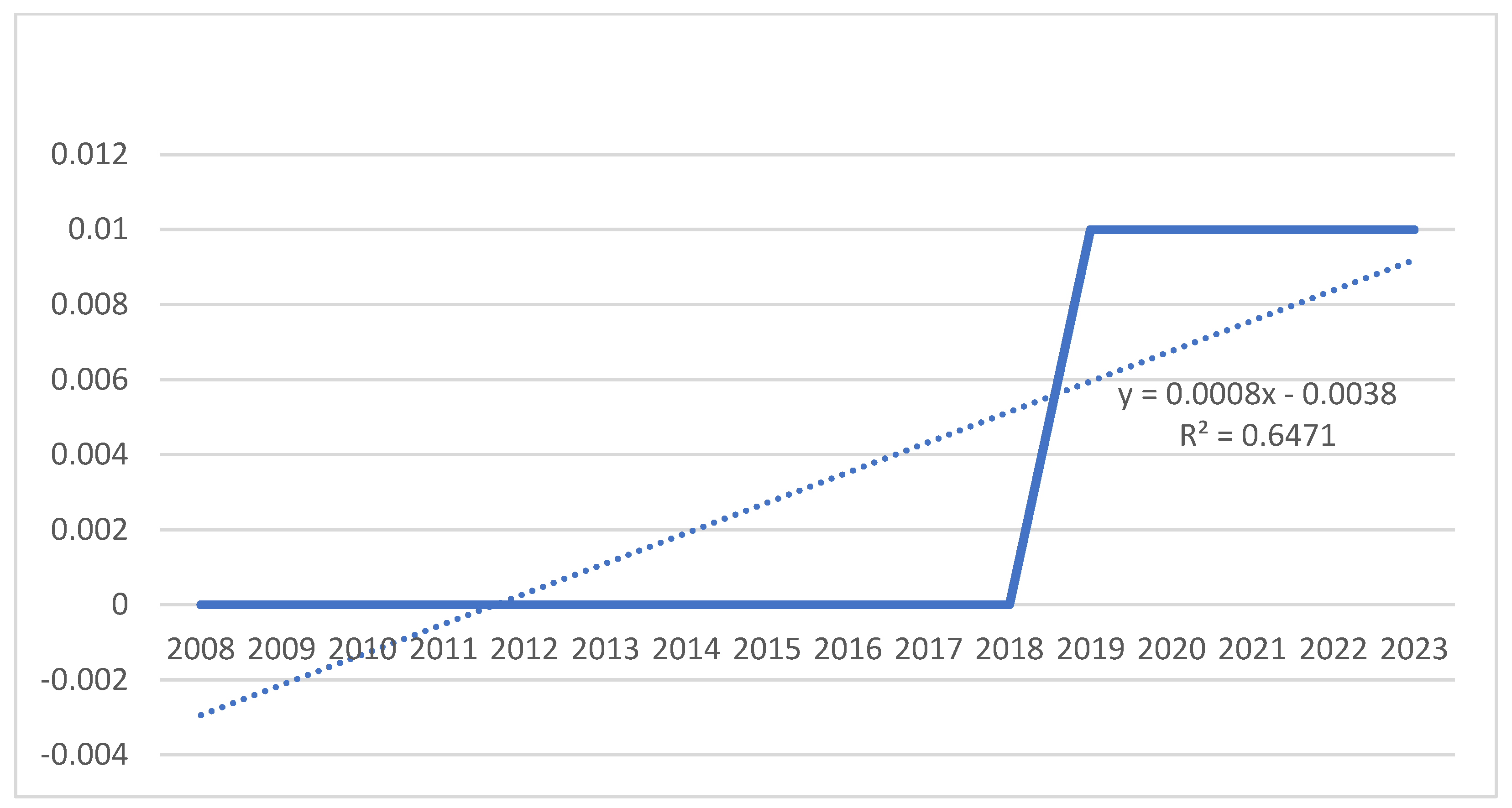
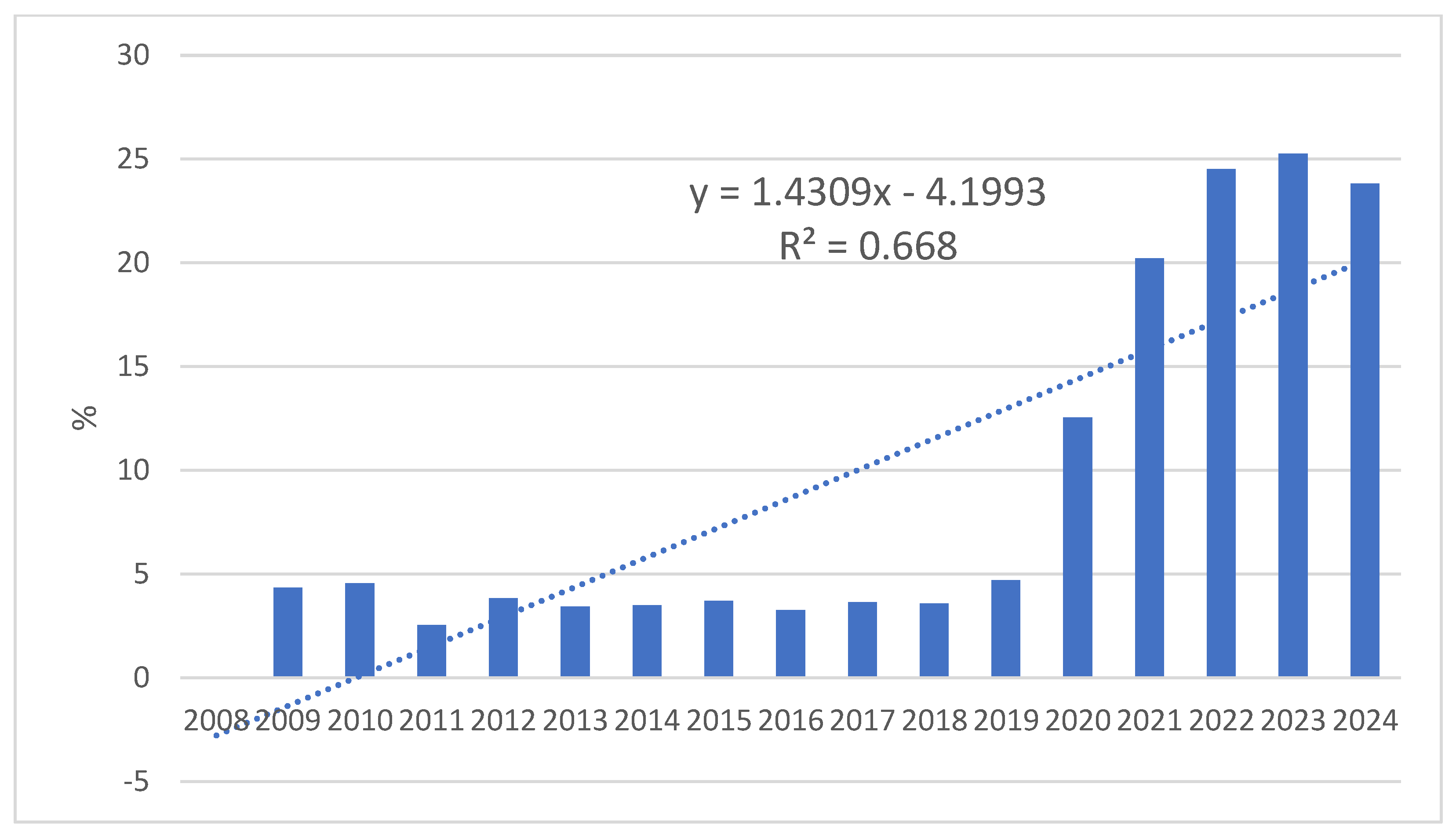
Analyzing European statistics data, it can be noted that in the general mass of alternative fuel vehicles, fuel cell vehicles still occupy a very modest share, significantly inferior to electric vehicles (both BEV and PHEV), which have demonstrated exponential growth starting around 2014. Nevertheless, the growth dynamics of fuel cell vehicles are also rapid and best described by a second-degree polynomial trend (
Figure 1,
Figure 2,
Figure 3 and
Figure 4).
However, transferring the identified trends to the Russian market situation would be incorrect due to different levels of motorization and different growth rates of vehicle fleets. Therefore, average trends were constructed for time series reflecting the dynamics of the share of various types of alternative fuel vehicles in the total fleet.
To forecast fuel cell vehicle adoption under the EU-Analogous Policy Scenario, we utilize a trend equation (along with its confidence interval) derived from the growth dynamics of fuel cell vehicle share in the EU vehicle fleet. Similarly, for the Green Hydrogen Focused Policy Scenario in the transport sector, we employ a trend equation and confidence interval based on the growth of alternative fuel vehicles in the EU fleet.
3.3. Learning Curve Parameterization
The learning curve methodology is based on fundamental laws of learning theory, according to which, as cumulative (total) production volume increases, production costs decrease due to accumulation of production experience (learning-by-doing effect). Learning curves express the hypothesis that technology costs decrease by a constant fraction (%) with each doubling of installed capacity. Consequently, in logarithmic scale, the relationship between these technology costs and total production volume represents a downward-sloping straight line.
The learning curve concept was first defined by Wright [
15] and Arrow [
16] as the reduction in unit cost with each doubling of accumulated production.
Mathematically, the fundamental law of learning theory is described by the following formula:
where
C0—initial unit costs (cost per unit of production)
C(Xt)—unit costs at time t
Xt—cumulative (over the entire period) production volume
LR—expected learning rate in the production process
LR (learning rate) is usually expressed as a percentage and shows how much production costs decrease with each doubling of cumulative production volume. By calculating the learning rate from available statistical data, one can forecast how price/cost will change as production volumes increase.
The learning rate LR is related to the learning index b through:
For each scenario, two estimates of the learning rate in green hydrogen production will be used—5% and 10.1%. These are the minimum and maximum median estimates reflecting possible variation depending on electrolyzer type and renewable energy type used in hydrogen production. Empirical studies report electrolyzer learning rates between 7% and 21%, with component-level analyses suggesting 9–20% ranges depending on the configuration [
5,
19]. To capture a conservative and an optimistic trajectory consistent with this literature while acknowledging Russia-specific uncertainties, we adopt two learning rate values for each scenario: LR = 5% (conservative) and LR = 10.1% (optimistic) [
31].
The selection of these two learning rate values is grounded in our prior component-based learning curve analysis, which disaggregated green hydrogen production costs into three components: (i) renewable electricity LCOE, (ii) electrolyzer CAPEX, and (iii) a residual non-learning component (operation and maintenance, approximately 10% of total cost). Single-component learning rates were estimated at approximately 4% for both alkaline (AE) and PEM electrolyzers, 14.3–14.4% for solar PV electricity, and 7.4–9.6% for wind electricity. Applying the multi-component learning curve framework, the composite learning rate for green hydrogen production varies between 4% and 10.2%, depending on the assumed electricity cost share (30–60% of total production cost) and the dominant renewable energy source (wind versus solar). The conservative estimate of LR = 5% corresponds to wind-dominated electricity supply with a higher electrolyzer cost share—conditions broadly consistent with Russia’s current renewable energy profile, where wind resources in the Northwest and Arctic regions are more developed than utility-scale solar PV. The optimistic estimate of LR = 10.1% corresponds to solar-dominated configurations with a lower electrolyzer cost share, representing trajectories achievable as Russia expands solar capacity in southern regions and benefits from global electrolyzer manufacturing scale-up. Thus, the two learning rates adopted in this study span the empirically derived range from the component-based decomposition rather than serving as arbitrary literature benchmarks.
We assume an initial green hydrogen cost C0 = 15 USD/kg H2 for early domestic production, reflecting high capital costs, elevated financing risk, and relatively high renewable electricity prices compared to global best-practice sites.
Cumulative domestic green hydrogen production X_t is approximated as the integral of annual realized demand under each scenario, with the simplifying assumption that domestic demand is fully met by domestic green hydrogen production.
4. Results
4.1. Hydrogen Demand Trajectories by Scenario
Three distinct scenarios of hydrogen demand realization trajectories are analyzed, reflecting different policy support intensities and infrastructure development levels. Rather than employing comprehensive econometric modeling—inappropriate given the absence of historical Russian hydrogen adoption data—we adopt transparent, parameter-explicit scenarios enabling sensitivity analysis and policy robustness testing.
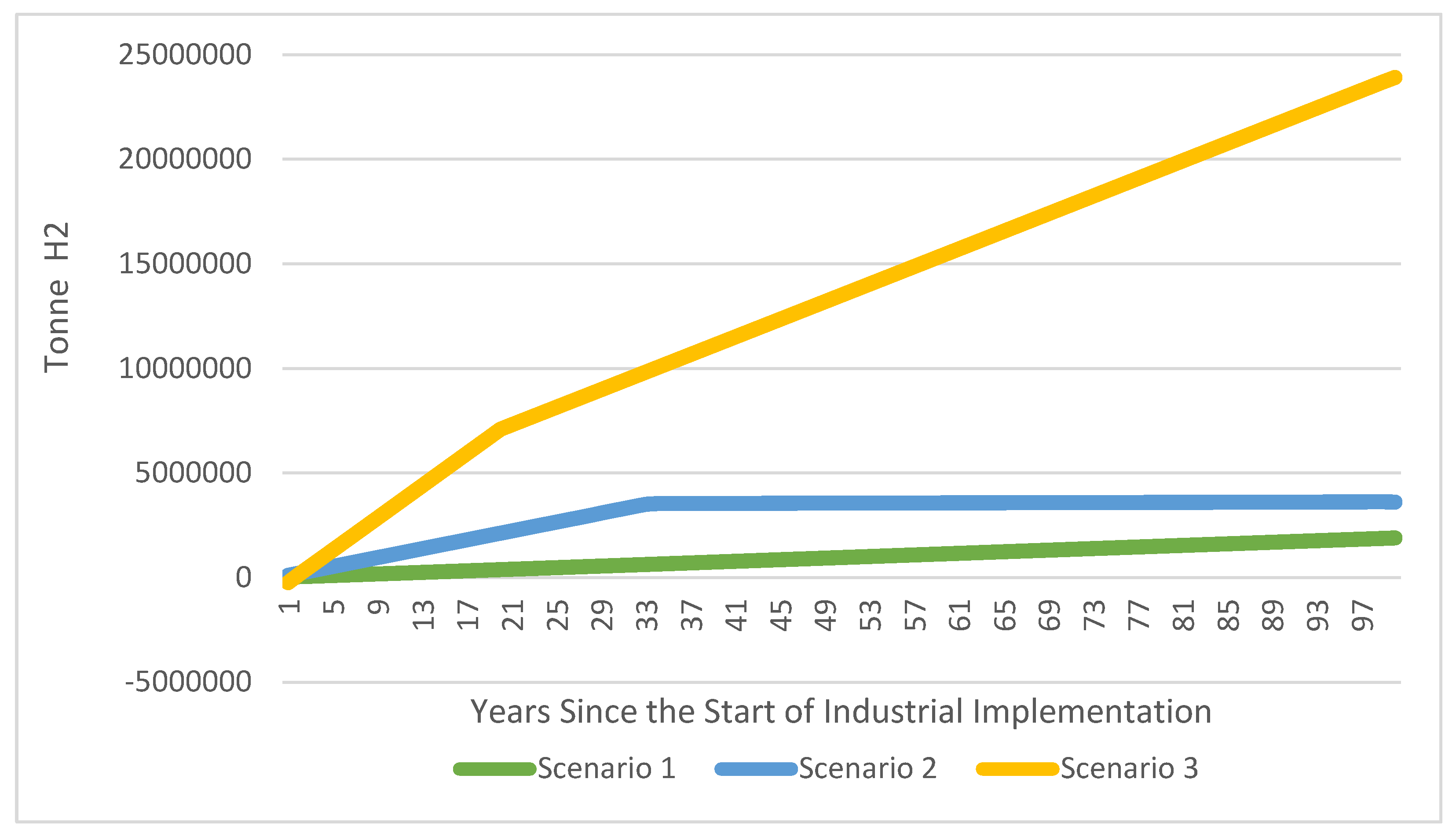
Assuming that the transition to hydrogen as fuel in both economic sectors will begin in the next 2–3 years, projected values are obtained and presented in
Figure 5.
The BaS Scenario assumes minimal state support and continued competition from alternative technologies (battery electric vehicles, sustainable fuels). The steel sector growth follows linear accumulation at 0.5–1.0% annual penetration rates. The transport sector similarly exhibits linear growth without S-curve acceleration. Under these conditions, full demand potential remains unrealized across the 100-year analysis horizon.
The EU-Analogous Policy Scenario incorporates policy support mechanisms comparable to European Union hydrogen initiatives, including carbon contracts for difference (CCfD), targeted research and development subsidies, and coordinated infrastructure investment. Steel sector adoption follows logistic growth, reaching 100% sectoral penetration by year 33, with 3% annual penetration rates in early implementation phases. Transport sector adoption mirrors European FCEV diffusion patterns as observed in data from the European Alternative Fuels Observatory (2008–2024), parameterized through polynomial trend-fitting of historical adoption rates applied to Russian vehicle stock growth projections.
The Green Hydrogen Focused Policy Scenario assumes aggressive domestic policy support with exclusive hydrogen prioritization (foregoing subsidies for competing alternative fuels) combined with rapid infrastructure deployment. The steel sector reaches full penetration by year 20 via 5% annual penetration rates. The transport sector follows accelerated adoption patterns equivalent to the all-alternative-fuel diffusion trajectory observed across multiple vehicle classes in European markets, potentially achieving 70–99% market penetration by year 100.
4.2. Green Hydrogen Cost Trajectories Under Learning Curves
We now construct a forecast of green hydrogen cost reduction as production volumes increase to meet growing domestic market demand. For each scenario, two estimates of the learning rate in green hydrogen production will be used—5% and 10.1%. These are the minimum and maximum median estimates reflecting possible variation depending on electrolyzer type and renewable energy type used in hydrogen production.
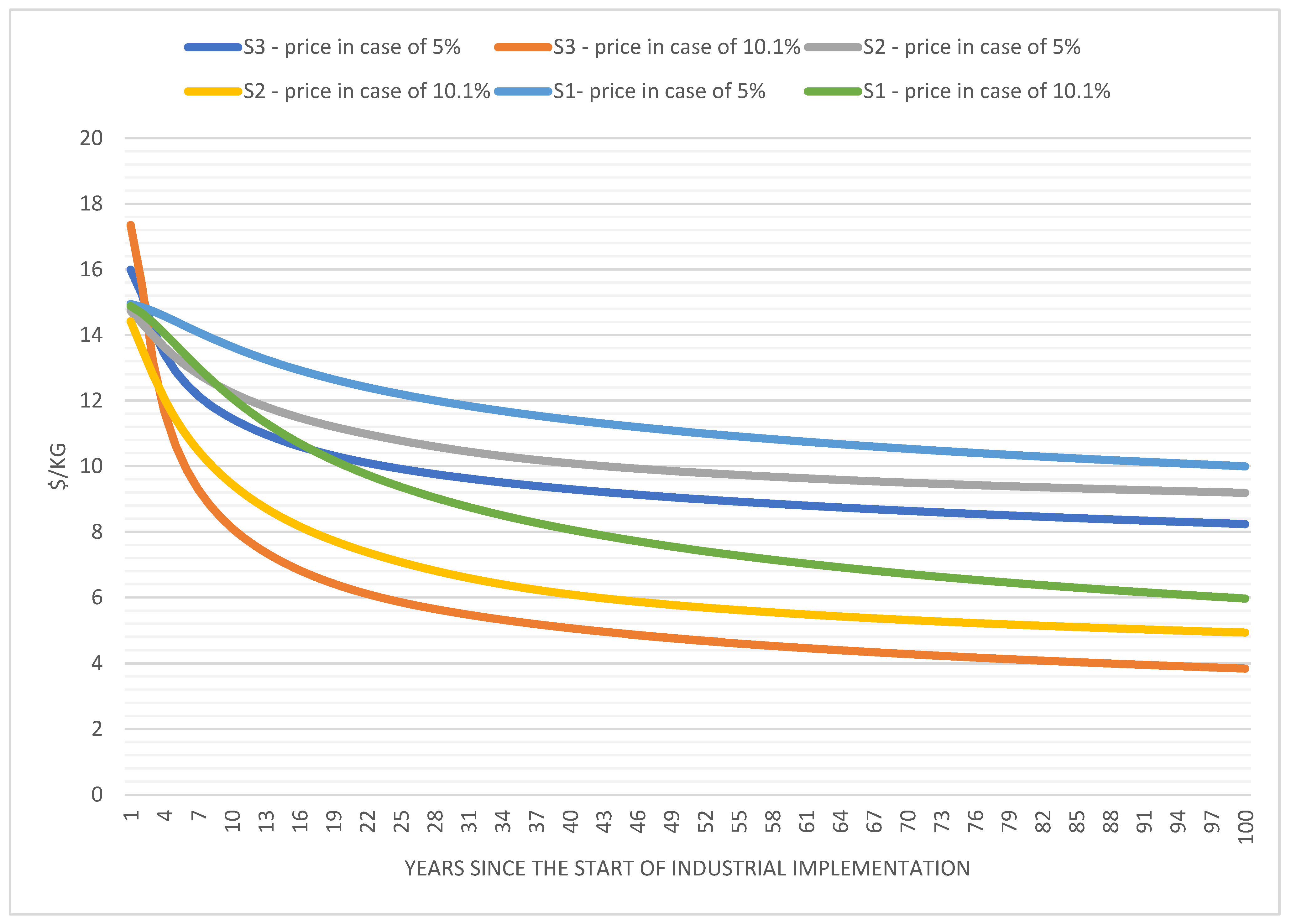
The calculated projected values of green hydrogen cost, obtained assuming an initial cost of USD 15 per kg H
2, are presented in
Figure 6.
According to the first (BaU) scenario for hydrogen demand potential realization in Russia’s domestic market, a 30% reduction in initial price (to USD 10 per kg H2) is expected only by the end of the forecast period with a 5% learning rate and after 20 years with a 10.1% learning rate. A 50% reduction in initial price (to USD 7.5 per kg H2) is not achieved within the 100-year forecast horizon with a 5% learning rate, but is achieved after 50 years with a 10.1% learning rate.
The projected green hydrogen cost at the end of the forecast period is estimated at USD 9.99 with a 5% learning rate and USD 5.96 with a 10.1% learning rate.
According to the second (EU-Analogous Policy) Scenario for hydrogen demand potential realization in Russia’s domestic market, a 30% reduction in initial price (to USD 10 per kg H2) is expected only after 43 years with a 5% learning rate and after 10 years with a 10.1% learning rate. A 50% reduction in initial price (to USD 7.5 per kg H2) is not achieved within the 100-year forecast horizon with a 5% learning rate, but is achieved after 21 years with a 10.1% learning rate.
The projected green hydrogen cost at the end of the forecast period is estimated at USD 9.19 with a 5% learning rate and USD 4.93 with a 10.1% learning rate.
According to the third (Green Hydrogen Focused Policy) Scenario for hydrogen demand potential realization in Russia’s domestic market, a 30% reduction in initial price (to USD 10 per kg H2) is expected after 23 years with a 5% learning rate and after only 5 years with a 10.1% learning rate. A 50% reduction in initial price (to USD 7.5 per kg H2) is not achieved within the 100-year forecast horizon with a 5% learning rate, but is achieved after 12 years with a 10.1% learning rate.
The projected green hydrogen cost at the end of the forecast period is estimated at USD 8.24 with a 5% learning rate and USD 3.84 with a 10.1% learning rate (
Table 4).
Three key patterns emerge from the results:
Learning rates matter as much as demand growth. For example, under the realistic scenario, the difference between 5% and 10.1% learning rates yields a cost gap of more than USD 4/kg by 2050 (USD 11.43 vs. 7.23).
Demand growth accelerates cost reductions. Higher cumulative demand under the optimistic scenario leads to earlier attainment of cost thresholds. At a 10.1% learning rate, the pessimistic scenario reaches USD 10/kg only by around 2045, whereas the optimistic scenario meets this threshold by approximately 2030.
Even under very optimistic conditions, costs remain above global best-case projections. By 2050, the optimistic scenario with 10.1% learning rate yields USD 6.12/kg, substantially higher than the USD 1.3–3.5/kg range projected for green hydrogen in global optimal locations.
5. Discussion
Thus, to ensure price competitiveness of green hydrogen in Russia’s domestic market, either more significant demand stimulation or ensuring maximum learning rates in production is necessary. The first method of achieving competitiveness appears more difficult, as it requires excessively large-scale government support measures. These limitations can be overcome through hydrogen exports to markets of other countries (which was originally planned in the Concept for Development of Hydrogen Energy in the Russian Federation). Under sanctions conditions, implementing this strategy is difficult but not impossible. At a minimum, green hydrogen sales to markets in friendly countries are possible, primarily to countries of the Eurasian Economic Union, whose technological development is largely co-directed with Russia’s technological development.
The second method of ensuring price competitiveness through achieving maximum learning rates in production appears more realistic, as green hydrogen energy development in Russia is not starting from zero but has the opportunity to rely on the best world achievements in electrolyzer production. In this area of technological development in Russia, there is no path-dependence, which is a certain advantage. To ensure maximum learning rates in this case, it makes sense to organize the import and adaptation of modern electrolyzer production technologies.
Our scenario-learning curve analysis generates several actionable policy insights, which are discussed below.
Firstly, the analysis reveals that relying solely on domestic demand is insufficient to achieve global-scale cost competitiveness. Even under the Green Hydrogen Focused Policy Scenario—characterized by rapid adoption across both steel and road transport sectors, coupled with a 10.1% learning rate—green hydrogen costs are projected to remain above USD 6/kg by 2050, significantly higher than global projections of USD 1.3–3.7/kg in optimal locations [
3,
5]. Consequently, we recommend that Russia prioritize the development of hydrogen export corridors to friendly markets, particularly within the Eurasian Economic Union (EAEU) and with selected Asian partners, acknowledging existing geopolitical constraints. Our modeling suggests that each effective doubling of accessible market size has the potential to reduce costs by 5–10% through additional learning-by-doing.
Secondly, the analysis demonstrates that technology pathway selection significantly shapes long-term cost trajectories. Specifically, the difference between a 5% and a 10.1% learning rate results in substantial cost differentials of USD 3–4.5/kg by 2050 across scenarios. Therefore, we recommend establishing a technology-neutral yet performance-oriented support framework that incentivizes technologies with higher learning potential and opportunities for localization. This could be achieved through competitive grants for pilot projects, joint ventures with international technology leaders, and targeted R&D funding focused on component-level innovation.
Finally, the results highlight that front-loaded policy support is considerably more effective than delayed interventions. Early deployment, under either realistic (EU-Analogous Policy) or optimistic (Green Hydrogen Focused) scenarios, combined with a 10.1% learning rate, brings hydrogen costs below USD 10/kg by 2030–2035. In contrast, slow deployment delays reaching this threshold by decades. To capitalize on this, we recommend designing comprehensive policy packages for the 2025–2035 period, including carbon contracts for difference (CCfDs) for green steel and heavy-duty hydrogen transport, capital subsidies and low-interest financing for electrolyzer projects, and mandates for increasing green hydrogen shares in industrial consumption (
Table 5).
The systematically higher cost levels in our projections can be attributed to: (1) scale disadvantage—Russia’s domestic demand potential (18.2 Mt/year) yields cumulative volumes significantly below global deployment scenarios; (2) infrastructure and financing constraints under sanctions; and (3) higher initial costs and electricity prices compared to best-case sites.
Limitations and Future Research Directions
While this study provides valuable insights, it is important to acknowledge several limitations.
Firstly, in the present analysis, penetration rates and policy support levels are specified exogenously rather than derived endogenously from an economic optimization framework, which implies that dynamic interactions between policy choices, market forces, and technology diffusion are only partially captured. This limitation creates a natural avenue for future work employing agent-based or system-dynamics models to represent feedback between hydrogen demand growth, cost learning, and policy design in the Russian context. As a next step, an agent-based model of low-carbon hydrogen production and adoption in Russia is being developed to address this limitation and extend the present scenario framework.
Secondly, the present analysis applies a single aggregate learning curve to overall green hydrogen costs rather than disaggregating component-level learning effects within the demand-cost feedback model. While the learning rate values used here (5% and 10.1%) are derived from our multi-component analysis, the aggregate formulation may mask differential cost reduction dynamics across electrolyzer CAPEX, renewable electricity LCOE, and system integration costs. In particular, if electrolyzer learning accelerates relative to renewable electricity costs—or vice versa—the optimal policy mix (e.g., electrolyzer manufacturing subsidies versus renewable energy deployment support) may differ from what an aggregate cost trajectory would suggest. Integrating a multi-component learning curve directly into the demand-cost feedback framework represents a natural extension of the present work.
Thirdly, the scenario framework abstracts from Russia’s institutional capacity to implement the envisaged policy packages. The analysis does not explicitly represent constraints related to cross-sectoral coordination of infrastructure projects (pipeline repurposing, refueling network deployment, grid reinforcement), regulatory stability, or the ability to mobilize long-term investment under sanctions and macroeconomic uncertainty. These institutional dimensions are only indirectly captured through scenario narratives and parameter choices, and they may accelerate or slow down the realized demand trajectories relative to the model results. Extending the framework to incorporate institutional indicators and governance constraints would provide a more holistic assessment of the feasibility of alternative demand pathways.
Regarding the question of whether the adoption of hydrogen technologies represents a competitive decarbonization option for the Russian economy compared to direct electrification or the development of carbon capture and storage (CCS) technologies, this issue falls outside the primary scope of our analysis for several reasons. Russia’s Energy Strategy explicitly prioritizes the development of hydrogen energy, while mentioning CCS technologies only briefly and, notably, within the context of hydrogen energy production. CCUS projects in Russia remain structurally dependent on external regulatory pressure rather than internal economic logic. Some recent studies [
32] show that full-chain CCS costs average around USD 82 per t CO
2, while capture costs in power and industry range from USD 40–120 per t CO
2. Under the current “soft” framework established by Federal Law No. 296-FZ, there is no binding carbon price capable of closing this gap. Even the Sakhalin pilot carbon price (~USD 12/t CO
2) has only marginal impact on project economics. In contrast to jurisdictions such as the United States or Norway, where long-term tax credits and carbon pricing underpin commercial CCS deployment, Russia lacks predictable fiscal incentives and a dedicated CO
2 storage regime.
CCUS deployment is highly capital-intensive and concentrated within vertically integrated oil and gas companies. This limits scalability and makes CCS a niche, export-preserving instrument rather than a system-wide decarbonization solution. Some pilot projects (e.g., Orenburg) are not expected to be profitable without substantial policy reform and scale expansion.
Environmental credibility remains contested. Lifecycle emissions of blue hydrogen (7.6–9.3 kg CO
2-eq/kg H
2) remain significantly higher than renewable-based hydrogen, and methane leakage risks further weaken its climate performance. This creates additional market risks under mechanisms such as the EU’s Carbon Border Adjustment Mechanism. As we analyzed in the previous study [
33], the integrated score of the eco-efficiency of hydrogen production with technologies like coal gasification with CCS or steam methane reforming with CCS is lower than that of PEM electrolysis with the use of renewable energy counting through the entire life cycle.
Taken together, these factors indicate that, under current institutional and economic conditions, CCS/CCUS in Russia functions primarily as a compliance and export-adjustment mechanism rather than a cost-competitive decarbonization option.
Finally, the representation of geopolitical risks is somewhat simplified, with export constraints being characterized qualitatively through scenario narratives. Future work should focus on developing more sophisticated geopolitical scenario trees that assign probabilities to different sanction regimes and market access conditions, thereby providing a more quantitative assessment of these risks.
6. Conclusions
This paper has presented an integrated scenario-learning framework to assess Russia’s green hydrogen demand potential and cost trajectories in the steel and road transport sectors. Starting from a theoretical domestic demand potential of approximately 18.2 Mt/year, we developed three scenarios (pessimistic, realistic, optimistic) reflecting varying policy and infrastructure support levels. We combined these demand trajectories with Wright-type learning curves using conservative (5%) and optimistic (10.1%) learning rates to project green hydrogen costs from an initial level of USD 15/kg.
The results suggest that:
Realistic (EU-Analogous Policy) or optimistic (Green Hydrogen Focused) domestic demand growth scenarios can significantly reduce green hydrogen costs over the long term, but achieving parity with international cost benchmarks is unlikely without larger-scale deployment and export integration.
Learning rates and early deployment are critical levers: under a 10.1% learning rate and optimistic demand, hydrogen costs can fall to roughly USD 6/kg by 2050, reaching USD 10/kg as early as 2030.
Policy design should prioritize front-loaded support for high-learning-potential technologies, strategic export corridors, and cluster-based infrastructure deployment to compensate for Russia’s scale disadvantage.
By explicitly linking sectoral demand pathways to learning-by-doing dynamics, this study contributes to a more nuanced understanding of the conditions under which Russia can develop a competitive green hydrogen sector despite structural constraints.