
Next Article in Journal
Hydrogen from Waste Plastics: Integrated Pyrolysis–Reforming Simulation and Techno-Economic Insights for a Circular Economy
Previous Article in Journal
Assessment of Russia’s Green Hydrogen Demand Potential and Realization Pathways: A Scenario Analysis with Learning Curve Dynamics
Previous Article in Special Issue
Game-Theoretic Assessment of Grid-Scale Hydrogen Energy Storage Adoption in Island Grids of the Philippines
 
 
Due to scheduled maintenance work on our servers, there may be short service disruptions on this website between 11:00 and 12:00 CEST on March 28th.
Article

The Energetic Aspect of the Formation of Molecular Hydrogen During Gamma Irradiation of Liquid Cyclohexane
by
Igor Y. Shchapin
1,2,* and
Andrey I. Nekhaev
3
1
Scientific Research Institute of Space Device Engineering, Aviamotornaya Street 53, 111024 Moscow, Russia
2
Department of High Energy Chemistry and Radioecology, D.I. Mendeleev University of Chemical Technology of Russia, Miusskaya ploshchad 9, 125047 Moscow, Russia
3
A.V. Topchiev Institute of Petrochemical Synthesis, Russian Academy of Sciences, Leninsky prospect 29, 119991 Moscow, Russia
*
Author to whom correspondence should be addressed.
Hydrogen 2026, 7(1), 29; https://doi.org/10.3390/hydrogen7010029
Submission received: 27 December 2025 / Revised: 14 February 2026 / Accepted: 19 February 2026 / Published: 22 February 2026

Abstract

Molecular hydrogen, the basis of hydrogen energy, is formed in many physical and chemical processes, including the absorption of gamma-ray energy by liquid cyclohexane. From the point of view of energy consumption, the stages of gamma radiolytic formation of molecular hydrogen have not been quantified. By means of a new energy method, we analyzed the amounts of released molecular hydrogen during gamma irradiation of liquid cyclohexane in the absence and presence of small additives of bicyclic mono- and dienes RH (initial concentrations of C0(RH) ≈ 5 × 10⁻³ M/L), depending on the first ionization potentials of the components of solutions determined in the gas phase. Using the new energy method, four primary intermediates—radical anion, electronically excited molecule, radical cation, and superexcited molecule—of liquid cyclohexane gamma radiolysis were identified. Energy, mechanistic, and spin relationships and connections between these four cyclohexane intermediates were established. The experimental value of the adiabatic electron affinity of the cyclohexane molecule is −2.01 eV. The energy of formation of the superexcited cyclohexane molecule is 18 eV (gas phase). Using the energy method, it is shown that an increase in C0(RH) concentrations from 5 × 10⁻³ to 0.1 M/L leads to a change in the mechanism of RH consumption. Instead of RH activation, as a result of the single electron transfer reaction, RH polymerization begins, which is initiated by cyclohexyl radicals.

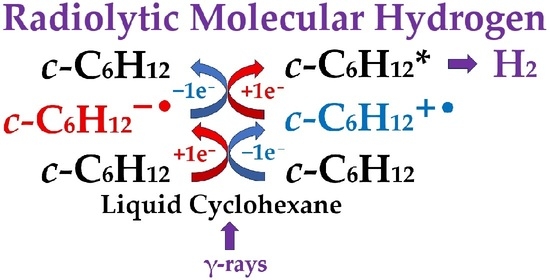
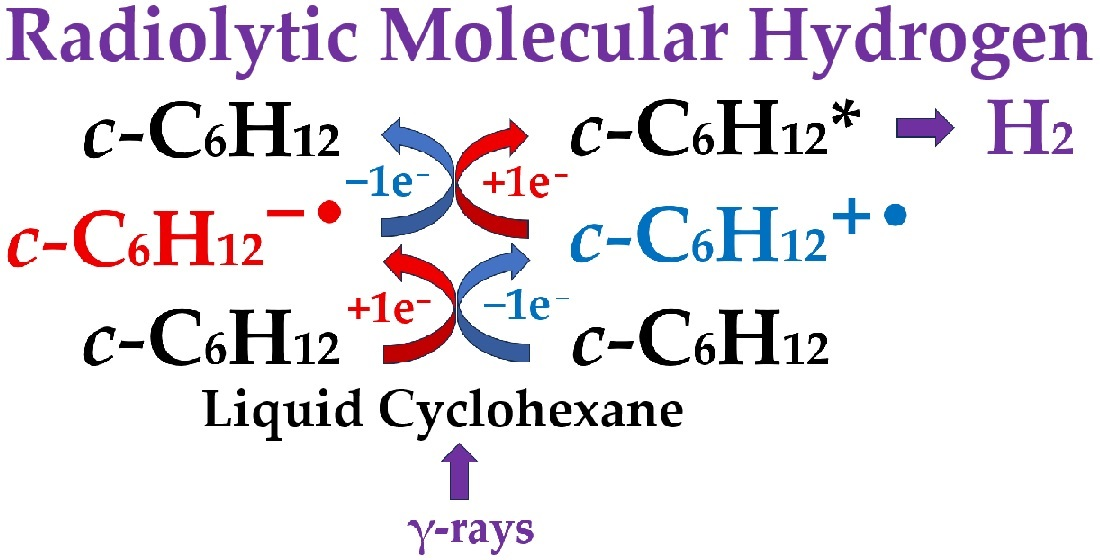
Graphical Abstract

1. Introduction

Hydrogen energy is one of the modern approaches to producing energy from alternative natural sources, offering several advantages over coal, gas, and oil [1,2,3,4]. A comparison of renewable and hydrogen energy is presented in [5]. A common method for producing “green” hydrogen is water electrolysis [6,7].
Radiolytic molecular hydrogen is formed in natural conditions when exposed to natural radiation on hydrogen-containing substances (water, hydrocarbons, shale, and so on) [8,9,10,11].
The evolution of molecular hydrogen during irradiation of hydrocarbons with high-energy radiation from nuclear reactors has been studied under various experimental conditions [12,13,14,15,16,17].
In this field of radiation chemistry, a large amount of data on the specific methods of processing has been accumulated. This data has great potential for the further development of hydrogen energy, which has not yet been fully utilized.
One of the methodological techniques in the field of radiation-chemical research is the study of chemically similar binary systems, which are composed in a special way based on the energy characteristics of the components: their ionization potentials (IPs) and electron affinities (EAs) [16,18,19]. This approach allows us to track the processes of single electron transfer (SET) between the components, which lead to the formation of ion radical pairs, which become precursors of molecular hydrogen.
In the framework of radiation chemistry, this approach was developed to search for radioprotectors, substances that, when introduced into a solvent in the form of small impurities, selectively collect radiation energy absorbed by the solvent and thereby prevent the formation of molecular hydrogen and other products from it [20]. If desired, binary mixtures can be formed in which molecular hydrogen will be selectively formed from an impurity component.
In this article, we draw the reader’s attention to the practical application of our proposed energy procedure [16,19,21,22] to identify the composition of the components involved in the SET process under conditions of gamma radiolysis of liquid cyclohexane (c-C6H12). This was not done in [16].
Earlier, we showed the applicability of such a radiation-chemical approach to the RH/H2O2/Cu2Cl4·2DMG/CH3CN catalytic system, where RH is a set of hydrocarbons with a wide range of IP determined in the gas phase, and DMG is dimethylglyoxime [21]. We determined the boundary between the release of only molecular oxygen or in a mixture with hydrogen (1:1), which was determined by the participation or non-participation of two primary intermediates in the processes: radical anion (RA) Cu3Cl5•− ((CuCl (on a solid surface) + Cu2Cl4 (from solution)) + e) and radical cation (RC) H2O2•+ (H2O2 − e) (e − electron) [22].
In this paper, using experimental data from [16], we applied the same approach to identify a pair of radical ions (RC and RA), the primary products of gamma radiolysis of liquid cyclohexane. In this pair, RC is a well-known intermediate, and RA is a new intermediate for which experimental energy parameters were first estimated by us using quantum chemical calculations [19].
Using the energy procedure proposed by us, we also determined for the first time the energy of a superexcited molecule (SEM) of cyclohexane (c-C6H12**), which presumably initiates all subsequent chains of radiation-chemical processes and, in this sense, acts as the activation energy of such chains of nonequilibrium processes considered below.

2. Materials and Methods

Orca—an ab initio, DFT, and semiempirical SCF-MO package—version 3.0.1 was used for all DFT calculations at the PBE0/TZVPP level of theory [23,24,25,26,27]. The ChemCraft 1.7 program was used to create input files and visualize and design the calculation results [28]. Vertical and adiabatic IP and EA were calculated as VIP and AIP, and VEA and AEA, respectively. The calculation details and equipment are the same as in [19].
The calculation results are given in the text of the article and in the “Supplementary Materials” file.
ORCA 3.0.1 was the computational version adopted in the preliminary work of Ref. [19]. To ensure research continuity and data consistency, this version is retained in the current study. The calculations herein focus solely on the determination of the first ionization potentials and electron affinities, for which the algorithms and precision of this version are sufficiently competent. Furthermore, by establishing a correlation between theoretical calculations and experimental data, the computed results were further calibrated, eliminating potential version-related errors.
The software package Orca version 3.0.1 was released more than 10 years ago. It provides accurate results for our tasks. The Orca software package, version 6, is up-to-date.
This work is a continuation of the work of [19]. Therefore, we preferred to use the same version of ORCA. The accuracy of the calculations was achieved not by choosing a more modern version of the program and the modern DFT method but by building a correlation of theoretical and experimental data. This approach makes it possible to eliminate or minimize possible disadvantages of the theoretical method and to provide reliable estimates of experimental data.
A methodological feature of this work is the use of the theoretically estimated experimental value of AEA(c-C6H12) = −2.13 eV [19] to increase the energy range for which the correlation of experimental data was constructed.
It was important to apply this approach because the radiation-chemical data necessary for constructing the correlation were available only for four hydrocarbons, the IP values of which were located in a narrow range of values.
The energy values E(eV) = (V,A)IP and (V,A)EA were calculated using the energy values ΔE(h) calculated by the DFT method, where ΔE(h) is the energy difference E(h) between the initial and final structures of the SET process, taking into account the sign, which is determined by the direction of electron transfer. The equation E(eV) = ΔE(h)·K was used to convert energy from one unit (Eh) to another (eV), in which K = 27.2113834 [24].
Using the ORCA program, the energies E(h) were calculated with an accuracy of 10−12 Eh. The energy values E(eV) were rounded up to 10−2 eV. This means that we used the theoretical energy values E(h), which had excessive accuracy for our purpose. The results of rounding energy E(eV) values were influenced by no more than 5–6 decimals of energy values E(h).
We did not determine the real accuracy of our DFT calculations in comparison with calculations of higher levels and depending on the calculation parameters. Usually, the calculation accuracy is at least 10−5–10−6 Eh, which is sufficient to calculate the energies E(eV) with a given accuracy of 10−2 eV. Therefore, for the calculation method we have chosen, the energy values E(h) with an accuracy of 10−12 Eh (and not rounded to 10−6 Eh) will be given below solely for illustrative purposes, by analogy with the work [19].

3. Results and Discussion

3.1. General Scheme of Molecular Hydrogen Formation During Gamma Radiolysis of Cyclohexane

A detailed scheme for the formation of molecular hydrogen during gamma radiolysis of cyclohexane was described and discussed in our previous article [19]. Therefore, in this article, we have presented an energy scheme for the formation of molecular hydrogen during gamma radiolysis of cyclohexane in a generalized form without detailed comments and taking into account the formation of RA c-C6H12•− [19].
In the energy scheme of radiolysis (reactions (1)–(12), (1′), (1″)), the energies E of the free electrons e(E,eV) participate in these reactions. Each type of free electron reaction is determined by the energy properties of the cyclohexane molecule: the first ionization potential is IP(Gas) ≈ 10 eV [29,30,31,32,33], IP(Liquid) ≈ 9 eV [19], the electron excitation energy is E*(Liquid) ≈ 7 eV (the lowest values are indicated) [34,35], and negative electron affinity is −EA(Gas) ≈ −EA(Liquid) ≈ 2 eV [19].
Reactions (1)–(5) show a simplified model of the formation of the three main primary intermediates of gamma radiolysis of liquid cyclohexane: RC c-C6H12•+, an electronically excited molecule (EEM) c-C6H12*(S and T) (S—Singlet, T—Triplet), RA c-C6H12•−.
c-C6H12 + γ-rays → m(c-C6H12•+(E≈9eV)) + (m − n)(c-C6H12•−(E≈2eV)) + n(e(E≈60±40eV))
c-C6H12 + e(E≈60±40eV) → k(c-C6H12•+(E≈9eV) + c-C6H12•−(E≈2eV)) + (k − l)(e(E≈18eV))
c-C6H12 + e(E≈18eV)c-C6H12•+(E≈9eV) + e(E≈9eV)
c-C6H12 + e(E≈9eV)c-C6H12*(S and T)(E≈7eV) + e(E≈2eV)
c-C6H12 + e(E≈2eV)c-C6H12•−(E≈2eV)
In an even more simplified form, the same thing can be conveyed using Equation (1′). After charge neutralization (reaction (6)), only EEM c-C6H12*(S and T) remain as chemically active intermediates.
c-C6H12 + γ-rays → c-C6H12•+ + c-C6H12*(S and T) + c-C6H12•−
c-C6H12•+ + c-C6H12•−c-C6H12*(S and T) + c-C6H12
After this stage is completed, gamma radiolysis of liquid cyclohexane can be transmitted in the most simplified form using reactions (1″) and (7)–(12), which show that EEM c-C6H12*(S and T) are precursors of all end products: molecular hydrogen (H2), cyclohexene (c-C6H10) and dicyclohexyl ((c-C6H11)2).
c-C6H12 + γ-rays → c-C6H12*(S and T)
4c-C6H12*(S and T) = 1c-C6H12*(S) + 3c-C6H12*(T)
c-C6H12*(S) → H2 + c-C6H10
c-C6H12*(T) → H + c-C6H11
H + c-C6H12 → H2 + c-C6H11
2c-C6H11c-C6H10 + c-C6H12
2c-C6H11 → (c-C6H11)2
We do not consider reactions (11) and (12) in this article. Simplified general reactions (1), (1′), and (1″) in combination with reactions (2)–(5), (6), and (7)–(12) reflect different chronological stages of gamma radiolysis of liquid cyclohexane [19].
For the purposes of this work, it is convenient to present the general scheme of gamma radiolysis of liquid cyclohexane in the form of reaction (1‴), which includes the proposed stage of formation of SEM c-C6H12**, which begins the chain of reactions leading to the formation of molecular hydrogen.
The SEM c-C6H12** was briefly mentioned earlier and will be discussed in detail below. It is important to note here that if a small amount of an additive (AD) is introduced into cyclohexane, for which IP(AD) < IP(c-C6H12), it will lead to a sequence of reactions (13)–(15) (H2 is not the main product of reaction (15)); as a result, the amount of molecular hydrogen produced by the reaction (1‴) will decrease.
c-C6H12 + γ-rays → c-C6H12** → c-C6H12•+ + c-C6H12•−c-C6H12* → H2
c-C6H12•+ + AD → c-C6H12 + AD•+
AD•+ + c-C6H12•− → AD* + c-C6H12
AD* → Products
If we select a number of structurally similar ADs with known and non-matching IP(AS), usually determined in the gas phase, then the amount of molecular hydrogen released by the reaction (1‴) from cyclohexane containing AD will depend on IP(AD) [16].
It was with a deeper analysis of this effect, previously reported by us in [16], that the main results of this work were obtained. The class of organic compounds and the results previously obtained in [16], which will be used in this work, are reported in the next section of the article.

3.2. The Effect of Mono- and Dienobicyclic Additives in Liquid Cyclohexane on the Formation of Molecular Hydrogen Under Gamma Irradiation

Our fundamentally new result in the field of catalysis [21,22] made it possible to return to the RH/c-C6H12 binary system, where AD = RH is a set of bicyclic mono- and dienes and related compounds, which we previously comprehensively studied from the point of view of the composition of its gamma radiolysis products, including H2 [16].
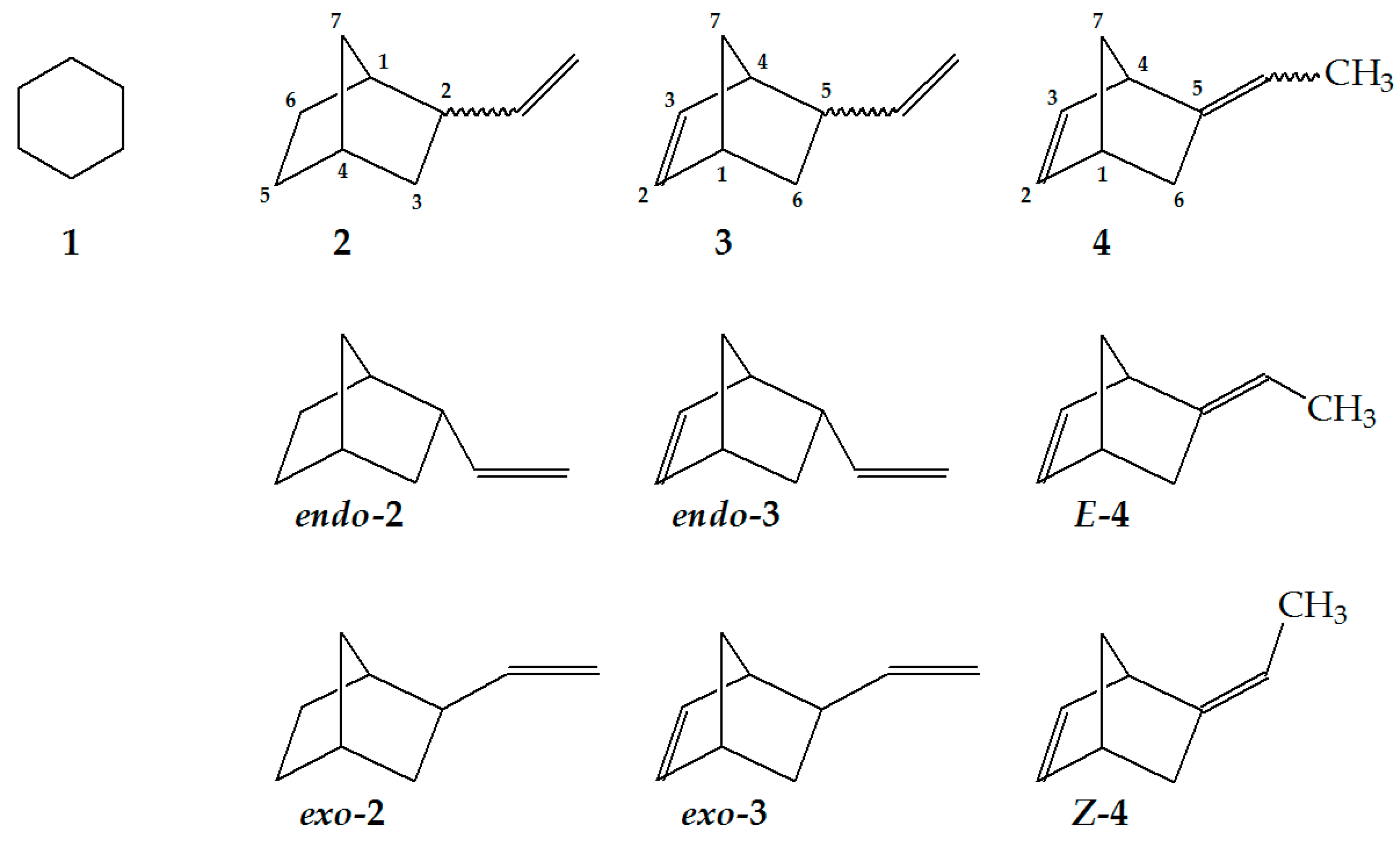
Approximately equal amounts of hydrocarbons (RH) were added to cyclohexane (1): 2-vinylnorbornane (VNN) (2-vinyl-bicyclo[2.2.1]heptane) (2), 5-vinylnorbornene (VNB) (5-vinyl-bicyclo[2.2.1]hepten-2) (3), and 5-ethylidenenorbornene (ENB) (5-ethylidene-bicycle[2.2.1]hepten-2) (4) (Scheme 1). Each RH was a mixture of two isomers with a ratio of 66% endo- and 34% exo- in 2 and 3 and 50% E- and 50% Z- in 4 (Scheme 1).
In a specially selected RH 24 series, the values of 9.61 ± 0.02 eV, 8.87 ± 0.02 eV, and 8.55 ± 0.02 eV of the first vertical ionization potentials (VIPs) corresponded to differently substituted double C=C bonds: mono-(vinyl group, exocyclic) (2), di-(norbornene, cyclic) (3), and tri-(ethylidene group, exocyclic) (4), respectively [36]. As the value of VIP 2, the value of the second VIP 3, related to the vinyl group, was taken [36].
Our choice of objects 24 of the study provided the largest possible range of VIP values within the same class of compounds with a similar structure. The dependencies of VIP double C=C bonds of different compounds on the type of substitution are systematically reviewed in [37].
In radiation chemistry, it is customary to use the initial radiation-chemical yields, G0 (species/100 eV), which represent the number of species that are consumed or formed when the substance absorbs 100 eV of radiation energy at the initial moment of radiolysis, that is, extrapolated to the zero absorbed radiation dose. Species are understood as molecules of both initial and final products, radical ions, electronically excited molecules, neutral radicals, and so on.
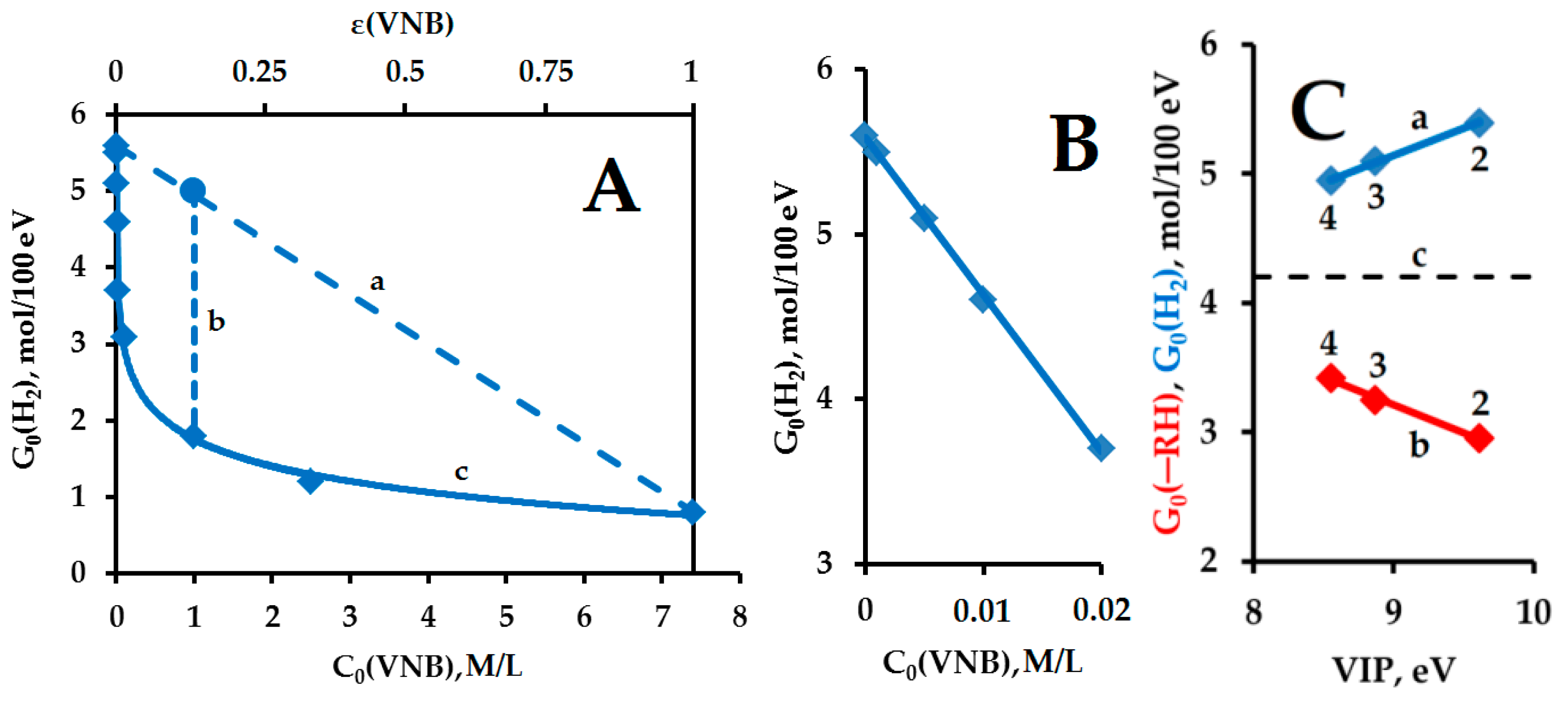
When studying the radiolysis of binary systems, it is customary to compare the results obtained with the theoretical additive line (Figure 1A, line a). The electron fraction of one of the two components of the mixture, in our case ε(VNB), is deposited along the abscissa axis (Figure 1A). When calculating, for example, ε(VNB), the ratio of the amounts of all electrons included in both components (VNB and c-C6H12), including electrons located on the inner 1s MOs of carbon atoms, is determined.
In c-C6H12, MOs to which 1s atomic orbitals of carbon atoms contribute have energies E(1s-C) ≈ 290 eV [38], and those with contributions from 2s and 2p atomic orbitals of carbon atoms have energies E(2s-C and 2p-C) ≈ 10–20 eV [29,39,40]. Ionizing gamma rays of 60Co have significantly higher energies: the average value of Eav(gamma rays) ≈ 1.25 MeV is determined by gamma rays with energies of 1.1732 and 1.3325 MeV, formed in equal quantities [18]. Therefore, it is believed that gamma rays are capable of ionizing all available electrons with approximately equal efficiency. It is this circumstance that is highlighted when using the electronic fractions ε of the components of gamma-irradiated binary mixtures [15,16].
Thus, the theoretical additive line (Figure 1A, line a) corresponds to the initial physical stage of radiolysis of a binary mixture without redistributing the absorbed energy of ionizing radiation between components. The consequence of this is that the studied characteristic of the binary system, in our case G0(H2) (Figure 1A, line a), at the initial time of exposure to high-energy ionizing radiation is the sum of the characteristics of its components.
Then, the processes of redistribution of absorbed energy between the components of the binary mixture start. Because of this, the studied characteristic deviates (Figure 1A, line b) from additive line a. In our case, all experimental points (Figure 1A, line c) have a negative deviation from additive line a. The largest deviation, ∆G0(H2) = 3.2 molecules/100 eV, is observed at C0(VNB) = 1 M/L (Figure 1A, line b).
Next, instead of the values of ε, we will use the more familiar scale for chemists, the concentration scale C0(VNB), M/L, with which ε(VNB) is related by linear dependence (ε(VNB) = 0.1353·C0(VNB), R2 = 1).
The most interesting area is the low concentrations of C0(VNB), in which the experimental values of G0(H2) deviate most strongly from the values of the additive line a (Figure 1B). A significant decrease in G0(H2) with an increase in the concentration of C0(VNB) is explained by the course of reactions (1‴) and (13)–(15), where AD = VNB [16].
In the region of low concentrations of C0(VNB), when exposed to gamma rays on a binary mixture, ionization of cyclohexane molecules mainly occurs (Reaction (1‴)). Since VIP(VNB) < VIP(c-C6H12), one electron from the VNB molecule passes to the SOMO of the RC c-C6H12•+, resulting in the formation of RC VNB•+ (reaction (13)). Since the positive charge has moved to the RC VNB•+, it is this positive ion that further participates in the neutralization reaction with the electron released from the cyclohexane molecule (reaction (14)). The EEMs VNB* formed by reaction (14) further give a set of products (reaction (15)), among which G0(H2) = 0.8 molecules/100 eV for an individual VNB [16]. This value is 7 times less than G0(H2) = 5.6 molecules/100 eV for an individual c-C6H12 [16].
As a result of reactions (1‴) and (13)–(15), where AD = VNB, with an increase in C0(VNB), the fractions of RC c-C6H12•+ and c-C6H12•− decrease. This leads to a decrease in G0(H2).
In radiation chemistry, reactions ((1), (1′), (1‴)) and (13) are called direct and indirect mechanisms of ionization, respectively, of the main and impurity components of the irradiated binary mixture.
Thus, in the region of low concentrations of C0(VNB), when exposed to gamma rays on a binary mixture, its main component absorbs radiation energy, and its impurity component, taken in small quantities, undergoes a non-additively strong chemical transformation.
When using VIP(RH) three RH 24, it was found [16] that at a concentration of C0(RH) ≈ 5 × 10⁻³ M/L of the impurity component, a decrease in VIP(RH) led to a decrease in G0(H2) exactly equal to an increase in G0(–RH), where “–RH” indicates the decrease in the impurity component RH (Figure 1C, lines a and b, respectively). The lines a and b intersect at a point with VIP(RH) = 6.8 eV and G0(H2) = 4.2 molecules/100 eV. In Figure 1C, this value of G0(H2) is marked using line c, relative to which lines a and b are arranged symmetrically.
In [16], the intermediates that determine the slope of the straight line a were not identified, since at the time of writing, we did not have a new methodological technique, which was formed only after our series of works in the field of catalysis at thermal (T = 50 °C) activation [21,22,41].
In the next section, we show that the new method we have developed is also effective in the field of high-energy chemistry as one of the useful tools for establishing the mechanism of molecular hydrogen release during gamma radiolysis of a liquid binary mixture RH/c-C6H12 (1), where RH is a set of impurity components consisting of two structurally similar bicyclic dienes and one related monoene compound: VNN (2), VNB (3) and ENB (4) (Scheme 1).

3.3. Energy Analysis of the Amount of Molecular Hydrogen Formed Under Gamma Irradiation of Liquid Binary Systems Bicyclic Mono- and Diene/Cyclohexane

Using our experience in the field of catalysis [22] and in the field of radiation chemistry [16], we added to the three data on binary systems RH 2, 3, and 4/c-C6H12 a point with values AIP(c-C6H12) = 9.88 eV [29,30,32] and G0(c-C6H12) = 5.6 molecules/100 eV [16], which corresponds to C(RH) = 0 M/L (RH 24).
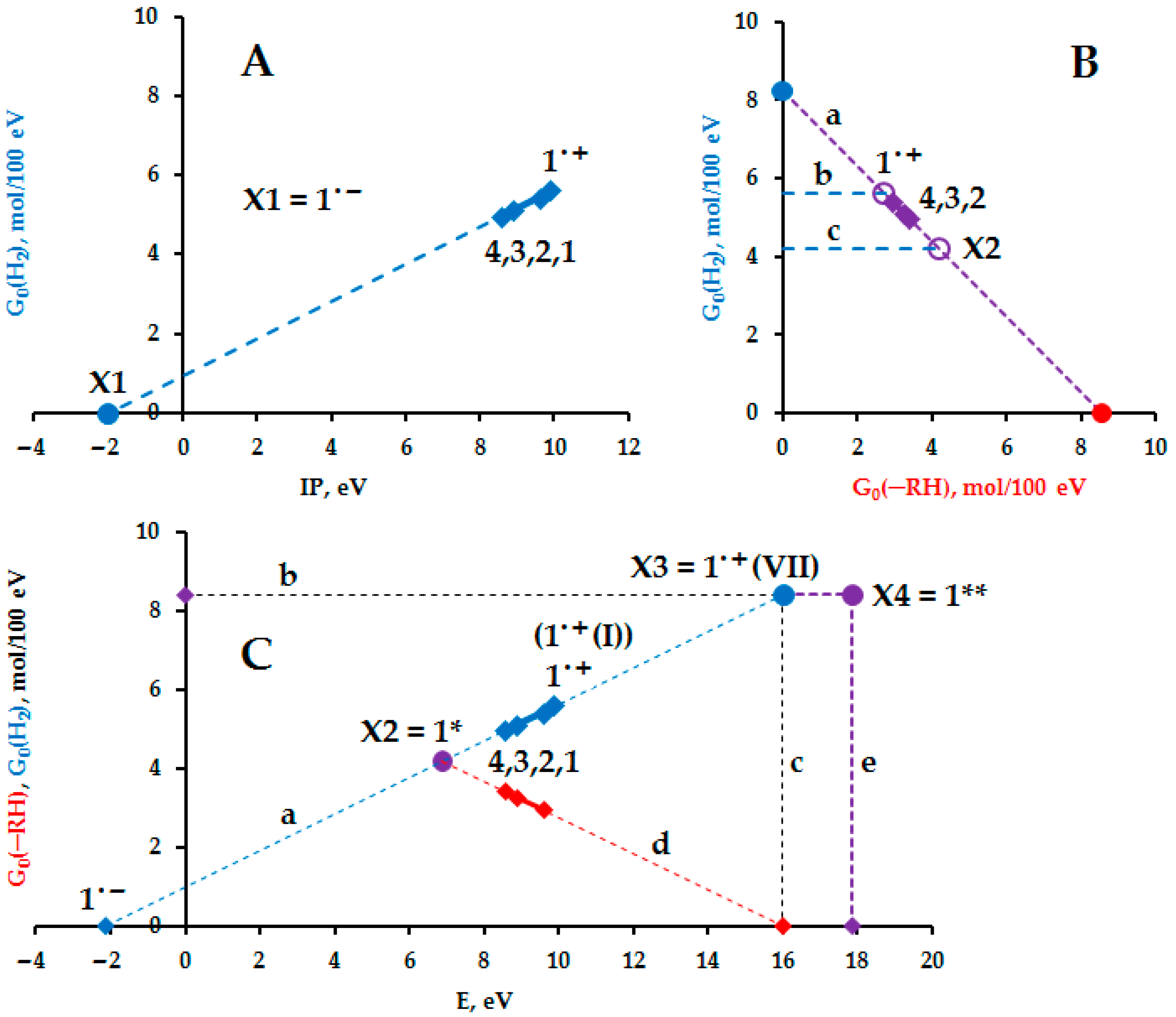
A straight line drawn through four experimental points intersects the abscissa axis at (−2.01, 0) (Figure 2A). This means that the intermediate X1, which has IP(X1) = −2.01 eV, participates in the formation of H2.
A negative value of IP(X1) means that when one electron is removed from the highest occupied molecular orbital (HOMO) or from the single occupied molecular orbital (SOMO) of X1, energy is released, but not absorbed, as happens with a single ionization of molecules and intermediates X, in which IP(X) > 0 eV [22]. This property is possessed by RAs of molecules with negative electron affinity; in our case, X1 = 1−•, AIP(1−•) = AEA(1) = −2.01 eV.
The experimental value of AEA(1) = −2.01 eV, determined using the energy procedure, almost coincides with the experimental value of AEA(1) = −2.13 eV, previously determined using theoretical calculations [19]. This is another confirmation that the experimental value of AEA(1) ≈ −2 eV determined by us is correct, and the experimental value of EA(1) = −4.11 eV [42] is almost twice as underestimated.
All experimental points for RH 24 are located within the range 4.2 < G0(H2) < 5.6 molecules/100 eV (Figure 2B, line a). The value of G0(H2) = 5.6 molecules/100 eV (line b) is the total amount of released molecular hydrogen, corresponding to AIP(1) = 9.88 eV [29,30,32], indicating the formation of RC 1•+. The value of G0(H2) = 4.2 molecules/100 eV (line c) corresponds to the second intermediate X2, which we were able to identify using the energy approach (Figure 2C).
With a decrease in IP(RH), there is a decrease in G0(H2) equal to an increase in G0(–RH) (line a in Figure 2B). As a result, the sum of G0(H2) + G0(–RH) = constant = 8.4 ± 0.2 molecules/100 eV. The value G0(H2) = 8.4 molecules/100 eV is used in Figure 2C as line b.
Since the two experimental values of AEA(1) = −2.01 eV [this work] and AEA(1) = −2.13 eV [19] almost coincide, their average value of AEA(1) = −2.07 ± 0.06 eV would be possible to recommend as a reliable estimate of the experimental value of AEA(1), which would relate to the gas phase. However, in Figure 2C (line a), in the refined analysis of radiation-chemical data, we used the experimental value of AEA(1) = −2.13 eV, estimated in a more familiar theoretical way [19]. The experimental estimate of AEA(1) = −2.01 eV, obtained using a methodically new energy method for analyzing experimental data (Figure 2A), is unusual and needs to be confirmed for its reliability. This will be done in the next section of the article.
In Figure 2C, line a is drawn through five experimental points, which include the point for RA 1•− (−2.13; 0). Lines a and b intersect at a point with coordinates (16.00; 8.4), which corresponds to the third active intermediate, X3, which we also identified using the energy approach.
Line c was used to more accurately determine line d by introducing the fourth point (16.00; 0) as an experimental one. Lines a and d intersect at point X2 with coordinates (6.89 ≈ 6.9; 4.18 ≈ 4.2).
The value of E = 6.9 eV coincides with ΔE(1) = E(HOMO) − E(LUMO) (lowest unoccupied molecular orbital (LUMO)), which is the band gap, the boundary (lowest) value of the energy of light quanta (180 nm) absorbed by liquid cyclohexane molecules [43]. Therefore, point X2 corresponds to EEM 1*.
The value of E = 16.0 eV coincides with the maxima, or midpoints, of the broad peaks of energy absorption of photon and electron radiation passing through gaseous cyclohexane [29,44,45,46]. Using the designation X3 = 1•+(VII) introduced by us (Figure 2C), we indicate that the energy E = 16.0 eV corresponds to the seventh band in the photoelectron spectrum of gaseous cyclohexane [29].
This result means that in the region E = 7–16 eV (Figure 2C), experimentally unregistered reactions such as reactions (13′) and (13″) are realized, in which AD = RH (reaction (13)) molecules 1 and 24 are involved, respectively.
c-C6H12•+(II-VII) + c-C6H12c-C6H12 + c-C6H12•+(I)
c-C6H12•+(II-VII) + RH → c-C6H12 + RH•+(I)
Since RH ceases to affect G0(H2) at E > 16 eV, in the region of E > 16 eV, we have G0(H2) = constant = 8.4 molecules/100 eV (Figure 2C, continuation of line b). According to reaction (1‴), after absorption of gamma-ray energy from the precursor c-C6H12**, which has a zero charge, a pair of c-C6H12•+ and c-C6H12•− ions should be formed. In relation to c-C6H12•+(VII), this is the reaction (1′′′′).
c-C6H12** → c-C6H12•+(VII) + c-C6H12•−
By reaction (1′′′′) we have E(1**) = E(1•+(VII)) + E(1•−) = 16.00 + 1.81 = 17.81 eV if we use −VEA(1) = 1.81 eV and E(1**) = 18.13 eV if we use −AEA(1) = 2.13 eV [19]. In Figure 2C, straight line e, the experimental value E = 17.86 eV/molecule = (100 eV/5.6 molecules) was used, which is the gamma radiation energy that liquid cyclohexane absorbs to form one H2 molecule [19]. Thus, the energy E = 17.86 eV corresponds to the formation of the intermediate X4 = 1**. This experimental value, E(1**) = 17.86 eV, is located within a narrow range of values, 17.81–18.13 eV, obtained using the theoretical values VEA(1) and AEA(1), respectively. For illustrative purposes, we will indicate that E(1**) ≈ 18 eV.
For EEM 1**, the name SEM was assigned, which emphasizes that SEM 1** is formed when the molecule absorbs energy exceeding its first IP [47,48]. In this article, for the first time, we have defined and specified what SEM is in terms of the energy of its formation.
Thus, the four points of the primary active intermediates of cyclohexane gamma radiolysis are located on one straight line a in Figure 2C: 1•−, 1*, 1•+(I) and 1•+(VII). All values of their energies relate to the gas phase. For point 1*, the energy ΔE(1) = E(HOMO) − E(LUMO) = 6.9 eV does not change during the transition from the liquid [43] to the gaseous state [49] of cyclohexane. For the gaseous state of cyclohexane from Figure 1 of [49], we determined the value of ΔE(1) = 6.91 eV. In the theoretical work [50], with reference to the work [49], the value of ΔE(1) = 7.00 eV was indicated.
These four points—1•−, 1*, 1•+(I) and 1•+(VII), which have energies of −2.13, 6.9, 9.88, and 16.0 eV (gas phase), respectively—are filled with additional meanings from the point of view of the initial and very fast, experimentally unregistered, gamma radiolysis processes of liquid cyclohexane if we analyze the ratios of the amounts of G0(H2): 0, 4.2, 5.6, and 8.4 molecules/100 eV, respectively, and take into account that G0(H2) refers to a liquid. The value G0(H2) = 8.4 molecules/100 eV corresponds to 1•+(VII) and 1** intermediates.
Based on the ratio of 8.4/5.6 = 3/2, it can be assumed that 1** is the primary intermediate of gamma radiolysis of liquid cyclohexane, whose energy E(1**) ≈ 18 eV is sufficient to generate three intermediates: 1•+(I) (IP(Liquid 1) = 8.43 eV [51]), 1* (E = 6.9 eV, [43]), 1•− (−AEA = 2.13 eV [19]), and ΣE = 17.46 eV (reaction (16)).
After neutralization of the charges, a second EEM 1* is formed, and one of the intermediates (1•−) transforms into a molecular form (reaction (17)).
c-C6H12**+ c-C6H12 + c-C6H12c-C6H12•+ + c-C6H12•− + c-C6H12*
c-C6H12•+ + c-C6H12•− + c-C6H12* → c-C6H12* + c-C6H12 + c-C6H12*
Thus, three molecules of 1 were activated by reaction (16), of which, after reaction (17), only two EEM 1* molecules remain, the decay of which will lead to the formation of molecular hydrogen by reactions (7)–(10).
The ratio 5.6/4.2 = 4/3, combined with the fact that all G0(H2) = 5.6 molecules/100 eV were formed from 1*, suggests that during gamma radiolysis of liquid cyclohexane, the statistical ratio of the spin states S and T of the EEM 1* is realized, namely 1*(S):1*(T) = 1:3. In this case, G0(H2) = 5.6 molecules/100 eV corresponds to 1 + 3 = 4 types of 1*(S+T), G0(H2) = 4.2 molecules/100 eV corresponds to three types of 1*(T), and ΔG0(H2) = 5.6 − 4.2 = 1.4 molecules/100 eV corresponds to one type of 1*(S). Our estimate that ΔG0(H2) = G0(1*(S)) = 1.4 molecules/100 eV is in good agreement with the experimentally determined value of G0(1*(S)) = 1.45 ± 0.15 molecules/100 eV [52].
Since all the experimental points for RH 24 are located within the range of 4.2 < G0(H2) < 5.6 molecules/100 eV (Figure 2B, straight line a), it can be assumed that AD = RH 24 selectively accept the energy of singlet pairs 1•+ and 1•− (reactions (1‴), (13)–(15))—precursors of 1*(S) states of cyclohexane formed by reaction (6). This may mean that during gamma irradiation of liquid cyclohexane, pairs (1•+ + 1•−)(S+T) in reactions (1′), (6), (1″), and (1‴) are formed in the statistical ratio S:T = 1:3.
Our results are in good agreement with the fact that during gamma radiolysis of liquid cyclohexane, the entire amount of H2 is formed from EEMs 1*(S and T) at the final stage of the transformation of gamma-ray energy and high-energy secondary electrons into a set of secondary low-energy electrons with energies E(e) ≈ 2–9 eV (reactions (3)–(10)).
Therefore, it can be assumed that the results obtained in this work, dedicated to the analysis of chemical processes activated by high-energy gamma rays, can be successfully applied to many traditional areas of hydrogen energy, which use more familiar methods of activating chemical reactions: thermal, photochemical and electrochemical.

3.4. The Influence of Various Theoretical and Experimental Factors on the Experimental Values of the Electron Affinity of the Cyclohexane Molecule, Determined Using the Energy Technique

3.4.1. Theoretical Estimates of Experimental Values of Energy Characteristics of Bicyclic Mono- and Diene Molecules

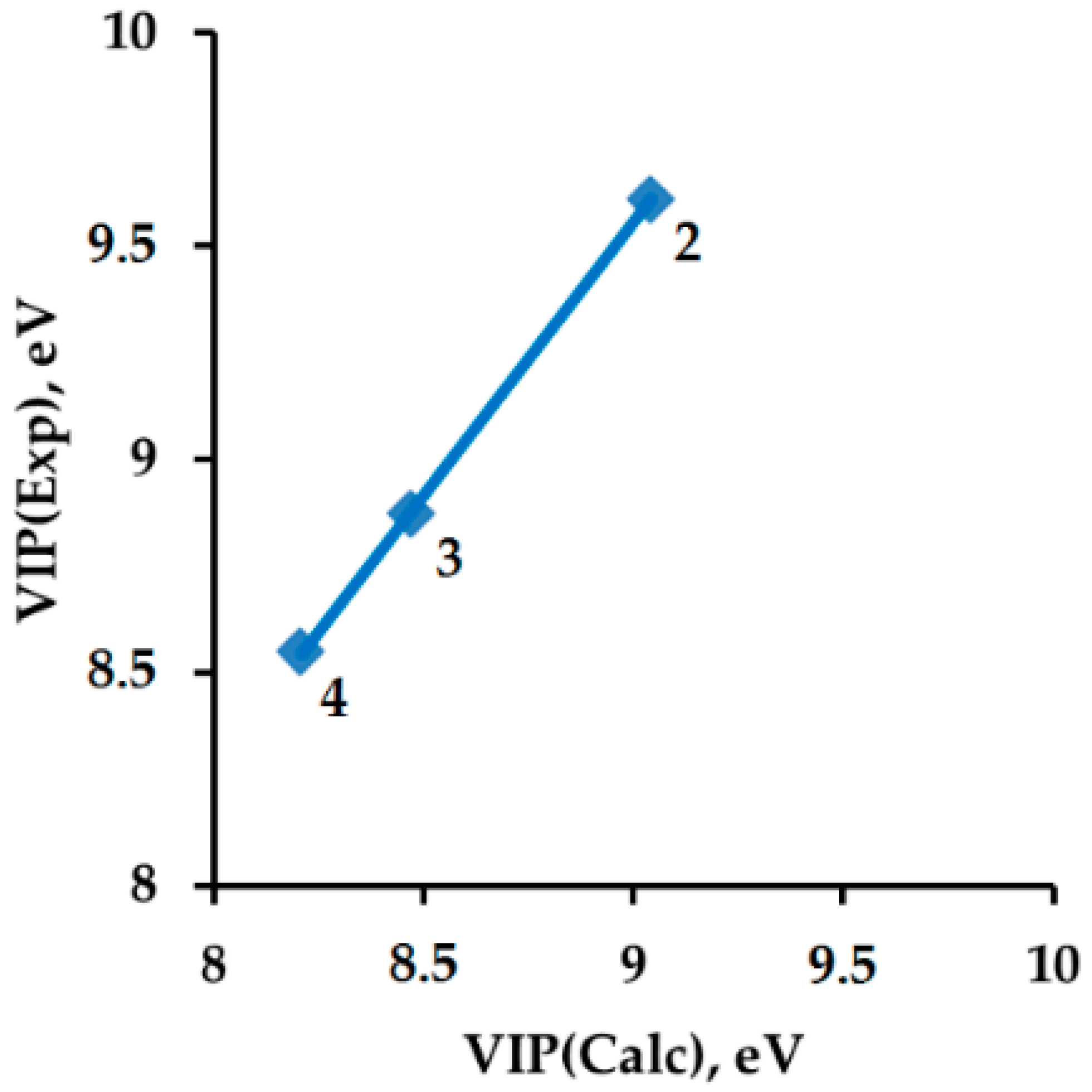
In our work, we used the experimental values of VIP(RH), where RH = 3, 4 [36]. For RH = 2, we used the value of the second VIP(RH) belonging to the vinyl group RH = 3 as the experimental value of VIP(RH) [36]. For RH = 3, 4, the AIP(RH) values were not determined in [36]. Therefore, using DFT calculations, we determined VIP(RH) and AIP(RH), where RH = 2, 3, 4 in two isomeric forms, and compared the theoretical and experimental values (Figure 3, Table 1 and Table 2).
The data obtained confirm that the experimental value of VIP(RH), where RH = 2, is correct. From the data in Table 1, it can be seen that compared with RH = 1 (VIP(1) = 10.3 ± 0.2 eV [29,32], AIP(1) = 9.88 ± 0.02 [29,30,31,32,33], VEA(1) = −1.81 eV, and AEA(1) = −2.13 eV [19]), all IP(1) > IP(24), and EA(1) ≤ EA(24).

3.4.2. Comparison of Different Methods for Estimating Intermediate Energies Corresponding to the Limit Values G0(H2) = 0 and 8.4 Molecules/100 eV

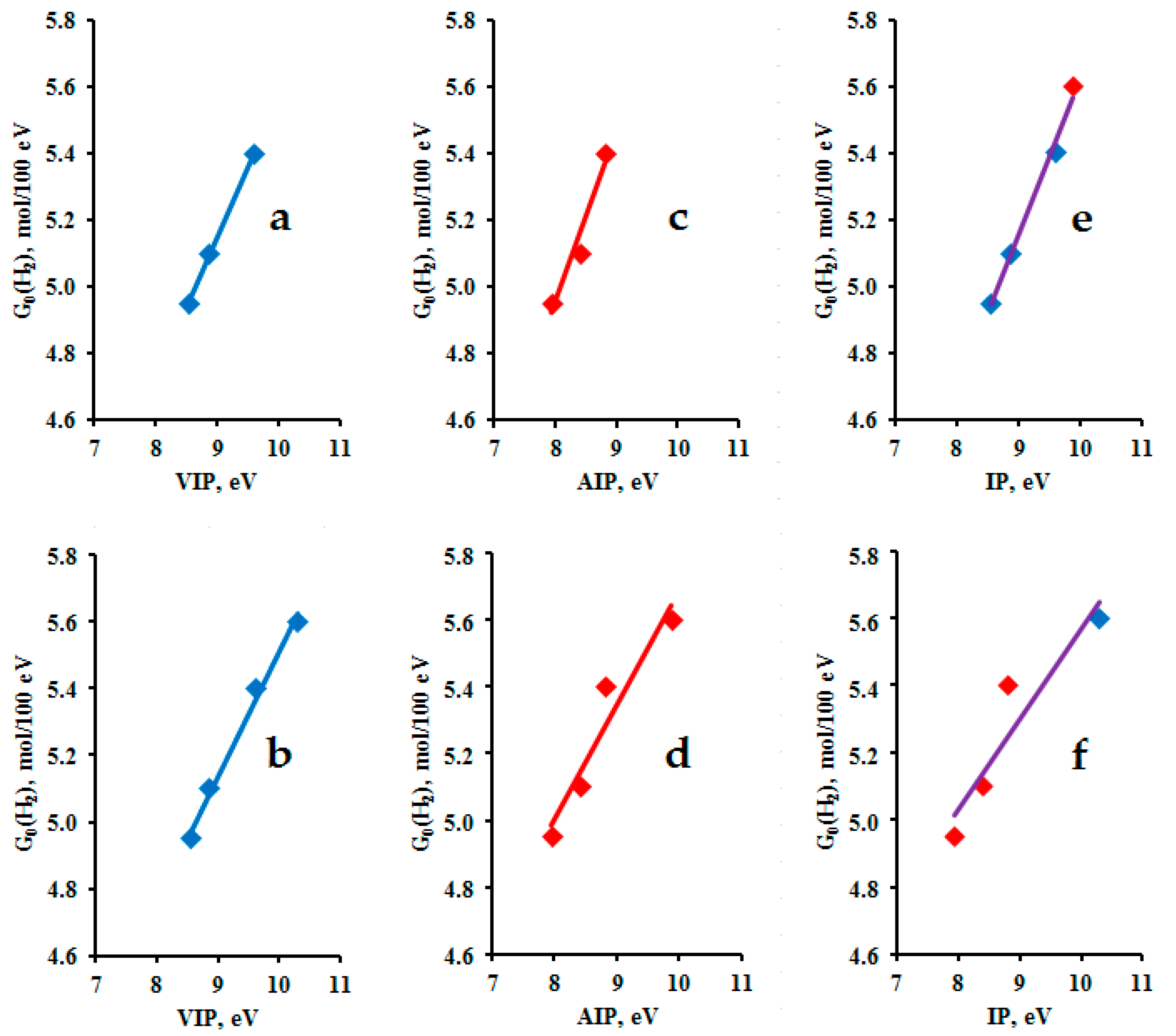
Our theoretical estimates of the experimental values of VIP, AIP, VEA, and AEA RH 24 (Table 1) allow us to analyze how all possible energy methods for analyzing experimental data on G0(H2) for RH 14 affect the estimates of experimental formation energies E at G0(H2) = 0 and 8.4 molecules/100 eV, respectively, for 1•− and 1** (Figure 4, Table 3).
From the data in Table 3, it can be seen that only option e, which we used earlier (Figure 2 and Figure 4e), agrees well with experimental data and their theoretical estimates related to E(1•−) and E(1•+(VII)). This fact requires additional comments.
Of the five points that are located along the straight line shown in Figure 4e, the values of the two extreme points (Table 3, option e) belong to AEA(1) and AIP(1), and the three middle points belong to VIP(RH), where RH = 24. From this observation, it can be concluded that during gamma radiolysis of liquid cyclohexane containing C0(RH) ≈ 5 × 10⁻³ M/L, where RH = 24, RC 1•+ and RA 1•− have enough time to transform into energetically more stable (adiabatic) states before the stages of subsequent electron transfer between the components of a binary system and the formation of EEMs 1*(S and T), the precursors of molecular hydrogen.

3.4.3. The Importance of Using Low Concentrations of Additives to Study the Initial Stages of Gamma Radiolysis of Liquid Cyclohexane

The second and most significant factor that can and does influence the determined value of E(1•−) = AEA(1) was the experimental factor—the correct choice of the initial concentrations of additives C0(RH). The dependence of G0(H2) on C0(RH) (Figure 1A, curve c) means that AEA(1) should depend on C0(RH). Only at low initial concentrations of C0(RH) < 0.02 M/L was the dependence of G0(H2) on C0(RH) linear (Figure 1B). This corresponds to the interval, C0(RH) < 0.02 M/L, within which, at C0(RH) ≈ 5 × 10⁻³ M/L, a decrease in VIP(RH) led to a decrease in G0(H2) exactly equaled the increase in G0(–RH) (Figure 1C).
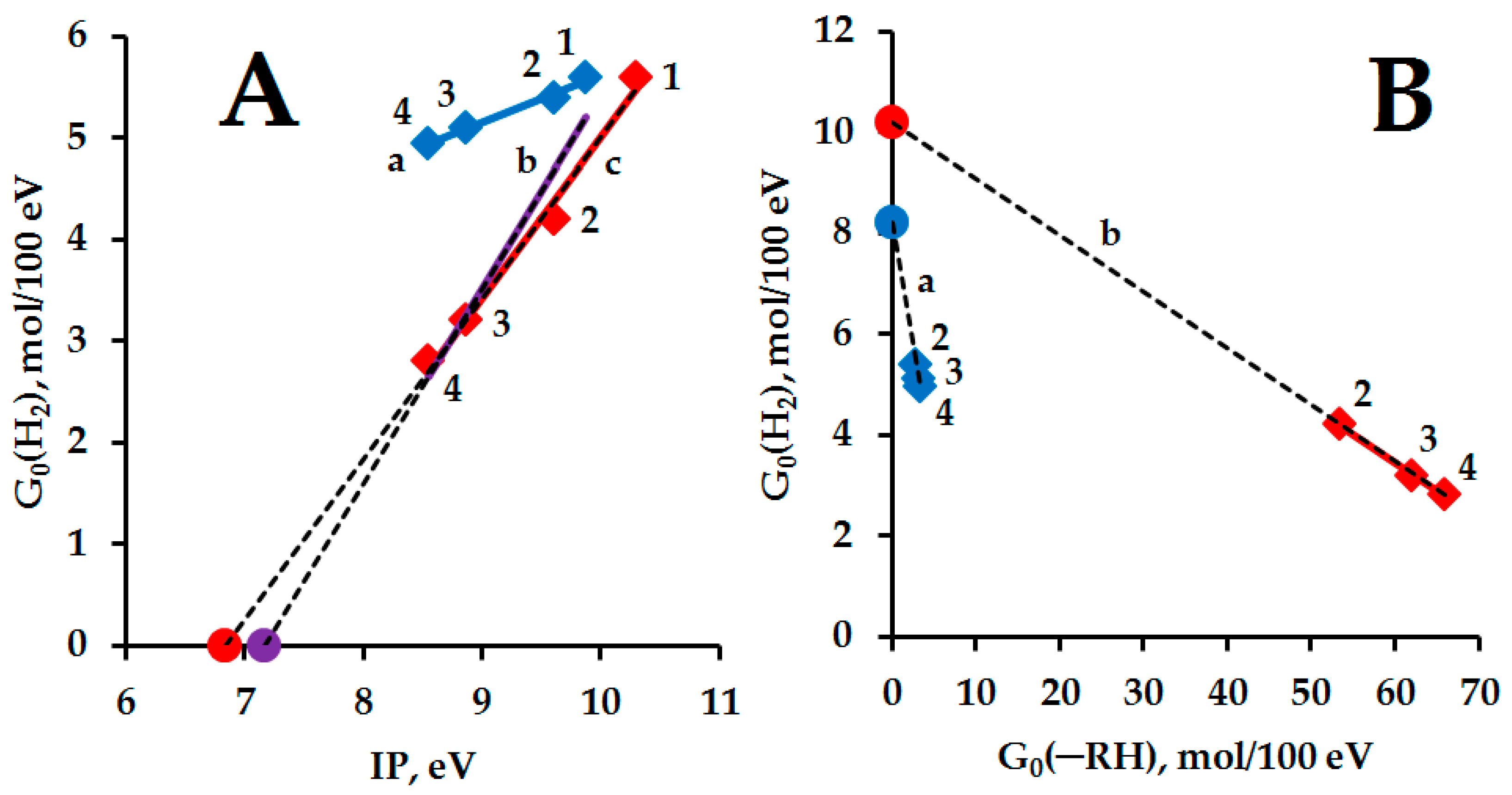
To emphasize the importance of using low concentrations of additives to study the initial stages of gamma radiolysis of liquid cyclohexane, we analyzed the data from [16] related to two different concentrations of C0(RH): 5 × 10⁻³ and 0.1 M/L. With an increase in C0(RH) from 5 × 10⁻³ M/L (Figure 5A, straight line a) to 0.1 M/L (Figure 5A, straight lines b and c), the determined AIP value increases from −2.01 eV (see Figure 2A) to about 7 eV (Figure 5A). The lines b and c differ in that, in the first case, the experimental value of AIP(1) was used, and the estimate of AIP(X5) = 7.17 eV was obtained, while in the second case, the value of VIP(1) was used, and the estimate of VIP(X5) = 6.84 eV was obtained.
Our estimate of AIP(X5) = 7.17 eV, obtained using the energy technique, practically coincides with the experimentally determined value of AIP(c-C6H11) = 7.15 ± 0.04 [32] and our theoretical estimate of AIP(c-C6H11) = 7.16 eV [19], obtained using DFT calculations. Thus, at C0(RH) = 0.1 M/L, using the proposed technique, the X5 intermediate was identified as the cyclohexyl radical c-C6H11.
Our results show that at concentrations of C0(RH) = 5 × 10⁻³ and 0.1 M/L, different mechanisms initiate the consumption of impurity RH molecules. In the first case, a one-electron transfer occurs between the components of the binary system. In the second case, the free radical c-C6H11 attaches to the double bonds of bicyclic mono- and dienes, and free radical polymerization of RH is realized (Figure 5A,B, lines a and b). The implementation of the second mechanism was indicated by large values of G0(–RH) ˃ 50 molecules/100 eV (Figure 5B, line b).
In gamma radiolysis of liquid cyclohexane, the precursors of neutral c-C6H11 radicals are triplet excited c-C6H12*(T) molecules and hydrogen atoms H (reactions (9) and (10), respectively). This was the final stage of gamma radiolysis. Therefore, binary solutions with C0(RH) = 5 × 10⁻³ and 0.1 M/L provide information about different stages of gamma radiolysis: initial and final, respectively.
The straight line B-b in Figure 5 gave the maximum value of G0(H2) = 10.23 molecules/100 eV, which, according to the equations of the straight lines A-b and A-c in Figure 5, gave E = 12.51 and 13.30 eV, respectively. We have not studied this area of concentrations and energies in detail. Perhaps, when clarifying the data related to G0(–RH) for binary solutions with C0(RH) = 0.1 M/L, it will turn out that the straight line B-b in Figure 5 has a smaller slope, which corresponds to the maximum value of G0(H2) = 8.4 molecules/100 eV. This fact does not change the main conclusions based on G0(H2) data.

4. Conclusions

  • Using the correlation of the initial radiation-chemical yields of molecular hydrogen (G0(H2), molecules/100 eV) formed during gamma radiolysis of liquid cyclohexane in the absence and presence of small additives of bicyclic mono- and dienes RH (C0(RH) ≈ 5 × 10⁻³ M/L) and the first ionization potentials (IPs) of solvent molecules and dissolved substances determined in the gas phase, the experimental value of the adiabatic electron affinity of the cyclohexane molecule was determined: AEA(c-C6H12) = −2.01 eV.
  • Using the same technique for identifying active intermediates of gamma radiolysis of liquid cyclohexane by their formation energies, the energy of the superexcited molecule E(c-C6H12**) ≈ 18 eV, precursor of all other primary chemically active intermediates—radical cation, radical anion, and electronically excited molecules—was determined for the first time.
  • The ratio 8.4/5.6 = 3/2, where 8.4 and 5.6 are the quantities of G0(H2) molecules/100 eV, respectively—the largest possible quantity determined for the first time and the experimentally observed quantity—corresponds to the ratio of the number of primary active intermediates of gamma radiolysis of liquid cyclohexane before and after the charge neutralization reaction: before this reaction, there were three primary active intermediates (PAIs) in the system in a ratio of 1:1:1: a radical cation, a radical anion, and an electronically excited cyclohexane molecule. After this reaction, two electronically excited cyclohexane molecules remained in the system—the precursors of molecular hydrogen—and one neutral molecule appeared, which was not detected.
  • The ratio 5.6/4.2 = 4/3, where 5.6 and 4.2 are the quantities of G0(H2) molecules/100 eV, respectively—the experimentally observed quantity and the coordinate of the intersection point of the linear dependences of G0(H2) and G0(–RH) (C0(RH) ≈ 5 × 10⁻³ M/L) on the PI of the solvent and solute molecules—corresponds to the ratio of statistically realized singlet (S) and triplet (T) spin states of all formed electronically excited molecules (S + T). These are precursors of molecular hydrogen before and after the complete transfer of their S states to the additive molecules (S—one electronic state, T—three electronic states).
  • Using the energy method, it has been shown that an increase in C0(RH) concentrations from 5 × 10⁻³ to 0.1 M/L leads to a change in the mechanism of RH consumption. Instead of RH activation, as a result of the single electron transfer reaction, RH polymerization begins, which is initiated by cyclohexyl radicals.

Supplementary Materials

The following supporting information can be downloaded at https://www.mdpi.com/article/10.3390/hydrogen7010029/s1, Table S1: The charge, spin state, energy, and XYZ coordinates of all atoms of all structures optimized by the DFT method.

Author Contributions

Conceptualization, I.Y.S.; methodology, I.Y.S.; software, I.Y.S.; validation, A.I.N. and I.Y.S.; formal analysis, A.I.N. and I.Y.S.; investigation (DFT calculations), I.Y.S.; resources, A.I.N. and I.Y.S.; data curation, A.I.N. and I.Y.S.; writing—original draft preparation, I.Y.S.; writing—review and editing, A.I.N. and I.Y.S.; visualization, I.Y.S.; supervision, A.I.N. and I.Y.S.; project administration, A.I.N. and I.Y.S.; funding acquisition, A.I.N. and I.Y.S. All authors have read and agreed to the published version of the manuscript.

Funding

This research received no external funding.

Institutional Review Board Statement

Not applicable.

Informed Consent Statement

Not applicable.

Data Availability Statement

The original contributions presented in this study are included in the article/Supplementary Material. Further inquiries can be directed to the corresponding author.

Conflicts of Interest

The authors declare no conflicts of interest.

Abbreviations

ADAdditive
AIPAdiabatic ionization potential
AEAAdiabatic electron affinity
AnAnion ()
CatCation (+)
c-C6H10Cyclohexene molecule
c-C6H11Cyclohexyl radical
c-C6H12Cyclohexane molecule (1)
(c-C6H11)2Dicyclohexyl
DFTDensity functional theory
EEnergy
EAElectron affinity
EEMElectronically excited molecule (*)
eElectron
E*Electron excitation energy
ENB5-ethylidenenorbornene (5-ethylidene-bicycle[2.2.1]hepten-2) (4)
EhUnit energy in Hartree
E(h)Energy in Hartrees
eVUnit energy in electron Volt
E(eV)Energy in electron Volts
GGAGeneralized gradient approximation
HHydrogen radical (atom)
H2Hydrogen molecule
HOMOHighest occupied molecular orbital
IPIonization potential
IUPACInternational union of pure and applied chemistry
LUMOLowest unoccupied molecular orbital
M/LMole/Liter
MOMolecular orbital
PAIPrimary active intermediate
PBE0One-parameter hybrid version of PBE
PBEPerdew–Burke–Erzerhoff GGA functional
PPThree sets of first polarization functions on all atoms
RARadical anion (•−)
RCRadical cation (•+)
RHFRestricted Hartree–Fock
SSinglet
SCF-MOSelf-consistent field–molecular orbital
SEMSuperexcited molecule
SETSingle electron transfer
SOMOSingle occupied molecular orbital
TTriplet
TZVAhlrichs triple-zeta valence basis set
TZVPPTZV + PP
UHFUnrestricted Hartree–Fock
VEAVertical electron affinity
VIPVertical ionization potential
VNB5-vinylnorbornene (5-vinyl-bicyclo[2.2.1]hepten-2) (3)
VNN2-vinylnorbornane (2-vinyl-bicyclo[2.2.1]heptane) (2)

References

  1. Le, T.T.; Sharma, P.; Bora, B.J.; Tran, V.D.; Truong, T.H.; Le, H.C.; Nguyen, P.Q.P. Fueling the future: A comprehensive review of hydrogen energy systems and their challenges. Int. J. Hydrogen Energy 2024, 54, 791–816. [Google Scholar] [CrossRef]
  2. Anekwe, I.M.S.; Sherif Ishola Mustapha, S.I.; Akpasi, S.O.; Tetteh, E.K.; Joel, A.S.; Isa, Y.M. The hydrogen challenge: Addressing storage, safety, and environmental concerns in hydrogen economy. Int. J. Hydrogen Energy 2025, 167, 150952. [Google Scholar] [CrossRef]
  3. Kaur, S.; Kumar, R.; Singh, K.; Singh, S. Systematic review of hydrogen, biomass, biogas, and solar photovoltaics in hybrid renewable energy systems: Advancements, challenges, and future directions. Int. J. Hydrogen Energy 2025, 137, 160–189. [Google Scholar] [CrossRef]
  4. Li, Q.; Zhang, Q.; Zhang, L.; Lang, J.; Yuan, W.; An, G.; Lei, T.; Yan, J. A comprehensive review of advances and challenges of hydrogen production, purification, compression, transportation, storage and utilization technology. Ren. Sust. Energy Rev. 2026, 226, 116196. [Google Scholar] [CrossRef]
  5. Tackie-Otoo, B.N.; Mahmoud, M.; Raza, A. Renewable Energy versus Hydrogen Energy: Assessing Current Needs for Sustainable Energy Solutions. Energy Fuels 2025, 39, 17730–17762. [Google Scholar] [CrossRef]
  6. Yang, J.; Lam, T.Y.; Luo, Z.; Cheng, Q.; Wang, G.; Yao, H. Renewable energy driven electrolysis of water for hydrogen production, storage, and transportation. Ren. Sust. Energy Rev. 2025, 218, 115804. [Google Scholar] [CrossRef]
  7. Nazir, M.A.; Afzal, S.; Razzaq, I.; Gurbanova, L.; Ullah, S.; Shaaban, I.A.; Ahmad, A.; Mohammad, A.; Shah, S.S.A. Graphene-supported electrocatalysts for efficient hydrogen evolution: Advances and applications. Int. J. Hydrogen Energy 2025, 161, 150710. [Google Scholar] [CrossRef]
  8. Yang, S.; Schulz, H.-M.; Horsfield, B.; Schovsbo, N.H.; Noah, M.; Panova, E.; Rothe, H.; Hahne, K. On the changing petroleum generation properties of Alum Shale over geological time caused by uranium irradiation. Geochim. Cosmochim. Acta 2018, 229, 20–35. [Google Scholar] [CrossRef]
  9. Wang, W.; Liu, C.; Zhang, D.; Liu, W.; Chen, L.; Liu, W. Radioactive genesis of hydrogen gas under geological conditions: An experimental study. Acta Geol. Sin. Engl. Ed. 2019, 93, 1125–1134. [Google Scholar] [CrossRef]
  10. Sauvage, J.F.; Flinders, A.; Spivack, A.J.; Pockalny, R.; Dunlea, A.G.; Anderson, C.H.; Smith, D.C.; Murray, R.W.; D’Hondt, S. The contribution of water radiolysis to marine sedimentary life. Nat. Commun. 2021, 12, 1297. [Google Scholar] [CrossRef]
  11. Ballentine, C.J.; Karolyte, R.; Cheng, A.; Lollar, B.S.; Gluyas, G.; Daly, M.C. Natural hydrogen resource accumulation in the continental crust. Nat. Rev. Earth Environ. 2025, 6, 342–356. [Google Scholar] [CrossRef]
  12. Ho, S.K.; Freeman, G.R. Radiolysis of Cyclohexane. V. Purified Liquid Cyclohexane and Solutions of Additives. J. Phys. Chem. 1964, 68, 2189–2197. [Google Scholar] [CrossRef]
  13. Földiak, G. (Ed.) Radiation Chemistry of Hydrocarbons; Akadémiai Kiadó: Budapest, Hungary, 1981. [Google Scholar]
  14. LaVerne, J.A.; Pimblott, S.M.; Wojnarovits, L. Diffusion–kinetic modeling of the γ-radiolysis of liquid cycloalkanes. J. Phys. Chem. A 1997, 101, 1628–1634. [Google Scholar] [CrossRef]
  15. Wojnárovits, L. Radiation Chemistry. In Handbook of Nuclear Chemistry; Vértes, A., Nagy, S., Klencsár, Z., Lovas, R.G., Rösch, F., Eds.; Springer Science + Business Media B.V.: Berlin/Heidelberg, Germany, 2011; Volume 3, pp. 1263–1331. [Google Scholar] [CrossRef]
  16. Shchapin, I.Y.; Makhnach, O.V.; Klochikhin, V.L.; Nekhaev, A.I. Radiolysis products of the cyclohexane–bicyclic diene binary system. Pet. Chem. 2017, 57, 897–903. [Google Scholar] [CrossRef]
  17. Ali, I.; Imanova, G.; Agayev, T.; Aliyev, A.; Habila, M.A.; Basheer, A.A. Modeling of hydrogen generation by hexane and its water mixture by radiolysis. Radiation Phys. Chem. 2024, 215, 111329. [Google Scholar] [CrossRef]
  18. Pikaev, A.K. Modern Radiation Chemistry. Min Regularities. Experimental Technique and Methods; Nauka: Moscow, Russia, 1985. (In Russian) [Google Scholar]
  19. Shchapin, I.Y.; Nekhaev, A.I. Theoretically Estimated Experimental Adiabatic Electron Affinities of Hydrogen and Cyclohexane Molecules. Hydrogen 2025, 6, 115. [Google Scholar] [CrossRef]
  20. Aliper, A.M.; Bozdaganyan, M.E.; Sarkisova, V.A.; Veviorsky, A.P.; Ozerov, I.V.; Orekhov, P.S.; Korzinkin, M.B.; Moskalev, A.; Zhavoronkov, A.; Osipov, A.N. Radioprotectors.org: An open database of known and predicted radioprotectors. Aging 2020, 12, 15741–15755. [Google Scholar] [CrossRef]
  21. Shchapin, I.Y.; Nekhaev, A.I.; Ramazanov, D.N.; Al-Yusufi, M.; Samoilov, V.O.; Maximov, A.L. Hydrocarbon oxidation depth: H2O2/Cu2Cl4·2DMG/CH3CN system. Catalysts 2022, 12, 409. [Google Scholar] [CrossRef]
  22. Shchapin, I.Y.; Nekhaev, A.I. The boundary between two modes of gas evolution: Oscillatory (H2 and O2) and conventional redox (O2 only), in the hydrocarbon/H2O2/Cu(II)/CH3CN system. Hydrogen 2023, 4, 74–102. [Google Scholar] [CrossRef]
  23. Neese, F. The ORCA program system. WIREs Comput. Mol. Sci. 2012, 2, 73−78. [Google Scholar] [CrossRef]
  24. Neese, F. ORCA—An Ab Initio, DFT and Semiempirical SCF-MO Package—Version 3.0.1; Max-Plank-Institute for Chemical Energy Conversion: Ruhr, Germany, 2013; Available online: https://orcaforum.kofo.mpg.de/ (accessed on 26 November 2022).
  25. Valeev, E. Libint: High-Performance Library for Computing Gaussian Integrals in Quantum Mechanics. Available online: http://libint.valeyev.net (accessed on 19 December 2023).
  26. Schaefer, A.; Horn, H.; Ahlrichs, R. Fully optimized contracted Gaussian basis sets for atoms Li to Kr. J. Chem. Phys. 1992, 97, 2571–2577. [Google Scholar] [CrossRef]
  27. The TurboMole Basis Set Library. Available online: http://ftp.chemie.uni-karlsruhe.de/pub/bases (accessed on 27 January 2024).
  28. Chemcraft—Graphical Software for Visualization of Quantum Chemistry Computations. Available online: https://www.chemcraftprog.com (accessed on 27 January 2024).
  29. Ikuta, S.; Yoshihara, K.; Shiokawa, T.; Jinno, M.; Yokoyama, Y.; Ikeda, S. Photoelectronspectroscopy of cyclohexane, cyclopentane, and related compounds. Chem. Lett. 1973, 2, 1237–1240. [Google Scholar] [CrossRef]
  30. Watanabe, K. Ionization potentials of some molecules. J. Chem. Phys. 1957, 26, 542–547. [Google Scholar] [CrossRef]
  31. Bischof, P.; Hashmall, J.A.; Heilbronner, E.; Hornung, V. Photoelektronspektroskopische Bestimmung der Wechselwirkung zwischen nicht-konjugierten Doppelbindungen [1]. Vorläufige Mitteilung. Helv. Chim. Acta 1969, 52, 1745–1749. [Google Scholar] [CrossRef]
  32. Bieri, G.; Burger, F.; Heilbronner, E.; Maier, J.P. Valence ionization energies of hydrocarbons. Helv. Chim. Acta 1977, 60, 2213–2233. [Google Scholar] [CrossRef]
  33. Raymonda, J.W. Rydberg states in cyclic alkanes. J. Chem. Phys. 1972, 56, 3912–3920. [Google Scholar] [CrossRef]
  34. Jung, J.M.; Gress, H. Single-photon absorption of liquid cyclohexane, 2,2,4 trimethylpentane and tetramethylsilane in the vacuum ultraviolet. Chem. Phys. Lett. 2003, 377, 495–500. [Google Scholar] [CrossRef]
  35. Jung, J.M. On the photoionisation of liquid cyclohexane, 2,2,4 trimethylpentane and tetramethylsilane. Chem. Phys. Lett. 2003, 380, 190–195. [Google Scholar] [CrossRef]
  36. Voronenkov, V.V.; Osokin, Y.G.; Baidin, V.N.; Rusakov, A.I. Photoelectron spectra and quantum-chemical calculation of 5-vinyl- and 5-ethylidenebicyclo[2.2.1]hept-2-ene. Theor. Exp. Chem. 1985, 21, 450–452. [Google Scholar] [CrossRef]
  37. Masclet, P.; Grosjean, D.; Mouvier, G.; Dubois, J. Alken ionization potentials. Part I: Quantitative determination of alkyl group structural effects. J. Electr. Spectr. Relat. Phenom. 1973, 2, 225–237. [Google Scholar] [CrossRef]
  38. Oltedal, V.M.; Børve, K.J.; Sæthre, L.J.; Thomas, T.D.; Bozek, J.D.; Kukk, E. Carbon 1s photoelectron spectroscopy of six-membered cyclic hydrocarbons. Phys. Chem. Chem. Phys. 2004, 6, 4254–4259. [Google Scholar] [CrossRef]
  39. Al-Joboury, M.I.; Turner, D.W. Molecular photoelectron spectroscopy. Part II. A summary of ionization potentials. J. Chem. Soc. 1964, 4434–4441. [Google Scholar] [CrossRef]
  40. Rao, C.N.R.; Basu, P.K.; Hegde, M.S. Systematic organic UV photoelectron spectroscopy. Appl. Spectr. Rev. 1979, 15, 1–193. [Google Scholar] [CrossRef]
  41. Shchapin, I.Y.; Ramazanov, D.N.; Nekhaev, A.I.; Borisov, R.S.; Buravlev, E.A.; Maximov, A.L. One-stage catalytic oxidation of adamantane to tri-, tetra-, and penta-ols. Catalysts 2021, 11, 1017. [Google Scholar] [CrossRef]
  42. Howard, A.E.; Staley, S.W. Negative ion states of three- and four-membered ring hydrocarbons: Studied by electron transmission spectroscopy. In Resonances; ACS Symposium Series; ACS Publications: Washington, DC, USA, 1984; Volume 263, pp. 183–192. [Google Scholar] [CrossRef]
  43. Costner, E.A.; Long, B.K.; Navar, C.; Jockusch, S.; Lei, X.; Zimmerman, P.; Campion, A.; Turro, N.J.; Willson, C.G. Fundamental optical properties of linear and cyclic alkanes: VUV absorbance and index of refraction. J. Phys. Chem. A. 2009, 113, 9337–9347. [Google Scholar] [CrossRef]
  44. Killat, U. Optical properties of C6H12, C6H10, C6H8, C6H6, C7H8, C6H5Cl and C5H5N in the solid and gaseous state derived from electron energy losses. J. Phys. C Solid State Phys. 1974, 7, 2396–2408. [Google Scholar] [CrossRef]
  45. Koizumi, H.; Shinsaka, K.; Hatano, Y. VUV-optical oscillator strength distributions of molecules and their implications to early events in radiation chemistry. Int. J. Radiat. Appl. Instrum. Part C Radiat. Phys. Chem. 1989, 34, 87–92. [Google Scholar] [CrossRef]
  46. LaVerne, J.A.; Pimblott, S.M. Electron energy loss distributions in solid and gaseous hydrocarbons. J. Phys. Chem. 1995, 99, 10540–10548. [Google Scholar] [CrossRef]
  47. Makarov, V.I.; Polak, L.S. Role of excited states in radiolysis of cyclohexane. Int. J. Radiat. Phys. Chem. 1976, 8, 187–203. [Google Scholar] [CrossRef]
  48. Shchapin, I.Y.; Makhnach, O.V.; Klochikhin, V.L.; Osokin, Y.G.; Nekhaev, A.I. Chemical behavior of 5-vinyl-2-norbornene, 5-ethylidene-2-norbornene, and related compounds as a key to understanding the specifics of radiation-chemical processes: 5. Energy-controlled positive-charge transfer processes. Pet. Chem. 2010, 50, 476–483. [Google Scholar] [CrossRef]
  49. Pickett, L.W.; Muntz, M.; McPherson, E.M. Vacuum ultraviolet absorption spectra of cyclic compounds. I. Cyclohexane, cyclohexene, cyclopentane, cyclopentene and benzene. J. Am. Chem. Soc. 1951, 73, 4862–4865. [Google Scholar] [CrossRef]
  50. Davari, N.; Haghdani, S.; Åstrand, P.O.; Schatz, G.C. Local electric field factors by a combined charge-transfer and point-dipole interaction model. RSC Adv. 2015, 5, 31594–31605. [Google Scholar] [CrossRef]
  51. Schmidt, W.F. Electrons in nonpolar dielectric liquids. IEEE Transact. Electr. Insul. 1991, 26, 560–567. [Google Scholar] [CrossRef]
  52. Choi, H.T.; Askew, D.; Lipsky, S. A note on the G value for the production of the lowest excited singlet state of cyclohexane. Radiat. Phys. Chem. 1982, 19, 373–375. [Google Scholar] [CrossRef]
Scheme 1. Hydrocarbons 14. Numbering of 1–7 carbon atoms in 14 according to IUPAC.
Hydrogen 07 00029 sch001
Figure 1. (A,B) The initial radiation-chemical yields G0(H2) of molecular hydrogen formation from γ-irradiated liquid cyclohexane at 40 °C depend on the initial concentration of C0(VNB) and the initial electron fraction ε(VNB) (collected data from [16]). ((A)-a) The theoretical additive line. ((A)-b) The largest negative deviation ∆G0(H2) = 3.2 molecules/100 eV (curve b) of the experimental curve c from the theoretical additive line a, which occurred at C0(VNB) = 1 M/L, is shown. ((A)-c) The experimental curve. (B) The initial, close to rectilinear, section of the experimental curve c: G0(H2) = −95.202·C0(VNB) + 5.5855, R2 = 0.9992. (C) Equations of lines: ((C)-a) G0(H2) = 0.4212·VIP(RH) + 1.3552, R2 = 0.9988; ((C)-b) G0(–RH) = −0.4367·VIP(RH) + 7.1417, R2 = 0.9956; ((C)-c) G0(H2) = G0(–RH) = 4.2 molecules/100 eV [16]. A square point is an experiment, a round point is a vertical extrapolation.
Hydrogen 07 00029 g001
Figure 2. (A) Dependence of IP and G0(H2) for RH 14. The equation of a straight line: G0(H2) = 0.4682·IP + 0.9419, R2 = 0.9891. The point X1 has coordinates (−2.01; 0). (B) Straight lines: (a) G0(H2) + G0(–RH) = 8.4 ± 0.2 molecules/100 eV; (b) G0(H2) = 5.6 molecules/100 eV, the point 1•+; (c) G0(H2) = 4.2 molecules/100 eV, the point X2. (C) Dependence of E and G0(H2) for RH 14, straight lines: (a) G0(H2) = 0.4634·E + 0.9866, R2 = 0.9999, points: 1•− (−2.13; 0), X2 (6.89; 4.18), 1•+ (9.88; 5.6), X3 (16.00; 8.4); (b) G0(H2) = 8.4 molecules/100 eV; (c) E = 16.00 eV; (d) dependence of E and G0(–RH), G0(–RH) = −0.4584·E + 7.3363, R2 = 0.9999; (e) E = 17.86 eV [19]. A square point is an experiment, a round point is an extrapolation.
Hydrogen 07 00029 g002
Figure 3. Correlation between DFT-calculated and experimental values of VIP of 24 molecules: VIP(Exp) = 1.2806·VIP(DFT) − 1.9687, R2 = 0.9998.
Hydrogen 07 00029 g003
Figure 4. There are six types of IP and G0(H2) correlations: VIP only (a,b), AIP only (c,d) and different types of IP (e,f). Blue point—VIP, red point—AIP. The values used are shown in Table 3.
Hydrogen 07 00029 g004
Figure 5. For initial concentrations of C0(RH) = 5 × 10⁻³ and 0.1 M/L (blue and red points respectively), where RH = 14, correlations: (A) IP(RH) and G0(H2); (B) G0(–RH) and G0(H2). AIP(1) and VIP(1) are used in (A)-a,b, and (A)-c, respectively. Equations of straight lines: ((A)-a) G0(H2) = 0.4682·IP(RH) + 0.9419, R2 = 0.9891; ((A)-b) G0(H2) = 1.9152·IP(RH) − 13.723, R2 = 0.9102; ((A)-c) G0(H2) = 1.5835·IP(RH) − 10.8280, R2 = 0.9876; ((B)-a) G0(H2) = −0.9623·G0(–RH) + 8.2359, R2 = 0.9990; ((B)-b) G0(H2) = −0.1129·G0(–RH) + 10.2290, R2 = 0.9986. A square point is an experiment, a round point is an extrapolation.
Hydrogen 07 00029 g005
Table 1. Experimental and DFT-calculated (eV) vertical ionization potential (VIP), adiabatic ionization potential (AIP), vertical electron affinity (VEA) and adiabatic electron affinity (AEA) of molecules 24 *.
RH VIP AIPVEAAEA
Exp. [36]DFTDFT″DFTDFT″DFTDFT″DFTDFT″
Endo-29.61 **9.039.608.678.83−2.14−1.84−1.62−1.33
Exo-29.079.658.628.78−2.14−1.84−1.65−1.36
Endo-38.87 ± 0.028.488.898.268.43−1.80−1.51−1.61−1.32
Exo-38.448.848.188.35−1.82−1.53−1.48−1.19
E-48.55 ± 0.028.208.537.777.94−1.60−1.31−1.45−1.16
Z-48.218.557.767.93−1.79−1.50−1.48−1.19
* Ratios: endo:exo = 2:1 for 2, 3, E:Z = 1:1 for 4; DFT-calculated (V,A)IP = −(E(Mol) − E(RC))·27.2113834, (V,A)EA = (E(Mol) − E(RA))·27.2113834 (see Table 2 for E(Mol, RC, RA), Eh); DFT″ = A·DFT + B. The coefficients: A = 1.2806 and B = −1.9687 for VIP (Figure 3), A = 0.9874 and B = 0.2702 for AIP, VEA and AEA ([19]); averaged values DFT″: VIP(2, 3, 4) = 9.61, 8.87, 8.54, AIP(2, 3, 4) = 8.81, 8.40, 7.94, VEA(2, 3, 4) = −1.84, −1.52, −1.41, AEA(2, 3, 4) = −1.34, −1.28, −1.18. ** VIP(2) = second VIP(3).
Table 2. DFT-calculated energies (Eh) of molecules (Mol), radical anions (RAs) and radical cations (RCs) of RH (v—vertical, a—adiabatic).
RHMolRC (v)RC (a)RA (v)RA (a)
Endo-2−351.060120376437−350.728443218054−350.741704397983−350.981438285079−351.000485487637
Exo-2−351.061022545334−350.727727732873−350.744321106471−350.982573736897−351.000583161625
Endo-3−349.823786262158−349.512000662362−349.520336422025−349.757631072094−349.764603326769
Exo-3−349.823488843816−349.513469690389−349.522942294282−349.756462871229−349.769005846606
E-4−349.829964774994−349.528653786183−349.544612794737−349.765318235163−349.776721547205
Z-4−349.831190292785−349.529341940157−349.545915840650−349.765462787655−349.776765568561
Table 3. There are six possible correlations between the energy parameters of RH 14 hydrocarbons and the amounts of radiation-released molecular hydrogen *.
RHC0(RH), M/LG0(H2), Molecules/
100 eV
TypeIP, eV
(Band No. 1)
VIPAIPIP
19.265.6AIP9.88 ± 0.02 [30,32] ++
VIP10.3 ± 0.2 [29,32] + +
24.91 × 10−35.4AIP8.81 [This work] ++ +
VIP9.61 ± 0.02 [36]++ +
35.18 × 10−35.1AIP8.40 [This work] ++ +
VIP8.87 ± 0.02 [36]++ +
45.10 × 10−34.95AIP7.94 [This work] ++ +
VIP8.55 ± 0.02 [36]++ +
G0(H2) = A∙IP + B
A0.42120.37210.51340.33980.46820.2685
B1.35521.79000.84622.28660.94192.8833
R20.99880.99130.95100.92550.98910.8793
19.260E(1•−) = EA(1) = IP(1−•)−3.22−4.81−1.65−6.73−2.01−10.74
0E(1•−) = EA(1) [19]−1.81 (VEA) −2.13 (AEA)
8.4E(1•+(VII))16.7318.9314.7117.9916.0920.55
8.4E(1•+(VII)) [Reference]15.6 [44], 16.0 [29,46], 16.3 [45],16.00 [Figure 2C]
Figure 4, option:abcdef
* The VIP(2) = second VIP(3) [36]; (15.83(a) + 16.13(v))/2 = 15.98 ≈ 16.0 eV [29]; E(1•+(VII)) = 16.3 eV (E(hν) = 76 nm) [45], VII—band number 7 [29]. The straight lines af and the location of the points are shown in Figure 4a–f.
Disclaimer/Publisher’s Note: The statements, opinions and data contained in all publications are solely those of the individual author(s) and contributor(s) and not of MDPI and/or the editor(s). MDPI and/or the editor(s) disclaim responsibility for any injury to people or property resulting from any ideas, methods, instructions or products referred to in the content.