Review

Promising Use of Proteins of Rainbow Trout Byproducts for Obtaining Multifunctional Bioactive Peptides: Processing Perspective


by
Daniel Farfán Flores
1,
Paula Andrea Santana Sepúlveda
2,
Claudio Andrés Álvarez Álvarez
3,
Oscar Arce Cervantes
1,
Silvia Armenta Jaime
1,* and
Luis Guillermo González Olivares
4,*
1
Instituto de Ciencias Agropecuarias, Universidad Autónoma del Estado de Hidalgo, Avenida Universidad Km. 1, Rancho Universitario, Tulancingo-Santiago Tulantepec, Tulancingo 43600, Hidalgo, Mexico
2
Instituto de Ciencias Aplicadas, Facultad de Ingeniería, Universidad Autónoma de Chile, Avenida del Valle 534, Huechuraba 8581151, Santiago, Chile
3
Departamento de Acuicultura, Universidad Católica del Norte, Larrondo 1281, Coquimbo 1780000, Elqui, Chile
4
Instituto de Ciencias Básicas e Ingeniería, Universidad Autónoma del Estado de Hidalgo, Mineral de la Reforma 42184, Hidalgo, Mexico
*
Authors to whom correspondence should be addressed.
Eng 2026, 7(4), 164; https://doi.org/10.3390/eng7040164
Submission received: 2 March 2026 / Revised: 26 March 2026 / Accepted: 30 March 2026 / Published: 1 April 2026
(This article belongs to the Special Issue Interdisciplinary Insights in Engineering Research 2026)

Abstract

Rainbow trout (Oncorhynchus mykiss) is one of the most widely farmed and consumed aquaculture species worldwide. Processing generates large amounts of by-products, including heads, frames, skin, and viscera, which are often discarded. However, these by-products are a valuable source of high-quality protein that can be converted into bioactive peptides through controlled hydrolysis. Numerous studies have shown that trout-derived peptides exhibit a wide range of functional properties, including antioxidant, antihypertensive, antimicrobial, and anti-inflammatory activities. From this perspective, the article provides a critical, up-to-date review of recent advances in the valorization of proteins from rainbow trout by-products, with an emphasis on the most efficient processing methods (including enzymatic, chemical, and microbial hydrolysis) and their potential applications in the food and nutraceutical industries. In addition, downstream processes such as ultrafiltration and chromatographic separation are discussed in the context of peptide purification and recovery. Finally, a systematized industrial process for the integral utilization of these by-products is proposed. Therefore, the objective of this review is to analyze and synthesize the available scientific evidence on the production, functionality, and applications of bioactive peptides derived from rainbow trout by-products, highlighting key process parameters such as enzyme type, pH, temperature, and degree of hydrolysis and their influence on peptide size (typically <5 kDa), yield, and bioactivity, and to propose a viable industrial process for their sustainable valorization. Despite these advances, challenges related to process standardization, cost efficiency, and industrial scalability remain.

1. Introduction

Rainbow trout farming has experienced sustained growth over the past decade, driven by its high nutritional value, broad acceptance in international gastronomy, and the implementation of improvement strategies to reduce environmental impact [1]. However, as in other sectors of the fish-processing industry, processing generates large volumes of by-products that are often classified as low-value waste [2]. These by-products, including heads, viscera, frames, skin, and scales, represent a significant source of high-biological-value protein and can be exploited to produce bioactive peptides through controlled hydrolysis. Bioactive peptides are defined as specific amino acid sequences derived from food proteins that, once released, can exert beneficial physiological effects on human health, leading to growing scientific interest in their functional properties.
Valorizing proteins from rainbow trout by-products is an effective strategy to reduce waste, enhance the sustainability of the production chain, and generate ingredients with potential applications in functional foods and nutraceutical products [3,4]. In this context, enzymatic hydrolysis has emerged as one of the most efficient approaches for producing bioactive peptides, owing to its ability to control the degree of hydrolysis and promote the release of peptides with specific biological activities [5]. Accordingly, this review provides a critical analysis of the main processing methods for obtaining bioactive peptides from rainbow trout by-products, along with their potential industrial applications.
Despite their potential, the industrial use of rainbow trout by-products remains limited due to several challenges, including raw material variability, rapid degradation, a lack of standardized processing methods, high costs of enzymatic treatments, and difficulties in scaling lab processes to industrial levels. These challenges underscore the need for integrated engineering approaches to enable efficient, reproducible, and cost-effective valorization strategies.

2. Oncorhynchus mykiss Byproducts: Pollution and Sustainable Value

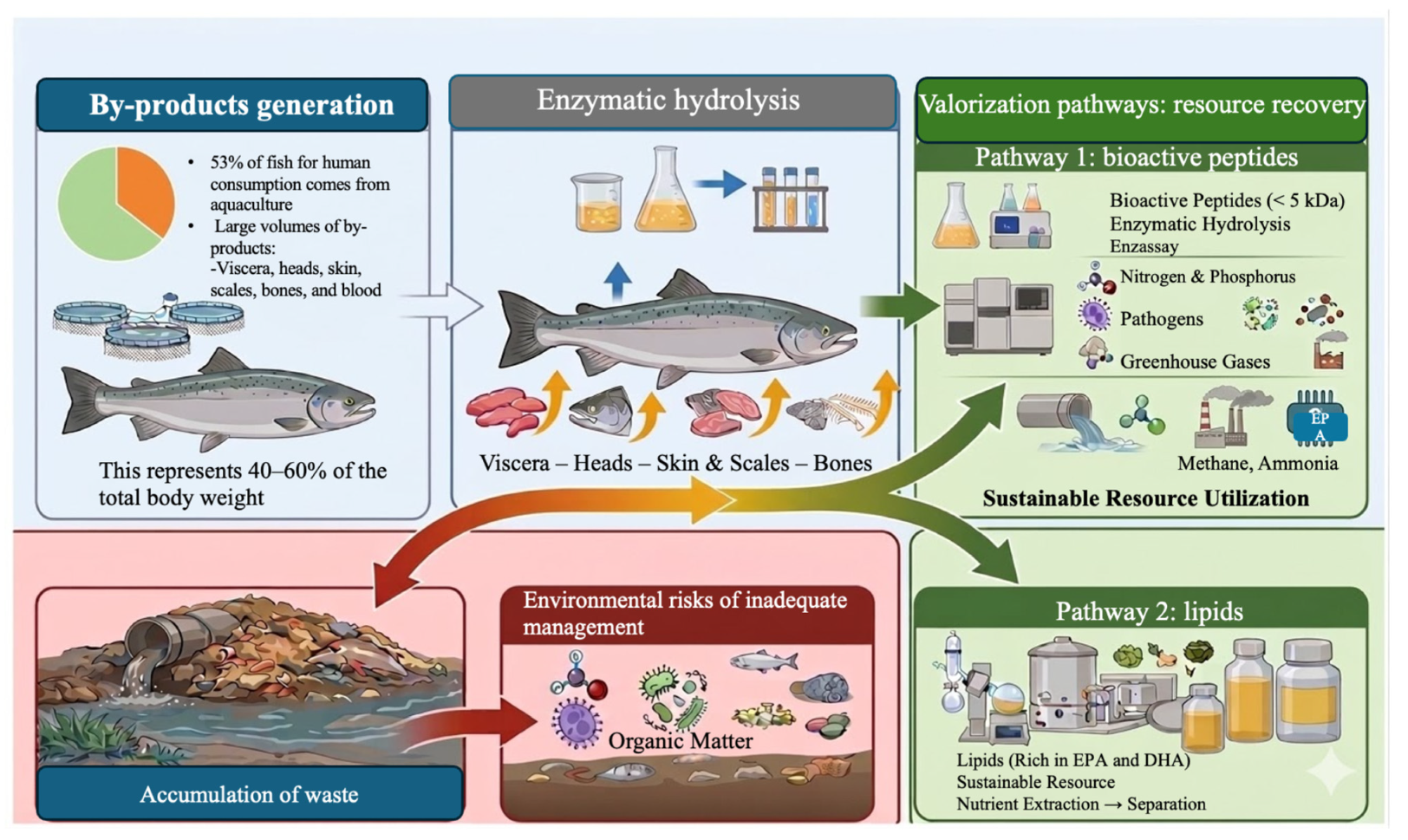
The rapid expansion of aquaculture has solidified its status as a major source of animal protein worldwide. According to the FAO (2022), more than 53% of fish destined for human consumption now comes from aquaculture systems, progressively displacing capture fisheries [6]. However, this growth has been accompanied by significant environmental challenges, particularly the generation of large volumes of organic by-products that, in many regions, lack adequate management and valorization strategies, thereby posing a potential source of environmental contamination [7]. During industrial fish processing, it is estimated that 40–60% of the total body weight is converted into by-products, including viscera, heads, skin, scales, bones, and blood [8]. Due to their high organic load and microbiological instability, these materials degrade rapidly and, when not properly treated or stabilized, contribute to pollution by organic matter, nitrogen, and phosphorus, promoting eutrophication, pathogen proliferation, greenhouse gas emissions (such as methane and ammonia), and the generation of offensive odors [9].
This issue is particularly pronounced in the farming and processing of rainbow trout (Oncorhynchus mykiss), one of the most widely exploited freshwater species in Latin America, Europe, and Asia [10]. Its rapid growth, adaptability to diverse environmental conditions, and high commercial value have contributed to its prominent position in global aquaculture. Nevertheless, up to 55% of processed rainbow trout biomass is estimated to be converted into by-products, with viscera among the most abundant fractions [11]. These internal organs, which include metabolically active tissues such as the liver, intestine, spleen, and pancreas, are particularly susceptible to accelerated degradation under uncontrolled conditions. Consequently, their accumulation in processing facilities or improper disposal in open environments poses a significant sanitary and environmental risk [7].
Far from being low-value waste, rainbow trout viscera exhibit a remarkable biochemical composition, positioning them as a raw material of high interest. Several studies report crude protein contents ranging from 30 to 45%, including myofibrillar, sarcoplasmic, and enzymatic proteins [11]. These proteins can be effectively exploited through enzymatic hydrolysis processes conducted under controlled conditions of temperature (40–55 °C), neutral to slightly alkaline pH (6.5–8.0), and moderate agitation, enabling the generation of low-molecular-weight bioactive peptides (<5 kDa) [12,13]. These peptides have demonstrated a wide range of physiological activities, including antioxidant, antihypertensive, antimicrobial, and immunomodulatory effects, making them compounds of considerable interest for the food, nutraceutical, and pharmaceutical industries [14,15].
In addition to their protein fraction, trout viscera contain between 15 and 25% total lipids and are particularly rich in long-chain polyunsaturated fatty acids, primarily eicosapentaenoic acid (EPA) and docosahexaenoic acid (DHA). These fatty acids are widely recognized for their cardioprotective, anti-inflammatory, and neuroprotective properties and possess high commercial value in the formulation of dietary supplements, functional foods, and cosmetic products. Their recovery can be achieved through mechanical pressing, centrifugation, or extraction using food-grade solvents, followed by purification processes such as physical refining and the removal of pro-oxidant compounds [16]. Figure 1 summarizes the generation of rainbow trout processing by-products, their associated environmental risks, and the main valorization pathways for recovering high-value compounds such as bioactive peptides, lipids, and minerals. It highlights the transition from waste accumulation to sustainable resource utilization within the aquaculture value chain.
Furthermore, rainbow trout viscera is a relevant source of micronutrients, particularly calcium, phosphorus, iron, zinc, and magnesium [17]. These essential elements can be recovered through controlled digestion, calcination, or leaching processes and are subsequently applied in the formulation of mineral supplements, organic fertilizers, animal feed additives, and food biofortification strategies [18]. The integration of these recovery processes into the aquaculture value chain promotes a comprehensive valorization approach that minimizes waste generation and transforms environmental liabilities into value-added products [16,19,20].
The valorization of aquaculture by-products is not exclusive to rainbow trout. Other commercially relevant species, such as Atlantic salmon (Salmo salar), tilapia (Oreochromis niloticus), white shrimp (Litopenaeus vannamei), and tuna (Thunnus spp.), also generate residues with similar compositional characteristics and high utilization potential. A technical comparison of these species, their by-products, compositional profiles, and generation volumes is presented in Table 1, highlighting the magnitude of the associated environmental impact and the need to integrate these materials into circular economy frameworks. Within this context, rainbow trout emerges as a representative model due to its production volume and the high biochemical value of its viscera, making it a paradigmatic case for the revalorization of aquaculture by-products.
Consequently, the effective management and valorization of by-products generated by the rainbow trout industry constitute a strategic axis for reducing the environmental impact of organic waste while simultaneously promoting sustainable practices based on the recovery of high-value compounds. Among these compounds, bioactive peptides derived from visceral proteins stand out due to their growing scientific relevance and application potential. The following section therefore provides a detailed analysis of their structural, functional, and bioactive characteristics, as well as their potential applications in nutrition, pharmacology, and human health.
These environmental and compositional characteristics directly support the feasibility of implementing valorization strategies, particularly for the production of bioactive peptides discussed in the following sections.

3. Properties of Bioactive Peptides from Rainbow Trout Byproducts

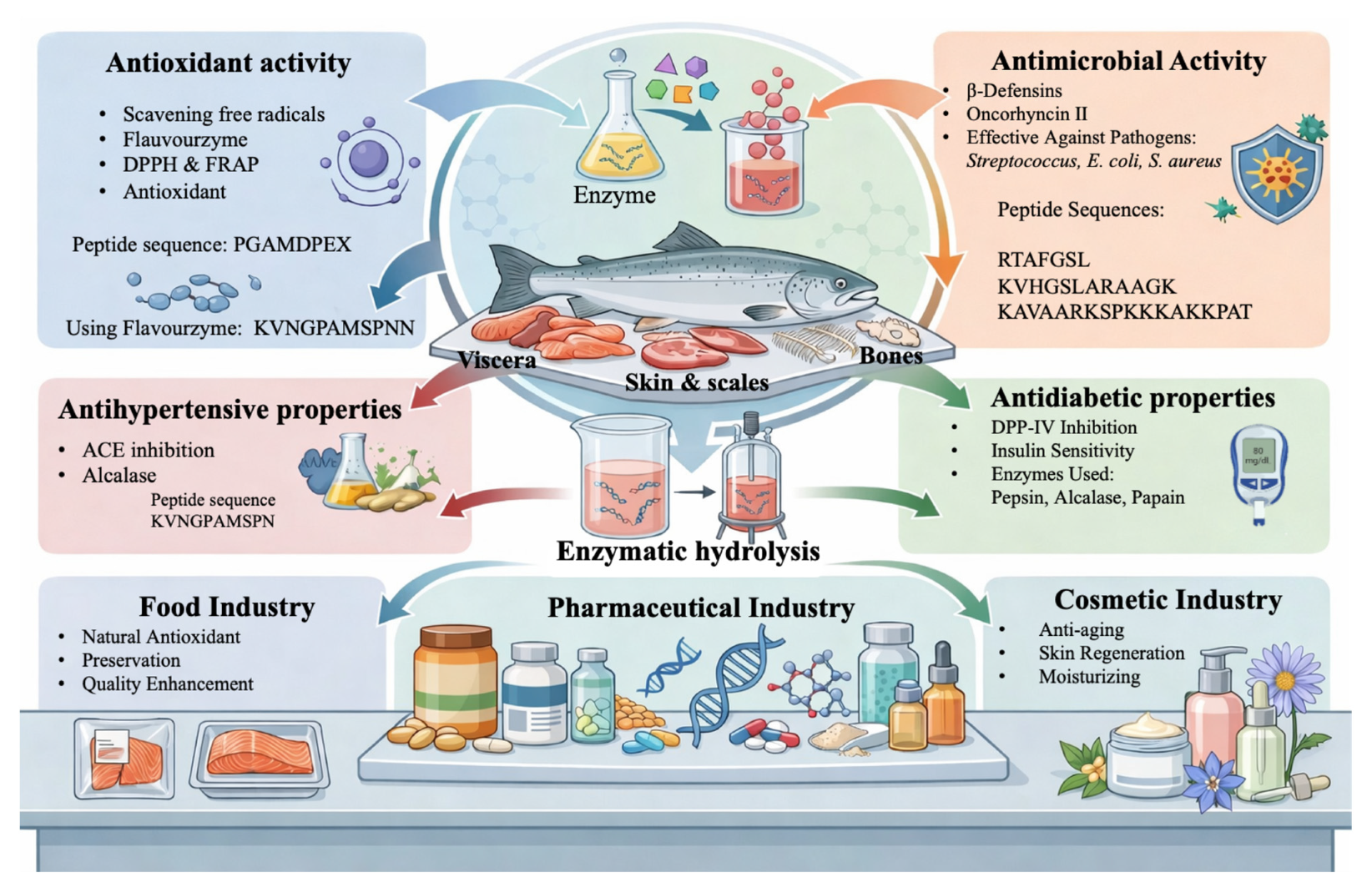
Peptides derived from rainbow trout proteins exhibit a wide range of functional properties, making them attractive for diverse applications across the food, pharmaceutical, and cosmetic industries (Figure 2).
The peptide fragments identified in the analyzed sequences (Table 2) exhibit compositional features commonly reported for bioactive peptides derived from fish proteins. In the present dataset, hydrophobic residues (V, L, I, A, F, and P) and basic amino acids (K and R) were particularly abundant, and glycine and proline were also frequent. This distribution is consistent with peptides released from collagen-rich substrates and aligns with previous reports on rainbow trout protein hydrolysates with multifunctional properties [13,31].
From a structural perspective, many sequences contain hydrophobic or proline residues in the C-terminal region and recurrent X–Pro motifs (e.g., VP, GP, KP, VPG), patterns repeatedly associated with enhanced interactions with angiotensin-converting enzyme (ACE) and dipeptidyl peptidase IV (DPP-IV). The predominance of short di- and tripeptides in Table 2 further supports their potential bioavailability and inhibitory capacity. In addition, the presence of aromatic and electron-donating residues, particularly histidine, tyrosine, and phenylalanine, and, to a lesser extent, cysteine, suggests a complementary antioxidant contribution through radical scavenging and possible metal-chelating mechanisms, as previously described for trout-derived peptides [13,32].
Taken together, enrichment in hydrophobic and proline-containing motifs helps explain the observed overlap between predicted ACE- and DPP-IV-inhibitory activities, while the moderate representation of aromatic residues supports an additional antioxidant role. Collectively, the structural patterns observed in the peptides listed in Table 2 align well with those reported for multifunctional peptides from rainbow trout protein hydrolysates, as determined by in silico analysis with the BIOPEP platform [31]. This overview reflects the potential of the rainbow trout proteins as a source of multifunctional peptides. Particular sequences have been identified in various studies; however, reports often lack such identification, creating opportunities for deeper research in this field.

3.1. Antioxidant Activity

Bioactive peptides from rainbow trout have demonstrated remarkable antioxidant capacity, attributed to specific amino acid sequences that scavenge free radicals and prevent oxidative stress-associated cellular damage [21]. This property is of particular interest for the prevention of degenerative diseases and premature aging. In several studies on the hydrolysis of proteins derived from rainbow trout skin, the most used enzymes are Alcalase and Flavourzyme [32,33,34]. In these studies, antioxidant activity was evaluated using DPPH and FRAP assays, and results indicated that the highest antioxidant activity was achieved when Flavourzyme was employed as the active protease. Specifically, Yaghoubzadeh et al. [32] reported that skin hydrolysates treated with Flavourzyme exhibited greater free-radical-scavenging capacity, as measured by the DPPH assay, than hydrolysates obtained using Alcalase.
In another study, raw material, including heads, tails, skin, bones, and trimmings of rainbow trout and Atlantic salmon, was hydrolyzed with papain and bromelain under different pressure treatments. Differences were observed in both antioxidant activity and the molecular weight of the resulting peptides. At low pressures (200–400 MPa), peptides had molecular weights of 2–5 kDa, whereas at 600 MPa, molecular weights were 1–2 kDa. In both cases, antioxidant activity was observed; however, peptides with lower molecular weight showed higher antioxidant activity in Caco-2 cells [33]. Additionally, Pérez-Escalante et al. [35] evaluated the antioxidant activity of peptides in hydrolysates derived from rainbow trout muscle using the commercial enzyme Alcalase. Antioxidant activity was assessed using DPPH and FRAP assays, and the hydrolysates showed antioxidant capacity in both assays.
Furthermore, hydrolysates were produced from eviscerated rainbow trout, including heads, which were minced before papain- and bromelain-mediated protein hydrolysis. The objective was to evaluate antioxidant activity by measuring reductions in reactive oxygen species (ROS) levels and hydrogen peroxide (H2O2)-induced lipid peroxidation [31].

3.2. Antihypertensive Properties

Some peptides derived from rainbow trout by-products can inhibit angiotensin-converting enzyme (ACE), thereby contributing to reductions in blood pressure. This activity is comparable to that of synthetic ACE inhibitors, suggesting their potential for use in developing functional foods for the management of hypertension [15].
Despite the popularity and nutritional value of rainbow trout, relatively few studies have examined its bioactive peptide (BAP) content. Kim and Byun [36] analyzed rainbow trout muscle hydrolysates to evaluate ACE inhibitory activity. The hydrolysates showed strong ACE inhibition (pepsin: 0.61 mg/mL; trypsin: 1.09 mg/mL; α-chymotrypsin: 1.51 mg/mL). Fraction A, containing the amino acid sequence KVNGPAMSPNAN, was isolated from pepsin hydrolysates and exhibited the highest ACE inhibitory activity, with an IC50 of 0.19 mg/mL.
Bartolomei et al. [31] evaluated the biological activity of the proteins using in vitro assays and observed dose-dependent ACE inhibition by the hydrolysates, suggesting potential antihypertensive effects. This inhibition was also confirmed at the cellular level in Caco-2 cells, indicating that the peptides retain bioactivity in an intestinal model.
More recently, Vásquez et al. [15] investigated differences in the antihypertensive capacity of rainbow trout viscera and their Alcalase hydrolysates, both digested and undigested. Native viscera showed the highest IC50 value, indicating the lowest ACE inhibitory activity. However, digested viscera exhibited a significantly lower IC50 (approximately 53.7% reduction), suggesting that gastrointestinal digestion may generate antihypertensive peptides. Although the IC50 of digested viscera was higher than that of hydrolysates, these findings suggest that Alcalase hydrolysis enhances ACE inhibitory activity. No significant differences were observed between digested and undigested hydrolysates, indicating that ACE-inhibitory peptides are either resistant to intestinal digestion or that new peptides with similar activity are generated during digestion.

3.3. Antidiabetic Properties

Recent studies have shown that certain peptides derived from rainbow trout proteins may benefit individuals with type 2 diabetes by improving insulin sensitivity and lowering blood glucose. These effects are primarily attributed to the peptides’ inhibition of dipeptidyl peptidase IV (DPP-IV), an enzyme that degrades incretins, essential hormones for glucose regulation [33]. By inhibiting DPP-IV, these peptides prolong incretin activity, thereby enhancing insulin response and glycemic control.
Miyamoto et al. [37] investigated the hydrolysis of fish skin, including rainbow trout, using several enzymes, including Alcalase, papain, pepsin, trypsin, and protease P “Amano” 3SD. Hydrolysates produced with Alcalase showed the highest DPP-IV inhibitory activity, suggesting that peptides generated with this enzyme are particularly effective for glucose regulation.
Similarly, Cheung and Li-Chan [38] hydrolyzed rainbow trout skin with multiple enzymes, including Alcalase, bromelain, Corolase N, protease P “Amano” 6SD, protease M “Amano” SD, pepsin, and papain. The highest DPP-IV inhibition was observed in hydrolysates produced with pepsin, Corolase N, and papain, which yielded low-molecular-weight peptides (<3 kDa). These peptides are particularly effective because of their high bioavailability. Ketnawa et al. [39] further advanced this field by producing bioactive peptides from rainbow trout bone waste using Alcalase hydrolysis assisted by a microwave system. This emergent process accelerated proteolysis and improved peptide production efficiency. The resulting low-molecular-weight peptides (300–500 Da) exhibited strong DPP-IV inhibitory activity, highlighting their potential as functional ingredients for the prevention and management of type 2 diabetes.
Finally, Bartolomei et al. [31] produced hydrolysates from rainbow trout without viscera using papain and bromelain and evaluated their DPP-IV inhibitory activity. The hydrolysates significantly reduced DPP-IV activity, indicating substantial potential for diabetes management.
The available evidence indicates that peptides derived from rainbow trout skin, heads, and other by-products exhibit bioactive properties with significant potential for the management of type 2 diabetes. Hydrolysates produced with specific enzymes such as Alcalase, pepsin, and papain exhibit strong DPP-IV inhibitory activity, thereby improving insulin response and glycemic control. This evidence supports that rainbow trout represents an accessible and sustainable source of functional ingredients for the food and pharmaceutical industries, offering natural and effective alternatives for the prevention and management of type 2 diabetes.

3.4. Antimicrobial Activity

Different antimicrobial peptides have been characterized in Oncorhynchus mykiss. Table 3 compiles peptide sequences derived from diverse studies of rainbow trout proteins that inhibit different microorganisms.
Three members of the β-defensin family have been identified in rainbow trout, with peptides of 43, 39, and 42 amino acids detected by RT-PCR in mucosal tissues. These peptides exhibited antimicrobial activity in in vivo bacterial assays [43]. Another study isolated an antimicrobial peptide from skin secretions and epithelial cells of rainbow trout using cation-exchange and reverse-phase chromatography. This peptide, with the sequence, shows similarity to the 40S ribosomal protein of medaka fish and inhibits growth of the Gram-positive bacterium Planococcus citreus [42].
Additionally, an antimicrobial peptide, oncorhyncin II, was identified in acidic skin secretions. This peptide, composed of the amino acid sequence KAVAAKKSPKKAKKPAT and similar to rainbow trout histone H1, exhibited antimicrobial activity against both Gram-positive and Gram-negative bacteria [40].
The ability of rainbow trout-derived peptides to inhibit pathogenic bacteria, including Escherichia coli, Staphylococcus aureus, and Listeria monocytogenes, makes them promising natural preservatives in the food industry. For example, the peptide rtVWF, which shares similarity with the von Willebrand factor protein of salmonids and has the sequence KRFKKFFMKLKGVLKKIGKKI, was shown to reduce the growth of Streptococcus iniae without hemolytic effects on rainbow trout erythrocytes [44].
More recently, the antimicrobial activity of rainbow trout protein hydrolysates was evaluated using disk and well diffusion methods, focusing on the inhibitory concentration (IC50) of peptides smaller than 3 kDa for exotoxin A expression in Pseudomonas aeruginosa ATCC 27853. After exposure to <3 kDa peptides in BHI broth, exotoxin A gene expression was analyzed by real-time PCR, revealing a significant inhibitory effect. The minimum inhibitory concentration (MIC) of these peptides was determined to be 0.12 μg/mL. This observation highlights that rainbow trout protein hydrolysates could serve as effective antimicrobial agents by preventing toxin production and enhancing food safety [32].

4. Processing Methods for Obtaining Bioactive Peptides

Processing methods for obtaining bioactive peptides include enzymatic and non-enzymatic techniques that release peptides from precursor proteins. Enzymatic hydrolysis is among the most widely used strategies, employing specific proteases to cleave peptide bonds and generate peptides with targeted functional properties. These enzymes may be of microbial, animal, or plant origin and allow precise control over peptide size and biological activity.
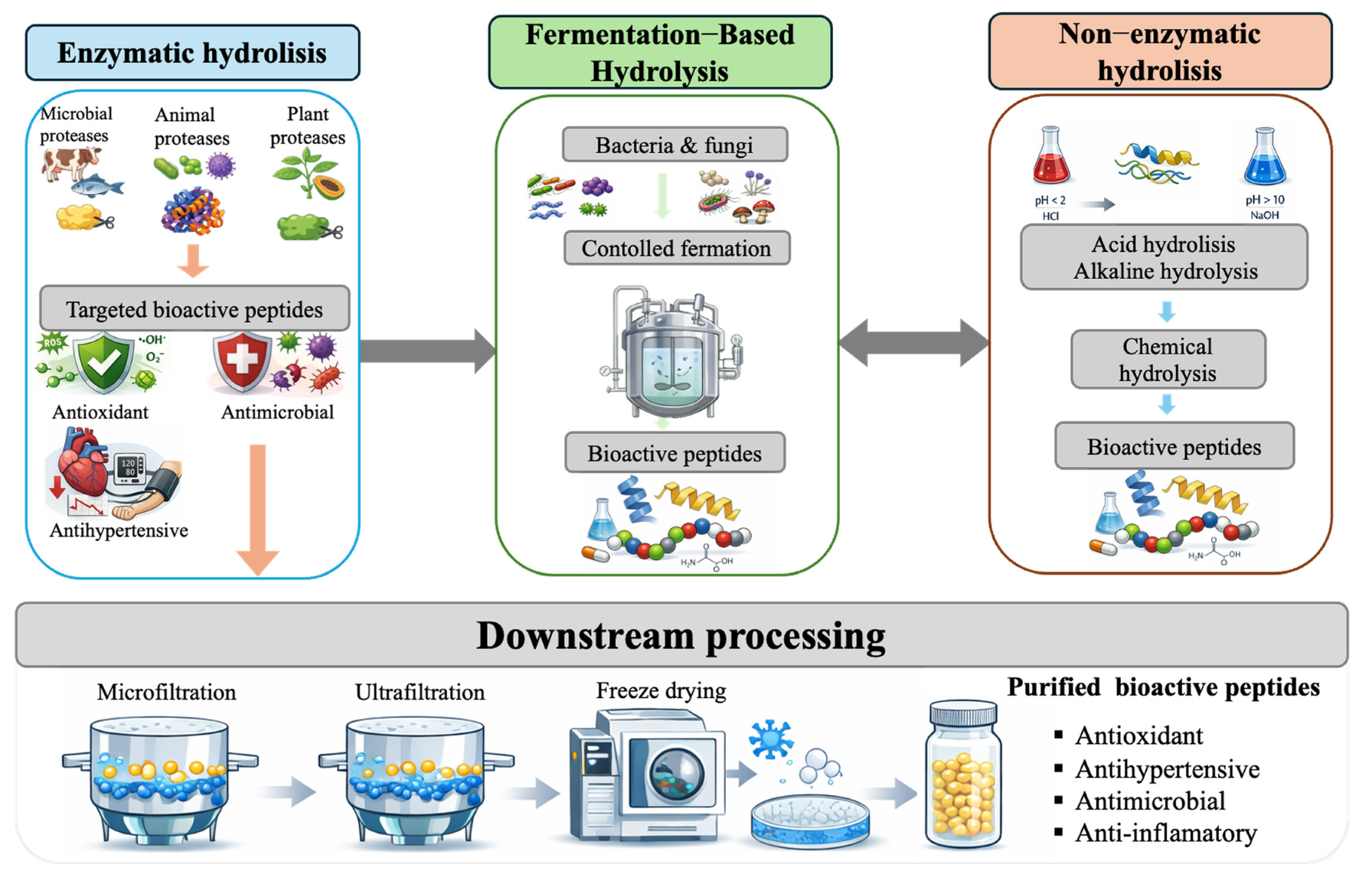
Fermentation-based hydrolysis is another relevant approach that relies on microorganisms, such as bacteria and fungi, to degrade proteins in a controlled manner. This process not only promotes the release of bioactive peptides but also improves protein digestibility and may enhance nutrient availability [45]. In addition, fermentation can create favorable conditions for generating peptides with antimicrobial and anti-inflammatory properties [46]. When combined with downstream technologies such as microfiltration and freeze-drying, these methods optimize the recovery and purification of bioactive peptides. Figure 3 presents the various hydrolysis techniques used to obtain bioactive peptides, coupled with purification techniques.
Non-enzymatic methods, including acid, are also used, though they are generally less selective and may produce undesirable by-products [47]. Separation and concentration techniques, such as microfiltration, ultrafiltration, and lyophilization, are commonly used to purify bioactive peptides. When integrated with advanced biotechnological approaches, these strategies improve the efficiency of obtaining peptides with antioxidant, antimicrobial, antihypertensive, and other bioactivities [48].
Despite their effectiveness, these methods still face limitations related to selectivity, scalability, and cost-efficiency, which must be addressed to ensure successful industrial implementation.

4.1. Enzymatic Hydrolysis

Enzymatic hydrolysis is the most widely used method for producing bioactive peptides because of its high specificity and ability to generate peptides with defined functional properties. This process uses proteolytic enzymes to cleave proteins into smaller fragments with distinct properties (Table 4).
As reported by Taheri et al. [49], enzyme selection is critical for producing protein hydrolysates with bioactive potential. In their study, protein hydrolysates were produced from rainbow trout viscera and poultry by-products (heads and feet) using Alcalase. Functional properties, including solubility, water-holding capacity, oil absorption, emulsifying and foaming properties, as well as amino acid composition, were evaluated. The hydrolysates from trout viscera exhibited significantly superior functional properties compared with those from poultry by-products. Amino acid analysis revealed methionine and histidine as the most abundant free amino acids in both hydrolysates, underscoring their nutritional relevance, particularly given methionine’s essential role in biological functions.
Several studies have demonstrated the potential of rainbow trout viscera as a raw material for producing high-value protein hydrolysates. Javaherdoust et al. [50] hydrolyzed trout viscera with Alcalase, achieving a degree of hydrolysis (DH) of 22%. The resulting hydrolysates were incorporated into diets for juvenile trout, and growth performance was evaluated at various inclusion levels, confirming a positive effect on fish weight gain. In this context, recent evidence highlights that fish viscera are not only a source of proteins but also of lipids and other valuable biomolecules, reinforcing their role as a versatile substrate within circular economy frameworks. Huang et al. [16] emphasize that the integral revalorization of fish viscera enables the recovery of proteins, bioactive peptides, lipids, and polysaccharides with applications in food and nutraceutical industries, supporting the transition from waste management to sustainable resource utilization.
In line with this integrated approach, Korkmaz and Öztürk [51] evaluated the quality of oil recovered from protein hydrolysates produced from rainbow trout by-products, demonstrating that hydrolysis processes also allow the simultaneous generation of high-value lipid fractions with suitable physicochemical properties. These findings further support the concept of a biorefinery strategy, where both peptide and lipid fractions are efficiently recovered, maximizing the overall valorization of fish-processing by-products.
Table 4. Main proteases used for fish (rainbow trout) protein hydrolysis.
EnzymeOriginCleavage Site SpecificityOptimal Temperature (°C)Optimal pHReferences
PepsinAnimal (porcine gastric mucosa)Preferential cleavage at the N-terminal side of aromatic amino acids (Phe, Tyr, Trp) and Leu30–451.5–3.0[52]
TrypsinAnimal (porcine/bovine pancreas)Cleaves at the C-terminal side of Lys and Arg residues35–407.5–8.5[53,54]
BromelainPlant (pineapple stem/fruit)Broad specificity; prefers peptide bonds involving Lys, Ala, Tyr, and Gly45–606.0–8.0[55]
PapainPlant (Carica papaya latex)Broad specificity; preferential cleavage next to hydrophobic residues50–656.0–7.5[56]
AlcalaseMicrobial (Bacillus licheniformis)Broad specificity endopeptidase; favors hydrophobic amino acids50–607.5–9.5[57,58]
ProtamexMicrobial (Bacillus spp., enzyme complex)Broad specificity; mixture of endo- and exopeptidases45–556.5–8.0[59,60]
FlavourzymeMicrobial (Aspergillus oryzae)Mixed endo- and exopeptidase activity; releases small peptides and free amino acids45–556.0–7.0[58,61]
Additional studies assessed the degree of hydrolysis (DH), pH, and functional properties, such as solubility, emulsifying capacity, and foam formation, of trout viscera hydrolysates. Process parameters, including substrate and enzyme concentrations, temperature, fat content, agitation speed, and DH, were optimized. A DH of 20.48% at pH 7 maximized solubility, whereas optimal emulsifying and foaming properties were observed at a DH of 5%, particularly at pH 4 [14].
In a comparative study evaluating Alcalase, Flavourzyme, and Neutrase for hydrolyzing trout viscera, Alcalase achieved the highest DH (24%) at pH 8.5 and 45 °C in a 500 mL reactor. Scale-up to a 7.5 L reactor altered process behavior, particularly agitation speed [62]. An in vitro optimization study evaluated pH, temperature, enzyme-to-substrate (E/S) ratio, and substrate concentration. Optimal conditions were pH 8.5, 60 °C, an E/S ratio of 10–30%, and substrate concentrations of 2–6%. The highest DH (27.6%) was achieved with an E/S ratio of 30% and a substrate concentration of 5.53% [63].
Further optimization using Alcalase examined soluble protein content, DH, protein recovery, peptide chain length, and antioxidant activity measured by DPPH radical-scavenging. Optimal hydrolysis times were 118–119 min at 59 °C, with enzyme concentrations of 1.9–2%. Peptide chain lengths of approximately 2.06–2.08 were obtained, along with antioxidant activities of 42.31–42.55%. Soluble protein concentrations reached up to 17.10 mg/mL, with DH values exceeding 42% [64]. In this case, hydrolysis efficiency depends on temperature, pH, enzyme concentration, and reaction time. Optimizing these parameters is essential to maximize peptide bioactivity. Collectively, these studies demonstrate that Alcalase-mediated hydrolysis of rainbow trout viscera can be optimized to enhance both functional and bioactive properties, positioning these hydrolysates as promising ingredients for animal nutrition and potentially for food and supplement applications.

4.2. Chemical Hydrolysis

Chemical hydrolysis is generally regarded as a simple, economical method that uses concentrated acid or alkaline solutions. Acid hydrolysis is commonly carried out with hydrochloric or sulfuric acid under elevated temperature and pressure. Conversely, alkaline hydrolysis typically involves high temperatures in the presence of sodium, calcium, or potassium hydroxides. Despite its practicality, it offers limited process control and often yields non-specific peptide mixtures that may contribute to undesirable bitterness. Furthermore, strongly acidic environments can promote degradation or racemization of sensitive amino acids such as tryptophan and serine, which may ultimately diminish the nutritional and functional quality of the resulting hydrolysate [65].
Wisuthiphaet et al. [66] reported that acid hydrolysis of fish proteins with hydrochloric acid at high temperatures (≈100–121 °C) produced hydrolysates with a high degree of protein solubilization but lower functional quality than those from enzymatic treatments. The study also noted the development of darker color and potential degradation of sensitive amino acids, confirming the limited selectivity of the acid process.
Similarly, Kristinsson and Rasco [67] reported that both acid and alkaline hydrolysis can achieve extensive protein breakdown under severe conditions; however, acid hydrolysis (typically at pH < 3 and high temperatures) tends to promote amino acid degradation, whereas alkaline hydrolysis (pH > 10) increases the risk of racemization and lysinoalanine formation. Compared with enzymatic methods, both chemical approaches generate less controlled peptide profiles and may negatively affect the nutritional and functional properties of fish protein hydrolysates.
Recently, Domínguez et al. [47] further demonstrated that, although acid-based autolysis of rainbow trout viscera can enhance amino acid release, enzymatic hydrolysis provides a more controlled and selective process, yielding peptide fractions with improved functional quality and better preservation of amino acid integrity. These findings reinforce the limitations of conventional chemical hydrolysis and highlight the advantages of enzymatic approaches for the production of bioactive peptides.
A comparative study evaluated acid hydrolysis with 0.4% formic acid against enzymatic hydrolysis with Alcalase, Protana Prime, and endogenous enzymes. Enzymatic hydrolysis achieved a higher DH (83.8%) than acid hydrolysis (75.8%), indicating greater efficiency in producing smaller bioactive peptides. The combination of Alcalase and Protana Prime was particularly effective, yielding peptides with potential applications as biostimulants in health-related industries [47].

4.3. Bacterial Fermentation

Bacterial fermentation is an alternative strategy for producing bioactive peptides, using probiotic bacteria such as Lactobacillus and Bifidobacterium to hydrolyze fish proteins. The proposed process also enables the generation of peptides with probiotic-associated benefits, expanding opportunities for functional food formulations, including fermented beverages and yogurts. Although research on rainbow trout fermentation remains limited, studies on other species, such as tuna, have shown that salt-assisted fermentation (5:1, w/w) over 7–14 days can produce peptides with strong angiotensin-converting enzyme (ACE) inhibitory activity, reaching up to 68.8% inhibition [68]. In addition, evidence from enzymatic hydrolysis studies combined with simulated gastrointestinal digestion provides further insight into the functional stability of these peptides. Vásquez et al. [15] reported that rainbow trout viscera hydrolysates exhibited significant ACE inhibitory activity, which was further enhanced after simulated gastrointestinal digestion, with a reduction of approximately 53.7% in IC50 values, indicating increased bioactivity. Moreover, the peptides showed stability during intestinal absorption in Caco-2 cell models, suggesting that bioactive sequences remain functionally active after digestion. These findings highlight the importance of considering gastrointestinal conditions when evaluating peptide functionality and support the potential application of trout-derived peptides in functional foods and nutraceuticals.
Rainbow trout by-products have also been fermented for alternative uses, including the production of liquid fertilizer. Anaerobic decomposition of trout viscera for 88–90 days produced products with near-neutral pH and favorable nutritional characteristics [69,70].
More recent studies have examined controlled fermentation of trout viscera to enhance nutritional value. In one approach, ground viscera were supplemented with molasses, sorbic acid, antioxidants, and probiotic strains (Streptococcus thermophilus, Lactobacillus bulgaricus, and Lactobacillus lactis). This process improved microbiological stability and produced a nutritionally enriched product [71]. These findings underscore the versatility of fermentation in valorizing fish by-products, not only for bioactive peptide production but also for fertilizers and nutritional supplements. As research progresses, more efficient and sustainable strategies are expected to maximize the utilization of aquaculture residues.
Finally, Ucak et al. [72] reported that marine-derived peptides exhibit antioxidant, antimicrobial, antihypertensive, and anticancer activities. The authors emphasized efficient, sustainable extraction and purification techniques and discussed applications in food preservation, functional food development, cosmetics, and pharmaceuticals. This body of evidence reinforces the valorization of marine by-products as a dual strategy to reduce waste and develop high-value-added products that promote health and well-being.
To better integrate the processing strategies described in this section, Table 5 summarizes the relationships among the main hydrolysis approaches (enzymatic, chemical, and fermentation), their operating conditions, and the characteristics of the resulting peptide fractions. This comparison highlights how process selection influences peptide size, composition, and associated bioactivities, providing a clearer link between processing technologies and functional outcomes.

5. Challenges and Future Perspectives

Despite the promising potential of bioactive peptides derived from rainbow trout by-products, their large-scale implementation remains hindered by significant technical, regulatory, and economic challenges that must be rigorously addressed from both scientific and engineering perspectives. A key obstacle is the standardization of enzymatic hydrolysis processes, as variables such as enzyme type and concentration, reaction time, temperature, pH, and substrate-to-enzyme ratio directly influence the resulting peptide profile and, consequently, the bioactive properties of the final product, limitation that has been widely recognized in recent studies, which emphasize that the lack of process control and reproducibility remains a major barrier to the industrial application of bioactive peptides derived from fish by-products [73]. This variability limits reproducibility and complicates industrial scale-up without compromising peptide quality or functionality.
Moreover, process optimization should not focus solely on extraction yield but also on energy efficiency, minimizing secondary waste streams, and integrating with complementary processing technologies, such as selective membrane systems, chromatography, and advanced drying methods. Incorporating process simulation models and real-time automated control systems could play a critical role in improving production efficiency and ensuring product consistency at an industrial scale. In this context, recent advances in artificial intelligence and data-driven bioprocessing have demonstrated significant potential for optimizing biorefinery operations, enabling predictive modeling, real-time monitoring, and adaptive control of key processing parameters [75]. Additionally, innovations in aquaculture systems, such as automated recirculating aquaculture systems (RAS), provide more consistent and controlled raw material quality, which is essential for improving the reproducibility of downstream processing [76]. Furthermore, emerging technological approaches in aquaculture nutrition and processing highlight the importance of integrating upstream and downstream strategies to enhance resource efficiency, product quality, and sustainability within the value chain [77].
Another critical aspect is the bioavailability of bioactive peptides, which depends on gastrointestinal stability, intestinal absorption, and systemic metabolism. Although numerous in vitro studies have demonstrated antioxidant, antihypertensive, and anti-inflammatory activities, there remains a lack of preclinical and clinical studies validating these effects under physiologically relevant conditions. Comprehensive pharmacokinetic and toxicity evaluations, assessments of interactions with other nutrients or pharmaceuticals, and well-designed clinical trials are essential to support their use as functional or nutraceutical ingredients. Recent advances indicate that the bioaccessibility and bioavailability of bioactive peptides are strongly influenced by factors such as peptide molecular size, amino acid composition, resistance to gastrointestinal enzymes, and transport mechanisms across the intestinal epithelium, including carrier-mediated uptake and paracellular diffusion [74]. In addition, strategies such as encapsulation and the use of delivery systems have been highlighted as effective approaches to improve peptide stability, protect against degradation, and enhance their physiological efficacy.
From a future-oriented perspective, advances in biotechnology, protein engineering, and the design of highly specific enzymes are expected to enable more efficient, selective, and cost-effective production of bioactive peptides from complex matrices, such as fish viscera. Emerging tools, including bioinformatics, machine learning, and metabolic engineering, may facilitate the prediction of bioactive peptide sequences, rational process design, and the comprehensive valorization of fish-processing by-products.
Looking ahead, the integration of artificial intelligence (AI), molecular simulation, and advanced analytical techniques is expected to transform the discovery, characterization, and production of bioactive peptides from fish by-products. Recent studies highlight that AI-driven approaches enable the rapid screening and prediction of peptide sequences with targeted bioactivities, significantly reducing experimental time and improving efficiency [78,79]. In parallel, combining machine learning models with process optimization tools, such as genetic algorithms, enables prediction and control of product quality attributes across different processing conditions, enhancing reproducibility and industrial scalability [80]. Furthermore, the integration of computational methods with instrumental analysis is opening new avenues for understanding peptide structure–function relationships and guiding rational process design [81]. Collectively, these advances suggest that future research should move toward data-driven and predictive bioprocessing frameworks, enabling more efficient, selective, and sustainable valorization of aquaculture by-products.

6. Industrial Design Proposal for Obtaining Multifunctional Peptides from Rainbow Trout

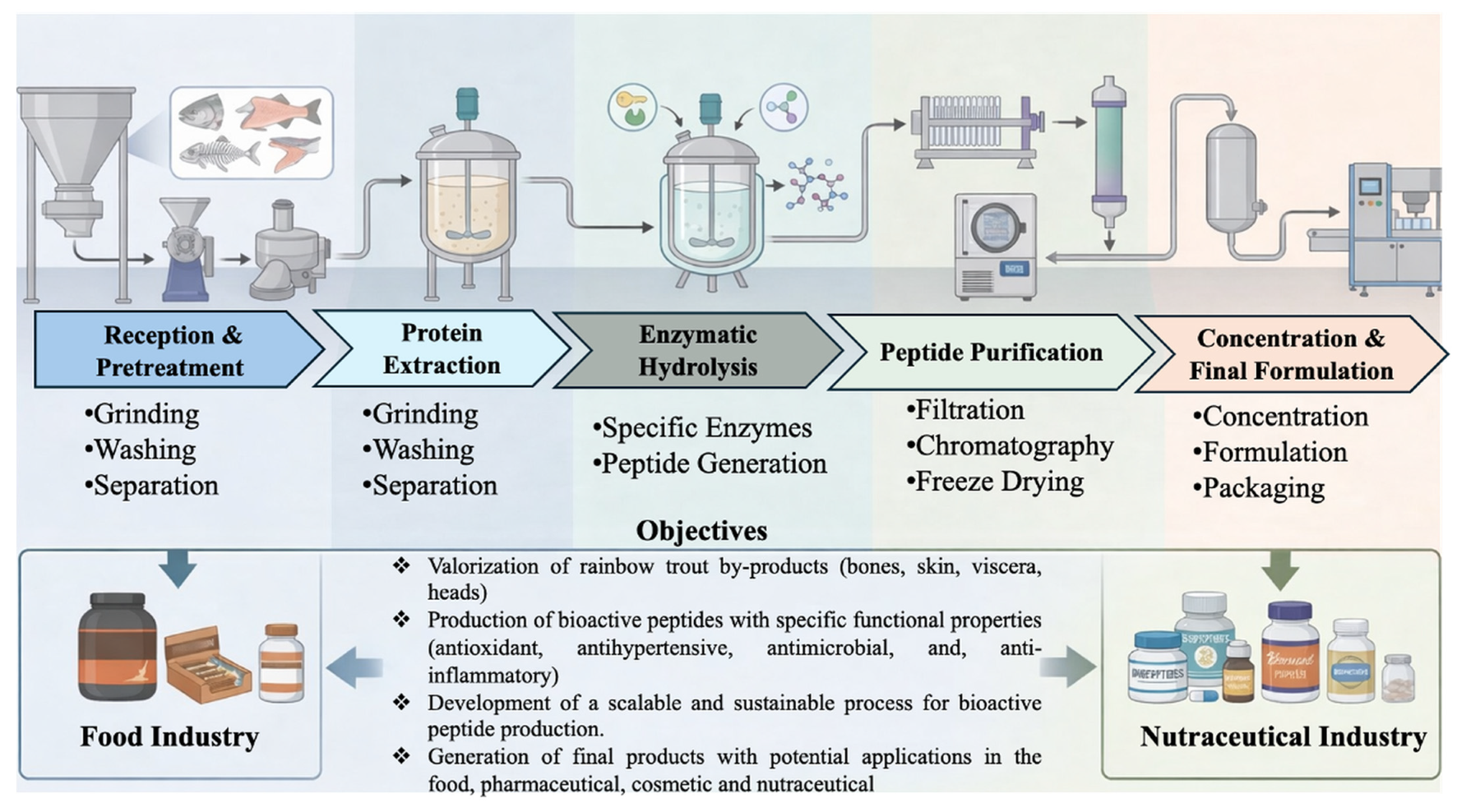
Because processing rainbow trout (Oncorhynchus mykiss) generates substantial by-products that are often discarded, there is a clear need to incorporate these materials into valorization strategies. Their high protein content and nutritional value make them suitable substrates for producing bioactive peptides with diverse functional properties, including antioxidant, antihypertensive, antimicrobial, anti-inflammatory, and antidiabetic activities. Accordingly, an industrial process is proposed to transform these by-products into functional ingredients through an efficient, scalable, and sustainable approach that employs advanced technologies for peptide extraction and purification.
As illustrated in Figure 4, the proposed industrial scheme integrates by-product reception and pretreatment, protein extraction, enzymatic hydrolysis, and downstream purification, concentration, and formulation steps, enabling the production of multifunctional bioactive peptides with potential applications in the food, nutraceutical, pharmaceutical, and cosmetic industries.

6.1. Reception and Pretreatment of Byproducts

The process begins with the reception of rainbow trout (Oncorhynchus mykiss) by-products (bones, viscera, skin, and heads), transported in hygienic containers at ≤4 °C to limit microbial growth. Upon arrival, quality and food safety controls are carried out, including organoleptic evaluation (color, odor, and texture), inspection for foreign materials or decomposition, and pH and temperature measurements to verify suitability for processing. Accepted materials undergo physicochemical pretreatment consisting of washing with potable water at 10–15 °C under continuous flow to remove blood, mucus, scales, and surface impurities, followed by disinfection with a food-grade agent (e.g., 0.1–0.2% peracetic acid) applied for at least 5 min and subsequent rinsing to remove residues [82].
After cleaning, the by-products are size-reduced to enhance protein release. Crushing is performed using a shredder or industrial grinder (10–20 mm), followed by fine grinding in a knife or colloidal mill (3–5 mm) to obtain a homogeneous paste, while maintaining the temperature below 10 °C. The resulting mass is then stored prior to enzymatic hydrolysis, either under refrigeration at 0–4 °C for short periods (<24 h) or rapidly frozen at ≤−18 °C for longer-term storage to preserve protein integrity and inhibit microbial growth. All materials are labeled with date, batch number, and by-product type to ensure traceability and process control [83].

6.2. Protein Extraction

The process relies on continuous protein solubilization followed by isoelectric precipitation, enabling selective recovery of functional proteins from rainbow trout by-products while removing lipids and insoluble components by simple mechanical separation, consistent with the pH-shift processing approach widely used for fish processing waste and by-products [84]. Previously ground material is homogenized with cold distilled water (4 ± 1 °C) at a 1:6 (w/v) ratio for 10–15 min using a cooled industrial homogenizer (2500–3000 rpm), promoting cell disruption and the release of myofibrillar proteins into the aqueous phase. The homogenate is then acidified to pH 2.5 by controlled addition of 1 N HCl under constant agitation, with the temperature maintained between 4 and 6 °C for 10 min to enhance protein solubilization and the dissociation of lipid-associated components, as reported for acid solubilization during pH-shift processing of fish by-products [84].
The acidified slurry is immediately centrifuged (10,000× g, 20 min, 4 °C) to remove bones, scales, and neutral lipids, and the protein-rich supernatant is collected. The supernatant is then adjusted to pH 5.5 by gradual addition of 1 N NaOH under gentle agitation at 6–8 °C, inducing isoelectric precipitation of myofibrillar proteins. A second centrifugation under identical conditions yields the protein pellet, which constitutes the functional protein isolate. The isolate (after quantification) is either freeze-dried under vacuum or stored at −20 °C under inert conditions, providing a stable substrate for subsequent enzymatic hydrolysis and food-related applications, as commonly described for fish protein isolates and hydrolysates derived from processing by-products [85].

6.3. Hydrolysis with Selected Enzymes

Enzymatic hydrolysis is a subsequent step that converts the previously obtained protein isolate into low-molecular-weight peptides with potential bioactivity. This hydrolysis is typically carried out at mild pH (6.0–8.0) and temperature (40–60 °C), without toxic solvents, making it suitable for food-related applications and enabling modulation of peptide profiles through specific proteases [85,86]. Prior protein solubilization and recovery at the isoelectric point facilitate the valorization of fishery by-products and improve their suitability as substrates for enzymatic hydrolysis [86].
The freeze-dried protein isolated from rainbow trout viscera is washed with 0.9% NaCl (25 °C, 10 min) and subjected to mild thermal treatment (60 °C, 15 min) to promote partial protein unfolding. The material is then homogenized at high speed (10,000 rpm, 5 min) under cooling to maintain temperatures below 10 °C, transferred to a stainless-steel hydrolysis reactor, and subjected to enzymatic hydrolysis with Alcalase® 2.4 L at 50 ± 1 °C and pH 8.0 ± 0.1, using an enzyme concentration of 1.5% (v/w), an enzyme/protein ratio of 1/100, and constant agitation (200 rpm) for 90 min, following conditions commonly used for enzymatic hydrolysis of fish by-products [13,87]. The degree of hydrolysis reaches approximately 27%, within the range commonly reported for fish protein hydrolysates intended for functional applications [85,86]. The reaction is terminated by thermal inactivation (90 °C, 10 min), followed by rapid cooling, centrifugation (10,000× g, 25 min), and clarification by 0.45 µm membrane filtration. The peptide-rich fraction is stabilized by freeze-drying or spray-drying and stored at −20 °C under vacuum or an inert atmosphere to preserve peptide integrity and functionality during storage, as described for bioactive peptide powders intended for food applications [13,88].

6.4. Separation and Purification of Peptides

Peptide fractionation is performed by sequential ultrafiltration with membranes having molecular weight cut-offs of <30 kDa, <10 kDa, and <3 kDa, a strategy widely used to enrich low-molecular-weight peptide fractions with enhanced bioactivity [86]. The resulting fractions are stored at −20 °C. Fractions below 3 kDa, which are often associated with higher bioactivities such as antihypertensive and antioxidant, are further purified by reverse-phase high-performance liquid chromatography (RP-HPLC) on C18 columns under controlled conditions. Purified peptides are then characterized for bioactivity and amino acid composition using HPLC-based methods, as commonly reported for the identification and evaluation of bioactive peptides from fish protein hydrolysates [89].
Peptide concentration is commonly performed to reduce water content and increase the proportion of bioactive compounds, using membrane-based processes such as ultrafiltration, which are widely applied at pilot and industrial scales for their efficiency and mild operating conditions [90,91]. Ultrafiltration with membranes having molecular weight cutoffs of 1–3 kDa enriches low-molecular-weight peptides while operating at moderate pressures and temperatures, thereby preserving peptide functionality and minimizing fouling [88].

7. Peptide Formulation and Stabilization Strategies

Following enzymatic hydrolysis, the peptide-rich fraction undergoes downstream processing to produce formulations suitable for industrial applications. The concentrated peptides are then formulated for their intended application. For liquid formulations intended for food or pharmaceutical use, peptide concentrates may be stabilized by adjusting the pH and through aseptic handling. For powdered products, stabilization is commonly achieved by freeze-drying or spray drying, both well-established techniques for preserving peptide integrity and bioactivity [92]. In particular, spray drying has been successfully applied to fish protein hydrolysates to obtain stable, food-grade peptide powders and encapsulated formulations suitable for industrial use [91]. For cosmetic applications, peptide fractions can be incorporated into emulsions or gels under controlled pH and temperature conditions to ensure peptide stability and compatibility with topical formulations.
The successful commercialization of these molecules in food, pharmaceutical, and cosmetic products depends largely on formulation strategies that mitigate their inherent physicochemical limitations. Although enzymatic hydrolysis generates peptide fractions with proven bioactivity, these molecules are often susceptible to enzymatic degradation, oxidation, aggregation, and loss of activity during processing and storage. Moreover, after oral or topical administration, they may encounter unfavorable pH conditions and proteolytic environments, which can reduce their stability and bioavailability [93,94].
Conventional stabilization approaches include pH control, aseptic handling, freeze-drying, and spray drying. Drying technologies are widely used to improve shelf life and handling of peptide ingredients; however, processing conditions can significantly influence physicochemical and nutritional properties of the resulting powders [95]. In food systems, these kinds of peptides have also been explored for preservation and functional packaging applications, highlighting the need for adequate stabilization strategies during formulation [96].
More recently, advanced delivery systems have attracted growing attention. Micro- and nanoencapsulation platforms, such as liposomes, biopolymer nanoparticles, solid lipid nanoparticles, and hydrogel matrices, have demonstrated improved peptide protection, controlled release behavior, and enhanced resistance to gastrointestinal degradation [97]. These systems may also reduce sensory impacts in foods and enable targeted or prolonged biological activity in nutraceutical and pharmaceutical applications.
In the food industry, bioactive peptides are increasingly used as functional ingredients targeting cardiovascular health, blood pressure regulation, and metabolic modulation. Their implementation typically involves converting them into stable liquid or powdered forms, often using spray-drying or related dehydration processes to improve shelf life and handling. These strategies align with earlier reports highlighting the potential of food-derived peptides as functional and antimicrobial ingredients in complex food matrices [98,99]. Before incorporation, homogenization and conventional mixing are commonly used to ensure uniform dispersion in products such as beverages, fermented foods, and instant formulations.
In pharmaceutical applications, the peptide-rich material are generally purified by preparative chromatographic techniques (e.g., reversed-phase or ion-exchange HPLC) to obtain highly defined bioactive molecules. Subsequent stabilization by lyophilization under controlled low-temperature vacuum conditions is widely used to preserve structural integrity and biological activity, facilitating formulation into solid dosage forms. These practices align with the recognized requirements for peptide-based therapeutics, including high purity, structural stability, and controlled delivery [100].
Within the cosmetic sector, peptides with antioxidant, anti-inflammatory, or anti-aging properties are commonly incorporated into emulsions, gels, or serums under mild processing conditions to maintain conformational stability. Recent studies emphasize that peptide efficacy in topical systems depends strongly on molecular stability, skin compatibility, and delivery efficiency. Accordingly, encapsulation into liposomes, nanoemulsions, or polymeric carriers is increasingly employed to enhance dermal penetration and protect peptide functionality [100,101,102].
For nutraceutical applications, peptides are most frequently delivered as dried powders, capsules, or functional beverages. Their efficacy depends on key biochemical attributes such as molecular size, amino acid composition, resistance to gastrointestinal digestion, and adequate bioavailability. Therefore, manufacturing workflows typically include controlled dehydration, powder standardization, and quality monitoring to ensure in vivo functional performance [103]. The successful translation of bioactive peptides into commercial products requires an integrated approach that combines appropriate downstream processing, stabilization, and delivery design. Overall, this industrial approach supports the circular economy by revalorizing rainbow trout by-products and enabling the development of functional ingredients for food, pharmaceutical, cosmetic, and nutraceutical markets, thereby contributing to the environmental sustainability and economic competitiveness of the fish-processing industry.

8. Conclusions

The use of rainbow trout by-products as a source of multifunctional bioactive peptides is a promising and sustainable alternative within the circular economy framework of the fish-processing industry. Rather than being treated as low-value waste, these materials can be converted into functional ingredients with potential applications across the food, pharmaceutical, cosmetic, and nutraceutical sectors.
Current evidence shows that technologies such as enzymatic hydrolysis, molecular-weight–based ultrafiltration, and liquid chromatography enable the selective recovery of peptides with antioxidant, antihypertensive, antimicrobial, and anti-inflammatory activities. These bioactive fractions have notable potential for incorporation into functional foods for chronic disease prevention and into cosmetic formulations with anti-aging properties.
Nevertheless, the transition from laboratory-scale research to industrial implementation remains constrained by several factors. Variability in raw materials, the need for robust process standardization, and limited validation of bioactivity under physiologically relevant conditions are key bottlenecks. Addressing these gaps will require comprehensive scale-up studies, detailed stability evaluations, and well-designed preclinical and clinical investigations.
Looking ahead, the integration of advanced process engineering, automation, and improved separation technologies is likely to enhance production efficiency and economic feasibility. However, the successful consolidation of this emerging biotechnology will ultimately depend on stronger collaboration among academia, industry, and regulatory bodies, supported by public policies that actively promote technological transfer and applied innovation. This review bridges the gap between biochemical characterization and process engineering by proposing an integrated, scalable approach to valorizing trout by-products.

Author Contributions

Conceptualization, L.G.G.O.; investigation, D.F.F., S.A.J. and L.G.G.O.; methodology, D.F.F. and L.G.G.O.; software, O.A.C. and S.A.J.; validation, P.A.S.S. and C.A.Á.Á.; formal analysis, O.A.C., P.A.S.S., C.A.Á.Á. and S.A.J.; resources, L.G.G.O. and S.A.J.; data curation, O.A.C.; writing—original draft preparation, D.F.F. and L.G.G.O.; writing—review and editing, D.F.F., P.A.S.S., C.A.Á.Á., O.A.C., S.A.J. and L.G.G.O.; visualization, S.A.J. and L.G.G.O.; supervision, L.G.G.O., S.A.J. and O.A.C. All authors have read and agreed to the published version of the manuscript.

Funding

This research received no external funding.

Institutional Review Board Statement

Not applicable.

Informed Consent Statement

Not applicable.

Data Availability Statement

Data supporting the findings of this study are available upon reasonable request from the corresponding author due to privacy and ethical reasons.

Acknowledgments

The authors appreciate the support of SECIHTI for the Ph.D. scholarship granted to Daniel Farfán-Flores.

Conflicts of Interest

The authors declare no conflicts of interest.

References

  1. Vasdravanidis, C.; Alvanou, M.V.; Lattos, A.; Papadopoulos, D.K.; Chatzigeorgiou, I.; Ravani, M.; Liantas, G.; Georgoulis, I.; Feidantsis, K.; Ntinas, G.K.; et al. Aquaponics as a promising strategy to mitigate impacts of climate change on rainbow trout culture. Animals 2022, 12, 2523. [Google Scholar] [CrossRef] [PubMed]
  2. D’Agaro, E.; Gibertoni, P.; Esposito, S. Recent trends and economic aspects in the rainbow trout (Oncorhynchus mykiss) sector. Appl. Sci. 2022, 12, 8773. [Google Scholar] [CrossRef]
  3. Estévez, A.; Padrell, L.; Iñarra, B.; Orive, M.; San Martin, D. Brewery by-products (yeast and spent grain) as protein sources in rainbow trout (Oncorhynchus mykiss) feeds. Front. Mar. Sci. 2022, 9, 862020. [Google Scholar] [CrossRef]
  4. Cozzolino, M.; Salomone, R.; Gulotta, T.M. Life cycle assessment of circular economy practices in rainbow trout farming: An Italian case study. Aquac. Int. 2025, 33, 192. [Google Scholar] [CrossRef]
  5. Kvangarsnes, K.; Dauksas, E.; Tolstorebrov, I.; Rustad, T.; Bartolomei, M.; Xu, R.; Lammi, C.; Cropotova, J. Physicochemical and functional properties of rainbow trout (Oncorhynchus mykiss) hydrolysate. Heliyon 2023, 9, e17979. [Google Scholar] [CrossRef]
  6. Singh, J.; Sarma, K. Climate change and its impact on fisheries and aquaculture. In Drought and Heat Stress in Agriculture: Implications, Mitigation and Policy Approaches; Springer Nature: Singapore, 2025; pp. 111–130. [Google Scholar]
  7. Fraga-Corral, M.; Ronza, P.; Garcia-Oliveira, P.; Pereira, A.; Losada, A.; Prieto, M.; Quiroga, M.; Simal-Gandara, J. Aquaculture as a circular bio-economy model with Galicia as a study case: How to transform waste into revalorized by-products. Trends Food Sci. Technol. 2022, 119, 23–35. [Google Scholar] [CrossRef]
  8. Maroušek, J.; Strunecký, O.; Maroušková, A. Insect rearing on biowaste represents a competitive advantage for fish farming. Rev. Aquac. 2023, 15, 965–975. [Google Scholar] [CrossRef]
  9. Zhu, Z.; Gross, A.; Brown, P.B.; Luo, G. Disinfection by-products in aquaculture: Sources, impacts, removal and future research. Rev. Aquac. 2025, 17, e70035. [Google Scholar] [CrossRef]
  10. Gyalog, G.; Cubillos Tovar, J.P.; Békefi, E. Freshwater aquaculture development in EU and Latin-America: Insight on production trends and resource endowments. Sustainability 2022, 14, 6443. [Google Scholar] [CrossRef]
  11. Escamilla-Rosales, M.F.; Pérez-Escalante, E.; Jara-Gutiérrez, C.E.; Santana-Sepúlveda, P.A.; Álvarez-Álvarez, C.A.; Castañeda-Ovando, A.; González-Olivares, L.G. Rainbow trout (Oncorhynchus mykiss) proteins as a source of antioxidant peptides with promising anticancer activity. Future Foods 2024, 10, 100509. [Google Scholar] [CrossRef]
  12. Zakipour Rahimabadi, E.; Nami, E.; Mehraban Sang Atash, M. Antioxidant properties of bioactive peptides from rainbow trout viscera using different ultrafiltration. Food Res. J. 2023, 33, 31–41. [Google Scholar]
  13. Khasmakhi, E.N.; Rahimabadi, E.Z.; Sangatash, M.M. Purification and characterization of antioxidant peptide fractions from protein hydrolysate of rainbow trout (Oncorhynchus mykiss) viscera. Food Res. Int. 2025, 206, 116027. [Google Scholar] [CrossRef] [PubMed]
  14. Vásquez, P.; Sepúlveda, C.T.; Zapata, J.E. Functional properties of rainbow trout (Oncorhynchus mykiss) viscera protein hydrolysates. Biocatal. Agric. Biotechnol. 2022, 39, 102268. [Google Scholar] [CrossRef]
  15. Vásquez, P.; Zapata, J.E.; Chamorro, V.C.; Fillería, S.F.G.; Tironi, V.A. Antioxidant and angiotensin I-converting enzyme (ACE) inhibitory peptides of rainbow trout (Oncorhynchus mykiss) viscera hydrolysates subjected to simulated gastrointestinal digestion and intestinal absorption. LWT 2022, 154, 112834. [Google Scholar] [CrossRef]
  16. Huang, S.; Yu, B.; Wang, B.; Soladoye, O.P.; Benjakul, S.; Zhang, Y.; Fu, Y. Revalorization of fish viscera as a sustainable source of proteins, lipids and polysaccharides in the food industry. Crit. Rev. Food Sci. Nutr. 2025, 65, 6542–6568. [Google Scholar] [CrossRef]
  17. Mmanda, F.P. Importance of Minerals and Their Bioavailability in Boosting Aquaculture: A Systematic Review. Aquac. Fish Fish. 2025, 5, e70067. [Google Scholar] [CrossRef]
  18. Välimaa, A.L.; Mäkinen, S.; Mattila, P.; Marnila, P.; Pihlanto, A.; Mäki, M.; Hiidenhovi, J. Fish and fish side streams are valuable sources of high-value components. Food Qual. Saf. 2019, 3, 209–226. [Google Scholar] [CrossRef]
  19. Dashputre, N.L.; Sable, R.R.; Sawant, M.; Khairnar, S.J.; Ahire, E.D.; Patil, S.B.; Kadam, J.D. Marine-derived sources of nutritional vitamins. In Vitamins as Nutraceuticals: Recent Advances and Applications; John Wiley & Sons: Hoboken, NJ, USA, 2023; pp. 129–166. [Google Scholar]
  20. Suleria, H.A.R.; Osborne, S.; Masci, P.; Gobe, G. Marine-based nutraceuticals: An innovative trend in the food and supplement industries. Mar. Drugs 2015, 13, 6336–6351. [Google Scholar] [CrossRef]
  21. Escamilla Rosales, M.F.; Olvera Rosales, L.; Jara Gutiérrez, C.E.; Jaimez Ordaz, J.; Santana Sepúlveda, P.A.; González Olivares, L.G. Proteins of milk, egg and fish as a source of antioxidant peptides: Production, mechanism of action and health benefits. Food Rev. Int. 2024, 40, 1600–1620. [Google Scholar] [CrossRef]
  22. Nguyen, E.; Jones, O.; Kim, Y.H.B.; San Martin-Gonzalez, F.; Liceaga, A.M. Impact of microwave-assisted enzymatic hydrolysis on functional and antioxidant properties of rainbow trout (Oncorhynchus mykiss) by-products. Fish. Sci. 2017, 83, 317–331. [Google Scholar] [CrossRef]
  23. Sun, T.; Xu, Z.; Prinyawiwatkul, W. FA composition of the oil extracted from farmed Atlantic salmon (Salmo salar L.) viscera. J. Am. Oil Chem. Soc. 2006, 83, 615–619. [Google Scholar] [CrossRef]
  24. Aspevik, T.; Totland, C.; Lea, P.; Oterhals, Å. Sensory and surface-active properties of protein hydrolysates based on Atlantic salmon (Salmo salar) by-products. Process Biochem. 2016, 51, 1006–1014. [Google Scholar] [CrossRef]
  25. Roslan, J.; Yunos, K.F.M.; Abdullah, N.; Kamal, S.M.M. Characterization of fish protein hydrolysate from tilapia (Oreochromis niloticus) by-product. Agric. Agric. Sci. Procedia 2014, 2, 312–319. [Google Scholar] [CrossRef]
  26. Vázquez-Sánchez, D.; Nepomuceno, E.F.V.; Galvão, J.A.; Fabrício, L.F.F.; Gaziola, S.A.; Azevedo, R.A.; Vieira, T.M.F.S.; Oetterer, M. Enzymatic conversion of red tilapia (Oreochromis niloticus) by-products in functional and bioactive products. J. Aquat. Food Prod. Technol. 2023, 32, 269–291. [Google Scholar] [CrossRef]
  27. Nikoo, M.; Xu, X.; Regenstein, J.M.; Noori, F. Autolysis of Pacific white shrimp (Litopenaeus vannamei) processing by-products: Enzymatic activities, lipid and protein oxidation, and antioxidant activity of hydrolysates. Food Biosci. 2021, 39, 100844. [Google Scholar] [CrossRef]
  28. Abreu, A.D.S.; De Souza, M.M.; Da Rocha, M.; Wasielesky, W.F.; Prentice, C. Functional properties of white shrimp (Litopenaeus vannamei) by-products protein recovered by isoelectric solubilization/precipitation. J. Aquat. Food Prod. Technol. 2019, 28, 649–657. [Google Scholar] [CrossRef]
  29. Gamarro, E.G.; Orawattanamateekul, W.; Sentina, J.; Gopal, T.S. By-Products of Tuna Processing. GLOBEFISH Research Programme; FAO: Rome, Italy, 2013; Volume 112, pp. 1–48. [Google Scholar]
  30. Oliveira, D.; Bernardi, D.; Drummond, F.; Dieterich, F.; Boscolo, W.; Leivas, C.; Kiatkoski, E.; Waszczynskyj, N. Potential use of tuna (Thunnus albacares) by-product: Production of antioxidant peptides and recovery of unsaturated fatty acids from tuna head. Int. J. Food Eng. 2017, 13, 20150365. [Google Scholar] [CrossRef]
  31. Bartolomei, M.; Cropotova, J.; Bollati, C.; Kvangarsnes, K.; D’adduzio, L.; Li, J.; Boschin, G.; Lammi, C. Rainbow trout (Oncorhynchus mykiss) as source of multifunctional peptides with antioxidant, ACE and DPP-IV inhibitory activities. Nutrients 2023, 15, 829. [Google Scholar] [CrossRef]
  32. Yaghoubzadeh, Z.; Peyravii Ghadikolaii, F.; Kaboosi, H.; Safari, R.; Fattahi, E. Antioxidant activity and anticancer effect of bioactive peptides from rainbow trout (Oncorhynchus mykiss) skin hydrolysate. Int. J. Pept. Res. Ther. 2020, 26, 625–632. [Google Scholar] [CrossRef]
  33. Kotsoni, E.; Daukšas, E.; Hansen Aas, G.; Rustad, T.; Tiwari, B.K.; Lammi, C.; Bollati, C.; Fanzaga, M.; D’adduzio, L.; Stangeland, J.K.; et al. Antioxidant activity and DPP-IV inhibitory effect of fish protein hydrolysates obtained from high-pressure pretreated mixture of rainbow trout (Oncorhynchus mykiss) and Atlantic salmon (Salmo salar) rest raw material. Mar. Drugs 2024, 22, 568. [Google Scholar] [CrossRef]
  34. Polat, A.; Tokur, B.; Buga, H. Extraction of protein from fresh rainbow trout (Oncorhynchus mykiss) viscera and smoked trout trimmings using commercial enzymes. Ege J. Fish. Aquat. Sci. 2022, 39, 71–80. [Google Scholar] [CrossRef]
  35. Pérez-Escalante, E.; Padilla-Zúñiga, S.A.; Contreras-López, E.; Sebastián-Nicolás, J.L.; Pérez-Flores, J.G.; Olloqui, E.J.; González-Olivares, L.G. Antioxidant and antihypertensive properties from muscle hydrolysates of farm rainbow trout. Biol. Life Sci. Forum 2022, 18, 55. [Google Scholar] [CrossRef]
  36. Kim, S.R.; Byun, H.G. The novel angiotensin I converting enzyme inhibitory peptide from rainbow trout muscle hydrolysate. Fish. Aquat. Sci. 2012, 15, 183–190. [Google Scholar] [CrossRef][Green Version]
  37. Miyamoto, H.; Safitiri, E.; Nagai, T.; Saito, M. Characterization fish skin hydrolysates exhibiting DPP-IV inhibitory activity. Indones. Food Nutr. Prog. 2024, 21, 1. [Google Scholar] [CrossRef]
  38. Cheung, I.W.Y.; Li-Chan, E.C.Y. Enzymatic production of protein hydrolysates from steelhead (Oncorhynchus mykiss) skin gelatin as inhibitors of dipeptidyl-peptidase IV and angiotensin-I converting enzyme. J. Funct. Foods 2017, 28, 254–264. [Google Scholar] [CrossRef]
  39. Ketnawa, S.; Suwal, S.; Huang, J.Y.; Liceaga, A.M. Selective separation and characterisation of dual ACE and DPP-IV inhibitory peptides from rainbow trout (Oncorhynchus mykiss) protein hydrolysates. Int. J. Food Sci. Technol. 2019, 54, 1062–1073. [Google Scholar] [CrossRef]
  40. Fernandes, J.M.O.; Molle, G.; Kemp, G.D.; Smith, V.J. Isolation and characterisation of oncorhyncin II, a histone H1-derived antimicrobial peptide from skin secretions of rainbow trout, Oncorhynchus mykiss. Dev. Comp. Immunol. 2004, 28, 127–138. [Google Scholar] [CrossRef]
  41. Fernandes, J.M.O.; Saint, N.; Kemp, G.D.; Smith, V.J. Oncorhyncin III: A potent antimicrobial peptide derived from the non-histone chromosomal protein H6 of rainbow trout, Oncorhynchus mykiss. Biochem. J. 2003, 373, 621–628. [Google Scholar] [CrossRef]
  42. Fernandes, J.M.; Smith, V.J. A novel antimicrobial function for a ribosomal peptide from rainbow trout skin. Biochem. Biophys. Res. Commun. 2002, 296, 167–171. [Google Scholar] [CrossRef]
  43. Casadei, E.; Wang, T.; Zou, J.; González Vecino, J.L.; Wadsworth, S.; Secombes, C.J. Characterization of three novel β-defensin antimicrobial peptides in rainbow trout (Oncorhynchus mykiss). Mol. Immunol. 2009, 46, 3358–3366. [Google Scholar] [CrossRef]
  44. Varga, J.F.A.; Brunner, S.R.; Cheng, G.; Min, D.; Aucoin, M.G.; Doxey, A.C.; Dixon, B. Identification and characterization of a novel peptide from rainbow trout (Oncorhynchus mykiss) with antimicrobial activity against Streptococcus iniae. Dev. Comp. Immunol. 2022, 137, 104518. [Google Scholar] [CrossRef]
  45. Sürengil, G.; Diler, A. Fermented rainbow trout production using Lactobacillus sakei and Saccharomyces cerevisiae: Effects on microbiological, biochemical, and sensory quality. Aquat. Sci. Eng. 2025, 40, 107–115. [Google Scholar] [CrossRef]
  46. Ramezanzadeh, S.; Abedian Kenari, A.; Esmaeili, N. Immunohematological parameters of rainbow trout (Oncorhynchus mykiss) fed supplemented diet with different forms of barberry root (Berberis vulgaris). Comp. Clin. Pathol. 2020, 29, 177–187. [Google Scholar] [CrossRef]
  47. Domínguez, H.; Iñarra, B.; Labidi, J.; Mendiola, D.; Bald, C. Comparison of amino acid release between enzymatic hydrolysis and acid autolysis of rainbow trout viscera. Heliyon 2024, 10, e27030. [Google Scholar] [CrossRef] [PubMed]
  48. Lemes, A.C.; Braga, A.R.C.; Gautério, G.V.; Fernandes, K.F.; Egea, M.B. Application of membrane technology for production of bioactive peptides. In Bioactive Peptides; CRC Press: Boca Raton, FL, USA, 2021; pp. 253–279. [Google Scholar]
  49. Taheri, A.; Anvar, S.A.A.; Ahari, H.; Fogliano, V. Comparison the functional properties of protein hydrolysates from poultry byproducts and rainbow trout. Iran. J. Fish. Sci. 2013, 12, 154–169. [Google Scholar]
  50. Javaherdoust, S.; Yeganeh, S.; Amirkolaie, A.K. Effects of dietary visceral protein hydrolysate of rainbow trout on growth performance, carcass composition, digestibility and antioxidant enzyme in juvenile Oncorhynchus mykiss. Aquac. Nutr. 2020, 26, 134–144. [Google Scholar] [CrossRef]
  51. Korkmaz, K.; Öztürk, S. Determination of the Quality of Oil Obtained from Protein Hydrolysate Produced Using Rainbow Trout (Oncorhynchus mykiss) By-Products. Foods 2025, 14, 3227. [Google Scholar] [CrossRef]
  52. Hou, Y.; Wu, Z.; Dai, Z.; Wang, G.; Wu, G. Protein hydrolysates in animal nutrition. In Bioactive Peptides from Food: Sources, Analysis, and Functions; CRC Press: Boca Raton, FL, USA, 2022; p. 209. [Google Scholar]
  53. Olsen, J.V.; Ong, S.E.; Mann, M. Trypsin cleaves exclusively C-terminal to arginine and lysine residues. Mol. Cell. Proteom. 2004, 3, 608–614. [Google Scholar] [CrossRef]
  54. Wu, Z.; Huang, J.; Lu, J.; Zhang, X. Reversible lysine derivatization enabling improved Arg-C digestion, a highly specific Arg-C digestion using trypsin. Anal. Chem. 2018, 90, 1554–1559. [Google Scholar] [CrossRef]
  55. Arshad, Z.I.M.; Amid, A.; Yusof, F.; Jaswir, I.; Ahmad, K.; Loke, S.P. Bromelain: An overview of industrial application and purification strategies. Appl. Microbiol. Biotechnol. 2014, 98, 7283–7297. [Google Scholar] [CrossRef]
  56. Choudhary, R.; Kaushik, R.; Chawla, P.; Manna, S. Exploring the extraction, functional properties, and industrial applications of papain from Carica papaya. J. Sci. Food Agric. 2025, 105, 1533–1545. [Google Scholar] [CrossRef] [PubMed]
  57. Sarwa, N.; Kumari, P.; Meena, D.; Udawat, P.; Chaudhary, N.S. Alkaline proteases from haloalkaliphiles: Unveiling nature’s catalysts for diverse applications. Appl. Biochem. Microbiol. 2024, 60, 855–870. [Google Scholar] [CrossRef]
  58. Sun, P.; Du, W.; Zheng, Y.; Sun, Q.; Wu, X.; Zhao, Q.; Mu, G.; Ma, C.; Li, Z.; Kong, F. Effects of Alcalase and Flavourzyme from different manufacturers on the antigenicity and mechanisms of β-lactoglobulin. LWT 2025, 232, 118276. [Google Scholar] [CrossRef]
  59. Ovissipour, M.; Benjakul, S.; Safari, R.; Motamedzadegan, A. Fish protein hydrolysates production from yellowfin tuna (Thunnus albacares) head using Alcalase and Protamex. Int. Aquat. Res. 2010, 2, 87–95. [Google Scholar]
  60. Liaset, B.; Julshamn, K.; Espe, M. Chemical composition and theoretical nutritional evaluation of the produced fractions from enzymic hydrolysis of salmon frames with Protamex™. Process Biochem. 2003, 38, 1747–1759. [Google Scholar] [CrossRef]
  61. Selamassakul, O.; Laohakunjit, N.; Kerdchoechuen, O.; Ratanakhanokchai, K. A novel multi-biofunctional protein from brown rice hydrolysed by endo/endo-exoproteases. Food Funct. 2016, 7, 2635–2644. [Google Scholar] [CrossRef]
  62. Zapata, J.E.; Moya, M.; Figueroa, O.A. Enzymatic hydrolysis of protein of rainbow trout viscera (Oncorhynchus mykiss): Effect of type of enzyme, temperature, pH and stirring speed. Inf. Tecnol. 2019, 30, 63–72. [Google Scholar] [CrossRef]
  63. Priscilla, V.; Jose, E.Z. Optimization of enzymatic hydrolysis of viscera proteins of rainbow trout (Oncorhynchus mykiss). Adv. J. Food Sci. Technol. 2018, 16, 292–300. [Google Scholar] [CrossRef]
  64. Shafiee, S.; Goli, M.; Khoshkhoo, Z.; Hosseini, S.E. Optimization of hydrolysis conditions (temperature, time, and concentration of alkalase) of rainbow trout viscera using the response surface methodology. J. Food Process Preserv. 2021, 45, e15456. [Google Scholar] [CrossRef]
  65. Nirmal, N.P.; Santivarangkna, C.; Rajput, M.S.; Benjakul, S.; Maqsood, S. Valorization of fish byproducts: Sources to end-product applications of bioactive protein hydrolysate. Compr. Rev. Food Sci. Food Saf. 2022, 21, 1803–1842. [Google Scholar] [CrossRef]
  66. Wisuthiphaet, N.; Kongruang, S.; Chamcheun, C. Production of fish protein hydrolysates by acid and enzymatic hydrolysis. J. Med. Bioeng. 2015, 4, 466–470. [Google Scholar] [CrossRef]
  67. Kristinsson, H.G.; Rasco, B.A. Fish protein hydrolysates: Production, biochemical, and functional properties. Crit. Rev. Food Sci. Nutr. 2000, 40, 43–81. [Google Scholar] [CrossRef] [PubMed]
  68. Wenno, M.R.; Suprayitno, E.; Hardoko, H. The physicochemical characteristics and angiotensin converting enzyme (ACE) inhibitory activity of skipjack tuna (Katsuwonus pelamis) bakasang. J. Teknol. Sci. Eng. 2016, 78, 119–124. [Google Scholar]
  69. Concha Olivares, L.J. Microorganismos Presentes y su Caracterización al Biol Elaborado de Vísceras de Oncorhynchus mykiis J.J.W. “Trucha arcoíris” en San Pedro de Carpish—Huánuco. Ph.D. Thesis, Universidad Nacional Agraría de la Selva, Tingo María, Peru, 2019. [Google Scholar]
  70. Jimenéz Mideros, J.M. Elaboración de Abono Orgánico Líquido Fermentado (Biol), a Partir de Vísceras de Trucha Arco Iris (Oncorhynchus mykiis), de los Criaderos Piscícolas de la Parroquia de Tufiño. Ph.D. Thesis, Universidad Politécnica Estatal del Carchi, Tulcán, Ecuador, 2012. [Google Scholar]
  71. David-Ruales, C.A.; Bedoya-Mejía, O.; Millán-Cardona, L.; Riaño, D.E.C. Silo from viscera of rainbow trout (Oncorhynchus mykiss) as a supplement for sheep feeding. Prod. Limpia 2018, 13, 29–36. [Google Scholar] [CrossRef]
  72. Ucak, I.; Afreen, M.; Montesano, D.; Carrillo, C.; Tomasevic, I.; Simal-Gandara, J.; Barba, F.J. Functional and bioactive properties of peptides derived from marine side streams. Mar. Drugs 2021, 19, 71. [Google Scholar] [CrossRef]
  73. Waqar, M.; Sajjad, N.; Ullah, Q.; Vasanthkumar, S.S.; Ahmed, F.; Panpipat, W.; Ageru, T.A. Fish By-Products Utilization in Food and Health: Extraction Technologies, Bioactive, and Sustainability Challenges. Food Sci. Nutr. 2025, 13, e71184. [Google Scholar] [CrossRef]
  74. Madhavi, B.G.K.; Obeme-Nmom, J.I.; Udenigwe, C.C.; Sun, X. Recent Advances in the Bioaccessibility and Bioavailability of Bioactive Peptides. In Bioavailability of Nutraceuticals and Bioactive Compounds; CRC Press: Boca Raton, FL, USA, 2025; pp. 149–176. [Google Scholar]
  75. Butean, A.; Cutean, I.; Barbero, R.; Enriquez, J.; Matei, A. A review of artificial intelligence applications for biorefineries and bioprocessing: From data-driven processes to optimization strategies and real-time control. Processes 2025, 13, 2544. [Google Scholar] [CrossRef]
  76. Wu, H.; Wang, Y.; Lu, G.; Gao, Y.; Feng, S.; Liu, W.; He, H.; Gao, K.; Chen, N.; Deng, X. Evaluation of an Innovative Automated Recirculating Aquaculture System (RAS) for the Cultivation of Rainbow Trout (Oncorhynchus mykiss): Integrated Analysis of Water Quality Dynamics, Growth Performance, and Flesh Quality. SSRN 2025. [Google Scholar] [CrossRef]
  77. Solomon, J.; Kumar, G.; Asgolkar, P.; Veeramaruthu, B.; Varghese, T. Emerging Technologies and Innovations in Aquaculture Nutrition. In Aquaculture: Enhancing Food Security and Nutrition; Springer Nature: Berlin/Heidelberg, Germany, 2025; pp. 183–202. [Google Scholar]
  78. Xu, L.; Guan, F.; Luo, H.; Yao, B.; Tian, J. Artificial intelligence-driven discovery of bioactive peptides: Computational approaches and future perspectives. aBIOTECH 2025, 7, 100014. [Google Scholar] [CrossRef]
  79. Chang, J.; Wang, H.; Su, W.; He, X.; Tan, M. Artificial intelligence in food bioactive peptides screening: Recent advances and future prospects. Trends Food Sci. Technol. 2025, 156, 104845. [Google Scholar] [CrossRef]
  80. Zeng, J.; Luo, J.; Song, Y.; Jiang, X.; Cong, P.; Liu, Y.; Xu, J. Multi-quality attributes prediction and process parameter optimization of liquid-smoked rainbow trout by different machine learning models combined with genetic algorithm. Food Res. Int. 2025, 221, 117497. [Google Scholar] [CrossRef] [PubMed]
  81. Cao, M.; Yang, X.; Chen, L.; Ji, H.; Su, L.; Kong, J.; Zuo, M. Research advances and outlook of bioactive peptides: Integrating artificial intelligence, molecular simulation, and instrumental analysis techniques. Food Chem. 2026, 506, 148082. [Google Scholar] [CrossRef] [PubMed]
  82. Sallam, K.I. Chemical, sensory and shelf life evaluation of sliced salmon treated with salts of organic acids. Food Chem. 2007, 101, 592–600. [Google Scholar] [CrossRef] [PubMed]
  83. Ramakrishnan, V.V.; Ghaly, A.E.; Brooks, M.S.; Budge, S.M. Extraction of proteins from mackerel fish processing waste using alcalase enzyme. J. Bioprocess. Biotech. 2013, 3, 1000130. [Google Scholar]
  84. Surasani, V.K.R. Acid and alkaline solubilization (pH shift) process: A better approach for the utilization of fish processing waste and by-products. Environ. Sci. Pollut. Res. 2018, 25, 18345–18363. [Google Scholar] [CrossRef]
  85. Nikoo, M.; Regenstein, J.M.; Haghi Vayghan, A.; Walayat, N. Formation of oxidative compounds during enzymatic hydrolysis of byproducts of the seafood industry. Processes 2023, 11, 543. [Google Scholar] [CrossRef]
  86. Araujo, J.; Sica, P.; Costa, C.; Márquez, M.C. Enzymatic hydrolysis of fish waste as an alternative to produce high value-added products. Waste Biomass Valor. 2021, 12, 847–855. [Google Scholar] [CrossRef]
  87. Naghdi, S.; Lorenzo, J.M.; Mirnejad, R.; Ahmadvand, M.; Moosazadeh Moghaddam, M. Bioactivity evaluation of peptide fractions from bighead carp (Hypophthalmichthys nobilis) using Alcalase and hydrolytic enzymes extracted from Oncorhynchus mykiss and their potential to develop edible coatings. Food Bioprocess. Technol. 2023, 16, 1128–1148. [Google Scholar] [CrossRef]
  88. Wang, Y.; Selomulya, C. Spray drying strategy for encapsulation of bioactive peptide powders for food applications. Adv. Powder Technol. 2020, 31, 409–415. [Google Scholar] [CrossRef]
  89. Hashem, A.M.; Venmarath, A.; Kudre, T.G. Preparation, purification, and identification of novel antioxidant peptides from red-bellied pacu (Piaractus brachypomus) fish meat protein hydrolysate. Food Sci. Biotechnol. 2023, 32, 2057–2068. [Google Scholar] [CrossRef]
  90. Alavi, F.; Ciftci, O.N. Purification and fractionation of bioactive peptides through membrane filtration: A critical and application review. Trends Food Sci. Technol. 2023, 131, 118–128. [Google Scholar] [CrossRef]
  91. Chorhirankul, N.; Janssen, A.E.; Boom, R.M. UF fractionation of fish protein hydrolysate. Sep. Purif. Technol. 2024, 330, 125232. [Google Scholar] [CrossRef]
  92. Hanifah, A.; Kosasih, W.; Ratnaningrum, D.; Andriani, D.; Putra, H.E.; Yelliantty, Y.; Priatni, S. Optimization of the encapsulation of lemuru fish protein hydrolysate by spray-drying using response surface methodology. Food Technol. Biotechnol. 2025, 63, 83–93. [Google Scholar] [CrossRef] [PubMed]
  93. Amigo, L.; Hernández-Ledesma, B. Current evidence on the bioavailability of food bioactive peptides. Molecules 2020, 25, 4479. [Google Scholar] [CrossRef]
  94. Segura-Campos, M.; Chel-Guerrero, L.; Betancur-Ancona, D.; Hernandez-Escalante, V.M. Bioavailability of bioactive peptides. Food Rev. Int. 2011, 27, 213–226. [Google Scholar] [CrossRef]
  95. Du, T.; Xu, J.; Zhu, S.; Yao, X.; Guo, J.; Lv, W. Effects of spray drying, freeze drying, and vacuum drying on physicochemical and nutritional properties of protein peptide powder from salted duck egg white. Front. Nutr. 2022, 9, 1026903. [Google Scholar] [CrossRef]
  96. Perez Espitia, P.J.; de Fátima Ferreira Soares, N.; dos Reis Coimbra, J.S.; de Andrade, N.J.; Souza Cruz, R.; Alves Medeiros, E.A. Bioactive peptides: Synthesis, properties, and applications in the packaging and preservation of food. Compr. Rev. Food Sci. Food Saf. 2012, 11, 187–204. [Google Scholar] [CrossRef]
  97. Perry, S.L.; McClements, D.J. Recent advances in encapsulation, protection, and oral delivery of bioactive proteins and peptides using colloidal systems. Molecules 2020, 25, 1161. [Google Scholar] [CrossRef]
  98. Benkerroum, N. Antimicrobial peptides generated from milk proteins: A survey and prospects for application in the food industry. Int. J. Dairy Technol. 2010, 63, 320–338. [Google Scholar] [CrossRef]
  99. Keymanesh, K.; Soltani, S.; Sardari, S. Application of antimicrobial peptides in agriculture and food industry. World J. Microbiol. Biotechnol. 2009, 25, 933–944. [Google Scholar] [CrossRef]
  100. Negahdaripour, M.; Owji, H.; Eslami, M.; Zamani, M.; Vakili, B.; Sabetian, S.; Nezafat, N.; Ghasemi, Y. Selected application of peptide molecules as pharmaceutical agents and in cosmeceuticals. Expert Opin. Biol. Ther. 2019, 19, 1275–1287. [Google Scholar] [CrossRef]
  101. Ngoc, L.T.N.; Moon, J.Y.; Lee, Y.C. Insights into bioactive peptides in cosmetics. Cosmetics 2023, 10, 111. [Google Scholar] [CrossRef]
  102. Tang, Y.; Nie, T.; Zhang, L.; Liu, X.; Deng, H. Peptides in cosmetics: From pharmaceutical breakthroughs to skincare innovations. Cosmetics 2025, 12, 107. [Google Scholar] [CrossRef]
  103. Gianfranceschi, G.L.; Gianfranceschi, G.; Quassinti, L.; Bramucci, M. Biochemical requirements of bioactive peptides for nutraceutical efficacy. J. Funct. Foods 2018, 47, 252–263. [Google Scholar] [CrossRef]
Figure 1. Environmental challenges and valorization pathways of rainbow trout (Oncorhynchus mykiss) processing by-products. Aquaculture expansion increases the generation of trout processing by-products (viscera, heads, skin and scales, and bones), which pose environmental risks but also represent valuable raw materials. Trout viscera can be valorized to obtain bioactive peptides (30–45% protein; antioxidant, antimicrobial, and antihypertensive activities), omega-3 fatty acids (EPA and DHA; 15–25% lipids), and essential micronutrients (Ca, Fe, Zn, Mg, and P), supporting sustainable resource recovery.
Eng 07 00164 g001
Figure 2. Conceptual overview of the generation and valorization of rainbow trout (Oncorhynchus mykiss) processing by-products via enzymatic hydrolysis, highlighting the recovery of bioactive peptides with antioxidant, antimicrobial, antihypertensive, and antidiabetic properties, and their potential applications in the food, pharmaceutical, and cosmetic industries.
Eng 07 00164 g002
Figure 3. Processing methods for the production of bioactive peptides from precursor proteins. The figure illustrates the main peptide-release strategies, including enzymatic hydrolysis using proteases of microbial, animal, or plant origin; fermentation-based hydrolysis employing microorganisms; and non-enzymatic methods such as acid- or alkaline-based hydrolysis. Post-processing steps, including microfiltration, ultrafiltration, and freeze-drying, are also considered key operations for the purification and concentration of peptides with antioxidant, antimicrobial, antihypertensive, and anti-inflammatory activities.
Eng 07 00164 g003
Figure 4. Proposed industrial process for the valorization of rainbow trout (Oncorhynchus mykiss) by-products into multifunctional bioactive peptides, illustrating the main processing stages—from pretreatment and protein extraction to enzymatic hydrolysis, peptide purification, and final formulation—and their potential applications in the food, nutraceutical, pharmaceutical, and cosmetic industries.
Eng 07 00164 g004
Table 1. Characterization of aquaculture byproducts: Biochemical composition and estimated generation volume.
SpeciesBy-ProductsBiochemical CompositionEstimated Global Production (Tons/Year)References
Rainbow trout (O. mykiss)Viscera, skin, bones, heads30–45% protein, 15–25% fat, Ca, Fe, Zn, 20–30% moisture900,000–1,200,000[5,21,22]
Atlantic salmon (S. salar)Blood, trimmings, skin, viscera35–50% protein, 10–20% lipids, minerals>2,000,000[23,24]
Tilapia (O. niloticus)Heads, scales, viscera, skin25–35% protein, 10–15% fat, collagen, Ca, P1,000,000–1,500,000[25,26]
White shrimp (L. vannamei)Head, hepatopancreas, exoskeletonChitin, 20–30% protein, astaxanthin, lipids400,000–600,000[27,28]
Tuna (Thunnus spp.)Bones, skin, viscera, blood35–45% protein, 5–10% lipids, minerals>1,800,000[29,30]
Table 2. Peptide sequences (in silico BIOPEP analysis) with potential antioxidant, antihypertensive (ACE-inhibitory), and antidiabetic (DPP-IV-inhibitory) bioactivity, adapted from Bartolomei et al. [31].
Sequence of Protein FractionPotential Bioactive PeptidesBiological Functions
(K)TELHFNHFAENSAFGIVPQPKSEDK(Q)LH, EL, LHF; AF, VP, GI, FG, TE, PQ, QP; FA, VP, QP, AE, AF, FN, GI, HF, KS, LH, NH, PK, PQ, TEAntioxidant; ACE inhibitor; DPP-IV inhibitor
(K)DLKRTKVLLADAQIMLDHMK(N)LK; LA, KR, DA; LA, LL, AD, IM, KR, KV, MK, ML, QI, TK, VLAntioxidant; ACE inhibitor; DPP-IV inhibitor
(K)QRPSSTTTDTGK(L)RP, GK, TG, STACE inhibitor; DPP-IV inhibitor
(K)DCKKSRFSSDIVGPSDPQPDK(N)RF, GP, VG, PQ, VGP, QP; KPACE inhibitor; DPP-IV inhibitor; Antioxidant
(K)TPVESGASSAENRAADSTMTTSKPK(D)RA, AA, GA, SG, KP, VE, TP, ST; RA, TP, KP, GA, RA, AA, AD, AE, AS, ES, NR, PK, PV, SK, TM, TS, TT, VEACE inhibitor; DPP-IV inhibitor
(K)LCAEPVAESAKSEHAVTEESETK(D)VA, HA, EP, AE, AV, EH, ES, ET, KS, PV, TE, TK, VT; LKACE inhibitor; DPP-IV inhibitor; Antioxidant
(K)RGGITCFLKVKCEEEMINDTMK(L)VK, GI, GG, CF, RG; FL, GG, GI, IN, KV, MI, MK, ND, RG, TM, VK; KDACE inhibitor; DPP-IV inhibitor
(K)QHIIDGEKTIIQNPTDQQRKDHEK(A)GE, DG, PT, EK; NP, EK, DQ, GE, HE, HI, II, IQ, KT, PT, QH, QN, QQ, RK, TD, TI; ELAntioxidant; ACE inhibitor; DPP-IV inhibitor
(K)SEHEVQDAELRTLLQSSASRKTQK(K)DA, QK, EV, LQ, TQ, AEL, LR; LL, AE, AS, EH, EV, HE, KT, QD, QS, RK, TL, TQ, VQAntioxidant; ACE inhibitor; DPP-IV inhibitor
(K)IRCVEEKPVLSLPCVPHVAPPSNPK(A)PHV, IR, KP; IR, VAP, AP, VP, KP, VE, PP, EK, PH, LP; PP, VA, AP, LP, VP, KP, NP, EK, SL, HV, IR, PH, PK, PS, PV, VE, VLAntioxidant; ACE inhibitor; DPP-IV inhibitor
(K)EVIRLEKDPEMLK(A)KD, IR, LK; RL, IR, EV, EK, LEK, DP, EV, IR, ML, RL, VIAntioxidant; ACE inhibitor; DPP-IV inhibitor
(K)ALYTQYLQFKENEIPLKETEK(S)LY, LK; LY, YL, PL, IP, EI, TE, LQ, TQ, EK, KE; IP, EK, AL, PL, YT, EI, ET, KE, NE, QF, QY, TE, TQ, YLAntioxidant; ACE inhibitor; DPP-IV inhibitor
(K)MSHKSAVANGGGPGNHAYLTNK(E)AY; PG, GP, YL, AY, GP, GG, NG, PG, NK, HK, AV; GP, VA, HA, AV, AY, GG, KS, LT, NG, NH, PG, SH, TN, YLAntioxidant; ACE inhibitor; DPP-IV inhibitor
(K)IVESYNTVSVLGVSK(S)GV, LG, SY, E, YN, LGV; ES, GV, NT, SK, SV, SY, TV, VE, VL, VS, YNACE inhibitor; DPP-IV inhibitor
(K)GSLGPFGVPGQVGPK(G)LGP, GP, VP, VG, FG, GS, GV, GQ, LG, PG, VPG, QVGP; GP, VP, SL, GV, PF, PG, PK, QV, VG, GPF; GPL, PLG, GP, PL, VG, GL, AG, KG, DA, GSACE inhibitor; DPP-IV inhibitor
(K)GLQGSPGPMGKEGDVGPLGDAGGPGSKGEK(G)MG, GK, GE, GG, QG, LG, GD, EG, PG, LQ, EK, KE, GPM, VGP, GP; GP, SP, EK, GL, PL, AG, EG, GE, GG, KE, KG, MG, PG, PM, QG, SK, VG, GPMACE inhibitor; DPP-IV inhibitor
Table 3. Antimicrobial peptides reported in Oncorhynchus mykiss.
OriginSequenceInhibited MicroorganismReference
Skin secretions–Oncorhyncin II (histone H1-derived)VGRGKKQGGKVRAKAKTRSSRAGLQFPVGRVHRLLRKEscherichia coli, Staphylococcus aureus, Aeromonas salmonicida[40]
Chromosomal protein H6–Oncorhyncin IIIVKAGFAWTANQQLSAGRRRRRRRRRRE. coli, S. aureus, Gram-positive and Gram-negative bacteria[41]
Ribosomal peptide (skin)KRRRGRRRGGSRARSRRRRRRGram-positive and Gram-negative bacteria[42]
β-defensin 1 (omDB-1)GICRCICGQTRGTCGPGTKCCKKPGram-positive and Gram-negative bacteria[43]
β-defensin 2 (omDB-2)FICRCICNQKGSCVPNTKCCSKPGram-positive and Gram-negative bacteria[43]
β-defensin 3 (omDB-3)GICRCICNEKGSCVPGTKCCSRPGram-positive and Gram-negative bacteria[43]
Novel peptide from O. mykissKRFKKFFMKLKGVLKKIGKKIStreptococcus iniae[44]
Table 5. Integration of processing technologies, operational conditions, and resulting bioactive peptide characteristics from rainbow trout (Oncorhynchus mykiss) by-products.
Processing MethodConditionsPeptide SizeKey Enzymes/MicroorganismsBioactivityLimitations
Enzymatic hydrolysispH 6–9; 40–60 °C<1–5 kDaAlcalase, Flavourzyme, PepsinAntioxidant, ACE, DPP-IVCost, enzyme specificity
Chemical hydrolysisHigh temp, extreme pHVariableHCl, NaOHLow specificityAmino acid degradation
Fermentation7–14 days, controlled pH<3 kDaLAB (Lactobacillus, Streptococcus)ACE inhibition, antimicrobialLow control, long time
Combined processesEnzyme and filtration<1–3 kDaMixed systemsEnhanced bioactivityComplexity
Note: The table was compiled and synthesized by the authors based on representative studies on enzymatic hydrolysis, chemical hydrolysis, and fermentation processes (Huang et al. [16]; Waqar et al. [73]; Domínguez et al. [47]; Madhavi et al. [74]).
Disclaimer/Publisher’s Note: The statements, opinions and data contained in all publications are solely those of the individual author(s) and contributor(s) and not of MDPI and/or the editor(s). MDPI and/or the editor(s) disclaim responsibility for any injury to people or property resulting from any ideas, methods, instructions or products referred to in the content.