
Engineered Armor Unit for Rubble Mound Breakwaters: Stability and Structural Response Evaluation

 , and
, and 
Abstract
1. Introduction
1.1. Research Background
1.2. Literature Review
1.3. Research Novelty
1.4. Research Main Objectives
2. Methodology
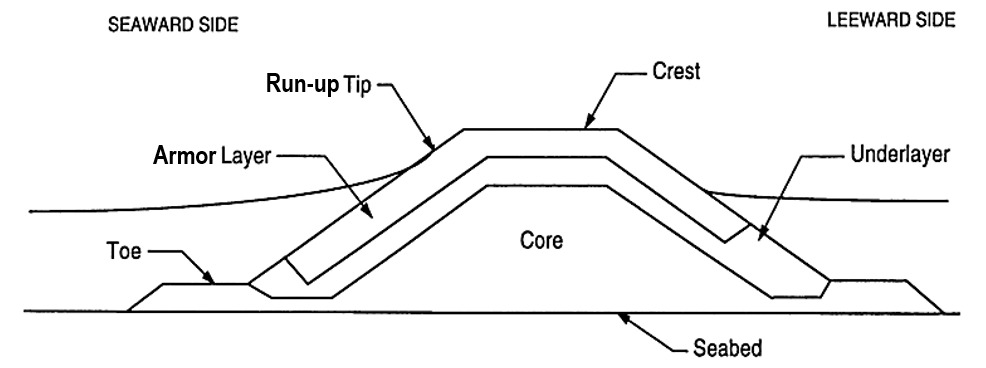
2.1. Armor Layer
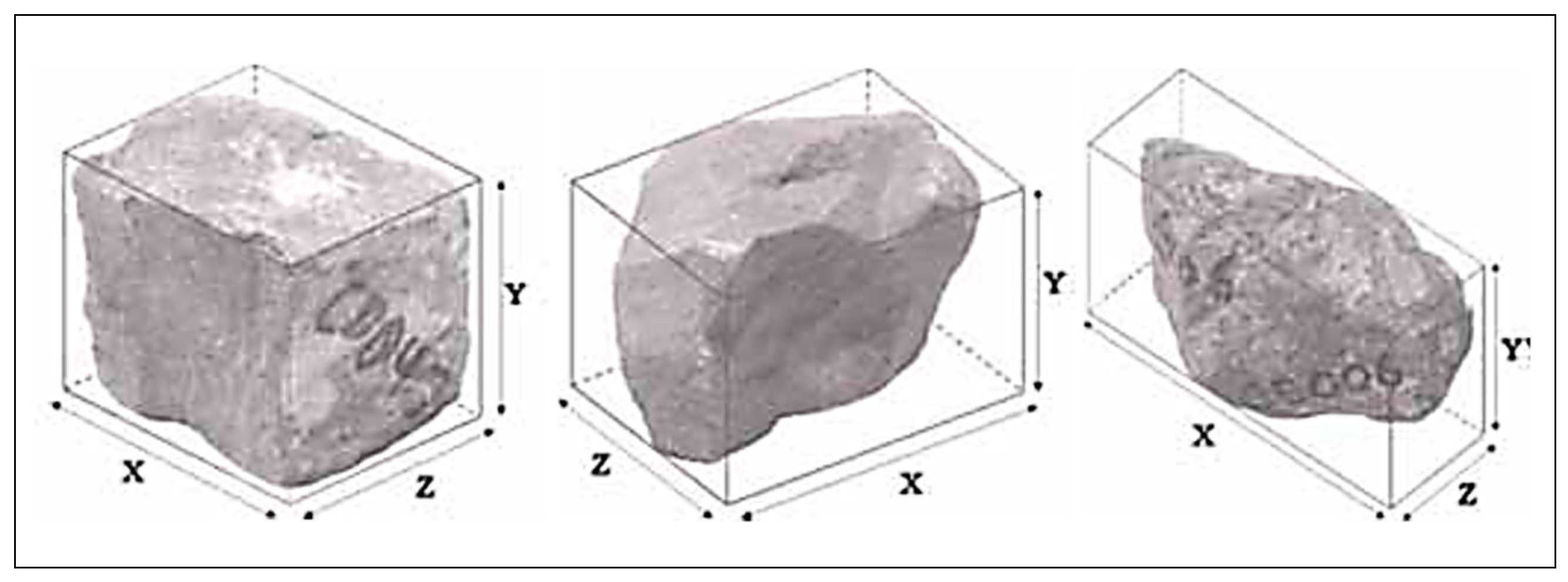
- Rock armor units
- •
- Random-shaped rocks
- •
- Polygonal armor units
- •
- Core-layer rocks
- •
- Artificial rock units
- •
- Riprap
- 2.
- Concrete armor units
- •
- Tetrapod
- •
- Dolos
- •
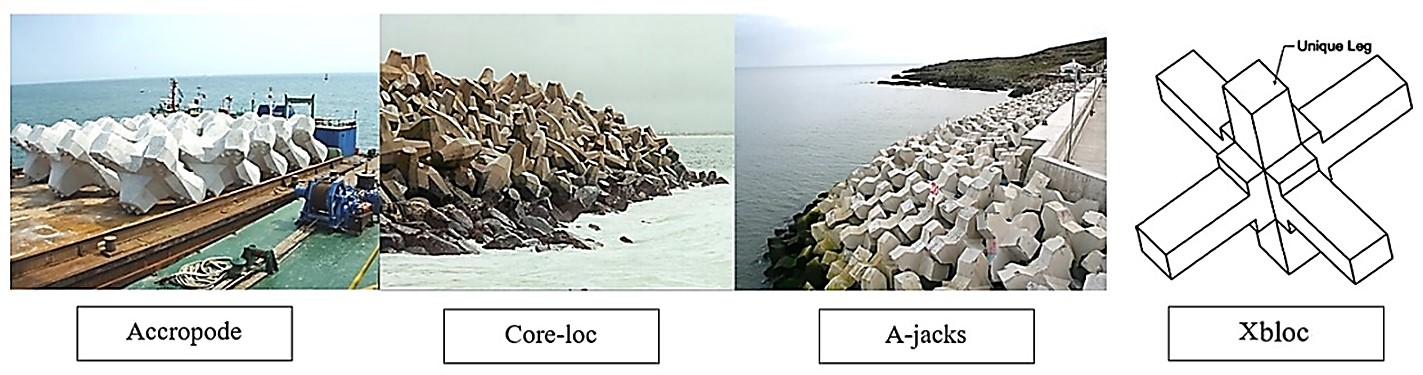
- Accropode
- •
- Core-loc
- •
- Cube
- •
- Xbloc
- •
- A-jacks
- •
- Riprap (modified concrete variants)
2.2. Design Adoption
- •
- A hydraulic stability similar to that of accropode and core-loc;
- •
- A robust shape that gives it higher structural integrity;
- •
- A concrete demand less than that of accropode and core-loc.
Design Concept
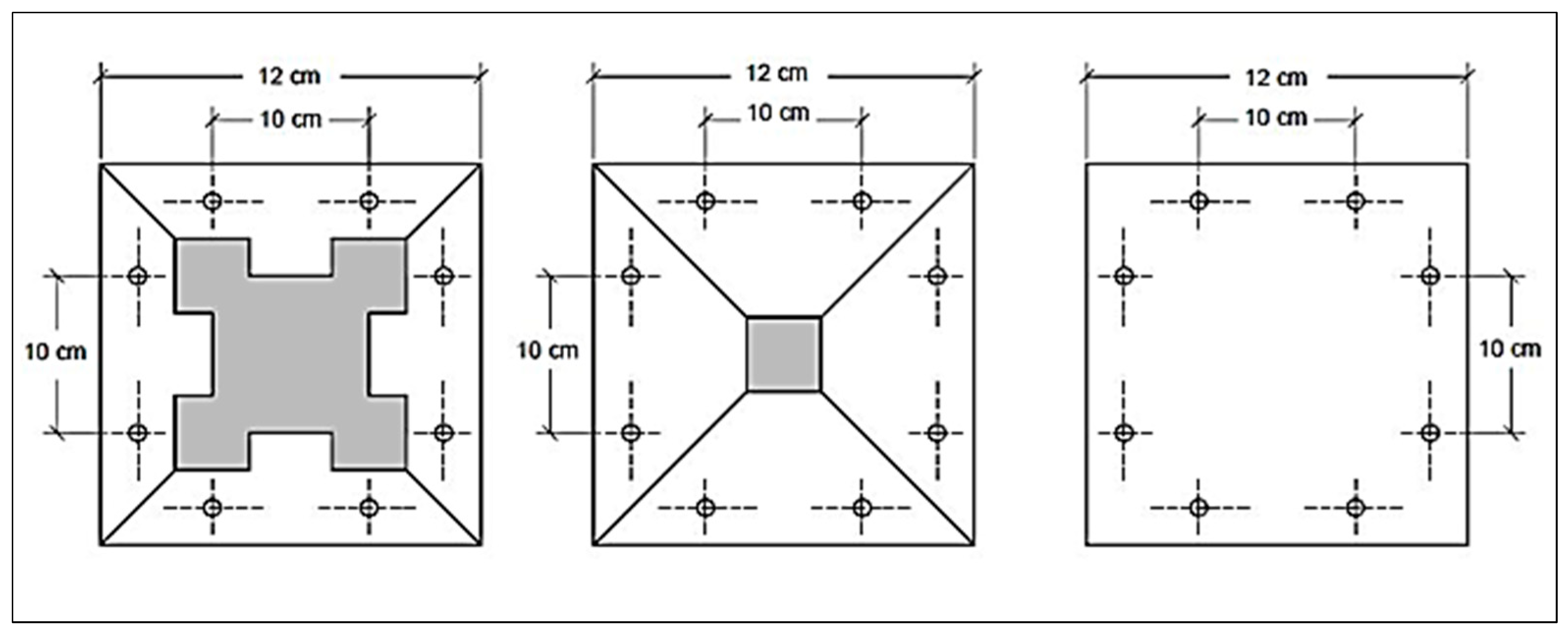
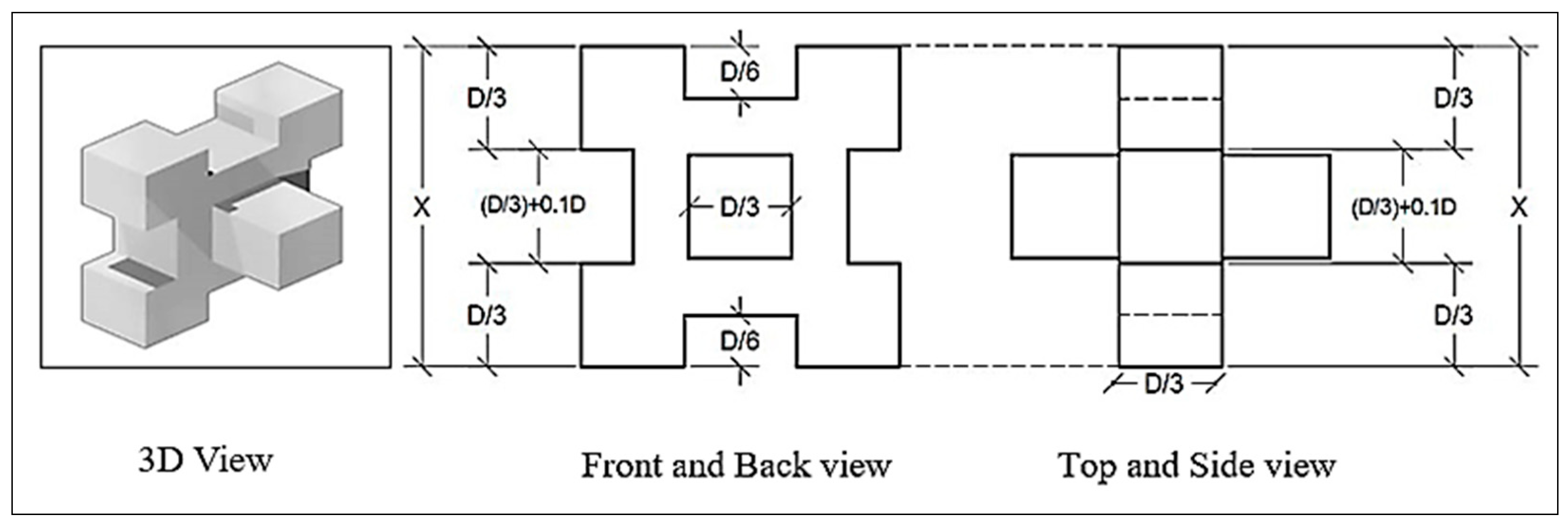
2.3. Geometric Configuration of the Proposed Armor Unit
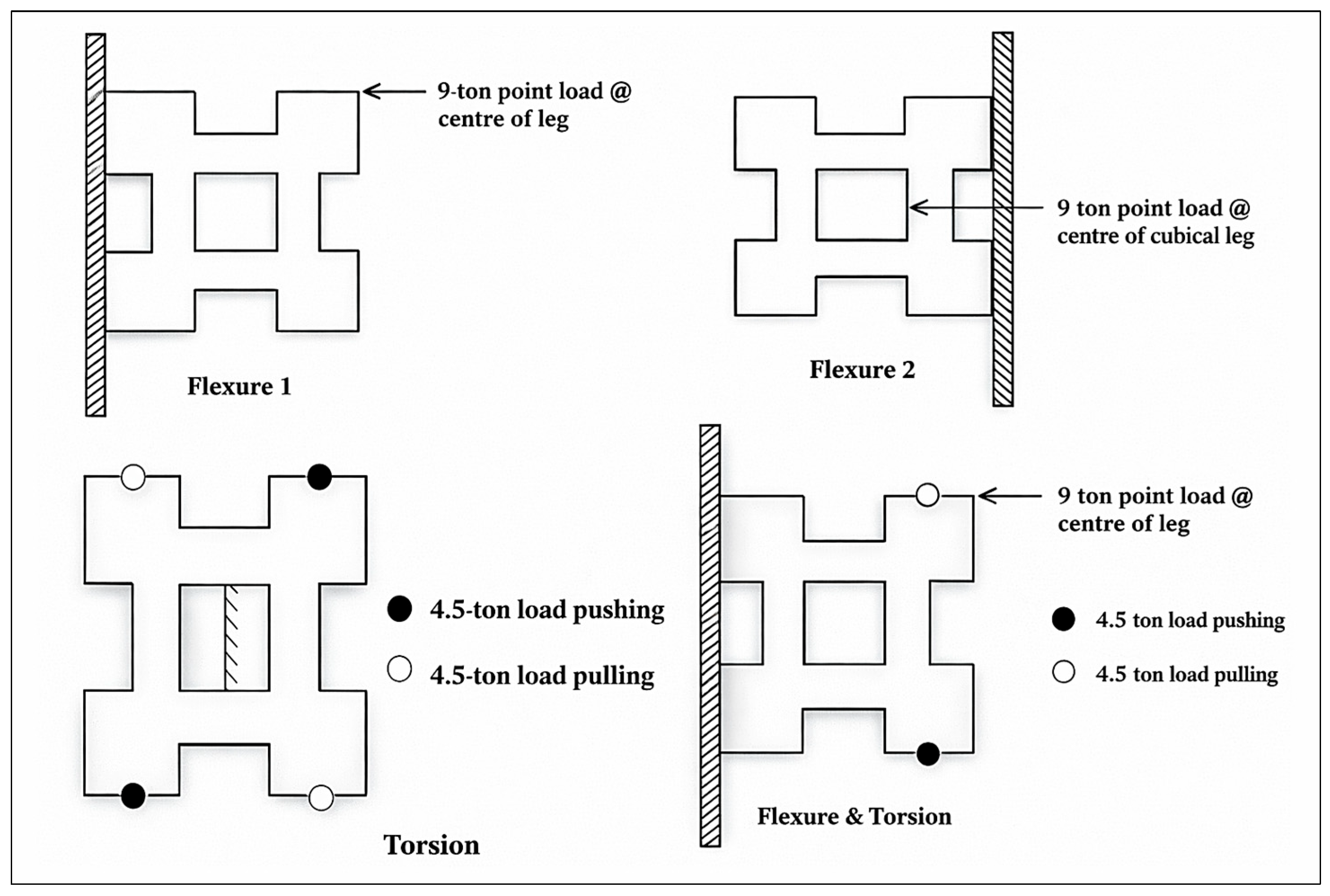
2.4. Structural Integrity
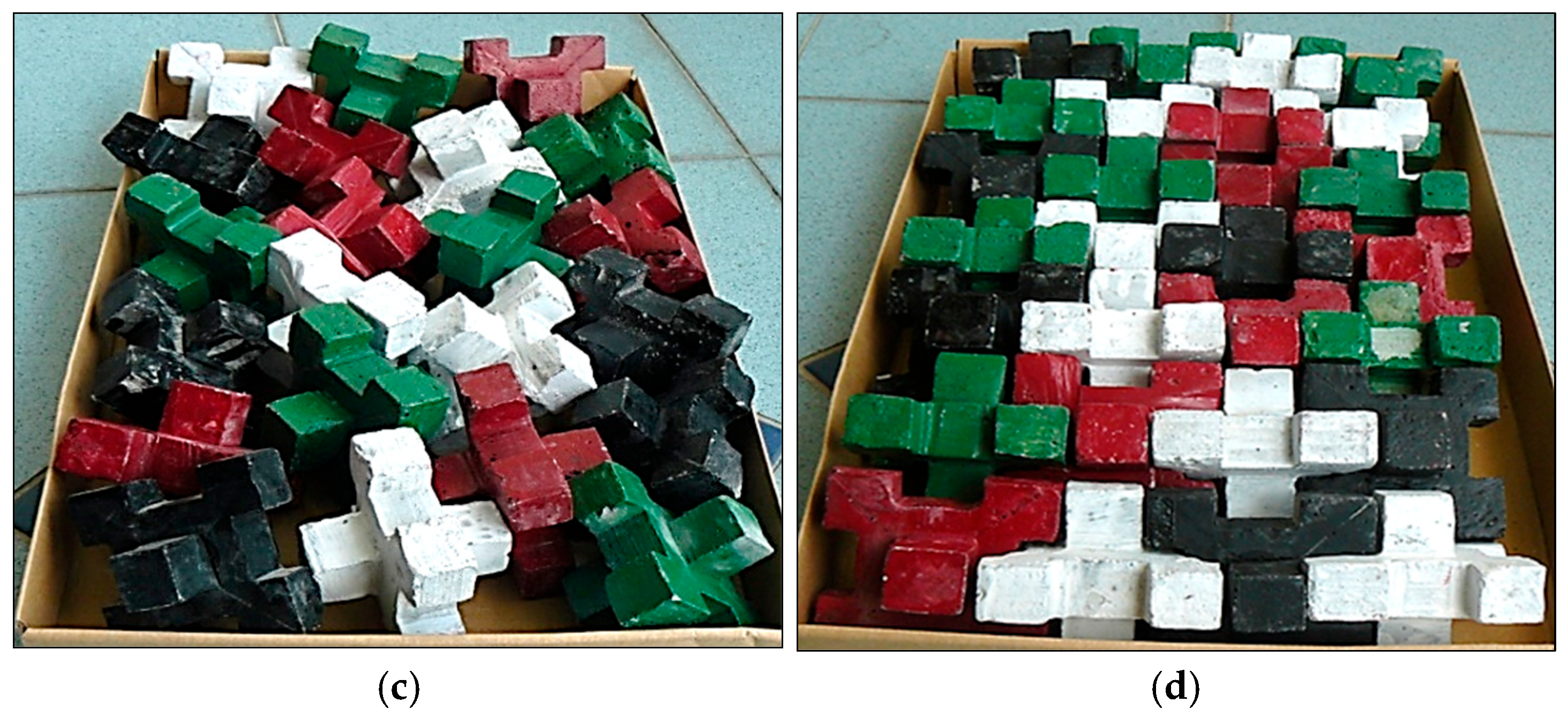
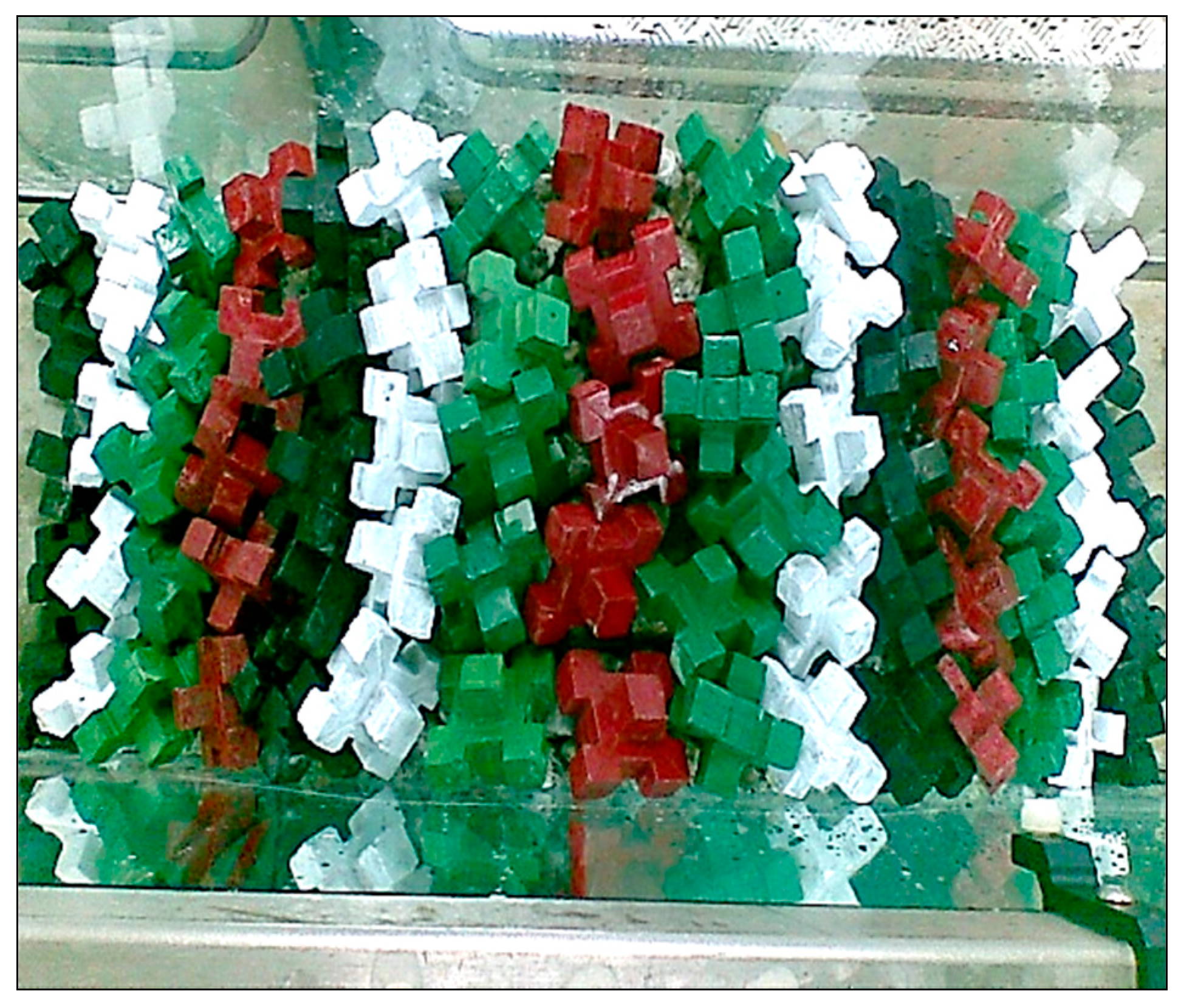
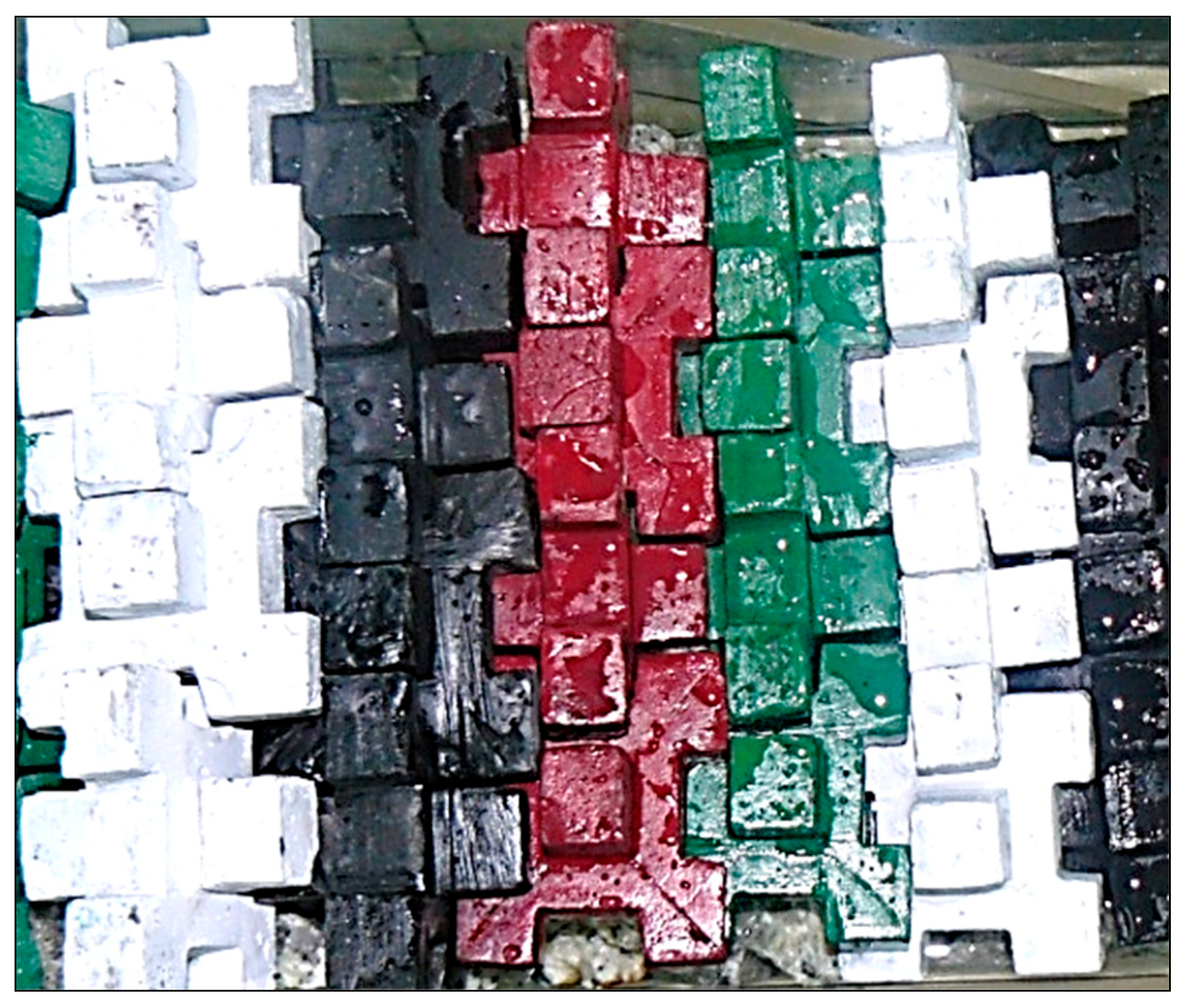
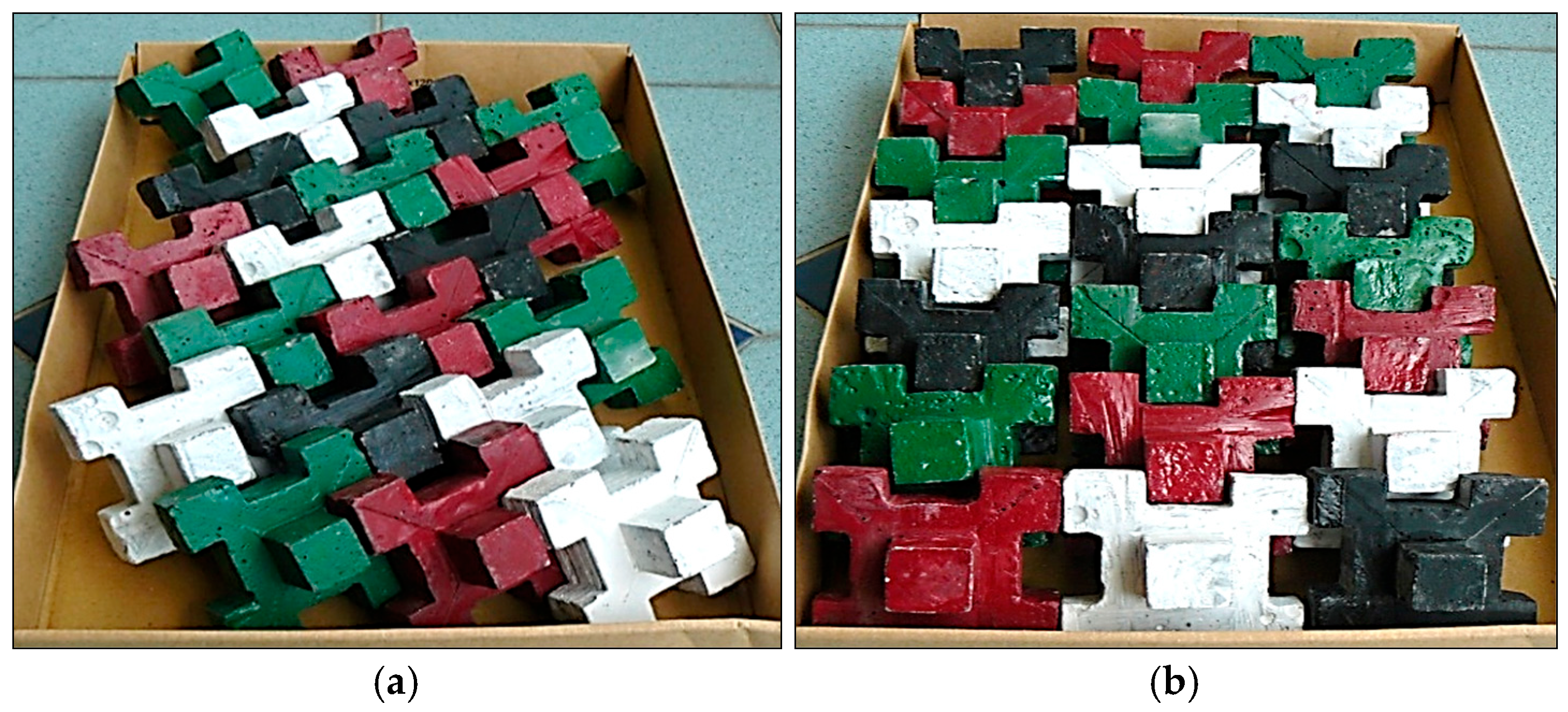
2.5. Possible Placement Arrangements
2.5.1. First Placement
2.5.2. Second Placement
2.5.3. Third Placement
2.5.4. Fourth Placement
2.6. Laboratory Work
2.6.1. Phase One (Unit Fabrication Phase)
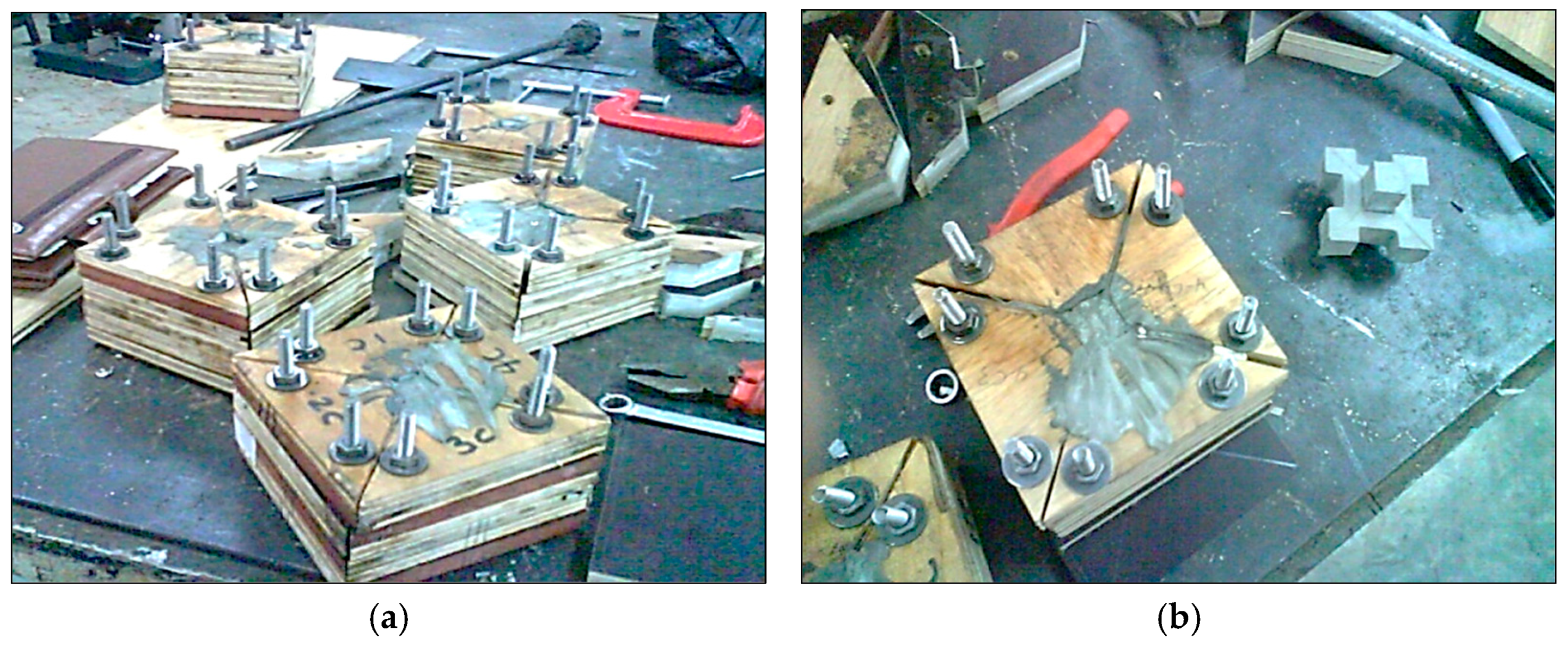
Mold Design Process
Mortar Mix
Fabrication Procedure
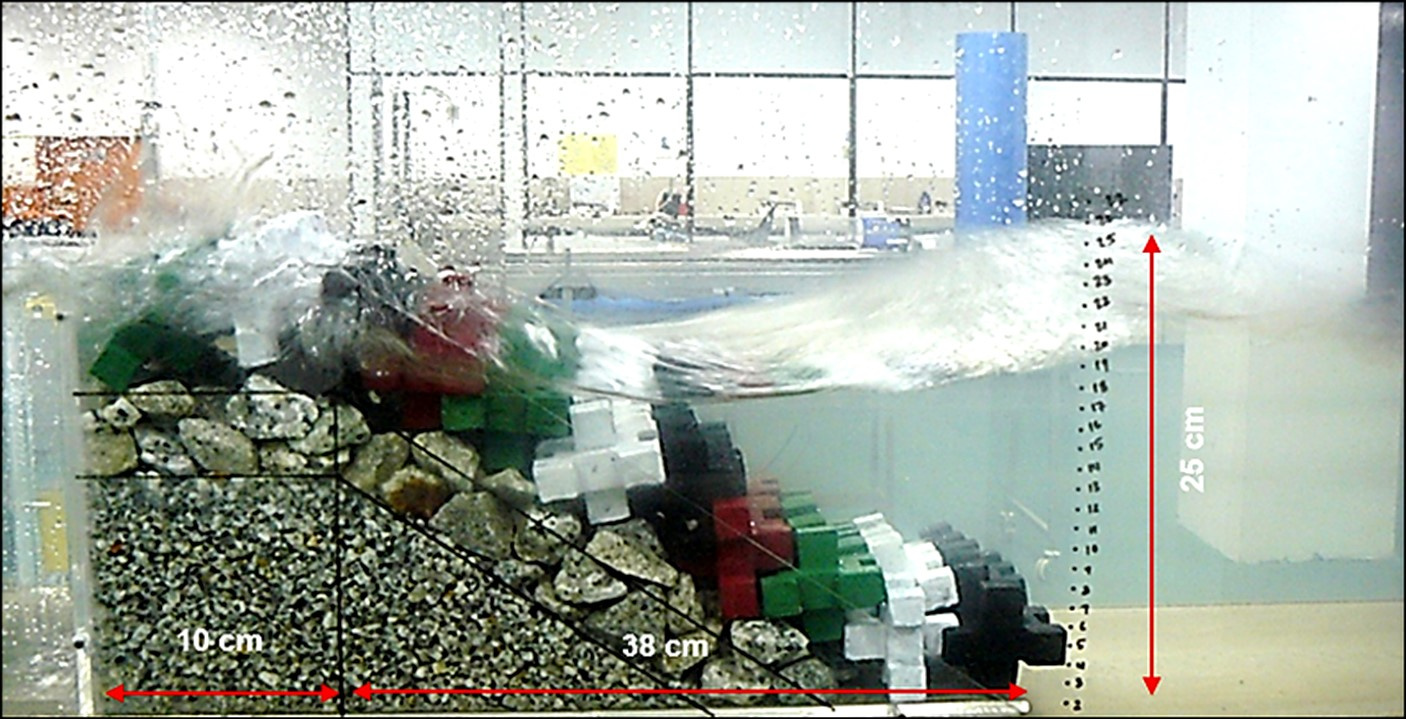
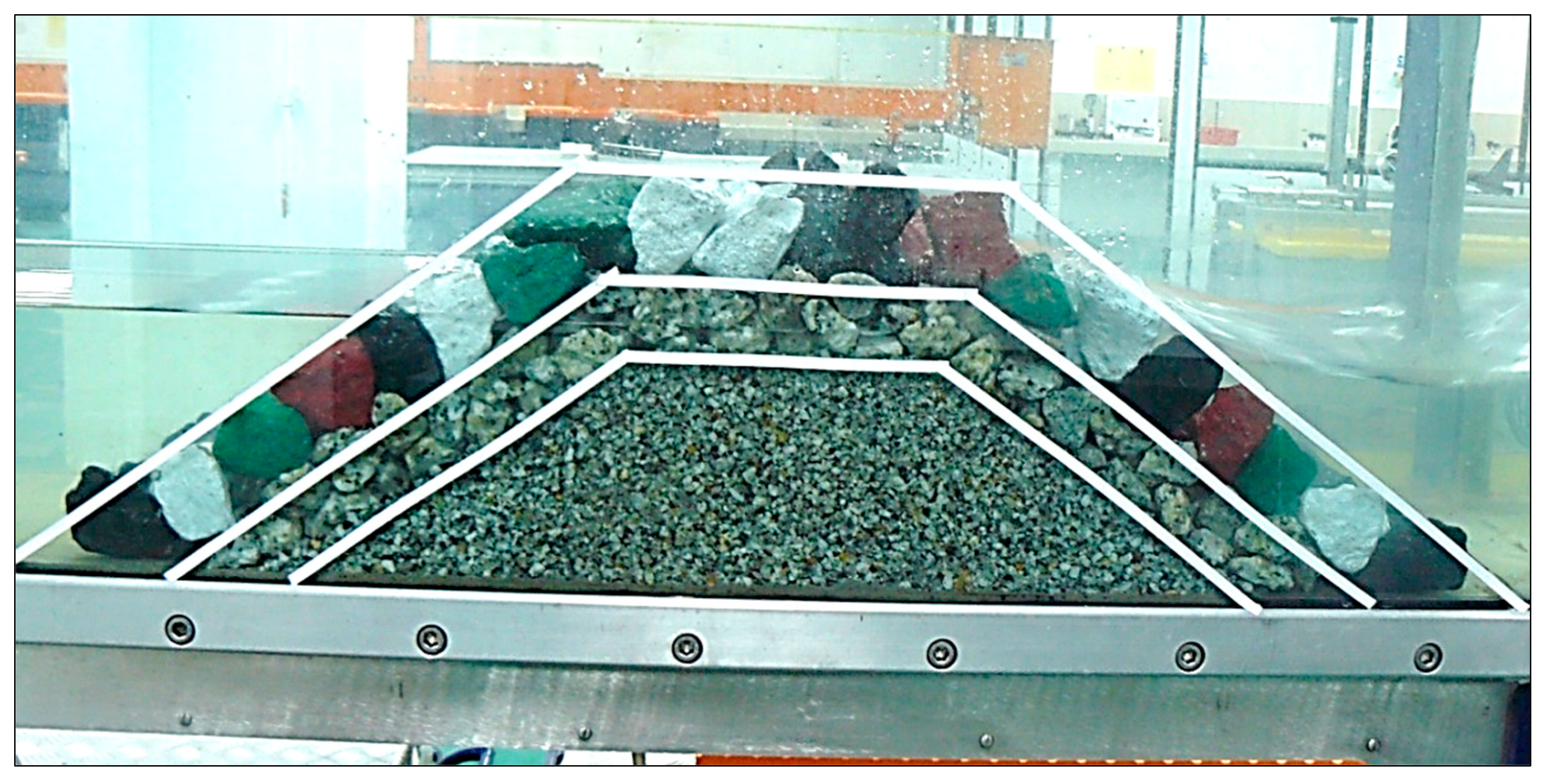
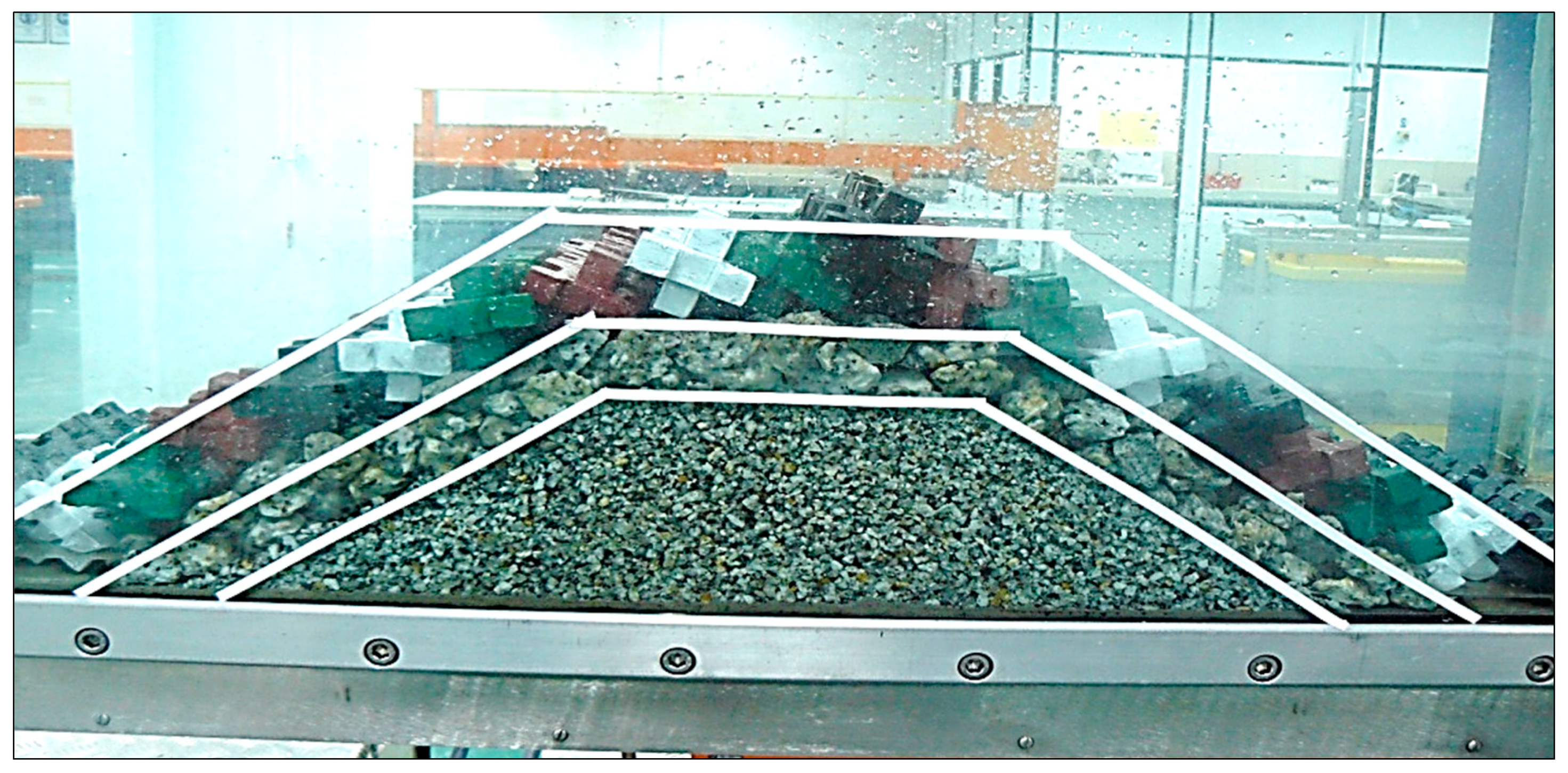
2.6.2. Phase Two (Structure Cross-Section Design)
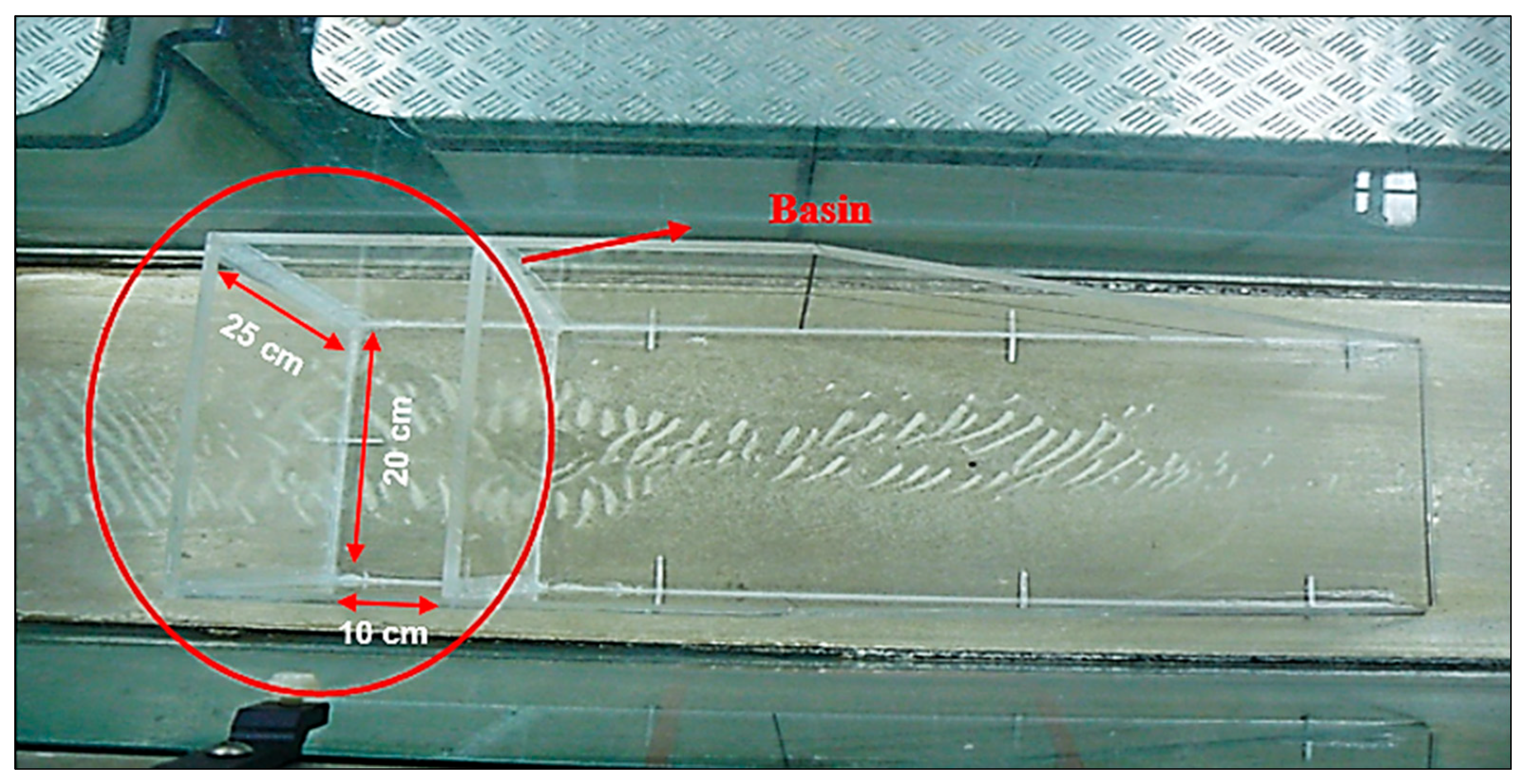
2.6.3. Phase Three (Experimental Set-Up)
2.6.4. Hydraulic Stability
2.6.5. Run-Up
2.6.6. Overtopping
3. Results and Discussion
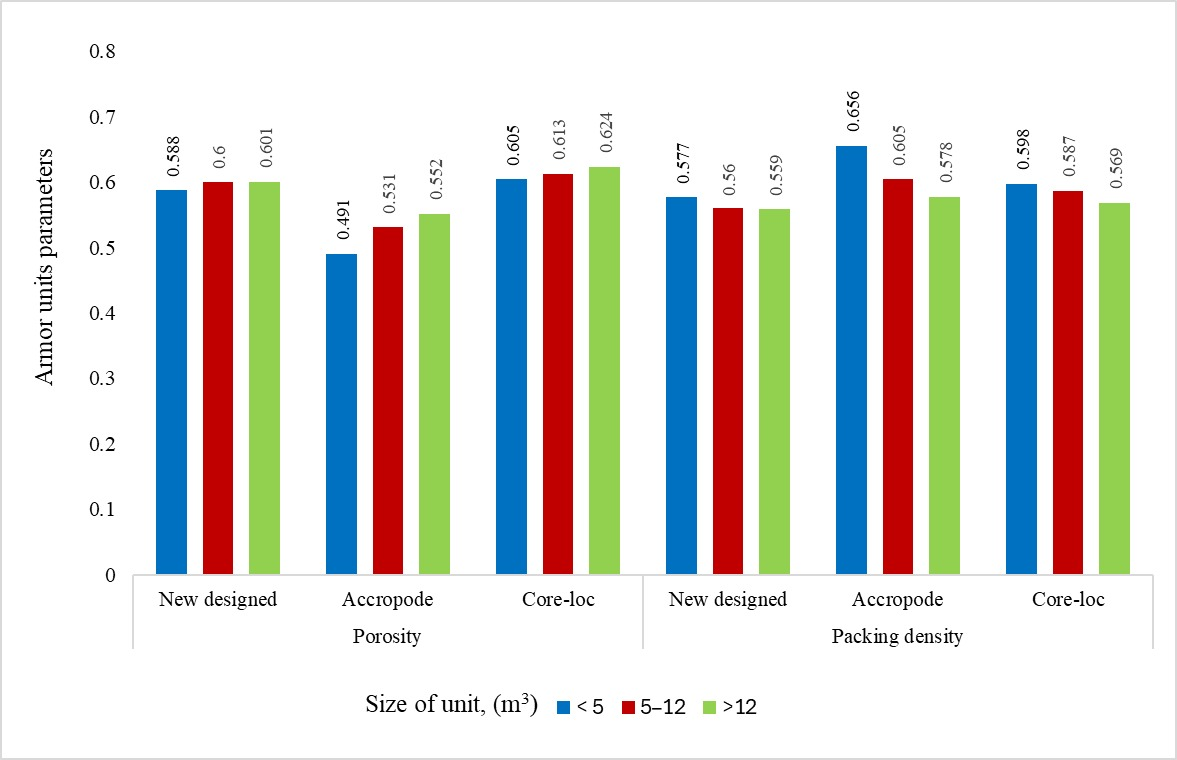
3.1. Layer Coefficients and Parameters
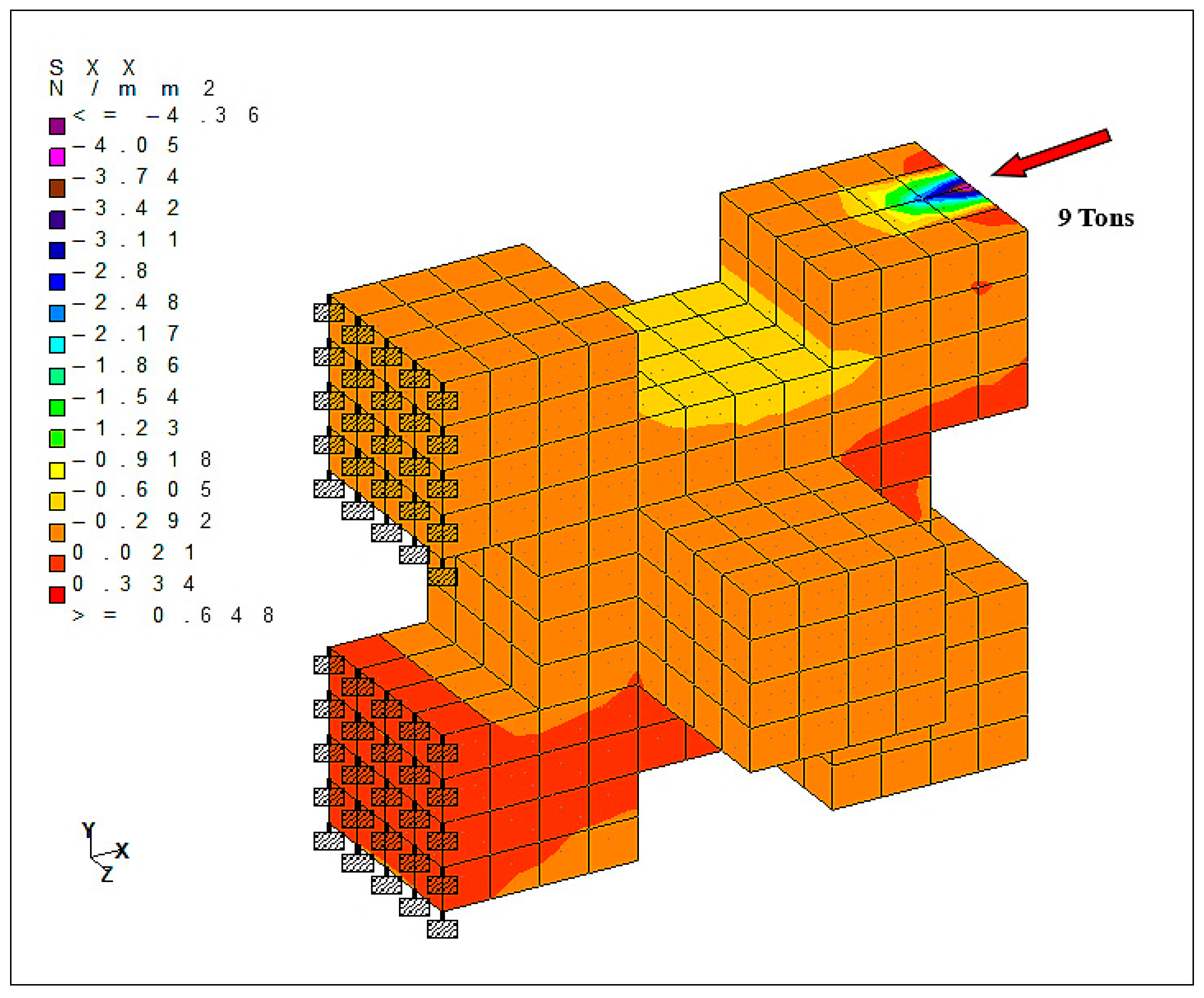
3.2. Stress–Strain Analysis (Structural Integrity)
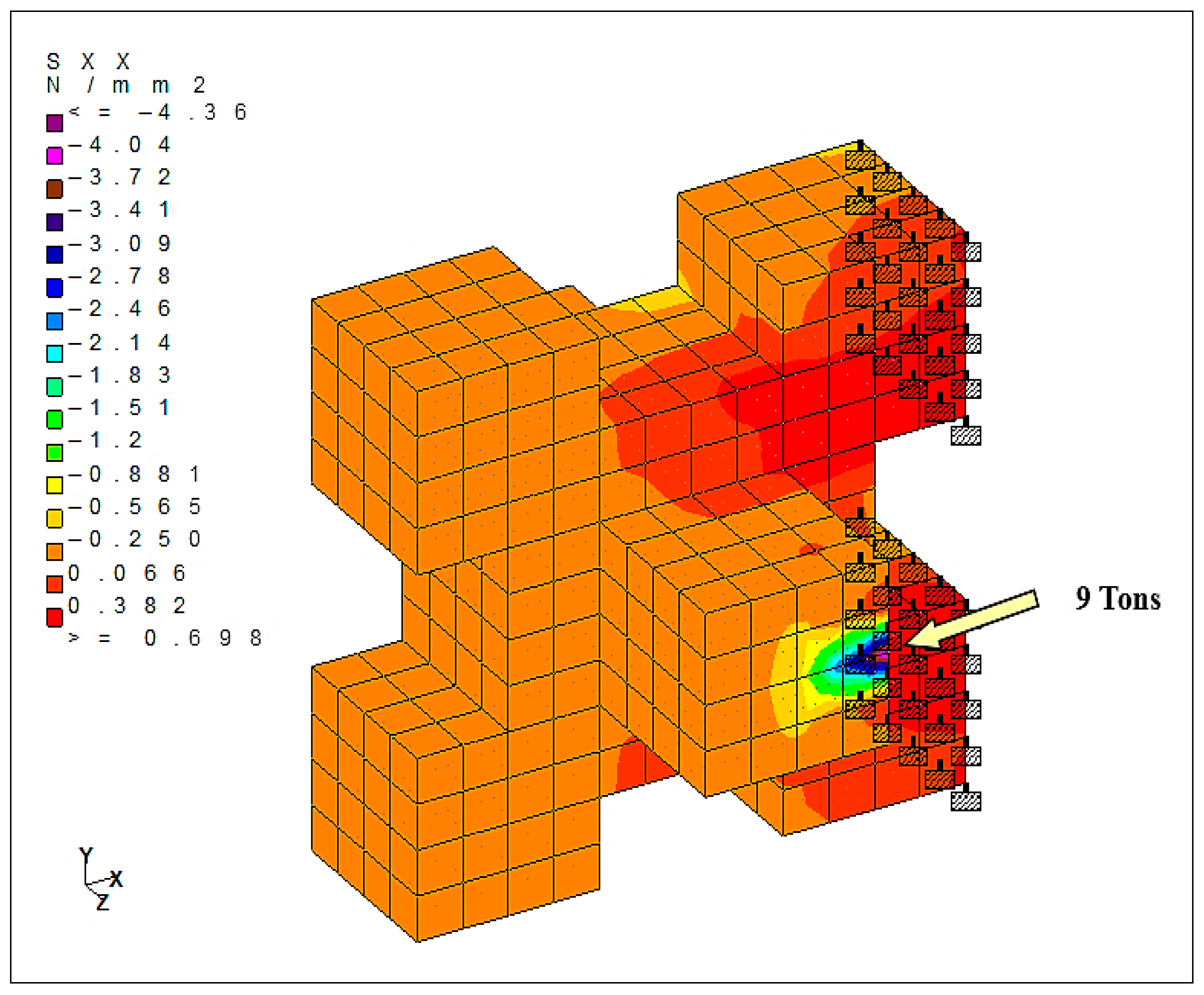
3.2.1. First Loading Scheme
3.2.2. Second Loading Scheme
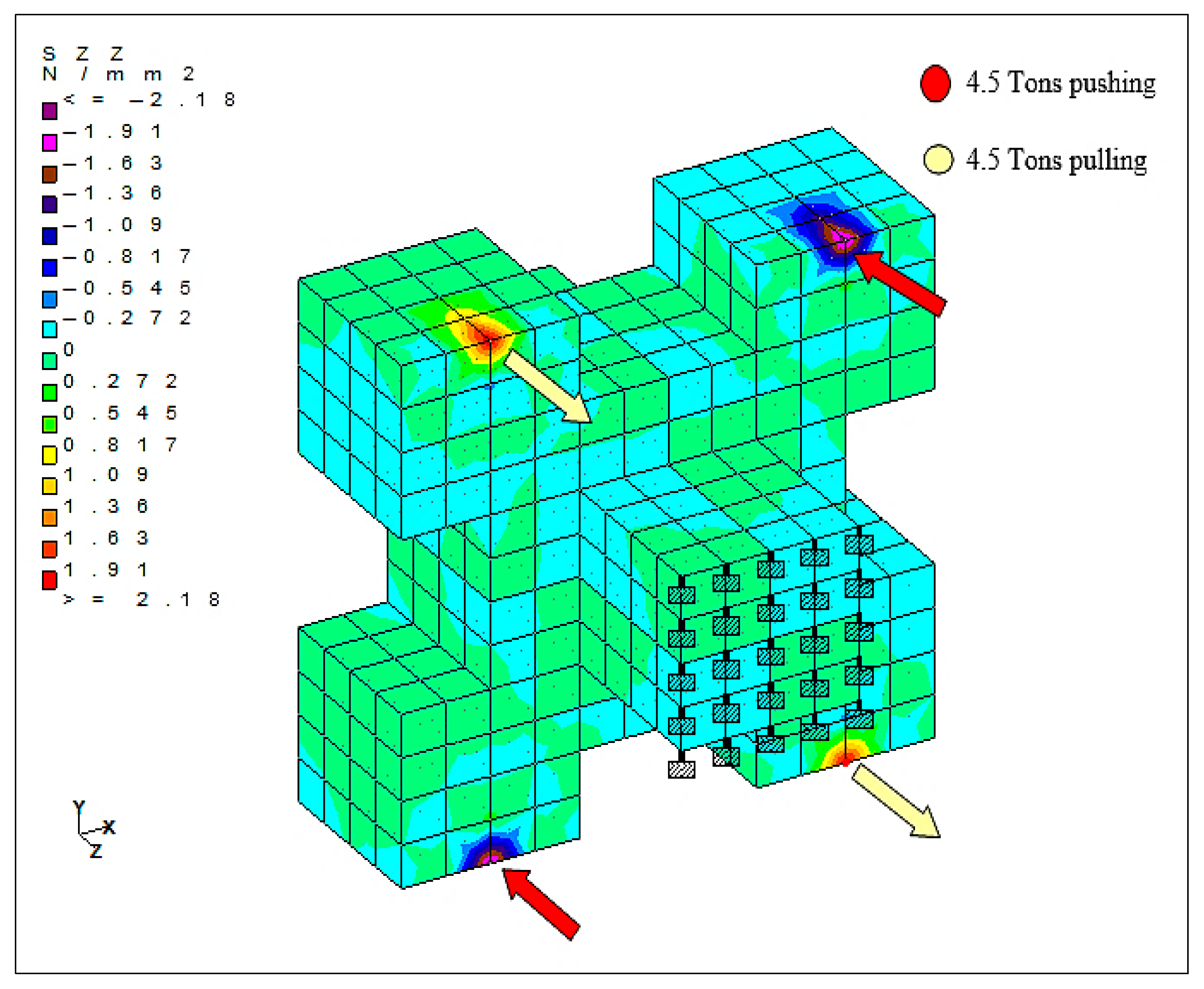
3.2.3. Third Loading Scheme
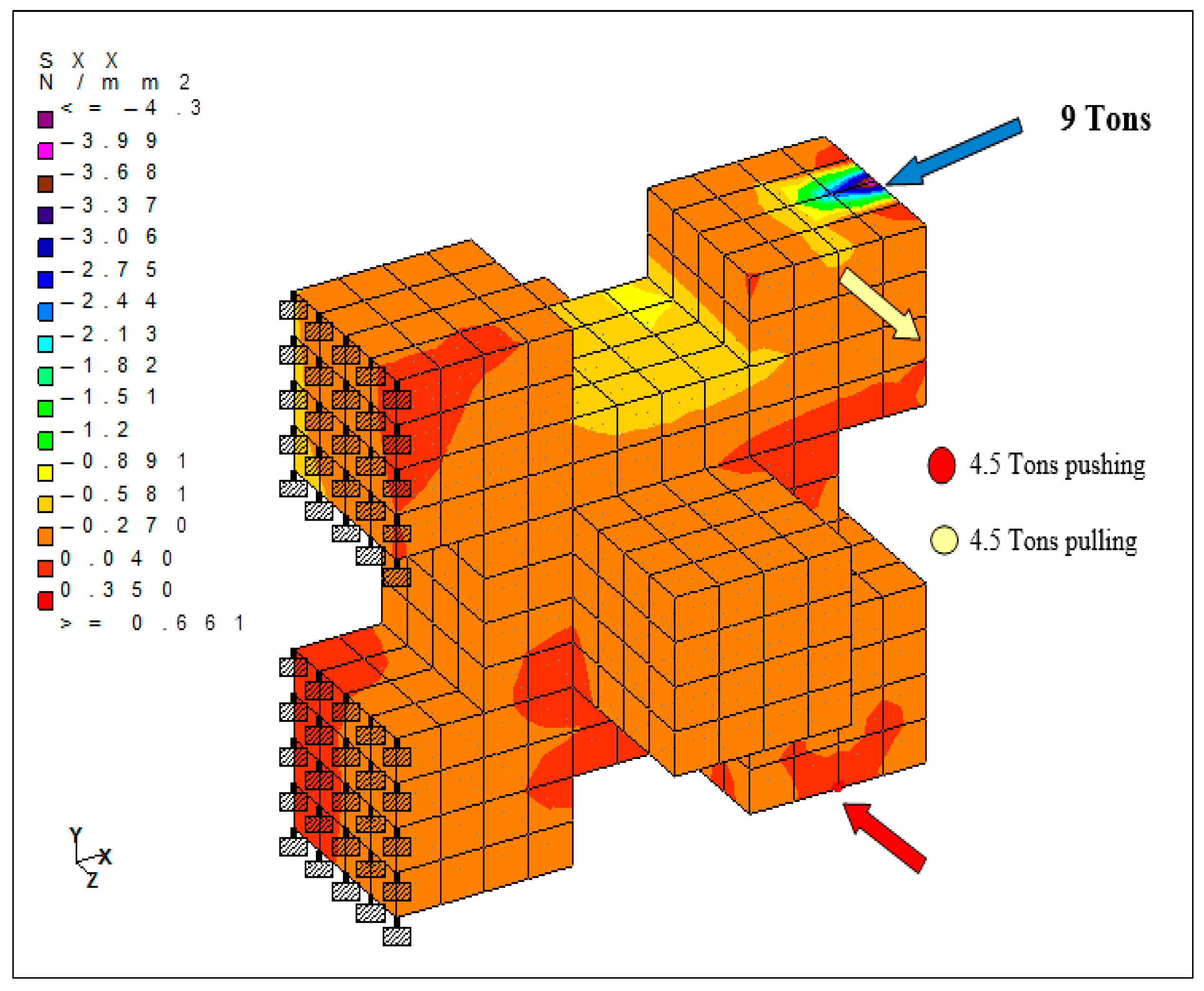
3.2.4. Fourth Loading Scheme
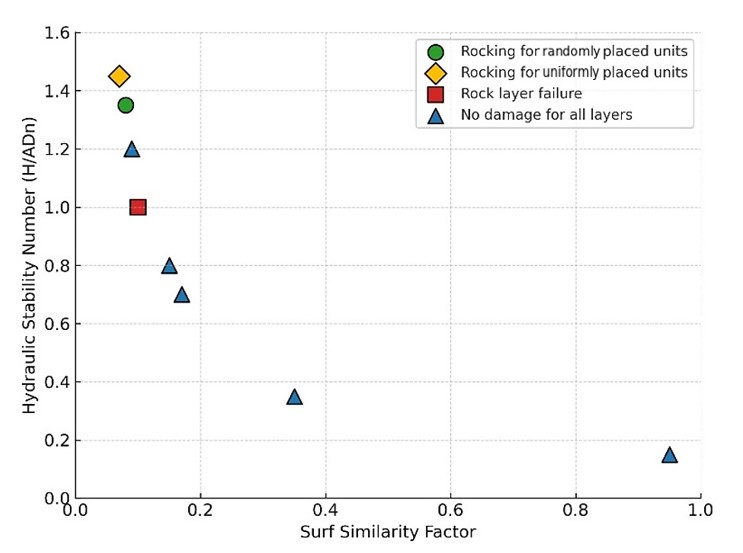
3.3. Hydraulic Stability Evaluation
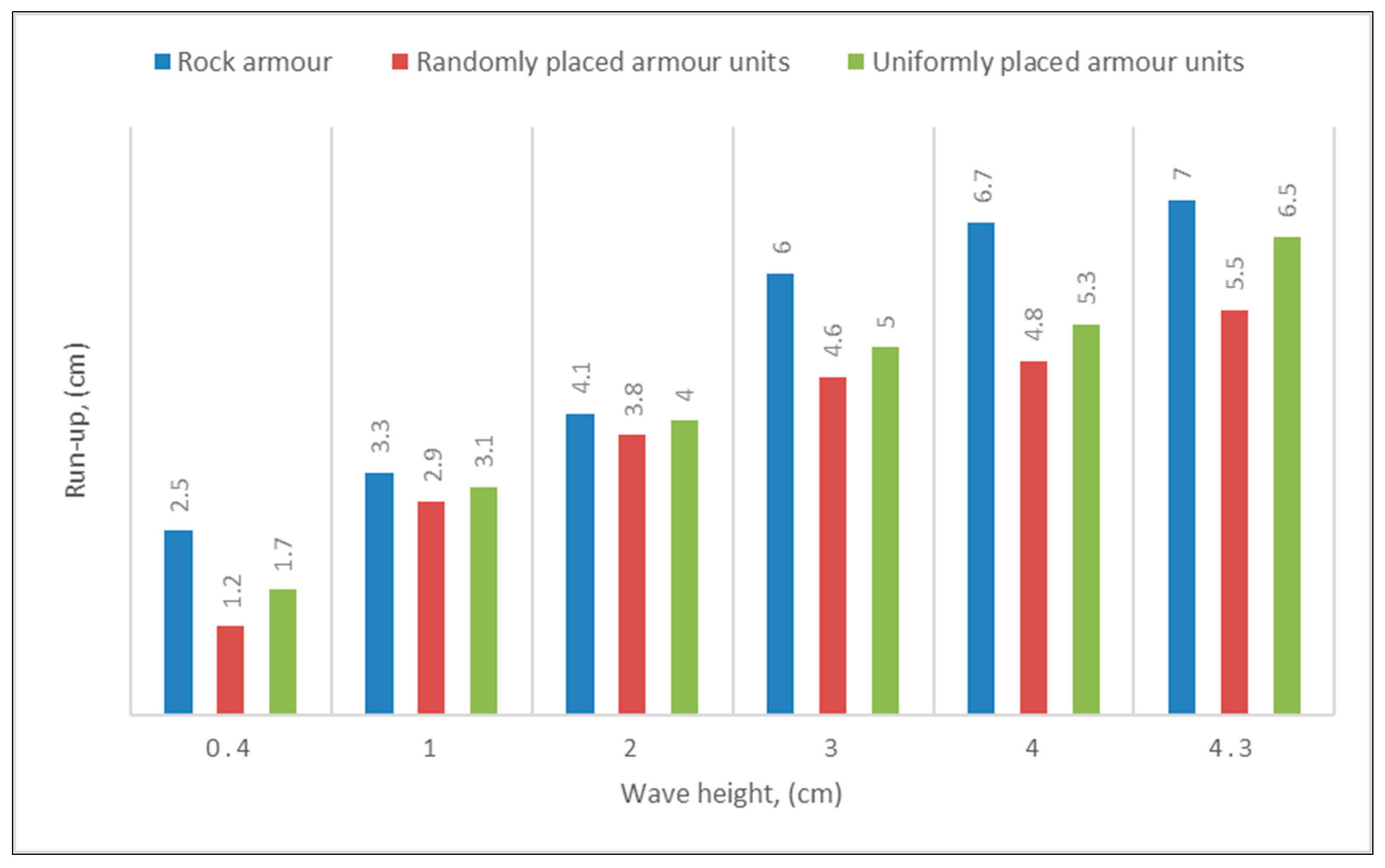
3.4. Run-Up Test Results
3.5. Overtopping Behavior
4. Conclusions
- The geometric efficiency of the newly designed armor unit in comparison to the accropode and core-loc designs demonstrates a superior balance between compactness and permeability. When it comes to porosity, the new armor unit achieved a porosity 8–16% higher than that of accropode, hence achieving better energy dissipation. However, the new unit achieved a lower porosity (2–4%) than that of core-loc, but it remains a more robust structural matrix. Furthermore, the newly designed unit reduced packing density by 2–14% in comparison to both accropode and core-loc, indicating a more efficient utilization of material, offering a cost-efficient alternative in which it optimizes concrete volume per unit area of protection.
- Mechanical analysis reveals that the geometric configuration of the newly designed armor unit mitigates stress concentrations more effectively. Under loading schemes that include flexure, torsion, and combined loading, the new unit exhibited a 8–15% reduction in internal stress when compared to accropode. In addition, a reduction in stress concentrations reaching 20–35% in comparison to core-loc was observed. These results hint that the double-cube geometry succeeded in redistributing loads, providing a more robust structural alternative that minimizes breakage of the armor unit.
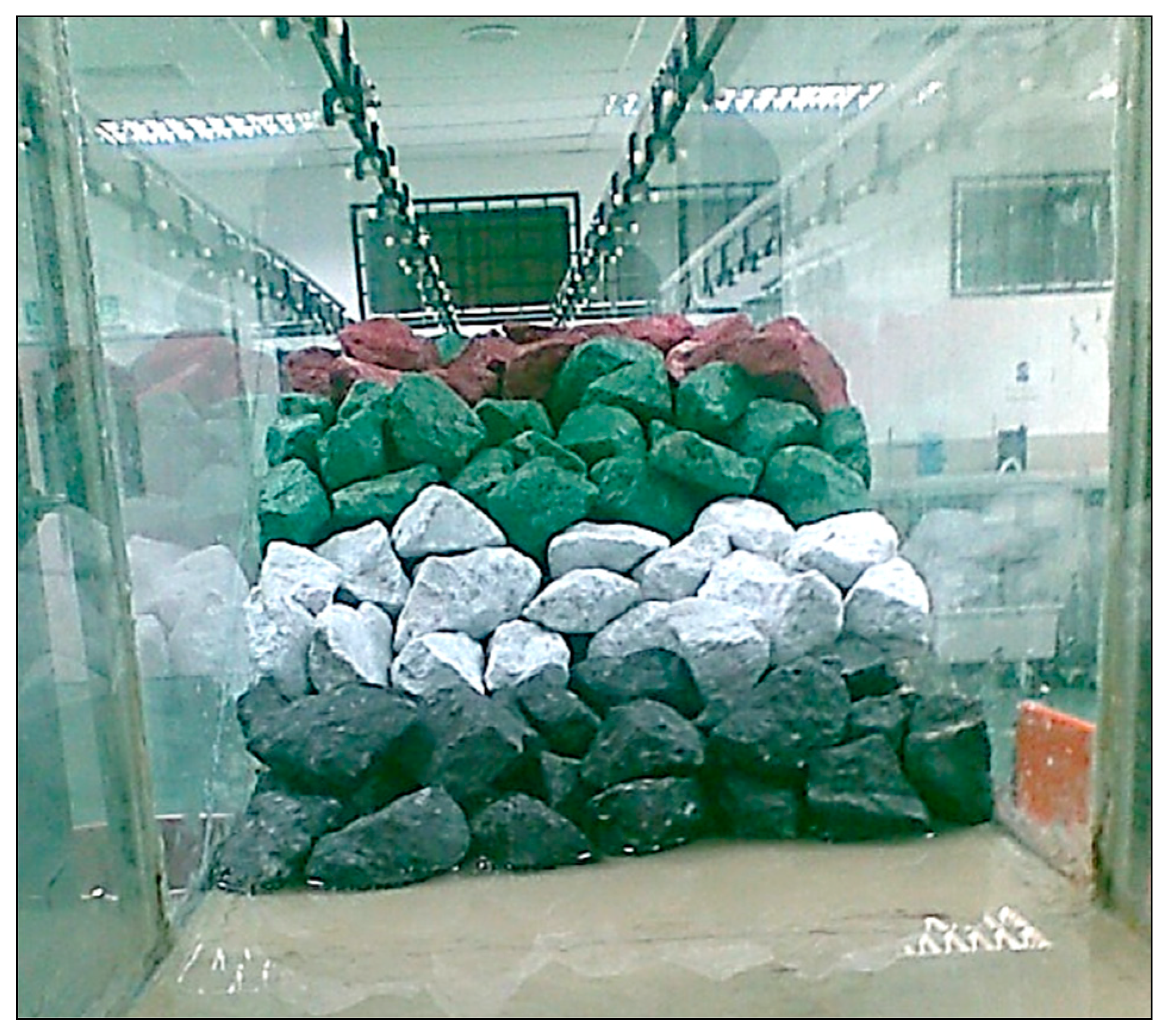
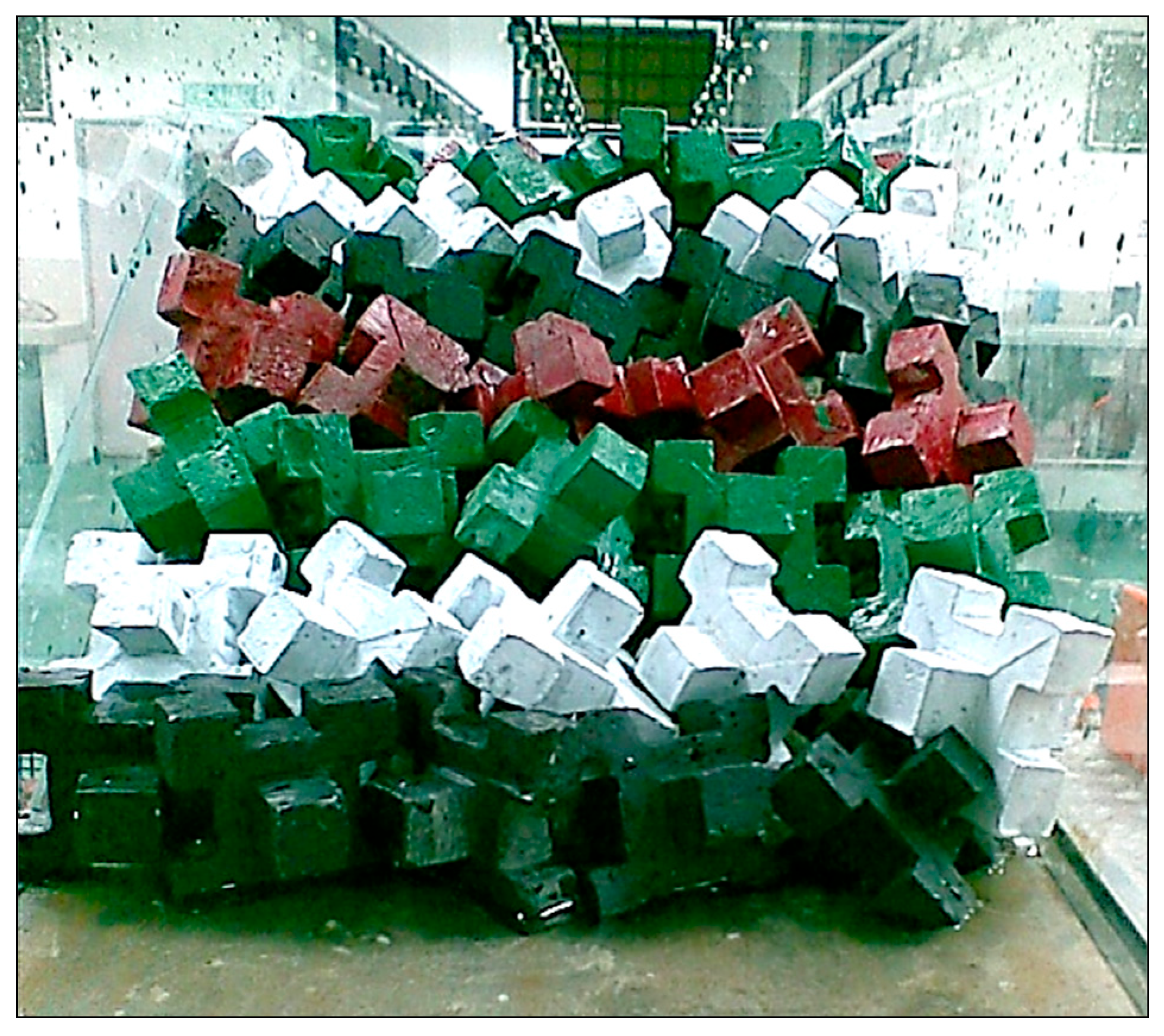
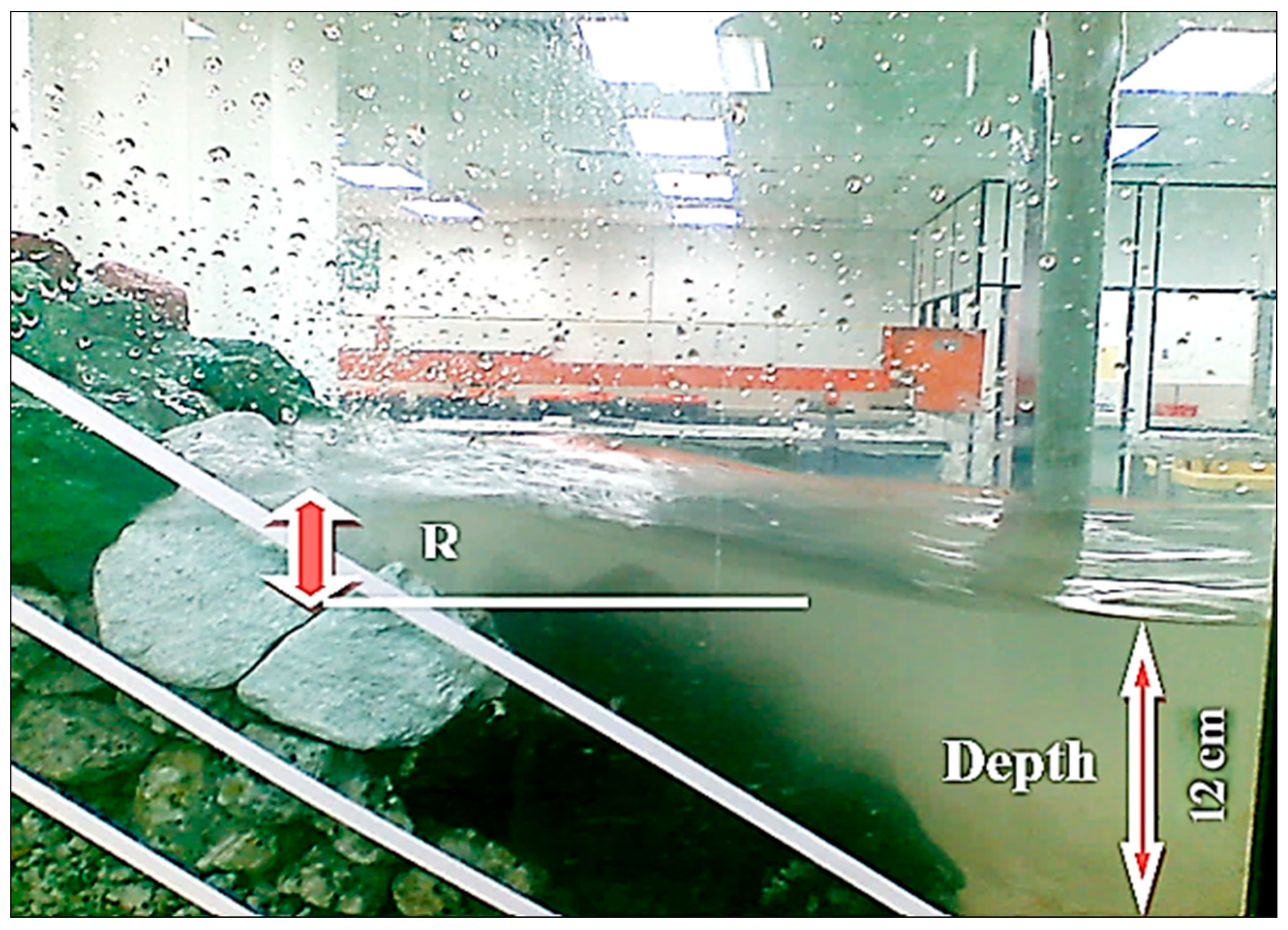
- When compared to traditional rock armor units, the newly designed unit provides superior stability and reduces wave–structure interaction. The proposed unit remained stable at higher loading, with rocking only initiated at Ns equal to 1.4 when randomly placed and at 1.5 when uniformly placed, while rock armor units reached failure at an Ns reading of 1.0. Randomly placed units achieved a 50% reduction in run-up during peak conditions, while uniform placed units achieved a 30% reduction. Furthermore, the proposed unit was effective in preventing overtopping. Randomly placed armor units reduced overtopping by approximately 59% in comparison to rock armor units, while uniformly placed units reduced the overtopping by 37%, confirming the design’s efficient protection of the leeward infrastructure.
Author Contributions
Funding
Institutional Review Board Statement
Informed Consent Statement
Data Availability Statement
Conflicts of Interest
References
- Ismail Ahmed Ahmed Meligy, S. The artistic development of the sea element in ancient civilizations. Int. J. Multidiscip. Stud. Art Technol. 2021, 4, 74–101. [Google Scholar] [CrossRef]
- Costello, C.; Cao, L.; Gelcich, S.; Cisneros-Mata, M.Á.; Free, C.M.; Froehlich, H.E.; Golden, C.D.; Ishimura, G.; Maier, J.; Macadam-Somer, I.; et al. The future of food from the sea. Nature 2020, 588, 95–100. [Google Scholar] [CrossRef] [PubMed]
- Alves, B.; Angnuureng, D.B.; Morand, P.; Almar, R. A review on coastal erosion and flooding risks and best management practices in West Africa: What has been done and should be done. J. Coast. Conserv. 2020, 24, 38. [Google Scholar] [CrossRef]
- Kindeberg, T.; Almström, B.; Skoog, M.; Olsson, P.A.; Hollander, J. Toward a multifunctional nature-based coastal defense: A review of the interaction between beach nourishment and ecological restoration. Nord. J. Bot. 2023, 2023, e03751. [Google Scholar] [CrossRef]
- Morris, R.L.; Heery, E.C.; Loke, L.H.; Lau, E.; Strain, E.; Airoldi, L.; Alexander, K.A.; Bishop, M.J.; Coleman, R.A.; Cordell, J.R.; et al. Design options, implementation issues and evaluating success of ecologically engineered shorelines. In Oceanography and Marine Biology; CRC Press: Boca Raton, FL, USA, 2019. [Google Scholar]
- Whitesell, L.A. Seismic reflection and beach nourishment–lessons from Hurricane Sandy. In Proceedings of the SEG International Exposition and Annual Meeting, Houston, TX, USA, 22–27 September 2013; p. SEG-2013-1494. [Google Scholar]
- Iskander, M.M.; Frihy, O.E.; El Ansary, A.E.; Abd El Mooty, M.M.; Nagy, H.M. Beach impacts of shore-parallel breakwaters backing offshore submerged ridges, Western Mediterranean Coast of Egypt. J. Environ. Manag. 2007, 85, 1109–1119. [Google Scholar] [CrossRef]
- Himi, T.H. Experimental Study on the Performance of Multilayer Geotube Breakwater with and without CC Block under Wave Attack. Master's Thesis, Bangladesh University of Engineering and Technology, Dhaka, Bangladesh, 2022. [Google Scholar]
- Rahmstorf, S. Rising hazard of storm-surge flooding. Proc. Natl. Acad. Sci. USA 2017, 114, 11806–11808. [Google Scholar] [CrossRef]
- Apu, N.; Das, U. Tectonics and earthquake potential of Bangladesh: A review. Int. J. Disaster Resil. Built Environ. 2021, 12, 295–307. [Google Scholar] [CrossRef]
- Pires, A.; Chaminé, H.I.; Piqueiro, F.; Rocha, F. Coastal geo-engineering techniques for the assessment of rock armour structures. Mar. Georesour. Geotechnol. 2014, 32, 155–178. [Google Scholar] [CrossRef]
- Jiao, L.; Liu, C.; Jiang, D.; Zhang, X.; Lv, X. Storm surge numerical simulation of Typhoon “Mangkhut” with adjoint data assimilation. J. Mar. Sci. Eng. 2025, 13, 1992. [Google Scholar] [CrossRef]
- Gökdağ, A. Assessment of Storm Damaged Breakwater and Reinforced Cross-Section. Master’s Thesis, Middle East Technical University, Ankara, Türkiye, 2025. [Google Scholar]
- Suwondo, R.; Keintjem, M.; Suangga, M.; Altaee, M. The Influence of the Armor Stability Coefficient on the Hydraulic, Economic, and Environmental Performance of Rubble Mound Breakwaters. Eng. Technol. Appl. Sci. Res. 2025, 15, 28475–28480. [Google Scholar] [CrossRef]
- van Gent, M.R.; Wolters, G.; Capel, A. Wave overtopping discharges at rubble mound breakwaters including effects of a crest wall and a berm. Coast. Eng. 2022, 176, 104151. [Google Scholar] [CrossRef]
- Hudson, R.Y. Laboratory investigation of rubble-mound breakwaters. J. Waterw. Harb. Div. 1959, 85, 93–121. [Google Scholar] [CrossRef]
- Van der Meer, J.W.; Pilarczyk, K.W. Stability of rubble mound breakwaters under random wave attack. In Proceedings of the 19th International Conference on Coastal Engineering, Houston, TX, USA, 3–7 September 1984. [Google Scholar]
- Sayar, S.D.; Baker, S.; Nistor, I.; Martinez, J.G. Hydraulic performance of ecofriendly breakwater armour units. In Proceedings of the 38th Conference on Coastal Engineering, Rome, Italy, 8–14 September 2024; Volume 38, ISBN 978-0-9896611-7-1. [Google Scholar] [CrossRef]
- Safa, E.; Mojtahedi, A.; Mohammadian, A.; Yaghin, M.A. Hydrodynamic assessment of a new nature-based armour unit on rubble mound breakwater for coastal protection. China Ocean Eng. 2024, 38, 439–452. [Google Scholar] [CrossRef]
- Park, Y.H.; Oh, Y.M.; Ahn, S.M.; Han, T.H.; Kim, Y.T.; Suh, K.D.; Won, D. Development of a new concrete armor unit for high waves. J. Coast. Res. 2019, 35, 719–728. [Google Scholar] [CrossRef]
- Leone, E.; Francone, A.; Paglialunga, A.; Ciardulli, F.; Long, J.; Aloisi, A.; Tomasicchio, G.R. Overtopping Assessment of a Rubble Mound Breakwater with Innovative Armor Units: A Physical and Numerical Study. J. Coast. Res. 2025, 113, 804–808. [Google Scholar] [CrossRef]
- Mousavi, S.H.; Kavianpour, M.R.; Aminoroayaie Yamini, O. Experimental analysis of breakwater stability with antifer concrete block. Mar. Georesour. Geotechnol. 2017, 35, 426–434. [Google Scholar] [CrossRef]
- Khodadoust, H. Evaluation of armoured breakwater alternatives using a multi-criteria approach: Case study of a fishery port in Southern Iran. Reg. Stud. Mar. Sci. 2025, 91, 104566. [Google Scholar] [CrossRef]
- Oumeraci, H.; Recio, J. Geotextile sand containers for shore protection. In Handbook of Coastal and Ocean Engineering; World Scientific Publishing Company: Singapore, 2018; pp. 775–822. [Google Scholar]
- Aliasgary, S.; Badiei, S.P.; Mouazé, D. Evaluation of the Factors Affecting the Hydraulic Stability of Tblock™ Coastal Protection Armour Unit. Water Waves 2024, 6, 571–592. [Google Scholar] [CrossRef]
- van der Meer, J.; van Gent, M.; Wolters, G.; Heineke, D. New Design Guidance for Underlayers and Filter Layers for Rock Armour under Wave Attack. In Coasts, Marine Structures and Breakwaters 2017: Realising the Potential; ICE Publishing: London, UK, 2018; pp. 1069–1079. [Google Scholar]
- Etemad-Shahidi, A.; Bali, M.; Van Gent, M.R. On the stability of rock armored rubble mound structures. Coast. Eng. 2020, 158, 103655. [Google Scholar] [CrossRef]
- Gao, Z.; Wang, Z.; Chen, Y.; Li, S.; Li, L.; Chen, L.; Huang, C.; Yang, Q. Study on the damage effect of 12.7 mm armour piercing incendiary projectile penetrating aramid reinforced concrete slab. Comput. Struct. 2025, 312, 107706. [Google Scholar] [CrossRef]
- Özvan, A.; Dinçer, İ.; Acar, A. Quality assessment of geo-materials for coastal structures (Yumurtalık, Turkey). Mar. Georesour. Geotechnol. 2011, 29, 299–316. [Google Scholar] [CrossRef]
- Safari, I.; Mouazé, D.; Aliasgary, S.; Carpentier, G.; Ropert, F. Hydraulic response and overtopping performance of single-layer double cube unit armored mound breakwater. J. Mar. Sci. Eng. 2023, 11, 1382. [Google Scholar] [CrossRef]
- Wurjanto, A.; Hardaya, A.P. Quantitative consideration in selection of breakwater concrete armor unit based on unit’s internal tensile stress response. IOP Conf. Ser. Earth Environ. Sci. 2022, 1065, 012021. [Google Scholar] [CrossRef]
- Campos, Á.; Castillo, C.; Molina-Sanchez, R. Damage in rubble mound breakwaters. Part I: Historical review of damage models. J. Mar. Sci. Eng. 2020, 8, 317. [Google Scholar] [CrossRef]
- Marino, S.; Galantucci, R.A.; Saponieri, A. Measuring rock slope damage on rubble mound breakwater through digital photogrammetry. Measurement 2023, 211, 112656. [Google Scholar] [CrossRef]
- Nielsen, A.F.; Gordon, A.D. Revetment Rock Armour Stability Under Depth-Limited Breaking Waves. Coasts 2025, 5, 12. [Google Scholar] [CrossRef]
- Buccino, M.; Calabrese, M.; Ciardulli, F.; Di Pace, P.; Tomasicchio, G.R. One layer concrete armor units with a rock-like skin: Wave reflection and run-up. J. Coast. Res. 2011, SI 64, 469–473. [Google Scholar]
- Bruce, T.; Van der Meer, J.W.; Franco, L.; Pearson, J.M. Overtopping performance of different armour units for rubble mound breakwaters. Coast. Eng. 2009, 56, 166–179. [Google Scholar] [CrossRef]










| Parameter | Equation | Equation No. |
|---|---|---|
| Armor unit volume, nominal diameter, and characteristic length | V = (M/ρc) = Dn3 = ksD3 | (1) |
| Center-to-center distance between armor units | Δx = Xc D = X Dn; X = Xc/ks1/3 Δy = Yc D = Y Dn; Y = Yc/ks1/3 | (2) |
| Area covered by one armor unit | Aa = Δx Δy = Xc Yc D2 = X Y Dn2 = n/N | (3) |
| Armor layer thickness | ta = n kt Dn = n kcD; kc = kt ks1/3 | (4) |
| Armor layer porosity | nv = 1 − nV/(A ta) = 1 − ks2/3/(Xc Yckt) = 1 − 1/(XYkt) | (5) |
| Packing density coefficients | Φ = nkt (1 − nv) | (6) |
| Number of units per unit area | N = Φ/Dn2 = Φ/V2/3 | (7) |
| Concrete volume | Vc = NV = ta (1 − nv) | (8) |
| Armor Unit Type | Size (m3) | Layer Coefficients | Shape Coefficient | Distance Between Units | Porosity | Packing Density Coefficient | Modified Layer Coefficient | Recommended Slope | |
|---|---|---|---|---|---|---|---|---|---|
| Horizontal | Slope-Parallel | ||||||||
| kt (-) | ks (-) | Δx/Dn (-) | Δy/D (-) | nv (-) | Φ (-) | kc | Cot α (-) | ||
| Rock (quarried stone, angular/boulders) | - | 1.0 | 0.8 | 1.0 | 1.0 | 0.4 | 0.56 | 1.0 | 1 to 1.5 |
| 1 to 2 | |||||||||
| Cube (two layers) 1 | - | 1.10 | 1.0 | 1.70 | 0.85 | 0.47 | 1.17 | 1.10 | - |
| Tetrapod Dolos (r = 0.32) | - | 1.02 | 0.280 | 1.98 | 0.99 | 0.5 | 1.02 | 0.667 | 4/3 to 1.5 |
| 0.94 | 0.16 | 2.19 | 1.10 | 0.56 | 0.83 | 0.51 | 2 to 3 | ||
| Accropode | <5 | 1.29 | 0.341 | 1.77 | 0.86 | 0.491 | 0.656 | 0.9021 | 4/3 to 1.5 |
| 5–12 | 1.82 | 0.91 | 0.531 | 0.605 | |||||
| >12 | 1.86 | 0.93 | 0.552 | 0.578 | |||||
| Core-loc | <5 | 1.516 | 0.2236 | 1.83 | 0.91 | 0.605 | 0.598 | 0.9201 | 4/3 to 1.5 |
| 5–8.5 | 1.85 | 0.92 | 0.613 | 0.587 | |||||
| 8.5–12 | 1.85 | 0.93 | 0.613 | 0.580 | |||||
| >12 | 1.87 | 0.92 | 0.624 | 0.569 | |||||
| Xbloc | <5 | 1.40 | 0.333 | 1.87 | 0.92 | 0.587 | 0.578 | 0.97 | 4/3 to 1.5 |
| 5–12 | 1.92 | 0.94 | 0.603 | 0.552 | |||||
| >12 | 1.96 | 0.97 | 0.623 | 0.528 | |||||
| Cube (one layer) | High 2 | 1.0 | 1.0 | 1.33 | 1.00 | 0.25 | 0.75 | 1.0 | - |
| Low 2 | 1.70 | 0.85 | 0.31 | 0.69 | |||||
| Size of Unit (m3) | Layer Coefficient Kt | Shape Coefficient Ks | Porosity nv | Packing Density Φ | Modified Layer Coefficient Kc |
|---|---|---|---|---|---|
| <5 | 1.4 | 0.32 | 0.588 | 0.577 | 0.96 |
| 5–12 | 0.60 | 0.560 | |||
| >12 | 0.601 | 0.559 |
| Type of Loading | Maximum Tensile Stresses |
|---|---|
| Loading scheme one (flexure) | 0.430 MPa |
| Loading scheme two (flexure) | 0.417 MPa |
| Loading scheme three (torsion) | 0.300 MPa |
| Loading scheme four (torsion and flexure) | 0.473 MPa |
| Adjustment Number | 1 | 2 | 3 | 4 | 5 | 6 | 7 | 8 |
|---|---|---|---|---|---|---|---|---|
| Wave height (cm) | 0.4 | 1.0 | 2.0 | 3.0 | 4.0 | 4.3 | 3.5 | 2.2 |
| Damage | _ | _ | start of damage | failure | _ | _ | _ |
| Adjustment Number | 1 | 2 | 3 | 4 | 5 | 6 | 7 | 8 |
|---|---|---|---|---|---|---|---|---|
| Wave height (cm) | 0.4 | 1.0 | 2.0 | 3.0 | 4.0 | 4.3 | 3.5 | 2.2 |
| Damage | _ | _ | _ | rocking | _ | _ | _ |
| Adjustment Number | 1 | 2 | 3 | 4 | 5 | 6 | 7 | 8 |
|---|---|---|---|---|---|---|---|---|
| Wave height (cm) | 0.4 | 1.0 | 2.0 | 3.0 | 4.0 | 4.3 | 3.5 | 2.2 |
| Damage | _ | _ | _ | _ | _ | rocking | _ | _ |
| Wave Height (cm) | 0.4 | 1.0 | 2.0 | 3.0 | 4.0 | 4.3 | 3.5 | 2.2 |
|---|---|---|---|---|---|---|---|---|
| R (cm) | 2.5 | 3.3 | 4.1 | 6.0 | 6.7 | 7.0 | 6.3 | 4.0 |
| Wave Height (cm) | 0.4 | 1.0 | 2.0 | 3.0 | 4.0 | 4.3 | 3.5 | 2.2 |
|---|---|---|---|---|---|---|---|---|
| R (cm) | 1.2 | 2.9 | 3.8 | 4.6 | 4.8 | 5.5 | 5.0 | 3.8 |
| Wave Height (cm) | 0.4 | 1.0 | 2.0 | 3.0 | 4.0 | 4.3 | 3.5 | 2.2 |
|---|---|---|---|---|---|---|---|---|
| R (cm) | 1.7 | 3.1 | 4.0 | 5.0 | 5.3 | 6.5 | 5.4 | 4.0 |
| Type of Armor Layer | Amount of Overtopping by (cm3) |
|---|---|
| Rock armor layer | 1500 |
| Randomly placed units | 620 |
| Uniformly placed units | 940 |
Disclaimer/Publisher’s Note: The statements, opinions and data contained in all publications are solely those of the individual author(s) and contributor(s) and not of MDPI and/or the editor(s). MDPI and/or the editor(s) disclaim responsibility for any injury to people or property resulting from any ideas, methods, instructions or products referred to in the content. |
© 2026 by the authors. Licensee MDPI, Basel, Switzerland. This article is an open access article distributed under the terms and conditions of the Creative Commons Attribution (CC BY) license.
Share and Cite
Al-Mulali, M.Z.; Hussein, S.S.; Fadhil, H.; Obaid, Z.H.; Kadhim, A.; Imran, M.K.; Wannas, L.F.; Eisa, Z.; Hashim, T.M.; Nasr, M.S.; et al. Engineered Armor Unit for Rubble Mound Breakwaters: Stability and Structural Response Evaluation. Eng 2026, 7, 62. https://doi.org/10.3390/eng7020062
Al-Mulali MZ, Hussein SS, Fadhil H, Obaid ZH, Kadhim A, Imran MK, Wannas LF, Eisa Z, Hashim TM, Nasr MS, et al. Engineered Armor Unit for Rubble Mound Breakwaters: Stability and Structural Response Evaluation. Eng. 2026; 7(2):62. https://doi.org/10.3390/eng7020062
Chicago/Turabian StyleAl-Mulali, Mohammed Zuhear, Sally Selan Hussein, Haneen Fadhil, Zahraa Hazim Obaid, Abdullah Kadhim, Merzah Kareem Imran, Lina Fahem Wannas, Zahraa Eisa, Tameem Mohammed Hashim, Mohammed Salah Nasr, and et al. 2026. "Engineered Armor Unit for Rubble Mound Breakwaters: Stability and Structural Response Evaluation" Eng 7, no. 2: 62. https://doi.org/10.3390/eng7020062
APA StyleAl-Mulali, M. Z., Hussein, S. S., Fadhil, H., Obaid, Z. H., Kadhim, A., Imran, M. K., Wannas, L. F., Eisa, Z., Hashim, T. M., Nasr, M. S., & Shubbar, A. (2026). Engineered Armor Unit for Rubble Mound Breakwaters: Stability and Structural Response Evaluation. Eng, 7(2), 62. https://doi.org/10.3390/eng7020062