Article

Optimizing Urban Bus Networks Through Mathematical Modeling: Environmental and Operational Gains in Medium-Sized Cities


by
María Torres-Falcón
1,*,
Omar Rodríguez-Abreo
2,
M. Romero-Sánchez
1,*,
Luis Angel Iturralde Carrera
2 and
Juvenal Rodríguez-Reséndiz
2
1
Industrial Technologies Division, Universidad Politécnica de Querétaro, El Marqués 76240, Mexico
2
Facultad de Ingeniería, Universidad Autónoma de Querétaro, Querétaro 76010, Mexico
*
Authors to whom correspondence should be addressed.
Eng 2025, 6(9), 238; https://doi.org/10.3390/eng6090238
Submission received: 21 June 2025 / Revised: 2 September 2025 / Accepted: 6 September 2025 / Published: 10 September 2025
(This article belongs to the Special Issue Interdisciplinary Insights in Engineering Research)

Abstract

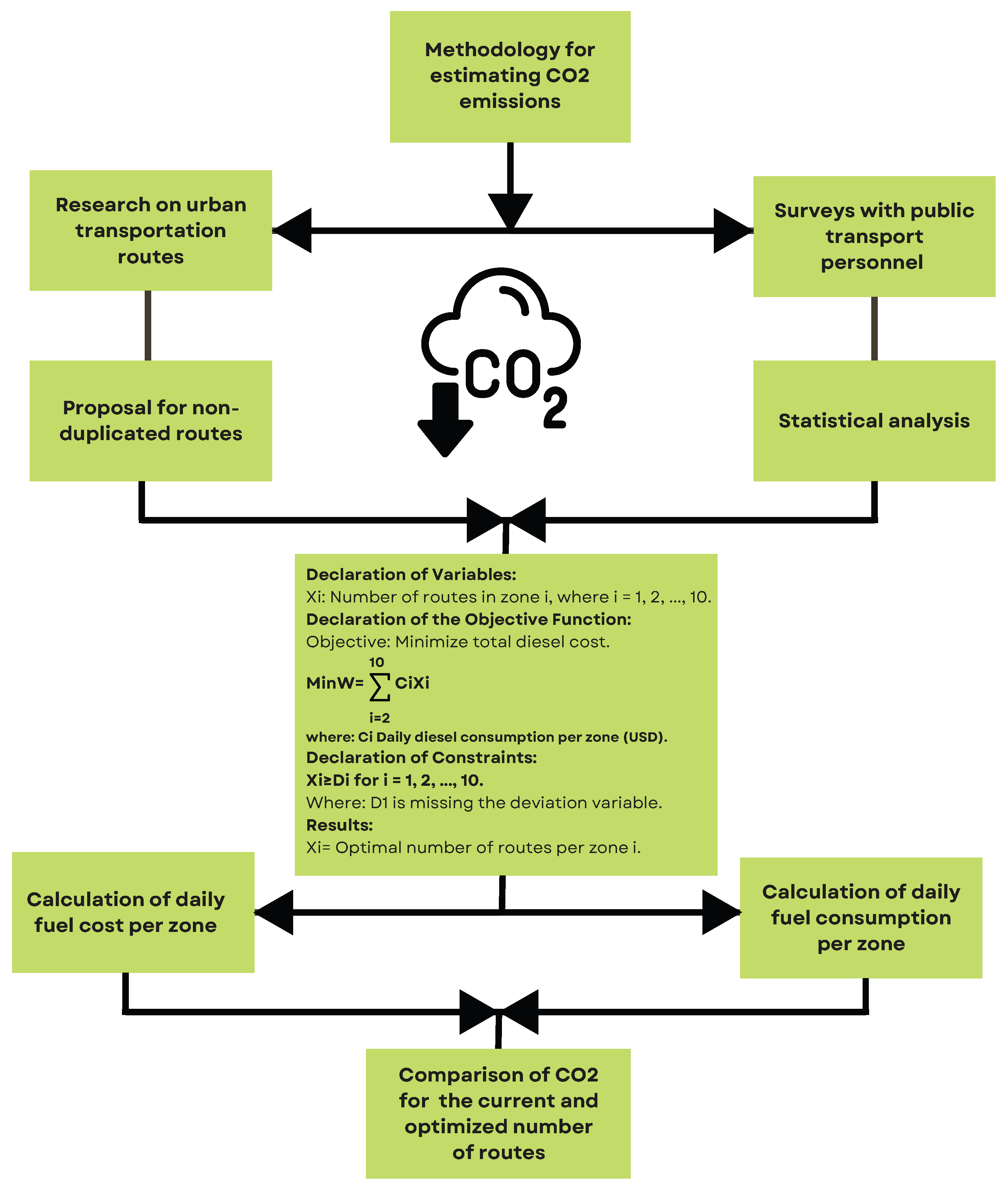
This study aimed to optimize the urban public transportation system in Queretaro, Mexico, while meeting passenger demand by using Linear Programming (LP) and Goal Programming (GP) models to reduce redundant routes, minimize fuel consumption and CO2 emissions, and balance costs with service coverage. Operational data from 316 drivers were collected on diesel consumption, working hours, and vehicle availability while incorporating twelve technical, labor, and regulatory constraints. The LP model reduced the number of routes from 148 to 124, achieving daily savings of 13,789 L of diesel, a reduction of 36,816 kg in CO2 emissions, and an economic benefit of USD 17,071.90, equivalent to 13,253 tons of CO2 avoided annually; these results demonstrate LP’s ability to deliver quantifiable improvements in efficiency and sustainability. The GP model integrated multiple and often conflicting objectives, such as maintaining a maximum fuel cost of USD 9312/day for 1944 buses distributed across five zones while ensuring a minimum coverage of 145 routes and 450,000 daily passengers, showing that it is possible to meet service targets with marginal cost overruns (USD 4118.66) when balancing both coverage and budget. The novelty of this paper lies in combining mathematical optimization models with real operational data and simultaneously reporting both economic and environmental impacts. This allows us to offer a replicable and highly interpretable tool with low computational cost for use in medium-sized cities seeking to align mobility planning with sustainability policies and operational efficiency.
Keywords: sustainable urban mobility; route optimization; linear programming; fuel saving; CO2 reduction; public transport operators; travel survey; urban sustainability sustainable urban mobility; route optimization; linear programming; fuel saving; CO2 reduction; public transport operators; travel survey; urban sustainability