


Abstract
Background/Objectives: Prepectoral direct-to-implant reconstruction is widely used, but implant rippling often necessitates lipofilling. This study aimed to identify preoperative and perioperative factors associated with delayed lipofilling. Methods: A retrospective cohort of consecutive patients who underwent immediate prepectoral implant reconstruction (April 2023–September 2024) was analyzed. Demographic data, BMI, smoking, comorbidities, oncologic treatments, surgical factors, and tumor location were recorded. Patients were divided according to whether delayed lipofilling was required. Univariate analysis was performed using Mann–Whitney U and Fisher’s exact tests. Results: Fifty-eight patients were included; approximately one-third required lipofilling. Patients who underwent lipofilling were younger and had lower BMI than those who did not. Tumor location was strongly associated with the outcome: upper inner quadrant tumors were consistently linked to delayed lipofilling, whereas upper outer quadrant tumors were more frequently observed in the group not requiring revision. Smoking history and planned radiotherapy showed nonsignificant trends toward higher lipofilling rates. No differences were found for diabetes or corticosteroid therapy. Conclusions: Younger age, low BMI, and tumor location, particularly in the upper inner quadrant, were key factors associated with delayed lipofilling after prepectoral reconstruction. These variables may support preoperative counseling and follow-up planning to better anticipate secondary procedures and optimize aesthetic outcomes.
1. Introduction
Breast cancer remains the most frequently diagnosed malignancy among women worldwide, accounting for almost one quarter of all new cancer cases and posing a major public-health challenge. In addition to the oncological burden, mastectomy can exert a profound psychosocial impact, affecting emotional well-being, body image, sexuality, and long-term quality of life [1,2].
Over the past two decades, implant-based reconstruction has become the most commonly chosen modality for restoring breast contour and volume after mastectomy [3,4]. Parallel advances in biomaterials and intra-operative imaging have encouraged a progressive shift from traditional submuscular implant placement to the immediate prepectoral direct-to-implant (DTI) technique [5,6,7]. Key enablers of this evolution include the introduction of acellular dermal matrices (ADMs) that provide implant support, polyurethane-coated implants that facilitate immediate prepectoral reconstruction, intra-operative fluorescence angiography (IFA) for real-time assessment of mastectomy-flap perfusion, and autologous fat grafting (lipofilling) for soft-tissue enhancement [8,9,10].
Compared with the submuscular approach, prepectoral DTI reconstruction offers several clinically relevant advantages [11,12]. These include the absence of animation deformity, preservation of pectoralis major function, reduced post-operative pain, the possibility of shorter recovery with earlier return to daily activities and potentially improved aesthetic outcomes due to a more natural breast contour. Collectively, these benefits translate into high levels of patient satisfaction when adequate soft-tissue coverage is present.
A persistent limitation of the prepectoral technique, however, is implant rippling, namely visible or palpable folds transmitted through the overlying skin envelope, which become most apparent when the patient is upright or leaning forward [13,14]. Reported incidences after augmentation or reconstruction vary widely, from 0% to 35%, and the condition frequently necessitates revisional surgery owing to aesthetic dissatisfaction [13,15,16]. Recognized predisposing factors include thin mastectomy flaps, low body-mass index, large implant volume relative to breast base width and the use of smooth-surface implants [17,18].
Autologous fat grafting has emerged as a versatile adjunct to mitigate rippling. Harvested adipose tissue is purified and injected in multiple planes to increase flap thickness, to obscure implant edges, and to improve global contour. A recent American Society of Plastic Surgeons survey indicated that 62% of members employ fat grafting in reconstructive cases specifically to camouflage implant borders or to optimize breast shape [19,20].
Because secondary lipofilling can add operative time, costs, and patient morbidity, the ability to predict which patients are at higher risk of requiring it is increasingly relevant. In this study, the term single-stage refers to the primary direct-to-implant reconstruction; delayed lipofilling was considered an optional aesthetic refinement during follow-up and was not performed prophylactically at the time of implant placement. Anticipating the need for this procedure would allow surgeons to individualize reconstructive plans, counsel patients more accurately, and allocate resources more efficiently. The present study, therefore, seeks to identify pre-operative and peri-operative variables predicting delayed lipofilling in prepectoral DTI reconstruction. By delineating these risk factors, we aimed to facilitate personalized surgical strategies and ultimately to enhance both clinical and patient-reported outcomes.
2. Materials and Methods
This study was conducted in accordance with the principles of the Declaration of Helsinki and followed the Strengthening the Reporting of Observational Studies in Epidemiology (STROBE) guidelines for observational research. Given the retrospective nature of the study and the use of anonymized data, formal ethical approval and informed consent were not required according to institutional guidelines for retrospective chart reviews.
2.1. Study Design and Population
A retrospective cohort study was performed analyzing all consecutive patients who underwent immediate prepectoral breast reconstruction following mastectomy at San Donato Hospital, Arezzo, Italy, between April 2023 and September 2024. Inclusion criteria comprised adult female patients (≥18 years) who underwent unilateral or bilateral mastectomy with immediate prepectoral implant-based reconstruction. Exclusion criteria included patients with incomplete medical records, those who underwent subpectoral reconstruction, delayed reconstruction, or autologous reconstruction techniques.
2.2. Data Collection
Patient data were systematically extracted from electronic medical records and included demographic characteristics, anthropometric measurements, medical comorbidities, oncological treatments, and tumor-related variables. Specifically, the following variables were collected: age at surgery, body weight, height, body mass index (BMI), smoking status (current, former, or never), diabetes mellitus, corticosteroid therapy, neoadjuvant chemotherapy, planned radiotherapy, tumor location, and laterality. The primary outcome variable was the need for delayed lipofilling, defined as any fat grafting procedure performed after the initial reconstruction to improve aesthetic outcomes, correct contour deformities attributable to implant rippling, or address volume deficiencies. Patients were categorized into two groups based on this outcome: Group 0 (no delayed lipofilling) and Group 1 (delayed lipofilling performed or planned).
2.3. Surgical Technique
All reconstructions were performed according to a standardized protocol with definitive implant placement in the pre-pectoral pocket, superficial to the pectoralis major. Reconstruction began immediately after completion of the mastectomy, once the oncologic surgeon had inspected skin-flap viability. The type of mastectomy incision (Wise pattern, S-shape, or inframammary fold access) was carefully chosen according to the degree of breast ptosis and the tumor location within the breast, as these factors strongly influence both the exposure required for oncological safety and the quality of the residual skin envelope. In particular, the Wise pattern was preferred in cases of significant ptosis to allow adequate resection and skin tailoring, while the S-shape incision provided versatile access for tumors in challenging quadrants. Conversely, an inframammary fold approach was favored in patients with minimal ptosis and favorable tumor positioning, as it maximized skin preservation and offered superior aesthetic outcomes by concealing the scar in a natural fold. The final decision on the incision type was always shared with the patient, taking into account her expectations and personal preferences, in order to align oncological safety with functional preservation and aesthetic goals. All operations were carried out by the same two-member team (board-certified plastic surgeon and breast surgical oncologist).
2.3.1. Step 1: Breast Reconstruction
The decision to proceed with immediate pre-pectoral direct-to-implant (DTI) reconstruction was based on the intra-operative assessment of mastectomy skin-flap perfusion by the oncologic team. Implant selection was guided by multiple factors, including the type of mastectomy performed, the patient’s anatomical characteristics and a detailed analysis of the contralateral breast morphology (base width, volume and overall shape) in order to achieve optimal symmetry. The implants used were either polyurethane-coated or microtextured implants wrapped with acellular dermal matrix to reinforce the lower pole and improve soft-tissue integration.
2.3.2. Step 2: Fat Grafting
At follow-up visits scheduled approximately at 6 months post-implant placement, the need for secondary volume enhancement was assessed. When indicated, structural fat grafting using the Coleman technique was performed to improve subcutaneous tissue thickness and optimize aesthetic outcomes [21]. This timing is crucial in order to guarantee the correct formation of a well-vascularized and defined recipient site that supports the viability of the transplanted adipose tissue. All donor sites (thigh, buttock and abdomen) were infiltrated with a tumescent solution [22]. After a latency period of about 20 min, fat was manually harvested using a 20 mL syringe connected to a 3 mm, 3-hole Mercedes-tip cannula. The syringes underwent a sedimentation process to separate and purify the adipose tissue in order to ensure that only high-quality fat was used for transfer. The purified fat was then injected subcutaneously using different types of cannulas, selected according to the clinical needs, in a layered and multidirectional manner, ensuring that skin turgor was maintained to preserve capillary perfusion. The fat grafts were placed in the plane between the skin and the implant capsule. All procedures were performed in a one-day admission setting. The indication for delayed lipofilling was established during follow-up visits based on clinically evident contour deformities attributable to implant rippling and/or volume asymmetries, together with patient-reported aesthetic dissatisfaction or discomfort. Rippling severity was recorded using the grading system described in Table 1 [13]. In our cohort, patients exhibiting grade 3 or 4 rippling were those who most frequently reported dissatisfaction and physical discomfort and, accordingly, most often met the clinical indication for secondary corrective procedures such as lipofilling.
Table 1.
Classification based on the clinical presentation of rippling [13].
2.4. Statistical Analysis
Continuous variables were summarized as medians and interquartile ranges and compared between groups using the Mann–Whitney U test. Categorical variables were reported as counts and percentages and compared using Fisher’s exact test. Odds ratios (ORs) with 95% confidence intervals (CIs) were calculated to quantify associations. In the presence of zero cells, a continuity correction of 0.5 was applied to allow OR estimation. Statistical significance was set at p < 0.05, while p-values between 0.05 and 0.10 were considered indicative of nonsignificant trends. Smoking status was dichotomized into current/former smokers versus never smokers.
3. Results
A total of 58 patients who underwent prepectoral breast reconstruction were included in the analysis. Based on the need for delayed lipofilling, patients were divided into two groups: Group 0 (no lipofilling required, n = 37, 63.8%) and Group 1 (lipofilling required, n = 21, 36.2%). Univariate analysis revealed several significant differences between the two groups.
Patients requiring delayed lipofilling were significantly younger at the time of surgery compared to those who did not require lipofilling (median age 50.5 years, IQR 46.8–60.25 vs. 63.0 years, IQR 58.0–72.0; p = 0.001). Similarly, patients in the lipofilling group had significantly lower body mass index (BMI) values (median 22.0 kg/m2, IQR 20.7–23.0 vs. 25.7 kg/m2, IQR 23.9–28.2; p < 0.001). Notably, no patient requiring lipofilling had a BMI greater than 28 kg/m2, whereas 27% (10/37) of patients in the no-lipofilling group had a BMI above this value.
Regarding oncological treatments, patients requiring lipofilling showed a trend toward higher rates of planned radiotherapy (24% vs. 5%, p = 0.086, OR 5.47, 95% CI 0.96–31.26), although this difference did not reach statistical significance. Similarly, neoadjuvant chemotherapy was more frequent in the lipofilling group, though not significantly (29% vs. 14%, p = 0.181, OR 2.56, 95% CI 0.67–9.74).
Smoking history (current or former smokers) showed a notable difference between groups, with 52% (11/21) of patients requiring lipofilling having a smoking history compared to 27% (10/37) of those not requiring lipofilling, though this difference approached but did not reach statistical significance (p = 0.087, OR 2.97, 95% CI 0.97–9.12).
No significant differences were observed between groups regarding diabetes mellitus (0% vs. 3%, p = 1.000, OR 0.57, 95% CI 0.02–14.52) or cortisone therapy (19% vs. 14%, p = 0.710, OR 1.51, 95% CI 0.36–6.36). The low prevalence of diabetes in both groups limited the statistical power for this comparison.
Tumor location analysis revealed significant associations with the need for delayed lipofilling. The upper outer quadrant (UOQ) showed a strong association with patients not requiring lipofilling, with 85% (11/13) of UOQ tumors occurring in Group 0 compared to only 15% (2/13) in Group 1 (p = 0.001, OR 30.25, 95% CI 3.59–254.74). Conversely, the upper inner quadrant (UIQ) demonstrated a complete separation between groups, with all UIQ tumors (7/7, 100%) occurring exclusively in patients requiring lipofilling (Group 1), while no UIQ tumors were observed in Group 0 (0/7, 0%) (p < 0.001, OR 0.00, 95% CI 0.00–0.25). The lower inner quadrant (LIQ) showed a non-significant trend, with 62% (13/21) of tumors in Group 0 versus 38% (8/21) in Group 1 (p = 0.217, OR 2.64, 95% CI 0.76–9.18). Central tumor location showed no significant difference between groups, with 43% (3/7) in Group 0 and 57% (4/7) in Group 1 (p = 1.000, OR 0.56, 95% CI 0.07–4.67) (Table 2).
Table 2.
Univariate analysis of factors associated with delayed lipofilling.
These findings suggest that younger age, lower BMI, tumor location in the upper inner quadrant, and potentially smoking history and radiotherapy planning may be associated with an increased likelihood of requiring delayed lipofilling following prepectoral breast reconstruction. The strong association between UIQ tumors and the need for lipofilling, along with the protective effect of UOQ location, indicates that tumor quadrant represents a significant predictor for delayed lipofilling requirements in prepectoral breast reconstruction.
4. Discussion
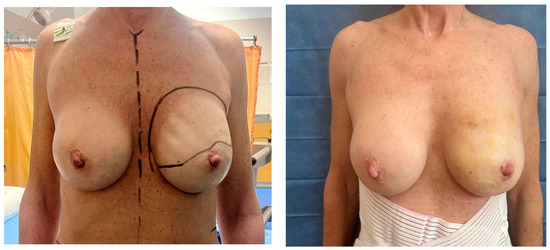
The results in our study indicate that specific patient characteristics may influence the need for delayed lipofilling following prepectoral breast reconstruction (Figure 1). Although some of these associations may be clinically expected, their quantification may still support preoperative counseling and follow-up planning.
Figure 1.
A 45-year-old patient after a nipple-sparing mastectomy for invasive carcinoma of the left breast after immediate prepectoral DTI ((left) rippling in the upper inner quadrants 6 months post-surgery; (right) postoperative appearance 2 weeks after lipofilling surgery).
Notably, younger patients and those with low BMI were significantly more likely to undergo lipofilling, suggesting that reduced subcutaneous tissue reserves and possibly higher aesthetics expectations in younger patients may be associated with an increased demand or clinical indication for secondary volume augmentation. The absence of patients with BMI > 28 kg/m2 who required lipofilling further supports that higher adipose tissue availability may reduce the subsequent necessity of fat grafting. Additionally, tumor location appeared to influence the incidence of rippling: tumors located in the upper-inner quadrants (QSI) were more frequently associated with post-operative contour deformities. Although not statistically significant, both a history of smoking and radiotherapy showed a trend toward association with the need for delayed lipofilling. No notable differences were found regarding diabetes or corticosteroid use.
In our cohort, younger patients were significantly more likely to require delayed lipofilling following prepectoral breast reconstruction, with a median age of 50.5 years compared to 63 years in those who did not undergo secondary procedures (p = 0.001). While advanced age is not generally considered a contraindication for implant-based reconstruction [23], age-related differences in aesthetic expectations may partially explain this finding. Furthermore, increased skin elasticity in younger patients could make minor volume deficits or implant edges more apparent [24], resulting in a higher perceived or actual need for secondary volume enhancement through lipofilling.
Body mass index (BMI) was another factor significantly associated with the need for delayed lipofilling. Patients who underwent delayed lipofilling had a significantly lower median BMI (22.0 kg/m2) compared to those who did not (25.7 kg/m2; p < 0.001). In this cohort, 28 kg/m2 represented the highest BMI observed among patients who underwent delayed lipofilling. These findings align with the existing literature [25], suggesting that patients with a higher BMI generally possess a thicker layer of subcutaneous fat, which may be able to give a better cover to the implant and minimize minor surface irregularities. In contrast, thinner patients tend to have reduced soft tissue coverage, which can result in a more prominent visibility of implant edges or surface irregularities such as rippling. While higher BMI may offer this anatomical advantage, it must be noted that obesity is independently associated with a greater risk of surgical complications, including fat necrosis, delayed wound healing and flap edges necrosis [26].
Our study found a significant association between tumor location and the need for delayed lipofilling, highlighting the tumor’s anatomical quadrant as a key predictive factor in surgical planning. Notably, all tumors in the upper inner quadrant (100%) were linked to delayed lipofilling (p < 0.001). Anatomically, the upper inner quadrant (UIQ) has thinner skin, less subcutaneous tissue, and reduced vascularity, especially near the sternum, making implant coverage more difficult and increasing the risk of rippling—particularly in patients with low BMI. Tumors in the upper outer quadrant (UOQ) were mostly found in patients not requiring lipofilling (85%), likely due to better soft tissue coverage from the pectoral and axillary fat pad, which improves implant concealment. The lower inner quadrant (LIQ) showed a non-significant trend toward more cases in the non-lipofilling group (62% vs. 38%, p = 0.217), while central tumors showed no difference between groups (43% vs. 57%, p = 1.000).
To date, no robust studies have established a clear link between tumor location and rippling incidence. In this context, our results further reinforce the idea that tumor location, particularly in the upper inner quadrant, is a critical anatomical predictor of the need for delayed lipofilling after prepectoral breast reconstruction, and their consideration in surgical planning may improve patient selection and aesthetic outcomes.
Although not statistically significant in our study (p = 0.087), over half of the patients who required delayed lipofilling had a history of smoking (52%), compared to only 27% among those who did not require additional fat grafting. This trend is consistent with the physiological and clinical evidence that smoking negatively affects reconstructive outcomes by compromising the mastectomy flap quality [27]. Smoking, in fact, compromises microvascular perfusion, leading to a thinner and less viable mastectomy flap, increasing the risk of implant visibility and rippling. Ultimately, although our study did not reach statistical significance, the observed trend aligns with similar findings reported in the literature [18], reinforcing the idea that smoking is a relevant contributing factor to the need for delayed lipofilling in prepectoral breast reconstruction. Preoperative smoking cessation, individualized planning, and hybrid strategies should be considered to optimize outcomes in this population.
In our cohort, patients who underwent radiotherapy showed a clear trend toward a higher incidence of delayed lipofilling, despite a lack of statistical significance (24% vs. 5%, p = 0.086). This observation aligns with the existing literature, which has extensively documented the impact of radiotherapy on soft tissue integrity (particularly relevant in prepectoral reconstruction, where flap thickness and elasticity are crucial for aesthetic outcomes). Ionizing radiation is known to induce chronic tissue remodeling characterized by fibrosis, reduced vascular density, dermal atrophy and impaired wound healing capacity. These histopathological changes compromise the thickness and elasticity of the mastectomy flap, increasing the risk of contour deformities and rippling, necessitating secondary restoration through fat grafting [28,29]. In this contest, delayed lipofilling serves not only as a volumetric correction but also as a regenerative intervention, as adipose-stem cells within the grafted fat have been shown to improve dermal quality and vascularity [30].
Therefore, even though the association between radiotherapy and lipofilling did not reach statistical significance in our cohort, likely due to sample size limitations, the known biological impact of radiotherapy and the supporting clinical evidence indicate that it should be taken into careful account during preoperative planning.
No significant difference was observed between groups regarding the presence of diabetes mellitus or the use of corticosteroid therapy. Specifically, diabetes was absent in the lipofilling group and present in only 3% of patients in the non-lipofilling group, while corticosteroid use was reported in 19% of patients requiring lipofilling and 14% of those who did not (p = 0.710). Although both conditions are associated with increased complication rates in reconstructive surgery [31], their low prevalence in our cohort limits the statistical power to make definitive conclusions. Further studies with larger sample sizes may help clarify their potential impact on secondary volume restoration procedures.
Limitations and Future Directions
This study presents several limitations that should be acknowledged. First, the relatively small sample size (58 patients) limits the generalizability of the findings and reduces the statistical power. Second, important patient-related variables such as ethnicity, race and genetic background were not recorded or considered, despite their potential influence on soft tissue characteristics, healing capacity and aesthetic outcomes. Additionally, the study was retrospective and single-center, which may introduce selection bias and limit external validity, as surgical techniques, perioperative management, and postoperative follow-up protocols may vary across institutions. Accordingly, the reported relationships should be interpreted as associations and hypothesis-generating signals rather than evidence of causality or externally validated predictors. Future directions should focus on developing personalized and risk-adapted strategies for pre-pectoral breast reconstruction, combining clinical, anatomical and patient-specific factors (BMI, tumor location, age, tissue quality) to guide surgical planning and to anticipate the need for secondary interventions. Multicenter studies with larger and more diverse populations are needed to validate these findings and better define predictive factors for delayed lipofilling.
5. Conclusions
Implant rippling is a common concern in patients undergoing direct-to-implant breast reconstruction and warrants careful consideration. This study identifies multiple predictive factors linked to the subsequent necessity for delayed lipofilling, notably including younger patient age, lower body mass index (BMI), and specific tumor location. Although the study is limited by a relatively small sample size and a lack of demographic diversity, the results provide important insights that can inform more individualized reconstructive strategies. Looking ahead, adopting a personalized approach will be crucial to optimizing surgical outcomes and minimizing the incidence of unplanned secondary interventions.
Author Contributions
Conceptualization, M.F. and G.M.; methodology, G.M. and D.M.P.; software, R.C.; validation, M.F., G.M., C.C. and D.M.P.; formal analysis, G.M.; investigation, C.C. and D.M.P.; resources, M.F.; data curation, D.M.P.; writing—original draft preparation, G.M.; writing—review and editing, M.F., C.C., R.C. and D.M.P.; visualization, D.M.P.; supervision, M.F.; project administration, G.M.; funding acquisition, M.F. All authors have read and agreed to the published version of the manuscript.
Funding
This research received no external funding.
Institutional Review Board Statement
Approval for this study was not required in accordance with national and institutional guidelines for retrospective observational studies based on anonymized data collected during routine clinical practice in Italy.
Informed Consent Statement
Patient consent was waived due to the retrospective design of the study and the use of anonymized data collected during routine clinical practice. Written informed consent has been obtained from the patient to publish this paper.
Data Availability Statement
The data presented in this study are available on request from the corresponding author. The data are not publicly available due to privacy and ethical restrictions.
Conflicts of Interest
The authors declare no conflict of interest.
Abbreviations
The following abbreviations are used in this manuscript:
| BMI | Body Mass Index |
| DTI | Direct-to-Implant |
| UIQ | Upper Inner Quadrant |
References
- Xiong, X.; Zheng, L.W.; Ding, Y.; Chen, Y.F.; Cai, Y.W.; Wang, L.P.; Huang, L.; Liu, C.C.; Shao, Z.M.; Yu, K.D. Breast cancer: Pathogenesis and treatments. Signal Transduct. Target. Ther. 2025, 10, 49. [Google Scholar] [CrossRef] [Scilit] [PubMed] [PubMed Central]
- Breastcancer Org. Breast Cancer Facts and Statistics. Available online: https://www.breastcancer.org/facts-statistics (accessed on 15 September 2025).
- Albornoz, C.R.; Bach, P.B.; Mehrara, B.J.; Disa, J.J.; Pusic, A.L.; McCarthy, C.M.; Cordeiro, P.G.; Matros, E. A paradigm shift in U.S. Breast reconstruction: Increasing implant rates. Plast. Reconstr. Surg. 2013, 131, 15–23. [Google Scholar] [CrossRef] [Scilit] [PubMed]
- Ilonzo, N.; Tsang, A.; Tsantes, S.; Estabrook, A.; Thu Ma, A.M. Breast reconstruction after mastectomy: A ten-year analysis of trends and immediate postoperative outcomes. Breast 2017, 32, 7–12. [Google Scholar] [CrossRef] [Scilit] [PubMed]
- Frey, J.D.; Salibian, A.A.; Levine, J.P.; Karp, N.S.; Choi, M. Evolution of the Surgical Technique for “Breast in a Day” Direct-to-Implant Breast Reconstruction: Transitioning from Dual-Plane to Prepectoral Implant Placement. Plast. Reconstr. Surg. 2020, 145, 647e–648e. [Google Scholar] [CrossRef] [Scilit] [PubMed]
- Highton, L.; Johnson, R.; Kirwan, C.; Murphy, J. Prepectoral Implant-Based Breast Reconstruction. Plast. Reconstr. Surg. Glob. Open 2017, 5, e1488. [Google Scholar] [CrossRef] [Scilit] [PubMed] [PubMed Central]
- Sbitany, H.; Piper, M.; Lentz, R. Prepectoral Breast Reconstruction: A Safe Alternative to Submuscular Prosthetic Reconstruction following Nipple-Sparing Mastectomy. Plast. Reconstr. Surg. 2017, 140, 432–443. [Google Scholar] [CrossRef] [Scilit] [PubMed]
- Clemens, M.W.; Kronowitz, S.J. Acellular dermal matrix in irradiated tissue expander/implant-based breast reconstruction: Evidence-based review. Plast. Reconstr. Surg. 2012, 130, 27S–34S. [Google Scholar] [CrossRef] [Scilit] [PubMed]
- Komorowska-Timek, E.; Gurtner, G.C. Intraoperative perfusion mapping with laser-assisted indocyanine green imaging can predict and prevent complications in immediate breast reconstruction. Plast. Reconstr. Surg. 2010, 125, 1065–1073. [Google Scholar] [CrossRef] [Scilit] [PubMed]
- Newman, M.I.; Samson, M.C.; Tamburrino, J.F.; Swartz, K.A. Intraoperative laser-assisted indocyanine green angiography for the evaluation of mastectomy flaps in immediate breast reconstruction. J. Reconstr. Microsurg. 2010, 26, 487–492. [Google Scholar] [CrossRef] [Scilit] [PubMed]
- Colwell, A.S.; Taylor, E.M. Recent Advances in Implant-Based Breast Reconstruction. Plast. Reconstr. Surg. 2020, 145, 421e–432e. [Google Scholar] [CrossRef] [Scilit] [PubMed]
- Nahabedian, M.Y.; Cocilovo, C. Two-Stage Prosthetic Breast Reconstruction: A Comparison Between Prepectoral and Partial Subpectoral Techniques. Plast. Reconstr. Surg. 2017, 140, 22S–30S. [Google Scholar] [CrossRef] [Scilit] [PubMed]
- Vidya, R.; Iqbal, F.M.; Becker, H.; Zhadan, O. Rippling Associated with Pre-Pectoral Implant Based Breast Reconstruction: A New Grading System. World J. Plast. Surg. 2019, 8, 311–315. [Google Scholar] [CrossRef] [Scilit] [PubMed] [PubMed Central]
- Busse, B.; Orbay, H.; Sahar, D.E. Sterile acellular dermal collagen as a treatment for rippling deformity of breast. Case Rep. Surg. 2014, 2014, 876254. [Google Scholar] [CrossRef] [Scilit] [PubMed] [PubMed Central]
- Tevlin, R.; Sharma, A.D.; Griffin, M.; Wan, D.; Momeni, A. Technical Tips to Reduce Implant Rippling in Staged Pre-pectoral Breast Reconstruction. Aesthetic Plast. Surg. 2023, 47, 2351–2359. [Google Scholar] [CrossRef] [Scilit] [PubMed]
- Wu, Y.; Yu, L.; Huang, M.; Huang, Y.; Li, C.; Liang, Y.; Liang, W.; Qin, T. Comparative complications of prepectoral versus subpectoral breast reconstruction in patients with breast cancer: A meta-analysis. Front. Oncol. 2024, 14, 1439293. [Google Scholar] [CrossRef] [Scilit] [PubMed Central]
- Parikh, N.; Gadiraju, G.K.; Prospero, M.; Shen, Y.; Starr, B.F.; Reiche, E.; Hyland, C.J.; Karinja, S.J.; Broyles, J.M. The Impact of Breast Implant Cohesivity on Rippling and Revision Procedures in 2-Stage Prepectoral Breast Reconstruction. Aesthetic Surg. J. Open Forum 2024, 6, ojae028. [Google Scholar] [CrossRef] [Scilit] [PubMed] [PubMed Central]
- Ryu, D.H.; Joo, O.Y.; Roh, Y.H.; Yang, E.J.; Song, S.Y.; Lee, D.W. Associated Factors and Prevention of Upper Pole Rippling in Prepectoral Direct-to-Implant Breast Reconstruction. Arch. Plast. Surg. 2023, 50, 541–549. [Google Scholar] [CrossRef] [Scilit] [PubMed] [PubMed Central]
- Pantelides, N.M.; Srinivasan, J.R. Rippling Following Breast Augmentation or Reconstruction: Aetiology, Emerging Treatment Options and a Novel Classification of Severity. Aesthetic Plast. Surg. 2018, 42, 980–985. [Google Scholar] [CrossRef] [Scilit] [PubMed]
- Kling, R.E.; Mehrara, B.J.; Pusic, A.L.; Young, V.L.; Hume, K.M.; Crotty, C.A.; Rubin, J.P. Trends in autologous fat grafting to the breast: A national survey of the american society of plastic surgeons. Plast. Reconstr. Surg. 2013, 132, 35–46. [Google Scholar] [CrossRef] [Scilit] [PubMed]
- Coleman, S.R. Structural fat grafts: The ideal filler? Clin. Plast. Surg. 2001, 28, 111–119. [Google Scholar] [CrossRef] [Scilit] [PubMed]
- Klein, J.A. The tumescent technique. Anesthesia and modified liposuction technique. Dermatol. Clin. 1990, 8, 425–437. [Google Scholar] [CrossRef] [Scilit] [PubMed]
- Martin Del Yerro, J.L.; Bengoa, S.D. Single-Center, Long-Term Experience with Mentor Contour Profile Gel Implants: What Can We Learn after 21 Years of Follow-Up? Plast. Reconstr. Surg. 2024, 154, 942–953. [Google Scholar] [CrossRef] [Scilit] [PubMed]
- Levakov, A.; Vucković, N.; Dolai, M.; Kaćanski, M.M.; Bozanić, S. Age-related skin changes. Med. Pregl. 2012, 65, 191–195. [Google Scholar] [CrossRef] [Scilit] [PubMed]
- Gabriel, A.; Sigalove, S.; Sigalove, N.M.; Storm-Dickerson, T.L.; Pope, N.; Rice, J.; Maxwell, G.P. Effect of Body Mass Index on Outcomes after Prepectoral Breast Reconstruction. Plast. Reconstr. Surg. 2019, 144, 550–558. [Google Scholar] [CrossRef] [Scilit] [PubMed]
- Leitner, H.S.; Pauzenberger, R.; Ederer, I.A.; Radtke, C.; Hacker, S. BMI Specific Complications Following Implant-Based Breast Reconstruction after Mastectomy. J. Clin. Med. 2021, 10, 5665. [Google Scholar] [CrossRef] [Scilit] [PubMed Central]
- Sørensen, L.T.; Hørby, J.; Friis, E.; Pilsgaard, B.; Jørgensen, T. Smoking as a risk factor for wound healing and infection in breast cancer surgery. Eur. J. Surg. Oncol. 2002, 28, 815–820, Erratum in Eur. J. Surg. Oncol. 2003, 29, 482. [Google Scholar] [CrossRef] [Scilit] [PubMed]
- Senkus-Konefka, E.; Jassem, J. Complications of breast-cancer radiotherapy. Clin. Oncol. 2006, 18, 229–235. [Google Scholar] [CrossRef] [Scilit] [PubMed]
- Kuske, R.R.; Schuster, R.; Klein, E.; Young, L.; Perez, C.A.; Fineberg, B. Radiotherapy and breast reconstruction: Clinical results and dosimetry. Int. J. Radiat. Oncol. Biol. Phys. 1991, 21, 339–346. [Google Scholar] [CrossRef] [Scilit] [PubMed]
- Tang, H.; He, Y.; Liang, Z.; Li, J.; Dong, Z.; Liao, Y. The therapeutic effect of adipose-derived stem cells on soft tissue injury after radiotherapy and their value for breast reconstruction. Stem Cell Res. Ther. 2022, 13, 493. [Google Scholar] [CrossRef] [Scilit] [PubMed] [PubMed Central]
- Mortada, H.; Alwadai, A.; Bamakhrama, B.; Alsinan, T.; Hanawi, M.D.; Alfaryan, S.M.; Obeid, F.M.; Arab, K. The Impact of Diabetes Mellitus on Breast Reconstruction Outcomes and Complications: A Systematic Literature Review and Meta-analysis. Aesthetic Plast. Surg. 2023, 47, 570–583. [Google Scholar] [CrossRef] [Scilit] [PubMed]

Disclaimer/Publisher’s Note: The statements, opinions and data contained in all publications are solely those of the individual author(s) and contributor(s) and not of MDPI and/or the editor(s). MDPI and/or the editor(s) disclaim responsibility for any injury to people or property resulting from any ideas, methods, instructions or products referred to in the content. |
© 2026 by the authors. Licensee MDPI, Basel, Switzerland. This article is an open access article distributed under the terms and conditions of the Creative Commons Attribution (CC BY) license.