
You are currently viewing a new version of our website. To view the old version click .
Telecom
  • Feature Paper
  • Article
  • Open Access

8 December 2025

Random Access Resource Configuration for LEO Satellite Communication Systems Based on TDD
,
,
,
and
1
National Mobile Communications Research Laboratory, Southeast University, Nanjing 210096, China
2
China Mobile Research Institute, Beijing 100032, China
*
Author to whom correspondence should be addressed.

Abstract

Time division duplexing (TDD) technology holds great promise for future satellite communication systems. To address the interference and low resource utilization encountered in satellite TDD scenarios, this paper proposes a flexible and on-demand frame structure, where the interference can be mitigated by scheduling the UE transmissions instead of configuring a long guard period (GP). Based on the frame structure, the interference between downlink broadcasting signals and preambles is analyzed, followed by formulating a random access channel (RACH) occasion (RO) configuration optimization problem that aims to maximize the RO utilization, and a structured global candidate exploration algorithm (SGCEA) is proposed to solve it. Some simulation experiments are carried out based on the practical configurations from the third-generation partnership project (3GPP)standards. Simulation results show that the proposed algorithm consistently identifies the optimal RO configuration from the predefined configurations, and the utilization remains above 80% as the satellite coverage area increases, which demonstrates the superior performance of the proposed approach and highlights its potential for practical deployment in future TDD-based satellite communication systems.

1. Introduction

To fulfill the provision of ubiquitous connection, the third-generation partnership project (3GPP) has proposed non-terrestrial network (NTN) solutions based on 5G standards [1,2], which utilize satellites to provide communication service in remote, underserved areas. The time division duplex (TDD) mode can flexibly support asymmetric transmission and simplify radio frequency circuitry [3], making it a promising technology for future satellite communication networks. However, the long propagation delay may cause severe interference, posing challenges to the adoption of TDD in satellite communication systems [4].
Random access (RA) is a necessary step for user equipment (UE) to access the network. To improve the random access channel (RACH) procedure, ref. [5] jointly optimized multiple RACH schemes, including the access class barring, back-off, and distributed queuing schemes. Ref. [6] proposes an efficient multiple access scheme that allocates resources between a physical random access channel (PRACH) and physical uplink shared channel based on PRACH traffic load estimation, thereby improving spectral efficiency. However, due to significant differences between satellite and terrestrial channel conditions, many components in RA, such as preamble design and timing advance (TA), will be affected [7,8]; thus, existing RA techniques cannot be directly adopted for low earth orbit (LEO) satellite communication systems [9,10,11]. In particular, under the TDD mode, the transmission of various broadcast and control information leads to complex interference conditions, necessitating the development of efficient RACH occasion (RO) allocation schemes.
For terrestrial systems, extensive studies have focused on the cross-link interference (CLI) in dynamic TDD scenarios. Ref. [12] analyzed the characteristics of CLI and proposed an aligned reverse frame structure to utilize and mitigate interference. An interference suppression scheme was proposed in [13] by designing advanced receivers and a corresponding interference measurement scheme, which effectively improved system performance. Ref. [14] proposed beamforming methods to reduce the CLI while minimizing the transmit power. Ref. [15] proposed a hybrid proactive–reactive interference mitigation framework, which prevents the occurrence of interference and minimizes the inevitable interference simultaneously. In satellite scenarios, studies mainly focused on frame structure design under interference conditions. An extended frame structure was proposed to improve the low efficiency of resource utilization caused by a long guard period (GP) [16]. Ref. [17] proposed to utilize the GP for downlink transmission under interference-free conditions, thereby further reducing overhead.
Several studies have focused on RA technologies in LEO satellite networks. To improve RA efficiency, ref. [18] proposed a systematic method including preamble structure modification and TA compensation for differential delay. Aiming to reduce collision probability and RA delay, ref. [19] proposed an optimized RACH framework, which integrates adaptive preamble allocation, beam-aware RACH planning, and predictive backoff. Ref. [20] proposed a pipelined beam hopping scheme for signaling beams and service beams, where the service beam illuminates the beam position when the preamble is detected through the signaling beam to complete the RA procedure, thereby reducing the overall RA latency. Ref. [21] proposed a RA congestion control strategy incorporating load prediction and satellite beam-hopping management. Ref. [22] designed a sensing and communication-aided RA architecture, which dynamically allocates bandwidth resources based on the number of intra-cluster-active UEs. For non-uniform RA traffic demands in non-geostationary orbit satellite networks, ref. [23] proposed an adaptive access control and resource allocation scheme to maximize average RA efficiency. For the TDD scenario, ref. [24] adopts an extended frame structure and proposes two solutions for downlink synchronization and RA timing design, but the overall system efficiency is relatively low due to the frame overhead. In addition, approaches have been proposed in [25,26] to address the propagation delay of preambles. For UEs equipped with a global navigation satellite system (GNSS), ref. [25] proposed to apply frame- and subframe-level offsets on the UE side while retaining a sample-level TA mechanism, to transmit the preamble in advance so that it arrives at pre-configured ROs. Ref. [26] considered UEs with and without GNSS, proposing three coexistence schemes between pre-configured ROs and preamble receiving windows to mitigate preamble contention between these two types of UEs.
Existing RA studies mainly focus on terrestrial systems or frequency division duplex-based satellite systems, making them unsuitable for satellite TDD scenarios due to distinct uplink–downlink interference characteristics and the inability to mitigate TDD-specific interference. Current approaches for TDD-based satellite communication systems typically rely on extending the frame or GP length, which significantly reduces resource efficiency. Moreover, RO temporal allocation under 3GPP RO configurations remains unexplored, underscoring the need for an efficient and 3GPP-compliant RO allocation scheme for satellite TDD communication. To address the above issues, this paper investigates the RO configuration in LEO satellite communication systems based on TDD. The main contributions of this paper are summarized as follows:
  • To address the reduced resource utilization in TDD-based LEO satellite communication systems, we propose a flexible and on-demand frame structure, where the slots allocated to UE can be scheduled flexibly and on demand without being constrained by the 5G frame structure, as long as the interference-free requirement is met. Therefore, the GPs can be removed from the frame structure of the base station (BS), thereby maximizing system resource utilization.
  • We formulate, for the first time, an RO allocation optimization problem that considers resource utilization in a TDD-based satellite RA scenario. Under the constraint of avoiding interference with the BS’s downlink broadcast signals, the proposed optimization algorithm selects the RO configuration with the highest utilization.
The structure of this paper is as follows: Section 2 introduces the downlink signals used in the synchronization process and the RO configuration for the RA procedure. Section 3 describes the system model and formulates the corresponding optimization problem. Section 4 presents the solution to the optimization problem. Section 5 constructs a simulation scenario and evaluates the performance of the proposed scheme. Finally, Section 6 summarizes the work and outlines future research directions. The main variables used in this paper are listed in Table 1 for easy reference.
Table 1. Variable list.
For clarity in the subsequent discussion, notations used in this paper are defined as follows: LCM ( x 1 , x 2 , , x n ) denotes the least common multiple of the integers x 1 , x 2 , , x n , and  x denotes rounding the real number x up to the nearest integer, while card T denotes the cardinality of the set T .

2. Synchronization and RA Procedure

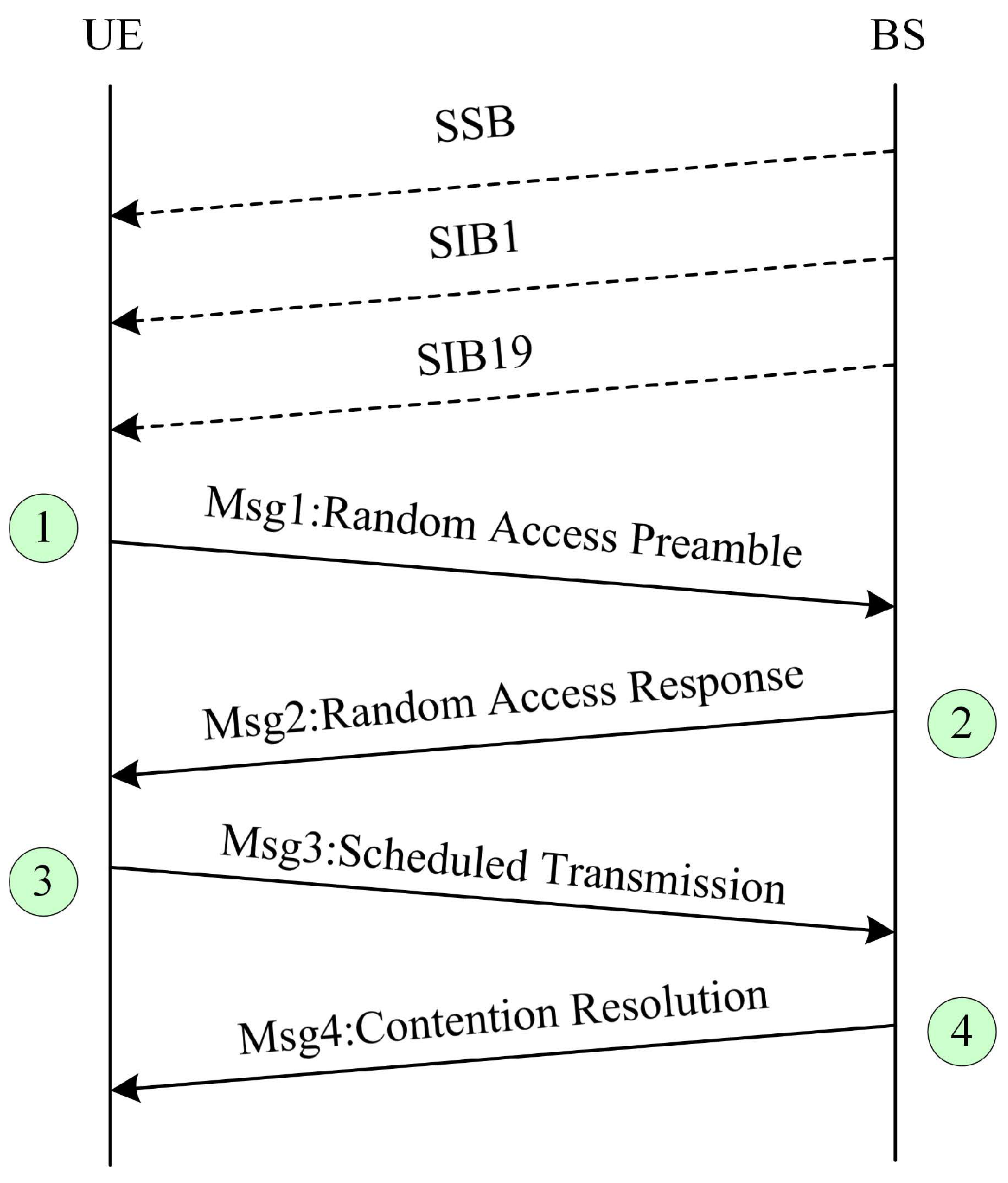
In satellite communication scenarios, a UE should successfully acquire the synchronization signal block (SSB) and necessary system information blocks (SIBs), such as SIB1 and SIB19, before initiating the RA procedure. The overall synchronization and RA procedures are shown in Figure 1, where the contention-based RA procedure consists of the following four steps: 
Figure 1. Synchronization and RA procedures in satellite communication systems.
  • The UE transmits a preamble on the PRACH, enabling the BS to estimate the propagation delay between them.
  • After detecting the preamble, the BS returns a random access response (RAR) containing TA, power control command, and the uplink resources for transmitting Msg3. The UE attempts to detect the RAR within a configured window.
  • The UE achieves uplink synchronization based on the TA and transmits Msg3 using the UL grant scheduled in the RAR. Msg3 carries the UE’s unique identifier.
  • The BS transmits Msg4 on the physical downlink shared channel, which carries the contention resolution information. The UE completes the RA procedure successfully once it detects that the identification in Msg4 matches its own.

2.1. Overview of SSB and SIB

This subsection provides an overview of the SSB and SIBs, highlighting their fundamental roles and transmission mechanisms, which form the basis for the subsequent interference analysis.

2.1.1. SSB Overview

SSB contains synchronization signals for downlink synchronization and parameters for acquiring SIB1. The BS transmits multiple SSBs within a half-frame, forming a synchronization signal burst set (SS burst set), which is transmitted periodically with a period T SSB . The maximum number of SSBs within an SS burst set depends on the operating frequency band, and each SSB serves a different beam position. For beam hopping satellites, each beam can be independently configured with an SS burst set. When two beams do not illuminate adjacent beam positions simultaneously, it is feasible to configure them with the same SS burst set.

2.1.2. SIB1 Overview

SIB1 provides essential information for UEs to access the network, such as resource configuration of the PRACH, preamble sequence parameters, and scheduling information for other system information (OSI). SIB1 is transmitted with a period of 160 ms, during which it can be transmitted repeatedly, and the actual transmission repetition period T SIB 1 depends on its multiplexing with the SSB and network implementation [27].

2.1.3. SIB19 Overview

SIB19, introduced by 3GPP in Release 17, provides UEs with essential satellite-specific information, such as ephemeris data and TA parameters, to assist UEs in accessing the satellite network [27]. SIB19 is carried in system information (SI) messages with a period T SIB 19 . The monitoring occasions of SIB19 within the SI window are indicated by the search space configuration of OSI.

2.2. RO Configuration in RA

In the RA procedure, a UE transmits the preamble on specific time–frequency resources, referred to as ROs. 3GPP provides RO configuration tables applicable to different frequency bands and duplexing modes [28], specifying the RO period T RO and its positions within each period. For LEO satellite communication systems, due to the large propagation delay, a proper RO configuration is necessary to ensure that all UEs within the satellite coverage can complete RA in TDD mode.

3. System Model and Problem Formulation

In this paper, we focus on determining the RO configuration in TDD-based LEO satellite communication systems. This section will first introduce the system model, then analyze the interference issues in RO configuration, followed by formulating the RO configuration optimization problem.

3.1. System Model

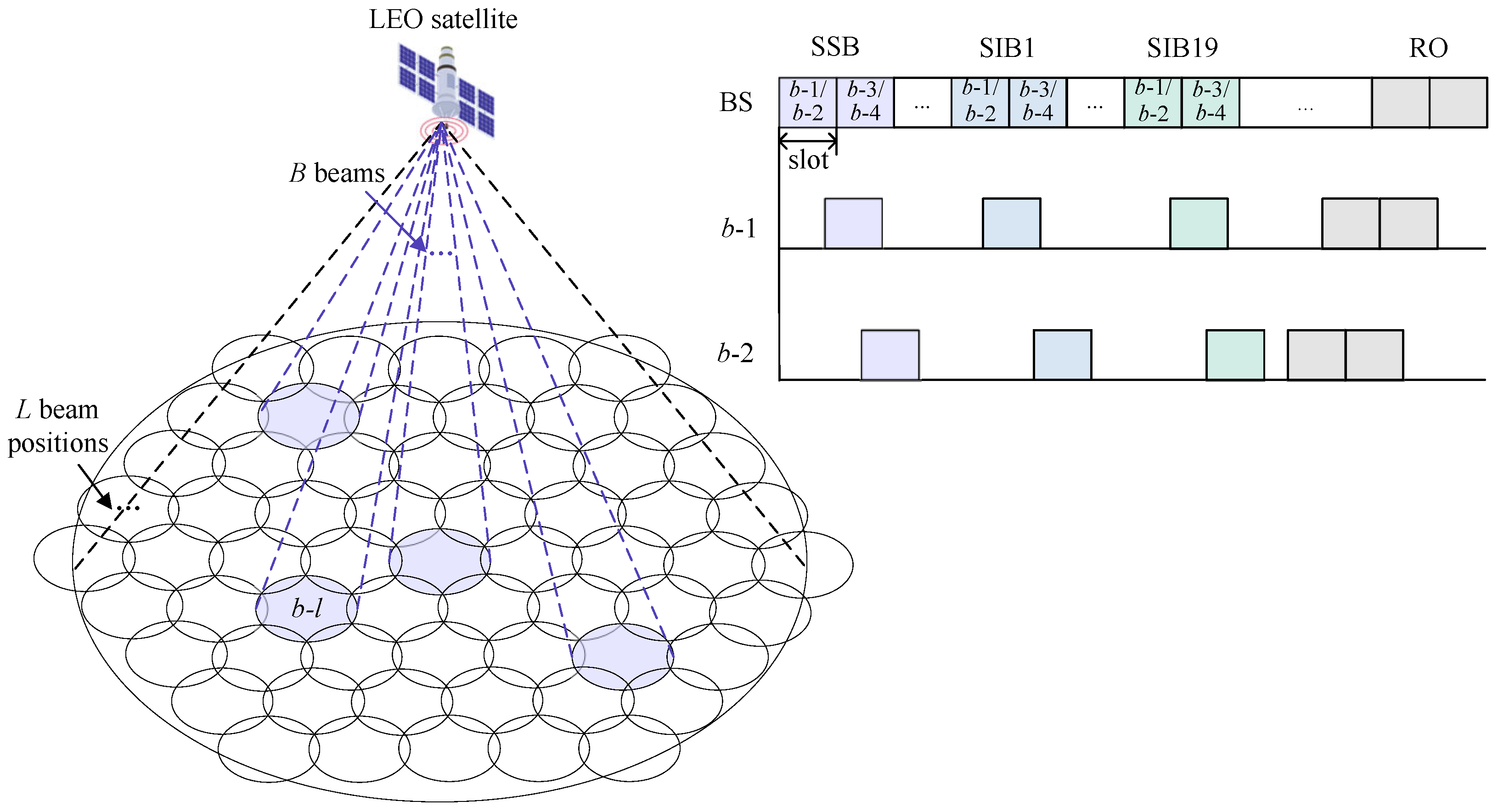
A LEO satellite communication system operating in TDD mode is considered in this paper, as shown in Figure 2. The satellite can generate B beams to illuminate L beam positions, with the beam set denoted as B = { 1 , 2 , , B } . Each beam transmits L b SSBs in its SS burst set, with the corresponding beam position set denoted as L b = { 1 , 2 , , L b } , and we have L = B · L b . For beam position l served by beam b (hereinafter referred to as beam position ( b , l ) ), the propagation delay range is expressed as [ τ min ( b , l ) , τ max ( b , l ) ] , which can be calculated based on the satellite’s coordinates, beam center coordinates, and beam radius.
Figure 2. Scenario of the LEO satellite communication system.
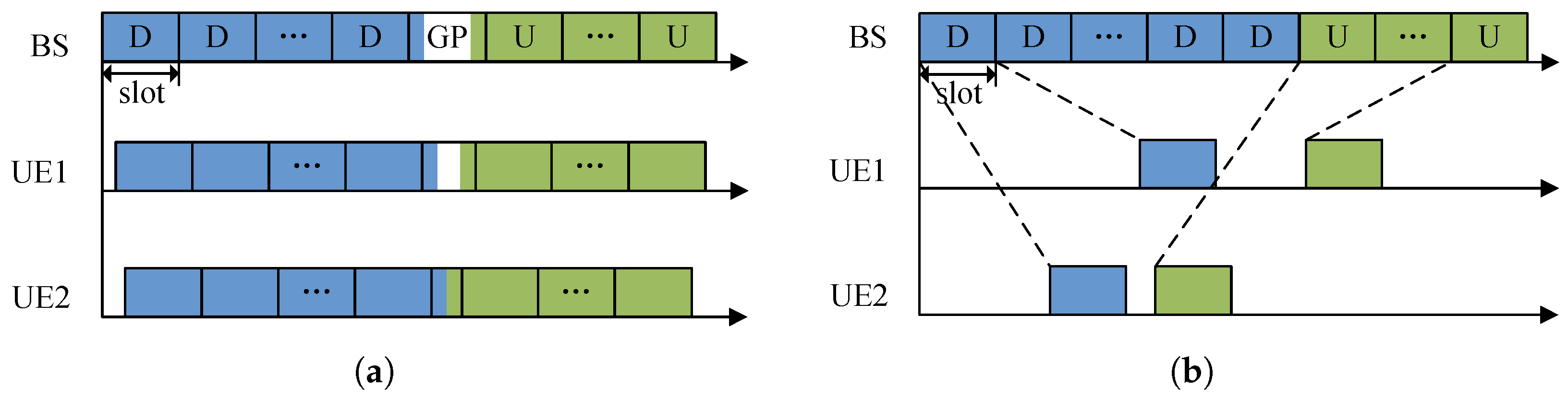
Due to the large propagation delay, the deployment of the traditional frame structure will cause severe interference, thus reducing the temporal resource utilization. To address this issue, we propose a flexible and on-demand frame structure, where the uplink and downlink slots of UEs are flexibly scheduled by the satellite based on the demands, without being constrained by the 5G frame structure, as illustrated in Figure 3. When the propagation delay is sufficiently large, the last several downlink slots overlap the first several uplink slots on the UE side, rendering the standard 5G frame structure unsuitable for TDD-based satellite communication systems. In our frame structure, the satellite must ensure that a UE’s uplink slots do not conflict with its downlink slots during scheduling to guarantee system reliability.
Figure 3. Comparison of two TDD frame structures: (a) 5G frame structure. (b) Flexible and on-demand frame structure.

3.2. Interference Analysis

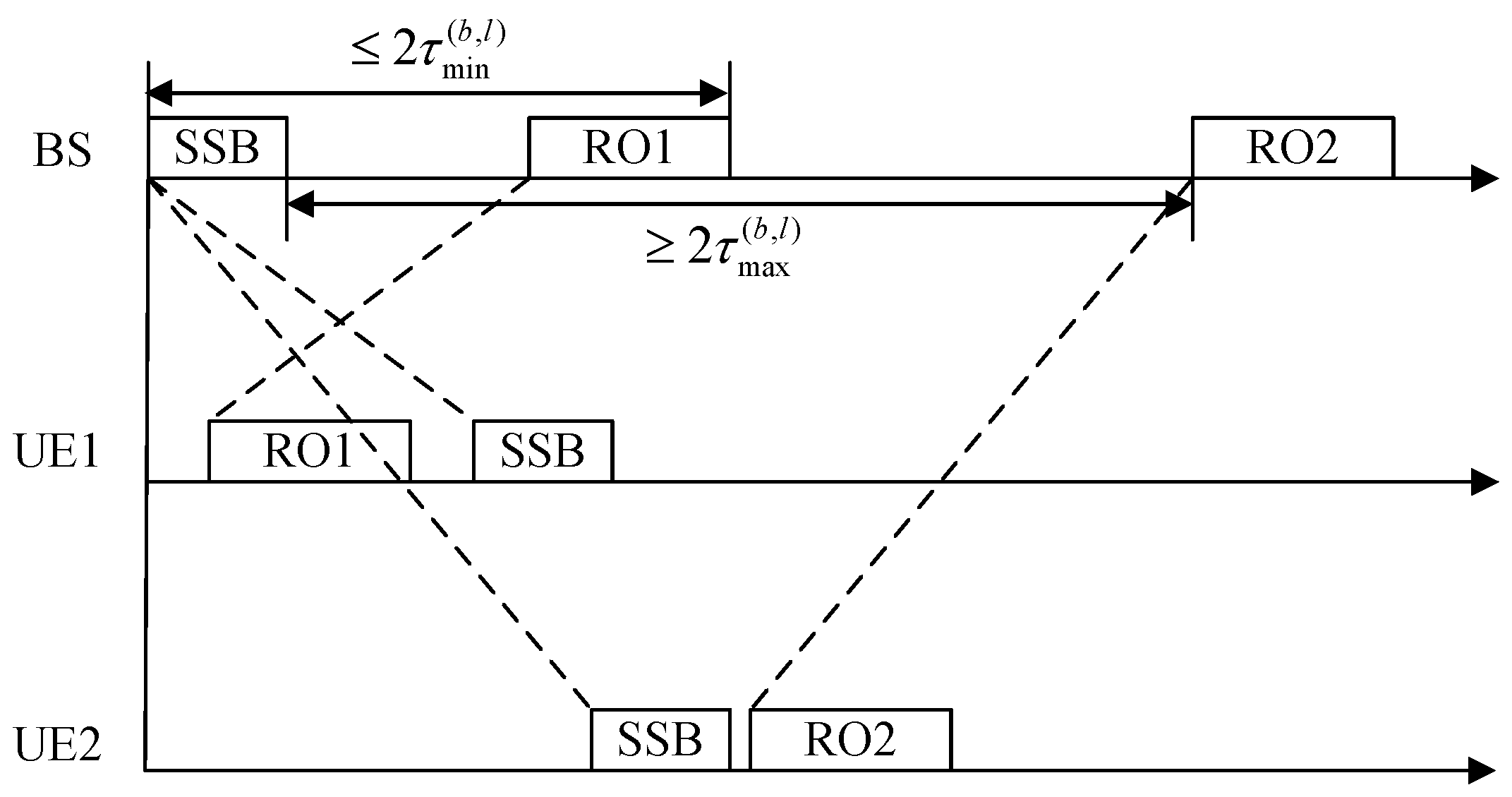
In TDD mode, since a UE cannot transmit and receive simultaneously, its downlink and uplink slots must not overlap in the time domain. Accordingly, a valid RO must not only be located within uplink slots but also avoid interference with SSB, SIB1, and SIB19, where the interference-free case between SSB and RO is illustrated in Figure 4. Therefore, it is necessary to determine the transmission intervals of these signals to ensure that ROs are separated temporally from downlink signals on the UE side.
Figure 4. Valid ROs without interference with SSB.
Since all the aforementioned signals are periodic and exhibit repetitive behavior across different periods, a judgement period can be defined as the least common multiple of their periods, T = LCM T SSB , T SIB 1 , T SIB 19 , T RO , to analyze their interference relationships in the time domain. Within this period, the validity of each RO is evaluated, and the result can be repeated for subsequent periods.
Without loss of generality, let the starting time of frame 0 at the BS be t = 0 . Due to the propagation delay, for ROs within [ 0 , T ] , downlink signals that may interfere with them come from [ 2 τ max ( b , l ) , T 2 τ min ( b , l ) ] . Based on this, the transmission intervals of these signals on the BS side are analyzed first. Further, to determine the interference conditions, these intervals need to be mapped to the UE side, thereby establishing corresponding interference-free constraints.

3.2.1. Analysis of SSB Transmission Duration

Within [ 0 , T SSB ] , the frame index and slot index of SSB l are S F N SSB , l and n SSB , l , with the transmission interval being [ t SSB , l start , t SSB , l end ] = S F N SSB , l · T f + 2 μ · [ n SSB , l , n SSB , l + 1 ] , where μ is the subcarrier spacing numerology and T f is the duration of a wireless frame. Therefore, the set of SSB transmission intervals for beam position ( b , l ) is given by
T SSB BS , ( b , l ) = n = N SSB , pre N SSB 1 [ t SSB , l start , t SSB , l end ] + n · T SSB ,
where N SSB = T T SSB is the number of repetitions of the SS burst set within [ 0 , T ] , and  N SSB , pre = 2 τ max ( b , l ) T SSB ensures that all SSBs within [ 2 τ max ( b , l ) , T 2 τ min ( b , l ) ] are included. On the UE side, these transmission intervals need to account for propagation delay, which can be expressed as follows:
T SSB UE , ( b , l ) = n = N SSB , pre N SSB 1 [ t SSB , l start + τ min ( b , l ) , t SSB , l end + τ max ( b , l ) ] + n · T SSB .

3.2.2. Analysis of SIB1 Transmission Duration

Within [ 0 , T SIB 1 ] , the frame index and slot index of SIB1 corresponding to SSB l are S F N SIB 1 , l and n SIB 1 , l , with the transmission interval being [ t SIB 1 , l start , t SIB 1 , l end ] = S F N SIB 1 , l · T f + 2 μ · [ n SIB 1 , l , n SIB 1 , l + 1 ] . Therefore, the set of SIB1 transmission intervals for beam position ( b , l ) is given by
T SIB 1 BS , ( b , l ) = n = N SIB 1 , pre N SIB 1 1 [ t SIB 1 , l start , t SIB 1 , l end ] + n · T SIB 1 ,
where N SIB 1 = T T SIB 1 , and  N SIB 1 , pre = 2 τ max ( b , l ) T SIB 1 . On the UE side, the set of SIB1 transmission intervals can be expressed as
T SIB 1 UE , ( b , l ) = n = N SIB 1 , pre N SIB 1 1 [ t SIB 1 , l start + τ min ( b , l ) , t SIB 1 , l end + τ max ( b , l ) ] + n · T SIB 1 .

3.2.3. Analysis of SIB19 Transmission Duration

Denote the number of SIB19 transmission occasions corresponding to SSB l within the SI window as L SIB 19 . Within  [ 0 , T SIB 19 ] , the frame index and slot index of the m-th SIB19 are S F N SIB 19 , m and n SIB 19 , m . Its transmission interval is given by t SIB 19 , m start , t SIB 19 , m end = S F N SIB 19 , m · T f + 2 μ · n SIB 19 , m , n SIB 19 , m + 1 . Therefore, the set of SIB19 transmission intervals for beam position ( b , l ) is given by
T SIB 19 BS , ( b , l ) = n = N SIB 19 , pre N SIB 19 1 m = 1 L SIB 19 [ t SIB 19 , m start , t SIB 19 , m end ] + n · T SIB 19 ,
where N SIB 19 = T T SIB 19 , and  N SIB 19 , pre = 2 τ max ( b , l ) T SIB 19 . On the UE side, the set of SIB19 transmission intervals can be expressed as
T SIB 19 UE , ( b , l ) = n = N SIB 19 , pre N SIB 19 1 m = 1 L SIB 19 [ t SIB 19 , m start + τ min ( b , l ) , t SIB 19 , m end + τ max ( b , l ) ] + n · T SIB 19 .

3.2.4. Analysis of Interference-Free Conditions of RO Configuration

Denote the candidate RO configuration set as C = { c 1 , c 2 , , c N C } , where N C is the number of candidate configurations. For a given configuration c C , taking format 0 as an example, the frame index and subframe index of the m-th RO within [ 0 , T RO ( c ) ] are S F N RO , m ( c ) and n RO , m ( c ) , where m = 1 , 2 , , L RO , c , and  L RO , c represents the number of ROs within each configuration period. Accordingly, the reception interval of the m-th RO is given by [ t RO , m ( c ) , start , t RO , m ( c ) , end ] = S F N RO , m ( c ) · T f + [ n RO , m ( c ) , n RO , m ( c ) + 1 ] · T sf , where T sf is the duration of a subframe. Therefore, the set of RO reception intervals within [ 0 , T ] is given by
T RO BS ( c ) = n = 0 N RO , c 1 m = 1 L RO , c [ t RO , m ( c ) , start , t RO , m ( c ) , end ] + n · T RO ( c ) ,
where N RO , c = T T RO ( c ) . On the UE side, the set can be expressed as
T RO UE , ( b , l ) ( c ) = n = 0 N RO , c 1 m = 1 L RO , c [ t RO , m ( c ) , start τ max ( b , l ) , t RO , m ( c ) , end τ min ( b , l ) ] + n · T RO ( c ) .
After determining the transmission intervals of these signals, the interference-free constraints for the RO configuration can be derived. Let T RO , valid BS , ( b , l ) ( c ) denote the set of valid RO reception intervals for beam position ( b , l ) on the BS side. The corresponding set of valid RO intervals on the UE side, denoted by T RO , valid UE , ( b , l ) ( c ) , should satisfy
CAP T x UE , ( b , l ) , T RO , valid UE , ( b , l ) ( c ) = , x { SSB , SIB 1 , SIB 19 } , l L b , b B , c C ,
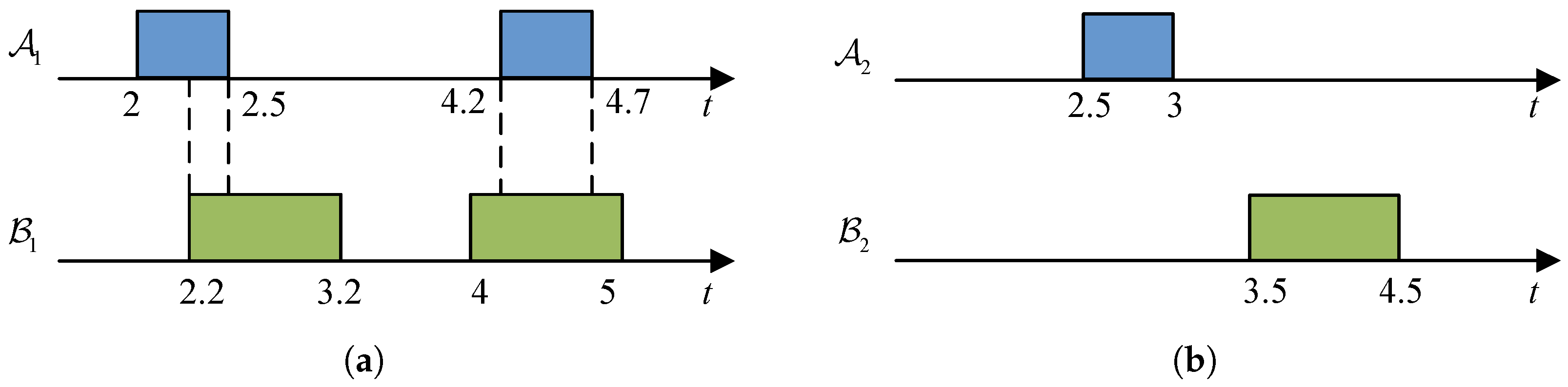
where T RO , valid UE , ( b , l ) ( c ) T RO UE , ( b , l ) ( c ) , and CAP ( A , B ) outputs the set of all non-empty intersections between intervals in A and intervals in B . In Figure 5a, A 1 = { [ 2.0 , 2.5 ] , [ 4.2 , 4.7 ] } , B 1 = { [ 2.2 , 3.2 ] , [ 4.0 , 5.0 ] } . Then, CAP ( A 1 , B 1 ) = { [ 2.2 , 2.5 ] , [ 4.2 , 4.7 ] } . In contrast, Figure 5b gives CAP ( A 2 , B 2 ) = .
Figure 5. Illustration of the CAP operation: (a) Overlapping case. (b) Non-overlapping case.
Since preambles are transmitted after the reception of SIB19, the difference between t RO start and t SIB 19 end should be no less than the round-trip delay, which can be formulated as
t RO start t SIB 19 end 2 τ k ,
where τ k is the propagation delay between the satellite and UE k.

3.3. RO Configuration Problem Formulation

To ensure the efficient utilization of RA resources within a given time interval, it is necessary to design an effective RO configuration scheme. Accordingly, the RO utilization of each beam is defined as the ratio between the number of valid ROs and the total number of ROs within the interval [ 0 , T ] . Aiming to maximize the average RO utilization across all beams, the corresponding optimization problem can be formulated as
P 0 : max c C 1 B b = 1 B card T RO , valid BS , ( b ) ( c ) card T RO BS ( c ) , s . t . ( C 1 ) : CAP T x UE , ( b , l ) , T RO , valid UE , ( b , l ) ( c ) = , x { SSB , SIB 1 , SIB 19 } , l L b , b B , ( C 2 ) : T RO , valid BS , ( b ) ( c ) = T RO , valid BS , ( b , 1 ) ( c ) T RO , valid BS , ( b , 2 ) ( c ) T RO , valid BS , ( b , L b ) ( c ) , b B , ( C 3 ) : T RO , valid BS , ( b ) ( c ) , b B , ( C 4 ) : T RO , valid BS , ( b ) ( c ) T RO , UL BS ( c ) , b B .
Constraint ( C 1 ) ensures that valid ROs do not interfere with SSB, SIB1, or SIB19; constraint ( C 2 ) guarantees that valid ROs in a given beam are available for every beam position; constraint ( C 3 ) ensures that each beam contains at least one valid RO; and constraint ( C 4 ) restricts valid ROs to the uplink slots of the BS, where T RO , UL BS ( c ) denotes the subset of T RO BS ( c ) , consisting of RO reception intervals that fall entirely within the uplink slots.

4. Solution for RO Configuration

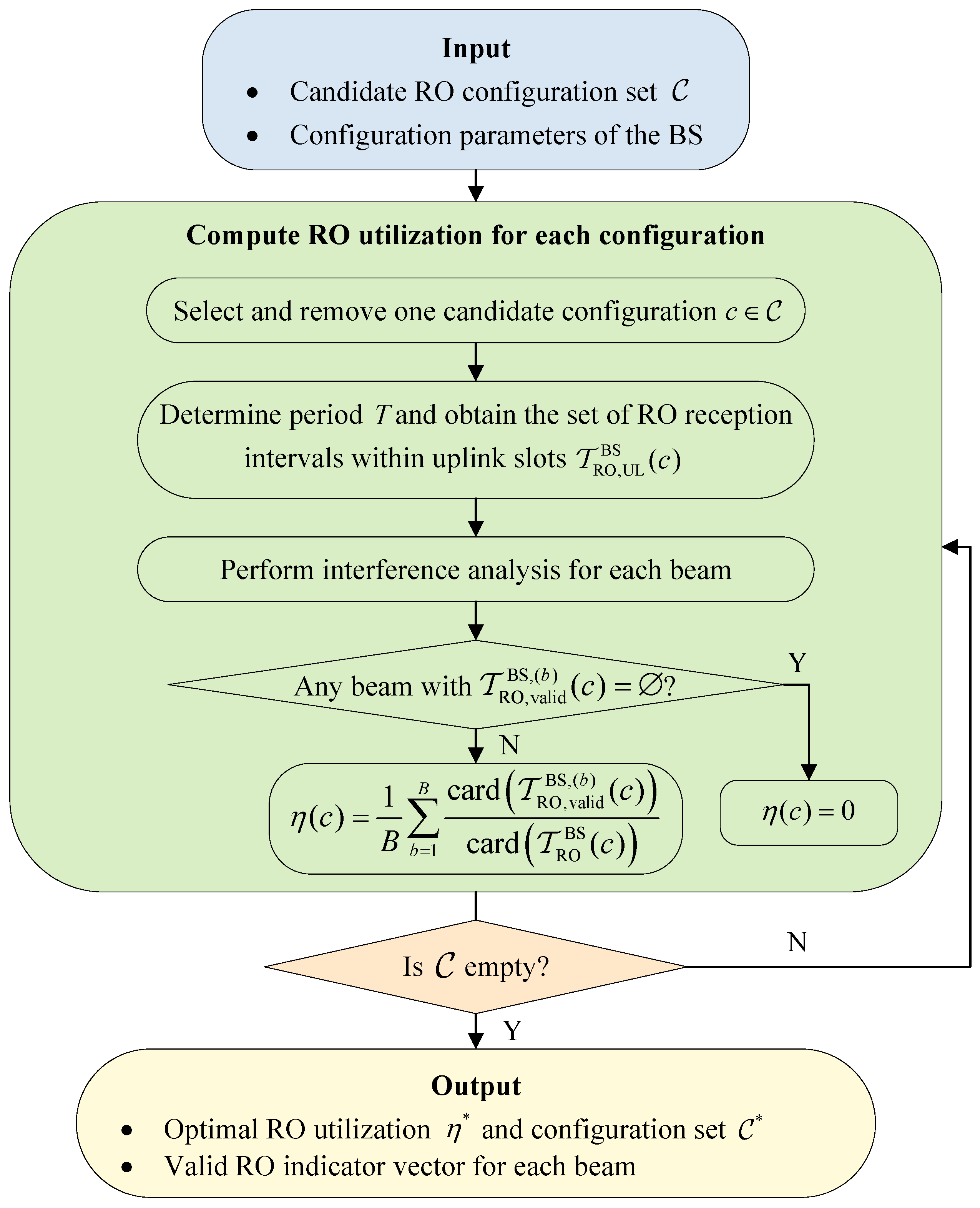
The problem P 0 is a combinatorial optimization problem, which cannot be solved in polynomial time. Besides, P 0 is hard to solve using the advanced mixed-integer optimization toolboxes such as Gurobi, which is a global optimizer with high performance and is widely used in both research and industry [29]. Noting that the candidate RO configurations are limited by the 3GPP specifications, we propose a structured global candidate exploration algorithm (SGCEA) to solve the RO configuration problem. Its main workflow is shown in Figure 6.
Figure 6. RO configuration optimization flowchart.
  • Parameter initialization
    First, all relevant parameters and system configurations are prepared, including the set of candidate RO configurations C , the set of beams B , the set of beam positions L b , and the propagation delay range [ τ min ( b , l ) , τ max ( b , l ) ] for each beam position ( b , l ) . In addition, the configuration parameters of SSB, SIB1, and SIB19, as well as the TDD frame structure of the BS, are specified. The optimal RO configuration set C * is initially set to be empty.
  • Interference assessment
    As shown in Figure 6, for each candidate RO configuration, the algorithm first determines the least common multiple of the periods of all relevant signals. Within this judgement period, the RO reception intervals are calculated and filtered to include only those located in uplink slots. Then, for each beam and each of its beam positions, the algorithm computes the transmission intervals of SSB, SIB1, and SIB19 based on their respective configuration indices. Based on the propagation delays, RO reception intervals that would interfere with any downlink signals are excluded, yielding the set of valid RO intervals for each beam position. The valid RO intervals for a beam are then obtained by intersecting those across all its beam positions. If no valid RO intervals exist for a beam under the given configuration, it will be discarded, with its RO utilization set to zero. Otherwise, the average RO utilization for this configuration is calculated.
  • RO configuration determination
    After evaluating all candidate configurations, those achieving the highest average RO utilization η * form the optimal configuration set C * , and the corresponding valid RO indicator vectors for each beam are also obtained.
Therefore, after determining the optimal RO configuration, the BS can indicate to UEs which ROs are valid. During the RA procedure, the UE selects only these valid ROs to transmit the preamble, thereby avoiding interference with SSB and SIBs, and ensuring that UEs in all beam positions can complete access. Based on the preceding discussion and derivations, the algorithm for optimal RO configuration is shown in Algorithm 1. In the algorithm, the parameters, such as signal configuration, can be determined according to the considered scenario. For example, we select the parameters that comply with the 3GPP documents, thereby guaranteeing feasibility with 3GPP constraints. Moreover, the algorithm searches the candidate RO configuration, which ensures the SGCEA always yields the optimal solution.
The algorithm evaluates each candidate configuration for every beam position, with a computational complexity of approximately O ( N c · B · L b ) . Since the RO configuration is derived from predefined beam positions, the computation can be performed offline and does not require real-time processing onboard the satellite.
Algorithm 1 Structured global candidate exploration algorithm
  • Input: Candidate RO configuration set C , the beam set B and beam position set L b with corresponding delay ranges, configuration parameters of SSB, SIB1, SIB19 and TDD frame structure of the BS
  • Output: Optimal utilization η * , optimal configuration set C * , valid RO indicators vector for each beam
  • Step 1: Parameter initialization
1:
C *
Step 2: Interference assessment
2:
for each candidate RO configuration c C  do
3:
     T = LCM ( T SSB , T SIB 1 , T SIB 19 , T RO ( c ) )
4:
    Compute T RO BS ( c ) based on Equation (7), then obtain T RO , UL BS ( c )
5:
     η ( c ) = 0
6:
    for  b = 1 ; b B ; b + +  do
7:
         for  l = 1 ; l L b ; l + +  do
8:
           Compute T SSB BS , ( b , l ) , T SIB 1 BS , ( b , l ) and T SIB 19 BS , ( b , l ) based on Equations (1), (3) and (5)
9:
           Determine T RO , valid BS , ( b , l ) based on Equation (9)
10:
       end for
11:
        T RO , valid BS , ( b ) ( c ) = l = 1 L b T RO , valid BS , ( b , l ) ( c )
12:
       if  T RO , valid BS , ( b ) =  then
13:
            η ( c ) = 0
14:
           break
15:
       else
16:
            η ( c ) = η ( c ) + card T RO , valid BS , ( b ) ( c ) card T RO BS ( c )
17:
       end if
18:
   end for
19:
     η ( c ) = η ( c ) B
20:
end for
Step 3: RO configuration determination
21:
η * max c C η ( c )
22:
C * { c C η ( c ) = η * }

5. Simulation Results

5.1. Simulation Settings

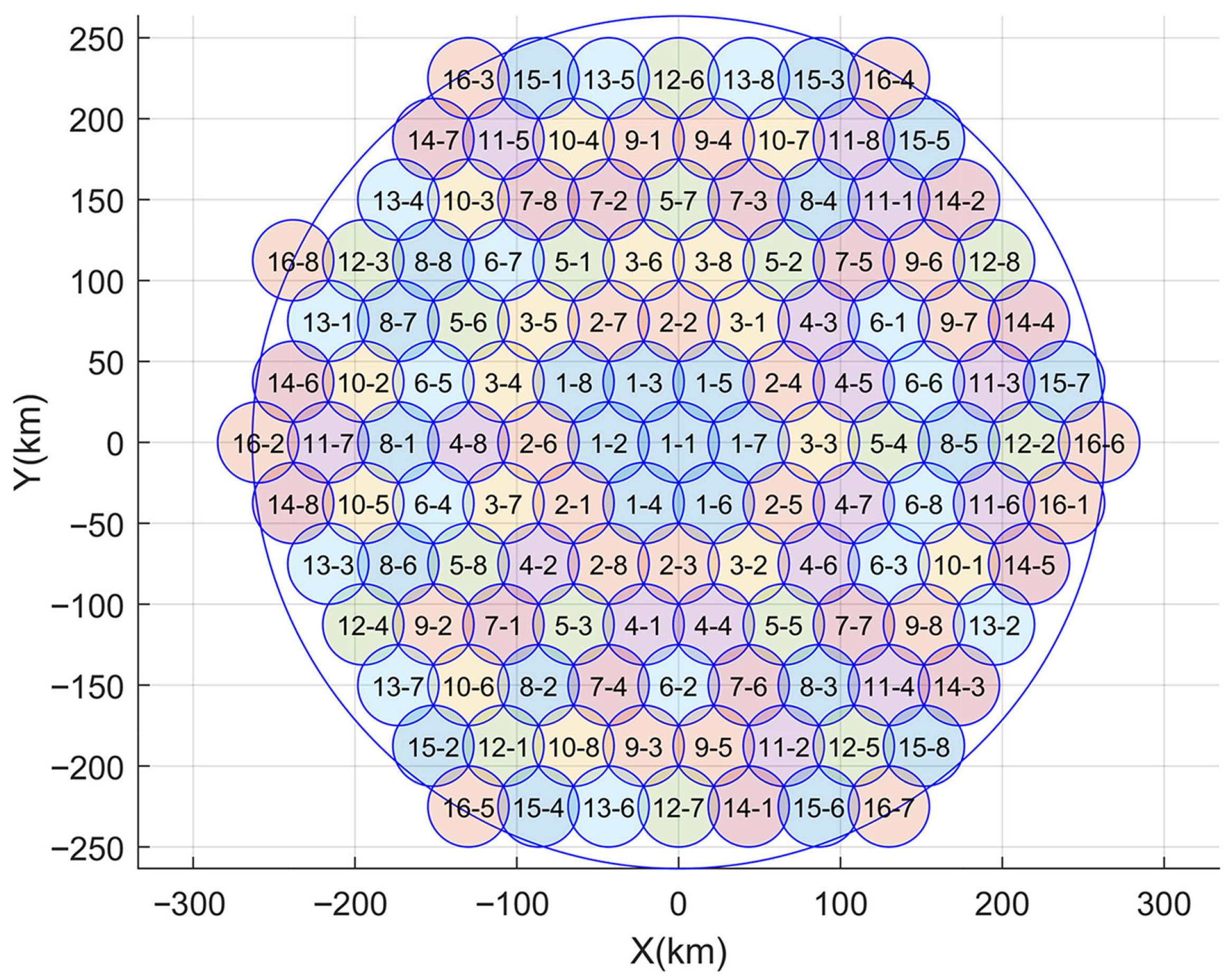
As mentioned in Section 3.1, each beam sequentially illuminates L b beam positions, so a satellite with B beams covers a total of L = B · L b beam positions. In the FR1 band, an SS burst set supports up to 8 SSBs [30], hence we set L b = 8 . For a typical choice of B = 16 , the beam hopping scenario in Figure 7 comprises 128 beam positions with identical radii. “2-3” in this figure refers to the beam position that is illuminated by the 3rd beam at the 2nd time slot. To avoid inter-beam interference, adjacent beam positions are not illuminated at the same time. Considering the relatively small satellite footprint radius compared to the Earth’s radius, the beam position is approximated as a plane.
Figure 7. Footprints of 128 beams with beam radius r = 25 km.
The satellite altitude is set to 600 km and the beam radius to 25–100 km, consistent with the reference scenario parameters specified in 3GPP [2]. To assess the resource utilization potential of the terrestrial communication systems in TDD-based satellite systems, we adopt the 5G frame structure and configurations. For example, the frame duration is set to 10 ms, comprising seven downlink slots and three uplink slots per half-frame. The periods of SSB, SIB1, and SIB19 are configured as 20 ms, 20 ms, and 80 ms, respectively. For both SIB1 and SIB19, each beam is served by four consecutive slots, with two transmission occasions per slot. Main simulation parameters are summarized in Table 2.
Table 2. Simulation parameters.
To demonstrate the superiority of the proposed algorithm, we compare the following algorithms:
  • Random: Randomly select a feasible RO configuration.
  • Greedy: Sequentially select a RO configuration with maximum utilization for each beam.
  • SGCEA: Use the proposed SGCEA algorithm to obtain the RO configuration.

5.2. Performance Evaluation

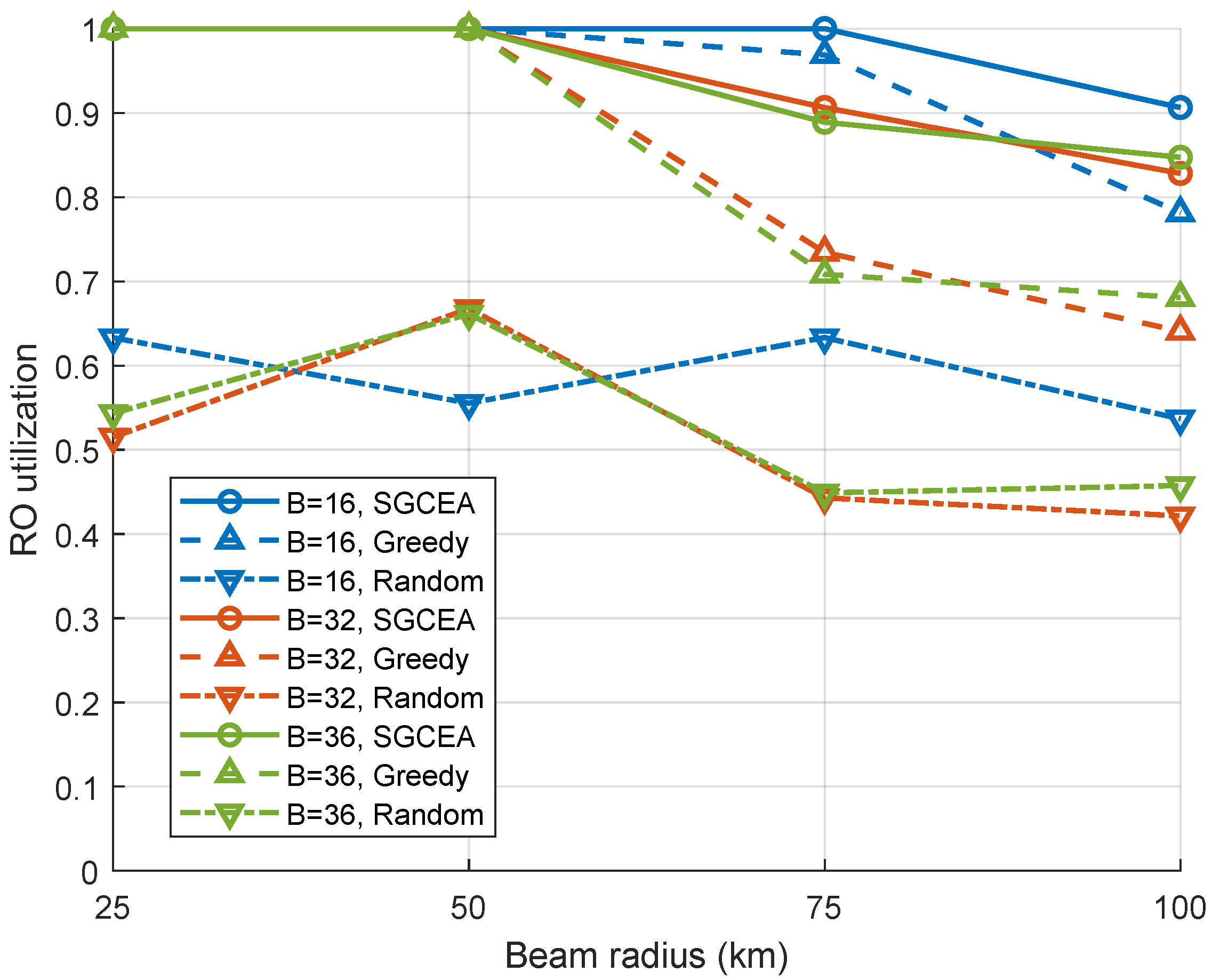
We simulated the RO utilization obtained by various algorithms with the beam radius under different beam radius, as shown in Figure 8. It can be observed that as the number of beams increases, the number of interference sources in the system also increases, leading to a degradation in RO utilization. Moreover, the RO utilization declines as the beam radius becomes larger, which can be attributed to the increasing differential propagation delay within each beam position. Across all configurations, the SGCEA algorithm consistently achieves better RO utilization performance than the baseline methods. When the beam radius is 25 km, both the SGCEA and the greedy algorithms achieve 100% RO utilization. However, when the beam radius increases to 100 km, the RO utilization achieved by the SGCEA algorithm is at least 10% higher than that of the other baseline algorithms.
Figure 8. Impact of satellite coverage on RO utilization.
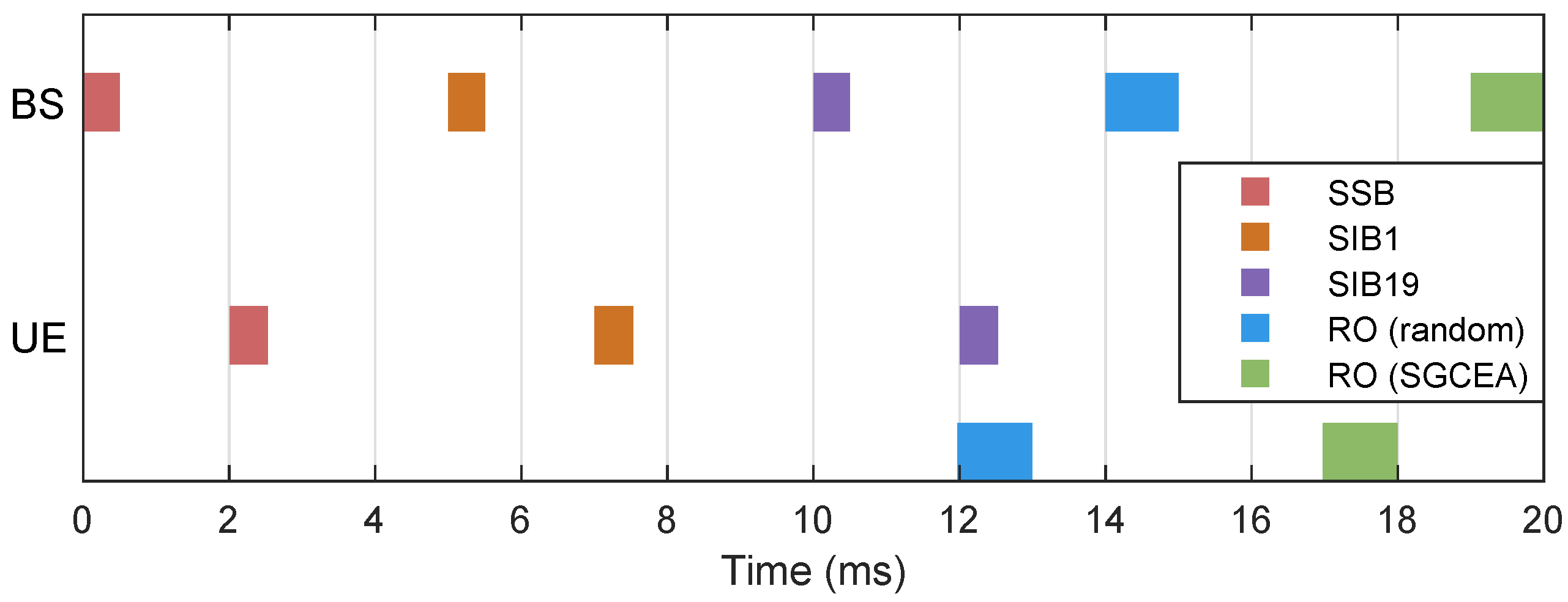
To intuitively illustrate selection results, Figure 9 shows the time domain distribution of downlink signals and preambles obtained by the random algorithm and SGCEA at beam position (2,1) with a beam radius of 25 km and 16 beams, corresponding to the optimal configuration obtained by the proposed algorithm and a randomly selected configuration, with time ranging from 0 to 20 ms. It can be seen that the RO in the optimal configuration does not interfere with any downlink signals, whereas the RO in the random configuration overlaps with SIB19 on the UE side. These results indicate that the proposed algorithm can effectively avoid interference and improve RO utilization.
Figure 9. Time domain distribution of downlink signals and preambles at beam position (2,1).
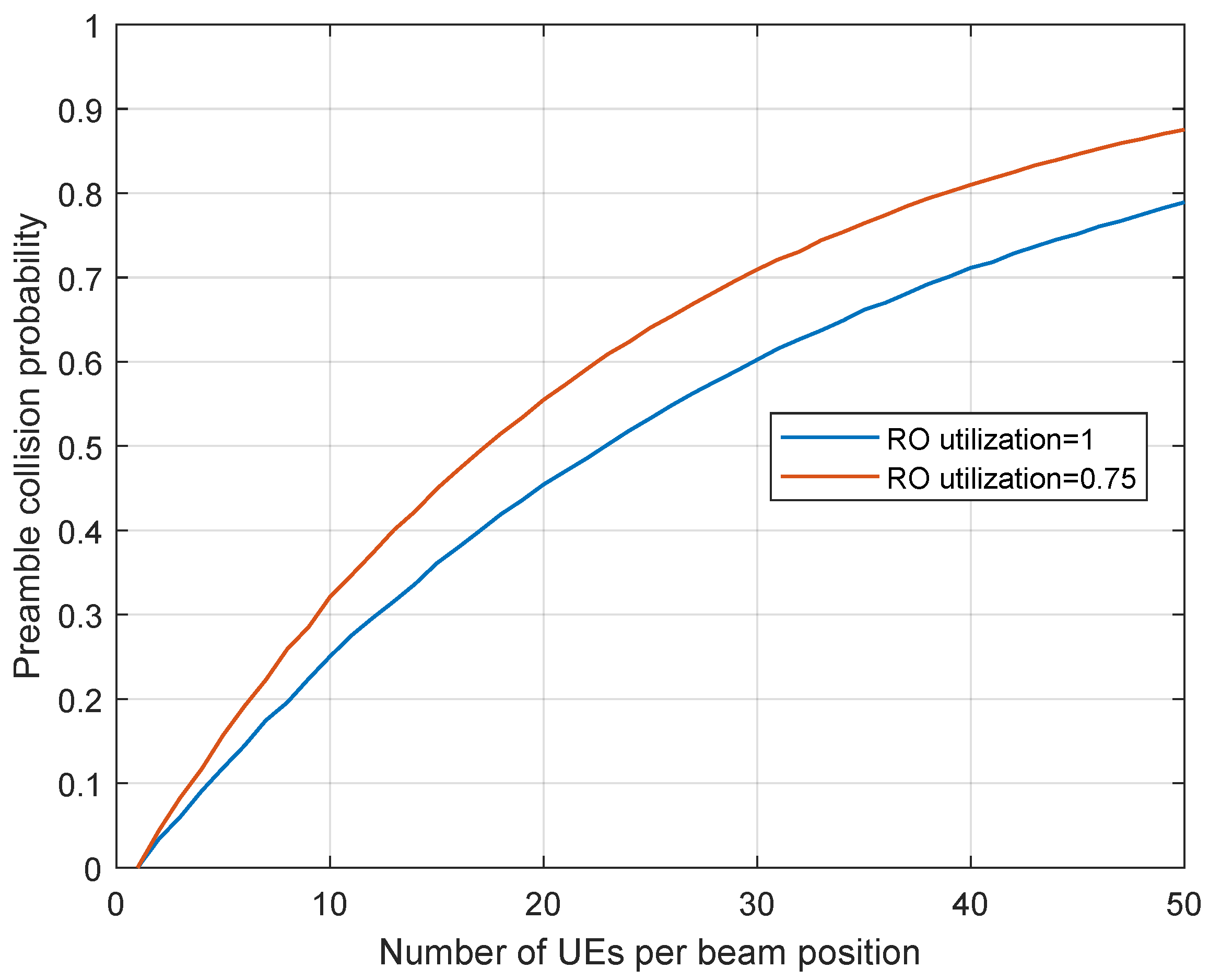
Figure 10 illustrates the preamble collision probability at a single beam position, where the horizontal axis denotes the number of UEs initiating RA within [ 0 , T ] . Assume that UEs are uniformly distributed within the satellite coverage, and both RO and preamble resources are evenly allocated among different beam positions. Two RO configurations are evaluated: one with 100% utilization and another with the same number of ROs but a utilization of only 75%. The results indicate that the collision probability increases as the number of UEs grows. For the lower-utilization configuration, the reduced number of valid ROs forces user preambles to be more concentrated in the time domain, thereby increasing the collision probability. As collisions become more frequent, the access success rate decreases, leading to additional retransmissions and thereby increasing the average access delay.
Figure 10. Comparison of preamble collision probability.
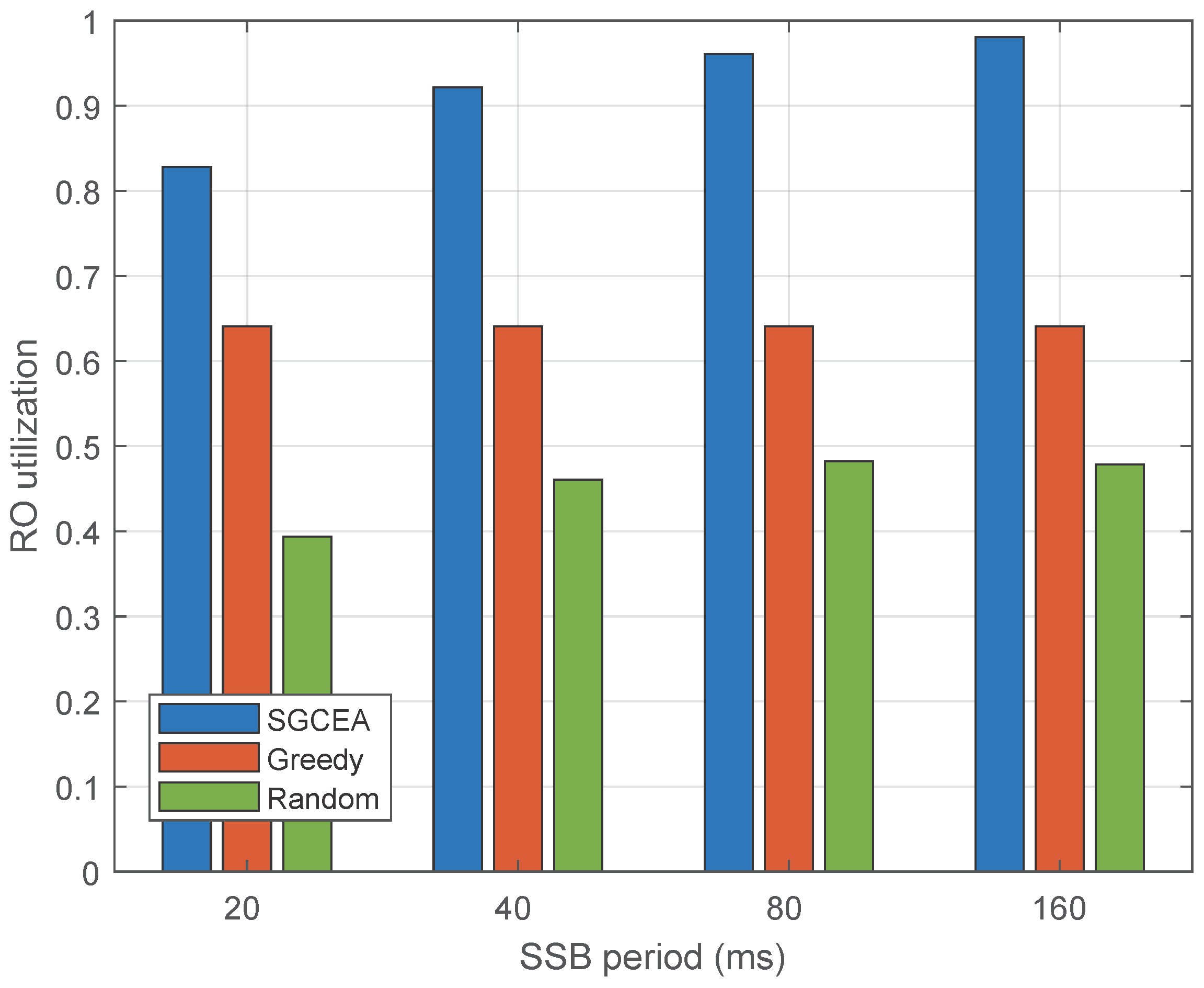
Figure 11 compares the RO utilization achieved by different algorithms under various SSB periodicities specified in 3GPP, with a beam radius of 100 km and 32 beams. As the SSB periodicity increases, the probability of interference between SSBs and preambles decreases, leading to improved RO utilization. When the SSB periodicity increases from 20 ms to 160 ms, the RO utilization obtained by the SGCEA algorithm rises from approximately 83% to 98%, whereas the RO utilization obtained by greedy and random algorithms is below 65% and 50%, respectively, demonstrating the superiority of the SGCEA algorithm over the baseline methods.
Figure 11. Impact of SSB period on RO utilization.

6. Conclusions

This paper investigates the RO allocation problem in TDD-based LEO satellite communication systems. To address the low resource utilization issue, a flexible and on-demand frame structure is proposed, in which slot resources allocated to UEs can be flexibly scheduled by the satellite, without being constrained by the 5G frame structure, thereby achieving maximized resource utilization. Under this frame structure, we analyze the transmission mechanisms of SSB, SIB1, and SIB19 during the synchronization process and establish interference-free conditions for the RO configuration. Based on this, an RO configuration optimization problem is formulated to maximize RO utilization for a beam-hopping scenario, and the optimal RO configuration is obtained using the proposed algorithm. Finally, we construct a simulation scenario with typical terrestrial parameters to validate the scheme, and simulation results demonstrate its effectiveness.
In this work, we mainly focus on time-domain interference between ROs and downlink broadcast signals and do not cover the complete RA procedure. Future work can further investigate the subsequent steps and data transmission after access to design a comprehensive TDD-based LEO satellite communication system.

Author Contributions

Conceptualization, W.W.; methodology, J.Y.; software, J.Y. and T.F.; validation, L.C. and Y.Z.; investigation, J.Y.; resources, W.W., L.C., and Y.Z.; writing—original draft preparation, J.Y. and T.F.; writing—review and editing, J.Y., T.F., and W.W.; supervision, W.W.; project administration, W.W.; funding acquisition, W.W. All authors have read and agreed to the published version of the manuscript.

Funding

This work was supported in part by the National Key Research and Development Program of China under Grant 2023YFB2904703, Southeast University-China Mobile Research Institute Joint Innovation Center.

Data Availability Statement

The original contributions presented in this study are included in the article. Further inquiries can be directed to the corresponding author.

Conflicts of Interest

Authors Li Chai and Yi Zheng were employed by the company China Mobile Research Institute. The remaining authors declare that the research was conducted in the absence of any commercial or financial relationships that could be construed as a potential conflict of interest.

Abbreviations

The following abbreviations are used in this manuscript:
3GPPThird generation partnership project
NTNNon-terrestrial network
TDDTime division duplex
RARandom access
UEUser equipment
RACHRandom access channel
PRACHPhysical random access channel
TATiming advance
LEOLow earth orbit
RORACH occasion
CLICross-link interference
GPGuard period
GNSSGlobal navigation satellite system
BSBase station
SSBSynchronization signal block
SIBSystem information block
SS burst setSynchronization signal burst set
OSIOther system information
SISystem information
RARRandom access response
SGCEAStructured global candidate exploration algorithm

References

  1. 3GPP. Study on New Radio (NR) to Support Non-Terrestrial Networks. TR 38.811 v15.0.0. Available online: https://portal.3gpp.org/desktopmodules/Specifications/SpecificationDetails.aspx?specificationId=3234 (accessed on 4 September 2025).
  2. 3GPP. Solutions for NR to support Non-Terrestrial Networks (NTN). TR 38.821 v16.0.0. Available online: https://portal.3gpp.org/desktopmodules/Specifications/SpecificationDetails.aspx?specificationId=3525 (accessed on 4 September 2025).
  3. Chen, S.; Sun, S.; Wang, Y.; Xiao, G.; Tamrakar, R. A comprehensive survey of TDD-based mobile communication systems from TD-SCDMA 3G to TD-LTE(A) 4G and 5G directions. China Commun. 2015, 12, 40–60. [Google Scholar] [CrossRef]
  4. Lee, H.; Roberts, I.P.; Heo, J.; Son, J.; Kim, H.; Lee, Y.; Hong, D. Can TDD Be Employed in LEO SatCom Systems? Challenges and Potential Approaches. arXiv 2025, arXiv:2502.08179. [Google Scholar] [CrossRef]
  5. Jiang, N.; Deng, Y.; Nallanathan, A.; Yuan, J. A Decoupled Learning Strategy for Massive Access Optimization in Cellular IoT Networks. IEEE J. Sel. Areas Commun. 2021, 39, 668–685. [Google Scholar] [CrossRef]
  6. Miuccio, L.; Panno, D.; Riolo, S. An Energy-Efficient DL-Aided Massive Multiple Access Scheme for IoT Scenarios in Beyond 5G Networks. IEEE Internet Things J. 2023, 10, 7936–7959. [Google Scholar] [CrossRef]
  7. Saarnisaari, H.; de Lima, C.M. 5G NR over Satellite Links: Evaluation of Synchronization and Random Access Processes. In Proceedings of the 2019 21st International Conference on Transparent Optical Networks (ICTON), Angers, France, 9–13 July 2019; pp. 1–4. [Google Scholar]
  8. Kodheli, O.; Maturo, N.; Chatzinotas, S.; Andrenacci, S.; Zimmer, F. On the Random Access Procedure of NB-IoT Non-Terrestrial Networks. In Proceedings of the 2020 10th Advanced Satellite Multimedia Systems Conference and the 16th Signal Processing for Space Communications Workshop (ASMS/SPSC), Graz, Austria, 20–21 October 2020; pp. 1–8. [Google Scholar]
  9. Saarnisaari, H.; Laiyemo, A.O.; de Lima, C.H.M. Random Access Process Analysis of 5G New Radio Based Satellite Links. In Proceedings of the 2019 IEEE 2nd 5G World Forum (5GWF), Dresden, Germany, 30 September–2 October 2019; pp. 654–658. [Google Scholar]
  10. Guidotti, A.; Vanelli-Coralli, A.; Conti, M.; Andrenacci, S.; Chatzinotas, S.; Maturo, N.; Evans, B.; Awoseyila, A.; Ugolini, A.; Foggi, T.; et al. Architectures and Key Technical Challenges for 5G Systems Incorporating Satellites. IEEE Trans. Veh. Technol. 2019, 68, 1939–9359. [Google Scholar] [CrossRef]
  11. Sattarzadeh, A.; Liu, Y.; Mohamed, A.; Song, R.; Xiao, P.; Song, Z.; Zhang, H.; Tafazolli, R.; Niu, C. Satellite-Based Non-Terrestrial Networks in 5G: Insights and Challenges. IEEE Access 2022, 10, 11274–11283. [Google Scholar] [CrossRef]
  12. Lee, K.; Park, Y.; Na, M.; Wang, H.; Hong, D. Aligned Reverse Frame Structure for Interference Mitigation in Dynamic TDD Systems. IEEE Trans. Wirel. Commun. 2017, 16, 6967–6978. [Google Scholar] [CrossRef]
  13. Guo, S.; Hou, X.; Wang, H. Dynamic TDD and interference management towards 5G. In Proceedings of the 2018 IEEE Wireless Communications and Networking Conference (WCNC), Barcelona, Spain, 15–18 April 2018; pp. 1–6. [Google Scholar]
  14. de Olivindo Cavalcante, E.; Fodor, G.; Silva, Y.C.B.; Freitas, W.C. Distributed Beamforming in Dynamic TDD MIMO Networks With BS to BS Interference Constraints. IEEE Wirel. Commun. Lett. 2018, 7, 788–791. [Google Scholar] [CrossRef]
  15. Kim, H.; Lee, K.; Wang, H.; Hong, D. Cross Link Interference Mitigation Schemes in Dynamic TDD Systems. In Proceedings of the 2019 IEEE 90th Vehicular Technology Conference (VTC2019-Fall), Honolulu, HI, USA, 22–25 September 2019; pp. 1–5. [Google Scholar]
  16. Kang, S.; Miao, D.; Sun, S.; Chen, S. TDD Mode on NTN Direct to Satellite Service. IEEE Future Networks. Available online: https://futurenetworks.ieee.org/images/files/Tech_Focus_Articles/PDFs/issue16/TDD_mode.pdf (accessed on 4 September 2025).
  17. Traspadini, A.; Giordani, M.; Zorzi, M. Enhanced Time Division Duplexing Slot Allocation and Scheduling in Non-Terrestrial Networks. In Proceedings of the 2024 58th Asilomar Conference on Signals, Systems, and Computers, Pacific Grove, CA, USA, 27–30 October 2024; pp. 835–841. [Google Scholar]
  18. Matloob, A.Z.K.; Aksoy, M.; Al-Qurabat, A.K.M.; AL lawndi, N.A. A comprehensive analysis of non-terrestrial networks impact on 5G NR random access. Telecommun. Syst. 2025, 88, 59. [Google Scholar] [CrossRef]
  19. Gupta, H.; Srivastava, N.; Borman, L. Optimized RACH Procedure for Low Earth Orbit (LEO) Satellites in Non-Terrestrial Networks (NTN). In Proceedings of the 2025 IEEE Space, Aerospace and Defence Conference (SPACE), Bangalore, India, 21–23 July 2025; pp. 1–6. [Google Scholar]
  20. Wang, D.; Sun, C.; Liu, L.; Li, J.; Zheng, Z.; Zhang, Z.; Yang, S.; Wang, X. Beam Hopping Random Access Scheme for the Next Generation LEO Satellite Internet. In Proceedings of the 2024 IEEE 24th International Conference on Communication Technology (ICCT), Chengdu, China, 18–20 October 2024; pp. 1112–1116. [Google Scholar]
  21. Zhang, Z.; Sun, C.; Liu, L.; Zheng, Z.; Li, J.; Wang, X.; Wang, B.; Wang, D. Random Access Beam Hopping Management Scheme for the Next Generation LEO Satellite Internet. In Proceedings of the 2024 16th International Conference on Communication Software and Networks (ICCSN), Ningbo, China, 18–20 October 2024; pp. 189–193. [Google Scholar]
  22. Zhao, B.; Wang, M.; Xing, Z.; Ren, G.; Su, J. Integrated Sensing and Communication Aided Dynamic Resource Allocation for Random Access in Satellite Terrestrial Relay Networks. IEEE Commun. Lett. 2023, 27, 661–665. [Google Scholar] [CrossRef]
  23. Jia, H.; Jiang, C.; Kuang, L.; Lu, J. Adaptive Access Control and Resource Allocation for Random Access in NGSO Satellite Networks. IEEE Trans. Netw. Sci. Eng. 2022, 9, 2721–2733. [Google Scholar] [CrossRef]
  24. Sun, X.; Zhou, S.; Kang, S.; Miao, D. Air Interface Design for a TDD-Based 5G NTN System. In Proceedings of the 2024 International Conference on Future Communications and Networks (FCN), Valletta, Malta, 18–22 November 2024; pp. 1–7. [Google Scholar]
  25. Kodheli, O.; Astro, A.; Querol, J.; Gholamian, M.; Kumar, S.; Maturo, N.; Chatzinotas, S. Random Access Procedure Over Non-Terrestrial Networks: From Theory to Practice. IEEE Access 2021, 9, 109130–109143. [Google Scholar] [CrossRef]
  26. Chuang, Y.-H.; Lee, P.-F.; Wang, S.-S.; Sheu, S.-T. Enhanced RACH Occasion in LEO-Based Non-Terrestrial Networks. In Proceedings of the ICC 2023-IEEE International Conference on Communications, Rome, Italy, 28 May–1 June 2023; pp. 283–289. [Google Scholar]
  27. 3GPP. Radio Resource Control (RRC) Protocol Specification. TS 38.331 V17.0.0. Available online: https://portal.3gpp.org/desktopmodules/Specifications/SpecificationDetails.aspx?specificationId=3197 (accessed on 4 September 2025).
  28. 3GPP. Physical Channels and Modulation. TS 38.211 v17.0.0. Available online: https://portal.3gpp.org/desktopmodules/Specifications/SpecificationDetails.aspx?specificationId=3213 (accessed on 4 September 2025).
  29. Huang, Y.-F.; Chiang, W.-K. Gurobi Optimization for 5GC Refactoring. In Proceedings of the 2023 International Conference on Consumer Electronics–Taiwan (ICCE–Taiwan), PingTung, Taiwan, 17–19 July 2023; pp. 115–116. [Google Scholar]
  30. 3GPP. Physical Layer Procedures for Control. TS 38.213 v17.0.0. Available online: https://portal.3gpp.org/desktopmodules/Specifications/SpecificationDetails.aspx?specificationId=3215 (accessed on 4 September 2025).
Disclaimer/Publisher’s Note: The statements, opinions and data contained in all publications are solely those of the individual author(s) and contributor(s) and not of MDPI and/or the editor(s). MDPI and/or the editor(s) disclaim responsibility for any injury to people or property resulting from any ideas, methods, instructions or products referred to in the content.

Article Metrics

Citations

Article Access Statistics

Multiple requests from the same IP address are counted as one view.