
Article

Oxygen- and Ozone-Functionalized Electronic Structure Modulation in C2N Monolayer for Efficient Photocatalytic Water Splitting

1
Department of Physics, Indian Institute of Technology (Indian Institute of Mines), Dhanbad 826004, Jharkhand, India
2
G. W. Woodruff School of Mechanical Engineering, Georgia Institute of Technology, Atlanta, GA 30332, USA
3
School of Physical Sciences, National Institute of Science Education and Research (NISER) Bhubaneswar, An OCC of Homi Bhabha National Institute, Bhubaneswar 752050, Odisha, India
*
Author to whom correspondence should be addressed.
Appl. Nano 2026, 7(3), 25; https://doi.org/10.3390/applnano7030025
Submission received: 10 July 2026 / Revised: 5 August 2026 / Accepted: 6 August 2026 / Published: 10 August 2026

Abstract

Photocatalytic water splitting has emerged as a promising strategy for sustainable hydrogen production using solar energy. In this work, we investigate the photocatalytic performance of the C2N monolayer under O2 and O3 exposure. Upon adsorption on C2N, both molecules form weakly interacting states, resulting in a metallic solution. However, after dissociation into atomic oxygen, the band gap of the oxidised monolayer increases relative to the pristine C2N, indicating a strong hybridisation of the C-O bond. These oxidised configurations exhibit band-edge positions that span the water redox potential, thereby reducing the likelihood of charge recombination and enhancing their separation. Interestingly, the optical absorption spectra show a blue shift relative to the pristine sample and lie in the visible region. These findings highlight the potential of oxygen- and ozone-modified C2N monolayers for applications in photocatalytic water splitting and sustainable hydrogen production.

1. Introduction

Driven by unprecedented population and economic growth, global energy demand is rising by approximately 1.3% annually, sustaining an exhaustive reliance on fossil fuels projected to last until at least 2050 [1,2]. To mitigate the resulting environmental degradation and escalating energy crisis, generating clean hydrogen fuel via solar-driven or electrochemical water splitting, encompassing both the hydrogen evolution reaction (HER) and the oxygen evolution reaction (OER), has emerged as an urgent, vital strategy [3]. Hydrogen represents a prominent carbon-neutral source, favoured for its exceptional storage capacity and zero-emission profile [4]. While gaining momentum as a sustainable alternative, water splitting currently accounts for only 4–5% of global hydrogen production, underscoring the urgent need to develop highly efficient photocatalytic materials [5]. Since the initial discovery of TiO2 as a photocatalyst, the search for efficient water-splitting materials has expanded to include various semiconductors such as CdSe, SrTiO3, and ZnO [6]. Traditionally, noble-metal-based catalysts such as Pt, Ir, and Ru exhibit superior catalytic performance; however, their widespread commercial utilisation is fundamentally hindered by exorbitant costs and scarcity [7,8,9]. To address the economic and material constraints of traditional catalysts, recent research has pivoted toward low-dimensional nanostructures as highly efficient, cost-effective, and non-precious alternatives.
Following the discovery of graphene [10], researchers have successfully fabricated numerous two-dimensional (2D) materials with tailored electronic structures, unlocking new possibilities for highly efficient photocatalytic water splitting. This potential is driven by their exceptionally large specific surface areas, which provide abundant active sites for catalytic reactions. Furthermore, their unique planar architectures facilitate short charge diffusion lengths, enhanced charge carrier separation, superior carrier mobility, and significantly reduced electron-hole recombination rates [11]. To date, numerous 2D photocatalysts have been extensively explored, including phosphorene [12] and transition-metal oxides (TMOs) [13]. Among this expanding catalogue, transition-metal carbides and nitrides (MXenes) have emerged as particularly promising candidates due to their high carrier mobility and tunable layered architectures. Despite these distinct advantages, their large-scale industrial deployment is hindered by complex synthesis pathways, a lack of bifunctionality (rarely catalysing both HER and OER simultaneously), and poor environmental stability [9,14,15,16,17,18]. To circumvent the limitations of these metal-heavy systems, attention has increasingly shifted toward light-element, metal-free 2D materials such as g-C3N4, C4N3, g-CN, hexagonal boron nitride, and C2N, which have been theoretically and experimentally predicted to be highly efficient candidates for solar-driven catalysis [19].
A fundamental prerequisite for an efficient water-splitting photocatalyst is a suitable thermodynamic band alignment. Specifically, the conduction band minimum (CBM) must be positioned energetically higher than the water reduction potential (H+/H2), while the valence band maximum (VBM) must lie lower than the water oxidation potential (O2/H2O) [4,20]. Consequently, for a 2D material to successfully drive the water splitting redox reactions under visible light, it must intrinsically possess a band gap exceeding the thermodynamic minimum of 1.23 eV. Thus, the universal challenge in designing highly efficient photocatalysts lies in simultaneously engineering an optimal band structure and accelerating the spatial separation of photogenerated charge carriers to maximise hydrogen yield [20].
However, the practical viability of these ultrathin monolayers is heavily dependent on their environmental stability, as interactions with atmospheric molecules can drastically alter their intrinsic electronic properties [21]. In our previous work, we investigated the impact of ambient oxygen (O2) and ozone (O3) exposure on the surface stability of the C2N monolayer, demonstrating that the framework exhibits excellent resistance to destructive ozonation compared to oxidation [22]. We also examined photocatalytic water splitting in a C2N/MoS2 van der Waals heterostructure under the influence of mechanical strain. In addition, the work established the usefulness of the strongly constrained and appropriately normed (SCAN) meta-GGA functional to accurately predict the band gap and band edge positions, consistent with experimental results, with fewer computational resources than the HSE-06 functional [11]. Despite this proven structural resilience, a critical knowledge gap remains: how these environmentally exposed and oxidised configurations respond during actual photocatalytic water splitting remains underexplored. In the present study, we therefore focus on the suitability of the oxygen- and ozone-dissociated C2N configurations for visible-light photocatalytic water splitting, which has not been studied systematically to the best of our knowledge.
Here, we comprehensively investigate the band-gap engineering, band-edge alignment, and optical properties of the C2N monolayer following atmospheric O2 and O3 exposure using first-principles Density Functional Theory (DFT) calculations. The electronic structure of C2N exhibits a metallic state during the interaction of O2 and O3 molecules, whereas an insulating state with a larger band gap is formed when the molecules are dissociated into individual atoms. By mapping the altered band edge positions against the water reduction and oxidation potentials, we evaluate the thermodynamic capability of these surfaces to drive both HER and OER simultaneously. Furthermore, to gain a fundamental understanding of the underlying interfacial chemistry, the bonding characteristics of C2N in both physisorbed and dissociated configurations are rigorously characterised through Crystal Orbital Hamiltonian Population (COHP) analysis utilising the LOBSTER code [23].

2. Computational Methods

First-principles density functional theory (DFT) calculations were performed using the Vienna Ab initio Simulation Package (VASP) version 5.4.4 [24]. The core electron interactions were described via the projector-augmented-wave (PAW) method [25,26], while electron exchange-correlation effects were treated using the generalised gradient approximation (GGA) parameterised by the Perdew–Burke–Ernzerhof (PBE) functional [27]. A plane-wave kinetic energy cutoff of 520 eV was specified for all systems. Electronic self-consistent field (SCF) cycles were converged to an energy tolerance threshold of 1 × 10⁻⁶ eV, and structural relaxations were continued until the maximum interatomic forces fell below 0.01 eV/Å. To eliminate spurious periodic interactions along the non-periodic direction, a 20 Å vacuum spacing was introduced along the z-axis. Reciprocal space integration within the 2D Brillouin zone was sampled using Monkhorst–Pack k-point grids of 7 × 7 × 1 for structural relaxation and 9 × 9 × 1 for the electronic structure calculations. Electronic band structures were systematically evaluated using the Heyd–Scuseria–Ernzerhof (HSE06) screened functional, thereby ensuring highly accurate band-gap estimates by mitigating the typical underestimation associated with generalised-gradient approximations. Long-range dispersion effects were incorporated using the empirical DFT-D3 correction method [28]. Chemical bonding strengths between the catalyst surfaces and reacting intermediates were evaluated using the projected crystal orbital Hamilton population (pCOHP) approach via the LOBSTER package (version 5) [23]. Finally, thermal and entropic corrections to the total energy for all intermediate states were evaluated using the VASPKIT tool (version 1.5.1) [29]. The thermal stability of the pristine and dissociated C2N monolayer was analysed using ab initio molecular dynamics simulations.

3. Results and Discussions

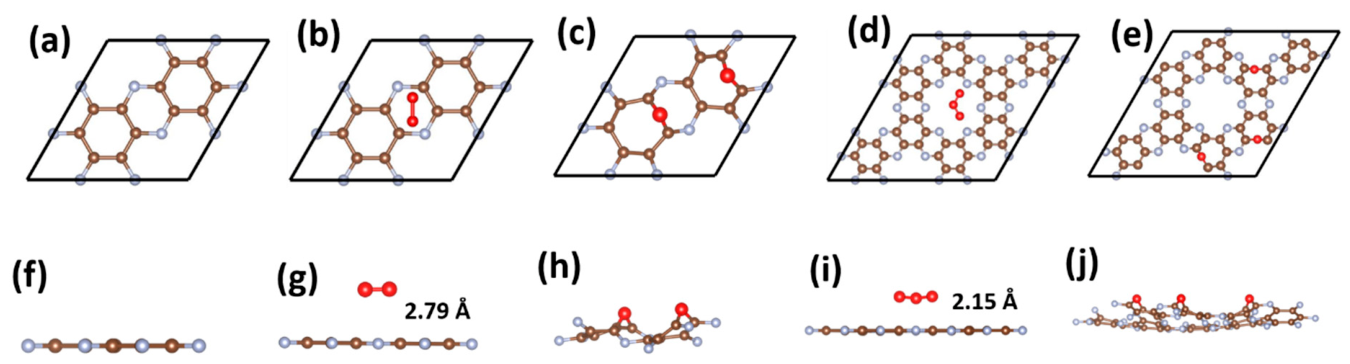
We begin with the structural analysis of the C2N monolayer in its pristine and oxidised configurations during interaction with O2 and O3 (Figure 1). The pristine C2N monolayer crystallises in a hexagonal unit cell with space group P6/mmm (No. 191) [30] (Figure 1a,f). The lattice constants after geometrical optimisation are a = b = 8.33   Å , which is in good agreement with previous theoretical predictions [19,31] and experimental results [32]. It is a two-dimensional porous material where a pyrazine ring connects two benzene rings. The C-C bond length inside the benzene ring (pyrazine ring) is calculated to be around 1.47 Å (1.43 Å). However, inside the pyrazine ring, the C-N bond length is found to be around 1.34 Å, which is consistent with previous reports [19,22]. Inside the pyrazine ring, the C-N-C angle is found to be 117.58°, which is slightly less than the expected value of 120° for a hexagonal lattice and consistent with previous studies [19,33]. The initial configuration for the adsorption of oxygen and ozone molecules was estimated by selecting different possible adsorption sites and performing ionic relax calculations. These possible adsorption sites are above the benzene ring, above the pyrazine ring, above the hollow region, above the C-C bond, above the C-N bond, etc. We note that we selected a single unit cell of the C2N monolayer for oxygen interaction. However, for ozone interaction, a 2 × 2 × 1 supercell of the C2N monolayer was selected to avoid recombination of the dissociated oxygen atoms during the optimisation process. Both horizontal and vertical orientations of the oxygen and ozone molecules were considered for each of these locations. Similarly, the final structure consisting of two (three) dissociated oxygen atoms for the oxygen (ozone)-adsorbed C2N monolayer was considered by placing two (three) oxygen atoms at different adsorption sites. Here, the adsorption sites were considered mostly above the C-C and C-N bonds. An ionic relaxation calculation was performed for the initial and final configurations at all possible adsorption sites, and the structure with minimum energy was selected as the ground state for the initial and final structures, respectively. The adsorption energy during the interaction of the oxygen and ozone molecules was estimated to be around −0.16 eV and −0.31 eV, respectively, using the relation
E a d s = E m o l e c u l e + C 2 N E m o l e c u l e E C 2 N
where E a d s represents the adsorption energy. Similarly, E m o l e c u l e + C 2 N , E m o l e c u l e , and E C 2 N represent the total energy of the C2N monolayer with adsorbed molecules, the interacting molecule, and the C2N monolayer without any adsorbed molecule, respectively. For more detailed information regarding the adsorption sites and adsorption energies, the reader is advised to refer to our earlier article [22].
When the O2 molecule interacts with the C2N monolayer, it prefers to be adsorbed in the middle of the pyrazine ring, forming a weakly interacting state (Figure 1b) with an adsorption energy of around −0.16 eV [22]. The distance between the O2 molecule and the monolayer surface is around 2.79 Å (Figure 1g). This relatively large separation and the modest adsorption energy can be attributed to the linear geometry and strong O=O double bond, which makes it less reactive on the surface of the C2N monolayer. After adsorption, the O-O bond length is slightly elongated to around 1.24 Å as compared to the free O2 molecule (1.21 Å). In contrast, when the O2 molecule dissociates into individual atoms, it becomes highly reactive and forms strong chemical bonds with carbon atoms (Figure 1c,h). The C-O bond lengths in the dissociated structure are around 1.41 Å and 1.38 Å, respectively.
In the case of ozone adsorption, the O3 molecule is physically adsorbed in the hollow region of the C2N monolayer at a distance of 2.15 Å from the surface (Figure 1d,i), with a negative adsorption energy of −0.31 eV [22]. This enhanced interaction arises from the non-linear geometry of O3 and its more polarised electronic distribution due to resonance among its oxygen atoms, which makes it more reactive and leads to stronger interaction with the electron-rich C2N monolayer. After dissociation into three oxygen atoms, it forms the C-O-C groups with the benzene ring (Figure 1e,j), with C-O bond lengths of about 1.38 Å. However, the C-O-C bond angles for the three oxygen-dissociated configurations vary from 111.23° to 106.40° and 109.23°. Notably, the C2N monolayer remains planar during interaction with O2 and O3 molecules, whereas it becomes distorted after dissociation into oxygen atoms. The detailed adsorption and dissociation mechanisms of O2 and O3 interactions on the C2N monolayer are discussed in our earlier article [22]. In this work, we focus on the photocatalytic activity of the dissociated structures for visible-light-driven water splitting.
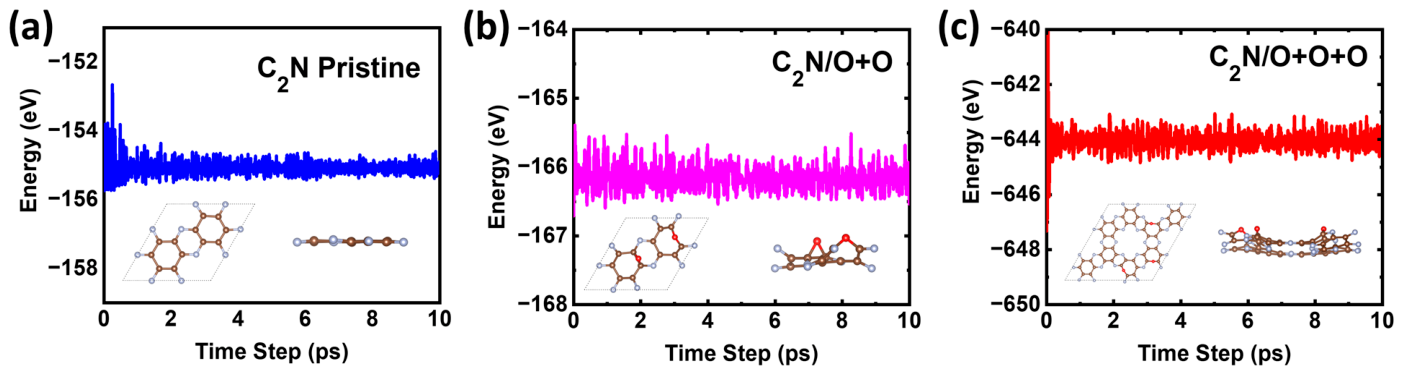
Before proceeding with the photocatalytic study, we verified the thermodynamic stability of the pristine and dissociated configurations of the C2N monolayer by performing ab initio molecular dynamics (AIMD) simulations. The calculation was performed at room temperature (T = 300 K) in two steps. In the first step, the system was heated from 0 K to 300 K over 10 ps with a time step of 1 fs using an NVE ensemble. In the second step, the system was kept at 300 K in an NVT ensemble for an additional 10 ps. The temperature was controlled using a Nosé–Hoover thermostat [34,35]. Figure 2 shows the fluctuations in total energy for the pristine C2N and its dissociated configurations with oxygen and ozone. The calculations reveal a very small change in total energy and a minor structural distortion at room temperature. The very small fluctuation in total energy ensures that all three configurations are thermodynamically stable at room temperature.
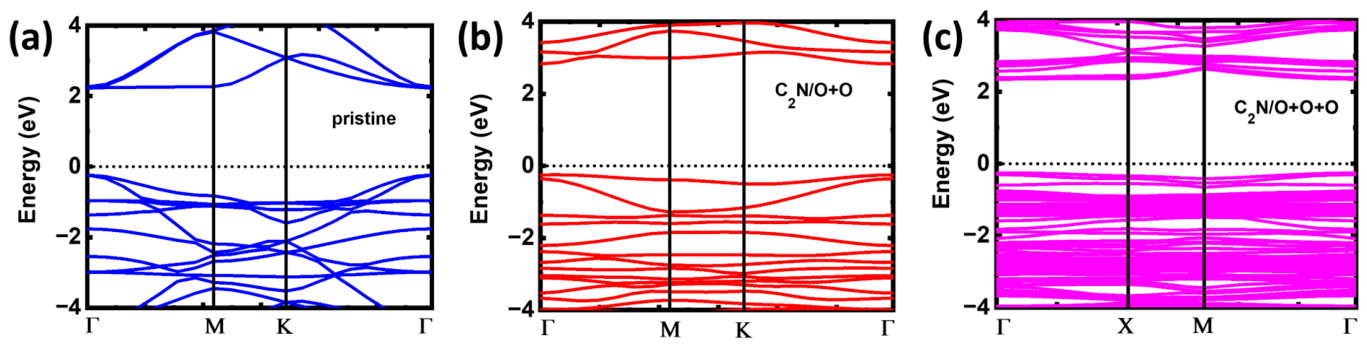
In the next section, we analysed the electronic properties of the pristine and oxidised C2N monolayer by performing band-structure and projected density-of-states calculations. Figure 3 shows the electronic band structure of all three configurations using the HSE-06 functional. The corresponding PBE-GGE results were already discussed in our previous article [22]. The calculated electronic structure of the pristine C2N monolayer indicates its semiconducting nature. Both the valence band maximum (VBM) and the conduction band minimum (CBM) occur at the ‘Γ’ point, indicating a direct band gap. The band gap is 2.46 eV, consistent with the previous literature reports [19]. We note that the adsorption of oxygen and ozone, which form a non-interacting state, makes the system metallic, as reported in our previous paper [22]. Therefore, we did not consider the initial configurations in the photocatalytic water-splitting study. Figure 3b illustrates the HSE-06 band structure of the oxygen-dissociated C2N structure, which exhibits a larger energy gap around 3.07 eV as compared to the pristine monolayer. Similarly, the ozone-dissociated configuration exhibits an energy gap of 2.60 eV (Figure 3c), which is slightly larger than the pristine value. Interestingly, after dissociation into oxygen atoms, both molecules over the C2N surface preserve the material’s direct band gap, which is favourable for water splitting.
After dissociation of oxygen and ozone molecules into atomic oxygen, the C2N monolayer exhibits a larger band gap than that of the pristine structure due to strong hybridisation and chemical bonding between the ‘2p’ states of carbon and oxygen forming the C-O-C group [22]. This is evidenced from the projected density of states calculations, which indicate that the ‘2p’ states of oxygen are dispersed deep inside the valence band region, far from the Fermi level for the oxygen- and ozone-dissociated C2N structure, thereby having negligible contribution to the formation of the valence band maximum or conduction band minimum. The strong chemical bond formation is further evidenced by the charge density difference and Bader charge calculations, reported in our earlier article [22], which indicate strong charge transfer between the carbon and oxygen forming the C-O-C group. The formation of these strong chemical bonds between carbon and oxygen modifies the electronic potential and reduces the overlapping of the frontier electronic states. This increases the energy separation between the valence band maximum and conduction band minimum, resulting in an enhanced band gap compared to the pristine C2N monolayer. A detailed comparison of the band gap with existing literature reports for all three configurations of the C2N monolayer is given in Table S1 in the Supplementary Information File.
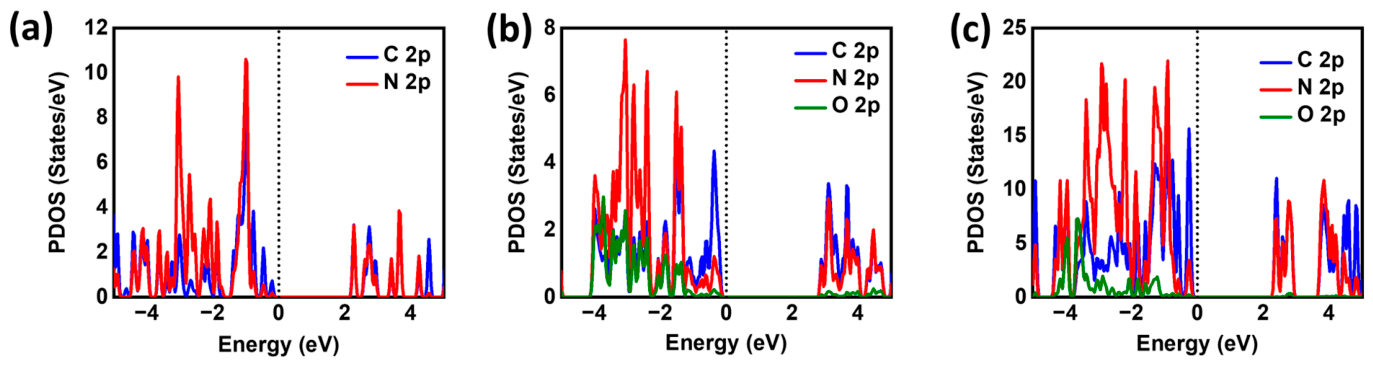
The formation of a larger energy gap can be further analysed using projected density of states (PDOS) calculations, which provide evidence for the contributions of different orbitals to the valence and conduction bands. In this section, we focus on the change in the dispersion of C 2p, N 2p, and O 2p orbitals during the dissociation of oxygen and ozone molecules on the monolayer surface. The calculated PDOS for all three structures considered is given in Figure 4. The pristine C2N monolayer exhibits an energy gap of 2.46 eV, with its CBM formed by the nitrogen ‘2p’ states and the VBM formed by a mixed contribution of carbon and nitrogen ‘2p’ states (Figure 4a). When the O2 molecule is dissociated into two oxygen atoms on the surface of the C2N, the contribution of carbon ‘2p’ states increases at the Fermi level as compared to the oxygen ‘2p’ states (Figure 4b). The conduction band is formed by an almost equal contribution of carbon and nitrogen ‘2p’ states. The ‘p’ orbital of dissociated oxygen atoms forming the C-O-C group is populated deep inside the valence band, indicating a strong hybridisation between the carbon and oxygen ‘2p’ states. Similarly, during dissociation of the ozone molecule, the C2N monolayer exhibits a strong signature of a larger band gap (2.60 eV), which is due to the hybridisation between C, N, and O p orbitals. The oxygen ‘2p’ states are populated mostly in the valence band region far from the Fermi level. The valence and conduction band states are formed by the carbon and nitrogen ‘2p’ states, respectively (Figure 4c).
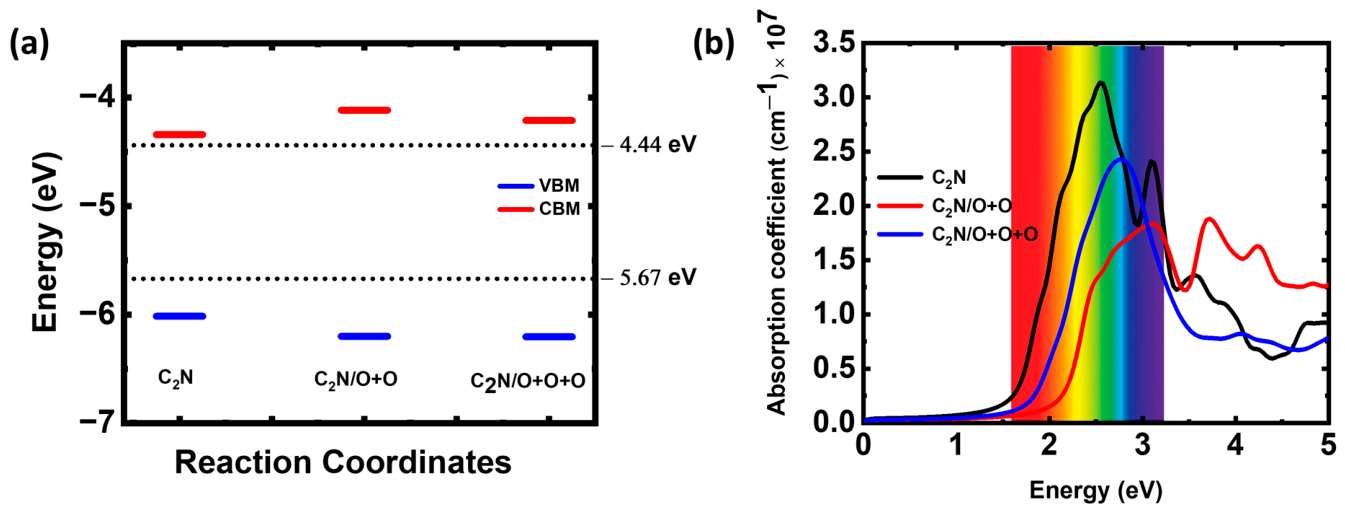
In the next section, we study the photocatalytic activity of all three configurations for water splitting by performing band-structure calculations using the HSE-06 functional. For efficient photocatalytic water splitting, the sample should satisfy the condition of appropriate band edge positions, i.e., the band edges must span the standard oxidation and reduction potentials of water. More specifically, the CBM should lie above the reduction reaction potential, and the VBM should lie below the oxidation reaction potential to execute the redox reaction. The standard oxidation and reduction potentials are −4.44 eV and −5.67 eV, respectively [19]. The band-edge positions for the pristine and dissociated configurations are shown in Figure 5. We note that the band-edge positions were independently evaluated for each configuration with respect to its own vacuum level, derived from the planar-averaged local electrostatic potential. In each case, the potential within the sufficiently large vacuum region was taken as the vacuum reference and set to zero, providing the energy baseline for determining the band-edge positions. From Figure 5a, it was observed that the band edges of all three structures straddle the water redox potential, enabling efficient separation of charge carriers and reducing recombination rates. The pristine C2N monolayer has its band edges close to the water redox potential line. In contrast, the oxidised configuration has its corresponding VBM and CBM slightly away from the water redox potential lines. However, sufficient separation between VBM and CBM opens the door to efficient photocatalytic water splitting.
In addition to the appropriate band edge position, it is equally important to verify whether the material can absorb a maximum fraction of visible light, as visible light accounts for around 42% of solar energy. Figure 5b illustrates the optical absorption coefficient for the pristine, oxygen- dissociated, and ozone-dissociated C2N monolayer as a function of energy. The plot reveals that the optical absorption edge of the pristine sample falls around 1.75 eV. It increases with photon energy and reaches a maximum at 2.37 eV. For the oxygen-dissociated configuration, the optical absorption exhibits a notable blue shift towards the visible region and falls around 2.22 eV. It has a maximum absorption at 2.81 eV. Similarly, for the ozone dissociation structure, the optical absorption edge lies around 1.86 eV, with a maximum absorption at 2.53 eV. The optical absorption spectrum of the dissociated configuration extends deep into the visible region. This notable blue shift in the absorption edge is consistent with the band-gap expansion of the oxidised structure relative to the pristine monolayer. Therefore, it is evident that the oxygen- and ozone-dissociated C2N monolayer can utilise a significant portion of visible light to generate an electron-hole pair and execute photocatalytic water dissociation.
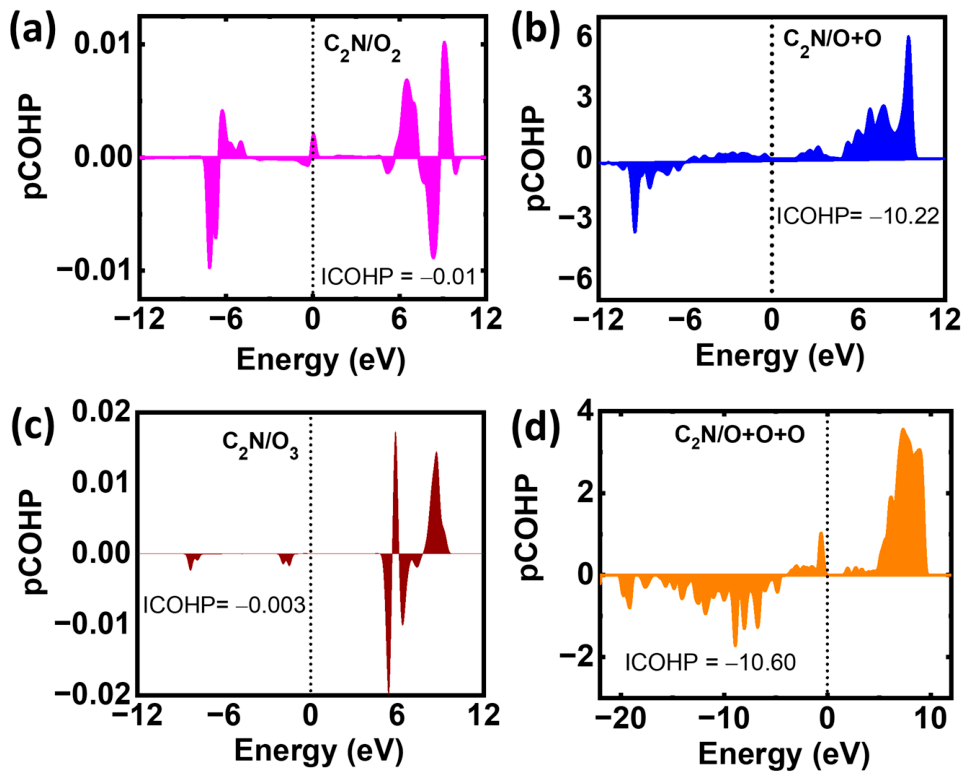
We used COHP analysis to better understand the interactions of O2 and O3 molecules with the C2N monolayer, both when adsorbed and when dissociated. The chemical bonding analysis based on the pCOHP profiles for the C–O interaction clearly distinguishes between weakly adsorbed molecules and strongly bonded dissociated forms on the C2N surface. For systems with O2 and O3 adsorbed, the pCOHP curves showed only small features near the Fermi level, and the integrated COHP (ICOHP) values of −0.01 and −0.003 eV suggest there is negligible bonding interaction, consistent with physisorption and weak coupling at the interface (Figure 6a,c). However, after dissociation, the pCOHP profiles for C2N/O+O and C2N/O+O+O showed strong bonding and antibonding states over a wide energy range (Figure 6b,d). The ICOHP values are estimated to be −10.22 and −10.60 eV for C2N/O+O and C2N/O+O+O configurations, respectively, suggesting the formation of strong covalent C–O bonds. The much higher ICOHP values in the dissociated structures suggest significant hybridisation between C 2p and O 2p orbitals, consistent with PDOS and band-structure results showing increased band gaps upon oxygen addition. Overall, the COHP results show that O2 and O3 molecules interact only weakly with pristine C2N, whereas dissociated oxygen atoms bond strongly to the surface and help stabilise oxidised configurations via strong C–O bonds. This change in bonding is important for the modified electronic structure required for photocatalytic water splitting.

4. Conclusions

In the present work, the photocatalytic activity of the C2N monolayer after oxygen and ozone dissociation was investigated using first-principles density functional theory calculations. The pristine C2N monolayer exhibits a direct band-gap semiconductor with an energy gap of 2.46 eV. During the dissociation of oxygen and ozone molecules into individual oxygen atoms on the monolayer surface, oxygen forms a strong chemical bond with carbon atoms and enhances the band gap to 3.07 eV (for the C2N/O+O configuration) and 2.60 eV (for the C2N/O+O+O configuration). The calculated band edge positions of the pristine and dissociated structures straddle the standard oxidation and reduction potentials of water, thereby satisfying the condition for photocatalytic water splitting by enabling charge-carrier separation and reducing recombination rates. The optical absorption edges of the oxygen- and ozone-dissociated structures lie in the visible region, with a robust blue shift relative to the pristine monolayer, thus enabling the use of visible light for water splitting. The COHP analysis provides further insight into the bonding and antibonding states and highlights the strong C–O orbital hybridisation, with ICOHP values increasing to −10.22 eV and −10.60 eV, respectively. The present work provides a theoretical perspective on the use of the C2N monolayer after environmental oxidation, with excellent thermal stability, and sheds light on its experimental validation for efficient water splitting aimed at sustainable hydrogen production.

Supplementary Materials

The following supporting information can be downloaded at: https://www.mdpi.com/article/10.3390/applnano7030025/s1, Table S1: Comparison of band gap (using PBE-GGA [19,22,36,37,38,39] and HSE-06 [19,22,36,40,41,42] functional) of the pristine, oxygen- and ozone-dissociated C2N monolayer with existing literature reports.

Author Contributions

Conceptualization, S.K.D., L.P., and S.S.; methodology, S.K.D., P.S., and S.S.; software, P.S., and S.S.; validation, S.K.D., D.D., L.P., P.S., and S.S.; formal analysis, S.K.D., D.D., and L.P.; investigation, S.K.D., D.D., L.P., and S.S.; resources, P.S.; data curation, S.K.D., and D.D.; writing—original draft preparation, S.K.D.; writing—review and editing, S.K.D., L.P., and S.S.; visualization, S.K.D., D.D., L.P., P.S., and S.S.; supervision, P.S., and S.S.; project administration, S.S.; All authors have read and agreed to the published version of the manuscript.

Funding

This research received no external funding.

Institutional Review Board Statement

Not applicable.

Informed Consent Statement

Not applicable.

Data Availability Statement

The data underlying the results presented in this study are available from the corresponding author upon reasonable request.

Acknowledgments

The authors gratefully acknowledge the computational resources and high-performance computing facilities provided by the National Institute of Science Education and Research (NISER), which were used to carry out this study.

Conflicts of Interest

The authors declare no conflicts of interest.

References

  1. Mahajan, P.; Khanna, V. 2D nanomaterials for photocatalytic and electrocatalytic water splitting: Transforming hydrogen production for sustainable energy. Int. J. Hydrogen Energy 2025, 145, 942–969. [Google Scholar] [CrossRef]
  2. Megía, P.J.; Vizcaíno, A.J.; Calles, J.A.; Carrero, A. Hydrogen production technologies: From fossil fuels toward renewable sources. A mini review. Energy Fuels 2021, 35, 16403–16415. [Google Scholar] [CrossRef]
  3. Nishioka, S.; Osterloh, F.E.; Wang, X.; Mallouk, T.E.; Maeda, K. Photocatalytic water splitting. Nat. Rev. Methods Prim. 2023, 3, 42. [Google Scholar] [CrossRef]
  4. Hao, J.; Li, Y.; Jia, B.; Zhang, X.; Zhang, C.; Wu, G.; Gao, S.; Ma, Y.; Zhang, B.; Lu, P. A theoretical investigation of transition metal doping-engineered MoSi2N4 materials as highly efficient photocatalysts for water splitting. Int. J. Hydrogen Energy 2024, 82, 492–501. [Google Scholar] [CrossRef]
  5. Dawood, F.; Anda, M.; Shafiullah, G. Hydrogen production for energy: An overview. Int. J. Hydrogen Energy 2020, 45, 3847–3869. [Google Scholar] [CrossRef]
  6. Li, Y.; Li, Y.-L.; Sa, B.; Ahuja, R. Review of two-dimensional materials for photocatalytic water splitting from a theoretical perspective. Catal. Sci. Technol. 2017, 7, 545–559. [Google Scholar] [CrossRef]
  7. Norskov, J.K.; Christensen, C.H. Toward efficient hydrogen production at surfaces. Science 2006, 312, 1322–1323. [Google Scholar] [CrossRef] [PubMed]
  8. Wang, R.; Kong, X.; Zhang, W.; Zhu, W.; Huang, L.; Wang, J.; Zhang, X.; Liu, X.; Hu, N.; Suo, Y.; et al. Mechanism insight into rapid photocatalytic disinfection of Salmonella based on vanadate QDs-interspersed g-C3N4 heterostructures. Appl. Catal. B Environ. 2018, 225, 228–237. [Google Scholar] [CrossRef]
  9. Huang, M.; Jiang, Y.; Luo, Z.; Wang, J.; Ding, Z.; Guo, X.; Liu, X.; Wang, Y. Transition metal doped WSi2N4 monolayer for water splitting electrocatalysts: A first-principles study. J. Phys. Condens. Matter 2023, 35, 485001. [Google Scholar] [CrossRef] [PubMed]
  10. Novoselov, K.S.; Geim, A.K.; Morozov, S.V.; Jiang, D.-E.; Zhang, Y.; Dubonos, S.V.; Grigorieva, I.V.; Firsov, A.A. Electric field effect in atomically thin carbon films. Science 2004, 306, 666–669. [Google Scholar] [CrossRef] [PubMed]
  11. Das, S.K.; Patra, L.; Samal, P.; Sahoo, P.K. Strain-Induced Enhanced Performance in 2D C2N/MoS2 Heterostructures for Photocatalytic Water Splitting: A Meta-GGA Study. ACS Appl. Electron. Mater. 2024, 6, 1415–1423. [Google Scholar] [CrossRef]
  12. Ran, J.; Guo, W.; Wang, H.; Zhu, B.; Yu, J.; Qiao, S.Z. Metal-free 2D/2D phosphorene/g-C3N4 Van der Waals heterojunction for highly enhanced visible-light photocatalytic H2 production. Adv. Mater. 2018, 30, 1800128. [Google Scholar] [CrossRef] [PubMed]
  13. Rahman, M.Z.; Raziq, F.; Zhang, H.; Gascon, J. Key strategies for enhancing H2 production in transition metal oxide based photocatalysts. Angew. Chem. Int. Ed. 2023, 62, e202305385. [Google Scholar] [CrossRef] [PubMed]
  14. Du, C.F.; Sun, X.; Yu, H.; Liang, Q.; Dinh, K.N.; Zheng, Y.; Luo, Y.; Wang, Z.; Yan, Q. Synergy of Nb doping and surface alloy enhanced on water–alkali electrocatalytic hydrogen generation performance in Ti-based MXene. Adv. Sci. 2019, 6, 1900116. [Google Scholar] [CrossRef] [PubMed]
  15. Li, N.; Chen, X.; Ong, W.-J.; MacFarlane, D.R.; Zhao, X.; Cheetham, A.K.; Sun, C. Understanding of electrochemical mechanisms for CO2 capture and conversion into hydrocarbon fuels in transition-metal carbides (MXenes). ACS Nano 2017, 11, 10825–10833. [Google Scholar] [CrossRef] [PubMed]
  16. Huang, B.; Li, N.; Ong, W.-J.; Zhou, N. Single atom-supported MXene: How single-atomic-site catalysts tune the high activity and selectivity of electrochemical nitrogen fixation. J. Mater. Chem. A 2019, 7, 27620–27631. [Google Scholar] [CrossRef]
  17. Li, Z.; Wu, Y. 2D early transition metal carbides (MXenes) for catalysis. Small 2019, 15, 1804736. [Google Scholar] [CrossRef] [PubMed]
  18. Yan, Y.; Xia, B.Y.; Zhao, B.; Wang, X.J. A review on noble-metal-free bifunctional heterogeneous catalysts for overall electrochemical water splitting. J. Mater. Chem. A 2016, 4, 17587–17603. [Google Scholar] [CrossRef]
  19. Ashwin Kishore, M.; Ravindran, P. Tailoring the electronic band gap and band edge positions in the C2N monolayer by P and As substitution for photocatalytic water splitting. J. Phys. Chem. C 2017, 121, 22216–22224. [Google Scholar] [CrossRef]
  20. Schneider, J.; Matsuoka, M.; Takeuchi, M.; Zhang, J.; Horiuchi, Y.; Anpo, M.; Bahnemann, D.W. Understanding TiO2 photocatalysis: Mechanisms and materials. Chem. Rev. 2014, 114, 9919–9986. [Google Scholar] [CrossRef] [PubMed]
  21. Rawat, A.; Patra, L.; Pandey, R.; Karna, S.P. First-principles study of the oxidation susceptibility of WS2, WSe2, and WTe2 monolayers. Nanoscale 2024, 16, 7437–7442. [Google Scholar] [CrossRef] [PubMed]
  22. Das, S.K.; Patra, L.; Samal, P.; Sahoo, P.K. Unveiling the reactivity of oxygen and ozone on C2N monolayer. Phys. Status Solidi RRL 2024, 18, 2400148. [Google Scholar] [CrossRef]
  23. Nelson, R.; Ertural, C.; George, J.; Deringer, V.L.; Hautier, G.; Dronskowski, R. LOBSTER: Local orbital projections, atomic charges, and chemical-bonding analysis from projector-augmented-wave-based density-functional theory. J. Comput. Chem. 2020, 41, 1931–1940. [Google Scholar] [CrossRef] [PubMed]
  24. Kresse, G.; Furthmüller, J. Efficient iterative schemes for ab initio total-energy calculations using a plane-wave basis set. Phys. Rev. B 1996, 54, 11169. [Google Scholar] [CrossRef] [PubMed]
  25. Blöchl, P.E. Projector augmented-wave method. Phys. Rev. B 1994, 50, 17953. [Google Scholar] [CrossRef] [PubMed]
  26. Kresse, G.; Joubert, D. From ultrasoft pseudopotentials to the projector augmented-wave method. Phys. Rev. B 1999, 59, 1758. [Google Scholar] [CrossRef]
  27. Heyd, J.; Scuseria, G.E.; Ernzerhof, M. Hybrid functionals based on a screened Coulomb potential. J. Chem. Phys. 2003, 118, 8207–8215. [Google Scholar] [CrossRef]
  28. Grimme, S. Semiempirical GGA-type density functional constructed with a long-range dispersion correction. J. Comput. Chem. 2006, 27, 1787–1799. [Google Scholar] [CrossRef] [PubMed]
  29. Wang, V.; Xu, N.; Liu, J.-C.; Tang, G.; Geng, W.-T. VASPKIT: A user-friendly interface facilitating high-throughput computing and analysis using VASP code. Comput. Phys. Commun. 2021, 267, 108033. [Google Scholar] [CrossRef]
  30. Li, Z.; Zhou, P.; Yan, Q.; Peng, X.; Ma, Z.; Sun, L. Second-order topological insulator in two-dimensional C2N and its derivatives. Phys. Rev. B 2022, 106, 085126. [Google Scholar] [CrossRef]
  31. Zhang, R.; Li, B.; Yang, J. Effects of stacking order, layer number and external electric field on electronic structures of few-layer C2N-h 2D. Nanoscale 2015, 7, 14062–14070. [Google Scholar] [CrossRef] [PubMed]
  32. Mahmood, J.; Lee, E.K.; Jung, M.; Shin, D.; Jeon, I.-Y.; Jung, S.-M.; Choi, H.-J.; Seo, J.-M.; Bae, S.-Y.; Sohn, S.-D.; et al. Nitrogenated holey two-dimensional structures. Nat. Commun. 2015, 6, 6486. [Google Scholar] [CrossRef] [PubMed]
  33. Liang, Z.; Xu, B.; Xiang, H.; Xia, Y.; Yin, J.; Liu, Z. Carrier-tunable magnetism in two dimensional graphene-like C2N. RSC Adv. 2016, 6, 54027–54031. [Google Scholar] [CrossRef]
  34. Nosé, S. A unified formulation of the constant temperature molecular dynamics methods. J. Chem. Phys. 1984, 81, 511–519. [Google Scholar] [CrossRef]
  35. Hoover, W.G. Canonical dynamics: Equilibrium phase-space distributions. Phys. Rev. A 1985, 31, 1695. [Google Scholar] [CrossRef] [PubMed]
  36. Ma, Z.; Wang, S.; Li, C.; Wang, F. Strain engineering for C2N/Janus monochalcogenides van der Waals heterostructures: Potential applications for photocatalytic water splitting. Appl. Surf. Sci. 2021, 536, 147845. [Google Scholar] [CrossRef]
  37. Slassi, A. Band offset engineering at C2N/MSe2 (M = Mo, W) interfaces. RSC Adv. 2022, 12, 12068–12077. [Google Scholar] [CrossRef] [PubMed]
  38. Chen, Z.; Li, X.; Yang, J. The contacts of the monolayer semiconductor C2N with 2D metal electrodes. Adv. Theory Simul. 2019, 2, 1800161. [Google Scholar] [CrossRef]
  39. Qin, G.-Q.; Du, A.-J.; Sun, Q. Charge- and electric-field-controlled switchable carbon dioxide capture and gas separation on a C2N monolayer. Energy Technol. 2018, 6, 205–212. [Google Scholar] [CrossRef]
  40. Yu, S.; Rao, Y.-C.; Duan, X.-M. Modulating the properties of monolayer C2N: A promising metal-free photocatalyst for water splitting. Chin. Phys. B 2017, 26, 087301. [Google Scholar] [CrossRef]
  41. Zhang, X.; Chen, A.; Zhang, Z.; Jiao, M.; Zhou, Z. Rational design of C2N-based type-II heterojunctions for overall photocatalytic water splitting. Nanoscale Adv. 2019, 1, 154–161. [Google Scholar] [CrossRef] [PubMed]
  42. Zhang, X.; Chen, A.; Zhang, Z.; Jiao, M.; Zhou, Z. Transition metal anchored C2N monolayers as efficient bifunctional electrocatalysts for hydrogen and oxygen evolution reactions. J. Mater. Chem. A 2018, 6, 11446–11452. [Google Scholar] [CrossRef]
Figure 1. Schematic representation of the (a,f) pristine, (b,g) oxygen-adsorbed, (c,h) oxygen-dissociated, (d,i) ozone-adsorbed, and (e,j) ozone-dissociated C2N monolayer. The top and bottom panels represent the top and side views of the corresponding structures. The color codes for the atoms are: brown—carbon, grey—nitrogen, and red—oxygen.
Applnano 07 00025 g001
Figure 2. AIMD simulation result (at T = 300 K) for the (a) pristine, (b) oxygen-dissociated, and (c) ozone-dissociated C2N monolayer. The relaxed structures after the simulation are given as insets. The colour codes for the atoms are the same as those utilised in Figure 1.
Applnano 07 00025 g002
Figure 3. Electronic band structure (using HSE-06 functional) for the (a) pristine, (b) oxygen-dissociated, and (c) ozone-dissociated C2N monolayer. The dotted horizontal line represents the Fermi level, which was set to zero.
Applnano 07 00025 g003
Figure 4. Projected density of states (using HSE-06 functional) for the (a) pristine, (b) oxygen-dissociated, and (c) ozone-dissociated C2N monolayer. The dotted vertical line represents the Fermi level, which was set to zero.
Applnano 07 00025 g004
Figure 5. (a) Band edge positions and (b) optical properties of pristine, oxygen-dissociated, and ozone-dissociated C2N monolayers.
Applnano 07 00025 g005
Figure 6. Crystal Orbital Hamiltonian Population of the C-O bond in (a) oxygen-adsorbed, (b) oxygen-dissociated, (c) ozone-adsorbed, and (d) ozone-dissociated C2N monolayer.
Applnano 07 00025 g006
Disclaimer/Publisher’s Note: The statements, opinions and data contained in all publications are solely those of the individual author(s) and contributor(s) and not of MDPI and/or the editor(s). MDPI and/or the editor(s) disclaim responsibility for any injury to people or property resulting from any ideas, methods, instructions or products referred to in the content.