1. Introduction
The transition to electrification in the commercial vehicle sector has made lightweight design a critical technology for extending driving range and improving energy efficiency. However, structural lightweighting must be predicated on strictly meeting international industry standards, such as EN12663 [
1] and EN15227 [
2], regarding stiffness, static strength, and crashworthiness. To address the conflict between high structural rigidity and low mass, structural optimization remains the most cost-effective and mainstream approach in the automotive industry.
In the realm of structural optimization, a complete lightweighting process typically requires multi-dimensional synergy. In the conceptual design phase, macroscopic topology optimization has been extensively applied to eliminate structural redundancy. For instance, Uçak et al. [
3] performed topology optimization on the lower control arm of an independent suspension, achieving a 46% weight reduction. Shreeshail et al. [
4] conducted modal and stiffness analysis on a subframe, realizing a 9% mass optimization. The foundational topology optimization theory established by Bendsøe et al. [
5] has provided robust mathematical bases for identifying the main load transfer paths and reconstructing foundational structures.
However, while topology optimization successfully establishes an efficient macroscopic structural framework, the subsequent detailed design phase—specifically, the collaborative size optimization of hundreds of interconnected sheet metal thickness parameters—still faces severe challenges. [
6] Direct optimization in such a massive full-scale vehicle space inevitably triggers the “curse of dimensionality”, leading to prohibitive computational costs. To alleviate this, global sensitivity analysis methods, such as analysis of variance (ANOVA), have been introduced to conduct high-dimensional feature engineering and precise dimensionality reduction [
7].
While dimensionality reduction effectively alleviates the computational burden, it simultaneously exposes a critical risk when exploring extreme lightweighting boundaries. Static surrogate models trained on initial sampling data exhibit high global accuracy but often suffer from severe extrapolation errors when approaching extreme physical boundaries characterized by sparse samples [
8]. This severe epistemic uncertainty leads to over-optimistic predictions regarding structural stiffness, causing optimization algorithms to fall into “pseudo-optimal” traps [
9,
10]. Consequently, solutions that appear optimal in mathematical surrogate models frequently suffer catastrophic structural failures during high-fidelity physical validation.
To fundamentally eliminate the epistemic uncertainty and prediction distortion of static surrogate models in extreme regions, data-driven strategies based on active learning have shown tremendous potential [
11,
12]. By introducing sequential approximate optimization (SAO) mechanisms, optimization systems can adaptively handle highly nonlinear engineering constraints and achieve high-precision model reconstruction [
13,
14,
15].
Taking the carbon steel frame of a distributed-drive vehicle body as the research object, this paper proposes a “Macroscopic Topology—Microscopic Data-Driven Size Synergy” lightweighting methodology. The main contributions are as follows:
- (1)
In the macroscopic phase, the main load transfer paths are identified to perform topology optimization on the underlying skeleton, achieving preliminary weight reduction.
- (2)
In the microscopic phase, a global ANOVA mechanism is introduced to conduct feature engineering, reducing the massive design space to core thickness features.
- (3)
A data-driven SAO closed-loop mechanism based on active learning is innovatively proposed to eliminate the constraint evasion caused by extrapolation errors, reconstructing an adaptive surrogate model with strong anti-distortion capability.
By integrating macroscopic topological reconstruction and microscopic SAO correction, this paper achieves a significant reduction in vehicle body weight while strictly meeting the EN12663 and EN15227 standards. This study provides a theoretically guiding and engineeringly practical solution for the lightweight development of similar complex load-bearing structures.
2. The Proposed Data-Driven SAO Methodology
Traditional vehicle body lightweighting optimizations often rely on an open-loop paradigm: “single sampling → static surrogate modeling → global optimization”. However, when facing the highly nonlinear physical responses of complex distributed-drive buses, static black-box models struggle to accurately map the physical evolution at extreme boundaries, often leading to extrapolation errors. To fundamentally overcome this limitation, this paper proposes a comprehensive data-driven closed-loop framework, encompassing data generation, feature dimensionality reduction, active learning, and adaptive model evolution.
2.1. Overview of the Data-Driven Closed-Loop Framework
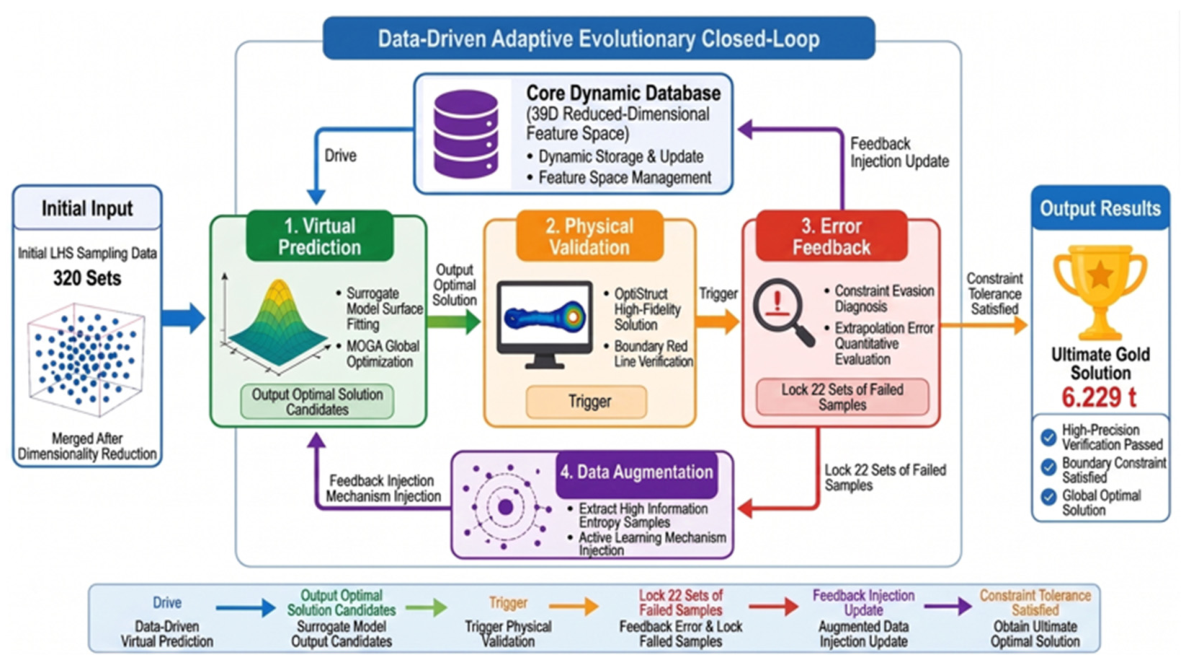
To eliminate the epistemic uncertainty inherent in static surrogate models, the proposed methodology breaks the unidirectional path of conventional computer-aided engineering (CAE) optimization. By introducing an error feedback mechanism, a dynamic data-driven closed-loop is established, as illustrated in
Figure 1.
The framework utilizes a core feature space, obtained through global sampling and dimensionality reduction, as the underlying dynamic data foundation. During the evolutionary loop, the system first conducts “Virtual Prediction” based on the surrogate model and drives a multi-objective genetic algorithm (MOGA) for global optimization. The generated Pareto extreme candidate solutions are then subjected to “Finite Element Verification” using high-fidelity solvers. If a deviation between mathematical prediction and physical reality is diagnosed (i.e., constraint evasion), the “Error Feedback” hub is triggered. Finally, through “Data Augmentation”, these boundary samples with high information entropy are injected back into the database as active learning materials to drive the reconstruction of the adaptive model.
2.2. Feature Engineering and Dimensionality Reduction via ANOVA
From a data-driven perspective, the initial sheet metal thickness parameters of a full-scale vehicle body constitute a massive high-dimensional feature space. Directly training machine learning models in this space easily triggers the “curse of dimensionality” and severe overfitting. To obtain a high-quality data foundation, this study employs the global analysis of variance (ANOVA) mechanism for precise feature engineering and dimensionality reduction, effectively reducing the design space from 169 initial variables to 39 core features.
By quantitatively analyzing the variance contribution and effective degrees of freedom (DOF) of each dimensional variable, the system profoundly reveals their intrinsic mechanisms on the macroscopic physical responses. As presented in
Table 1, the ANOVA results not only identified the primary load-bearing components with overwhelming variance contributions but also highlighted significant structural coupling effects. For instance, adjacent thin-walled components such as PSHELL_T_81 and PSHELL_T_107 (Corresponding to T 81 and T 107 in the table) exhibit strong joint action mechanisms during stress transfer and deformation coordination, thereby sharing a single DOF. Through this rigorous statistical evaluation, the system successfully filters out the long-tail data noise—where a massive number of variables occupying residual DOFs contribute minimally to the overall mechanical performance.
This feature engineering operation significantly compresses the data dimensionality, extracting the core feature parameters and substantially improving the signal-to-noise ratio (SNR) of the underlying dataset, thereby laying a pure data foundation for constructing high-generalization models.
2.3. Active Learning and SAO-Based Adaptive Evolution
In extreme lightweighting regions, sparse data density near the constraint boundaries leads to high epistemic uncertainty in the initial Latin Hypercube Sampling (LHS). Consequently, the surrogate model produces severe extrapolation errors. The extreme solutions that fail high-fidelity Finite Element Verification are not traditional optimization failures, but inevitable by-products of data-driven algorithms exploring unknown constraint boundaries.
Extracting these failed boundary samples for reverse injection perfectly aligns with the mechanism of active learning in artificial intelligence. As shown in
Table 2, these boundary samples, situated on the verge of physical structural collapse, possess extremely distinct features of high error and abrupt mutation, representing high information entropy. Consequently, these failed boundary samples play a critical role in model updating.
Driven by these high-entropy samples, the reconstruction of the second-generation model is no longer a simple static curve fitting, but an adaptive model evolution based on error feedback. The sequential approximate optimization (SAO) acts as an intelligent decision-maker in this process. By continuously assimilating boundary data containing actual physical laws, the algorithm shifts from “overfitting known regions” to “accurately identifying unknown physical boundaries”, ultimately realizing a high-fidelity mapping of complex nonlinear surfaces.
3. Macroscopic Method Validation on a Simplified Body
According to the proposed synergistic methodology, directly conducting optimization on the full-scale complex vehicle body is computationally prohibitive and inefficient due to the severe interference from non-structural components on the load transfer path analysis. Therefore, to verify the fundamental mechanism of the proposed strategy, this study first extracted the bare load-bearing carbon steel skeleton to serve as the “Simplified Body” for preliminary validation.
3.1. Definition of the Simplified Body Model
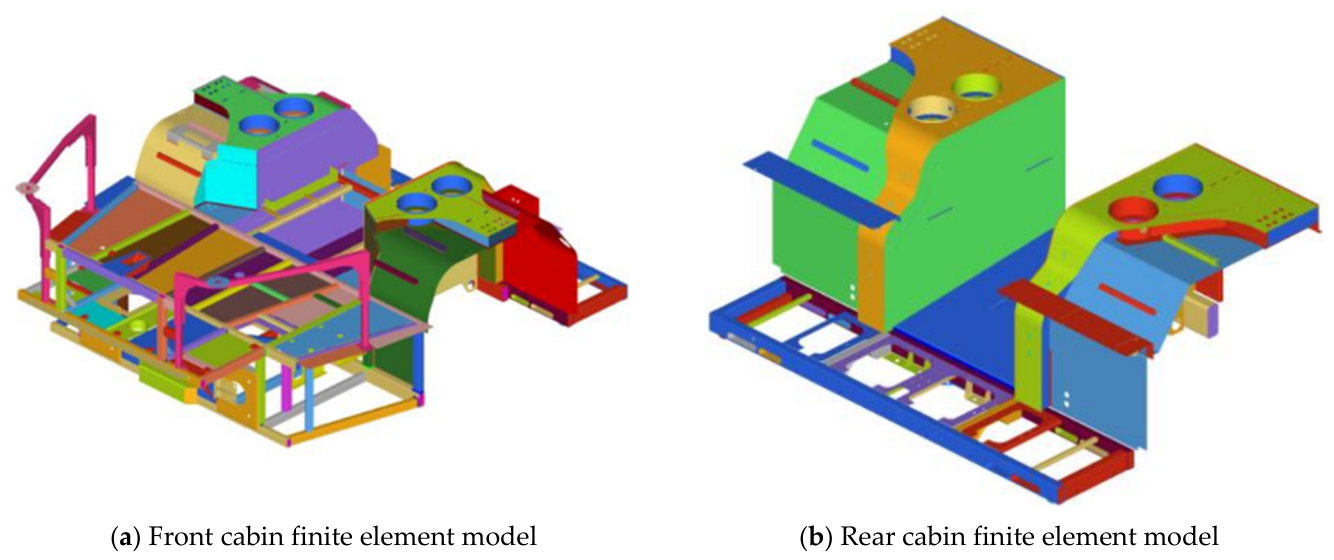
To isolate the primary load-bearing characteristics, all non-structural masses (e.g., decorative panels, glass, and accessories) were excluded. The finite element (FE) model of this simplified pure carbon steel skeleton was established using shell elements. The initial mass of this simplified skeleton was 2835.8 kg, as shown in
Figure 2.
To ensure the reproducibility of the finite element simulations, it is essential to specify the fundamental material properties. In linear static torsional stiffness analysis, various grades of structural steels and lightweight alloys share identical macroscopic elastic properties within their respective categories. Therefore, based on the actual industrial bill of materials (BOM) of the distributed-drive bus, the materials used in the complex FE model were categorized into representative material types. The mechanical properties of these dominant materials are summarized in
Table 3.
3.2. Three-Dimensional Synergistic Optimization Strategy
To systematically reduce the weight of this simplified body, a hierarchical “Macroscopic–Mesoscopic–Microscopic” 3D synergistic optimization strategy is executed, corresponding to topology, shape, and size optimizations, respectively:
Structural irrationalities, such as load flow blockages and local stress concentrations, are identified through displacement fields and strain energy density. By adding reinforcement ribs and improving connections, the interrupted load transfer paths are smoothed, laying a reasonable mechanical foundation for subsequent optimization.
- 2.
Mesoscopic Level: Morphology Reconstruction Guided by Topology Optimization.
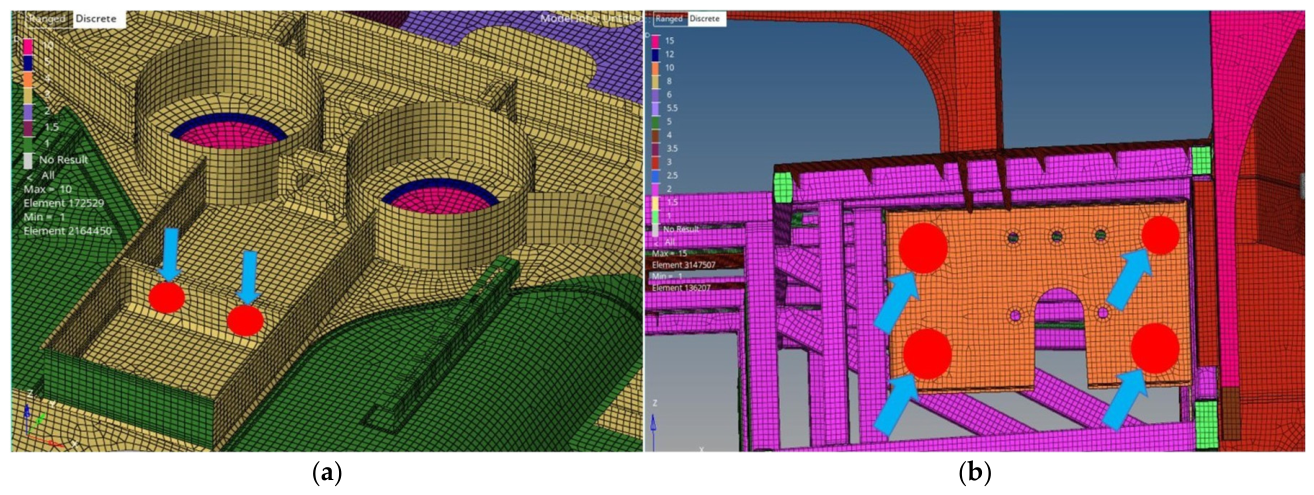
With clarified load paths, the solid isotropic material with penalization (SIMP) method is adopted to guide the morphology reconstruction. Two typical weight-reduction strategies are executed: boundary trimming for non-load-bearing external areas and array-hole generation for low-stress internal areas. This transforms the “theoretical optimal shape” into an engineering-manufacturable structure. Typical applications of the array-hole generation strategy are illustrated in
Figure 3, the specific locations of the array holes are marked by blue arrows.
- 3.
Microscopic Level: Parameter Fine-Tuning Based on Linear Sensitivity.
For the simplified skeleton with a limited number of variables, a traditional relative sensitivity analysis combined with the TOPSIS method is utilized to locally adjust the thickness of specific parts, achieving a preliminary and precise material distribution.
3.3. Results of the Simplified Body Validation
The 3D synergistic optimization on the simplified body effectively validates the fundamental stage of the proposed methodology. After removing the structural redundancy, the net mass of the carbon steel skeleton was significantly reduced from 2835.8 kg to 2566.9 kg, as shown in
Table 4.
This validation process achieves an absolute weight reduction of 268.9 kg (a 9.4% mass decrease). It proves that the fundamental topology strategy works efficiently for a simple structure with a limited number of variables.
3.4. Limitations on Complex Bodies and Methodological Upgrade
While the traditional linear sensitivity analysis in the “Microscopic Level” successfully handles the fine-tuning of the simplified skeleton, directly extending this local approach to the fully assembled complex vehicle body exposes significant bottlenecks.
The fully assembled vehicle model contains over 400 components (e.g., 441 parts under torsional conditions). Even after an initial engineering screening that selects 169 critical structural thickness variables, the design space remains massively high-dimensional. These 169 interdependent variables introduce severe high-dimensional coupling and nonlinear responses. In stark contrast to its performance on the simplified body, traditional local linear sensitivity analysis fails to capture the global nonlinearity within such a massive feature space. This inevitably leads to the “curse of dimensionality” and severe extrapolation prediction errors.
To overcome the inefficiency and inaccuracy of traditional methods when applied to extremely complex structures, it is imperative to upgrade the microscopic strategy from a “traditional local sensitivity approach” to a “global data-driven adaptive evolution mechanism”. This necessity leads directly to the core contribution of this paper: the application of the data-driven SAO methodology on the full complex vehicle body, which will be detailed in the subsequent sections.
4. Microscopic Data-Driven SAO Application on the Complex Vehicle Body
As established in
Section 3, while macroscopic topology optimization effectively reduces the mass of the simplified bare skeleton, the subsequent size optimization on the fully assembled vehicle body introduces a massive high-dimensional feature space. To overcome the significant bottlenecks of traditional linear methods, the proposed data-driven sequential approximate optimization (SAO) methodology was applied to the complex full vehicle body.
4.1. Mathematical Model and Feature Dimensionality Reduction
Before initiating the surrogate modeling and intelligent optimization, the mathematical description and acceptance criteria of the collaborative optimization must be explicitly defined. The core objective is to maximize mass reduction while ensuring that the torsional stiffness does not significantly deteriorate. To align with engineering acceptance, a 20% tolerance boundary was strictly applied to the displacement metrics. Moreover, the accuracy threshold (
) for the surrogate model was set to 0.90 to ensure mapping reliability. The defined multi-objective optimization mathematical model is presented in
Table 5.
The fully assembled distributed-drive bus model incorporates 169 critical sheet metal thickness parameters. Initially, a surrogate model encompassing all 169 dimensions was tentatively evaluated. However, as demonstrated in
Table 6, the diagnostic results of this full-dimensional initial model were severely non-compliant with the expected 0.90 threshold, confirming that the “curse of dimensionality” leads to unacceptable modeling errors and overfitting in high-dimensional spaces.
To mitigate this dimensional bottleneck, the ANOVA mechanism (theoretically detailed in
Section 2.2) was applied. By evaluating the actual engineering sensitivity weights of each feature variable, the system successfully filters out 130 long-tail noise variables. Consequently, the design space is precisely reduced to 39 core feature dimensions (
Table 7)
To define the sampling boundaries for the subsequent intelligent optimization, an asymmetric variation range—spanning from 30% to 130% of the initial thickness—is established for these 39 core variables. Furthermore, to ensure engineering manufacturability and prevent local structural instability, a strict absolute minimum lower bound of 0.6 mm was imposed across all variables. This purified and physically constrained 39-dimensional design space serves as a highly efficient foundation for the subsequent optimization database.
4.2. Identification of Extrapolation Errors in Static Surrogate Models
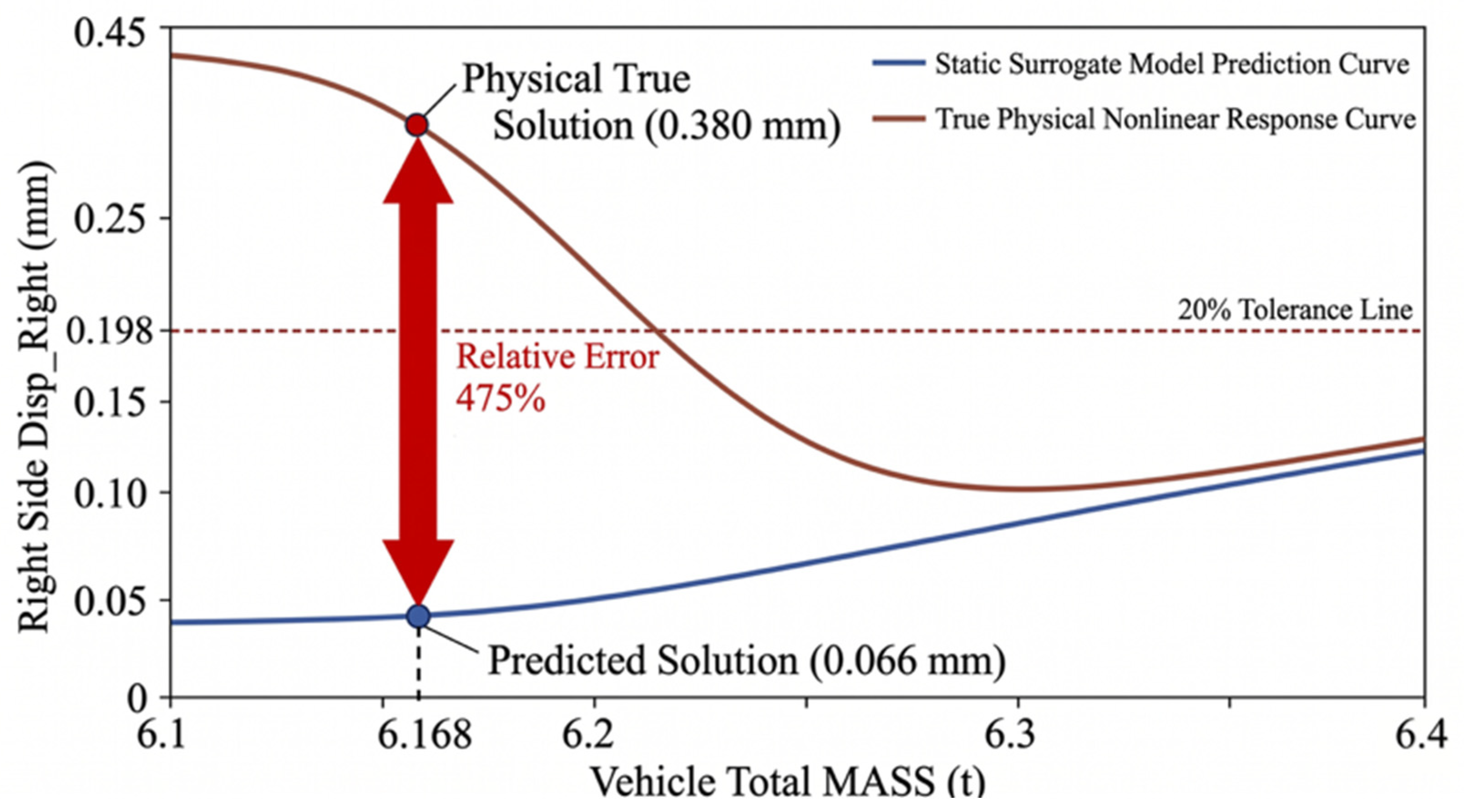
Based on the purified 39-dimensional feature space, an initial static surrogate model (Fit 1) was constructed using optimal Latin Hypercube Sampling (LHS). Driven by a multi-objective genetic algorithm (MOGA), a preliminary extreme lightweighting solution was mathematically identified at 6.168 t. However, when subjected to high-fidelity Finite Element Verification, the physical validation revealed a relative error of up to 475% in local displacement, indicating a severe constraint evasion.
To dissect the underlying mathematical mechanism of this discrepancy, the predictive behavior of the surrogate model near the extreme physical boundaries is illustrated in
Figure 4.
As observed in
Figure 4, within the conventional mass interval (right side), the smooth prediction curve highly aligns with the true physical response. However, as the optimization target continuously approaches the extreme boundary region (left side), the nonlinear characteristics abruptly erupt, breaking through the 20% engineering tolerance red line. Restricted by the scarcity of training samples in this extreme region, the static surrogate model erroneously adopts the linear gradient from the conventional region to blindly fit the nonlinear abrupt changes. This severe extrapolation error causes the prediction curve to falsely lurk below the safety threshold, tricking the algorithm into recognizing structurally failed regions as “pseudo-optimal” solutions.
4.3. Data Augmentation and SAO-Based Adaptive Evolution
To fundamentally eliminate the extrapolation errors observed in Fit 1, the active learning mechanism of the SAO framework is triggered. The physical validation identifies 22 extreme boundary solutions that suffer from constraint evasion. The data-driven system extracts them as high-information-entropy boundary samples (refer to the theoretical characteristics detailed in
Section 2.3) and reversely injects them into the underlying database.
Driven by this augmented active learning dataset, the system adaptively reconstructs the second-generation surrogate model (Fit 2). To rigorously evaluate the generalization performance, a cross-validation mechanism is utilized. The comprehensive accuracy comparison before and after the SAO correction is presented in
Table 8.
As demonstrated in
Table 8, by continuously assimilating the physical laws from the high-information-entropy boundary samples, Fit 2 successfully corrects the prediction distortion. Notably, the
value for the highly nonlinear stiffness response is elevated to approach the 0.90 threshold, demonstrating a significant improvement over Fit 1. This evolution guarantees a high-fidelity mapping of the unknown physical boundaries.
4.4. Final Synergistic Optimization Results and Verification
Relying on the highly robust Fit 2 adaptive model, the ultimate collaborative size optimization is executed within the strict 20% stiffness tolerance constraint defined in
Section 4.1.
The SAO closed-loop mechanism successfully navigates away from the “pseudo-optimal” traps and secures the true Pareto optimal solution. The final synergistic optimization reduces the total mass of the fully assembled vehicle body from the initial baseline of 6394.9 kg to 6229.3 kg, the detailed optimization results are presented in
Table 9.
This microscopic optimization achieved an absolute mass reduction of 165.6 kg (2.59% decrease) on the highly constrained complex vehicle body. When combined with the macroscopic topological reduction achieved on the simplified skeleton, the proposed strategy yielded exceptionally significant weight savings. The data-driven SAO methodology successfully excavates the extreme lightweighting potential while guaranteeing absolute structural reliability.
5. Conclusions
To address the critical challenges of high-dimensional coupling and prediction distortion in the lightweight design of complex distributed-drive vehicle bodies, this paper established a multi-dimensional “Macroscopic Topology—Microscopic Data-Driven Size Synergy” optimization framework. By integrating physical structural mechanics with data-driven active learning mechanisms, the inherent extrapolation errors of static models were effectively rectified. The primary conclusions are drawn as follows:
- (1)
Macroscopic Fundamental Optimization: A hierarchical “Topology–Shape–Size” strategy was implemented on the simplified bare carbon steel skeleton. By identifying the primary load transfer paths via strain energy density and executing morphology reconstruction through the SIMP method, structural redundancy was systematically eliminated. This foundational stage reduced the skeleton mass from 2835.8 kg to 2566.9 kg (a 9.4% reduction), establishing a highly efficient underlying architecture for subsequent optimization.
- (2)
Feature Dimensionality Reduction: To overcome the “curse of dimensionality” in the fully assembled complex vehicle body, a global ANOVA mechanism was introduced. By quantitatively evaluating the variance contributions and structural coupling effects (shared DOFs) of 169 initial thickness variables, the system successfully pruned 130 long-tail noise variables. This precise dimensionality reduction compressed the design space to 39 core dimensions, substantially improving the computational efficiency and the signal-to-noise ratio (SNR) of the underlying dataset, thereby enhancing model robustness.
- (3)
Adaptive Evolution and Error Elimination: The physical verification exposed a severe constraint evasion with up to a 475% local displacement error in the static surrogate model, profoundly revealing the mechanism of extrapolation errors at extreme boundaries. By extracting 22 high-information-entropy boundary samples and triggering the SAO active learning closed-loop, the adaptive surrogate model was reconstructed. This process completely rectified the prediction distortion, elevating the model’s accuracy () to approach the 0.90 reliability threshold.
- (4)
Ultimate Synergistic Lightweighting: Driven by the robust SAO mechanism, the optimization algorithm successfully bypassed “pseudo-optimal” traps to secure the true Pareto optimal solution. The final collaborative optimization reduced the full vehicle mass from 6395.0 kg to 6229.4 kg (an absolute reduction of 165.6 kg, or 2.59%) while strictly adhering to the 20% stiffness tolerance mandated by the EN12663 and EN15227 standards.
In conclusion, the proposed data-driven SAO methodology not only unlocks the extreme lightweighting potential of highly constrained complex systems, but also establishes a reliable, closed-loop paradigm for resolving epistemic uncertainties in modern structural optimization. Future work will focus on the experimental validation of the proposed methodology on full-scale physical prototypes under dynamic operating conditions.
Author Contributions
Conceptualization, Y.W. and C.Z.; methodology, H.L.; validation, Y.W., Z.H. and C.Z.; formal analysis, Y.W. and C.Z.; investigation, H.L.; resources, Y.W.; data curation, Z.H.; writing—original draft preparation, Y.W.; writing—review and editing, Z.H., C.Z. and H.L.; visualization, C.Z. and H.L.; supervision, Z.H.; project administration, Y.W. and Z.H.; funding acquisition, Z.H. All authors have read and agreed to the published version of the manuscript.
Funding
The authors of this study are thankful for the support of Guangxi Major Science and Technology Project (AB23026104) and Guangxi Key Research and Development Program (AB23075213).
Institutional Review Board Statement
Not applicable.
Informed Consent Statement
Not applicable.
Data Availability Statement
The original contributions presented in this study are included in the article. Further inquiries can be directed to the corresponding author.
Conflicts of Interest
Author Chenlin Zhang and Hao Liu were employed by the company Hunan CRRC Zhixing Technology Co., Ltd. The remaining authors declare that the research was conducted in the absence of any commercial or financial relationships that could be construed as a potential conflict of interest.
Abbreviations
The following abbreviations are used in this manuscript:
| BS-LPD max | Bending Stiffness Loading Point Max Displacement |
| TS-LPD max | Torsional Stiffness Loading Point Max Displacement |
| TS-LPD min | Torsional Stiffness Loading Point Min Displacement |
| VC-LSP | Vertical Condition Local Stress Point |
| CC-LSP | Cornering Condition Local Stress Point |
| EBC-LSP | Emergency Braking Condition Local Stress Point |
| OSW | Optimization Space Weight |
References
- EN 12663; Railway Applications—Structural Requirements of Railway Vehicle Bodies. European Committee for Standardization (CEN): Brussels, 2010; pp. 1–50.
- EN 15227; Railway Applications—Crashworthiness Requirements for Railway Vehicle Bodies. European Committee for Standardization (CEN): Brussels, 2020; pp. 1–45.
- Uçak, M.E.; Cengiz, A. Independent front suspension lower control arm design with topology optimization approach for electric light-duty vehicle. Int. J. Automot. Eng. Technol. 2025, 14, 77–85. [Google Scholar] [CrossRef]
- Shreeshail, M.L.; Santosh, B.; Gireesha, R.C.; Raju, G.U.; Krishnaraja, G.K.; Kotturshettar, B.B. Finite element analysis of light motor vehicle subframe for mass optimization. In Proceedings of the 8th Annual International Seminar on Trends in Science and Science Education (AISTSSE 2021), Coimbatore, India, 23–25 July 2021; pp. 123–130. [Google Scholar]
- Bendsøe, M.P.; Sigmund, O. Topology Optimization: Theory, Methods, and Applications; Springer: Berlin/Heidelberg, Germany, 2003; pp. 1–370. [Google Scholar]
- Veiga, S.D. Kernel-based ANOVA decomposition and Shapley effects—Application to global sensitivity analysis. J. Comput. Appl. Math. 2021, 392, 113–125. [Google Scholar]
- Miller, R.L.; Acton, C.; Fullerton, D.A.; Maltby, J.; Campling, J. Analysis of Variance (Anova). In The SAGE Encyclopedia of Research Design; Routledge: Oxon, UK, 2022; pp. 1–5. [Google Scholar]
- Forrester, A.I.; Keane, A.J. Recent advances in surrogate-based optimization. Prog. Aerosp. Sci. 2009, 45, 50–79. [Google Scholar] [CrossRef]
- Jin, Y. Surrogate-assisted evolutionary computation: Recent advances and future challenges. Swarm Evol. Comput. 2011, 1, 61–70. [Google Scholar] [CrossRef]
- Lang, J.; Przybytek, M.; Lesiuk, M. Estimating the Complete Basis Set Extrapolation Error through Random Walks. J. Phys. Chem. Lett. 2025, 16, 4952–4961. [Google Scholar] [CrossRef] [PubMed]
- Zhan, X.; Wang, Y.; Chan, A.B. Asymptotic optimality for active learning processes. In Proceedings of the Conference on Uncertainty in Artificial Intelligence, Eindhoven, The Netherlands, 1–5 August 2022. [Google Scholar]
- Zhang, M.; Zhang, Z.; Xia, S.; Li, X.; Yao, Q.; Yin, Z. An active learning strategy of reliability-based design and optimization by parallel adaptive sequential importance candidate region method. Struct. Multidiscip. Optim. 2024, 67, 14. [Google Scholar] [CrossRef]
- Wang, H.; Jin, Y.; Doherty, J. Committee-based active learning for surrogate-assisted particle swarm optimization of computationally expensive problems. IEEE Trans. Cybern. 2017, 47, 2664–2677. [Google Scholar] [CrossRef] [PubMed]
- Li, S.; Wang, D.J.; Wang, S.; Zhou, C. Structure-connection-performance integration lightweight optimization design of multi-material automotive body skeleton. Struct. Multidiscip. Optim. 2023, 66, 198. [Google Scholar] [CrossRef]
- Chen, H.; Lu, C.; Feng, L.; Liu, Z.; Sun, Y.; Chen, W. Structural optimization design of BIW using NSGA-III and entropy weighted TOPSIS methods. Adv. Mech. Eng. 2023, 15. [Google Scholar] [CrossRef]
| Disclaimer/Publisher’s Note: The statements, opinions and data contained in all publications are solely those of the individual author(s) and contributor(s) and not of MDPI and/or the editor(s). MDPI and/or the editor(s) disclaim responsibility for any injury to people or property resulting from any ideas, methods, instructions or products referred to in the content. |