Novel Design and Optimization of Aircraft Stiffened Panels for Improved Critical Buckling Load Resistance

 ,
, 
 and
and
Abstract
1. Introduction
2. Statistical Methods
2.1. Design of Experiments
2.2. Box–Behnken Experimental Design
2.3. Mathematical Background of Response Surface Methodology
2.4. Genetic Algorithm (GA)
- (i)
- Design Encoding: The initial and most critical step is encoding the design variables (the stiffener geometry and layout) into a digital format, often referred to as a chromosome. This sequence represents the genetic blueprint for a single candidate solution (a stiffened plate design). While binary coding is the foundational method, real-valued encoding is frequently used in complex engineering applications to directly represent the continuous dimensions of the stiffeners, such as height, thickness, and spacing.
- (ii)
- Population Initialization: A diverse, randomized initial population of stiffened plate designs is generated to begin the search. This step ensures that the algorithm explores many different designs, which helps prevent it from getting stuck on a poor solution early on, prevents premature convergence to a local optimum, and ensures a comprehensive search of the entire design space.
- (iii)
- Fitness Evaluation: Each individual in the population is assessed based on its performance against the design objective. In the context of plate stability, the critical buckling load is calculated by Finite Element Analysis (FEA) and serves as the fitness function. A higher critical buckling load indicates a fitter individual, resulting in a higher likelihood of selection for reproduction.
- (iv)
- Selection Operator: According to the calculation of the fitness value of the previous step, the individuals that are demonstrating superior fitness (i.e., those with a higher critical buckling load) are chosen to become “parents.” The goal is to preferentially select the “best” genes for inheritance by the next generation. Common selection strategies, such as the betting wheel (or roulette wheel) method, are used to ensure that while top performers are favored, less-fit individuals are retained with a low probability, maintaining genetic diversity.
- (v)
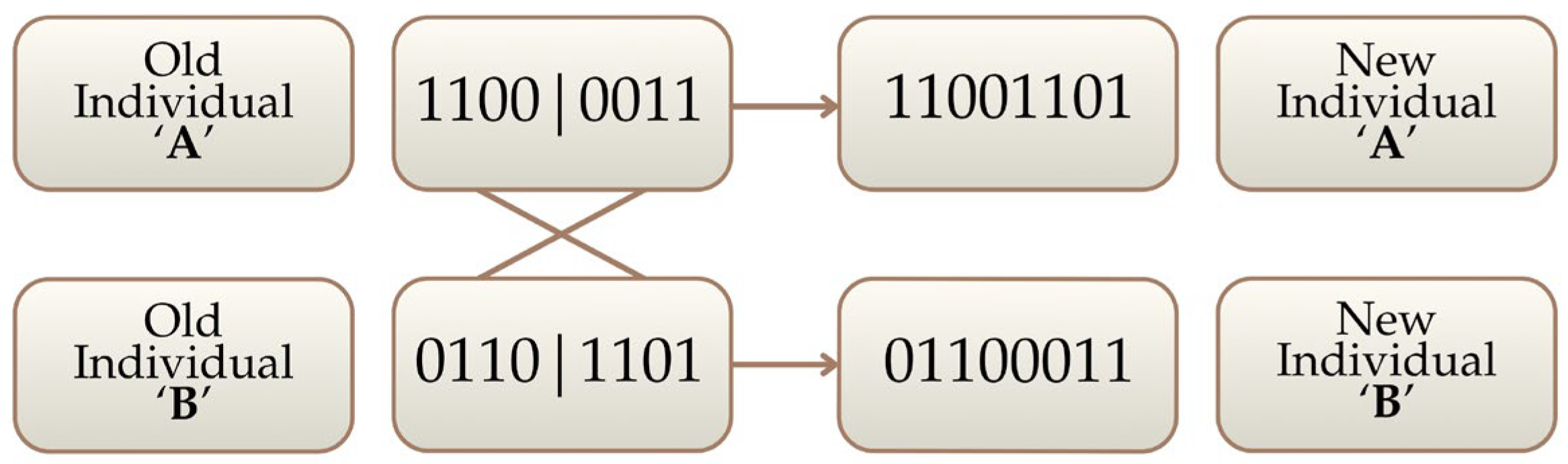
- Crossover Operator: Crossover is the primary mechanism for generating novel designs. It involves recombining the genetic code of two parent solutions to create two new offspring. This operation mimics biological reproduction by exchanging design parameters (genes) at one or more points along the encoded sequence. As illustrated in Figure 1, this mixing allows successful characteristics from two different designs to be rapidly integrated into a potentially superior new design.
- (vi)
- Mutation Operator: Following crossover, the mutation operator introduces random, slight modifications to the genes of the offspring. This step is crucial for maintaining genetic diversity and preventing premature convergence. Mutation ensures that the algorithm can explore areas of the design space that might not be reachable through simple crossover of existing population members.
- (vii)
- Termination and Optimal Solution: The evolutionary cycle, selection, crossover, and mutation are repeated over many generations. This iterative process drives the population toward increasingly higher fitness levels. The algorithm terminates when a predefined stop condition is satisfied. The stiffened plate design corresponding to the maximum attained fitness represents the optimal solution.
3. Theoretical Concept of Plate Buckling
3.1. Kirchhoff’s Plate Theory
3.2. Plate Buckling
3.3. Critical Buckling Load Validation Against Plate Theory
4. Materials and Methods
4.1. Material Model
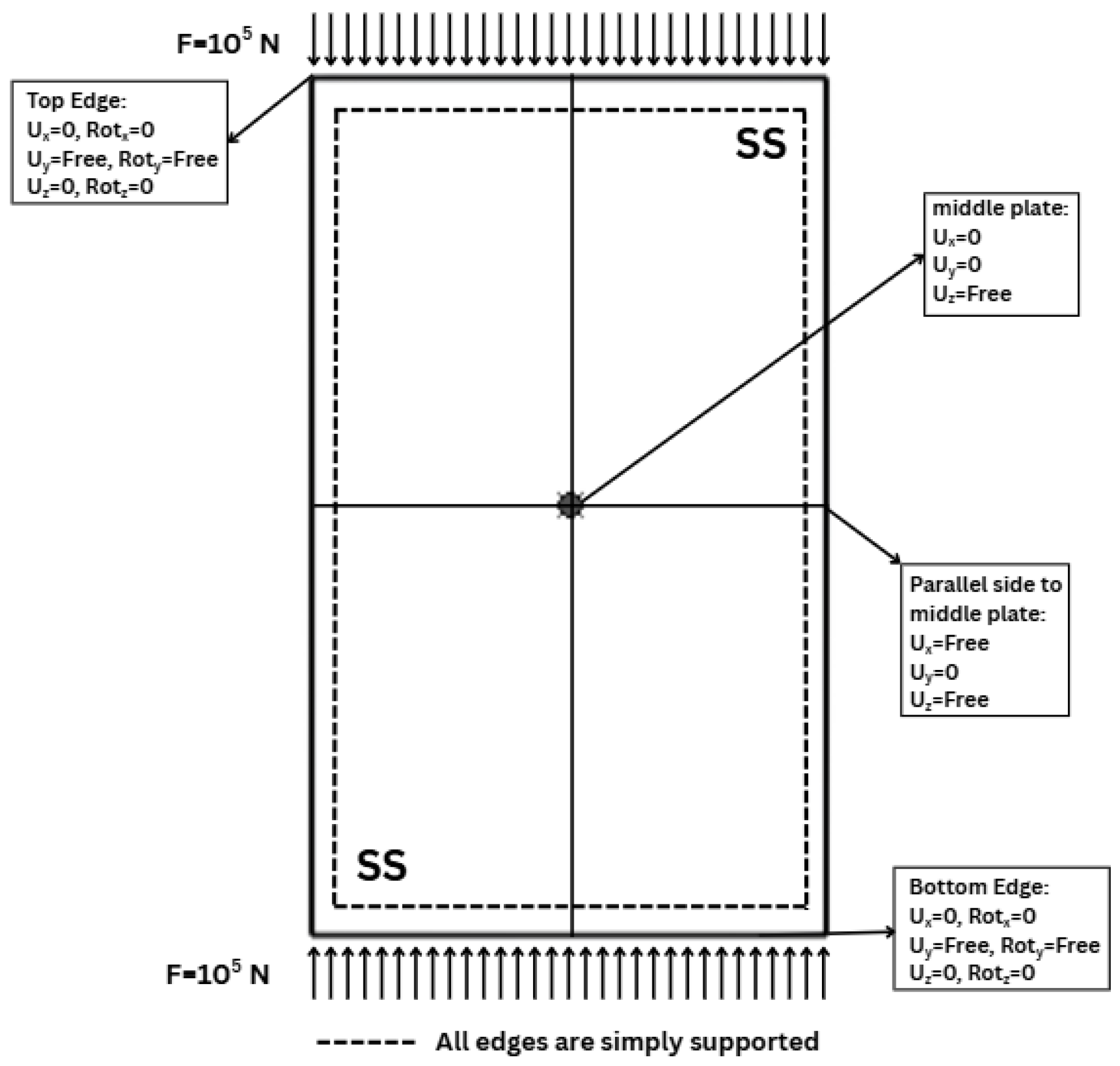
4.2. Mesh Study & Boundary Condition
4.3. Scenario Variation
5. Optimization Framework
6. Results and Discussions
6.1. Initial Critical Buckling Load Analysis
6.2. Optimization Results
6.2.1. Results of First Optimization with All Candidate Points and Error Percentage
6.2.2. Results of the Second Optimization with All Candidate Points and Error Percentage
6.2.3. Correlation Analysis of Stiffener Geometry and Buckling Load
7. Conclusions
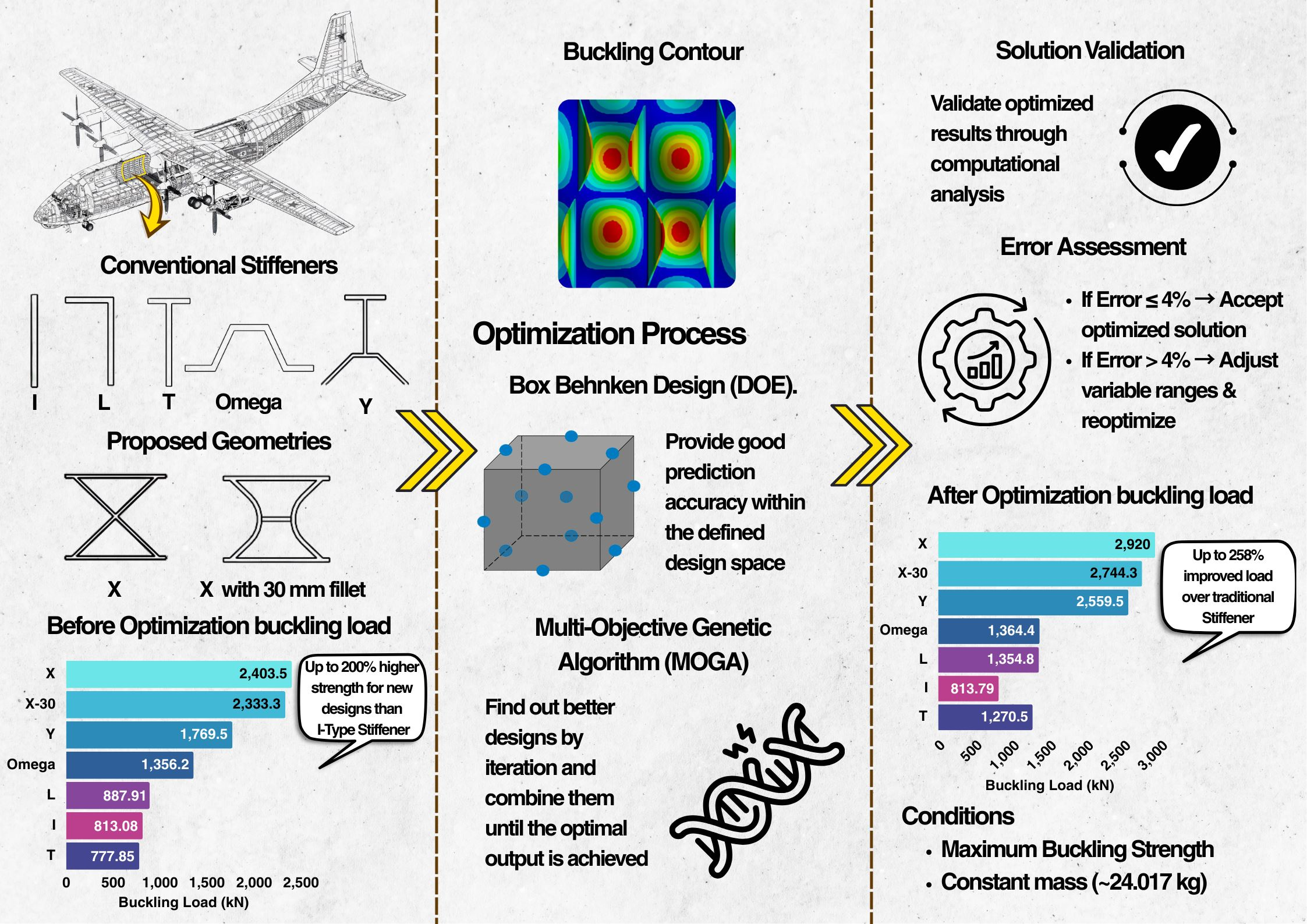
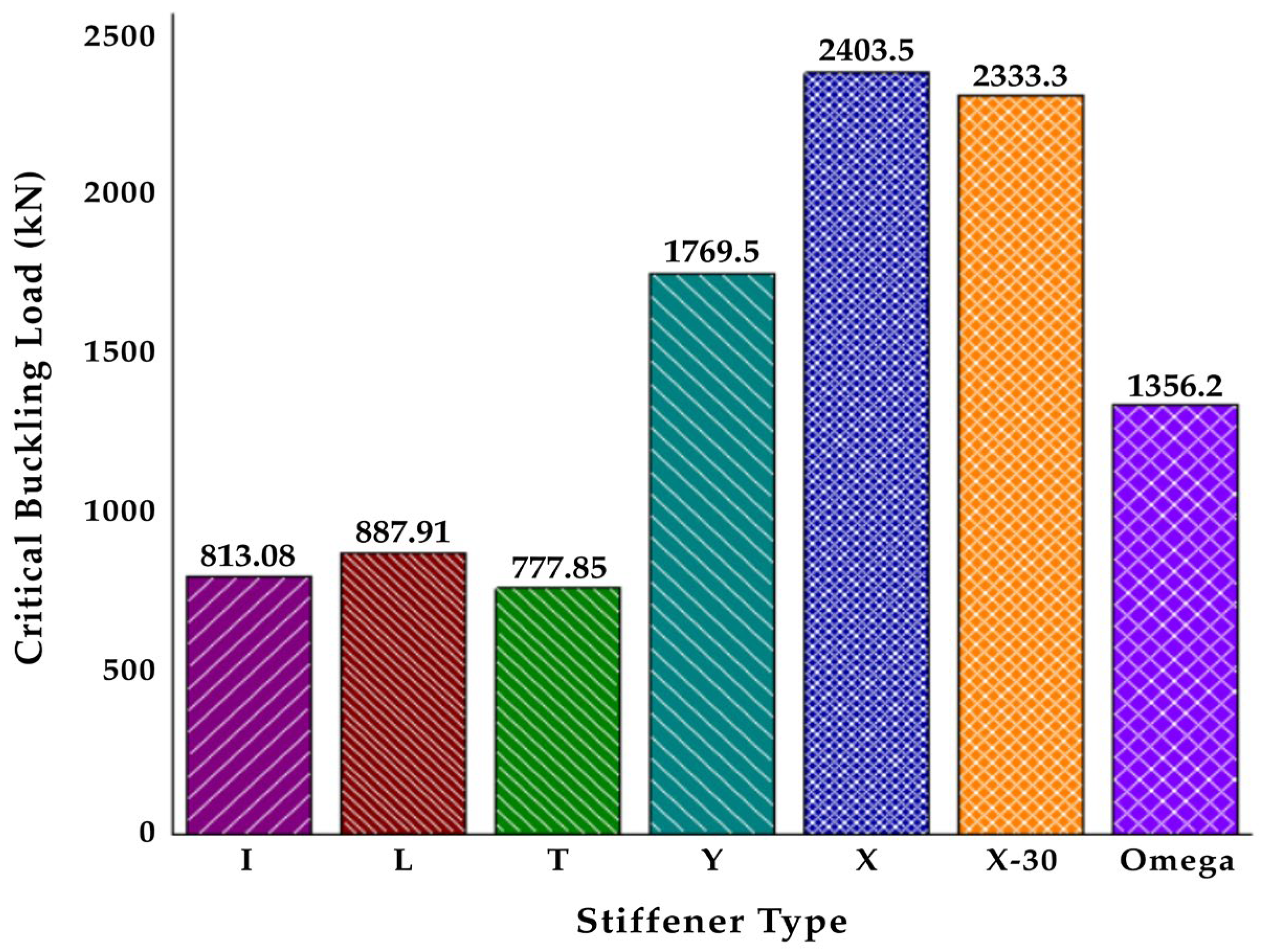
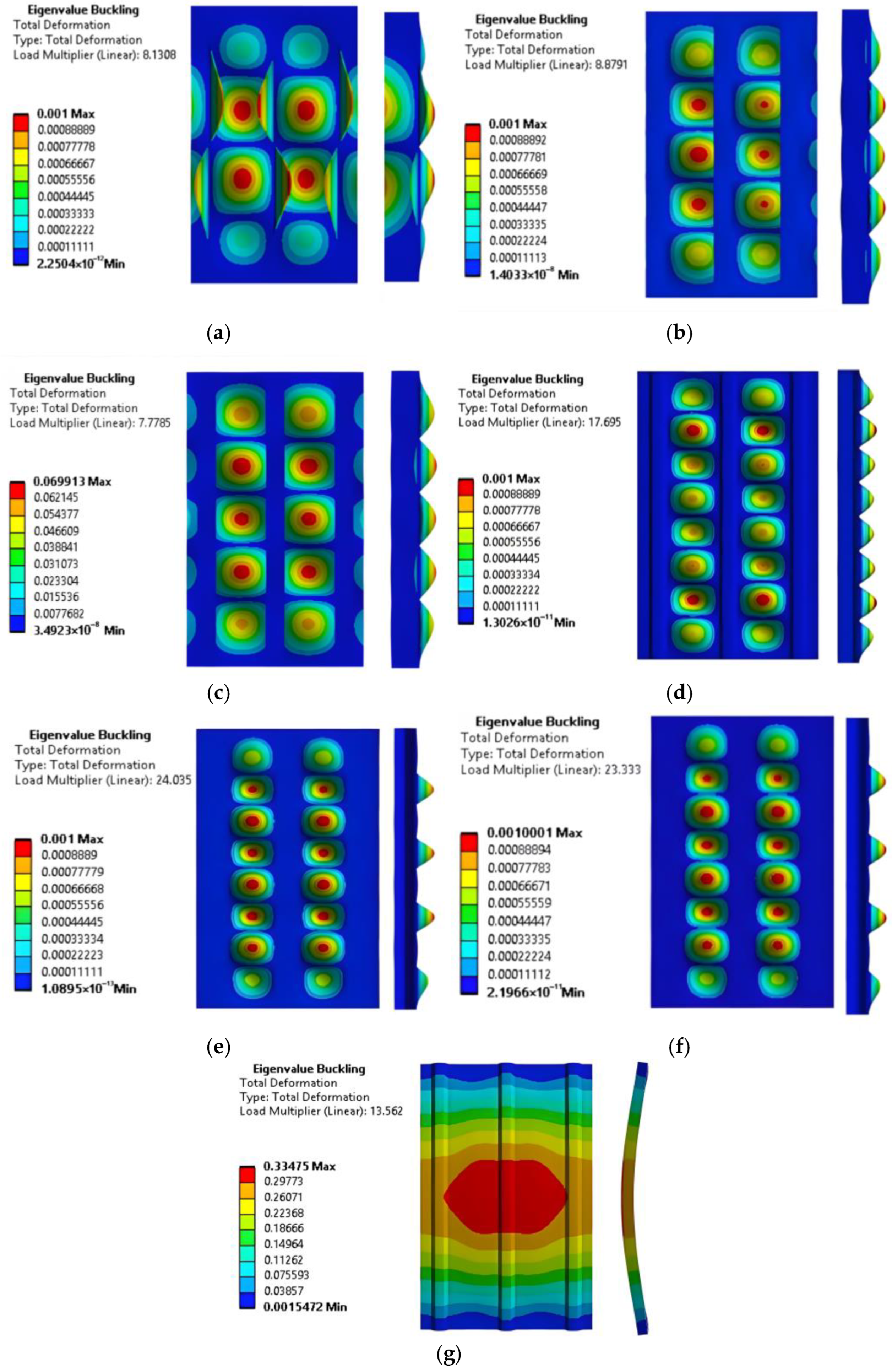
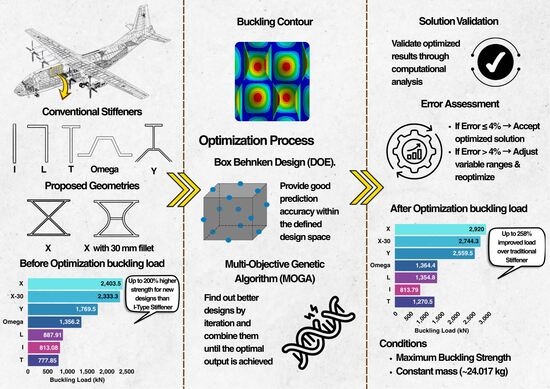
- In this paper, we proposed two novel stiffened panel configurations (X and X with 30 mm fillet) that are compared with the traditional stiffened panels (I-, L-, T-, Omega-, and Y-Stiffener). Among the initial design cases, the X-stiffened panel achieved the maximum critical buckling load of 2403.5 kN, indicating superior structural stability compared to the other stiffener configurations. Conversely, the T-stiffened panel recorded the minimum buckling load of 777.85 kN. Quantitatively, the X-stiffened design improves the buckling capacity by 37.6% over the Y-stiffened panel and by 209% relative to the T-stiffened panel, highlighting its enhanced stiffness efficiency and load-carrying performance.
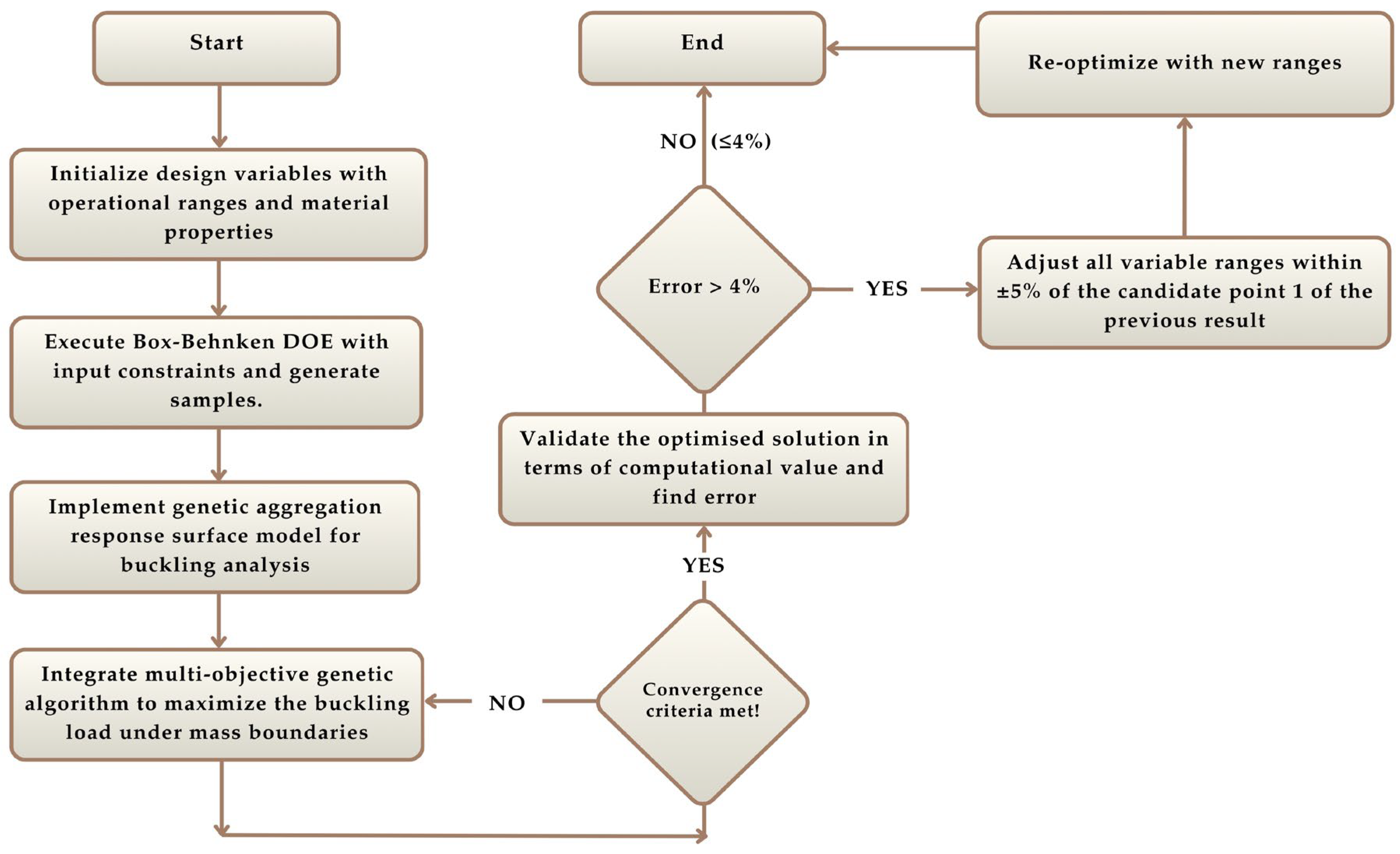
- These initial designs were optimized to enhance the critical buckling load, and the results were validated with the candidate points generated by Box–Behnken Design, and the error percentage was calculated. If the error percentage was found to be more than 4% in any of the stiffened panels, then those panels were optimized again.
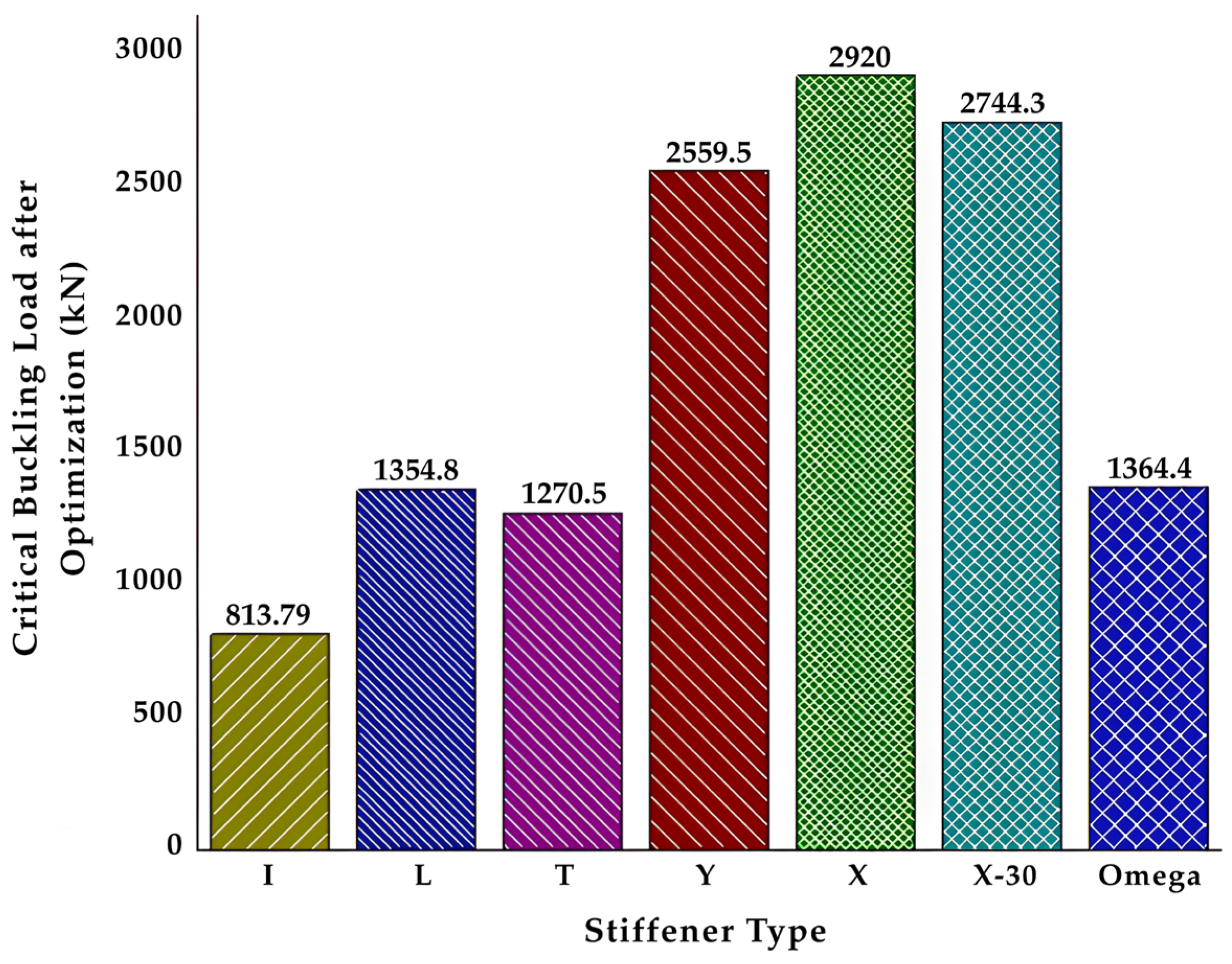
- After the optimization, the critical buckling load of each stiffened panel was enhanced significantly. The X-Stiffener performed best with a critical buckling load of 2920 kN and the I stiffened panel showed the lowest critical buckling load of 813.79 kN which indicates that the X-stiffened panel increases the critical buckling load by 258.81% compared to the I stiffened panel and 19.9% over its pre-optimized counterpart.
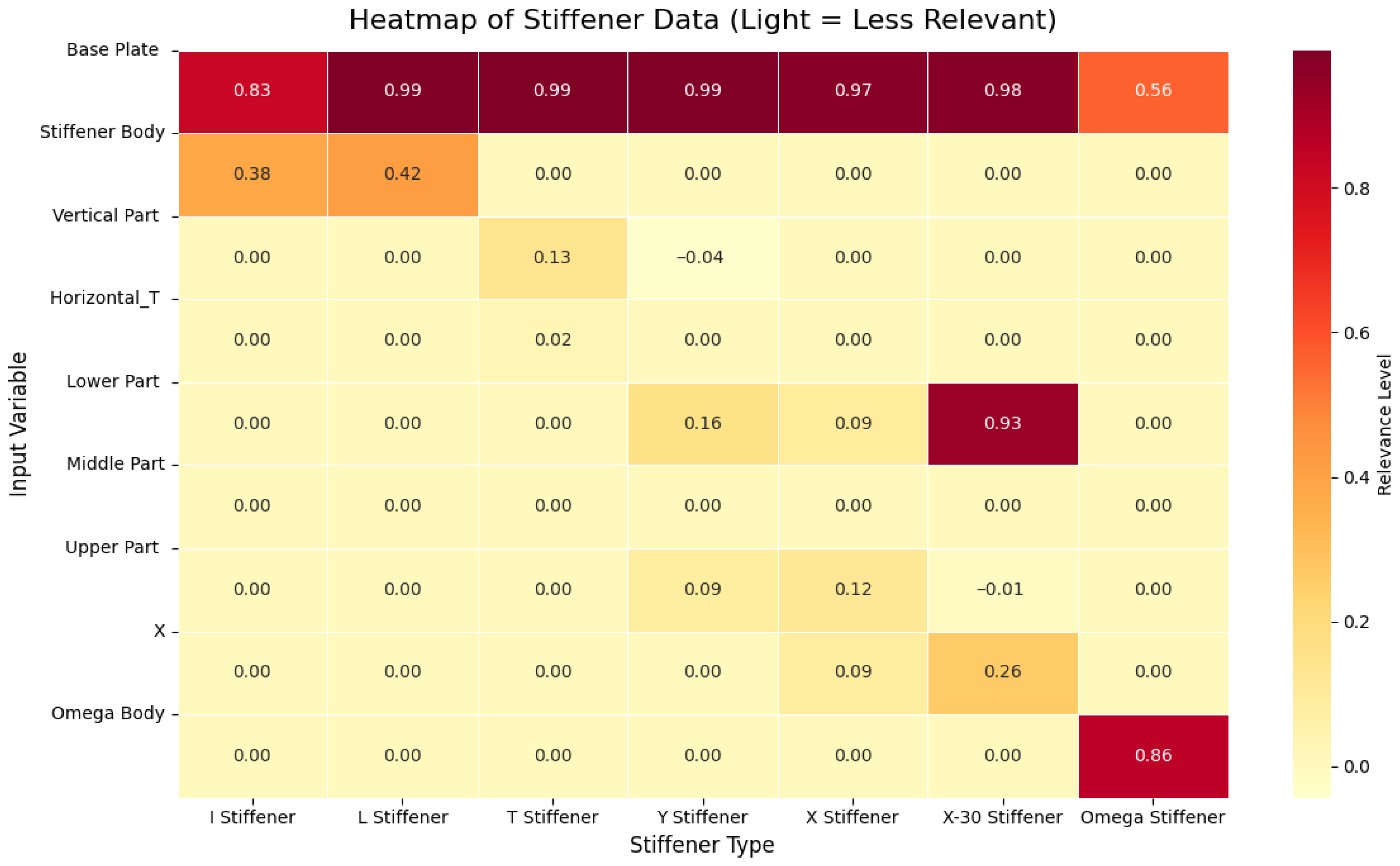
- The Pearson correlation matrix suggests that base plate thickness has a strong influence on the critical buckling load of both the X and X-30 stiffened panels, with 0.97 and 0.98 for the panels, respectively. However, for the X-30 type, the lower part of the stiffener on the panel also shows a strong correlation of 0.93.
Author Contributions
Funding
Institutional Review Board Statement
Informed Consent Statement
Data Availability Statement
Conflicts of Interest
References
- Sarwoko, A.R.K.; Prabowo, A.R.; Ghanbari-Ghazijahani, T.; Do, Q.T.; Ridwan, R.; Hanif, M.I. Buckling of Thin-Walled Stiffened Panels in Transportation Structures: Benchmarking and Parametric Study. Eng. Sci. 2024, 30, 1137. [Google Scholar] [CrossRef]
- Zhang, T.; Wei, Z.; Wang, L.; Xue, Z.; Wang, S.; Wang, P. Multi-objective optimization of composite stiffened panels for mass and buckling load using PNN-NSGA-III algorithm and TOPSIS method. Thin-Walled Struct. 2025, 209, 112878. [Google Scholar] [CrossRef]
- Vehicle, S.; Criteria, D. Space Vehicle Buckling Strength of Structural Plates; NASA: Washington, DC, USA, 1971. [Google Scholar]
- Seifi, R.; Khoda-Yari, N. Experimental and numerical studies on buckling of cracked thin-plates under full and partial compression edge loading. Thin-Walled Struct. 2011, 49, 1504–1516. [Google Scholar] [CrossRef]
- Quinn, D.; Murphy, A.; McEwan, W.; Lemaitre, F. Stiffened panel stability behaviour and performance gains with plate prismatic sub-stiffening. Thin-Walled Struct. 2009, 47, 1457–1468. [Google Scholar] [CrossRef]
- Zhang, Q.; Yang, H.; Wu, S.; Cheng, W.; Liang, Y.; Huang, Y. A Study on the Ultimate Strength and Failure Mode of Stiffened Panels. J. Mar. Sci. Eng. 2023, 11, 1214. [Google Scholar] [CrossRef]
- Prabowo, A.R.; Ridwan, R.; Muttaqie, T. On the Resistance to Buckling Loads of Idealized Hull Structures: FE Analysis on Designed-Stiffened Plates. Designs 2022, 6, 46. [Google Scholar] [CrossRef]
- Torres, M.; Franco-Urquiza, E.A.; Hernández-Moreno, H.; González-Villa, M.A. Mechanical Behavior of a Fuselage Stiffened Carbon-Epoxy Panel under Debonding Load. J. Aeronaut. Aerosp. Eng. 2018, 7, 1000280. [Google Scholar] [CrossRef]
- Kamarudin, N.A.S.; Mohamed, A.; Dharshani, S.A.P.; Meher, A.; Sundaravadivelu, R.; Feng, J. Linear, nonlinear and post buckling analysis of a stiffened panel with cutouts. IOP Conf. Ser. Mater. Sci. Eng. 2022, 1248, 012078. [Google Scholar] [CrossRef]
- Schilling, J.C.; Mittelstedt, C. Thin-Walled Structures Local buckling analysis of omega-stringer-stiffened composite panels using a new closed-form analytical approximate solution. Thin-Walled Struct. 2020, 147, 106534. [Google Scholar] [CrossRef]
- Young, R.D.; Rose, C.A.; Starnes, J.H. Skin, Stringer, and Fastener Loads in Buckled Fuselage Panels. In Proceedings of the 42nd AIAA/ASMEIASCE/AHS/ASC Structures, Structural Dynamics and Materials Conference, Anaheim, CA, USA, 11–14 June 2001. [Google Scholar]
- Elumalai, E.S.; Asokan, R.; Naidu, A.V.S.V.; Arunkumar, K.; Seralathan, S. Finite element analysis on buckling behaviour of integrated wing spar. J. Phys. Conf. Ser. 2024, 2837, 012078. [Google Scholar] [CrossRef]
- Liang, K.; Yin, Z. Investigation on nonlinear buckling performance of the optimized wing structure under the realistic flight cases. Aerosp. Sci. Technol. 2023, 139, 108416. [Google Scholar] [CrossRef]
- Akbulut, H.; Gundogdu, O. On the Buckling Analysis of Plates Reinforced with Stiff Ribs. Math. Comput. Appl. 2003, 8, 103–110. [Google Scholar] [CrossRef]
- Mittelstedt, C.; Beerhorst, M. Closed-form buckling analysis of compressively loaded composite plates braced by omega-stringers. Compos. Struct. 2009, 88, 424–435. [Google Scholar] [CrossRef]
- Houston, G.; Quinn, D.; Murphy, A.; Bron, F. Design rules for stiffened panel buckling containment features. Thin-Walled Struct. 2017, 116, 69–81. [Google Scholar] [CrossRef]
- Layachi, H.; Xu, Y.; Bennaceur, M.A. Topology Optimization and Design Guidelines of Sub- Stiffened Panels in Aerospace Applications. MATEC Web Conf. 2017, 114, 03009. [Google Scholar] [CrossRef]
- Chen, H.; Xu, Y.; Hu, J.; Wang, X. Optimization of lightweight sub-stiffened panels with buckling analysis and imperfection sensitivity analysis. J. Aerosp. Eng. 2019, 233, 5507–5521. [Google Scholar] [CrossRef]
- Ye, Y.; Zhu, W.; Jiang, J.; Xu, Q.; Ke, Y. Design and optimization of composite sub-stiffened panels. Compos. Struct. 2020, 240, 112084. [Google Scholar] [CrossRef]
- Alhajahmad, A.; Mittelstedt, C. Minimum weight design of curvilinearly grid-stiffened variable-stiffness composite fuselage panels considering buckling and manufacturing constraints. Thin-Walled Struct. 2021, 161, 107526. [Google Scholar] [CrossRef]
- Saritha, R. Buckling Analysis of Curve Stiffened Fuselage Panel of Very Light Jet Aircraft. IOP Conf. Ser. Mater. Sci. Eng. 2021, 1062, 012049. [Google Scholar] [CrossRef]
- Chagraoui, H.; Lazghab, T.; Soula, M. Structures Buckling optimization and post-buckling analysis of omega sub-stiffened composite panels using different cohesive interface properties. Thin-Walled Struct. 2023, 189, 110944. [Google Scholar] [CrossRef]
- Zhang, G.; Hu, Y.; Yan, B.; Tong, M.; Wang, F. Thin-Walled Structures Buckling and post-buckling analysis of composite stiffened panels: A ten-year review (2014–2023). Thin-Walled Struct. 2024, 205, 112525. [Google Scholar] [CrossRef]
- Rayhan, S.B.; Rahman, M.M.; Sultana, J.; Szávai, S.; Varga, G. Finite Element and Machine Learning-Based Prediction of Buckling Strength in Additively Manufactured Lattice Stiffened Panels. Metals 2025, 15, 81. [Google Scholar] [CrossRef]
- Stamatelos, D.G. Fast Buckling Analysis of Stiffened Composite Structures for Preliminary Aerospace Design. Aerospace 2025, 12, 726. [Google Scholar] [CrossRef]
- De Simone, M.C.; Veneziano, S.; Porcaro, A.; Guida, D. Design of Experiments Approach for Structural Optimization of Urban Air Mobility Vehicles. Actuators 2025, 14, 176. [Google Scholar] [CrossRef]
- Kechagias, J.D.; Vidakis, N. Parametric optimization of material extrusion 3D printing process: An assessment of Box–Behnken vs. full-factorial experimental approach. Int. J. Adv. Manuf. Technol. 2022, 121, 3163–3172. [Google Scholar] [CrossRef]
- Al-tayawi, A.N.; Horváth, Z.H.; László, Z. Methods for experimental design, central composite design and the Box–Behnken design, to optimise operational parameters: A review. Acta Aliment. 2023, 52, 521–537. [Google Scholar] [CrossRef]
- Bahloul, R.; Arfa, H.; Belhadjsalah, H. A study on optimal design of process parameters in single point incremental forming of sheet metal by combining Box–Behnken design of experiments, response surface methods and genetic algorithms. Int. J. Adv. Manuf. Technol. 2014, 74, 163–185. [Google Scholar] [CrossRef]
- Jha, A.K.; Sit, N. Comparison of response surface methodology (RSM) and artificial neural network (ANN) modelling for supercritical fluid extraction of phytochemicals from Terminalia chebula pulp and optimization using RSM coupled with desirability function (DF) and genetic algorithm (GA) and ANN with GA. Ind. Crops Prod. 2021, 170, 113769. [Google Scholar] [CrossRef]
- Myers, A.I.K.R.H.; Khuri, A.I.; Carter, W.H. American Society for Quality. Control Technometrics 1989, 31, 137–157. [Google Scholar] [CrossRef]
- Montgomery, D.C. Design and Analysis of Experiments, 9th ed; Springer: New York, NY, USA, 2009. [Google Scholar]
- Noordin, M.Y.; Venkatesh, V.C.; Sharif, S.; Elting, S.; Abdullah, A. Application of response surface methodology in describing the performance of coated carbide tools when turning AISI 1045 steel. J. Mater. Process. Technol. 2004, 145, 46–58. [Google Scholar] [CrossRef]
- Palanikumar, K.; Davim, J.P. Assessment of some factors influencing tool wear on the machining of glass fibre-reinforced plastics by coated cemented carbide tools. J. Mater. Process. Technol. 2008, 9, 511–519. [Google Scholar] [CrossRef]
- Alimohammadi, H.R.; Naseh, H.; Ommi, F. A novel framework for liquid propellant engine ’ s cooling system design by sensitivity analysis based on RSM and multi-objective optimization using PSO. Adv. Space Res. 2021, 67, 1682–1700. [Google Scholar] [CrossRef]
- Yadav, R.N. A hybrid approach of Taguchi-Response Surface Methodology for modeling and optimization of Duplex Turning process. Measurement 2017, 100, 131–138. [Google Scholar] [CrossRef]
- Feng, Q.; Su, X.; Li, Q. Human resource labor dispatch model using an improved genetic algorithm. Soft Comput. 2022, 26, 10665–10676. [Google Scholar] [CrossRef]
- Liu, L. Research on optimization of talent cultivation mode of industry-teaching integration for mechanical majors in higher vocational colleges based on genetic algorithm. Appl. Math. Nonlinear Sci. 2024, 9, 1–14. [Google Scholar] [CrossRef]
- Reddy, J.N. Theory and Analysis of Elastic Plates and Shells, 2nd ed.; Taylor & Francis: Oxfordshire, UK, 2006. [Google Scholar]
- Wang, C.M.; Zhang, Y.P.; Pedroso, D.M. Hencky bar-net model for plate buckling. Eng. Struct. 2017, 150, 947–954. [Google Scholar] [CrossRef]
- Love, A.E.H. The Small Free Vibrations and Deformation of a Thin Elastic Shell; Philosophical Transactions of the Royal Society of London: London, UK, 1888. [Google Scholar]
- Yao, T.; Fujikubo, M. Buckling and Ultimate Strength of Ship and Ship-like Floating Structures; Elsevier: Amsterdam, The Netherlands, 2016. [Google Scholar] [CrossRef]
- Goldarag, F.E.; Barzegar, S.; Babaei, A. An Experimental Method for Measuring the Clamping Force in Double Lap Simple Bolted and Hybrid Joints. Trans. Famena 2015, 39, 87–94. [Google Scholar]





| Authors | Year | Research Methodology | Research Object | Main Findings |
|---|---|---|---|---|
| Quinn et al. [5] | 2009 | Experimental, FEM | Prismatic sub-stiffened panel | The use of longitudinal sub-stiffeners successfully increased the initial buckling load by 87.2% and the ultimate collapse load by 17.7% for a panel of equivalent mass. |
| Mittelstedt and Beerhorst [15] | 2009 | Closed-form analytical method, FEM | Composite panel with omega stringer | The closed-form analytical technique for the critical buckling load of composite plates was found to agree with the exact numerical result. The result demonstrated that the increased stringer height or web angle increases the buckling load. |
| Houston et al. [16] | 2017 | Classical plate theory, FEM | Stiffened panel with Buckling Containment Features (BCF). | The research developed design charts that identify the minimum-mass design for a stiffened panel, which occurs at the transition between global and local buckling when Buckling Containment Features (BCF) are used. |
| Layachi et al. [17] | 2017 | Topology optimization, FEM | Grid sub-stiffened panel | The application of topology optimization, by introducing elliptic patterns into the stiffeners, successfully reduced the panel mass by 1.5% to 2% while maintaining a nearly identical critical buckling load (~222 kN). The optimized design also promoted a more favorable local buckling mode with a higher number of half-waves. |
| Chen et al. [18] | 2019 | FEM, Particle swarm optimization | Sub-stiffened panel | Three optimized sub-stiffened panel designs showed that the panel with a straight sub-stiffener was the most effective, achieving a critical buckling load of 241.0 kN—more than three times the load of the conventional panel (73.5 kN). It also increased the ultimate collapse load by 46%. The grid-stiffened panel was found to have the lowest sensitivity to manufacturing defects. |
| Ye et al. [19] | 2020 | Genetic algorithm, FEM. | Composite stiffened panel with sub stiffeners | Optimizing composite sub-stiffened panels increased the buckling strength by 122.66% while mass is constrained. However, the appearance of sub-stiffeners also made the panel’s ultimate collapse load more sensitive to the skin-stiffener interface properties. |
| Alhajahmad and Mittelstedt [20] | 2021 | Genetic algorithm, FEM | Curvilinear grid-stiffened panels | A new design framework was introduced that integrates a genetic algorithm with Python and the Abaqus interface. Weight was reduced up to 30% compared to the orthogrid and 18% compared to the angle grid design. |
| Chandra et al. [21] | 2021 | FEM | Curved stiffened panel (riveted or FSW, CSF Panel) | Curved rivet stiffened panel showed marginally small buckling load than the curved FSW stiffened panel. The curved stiffened panel with a small stringer showed a higher buckling load, while the closed hat stringer had better buckling strength than the open hat and z stiffener. |
| Prabowo et al. [7] | 2022 | FEM | Stiffened panel | The study showed that increasing the plate thickness increased the ultimate collapse load significantly, with a 5 mm plate showing 65.7% and 20.61% higher strength than 3 mm and 4 mm plates, and increasing the longitudinal stringer thickness moderately improved strength by up to 11.8%. In contrast, changes in sub-stiffener thickness had a negligible effect. |
| Chagraoui et al. [22] | 2023 | FEM | Sub stiffened panel with omega stringer | The introduction and optimization of sub-stiffeners of omega stringers into a T-stiffened composite panel resulted in a 242.63% increase in the primary buckling load without adding any mass. Furthermore, the cohesive interface properties were found to significantly change the deformation pattern of post-buckling, ultimate collapse load and the initiation and propagation of various failure modes. |
| Zhang et al. [23] | 2024 | FEM, Experimental, Analytical | Composite stiffened panel | This review concludes that analyzing composite stiffened panels requires integrating experimental, analytical, and numerical methods, as each approach offers unique strengths and faces distinct limitations. Future advances hinge on effectively combining these methodologies. |
| Sarwoko et al. [1] | 2024 | FEM | Stiffened panel | The adoption of a Y-shaped stiffener geometry significantly increased the critical buckling load and the ultimate collapse load compared to an I-type stiffener of the same volume. Again, reducing the distance between stiffeners and adding transverse stiffeners significantly enhanced buckling resistance and energy absorption. |
| Rayhan et al. [24] | 2025 | ML, FEM | Additively manufactured lattice stiffened panel | The Simple Cubic (SC) lattice panel showed higher buckling resistance at equivalent relative densities, showing up to 77% higher critical buckling load than Face Centered Cube (FCC) and Body Centered Cube (BCC) panels. Among all the machine learning models, polynomial regression achieved the highest prediction accuracy with a near-perfect R2 score of 0.9999 and the lowest error (MSE = 0.0001). |
| Stamatelos and Labeas [25] | 2025 | FEM, Analytical Macro Modeling Optimization | Composite stiffened panel, aircraft wing (Airbus A330) | The result showed a framework that reduced highly detailed models to plate-level size without compromising accuracy. Provides less than 5% deviation in predicting analytical buckling load. Sizing of the composite wing box using the proposed model was completed within minutes. |
| Zhang et al. [2] | 2025 | FEA, PNN. NSGA-III, TOPSIS | Composite stiffened panel | The result demonstrated that the Parallel Neural Network (PNN) accurately predicts the buckling load of the stiffened panel (R2 = 0.968, MAPE = 6.7%). The NSGA-III algorithm performs better at finding high-quality Pareto solutions than NSGA-II. Achieved a 22.18% reduction of mass and a buckling load increase of 0.11% compared to the original design. |
| No. | Case | Analytical Result (kN) | Computational Result (kN) | |
|---|---|---|---|---|
| 1 | All edges are simply supported | 2.067 | 2.067 | 0% |
| 2 | Loading edges are fixed support, and unloaded edges are simply supported | 2.288 | 2.279 | 0.39% |
| 3 | Loading edges are simply supported, and unloaded edges are fixed supported | 3.798 | 3.647 | 3.97% |
| 4 | All edges fixed support | 3.987 | 3.804 | 4.58% |
| Property | Value |
|---|---|
| Density (kg/m3) | 2780 |
| Young’s modulus (GPa) | 73.4 |
| Poisson’s ratio (-) | 0.33 |
| Yield Strength (MPa) | 315 |
| Ultimate Strength (MPa) | 550 |
| Panel Category | Loading Type | Experimental Value [5] kN | Computational Value, kN | |
|---|---|---|---|---|
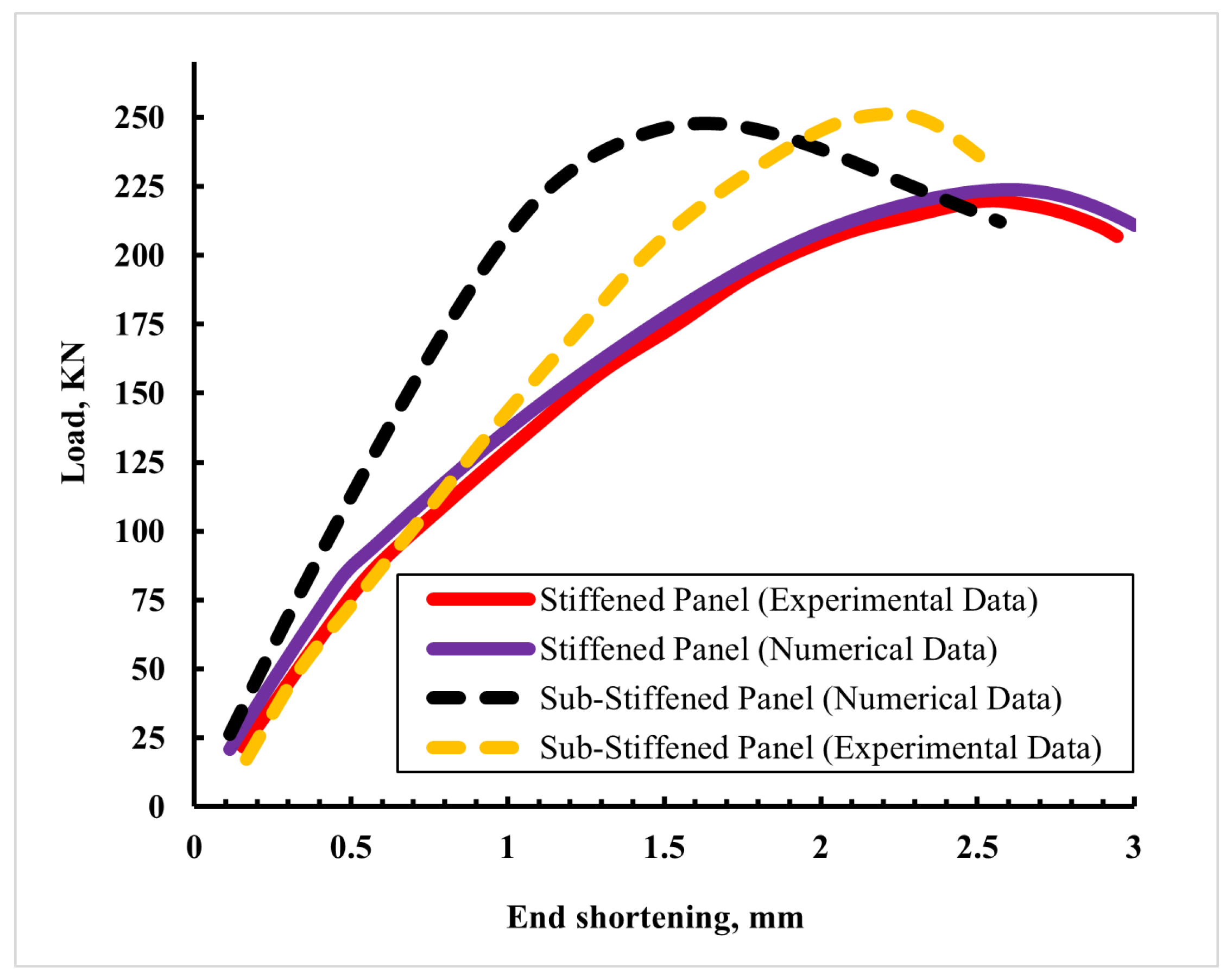
| Stiffener | Critical buckling load | 74.5 | 70.6 | 5.23 |
| Sub Stiffener | Critical buckling load | 140.2 | 147.89 | 5.48 |
| Stiffener | Ultimate collapse load | 216.6 | 218.3 | 0.77 |
| Sub Stiffener | Ultimate collapse load | 255 | 247.96 | 2.76 |
| No. | Mesh Size (mm) | Computational Value (kN) | Reference Value [5] (kN) | Error, % |
|---|---|---|---|---|
| 1 | 10 | 72.4 | 74.5 | 2.85 |
| 2 | 9 | 68.7 | 74.5 | 7.7 |
| 3 | 8 | 72.3 | 74.5 | 3 |
| 4 | 7 | 71.7 | 74.5 | 3.8 |
| 5 | 6 | 71.6 | 74.5 | 3.8 |
| Stiffener Type | Code |
|---|---|
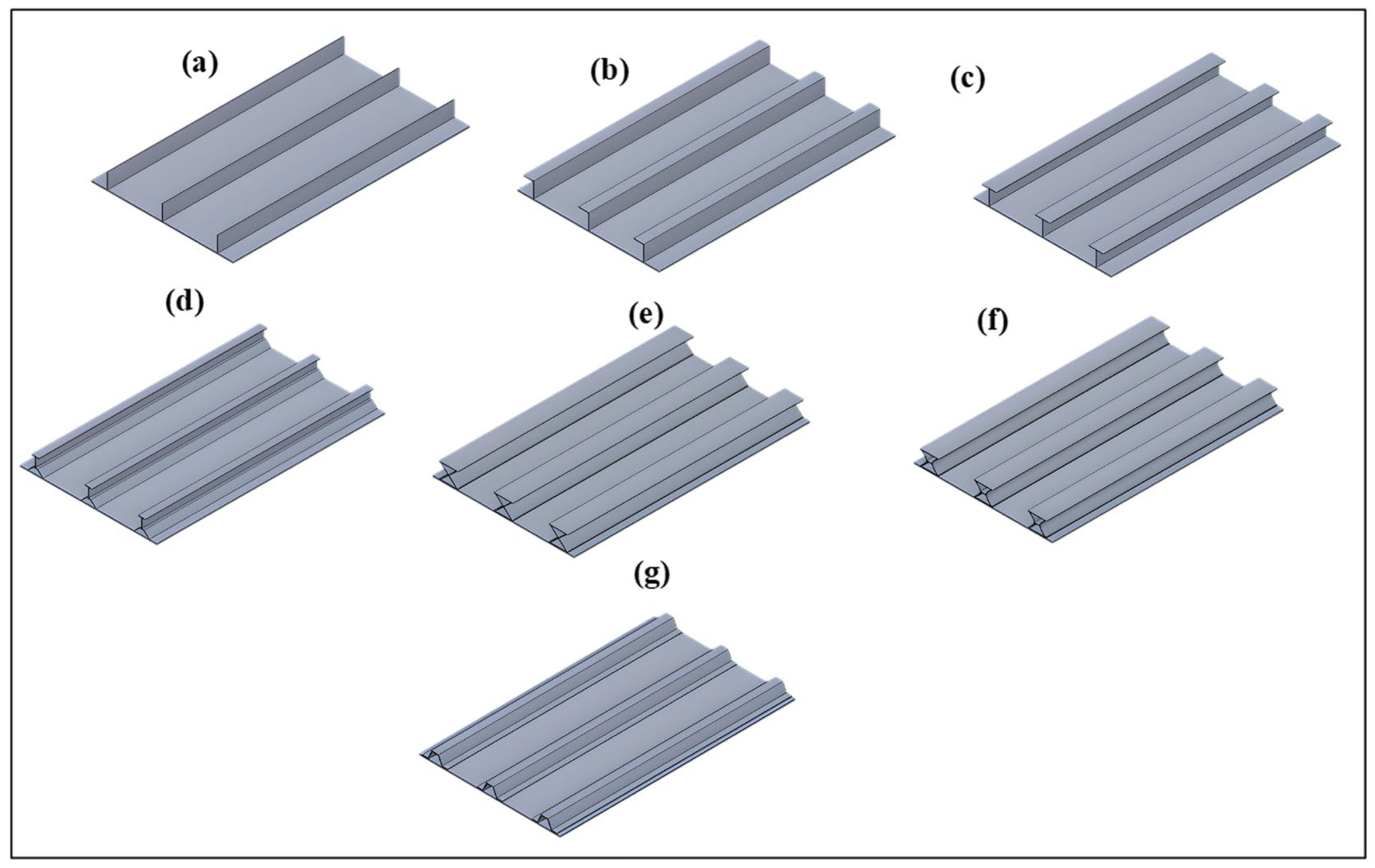
| I | Type-I |
| L | Type-L |
| T | Type-T |
| Y | Type-Y |
| X | Type-X (proposed) |
| X-30 | Type-X with 30 mm fillet (proposed) |
| Omega | Type-Omega |
| Type | Geometry | Dimension (mm) | Type | Geometry | Dimension (mm) |
|---|---|---|---|---|---|
| I |  | A = 150 mm B = 8 mm | T | A = 75 mm B = 6 mm C = 100 mm D = 8 mm |  |
| L |  | A = 75 mm B = 6 mm C = 100 mm D = 8 mm | Y | A = 37.5 mm B = 8 mm C = 50 mm D = 6 mm E = 45 degree F = 6 mm G = 80.90 mm |  |
| X | 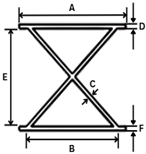 | A = 96 mm B = 80.90 mm C = 2.87 mm D = 2.87 mm E = 78 mm F = 2.87 mm | X-30 | A = 96 mm B = 80.90 mm C = 30 mm D = 26.44 mm E = 2.885 mm F = 2.885 mm G = 78 mm | 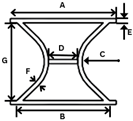 |
| Omega | A = 30 mm B = 127.5 mm C = 30 mm D = 6.675 mm E = 65 degree |  | |||
| SN | Stiffener Type | Input Parameters | Range |
| 1. | I-Stiffener Panel | Base Plate = 5 mm Stiffener Thickness = 8 mm | 3 mm to 7 mm 6 mm to 10 mm |
| 2. | L-Stiffener Panel | Base Plate = 5 mm Stiffener body = 6.85 mm | 3 mm to 7 mm 4 mm to 8 mm |
| 3. | T-Stiffener Panel | Base Plate = 5 mm Vertical Part = 6 mm Upper Part = 8 mm | 3 mm to 7 mm 4 mm to 8 mm 6 mm to 10 mm |
| 4. | Y-Stiffener Panel | Base Plate = 5 mm Lower Part = 6 mm Vertical Part = 6 mm Upper Part = 8 mm | 3 mm to 7 mm 4 mm to 8 mm 4 mm to 8 mm 6 mm to 10 mm |
| 5. | X-Stiffener | Base Plate = 5 mm Lower Part = 2.87 mm Upper Part = 2.87 mm X = 2.87 mm | 3 mm to 7 mm 2 mm to 4 mm 2 mm to 4 mm 2 mm to 4 mm |
| 6. | X-Stiffener with 30 mm Fillet | Base Plate = 5 mm Lower Part = 2.885 mm Middle Part = 2.885 mm Upper Part = 2.885 mm Middle part X = 2.885 mm | 3 mm to 7 mm 2 mm to 4 mm 2 mm to 4 mm 2 mm to 4 mm 2 mm to 4 mm |
| 7. | Omega-Stiffener Panel | Base Plate = 5 mm Stiffener thickness = 6.675 mm | 3 mm to 7 mm 5 mm to 9 mm |
| Using the Box–Behnken Method | |||||
|---|---|---|---|---|---|
| Input Variables | CP-1 | CP-2 | CP-3 | CP-4 | CP-5 |
| Base plate, mm | 5.064 | 5.029 | 5.1557 | 5.0187 | 5.0187 |
| Stiffener, mm | 7.8959 | 7.9537 | 7.7471 | 7.9641 | 7.9641 |
| Mass, kg | 24.017 | 24.019 | 24.013 | 24.01 | 24.01 |
| Buckling Load (Analytical), kN | 814.94 | 814.52 | 812.18 | 813.27 | 813.27 |
| Buckling Load (Computational), kN | 813.79 | 813.67 | 812.82 | 812.59 | 812.59 |
| Deviation | 0.14% | 0.10% | 0.71% | 0.83% | 0.83% |
| Using the Box–Behnken Method (CP1) | ||||||
|---|---|---|---|---|---|---|
| Input Variables | L-Stiffener | T-Stiffener | Y-Stiffener | X-Stiffener | X30-Stiffener | Omega-Stiffener |
| Base plate, mm | 6.2662 | 6.2725 | 6.1269 | 5.6001 | 6.1852 | 4.9638 |
| Stiffener, mm | 5.103 | - | - | - | - | - |
| Vertical Part, mm | - | 4.3173 | 4.1912 | - | - | - |
| Horizontal_T, mm | - | 6.1383 | - | - | - | - |
| Lower Part, mm | - | - | 4.1316 | 2.2168 | 1.3596 | - |
| Middle Part, mm | - | - | - | - | 1.7556 | - |
| Upper Part, mm | - | - | 8.307 | 3.7319 | 4.8671 | - |
| X, mm | - | - | - | 2.154 | 1.354 | - |
| Omega, mm | - | - | - | - | - | 6.7551 |
| Mass, kg | 23.988 | 23.994 | 24.019 | 24.011 | 23.968 | 24.016 |
| Buckling Load (Analytical), kN | 1334.5 | 1278.6 | 2581.9 | 2795.4 | 2715.9 | 1364.5 |
| Buckling Load (Computational), kN | 1205.2 | 1206.2 | 2559.5 | 2677.6 | 2630.4 | 1364.4 |
| Deviation | 9.68% | 5.66% | 0.86% | 4.21% | 3.14% | 0.01% |
| Second Optimization Using the Box–Behnken Method (CP1) | ||||
|---|---|---|---|---|
| Input Variables | L-Stiffener | T-Stiffener | X-Stiffener | X-30 Stiffener |
| Base plate, mm | 6.2788 | 6.4595 | 5.728 | 6.2753 |
| Stiffener, mm | 5.1035 | - | - | - |
| Vertical Part, mm | 4.1123 | - | - | |
| Horizontal_T, mm | - | 5.8432 | - | - |
| Lower Part, mm | - | - | 2.1133 | 1.2945 |
| Middle Part, mm | - | - | - | 1.7534 |
| Upper Part, mm | - | - | 3.5431 | 4.6269 |
| X, mm | - | 2.1437 | 1.4189 | |
| Omega, mm | - | - | - | |
| Mass, kg | 24.019 | 24.017 | 24.015 | 24.018 |
| Buckling Load (Analytical), kN | 1348.7 | 1277.2 | 3035.6 | 2793.5 |
| Buckling Load (Computational), kN | 1354.8 | 1270.5 | 2920 | 2744.3 |
| Deviation | 0.45% | 0.52% | 3.80% | 1.76% |
Disclaimer/Publisher’s Note: The statements, opinions and data contained in all publications are solely those of the individual author(s) and contributor(s) and not of MDPI and/or the editor(s). MDPI and/or the editor(s) disclaim responsibility for any injury to people or property resulting from any ideas, methods, instructions or products referred to in the content. |
© 2026 by the authors. Licensee MDPI, Basel, Switzerland. This article is an open access article distributed under the terms and conditions of the Creative Commons Attribution (CC BY) license.
Share and Cite
Hossain, R.; Ahmad, T.; Talukder, M.A.; Rahman, M.M.; Varga, G.; Rayhan, S.B. Novel Design and Optimization of Aircraft Stiffened Panels for Improved Critical Buckling Load Resistance. Appl. Mech. 2026, 7, 21. https://doi.org/10.3390/applmech7010021
Hossain R, Ahmad T, Talukder MA, Rahman MM, Varga G, Rayhan SB. Novel Design and Optimization of Aircraft Stiffened Panels for Improved Critical Buckling Load Resistance. Applied Mechanics. 2026; 7(1):21. https://doi.org/10.3390/applmech7010021
Chicago/Turabian StyleHossain, Raed, Tanvir Ahmad, Mohammed Aksir Talukder, Md Mazedur Rahman, Gyula Varga, and Saiaf Bin Rayhan. 2026. "Novel Design and Optimization of Aircraft Stiffened Panels for Improved Critical Buckling Load Resistance" Applied Mechanics 7, no. 1: 21. https://doi.org/10.3390/applmech7010021
APA StyleHossain, R., Ahmad, T., Talukder, M. A., Rahman, M. M., Varga, G., & Rayhan, S. B. (2026). Novel Design and Optimization of Aircraft Stiffened Panels for Improved Critical Buckling Load Resistance. Applied Mechanics, 7(1), 21. https://doi.org/10.3390/applmech7010021