


Skip to Content

Clocks & Sleep, Volume 3, Issue 3

2021 September - 14 articles

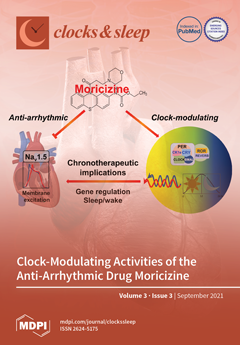
Cover Story: Despite the fundamental roles of circadian rhythms in physiology and diseases, chronotherapeutic implications for most drugs are poorly explored. In the study, an unbiased screening approach identified the Class I anti-arrhythmic drug moricizine as a novel modulator of circadian rhythms. Using experimental systems including reporter cells, tissue explants, and mice, they show that moricizine is able to lengthen circadian periods, reprogram gene expression and promote sleep. These findings illustrate a circadian mode of action for a heart disease drug, underscoring chronotherapeutic relevance in clock-related disorders. View this paper.
  • Issues are regarded as officially published after their release is announced to the table of contents alert mailing list .
  • You may sign up for email alerts to receive table of contents of newly released issues.
  • PDF is the official format for papers published in both, html and pdf forms. To view the papers in pdf format, click on the "PDF Full-text" link, and use the free Adobe Reader to open them.

Articles (14)

  • Review
  • Open Access
29 Citations
7,789 Views
20 Pages

19 September 2021

The study of dreams represents a crucial intersection between philosophical, psychological, neuroscientific, and clinical interests. Importantly, one of the main sources of insight into dreaming activity are the (oral or written) reports provided by...

  • Article
  • Open Access
5 Citations
3,589 Views
12 Pages

The Effects of General Anaesthesia and Light on Behavioural Rhythms and GABAA Receptor Subunit Expression in the Mouse SCN

  • Janelle Chong,
  • James Frederick Cheeseman,
  • Matthew D. M. Pawley,
  • Andrea Kwakowsky and
  • Guy R. Warman

17 September 2021

General anaesthesia (GA) is known to affect the circadian clock. However, the mechanisms that underlie GA-induced shifting of the clock are less well understood. Activation of γ-aminobutyric acid (GABA)-type A receptors (GABAAR) in the suprachiasmati...

  • Article
  • Open Access
8 Citations
4,810 Views
18 Pages

16 September 2021

Children with Foetal Alcohol Spectrum Disorders (FASD) and Autism Spectrum Disorders (ASD) experience significantly higher rates of sleep disturbances than their typically developing (TD) peers. Pre-sleep anxiety and waking emotional content is known...

  • Article
  • Open Access
7 Citations
6,967 Views
17 Pages

The Effect of Bright Light Treatment on Rest–Activity Rhythms in People with Dementia: A 24-Week Cluster Randomized Controlled Trial

  • Eirin Kolberg,
  • Ståle Pallesen,
  • Gunnhild Johnsen Hjetland,
  • Inger Hilde Nordhus and
  • Elisabeth Flo-Groeneboom

13 September 2021

Bright light treatment is an effective way to influence circadian rhythms in healthy adults, but previous research with dementia patients has yielded mixed results. The present study presents a primary outcome of the DEM.LIGHT trial, a 24-week random...

  • Article
  • Open Access
8 Citations
4,586 Views
13 Pages

Chronobiotics are a group of drugs, which are utilized to modify circadian rhythms targeting clock-associated molecular mechanisms. The circadian clock is known as a controller of numerous processes in connection with aging. Hypothesis: KL001 and KS1...

  • Brief Report
  • Open Access
3 Citations
3,923 Views
7 Pages

Consecutive Nights of Moderate Sleep Loss Does Not Affect Mood in Healthy Young Males

  • Christiana Harous,
  • Gregory D. Roach,
  • Thomas G. Kontou,
  • Ashley J. Montero,
  • Nicole Stuart and
  • Charli Sargent

Sleep loss causes mood disturbance in non-clinical populations under severe conditions, i.e., two days/nights of sleep deprivation or a week of sleep restriction with 4–5 h in bed each night. However, the effects of more-common types of sleep loss on...

  • Article
  • Open Access
10 Citations
5,933 Views
14 Pages

Seasonal Changes in Sleep Patterns in Two Saskatchewan First Nation Communities

  • Chandima P. Karunanayake,
  • Vivian R. Ramsden,
  • Clifford Bird,
  • Jeremy Seeseequasis,
  • Kathleen McMullin,
  • Mark Fenton,
  • Robert Skomro,
  • Shelley Kirychuk,
  • Donna C. Rennie and
  • Punam Pahwa
  • + 6 authors

Sleep is crucial for maintaining the recovery and restoration of the body and brain. Less sleep is associated with poor mental and physical performance. Seasonal changes in sleep patterns can be observed. This paper examines seasonal effects on sleep...

  • Article
  • Open Access
3 Citations
3,611 Views
6 Pages

Use of Actigraphy for a Rat Behavioural Sleep Study

  • Shinichi Esaki,
  • Meiho Nakayama,
  • Sachie Arima and
  • Shintaro Sato

Previous studies of animal behavioural sleep is mainly divided into two study types, observation by video recording or counts by sensor, both of which require a complex environment and procedure. An actigraph unit is a commercially available product...

  • Review
  • Open Access
5 Citations
5,798 Views
6 Pages

Dream Recall/Affect and the Hypothalamic–Pituitary–Adrenal Axis

  • Athanasios Tselebis,
  • Emmanouil Zoumakis and
  • Ioannis Ilias

In this concise review, we present an overview of research on dream recall/affect and of the hypothalamic–pituitary–adrenal (HPA) axis, discussing caveats regarding the action of hormones of the HPA axis (mainly cortisol and its free form, cortisol-b...

  • Article
  • Open Access
8 Citations
4,792 Views
10 Pages

The study’s aim was to examine the effect of chronotype on cognitive performance during a single night shift. Data were collected from 72 (36f) young, healthy adults in a laboratory study. Participants had a 9 h sleep period (03:00–12:00) followed by...

  • Article
  • Open Access
31 Citations
5,459 Views
11 Pages

Habitual Sleep Duration and the Colonic Mucosa-Associated Gut Microbiota in Humans—A Pilot Study

  • Ritwick Agrawal,
  • Nadim J. Ajami,
  • Sonal Malhotra,
  • Liang Chen,
  • Donna L. White,
  • Amir Sharafkhaneh,
  • Kristi L. Hoffman,
  • David Y. Graham,
  • Hashem B. El-Serag and
  • Li Jiao
  • + 1 author

We examined the association between the colonic adherent microbiota and nocturnal sleep duration in humans. In a cross-sectional study, 63 polyp-free adults underwent a colonoscopy and donated 206 mucosal biopsies. The gut microbiota was profiled usi...

  • Article
  • Open Access
2,542 Views
11 Pages

A Pilot Study of 24-h Motor Activity Patterns in Multiple Sclerosis: Pre-Planned Follow-Up at 2 Years

  • Lorenzo Tonetti,
  • Federico Camilli,
  • Sara Giovagnoli,
  • Vincenzo Natale and
  • Alessandra Lugaresi

Early multiple sclerosis (MS) predictive markers of disease activity/prognosis have been proposed but are not universally accepted. Aim of this pilot prospective study is to verify whether a peculiar hyperactivity, observed at baseline (T0) in early...

  • Article
  • Open Access
16 Citations
4,588 Views
15 Pages

Clock-Modulating Activities of the Anti-Arrhythmic Drug Moricizine

  • Chorong Han,
  • Marvin Wirianto,
  • Eunju Kim,
  • Mark J. Burish,
  • Seung-Hee Yoo and
  • Zheng Chen

Dysregulated circadian functions contribute to various diseases, including cardiovascular disease. Much progress has been made on chronotherapeutic applications of drugs against cardiovascular disease (CVD); however, the direct effects of various med...

Get Alerted

Add your email address to receive forthcoming issues of this journal.

XFacebookLinkedIn
Clocks & Sleep - ISSN 2624-5175