Article

Development of Crack-Suppressed Superhydrophilic PAA/Silica Coatings Through Optimized Particle Loading and Drying Conditions


1
Plastics Engineering Department, University of Massachusetts Lowell, Lowell, MA 01854, USA
2
Department of Polymer Materials Engineering, Shenkar College, Ramat Gan 5252626, Israel
*
Author to whom correspondence should be addressed.
Surfaces 2026, 9(2), 46; https://doi.org/10.3390/surfaces9020046
Submission received: 12 April 2026 / Revised: 19 May 2026 / Accepted: 21 May 2026 / Published: 27 May 2026
(This article belongs to the Special Issue Bio-Inspired Surfaces)

Abstract

A comprehensive study was conducted to develop structurally robust, crack-suppressed superhydrophilic nanocomposite coatings comprising poly(acrylic acid) (PAA) and silica nanoparticles. We systematically investigated the critical trade-off between particle loading, which drives surface wettability and stress-induced crack formation driven by capillary forces and shrinkage mismatch. Our findings identify a distinct structural failure threshold between 25 and 30 vol.% silica under conventional drying. By strategically optimizing drying kinetics (an initial flash-dry at 120 °C for 1 h followed by a 24 h ambient cure), we successfully fabricated transparent, crack-suppressed superhydrophilic coatings at elevated silica loadings up to 47 vol.%, establishing a practical, scalable framework for advanced functional surface engineering. The crack-suppressed mechanism was hypothesized to be related to internal stress.

1. Introduction

Superhydrophilic coatings, defined by water contact angles (WCA) approaching 0° [1,2], have garnered significant attention due to their potential in self-cleaning [3], anti-fogging [4,5], and various biomedical applications [6,7]. These functional interfaces operate by spreading impinging water droplets into a continuous, uniform film, thereby mitigating light scattering and facilitating the facile removal of surface contaminants [8]. Attaining this extreme state of wettability fundamentally relies on the synergistic interplay between high surface energy and hierarchical micro- or nano-scale roughness [9,10,11]. There is a variety of approaches to fabricate such surfaces, for example physical texturing methods, such as ultrafast laser processing, which have also proven effective in creating robust, long-term superhydrophilic surfaces [12,13,14]. Within synthetic systems, a ubiquitous strategy involves the incorporation of hydrophilic inorganic nanoparticles, such as silica (SiO2), into a polar polymer matrix, notably poly(acrylic acid) (PAA) [15,16]. PAA is exceptionally well-suited for this application due to its high density of carboxylic acid groups, which furnish robust hydrogen bonding sites for silica particles and impart high intrinsic hydrophilicity to the composite [17,18].
Despite the functional superiority of PAA/silica nanocomposites, a persistent bottleneck impeding their commercial deployment is the inherent trade-off between wetting performance and structural durability [19,20]. To engineer the specific porosity and surface chemistry required for instantaneous superhydrophilicity, high particle loadings—frequently exceeding 30 vol.%—are requisite [15]. However, as the volume fraction of the rigid inorganic phase increases, the coating becomes highly susceptible to “mud-cracking” during the solvent evaporation phase [21,22].
These stress-induced fractures compromise the mechanical integrity of the film, diminish optical transparency, and act as primary loci for premature failure [23,24]. While contemporary literature details various strategies to enhance coating durability [4,25,26,27], a comprehensive fundamental understanding of the triadic relationship between particle volume fraction, drying kinetics, and the resultant thermo-mechanical properties remains conspicuously limited [28].
The underlying mechanics of crack formation in colloidal and polymeric coatings are primarily governed by the localized accumulation of internal stresses during dehydration [21,29,30]. As the solvent front recedes into the porous nanoparticulate network, immense capillary forces generate substantial tensile stresses [22]. When these stresses surpass the cohesive strength of the polymer binder or the fracture toughness of the composite, catastrophic failure (cracking) ensues [30,31]. This vulnerability is acutely amplified at elevated particle loadings, where particle–particle contacts dominate the microstructural continuum, drastically restricting the polymer matrix’s capacity to dissipate stress via viscous deformation [32]. Furthermore, the profound mismatch in volumetric shrinkage between the contracting polymer matrix and the dimensionally stable silica nanoparticles induces interfacial stresses that compound as the film vitrifies [24,33].
Historically, while PAA/silica coatings have been extensively characterized, mitigating crack formation at the critical loadings necessary for superhydrophilicity remains a formidable challenge [15,16]. Advanced fabrication techniques, such as layer-by-layer (LbL) assembly, provide exceptional morphological control but are inherently time-intensive and pose significant scalability challenges for industrial adoption [34]. Conversely, scalable techniques like dip-coating are highly favored for large-area applications but are disproportionately vulnerable to the aforementioned stress-driven mechanical failures [19]. Consequently, there is an exigent need to decouple formulation parameters from processing conditions to establish a fabrication pathway that ensures both high functionality and structural fidelity [20].
In this work, we systematically elucidate the relationship between particle loading, drying conditions, and the resultant morphological and wetting characteristics of PAA/silica coatings. By modulating the silica content across a broad spectrum (5 to 90 vol.%) utilizing LUDOX SM-30 [35], we identify a distinct critical threshold for crack initiation between 25 and 30 vol.% under conventional drying protocols. Our observations confirm that while coatings containing ≤25 vol.% silica maintain a defect-free morphology, they lack the topological roughness requisite for superhydrophilicity. Conversely, coatings with 30 vol.% silica readily achieve superhydrophilic behavior but are universally compromised by extensive crack propagation networks [15,36].
The core innovation of this study is the empirical demonstration that superhydrophilicity can be attained independent of structural failure through the concurrent optimization of particle loading and drying kinetics. We report that coatings with high silica loadings (35 vol.% and 47 vol.%) can maintain an entirely crack-suppressed morphology while exhibiting superhydrophilic performance, provided they are subjected to a precisely controlled thermal sequence. Specifically, we establish that an initial flash-drying phase (120 °C for 1 h), succeeded by a 24 h ambient curing period, effectively manages and dissipates internal stress distributions within the composite film.
These findings strongly suggest that the kinetics of solvent removal are as critical to the final film architecture as the chemical formulation itself. While rapid solvent volatilization at elevated temperatures is classically assumed to exacerbate thermal stress, our results indicate it critically restricts the temporal window available for microcrack nucleation and propagation and may concurrently enhance polymer–particle interfacial adhesion to better distribute residual stresses [31,33]. By establishing a robust processing–structure–property design map, this study provides actionable guidelines for the fabrication of PAA/silica interfaces and offers a versatile framework applicable to analogous particle–polymer systems engineered for advanced surface technologies [36].

2. Experimental

2.1. Materials and Chemicals

Colloidal silica particles LUDOX SM-30 (30% wt. SiO2 suspension in water, average particle size of 7 nm, and surface area of 345 m2 g−1) and poly(acrylic acid) (PAA) (MW = 450,000) were purchased from Sigma-Aldrich (St. Louis, MO, USA). Plain glass microscope slides (75 × 25 mm) were used as a substrate (Fisher Scientific Company Cat. No. 12-550-A3, Waltham, MA USA). Deionized water was used in all rinsing processes and water-based solutions.

2.2. Preparation of Coatings

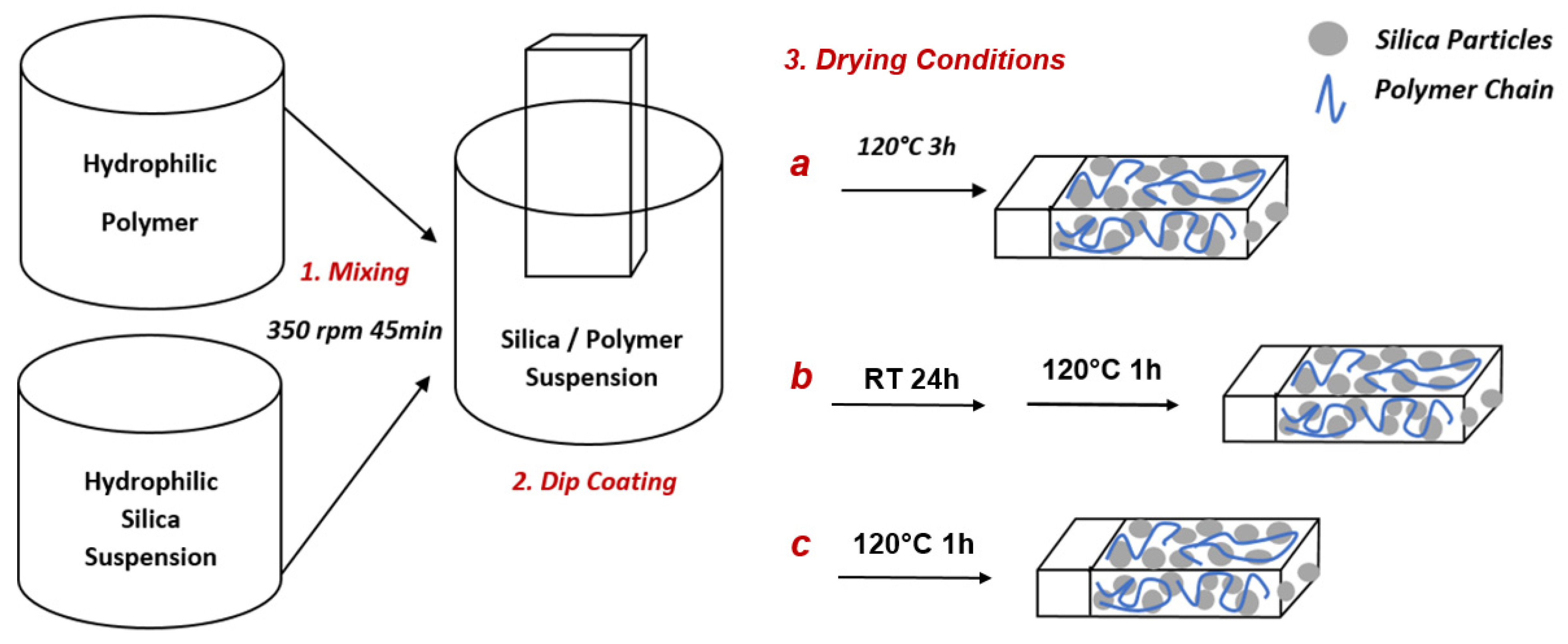
Schematic representation of the superhydrophilic film fabrication process is shown in Figure 1. PAA powder was dissolved in deionized water to prepare a 1% wt. PAA solution by stirring (350 rpm) at 85 °C for 12 h. PAA/SiO2 dispersions were prepared by adding the PAA aqueous solution into a predetermined amount of hydroxylated SiO2 colloidal suspension (Ludox SM-30) under stirring at 350 rpm for 45 min. Coatings of PAA/SiO2 were prepared by dipping the bare glass slides in the different PAA/SiO2 suspensions having predetermined SiO2 concentrations. The dip-coating process was performed manually with approximately a 2 mm/s dipping and withdrawal rate. All glass slides were cleaned with isopropyl alcohol and deionized water and then purged with nitrogen before coating. Coated samples were dried at room temperature for 5 min. Lastly, the samples were heated to 120 °C in an oven to remove any remaining solvent for 3 h and then cooled to room temperature for 12 h. The list of formulations is given in Table 1. The volume of the silica was calculated by taking the density of silica as 2.2 g/cm3 which is reported in the literature [34]. The density of polyacrylic acid was measured and taken as 0.98 g/cm3.
In order to obtain crack-suppressed superhydrophilic coatings, the PAA/silica coatings were formulated by varying the particle loading in the formulation from 10% to 90% vol. and prepared as shown in Figure 1.

2.3. Characterization

The contact angle measurements were done using the sessile drop method (Drop Shape Analyzer—DSA100-KRÜSS GmbH, Hamburg, Germany). The measurements were performed using a 2 µL droplet volume and 2.66 µL/s dropping speed. The contact angle was measured 30 s after the droplet was deposited. Three replicates were performed for each specimen and the average and standard deviation were taken. Scanning electron microscopy (SEM) images were taken on a field-emission scanning electron microscope (JSM 7401F, JEOL Inc., Peabody, MA, USA) typically at an electron energy of 2 to 10 kV. Coated samples were sputtered with a nanometer thin gold film to enhance the conductivity and avoid charging during scanning. The topography of the coating surface was analyzed using a confocal laser microscope (CLM) (LEXT 243 OLS5000, Olympus Inc., Center Valley, PA, USA). In order to provide a thorough evaluation of the surface features, roughness measurements were carried out by scanning a 259 × 259 μm2 area. Furthermore, to ensure the reliability and accuracy of the results, roughness parameters were obtained by scanning at least three samples for each formulation, thereby enhancing the robustness of the findings. Optical microscopy (OM) images were taken on a Nikon optical microscope. The transparency of the coatings was measured by UV-Vis, Hitachi U-2910 Spectrophotometer (Tokyo, Japan).

3. Results and Discussion

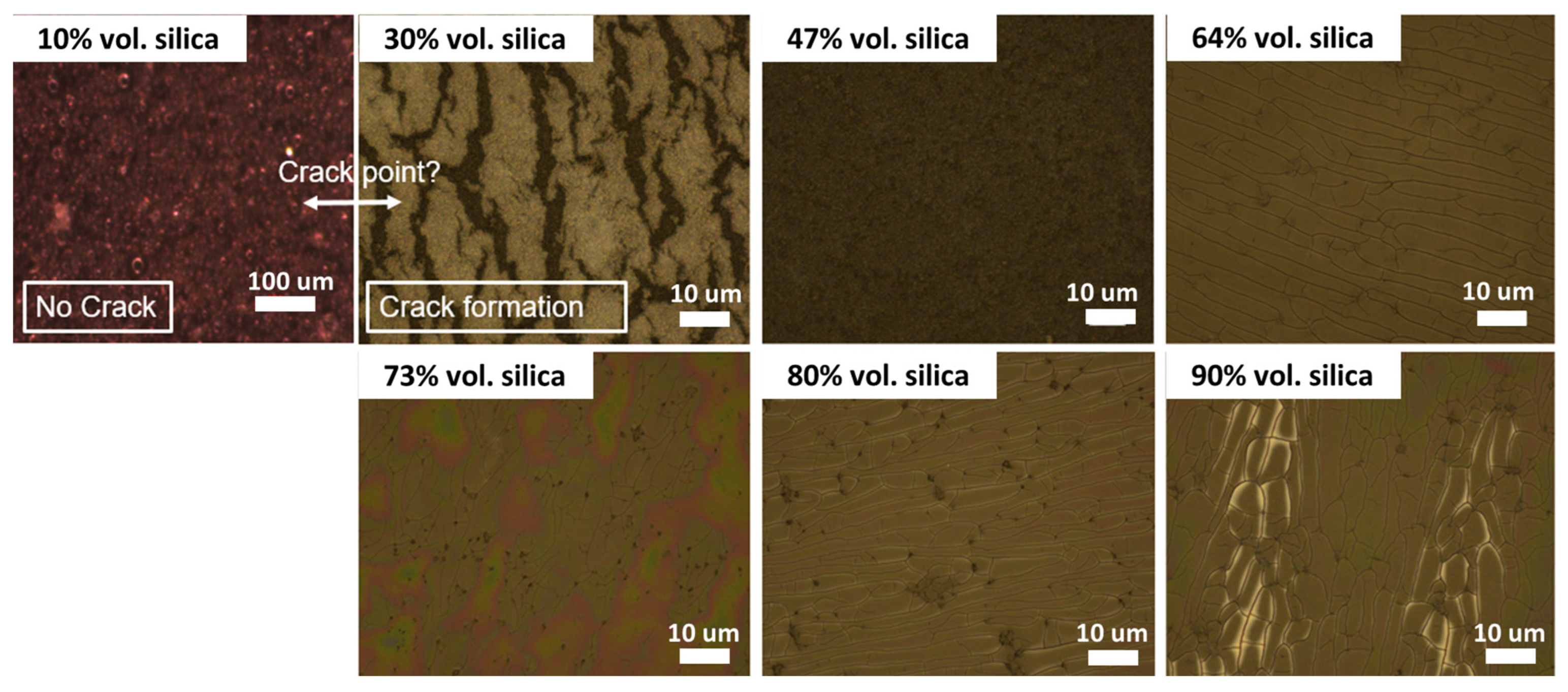
PAA/silica coatings with particle loadings ranging from 10 to 90 vol.% were prepared and dried at 120 °C for 3 h. Optical images of these coatings are shown in Figure 2, which indicated that coatings with loading level ≥ 30 vol.% consistently exhibited visible cracks. Instead, when the silica loading is low (for example 10 vol.%), cracks disappear. These findings establish a clear breakpoint for crack formation at 30 vol.% particle loading.
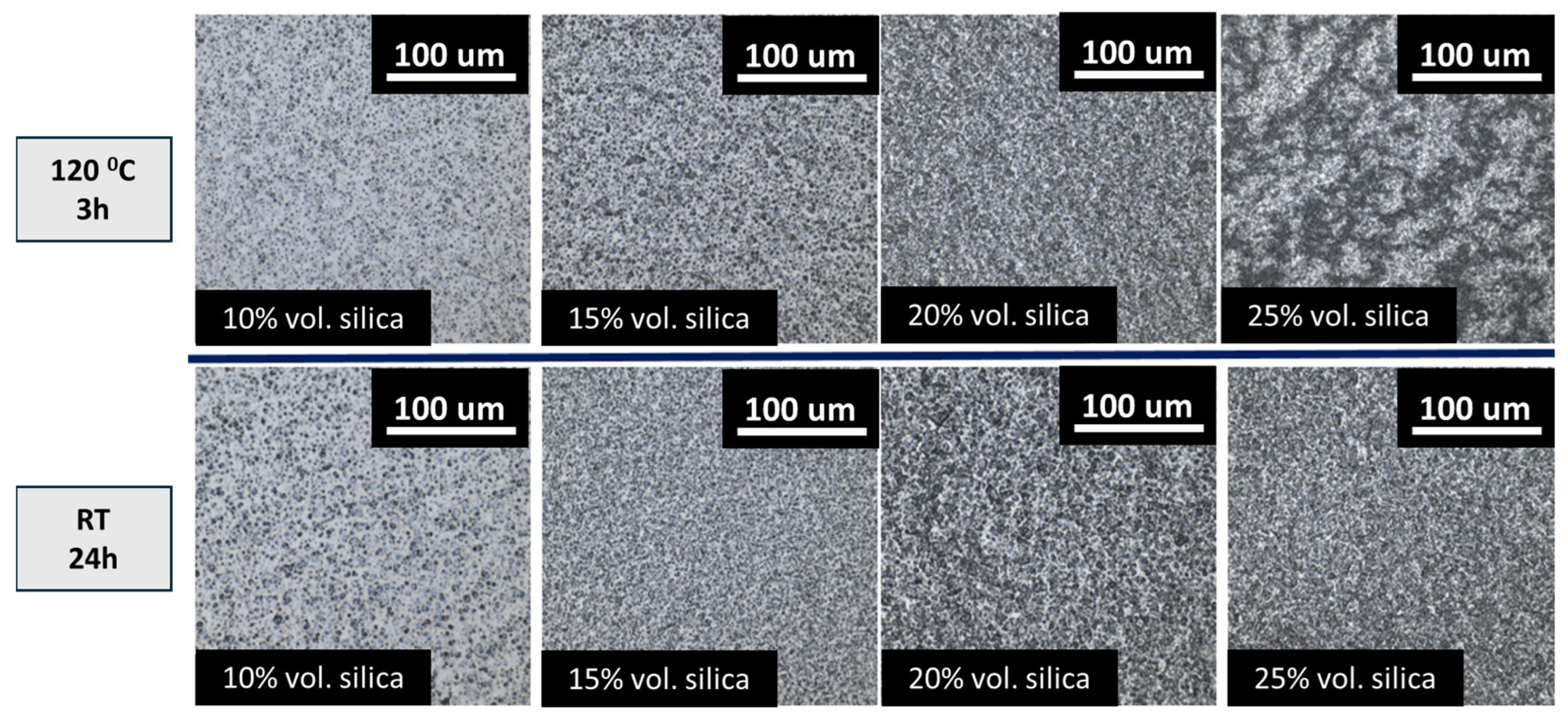
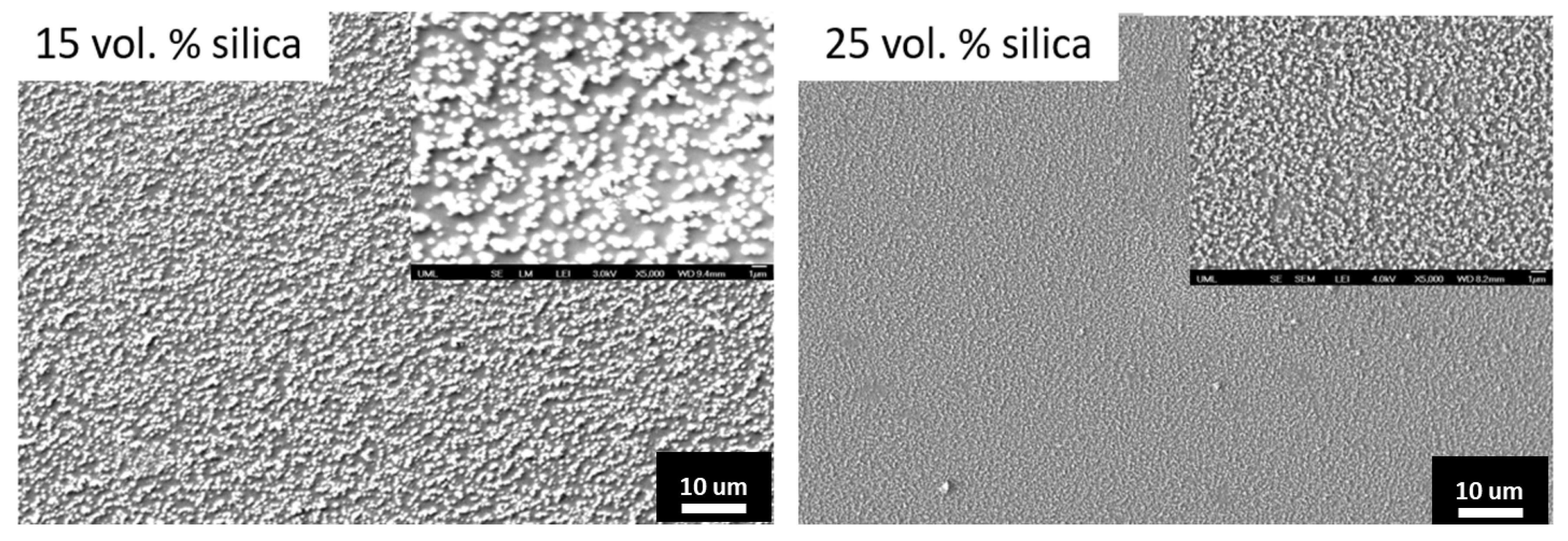
In order to further investigate a breakpoint at which cracking occurs, formulations having 25% vol. particle loading and less were prepared, and confocal laser microscopy images of these coatings were obtained and shown in Figure 3, which showed no indication of cracks even under different drying conditions when the particle loading was 25% vol. and less. To confirm that, SEM images were also taken on coatings with 15 and 25 vol.% silica loadings, as shown in Figure 4.
All these findings suggested that crack formation was significantly affected by the silica loading. Higher silica loading in our system could cause earlier crack formation. In our system 25–30 vol.% was found to be the breaking point for crack formation. The absence of cracks at lower loading might be attributed to reduced stress accumulation during solvent evaporation, whereas higher loadings likely promote stress concentration within the rigid silica network, leading to fracture.
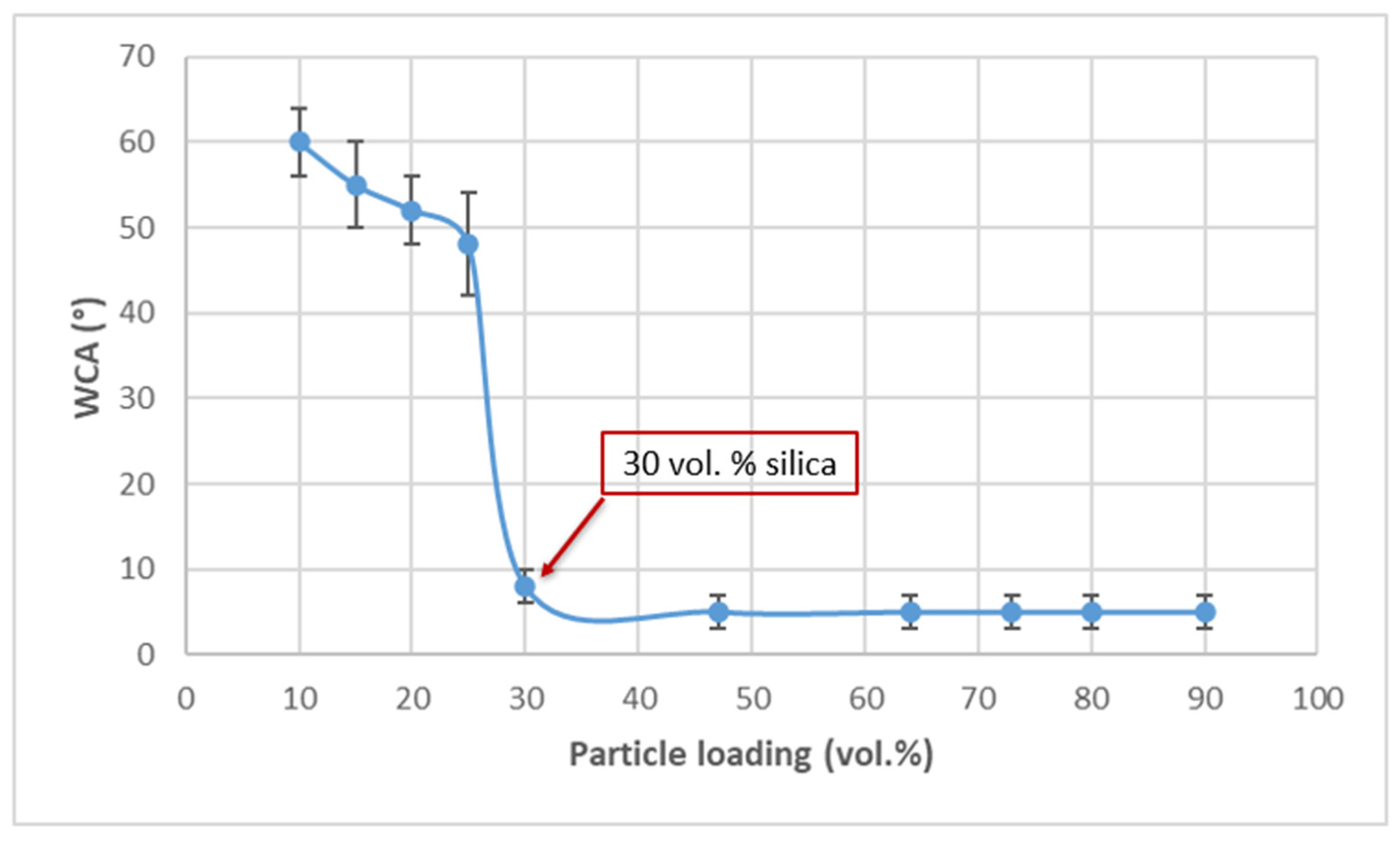
However, a dilemma exists between crack formation and superhydrophilicity which is shown in Figure 5. Figure 5 shows the effect of particle loading on the wettability. The increase in particle loading decreased the water contact angle, which indicated improving surface hydrophilicity. Superhydrophilic behavior was achieved only when the silica loading is 30 vol.% and above. Therefore, in our system, it is necessary to investigate how to prevent crack formation for coatings having 30% vol. particle loading and above to maintain superhydrophilicity.
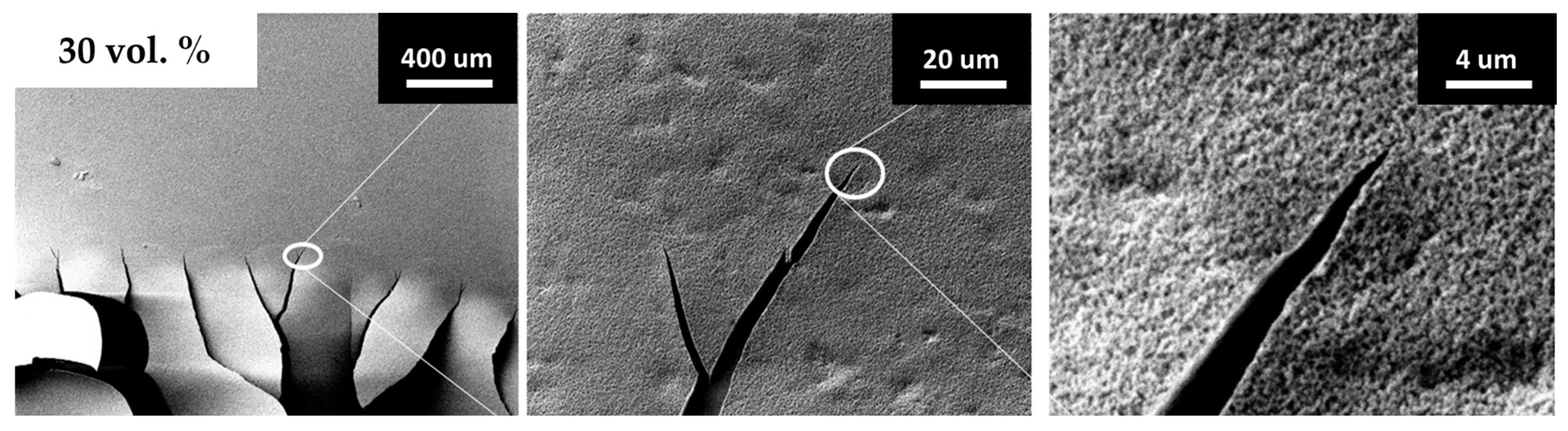
One of the primary drivers of crack formation in particle–polymer coatings is the buildup of capillary stresses during solvent evaporation. As the solvent front recedes, capillary forces within the porous particle network generate tensile stresses that can exceed the fracture strength of the composite film. These stresses are particularly pronounced at higher particle loadings, where particle–particle contacts dominate the microstructure and limit stress relaxation. Our observation that cracking initiates beyond 30 vol.% loading is consistent with this mechanism, suggesting that solvent-driven stress buildup plays a key role in destabilizing the coatings in our system. Another contributing factor to crack formation is the mismatch in shrinkage behavior between the polymer binder and the rigid silica particles. During drying, the polymeric phase undergoes volumetric shrinkage, while the silica particles remain dimensionally stable. This mismatch generates interfacial stresses that accumulate within the composite film. Similar effects have been reported in other polymer–particle systems, where crack density increases with particle content due to reduced polymer mobility and increased internal stress. In our coatings, the emergence of cracks above 30 vol.% may be partly explained by such shrinkage mismatch effects. Therefore, solvent evaporation rate might be the factor we can try to tune to prevent crack formation at high silica loading level. To do that, new coatings were made and subjected to different drying protocols. When 30 vol.% coatings were dried initially at room temperature for 24 h followed by heating at 120 °C for 1 h, extensive surface cracking was observed (Figure 6). Interestingly, crack initiation was detected after only 2 h of room-temperature drying, suggesting that early-stage solvent removal contributes strongly to stress development.
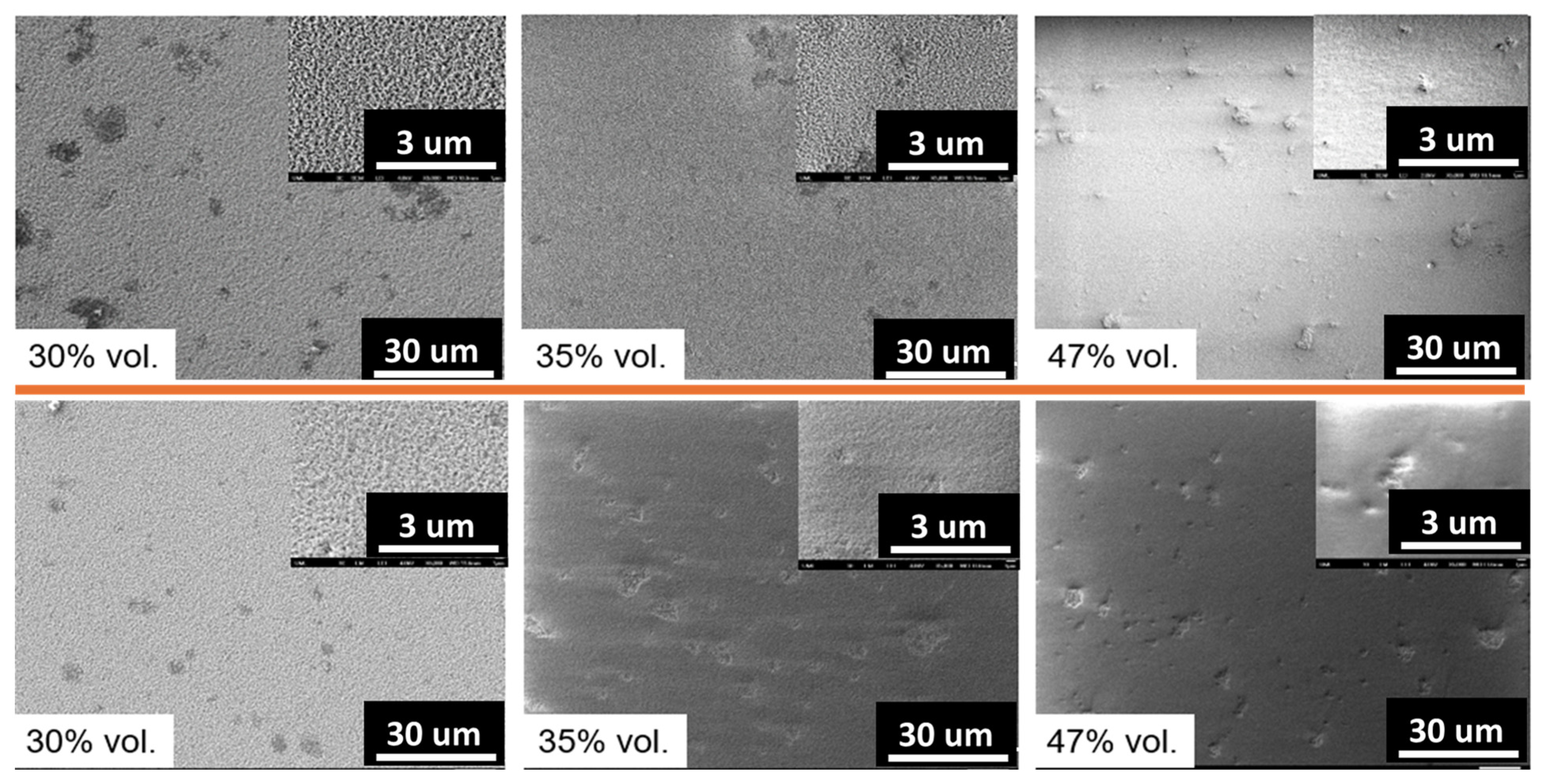
In contrast, coatings with silica loadings of 30 vol.%, 35 vol.%, and 47 vol.% that were dried directly at 120 °C for 1 h followed by curing at room temperature for 24 h showed no visible cracks, but localized microstructural defects were observed (Figure 7). These defects appeared as randomly distributed dark, flat spots with sizes ranging from approximately 1–5 μm in the 30 vol.% sample. As the particle loading increased, these dark spots became lighter in color but more dent-like in morphology. The origin and formation mechanism of these defects remain unclear. The kinetics of drying are known to strongly influence crack formation and propagation in thin films. Rapid solvent removal can prevent sufficient stress relaxation, leading to abrupt crack initiation and growth. In contrast, slower drying may allow time for stress redistribution, although it can also promote microstructural heterogeneity that eventually results in cracking. Our results, where coatings dried at room temperature for extended periods showed early crack initiation, indicate that both drying rate and total drying time play critical roles in determining the final coating morphology. Optimizing drying conditions is therefore essential to balance stress relaxation with structural stability. Although the exact mechanism remains to be fully determined, one plausible explanation is that rapid solvent removal at elevated temperature reduces the time available for stress concentration and microcrack propagation. Alternatively, elevated temperatures may enhance polymer–particle interactions, improving stress distribution across the coating. Up to now, our statements and hypotheses regarding crack formation have been based primarily on non-quantitative measurements. More quantitative characterization methods, such as TGA, FTIR, and internal stress measurements, are necessary to support and establish more conclusive interpretations. Future studies, including spectroscopic and thermal analyses, will be required to identify and confirm the dominant mechanism.
Finally, superhydrophilic and crack-suppressed coatings were obtained for the coatings having 35 vol.% particle loadings and above when the coatings were dried at 120 °C for 1 h and then RT for 24 h.
At last, the transparency of the coatings was measured by UV-Vis, using Hitachi U-2910 Spectrophotometer, and the result is shown in Figure S1. Figure S1 shows that coatings with higher silica loading exhibit better transparency. This might be related to their roughness in micro/nano scale. The SEM image at higher magnification (shown in the inserted window in Figure 7) indicates that coating’s surface looks rougher when particle loading decreases. For coatings with particle loading at 35 and 47% vol., the transparency reached to above 95% across almost all visible light range.
To evaluate the adhesion of prepared coating on glass, in this work, we also performed a tape test. The tape adhesion test was conducted in accordance with ASTM D3359-17 standard test method [37]. A cross-hatch pattern was made on the coating surface, followed by the application and removal of adhesive tape to evaluate the adhesion strength of the coating. The adhesion performance was then rated based on the amount of coating removed after the tape peel test. For most coatings, as shown in Table S1, the adhesion level was 4B–5B, which indicates good adhesion strength between our coating and glass. To evaluate mechanical durability, rotary abrasion resistance was characterized using a Taber Abraser in accordance with ASTM G195-13a [38]. The coating specimens, featuring a 47 vol.% filler loading, were subjected to abrasive wear utilizing CS-10 Calibrase wheels under a constant load of 250 g per arm. The degradation of surface performance was monitored by measuring the static water contact angle (WCA) at specific cycle intervals. This metric served as a proxy for the retention of superhydrophilicity during mechanical stress. As detailed in Table S2, the WCA exhibited a positive correlation with the number of abrasion cycles, indicating progressive surface damage. Notably, the coating lost its characteristic superhydrophilicity after only 10 cycles, suggesting a rapid transition in surface energy or a breakdown of the critical surface topography required for extreme wetting. To study the wetting stability over time, we put the samples in fume hood with 40% humidity and 25 C temperature for 7 days. Then we performed water contact angle test on these samples again to compare the changes with day one measurement. The results are shown in Table S4, which indicated the wetting performance of our prepared samples is stable under controlled environmental conditions.
Thickness of samples was also measured from the cross section SEM images shown in Figure S2 and the results were listed in Table S3. FTIR analysis of samples is given in Figure S3. The tentative assignment of functional groups is presented in Table S5. As seen in Figure S3, there were no discernible differences between the different loadings and the spectra were dominated by polyacrylic acid. Because there was no common peak to use as a reference it was not possible to quantitively determine changes in functional groups of the coatings.

4. Conclusions

This study provides a systematic evaluation of the interdependent effects of nanoparticle loading and drying kinetics on the structural integrity and wetting properties of PAA/silica nanocomposite coatings. A critical threshold for crack initiation was clearly delineated between 25 and 30 vol.% silica. While coatings containing 25 vol.% silica maintained structural fidelity, they failed to achieve superhydrophilicity; conversely, formulations exceeding 30 vol.% achieved extreme wettability but suffered from severe mud-cracking under standard thermal processing. By implementing an optimized, sequential drying protocol (flash drying at 120 °C for 1 h, followed by a 24 h ambient cure), the operational window for these composites was significantly expanded. Structurally intact, superhydrophilic coatings were successfully realized at silica loadings up to 47 vol.%. These findings highlight the paramount importance of modulating drying kinetics to manage capillary and shrinkage-induced stresses, offering a practical methodology for the engineering of robust, high-performance functional surface coatings.

Supplementary Materials

The following supporting information can be downloaded at: https://www.mdpi.com/article/10.3390/surfaces9020046/s1, Figure S1: UV-Vis spectrometer rest on some of our prepared coatings; Table S1: Tape test results; Table S2: Durability evaluation via Taber Test on Coating With Silica Loading 47 % vol.; Table S3: Coating thickness measurement; Figure S2: SEM cross section images of coatings with particle loading (vol. %) of 30, 35 and 47; Table S4: Water contact angle measurements for each coating and its stability after one week; Figure S3: FTIR spectrum of several samples.; Table S5: Figure S3 FTIR peak assignments.

Author Contributions

Conceptualization, S.T. and J.Z.; methodology, S.T. and F.A.; investigation, F.A. and S.T.; resources, J.M., H.D. and S.K.; data curation, S.T.; writing—original draft preparation, S.T.; writing—review and editing, F.A. and J.Z.; supervision, J.M. and J.Z.; project administration, J.Z. and J.M.; funding acquisition, J.Z. and J.M. All authors have read and agreed to the published version of the manuscript.

Funding

This research was funded by the U.S. Army Combat Capabilities Development Command Soldier Center (DEVCOM SC). Award ID: W911QY23P0019, Project Number: S51310000056881.

Institutional Review Board Statement

Not applicable.

Informed Consent Statement

Not applicable.

Data Availability Statement

The data presented in this study is available on request from the corresponding author.

Acknowledgments

The authors gratefully acknowledge the financial support of the U.S. Army Combat Capabilities Development Command Soldier Center (DEVCOM SC).

Conflicts of Interest

The authors declare no conflicts of interest.

References

  1. Wang, S.; Jiang, L. Definition of superhydrophobic states. Adv. Mater. 2007, 19, 3423–3424. [Google Scholar] [CrossRef]
  2. Drelich, J.; Chibowski, E.; Meng, D.D.; Terpilowski, K. Hydrophilic and superhydrophilic surfaces and materials. Soft Matter 2011, 7, 9804–9828. [Google Scholar] [CrossRef]
  3. Ganesh, V.A.; Raut, H.K.; Nair, A.S.; Ramakrishna, S. A review on self-cleaning coatings. J. Mater. Chem. 2011, 21, 16304–16322. [Google Scholar] [CrossRef]
  4. Nuraje, N.; Asmatulu, R.; Cohen, R.E.; Rubner, M.F. Durable antifog films from layer-by-layer molecularly blended hydrophilic polysaccharides. Langmuir 2011, 27, 782–791. [Google Scholar] [CrossRef]
  5. Howarter, J.A.; Youngblood, J.P. Self-cleaning and next generation anti-fog surfaces and coatings. Macromol. Rapid Commun. 2006, 27, 1295–1301. [Google Scholar] [CrossRef]
  6. Tentu, R.D.; Basu, S. Photocatalytic water-splitting for hydrogen production. Curr. Opin. Electrochem. 2017, 5, 56–62. [Google Scholar] [CrossRef]
  7. Korneva, G.; Ye, H.; Gogotsi, Y.; Halverson, D.; Friedman, G.; Bradley, J.C.; Kornev, K.G. Carbon nanotubes loaded with magnetic particles. Nano Lett. 2005, 5, 879–884. [Google Scholar] [CrossRef]
  8. Beysens, D. The formation of dew. Atmos. Res. 1995, 39, 215–237. [Google Scholar] [CrossRef]
  9. Boinovich, L.; Emelyanenko, A. Wetting and surface forces. Adv. Colloid Interface Sci. 2011, 165, 60–69. [Google Scholar] [CrossRef] [PubMed]
  10. Scheff, T.; Acha, F.; Diaz Armas, N.; Mead, J.L.; Zhang, J. Tuning wetting properties through surface geometry in the Cassie–Baxter state. Biomimetics 2025, 10, 20. [Google Scholar] [CrossRef]
  11. Acha, F.; Egbebunmi, D.; Ahmadu, S.; Ojuolape, A.; Egbosiuba, T. Recent advances in bio-inspired superhydrophobic coatings utilizing hierarchical nanostructures for self-cleaning and anti-icing surfaces. Physchem 2025, 5, 48. [Google Scholar] [CrossRef]
  12. Rajan, R.A.; Ngo, C.V.; Yang, J.; Liu, Y.; Rao, K.S.; Guo, C. Femtosecond and picosecond laser fabrication for long-term superhydrophilic metal surfaces. Opt. Laser Technol. 2021, 143, 107241. [Google Scholar] [CrossRef]
  13. Domke, M.; Sonderegger, G.; Kostal, E.; Matylitsky, V.; Stroj, S. Transparent laser-structured glasses with superhydrophilic properties for anti-fogging applications. Appl. Phys. A 2019, 125, 10. [Google Scholar] [CrossRef]
  14. Zhang, J.; Chen, F.; Lu, Y.; Zhang, Z.; Liu, J.; Chen, Y.; Liu, X.; Yang, X.; Carmalt, C.J.; Parkin, I.P. Superhydrophilic–superhydrophobic patterned surfaces on glass substrate for water harvesting. J. Mater. Sci. 2020, 55, 498–508. [Google Scholar] [CrossRef]
  15. Turkoglu, S.; Zhang, J.; Dodiuk, H.; Kenig, S.; Ratto, J.A.; Mead, J. Wetting characteristics of nanosilica-poly(acrylic acid) transparent anti-fog coatings. Polymers 2022, 14, 4663. [Google Scholar] [CrossRef] [PubMed]
  16. Lilin, A.; Bischofberger, I. Criteria for Crack Formation and Air Invasion in Drying Colloidal Suspensions. Langmuir 2022, 38, 7442–7447. [Google Scholar] [CrossRef]
  17. Dodiuk, H.; Kenig, S. Handbook of Nanopolymers; Smithers Rapra Technology: Shewsbury, UK, 2013. [Google Scholar]
  18. Sennerfors, T.; Bogdanovic, G.; Tiberg, F. Formation, Chemical Composition, and Structure of Polyelectrolyte−Nanoparticle Multilayer Films. Langmuir 2002, 18, 6410–6415. [Google Scholar] [CrossRef]
  19. Polakiewicz, A.; Dodiuk, H.; Kenig, S. Super-hydrophilic coatings based on silica nanoparticles. J. Adhes. Sci. Technol. 2014, 28, 466–478. [Google Scholar] [CrossRef]
  20. Rios, P.F.; Dodiuk, H.; Kenig, S. Self-cleaning coatings. Surf. Eng. 2009, 25, 89–92. [Google Scholar] [CrossRef]
  21. Tirumkudulu, M.S.; Russel, W.B. Role of Capillary Stresses in Film Formation. Langmuir 2004, 20, 2947–2961. [Google Scholar] [CrossRef]
  22. Routh, A.F. Drying of thin colloidal films. Rep. Prog. Phys. 2013, 76, 046603. [Google Scholar] [CrossRef]
  23. Lei, H.; Francis, L.F.; Gerberich, W.W.; Scriven, L.E. Stress development in drying coatings after solidification. AIChE J. 2002, 48, 437–451. [Google Scholar] [CrossRef]
  24. Olad, A. Polymer/clay nanocomposites. In Advances in Diverse Industrial Applications of Nanocomposites; IntechOpen: London, UK, 2011; Volume 114, pp. 113–139. [Google Scholar]
  25. Sarieddine, R.; Kadiri, H.; Guelorget, B.; Le Cunff, L.; Alhussein, A.; Habchi, R.; Lérondel, G. A review on potential mechanically resistant materials for optical multifunctional surfaces: Bioinspired surfaces with advanced properties. Adv. Mater. Interfaces 2024, 11, 2300793. [Google Scholar] [CrossRef]
  26. Igwe, I.O.; Acha, F.N.; Anyaegbu, C.O.; Agwu, G.I.; Ifeacho, V.C.; Esinwoke, W.C.; Nwapa, C. Formulation of anti-corrosive alkyd paints based on Umuahia clay extender. SSRG Int. J. Polym. Text. Eng. 2020, 7, 25–30. [Google Scholar] [CrossRef]
  27. Igwe, I.O.; Acha, F.N.; Agwu, G.I.; Ifeacho, V.C.; Okonkwo, S.N.; Ekwueme, C.C.; Igboanugo, U.I. Utilization of granite quarry dust extender in formulating anti-corrosive paints for the protection of steel. Aust. J. Sci. Technol. 2021, 5, 632–638. [Google Scholar]
  28. Yow, H.N.; Goikoetxea, M.; Goehring, L.; Routh, A.F. Effect of film thickness and particle size on cracking stresses in drying latex films. J. Colloid Interface Sci. 2010, 352, 542–548. [Google Scholar] [CrossRef] [PubMed]
  29. Chiu, R.C.; Garino, T.J.; Cima, M.J. Drying of granular ceramic films: I, effect of processing variables on cracking behavior. J. Am. Ceram. Soc. 1993, 76, 2257–2264. [Google Scholar] [CrossRef]
  30. Singh, K.B.; Tirumkudulu, M.S. Cracking in drying colloidal films. Phys. Rev. Lett. 2007, 98, 218302. [Google Scholar] [CrossRef]
  31. Francis, L.F.; McCormick, A.V.; Vaessen, D.M.; Payne, J.A. Development and measurement of stress in polymer coatings. J. Mater. Sci. 2002, 37, 4717–4731. [Google Scholar] [CrossRef]
  32. Roy, S.; Tirumkudulu, M.S. Drying and consolidation in drying colloidal dispersions. Procedia IUTAM 2015, 15, 57–63. [Google Scholar] [CrossRef][Green Version]
  33. Tuteja, A.; Choi, W.; Ma, M.; Mabry, J.M.; Mazzella, S.A.; Rutledge, G.C.; McKinley, G.H.; Cohen, R.E. Designing superoleophobic surfaces. Science 2007, 318, 1618–1622. [Google Scholar] [CrossRef] [PubMed]
  34. Richardson, J.J.; Cui, J.; Bjornmalm, M.; Braunger, J.A.; Ejima, H.; Caruso, F. Innovation in layer-by-layer assembly. Chem. Rev. 2016, 116, 14828–14867. [Google Scholar] [CrossRef] [PubMed]
  35. Sigma-Aldrich. LUDOX® SM-30 Colloidal Silica Technical Data Sheet; Sigma-Aldrich: St. Louis, MI, USA, 2024. [Google Scholar]
  36. Turkoglu, S.; Zhang, J.; Dodiuk, H.; Kenig, S.; Ratto, J.A.; Mead, J. Dynamic wetting properties of silica-poly(acrylic acid) superhydrophilic coatings. Polymers 2023, 15, 1242. [Google Scholar] [CrossRef] [PubMed]
  37. ASTM D3359-17; Standard Test Methods for Rating Adhesion by Tape Test. ASTM International: West Conshohocken, PA, USA, 2017.
  38. ASTM G195-13a; Standard Guide for Conducting Wear Tests Using a Rotary Platform Abraser. ASTM International: West Conshohocken, PA, USA, 2013.
Figure 1. Sample preparation procedure.
Surfaces 09 00046 g001
Figure 2. Optical microscopy images of coatings with different silica loadings.
Surfaces 09 00046 g002
Figure 3. Confocal laser microscopy images of the different particle loading coatings. All images are 259 μm × 259 μm in size.
Surfaces 09 00046 g003
Figure 4. SEM images of the different particle loading coatings.
Surfaces 09 00046 g004
Figure 5. WCA vs. particle loading.
Surfaces 09 00046 g005
Figure 6. SEM images of 30 vol.% particle loading coating dried at RT for 24 h and then in the oven at 120 °C for 1 h at different magnifications.
Surfaces 09 00046 g006
Figure 7. SEM images of the different particle loading coatings dried at: (top) 120 °C for 1 h, (bottom) 120 °C 1 h then RT for 24 h.
Surfaces 09 00046 g007
Table 1. Formulations of PAA/silica coatings.
Ludox SM-30 (g)1% PAA (g)Silica Content (vol.%)
6.331090
62080
42073
2.672064
3.335047
1.64035
1.675030
14025
0.734020
0.534015
0.334010
Disclaimer/Publisher’s Note: The statements, opinions and data contained in all publications are solely those of the individual author(s) and contributor(s) and not of MDPI and/or the editor(s). MDPI and/or the editor(s) disclaim responsibility for any injury to people or property resulting from any ideas, methods, instructions or products referred to in the content.