
Article

Red Dyes in Transition: Investigating Natural and Synthetic Colourants in Javanese Batik Textiles by HPLC-DAD-MS/MS and SERS

1
Heritage Conservation Centre, National Heritage Board, 32 Jurong Port Road, Singapore 619104, Singapore
2
Department of Scientific Research, British Museum, Great Russell Street, London WC1B 3DG, UK
3
Independent Researcher, Singapore
4
Department of Asia, British Museum, Great Russell Street, London WC1B 3DG, UK
*
Authors to whom correspondence should be addressed.
Heritage 2026, 9(6), 231; https://doi.org/10.3390/heritage9060231 (registering DOI)
Submission received: 26 March 2026 / Revised: 29 May 2026 / Accepted: 2 June 2026 / Published: 12 June 2026
(This article belongs to the Special Issue Dyes in History and Archaeology 44)

Abstract

Fifty-five batik textiles produced along coastal Java in the late 19th to early 20th century were analysed to study the red dyes and the cotton fabrics. Surface-Enhanced Raman Spectroscopy (SERS) classified the dyes into six groups and identified 70% of the samples as Morinda. High-Performance Liquid Chromatography coupled with a diode array detector and tandem Mass Spectrometry (HPLC-DAD-MS/MS) confirmed the SERS results and identified synthetic dyes in the remaining samples, which were used either alone or in mixtures with Morinda or indigo. Synthetic alizarin (C.I. 58000, Mordant Red 11) was the most frequently detected synthetic dye. Auramine O (C.I. 41000, Basic Yellow 2), fuchsin (C.I. 42510, Basic Violet 14), and rhodamine B (C.I. 45170, Basic Violet 10) were occasionally detected. The results also highlighted two possible types of Morinda and two variations of synthetic alizarin. The shades obtained from mixtures of natural and synthetic dyes were visually indistinguishable from those obtained with pure natural or synthetic dye, as confirmed by colourimetry. The variety of dyes and cotton fabrics shared across batik producers makes it challenging to attribute unsigned batiks to specific workshops. Nevertheless, this study demonstrated that synthetic dye uptake during this period was limited and experimental, with natural Morinda remaining the preferred choice despite the availability of European synthetic alternatives.

1. Introduction

Coastal batik textiles (or Pesisir batiks) flourished along Java’s north coast in the late 19th/early 20th century as a distinctive art form different from Central Javanese court traditions [1,2]. Produced primarily in centres such as Pekalongan, Lasem, Cirebon, and Semarang, these textiles were characterised by relatively free designs, market-driven production, and strong responsiveness to changing consumer tastes [3]. They were often created in female-led entrepreneurial ateliers that experimented with Chinese, European, or Arab aesthetic ideas and motifs, resulting in finely crafted textiles of exceptional quality [4]. The technical mastery of these workshops is exemplified by their sophisticated wax-resist (tulis) techniques, the ability to achieve clean white grounds through wax application and removal across multiple dyeing stages, and natural dyeing with Morinda (Morinda citrifolia or mengkudu) root for red and indigo (Indigofera tinctoria) for blue, alongside the development of quicker stamping methods for increased production efficiency [5].
Batik textiles from the late 19th century are often found in various museums and private collections. Nevertheless, they are not all signed by their makers and are seldom attributed to specific workshops. Hence, this research originated from a curatorial question aimed at determining whether material analysis can assist in assigning batiks to specific workshops. In the framework of the exhibition “Batik Nyonyas: Three Generations of Art and Entrepreneurship” at the Peranakan Museum, initial analysis of unsigned pieces attributed to Nyonya Oeij Soen King, alongside signed or stamped works from contemporaneous workshops (van Zuylen, Jans, Ong) in Pekalongan and Lasem, was carried out using Surface-Enhanced Raman Spectroscopy (SERS), colourimetry and microscopy to compare the red dyes and fabrics [6]. While this investigation did not reveal unique features capable of differentiating Oeij’s works from her contemporaries, it uncovered a variety of red dye compositions and cotton fabrics across different workshops, revealing research gaps that warrant further investigation. First, SERS could only classify the red dyes into three distinct groups, possibly assigned to Morinda citrifolia, an unidentified anthraquinone-based dye, and possibly Oldenlandia umbellata (chay root). The suggestion of chay root was particularly questionable, as this is not a native Indonesian dye. Additionally, colourimetric analysis revealed a wide variety of red shades from dark red to light pink, yet it remained unclear whether these variations resulted from Morinda alone or represented other dyes and dye combinations. A reliable dye analysis technique was therefore required to correlate the SERS and colourimetry data.
At present, High-Performance Liquid Chromatography coupled with Mass Spectrometry (HPLC-MS) is the state-of-the-art technique for dye analysis of historical textiles, as it can resolve dye mixtures and identify dyes at the molecular level [7,8,9,10]. SERS is also utilised for dye analysis in textiles [7,11,12,13,14,15,16]. Its high sensitivity and minimal sample requirement make SERS valuable for the identification of dyes and organic colourants present in low concentrations [7,17,18]. However, SERS application is limited by its inability to resolve dye mixtures, the preferential detection of analytes with affinity to the SERS substrate and the need for comparable dye reference databases [7,19,20]. The success of SERS depends largely on the sample matrix and choice of SERS method. As natural dyes can be mordanted onto textile fibres, samples require pre-treatment with acids, organic solvents or chelating agents to hydrolyse the dye–metal bond in mordanted fibres [21,22]. In particular, the brief sample exposure to hydrofluoric (HF) acid vapour results in spectra with a better signal-to-noise ratio and reproducibility without altering the dye molecular structure or degrading the substrate [23,24]. HF pre-treatment with SERS has proven effective on a range of dyed textile collections [19,23,24,25,26], including our previous work on red-dyed batik textiles [6]. Dye analysis can also be performed by Gas Chromatography–Mass Spectrometry (GC-MS) with derivatisation [27,28], which is capable of detecting degradation products from the dyes and substrates, non-dye marker compounds, auxiliary compounds added to the dye bath, and other contaminants [7,27]. However, GC is not as commonly reported as LC for dye analysis, and its sensitivity for dyes and colourants is lower than HPLC.
In Java, red was historically achieved using the natural dye extracted from the root bark of Morinda citrifolia or mengkudu mixed with the leaves of the Symplocos spp. (an aluminium-rich plant that acts as mordant). Other dyes producing a red hue were possibly available, as previous technical studies of 19th to 20th century Indonesian textiles have identified a wide variety of dyes including Morinda, chay root, indigo, tannins, cochineal, synthetic alizarin, weld, lac, sappanwood, and unknown synthetics [29,30,31]. However, the extent to which these red dyes were used or adopted in coastal batik textiles remains unknown. To date, only one technical study of coastal batiks has been conducted, focusing on 19th century Franquemont batiks (1817–1867) made in Semarang, where Morinda (possibly Morinda citrifolia and Morinda umbellata) red was identified and no synthetic dye was found [32].
Synthetic dyes greatly shortened dyeing processes and allowed makers to focus more on hand-drawn or tulis work. The precise timing of synthetic dye adoption into the Javanese batik market is unclear. While synthetic dyes had revolutionised European textile production by the 1870s [33], their introduction to Java likely occurred around the 1880s through Dutch colonial networks, coinciding with railway construction along the north coast that facilitated trade, including batik exports [5,29]. Different sources indicate that the use of synthetic dyes in batik-making became increasingly apparent from the 1930s [29,34].
Questions about dye usage and the adoption of synthetic dyes provide the impetus for the present study, which integrates HPLC-DAD-MS/MS with SERS analysis of the same sample set to characterise the dye compositions. The fifty-five batik textiles belong to the collections of the Peranakan Museum, the private collection of Mr and Mrs Lee Kip Lee and the British Museum, and consist of late 19th–early 20th century batik textiles produced mostly in Pekalongan, Lasem, and unknown provenances in Java, likely along the north coast. Some are signed and stamped, while others are not. Reds were primarily selected for analysis as they represent a dominant colour in the sample set, enabling comparison across textiles from this region. Where possible, other colours such as blues and yellows were also analysed. Colourimetry is included to document and compare the different shades of red, whilst fabric analysis of the cotton provides insights into batik quality. Through reliable dye identification with HPLC-DAD-MS/MS, this research aims to develop SERS as a tool for identifying red dye compositions in historical Javanese batik textiles and to investigate the material choices and extent of synthetic dye adoption within this group of coastal batiks.

2. Materials and Methods

2.1. Batik Textile Samples

Fifty-five batik textiles representative of Javanese north coast production in the late 19th–early 20th century were selected for analysis (Table 1). The batiks from the Peranakan Museum, National Heritage Board of Singapore, include 15 unsigned pieces attributed to Nyonya Oeij Soen King (1872–1925, Pekalongan), donated by the Oeij family. The batiks from the Mr and Mrs Lee Kip Lee private collection include 10 Lasem pieces signed by Ong Hong Hie, 5 pieces signed by Eliza van Zuylen (1863–1947, Pekalongan) and 5 pieces signed by Johanna Jans (1850–1920, Pekalongan). The batiks from the British Museum (BM) comprise 19 pieces acquired by Charles Beving between 1880 and 1913 in various parts of Java (Madura, Cirebon, Pekalongan and other unknown areas, mostly along the north coast). Two of them have the signature of Mevr B Fisfer Pek (Pekalongan) and one was possibly produced by Catharina Carolina van Oosterom. Additionally, one Javanese-made piece, which was sold to Europe, purchased by Mrs Eustrace Smith, and later donated to the British Museum, is also included.
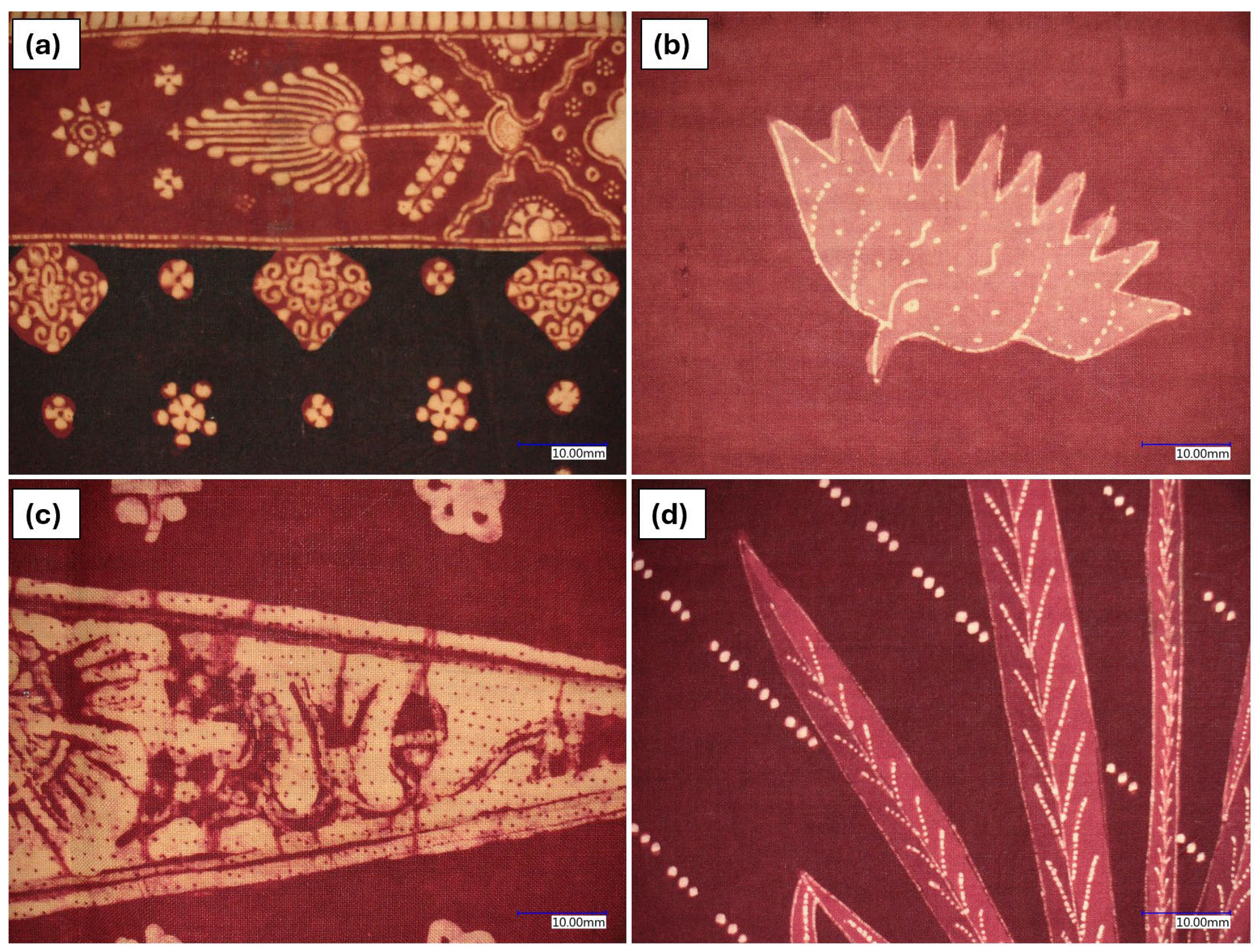
All of the textiles contain at least one shade of red (Figure 1). Representative images of the textiles are available in the Supplementary Materials.
Red-dyed threads (a few millimetres long) were cut from loose ends, damaged areas or edges/fringes of the textiles, giving a total of 67 red samples for analysis. One of the red samples was not analysed with HPLC due to an insufficient quantity being gathered. Where available, some blue and yellow threads were also removed for dye analysis, as specified in Table 1.

2.2. Reference Samples

Dye references include Rubia cordifolia- and Rubia tinctorum-dyed cotton (dyed by Miki Komatsu in 2006), Morinda citrifolia-dyed cotton (“Aal” dye from a dye manual book produced in India in 1987 [35], Morinda citrifolia-dyed cotton purchased in 2024 from the “Threads of Life” shop in Bali, Indonesia. Morinda citrifolia-dyed cotton sourced in 2024 from local dyer Pak Kornelis in Sumba, Indonesia. Oldenlandia umbellata-dyed cotton from a textile in the collection of the TPM (accession number: 2011-00088), verified by HPLC [31], and synthetic-alizarin-dyed cotton from a textile in the collection of the TPM (accession number: 2001-00361), verified by HPLC [31].
Cotton fabric references were sourced in 2024 from Toko German, a long-standing store that has supplied materials for batik-making since the late 20th century in Pekalongan, Indonesia. They include three grades of primissima cotton (55 K, 35 K and mercerised 25 K Indonesia Ringgit per metre) and one prima cotton (mercerised 25 K Indonesia Ringgit per metre). A primissima cotton used by Widianti Widjaja (Oey Kiem Lian), third generation batik-maker of the Oey Soe Tjoen workshop (1925–2025) in Pekalongan, Indonesia, was also obtained in 2024.

2.3. Surface-Enhanced Raman Spectroscopy (SERS)

Silver nanoparticles were prepared using a microwave with citrate as a stabiliser and glucose as a reducing agent [21,24]. The sample (less than 1 mm) was exposed to 10% hydrofluoric acid (HF) in a sealed polyethylene vial for 5–10 min. The HF-treated sample was then removed from the vial and analysed in situ with Raman spectroscopy after adding 2 μL of silver nanoparticle colloid and 1 μL of potassium nitrate for aggregation [21,23,24]. All operations using HF were done in a HF-resistant fume cupboard. Initial tests conducted on a few samples (red-dyed cotton in batik textiles) showed excellent reproducibility with HF pre-treatment and SERS, whilst direct analysis with normal Raman spectroscopy or SERS without HF yielded poor spectra with high fluorescence (Figure S1, Supplementary Materials). Hence, all samples were analysed in the same manner with HR pre-treatment and SERS.
SERS spectra were obtained using a Qontor Invia confocal microscope (Renishaw, Gloucester UK) with a 532 nm (50 mW) laser, 1800 L/mm grating and 50 × L objective. For each sample, at least three SERS spectra from various points were measured to ensure the representativeness of the resultant spectrum. The spectra were taken at an exposure time of 0.5–3 s, over 3–10 accumulations at 0.05–0.1% of the laser power at source. The spectra were processed with Wire 5.4 and compared using diagnostic peaks and visual overlays. The programme Origin 2017 was used to plot the spectral graphs.

2.4. HPLC-DAD-MS/MS

The dye extraction was performed using a method published in [36], which consists of a double mild extraction procedure, using DMSO first, and secondly a mixture of methanol/acetone/water/0.5 M oxalic acid 30:30:40:1 (v/v/v/v). The extracts were then analysed by High-Performance Liquid Chromatography coupled to a diode array detector and electrospray ionisation followed by Quadrupole and Time of Flight detection (HPLC-DAD-ESI-QToF).
The instrumentation consisted of a 1260 Infinity HPLC (Agilent Technologies, Waldbronn, Germany), coupled to a 1100 DAD detector (Agilent Technologies, Waldbronn, Germany) and to a Quadrupole–Time of Flight tandem mass spectrometer 6530 Infinity Q-ToF detector (Agilent Technologies, Waldbronn, Germany) by a Jet Stream ESI interface (Agilent Technologies, Waldbronn, Germany). Separation was achieved using a Zorbax Extend-C18 column (2.1 mm × 50 mm, 1.8 μm particle size) with a 0.4 mL/min flow rate and 40 °C column temperature, and a gradient of water with 0.1% formic acid (eluent A) and acetonitrile with 0.1% formic acid (eluent B). The elution gradient was programmed as follows: initial conditions 95% A, followed by a linear gradient to 100% B in 10 min, and held for 2 min. Re-equilibration time for each analysis was 10 min. A 10 μL injection volume was adopted for MS experiments and 20 μL for MS/MS experiments.
The DAD detector (cell volume 50 µL) scanned in the range of 190–700 nm with 2 nm resolution. The ESI operating conditions were: drying gas (N2, purity > 98%) temperature 350 °C and 10 L/min flow; capillary voltage 4.0 kV; nebulizer gas pressure 40 psig; and sheath gas (N2, purity > 98%) temperature 375 °C and flow 11 L/min. High-resolution MS and MS/MS spectra were acquired in both negative and positive mode in the range 100–1700 m/z. The fragmentor was kept at 100 V, nozzle voltage 1000 V, skimmer 65 V, and octapole RF 750 V. For the MS/MS experiments, different voltages (from 10 to 50 V) in the collision cell were tested for Collision-Induced Dissociation (CID), in order to maximise the information obtained from the fragmentation of the single molecules. The collision gas was N2 (purity 99.999%). The data were collected by targeted MS/MS acquisition with an MS scan rate of 1.0 spectra/sec and a MS/MS scan rate of 1.0 spectra/sec. Auto-calibration was performed daily using Agilent tuning mix HP0321 (Agilent Technologies) prepared in 90% water–10% acetonitrile.
MassHunter Workstation Software (v.10) was used to carry out diode array detector and mass spectrometer control, data acquisition, and data analysis. In particular, DAD and extracted ion chromatograms were obtained using the software EIC function and selecting the correct wavelength or mass.
Molecular identifications were obtained by comparing experimental accurate mass values, retention times and DAD spectra of detected molecules with in-house molecular databases of natural [37] and synthetic dyes [10], as well as data available in the relevant literature (see corresponding sections). Differences in retention times were all within 0.1 min. Differences between experimental and calculated masses were all within 2 ppm. In the case of tentatively identified molecular formulas, these were also based on m/z values being within 2 ppm of the corresponding calculated values. However, molecular structures are not provided in these cases, as the information is not sufficient to discriminate among various possible isomers without the use of molecular standards, which are not available.

2.5. p-XRF Spectrometer

A portable or hand-held XRF (Thermo Scientific Niton Xl3t GOLDD+, Waltham, MA, U.S.) with a silver anode was used to investigate the possible use of mordants in the red areas. Only TPM and LKL pieces were analysed by XRF. The flat batik textile was placed on a 2.5 cm thick acrylic sheet during the analysis. Data was collected from an undyed and red-dyed area. Each measurement used a 3 mm spot size and “mining” mode (Spectrum 1: 10 s, Spectrum 2: 10 s, Spectrum 3: 60 s, for 2 batch runs with a total duration of 160 s). Spectrum 3 (for light and low-Z elements below 8 KeV) was processed using the Thermo Scientific Niton Data Transfer software version 8.4.3, for comparing undyed and red-dyed areas.

2.6. Colourimetry

It is difficult to define a red hue, as the batiks contain varying shades of red from dark to bright, and deep reds to oranges and pinks. Hence, colourimetry was used to document the shade of red analysed. For the TPM and LKL batiks, eight to twelve points per colour were collected and averaged using a Konika Minolta (Tokyo, Japan) 26D spectrophotometer, which is equipped with a white calibration plate, 3 mm aperture, and di:8°, de:8 sphere geometry, providing a 360–740 nm wavelength range with 10 nm measurement intervals. For the BM batiks, one point per colour was measured, due to limited time to access the textiles. A Konika Minolta (Tokyo, Japan) CM-2600d spectrophotometer was used, which is equipped with a 52 mm barium sulphate integrating sphere, dual-beam geometry, di:8°, de:8°, and a 360–740 nm wavelength range with 10 nm measurement intervals. The measuring area was 3 mm in diameter, and the standard illuminant was D65. The values are averages of three consecutive measurements on the same spot. A plate of barium sulphate was used as a white reference to calibrate reflectance spectra. The CIE L*a*b* colour space was adopted. In this system, L* represents the lightness (from 0 black to 100 pure white), a* is related to the red and green components (positive red—negative green) and b* is related to the blue and yellow components (positive yellow—negative blue).
A digital pseudo-colour was produced based on the L*a*b* values, using Spectra Magic NX Software (CM-S100w, Konica Minolta Inc, Tokyo, Japan. 2003–2021). The tristimulus points were plotted into the same 3D scatter plot using Origin 2017 software. Although the ACM and LKL tristimulus points were plotted based on an average point whilst BM tristimulus points were based on a single point, both datasets can be reliably correlated in the same plot as the deviation from the average colour is low, within the range of 3 along the L, a and b axes.

2.7. Optical Microscope and Thread Count Analysis

Examination of fabric was conducted using a hand-held lens of approximately 30×, a thread counter and a digital microscope (Dinolite Edge AF4515T-FVW) at 50× to 200× magnification. Weave structure, thread count (the sum of warp and weft within a 10 mm square), thread make-up and thread twist (S or Z direction) were evaluated for each textile.

3. Results

3.1. SERS

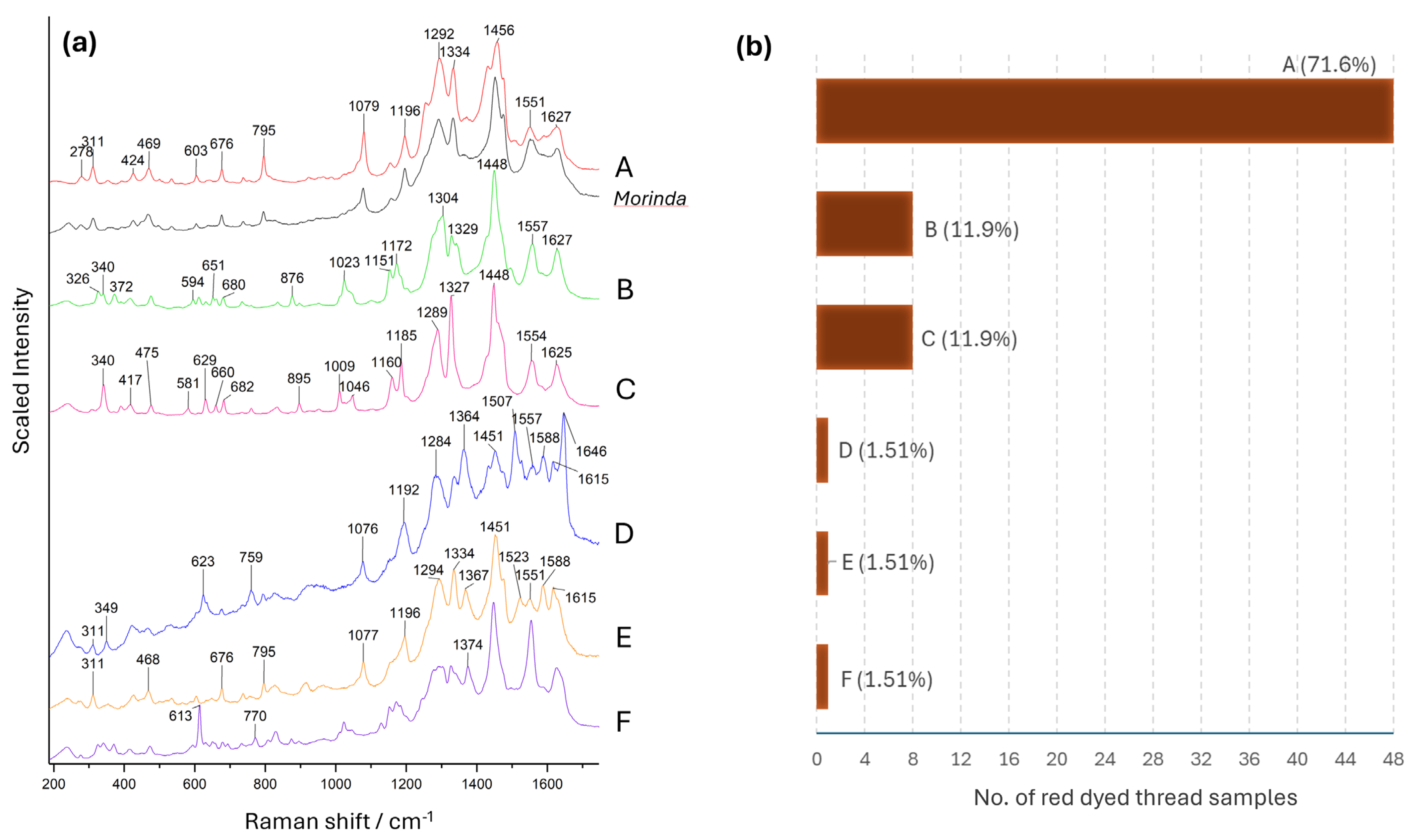
The SERS results of the red samples indicate a variety of dye compositions (Figure 2a). These were classifiable into six different groups referred to as Dyes A–F.
Dye A was identified as Morinda, by comparison of its SERS spectrum with a reference sample of cotton dyed with Morinda citrifolia (Figure 2a). We refer to this dye as Morinda, because the exact species cannot be ascertained (see further discussion in the following sections). Morinda is detected in more than 70% of the red samples analysed (Figure 2b).
Dyes B–F did not match any available reference, and hence their assignment to a specific dye composition was not possible. The spectra of Dyes B, C and F revealed similarities with Dye A. In particular, SERS peaks at 1625–1627, 1554–1557, 1448, 1327–1329, 1289–1304 cm−1 are typical of dyes containing alizarin [24,25,38,39]. Dyes B and C differ in the spectral peaks below 1200 cm−1. Dye F matches well with B, but it also shows additional peaks at 613, 770, and 1374 cm−1. Both D and E appear very different from the other dye compositions, especially in the spectral region 1300–1600 cm−1. Dye D matches well with E, except for a few additional peaks at 1646 and 623 cm−1. While Dyes B and C were detected in various samples, Dyes D, E and F were only detected in one sample each (Figure 2b).
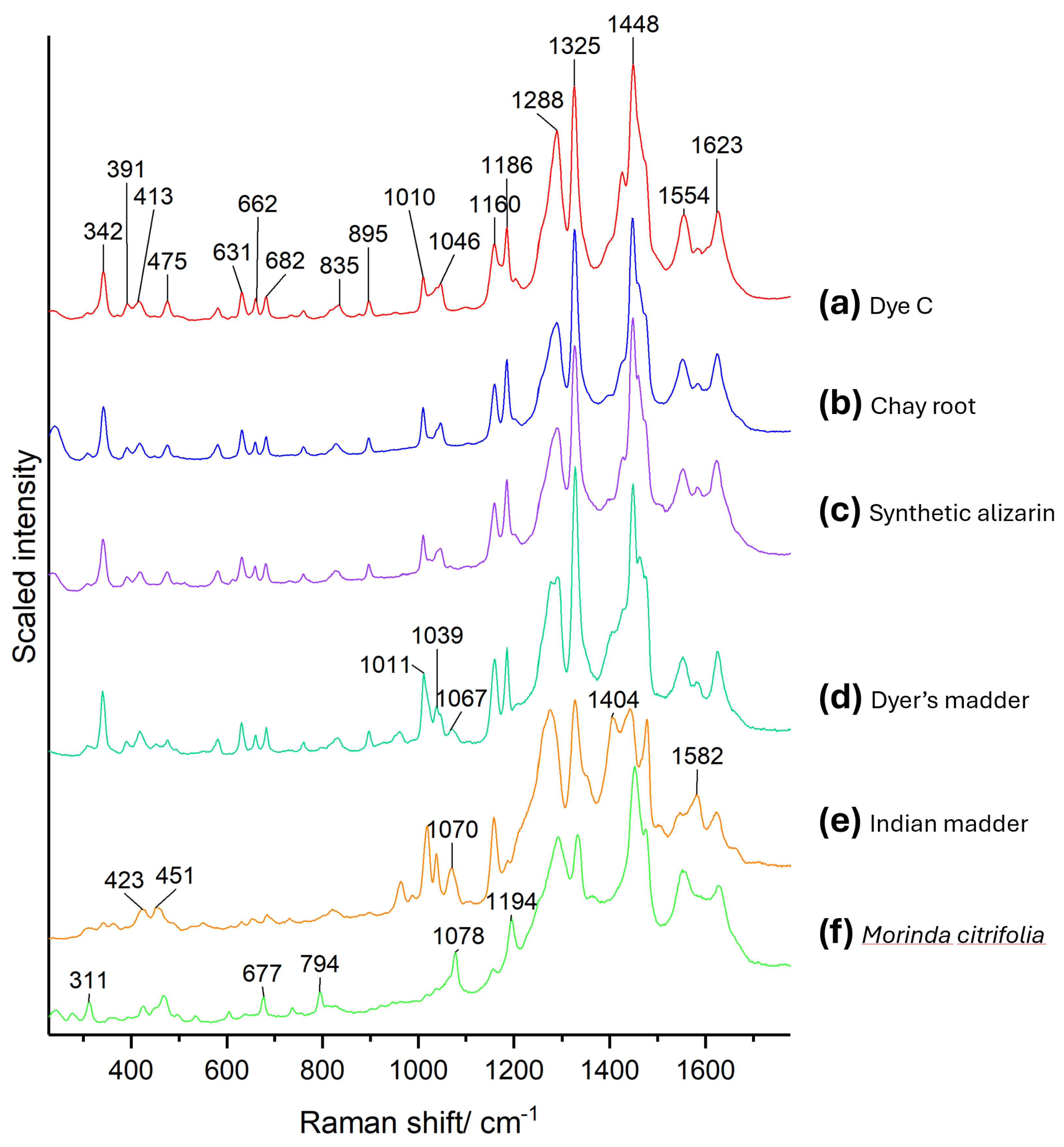
Dye C produced a good match with Oldenlandia umbellata (chay root) (Figure 3b), and was therefore initially assigned to this dye source [6]. However, the detection of chay root was questionable as this plant is not native to Indonesia [40]. Its use as a dye in batik-making has only been documented in a few pieces of “Indonesian” textiles whose origins lack clarity [31]. Upon further investigation, the spectrum of Dye C was also found to match well with historical textiles containing cotton dyed with synthetic alizarin (Figure 3c). The comparison with other anthraquinone dye references is less convincing (Figure 3d–f). The close chemical resemblance between chay root and synthetic alizarin—both alizarin-rich colourants—resulted in difficulty differentiating these two sources by SERS [25].

3.2. HPLC-DAD-MS/MS

All blue samples examined by HPLC-DAD-MS/MS revealed the exclusive use of an indigoid dye in all shades (Figure S2, Supplementary Materials).
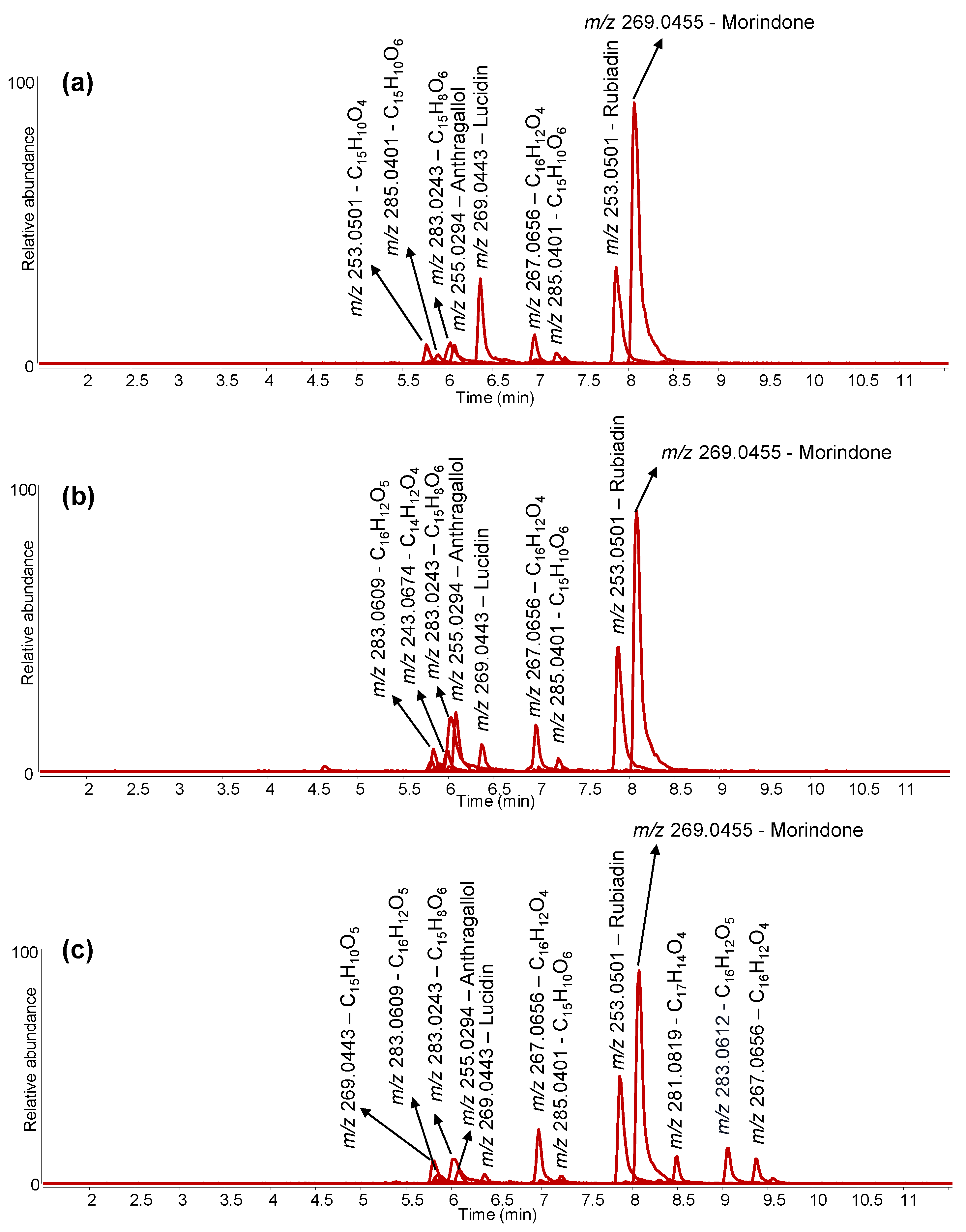
In order to evaluate the compositional variability of the Morinda dye, three reference cotton samples dyed with Morinda citrifolia from India and the Indonesian islands of Bali and Sumba were analysed. The results are shown in Figure 4. The samples had very similar compositions, with morindone (1,2,5-trihydroxy-6-methylanthraquinone) present as the most abundant component. Other minor anthraquinones were detected but not all were identified. Numerous anthraquinones are reported among the extracts of Morinda citrifolia roots [32,41,42]. However, the data are not consistent, and molecular standards are not available for all possible compounds. Tandem mass spectra for most of these compounds are reported in Figure S3, Supplementary Materials.
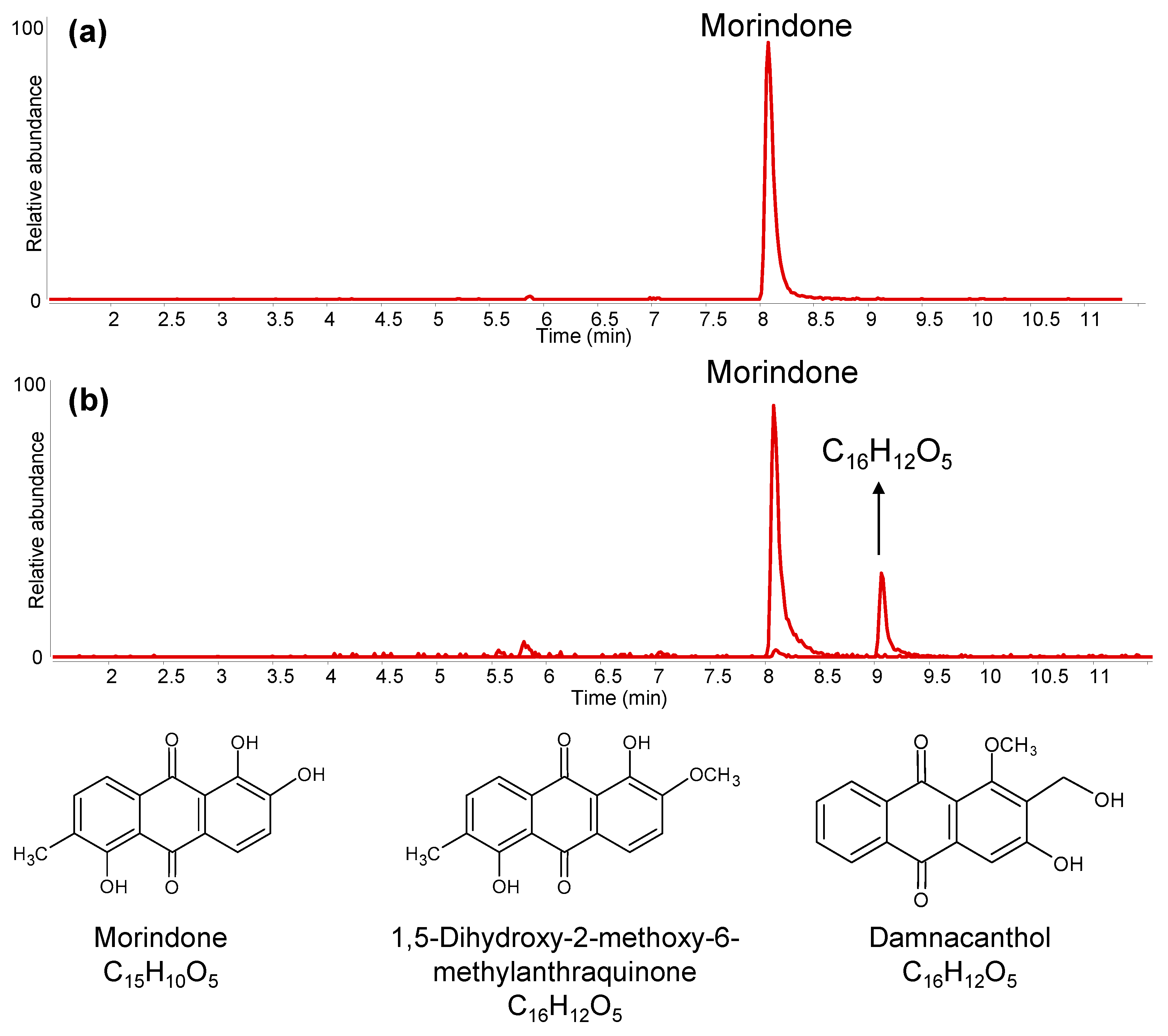
The reference sample from Sumba showed some differences compared to the other samples. A few compounds with higher retention times than morindone were observed, among which the C16H12O5 compound eluting at ca. 9 min was the most abundant one. This compound might be tentatively identified as 1,5-dihydroxy-2-methoxy-6-methylanthraquinone, which is reported in the literature and is closely related to morindone [43]. However, damnacanthol (3-hydroxy-2-(hydroxymethyl)-1-methoxyanthraquinone) is an isomer and is also mentioned as a component of Morinda citrifolia [32,40]. This compound showed good ionisation yield in positive mode. It could not be identified with certainty and could not be considered as a molecular marker solely based on these data. Nevertheless, the results confirm that a certain variability is present in the composition of the extracts of the Morinda citrifolia reference samples.
All samples classified as Dye A by SERS were confirmed as Morinda by HPLC-DAD-MS/MS analysis. The main molecule detected was morindone, in agreement with the results obtained for the reference samples. The C16H12O5 compound eluting at ca. 9 min was detected with relatively high but variable abundance in a number of samples. This unidentified molecule was only present in the reference sample of Morinda citrifolia from Sumba (Figure 4c). Most samples also included some of the other minor anthraquinone components in variable relative abundances. All the results are summarised in Table 2. Samples in which morindone is largely predominant are indicated as Morinda I, whereas samples with high relative abundance of the C16H12O5 compound are indicated as Morinda II. Examples of these two predominant compositions are shown in Figure 5.
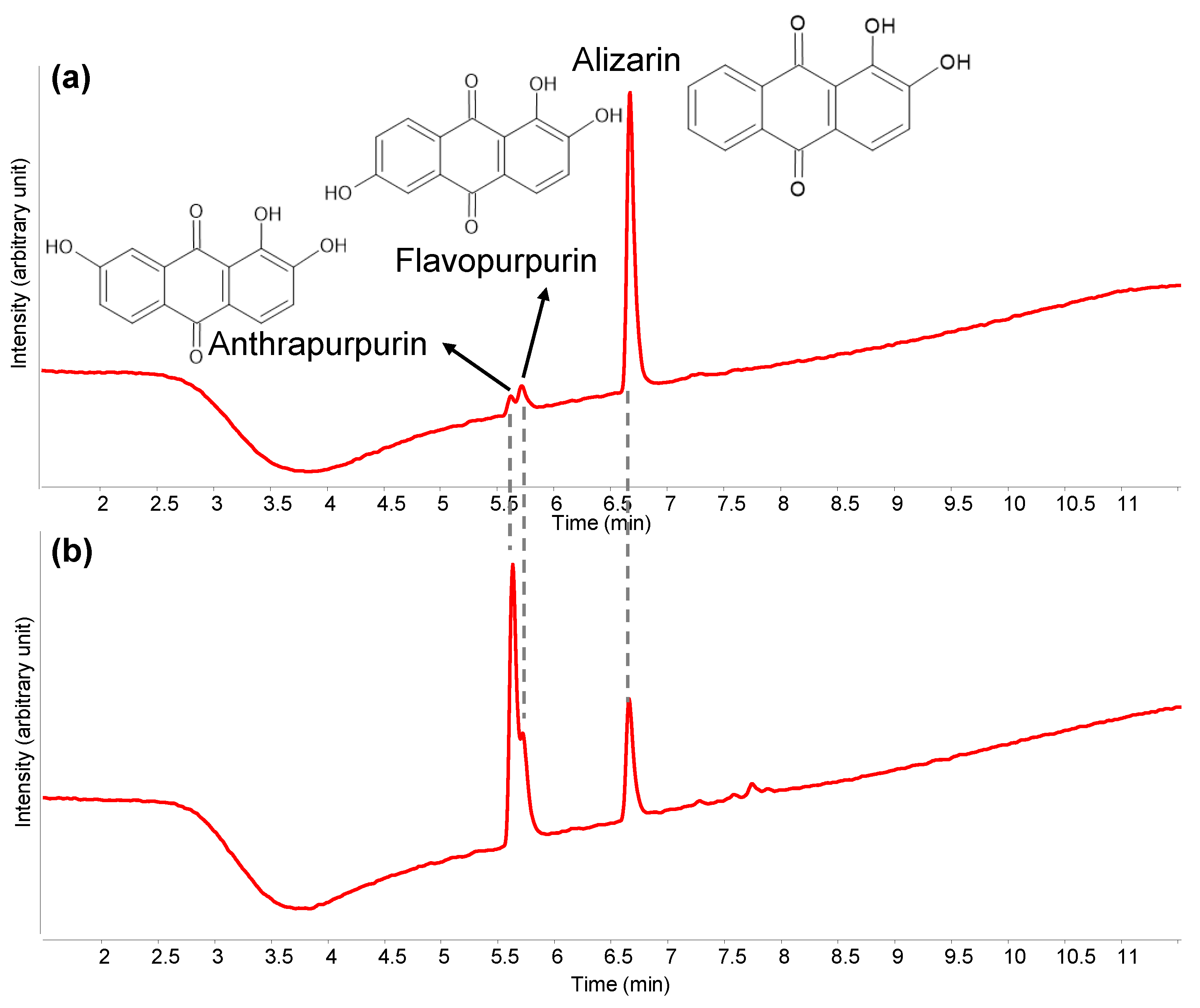
Dyes B and C, the second most dominant group constituting 24% of the samples, were identified by HPLC-DAD-MS/MS as formulations containing synthetic alizarin (C.I. 58000), either alone or in mixture with other dyes such as Morinda, indigo and/or auramine O (C.I. 41000). Synthetic alizarin was identified by the presence of alizarin and its synthesis by-products, i.e., anthrapurpurin (1,2,7-trihydroxyanthraquinone) and flavopurpurin (1,2,6-trihydroxyanthraquinone) [44]. Two main formulations of synthetic alizarin were detected in the samples, differing for the relative abundance of the three anthraquinones. In one case, alizarin was present with higher relative abundance than anthrapurpurin and flavopurpurin (Figure 6a). In other cases, anthrapurpurin and flavopurpurin were predominant over alizarin (Figure 6b). In the former case, the formulation is referred to as Synthetic Alizarin I, and in the latter as Synthetic Alizarin II (Table 2). Interestingly, all samples containing Synthetic Alizarin I were classified as Dye C by SERS, whereas all the samples containing Synthetic Alizarin II were classified as Dye B. This confirms the ability of SERS to distinguish different dye formulations mostly based on the main molecular components.
Samples LKL652, LKL653 and LKL825 also contained a synthetic yellow dye, namely auramine O (C.I. 41000), in addition to synthetic alizarin. This dye was identified by the presence of the auramine molecules, as well as Michler’s ketone and demethylated products, as reported in the literature [10] (Figure S4, Supplementary Materials).
Dyes D and E correspond to a pinkish colour in BM11P and to a dark red colour in BM2D, respectively. These dyes were identified as unique formulations containing Morinda and rhodamine B (C.I. 45170) in the former case, and Morinda and fuchsin (C.I. 42510) in the latter case. They were identified by the presence of their characteristic molecular markers, as reported in the literature [33] and as shown in Figure S5 (Supplementary Materials). This result suggests that Javanese batik workshops had access to synthetic dyes other than synthetic alizarins and were using them to obtain various shades of red.
Dye F corresponds to a dark red colour in LKL655D. This sample contains Synthetic Alizarin II, indigo and one additional molecule, which was not identified (Figure S6, Supplementary Material). This molecule is yellow (λmax = 290, 345 nm) and only ionises in positive mode, producing a molecular ion [M]+ = m/z 269.0804. This corresponds to the chemical formula C16H12O4 (dppm = −1.62), which in turn correlates with various hydroxy-methoxy-flavones. Unfortunately, a fragmentation spectrum was not obtained for this molecule, making further structural elucidation impossible.

3.3. p-XRF

p-XRF analysis of all red shades (including dark red and bright red) showed traces of aluminium (Al) and small amounts of calcium (Ca), which were not seen in the undyed areas (Figure S7, Supplementary Materials). The presence of Al implies the reds are achieved using aluminium as mordant, which is expected for Morinda and synthetic alizarin. Nevertheless, the source of Al cannot be ascertained; it could be Al-rich leaves of Symplocos spp. [5,40,45,46,47] or mineral mordants, such as alum. Calcium is likely associated with dyeing auxiliaries (e.g., Symplocos spp.), or alkaline water used in the dyeing process [48,49,50].

3.4. Colourimetry

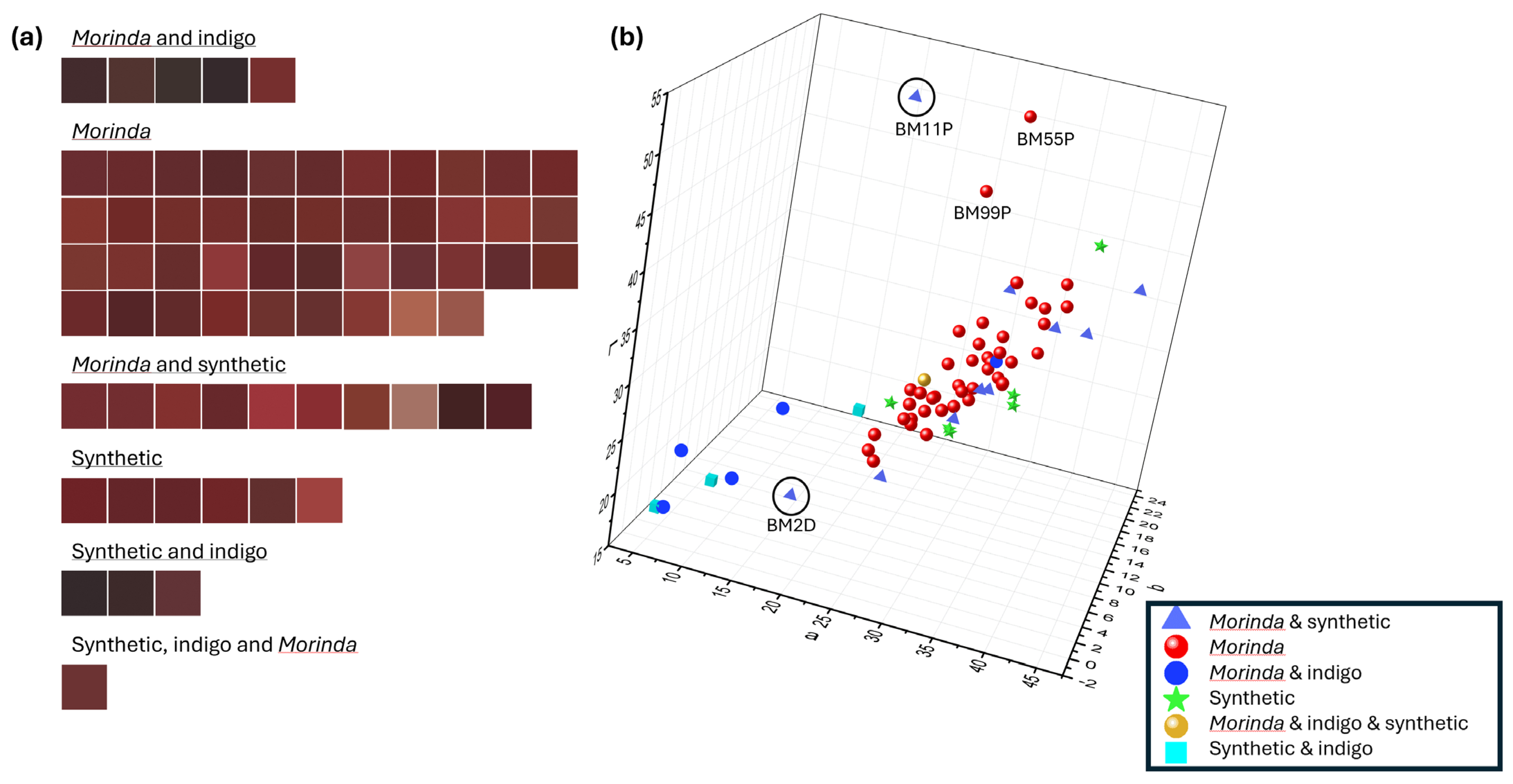
When examining a piece of textile, it is often difficult to describe the exact colour observed, and thus whether the presence of synthetic dyes can be detected visually remains a common question in the art history field, especially for textiles produced in the late 19th–early 20th century when synthetic dyes were introduced. For these reasons, the different shades of red on the batiks were documented using a colourimeter, reporting the chromaticity values L* (lightness), a* (from green to red) and b* (from blue to yellow) for each red in the CIEL*a*b* colour space. Reconstructed pseudo-colours are represented in Figure 7a, providing a visual representation of the various shades of red correlated to HPLC results. The tristimulus points (Table S1, Supplementary Materials) are then plotted onto a 3D scatter graph and correlated to the HPLC results (Figure 7b).
As shown in Figure 7a, it is hardly possible to visually distinguish mixtures of natural Morinda with synthetics, purely natural Morinda and purely synthetic dyes due to the close resemblance in the variety of shades obtained. In Figure 7b, Morinda shades (red circles) appear directional and longitudinal. A few Morinda points (BM55P and BM99P) show very high L* values and deviate from the Morinda red cluster, which may suggest poor lightfastness or a lighter shade. Morinda reds can be clearly distinguished from dark reds (blue circles). The addition of blue indigo shifts the colour to lower a* values (greener) and lower b* values (bluer). The distinction between pure Morinda (red circles) and pure synthetic (green stars) may be possible, considering that the synthetics lie at the periphery of the Morinda cluster. However, the distinction between “Morinda and synthetic” mix (blue triangles) is less clear, as they overlap with the Morinda cluster or lie around the periphery of the cluster.
Two outliers of the “Morinda and synthetic” mix (circled in black) deviate from the Morinda cluster as the synthetic dye additions, rhodamine B (BM11P) and fuschin (BM2D), belong to a different dye class from synthetic alizarin. This may explain why synthetic alizarin red was more frequently used than other synthetic reds (Table 2), as the colour obtained with synthetic alizarin matched Morinda shades more closely compared to other synthetic dyes.

3.5. Fabric Analysis

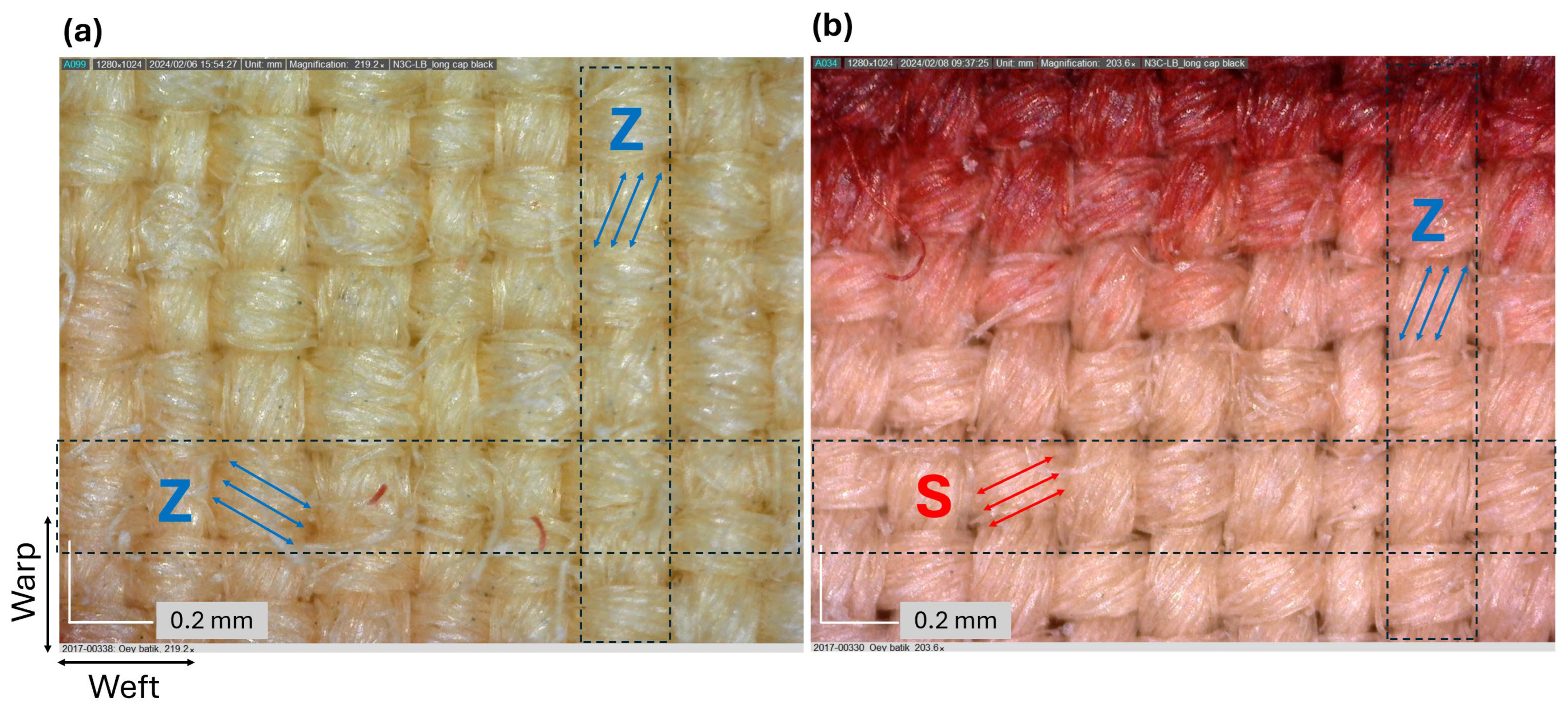
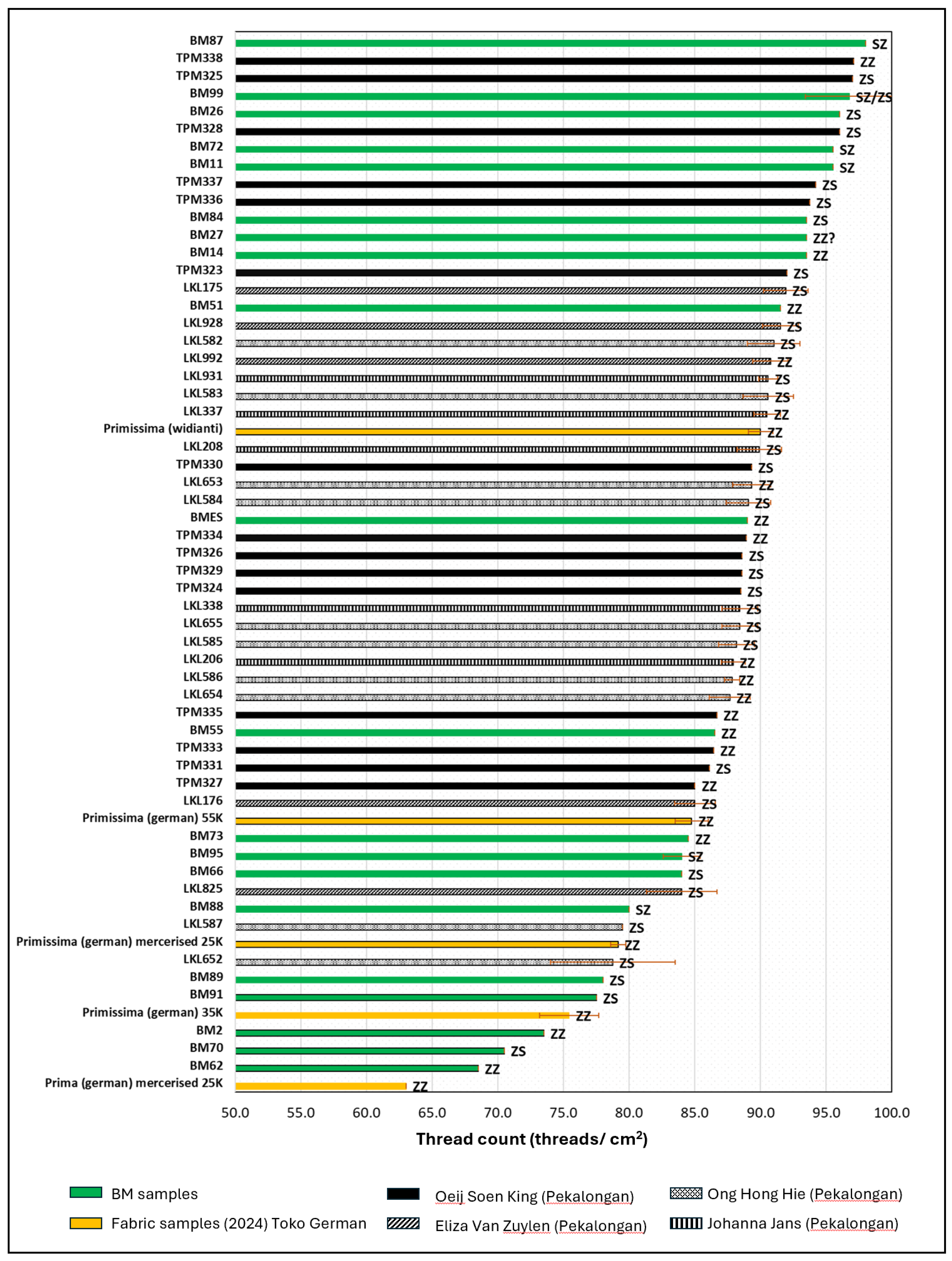
All batiks in this study were produced using 100% plain weave cotton with single-ply yarns. As these fabrics exhibit balanced plain weave, where the number of warp and weft threads are approximately equal, the thread count is reported as the sum of warp and weft threads per cm2, allowing for more straightforward comparison across samples. Twist combinations (the direction in which the fibres are spun together) and thread counts vary across the cotton fabrics. The yarn twist combinations (warp and weft) are ZZ, ZS and SZ; no SS is observed. The thread count varies from 60 to 100 threads per cm2. Cotton with similar thread counts but different twist patterns indicates a different fabric source. Figure 8 shows representative microscopy images illustrating the thread counts and yarn twist direction of the batik textiles. Initial results indicate that workshops had access to a diverse range of machine-made white cotton through trade, and that batik workshops did not exclusively use specific types or qualities of cotton [6]. The results also suggest the possibility that variations may occur between different fabric rolls or production batches.
The use of tightly woven, high-thread-count cotton is essential in batik production to prevent wax from penetrating between fibres and compromising pattern definition, a consideration that is particularly critical for intricate designs. Historically, van Roojen documents three distinct types of cotton qualities [51], listed from highest to lowest grade: primissima, the finest quality that is very smooth and ideal for detailed hand-drawn batik; prima, a high-quality cloth that is commonly used for hand-drawn or stamped batik; and biru/merah, a lower-quality fabric used for mass production. However, these terms are loosely used by batik-makers, and no technical assessment of these fabric grades has been documented. Figure 9 presents the thread count and yarn twist combinations of all batik textiles in this study, alongside the primissima and prima cotton reference samples from Pekalongan (described in Section 2.2), providing contemporary reference points for assessing the cotton quality of the batik textiles studied here. While such cotton references obtained in present times can never fully represent the batik cotton produced in the 19th–20th century, they are the closest materials that could be obtained at the time of this study.
All four types of primissima cotton show a high thread count ranging from 73 to 90 threads/cm2, while prima cotton shows a lower count with around 63 threads/cm2. Most batiks in this study had a thread count of 75–100 threads/cm2, which aligns well with the highest and finest primissima grade. Three batiks (BM2, BM62 and BM70) produced a thread count between 60 and 75 threads/cm2, suggesting that they could be made with prima cotton or the lower end of the primissima grade.
Correlation analysis between cotton quality and other variables revealed no significant relationship between thread count and dye types, nor between fabric quality and overall design complexity or aesthetic achievement. For example, batiks with the highest thread counts (>95 threads/cm2) indicating better fabric quality use a variety of dyes combinations, such as Morinda I, Morinda II, Morinda I + Synthetic Alizarin II, or Morinda I + rhodamine B dye systems. However, the limited sample size in this study precludes definitive correlation analysis, and further research with larger sample populations is required to establish statistically significant relationships between fabric quality and other production variables. The current findings suggest that fabric quality and artistic merit operated as independent variables in batik production, with workshops potentially prioritising different aspects depending on market demands or production contexts, though this hypothesis requires further validation.

4. Discussion

4.1. Correlating SERS and HPLC Data

In the light of the HPLC results, it became possible to assign peaks in the SERS spectra that indicate the presence of specific dyes (Table 3).
Unlike HPLC, which could further differentiate Morinda I and II, SERS only showed one spectrum characteristic of Morinda (Dye A). Additionally, SERS spectra of reference cotton samples dyed with Morinda citrifolia from India, Bali and Sumba showed no difference (Figure S8, Supplementary Materials), suggesting that the minor anthraquinones used to differentiate Morinda I and Morinda II (including the C16H12O5 compound) by HPLC were not as effectively detected as the main compound morindone in SERS. Published SERS spectra of Morinda extracts are scarce. Only one study reports on the dye extract of Morinda citrifolia roots in liquid form [52], which is different in nature and not as reliable as a Morinda-dyed thread reference, obtained in this study.
By contrast, the ability of SERS to differentiate the two variants of synthetic alizarins was well demonstrated, regardless of the presence of other dyes (Morinda, auramine or indigo). SERS spectra of natural madder, alizarin and purpurin are well studied [24,38,39,53,54], whereas SERS spectra of synthetic alizarins are only available in a few studies. Additionally, these just report on samples rich in alizarin, which correspond to Synthetic Alizarin I in our study [25,55,56]. The SERS spectrum of Synthetic Alizarin II—Dye B (rich in by-products anthrapurpurin and flavopurpurin)—is reported here for the first time to the best of the authors’ knowledge.
Interestingly, the same thread sample BM2D produced two distinct SERS spectra (Dyes A and E), which corresponded to Morinda and a mixture of Morinda and fuchsin with HPLC (Table 2 and Table 3). The spectral contribution of fuschin showed up with Morinda as soon as the HF-treated samples were analysed with Raman spectroscopy, but disappeared a few moments later, leaving behind the spectral contribution of Morinda only. Although the exact reason for this was not clear, the observation might be associated with SERS’s limitations in analysing dye mixtures and its preferential detection of one component over another [20,53].

4.2. Compositional Variability of Dye Sources

Alizarin was first synthesised in 1868 with a method that involved the bromination of anthraquinone followed by alkali fusion. In 1869, bromination was replaced by the less expensive high-temperature sulfonation. However, it was well known by 1871 that neither process produced pure alizarin, and the trihydroxy compounds anthrapurpurin and flavopurpurin were accepted as part of the reaction [57]. Between the 1870s and 1900s, synthetic alizarin was produced by the main dye companies in both Great Britain and Germany under different trade names [58]. A few analyses of historic samples of synthetic alizarin from this period have revealed variability in the chemical composition, especially in the relative abundances of alizarin, flavopurpurin and anthrapurpurin [10,33,44,59]. However, no trends or correspondence between the chemical compositions of these historical formulations and their trade names were observed. The results of this study therefore confirm that different formulations of synthetic alizarins (here indicated as Synthetic Alizarin I and II) were indeed available on the market. However, it is difficult to ascertain whether these formulations correspond to different manufacturers or simply reflect the inability to fully optimise the synthetic process of alizarin. In any case, it is interesting to observe that flavopurpurin and anthrapurpurin are yellowish/brownish molecules, whereas alizarin is orange-red. As a result, different relative amounts of these molecules would have produced slightly different colours [60]. Natural Morinda red is a relatively dark brick red colour, and thus formulations of synthetic alizarin rich in flavopurpurin and anthrapurpurin might have been attractive to batik dyers aiming to reproduce the Morinda colour. Further investigations into the compositional variability of historical formulations of synthetic alizarins are important to advance this research line.
In the case of Morinda, two compositional variations (Morinda I and II) were identified in the samples. The exact reason for this is not clear. From recent fieldwork research conducted in the Lesser Sunda Islands, the only extant Morinda species is Morinda citrifolia, but it is available in different varieties on different islands (personal communications with Pak Pung, Threads of Life, Bali). Not all varieties are used for dyeing, and local dyers are able to identify the variety that is suitable for dyeing based on the fruits and leaves (personal communications with Pak Kornelis, master dyer in Sumba; Freddy, textile specialist in Sumba; and Ambu, master dyer in Sumba). The exact scientific taxonomy for the type commonly used for dyeing could not be obtained from the local dyers, but according to another source, the botanical variant used for Morinda dyeing is very likely Morinda citrifolia var. bracteata, which has small fruits and leaves and was historically shipped to and cultivated in Java [46]. Other than Morinda citrifolia, Morinda species such as Morinda umbellata and Morinda tomentosa were mentioned as possible sources for dyeing [46,47]. While Morinda umbellata has been reported alongside Morinda citrifolia in batik red dyes [32], the use of Morinda tomentosa for dyeing is not proven [46]. With the limited information available on Morinda, it is difficult to explain the compositional differences observed in the Morinda samples, which can be attributed to a number of hypothesised reasons. These include different Morinda species (although the reference samples are described as Morinda citrifolia by local people) or botanical varieties, the geographical origin of the Morinda plant, or intrinsic variability in its chemical composition. Interestingly, the red samples from Lasem and the Jans workshop showed exclusively Morinda II. Further investigation is needed. Nevertheless, the fact that two compositional variations of Morinda can be identified with HPLC remains interesting, and this information may be a potential avenue of future research on batiks to identify workshop origins or provenance.

4.3. Synthetic Dye Usage in Late 19th to Early 20th Century Batiks

The results from the current sample set (fifty-five batiks) suggest that natural red and blue dyes (Morinda and indigo) remained prevalent from the late 19th to early 20th century. Synthetic dyes were indeed introduced in batik-making during this period (Figure 6), but they appear to be less commonly used than natural dyes according to these data. The consistent use of synthetic alizarin and its occurrence in mixture with natural Morinda suggest deliberate efforts by Javanese batik-makers to stay faithful to the specific brick red shade of the Morinda dye. In fact, the colourimetry results reinforced this observation, as the colours obtained by mixtures of Morinda and synthetic alizarin did not significantly differ from the ones obtained by pure Morinda or pure synthetic alizarin (Figure 7). Interestingly, the use of synthetic alizarin to “replace” the natural Morinda red dye has been observed in other Southeast Asian textiles, including Karen textiles from Myanmar (1830s–early 1900s) [59] and Iban pua textiles from Borneo (unpublished data), further strengthening this point.
Despite the variety of European synthetic dyes available by the 1880s, only a handful, specifically auramine, fuchsin and rhodamine B, were identified in a few textiles in this study. This further suggests that the dyers sometimes adjusted their red shades by mixing different materials, and did not rely on the sole use of synthetic alizarin when incorporating synthetic dyes. This observation together with the prevalent use of natural Morinda makes it difficult to use dye identification to refine the dating of these textiles. While the presence of a synthetic dye immediately establishes a terminus post quem production date based on when the dye was first synthesised, a batik textile exclusively dyed with Morinda might not necessarily be older than one containing synthetic dyes.

5. Conclusions

Fifty-five batik textiles from coastal Java probably made in the late 19th to early 20th century were investigated with the aim of identifying their red dyes and cotton fabric. The high sensitivity of SERS enabled the classification of the red dyes into six distinct compositional categories (Dyes A–F). HPLC-DAD-MS/MS provided reliable reference points for interpreting SERS classifications. Dye A was identified as pure Morinda, and two variations (Morinda I and II) with different relative abundances of a tentatively identified compound (C16H12O5) and morindone were detected. More research is needed to clarify whether this difference is indicative of different species or variants of Morinda, and/or geographical origin, or simply reflects intrinsic variability in its chemical composition. The rest of the dyes, Dyes B–F, contained synthetics, used either alone or in mixtures with natural Morinda or indigo. Specifically, Dyes B and C mainly corresponded to two variants of synthetic alizarin (C.I. 58000, Mordant Red 11) with different relative abundance of alizarin and its synthesis by-products, anthrapurpurin and flavopurpurin. Auramine O (C.I. 41000, Basic Yellow 2) was occasionally detected with synthetic alizarin. Dyes D and E represented Morinda mixed with rhodamine B (C.I. 45170, Basic Violet 10) or fuchsin (C.I. 42510, Basic Violet 14) respectively. Dye F contained synthetic alizarin, indigo and an unidentified yellow dye.
Overall, the results from this sample set demonstrate that red shades were predominantly obtained with pure natural Morinda (71%). A smaller but significant portion of the samples (24%) contain synthetic alizarin, partly mixed with natural Morinda. These mixed compositions produced colours visually indistinguishable from pure Morinda or pure synthetic alizarin. The thread count and yarn twist results showed a wide variety of cotton fabrics, suggesting different sources. The higher-quality cotton did not necessarily correlate to the types of dyes used or higher-quality batik. Despite the proliferation of synthetic dyes in Europe, only synthetic alizarin was relatively frequently employed in these batiks. Although additional analyses are needed to strengthen the representative nature of the results, these findings suggest that synthetic dye uptake in late 19th to early 20th century coastal Javanese batik production was relatively limited and experimental. Traditional Morinda dyeing appears to have been strongly favoured, and the use of synthetic alizarin emerges as a deliberate choice to maintain standard colouration. Nevertheless, this study also confirms a variety of dye and cotton materials shared across batik-makers, challenging the possibility of assigning non-signed textiles to specific workshops.

Supplementary Materials

The following supporting information can be downloaded at https://www.mdpi.com/article/10.3390/heritage9060231/s1.

Author Contributions

Conceptualization, L.C., D.T. and M.K.; methodology, L.C., D.T. and M.K.; software, L.C. and D.T.; validation, L.C., D.T. and M.K.; formal analysis, L.C., D.T. and M.K.; investigation, L.C., D.T. and M.K.; resources, L.C., D.T., M.K., P.L. and A.G.; data curation, L.C., D.T. and M.K.; writing—original draft preparation, L.C.; writing—review and editing, D.T., M.K., P.L. and A.G.; project administration, L.C., D.T. and M.K. All authors have read and agreed to the published version of the manuscript.

Funding

This research received no external funding.

Data Availability Statement

The original contributions presented in this study are included in the article/Supplementary Materials. Further inquiries can be directed to the corresponding author.

Acknowledgments

The authors like to thank Naomi Wang and Darryl Lim, for their coordination and inputs to the research, Sabine Bolk for the insightful discussions on coastal batiks, Alan Chong for providing historical literature to support this research, Agni Malagia for the discussions of Lasem reds, and Lio Shi Jie for purchasing the materials and dyestuff references for this project. Special thanks to Ong Chiew Yen and J. D. Hill for their strong support in this collaborative project.

Conflicts of Interest

The authors declare no conflicts of interest.

Abbreviations

The following abbreviations are used in this manuscript:
HPLCHigh-Performance Liquid Chromatography
SERSSurface-Enhanced Raman Spectroscopy
XRFX-ray Fluorescence
DMDigital Microscopy
TPMThe Peranakan Museum
LKLMr and Mrs Lee Kip Lee (Private Collection)
BMThe British Museum

References

  1. Jasper, J.E.; Pirngadie, M. De Inlandsche Kunstnijverheid in Nederlandsch Indië; Mouton & Co.: The Hague, The Netherlands, 1912; Volume 2, p. 451. [Google Scholar]
  2. Gittinger, M. Splendid Symbols: Textiles and Tradition in Indonesia; Oxford University Press: Singapore, 1990; p. 243. [Google Scholar]
  3. Rismantojo, S. Peranakan Batik: Cultures Connection in Indonesia, Malay Peninsula, and Thailand. New Viridian J. Arts Humanit. Soc. Sci. 2021, 1, 57–72. [Google Scholar]
  4. Ishwara, H.; Yahya, L.R.S.; Moeis, X.; Rambe, A. Batik Pesisir: An Indonesian Heritage: Collection of Hartono Sumarsono, 1st ed.; Kepustakaan Populer Gramedia: Jakarta, Indonesia, 2012. [Google Scholar]
  5. Lee, P. In-laws and ingenuity: Nyonya Oeij Soen King and Nyonya Oeij Kok Sing as batik entrepreneurs. In Batik Nyonyas: Three Generations of Art and Entrepreneurship—Nyonya Oeij Soen King, Nyonya Oeij Kok Sing, Jane Hendromartono; Chong, A., Ed.; Asian Civilisations Museum: Singapore, 2024; pp. 16–77. [Google Scholar]
  6. Chua, L.; Komatsu, M. The red dyes and fabric of the batiks of Oeij Soen King and her circle. In Batik Nyonyas: Three Generations of Art and Entrepreneurship—Nyonya Oeij Soen King, Nyonya Oeij Kok Sing, Jane Hendromartono; Chong, A., Ed.; Asian Civilisations Museum: Singapore, 2024; pp. 122–131. [Google Scholar]
  7. Shahid, M.; Wertz, J.; Degano, I.; Aceto, M.; Khan, M.I.; Quye, A. Analytical methods for determination of anthraquinone dyes in historical textiles: A review. Anal. Chim. Acta 2019, 1083, 58–87. [Google Scholar] [CrossRef]
  8. Graaff, J.H.; Roelofs, W.G.T.; Bommel, M.R. A Colourful Past: The Origins, Chemistry and Identification of Natural Dyestuffs; Abegg-Stiftung: Riggisberg, Switzerland, 2007. [Google Scholar]
  9. Petroviciu, I.; Teodorescu, I.; Vasilca, S.; Albu, F.; Medvedovici, A. Liquid chromatography as analytical tool for the study of natural and early synthetic dyes in traditional Saxon textiles. Herit. Sci. 2023, 11, 164. [Google Scholar] [CrossRef]
  10. Tamburini, D. On the reliability of historic books as sources of reference samples of early synthetic dyes–The case of “The Coal Tar Colours of the Farbwerke vorm. Meister, Lucius & Brüning, Höchst on the Main, Germany–A General Part” (1896). Dye. Pigment. 2024, 221, 111796. [Google Scholar] [CrossRef]
  11. Bruni, S.; Guglielmi, V.; Pozzi, F. The identification of ancient textile dyes by surface-enhanced Raman spectroscopy (SERS) on silver and gold colloids. In Proceedings of the 5th International Congress on the Application of Raman Spectroscopy in Art and Archaeology, Bilbao, Spain, 14–18 September 2009. [Google Scholar]
  12. Lee, J.; Kim, M.J.; Van Elslande, E.; Walter, P.; Lee, Y. Identification of Natural Dyes in Ancient Textiles by Time-of-Flight Secondary Ion Mass Spectrometry and Surface-Enhanced Raman Spectroscopy. J. Nanosci. Nanotechnol. 2015, 15, 8701–8705. [Google Scholar] [CrossRef]
  13. Jurasekova, Z.; del Puerto, E.; Bruno, G.; García-Ramos, J.V.; Sanchez-Cortes, S.; Domingo, C. Extractionless non-hydrolysis surface-enhanced Raman spectroscopic detection of historical mordant dyes on textile fibers. J. Raman Spectrosc. 2010, 41, 1455–1461. [Google Scholar] [CrossRef]
  14. Yao, M.; Liu, J.; Narengaowa; Li, Y.; Zhao, F. In situ detection of natural dyes in archaeological textiles by SERS substrates immobilized on the fiber. J. Microchem. 2023, 192, 108939. [Google Scholar] [CrossRef]
  15. Xi, X.-H.; Zhang, Y.; Yan, S.; Wang, P.-S.; Ma, H.; Ren, M.; Liu, G.-K.; Lei, Y.; Ren, B.; Wang, X. Rapid and Accurate Identification of Dyes on Ancient Textiles by SERS with a Negligibly Invasive Approach. J. Raman Spectrosc. 2024, 55, 1281–1288. [Google Scholar] [CrossRef]
  16. Woodhead, A.L.; Cosgrove, B.; Church, J.S. The purple coloration of four late 19th century silk dresses: A spectroscopic investigation. Spectrochim. Acta A 2016, 154, 185–192. [Google Scholar] [CrossRef] [PubMed]
  17. Casadio, F.; Leona, M.; Lombardi, J.R.; Van Duyne, R. Identification of Organic Colorants in Fibers, Paints, and Glazes by Surface Enhanced Raman Spectroscopy. Acc. Chem. Res. 2010, 43, 782–791. [Google Scholar] [CrossRef]
  18. Committee, A.M. AMC technical brief No 80: Surface-enhanced Raman spectroscopy (SERS) in cultural heritage. Anal. Methods 2017, 9, 4338–4340. [Google Scholar] [CrossRef]
  19. Pozzi, F.; Porcinai, S.; Lombardi, J.R.; Leona, M. Statistical methods and library search approaches for fast and reliable identification of dyes using surface-enhanced Raman spectroscopy (SERS). Anal. Methods 2013, 5, 4205–4212. [Google Scholar] [CrossRef]
  20. Bersani, D.; Conti, C.; Matousek, P.; Pozzi, F.; Vandenabeele, P. Methodological evolutions of Raman spectroscopy in art and archaeology. Anal. Methods 2016, 8, 8395–8409. [Google Scholar] [CrossRef]
  21. Cesaratto, A.; Leona, M.; Pozzi, F. Recent advances on the analysis of polychrome works of art: SERS of synthetic colorants and their mixtures with natural dyes. Front. Chem. 2019, 7, 105. [Google Scholar] [CrossRef]
  22. Marcaida, I.; Maguregui, M.; Morillas, H.; García-Florentino, C.; Pintus, V.; Aguayo, T.; Campos-Vallette, M.; Madariaga, J.M. Optimization of sample treatment for the identification of anthraquinone dyes by surface-enhanced Raman spectroscopy. Anal. Bioanal. Chem. 2017, 409, 2221–2228. [Google Scholar] [CrossRef] [PubMed]
  23. Pozzi, F.; Lombardi, J.R.; Bruni, S.; Leona, M. Sample Treatment Considerations in the Analysis of Organic Colorants by Surface-Enhanced Raman Scattering. Anal. Chem. 2012, 84, 3751–3757. [Google Scholar] [CrossRef]
  24. Leona, M.; Stenger, J.; Ferloni, E. Application of surface enhanced Raman scattering techniques to the ultrasensitive identification of natural dyes in works of art. J. Raman Spectrosc. 2006, 37, 981–992. [Google Scholar] [CrossRef]
  25. Rambaldi, D.C.; Pozzi, F.; Shibayama, N.; Leona, M.; Preusser, F.D. Surface-enhanced Raman spectroscopy of various madder species on wool fibers: The role of pseudopurpurin in the interpretation of the spectra. J. Raman Spectrosc. 2015, 46, 1073–1081. [Google Scholar] [CrossRef]
  26. Zaffino, C.; Bruni, S.; Guglielmi, V.; De Luca, E. Fourier-transform surface-enhanced Raman spectroscopy (FT-SERS) applied to the identification of natural dyes in textile fibers: An extractionless approach to the analysis. J. Raman Spectrosc. 2014, 45, 211–218. [Google Scholar] [CrossRef]
  27. Poulin, J. A New Methodology for the Characterisation of Natural Dyes on Museum Objects Using Gas Chromatography–Mass Spectrometry. Stud. Conserv. 2018, 63, 36–61. [Google Scholar] [CrossRef]
  28. Degani, L.; Riedo, C.; Gulmini, M.; Chiantore, O. From Plant Extracts to Historical Textiles: Characterization of Dyestuffs by GC–MS. Chromatographia 2014, 77, 1683–1696. [Google Scholar] [CrossRef]
  29. Keijzer, R.; Bommel, M.R. TLC and HPLC Analysis of Red and Violet Cotton Yarns of Indonesian Textiles. Dye. Hist. Archaeol. 2005, 20, 70–79. [Google Scholar]
  30. Do, K.L.; Mushtaq, A.; Liu, J.; Zhao, F.; Su, M. Unveiling the Use of Natural and Early Synthetic Dyes in Indonesian Historical Silk Textiles. Fibers Polym. 2024, 25, 2233–2244. [Google Scholar] [CrossRef]
  31. Mouri, C. Analysis of dyes in Noro Priestess Textiles from the Ryukyu Kingdom. Dye. Hist. Archaeol. 2021, 33/34, 102–117. [Google Scholar]
  32. Gaibor, A.P.; Joosten, I.; Bolk, S. Research into the Chemical Composition of Organic Dyes in 19th Century Sarongs; RCE project 2021-082; Rijksdienst voor het Cultureel Erfgoed, Rijkserfgoedlaboratorium: Amsterdam, The Netherlands, 2022. [Google Scholar]
  33. Tamburini, D.; Shimada, C.M.; McCarthy, B. The molecular characterization of early synthetic dyes in E. Knecht et al’s textile sample book “A Manual of Dyeing” (1893) by high performance liquid chromatography—Diode array detector—Mass spectrometry (HPLC-DAD-MS). Dye. Pigment. 2021, 190, 109286. [Google Scholar] [CrossRef]
  34. Widiawati, D. The Revival of the Usage of Natural Fibers and Natural Dyes in Indonesian Textile. J. Vis. Art Des. 2009, 3, 115–128. [Google Scholar] [CrossRef]
  35. Mohanty, B.C.; Chandramouli, K.V.; Naik, H.D. Natural Dyeing Processes of India; Calico Museum of Textiles: Ahmedabad, India, 1987. [Google Scholar]
  36. Tamburini, D.; Cartwright, C.R.; Pullan, M.; Vickers, H. An investigation of the dye palette in Chinese silk embroidery from Dunhuang (Tang dynasty). Archaeol. Anthropol. Sci. 2019, 11, 1221–1239. [Google Scholar] [CrossRef]
  37. Tamburini, D. Investigating Asian colourants in Chinese textiles from Dunhuang (7th–10th century AD) by high performance liquid chromatography tandem mass spectrometry—Towards the creation of a mass spectra database. Dye. Pigment. 2019, 163, 454–474. [Google Scholar] [CrossRef]
  38. Bruni, S.; Guglielmi, V.; Pozzi, F. Historical organic dyes: A surface-enhanced Raman scattering (SERS) spectral database on Ag Lee–Meisel colloids aggregated by NaClO4. J. Raman Spectrosc. 2011, 42, 1267–1281. [Google Scholar] [CrossRef]
  39. Chen, K.; Leona, M.; Vo-Dinh, K.C.; Yan, F.; Wabuyele, M.B.; Vo-Dinh, T. Application of surface-enhanced Raman scattering (SERS) for the identification of anthraquinone dyes used in works of art. J. Raman Spectrosc. 2006, 37, 520–527. [Google Scholar] [CrossRef]
  40. Cardon, D. Natural Dyes: Sources, Tradition, Technology and Science; Archetype Publicaitons Ltd.: London, UK, 2007. [Google Scholar]
  41. Lv, L.; Chen, H.; Ho, C.-T.; Sang, S. Chemical components of the roots of Noni (Morinda citrifolia) and their cytotoxic effects. Fitoterapia 2011, 82, 704–708. [Google Scholar] [CrossRef]
  42. Hou, S.; Ma, D.; Wu, S.; Hui, Q.; Hao, Z. Morinda citrifolia L.: A Comprehensive Review on Phytochemistry, Pharmacological Effects, and Antioxidant Potential. Antioxidants 2025, 14, 295. [Google Scholar] [CrossRef]
  43. Ee, G.; Wen, Y.P.; Sukari, M.; Go, R.; Lee, H.L. A new anthraquinone from Morinda citrifolia roots. Nat. Prod. Res. 2009, 23, 1322–1329. [Google Scholar] [CrossRef]
  44. Chen, V.J.; Smith, G.D.; Whitaker, M.R.; von Rabenau, B. Identification of Red Dyes in Selected Textiles from Chin and Karen Ethnic Groups of Myanmar by LC-DAD-ESI-MS. Dye. Hist. Archaeol. 2021, 33, 92–101. [Google Scholar]
  45. Adam, T. The Art of Batik—Weaving and Dyeing in Java; Holyoake Press: Holyoke, MA, USA, 2010. [Google Scholar]
  46. Richardson, D.; Richardson, S. Morinda. Available online: https://www.asiantextilestudies.com/morinda (accessed on 12 December 2025).
  47. Keijzer, R. The Bühler Collection of Indonesian Dyeplants. Dye. Hist. Archaeol. 1997, 15, 3–26. [Google Scholar]
  48. Sabatini, F.; Bacigalupo, M.; Degano, I.; Javér, A.; Hacke, M. Revealing the organic dye and mordant composition of Paracas textiles by a combined analytical approach. Herit. Sci. 2020, 8, 122. [Google Scholar] [CrossRef]
  49. Schmitt, M.; Boras, S.; Tjoa, A.; Watanabe, T.; Jansen, S. Aluminium Accumulation and Intra-Tree Distribution Patterns in Three Arbor aluminosa (Symplocos) Species from Central Sulawesi. PLoS ONE 2016, 11, e0149078. [Google Scholar] [CrossRef]
  50. Cárcamo-Vega, J.J.; Sepúlveda, M.; Casanova-González, E.; Gutiérrez, S.; Mitrani, A.; Dauelsberg, E.J.; Aliaga Á, E.; Lemp, C.; Ruvalcaba-Sil, J.L. New insights into archaeological textiles (1000–1450AD) from the coastal region of the Atacama Desert: Preliminary evidence of a cochineal and shellfish purple dye combination. PLoS ONE 2025, 20, e0325623. [Google Scholar] [CrossRef]
  51. Roojen, P.v. Batik Design; The Pepin Press: Amsterdam, The Netherlands, 1993. [Google Scholar]
  52. De Luca, E.; Redaelli, M.; Zaffino, C.; Bruni, S. A SERS and HPLC study of traditional dyes from native Chinese plants. Vibrat. Spec. 2018, 95, 62–67. [Google Scholar] [CrossRef]
  53. Pozzi, F.; Zaleski, S.; Casadio, F.; Van Duyne, R.P. SERS Discrimination of Closely Related Molecules: A Systematic Study of Natural Red Dyes in Binary Mixtures. J. Phys. Chem. C 2016, 120, 21017–21026. [Google Scholar] [CrossRef]
  54. Shadi, I.T.; Chowdhry, B.Z.; Snowden, M.J.; Withnall, R. Semi-quantitative analysis of alizarin and purpurin by surface-enhanced resonance Raman spectroscopy (SERRS) using silver colloids. J. Raman Spectrosc. 2004, 35, 800–807. [Google Scholar] [CrossRef]
  55. Calà, E.; Gosetti, F.; Gulmini, M.; Serafini, I.; Ciccola, A.; Curini, R.; Salis, A.; Damonte, G.; Kininger, K.; Just, T.; et al. It’s Only a Part of the Story: Analytical Investigation of the Inks and Dyes Used in the Privilegium Maius. Molecules 2019, 24, 2197. [Google Scholar] [CrossRef]
  56. Whitney, A.V.; Van Duyne, R.P.; Casadio, F. An innovative surface-enhanced Raman spectroscopy (SERS) method for the identification of six historical red lakes and dyestuffs. J. Raman Spectrosc. 2006, 37, 993–1002. [Google Scholar] [CrossRef]
  57. Welham, R. The early history of the synthetic dye industry. J. Soc. Dye. Colour. 1963, 79, 146–152. [Google Scholar] [CrossRef]
  58. van Bommel, M.R.; de Keijzer, M. Bright Colours from the Past: The History, Chemistry, Characterisation and Application of Synthetic Dyes Between 1856 and 1914; Springer Nature: Berlin/Heidelberg, Germany, 2025. [Google Scholar]
  59. Tamburini, D.; Dyer, J.; Cartwright, C.; Green, A. Changes in the production materials of Burmese textiles in the nineteenth century—dyes, mordants and fibres of Karen garments from the British Museum’s collection. Herit. Sci. 2023, 11, 150. [Google Scholar] [CrossRef]
  60. Knecht, E.; Rawson, C.; Loewenthal, R. A Manual of Dyeing: For the Use of Practical Dyers, Manufacturers, Students, and All Interested in the Art of Dyeing; C. Griffin & Co.: London, UK, 1893; Volume 2. [Google Scholar]
Figure 1. Digital microscopy images illustrating different shades of red among the batiks of different workshops: (a) TPM336—2 red shades; (b) LKL175—2 red shades; (c) LKL652—1 red shade; (d) LKL208—3 red shades.
Heritage 09 00231 g001
Figure 2. Surface−Enhanced Raman Spectroscopy (SERS) spectra (λexc = 532 nm) representing 6 different groups (Dyes A, B, C, D, E and F) obtained from the analysis of red-dyed threads of the batik textiles. (a) A—TPM335, Morinda—cotton reference dyed with Morinda citrifolia [35], B−LKL655, C−LKL654, D−BM11P, E−BM2D, F−LKL655D. (b) Bar graph shows the percent (%) distribution of the number of red thread samples detected for Dyes A −F.
Heritage 09 00231 g002
Figure 3. SERS spectrum (λexc = 532 nm) of Dye C and comparative references of red anthraquinone dyes: (a) Dye C−LKL653; (b) Oldenlandia umbellata (or chay root)-dyed cotton reference; (c) synthetic-alizarin-dyed cotton reference; (d) Rubia tinctorium (dyer’s madder)-dyed cotton reference; (e) Rubia cordifolia (Indian madder)-dyed cotton reference; and (f) Morinda citrifolia-dyed cotton reference (from India).
Heritage 09 00231 g003
Figure 4. Extracted ion chromatograms obtained by High Performance Liquid Chromatography – Mass Spectrometry (HPLC-MS) analysis in negative ionisation mode of reference cotton samples dyed with Morinda citrifolia from (a) India, (b) Bali, and (c) Sumba. © The Trustees of the British Museum.
Heritage 09 00231 g004
Figure 5. Extracted ion chromatograms in positive ionisation mode of [M + H]+ = m/z 271.0601 (morindone, C15H10O5) and [M + H]+ = m/z 285.0757 (C16H12O5) obtained by the HPLC-MS analysis of samples (a) TPM323 (composition referred to as Morinda I) and (b) LKL584 (composition referred to as Morinda II). The molecular structures of morindone are reported alongside 1,5-dihydroxy-2-methoxy-6-methylanthraquinone and damnacanthol (possible candidates for the C16H12O5 compound). © The Trustees of the British Museum.
Heritage 09 00231 g005
Figure 6. DAD chromatograms extracted at 450 nm of samples (a) LKL176 (SERS: Dye C—composition referred to as Synthetic Alizarin I) and (b) LKL655 (SERS: Dye B—composition referred to as Synthetic Alizarin II). © The Trustees of the British Museum.
Heritage 09 00231 g006
Figure 7. Colourimetric results of red shades on batik textiles. (a) Pseudo−colours correlated to HPLC results. (b) 3D scatter plot of L*, a*, b* values correlated to HPLC results.
Heritage 09 00231 g007
Figure 8. Microscopy images of selected batik textiles, illustrating the thread count (sum of warp and weft threads per cm2) and yarn twist direction (warp/weft): (a) TPM338—97.1, ZZ; (b) TPM330—89.3, ZS.
Heritage 09 00231 g008
Figure 9. Thread count (sum of warp and weft threads per cm2) and yarn twist combinations (SZ, ZS, ZZ) of batik textiles from the collection of TPM, LKL, BM, and cotton references sourced from Pekalongan. Error bars represent standard deviation for samples with multiple measurement points.
Heritage 09 00231 g009
Table 1. Batik textiles selected for this study and their samples.
Batik No.MuseumWorkshopOriginDyed Samples
TPM323TPMOeijPekalonganRed
TPM324TPMOeijPekalonganRed, blue
TPM325TPMOeijPekalonganRed, yellow
TPM326TPMOeijPekalonganRed
TPM327TPMOeijPekalonganRed, dark red, blue, light blue
TPM328TPMOeijPekalonganRed, blue
TPM329TPMOeijPekalonganRed
TPM330TPMOeijPekalonganRed, blue
TPM331TPMOeijPekalonganRed
TPM333TPMOeijPekalonganRed
TPM334TPMOeijPekalonganRed
TPM335TPMOeijPekalonganRed
TPM336TPMOeijPekalonganRed
TPM337TPMOeijPekalonganRed, dark red
TPM338TPMOeijPekalonganRed
LKL582LKLOngLasemRed
LKL583LKLOngLasemRed
LKL584LKLOngLasemRed
LKL585LKLOngLasemRed
LKL586LKLOngLasemRed
LKL587LKLOngLasemRed
LKL652LKLOngLasemRed
LKL653LKLOngLasemRed, dark red
LKL654LKLOngLasemRed
LKL655LKLOngLasemRed, dark red, blue
LKL175LKLVan ZuylenPekalonganRed
LKL176LKLVan ZuylenPekalonganRed, blue
LKL928LKLVan ZuylenPekalonganRed
LKL825LKLVan ZuylenPekalonganRed
LKL992LKLVan ZuylenPekalonganRed, blue
LKL206LKLJansPekalonganRed, dark red, blue
LKL208LKLJansPekalonganRed, bright red
LKL337LKLJansPekalonganRed
LKL338LKLJansPekalonganRed
LKL931LKLJansPekalonganRed
BM2BMUnknownMaduraDark red
BM11BMMevr FisferPekalonganPink, light red, dark red
BM14BMUnknown North coastRed
BM26BMMevr FisferPekalonganLight red, dark red
BM27BMUnknownPekalonganRed
BM51BMCatharina Oosterom?JavaRed
BM55BMUnknownPekalonganPink, red
BM62BMUnknownJavaRed
BM66BMUnknownJavaRed
BM70BMUnknownJavaDark red
BM72BMUnknownJavaRed
BM73BMUnknownJavaRed
BM84BMUnknownMaduraRust, red
BM87BMUnknownJavaRed
BM88BMUnknownJavaDark red
BM89BMUnknownCirebonRed
BM91BMUnknownJavaRed
BM95BMUnknownJavaRed
BM99BMUnknownJavaRed, pink
BMESBMUnknownMade Java, purchased EuropeRed
TPM: The Peranakan Museum; LKL: Mr and Mrs Lee Kip Lee (Private collection); BM: British Museum. Accession number of TPM, 2017-00XXX, is labelled as TPMXXX. Accession number of BM, As1934,0307.XX, is labelled as BMXX and As1907,1016.14 is labelled as BMES.
Table 2. Summary of the results obtained from SERS and HPLC analysis.
Sample No.SERSHPLCOther Colours
TPM323AMorinda I
TPM324BMorinda I, Synthetic Alizarin IIBlue: indigo
TPM325BMorinda I, Synthetic Alizarin IIYellow: synthetic alizarin, Morinda traces
TPM326AMorinda II
TPM327AMorinda IBlue: indigo
TPM327DA Morinda I, indigo
TPM328AMorinda IBlue: indigo
TPM329AMorinda II
TPM330AMorinda IBlue: indigo
TPM331AMorinda I
TPM333AMorinda I
TPM334AMorinda II
TPM335AMorinda I
TPM336AMorinda II
TPM337AMorinda II
TPM337DA Morinda II, indigo
TPM338ANo sample
LKL582AMorinda II
LKL583AMorinda II
LKL584AMorinda II
LKL585AMorinda II
LKL586AMorinda II
LKL587AMorinda II
LKL652CSynthetic Alizarin I, auramine
LKL653CSynthetic Alizarin I, auramine
LKL653DCSynthetic Alizarin I, auramine, indigo
LKL654CSynthetic Alizarin I
LKL655BSynthetic Alizarin IIBlue: indigo
LKL655DFSynthetic Alizarin II, indigo, yellow dye
LKL175AMorinda I
LKL176CSynthetic Alizarin I, indigo
LKL928AMorinda II
LKL825CSynthetic Alizarin I, auramine
LKL992CMorinda II, Synthetic Alizarin I
LKL206AMorinda IIBlue: indigo
LKL206DAMorinda II, indigo
LKL208BMorinda II, Synthetic Alizarin II
LKL208BBSynthetic Alizarin II, Morinda II
LKL337AMorinda II
LKL338AMorinda II
LKL931AMorinda II
BM2DA and EMorinda I, fuchsin
BM11PDMorinda I, rhodamine B
BM11LAMorinda I
BM11DAMorinda I
BM14AMorinda II
BM26LAMorinda I
BM26DAMorinda I
BM27AMorinda I, indigo
BM51AMorinda I
BM55PAMorinda I
BM55AMorinda I, Synthetic Alizarin I (minor), indigo
BM62LBSynthetic Alizarin II
BM66AMorinda I
BM70DCMorinda I, Synthetic Alizarin I (major)
BM72AMorinda I
BM73AMorinda I
BM84RBMorinda I, Synthetic Alizarin II
BM84BMorinda I, Synthetic Alizarin II
BM87AMorinda I
BM88DAMorinda I, indigo
BM89AMorinda I
BM91AMorinda II
BM95AMorinda I
BM99AMorinda II
BM99PAMorinda II
BMESAMorinda I
Morinda citrifolia-dyed cotton from IndiaAMorinda I
Morinda citrifolia-dyed cotton from BaliAMorinda I
Morinda citrifolia-dyed cotton from SumbaAMorinda II
Sample No: D—dark red, P—pink, L—light red, B—bright red, R—rust.
Table 3. Main bands observed in SERS spectra (λexc = 532 nm) of the batik red-dyed threads and reference dyed cotton.
SERS ResultHPLC ResultSERS Wavenumbers (cm−1)Remarks
Dye A (Morinda)Morinda I or Morinda II1627 m, 1551 m, 1474 sh, 1456 vs, 1432 sh, 1334 s, 1292 vs, 1196 s, 1079 s, 795 m, 676, 603, 469, 424, 311, 278Bold bands are markers of Morinda
Dye BSynthetic Alizarin II *1627 m, 1557 m, 1448 vs, 1329 s, 1304 vs, 1172 m, 1151 m, 1023, 876, 680, 651, 594, 469, 424, 372, 340, 326 Bold bands are markers of Synthetic Alizarin II
Dye C Synthetic Alizarin I *1625 m, 1554 m, 1448 vs, 1327 vs, 1289 s, 1185 m, 1160, 1046, 1009, 895, 682, 660, 629, 581, 475, 417, 340 mBold bands are markers of Synthetic Alizarin I
Dye DMorinda I, rhodamine B1646 vs, 1615, 1588, 1557, 1507 vs, 1451, 1364 s, 1284 s, 1192 m, 1076, 759, 623, 349, 311Similar to Dye E; bold bands are likely markers of rhodamine B
Dye EMorinda I, fuchsin1615 m, 1588 m, 1551, 1523, 1451 vs, 1367 s, 1334 vs, 1294 s, 1196, 1077, 795, 676 sp, 468, 311Similar to Dye D; bold bands are likely markers of fuchsin
Dye FSynthetic Alizarin II, indigo, yellow dye1624 m, 1554 m, 1448 vs, 1374, 1293 (br), 1277, 1246, 1172 m, 1149 m, 1129, 1022
894, 876, 832, 808, 770, 731, 691, 677, 649, 628, 613 s, 593, 472, 413, 371, 342, 324
Similar to Dye B, except for a few bands in bold
* may be mixed with Morinda, auramine or indigo. Bold indicates characteristic markers of specific dyes. w—weak, m—medium, s—strong, vs—very strong, sp—sharp, sh—shoulder.
Disclaimer/Publisher’s Note: The statements, opinions and data contained in all publications are solely those of the individual author(s) and contributor(s) and not of MDPI and/or the editor(s). MDPI and/or the editor(s) disclaim responsibility for any injury to people or property resulting from any ideas, methods, instructions or products referred to in the content.