
Documenting a Graffiti Tag by Muelle, a Pioneer of Graffiti Art in Spain

 , , and
Abstract
1. Introduction
2. Materials and Methods
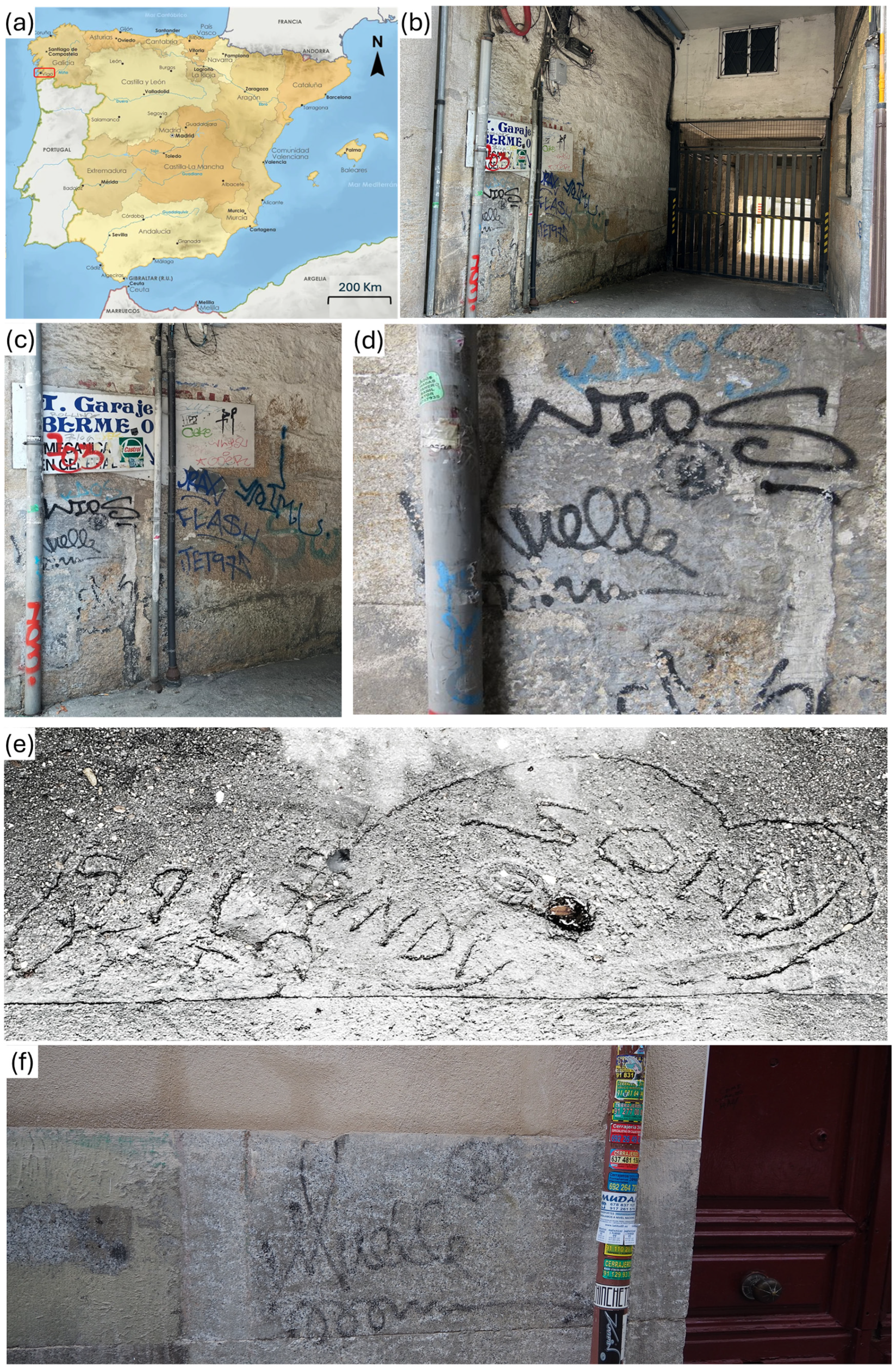
2.1. The Location of the Signature and the Environmental Context
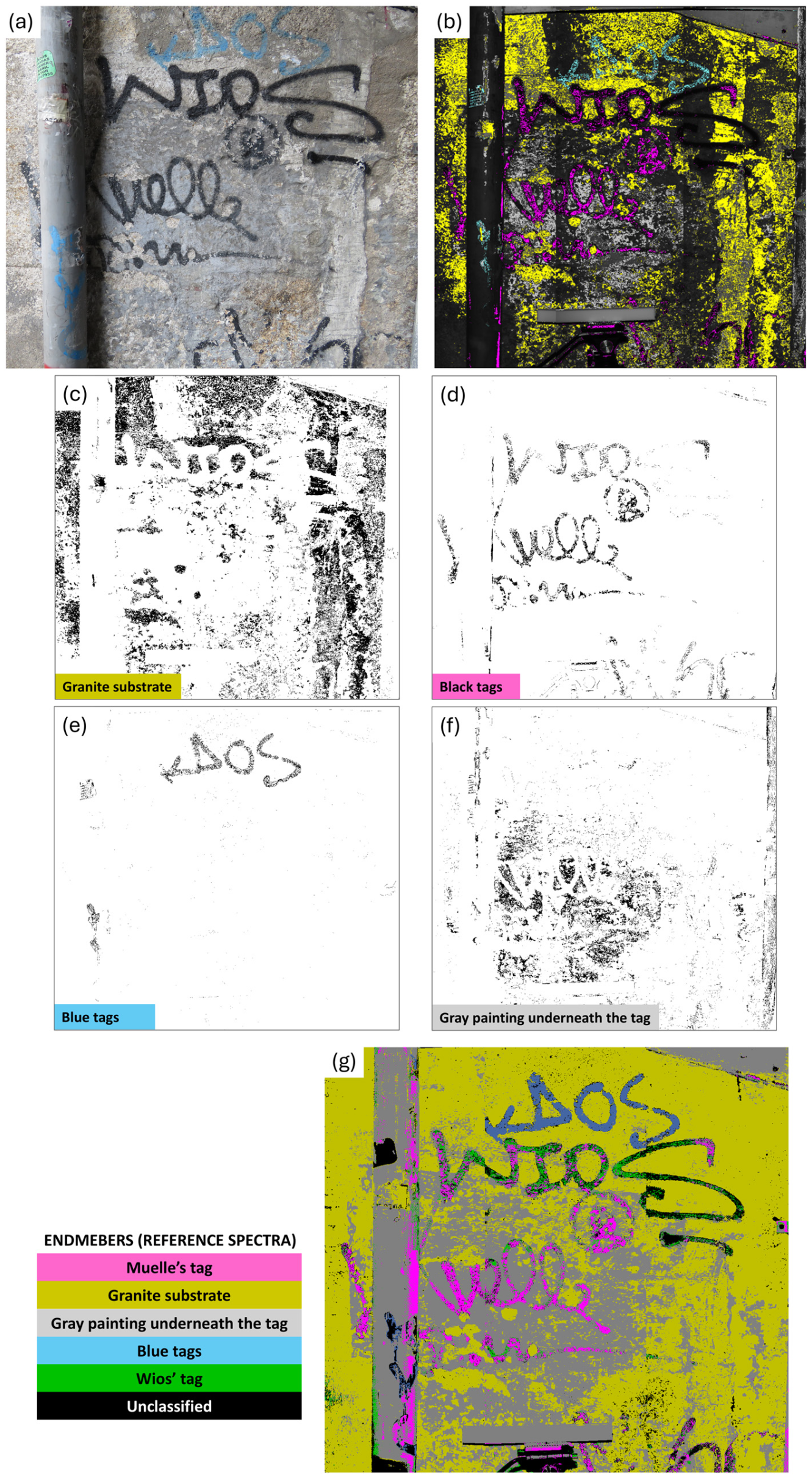
2.2. The Techniques Used to Document and Characterize the Materials
- A micromorphological analysis of the polished transverse sections of the samples with an optical microscope (OM) ZEISS Axioscope 5/7KMAT (Carl Zeiss Meditec Iberia S.A.U., Madrid, Spain). The specimens were first embedded in epoxy resin (EpoThin 2 Epoxy Resin and EpoThin 2 Epoxy Hardener) and then cut and polished to a mirror shine.
- A micromorphological and chemical analysis of the polished transverse sections the of samples by scanning electron microscopy (SEM) (with a JEOL JSM 6010L, JEOL Ltd., Tokyo, Japan) with energy-dispersive X-ray spectroscopy (EDS) in both secondary (SE) and backscattered electron (BSE) detection modes. The observation conditions included a working distance of around 10 mm, an accelerating potential of 20 kV, and a specimen current of ~60 mA.
- An X-ray diffraction (XRD) analysis (with a SIEMENS D5000 Siemens S.A., Madrid, Spain). The samples were ground to less than 50 µm and analyzed by the crystalline powder method. Analyses were conducted using Cu-Kα radiation, an Ni filter, a voltage of 40 kV, and a 40 mA intensity, applying the random powder method. The exploration range was 3° to 60° 2θ and the goniometer speed was 0.01° 2θ/s. The minerals were identified with Xpert Highscore 2.0 software (Malvern Panalytical B.V.).
- Fourier transform infrared spectroscopy (FTIR) (with a Thermo Nicolet 6700 spectrometer, Thermo Fisher Scientific, Waltham, MA, USA). Spectra were recorded in the mid (400–4000 cm−1) infrared spectral region at a spectral resolution of 4 cm−1, for 32 sample scans and a 38.17 s collection time. Spectra were collected using an infrared microscope (Nicolet Continuum, Thermo Fisher Scientific, USA), first analyzing the sample surface using reflection mode and then on the bulk sample using attenuated total reflectance (ATR) mode (with the Smart Orbit Diamond II accessory).
3. Results and Discussion
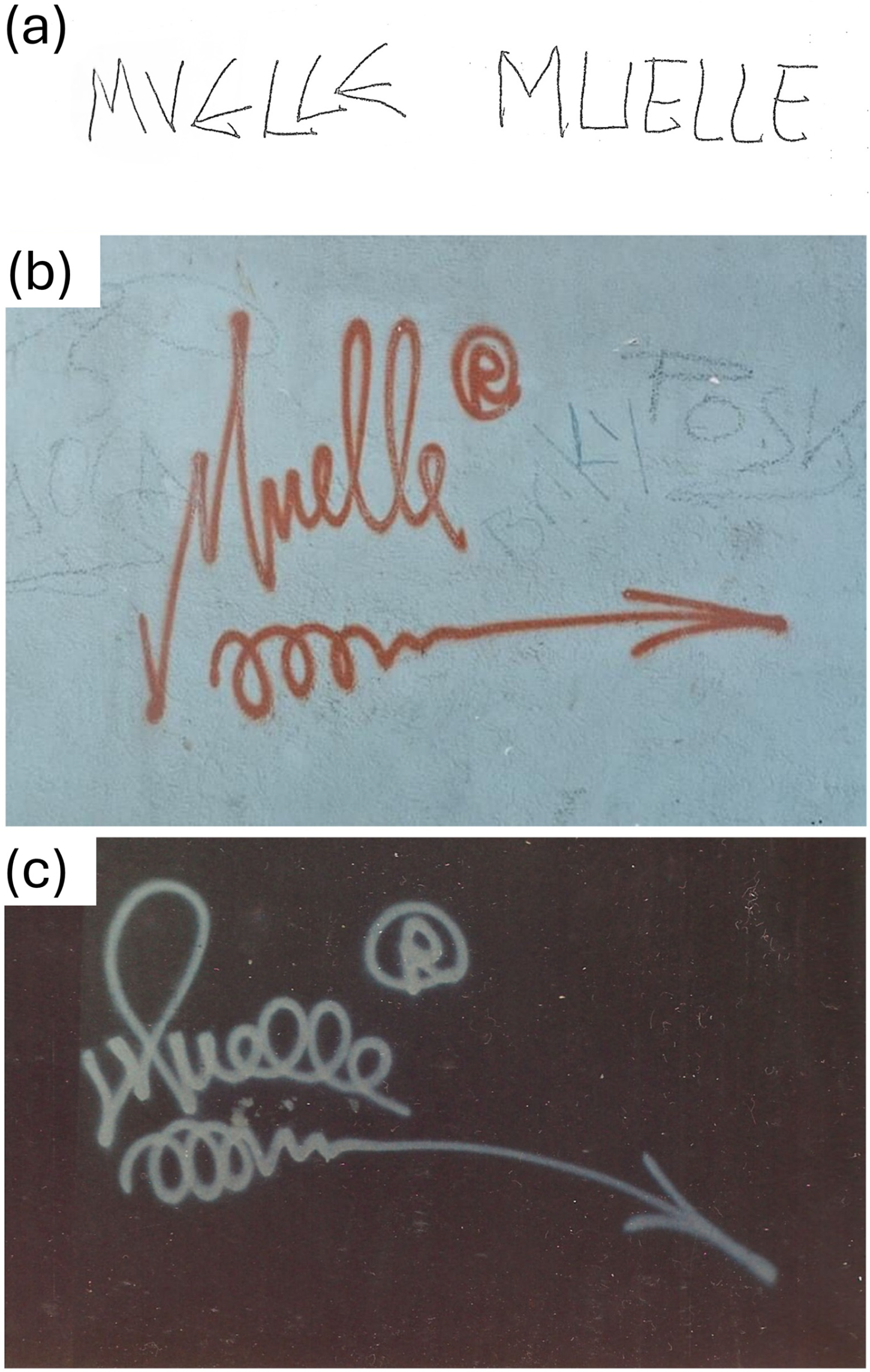
3.1. Description and Attribution
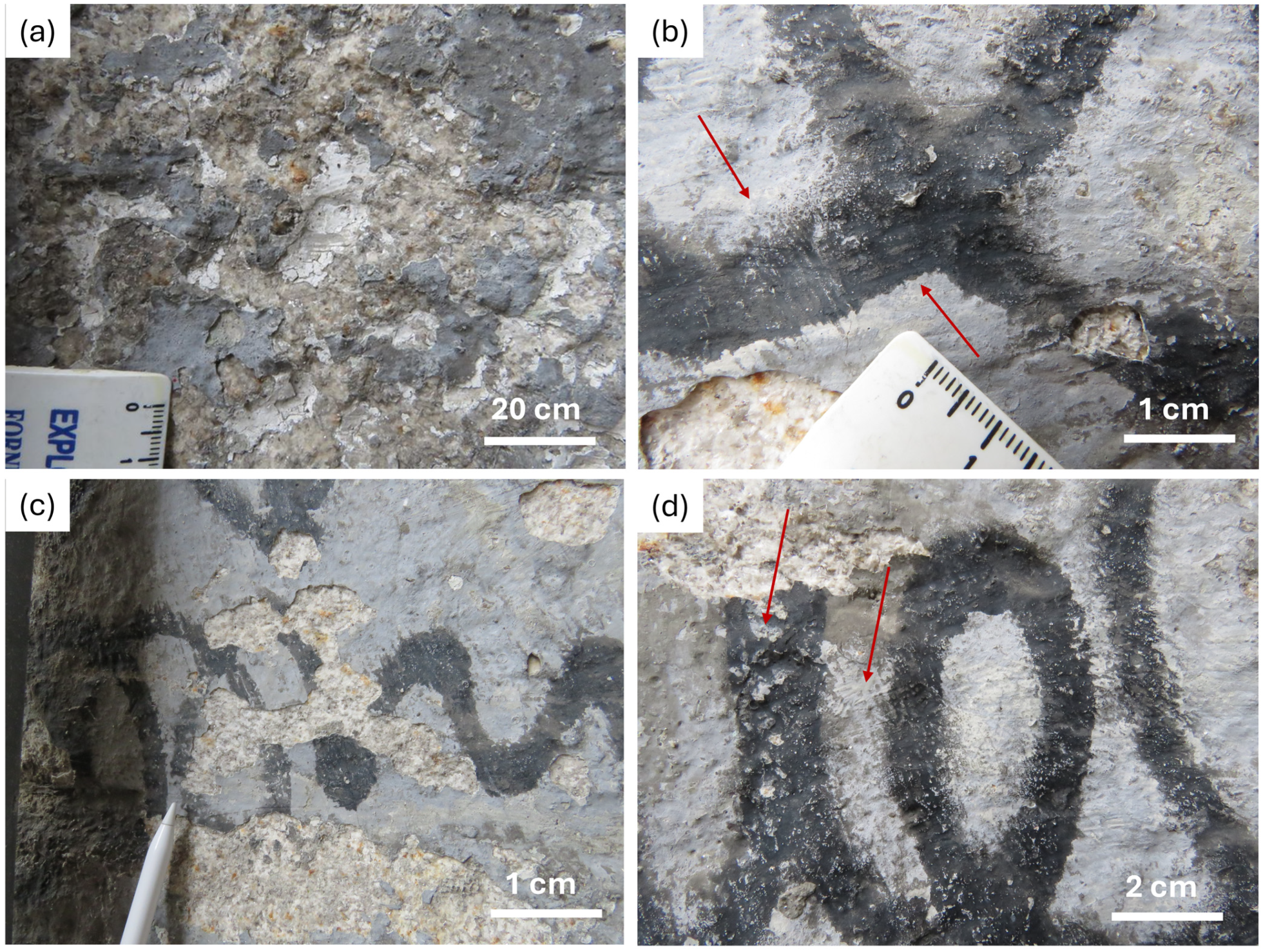
3.2. Characterization and Diagnosis of the Conservation Status
- Scaling: Detachment of the pictorial layer along with the substrate material. This is the most severe type of alteration and has strongly affected the integrity of the tag, causing the loss of large portions of the paintwork (in the order of centimetres) (Figure 3b–d). Scaling has affected the underlying substrate (the white mortar and grey paint) as well as the pictorial layer of the signature. In the most severely affected areas, the granite surface of the wall is exposed.
- Peeling: Loss of the pictorial layer. The black paint layer has peeled at some points, leaving the underlying substrate exposed (Figure 3d). This type of alteration affects much smaller areas than scaling, in the order of millimetres.
- (1)
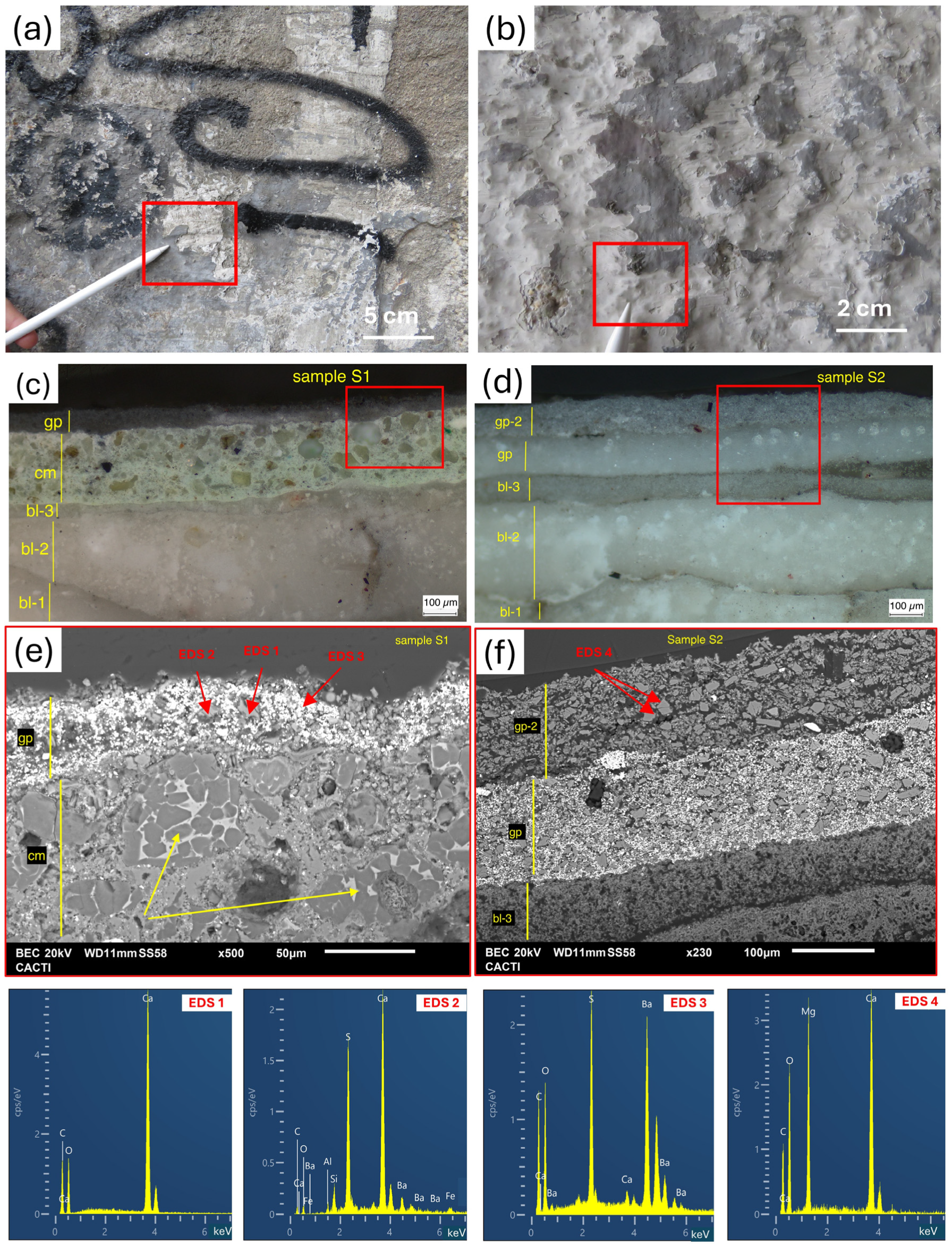
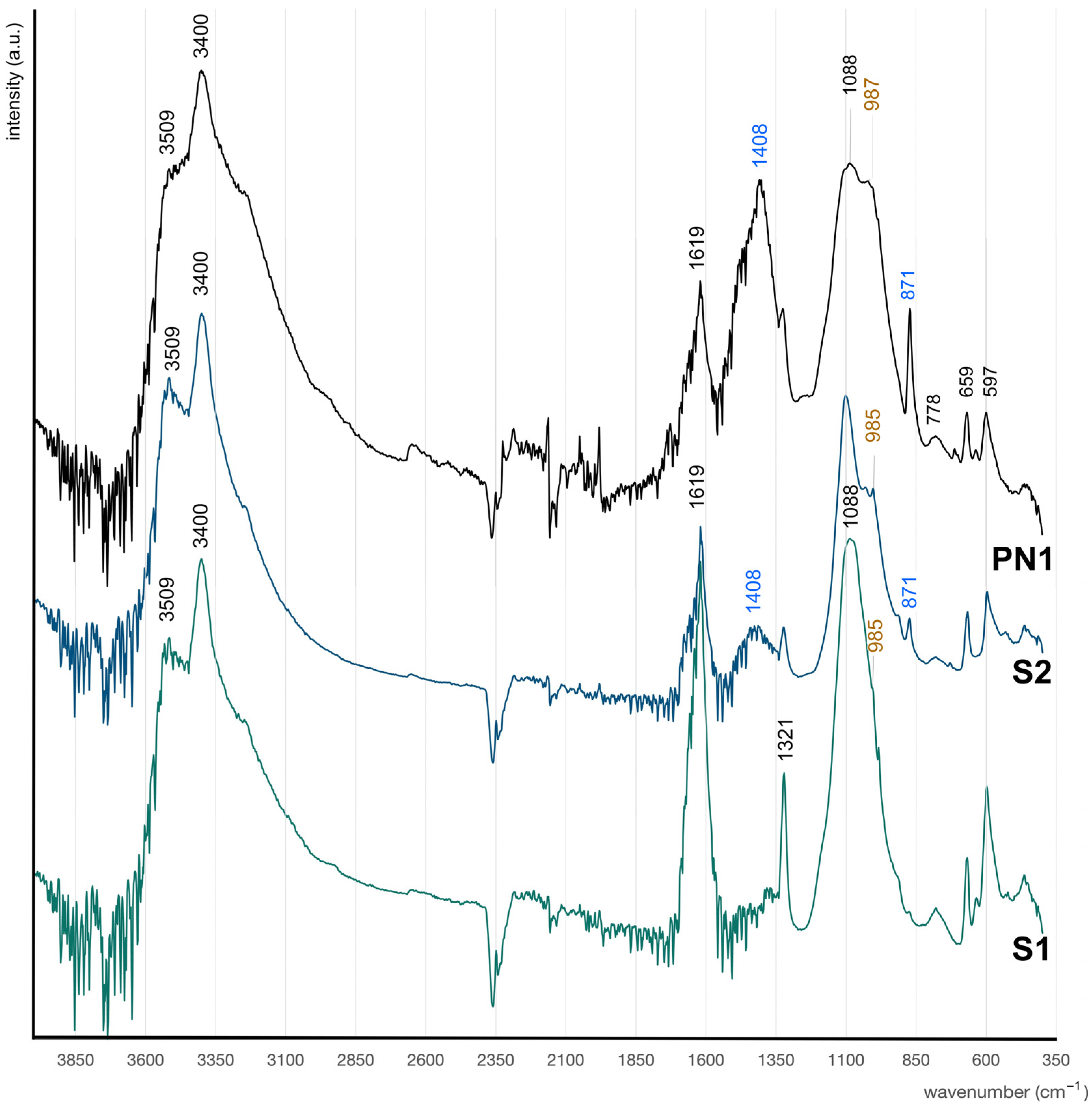
- Two samples of the wall coating (which, in turn, consist of a white layer of mortar and an overlying layer of grey paint): sample S1 is from the coating on the wall in the area with the graffiti tags (Figure 5a) and sample S2 (Figure 5b) is from the coating on another part of the wall (further along the alley, on the other side of the metal door, see Figure 3b) where there are no tags or other graffiti. These samples were examined to determine whether the signatures were painted directly on the wall, without prior preparation of the surface. Given that the samples were micro-samples, it was necessary to optimize the analytical protocol. To this end, an aliquot of each sample was first analyzed by FTIR (reflection mode), followed by XRD (random powder), and subsequently by FTIR (ATR mode). Another aliquot was studied under an OM and by SEM after being prepared as a cross-section.
- (2)
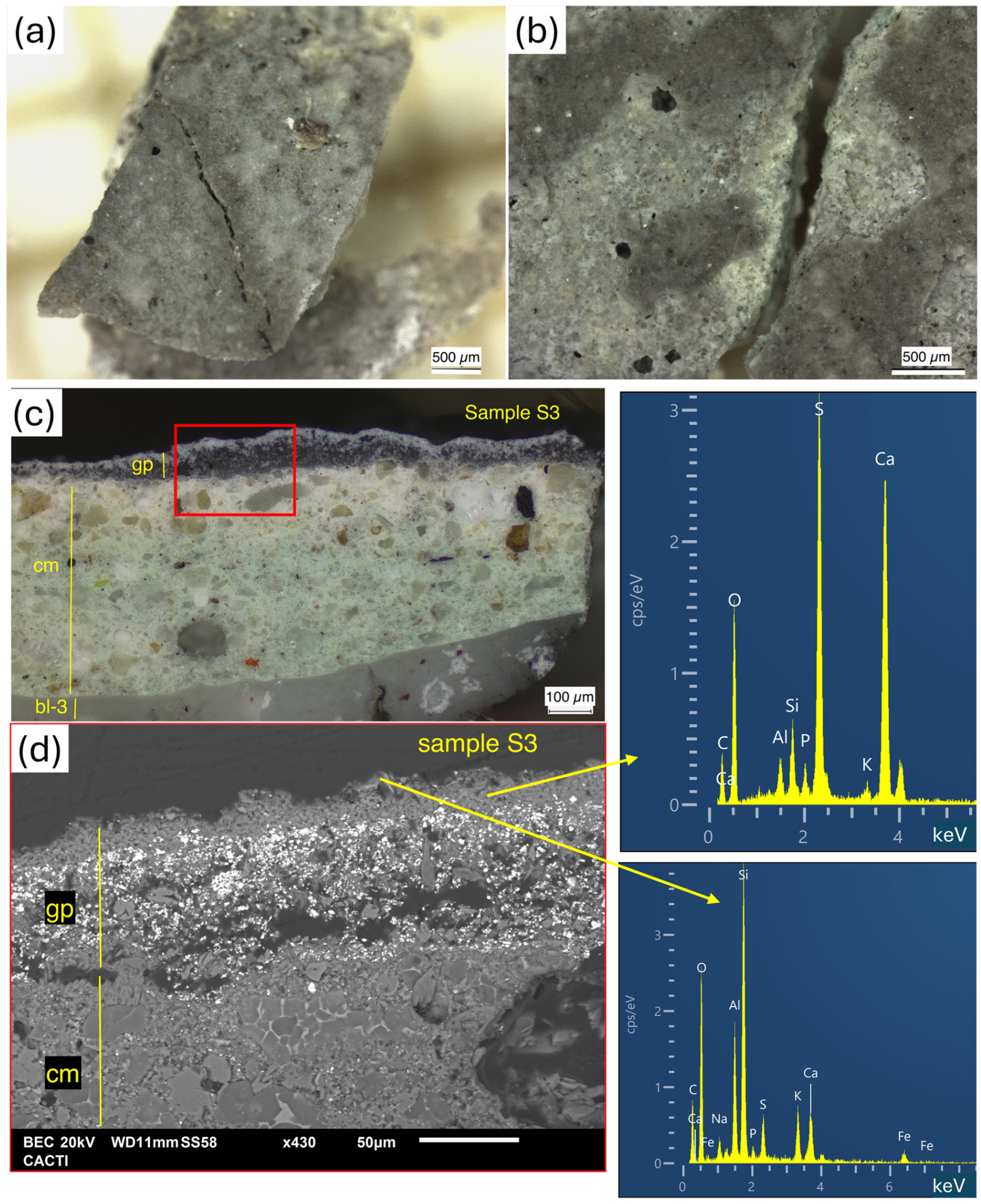
- A third sample of the coating that forms the substrate for Muelle’s tag, which is of a lighter grey colour than the rest of the wall (S3, Figure 3d and Figure 7). This sample was obtained with the aim of determining whether there was a layer of lighter grey paint under Muelle’s tag, as suggested by visual observations made in situ. The whole sample was prepared as cross-section and analyzed by an OM and SEM-EDS and the observations were compared with those of sample S1.
- (3)
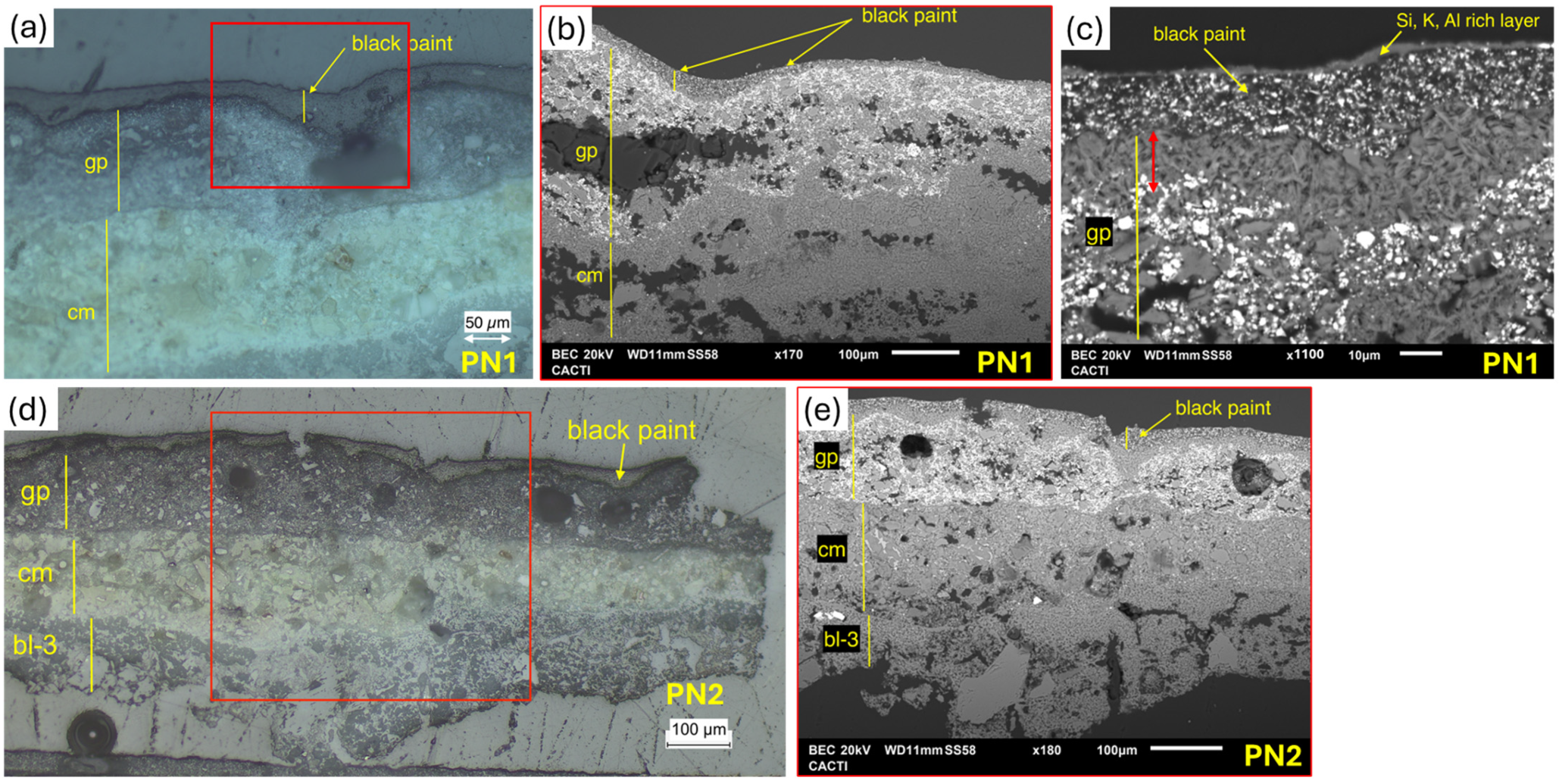
- Two samples of black paint from the lines forming the signature: one in an apparently good state of conservation (PN1) and another affected by peeling (PN2); an aliquot of each sample was first analyzed by FTIR (reflection mode) and subsequently by FTIR (ATR mode). Another aliquot was studied under an OM and by SEM after being prepared as a cross-section.
- A white base layer (bl in Figure 5c) of variable thickness (90–200 µm) formed, in turn, by different sublayers (bl-1, bl-2, and bl-3). The deepest sublayer is rich in S and Ca (forming gypsum, according to the XRD analysis) and the other two layers are richer in Ca, C, and O (forming calcium carbonate, according to the XRD analysis). This deep layer may correspond to plaster made from air lime and gypsum.
- Covering the aforementioned white base layer, there is a layer of thickness 270–110 µm (cm, Figure 5c), formed by angular-shape grains of sizes between 90 and 10 µm agglomerated by a cementing matrix. SEM-EDS (Figure 5e) confirmed that the grains are calcium carbonate and that the matrix is formed by two phases: one of very fine grains rich in C, Ca, and O (forming calcium carbonate) and another formed by grains of mixed composition, formed by Si- and Ca-rich phases intermixed with Al- and Ca-rich phases; these grains correspond to the typical calcium silicates and calcium aluminate hydrated mineral phases of early Portland cement (manufactured between 1820 and 1890; [56]). The mixed composition (cemented aggregates) suggest that this layer is a mortar made from lime and Portland cement.
- This layer of mortar is covered by a thin coat (25–150 µm) of grey paint (grey paint, gp, Figure 5c,e). This grey paint is composed of a C-rich matrix (of low contrast under BSE detector, Figure 5e) that agglomerates subangular fragments of size 2–12 µm, rich in Ca, C, and O (probably calcium carbonate), S and Ca (probably gypsum), and also bright microparticles (<2 µm) rich in S and Ba (present in an atomic ratio equivalent to that of barium sulphate) (Figure 5e). Calcium carbonate, gypsum, and barite, which were detected by XDR, are typical mineral phases used as fillers in modern paints [57,58].
4. Conclusions
Author Contributions
Funding
Data Availability Statement
Acknowledgments
Conflicts of Interest
References
- Schacter, R. Street Art Is a Period. Period. Or the Emergence of Intermural Art. Hyperallergic 2016. Available online: https://hyperallergic.com/street-art-is-a-period-period-or-the-emergence-of-intermural-art/ (accessed on 16 October 2024).
- Vigo Cidade Da Cor. Festival Arte Urbano. Available online: https://ciudaddecolor.vigo.org/?lang=es (accessed on 16 October 2024).
- Castleman, C.A. “Getting Up”: Subway Graffiti in New York. Ph.D. Thesis, Columbia University, New York, NY, USA, 1980. [Google Scholar]
- Mezzadri, P. Contemporary Murals in the Street and Urban Art Field: Critical Reflections between Preventive Conservation and Restoration of Public Art. Heritage 2021, 4, 2515-2525. [Google Scholar] [CrossRef]
- Bruni, R.; Rauhut Kompaniets, O. Street Art and Place-Making of Villages: Examples of Italian Painted Villages. J. Place Manag. Dev. 2024, 17, 527–557. [Google Scholar] [CrossRef]
- Rivas, T.; Alonso-Villar, E.M.; Pozo-Antonio, J.S. Forms and Factors of Deterioration of Urban Art Murals under Humid Temperate Climate; Influence of Environment and Material Properties. Eur. Phys. J. Plus 2022, 137, 1257. [Google Scholar] [CrossRef]
- Pagnin, L.; Calvini, R.; Wiesinger, R.; Schreiner, M. SO2- and NOx-Initiated Atmospheric Degradation of Polymeric Films: Morphological and Chemical Changes, Influence of Relative Humidity and Inorganic Pigments. Microchem. J. 2021, 164, 106087. [Google Scholar] [CrossRef]
- Germinario, G.; Logiodice, A.L.; Mezzadri, P.; Di Fusco, G.; Ciabattoni, R.; Melica, D.; Calia, A. Integrated Investigations to Study the Materials and Degradation Issues of the Urban Mural Painting Ama Il Tuo Sogno by Jorit Agoch. Sustainability 2024, 16, 5069. [Google Scholar] [CrossRef]
- Fang, S.; Hu, W.; Li, Q.; Zhang, B.; Chen, X.; Xie, L. The Relationship between the Microclimate and Efflorescence of Revealed Mural Paintings and the Later Protection Strategy. Sci. Total Environ. 2024, 922, 171337. [Google Scholar] [CrossRef]
- Shpakova, H.; Shpakov, A.; Kripak, W.; Koliakova, V. Structural and Technological Aspects of Conservation of Street Art on Buildings Damaged during the War. Int. J. Conserv. Sci. 2024, 15, 103–118. [Google Scholar] [CrossRef]
- Sabatini, F.; Albertin, F.; Doherty, B.; Monico, L.; Rosi, F.; Buti, D.; Romani, A.; Pecci, A.; Abate, N.; Sileo, M.; et al. Unveiling Street Art: A Multimodal and Multitechnique Approach for Analyzing and Mapping Painting Materials on Large Murals. Proc. Natl. Acad. Sci. USA. 2025, 122, e2504918122. [Google Scholar] [CrossRef]
- Guarnieri, N.; Pagnin, L.; Berti, L.; Goidanich, S.; Gulotta, D.; Izzo, F.C.; Toniolo, L. Preserving the Contemporary Mural “Musica Popolare” by Orticanoodles in Milan, Italy: Deterioration Processes and Protection Performance of Commercial Coatings. J. Cult. Herit. 2025, 75, 326–332. [Google Scholar] [CrossRef]
- Guarnieri, N.; Di Benedetto, A.; Comelli, D.; Mirani, F.; Dellasega, D.; Pagnin, L.; Goidanich, S.; Toniolo, L. Rapid Chromatic Alteration of Street Art: Mechanisms of Deterioration of the Painting Materials of the 20 Years of Freedom and Democracy Mural. Dye. Pigment. 2025, 239, 112733. [Google Scholar] [CrossRef]
- CAPuS. Available online: https://capusproject.eu/glossary/ (accessed on 21 October 2025).
- Cucci, C.; Bartolozzi, G.; De Vita, M.; Marchiafava, V.; Picollo, M.; Casadio, F. The Colors of Keith Haring: A Spectroscopic Study on the Materials of the Mural Painting Tuttomondo and on Reference Contemporary Outdoor Paints. Appl. Spectrosc. 2016, 70, 186–196. [Google Scholar] [CrossRef] [PubMed]
- La Nasa, J.; Orsini, S.; Degano, I.; Rava, A.; Modugno, F.; Colombini, M.P. A Chemical Study of Organic Materials in Three Murals by Keith Haring: A Comparison of Painting Techniques. Microchem. J. 2016, 124, 940–948. [Google Scholar] [CrossRef]
- La Nasa, J.; Campanella, B.; Sabatini, F.; Rava, A.; Shank, W.; Lucero-Gomez, P.; De Luca, D.; Legnaioli, S.; Palleschi, V.; Colombini, M.P.; et al. 60 Years of Street Art: A Comparative Study of the Artists’ Materials through Spectroscopic and Mass Spectrometric Approaches. J. Cult. Herit. 2021, 48, 129–140. [Google Scholar] [CrossRef]
- Magrini, D.; Bracci, S.; Cantisani, E.; Conti, C.; Rava, A.; Sansonetti, A.; Shank, W.; Colombini, M. A Multi-Analytical Approach for the Characterization of Wall Painting Materials on Contemporary Buildings. Spectrochim. Acta Part A Mol. Biomol. Spectrosc. 2017, 173, 39–45. [Google Scholar] [CrossRef]
- Bosi, A.; Ciccola, A.; Serafini, I.; Guiso, M.; Ripanti, F.; Postorino, P.; Curini, R.; Bianco, A. Street Art Graffiti: Discovering Their Composition and Alteration by FTIR and Micro-Raman Spectroscopy. Spectrochim. Acta Part A Mol. Biomol. Spectrosc. 2020, 225, 117474. [Google Scholar] [CrossRef]
- Rousaki, A.; Vandenabeele, P.; Berzioli, M.; Saccani, I.; Fornasini, L.; Bersani, D. An In-and-out-the-Lab Raman Spectroscopy Study on Street Art Murals from Reggio Emilia in Italy. Eur. Phys. J. Plus 2022, 137, 252. [Google Scholar] [CrossRef]
- Sabatini, F.; La Nasa, J.; Degano, I.; Campanella, B.; Legnaioli, S.; Saccani, I.; Modugno, F. Fluorescent Paints in Contemporary Murals: A Case Study. Heritage 2023, 6, 5689–5699. [Google Scholar] [CrossRef]
- Fernández Arcos, A.; Hermelo Veiga, S. Estudio y Conservación de Un Graffiti.: Intervención de Una Firma de Muelle En Vigo. Ge-Conservacion 2025, 28, 39–47. [Google Scholar] [CrossRef]
- Collina, A.; Beghè, B.; Stringhetti, F.; Caglio, S.; Rava, A.; Rivaroli, L.; Macchia, A. A Dialogue between Two Worlds: The Conservation of Poesia DI.VINO by Ivan Tresoldi. J. Cult. Herit. 2022, 55, 11–17. [Google Scholar] [CrossRef]
- Alonso-Villar, E.M.; Rivas, T.; Pozo-Antonio, J.S.; Pellis, G.; Scalarone, D. Efficacy of Colour Protectors in Urban Art Paintings under Different Conditions: From a Real Mural to the Laboratory. Heritage 2023, 6, 3475–3498. [Google Scholar] [CrossRef]
- Melchiorre Di Crescenzo, M.; Zendri, E.; Sánchez-Pons, M.; Fuster-López, L.; Yusá-Marco, D.J. The Use of Waterborne Paints in Contemporary Murals: Comparing the Stability of Vinyl, Acrylic and Styrene-Acrylic Formulations to Outdoor Weathering Conditions. Polym. Degrad. Stab. 2014, 107, 285–293. [Google Scholar] [CrossRef]
- Pintus, V.; Wei, S.; Schreiner, M. Accelerated UV Ageing Studies of Acrylic, Alkyd, and Polyvinyl Acetate Paints: Influence of Inorganic Pigments. Microchem. J. 2016, 124, 949–961. [Google Scholar] [CrossRef]
- Anghelone, M.; Jembrih-Simbürger, D.; Pintus, V.; Schreiner, M. Photostability and Influence of Phthalocyanine Pigments on the Photodegradation of Acrylic Paints under Accelerated Solar Radiation. Polym. Degrad. Stab. 2017, 146, 13–23. [Google Scholar] [CrossRef]
- Anghelone, M.; Stoytschew, V.; Jembrih-Simbürger, D.; Schreiner, M. Spectroscopic Methods for the Identification and Photostability Study of Red Synthetic Organic Pigments in Alkyd and Acrylic Paints. Microchem. J. 2018, 139, 155–163. [Google Scholar] [CrossRef]
- Cortea, I.M.; Ratoiu, L.; Rădvan, R. Characterization of Spray Paints Used in Street Art Graffiti by a Non-destructive Multi-analytical Approach. Color Res. Appl. 2021, 46, 183–194. [Google Scholar] [CrossRef]
- Aguilar-Rodríguez, P.; Mejía-González, A.; Zetina, S.; Colin-Molina, A.; Rodríguez-Molina, B.; Esturau-Escofet, N. Unexpected Behavior of Commercial Artists’ Acrylic Paints under UVA Artificial Aging. Microchem. J. 2021, 160, 105743. [Google Scholar] [CrossRef]
- França De Sá, S.; Viana, C.; Ferreira, J.L. Tracing Poly(Vinyl Acetate) Emulsions by Infrared and Raman Spectroscopies: Identification of Spectral Markers. Polymers 2021, 13, 3609. [Google Scholar] [CrossRef]
- Alonso-Villar, E.M.; Rivas, T.; Pozo-Antonio, J.S. Sol-Silicate versus Organic Paints: Durability after Outdoor and Ultraviolet Radiation Exposures. Prog. Org. Coat. 2022, 168, 106843. [Google Scholar] [CrossRef]
- Pellis, G.; Bertasa, M.; Ricci, C.; Scarcella, A.; Croveri, P.; Poli, T.; Scalarone, D. A Multi-Analytical Approach for Precise Identification of Alkyd Spray Paints and for a Better Understanding of Their Ageing Behaviour in Graffiti and Urban Artworks. J. Anal. Appl. Pyrolysis 2022, 165, 105576. [Google Scholar] [CrossRef]
- Marazioti, V.; Douvas, A.M.; Vouvoudi, E.C.; Bikiaris, D.; Papadokostaki, K.; Nioras, D.; Gogolides, E.; Orfanoudakis, S.; Stergiopoulos, T.; Boyatzis, S.; et al. The Condition of Contemporary Murals in Sun-Exposed Urban Environments: A Model Study Based on Spray-Painted Mock-Ups and Simulated Light Ageing. Heritage 2024, 7, 3932–3959. [Google Scholar] [CrossRef]
- Pozo-Antonio, J.S.; Alonso-Villar, E.M.; Rivas, T.; Márquez, I. Evaluation of a Protective Acrylic Finish Applied to Surfaces Painted with Acrylic Paints for Outdoor or Indoor Uses. Dye. Pigment. 2023, 212, 111141. [Google Scholar] [CrossRef]
- Figueroa-Saavedra, F. Graphitfragen: Una Mirada Reflexiva Sobre El Graffiti; Minotauro Digital: Madrid, Spain, 2006; ISBN 84-611-0453-6. [Google Scholar]
- Observatorio de Arte Urbano. Available online: https://observatoriodearteurbano.org/ (accessed on 21 October 2025).
- Conservando Muelle. Available online: https://conservandomuelle.wordpress.com/ (accessed on 21 October 2025).
- Gayo, E.G.; Observatorio de Arte Urbano. Restauración Del Muelle de Montera. Gestión, Innovación y Riesgos. In Conservación de Arte Contemporáneo: 18a Jornada, Febrero 2017; Museo Nacional Centro de Arte Reina Sofía: Madrid, Spain, 2017; pp. 167–177. [Google Scholar]
- Santos-Hermo, A. Hallazgo y Autenticación de Una Firma de Muelle En La Ciudad de Vigo. In V Congreso Internacional de Investigacion en Artes Visuales ANIAV 2022. RE/DES Conectar; Editorial Universitat Politècnica de València: Valencia, Spain, 2022. [Google Scholar]
- Figueroa Saavedra, F. El Grafiti de Firma; Minobitia: Madrid, Spain, 2014; ISBN 978-84-938344-7-0. [Google Scholar]
- Martínez-Cortizas, A. Zonas Agroecologicas de Galicia: Zonas Climaticas FAO. In Anales de Edafología y Agrobiología; Consejo Superior de Investigaciones Científicas; Instituto Nacional de Edafología y Agrobiología: Madrid, Spain, 1987; Volume 46. [Google Scholar]
- Martínez-Cortizas, A.; Pérez Alberti, A. (Eds.) Atlas Climático de Galicia; Xunta de Galicia: Santiago de Compostela, Spain, 1999; Volume 187, ISBN 84-453-2611-2. [Google Scholar]
- MeteoGalicia. Available online: https://www.meteogalicia.gal/web/home (accessed on 21 October 2025).
- Silva, B.; Rivas, T.; Garciarodeja, E.; Prieto, B. Distribution of Ions of Marine Origin in Galicia (NW Spain) as a Function of Distance from the Sea. Atmos. Environ. 2007, 41, 4396–4407. [Google Scholar] [CrossRef]
- Vergès-Belmin, V. (Ed.) ICOMOS-ISCS: Illustrated Glossary on Stone Deterioration Patterns; Monuments and Sites; English-French Version; ICOMOS: Paris, France, 2008; ISBN 978-2-918086-00-0. [Google Scholar]
- Weyer, A. (Ed.) EwaGlos: European Illustrated Glossary of Conservation Terms for Wall Paintings and Architectural Surfaces; English definitions with translations into Bulgarian, Croatian, French, German, Hungarian, Italian, Polish, Romanian, Spanish and Turkish; Series of publications by the Hornemann Institute; Michael Imhof Verlag: Petersberg, German, 2015; ISBN 978-3-7319-0260-7. [Google Scholar]
- Kruse, F.A.; Lefkoff, A.B.; Boardman, J.W.; Heidebrecht, K.B.; Shapiro, A.T.; Barloon, P.J.; Goetz, A.F.H. The Spectral Image Processing System (SIPS)—Interactive Visualization and Analysis of Imaging Spectrometer Data. Remote Sens. Environ. 1993, 44, 145–163. [Google Scholar] [CrossRef]
- Muelleart Web. Available online: https://muelleart.com/evolucion-de-la-firma/ (accessed on 21 October 2025).
- Figueroa, F. El Reconocimiento Cultural Del Graffiti: El Caso Muelle [Video de Youtube]. 2020. Available online: https://www.Youtube.Com/Watch?v=71AV9Fkb7o4 (accessed on 21 October 2025).
- Capdevila, R.; Floor, P. Les Différents Types de Granites Hercyniens et Leur Distribution Dans Le Nord Ouest de l’Espagne. Bol. Geológico Minero. T. LXXXI.-II-III Ano 1970, 215, 225. [Google Scholar]
- Ali, U.A.M.E.; Maniamfu, P.; Kameyama, K. Efficient Band Reduction for Hyperspectral Imaging with Dependency-Based Segmented Principal Component Analysis. Int. J. Remote Sens. 2024, 45, 9311–9337. [Google Scholar] [CrossRef]
- Jones, F. Infrared Investigation of Barite and Gypsum Crystallization: Evidence for an Amorphous to Crystalline Transition. CrystEngComm 2012, 14, 8374. [Google Scholar] [CrossRef]
- Socrates, G. Infrared and Raman Characteristic Group Frequencies: Tables and Charts, 3rd ed.; John Wiley and Sons: Chichester, UK, 2001; 366p. [Google Scholar]
- Stefov, V.; Jovanovski, G.; Shoptrajanov, B.; Minceva-Sukarova, B.; Dimitrovska, S.; Boev, B. Minerals from Macedonia V. Characterization of Gypsum, Barite and Their Synthetic Analogues by FTIR and RAMAN Spectroscopy. Geol. Maced. 2000, 14, 61–66. [Google Scholar]
- Weber, J.; Bayer, K.; Pintér, F. Nineteenth Century “Novel” Building Materials: Examples of Various Historic Mortars under the Microscope. In Historic Mortars: Characterisation, Assessment and Repair; Springer: Berlin/Heidelberg, Germany, 2012; pp. 89–103. [Google Scholar]
- Marrion, A.R. (Ed.) The Chemistry and Physics of Coatings; The Royal Society of Chemistry: London, UK, 2004; ISBN 978-0-85404-604-1. [Google Scholar]
- Buyondo, A.K.; Kasedde, H.; Kirabira, J.B.; Yusuf, A.A. Integration of Fillers in Paint Formulation: Comprehensive Insights into Methods, Properties, and Performance. Results Eng. 2025, 26, 105543. [Google Scholar] [CrossRef]
- Germinario, G.; Van Der Werf, I.D.; Sabbatini, L. Chemical Characterisation of Spray Paints by a Multi-Analytical (Py/GC–MS, FTIR, μ-Raman) Approach. Microchem. J. 2016, 124, 929–939. [Google Scholar] [CrossRef]
- Rivas, T.; Prieto, B.; Silva, B.; Birginie, J.M. Weathering of Granitic Rocks by Chlorides: Effect of the Nature of the Solution on Weathering Morphology. Earth Surf. Process. Landf. J. Br. Geomorphol. Res. Group 2003, 28, 425–436. [Google Scholar] [CrossRef]
- Morillas, H.; De Mendonça Filho, F.F.; Derluyn, H.; Maguregui, M.; Grégoire, D.; Madariaga, J.M. Decay Processes in Buildings Close to the Sea Induced by Marine Aerosol: Salt Depositions inside Construction Materials. Sci. Total Environ. 2020, 721, 137687. [Google Scholar] [CrossRef]
- Barca, D.; Comite, V.; Belfiore, C.M.; Bonazza, A.; La Russa, M.F.; Ruffolo, S.A.; Crisci, G.M.; Pezzino, A.; Sabbioni, C. Impact of Air Pollution in Deterioration of Carbonate Building Materials in Italian Urban Environments. Appl. Geochem. 2014, 48, 122–131. [Google Scholar] [CrossRef]
- Ruffolo, S.A.; Comite, V.; La Russa, M.F.; Belfiore, C.M.; Barca, D.; Bonazza, A.; Crisci, G.M.; Pezzino, A.; Sabbioni, C. An Analysis of the Black Crusts from the Seville Cathedral: A Challenge to Deepen the Understanding of the Relationships among Microstructure, Microchemical Features and Pollution Sources. Sci. Total Environ. 2015, 502, 157–166. [Google Scholar] [CrossRef]
- Calparsoro, E.; Maguregui, M.; Giakoumaki, A.; Morillas, H.; Madariaga, J.M. Evaluation of Black Crust Formation and Soiling Process on Historical Buildings from the Bilbao Metropolitan Area (North of Spain) Using SEM-EDS and Raman Microscopy. Environ. Sci. Pollut. Res. 2017, 24, 9468–9480. [Google Scholar] [CrossRef]



| Name | Area (%) | Classification Accuracy (%) |
|---|---|---|
| Muelle’s tag | 4.01 | 93.3 |
| Granite substrate | 53.46 | 95.4 |
| Grey paintwork underneath the tag | 33.79 | 95.17 |
| Blue tag | 1.69 | 94.07 |
| Wios’ tag | 2.32 | 92.55 |
| Unclassified | 4.73 | 100 |
| Name | Description | Location | Analyses |
|---|---|---|---|
| S1 | Wall coating | Graffiti painting area | FTIR, XRD (bulk sample) OM and SEM (cross-section) |
| S2 | Wall coating | Inaccessible area of the alley | FTIR, XRD (bulk sample) OM and SEM (cross-section) |
| S3 | Wall coating | Substrate of Muelle’s tag | OM and SEM (cross section) |
| PN1 | Black paint in good condition | Muelle’s tag | FTIR (bulk sample) OM and SEM (cross-section) |
| PN2 | Black paint affected by peeling | Muelle’s tag | FTIR (bulk sample) OM and SEM (cross-section) |
Disclaimer/Publisher’s Note: The statements, opinions and data contained in all publications are solely those of the individual author(s) and contributor(s) and not of MDPI and/or the editor(s). MDPI and/or the editor(s) disclaim responsibility for any injury to people or property resulting from any ideas, methods, instructions or products referred to in the content. |
© 2026 by the authors. Licensee MDPI, Basel, Switzerland. This article is an open access article distributed under the terms and conditions of the Creative Commons Attribution (CC BY) license.
Share and Cite
Rivas, T.; Santos-Hermo, A.; Andrés-Herguedas, L.; Pozo-Antonio, J.S. Documenting a Graffiti Tag by Muelle, a Pioneer of Graffiti Art in Spain. Heritage 2026, 9, 23. https://doi.org/10.3390/heritage9010023
Rivas T, Santos-Hermo A, Andrés-Herguedas L, Pozo-Antonio JS. Documenting a Graffiti Tag by Muelle, a Pioneer of Graffiti Art in Spain. Heritage. 2026; 9(1):23. https://doi.org/10.3390/heritage9010023
Chicago/Turabian StyleRivas, Teresa, Alberto Santos-Hermo, Laura Andrés-Herguedas, and Jose Santiago Pozo-Antonio. 2026. "Documenting a Graffiti Tag by Muelle, a Pioneer of Graffiti Art in Spain" Heritage 9, no. 1: 23. https://doi.org/10.3390/heritage9010023
APA StyleRivas, T., Santos-Hermo, A., Andrés-Herguedas, L., & Pozo-Antonio, J. S. (2026). Documenting a Graffiti Tag by Muelle, a Pioneer of Graffiti Art in Spain. Heritage, 9(1), 23. https://doi.org/10.3390/heritage9010023