Article

Restitution of the Sensory Urban Ambiences of a French Colonial Urban Fabric in Algeria: A Case Study of Didouche Mourad Street, Skikda

by
Rima Boukerma
1,*,
Lamia Mansouri
1,
Bidjad Arigue
2,
Giovanni Santi
3 and
Daniela Ladiana
4
1
Laboratory of Architecture, Heritage and Urban Environment, Department of Architecture, Faculty of Science, University of Algiers 1—Ben Youssef Ben Khadda, Algiers 16000, Algeria
2
Laboratory of Design and Modeling of Architectural Forms and Ambiances (LACOMOFA), Department of Architecture, Mohamed Khider University, Biskra 07000, Algeria
3
Department of Energy, Systems, Territory and Construction Engineering, University of Pisa, 56122 Pisa, Italy
4
Department of Architecture, University of Chieti-Pescara, Viale Pindaro 42, 65127 Pescara, Italy
*
Author to whom correspondence should be addressed.
Heritage 2026, 9(1), 22; https://doi.org/10.3390/heritage9010022
Submission received: 19 November 2025 / Revised: 4 January 2026 / Accepted: 5 January 2026 / Published: 9 January 2026

Abstract

The ambiance-based approach to old urban fabrics has emerged as a response to the evolution of heritage, focusing on the spirit of place and the relationship between people and their environment. It aims to preserve the identity of architectural and urban spaces, incorporating intangible elements beyond their physical character. In Algeria, colonial-era urban fabrics continue to structure cities. Skikda, a city in eastern Algeria was created ex-nihilo during this era. In this context, Didouche Mourad Street—the main thoroughfare and structuring element of the city—constitutes the core of the analysis. This study focuses on the French colonial period (1838–1962), considered a foundational phase in the spatial and sensory formation of the street. It aims to restitute the sensory urban ambiences of this period and to analyse their evolution in order to identify sensory permanences contributing to the heritage identity of the place. A thematic content analysis was used to identify sensory ambiences, supported by NVivo software to quantify their recurrences and analyse their spatio-temporal dynamics. The findings show that some ambiences have persisted, others have disappeared, and new ones have emerged through successive transformations. By documenting the sensory history of the street, this research proposes a conceptual and methodological framework for the interpretation of heritage urban ambiences and for informing contemporary rehabilitation approaches, considering permanent ambiences as interpretative tools and reference points for understanding heritage dynamics.

1. Introduction

1.1. Introduction and Historical Background

After colonisation, Algerian cities underwent a radical transformation in their urban organisation. A new urban fabric structure gradually took hold, profoundly altering the appearance and architectural identity of these areas. These changes marked a decisive turning point in the history of Algerian urban landscapes, forever overturning their traditional configuration. Today, this colonial legacy forms the main backbone of many Algerian city centres, bearing witness to a collective memory that links the two shores of the Mediterranean.
The heritage issue of colonial cities has often been approached from the angle of physical conservation and architectural rehabilitation, but the intangible dimensions, such as ambience and sensory perceptions, remain largely neglected. Yet these aspects play a crucial role in preserving this heritage. The city of Skikda, formerly Philippeville, is a prime example of colonial urban planning in Algeria. Created ex nihilo on the remains of the ancient Roman city of Rusicade, it embodies exceptional architectural and urban wealth, particularly through its main thoroughfare: Didouche Mourad Street, formerly Rue George Clémenceau. This street, once the Roman cardo, has survived the ages to become a structuring element of the colonial and contemporary urban fabric. The aim of this research is to explore the sensory ambiences that characterised this street during the colonial era, raising a number of questions: What were the urban ambiences present in this street? Did these ambiences evolve over the different phases of colonisation between 1830 and 1962? Which ambiences have endured and which have disappeared? All these questions will enable us to retrace the sensitive urban history of Skikda, while highlighting the social and cultural transformations linked to this area.

1.2. Literature Review

The concept of ambience was first introduced into the field of architecture by Christian Norberg-Schulz [1], and subsequently developed within scientific research by the teams of the Cresson laboratory in Grenoble and the Crenau laboratory in Nantes. Early research on ambiences primarily focused on the sound dimension at the urban scale. This approach later evolved beyond a normative and strictly physical framework towards a multidimensional perspective, integrating the full range of sensory and perceptual registers and grounded in users’ lived experience. This evolution led to considering ambience not only as a theoretical notion but also as a methodological tool for analysing built environments [2].
Within this framework, ambience is defined as a relational and interdisciplinary phenomenon resulting from the interaction between the physical signals of the environment (sonic, luminous, olfactory, and thermal), the built space that filters and shapes them, the perceiving users engaged bodily within the situation, and the temporality in which this interaction unfolds [3]. Ambience therefore cannot be reduced to an isolated signal or a spatial configuration, but rather constitutes a global, lived and interpreted phenomenon.
This approach highlights the central role of sensoriality in the construction of ambiences. Ambiences can be understood as the sensitive expression of the relationship between individuals and their environment [4], mobilising multiple sensory modalities and involving the body and perception of users [5]. They convey a situated, socially and culturally constructed multisensory experience that goes beyond a purely physical or morphological reading of space.
Several conceptual models have been developed to formalise this approach. Augoyard [6] proposed an initial framework based on the interdependence between constructed forms, perceived forms and represented forms, articulating physical, perceptual and cultural dimensions. This framework was further refined by Chelkoff [7] through the model of forms, formants and formalities, which, respectively, distinguish the morphological and physical properties of space, users’ sensory experience, and social and symbolic practices. These models affirm that ambience emerges from an inseparable interplay between spatial materiality, sensory perception and social dynamics.
From a complementary perspective, Belakehal [8] developed an integrative model of the ambience situation based on the interaction between the context of the place (climatic, cultural and social), the architectural or urban space, the physical environment of stimuli, and the user as a perceiving and acting subject. This model explicitly distinguishes in situ ambience situations, observable in existing spaces, from ex situ situations related to historical spaces that have disappeared or undergone significant transformations, for which restitution relies on archival, textual or iconographic sources, potentially complemented by numerical simulations or content analysis.
Beyond these fundamental components, temporality constitutes a key dimension of ambience. Ambience is intrinsically situated in time: it emerges, evolves and disappears according to natural rhythms, patterns of use and urban transformations [9]. This lived temporality enriches historical analyses of urban spaces and provides a structuring framework for research on urban ambiences. Taken together, these models enable a rigorous articulation of material, sensory, social and temporal data, and today constitute a major reference within the field of urban ambience studies.
Among the various research directions addressing architectural and urban ambiences, the present article specifically focuses on the temporal dimension of ambiences and the modalities of their transmission or transposition. Although anchored in the present, ambiences carry elements of the past and anticipate future dynamics, thereby establishing temporal continuity while revealing transformations in the sensory relationships between individuals and their environment [10]. This perspective highlights the close links between ambiences and heritage, as well as the challenges related to their safeguarding and transmission.
In parallel, instruments for the management and preservation of cultural heritage have undergone significant evolution [11,12,13], progressively integrating the sensitive dimensions of architectural and urban heritage. These dimensions correspond to what is referred to as sensory heritage, encompassing sensory environments that convey forms of identity [14]. Despite their ephemeral and situated nature, ambiences may be considered as sensitive legacies, carrying perceptual permanences and transmissible cultural values [15].
The conceptualisation of sensory heritage is grounded both in collective memory and in sensory experience, the latter constituting a major vector of place identity. The experience of space is simultaneously physical, sensory, perceptual and affective. Approaching heritage through the lens of ambiences therefore makes it possible to consider places not merely as built forms, but as lived and perceived environments. This perspective, notably developed within Cresson research, emphasises the importance of users’ individual sensory experiences and the ambiences that shape the quality of places. It differs from conventional heritage approaches, largely centred on materiality and formal conservation as defined in international charters, by integrating social practices, everyday uses and sensory perceptions as core components of a place’s historical specificity [16].
This theoretical shift underscores that place identity derives as much from ambience as from architecture, and that the sensory dimension contributes substantially to heritage value.
In this context, several studies have demonstrated that ambiences play a central role in shaping identity, memory and heritage value within historical urban fabrics, through sensitive approaches based on qualitative and interpretative methods. The works of Sahraoui [17] and Chtara [2], for instance, address sound ambience as a key heritage component. Their approaches rely on both direct and indirect modes of cognition, combining the analysis of historical texts (travelers’ accounts), memorial testimonies, targeted interviews (with musicians and residents), and morphological analysis of urban forms. These methodologies enable the identification of sound generators, sensitive effects and sonic permanences, revealing sound ambience as a patrimonial signature of practices and ways of life.
Other studies have extended the analysis of ambiences to their contribution to urban memory and the spirit of place. Belakehal and Farhi [18], as well as Makhloufi [19], primarily employ textual content analysis (literary works and travel narratives) alongside observations of social practices to describe the urban ambiences of medinas. These studies show that ambiences, apprehended through uses, social interactions and sensory perceptions, contribute to the transmission of cultural identities and to the legibility of historic urban fabrics.
The articulation between ambiences, memory and temporality is further developed by Said [20], who proposes a reading of the palimpsest of urban ambiences. Her methodology is structured as a qualitative, multi-tool method combining archival research, direct observation by the researcher, commented walks with users, and interviews with writers and knowledgeable actors of the city. This approach captures the temporal depth of ambiences and interprets them as receptacles of sensitive strata emerging from both past and present.
More recently, ambiences have been examined through the lens of appropriation processes and heritage mediation. Djedi [21] employs commented walks, complemented by field observations and interviews, to co-construct heritage ambiences with residents of the Casbah of Algiers. Toumadher [22] proposes a methodology structured around sensitive observation, the collection of residents’ narratives, descriptive analysis and an experimental phase, demonstrating that ambiences reveal processes of cultural hybridity, persistence and identity recomposition.
In parallel, several studies have focused on the historical restitution of ambiences through indirect sources. Joanne [23], Ben Hadj Salem [24], Dali and Belakehal [25], as well as Zidelmal and Belakehal [26], rely on content analysis of archival and literary sources. These works demonstrate that ambiences can be considered as historical facts in their own right, provided that sensitive descriptions are systematically cross-referenced with spatial methods and practices. Finally, recent approaches based on numerical modelling and immersive experimentation [27,28] further validate the scientific relevance of ambience restitution methodologies.
Overall, these studies converge towards recognising ambience as a fundamental component of heritage and towards the necessity of exploring its role in the construction of place memory and identity. In line with these approaches, the present research adopts a sensitive restitution methodology based on archival and textual sources. It differs from existing studies by applying this framework to an Algerian colonial urban fabric, and more specifically to a city created ex nihilo, an object that remains largely unexplored in the literature, which has predominantly focused on medinas and traditional urban fabrics.
By concentrating on the colonial period, this research seeks to restitute the original sensory ambiences of Didouche Mourad Street, in order to identify the permanences, transformations and sensitive generators specific to this historical phase. This restitution enables the documentation of sensory permanences from the colonial era as historical traces in their own right. These reconstructed ambiences therefore constitute a referential document of sensitive urban history, contributing to a deeper understanding of the formation of the place, its initial uses, and the sensitive relationships between space, practices and society.

2. Materials and Methods

The material used in this article mainly brings together textual and iconographic documents dating from the colonial era (1838–1962 (although the colonisation of Algeria started in 1830, the city of Skikda was not colonised until 1838.)), from the various collections to which we had access: the municipal archives of the Communal Popular Assembly (APC) of Skikda, the archives of the historical defence service of Vincennes in France and the archives of the maps and plans department of the national library of France, where most of the maps of the city were collected, as well as plans and monographic reports dating from the period under study. These documents were used to present the Rue George Clémenceau and trace the history of its urban development. The detailed references of the cartographic and iconographic documents analysed are provided in the corresponding analytical sections.
Travel accounts and newspapers from the colonial era were consulted through the digital collections of the “Bibliothèque nationale de France” (Gallica). At the same time, historical works and novels dealing with Skikda during the colonial era were collected at Skikda’s main public reading library. All of these documents were analysed using the content analysis method, in order to identify the sensory urban ambiences of the street, their generators and the spaces where they were manifested.
In order to respond to the initial problem and achieve the targeted objectives, a methodological scenario was designed. This was organised around three key stages, enabling the approach to be structured coherently and effectively.
The first stage is the presentation of the urban history of Rue Georges Clémenceau: this stage aims to retrace the key phases in its construction and development.
This is followed by a categorical thematic content analysis applied to the textual sources. The aim is to identify the sensory urban ambiences perceived in the Rue Georges Clémenceau during the colonial era and their generators, as well as the spatial components—i.e., support places—where they manifested themselves.
The third stage of our analysis is the quantification of the recurrences of the sensory urban ambiences identified previously, and their generators in each spatial component and during each temporal phase. In this phase, we used NVivo 14 (QSR International, Burlington, MA, USA), a data analysis software, to study the evolution of the ambiences throughout the period under study.

3. Procedural Analysis

3.1. Urban Development of Rue George Clémenceau

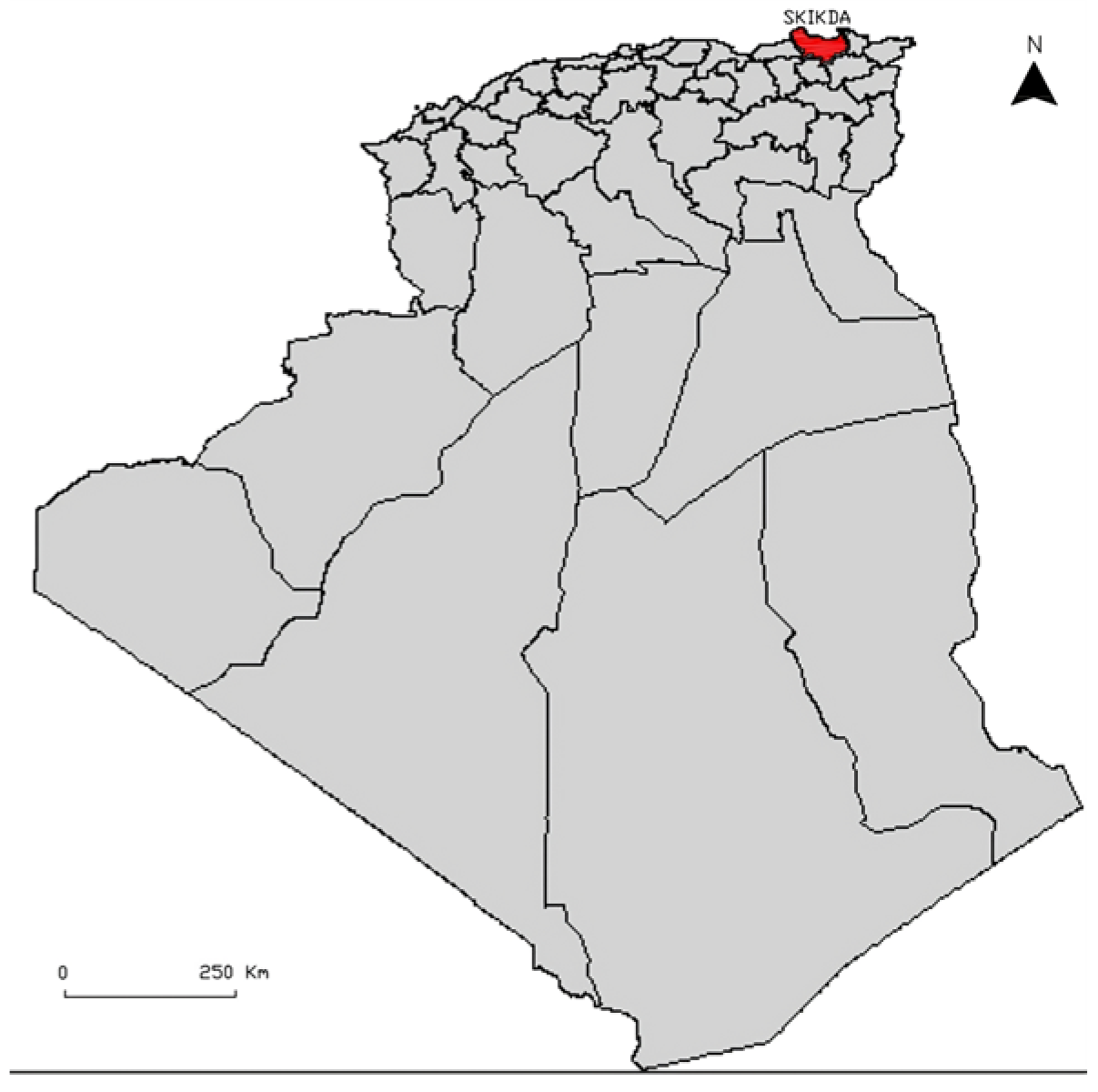
The city of Skikda, located in north-eastern Algeria on the Mediterranean (Figure 1), has always occupied an important place since antiquity. The city has been coveted by many civilisations, testifying to its rich history.
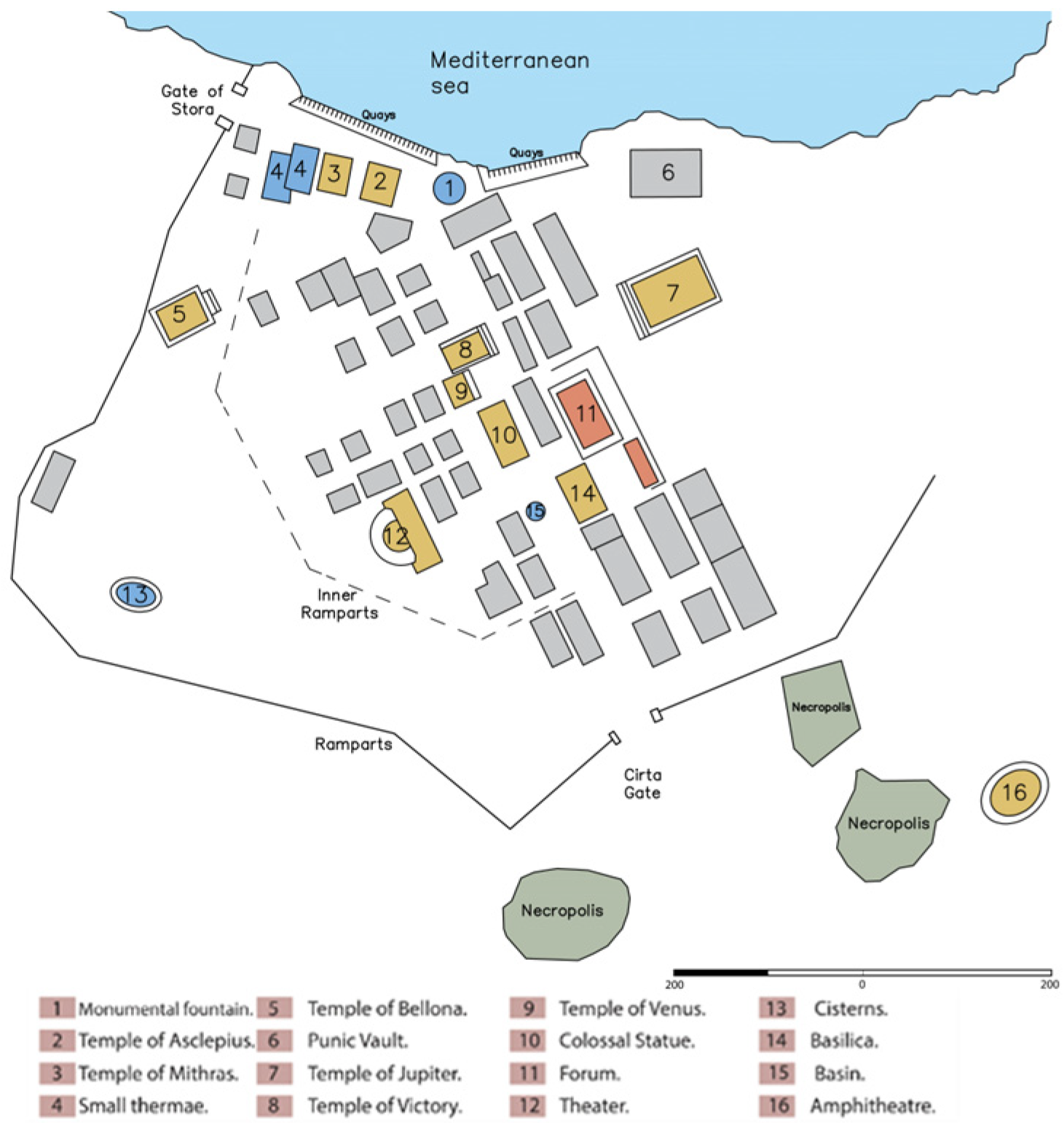
In ancient times, a prosperous Phoenician trading post was established in the Gulf of Numidia. Later, with the Roman conquest, the city of Rusicade (“Rusicade” was the name given to the city of Skikda during the Roman era.) (Figure 2) came into being. This era had a profound effect on the history of Skikda, with the construction of numerous monuments testifying to its great prosperity.
After the fall of the Roman Empire, the city was destroyed and lay in ruins until the arrival of French troops on 9 April 1838. Following the capture of Constantine, capital of eastern Algeria at the time, the French army sought a maritime outlet to Europe.
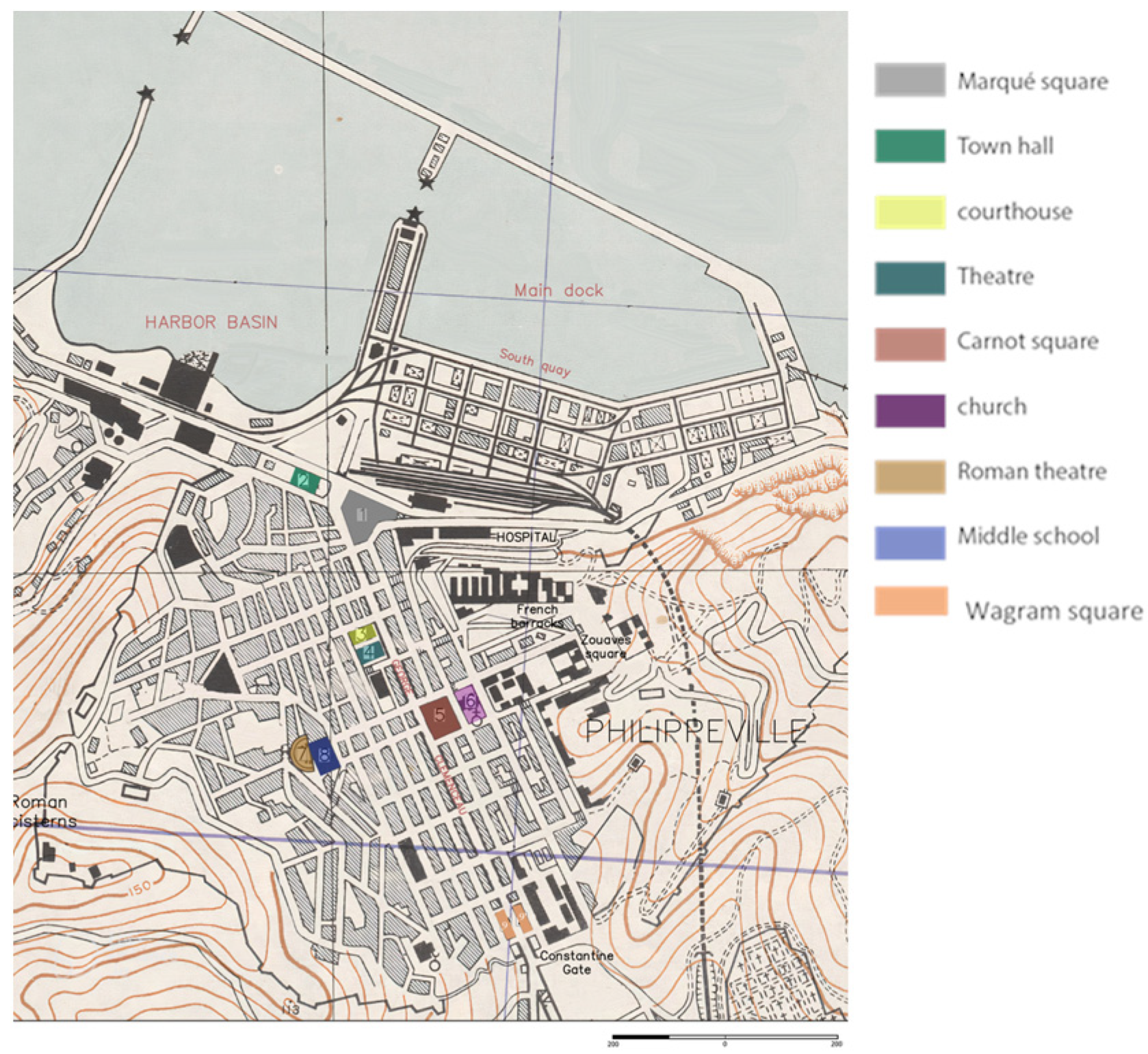
After exploring the ancient port of Stora (the port of Stora was the main port of the Roman city of Rusicade), the main maritime access to Rome during the Roman era, they chose the ruins of Rusicade to found a new city: Philippeville. It was built from scratch along the lines of the ancient Roman city (Figure 3).
During the 132 years of French colonisation, it was one of the country’s most important cities. After Algeria’s independence in 1962, the city changed its name to Skikda.
Rue Georges Clémenceau was chosen as the main study area. This street was created during the French colonial era, following the route of the ancient Roman cardo. The various phases in the street’s urban development are representative of that of the city of Skikda, marked by two main periods.
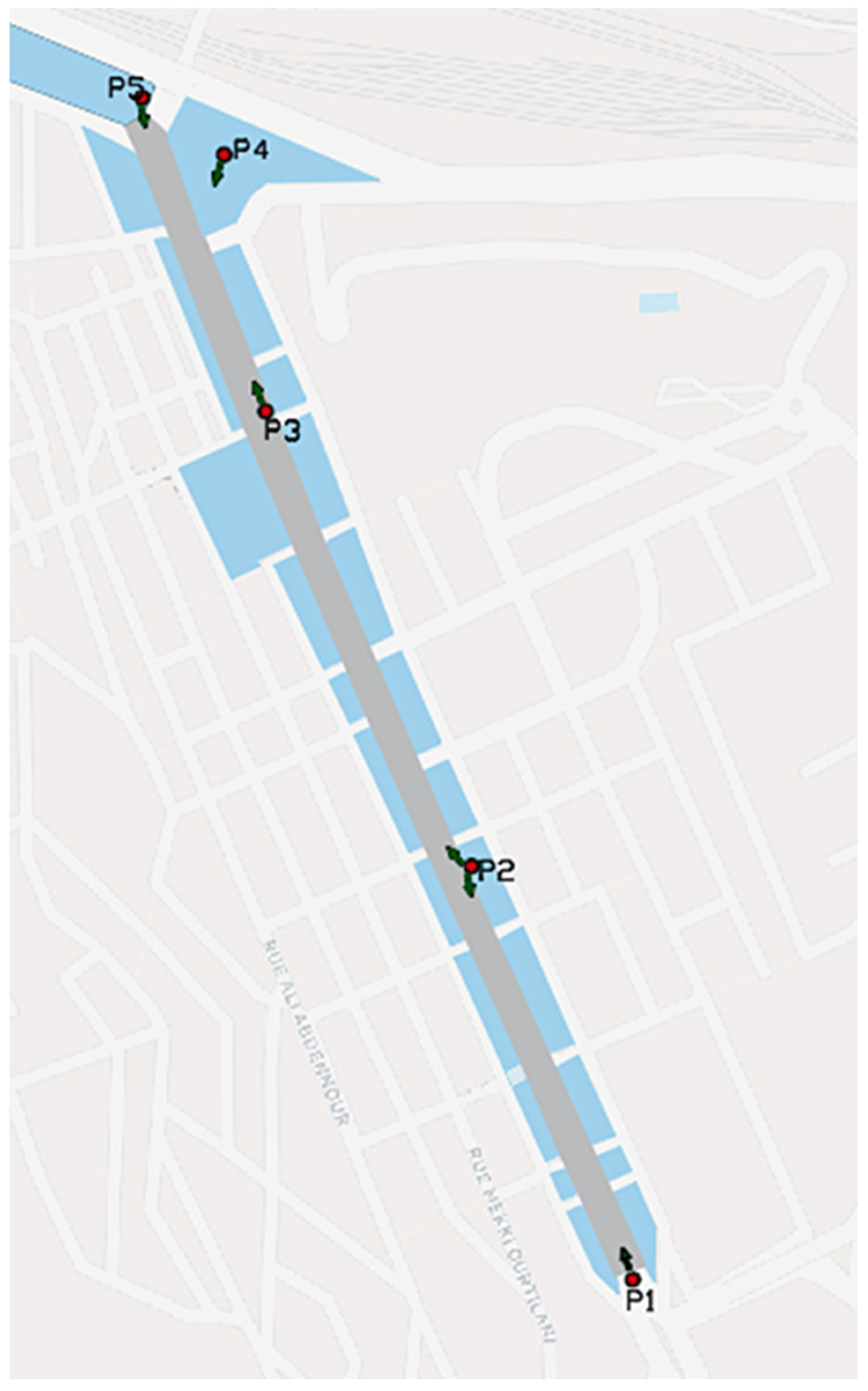
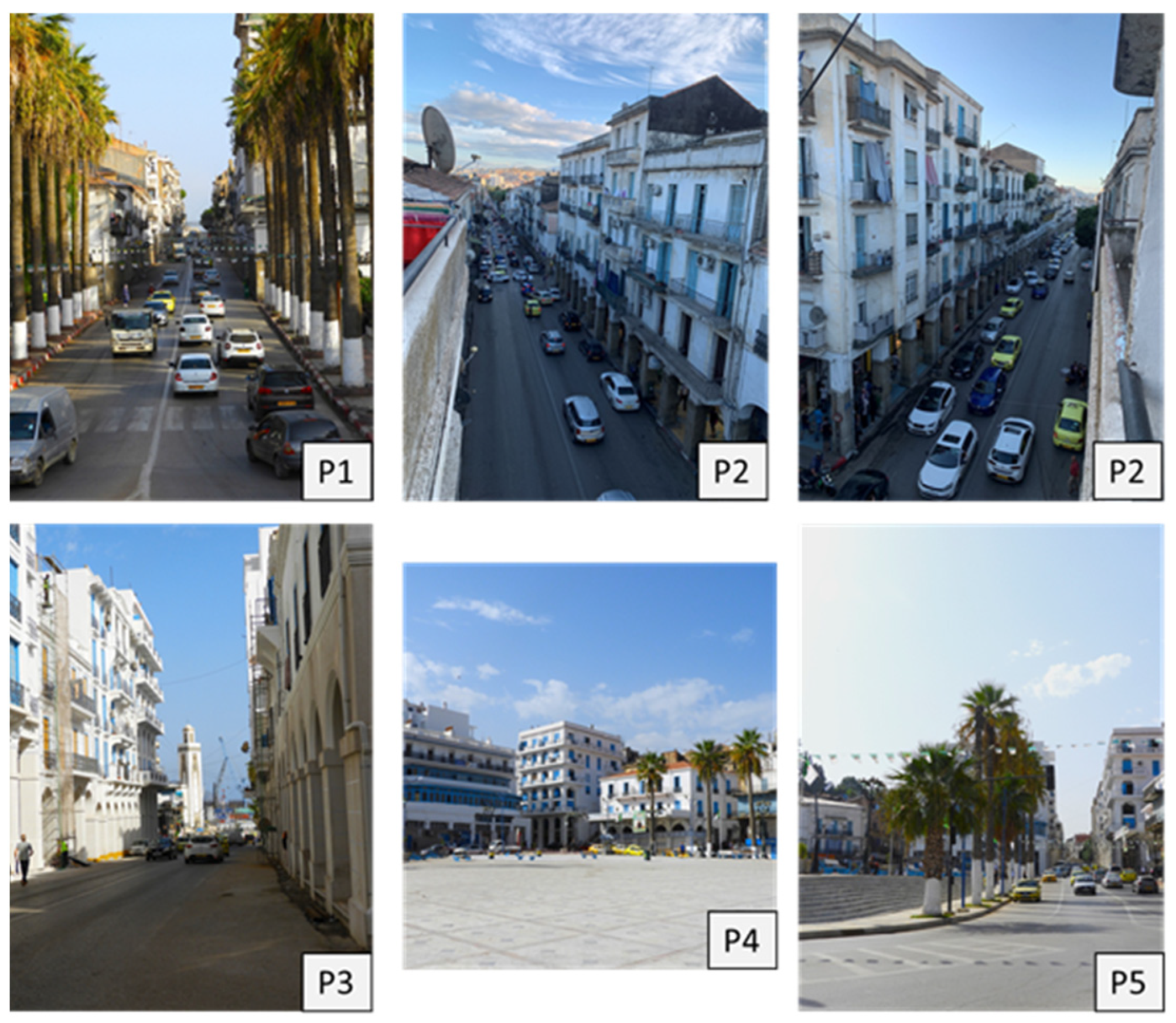
To orient the reader and to complete the description of the study site, it is necessary to briefly present the current state of the street. Now known as Didouche Mourad Street, it remains one of the major axes of the contemporary urban fabric. Its principal layout, inherited from the colonial period, has been preserved, although the uses and functions of the adjoining spaces have evolved with commercial densification and the development of urban facilities. The contemporary maps (Figure 4) and photographs (Figure 5) presented below serve only to contextualise the street within its present-day environment; they do not constitute analytical material in this study. The analysis developed in this article focuses on the French colonial period (1838–1962), which is considered a foundational phase in the spatial and sensory formation of the street. This approach aims to establish a historical sensory reference framework, intended to be confronted, in a later stage of the research, with post-colonial and contemporary ambiences.
Before 1840, the Rue George Clémenceau was mainly a military installation area, characterised by the presence of simple barracks for soldiers [29]. Between 1840 and 1929, the first concrete phase of the street’s construction began. At that time, it was located in a ravine framed by two hills that formed the heart of the old city. This ravine corresponded to the layout of the Roman city’s cardo, bearing witness to the site’s historical heritage [29]. The city’s first construction plan was drawn up in October 1838, marking the start of a structured urban transformation. It faithfully followed the grid layout of the Roman city [30].
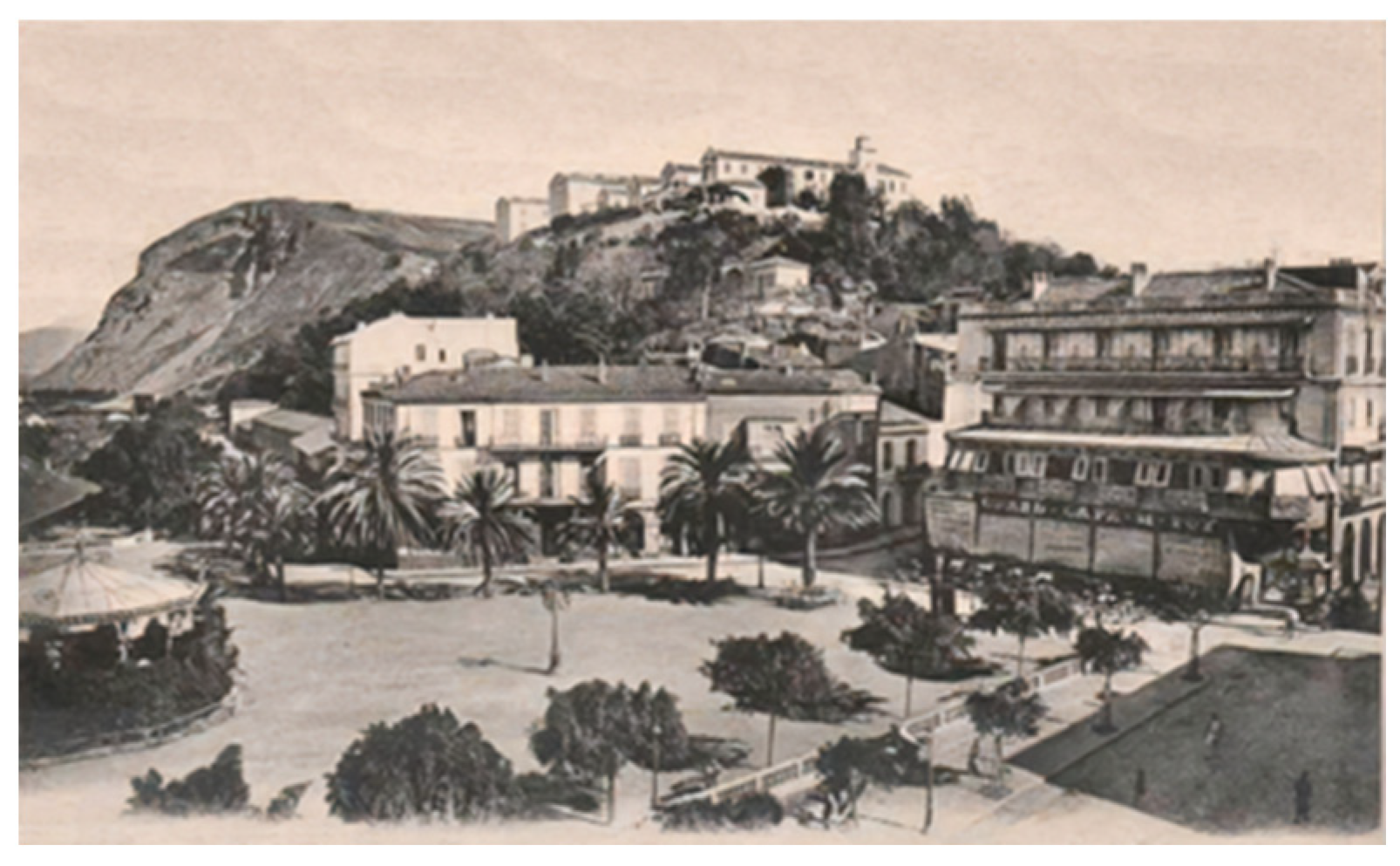
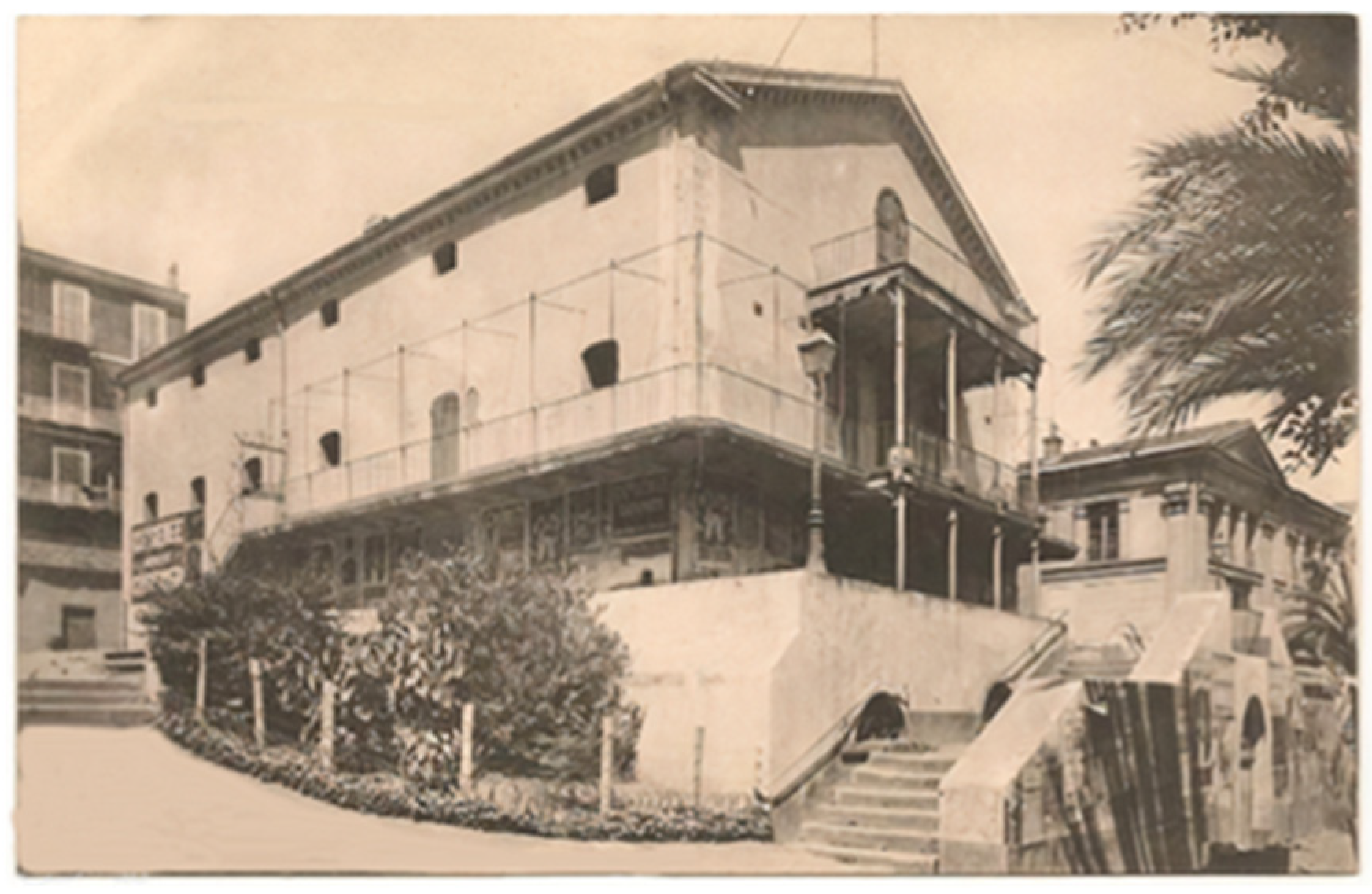
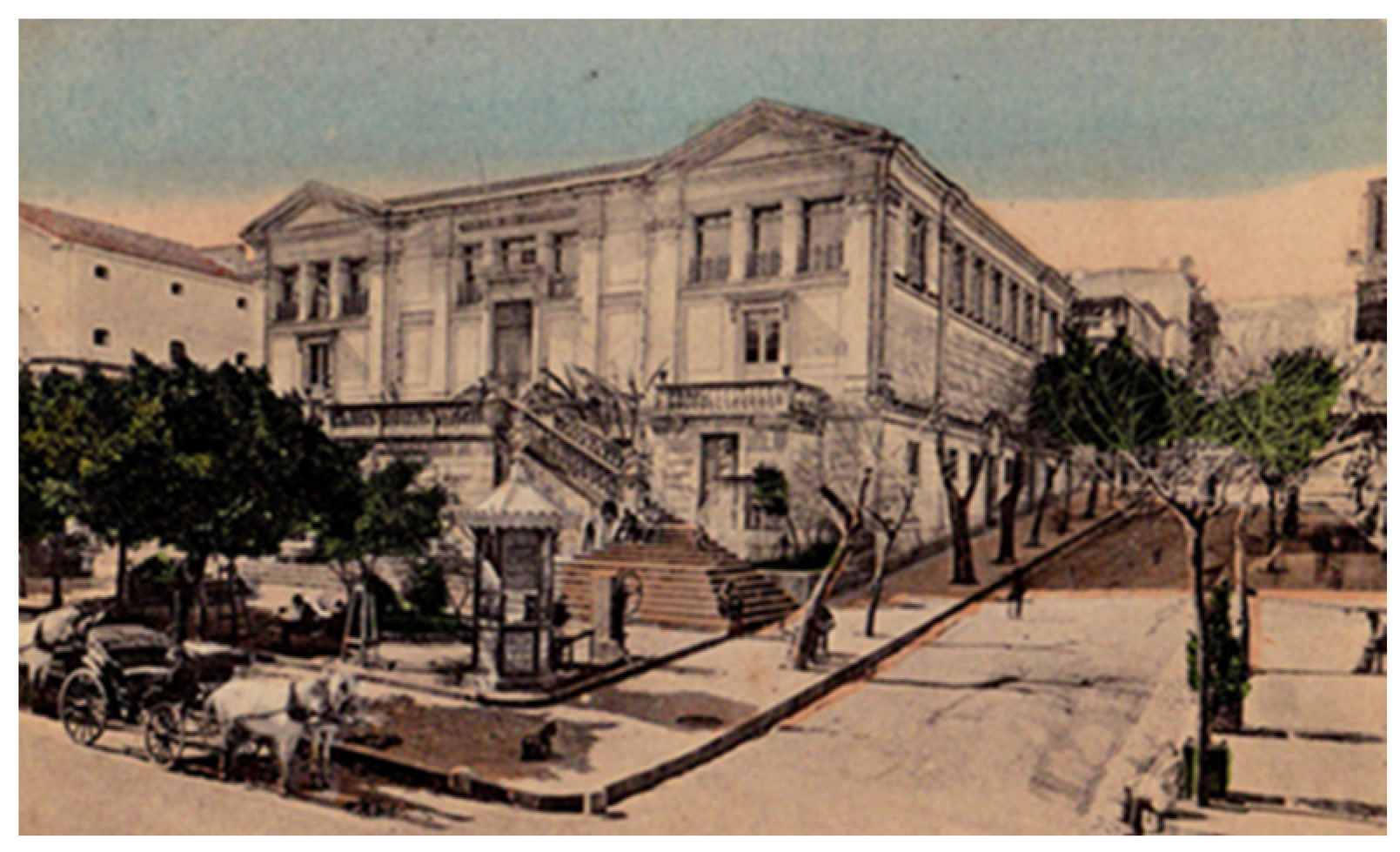
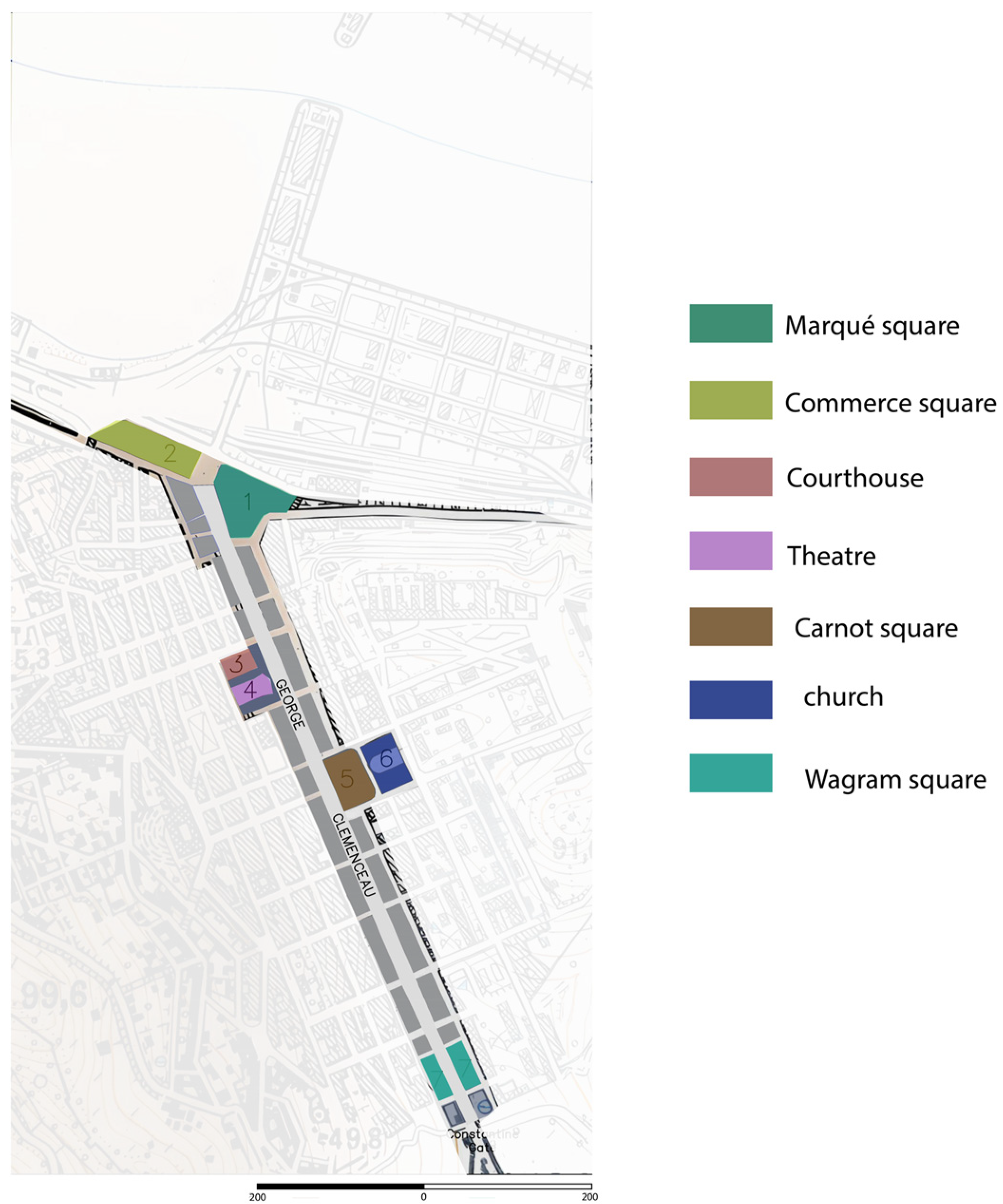
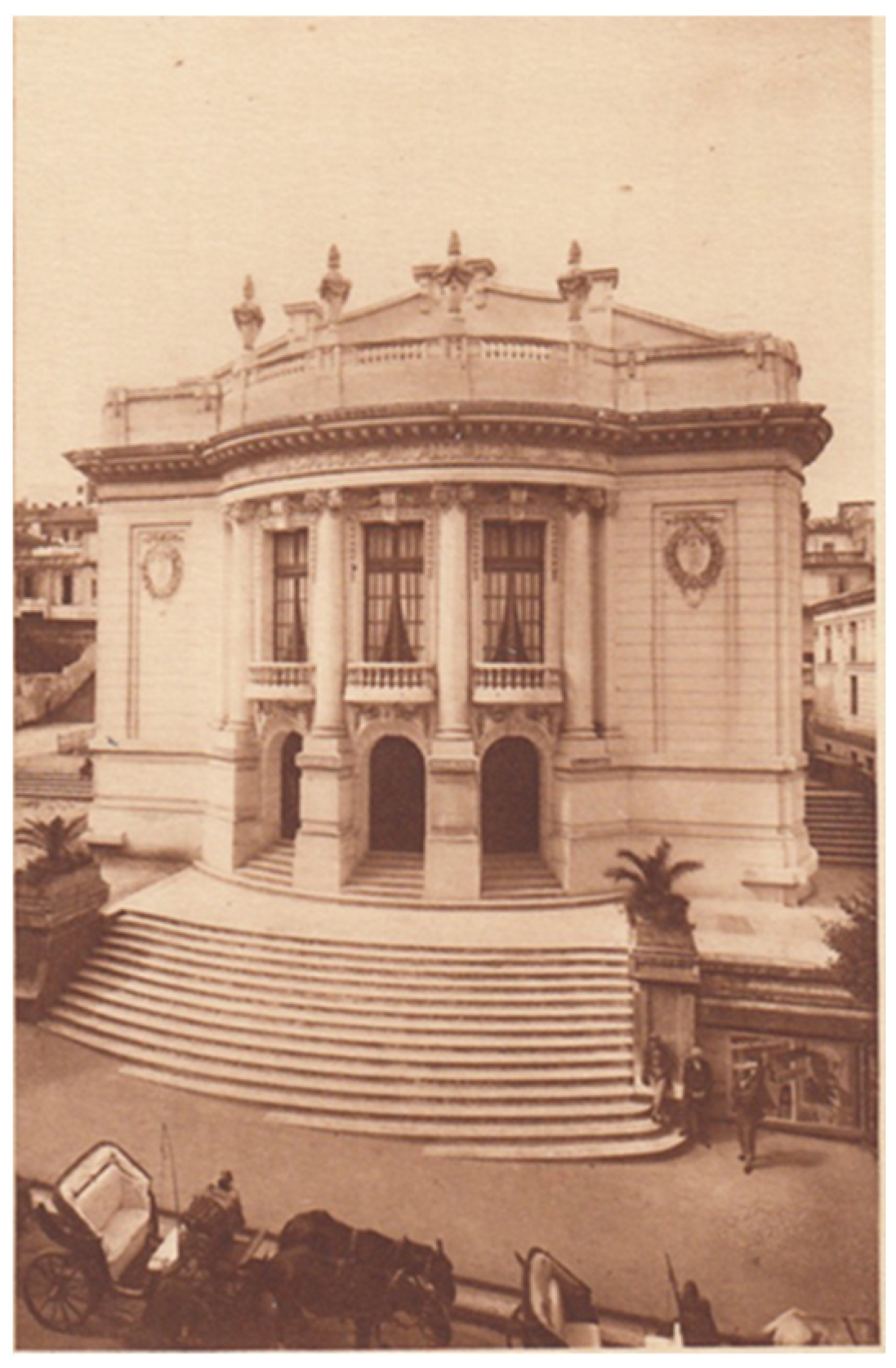
In 1839, work began to fill in the central ravine, which was transformed into a main road called the ‘Route Royale’. This road was later renamed ‘Rue Georges Clémenceau’ [31]. At the northern end of this street, a flat area was laid out to create a square known as ‘Place de la Marine’, however, this was not marked out until early 1842 [31,32]. During this period, the layout of the street was finalised, extending from the Porte de Constantine to the Place de la Marine. The street was paved, making it the only road accessible to vehicles in this part of the city [31,33]. The street continued to densify, with the construction of mainly residential buildings with arcades on the ground floor housing various shops. Numerous public buildings were erected, including the theatre built in 1845 (Figure 6) on the square known as “Place Corneille” [29], and the courthouse built in 1880 (Figure 7) next to the theatre on the same square [31].
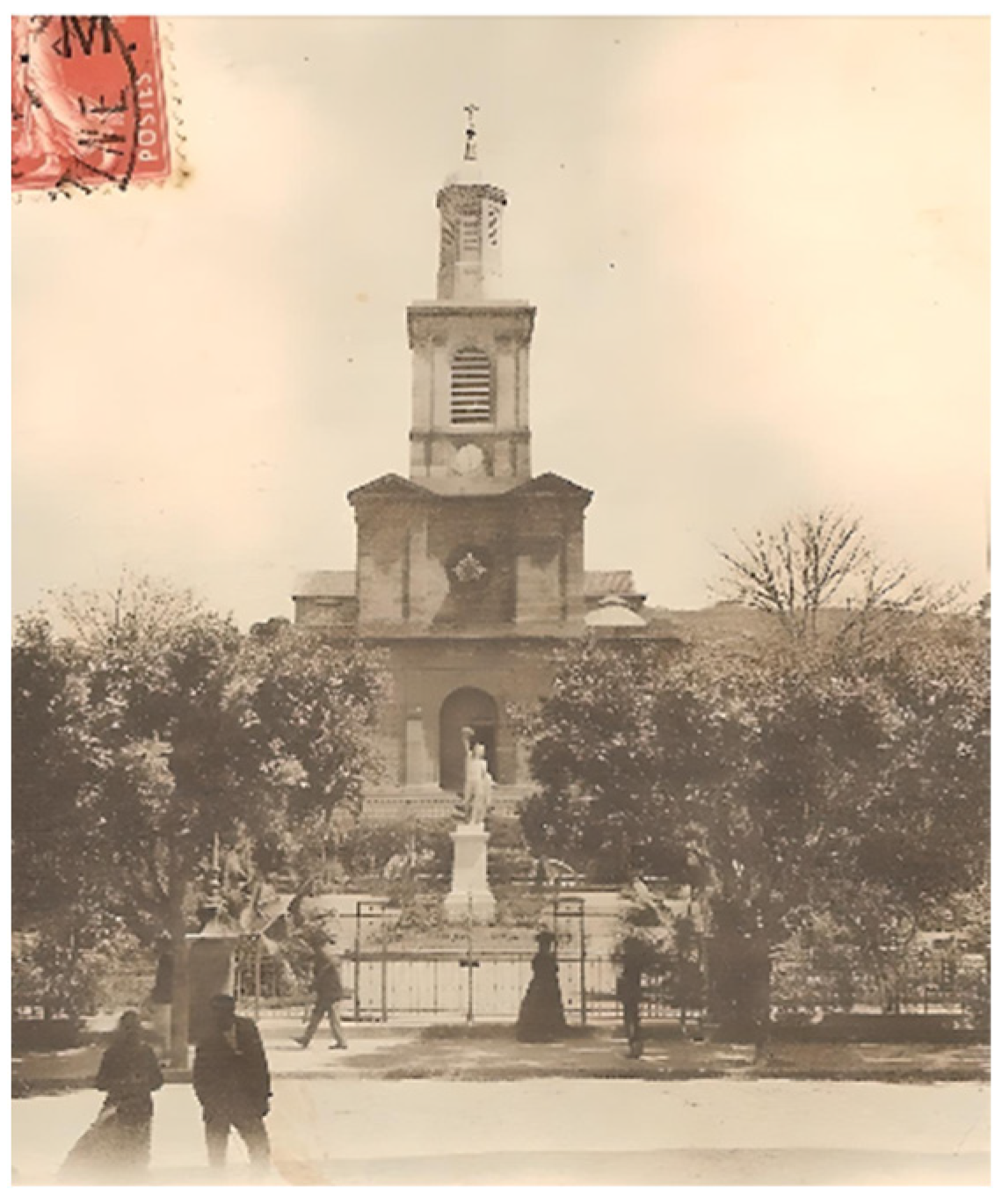
Rue George Clémenceau also saw the construction of a church, completed in 1848 (Figure 8). This church was built on the upper part of the ‘Square Carnot’, located on the eastern side of the street. This area is commonly referred to as the “church square” (currently Place de l’Indépendance, commonly referred to as “Place de l’Église”) [29,31,33].
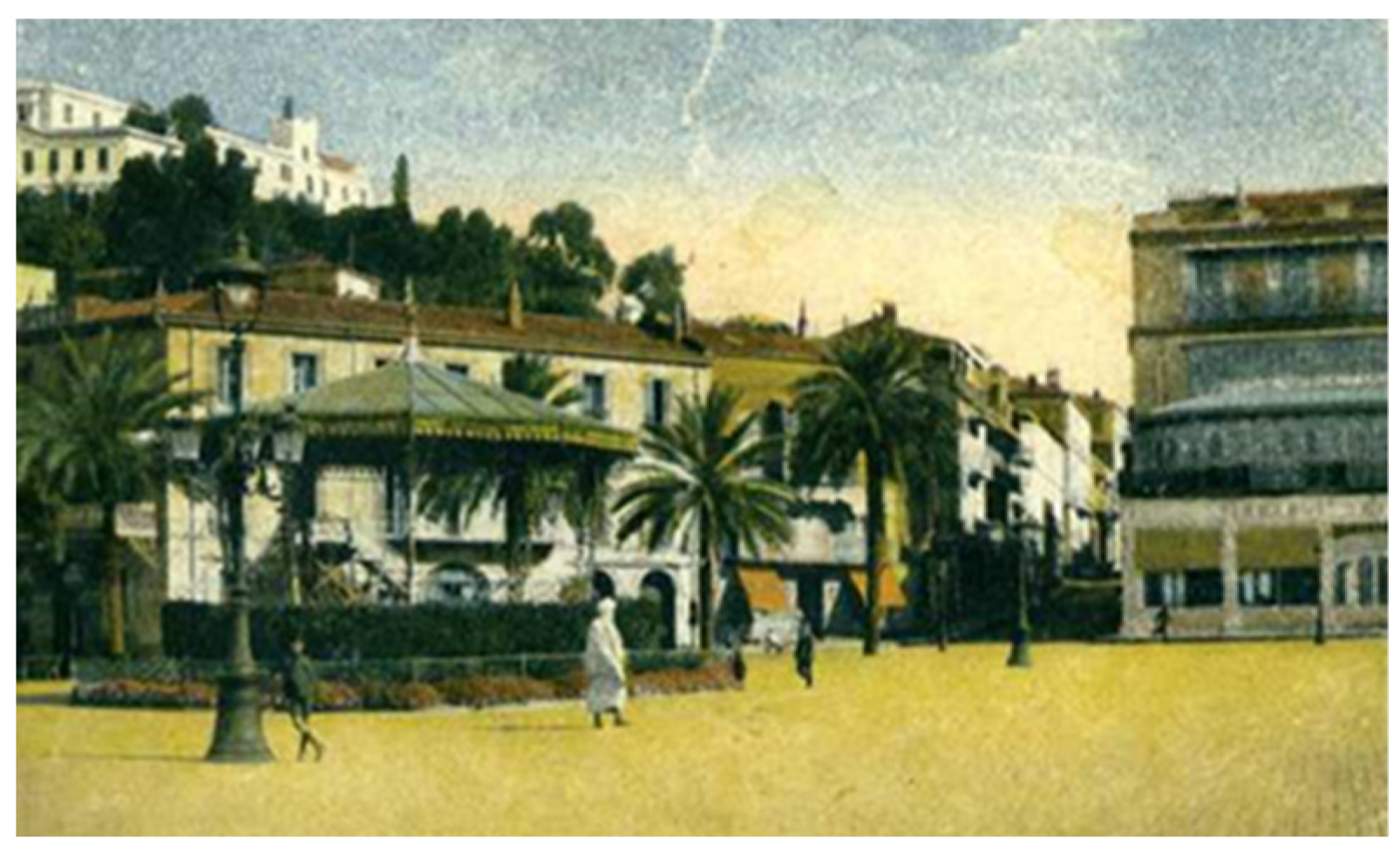
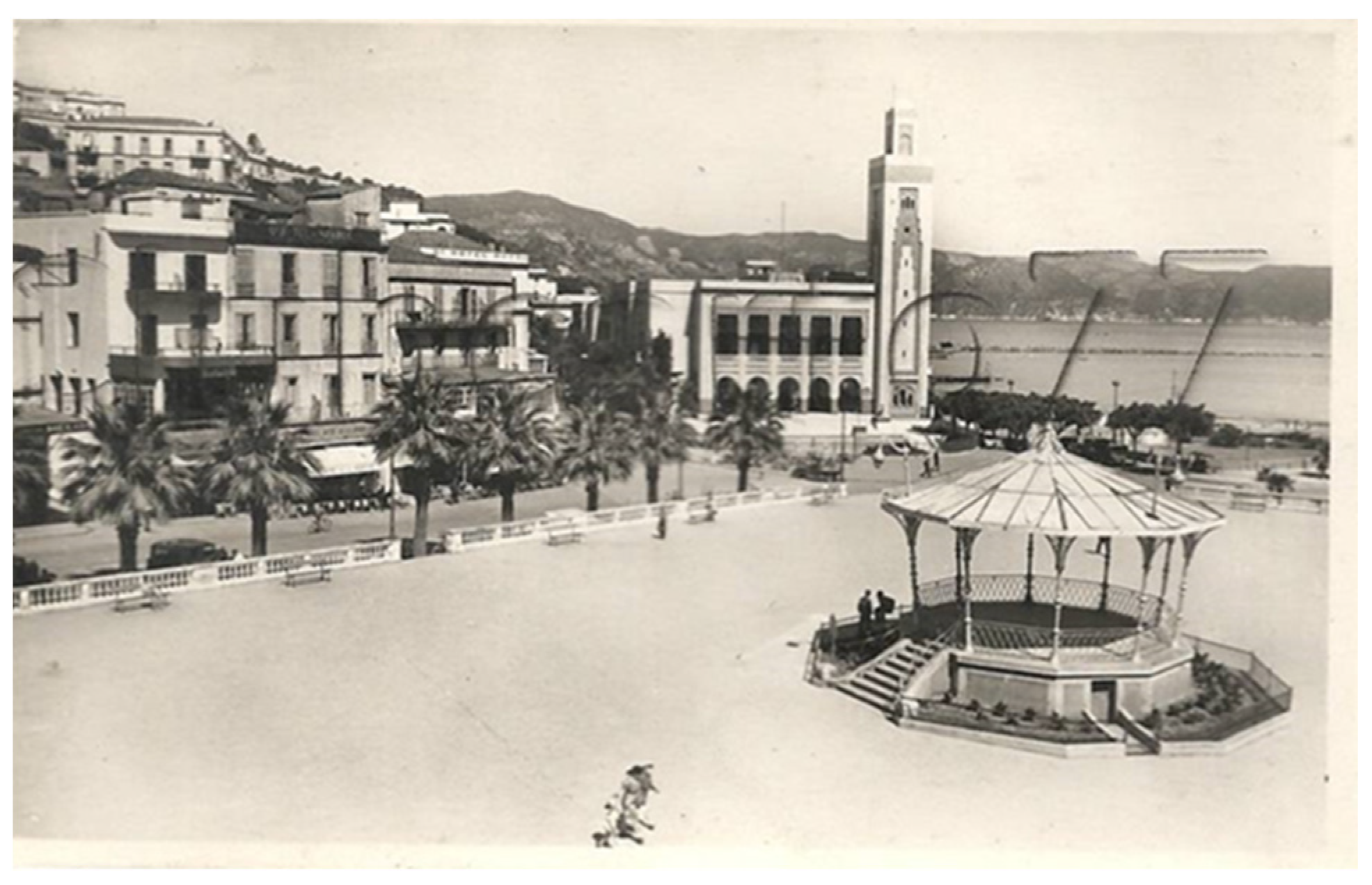
In 1858, the Place de la Marine was embellished as the end of the street with its panoramic view of the sea [29] and on 5 May 1860, it was renamed the “Marqué Square” [33]. (Currently Place du 1er Novembre, commonly referred to as “La Place”.) (In order to maintain the temporal consistency of the study, place names are referred to using their denominations during the French colonial period in Algeria. When relevant, current place names and commonly used contemporary denominations are indicated at their first occurrence to facilitate spatial identification and diachronic reading.) From 1865, a bandstand adorned the square (Figure 9 and Figure 10).
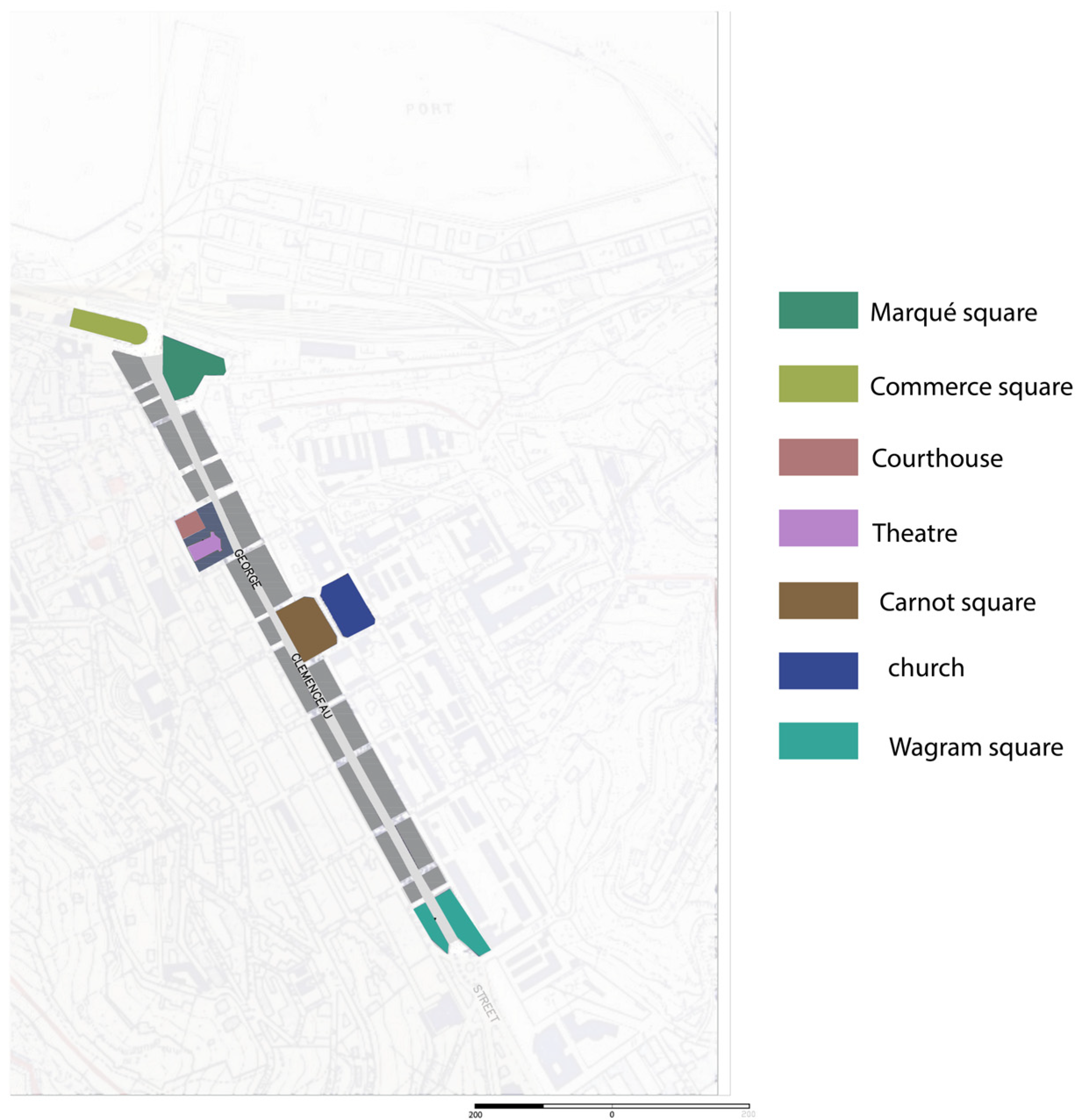
From then on, the street was defined entirely by its two urban façades, which gave it its architectural character, and by its public squares, which stood out as structuring spatial components (Figure 11).
The second period was defined between 1929 and 1962, when Rue Georges Clémenceau entered a phase of embellishment marked by significant transformations. With the arrival of Paul Cuttoli as mayor in 1929, Philippeville underwent a remarkable boom in terms of urban planning and aesthetics, which also benefited this emblematic street. Although already densely built-up at the time, no major new buildings were erected here. However, the existing buildings were modernised and embellished.
One of the flagship projects of this period was the reconstruction of the municipal theatre. Larger than the old one, the new theatre was designed by architect Charles Montaland in a distinctive Baroque style (Figure 12) and opened in 1930. At the same time, another remarkable building came into being: the city hall, built on the Avenue de la République, opposite the Marqué Square (Figure 13). This building, also designed by Charles Montaland, adopts the neo-Moorish style [31].
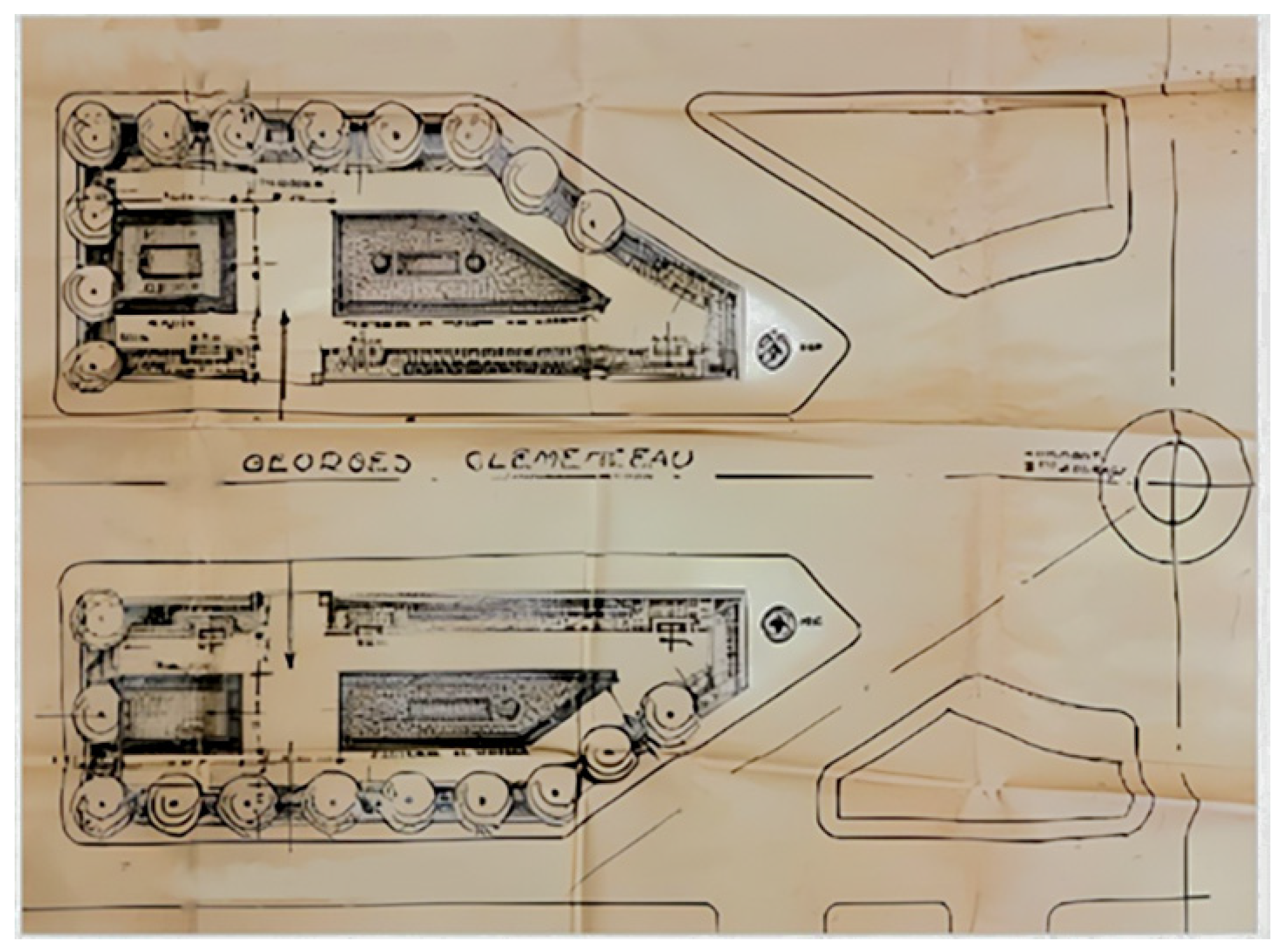
The southern entrance to the city was also developed, marking the end of the street by creating two squares on either side of it, known as ‘Place Wagram’ (currently Place des Martyrs) (Figure 14). These public spaces became popular meeting places for the local population.
Since then, Rue George Clémenceau has become the city’s main thoroughfare, providing both pedestrian and mechanical space essential to urban traffic (Figure 15). It is also the city’s main commercial thoroughfare, bringing together a diversity of commercial activities that reflect its economic and social dynamism.
The street was home to the majority of the city’s banks, ideally located between the port and the church. It was also notable for the richness and diversity of its commercial activities: there were around ten watchmakers, thirteen novelty shops, six confectioners, four chemists, and three pork butchers, as well as all the fishing tackle shops and all the shoe shops. The street was alive with cafés: five European establishments occupied the ‘Marqué Square’, while around fifteen others lined the main thoroughfare. Hotels and restaurants were also concentrated in this square, reinforcing the central role of this area.
On the Place Wagram side, there was a high concentration of so-called “anomalous” shops, run by locals as well as Europeans, particularly hardware stores [32].

3.2. Content Analysis

The study of the urban evolution of the street during the colonial era reveals two significant temporal phases in its construction and evolution. The analytical phase will be responsible for identifying the urban sensory ambiences specific to the street and their generators, and then analysing how these ambiences have evolved over these two major periods. To do this, the content analysis will be based on textual sources that refer to Rue George Clémenceau during the colonial era.
This method makes it possible to access the perceptions and lived experiences of past users through their written testimonies in historical sources, thereby enabling the restitution of former ambiances. By applying content analysis to these textual materials, this approach reveals the sensitive history of ambiances, as it directly interrogates the lived experience, sensory perceptions, and practices of users in a bygone era. It therefore allows ambiances to be apprehended as they were lived, felt, and narrated in the past, offering a valuable complement to conventional heritage analysis tools, which largely focus on material and morphological observation [2].
Textual analysis provides access to the sensitive dimension of places and enables the extraction of the perceptual experiences associated with them. It makes it possible to reconstruct various facets of ambiance through historical writings. These texts thus act as mediators for informing, interpreting, and conveying past ambiances, while revealing their heritage value.
The content analysis method has been used in the field of architecture and urban planning as a research method mainly to reveal the previous ambiences of architectural and/or urban spaces [2,23,26,34]. The method must be objective, meaning that by analysing the same texts, the results should be the same; systematic, meaning that the analysis should be carried out on all the content, without omission or elimination; and quantitative, meaning that the results obtained can be quantified and measured [35]. Among the various types of content analysis, categorical thematic analysis is the most appropriate for our research; this involves examining themes, terms or concepts in order to identify nuclei of meaning in relation to the research objectives, within the corpus analysed [36].
In order to obtain reliable results, the analysis must go through several phases:
Pre-analysis: this is an ‘organisational’ phase [36], and consists of choosing the corpus of text to be studied and defining the research objectives. For this article, the choice of the corpus of texts to be analysed was established after lengthy research work, resulting in a total of eighteen texts, including fifteen travel accounts, a novel, a newspaper and a book on the history of Skikda during the colonial period (Table A1).
Definition of information units: the aim of this phase is to define the text segments to be categorised, containing information that meets the research objectives [35,36]
In this article, the defined information units referred to one or more ambiences.
Categorisation: This step consists of establishing categories according to which the information units drawn from the analysed texts will be grouped [35].
The searched categories were mainly the spatial components of the street most significant in terms of ambient richness; this richness was revealed through the diversity of ambience and their recurrences in the texts.
In order to analyse the collected data, an analysis grid (Table 1) has been developed to link the spatial components, where information units will be categorised, with the thematic categories including the sensory channels mobilised (visual, sound, olfactory, gustatory, thermal, and tactile), the perceived sensory ambiences and their generators. These thematic categories have been defined on the basis of the literature on ambiences, taking into account the problem statement, the hypotheses and the research objectives.
The categorisation was carried out according to the two temporal phases previously defined by the study of urban development of (1840–1929) and (1929–1962). In each period, the textual information units were categorised. Table 1 and Table 2 provide illustrative examples of the classification process applied to the first and second phases, respectively, in order to demonstrate the methodological continuity of the analytical framework.
Coding and quantification: this stage consists of organising and structuring the categorised data, so that it can be accurately described [36].
In this phase, NVivo software was used as a tool for analysing and interpreting the qualitative data. NVivo is widely used by researchers in the field of architecture and urban planning, particularly for processing qualitative data [10,39,40,41].
The NVivo tool was used to store and code the data, as well as to quantify the recurrences of the ambiences identified and their generators, in accordance with the analysis grid developed. However, it should be pointed out that the researcher is the main analyst who interprets and codes the information, not the software.
The first stage consisted of open coding, allowing the sensory stimuli to be extracted as they were mentioned in the texts (Table 1).
In the second step, in order to calculate the recurrences of stimuli, we proceeded to a grouping of stimuli into semantic themes, which allowed us to determine thematic groupings of stimuli, defined from the identified stimuli, according to their nature, and the meanings they carry (Table 3).
Using NVivo software, the recurrences of each type of sensory ambience were quantified for each spatial component. NVivo also enabled us to determine the recurrences of thematic groupings of stimuli for each type of ambience.
The graphic representation of the recurrences of the ambiences and their thematic groupings of stimuli was done using column graphs generated automatically by NVivo. This visualisation will allow a comparative reading of the ambiences and their generators between the different spatial components.

4. Results

4.1. First Temporal Phase 1840–1929

In the first temporal phase, the analysis identified three spatial components: Rue George Clémenceau, Marqué Square and the Church Square.

4.1.1. Rue George Clémenceau

Perceived ambiences:
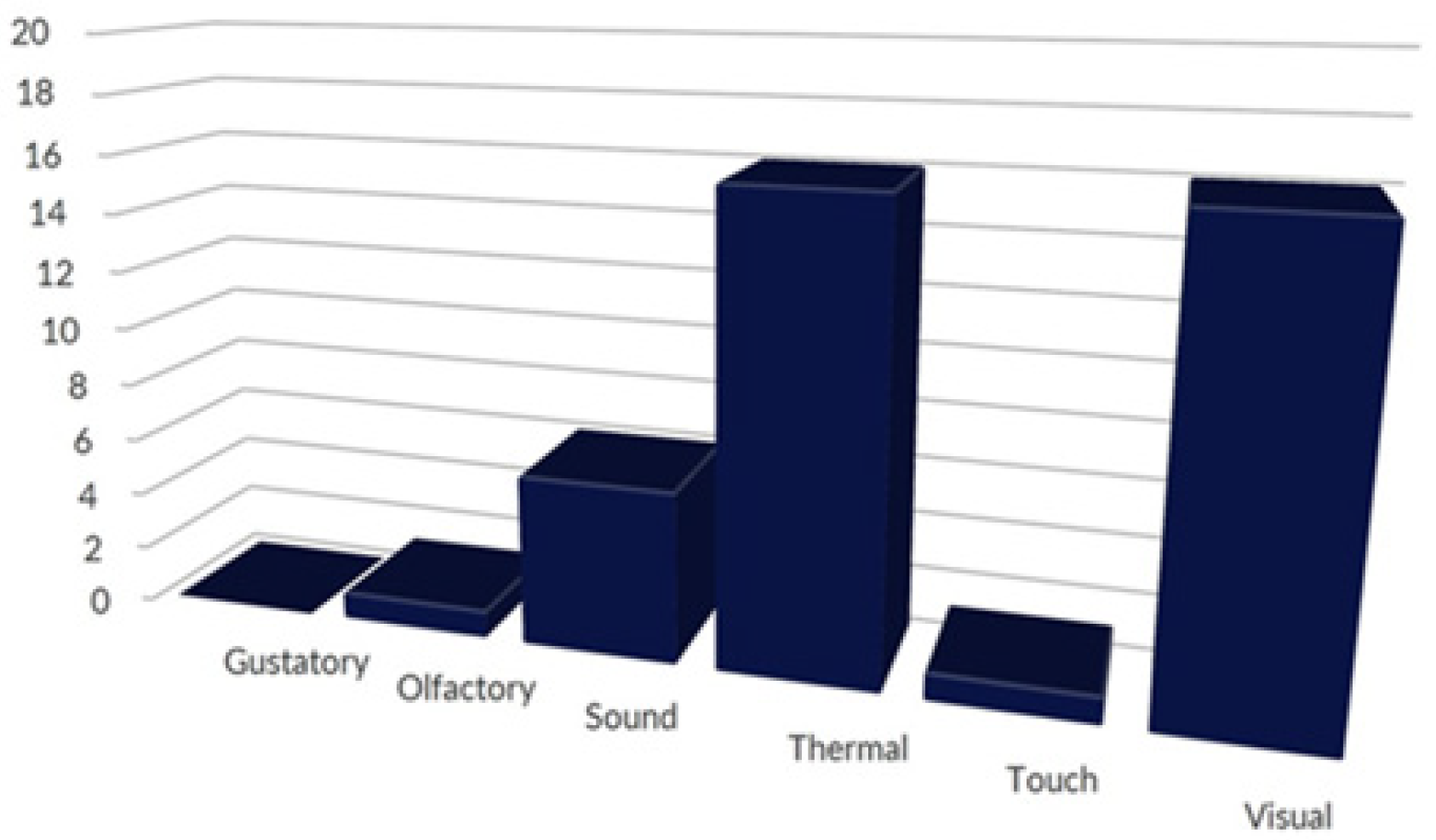
Figure 16 shows that visual and thermal ambiences predominate, followed by sound ambiences and finally tactile and olfactory ambiences.
Ambience Generators:
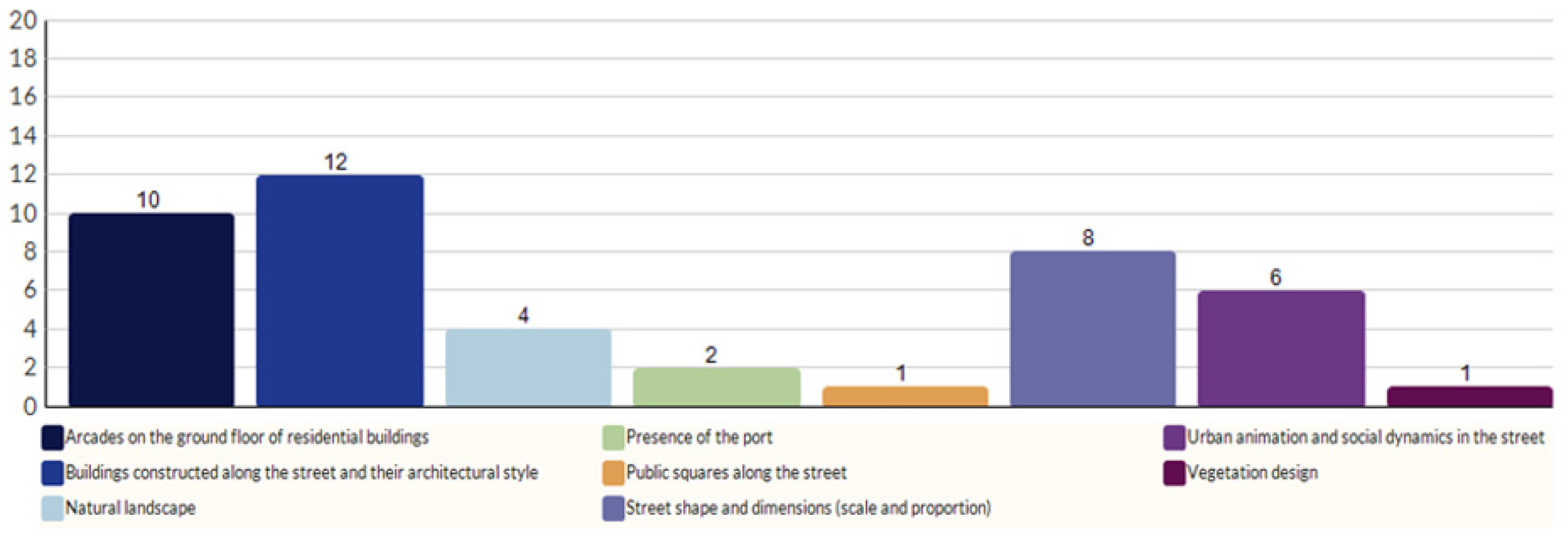
Visual ambiences (Figure 17) are primarily generated by the architectural style of the buildings and by the presence of arcades as key architectural elements. These features underline the importance of spatial configuration in the perception of ambiences. Urban life and social dynamics further attest to the role of human interactions and everyday animation in the construction of the street’s sensory identity.
By contrast, the natural landscape perceived through the street, the presence of the port, as well as public squares and vegetation, appear as less frequently cited generators of ambience. This suggests that, within this urban context, built elements and social uses prevail over natural or port-related components in shaping visual and sensory ambiences.
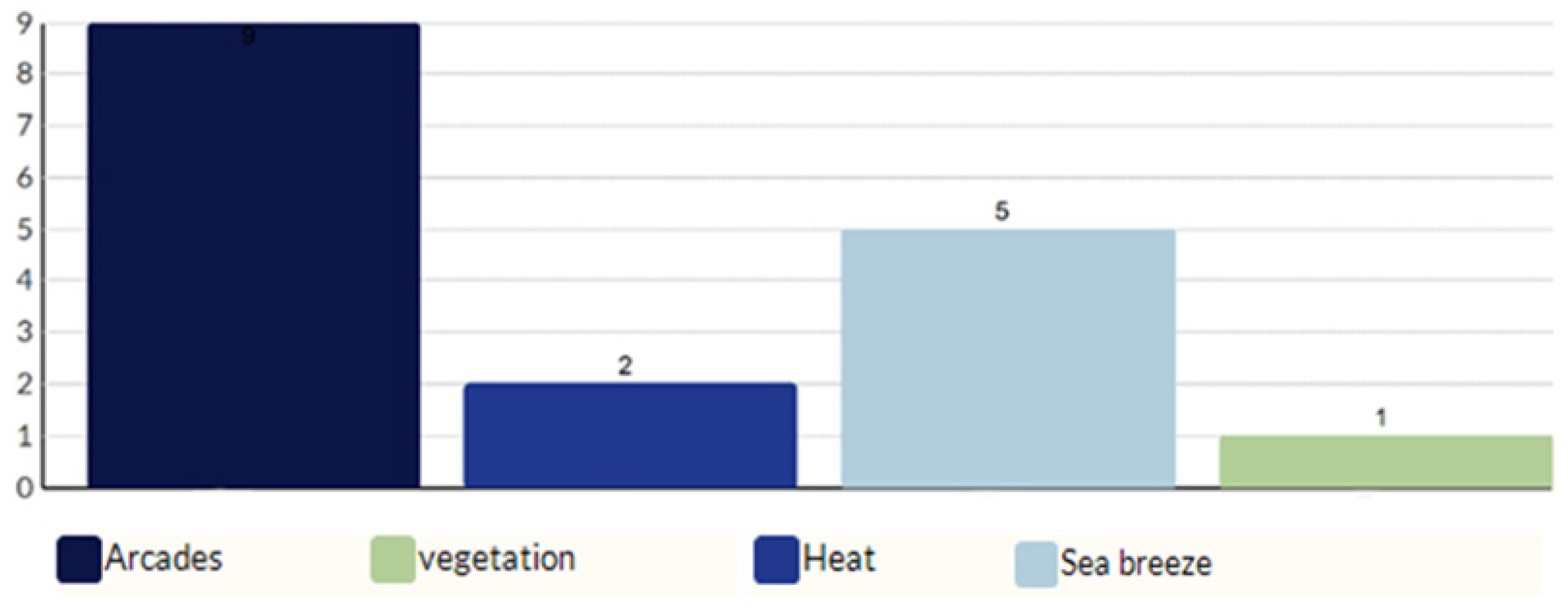
The predominance of arcades can be explained by their ability to provide shaded and protected areas, reducing direct exposure to the sun and thus improving thermal comfort for pedestrians, particularly during hot periods.
On the other hand, there is little vegetation in this urban context, which explains why it is rarely used to create a thermal ambiences. Similarly, heat, as a generator, is cited less frequently, probably because it is perceived more as a constraint than as a desirable quality of the street ambiences (Figure 18).
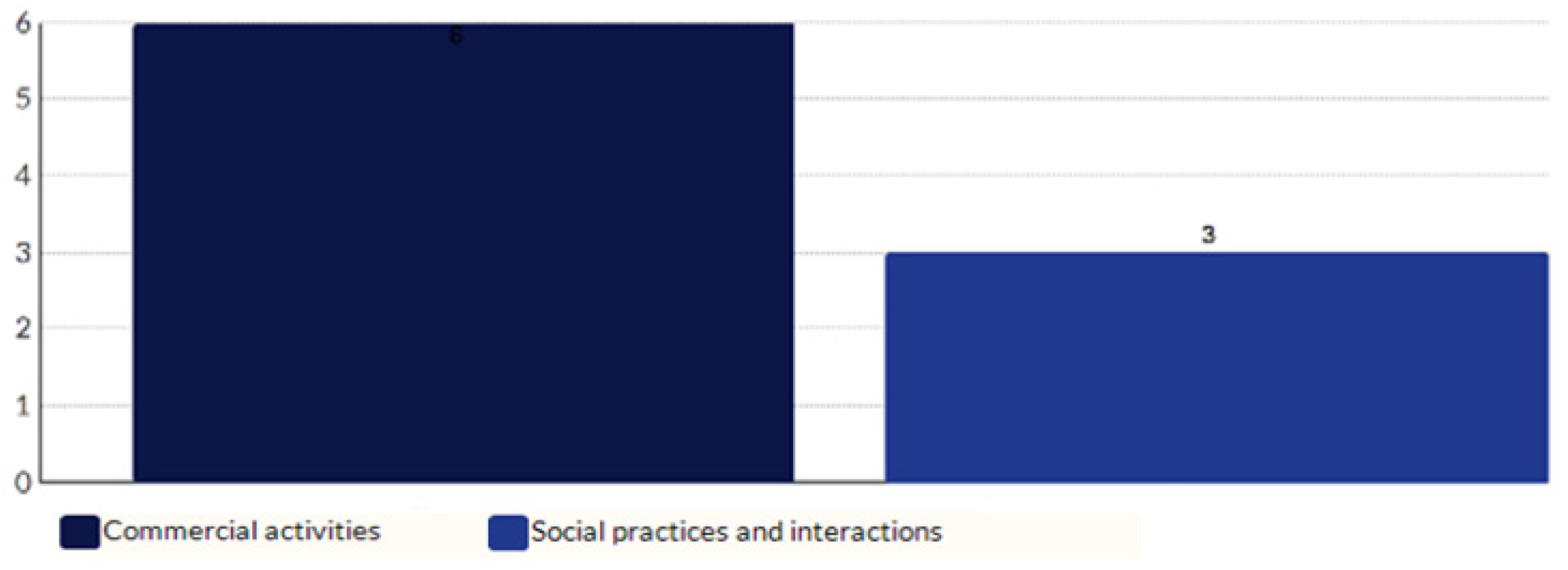
The predominance of commercial activities is due to the commercial nature of the street, which has the largest number of shops in the city.
The revelation of social practices and interactions as generators of street sound ambiences testifies to the sensory as well as the social dimension of urban ambiences (Figure 19).
Table 4 shows that fish shops are the only source of odours found in the street, this specificity can be explained by the local context: Skikda, a coastal city, is known for its restaurants specialising in seafood products, which justifies the presence of fish shops and the predominance of associated odours in the urban space.
Tactile ambiences are predominantly induced by construction materials; this predominance suggests that the nature, texture, and composition of the materials used play a decisive role in shaping the users’ sensory experience.

4.1.2. Marqué Square

Perceived ambiences:
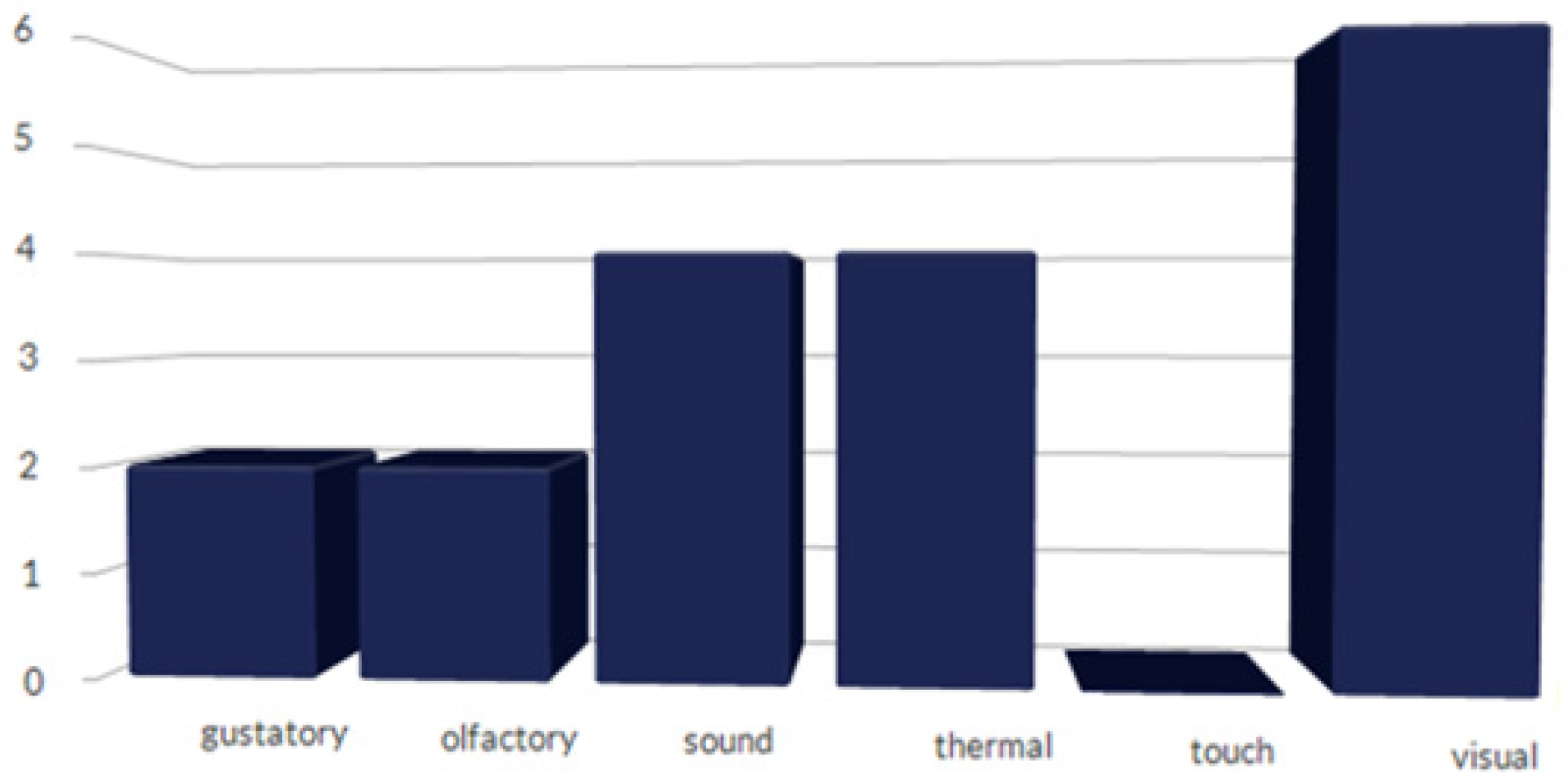
Figure 20 shows that visual ambiences are predominant, followed by thermal and auditory ambiences, and finally olfactory and gustatory ambiences.
Ambience Generators:
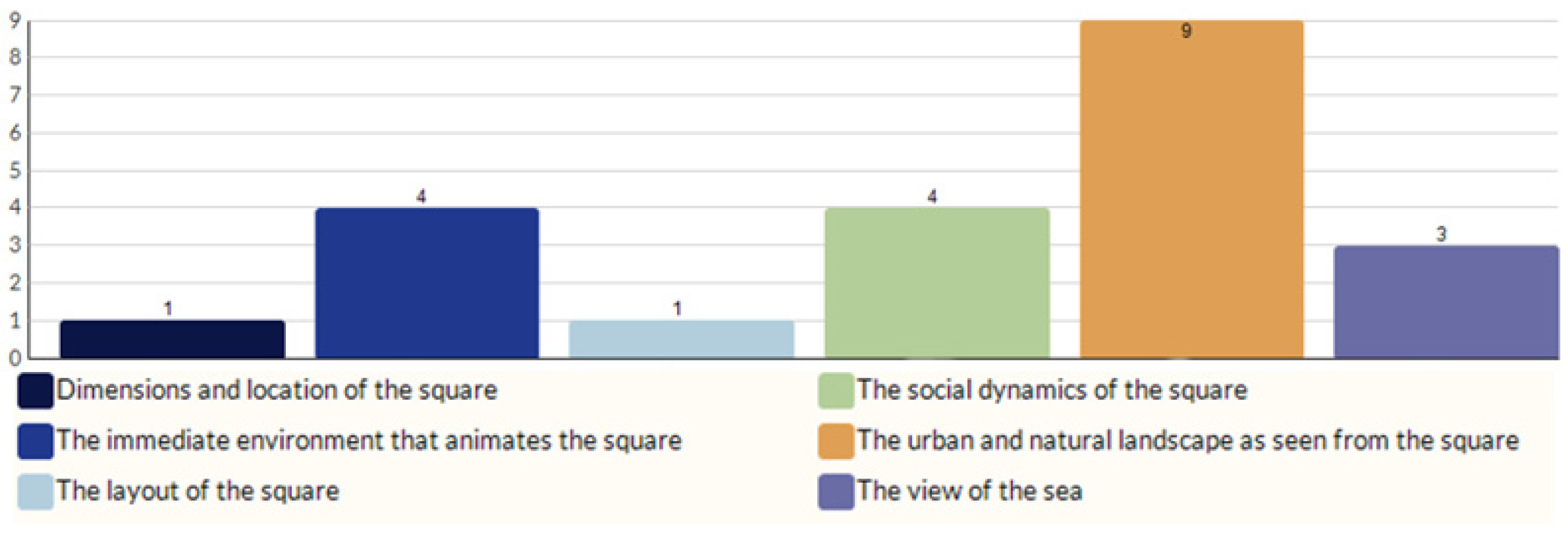
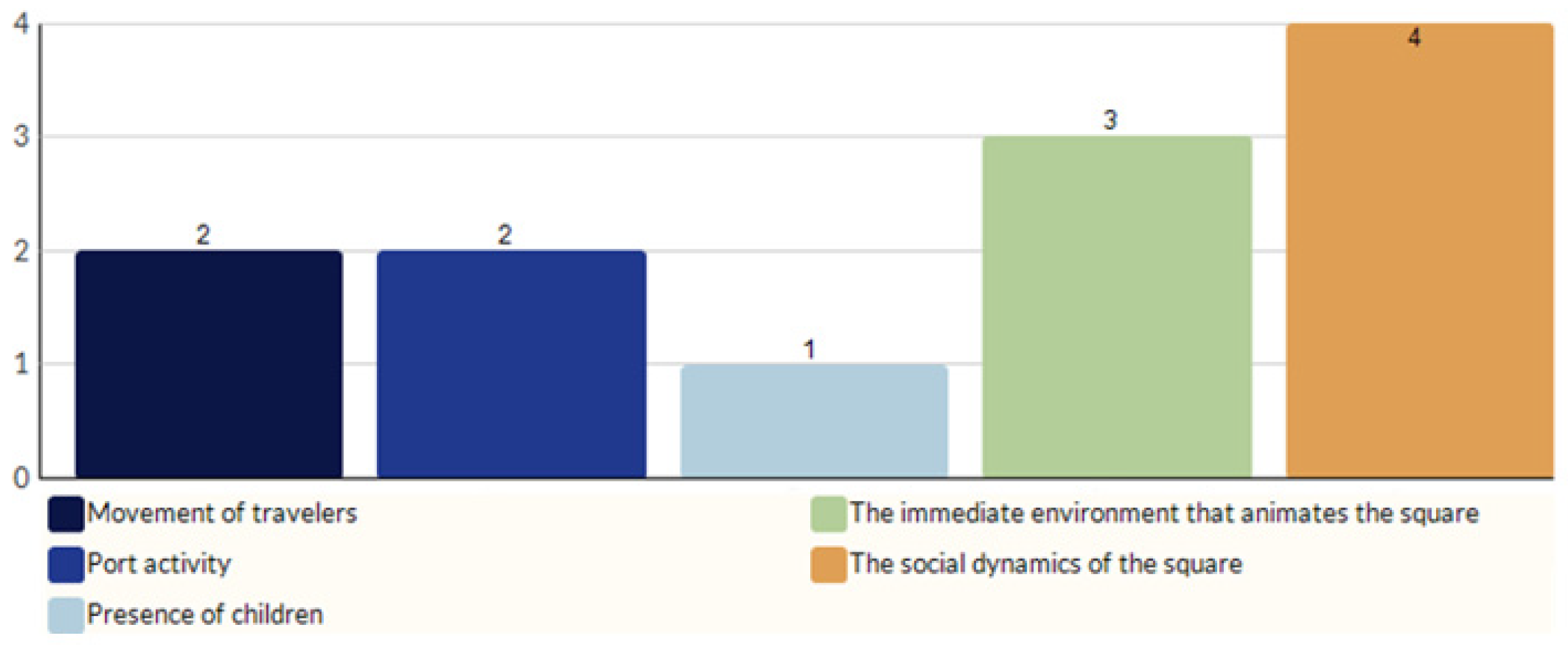
Figure 21 highlights the strategic role of the square in the urban structure, both as a space offering unobstructed visual perspectives on the various components of the city (urban and natural landscape and sea view), and as a place for gathering, strolling and social interaction.
Figure 22 underlines the central role of the square as a space for sociability, where the intensity and diversity of social interactions play an active part in creating characteristic sound ambiences. The square is not only a physical space, but also a catalyst for collective experiences and sonic conviviality.
Table 5 shows that sea breeze is the main generator of thermal ambiences in the square, which can be explained by its location facing the sea. However, the cafeterias and bars lining the square are the main generators of gustatory and olfactory ambiences. This predominance highlights the importance of these establishments in the sensory stimulation of users, in particular through the smells and flavours associated with the consumption of food and drink. These results underline the role of the square as a lively and attractive space, where the presence of sensory stimuli linked to conviviality and relaxation contributes to its attractiveness and identity, and to the quality of the urban experience.

4.1.3. Church Square

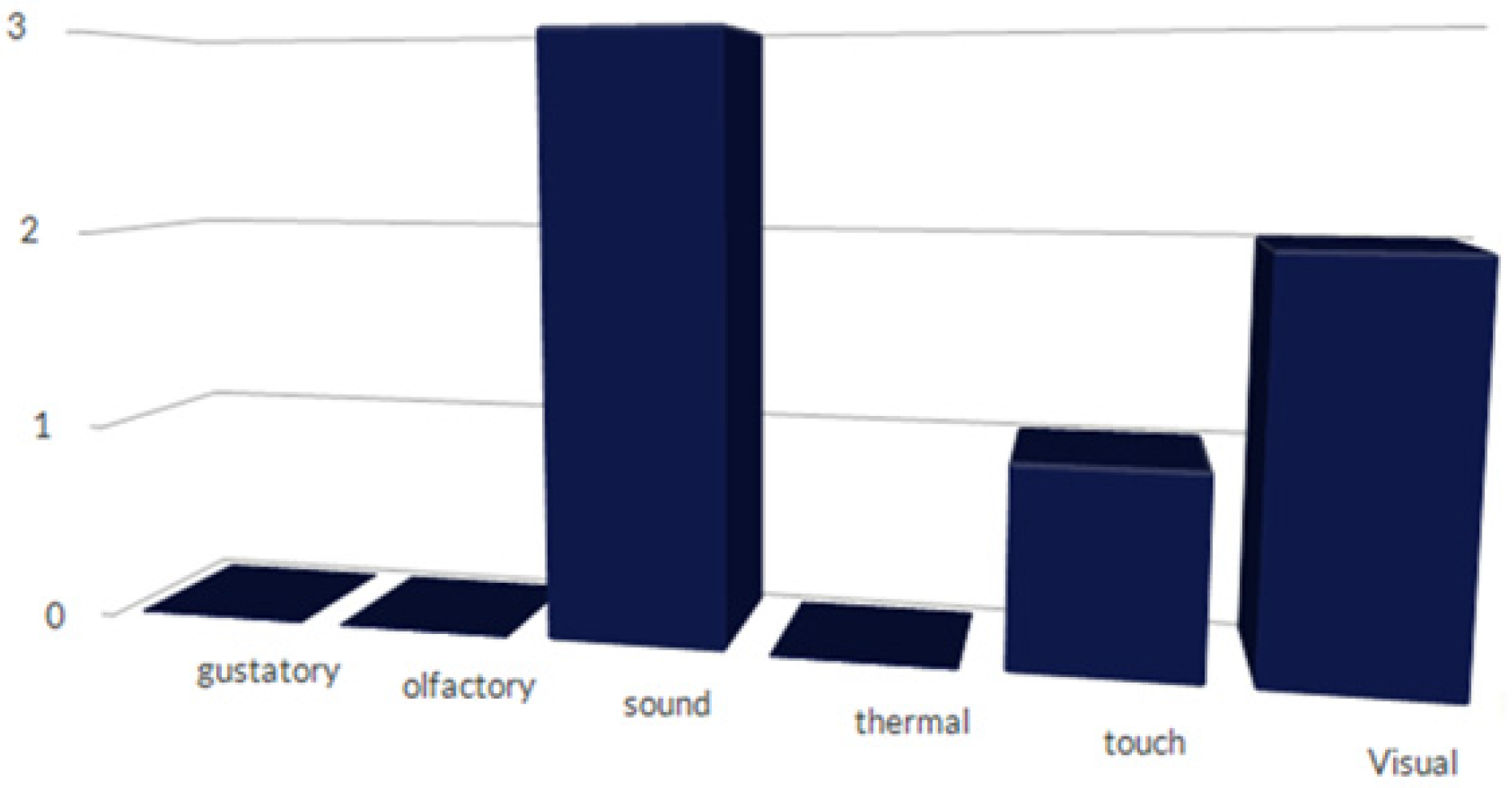
Perceived ambience: Figure 23 shows that sound ambiences are predominant, followed by visual ambiences, and finally tactile ambiences.
Ambience generators:
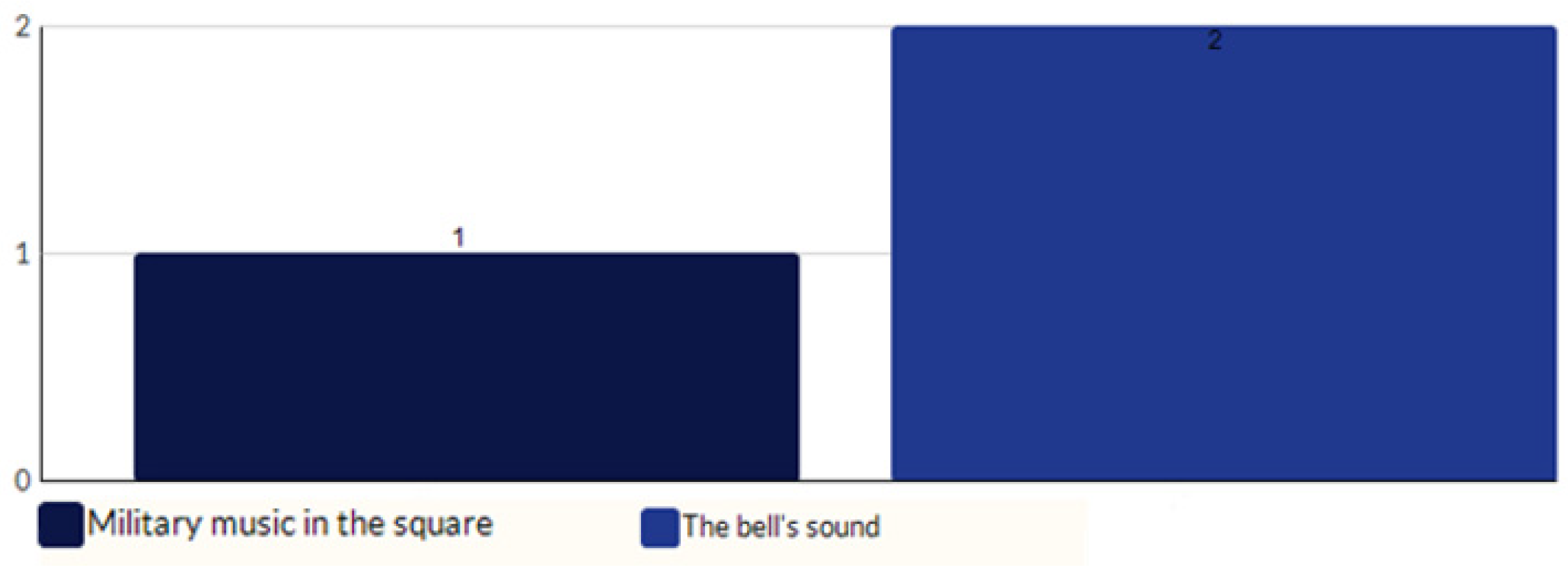
Figure 24 show that the predominance of church-related sounds can be explained by the presence of this religious building, which acts as a major spatial landmark in the square, structuring its sound ambience through regular signals carrying multiple values. The strong symbolic charge of these sounds also contributes to their impact, leaving a lasting mark on the public space and helping to anchor the sound ambiences of the square in memory.
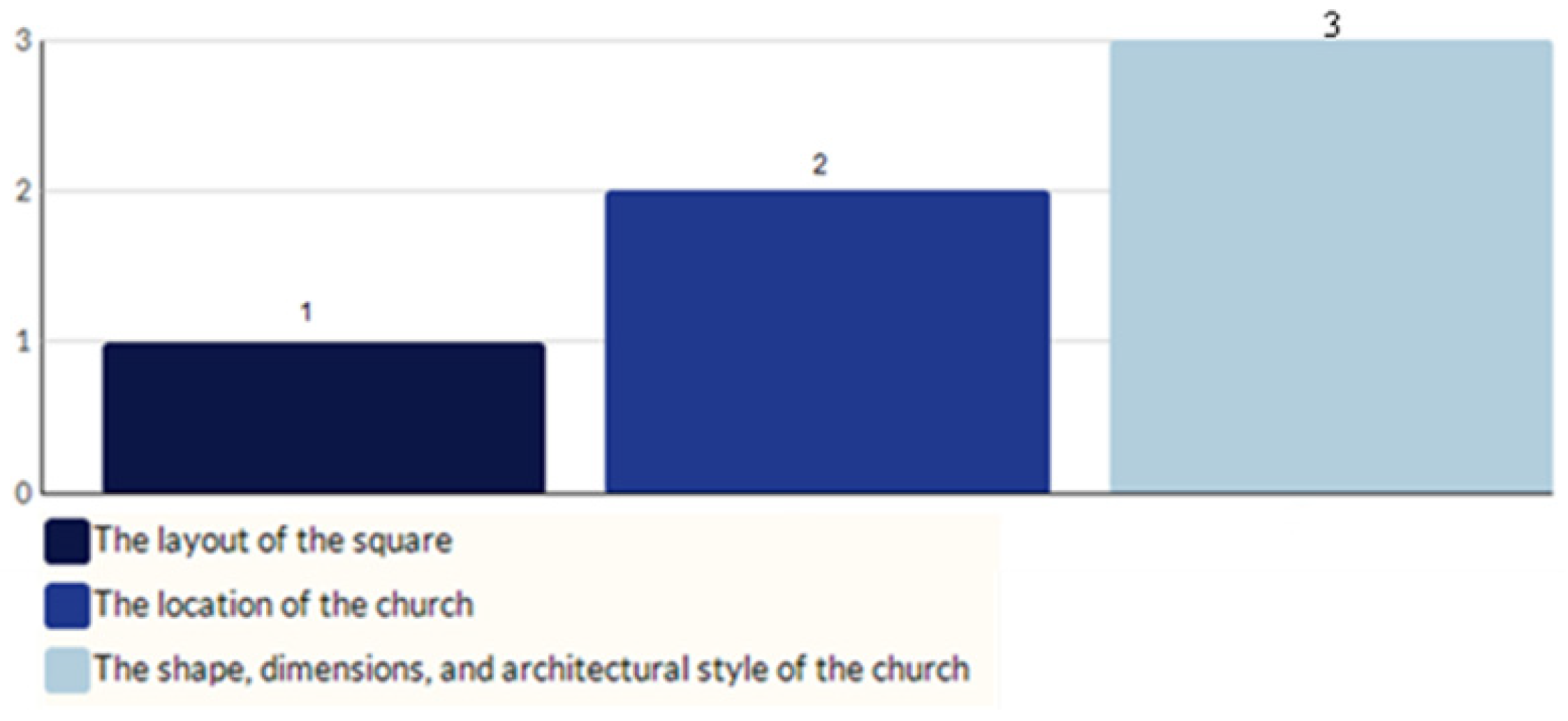
Figure 25 highlight the predominance of the shape, size and architectural style of the church as the main generators of visual ambiences. This predominance reflects the significant impact of the church on the urban landscape, where it stands out as a visual landmark structuring the spatial organisation of the square.
The location of the church also appears to be a determining factor, underlining the importance of its strategic position in the urban composition. Finally, the design of the square completes the setup by enhancing the building and encouraging the emergence of a coherent visual ambience.
All these elements converge to confirm the central role of the church in creating the visual ambiences of the square. By acting as both a focal point and a structuring element, the church helps to prioritise visual perceptions and create a meaningful spatial framework for users.
Table 6 highlights building materials as the only generators of tactile ambiences. This singularity can be explained by the direct role of materials in the tactile experience of users of urban space, involving the senses of touch in contact with architectural elements.

4.1.4. Synthesis of the Results of the First Temporal Phase 1840–1929

The analysis of the first temporal phase enabled us to identify the sensory ambiences and their generators for each spatial component.
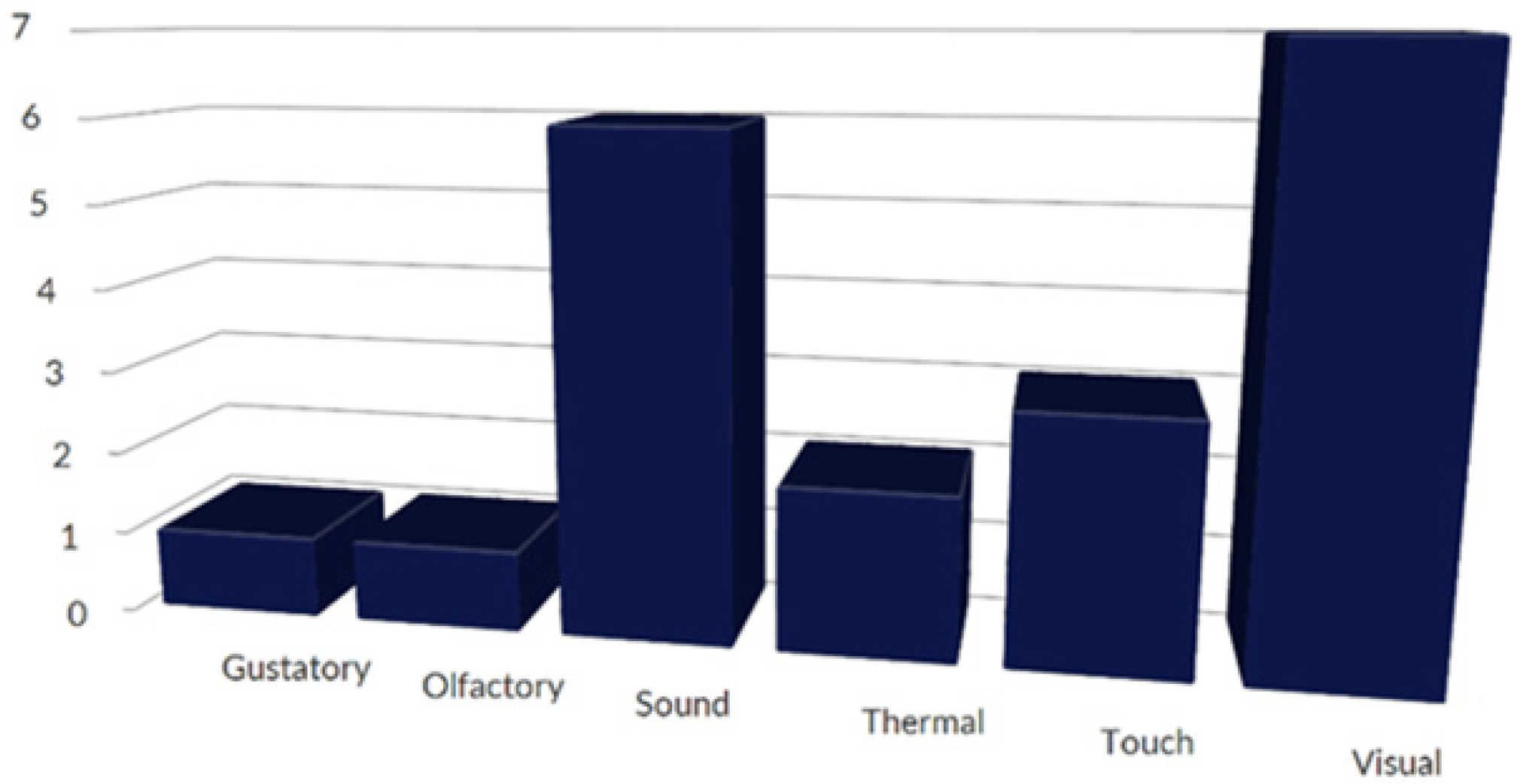
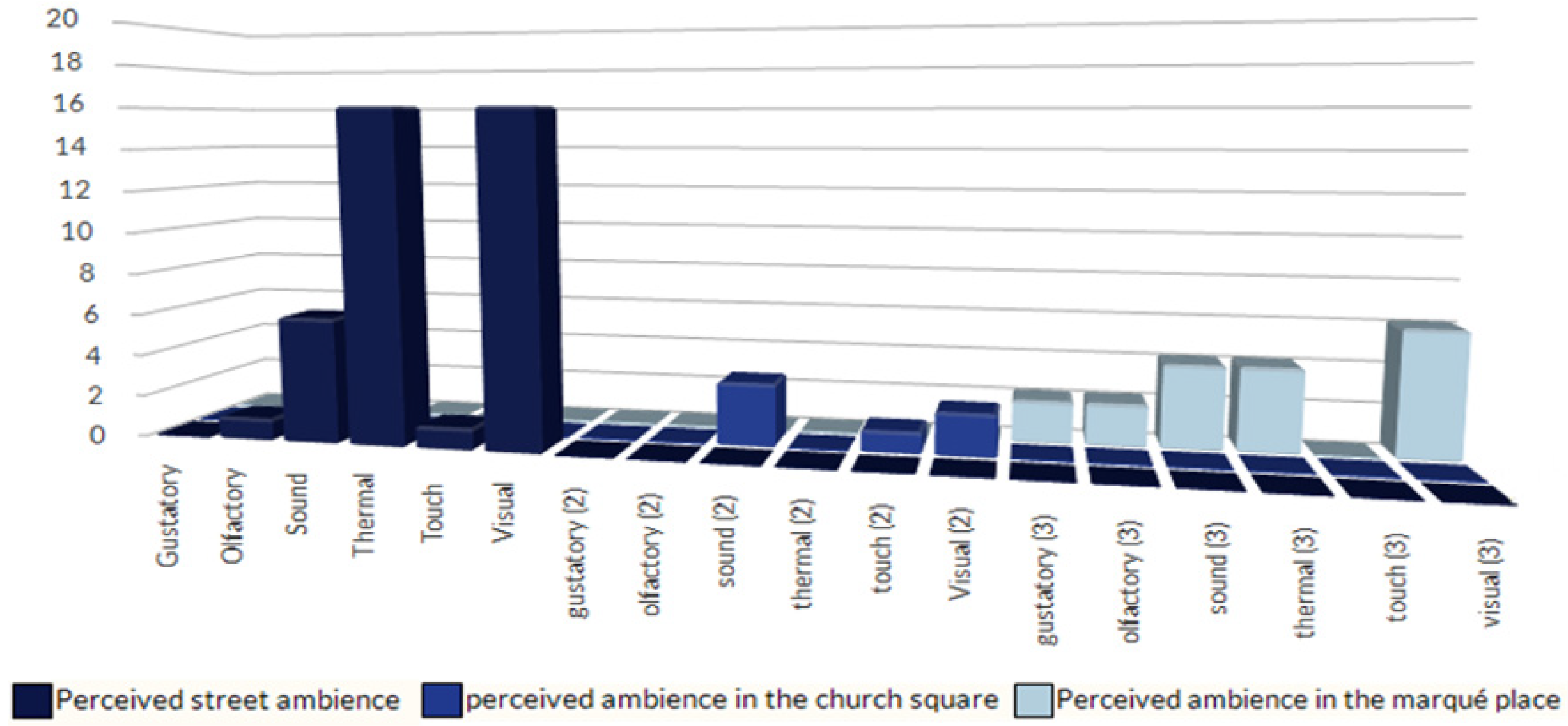
Figure 26 highlights the ambiences and their variations in the three spatial components studied. Visual and sound ambiences predominate, followed by thermal ambiences, while tactile, olfactory and gustatory ambiences are the least evoked. These variations in ambiences are closely linked to the diversity of their generators.
Visual ambiences are mainly produced by the architectural and urban configuration: the street grid, the spatial layout of the public squares, and the architectural style of the buildings, which is a major generator. The visual perspectives offered by the street and squares make it possible to appreciate both rich urban views and openings onto the surrounding natural landscapes.
Social activity, enriched by interactions between users and commercial activities, also contributes to the generation of visual and acoustic ambiences within all the spatial components.
From a thermal and environmental point of view, the intense heat has imposed itself as a generator of sometimes unpleasant thermal ambience. However, this constraint has been offset by the existence of continuous arcades on the ground floors of the buildings, which provide areas of shade and promote coolness. Similarly, the proximity of the sea and the circulation of sea breeze provide a pleasant sensation of freshness, particularly noticeable in certain parts of the street and in Marqué Square thanks to its openness to the sea.
To complement the qualitative analysis conducted above, the table (Table 7) below summarizes the variations in sensory ambiences across the different spatial components during the first temporal phase (1840–1929). This hierarchical representation aims to clarify the relative dominance of sensory channels within each space, as revealed through the coding of historical sources.

4.2. Second Temporal Phase 1929–1962

The second temporal phase identified four spatial components: George Clémenceau Street, Marqué Square and Church Square, as well as the square of the municipal theatre and its garden.

4.2.1. Rue George Clémenceau

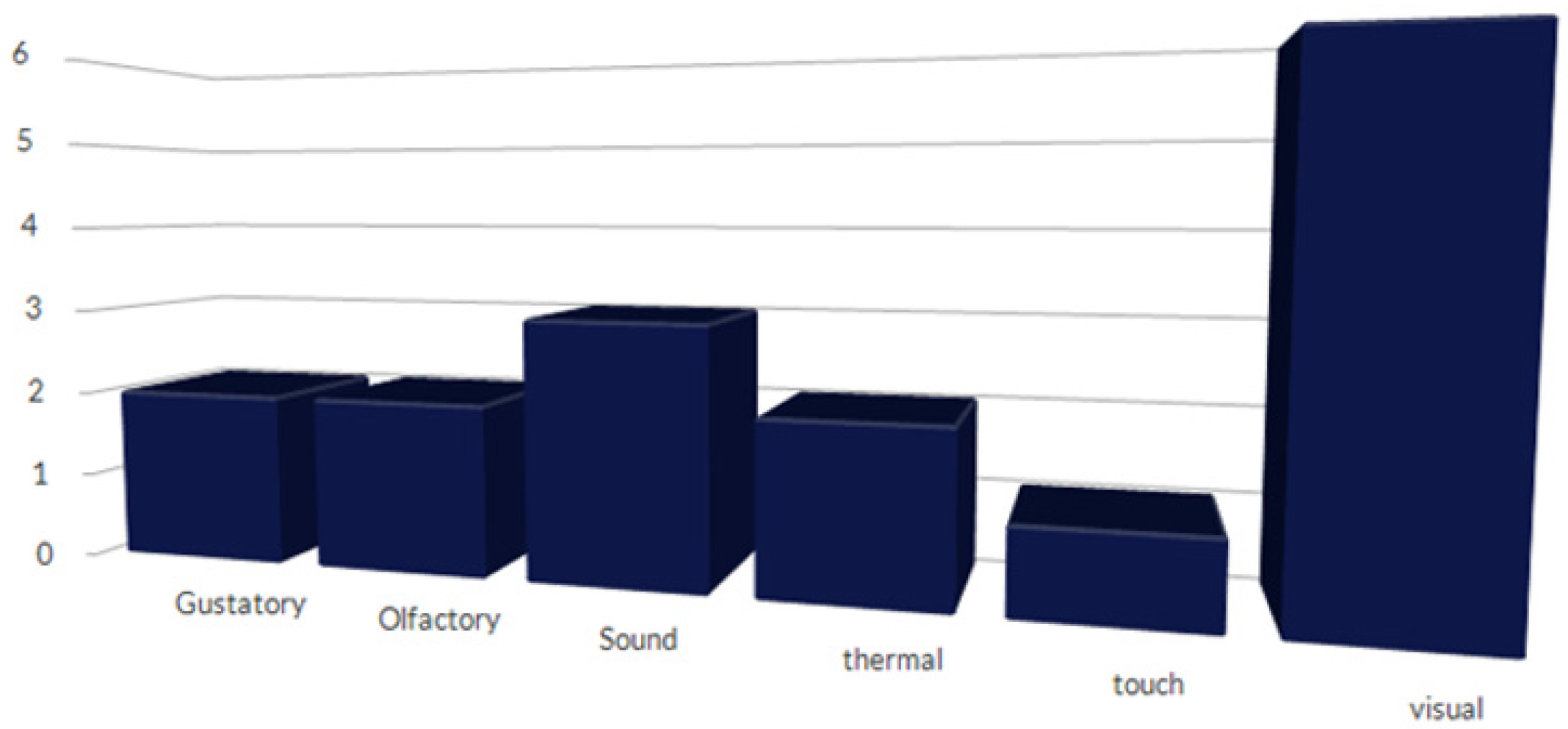
Perceived ambience: Figure 27 shows that visual ambiences are predominant, followed by sound ambiences, olfactory, gustatory and thermal ambiences and tactile ambiences.
Ambience Generators:
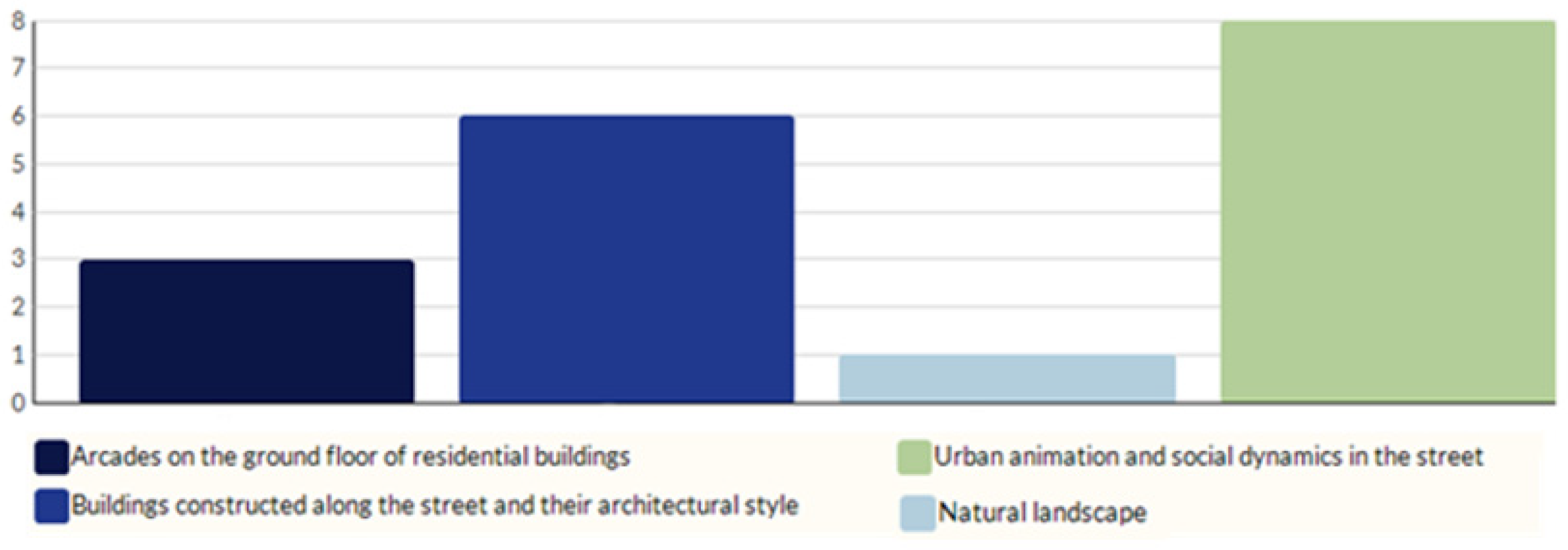
Figure 28 shows the predominance of urban animation and social dynamics in the street, as being the most frequently mentioned generators of visual ambiences, these elements embody the living dimension of urban space, and translate the active role of human practices and interactions in the production of street ambiences. These are followed by buildings and their architectural styles, reflecting the impact of buildings on the visual interpretation of urban space. Then there are the arcades on the ground floors of the buildings, which provide not only architectural continuity, but also a spatial quality conducive to the sensory experience of users. However, the natural landscapes perceived through the street are the least frequently revealed generators. This indicates that built elements and social uses have taken precedence over natural components.
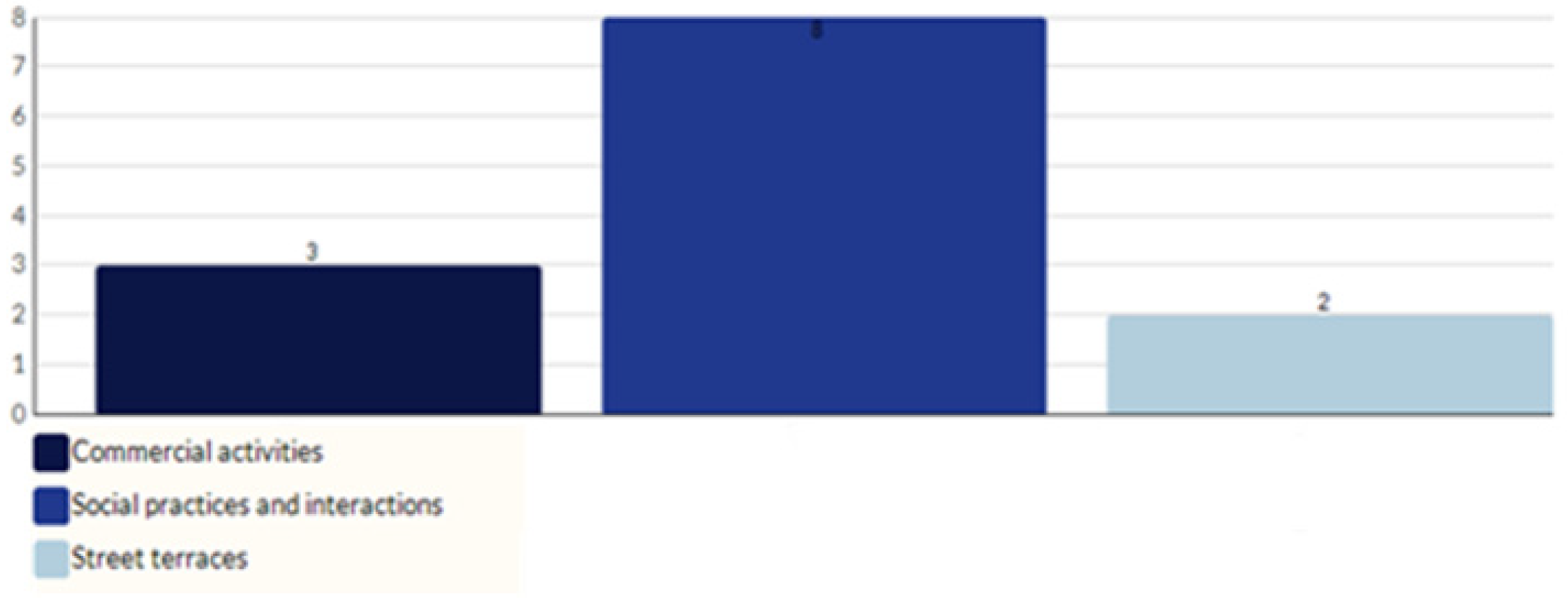
Figure 29 shows that social practices and interactions are the most frequently mentioned generators of sound ambiences; these results testify to the crucial role of social life in the production of the street’s sound ambiences. Followed by commercial activities, this can be explained by the highly commercial nature of the street, which is home to a significant concentration of shops. On the other hand, the street’s terraces are the least mentioned.
Table 8 illustrates that gustatory and olfactory ambiences were mainly generated in the street through bars and restaurants, pastry shops and street food stalls and rotisseries. This low recurrence rate reflects a secondary sensory perception of these ambiences in the urban experience of the street.
However, the table shows that arcades are the main generators of thermal ambiences. This result highlights the significant role of these architectural structures in modulating the thermal comfort of users. By providing shade and coolness, particularly during periods of high heat. Paving appears to be the main generator of tactile ambiences in the street, which explains that the paving of surfaces engages the sense of touch through walking, and contributes to the bodily experience of urban space.

4.2.2. Marqué Square

Perceived ambiences: Figure 30 shows the predominance of visual ambiences, followed by sound ambiences, with tactile ambiences in third place, followed by thermal ambiences and finally olfactory and gustatory ambiences.
Ambiences Generators:
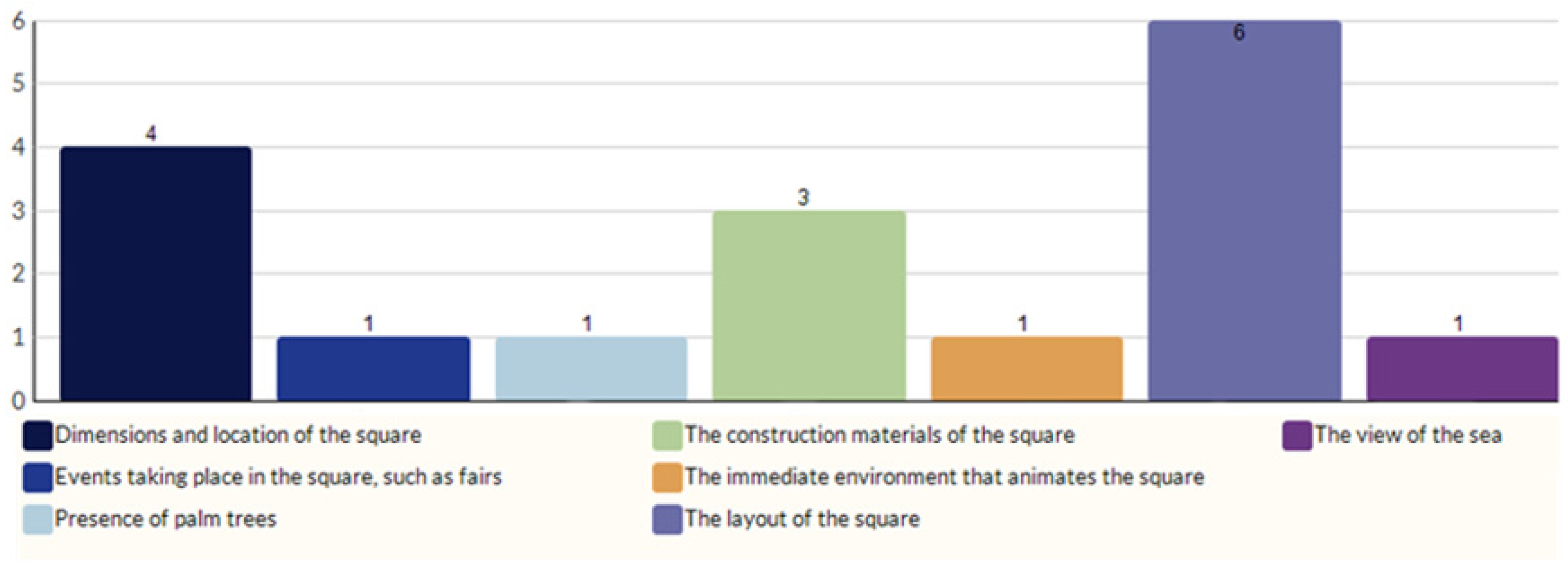
Figure 31 illustrates the hierarchy of generators which underlines the importance given to the configuration and physical characteristics of the square in sensory perception, compared with natural elements or events.
Figure 32 demonstrates the combined influence of environmental, cultural and social factors in the production of the sound ambiences in the square.
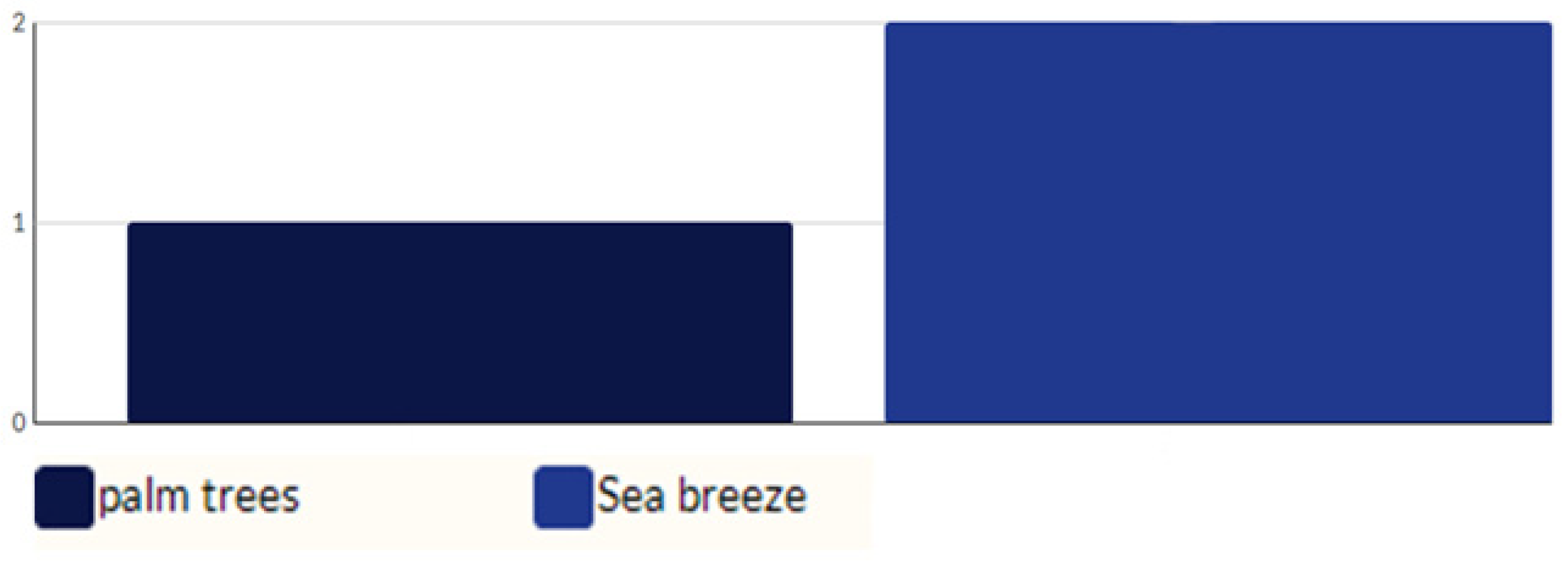
Figure 33 shows that the thermal ambiences were mainly generated by the sea breeze, which gave the square a feeling of freshness. The presence of palm trees contributed to thermal regulation by providing areas of shade.
Table 9 shows that bars and cafeterias appear to be the only generators of gustatory and olfactory ambiences in the square. This reflects the low presence of sensory stimuli related to smell and taste in the square. The table highlights the appearance of building materials as the main generator of tactile ambiences within the square, indicating their capacity to solicit the sense of touch in the sensitive experience of space.

4.2.3. Church Square

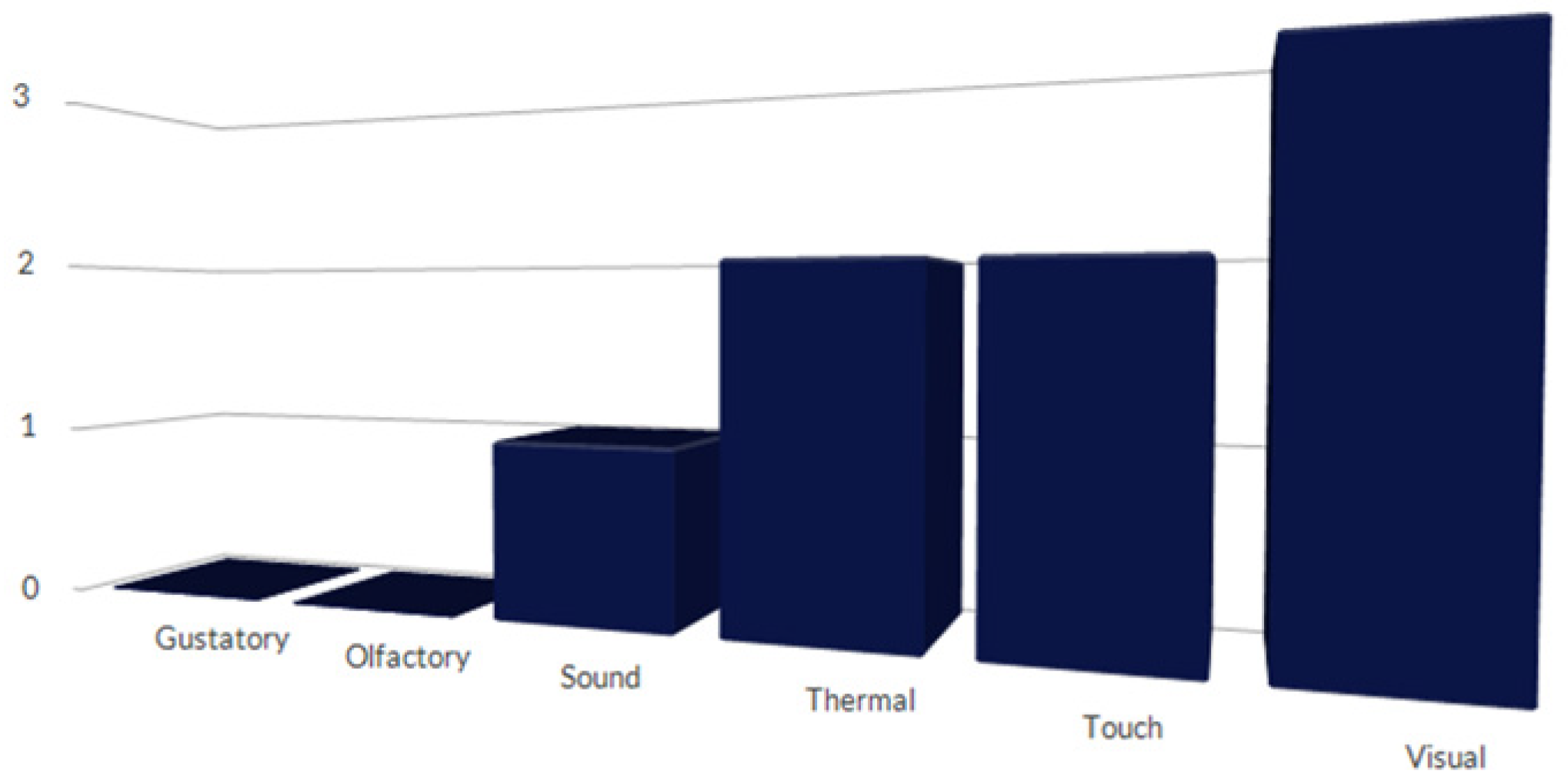
Perceived ambiences: Figure 34 shows that visual ambiences predominate, followed by thermal and tactile ambiences, and finally sound ambiences.
Ambiences Generators:
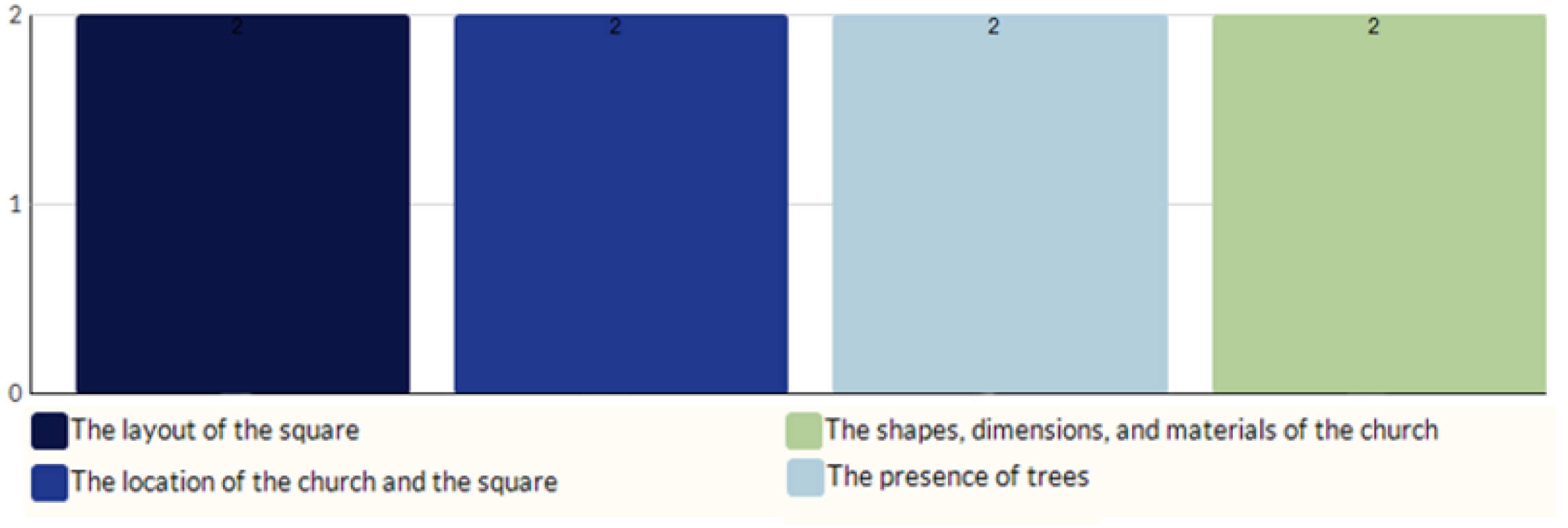
Figure 35 shows that the visual ambiences were generated by multiple elements, and highlights a balanced distribution of sources of visual stimulation in this spatial component.
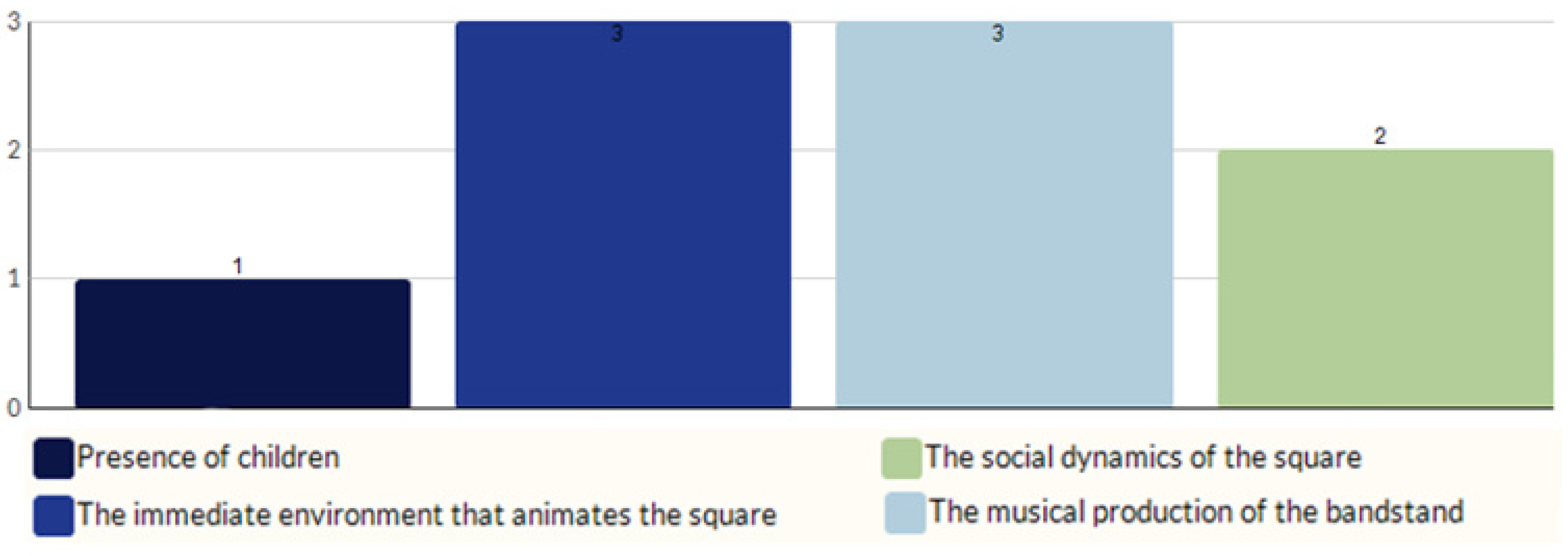
Table 10 shows that the presence of children is the only sound generator; this indicates a generally calm ambience.
The thermal ambiences was generated mainly by the presence of trees in the square with trees providing shade and coolness to help regulate the heat felt by users.
Building materials appear to be the main generators of tactile ambiences in the square, revealing the importance of these elements and their influence on users’ sensory experience and perception of the ambiences of the place.

4.2.4. The Square of the Municipal Theatre and Its Garden

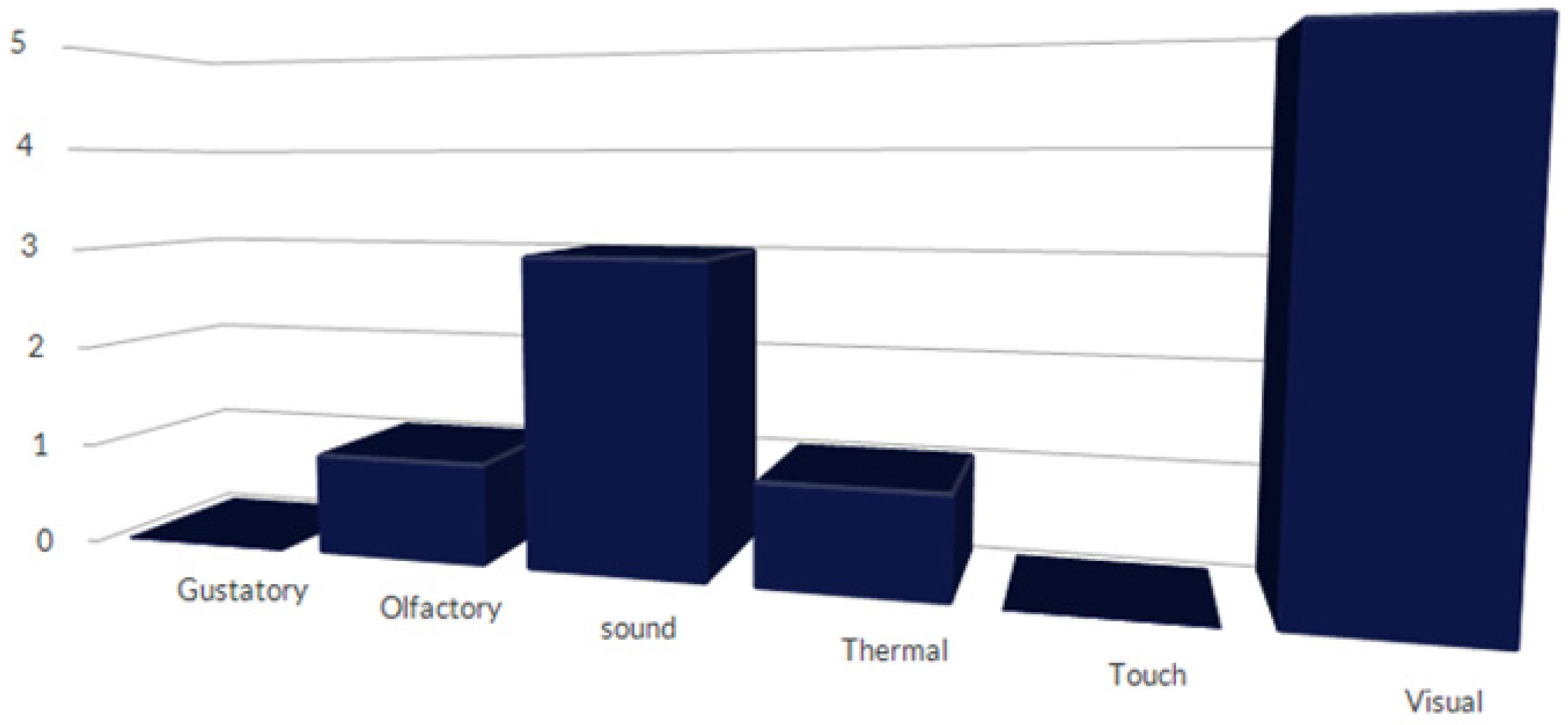
Perceived ambiences: Figure 36 shows that visual ambiences predominate, followed by sound ambiences, and finally olfactory and thermal ambiences.
Ambiences Generators:
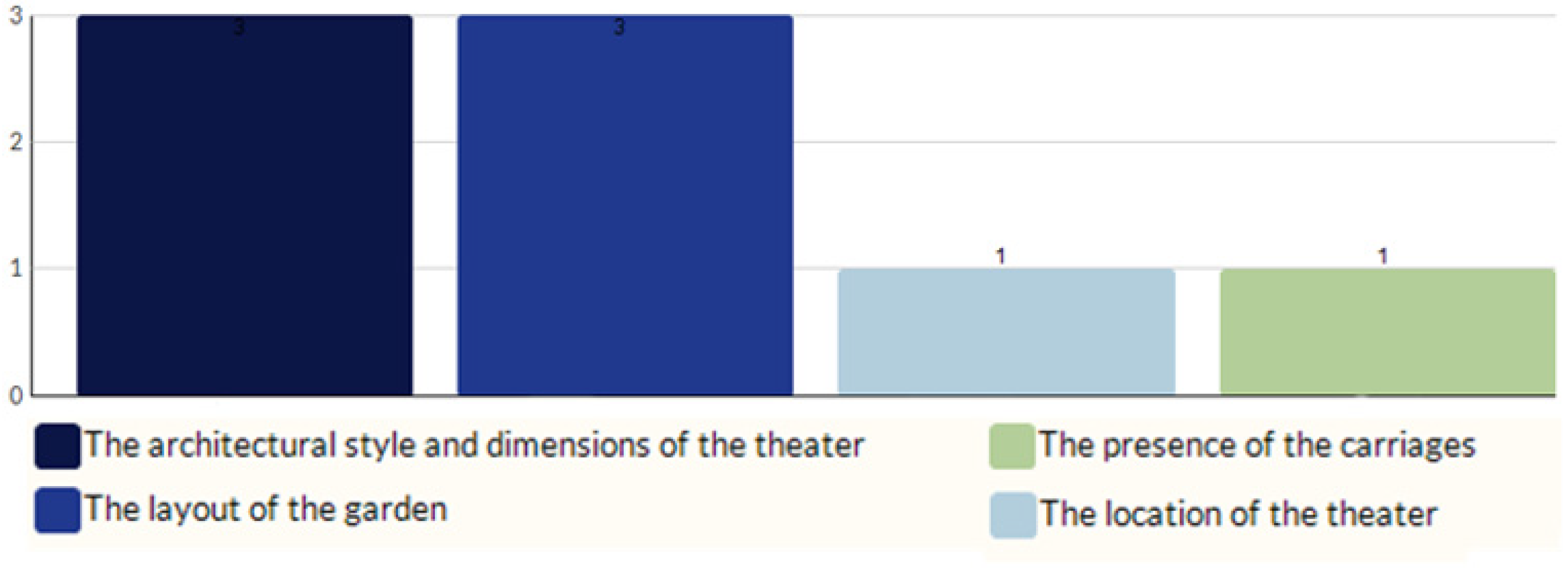
Figure 37 show that the architectural style and dimensions of the theatre, as well as the layout of the garden, are the main generators of visual ambiences. These elements contribute to the visual staging of the space. The location of the theatre and the picturesque presence of the horse-drawn carriages were less frequently mentioned, but nevertheless contribute to enriching the visual landscape and reinforcing the urban identity of the space.
Figure 38 indicates that sound ambiences are primarily generated by the presence of water, which introduces a calming dimension to the urban environment. In contrast, children’s shouting and the noise of horse-drawn carriages are each mentioned only once, highlighting the diversity of sound sources within the space.
Table 11 reveals that the garden and the water basin are the main generators of thermal ambiences, acting as microclimatic regulators and creating a more pleasant thermal ambience.
The smell of horses appears as the sole identified source of olfactory ambiences. This scent serves as a distinctive sensory marker, embedded within the multisensory experience of the space.

4.2.5. Synthesis of the Results of the Second Temporal Phase 1929–1962

The analysis of the second time period allowed for the identification of sensory ambiences and their generators for each spatial component. The results reveal variations in perceived ambiences depending on the spatial component.
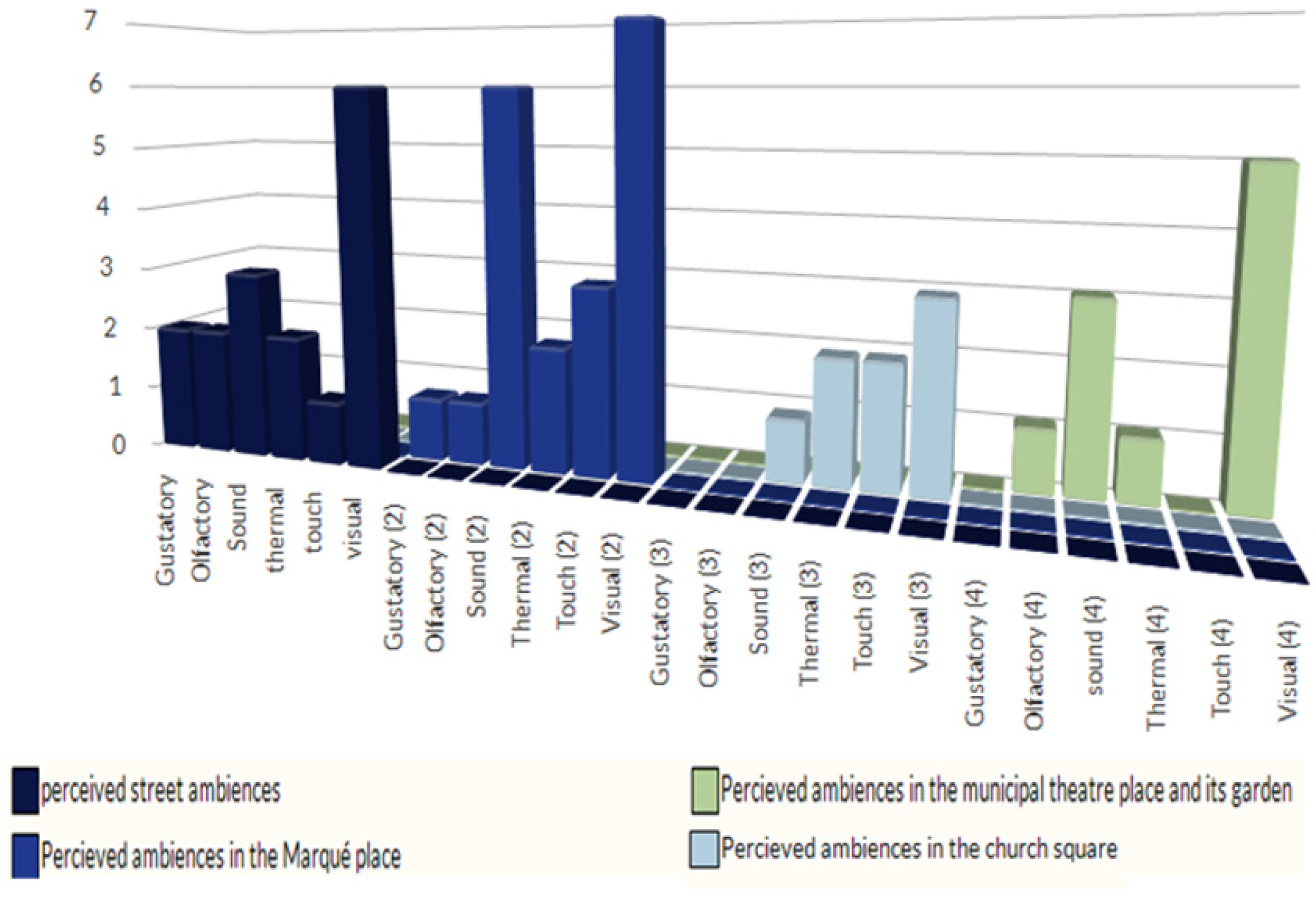
Figure 39 represents the ambiences and their variations across all studied spatial components. Once again, visual and auditory ambiences emerge as predominant, followed by thermal ambiences, while tactile, olfactory, and gustatory ambiences are only marginally mentioned.
This hierarchy reflects a continuity in perceived sensory dynamics, while also highlighting characteristics specific to this second temporal period.
Visual ambiences primarily originate from the design of plazas and squares, the architectural style of the buildings, spatial dimensions and forms, as well as the presence of vegetation (trees, palm trees). Arcades play a dual role: they structure the façades and extend the built environment in a rhythmic sequence, enhancing urban legibility and the depth of visual perspectives. Additional elements such as horse-drawn carriages or sea views enrich the visual ambiences through their unique landscape character.
In terms of sound, commercial activities and social interactions—particularly the presence of children or musical production of the bandstand—remain the main generators. Specific sources such as the sound of water or the noise of carriages also contribute to defining the sound ambiences of certain areas.
Thermal ambiences are generated by both natural elements—such as vegetation (trees and gardens), water basins, and the sea breeze—and architectural features such as arcades, which provide shade and coolness while encouraging pedestrian circulation. These arcades thus act as essential microclimatic regulators within the streetscape.
As for olfactory and gustatory ambiences, though rarely mentioned, a few generators were identified: cafés, bars, pastry shops, food stalls, and rotisseries, as well as the smell of horses from the carriages. These elements contribute to a unique multisensory ambiences rooted in local practices.
Lastly, tactile ambiences, though only minimally referenced, are primarily associated with construction materials and paving. These highlight the body’s engagement in sensory perception of place, particularly through contact with ground surfaces or built structures.
To complement the qualitative analysis presented above, the table below (Table 12) summarises the variations in sensory ambiences according to spatial components during the second temporal phase (1929–1962).

4.3. Overall Synthesis of the Results for the Two Temporal Phases

The analysis of urban ambiences in the street and its squares highlights a marked evolution between the two time periods studied (Table 13), both in the nature of the ambiences and in the diversity and consistency of their generators. These variations reflect the intrinsic dynamics of urban ambiences, which are continually readjusted according to spatial, social and functional transformations of the urban environment.
Main developments observed in the street:
Recomposition of the hierarchy of visual, thermal, and sound ambiences.
During the second period, the relative importance of visual, thermal and sound ambiences within the hierarchy of ambiences was redefined. This evolution reflects the modifications of the built environment, the evolution of uses and the transformation of social practices, which have led to a reconfiguration of the dominant sensory stimuli in public space.
Reinforcement of olfactory ambiences and emergence of gustatory ambiences.
Olfactory ambiences now occupy a more significant place, in connection with the appearance of new sensory generators such as bars, pastries and street food stalls. At the same time, gustatory ambiences, new in the sensory landscape of the street, are an integral component, directly associated with the diversification of food practices and the rise of the restaurant industry.
Stability of tactile ambiences with evolution of the generators.
Tactile ambiences retain a stable place within the hierarchy, although their generators have evolved from traditional building materials to new pavements materials.

5. Discussion

This diachronic study conducted on Rue George Clémenceau and its squares highlights the richness and dynamics of sensory ambiences, revealing the influence of spatial, social, and functional transformations on the hierarchy and diversity of ambiences over time.
These variations are not limited to reflecting quantitative changes in recurrence frequencies, but rather reveal transformations in the relationships between physical forms, social practices, and the appropriation of space.
Evolution of Ambiences and their generators:
The analysis highlights that the diversity and hierarchy of sensory ambiences evolve according to changes in the built environment, uses and social practices. During the first phase (1840–1929), visual and thermal ambiences predominated, driven by the architectural configuration, the presence of arcades and urban morphology. Sound ambiences, mainly generated by commercial activities and social life, also occupy an important place, while tactile and olfactory ambiences remain more marginal, often associated with specific elements such as building materials or the presence of fish shops.
In the second phase (1929–1962), the hierarchy of ambiences is recomposed. Visual and sound ambiences remain central, but their relative importance is modulated by the appearance of new sensory generators and the evolution of practices. Olfactory and gustatory ambiences are gaining visibility, in direct connection with the rise of the restaurant industry (cafes, bars, pastries, and street food stalls) and the diversification of food practices. Tactile ambiences, on the other hand, remain stable in the hierarchy, although their generators evolved from traditional materials to new pavements materials.
These results confirm that physical elements constitute essential components of the ambience phenomenon, as they contribute to the emergence of ambiences while simultaneously structuring users’ sensory perceptions
The notion of permanence in urban ambiences:
Beyond these evolutions, the analysis reveals the presence of elements of permanence that structure the sensory experience of users over time. Some generators of ambiences—such as iconic architectural forms, the presence of the church, or the configuration of squares—maintain their structuring role despite the transformations of the urban context. This permanence also manifests itself in the sensory hierarchy, where visual and sound ambiences retain a high relative importance from one period to another.
The notion of permanence refers to the structuring and recurrent role of certain spatial components, which continue to shape the urban experience despite transformations in uses and practices.
The permanence of ambiences reflects the ability of urban space to offer stable sensory markers, contributing to the construction of a collective memory and the identity anchoring of places. It is expressed through the continuity of certain uses (gatherings and social practices), the recurrence of materials or built forms, or even the persistence of specific social dynamics in each space. This permanent dimension, far from opposing evolution, coexists with the dynamics of transformation and innovation, ensuring a sensible continuity that allows users to find familiar markers while opening up to new experiences.
The results thus confirm that the urban ambiences are a complex phenomenon, resulting from the interaction between physical, natural, social and cultural elements. No sense acts in isolation: the sensory perception of places is the result of a simultaneous solicitation of several sensory organs, revealing the multi-sensorial dimension of the urban experience.
The user, far from being a passive recipient, actively participates in the creation and evolution of ambiences through their practices, cultural background, and mere presence. The permanence of certain ambiences and their generators ensures a continuity of sensory experience over time, underscoring the critical role of temporality in shaping the sensuous urban experience. This permanence contributes significantly to the enrichment of the city’s intangible heritage, wherein sensory memory serves as a vital medium for transmitting the identity of place.

6. Conclusions

The evolution of urban ambiences in Rue George Clémenceau and its adjoining squares highlights the remarkable adaptability of the urban fabric in response to physical, social, and functional transformations. This research—based on a thematic analysis of textual sources and a quantitative exploitation via NVivo software—has enabled the restitution of the diversity of sensory ambiences, the identification of their principal generators, and the mapping of their spatial and temporal distribution throughout the colonial era.
The findings reveal that the hierarchy of sensory ambiences is restructured according to shifts in the built environment, evolving social dynamics, and patterns of use, while the permanence of certain generators guarantees the continuity of both sensory and identity-related experiences. The study further underscores the structuring role of public spaces in enriching and diversifying sensuous experiences, reaffirming the significance of the sensory dimension in the understanding of urban heritage.
Beyond the mere conservation of physical elements, the integration of sensory ambiences emerges as essential for grasping the memory and identity embedded within places. However, the study is not without limitations, notably those related to the subjectivity and availability of historical textual sources, as well as the lack of specificity regarding the periodicity of descriptions. The quantitative approach was employed to mitigate these biases and strengthen the reliability of the results.
Future research avenues could explore the resilience of the identified ambiences: Have those that persisted during the colonial era endured into the postcolonial context? More broadly, what remnants of these ambiences remain today, despite the city’s successive transformations? Such questions pave the way for new investigations into sensory memory and urban identity.

Author Contributions

Conceptualization, R.B., L.M. and D.L.; methodology, R.B., L.M., B.A., G.S. and D.L.; software, R.B. and B.A.; investigation, R.B.; resources, B.A. and L.M.; data curation, R.B. and B.A.; writing—original draft preparation, R.B.; writing—review and editing, L.M., G.S., B.A. and D.L.; visualization, B.A.; supervision, L.M., G.S., B.A. and D.L.; Funding acquisition, D.L. and G.S., project administration, L.M., G.S. and D.L. All authors have read and agreed to the published version of the manuscript.

Funding

Università degli studi G.d’Annuzio-Pescara, Italy.

Data Availability Statement

The data supporting the findings of this study consist of historical archival documents, textual sources, and iconographic materials consulted in public archives and libraries. Due to the nature of these sources and potential copyright or access restrictions, the data are not publicly available. However, the corpus analyzed during the study can be made available from the corresponding author upon reasonable request and subject to archive access conditions.

Acknowledgments

The authors would like to thank the institutions that facilitated access to the documentary sources required for this research, including the Bibliothèque nationale de France, the Service historique de la Défense in Vincennes, the municipal archives of the APC of Skikda, and the public library of Skikda. The authors also express their gratitude to Messikh B. for granting access to his private collection of historical postcards. Finally, the authors gratefully acknowledge Campus France for awarding the André Mandouze Scholarship, 2024 edition, as part of the High-Level Scientific Stay Program in the Humanities and Social Sciences (SHS), which enabled the consultation of archival centers in France essential to this study.

Conflicts of Interest

The authors declare no conflicts of interest.

Appendix A. Corpus of Analysed Texts

Table A1. Corpus of analysed texts.
Texts’ ReferencesTypes of DocumentsCodes
Marmier, Xavier, «Lettres sur l’Algérie», (1847), Paris, Arthus Bertrand, éditeur libraire de la société de géographie, rue Haut feuille 23 de l’imprimerie de crapelet [42].Travel accountsTA01
M.BEQUET, «L’Algérie en 1848, tableau géographique et statistique», (1848–1849), Paris, Librairie de Hachette et Cie, rue Pierre Sarrazin, N 12. Alger librairie centrale de la méditerranée, rue de la Marine, N117 [43] (Bequet 1848).Travel accountsTA02
DR Thém. LESTIBOUDOIS, (A. Voyage 31 October 1849) «Voyage en Algérie, ou études sur la colonisation de l’Afrique Française.» (1853). Lille imprimerie de L.Danel, grand ’place [44].Travel accountsTA03
Béliard, J, (A. Voyage Mai 1849) «Souvenirs d’un voyage en Algérie. Les monts Fel-Fela et leurs carrières de marbre blanc», (1854). Visite mai 1849 [45].Travel accountsTA04
Alexandre Dumas, «Le véloce, Tanger, Alger et Tunis», (1855). Montréal, Réédité par les éditions Le Joyeux Roger, 2006 [46].Travel accountsTA05
Thierry-Mieg, Charles, «Six semaines en Afrique: souvenirs de voyage», (1861), Paris, Michel Levy frères, libraire-éditeur, 8 rue Vivienne [47].Travel accountsTA06
Piesse, Louis, «Itinéraire historique et descriptif de l’Algérie, comprenant le Tell et le Sahara», (1862), Paris-imprimerie de CH. Lahure et C, Rue de Fleurus, 9 [48].Travel accountsTA07
Carteron, Charles, «Voyage en Algérie: tous les usages des Arabes, leur vie intime et extérieure, ainsi que celle des Européens dans la colonie», 20 Fevrier (1866). Paris, J. Hetzel, libraire-éditeur, 18 rue Jacob [49].Travel accountsTA08
Reuss Louis-Jean-Max, «A travers l’Algérie», (1884), Paris, librairie Générale de vulgarisation, 7 rue de verneuil. (pas de date de visite) [50]Travel accountsTA09
DR LOUIS BOUCHER, «La colonisation de Philippeville à Constantine», (1886), Rouen, imprimerie de Espérance Cagniard, rue Jeanne-d ’arc, 88, et des Basnage, 5. (Visite 1883) [51]Travel accountsTA10
Robert, Georges, «Voyage à travers l’Algérie: notes et croquis», (1891). Paris, imprimerie de G, Rougier et Cie, 1, rue Cassette [52].Travel accountsTA11
Germain, Henri, «Les vacances de Paul: Voyage en Algérie», (1891), Paris, Legéne, oudin et C, éditeurs 17 rue Bonaparte, 17 [37].Travel accountsTA12
Trumet de Fontarce, Armand, «Souvenirs d’Afrique. Algérie, Tunisie, mission officielle, journal de voyage», (10 Septembre 1896), Bar-sur-Seine, imprimerie V C. Saillard, éditeur [53].Travel accountsTA13
Conty, Henry Auxcouteaux, «Algérie-Tunisie: Guides pratiques», (1901), Paris, administration des guides Conty, 12 rue Auber (IXe Arr.) [54].Travel accountsTA14
REIBELL (General), «L’Algérie du centenaire vue par un Alsacien», (1930), Strasbourg, imprimerie des dernières nouvelles de Strasbourg [55].Travel accountsTA15
Rabah Toubal, «Skikda de mon enfance (1955–1970)», (2018), édition, Les presses du Chélif, cité 16 logements agence foncière Hay Bensouna Chlef [38].NovelNO
Philippeville historique, L’Afrique du nord illustrée [56]JournalJO
Mohamed Sadek Messikh, «Skikda la mémoire, histoire de Skikda et de sa région», (2022), Edition Rais [31].BookBO

References

  1. Norberg-Schulz, C. Genius Loci: Paysage, Ambiance, Architecture; Editions Mardaga: Brussels, Belgium, 1997; ISBN 978-2-87009-651-2. [Google Scholar]
  2. Chtara, C. Caracterisation(s) de L’espace Sonore de la Medina de Tunis au Xixe—Debut XXe Siecles: Recits de Voyage, Formes Urbaines et Effets Sonores. Ph.D. Thesis, Universite de Carthage de Tunis Ecole D’architecture et D’urbanisme de Tunis Ecole Doctorale Sciences et Ingenieries Architecturales, Tunis, Tunisia, 2016. [Google Scholar]
  3. Thibaud, J.-P.; Balez, S.; Boyer, N.; Couic, M.-C.; Fiori, S.; Saraiva, M.; Thomas, R.; Tixier, N. Comment Observer Une Ambiance? Les Cah. Rech. Archit. Cah. Rech. Archit. Urbaine 1998, 77–90. Available online: https://hal.science/hal-01520077 (accessed on 4 January 2026).
  4. Manola, T. La sensorialité, dimension cachée de la ville durable. Métropolitiques 2013. Available online: https://shs.hal.science/halshs-01526794 (accessed on 4 January 2026).
  5. Amphoux, P.; Chelkoff, G.; Thibaud, J.P. Ambiances en Débats; Amphoux, P., Thibaud, J.-P., Chelkoff, G., Eds.; Ambiances, ambiance; A la Croisée: Bernin, France, 2004; ISBN 978-2-912934-08-6. [Google Scholar]
  6. Augoyard, J.-F. Éléments pour une théorie des ambiances architecturales et urbaines. Cah. Rech. Archit. 1998, 3, 7–23. [Google Scholar]
  7. Chelkoff, G.; Amphoux, P.; Thibaud, J.-P. Ambiances en Débats; A la Croisée: Bernin, France, 2004. [Google Scholar]
  8. Belakehal, P.A. De la notion d’Ambiance. Rev. Courr. Savoir Sci. Tech. 2013, 49–54. [Google Scholar]
  9. Amphoux, P. La Notion d’ambiance. Un Outil de Compréhension et d’action Sur l’espace Public. In L’espace Public Urbain: De L’objet au Processus de Construction; Capron, G., Haschar-Noé, N., Eds.; PU du Mirail: Toulouse, France, 2007; pp. 71–81. [Google Scholar]
  10. Thibaud, J.-P.; Siret, D.; Congrès International sur les Ambiances; Centre Canadien D’architecture; Réseau International Ambiances; Centre for Sensory Studies. Ambiances in Action =Ambiances en Acte(s): Proceedings of the 2nd International Congress on Ambiances, Canadian Centre for Architecture, Montreal, Septembre 2012; Réseau international Ambiances = International Ambiances Network: Grenoble, ON, Canada, 2012; ISBN 978-2-9520948-3-2. [Google Scholar]
  11. UNESCO. UNESCO, 2003—*Convention pour Convention Pour la Sauvegarde du Patrimoine Culturel Immatériel; UNESCO: Paris, France, 2003. [Google Scholar]
  12. ICOMOS. Déclaration de Québec sur la Préservation de L’esprit du Lieu; ICOMOS: Paris, France, 2008. [Google Scholar]
  13. UNESCO. Recommandation sur le Paysage Urbain Historique; UNESCO: Paris, France, 2011. [Google Scholar]
  14. Simonnot, N.; Siret, D. Héritage industriel et mémoire sensible: Observations sur la constitution d’un “patrimoine sensoriel”. Homme Société 2014, 192, 127–142. [Google Scholar] [CrossRef]
  15. Belakehal, A. Ambiances patrimoniales. Problèmes et méthodes. In Ambiances in Action: Proceedings of the 2nd International Congress on Ambiance (Ambiances en Acte (s)); Thibaud, J.-P., Siret, D., Eds.; International Ambiances Network: Montreal, QC, Canada, 2012; pp. 505–510. [Google Scholar]
  16. Simonnot, N. Le paradoxe de la patrimonialisation des ambiances. In Ambiances in Action: Proceedings of the 2nd International Congress on Ambiance (Ambiances en Acte (s)); Thibaud, J.-P., Siret, D., Eds.; International Ambiances Network: Montreal, QC, Canada, 2012; pp. 33–38. [Google Scholar]
  17. Sahraoui, N. L’identité Sonore de la Médina de Constantine: La Qualité Acoustique de L’espace Urbain, Permanences et Changements; DEA Ambiances architecturales et urbaines option Acoustique et Eclairagisme CRESSON-1995-2006; CRESSON: Grenoble, France, 2006. [Google Scholar]
  18. Belakehal, A.; Farhi, A. Les ambiances environnementales de la médina: Le patrimoine oublié. In Proceedings of the Actes de la Conférence Internationale sur la Médina, Tlemcen, Algeria, May 2008; pp. 77–84. [Google Scholar]
  19. Makhloufi, L. Les Ambiances dans les Vieilles Villes Algériennes: Entre Cultures, Identités et Héritages Sensoriels; International Ambiances Network: Nantes, France, 2012; p. 487. [Google Scholar]
  20. Said, N.G. Vers une Écologie Sensible des Rues du Caire: Le Palimpseste des Ambiances D’une Ville en Transition. Ph.D. Thesis, Université de Grenoble, Saint-Martin-d’Hères, Grenoble, France, 2014. [Google Scholar]
  21. Djedi, H.; Belakehal, A. Les ambiances patrimoniales à l’épreuve de l’appropriation: Cas de la Casbah d’Alger. Bull. Société Géographique Liège 2023, 79, 285–308. [Google Scholar] [CrossRef]
  22. Toumadher, A. Le Métissage Culturel Comme Générateur D’ambiances et de Formes Urbaines Spécifiques: Les Quartiers de Capaci Piccolo et Capaci Grandi à Sousse, à la Croisée des Cultures Ambiantales et Urbaines Italienne, Française et Tunisienne. Ph.D. Thesis, Université Grenoble Alpes, Ecole Nationale D’architecture et D’urbanisme (Tunis), Saint-Martin-d’Hères, France, 2017. [Google Scholar]
  23. Joanne, P. L’espace Sensible du Monastère Cistercien aux Origines: Essai de Caractérisation des Ambiances Architecturales. Ph.D. Thesis, Université de Nantes, École Polytechnique de l’Université de Nantes, Nantes, France, 2003. [Google Scholar]
  24. Ben Hadj Salem, M. Les Effets Sensibles Comme Outils D’analyse et D’aide à la Conception Dans Les Gares du XIXe Siècle. Master’s Thesis, Université Pierre Mendès-France—Grenoble II, Grenoble, France, 2009. [Google Scholar]
  25. Dali, A.; Belakehal, A. Les ambiances au sein des equipements touristiques de la ville coloniale de Biskra (Est Algerien). Annu. Roum. Anthropol. 2024, 2024, 71–102. [Google Scholar] [CrossRef]
  26. Zidelman, N.; Belakehal, A. Les ambiances de la Casbah d’Alger. Les révélations des textes. In Proceedings of the Ambiances, Tomorrow. Proceedings of 3rd International Congress on Ambiances. Septembre 2016, Volos, Greece; Rémy, N., Tixier, N., Dir, N., Eds.; International Network Ambiances: Volos, Greece, 2016; Volume 2, pp. 993–998. [Google Scholar]
  27. Giraldo, G.; Servières, M.; Tourre, V.; Signorelli, V.; Bonnet, A. Caractérisation et restitution vidéographique des ambiances urbaines. SHS Web. Conf. 2018, 47, 01012. [Google Scholar] [CrossRef][Green Version]
  28. Djouadi, H.; Belakehal, A.; Zanovello, P. The Luminous Ambience of an Ancient Roman Public Building: A Characterization of the Inner Daylit Environment of Rogatianus Library in Thamugadi City (Timgad, Algeria). Heritage 2025, 8, 300. [Google Scholar] [CrossRef]
  29. Solal, E. Philippeville et sa Région, 1837–1870; La Maison des Livres: Paris, France, 1957. [Google Scholar]
  30. Franck, C. Philippeville, son histoire. Rev. Francaise Lélite Eur. 1960. [Google Scholar]
  31. Messikh, M.S. Skikda la Mémoire, Histoire D’une Région; La Mémoire: Rais, Algeria, 2022; ISBN 978 9947-0-6038-4. [Google Scholar]
  32. Bardet, G. Plan D’aménagement de la Commune de Philippeville (Algérie) Rapport Monographique 1954.
  33. Bertrand, L. Histoire de Philippeville; Impr. Administrative et Commerciale Moderne: Skikda, Algeria, 1903. [Google Scholar]
  34. Mahroug, E. Les Ambiances Patrimoniales au Sein des Opérations de Reconversion des Édifices de la Médina de Tunis. Ph.D. Thesis, Ecole Nationale d’Architecture et d’Urbanisme de Tunis, Sidi Bou Saïd, Tunisia, 2017. [Google Scholar]
  35. Aktouf, O. Méthodologie des Sciences Sociales et Approche Qualitative des Organisations: Une Introduction à la Démarche Classique et une Critique; Presses de L’université du Québec: Quebec, QC, Canada, 1987; ISBN 978-2-7605-0457-8. [Google Scholar]
  36. Bardin, L. L’analyse de Contenu; Presses Universitaires de France: Paris, France, 1977. [Google Scholar]
  37. Germain, H. Les Vacances de Paul: Voyage En Algérie; Hachette Livre—BNF: Paris, France, 2016; ISBN 978-2-01-611589-3. [Google Scholar]
  38. Toubal, R. Skikda de Mon Enfance, 1955–1970; Les Presses du Chélif: Dijon, France, 2018; ISBN 978-9947-0-5231-0. [Google Scholar]
  39. Marry, S.; Arantes, L. Variations des représentations et perceptions d’espaces publics sonores ordinaires selon les formes urbaines. Cybergeo Eur. J. Geogr. 2012. [Google Scholar] [CrossRef]
  40. Santo-Tomás Muro, R.; Rodríguez Romero, E.J.; Sáenz de Tejada Granados, C. Methodological Design and Application of NVIVO for a Perceptual Analysis of Green Infrastructure in the Periphery of Madrid. In Computer Supported Qualitative Research; Costa, A.P., Moreira, A., Sánchez-Gómez, M.C., Wa-Mbaleka, S., Eds.; Springer International Publishing: Cham, Switzerland, 2022; pp. 82–96. [Google Scholar]
  41. Barkani, A.; Bouchareb, A. Espace Patrimonial et Configuration Ambiantale. Au-Delà des Formes, vers une Lecture Sensible de L’espace Oasien. Master’s Thesis, Université Constantine 3 Salah Boubnider, Faculté D’architecture et D’urbanisme, Constantine, Algeria, 2024. [Google Scholar]
  42. Marmier, X. Lettres sur l’Algérie; Arthus Bertrand: Paris, France, 1847. [Google Scholar]
  43. Bequet, M. Tableau Géographique et Statistique, Avec un Calendrier Approprié au Pays; L. Hachette: New York, NY, USA, 1848. [Google Scholar]
  44. Lestiboudois, T. Voyage En Algérie, Ou Études Sur La Colonisation de l’Afrique Française (Éd.1853); Hachette Livre—BNF: Paris, France, 2012; ISBN 978-2-01-277785-9. [Google Scholar]
  45. Béliard, J. Souvenirs d’un Voyage en Algérie. Les Monts Fel-Fela et Leurs Carrières de Marbre Blanc; Pillet Fils Aîn: Romans-sur-Isère, France, 1854. [Google Scholar]
  46. Dumas, A. Le Veloce, Ou Tanger, Alger et Tunis; Hachette Groupe Livre: New York, NY, USA, 2013; ISBN 978-2-01-217232-6. [Google Scholar]
  47. Thierry-Mieg, C. Six Semaines en Afrique: Souvenirs de Voyage (Éd.1861); Hachette Livre—BNF: Paris, France, 2012; ISBN 978-2-01-262551-8. [Google Scholar]
  48. Piesse, L. Itinéraire Historique et Descriptif de L’ALGÉRIE, Comprenant le Tell et le Sahara; Hachette: New York, NY, USA, 1862. [Google Scholar]
  49. Carteron, C. Voyage en Algérie: Tous les Usages des Arabes, Leur Vie Intime et Extérieure, Ainsi Que Celle Des Européens Dans la Colonie; J. Hetzel: Paris, France, 1866. [Google Scholar]
  50. Reuss, L.-J.-M.A. A Travers l’Algérie; Librairie Générale de Vulgarization: Paris, France, 1884. [Google Scholar]
  51. Boucher, L.A. La Colonisation de Philippeville à Constantine; Hachette Livre BNF: Vanves, France, 1886. [Google Scholar]
  52. Robert, G. Voyage À Travers l’Algérie: Notes Et Croquis (Éd.1891); Hachette Livre—BNF: Paris, France, 2012; ISBN 978-2-01-263185-4. [Google Scholar]
  53. Fontarce, A.T. De Souvenirs d’Afrique. Algérie, Tunisie. Mission Officielle, Journal de Voyage; Vve C. Saillard: Bar-sur-Seine, France, 1896. [Google Scholar]
  54. Conty, H.A. De Algérie-Tunisie: Guides Pratiques Conty; Administration des Guides-Conty: Paris, France, 1901. [Google Scholar]
  55. Reibell, É. L’Algérie du Centenaire: Vue par un Alsacien; FeniXX Réédition Numérique: Rotterdam, The Netherlands, 1930; ISBN 978-2-402-27801-0. [Google Scholar]
  56. Rouget, F. Inconnu Philippeville et sa région dans. In L’afrique du Nord Illustrée; FeniXX: Rotterdam, The Netherlands, 1921; pp. 31–106. [Google Scholar]
Figure 1. Geographical location of the city of Skikda, prepared by the author using administrative boundary data from GADM (version 4.0, https://gadm.org/, accessed on 18 January 2025).
Heritage 09 00022 g001
Figure 2. Partially reconstructed plan of ancient Rusicade, redrawn and processed by the author based on cartographic information available on the website “Skikda Rusicade” (http://skikda.boussaboua.free.fr/), accessed on 7 April 2025.
Heritage 09 00022 g002
Figure 3. Historical map of Philippeville (1942), modified and annotated by the author based on an archival cartographic document accessed via the GIFEX website (https://gifex.com/fr/), accessed on 14 June 2024.
Heritage 09 00022 g003
Figure 4. Contemporary map of Didouche Mourad Street showing the locations of the photographic viewpoints (P1–P5). The circle indicates the photographic viewpoint, and the triangle indicates the direction of the camera. Source: OpenStreetMap, redrawn and annotated by the author (2025).
Heritage 09 00022 g004
Figure 5. Contemporary views of Didouche Mourad Street corresponding to the photographic viewpoints indicated in Figure 4 (P1–P5). Photos by the author (2023–2024).
Heritage 09 00022 g005
Figure 6. Postcard of the theatre. Source: Private collection of (Messikh B.), consulted in July 2024.
Heritage 09 00022 g006
Figure 7. Postcard of the courthouse. Source: Private collection of (Messikh B.), consulted in July 2024.
Heritage 09 00022 g007
Figure 8. Postcard of the Church and Carnot Square. Source: Private collection of (Messikh B.), consulted in July 2024.
Heritage 09 00022 g008
Figure 9. Postcard of Marqué Square. Source: Private collection of (Messikh B.), consulted in July 2024.
Heritage 09 00022 g009
Figure 10. Postcard of the bandstand in Marqué Square. Source: Private collection of (Messikh B.), consulted in July 2024.
Heritage 09 00022 g010
Figure 11. Map showing Rue George Clémenceau in 1929. Source: Bibliothèque nationale de France, Department of Maps and Plans, reference [GE DD 29 89], consulted in November 2024. Processed by the author (April 2025).
Heritage 09 00022 g011
Figure 12. Postcard of the municipal theatre. Source: Private collection of (Messikh B.), consulted in July 2024.
Heritage 09 00022 g012
Figure 13. Postcard of the Marqué Square and the City Hall. Source: Private collection of (Messikh B.), consulted in July 2024.
Heritage 09 00022 g013
Figure 14. Map of Place Wagram, dated October 1937. Source: Municipal archives of the APC of Skikda, box n. 26, consulted by the author in August 2023, and processed by the author (April 2025).
Heritage 09 00022 g014
Figure 15. Map showing Rue George Clémenceau in 1961. Source: Municipals archives of the APC of Skikda, box n. 317, consulted by the author in August 2023, and processed by the author (April 2025).
Heritage 09 00022 g015
Figure 16. Graph generated with NVivo 14 representing the perceived ambiences of Rue Georges Clémenceau during the first period (1840–1929). Source: Produced by the author (July 2024).
Heritage 09 00022 g016
Figure 17. Graph generated with NVivo 14 representing the visual ambiences generators perceived in Rue Georges Clémenceau during the first period (1840−1929). Source: Produced by the author (January 2025).
Heritage 09 00022 g017
Figure 18. Graph generated with NVivo 14 representing the generators of thermal ambiences perceived in Rue Georges Clémenceau during the first period (1840–1929). Source: Produced by the author (January 2025).
Heritage 09 00022 g018
Figure 19. Graph generated with NVivo 14 representing the generators of the sound ambiences perceived in Rue Georges Clémenceau during the first period (1840–1929). Source: Produced by the author (January 2025).
Heritage 09 00022 g019
Figure 20. Graph generated with NVivo 14 representing the perceived ambiences of Marqué Square during the first period (1840–1929). Source: Created by the author (July 2024).
Heritage 09 00022 g020
Figure 21. Graph generated with NVivo 14 representing the visual ambiences generators perceived in Marqué Square during the first period (1840–1929). Source: Produced by the author (January 2025).
Heritage 09 00022 g021
Figure 22. Graph generated with NVivo 14 representing the generators of sound ambiences perceived in the Marqué Square during the first period (1840–1929). Source: Produced by the author (January 2025).
Heritage 09 00022 g022
Figure 23. Graph generated with NVivo 14 representing the perceived ambiences of the church square during the first period (1840–1929). Source: Produced by the author (July 2024).
Heritage 09 00022 g023
Figure 24. Graph generated with NVivo 14 representing the generators of sound ambiences perceived in the church square during the first period (1840–1929). Source: Created by the author (January 2025).
Heritage 09 00022 g024
Figure 25. Graph generated with NVivo 14 representing the generators of visual ambiences perceived in the church square during the first period (1840–1929). Source: Created by the author (January 2025).
Heritage 09 00022 g025
Figure 26. Graph generated with NVivo 14 representing the perceived ambiences of the three spatial components during the first period (1840–1929). Source: Created by the author (July 2024).
Heritage 09 00022 g026
Figure 27. Graph generated with NVivo 14 representing the perceived ambiences of Rue Georges Clémenceau during the second period (1929–1962). Source: Created by the author (July 2024).
Heritage 09 00022 g027
Figure 28. Graph generated with NVivo 14 representing the generators of visual ambiences perceived in Georges Clémenceau Street during the second period (1929–1962). Source: Created by the author (January 2025).
Heritage 09 00022 g028
Figure 29. Graph generated with NVivo 14 representing the generators of sound ambiences perceived in Rue Georges Clémenceau during the second period (1929–1962). Source: Created by the author (January 2025).
Heritage 09 00022 g029
Figure 30. Graph generated with NVivo 14 representing the perceived ambiences of Marqué Square during the second period (1929–1962). Source: Produced by the author (July 2024).
Heritage 09 00022 g030
Figure 31. Graph generated with NVivo 14 representing the visual ambiences generators perceived in Marqué Square during the second period (1929–1962). Source: Produced by the author (January 2025).
Heritage 09 00022 g031
Figure 32. Graph generated with NVivo 14 representing the sound ambiences generators perceived in Marqué Square during the second period (1929–1962). Source: Produced by the author (January 2025).
Heritage 09 00022 g032
Figure 33. Graph generated with NVivo 14 representing the generators of thermal ambiences perceived in Marqué Square during the second period (1929–1962). Source: Produced by the author (January 2025).
Heritage 09 00022 g033
Figure 34. Graph generated with NVivo 14 representing the perceived ambiences of Church Square during the second period (1929–1962). Source: Produced by the author (July 2024).
Heritage 09 00022 g034
Figure 35. Graph generated with NVivo 14 representing the visual ambiences generators perceived in Church Square during the second period (1929–1962). Source: Produced by the author (January 2025).
Heritage 09 00022 g035
Figure 36. Graph generated with NVivo 14 representing the perceived ambiences of the square of the municipal theatre and its garden during the second period (1929–1962). Source: Produced by the author (July 2024).
Heritage 09 00022 g036
Figure 37. Graph generated with NVivo 14 representing the visual ambiences generators perceived in the square of the municipal theatre and its garden during the second period (1929–1962). Source: Produced by the author (January 2025).
Heritage 09 00022 g037
Figure 38. Graph generated with NVivo 14 representing the generators of the sound ambiences perceived in the square of the municipal theatre and its garden during the second period (1929–1962). Source: Produced by the author (January 2025).
Heritage 09 00022 g038
Figure 39. Graph generated with NVivo 14 representing the perceived ambiences of the four spatial components during the second period (1929–1962). Source: Created by the author (July 2024).
Heritage 09 00022 g039
Table 1. Analysis grid and example of categorisation first phase (1840–1929).
Time Period: First Phase (1840–1929)
Spatial ComponentInformation UnitSensory ChannelPerceived AmbiencesStimuli
GEORGE CLÉMENCEAU
Street
“Philippeville is crossed in its entire length by a large straight street that runs from the port to the Porte de Constantine. Up to the church square, the sidewalks are sheltered by arcades.
On the right side of Marine Street, rises the Arab and Maltese city, where the fish market, the market, and the college are located. On the left, is located the French city, which includes the Hotel de la Place et de l’Intendance, the Church, the shops. From this position, the view plunges to infinity over the blue sea.” (Translated by author, original in French.) [37] (pp. 136–137).
VisionVisual-The shape and size of the street.
-The port.
-The arcades.
-The hotel.
-The square.
-The church.
-The shops.
TouchThermal-The port.
-The arcades.
HearingSound-The market.
-The college.
-The shops.
SmellOlfactory-Fish market
Table 2. Analysis grid and example of categorisation second phase (1929–1962).
Time Period: Second Phase (1929–1962)
Spatial ComponentInformation UnitSensory ChannelPerceived AmbiencesStimuli
GEORGE CLÉMENCEAU
Street
“On both the right and left sides, several hotels, bars, and restaurants can be found, featuring elegant terraces and verandas. Facing them, on the left, is the taxi rank running along Marqué Square, as well as the Excelsior bar–hotel–restaurant, located a few metres from the Hotel orient, along the route leading to the Eden Cinema and the railway station.” [38] (Translated by author, original in French) (p. 165)
“Further to the right stands the Rialto Cinema. A little further on, to the left, is the optician’s shop of Aammi Bachir Bensaid, located between the Maghlaoui tailor’s shop and the Saci Gargatt pastry shop (formerly Windsor), renowned for its chocolate and fruit cakes” [38] (p. 166)
VisionVisual-Hotels, bars, and restaurants
-Terraces and verandas
-Taxi rank
-Bar–hotel–restaurant establishments
-Rialto Cinema
HearingSound-Terraces and verandas
-Taxi rank
-Bar–hotel–restaurant
SmellOlfactory-Pastry shop
-Bars and restaurants
TasteGustatory-Pastry shop
-Bars and restaurants
Table 3. Examples of how the thematic groupings of stimuli are constructed.
Space Component: George Clémenceau Street
Perceived AmbiencesIdentified StimuliThematic Groupings of Stimuli
Visual-The neighborhoods
-Style and forms of constructions
-Aspect of the city
-The windows of the facades of the buildings
-The style of the houses-The hospital
-The dimensions of the church
-The houses with arcades
-The hotel
-The church
-The beauty of the street.
The buildings constructed along the street and their architectural styles.
-Shopfront displays
-The shop
-Presence of indigenous people
-The square.
Urban life and the social dynamics in the street.
Sounds-Shops
-Businesses
-The market.
Commercial activities
-Movement
-Inns
-Indigenous people
-The market
-The college
Social practices and interactions.
Table 4. Recurrence of olfactory and tactile ambience generators along Georges Clémenceau Street during the first temporal phase (1840–1929).
Spatial ComponentPerceived AmbiencesAmbience GeneratorsGenerator Recurrences
Georges Clémenceau StreetOlfactoryFish shops1
TactileBuilding materials1
Table 5. Recurrence of thermal, gustatory, and olfactory ambience generators in Marqué Square during the first temporal phase (1840–1929).
Spatial ComponentPerceived AmbiencesAmbience GeneratorsGenerator Recurrences
Marqué SquareThermalSea breeze4
GustatoryCafeterias and bars1
OlfactoryCafeterias and bars2
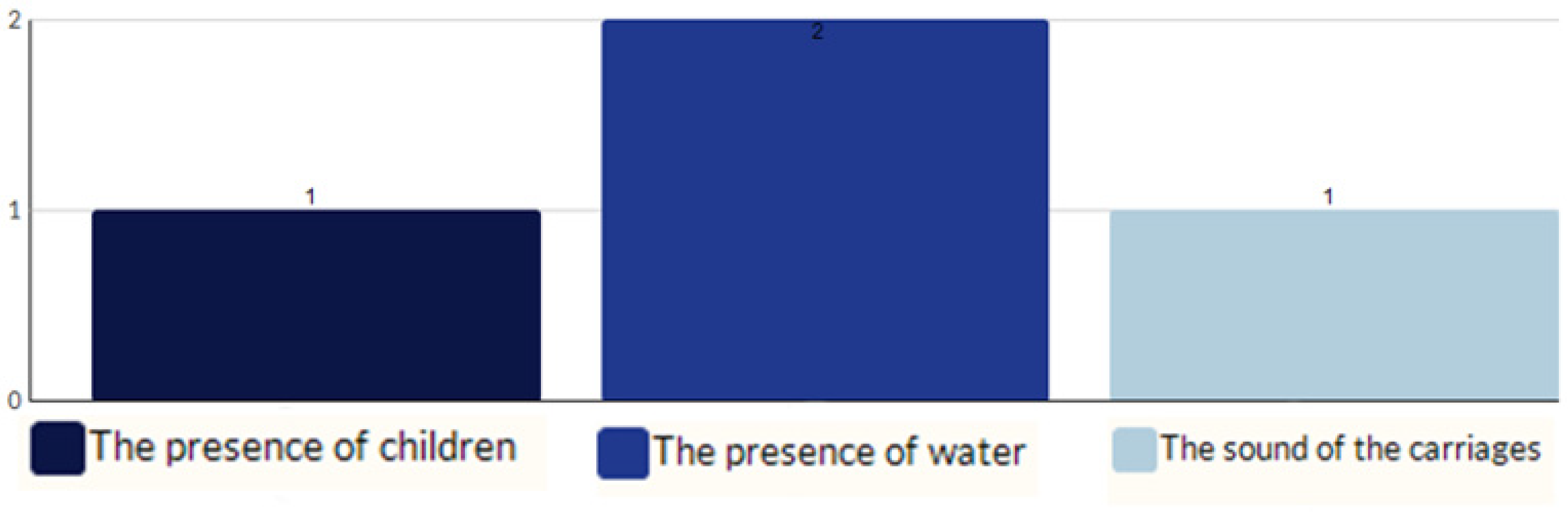
Table 6. Recurrence of touch ambience generators in Church Square during the first temporal phase (1840–1929).
Spatial ComponentPerceived AmbiencesAmbience GeneratorsGenerator Recurrences
Church SquareTouchBuilding materials1
Table 7. Variations in sensory ambiences across spatial components during the first temporal phase (1840–1929).
Time Period: First Phase (1840–1929)
Spatial ComponentVisualSoundThermalTactileOlfactoryGustatory
George Clemenceau StreetDominant2nd positionDominantWeakWeakAbsent
Marqué SquareDominant2nd position2nd positionAbsentWeakWeak
Church Square2nd positionDominantAbsentWeakAbsentAbsent
Table 8. Recurrence of gustatory, olfactory, thermal and tactile ambience generators along Georges Clémenceau Street during the second temporal phase (1929–1962).
Spatial ComponentPerceived AmbiencesAmbience GeneratorsGenerator Recurrences
Georges Clémenceau StreetGustatorybars and restaurants1
pastry shops1
street food stalls and rotisseries1
Olfactorybars and restaurants1
pastry shops1
street food stalls and rotisseries1
ThermalArcades2
TouchPaving1
Table 9. Recurrence of touch, gustatory, and olfactory ambience generators in Marqué Square during the second temporal phase (1929–1962).
Spatial ComponentPerceived AmbiencesAmbience GeneratorsGenerator Recurrences
Marqué SquareTouchBuilding materials3
GustatoryCafeterias and bars1
OlfactoryCafeterias and bars2
Table 10. Recurrence of sound, thermal and touch ambience generators in Church Square during the second temporal phase (1929–1962).
Spatial ComponentPerceived AmbiencesAmbience GeneratorsGenerator Recurrences
Church SquareSoundPresence of children1
ThermalThe trees in the square2
TouchMaterials3
Table 11. Recurrence of thermal and olfactory ambience generators in the square of the municipal theatre and its garden during the second temporal phase (1929–1962).
Spatial ComponentPerceived AmbiencesAmbience GeneratorsGenerator Recurrences
square of the municipal theatre and its gardenThermalThe garden and the water basin1
OlfactoryThe smell of the horses1
Table 12. Variations in sensory ambiences across spatial components during the second temporal phase (1929–1962).
Time Period: Second Phase (1929–1962)
Spatial ComponentVisualSoundThermalTactileOlfactoryGustatory
George Clemenceau StreetDominant2nd position3rd positionWeak3rd position3rd position
Marqué SquareDominant2nd position4th position3rd positionWeakWeak
Church SquareDominantWeak2nd position2nd positionAbsentAbsent
Municipal Theatre SquareDominant2nd positionWeakAbsentWeakAbsent
Table 13. Synthesis of variations in sensory ambiences across the two temporal phases (1840–1929 and 1929–1962).
Synthesis of Variations in Sensory Ambiences Across the Two Temporal Phases
Sensory AmbiancesFirst Phase (1840–1929)Second Phase (1929–1962)Justification
VisualPredominanceRecomposition of dominanceModifications of the built environment, evolution of uses, and transformation of social practices
SoundPredominanceRecomposition of dominance
ThermalPredominanceRecomposition of dominance
TactileModerate presencePersistenceEvolution of generators
OlfactoryWeak presenceReinforcementEmergence of new sensory generators such as bars, pastry shops, and street food stalls
GustatoryAbsentEmergence
Disclaimer/Publisher’s Note: The statements, opinions and data contained in all publications are solely those of the individual author(s) and contributor(s) and not of MDPI and/or the editor(s). MDPI and/or the editor(s) disclaim responsibility for any injury to people or property resulting from any ideas, methods, instructions or products referred to in the content.