
Abstract
This study presents a comprehensive digital workflow for the archaeological investigation and heritage enhancement of the Coëby megalithic necropolis (Brittany, France). Dating to the Middle Neolithic, between the 4th and 3rd millennia BC, this chronology is established through stratigraphy, material culture, and radiocarbon dating. Focusing on cairns TRED 8 and TRED 9, which are two excavation units, we combined field archaeology, photogrammetry, and topographic data with open-source 3D geometric modeling to reconstruct the monuments’ original volumes and test construction hypotheses. The methodology leveraged the free software Blender (version 3.0.1) and its Bagapie extension for the procedural simulation of lithic block distribution within the tumular masses, ensuring both metric accuracy and realistic texturing. Beyond static reconstruction, the research explores innovative dynamic and narrative visualization techniques. We employed the FILM model for smooth video interpolation of the construction sequences and utilized the Wan 2.1 AI model to generate immersive video scenes of Neolithic life based on archaeologically informed prompts. The entire process, from data acquisition to final visualization, was conducted using free and open-source tools, guaranteeing full methodological reproducibility and alignment with open science principles. Our results include detailed 3D reconstructions that elucidate the complex architectural sequences of the cairns, as well as dynamic visualizations that enhance the understanding of their construction logic. This study demonstrates the analytical potential of open-source 3D modelling and AI-based visualisation for megalithic archaeology.
1. Introduction
1.1. Archaeological and Scientific Context
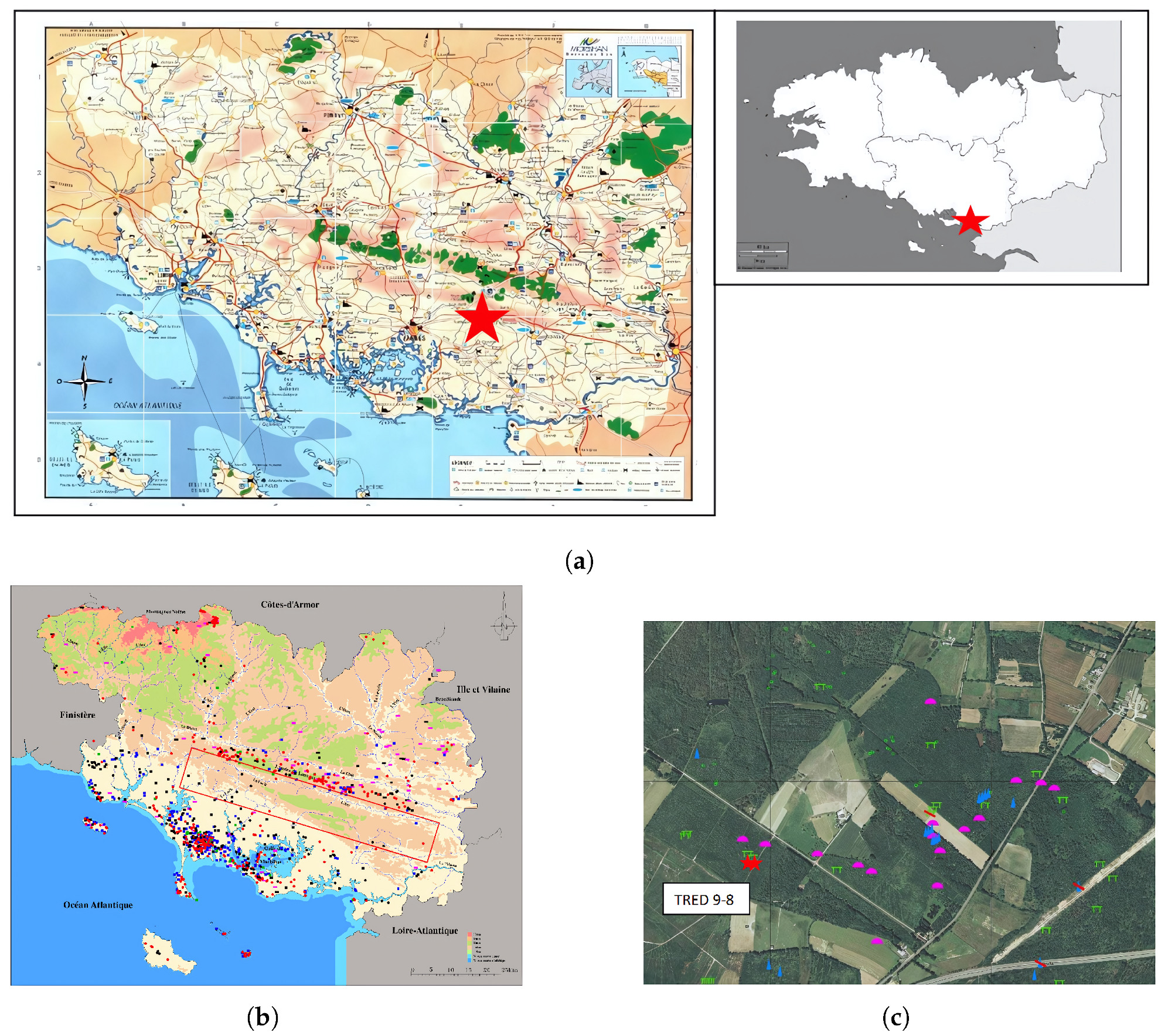
The TRED 8 and TRED 9 megalithic complexes of the Coëby necropolis (Brittany, France) constitute an exceptional assemblage for the study of funerary practices and construction dynamics of the Neolithic period. Located at the heart of the granitic massif of the Landes de Lanvaux in Morbihan, the site was revealed during systematic surveys conducted between 1986 and 1990 [1,2]. These investigations identified nearly 300 megalithic remains across the entire massif, including 75 concentrated structures forming a true necropolis (Figure 1) [3].
Figure 1.
Location and distribution of remains at the Coëby site [3]. (a) Geographic location map of the Coëby necropolis (Trédion municipality, Morbihan, France), generated using geographic information system (GIS) data from the French National Institute of Geographic and Forest Information (IGN). (b) Distribution map of megalithic remains across the Landes de Lanyaux massif, produced by compiling systematic survey data and integrated into a GIS. (c) Plan of the distribution of structures within the Coëby necropolis (purple) and location of the archaeological operation (red), created from topographic surveys.
In this study, the term ‘cairn’ refers to a funerary monument composed of a tumular mass of stone blocks covering one or more burial chambers, frequently surrounded by concentric stone facings. The Coëby necropolis has been the subject of recurring archaeological interest since its identification, with early work focusing primarily on inventory, typological classification, and regional contextualisation within Armorican megalithism [1,2]. Subsequent excavations, notably those directed by one of the authors (P. Gouézin), have shifted the focus towards understanding the internal architecture, construction sequences, and long-term use of its cairns [3]. These investigations revealed complex multi-phase structures characterised by concentric facings, blocked access passages, and evidence of reuse—features that challenge traditional static interpretations of megalithic tombs. Previous research on the site has been synthesised in several excavation reports and regional studies [3], but a comprehensive integration of digital volumetric reconstruction, procedural simulation, and AI-assisted visualisation had not yet been attempted. This study builds on this archaeological foundation by introducing a digital modelling approach.
Recent excavations continue previous research on the monumentalisation of megalithic architectures [4,5,6,7]. These monuments stem from complex architectural projects that have been largely leveled or collapsed today, whose reconstruction poses significant methodological challenges [8,9]. However, dolmens and cairns are the result of complex architectures, now partially destroyed, which makes their volumetric and architectural reconstruction particularly challenging.
1.2. Contributions of Remote Sensing and 3D Modelling
Recent advances in remote sensing and three-dimensional modelling now provide powerful tools to overcome these limitations. LiDAR (Light Detection and Ranging) data allow detailed restitution of microreliefs, even under dense forest cover [10,11,12,13]. Combined with drone photogrammetry (Structure from Motion, SfM), they facilitate the production of high-resolution georeferenced models and detailed documentation of architectural features [14]. Moreover, the integration of multispectral and hyperspectral data opens new perspectives for material characterization and palaeo-landscape analysis [15,16].
In this well-established context, our use of 3D modelling constitutes a deliberate advancement beyond basic restitution. While these remote sensing techniques are increasingly standard for recording current states, their application as a foundation for procedural simulation and dynamic process modelling remains less explored, particularly for megalithic cairns. Our methodology leverages 3D modelling not only to reconstruct lost volumes but also as an active experimental platform: to simulate different construction hypotheses through procedural generation, assess the spatial and volumetric coherence of competing architectural sequences, and produce dynamic visualizations that elucidate construction logic.
1.3. Methodological Choices and Technical Justification
For megalithic structures such as cairns, the use of a 3D mesh with explicit geometry offers several technical and perceptual advantages over simple texturing, even when enriched with bump or normal mapping. Explicit geometry allows faithful restitution of stone contours, volumes, and cast shadows—elements essential to perceiving the materiality and scale of the construction. Conversely, procedural textures, while effective for simulating relief, do not produce true topographic discontinuities, which limits their realism at close range or under grazing angles [17].
Studies on visual perception confirm that the quality of a model depends jointly on its geometry and its texture [18]. Furthermore, geometric modelling ensures the metric and topological accuracy required for quantitative analysis (volume, orientation, shading) and spatial computations.
Recent work has shown that three-dimensional reconstruction and simulation are not only tools for volumetric restitution, but also for exploring the perceptual and experiential dimensions of monumentality within past landscapes. Aires Da Cruz et al. [19] demonstrate how multidimensional 3D simulations can be used to assess the visual impact, spatial dominance, and sensory perception of monuments from the Neolithic to the Bronze Age. This perspective directly informs our approach, in which explicit geometric modelling and procedural simulation are employed to test not only architectural coherence, but also the readability and perceptual presence of cairns within their spatial context.
1.4. Towards Enhanced Digital Archaeology: Avatars and AI
Virtual humans play an increasingly important role in heritage reconstructions and digital archaeological environments. Far from being simple decorative elements, they contribute to validating spatial usage hypotheses, behavioural simulations, and immersive mediation. Numerous studies explore these applications, from the reconstruction of technical gestures to crowd modelling and social interactions (Table 1). These approaches help connect 3D models with plausible human contexts and enhance the pedagogical and interpretative value of visualisations, even though historical fidelity and behavioural calibration remain significant challenges.
Table 1.
Main use cases of virtual humans in archaeology and cultural heritage.
These examples demonstrate a trajectory towards more complex, interactive, and behaviorally rich simulations. However, they often rely on proprietary software, costly motion-capture systems, or custom-coded AI agents, creating barriers to reproducibility and widespread adoption. Our study references this body of work, particularly drawing on the goals of spatial validation and narrative mediation. Yet, it seeks to advance the field in three key ways:
- 1.
- Democratization through Open-Source Tools: We replace high-cost, proprietary pipelines (e.g., dedicated game engines, motion capture) with a fully open-source workflow. This prioritizes methodological reproducibility and accessibility.
- 2.
- Integration of Generative AI for Narrative: While previous work often uses pre-scripted or physically simulated avatars, we experiment with emerging generative AI video models to create narrative scenes directly from archaeologically informed text prompts. This explores a new, rapid method for generating plausible human context for architectural reconstructions.
- 3.
- Focus on Process over Product: Our primary aim is not to create a definitive, immersive VR experience, but to develop and test a reproducible pipeline that links geometric reconstruction, procedural simulation, and AI-assisted visualization for the purpose of hypothesis exploration and controlled scientific mediation.
The recent emergence of AI-based video generation tools and virtual avatars makes such experimentation far more accessible today. This work falls within this perspective by exploring the use of open-source tools to integrate the scientific, visual, and narrative dimensions of archaeological reconstruction seamlessly.
1.5. Objectives of the Study
To position this study within the reviewed state of the art, we explicitly address the following research questions, which highlight both continuity with and advancement beyond prior methodological approaches. Despite the richness of the archaeological documentation available for the Coëby necropolis, the original volumetry, construction sequences, and internal organization of the TRED 8 and TRED 9 cairns remain only partially understood. Erosion, stone extraction, and successive phases of reuse have profoundly altered these monuments, limiting the interpretative potential of traditional plans and stratigraphic descriptions when considered alone.
The present study is therefore structured around the following research questions:
- To what extent can the integration of remote sensing data, archaeological field observations, and explicit geometric 3D modelling contribute to the reconstruction of the original volumes and architectural sequences of complex megalithic cairns?
- Can procedural simulation of lithic block distribution be used to test, compare, and spatially validate competing hypotheses regarding the construction and evolution of multi-phase tumular monuments?
- How do dynamic visualisations derived from successive 3D reconstruction stages improve the analysis of construction processes and monument transformations when compared to static representations?
- What are the scientific contributions and limitations of relying exclusively on free and open-source tools, including emerging AI-based video generation methods, for hypothesis testing and archaeological mediation?
To address these questions, this research pursues four main objectives:
- To extract and characterise the micro-topographic and architectural features associated with the TRED 8 and TRED 9 cairns through the combined use of remote sensing data, photogrammetry, and field documentation;
- To reconstruct the internal geometry and original volumes of the monuments using explicit geometric 3D modelling, and to evaluate the spatial coherence of different construction hypotheses;
- To assess the analytical value of procedural modelling and dynamic visualisation for understanding the construction logic and long-term transformation of megali- thic architectures;
- To critically explore the role of open-source and AI-assisted visualisation tools as reproducible instruments for both scientific analysis and controlled heritage mediation.
By explicitly articulating research questions and objectives, this study aims to move beyond purely illustrative reconstructions and to demonstrate how digital modelling and simulation can function as experimental tools for investigating Neolithic architectural practices and their social and ritual implications.
2. Materials and Methods
2.1. General Framework and Interdisciplinary Approach
This study is based on an integrated approach combining field excavations, architectural analyses, photogrammetry, remote sensing, and 3D modelling. The methodological protocol was designed to articulate in situ archaeological recording, the acquisition of high-resolution spatial data, and their exploitation in a reproducible digital environment. This approach is fundamentally interdisciplinary, directly integrating methods from field archaeology, geomatics, 3D modeling, and artificial intelligence. Digital documentation involved photogrammetric recording using both drone and terrestrial cameras. The photogrammetric models, created from this imagery, served as the primary geometric reference for the 3D reconstructions, ensuring metric accuracy. Field operations consisted of a stratigraphic dismantling of the stones forming the tumular mass, together with precise architectural recording of the facings and internal structures. Spatial data derived from photogrammetry, topography, and stratigraphic documentation were integrated into a single georeferenced framework. In addition, several specialised analyses were conducted: lipid residue analyses following established protocols [28,29], radiocarbon (14C) dating, geomorphological studies, and geophysical surveys [30]. These results provided the chronological and environmental constraints essential for interpreting the structures.
2.2. Documentary Sources and Data Validation
The documentary corpus used included plans and sections produced during the excavation campaigns, field photographs and annotated stratigraphic drawings, and photogrammetric models derived from drone and ground-based imagery. These sources served both to guide geometric modelling and to validate the spatial coherence of the reconstructed structures. In addition to visual inspection, a set of quantitative consistency indicators was derived from the reconstructed 3D models in order to assess their spatial coherence. All cairn models were produced as closed, metrically constrained meshes based on georeferenced excavation plans, photogrammetric data, and stratigraphic documentation. Rather than aiming at absolute volumetric measurements, we relied on relative and structural indicators extracted directly from the models, including: (i) relative proportions between successive construction phases, (ii) thickness ratios between facings and tumular envelopes, and (iii) spatial continuity and symmetry of reconstructed architectural elements. These indicators provide quantitative constraints that allow comparison between reconstruction stages and between monuments, while remaining compatible with the uncertainties inherent to archaeological reconstruction.
2.3. Environment and 3D Modelling Pipeline
2.3.1. Choice of Environment
The 3D reconstruction was carried out using the open-source software Blender (version 3.0.1), selected for its Python (version 3.11) scripting capabilities, which facilitate automation and reproducibility; its flexibility for geometric modelling of complex structures; its integration with specialised extensions such as Bagapie; and its compatibility with open-science principles.
2.3.2. Workflow
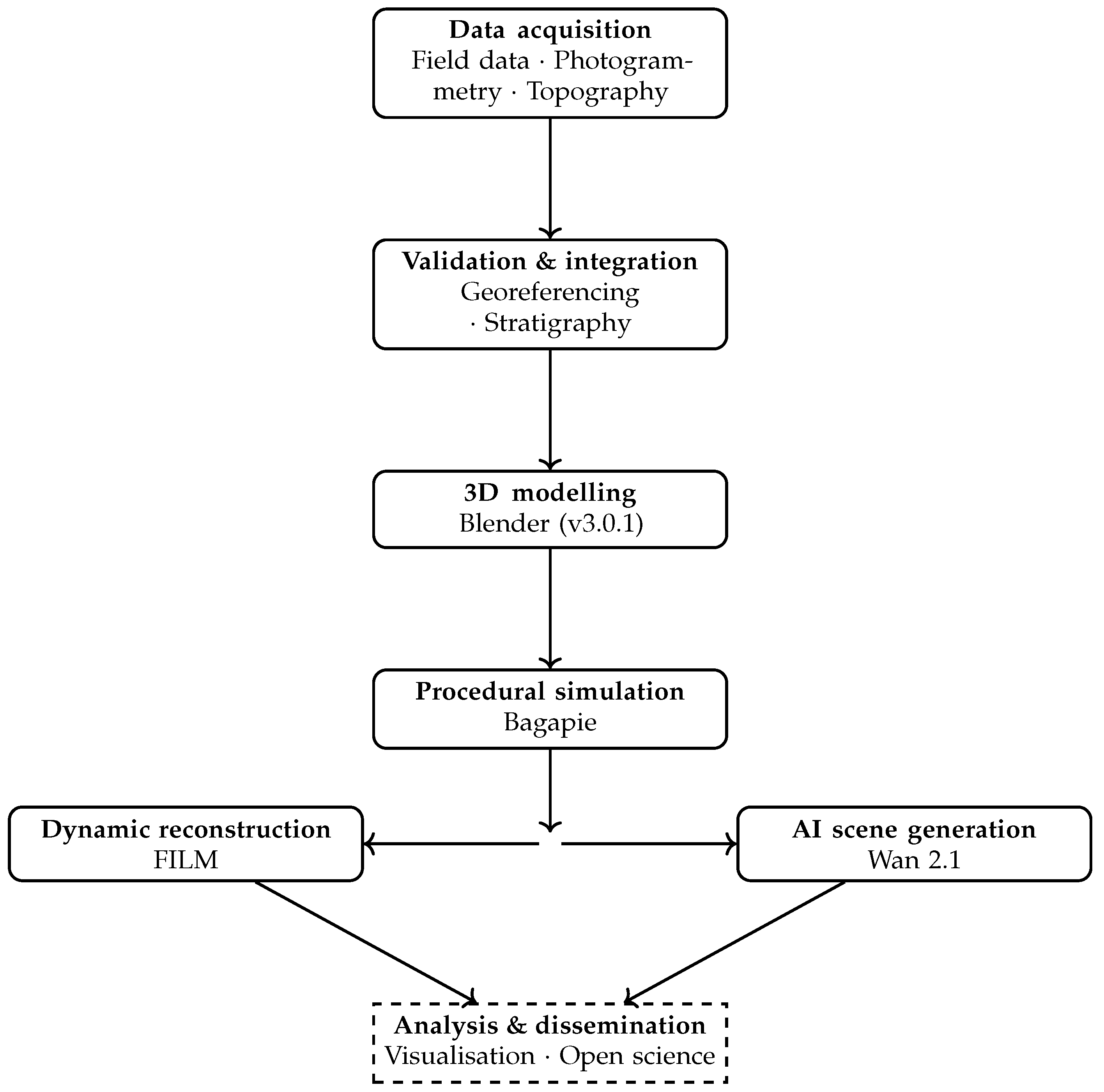
The 3D workflow consisted of four main stages, as illustrated in Figure 2. First, spatial data acquisition and preprocessing involved the integration of plans and field sketches within a single reference system. Second, geometric modelling entailed the reconstruction of structural elements (floor slabs, orthostats, facings, capstones) based on field data and observations. Third, simulation of tumular volumes involved the controlled or semi-random distribution of lithic blocks according to geometric and stratigraphic constraints using the Bagapie extension [31]. Fourth, rendering and visualisation involved the production of images and 3D sequences for comparative analysis and heritage dissemination.
Figure 2.
Synthetic diagram of the methodological processing pipeline, from data acquisition to visualization. The workflow integrates field data, photogrammetry, and topography; their georeferencing and stratigraphic validation; explicit 3D modeling in Blender; procedural block simulation using the Bagapie extension; dynamic video interpolation with the FILM model; narrative scene generation via the Wan AI model; and finally, scientific analysis and mediation phases.
2.4. Simulation of Stone Distribution
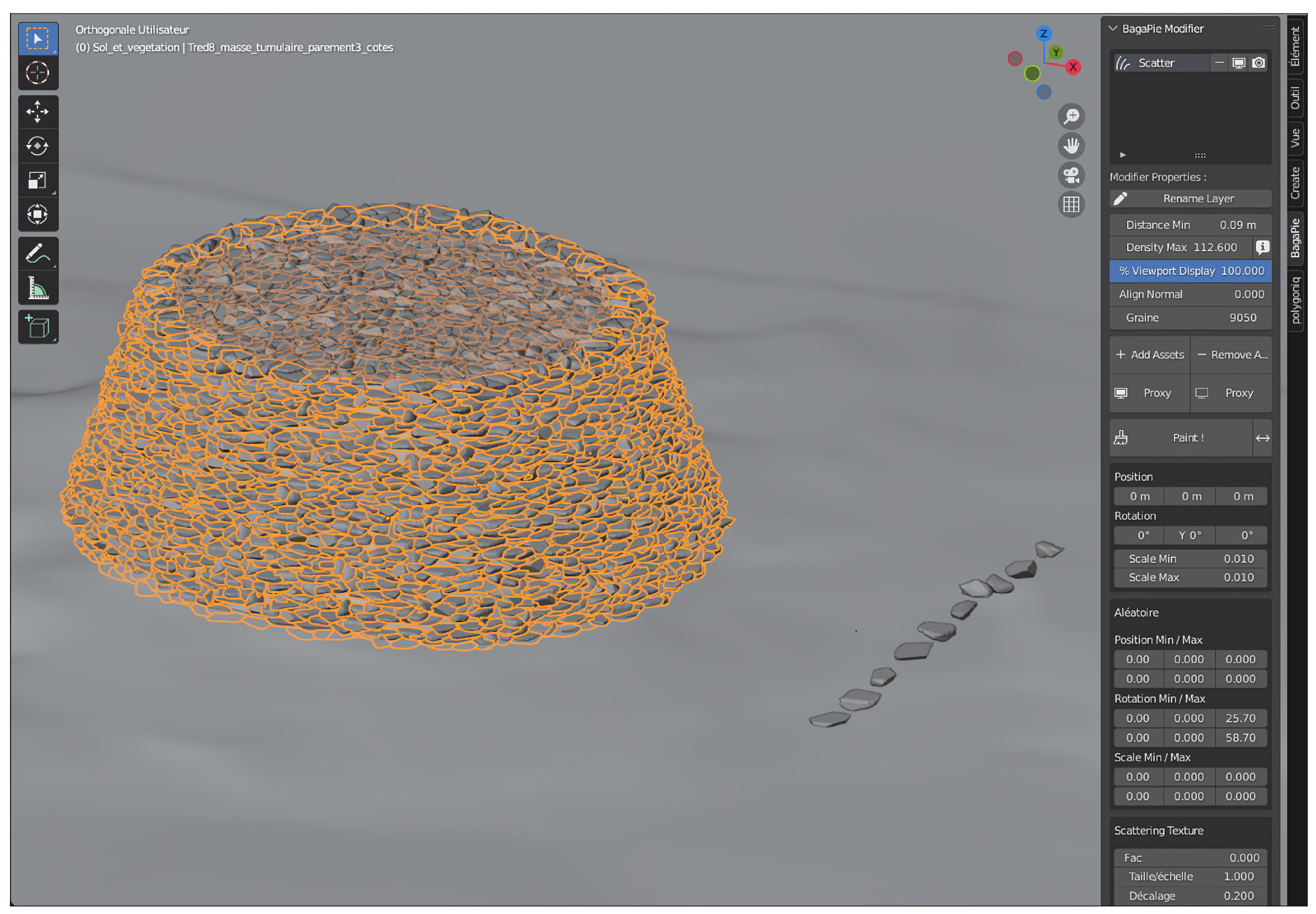
The simulation of lithic block distribution was performed in Blender using the open-source extension Bagapie [31]. The procedural simulation of lithic block distribution is conceived as a constrained exploratory tool rather than a predictive reconstruction. Its objective is not to reproduce a single “true” construction state, but to explore a space of volumetrically and architecturally plausible solutions compatible with the archaeological record. Consequently, the robustness of the method does not rely on a unique parameter setting, but on the convergence of global structural outcomes under a range of archaeologically plausible parameters. Developed for the procedural generation of complex structures, this tool allows the definition of geometric and topological rules (orientation, slope, density, volumetric limits) for block distribution. Figure 3 illustrates an example of a distribution generated using this method. Block density parameters were defined according to three complementary constraints. First, a volumetric constraint ensures the closure of the tumular mass between successive facings, avoiding large internal voids incompatible with the observed long-term stability of the monuments. Second, archaeological constraints derive from field observations of tightly packed granite blocks within Armorican cairns, characterized by heterogeneous block sizes and limited interstitial spaces. Third, an experimental constraint was applied through iterative testing: parameter values producing systematic interpenetration, excessive voids, or unrealistically regular surfaces were rejected.
Figure 3.
Example result of the procedural simulation of lithic block distribution within the cairn, generated using the Bagapie extension in Blender (version 3.0.1). The simulation applies volumetric, archaeological, and geometric constraints to controllably reproduce the architectural texture of the tumular mass. The render uses Blender’s Cycles engine.
2.5. Video Production from 3D Reconstructions
2.5.1. Image Interpolation and Video Generation with FILM
The creation of animated sequences from 3D renderings was carried out in Google Colab [32], using the FILM (Frame Interpolation for Large Motion) model [33,34]. Developed by Google Research and released under the Apache 2.0 open-source licence, this model automatically generates intermediate frames between two successive images to produce smooth animation.
The image series resulting from the cairn reconstructions were transferred to Google Drive and processed using a customised notebook (FILM_coeby.ipynb). The FILM neural network relies on a hierarchical convolutional architecture capable of predicting motion flow and reconstructing occluded areas. Interpolation is applied iteratively to all images in a sequence, then assembled into an MP4 video.
Initial processing took one to two minutes per sequence (on GPU), and up to 60 min when only CPU usage was permitted. Final videos were assembled using the open-source software Shotcut (version 23.09.29) [35], producing a continuous sequence illustrating the construction and progressive transformation of the structures. All video results are available in [36].
2.5.2. Generation of Video Scenes Using AI Models
For the scenes illustrating Neolithic life, and following a previous study [37], we used the Wan 2.1 model, an open-source video-generation system released under the Apache 2.0 licence [38]. Wan 2.1 is based on an architecture combining a variational autoencoder (VAE) and a diffusion transformer [39], enabling text-to-video (T2V) and image-to-video (I2V) generation with temporal continuity.
The Wan-VAE module encodes sequences into a low-dimensional latent space, preserving the dynamics of movement. The diffusion transformer then refines these latent representations to produce coherent successive images. This architecture, trained on billions of images and videos, ensures strong spatio-temporal coherence.
Two scenes were generated from two 3D-rendered images:
- Outdoor scene (cairns)—“Realistic slow-camera video. Around the cairns, make a small group of Middle Neolithic humans (4th–3rd millennium BC) appear, men and women aged 20–40, with sun-exposed medium skin tones and brown or black hair tied in simple braids. Clothing made of woven plant fibres, deer hides, and coarse wool cloaks, in earth, ochre, and brown tones. No metal. They interact peacefully with the monuments under construction: some carry small granite plaques or large cobbles from the local substrate, others inspect the cairn facings, adjust slabs, or clean the forecourt by scraping the ground with wooden or antler tools. The scene shows calm, precise gestures. Include a slight travelling camera movement. Sober atmosphere, rooted in archaeological reality, without anachronisms.”
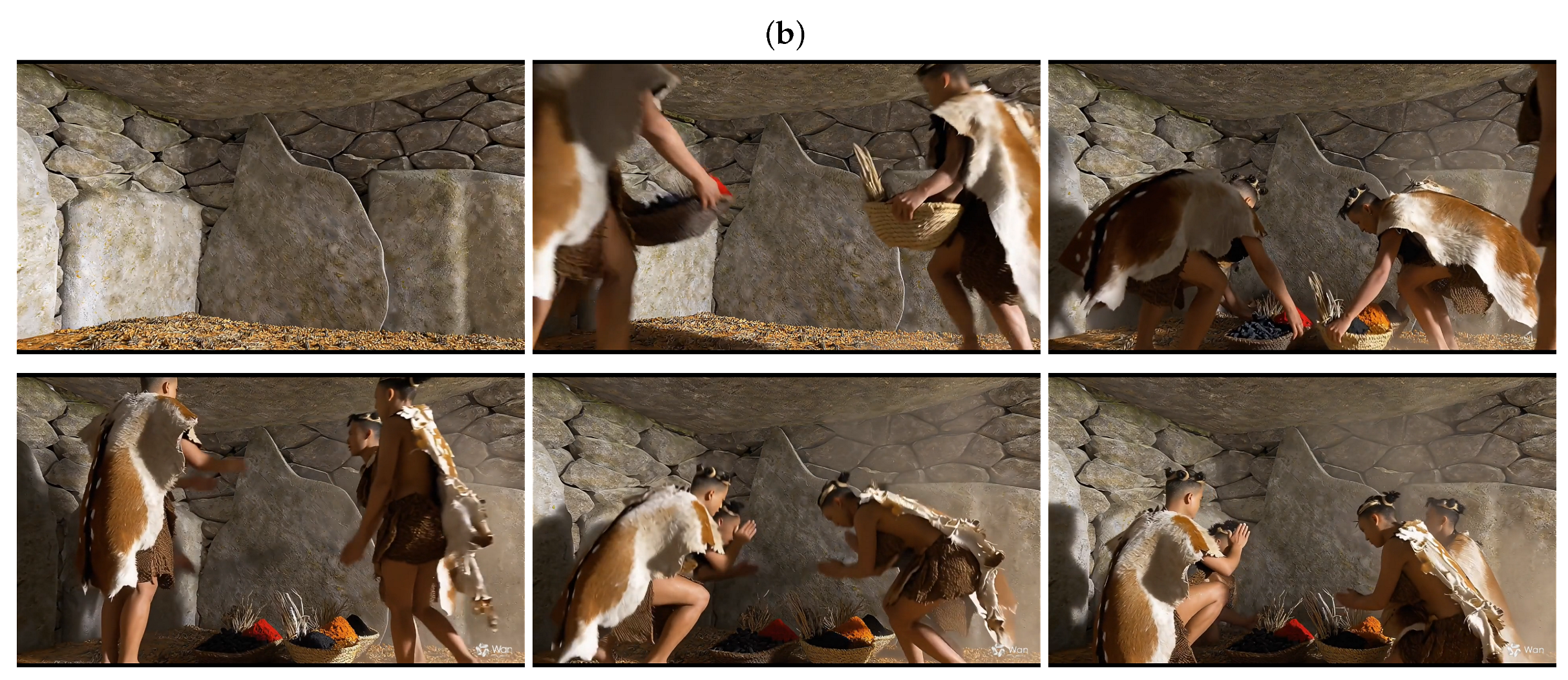
- Indoor scene (Tred 8)—“Immersive backlit video inside the funerary chamber, illuminated by natural light entering through the corridor. Show two or three Neolithic individuals wearing deer-skin coats and woven tunics, hair tied in twists. They enter slowly, carrying plant-fibre baskets containing charcoal, ochre pigments, and small symbolic offerings (polished pebbles, flint fragments). They place these objects at the foot of the stele already visible at the centre of the image and perform respectful gestures. The atmosphere should be calm and ritualised: dust suspended in the light, shadows sliding over the stones, emphasis on the materiality of the granite and the texture of the loamy floor. The camera must remain fixed.”
The generated videos are also accessible in [36].
3. Results
3.1. Archaeological and Architectural Results
The combined use of data from photogrammetry, topography, and stratigraphic documentation made it possible to reconstruct the architectural sequences and to test different hypotheses regarding the original configuration of the tumuli.
3.1.1. TRED 8
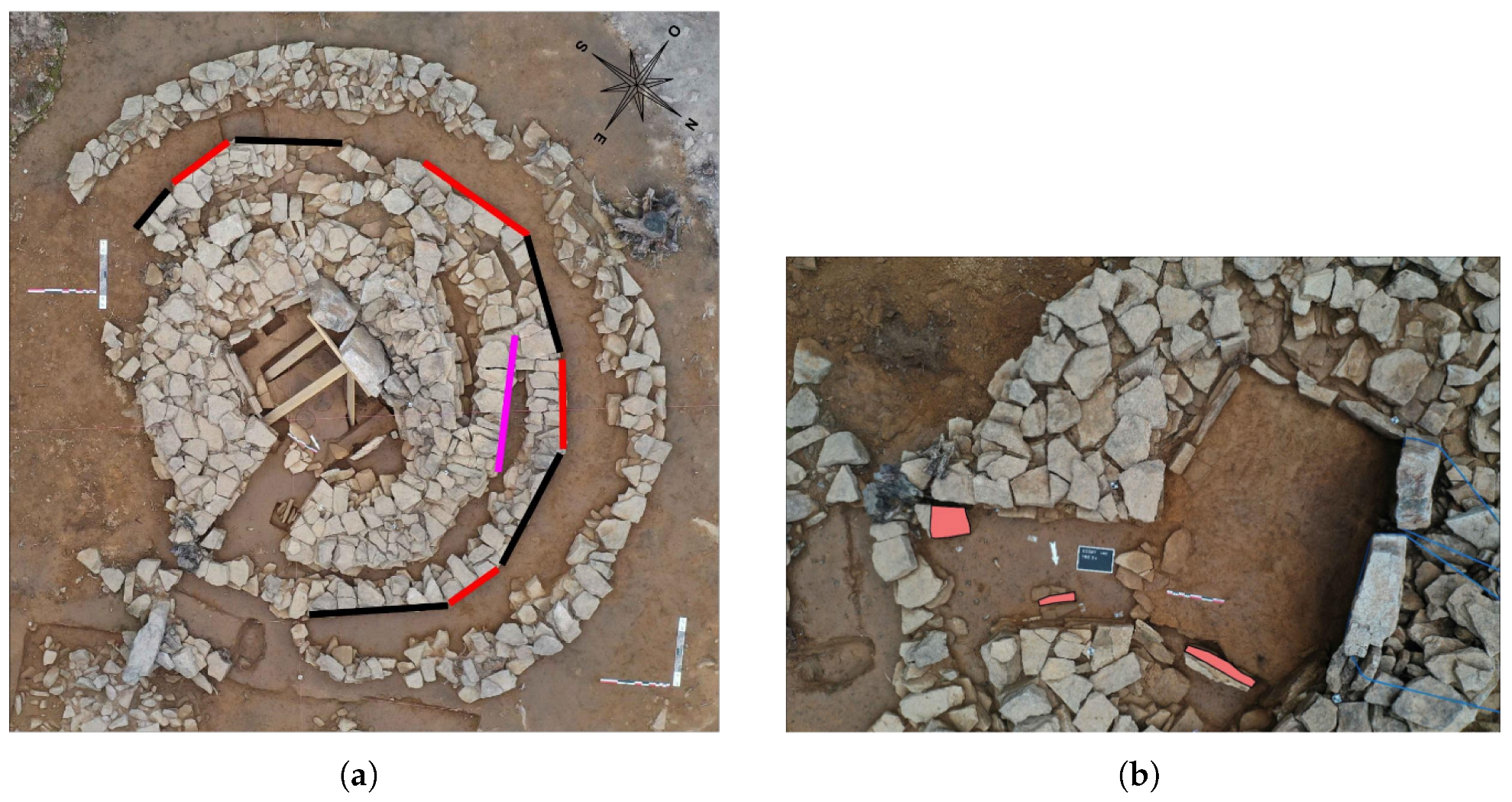
TRED 8 presents a complex tumular structure composed of four concentric facings (P1 to P4) surrounding an additional inner facing (P0), a rare feature in Neolithic funerary monuments. Facing P3, built with straight segments (Figure 4a), suggests a technique aimed at obtaining a circular ground plan.
Figure 4.
(a) Zenithal view of facing P3 of cairn TRED 8, extracted from the high-resolution photogrammetric model. The rectilinear geometry of the segments suggests a construction technique aimed at achieving a circular ground plan; (b) Hypothesis of an alignment of standing stones in the access corridor of TRED 8, reconstructed from excavation observations and integrated into the georeferenced 3D model. The perspective aims to test the spatial coherence of this configuration.
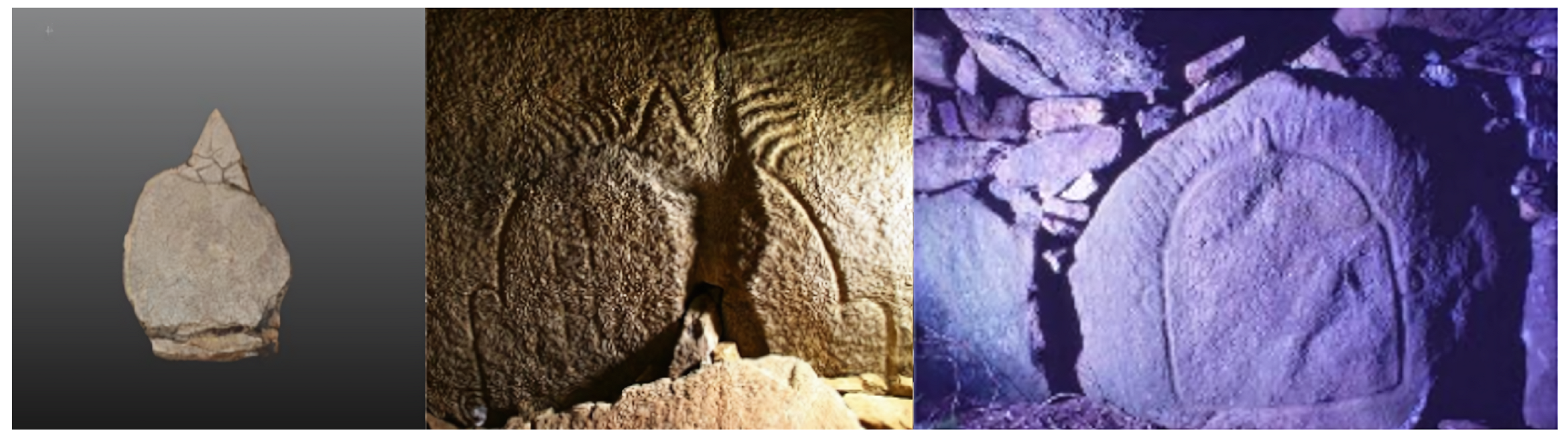
The access corridor includes several successive blocking systems and truncated standing stones aligned with an anthropomorphic stele (Figure 4b), indicating a possible reuse of an earlier megalithic arrangement, similar to observations made at Hoëdic [40]. In the burial chamber, an anthropomorphic stele (Figure 5), two intact pots attributed to the Middle Neolithic II, and a pink bladelet potentially dating to the Mesolithic form an exceptional assemblage.
Figure 5.
Anthropomorphic stele discovered in the chamber of cairn TRED 8 (photo: P. Gouézin, 2021 campaign).
Lipid residue analysis on the pottery [41] reveals animal fats, likely dairy, in P5 and a mixture of fats and beeswax in P6, in accordance with standardized protocols [42,43,44,45,46]. These results align with the European trend of functional specialization of funerary vessels [47,48,49].
3.1.2. TRED 9
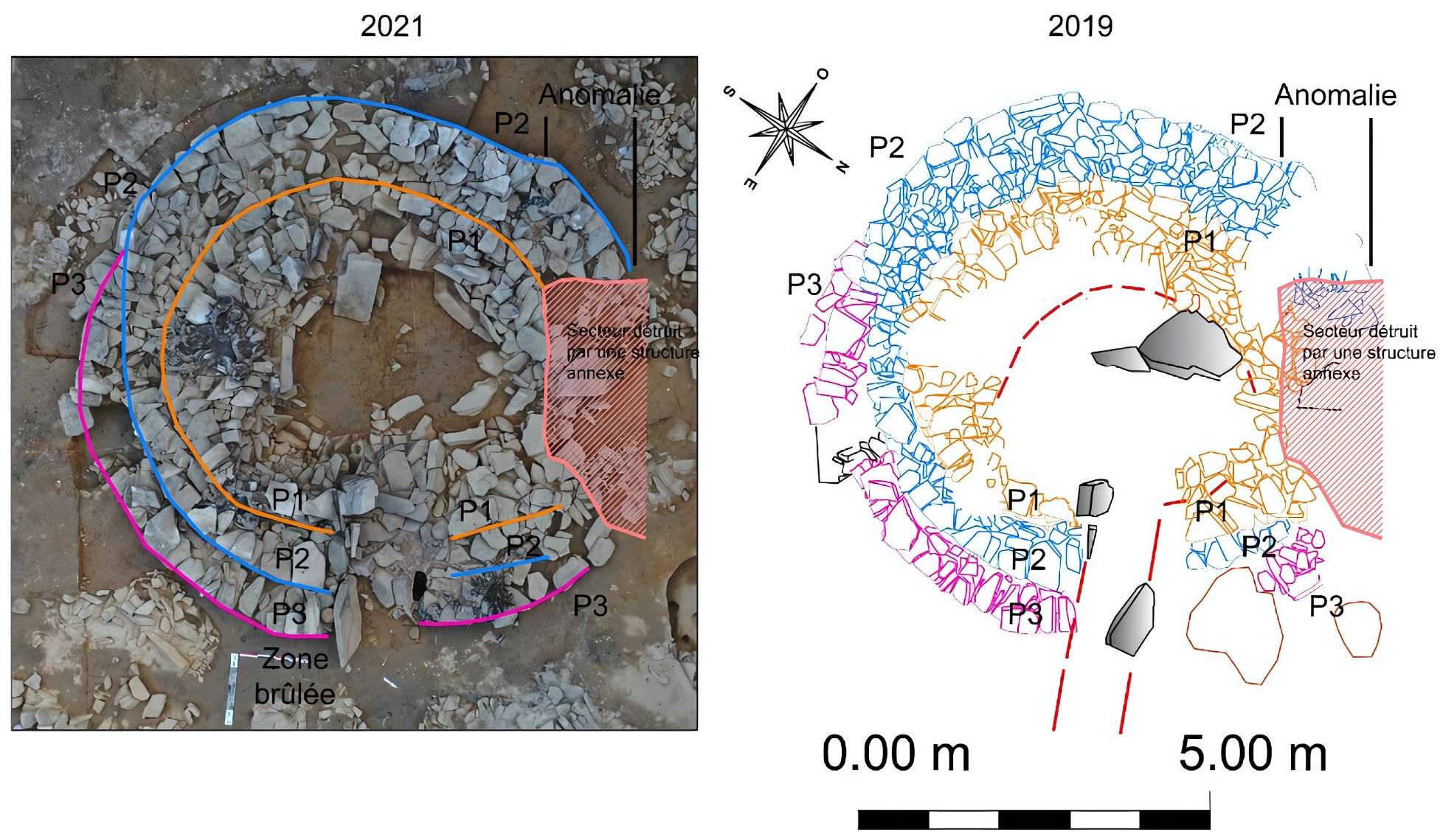
Despite disturbances caused by stone extraction, TRED 9 shows an organization comparable to TRED 8, with three concentric facings and repairs on P2 (Figure 6). The annex structure SA4 yielded an engraved statue-menhir, exceptional in a Breton context, comparable to those of Kermené, Laniscar, and Guernsey [50].
Figure 6.
Zenithal view and state of the structures of cairn TRED 9. (Left) Orthophotoplan from the 2021 drone photogrammetry campaign. (Right) Orthophotoplan of the state of structures in 2019. The comparison visualizes the excavation progress and disturbances related to stone extraction.
3.2. 3D Reconstructions of the Cairns
3.2.1. General Methodology
The 3D models of cairns TRED 8 and TRED 9 were produced from data enabling the visualization of construction progress (see Table 2), the relationships between chambers, corridors, and peripheral devices, as well as the complexity of the concentric facings. These images were already presented in November 2022 at a conference on archaeology entitled Rencontres du Mégalithisme (also known as “Meetings on Megalithism”) [51].
Table 2.
Main reconstruction stages of cairns TRED 8 and TRED 9.
3.2.2. TRED 8
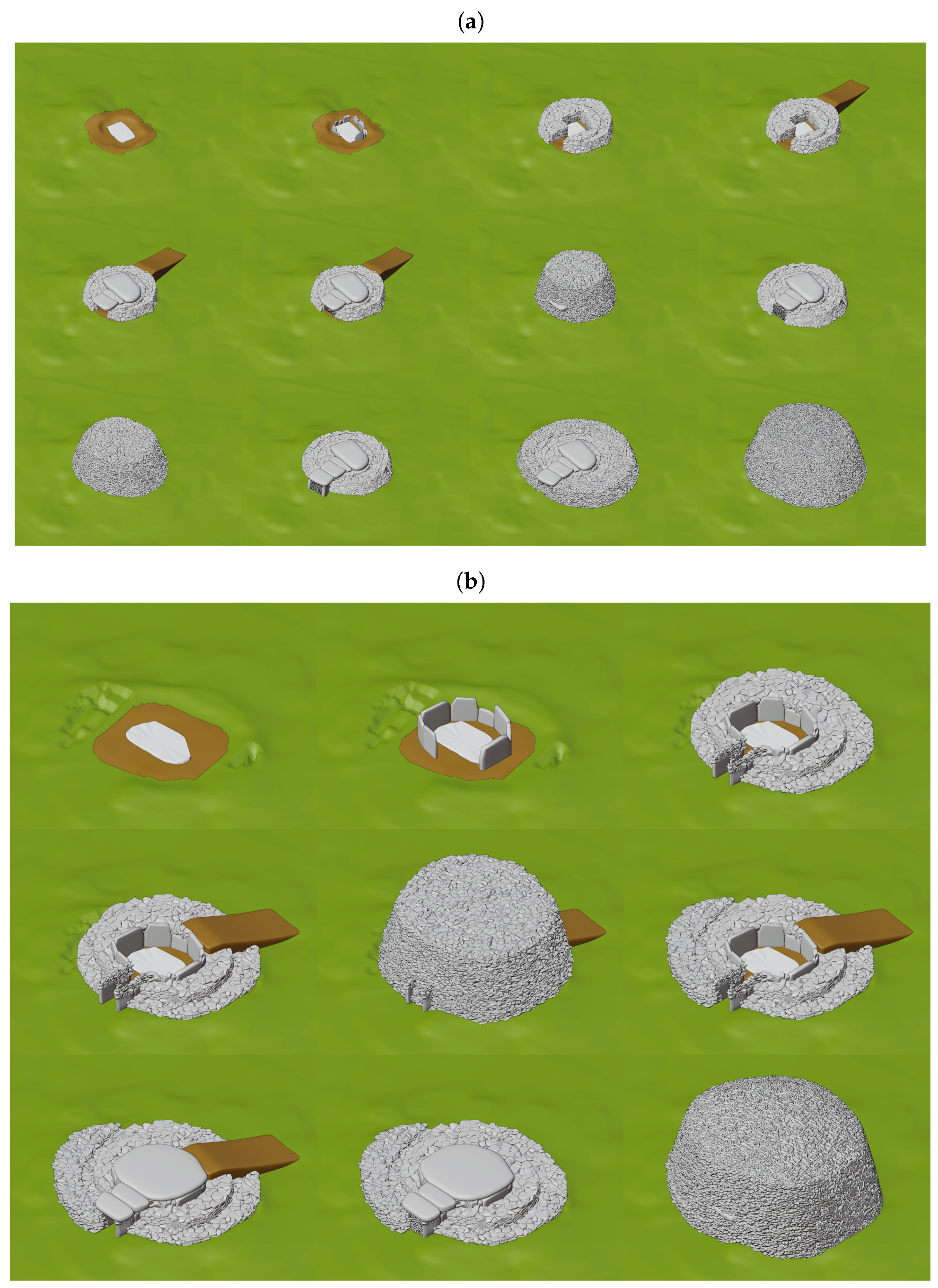
The series of 12 views (Figure 7a) retraces the progression from the reconstruction of the substratum to the final configuration of the tumulus, integrating orthostats, successive facings, and internal blocks.
Figure 7.
(a) Series of 12 static views illustrating the 3D reconstruction stages of cairn TRED 8. The sequence, generated by successive rendering in Blender, progresses from the modeling of the substrate to the final tumulus configuration, integrating orthostats, concentric facings, and the stone mass; (b) Series of 9 static views illustrating the 3D reconstruction stages of cairn TRED 9. Produced using the same methodology, it highlights the architectural organization. Both series served as the basis for dynamic video interpolation via the FILM model. (a) TRED 8 series: 12 views. (b) TRED 9 series: 9 views.
3.2.3. TRED 9
The series of 9 views (Figure 7b) shows a monument with a comparable organization, highlighting the coherence of the overall plan and the position of the annex structure.
The reconstructed 3D models allow the extraction of simple quantitative indicators that complement the visual analysis of the cairns. These indicators focus on relative spatial properties rather than absolute measurements. For both TRED 8 and TRED 9, the ratios between the thickness of successive facings and the overall tumular envelope remain consistent across reconstruction stages, supporting the internal coherence of the proposed construction sequences. Similarly, the relative expansion of the tumular mass between architectural phases follows a progressive pattern compatible with multi-phase accumulation rather than single-event construction. These relative indicators provide quantitative support for the architectural interpretations, demonstrating that the reconstructed geometries are not only visually plausible but also spatially coherent within a constrained metric framework.
3.3. Analysis of Reconstruction Video Sequences
The analysis of the video sequences allows observation of the appearance, deformation, and disappearance of architectural structures. Table 3 summarizes the transformations observed for TRED 8 and TRED 9, highlighting morphological differences and spatial coherence.
Table 3.
Analysis of construction video sequences for TRED 8 and TRED 9.
3.4. Analysis of Scene Videos
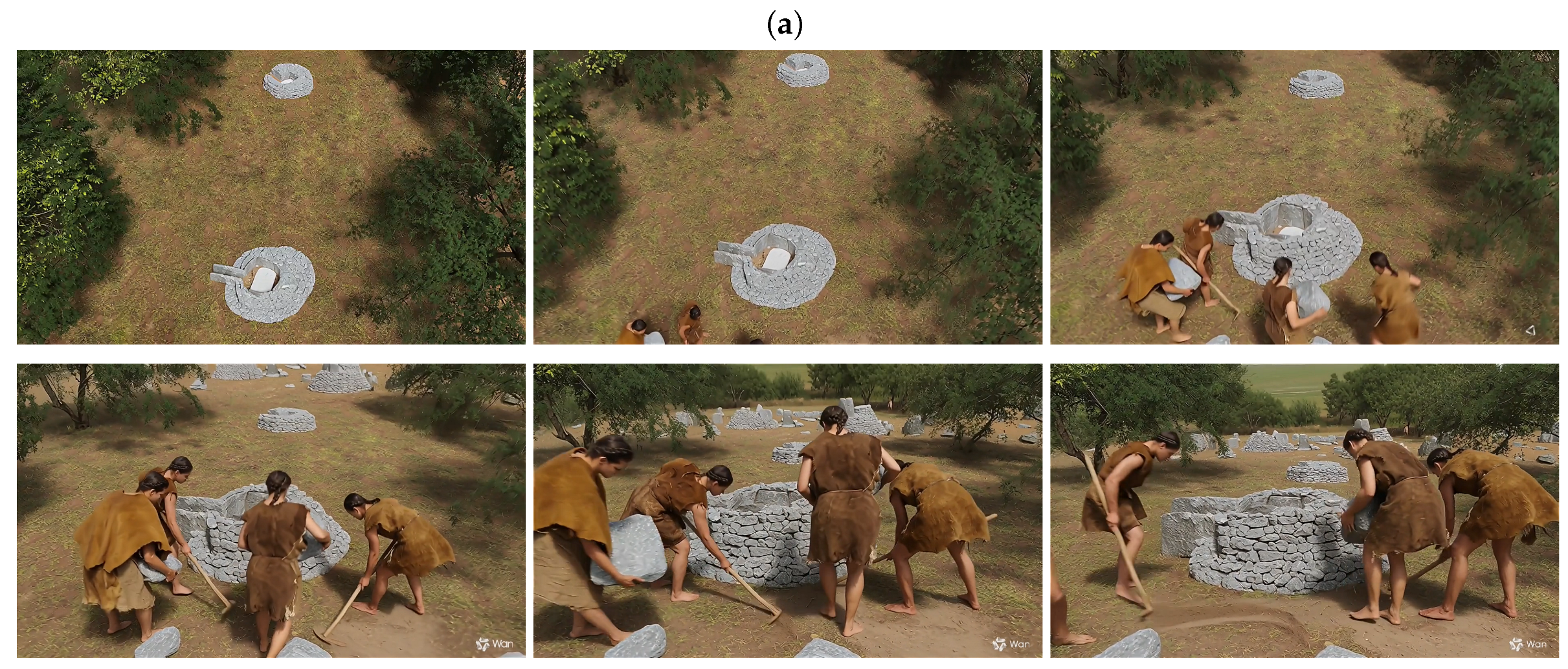
Figure 8 shows screenshots from the two videos, exterior (a) and interior (b). The videos are 5 s long, and the screenshots were taken every second.

Figure 8.
(a) Screenshots, at one-second intervals, of the AI-generated video (Wan 2.1 model) for the exterior scene. The 5-s sequence was produced from a detailed textual prompt describing plausible Neolithic construction activities. Notable biases are present (skin tones, scale, concentration of characters); (b) Screenshots, at one-second intervals, of the AI-generated video for the interior scene of the TRED 8 funerary chamber. Generated from a base 3D render and a prompt describing a ritual, it presents an immersive atmosphere but similar limitations (skin tones, absence of the deceased).
The generated videos are visually striking and dynamic, successfully recreating an immersive atmosphere. Several limitations related to scale, realism, and interpretative control were observed and are discussed in Section 4.4.
4. Discussion
4.1. Archaeological and Interpretative Perspectives
This study is situated within the continuity of research on Armorican megalithism initiated by Giot [52], L’Helgouach and Lecornec [53], and Le Roux and L’Helgouach [54]. However, it renews these approaches by integrating 3D modelling and numerical simulation, thereby providing unprecedented analytical access to the structural logic of megalithic monuments.
4.1.1. Integrating Architecture and Funerary Practice
A core methodological premise of this work is that funerary use and architectural form are intrinsically linked. Features documented at TRED 8 and TRED 9—including chamber dimensions, access systems, blocking devices, and multi-phase construction—are interpreted as being directly shaped by repeated ritual activity. Archaeological evidence from Armorican megaliths attests to highly variable and long-term mortuary behaviors, such as primary and secondary inhumations, sequential chamber reopenings, and the rearrangement of remains and goods [55,56,57]. Such practices inevitably influence a monument’s stability, spatial organization, and progressive alteration.
4.1.2. From Technical Analysis to Social Inference
The detailed architectural sequences revealed by our models allow us to formulate new hypotheses concerning the Neolithic communities involved. The technical complexity observed—such as the multi-phase concentric facings of TRED 8 or the repair of facing P2 at TRED 9—indicates a significant, coordinated investment of labor and sophisticated architectural knowledge that was transmitted across generations. These were not static tombs but dynamic structures. Evidence of reopening, rearrangement (e.g., the repositioned stele in TRED 8), and maintenance suggests the cairns served as active focal points in the social and ritual landscape. Their physical transformation likely mirrored the evolving practices and social narratives of the communities that returned to them over centuries.
Future work could build on this architectural foundation to address funerary and social dynamics more directly, potentially through non-figurative spatial simulations or interdisciplinary approaches combining architecture, bioarchaeology, and taphonomy.
4.2. Procedural Simulation of Block Distribution
The robustness of the procedural approach was assessed by varying key parameters—block density, size dispersion, and shape constraints—within archaeologically plausible ranges. While local surface textures and micro-variations differ between simulations, the global architectural features (overall volume, stability of facings, and readability of construction phases) remain stable. This indicates that the interpretative conclusions are not driven by fine-tuned parameter choices but by the underlying architectural and archaeological constraints imposed on the model.
The use of the Bagapie extension in Blender to simulate block distribution made it possible to realistically reproduce the morphological variability observed in the field. This approach relies on controlled stochastic modelling, combining the geometric accuracy of topographic data with constrained random generation, thereby recreating the characteristic architectural texture of cairns. The simulations revealed differentiated zones within the composition of the tumular masses.
From a methodological standpoint, simulation opens the way to a form of digital experimental archaeology. It allows various construction scenarios to be tested (assembly order, material density, structural balance) while ensuring traceability and reproducibility of the employed parameters. The use of open-source software further enhances scientific transparency and facilitates the transferability of the protocol to other megalithic contexts.
Importantly, the quantitative approach adopted here is deliberately based on relative and structural indicators rather than absolute measurements. Given the partial preservation of the monuments and the hypothetical nature of volumetric reconstruction, relative metrics offer a more robust and epistemologically appropriate means of validation.
These indicators function as internal consistency checks, ensuring that the reconstructed architectures obey plausible spatial relationships and construction logic. As such, they reinforce the scientific contribution of the study beyond pure visualization, while avoiding over-interpretation of uncertain absolute values.
4.3. Video Interpolation for Dynamic Reconstruction
The application of the FILM model (Frame Interpolation for Large Motion) to interpolate sequences derived from 3D reconstructions represents a significant methodological advance. Originally designed for video processing, this technique has proven particularly effective in restoring the morphological continuity of monuments throughout the reconstruction stages.
The resulting videos provide a fluid visualisation of the spatial transformations involved in the construction and degradation of structures. They facilitate the understanding of constructive processes by revealing how volumes adjust and interact. Moreover, this approach promotes effective scientific outreach: animations, integrated within open-source environments, enable wide dissemination of the results to non-specialist audiences without compromising scientific rigour.
Despite its advantages, this method presents several limitations. On the technical side, some interpolations still produce visual artefacts that may hinder morphological interpretation. Additionally, the intentionally rapid transition pace, while effective for highlighting volumetric continuity, may reduce the immediate legibility of individual construction phases. Interpretatively speaking, the fluidity of transitions can create an illusion of temporal continuity, effectively smoothing over the actual stratigraphic discontinuities caused, for instance, by funerary activity. It is therefore essential to clarify that this is a technical simulation rather than a chronological reconstruction. This methodological choice primarily aims to validate the architectural and spatial coherence of the structures, rather than to reconstruct the precise cultural or chronological sequences of their use. Finally, reliance on cloud environments raises issues of data sustainability and sovereignty.
Despite these constraints, the FILM approach represents a promising avenue for the dynamic analysis and mediation of megalithic architectures, provided its uses are rigorously framed and its potential biases thoroughly documented. The 3D reconstructions focus on architectural form and construction sequence, deliberately omitting the central mortuary activities that defined the site’s purpose. While the architectural analysis is informed by this function, visualising the specific funerary practices—such as the deposition and manipulation of remains—remains speculative. This represents a methodological boundary between reconstructing the monument’s physical structure and interpreting its core ritual use.
The dynamic visualizations derived from 3D reconstructions are not merely illustrative tools, but genuine devices for interpretative analysis. By animating the various construction and transformation hypotheses for the cairns, they allow for testing their spatial and architectural coherence over time.
This approach highlights the fundamentally processual nature of the monuments: cairns are not static architectures, but evolving structures, regularly modified according to funerary practices. Dynamic visualization makes perceptible the spatial constraints related to the reopening of chambers, phases of closure, and successive rearrangements, strengthening the interpretation of the monuments as active collective tombs over the long term.
Finally, shifting from static reconstructions to animated sequences allows for a better understanding of the progressive monumentalization of the structures. It becomes possible to visualize how certain architectures physically and symbolically disappear under later mound additions, contributing to an intentional transformation of the monument’s perception. In this sense, dynamic 3D reconstructions constitute an essential heuristic tool for linking archaeological data, architectural hypotheses, and the interpretation of funerary practices.
4.4. AI-Based Generation of Video Scenes
The use of the Wan 2.1 model to generate videos from textual descriptions marks an important step in producing immersive Neolithic reconstructions. This diffusion-transformer system enables the simulation of animated environments incorporating gestures, materials, and lighting conditions consistent with current archaeological knowledge.
These scripted videos, based on archaeologically coherent prompts, offer a novel tool for visual experimentation: they facilitate the assessment of the plausibility of architectural or ritual hypotheses and stimulate scientific discussion on the social and symbolic functions of the monuments. The openness of the code and transparency of parameters (model weights, prompts, diffusion settings) ensure an ethical production process aligned with research standards.
Several concerns must nonetheless be raised. The generated avatars rely on contemporary datasets, introducing cultural or morphological biases (anachronistic features, inadequate gestures, questionable skin tones). Similarly, the metric consistency of the scenes (scale of characters, shadows, perspectives) remains imperfect. These aspects must be systematically contextualised to avoid overinterpretation. The scientific robustness of this study relies on transparent documentation: model versions, prompts, and parameters are specified to ensure reproducibility. Each visual output, from static reconstructions to AI-generated scenes, is presented with its associated limitations, framing them as tools for hypothesis exploration rather than definitive representations.
A particularly significant limitation for archaeological application is the current models’ weak handling of metric scale and geometric faithfulness. This is exemplified in the video, where the generative process failed to maintain the precise scale relationship defined by the source 3D model, resulting in a cairn that appears disproportionately small relative to the human figures. This distortion stems from a fundamental technical gap: diffusion-based video generation models like Wan 2.1 are optimized for visual and semantic coherence from textual prompts but lack an embedded mechanism to faithfully inherit and constrain scenes using the metric data from archaeological 3D geometry. Consequently, while effective for creating atmospheric narrative ambience, such AI-generated sequences in their current form have limited utility for testing specific hypotheses related to human-monument interaction, spatial ergonomics, or the experiential perception of scale. This highlights a critical challenge for future work: integrating the narrative potential of generative AI with the metric rigor of explicit 3D modelling will require hybrid pipelines where generation is tightly controlled via depth maps, normal passes, or other geometric constraints to preserve archaeological accuracy.
Practically, AI video generation remains computationally expensive: each sequence requires multiple diffusion and GPU encoding iterations. Access to such resources remains uneven across the academic world: only certain national infrastructures (such as Jean Zay in France) or university clusters equipped with recent GPUs (A100/H100) enable smooth processing [58,59]. Conversely, the creation of low-cost local clusters—based on consumer GPUs and open-source management [60]—offers a viable alternative, though limited in scale and energy efficiency [61]. Occasional use of public cloud resources provides flexibility and scalability, but introduces dependencies on private actors and raises issues of data sovereignty.
Three major challenges thus emerge: (i) articulating access to massive national resources with flexible local infrastructures, (ii) optimising governance and allocation of computing resources to ensure performance and reproducibility, and (iii) ensuring the sustainability and energy efficiency of data and infrastructures.
This omission is not only methodological but also ethical. The visual representation of human remains and intimate funerary gestures raises significant ethical questions concerning respect for the deceased, the potential sensitivities of descendant communities, and the risk of reducing sacred practices to mere visual spectacle. In a context of public dissemination, such representations could be perceived as disrespectful or could inadvertently perpetuate narratives detached from the cultural and spiritual significance of these acts. Therefore, out of both scientific prudence and ethical consideration, we deliberately avoided modelling the mortuary process itself, focusing instead on the architectural container that framed those practices.
The use of AI-based video generation introduces several layers of uncertainty and bias that must be explicitly acknowledged. First, the underlying models are trained on contemporary visual datasets, which may induce morphological, cultural, and aesthetic biases when representing prehistoric populations. Second, the generative process tends to fill underdetermined aspects of the scene with statistically plausible but archaeologically unverifiable elements, potentially naturalizing interpretative hypotheses. Third, metric and spatial inconsistencies—such as scale distortions or perspective effects—may affect the perception of monumentality and human–architecture relationships. Finally, the narrative continuity inherent to video risks creating an illusion of chronological or causal coherence that does not reflect the discontinuous and episodic nature of archaeological processes.
To mitigate these limitations, future work will focus on a more constrained hybrid approach, combining generative AI with explicit archaeological and geometric constraints derived from 3D models. The systematic documentation of prompts, parameters, and model versions will further enhance reproducibility and critical reassessment. Additionally, generating multiple alternative scenarios rather than a single canonical visualization may help make uncertainty explicit and stimulate comparative interpretation. In this framework, AI-generated videos should be understood not as reconstructions, but as heuristic and mediating devices designed to explore plausible ranges of past human–environment interactions.
For AI-assisted archaeological studies, a hybrid strategy appears most suitable: the use of supercomputers for training and heavy-generation tasks, local clusters for prototyping, and cloud services for occasional needs. This combination, supported by thorough documentation of workflows, promotes reproducibility and dissemination of results while fostering the democratisation of AI-assisted archaeological modelling practices.
5. Conclusions
This study has demonstrated the potential of an integrated approach, combining archaeological field data, procedural 3D geometric modelling, and recent AI tools, to reconstruct and analyse megalithic landscapes. Applying this methodology to the TRED 8 and TRED 9 cairns of the Coëby necropolis made it possible to test construction hypotheses, validate the spatial coherence of the structures, and produce dynamic reconstructions usable for research and mediation.
The exclusive use of free and open-source software—from Blender with the Bagapie extension for block simulation to FILM and Wan 2.1 for interpolation and video generation—not only ensures the reproducibility of the method but also aligns fully with the principles of open science. This technical accessibility paves the way for broader adoption of these digital practices in archaeology.
While the results are promising, this research also highlights persistent challenges, including biases in AI generations, technical limitations of interpolation, and issues related to the cost and sovereignty of intensive computing. Future work should focus on improving the historical fidelity of avatars, optimising hybrid computational workflows (supercomputers, local clusters, cloud), and exploring deeper integrations between physical simulation and generative AI.
In conclusion, this study contributes to expanding the archaeologist’s digital toolkit. The reproducible pipeline developed here—from 3D modeling to AI-assisted visualization—provides a robust foundation for spatial analysis and hypothesis testing. Crucially, these technical methods are not an end in themselves but a means to generate and explore more nuanced questions about the Neolithic builders: their technical choices, social organization, and the lived, ritual experiences that unfolded within and around these monumental structures. By making the architectural logic and temporal depth of the cairns tangible, this approach ultimately seeks to bridge the gap between digital stones on a screen and the human societies that shaped the megalithic landscape of Coëby.
Author Contributions
In this study, P.G. carried out the archaeological excavations, while J.-B.B. managed the digital reconstruction and data processing. All authors have read and agreed to the published version of the manuscript.
Funding
The archaeological excavations were conducted within the framework of programmed research authorised by the French Ministry of Culture. No specific funding was allocated to the digital reconstruction and AI-based analyses presented in this study.
Informed Consent Statement
Not applicable.
Data Availability Statement
AI-generated images/videos [36] produced in this study are deposited in a public repository (currently without DOI, which will be assigned later).
Conflicts of Interest
The authors declare no conflicts of interest.
References
- Gouézin, P. Les mégalithes du Morbihan intérieur des landes de Lanvaux au nord du département. Rev. Archéologique De l’Ouest 1994, 11, 220. [Google Scholar]
- Gouézin, P. La néolithisation du Morbihan intérieur: La nécropole de Coëby, commune de Tredion. Premiers résultats. Rev. Archéologique De l’Ouest. Suppl. 1992, 5, 63–70. [Google Scholar]
- Gouézin, P. Rapport Scientifique 2021—Opération Archéologique de la Nécropole de Coëby (TRED 8–TRED 9), Commune de Trédion (Morbihan); Technical Report; Rapport de Fouille Programmé; DRAC Bretagne, Université Rennes 1: Rennes, France, 2021. [Google Scholar]
- Laporte, L.; Jallot, L.; Sohn, M. Mégalithismes en France. Nouveaux acquis et nouvelles perspectives de recherche. Gall. Préhistoire 2011, 53, 289–334. [Google Scholar] [CrossRef]
- Scarre, C.; Laporte, L.; Joussaume, R. Long Mounds and Megalithic Origins in Western France: Recent Excavations at Prissé-la-Charrière. Proc. Prehist. Soc. 2003, 69, 235–251. [Google Scholar] [CrossRef]
- Bueno, P.; De Balbín, R.; Barroso, R. Human images, images of ancestors, identity images. The South of the Iberian Peninsula. In Statues-Menhirs et Pierres Levees du Néolithique à Aujourd’hui; Direction Régionale des Affaires Culturelles: Languedoc-Roussillon, France, 2015; pp. 443–455. [Google Scholar]
- Laporte, L.; López-Romero, E.; Bernard, R. Les tumulus allongés du Centre-Ouest de la France: Nécropoles, espaces, paysages. In Fonctions, Utilisations et Représentations de l’Espace dans les Sépultures Monumentales du Néolithique Européen; Presses Universitaires de Provence: Aix-en-Provence, France, 2016; pp. 265–281. [Google Scholar] [CrossRef]
- Laporte, L.; Bernard, Y. Le mégalithisme atlantique: Une illusoire tentative de domestication du temps et de l’espace? In Death as Archaeology of Transition: Thoughts and Materials. Papers from the II International Conference of Transition Archaeology: Death Archaeology, 29 April–1 May 2013; Hadrian Books: Oxford, UK, 2015; pp. 35–50. [Google Scholar]
- Laporte, L. Structural functions and architectural projects within the long monuments of Western France. In The Megalithic Architectures of Europe; Oxbow Books: Oxford, UK, 2015; pp. 17–30. [Google Scholar] [CrossRef]
- Lasaponara, R.; Masini, N. Satellite remote sensing in archaeology: Past, present and future perspectives. J. Archaeol. Sci. 2011, 38, 1995–2002. [Google Scholar] [CrossRef]
- Štular, B.; Lozić, E.; Eichert, S. Airborne LiDAR-Derived Digital Elevation Model for Archaeology. Remote Sens. 2021, 13, 1855. [Google Scholar] [CrossRef]
- Sech, G.; Soleni, P.; Verschoof-van der Vaart, W.B.; Kokalj, Z.; Traviglia, A.; Fiorucci, M. Tranfer Learning of Semantic Segmentation Methods for Identifying Buried Archaeological Structures on Lidar Data. In Proceedings of the IGARSS 2023-2023 IEEE International Geoscience and Remote Sensing Symposium, Pasadena, CA, USA, 16–21 July 2023; pp. 6987–6990. [Google Scholar] [CrossRef]
- Abate, N.; Roubis, D.; Aggeli, A.; Sileo, M.; Amodio, A.M.; Vitale, V.; Frisetti, A.; Danese, M.; Arzu, P.; Sogliani, F.; et al. An Open-Source Machine Learning–Based Methodological Approach for Processing High-Resolution UAS LiDAR Data in Archaeological Contexts. J. Archaeol. Method Theory 2025, 32, 38. [Google Scholar] [CrossRef]
- Jalandoni, A.; Haubt, R.; Walshe, K.; Nowell, A. Chiaroscuro Photogrammetry: Revolutionizing 3D Modeling in Low Light Conditions for Archaeological Sites. J. Field Archaeol. 2024, 50, 132–144. [Google Scholar] [CrossRef]
- Guo, J.; Zimmer-Dauphinee, J.R.; Nieusma, J.M.; Lu, S.; Liu, Q.; Deng, R.; Cui, C.; Yue, J.; Lin, Y.; Yao, T.; et al. DeepAndes: A Self-Supervised Vision Foundation Model for Multispectral Remote Sensing Imagery of the Andes. IEEE J. Sel. Top. Appl. Earth Obs. Remote Sens. 2025, 18, 26983–26999. [Google Scholar] [CrossRef]
- Kadhim, I.; Abed, F.M. A Critical Review of Remote Sensing Approaches and Deep Learning Techniques in Archaeology. Sensors 2023, 23, 2918. [Google Scholar] [CrossRef]
- Ivanov, D.; Kuzmin, Y. Spatial Patches—A Primitive for 3D Model Representation. Comput. Graph. Forum 2001, 20, 522–532. [Google Scholar] [CrossRef]
- Guo, J.; Vidal, V.; Cheng, I.; Basu, A.; Baskurt, A.; Lavoue, G. Subjective and Objective Visual Quality Assessment of Textured 3D Meshes. ACM Trans. Appl. Percept. 2016, 14, 1–20. [Google Scholar] [CrossRef]
- Da Cruz, T.A.; Munoz, O.; Giligny, F.; Gouranton, V. For a Perception of Monumentality in Eastern Arabia from the Neolithic to the Bronze Age: 3D Reconstruction and Multidimensional Simulations of Monuments and Landscapes. In Proceedings of the 2025 IEEE Conference on Virtual Reality and 3D User Interfaces Abstracts and Workshops (VRW), Saint Malo, France, 8–12 March 2025; IEEE: Piscataway, NJ, USA, 2025; pp. 47–50. [Google Scholar] [CrossRef]
- Sylaiou, S.; Fidas, C. Virtual Humans in Museums and Cultural Heritage Sites: A Review. Appl. Sci. 2022, 12, 9913. [Google Scholar] [CrossRef]
- Machidon, O.M.; Duguleana, M.; Carrozzino, M. Virtual humans in cultural heritage ICT applications: A review. J. Cult. Herit. 2018, 33, 249–260. [Google Scholar] [CrossRef]
- Seron, F.; Baldassarri, S.; Cerezp, E. Interactive Embodied Agents for Cultural Heritage and Archaeological presentations. Virtual Archaeol. Rev. 2010, 1, 181. [Google Scholar] [CrossRef]
- Hegarty, Z.L. Repopulating the Colosseum: Investigations into AI Simulation for Ancient Crowd Composition. Stud. Digit. Herit. 2024, 8, 67–96. [Google Scholar] [CrossRef]
- Magnenat-Thalmann, N.; Thalmann, D. Handbook of Virtual Humans; Wiley: Hoboken, NJ, USA, 2004. [Google Scholar] [CrossRef]
- Gaugne, R.; Barreau, J.B.; Duc-Martin, P.; Esnault, E.; Gouranton, V. Sport heritage in VR: Real tennis case study. Front. Virtual Real. 2022, 3, 922415. [Google Scholar] [CrossRef]
- Barreau, J.B.; Gaugne, R.; Olivier, A.H.; Llinares, S.; Gouranton, V. Reconstitution de la vie à bord d’un navire de la Compagnie des Indes orientales au xviiie siècle. Situ 2020. [Google Scholar] [CrossRef]
- Barreau, J.B.; Nouviale, F.; Gaugne, R.; Bernard, Y.; Llinares, S.; Gouranton, V. An Immersive Virtual Sailing on the 18th-Century Ship Le Boullongne. Presence Teleoperators Virtual Environ. 2015, 24, 201–219. [Google Scholar] [CrossRef]
- Evershed, R.P. Biomolecular archaeology and lipids. World Archaeol. 1993, 25, 74–93. [Google Scholar] [CrossRef]
- Evershed, R.P. Organic residue analysis in archaeology: The archaeological biomarker revolution. Archaeometry 2008, 50, 895–924. [Google Scholar] [CrossRef]
- Mathé, V.; Legrand, V.; Camus, A.; Ard, V. Nouvelles données sur l’architecture et l’environnement des mégalithes grâce aux prospections géophysiques multiméthodes. In Mégalithismes et Monumentalismes Funéraires. Passé, Présent, Futur; Sidestone Press: Leiden, The Netherlands, 2021; pp. 135–152. [Google Scholar]
- Vera Idoate, S. Animación Experimental 3D por Nodos. Desarrollo de una Investigación artística Basada en el Software Libre Blender y su Comunidad. Master’s Thesis, Universidad de Granada, Granada, Spain, 2022. [Google Scholar]
- Bisong, E. Google Cloud Machine Learning Engine (Cloud MLE). In Building Machine Learning and Deep Learning Models on Google Cloud Platform; Apress: New York, NY, USA, 2019; pp. 545–579. [Google Scholar] [CrossRef]
- Reda, F.; Kontkanen, J.; Tabellion, E.; Sun, D.; Pantofaru, C.; Curless, B. FILM: Frame Interpolation for Large Motion. In Computer Vision–ECCV 2022; Springer Nature: Cham, Switzerland, 2022; pp. 250–266. [Google Scholar] [CrossRef]
- Reda, F.; Kontkanen, J.; Tabellion, E.; Sun, D.; Pantofaru, C.; Curless, B. Tensorflow 2 Implementation of “FILM: Frame Interpolation for Large Motion”. 2022. Available online: https://github.com/google-research/frame-interpolation (accessed on 9 January 2026).
- Gross, R.T.; Ghaltakhchyan, N.; Nanney, E.M.; Jackson, T.H.; Wiesen, C.A.; Mihas, P.; Persky, A.M.; Frazier-Bowers, S.A.; Jacox, L.A. Evaluating video-based lectures on YouTube for dental education. Orthod. Craniofacial Res. 2023, 26, 210–220. [Google Scholar] [CrossRef] [PubMed]
- Barreau, J.B. 3D Modeling of Coëby Necropolis [Video]. 2025. Available online: https://github.com/jean-baptiste-barreau/jean-baptiste-barreau.github.io/raw/refs/heads/main/publications/coeby/coeby.mp4 (accessed on 12 November 2025).
- Barreau, J.B.; Guemona, D.; Robion-Brunner, C. Reconstructing Ancient Iron-Smelting Furnaces of Guéra (Chad) Through 3D Modeling and AI-Assisted Video Generation. Electronics 2025, 14, 3923. [Google Scholar] [CrossRef]
- Wan 2.1—Open Source Text-to-Video Generation Model. 2025. Available online: https://wan2.video (accessed on 9 January 2026).
- Wan, T.; Wang, A.; Ai, B.; Wen, B.; Mao, C.; Xie, C.W.; Chen, D.; Yu, F.; Zhao, H.; Yang, J.; et al. Wan: Open and Advanced Large-Scale Video Generative Models. arXiv 2025, arXiv:2503.20314. [Google Scholar] [CrossRef]
- Large, J.M. La File de Pierres Dressées du Douet:(Hoedic-Morbihan); Melvan: Orléans, France, 2014. [Google Scholar]
- Prévost, C. Pour une approche biomoléculaire et fonctionnelle des céramiques néolithiques et protohistoriques de la façade atlantique. In Proceedings of the 2e Colloque Jeunes Chercheur. se. s Préhistoire, Paléoenvironnements et Archéosciences, CEPAM, EUR ODYSSEE, Université Côte d’Azur, Master PPA, Nice, France, 21 June 2021. [Google Scholar]
- Bethell, P.H.; Evershed, R.P.; Goad, L.J. The Investigation of Lipids in Organic Residues by Gas Chromatography/Mass Spectrometry: Applications to Palaeodietary Studies. In Prehistoric Human Bone; Springer: Berlin/Heidelberg, Germany, 1993; pp. 229–255. [Google Scholar] [CrossRef]
- Charters, S.; Evershed, R.P.; Blinkhorn, P.W.; Denham, V. Evidence for the mixing of fats and waxes in archaeological ceramics. Archaeometry 1995, 37, 113–127. [Google Scholar] [CrossRef]
- Charters, S.; Evershed, R.P.; Goad, L.J.; Leyden, A.; Blinkhorn, P.W.; Denham, V. Quantification and distribution of lipid in archaeological ceramics: Implications for sampling potsherds for organic residue analysis and the classification of vessel use. Archaeometry 1993, 35, 211–223. [Google Scholar] [CrossRef]
- Copley, M.S.; Berstan, R.; Dudd, S.N.; Docherty, G.; Mukherjee, A.J.; Straker, V.; Payne, S.; Evershed, R.P. Direct chemical evidence for widespread dairying in prehistoric Britain. Proc. Natl. Acad. Sci. USA 2003, 100, 1524–1529. [Google Scholar] [CrossRef]
- Copley, M.S.; Bland, H.A.; Rose, P.; Horton, M.; Evershed, R.P. Gas chromatographic, mass spectrometric and stable carbon isotopic investigations of organic residues of plant oils and animal fats employed as illuminants in archaeological lamps from Egypt. Analyst 2005, 130, 860. [Google Scholar] [CrossRef]
- Cubas, M.; Lucquin, A.; Robson, H.K.; Colonese, A.C.; Arias, P.; Aubry, B.; Billard, C.; Jan, D.; Diniz, M.; Fernandes, R.; et al. Latitudinal gradient in dairy production with the introduction of farming in Atlantic Europe. Nat. Commun. 2020, 11, 2036. [Google Scholar] [CrossRef]
- Roffet-Salque, M.; Regert, M.; Evershed, R.P.; Outram, A.K.; Cramp, L.J.E.; Decavallas, O.; Dunne, J.; Gerbault, P.; Mileto, S.; Mirabaud, S.; et al. Widespread exploitation of the honeybee by early Neolithic farmers. Nature 2016, 534, S17–S18. [Google Scholar] [CrossRef][Green Version]
- Stojanovski, D.; Živaljević, I.; Dimitrijević, V.; Dunne, J.; Evershed, R.P.; Balasse, M.; Dowle, A.; Hendy, J.; McGrath, K.; Fischer, R.; et al. Living off the land: Terrestrial-based diet and dairying in the farming communities of the Neolithic Balkans. PLoS ONE 2020, 15, e0237608. [Google Scholar] [CrossRef]
- Du Chatellier, P. Les époques Préhistoriques et Gauloises dans le Finistère: Inventaire des Monuments de ce Département des Temps Préhistoriques à la fin de l’Occupation Romaine; J. Plihon et Hommay: Rennes, France, 1907. [Google Scholar]
- Barreau, J.B.; Gouézin, P. Proposition de reconstruction 3D des ensembles mégalithiques Tred 8 et Tred 9 de la nécropole néolithique de Coëby. In Proceedings of the Conference: Rencontres du Mégalithisme, Grand-Champ and Trédion, France, 12–13 November 2022. [Google Scholar] [CrossRef]
- Giot, P.-R. Barnenez, Carn, Guennoc; Travaux du Laboratoire d’Anthropologie-Préhistoire-Protohistoire et Quaternaire Armoricais; Université de Rennes I: Rennes, France, 1987. [Google Scholar]
- L’Helgouach, J.; Lecornec, J. Le site mégalithique “Min Goh Ru” près de Larcuste à Colpo (Morbihan). Bull. De La Soc. Préhist. Fr. Études Et Trav. 1976, 73, 370–397. [Google Scholar] [CrossRef]
- Le Roux, C.T.; l’Helgouach, J. Le Cairn Mégalithique avec Sépultures à Chambres Compartimentées de Kerleven, Commune de la Forêt-Fouesnant (Finistère); PERSEE Program; Presses Universitaires de Rennes: Rennes, France, 1967; Volume 74, pp. 7–52. [Google Scholar] [CrossRef]
- Duday, H. Sépultures secondaires à crémation. Quelques réflexions sur trente années d’évolution méthodologique en France. Les Nouvelles de l’Archéologie 2019, 157–158, 100–106. [Google Scholar] [CrossRef]
- Knüsel, C.J.; Schotsmans, E.M. The Routledge Handbook of Archaeothanatology: Bioarchaeology of Mortuary Behaviour; Routledge: London, UK, 2022. [Google Scholar] [CrossRef]
- Aparecida Silva Oliveira, M.; Francisco Serafim Monteiro Silva, S. Funerary Practices in Archaeology: Pluralities & Heritage. Int. J. Archaeol. 2021, 9, 62–73. [Google Scholar] [CrossRef]
- GENCI; CNRS. Jean Zay Supercomputer: France Has Increased Its AI-Dedicated Resources Fourfold. Press Release, 2025. Available online: https://www.cnrs.fr/en/press/jean-zay-supercomputer-france-has-increased-its-ai-dedicated-resources-fourfold (accessed on 7 January 2026).
- CNRS. Jean Zay: Présentation. IDRIS Website, 2024. Available online: http://www.idris.fr/jean-zay/jean-zay-presentation.html (accessed on 7 January 2026).
- Ghimire, A.; Alam, S.; Giri, S.; Ghimire, M.P. Cost-effective deep learning infrastructure with NVIDIA GPU. Kathmandu Univ. J. Sci. Eng. Technol. 2025, 19. [Google Scholar] [CrossRef]
- Kang, D.-K.; Lee, K.-B.; Kim, Y.-C. Cost Efficient GPU Cluster Management for Training and Inference in Deep Learning. Energies 2022, 15, 474. [Google Scholar] [CrossRef]
Disclaimer/Publisher’s Note: The statements, opinions and data contained in all publications are solely those of the individual author(s) and contributor(s) and not of MDPI and/or the editor(s). MDPI and/or the editor(s) disclaim responsibility for any injury to people or property resulting from any ideas, methods, instructions or products referred to in the content. |
© 2026 by the authors. Licensee MDPI, Basel, Switzerland. This article is an open access article distributed under the terms and conditions of the Creative Commons Attribution (CC BY) license.