1. Introduction
The modern idea and conceptualization of ‘smart city’ views urban areas as testbeds for digital technologies, data-driven governance, and participatory platforms, positioning cities as key environments for developing and scaling societal intelligence, resilience, and sustainability. The key topics developing the concept of a smart city emphasize the following: operationalization (the method of giving abstract concepts a tangible form), urban environments as testbeds (highlighting cities as controlled spaces for innovation), key components (digital tech, governance, and participation), and locus for scaling (suggesting cities are foundational to broader societal transformation).
At present, there is no unified and comprehensive system for recording built cultural heritage in Romania: local authorities report, when issuing urban planning certificates for the purpose of initiating an intervention (construction, demolition, sale/purchase of real estate) in the territory they manage, primarily on the basis of studies supporting general urban plans and urban planning regulations for areas with built heritage, approved by local council decisions; in many cases, these are not updated (the update period is 10 years). The List of Historical Monuments, managed by the National Heritage Institute, an institution under the Ministry of Culture, is not duplicated for a significant number of monuments, especially in the category of archeological sites, by a spatial delimitation of the site area and the protection zone. The National Archeological Repertory, also managed by the National Heritage Institute, is not up to date with the registration of sites included in the PUG feasibility studies or those resulting from preventive archeological research. Some of the county directorates for culture (the decentralized services of the Ministry of Culture in the territory) have built their own systems for recording built (archeological) heritage, while others have poor records. Museums, which hold information on archeological sites and discoveries in their areas of jurisdiction, rarely make this information public.
The ArchTerr project was coordinated by the “Dunarea de Jos” University of Galati
www.ugal.ro (accessed on 2 December 2025) and aimed to design, experimentally pilot, and validate a model for managing archeological heritage, applicable at the national level, by creating two products. The first is a working tool consisting of a database interconnected with an interactive digital map. The data can be updated as new scientific information is accumulated, and it offers multiple query options. This tool is permanently available to those who manage information and issues related to archeological heritage. A second product of the ArchTerr project is a set of uniform procedures applicable to all decentralized public services of the Ministry of Culture in the territory, the county directorates for culture [
1].
This article introduces a novel Geographic Information System (GIS) and blockchain framework for smart city land administration and heritage protection. By combining spatial intelligence with distributed ledger transparency, the proposed system ensures geospatial accuracy, data immutability, and interoperable governance across administrative domains. This integration moves beyond conventional, isolated land and heritage management tools, advancing digital transparency in cultural preservation. The framework’s originality has been validated through the ArchTerr pilot project, where archeologists confirmed its effectiveness in improving accuracy, accountability, and decision-making in heritage management. Our paper will focus mainly on the first two steps, focusing on innovative technologies for urban land management in the implementation of smart cities.
In recent years, the idea of a “smart city” has begun to emerge, garnering ever-growing attention for its innovative and revolutionary ideas based on utilizing data analytics and digital technologies as an answer to the intricate problems that arise with contemporary urbanization. That is, a “smart-city” is an integration of state-of-the-art technology systems that are meant to approach and assist with different aspects of the urban residents’ lives through environmental sustainability and public service optimization [
2].
Data-driven insights are essential to this vision because they streamline resource management, increase operational efficiency, and support infrastructure that can adapt to changing urban needs. The strategy of the Internet of Things (IoT) implementation through sensors and advanced analytics constitutes a pivotal component in the transition to smart cities [
3]. The objective of these efforts is to create more livable, resilient, and resource-efficient environments, thereby paving the way for a future where urban living is both sustainable and increasingly interconnected. This approach enhances urban quality of life while helping cities respond to global challenges such as resource depletion, population growth, and climate change.
A smart city improves the quality of life by establishing a more integrated, sustainable, and efficient urban environment. The technologies and strategies used aim to solve existing problems and improve the city’s infrastructure, economy, and social dynamics.
IoT (Internet of Things): Sensors and devices are embedded in various aspects of city infrastructure—traffic lights, streetlights, waste bins, etc.—to collect and transmit data that can be analyzed for better management. Big Data and Analytics: City systems collect large amounts of data [
3], which is then analyzed to improve services like public transport, waste management, and energy use.
- 2.
Smart Infrastructure
Energy Efficiency: To optimize energy usage and manage electricity distribution [
4], smart grids are used for solar panels, wind energy, and electric vehicles (EVs). Charging stations are also key elements. Sustainable Buildings: Use of sustainable materials, energy-efficient design, and green building technologies to reduce carbon footprints.
- 3.
Transport and Mobility
Public Transit: Smart buses and trains with real-time tracking for convenience. Cities may also use data to optimize routes and schedules. Smart Parking: Sensors in parking spots that indicate whether a spot is available, cutting down the time spent looking for parking places. Electric and Autonomous Vehicles: Managed autonomous vehicles will reduce traffic congestion and, combined with electric vehicles, will reduce pollution.
- 4.
Public Safety
Surveillance Systems [
5]: Smart cameras and sensors help monitor public spaces and detect unusual activities, potentially improving safety. Disaster Management: Real-time data can help coordinate emergency responses in case of natural disasters or accidents.
- 5.
Waste Processing and Management
Smart Bins: Trash cans with sensors installed that alert the city when they are full, helping optimize waste collection schedules. Recycling Programs: Smart systems can sort and manage waste better, promoting sustainability.
- 6.
Healthcare and Well-being
Telemedicine and Health Monitoring [
6]: Smart cities may offer access to telehealth services and wearables that help track residents’ health. Improved Air Quality: Using sensors to monitor the air quality by controlling pollutants and traffic flow.
- 7.
Governance
E-Government Services: Digital platforms for residents to access services like paying taxes, applying for permits, or engaging with local government officials. Citizen Engagement: Mobile apps or platforms that allow residents to report issues (like potholes) or provide feedback on city projects.
This system can be an integrated platform for a smart city using blockchain technology together with the GIS.
This integrated approach addresses common challenges in urban management, such as fragmented data management, lack of secure record-keeping, and inefficient service delivery, all of which hinder effective decision-making. By consolidating spatial data and auditable records into a single platform, the application enhances administrative efficiency, supports transparent governance, and provides a scalable framework conceptually adaptable to diverse urban contexts.
The paper tries to answer the following research questions: (RQ1) how can a unified web application that integrates GIS and blockchain technology be developed to enhance urban management, planning, and governance; (RQ2) what are the specific use cases and implementation details of such a system for land administration, real estate, and heritage protection within a smart city ecosystem; and (RQ3) how does the fusion of location intelligence (GIS) with immutable records (blockchain) address common challenges like fragmented data, insecure records, and inefficiencies in urban administration.
We use the Design Science Research (DSR) methodology [
7], which is appropriate for a project like this that creates an innovative software artifact that is used for current problems, such as integrated land management. We follow the six activities outlined in DSR:
Problem identification and motivation: The research highlighted challenges such as data fragmentation, insecure record-keeping, and inefficient service delivery in land management, coupled with the requirement of balancing urban development with the protection of archeological heritage.
Define Objectives of a Solution: By analyzing the challenges identified at the previous point, domain analysis, and stakeholder needs, we have defined the objectives of our proposed system: land title and ownership management, including dispute resolution and heritage-sensitive land transactions, urban planning, high precision mapping, traceable document management, and heritage management.
Design and development: The proposed artifact is a web application that integrates GIS and blockchain technology. The design and implementation process is detailed, covering system architecture, user interface design, integration with GIS, and blockchain.
Demonstration: The system was used in a pilot phase in Romania, part of a research project.
Evaluation: A series of questionnaires was conducted with 125 respondents from various fields, like archeology, public services, and real estate, to evaluate the application’s usability, user experience, and perceived value.
Communication: The pilot results were communicated in research articles and as part of the research project dissemination activities.
The artifact is grounded in two kernel theories that correspond directly to our research questions: (1) GIS as a spatial decision–support mechanism enabling precise land delimitation, heritage monitoring, and administrative verification (RQ1, RQ3); and (2) blockchain immutability as a guarantee of document integrity and auditability, ensuring that archeological, administrative, and regulatory records cannot be altered once issued (RQ1, RQ2, and RQ3).
From these kernel theories, we derived four design principles:
DP1: Ensure spatial data integrity and conversion accuracy.
Derived requirement (R1): support automatic, lossless WGS84–Stereo70 coordinate conversion and spatial validation to prevent errors in site delimitation.
DP2: Guarantee immutable document provenance.
Requirement (R2): store document hashes and transaction records on blockchain, enabling tamper-evident audit trails.
DP3: Supports reliable multi-actor workflows within the tested execution conditions.
Requirement (R3): implement role-based access for archeologists, managers, and public users, ensuring controlled data entry and validation.
DP4: Provide a usable and transparent interface for expert and non-expert stakeholders.
Requirement (R4): implement an intuitive map interface, dual coordinate display, and differentiated public/manager views.
These principles guided the artifact’s iterative development as a search process, in which alternative architectural solutions were evaluated before converging on the dual GIS–blockchain design. The artifact was then assessed through (a) performance testing using k6; (b) a 125-respondent questionnaire evaluating usability, clarity, and privacy; and (c) a pilot deployment within Romanian archeological and administrative institutions. Together, these evaluations satisfy the DSR criteria of problem relevance (fragmented spatial and document data), design efficacy, research rigor, and effective communication, confirming that the resulting system constitutes a transferable and generalizable framework for land administration and heritage protection.
This paper details the system architecture and implementation, as well as the potential use cases within smart city ecosystems. We also discuss its implications for policy, governance, and how this solution can lay the groundwork for future data-driven policies that foster transparent and accountable urban management. This work demonstrates how interdisciplinary technological integration can play a transformative role in building smarter, more resilient cities.
The initial implementation of the pilot phase was endorsed at the national level as a result of a comprehensive research project undertaken by multiple county departments of the Romanian Ministry of Culture. The scope of the initiative is currently undergoing expansion, encompassing additional heritage sites, environmental protection areas, pedestrian zones, and recreational parks.
As an intermediate conclusion, this paper extends existing research on digital governance and heritage informatics by bridging two traditionally separate technological paradigms—spatial intelligence through GIS and distributed trust through blockchain. While prior real life implementations have explored these technologies independently for land administration or heritage documentation, few have tested and implemented a unified framework in smart city ecosystems. The proposed approach contributes to the current body of knowledge by establishing a replicable model of geo-trusted digital governance, offering both a conceptual and empirical foundation for integrating location-based data accuracy with immutable record-keeping. This synthesis contributes to the understanding of how technological convergence can reinforce trust and resilience in heritage and urban management systems.
2. State of the Art
2.1. Heritage Land Systems Integrated in Smart Cities’ Urban Planning
Some cities are very old and are repositories of archeological artifacts of the utmost importance, dating back thousands of years. Viable solutions must be innovated to balance the protection of these areas with an inestimable heritage value with the creation of an environment for the development of cities according to new technologies, so that they become smart cities. After the Second World War, an unprecedented real estate policy harmed the archeological heritage in Europe, resulting in significant changes in how it is managed. New ideas and methods for gathering evidence and conserving it have also emerged. Therefore, the terms “rescue archaeology,” “salvage archaeology,” and “archéologie de sauvetage” (French) were introduced to the idea of “systematic archaeology” (study carried out in locations significant to the country’s history over a period of years or decades); the new term refers to circumstances where archeological research is carried out in archeologically significant areas where landscaping or construction projects are planned, or instead, to preserve remnants that have emerged since the start of such projects and are in danger of being completely destroyed [
8].
The “Heritage Gateway” portal [
9] was created in England and is managed by the Historic England government agency in conjunction with the “Association of Local Government—Archaeological Officers” and the “Institute of Historic Building Conservation”. The website has been open to the public since 2011 and is regularly updated. It includes text material, a geographical map, and helpful facts on the goals of the UK’s archeological heritage and historical data.
Through regional archeology services, the Ministry of Culture in France organizes the record of the archeological legacy both centrally and regionally. The national archeological map “La carte archéologique nationale” [
10] that constitutes a component of “L’Atlas des patrimoines” [
11] is a public, digitally available national map inventory of French archeological sites and discoveries [
12].
The creation of an up-to-date record and management system for Italy’s archeological heritage was additionally initiated by the threats to the archeological maps, “C.A.R.T.—Carta archeologica del rischio territorial” [
13], a GIS that includes all the archeological data for one particular region. C.A.R.T. was started in 1995 [
14] and is used at many administrative–territorial levels. It serves as a knowledge tool and safeguards the archeological legacy, but it is primarily used to support the scheduling of any interventions in the area.
In Greece, the “National Archive of Monuments” created the web platform “The Archaeological Cadastre” [
15], which provides an integrated data application for record keeping and national heritage management.
The archeological repertoires created using the research, identification, and evidence available in the 1970s and 1980s [
16] are only useful in a small number of counties. Only a small number of deconcentrated services have implemented computer mechanisms for archiving the archeological heritage of the reference county and the preservation of archeological artifacts during the planning and development of smart cities.
The above-mentioned applications are customized web applications developed for a specific beneficiary. We can mention, as a COTS application, the ARCGIS application produced by ESRI, which represents a de facto standard as a commercial implementation. In the case of our application, a specific requirement was to ensure transparency and immutability of documents, and that is why we opted for integration with blockchain. This is necessary so that all stages of document management for obtaining authorization within the smart city can be easily audited and made transparent.
In the specialized literature, GISs are frequently used to protect archeological heritage, and their integration into urban planning contributes to the development of smart cities that sustainably capitalize on land heritage. Old maps and topographic diagrams, integrated through GIS technology, play an essential role in the conservation and understanding of cultural heritage, providing a precise perspective on the historical evolution of a site [
17]. A notable example is the application of digital technology to a topographic map of Navarino Castle in Greece. Through the process of digitization and georeferencing, the map enabled a visual correlation of past and present, thereby underscoring the structural and geographical changes that had transpired. The preventive conservation of the built heritage in the case of the Ibero-American Exposition pavilions was carried out with GIS models and the database adapted for heritage management, demonstrating that monitoring, risk assessment, and decision-making activities can be effectively supported, offering an accessible and scalable solution for heritage management in complex contexts [
18]. Mapping slow tourism routes between local railway stations in the Turin–Milan area and the surrounding heritage using GIS demonstrates the potential of these connections for promoting sustainable and accessible tourism, thus supporting decision-making for balanced territorial development, contributing to the revitalization of marginalized areas and the diversification of tourist experiences [
19]. Likewise, a least-cost path analysis via GIS was used to map heritage routes in Tambunan District, Malaysia, where megalithic stones are located [
20]. This resulted in detailed heritage route maps that capitalize on these cultural sites as tourism products, thus supporting both conservation of tradition and local economic development.
Recent studies have also examined the socio-cultural implications of applying blockchain technologies in the field of heritage. Stublić et al. [
21] make a comprehensive review of the advantages and challenges of using blockchain technologies in the heritage domain. Among the stated advantages are not only improving the legal aspects (such as copyrights), authentication, and provenance of artifacts but also new possible uses, such as shared ownerships or virtual display of artifacts. Challenges are related to infrastructure costs and energy consumption, lack of know-how, and regulations. Socio-political implications of using blockchain in heritage domain are developed in the study by Liu et al. [
22], highlighting the disruptions in the traditional heritage approach, that transitions from a highly authoritative model, based on governments and professional institutions, to a more decentralized model. Another study by Sharma et al. [
23] focuses on using blockchain for maintaining data sovereignty by indigenous communities, allowing for safe keeping and sharing.
2.2. GIS Role in Smart City Management
Geographic Information Systems (GIS) is a core element of smart cities because it provides tools for analyzing the spatial distribution of key urban features. GIS applications are typically integrated across various smart city domains because they provide a spatial context for data, helping decision-makers visualize, analyze, and manage urban resources effectively. GIS has long served not merely as a mapping utility but as a core governance instrument that structures how heritage spaces are monitored, evaluated, and regulated. Ciski [
24] demonstrates that GIS-based spatial modeling enhances sustainable heritage management by enabling precise territorial assessments and improving the transparency of decisions affecting historical objects. In parallel, Liu et al. [
25] show that GIS technologies underpin contemporary cultural heritage conservation through standardized spatial data exchange, risk assessment, and analytic capabilities that inform policy and administrative action.
Here is where GIS is commonly involved with the topics mentioned:
Urban Planning and Land Use [
26]: GIS helps in mapping out the city’s infrastructure—roads, utilities, buildings, and land use patterns—allowing planners to optimize the layout of new developments and infrastructure projects.
Energy Distribution [
27]: GIS is used to map power grids, solar installations, and smart meters. It helps utilities track energy usage patterns and plan the expansion of the energy grid.
Water and Waste Management [
28]: GIS is used to monitor the sewer systems. It helps detect leaks, plan maintenance, and optimize resource allocation on water distribution networks
- 2.
Transport and Mobility:
Traffic Management [
29]: GIS integrates real-time traffic data with mapping systems, helping to identify traffic congestion, analyze traffic flow, and optimize traffic light patterns or public transit routes.
Route Planning [
30]: For both public transit and logistics, with consideration for traffic, road conditions, and physical barriers, GIS can assist in route optimization.
Smart Parking [
31]: Slower speeds during parking searches are one of the main causes of traffic congestion. Drivers can be guided to the nearest available parking spaces by using GIS tools, which can map available spots in real-time.
- 3.
Crime location and preemptive policing: GIS is employed by law enforcement to track crime patterns on a map, enabling them to identify hotspots and allocate resources more effectively.
Emergency Response: In the event of a disaster or emergency, GIS helps to map affected areas, track resources (like ambulances or fire trucks), and coordinate response efforts in real-time.
Surveillance and Monitoring: GIS can be integrated with surveillance systems (like cameras or sensors), allowing operators to monitor public spaces and detect unusual activities based on location data.
- 4.
Waste Management:
Optimized Waste Collection [
33]: GIS is used to plan and optimize the routes for garbage trucks. By analyzing the geographic spread of waste bins and the amount of waste generated in each area, cities can reduce fuel consumption and increase efficiency in waste collection.
Recycling Programs: GIS tools can help identify areas with low recycling participation and target interventions based on location data.
- 5.
Healthcare and Well-being:
Health Services Mapping: The GIS utilization in healthcare settings facilitates the mapping of healthcare facilities and resources, thereby contributing to the optimization of healthcare service distribution. For example, mapping where healthcare services are lacking or identifying high-risk areas for disease outbreaks.
Air Quality Monitoring [
34]: Air-quality-monitoring sensors are often paired with GIS to map pollution hotspots and analyze the spread of pollutants over different geographical areas. This helps in managing public health strategies.
Epidemiology and Disease Tracking [
35]: GIS plays a key role in tracking the spread of diseases by mapping data like patient locations and areas of infection, which can inform public health strategies.
- 6.
Governance and Citizen Engagement [
36]:
E-Government and Public Services: GIS is frequently used in government platforms for mapping local services and resources (like schools, libraries, and health clinics). This technology enables residents to visually identify and document issues such as potholes or streetlight malfunctions, thereby facilitating efficient resolution.
Smart Urban Planning: Through public-facing GIS platforms, citizens can engage in planning processes by accessing maps of proposed developments, zoning changes, and public services.
- 7.
Environmental Sustainability:
Environmental Monitoring [
37]: GIS is crucial in environmental monitoring, helping to map and track things like green spaces, urban heat islands, water bodies, and natural resources.
Climate Change Resilience [
38]: GIS technologies can help guide adaptation plans by modeling the possible effects of climate change on a city, such as flooding and temperature changes.
- 8.
Risk Avoidance and Disaster Mitigation [
39]:
Risk and Hazard localization: GIS is used to generate areas at risk of natural disasters, like floods, earthquakes, and storms, and helps cities prepare disaster-response plans.
Evacuation Routes: GIS helps to plan and visualize the safest and most efficient evacuation routes for residents during emergencies.
As a conclusion, the primary advantages of GIS implementation in a smart city context can be outlined as follows:
Real-Time Data: GIS can integrate with real-time sensors (e.g., traffic cameras, air quality monitors) to provide up-to-date information that helps in decision-making.
Visualization: It helps city officials and residents understand complex data through maps, charts, and visual representations, making it easier to identify patterns and make informed decisions.
Resource Optimization: GIS helps manage resources (like water, electricity, and waste) more effectively, reducing waste and improving efficiency.
Public Engagement: It allows residents to engage with urban planning and governance by providing interactive maps and data visualizations.
In summary, GIS is a backbone technology in many aspects of a smart city, from optimizing resources and improving public safety to enhancing urban planning and supporting environmental sustainability. Its ability to handle and analyze spatial data makes it indispensable for making cities smarter and more efficient.
2.3. Blockchain Technology in Smart Cities Governance
The main role of city governance is to ensure the proper functioning of the city area; in exchange, citizens want transparency, efficient services, and a reduction in bureaucracy in return for the taxes paid. Distributed ledger technology (DLT) is a decentralized and immutable database that allows for simultaneous access, validation, and updating of records. The use of DLT can technologically improve the relationship between the government agencies and the citizens. Citizens can monitor the activities of public officials to ensure that their taxes are spent efficiently, while public officials can also benefit from an improved audit process. The blockchain is the most well-known form of DLT among researchers and developers since, with their help, technological advances and the development of applications on the blockchain were possible [
40]. Sectors that blockchain technology has revolutionized include healthcare, energy trading, real estate, and supply chain [
41]. Moreover, blockchain technology benefits from the migration of government agencies around the world that have begun to rely on cloud computing to provide public services to citizens. Blockchain is a decentralized network of nodes that uses cloud services to distribute data and processing power to secure the network.
The continuous growth of blockchain technology has led to the emergence of several decentralized applications and smart contracts, which have drastically changed applications on the Internet [
42]. Overall, blockchain is still a young technology that has several challenges to overcome, such as cost and reliability. Recently, several public DLTs have been developed that offer smart contracts, but until now, Ethereum has remained the main one, although it has the highest fees for a transaction. In order to reduce the costs of a transaction, several Layer 2 solutions were developed on Ethereum that increase scalability but decrease security. Moreover, government agencies using public DLTs have no control over cost and security. A private DLT can ensure better security and fixed costs in exchange for reduced transaction transparency. Proper integration of blockchain-based applications with existing government systems can provide efficient and transparent services to citizens.
Blockchain technology is based on the following key elements: the shared ledger for storing digital data, permissions to limit access, smart contracts that execute automatically, and consensus for validating transactions [
43]. Blockchain technology provides computing capabilities through smart contracts. A smart contract is an application that expresses very complex transaction logic by defining a set of functions [
44]. Smart contracts contain code that executes actions only when conditional statements are met, and, once executed, transactions are traceable and irreversible. The main role of smart contracts is that they allow for the development of applications that inherit blockchain properties.
Blockchain technology stands out for its ability to track transactions in decentralized and public databases, eliminating the possibility of fraud [
45]. Thus, each transaction is registered, and its authenticity can be verified. Compared to other networks, the blockchain is a copy of the data held by all participants, so different security breaches can be avoided through a synchronization mechanism that resumes the most recent state of the system.
Blockchain records transactions in chronological order in blocks of data. The blocks in a blockchain are linked by a hash and are composed of a body and a header. A new block with transactions must have consensus in order to be linked to the existing chain of blocks. The consensus mechanism validates whether the entered transactions comply with the rules of the network. Users create two keys (public and private) that act in pairs. Blockchain is a type of shared database that stores information in a public or private ledger. The ledger can store a block or the entire chain of blocks along with their hash values. Data stored in a decentralized blockchain cannot be modified or deleted. IBM has launched a platform called Hyperledger, with its own unique methodology for recording data [
46]. Hyperledger Fabric is a modular blockchain platform used by business and the public sector.
Developers must design applications that use blockchain seamlessly, without requiring users to recognize or manage blockchain-specific features. The user experience is not impacted by decentralized applications developed on blockchain, but it is a challenge because the user can lose the assets in the wallet due to a security breach. Thus, users have a state of insecurity in every interaction when using decentralized applications on blockchain and are careful every time they sign digitally.
Although local authorities are required to publish the General Urban Plan, including the map with regulations on built heritage, in many cases (over 40%), it is not available on the municipality’s website for the public or potential investors to access. The decision to request or not to request approval for an intervention in areas with built heritage (archeological, in particular) or in areas with archeological potential or archeological risk depends on the level of training and integrity of a city hall official. This approach can lead to numerous cases of corruption in this area. The data is provided by one of the authors of the paper, Dr. Mihaela Iacob, advisor and counselor to the Ministry of Culture and executive director of a county department for culture. Given these circumstances, trust in local authorities is low.
Blockchain technology has its conceptual foundations in the works of Haber and Stornetta [
47], who introduced cryptographically secured timestamping to ensure data integrity and verifiability. Although proposed more than three decades ago, blockchain remained largely theoretical until the emergence of Bitcoin in 2008, which demonstrated a practical decentralized ledger capable of secure, append-only storage. Since then, blockchain has evolved into a general-purpose technology supporting smart contracts, decentralized applications, and transparent transactional systems. However, its use in public services introduces challenges related to citizen accessibility, as public authorities must shield end-users from excessive technical complexity, especially the need to manage cryptographic keys or wallets. For these reasons, blockchain-based public services require careful system engineering to align with governance principles, such as reliability, accountability, and institutional compliance. Comprehensive analyses, including the systematic review by Yli-Huumo et al. [
48], emphasize that these considerations are essential when evaluating blockchain’s role in urban management and digital governance. Moreover, using blockchain not only provides benefits regarding data integrity, but it will also be possible to reduce operational costs. This is made possible through smart contracts being used without a trusted third party in order to eliminate intermediaries [
49]. Citizens’ perception of smart city governance services is determined both by the more efficient satisfaction of a need and by their ease of use [
50]. The use of blockchain in addressing security and credibility issues in smart city governance services, with the aim of resolving public opinion crises surrounding government, is in its initial stages [
51].
Digital governance applications ensure that only authorized users can access confidential information. In addition to security and privacy, another key factor to consider during implementation is building a trust system that users can adopt with increased confidence [
52]. Blockchain technology has begun to rise in popularity among smart city governance leaders, with an emphasis being made on transparency and accessibility of information for government officials as well as for the general public [
53]. Blockchain technology can be used for information exchange and any transaction that takes place in public institutions [
54]. Blockchain applications in operations management have the following key strengths: visibility, aggregation, validation, automation, and resilience [
55]. Governments, like all large organizations, are adopting new technologies to make processes more efficient, but taxpayers expect governments to deliver transparency, fairness, and accountability.
Governments are composed of complex structures, and the distribution of information must be personalized for each public service, so relying on the characteristics of blockchain technology can ensure traceability of information in order to coordinate multiple public services.
2.4. An Examination of Legal and Regulatory Perspectives
The integration of Geographic Information Systems (GIS) and blockchain technologies into smart city land management systems presents a transformative opportunity to enhance efficiency, transparency, and trust in urban governance. However, this technological advancement brings with it a complex array of legal and regulatory challenges that must be carefully addressed to ensure successful and lawful implementation. These considerations are not merely technical; they strike at the core of how data is governed, how property rights are enforced, and how public institutions maintain accountability to the citizens they serve.
A key challenge is the inherent tension between blockchain’s immutability, transparency, and decentralization and the requirements of data protection laws, particularly the European Union’s General Data Protection Regulation (GDPR) [
56]. Blockchain’s design makes it extremely difficult to alter or delete data once it has been recorded on the ledger. Although immutability helps prevent fraud and improve auditability, it can conflict with GDPR obligations such as the right to erasure (also known as the “right to be forgotten”) [
57]. As smart cities adopt blockchain-based solutions for managing property records and land use data, regulators and system designers must reconcile the need for immutable records with citizens’ rights to control and, if necessary, delete their personal information.
Protecting sensitive data—such as personally identifiable information (PII), property ownership details, and spatial data—is essential to maintaining public trust and legal compliance [
58]. DLT-based land management systems must include strong data governance measures (such as encryption, selective disclosure, and off-chain storage) to prevent unauthorized access or misuse. Legal frameworks must be adapted or clarified to define responsibility and accountability in decentralized systems, particularly where no single entity has full control over the data infrastructure [
59].
Another crucial legal consideration involves the enforceability of smart contracts in real estate and land administration processes. Smart contracts—self-executing agreements coded onto a blockchain—can automate functions such as title transfers, payments, and registration updates. While these mechanisms promise to streamline bureaucratic procedures, their legal standing varies across jurisdictions. Many national legal systems still require formal recognition of traditional written contracts, notarization, and compliance with registry procedures for real estate transactions to be legally valid [
60]. Consequently, the adoption of smart contracts in property transactions must be harmonized with existing national land registry laws, contract law principles, and digital governance frameworks. Without this alignment, smart contract executions may lack legal recognition, potentially leading to disputes and undermining user confidence.
To navigate this evolving legal landscape, governments and regulatory bodies may consider the use of “sandbox” environments [
61]. These controlled experimental settings allow policymakers, technologists, and legal experts to collaboratively test blockchain-based land management applications under relaxed regulatory conditions. By simulating real-world conditions while maintaining regulatory oversight [
62], sandboxes offer a safe space to identify potential legal and operational challenges, develop compliance strategies, and generate empirical evidence to inform broader policy development. This approach has already shown success in the fintech and digital identity sectors and holds promise for the urban land governance domain as well.
Furthermore, the adoption of emerging identity technologies, such as decentralized identifiers (DIDs) and verifiable credentials (VCs), can support secure and privacy-preserving digital identity management. These innovations enable individuals and organizations to prove their identity or credentials without exposing unnecessary personal information, aligning well with the principles of data minimization under privacy regulations [
63]. In the context of smart cities, DIDs and VCs can empower both citizens and public officials to authenticate their roles and permissions in land-related processes—such as applying for permits, signing contracts, or accessing land records—without relying on centralized identity providers. DIDs and verifiable credentials can strengthen trust in digital interactions while ensuring compliance with legal and regulatory requirements [
64].
Ultimately, addressing these legal and regulatory dimensions is not optional; it is foundational to the long-term success and legitimacy of GIS-blockchain integration in smart city land systems. Regulatory foresight, adaptive policy-making, and multi-stakeholder collaboration will be necessary to ensure that such systems operate within the bounds of the law, respect individual rights, and deliver the intended benefits of transparency, accountability, and operational efficiency. A robust legal framework, informed by real-world pilots and international best practices, can guide the responsible deployment of these technologies, thereby laying the groundwork for more resilient, inclusive, and data-driven urban governance in the digital age.
While a number of applications have been developed for managing land and heritage, as seen in England, France, Italy, and Greece, this study introduces a novel approach by integrating these functionalities with a blockchain-based document management system. Previous systems are often customized for a specific beneficiary and lack the transparency and immutability that a distributed ledger provides. The core innovation of this work lies in its fusion of GIS’s spatial intelligence, including the unique ability to automatically convert and display data in both WGS84 and Stereo70 coordinate systems, with blockchain auditing to ensure unchangeable records. This combination addresses the critical need for a system where all stages of document management for obtaining authorizations can be easily audited and made transparent. This is a significant advancement over existing commercial GIS products like ARCGIS, which do not inherently offer this level of integrated, auditable transparency for land administration.
3. Implementation
3.1. GIS and Blockchain Integrated Application
Our web application integrates GIS coordinates for land management, and a document management system with blockchain-auditing functionalities is already set up to address some very critical needs in land administration, urban planning, and real estate management. It is quite versatile and could be applied in various contexts. We present the best usage scenarios where these features come into play. We will break it down based on the application’s core functionalities.
The proposed framework supports land administration, urban planning, and heritage protection through a set of interconnected GIS and blockchain functionalities. While many core components focus on traditional land management, several are specifically designed to address the challenges of documenting, monitoring, and protecting archeological and built heritage. The functions include the following:
Records ownership and property rights while automatically cross-checking parcels with designated heritage zones, archeological risk areas, or protection buffers. Any land parcel intersecting heritage layers triggers mandatory compliance checks before ownership changes or interventions.
GIS Coordinates: GIS integration allows you to map out land parcels precisely using coordinates, which can be linked to specific ownership data. This is essential for land title management, as land ownership is often disputed due to unclear or conflicting records.
Blockchain Auditing: Using blockchain for document management adds an immutable audit trail for ownership transactions, making it possible to verify property titles, land transactions, and historical ownership changes with certainty.
Usage: Ideal for land registries, real estate developers, and government agencies responsible for land ownership records. Blockchain ensures the authenticity of every change made to the land registry.
- 2.
Parcel Identification, Mapping, Spatial Analysis, Real Estate Development, and Property Transactions:
Provides high-precision mapping using WGS84 and national coordinate systems. The spatial engine integrates heritage site boundaries, archeological layers, monument protection zones, and cultural landscape overlays, ensuring that planning analyses incorporate heritage constraints by default.
GIS Coordinates: Developers and real estate professionals can use the GIS component to track land parcels, view proximity to essential infrastructure (roads, utilities, etc.), and assess zoning laws based on geographic location.
Blockchain Auditing: When real estate transactions occur (e.g., buying, selling, leasing), blockchain can provide transparent and secure transaction records. Buyers, sellers, and regulators can be confident that the land transaction is legitimate, reducing fraud and potential disputes.
Usage: This makes your application perfect for real estate platforms, property management companies, and legal firms involved in real estate transactions.
- 3.
Document Management, Blockchain-Backed Traceability, Urban Planning, and Land Use Management:
All documents associated with heritage authorizations—archeological reports, excavation permits, intervention approvals, monitoring reports—are stored securely off-chain, while their hashes are immutably recorded on the blockchain. This prevents loss, tampering, or unauthorized modification of heritage-related documents.
GIS Coordinates: Urban planners can use GIS data to track land use patterns, ensure zoning compliance, and evaluate the potential for urban expansion or redevelopment. With GIS, they can map public spaces, roads, utilities, and potential development zones.
Blockchain Auditing: In urban planning, it is crucial to ensure transparency in land use decisions, zoning changes, and public consultations. Blockchain can help maintain a transparent record of all planning decisions, public hearings, and approvals.
Usage: This can be leveraged by city planners, municipal governments, and urban development agencies to improve the transparency and accountability of urban planning activities.
- 4.
Land Dispute Resolution and Regulatory Compliance Monitoring
Automatically evaluates proposed land-use changes—building permits, zoning updates, excavation requests—against national and regional cultural heritage regulations. The system generates alerts when planned activities fall within heritage protection zones or require specialized archeological assessments.
GIS Coordinates: By associating precise geographic coordinates with ownership and land usage data, GIS can help resolve disputes regarding land boundaries or encroachments.
Blockchain Auditing: Blockchain ensures that the transaction history of a specific parcel of land is transparent and traceable, which helps resolve disputes more easily by providing an unalterable record of historical ownership and agreements.
Usage: This is particularly useful for legal firms, mediators, and government authorities handling land conflicts and disputes, especially in regions with complex land ownership structures.
- 5.
Heritage Authorization Workflow, Environmental Monitoring, and Land Conservation:
Supports end-to-end workflows for heritage authorities, including submission, review, approval, and monitoring of archeological research permits, preventive archeology procedures, monument intervention requests, and excavation reports. All operations are timestamped and digitally notarized on-chain for transparency.
GIS Coordinates: You could use GIS data to track the land’s environmental status, including its use for agriculture, conservation, or as a protected area. This could include mapping wildlife habitats, forest cover, or water resources.
Blockchain Auditing: Blockchain can ensure transparency and accountability for conservation efforts, providing an immutable record of conservation agreements, land use restrictions, and environmental impact assessments.
Usage: This application could be used by environmental NGOs, government agencies, and conservation organizations that need to manage protected lands or conservation easements and ensure that land is being used in accordance with sustainability goals.
- 6.
Risk and Conflict Detection, Government, and Public Sector Land Management:
Identifies spatial conflicts between development proposals and protected heritage resources. GIS tools highlight overlapping areas with archeological layers, while blockchain audit trails record decisions, ensuring accountability and preventing unauthorized approvals.
GIS Coordinates: Governments and municipal authorities can use your application to manage large public land holdings, track land transactions, and ensure compliance with land regulations. GIS can also be used to plan for future infrastructure projects like roads, utilities, and public services.
Blockchain Auditing: Blockchain’s auditing functionality could be used to ensure transparency in government land transactions, public land sales, or grants. This is especially important in preventing corruption or misuse of public land.
Usage: This application could be deployed for public sector land administration, such as municipal or regional land management departments, as well as government agencies responsible for land titling and public resource management.
- 7.
Public Information and Transparency Services for Land Leasing and Agricultural Land Management:
Provides controlled public access to non-sensitive heritage information, such as protected sites, cultural zones, archeological notifications, and conservation status. By leveraging blockchain-based verification, the public can confirm the authenticity of published heritage data.
GIS Coordinates: For agricultural land or lease agreements, GIS can help track the exact boundaries of leased land, monitor land use (e.g., crop rotation, irrigation patterns), and evaluate its suitability for farming based on terrain and climate data.
Blockchain Auditing: Blockchain can serve as a secure platform to manage agricultural leases, ensuring that both landowners and farmers can access an immutable record of lease terms, payments, and any associated agreements.
Usage: This would be ideal for agricultural landowners, farmers, and land-leasing platforms that want to simplify land management and enhance trust through transparent and auditable transactions.
- 8.
Smart Contracts for Heritage-Sensitive Land Transactions:
Smart contracts automate transactions involving heritage-affected parcels, enforcing conditions such as mandatory archeological evaluation, conservation obligations, or preservation easements before ownership transfer or project approval.
GIS Coordinates: With the integration of GIS, your platform can automatically generate smart contracts based on land parcels’ specific geographic data (e.g., boundaries, location). It could even trigger payments or legal actions based on certain conditions related to the land.
Blockchain Auditing: Blockchain’s smart contract feature ensures that every transaction or legal contract associated with the land (buying, leasing, and development rights) is executed automatically and recorded on an immutable ledger.
Usage: Perfect for real estate investment platforms, property developers, and land transaction services that require automated and secure land deals, reducing the need for intermediaries.
- 9.
Archeological and Heritage Authorization Workflow
Provides end-to-end digital workflows for archeological excavations, preventive archeology procedures, monument intervention permits, conservation approvals, and follow-up reporting. Blockchain-based notarization ensures transparent, verifiable decision trails.
- 10.
Heritage Monitoring and Post-Intervention Documentation
Enables periodic monitoring of excavations, conservation interventions, and preservation status through geotagged updates and notarized documentation. Authorities can track compliance over time and maintain immutable records of heritage condition changes.
3.2. System and Database Redesign
The database attached to the interactive digital map was developed within the research project “Integrated management of archaeological heritage: archaeological map and administrative procedures for research and protection of heritage” (free of charge and publicly accessible), developed by “Dunarea de Jos University of Galati” and “Politehnica University of Bucharest” [
1,
65,
66]. The archeological site record sheet combines descriptive elements used for the record of archeological sites within RAN [
67], respectively, for the record and classification of archeological sites [
68].
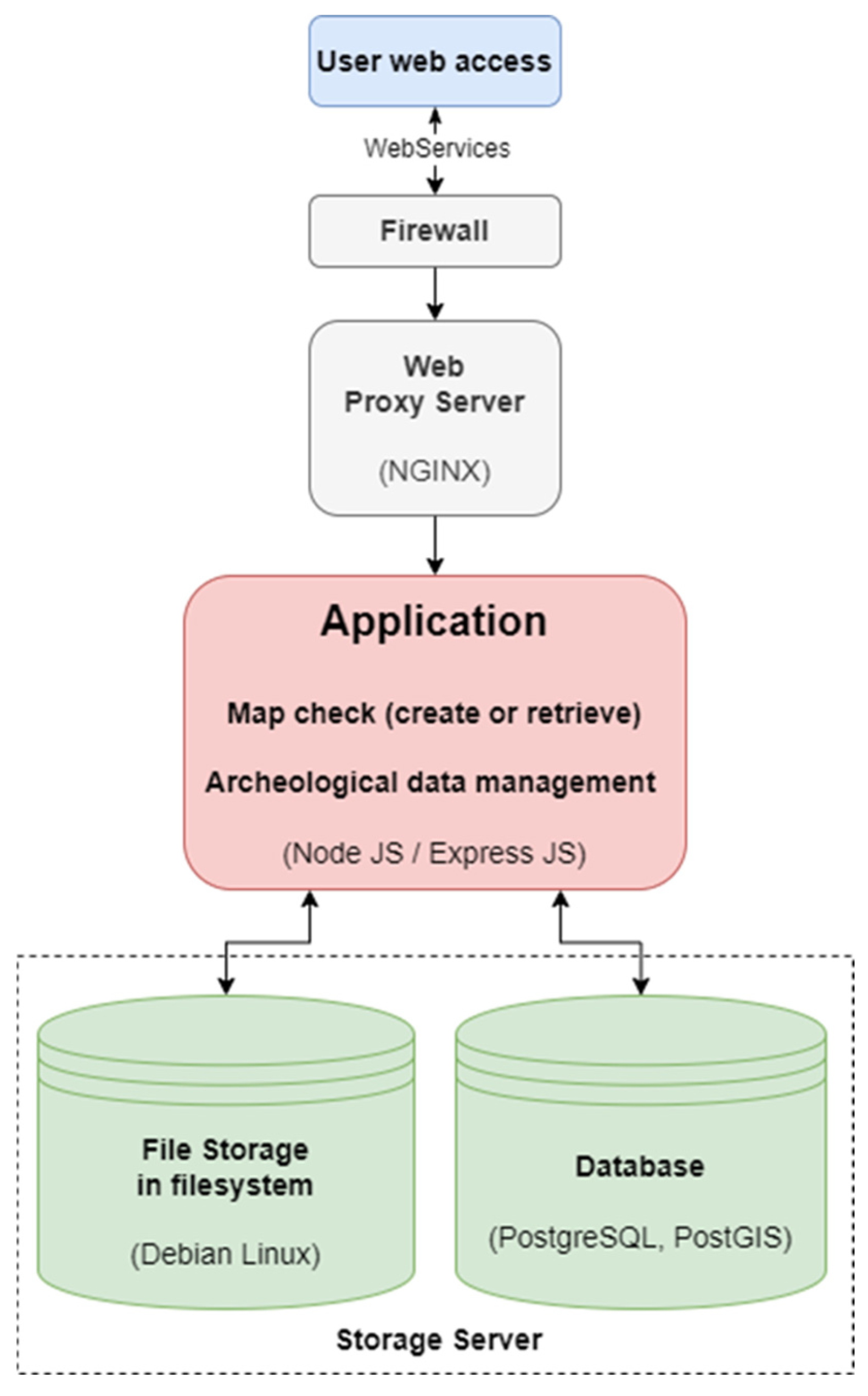
The original system (
Figure 1) and database designs were redone in order to integrate the document management functionalities and, even more importantly, the blockchain-based audibility and transparency.
To accommodate the system’s high bandwidth needs, two completely redundant servers were used to create a high-performance cluster (
Figure 1), one for the application and one for storage.
Archeological data and GIS data are stored in two databases on the storage server, which is located outside the application server. The file system contains the files associated with every archeological site.
Another significant advantage is the ease of extension for demanding processing power requirements. This applies to the first application and data-processing server. The processing-power requirements for the data repository apply only to the second server, database, and storage.
For the “Site name” field, its name is used in the following sequence: name from the List of Historical Monuments (LMI)—for historical monument sites; RAN name (for sites listed in this directory); names from urban planning documentation.
Dating: It was requested to use a unique name for each era/period, so that the terms used are the same by all authors of the files, and the information is easily accessible.
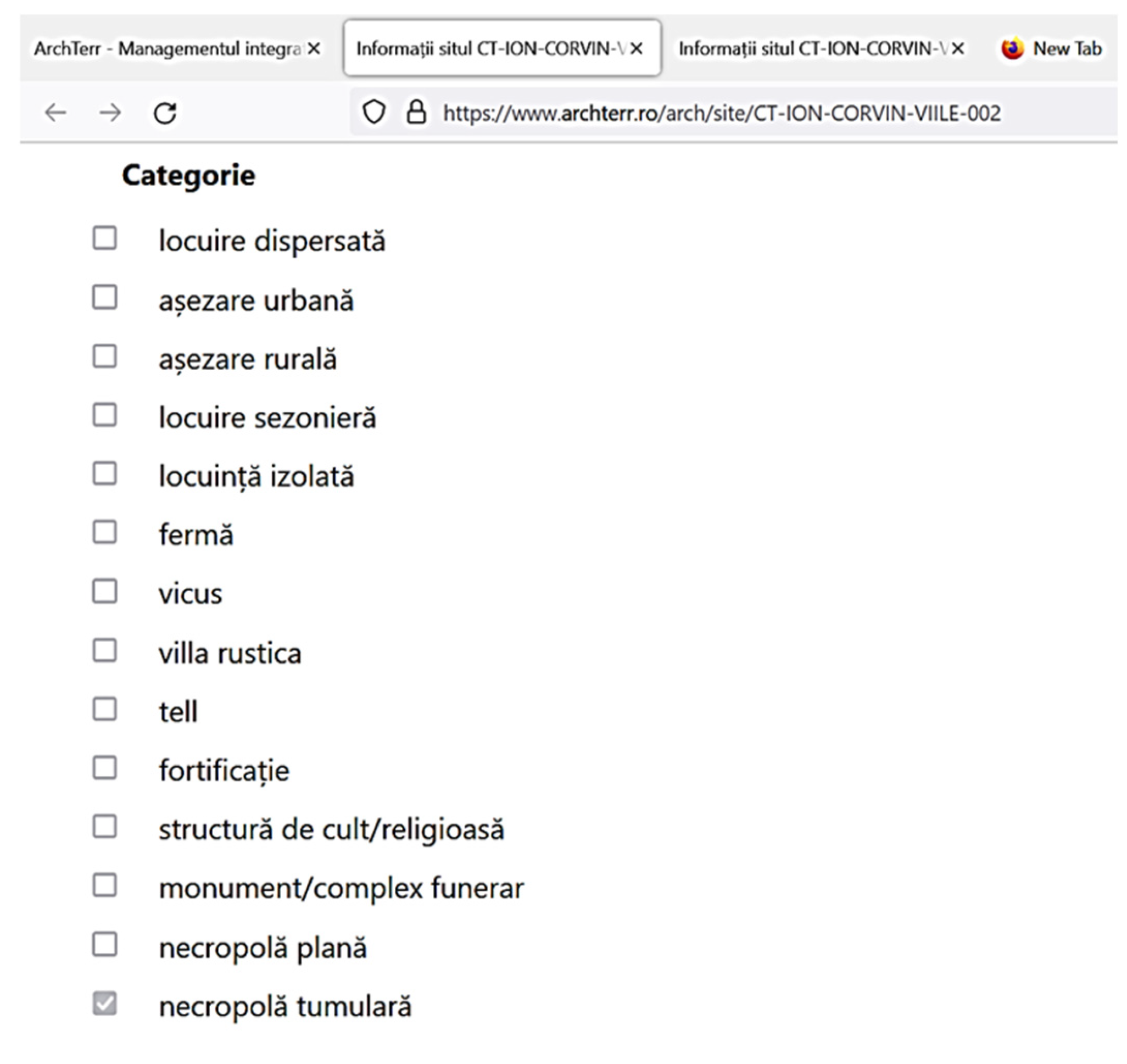
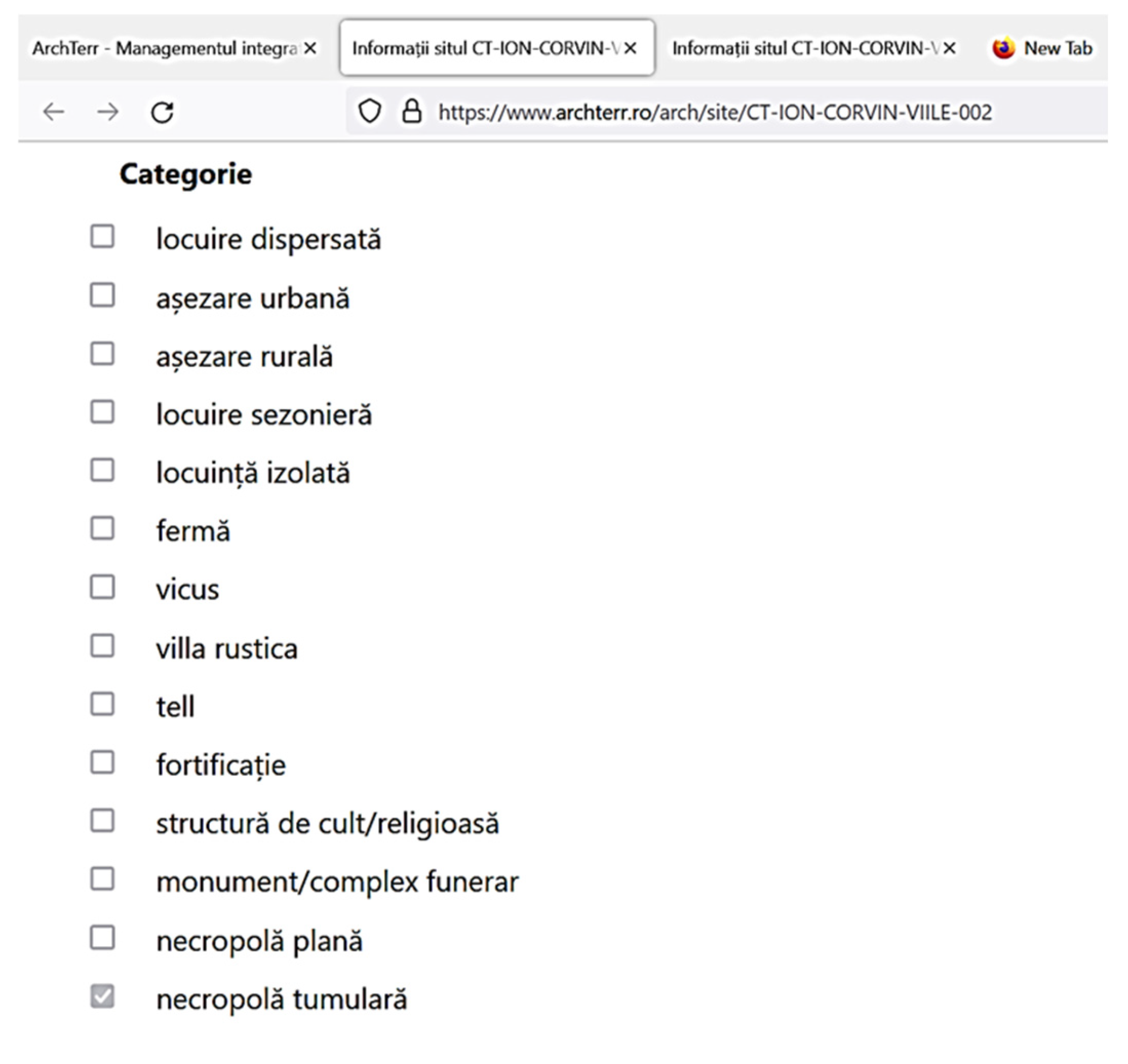
Category: It was requested to use a unique name for each site category (
Figure 2), so that the terms used are the same by all authors of the files, and the information is easy to access/search.
Site evidence: Because the evidence of the real archeological patrimony was made in time in different forms, by including it in lists of historical monuments (updated in time) for the officials of the county cultural directorates, it is necessary to make a history of its records to monitor it.
An “Observations” field (
Figure 3) gives the possibility to add in free format any explanations, information for situations that are not found in the precisely defined fields, etc.
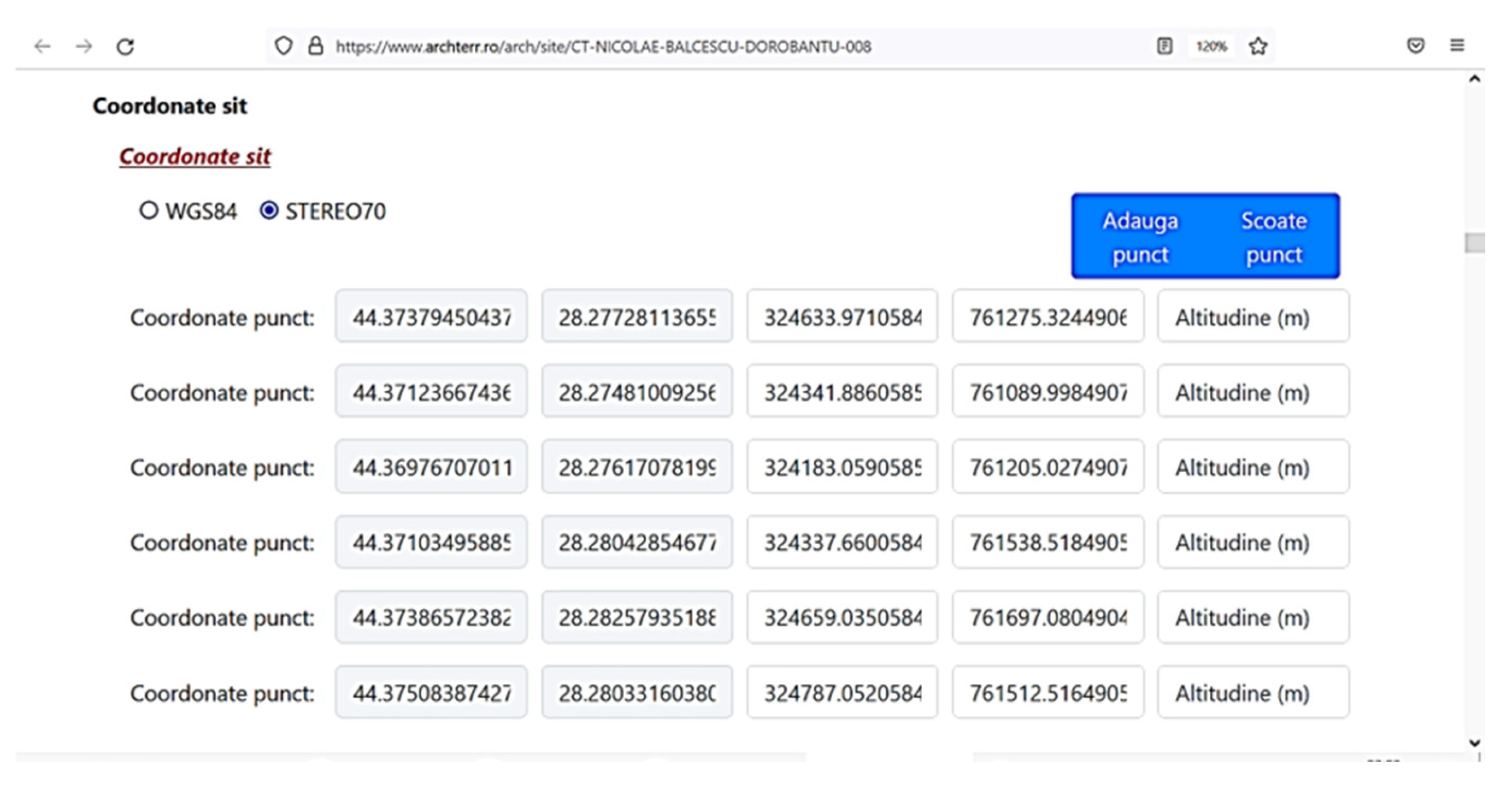
Site coordinates/site protection area coordinates. Given that in Romania all official cadastral documents operate with the delimitation of a site/protection zone in Stereo70 system (
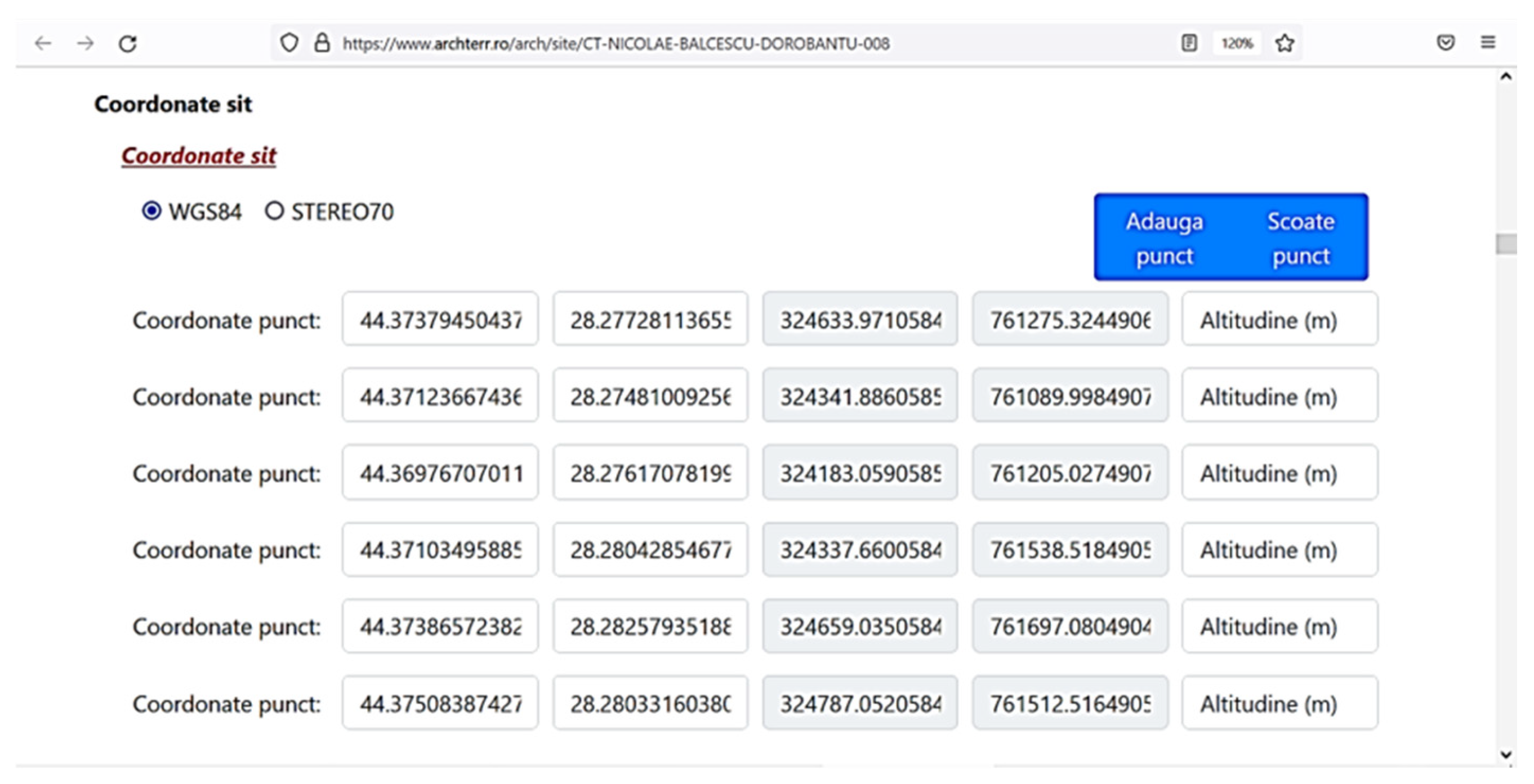
Figure 4), while on the ground, GPS allows for the delimitation in WGS 84 system (
Figure 5), the authors of the delimitation (archeologists or officials of decentralized public services) are forced to use intermediate transformation programs [
69], which leads to additional time consumption, with the danger of “altering” the information when entering it into the program. Therefore, the database has implemented a mechanism that makes it possible to enter data into the Sitemap in one or another of the geolocation systems, and the data is automatically converted from one system to another. This role is essential for the administration and preservation of the archeological legacy, given that the database is connected to a digital map, which allows for immediate verification both by those who manage the database and by any beneficiary (third party) of positioning a plot on the map.
The database, connected to the Digital Map, is a complete and complex tool made available to decentralized public services, contributing significantly to managing the challenges of protecting the archeological heritage.
3.3. Implementation of Digital Interactive Map and Graphical Interface
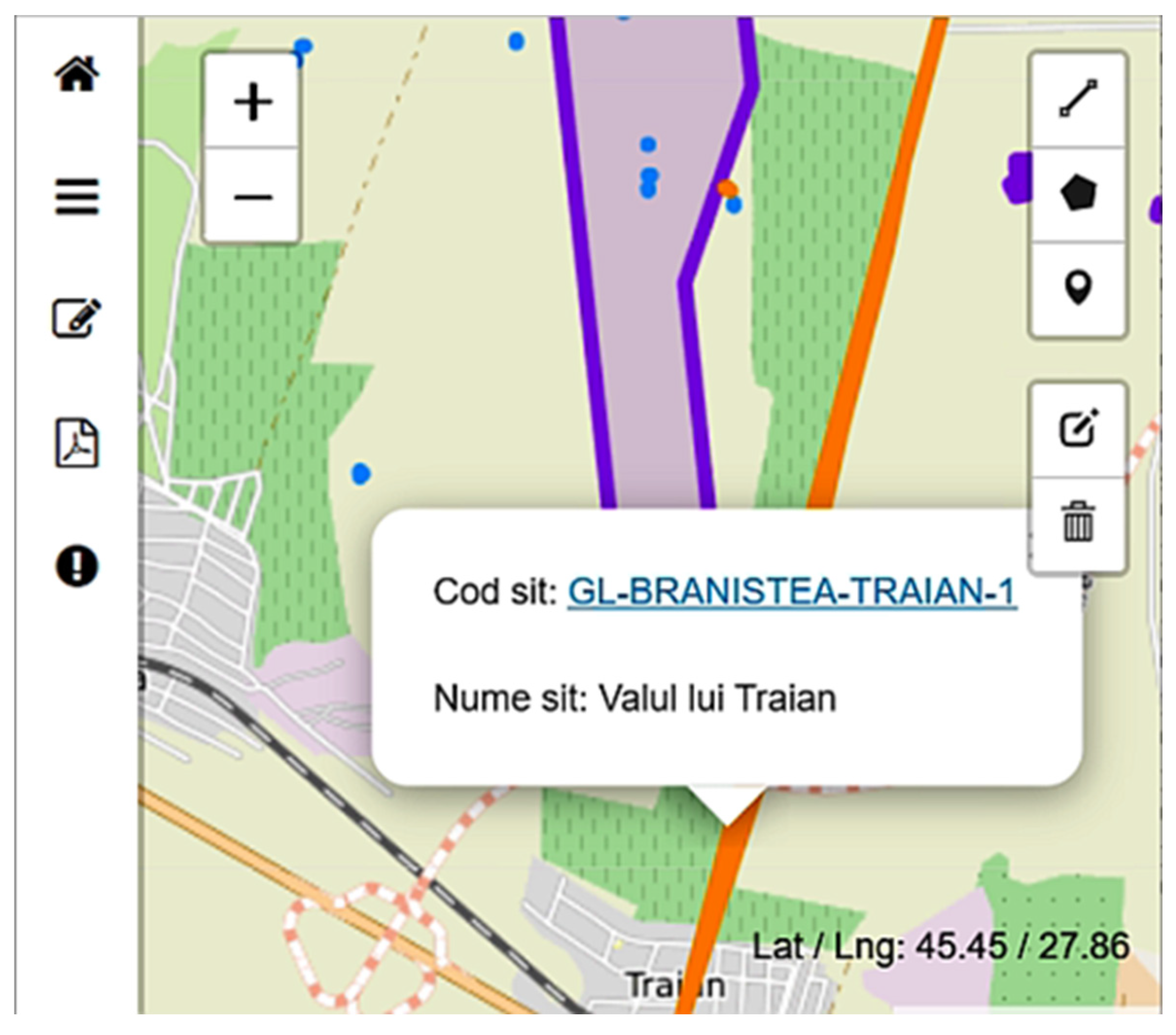
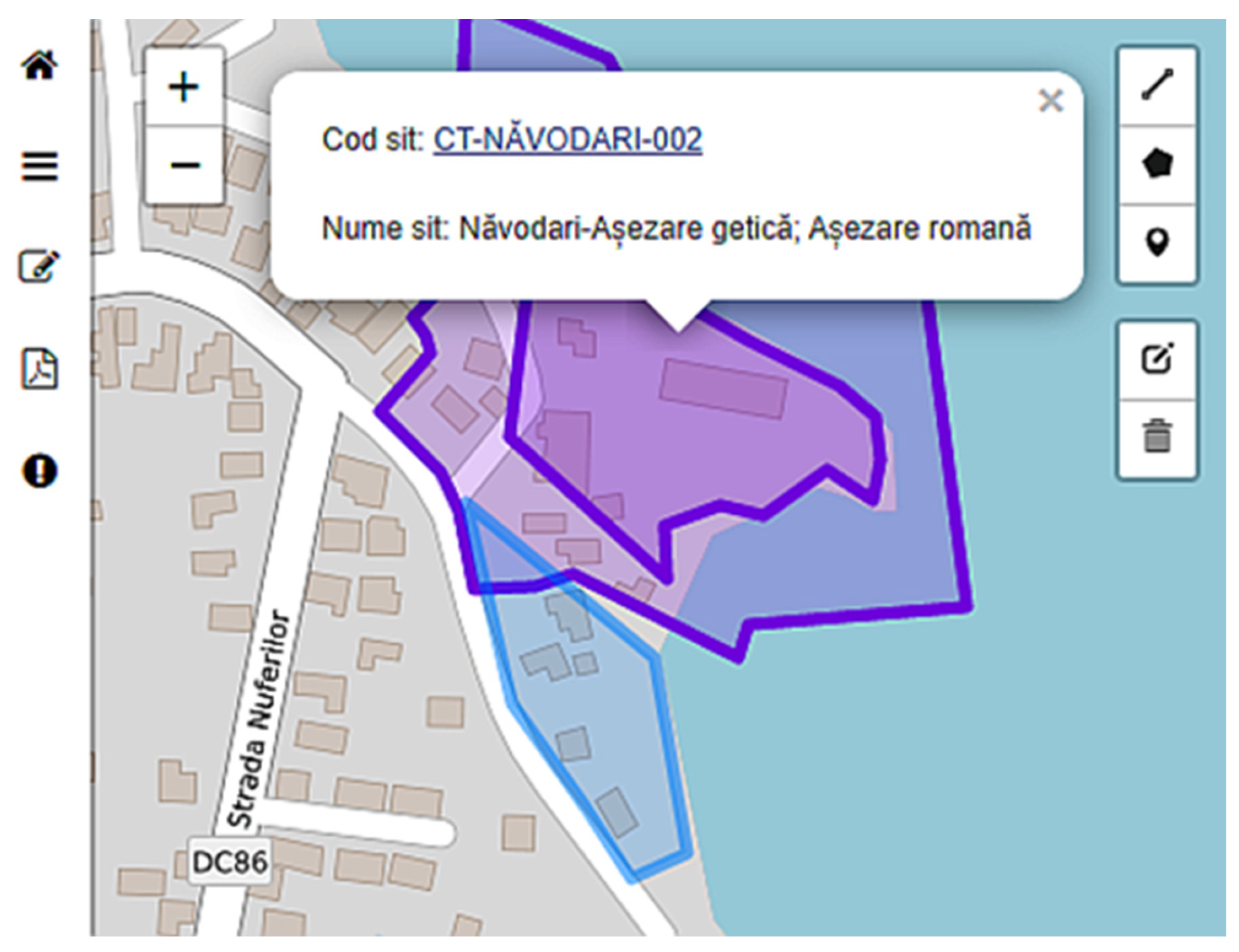
The system was created with a highly intuitive user interface that can support any kind of access, from smartphones for the general public to large-screen PCs (for archeology specialists who submit data). The non-specialist user perspective is shown in
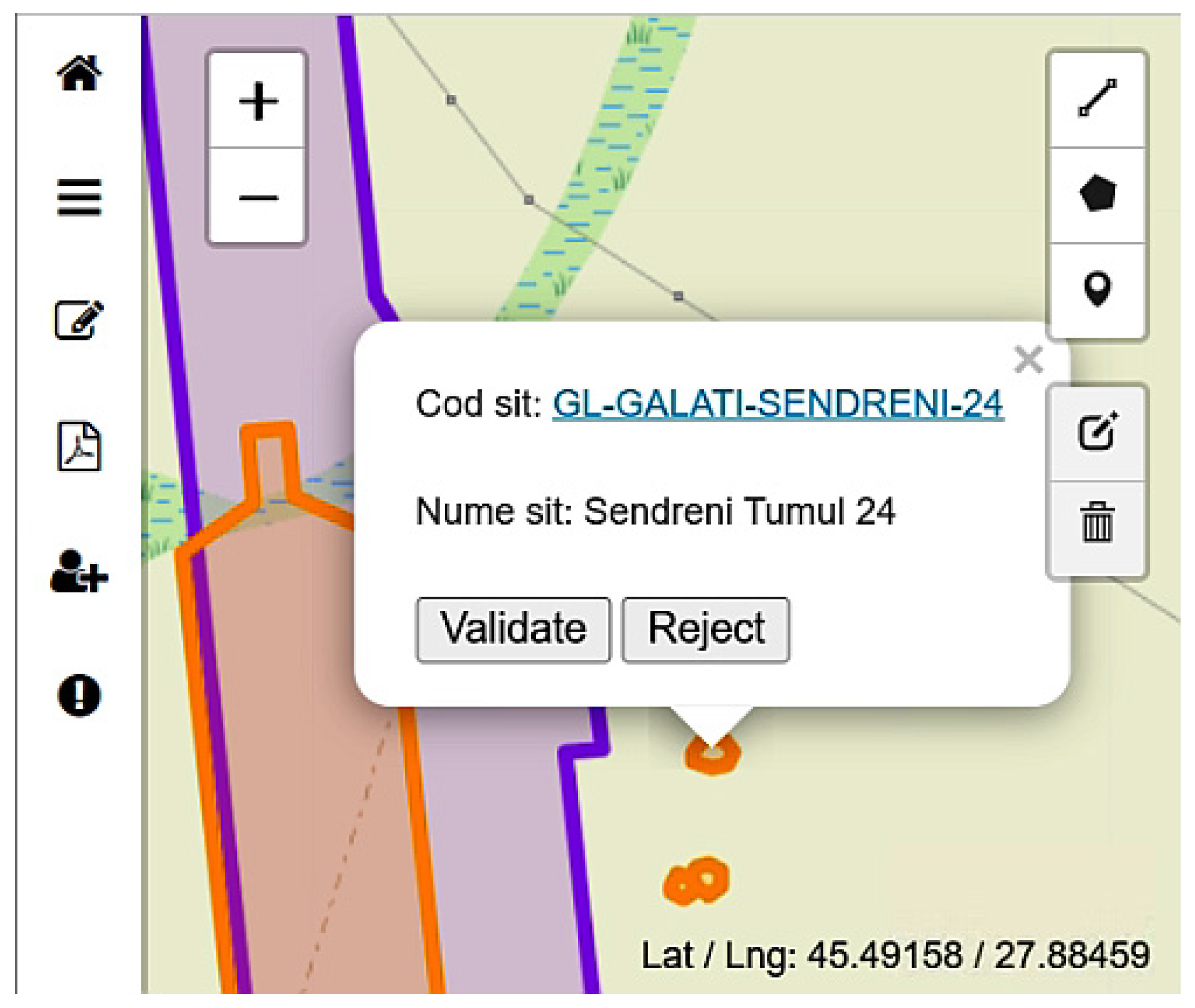
Figure 6 during the evaluation of a new potential site for real estate development (blue polygon). The
Figure 6,
Figure 7 and
Figure 8 were extracted from the Romanian-based interface. The “cod sit” translate to “site code” and “nume sit” translate to “site name”.
According to the algorithm used for the geographical delimitation of the site and the protection zone, the software application performs the function of recording and graphically representing the coordinates of the investigated areas and the areas unloaded from the archeological load. The coordinates can be entered either in WGS84 or in STEREO70, and the corresponding areas are represented on the map accordingly.
When a new industrial or private building development site is being evaluated (to make sure it does not overlap an archeological protection zone),
Figure 7 shows the public view without login credentials. The blue surfaces are the user’s view during the examination of a new potential building development location.
The manager’s validation interface is shown in
Figure 8, following the archeologist’s provision of data for each archeological site. The web application is open to anyone who wants to explore all of its capabilities.
We integrated significant functionalities as a consequence of the system beneficiaries’ consultation results and a careful review of several European applications created for the same purpose.
Although the Stereo70 projection method is used for official reporting of topographic and geodetic activities, it is well known that when field data on the geographical location of sites is gathered, it is typically available to archeologists or regular users in WGS84 format and infrequently in Stereo70 format. Because of this, a mathematical conversion between the two representation formats had to be put in place. This feature is not available in other platforms; hence, other apps must be used.
Additionally, simultaneous representation formats in both systems (WGS84 and Stereo70) were taken into consideration on the interactive map to make it easier for a broad range of users to access it and to confirm that land surfaces overlap with archeological sites regardless of the representation system used.
By integrating this automatic conversion into the system, it becomes unnecessary to employ other IT programs to convert field data into Stereo70 format, which reduces action times, expenses, and the possibility of errors caused by manual data entry.
Some inaccuracies that are relatively common in Romanian archeology regarding the position and location of such a site can be eliminated from the outset by verifying and visualizing in real time the data accuracy regarding the geospatial location and positioning of an archeological site. The error can be fixed promptly, before it has administrative repercussions that result in costs and expenditures.
Using different user access levels (e.g., the general public, managers who confirm the information, simple users, or simple visitors) when entering the information into the system ensures that the information is stored and provided to the beneficiaries with the highest level of accuracy possible, preventing errors or unintentional data deletion.
The application’s design does not prioritize autonomy and is not designed to be just a stand-alone system; rather, it is engineered to facilitate interoperability with other municipalities that are pursuing the development of smart societies.
In the domain of urban planning and the integration of distributed ledger technology (DLT), a predominant approach entails the implementation of shared blockchain standards and protocols. Examples in this category include interoperable smart contract standards, such as ERC-721 [
70] or ERC-1155 [
71]. In the context of blockchain interoperability, notable examples include cross-chain protocols, such as Hyperledger Cactus, which is designed for interoperability across enterprise blockchains, and Chainlink CCIP or Wormhole, which facilitates secure cross-chain communication.
A second approach (that works well for municipalities not implementing DLT) is to develop a standard API for data access, transaction submission, and status verification in cooperation with neighboring cities. Alternatively, open-data models, such as the 2024 and 2025 ISO 19152 LADM standard for Geographic information—Land Administration Domain Model [
72]—the Geography Markup Language (GML), and GeoJSON, can be employed for GIS data sharing.
In both cases, it is imperative to approach the framework between municipalities before addressing the technical issues. It is essential that this consortium governance define the shared data policies, the role-based permissions (i.e., who can write, read, and validate data), and the dispute mitigation and resolution process.
3.4. Document Management
The phases indicated in the workflow were developed for the registration of newly discovered remains, including the authorization of intervention, communication with the beneficiary and the institutions involved in the recording of archeological heritage, the authorization of intervention in areas with built heritage (historical monuments, archeological sites, areas protecting monuments and archeological sites, and protected built areas), and monitoring compliance with legal provisions. These phases were developed based on the legislation in force regarding the protection of historical monuments and archeological sites, including the internal provisions imposed by order of the Minister of Culture.
The important steps in the document management workflow for identifying and recording an archeological site are described below:
Step 1. A chance archeological discovery or the discovery of archeological remains during surface archeological investigations (archeological field diagnosis) as part of an investment project carried out by certified archeologists.
Step 2. Delimitation of the boundaries of the archeological site (specialist from the county directorate for culture, certified archeologist) by
2.1. Observing the distribution of artifacts on the soil surface;
2.2. Archaeophotogrammetry;
2.3. Geophysical studies (geomagnetic scanning, etc.);
2.4. LIDAR scanning (light detection and ranging);
2.5. According to legal provisions, in the case of chance archeological discoveries.
Step 3. Recording the geographical coordinates of the site (specialist from the county department of culture, certified archeologist).
Step 4. Drafting a site report (certified archeologist).
Step 5. Conducting a topographical survey of the site (archeologist, certified surveyor).
Step 6. Submitting the site file—including geographical coordinates—to the county department responsible for culture (certified archeologist, beneficiary of the study—initiator of the investment).
Step 7. Administrative verification of the archeological diagnostic study from the perspective of compliance with archeological standards and procedures by the specialized department within the county directorate for culture.
Step 8. Submission of the archeological diagnostic study (by the county departments of culture) for approval by the specialized commissions (National Archeology Commission, Regional Commission for Historical Monuments), with proposals for measures to protect the relevant heritage.
Step 9. Approval (with options for rejection/request for additional information) of the diagnostic report, including the protection proposals, by the specialized commissions.
Step 10. Transmission of the conclusions of the archeological study to the beneficiary by the county directorates for culture, with the imposition of the legal provisions to be followed in order to complete the next steps necessary for the implementation of the investment on the land in question: approval with conditions for the next stage, carrying out an intrusive archeological diagnosis, carrying out preventive archeological research in order to clear the land of archeological load, archeological supervision during the execution of works affecting the soil and subsoil.
Step 11. Registration of newly discovered sites in the database and GIS existing at the county level for culture (where available).
Step 12. Forwarding the site file to the other institutions involved in the recording and protection of heritage.
12.1. The National Heritage Institute for inclusion of the site in the National Archeological Register;
12.2. The commune/town hall for the purpose of taking appropriate protection measures;
12.3. The Cadastre and Real Estate Advertising Office at the county level for the purpose of recording the information in the cadastre/land registry.
Step 13. Additional verification of the boundaries and nature of the site through intrusive diagnosis (a procedure required for large investment projects following steps 7–10), with the involvement of certified archeologists/institutions organizing archeological research, and with the authorization of the Ministry of Culture.
Step 14. The implementation of preventive archeological research is imperative to mitigate the archeological implications associated with land that is subject to investment. This procedure is mandatory for large-scale investment projects, as outlined in steps 7–10. The execution of this research is to be conducted by certified archeologists or institutions specializing in archeological research, with the requisite authorization from the Ministry of Culture.
Steps 15–17. The present task entails the completion of steps 7–9, as previously described, this time for the preventive archeological research report.
Step 18. The Ministry of Culture’s Decentralized Services shall issue the archeological discharge certificate for the beneficiary, as well as approve requests for investment modifications and the issuance of conditional approval for the conservation and protection of archeological remains. In accordance with the Ministry of Culture/Decentralized Services approval, the beneficiary may continue the investment authorization procedure.
Step 19. The database of the decentralized public service is to be updated with the results of the archeological research. Subsequently, the corresponding data is to be transmitted to the National Heritage Institute for the purpose of updating the data in the National Archeological Repertory.
Step 20. The Ministry of Culture’s decentralized services are responsible for monitoring the compliance of archeological heritage with the legal provisions established for its protection. This monitoring is carried out in accordance with the opinions that have been issued.
It is important to note that in case of investments for which the opinion was conditional on archeological supervision, if archeological remains are discovered, the building permit is suspended, and steps 14–18 described above are followed.
Of the steps outlined in the documentation workflow, the mandatory procedures that were duly implemented include steps 1, 2.1, 2.2, 3, 4, 5, 6, 7, 8, 11, and 13.
3.5. Blockchain Implementation
In the initial version, the software application did not have blockchain technology, but because the application is targeted for cities where many real estate transactions take place, for easy auditing of these, we integrated blockchain in the current version. This approach mitigates the legal issues raised in
Section 2.4.
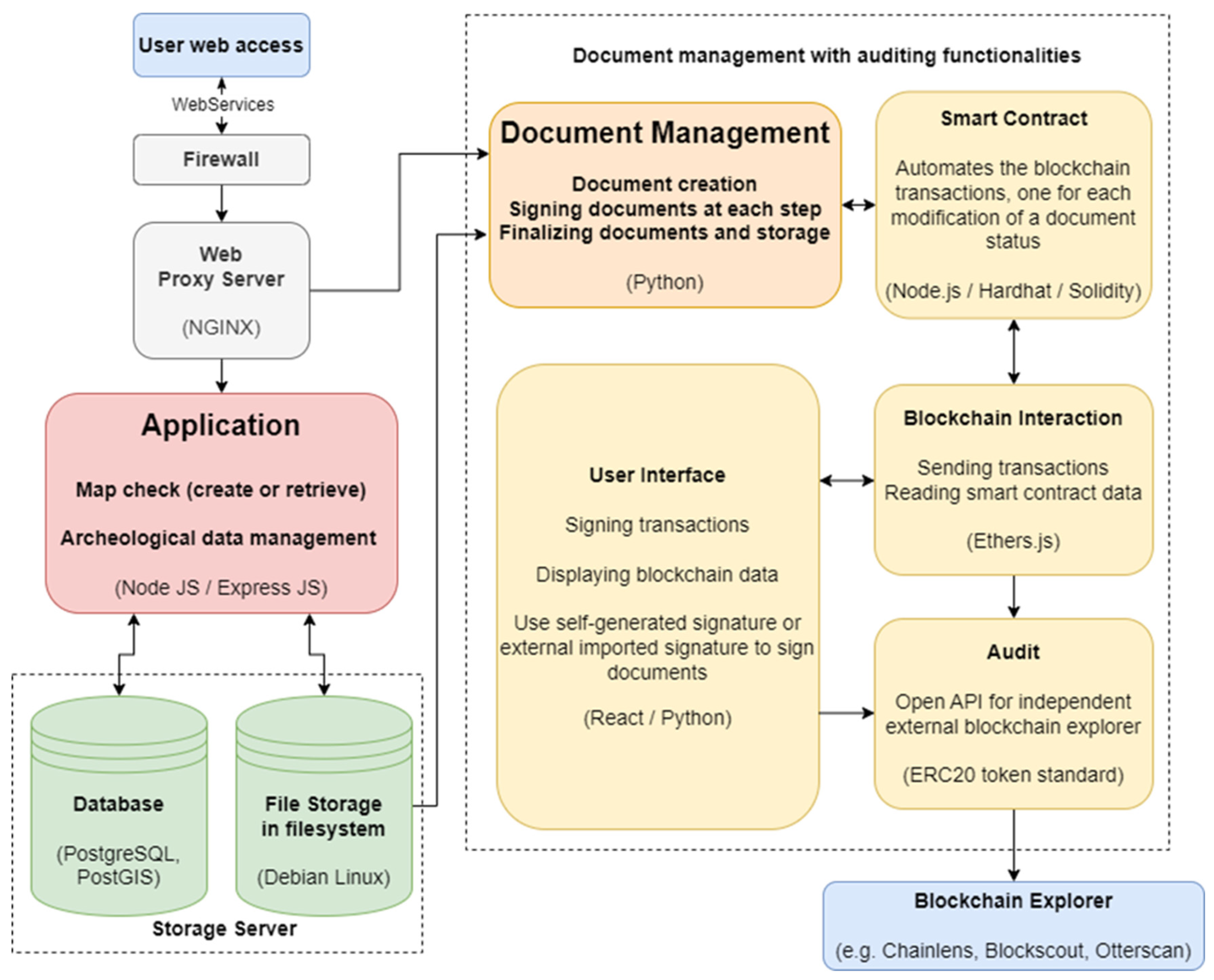
The web proxy is handling the user’s incoming requests and the Application Server interaction with the Map server to provide a user response directly from the maps repository or to build a new detailed map for a specific region.
The application consists of two virtual machines to ensure further easy development; in
Figure 9, we present an improved version by integrating a distributed ledger. It should be noted that an increase in processing power is directly proportional to the number of simultaneous users of the primary virtual machine that processes the information (Application Server). The second optimization is initiated by the quantity of stored archeological sites and involves an augmentation of storage capacity for the second virtual machine (Map Server).
To store GIS coordinates, the data is first structured in a standard JSON format, typically following the GeoJSON model.
For unencrypted storage, this JSON file is saved directly in a readable format, allowing it to be accessed and used by systems or users without restrictions. This is suitable for non-sensitive spatial data, such as any public maps or open-data portals.
For encrypted storage, the JSON content is first converted into a byte format and then encrypted using a symmetric encryption algorithm, such as Advanced Encryption Standard (AES). The encrypted output is saved as a binary file, ensuring that only authorized users with the correct decryption key can access the data. This method is ideal for protecting sensitive land information, such as legal ownership records or restricted geographic zones.
In both cases, the data integrity can be ensured by storing a cryptographic hash (like SHA-256) of the file on a blockchain, providing a tamper-proof record.
Node.js is used for applications that handle multiple simultaneous requests by facilitating communication between system components. In the context of the Node.js architecture, it is used to handle API requests and responses, which interact with the blockchain. It is integrated with Ethers.js to interact with Ethereum smart contracts. Ethers.js is the bridge between the frontend and backend, allowing users to send transactions and read smart contract data. We used the single-node Hardhat as a local development environment for the purpose of testing, debugging, and interacting with the smart contract. The pilot implementation was deployed on a locally simulated instance of the Ethereum Sepolia test network, which replicated the configuration and behavior of the public Sepolia environment. This approach allowed testing under realistic blockchain conditions without requiring network connectivity or incurring gas consumption. Smart contracts are written in JavaScript, providing automation by reducing manual intervention and errors. To allow the user to interact with the application, the React library was used to create a simple and intuitive design. The user has access through the frontend to sign transactions, display data from the blockchain, and use an automatically generated signature or an externally imported signature to sign documents. OAuth was used for authentication and authorization in order to allow users to access application functionality without sharing credentials, thus protecting the integrity and confidentiality of sensitive information stored on the blockchain. The local Sepolia simulation also enabled auditing and monitoring functions equivalent to those of the public network, while supporting integration with blockchain explorers such as Chainlens [
73], Blockscout [
74], or Otterscan. Blockchain Explorer tools can be accessed free of charge, provided they are integrated into applications developed with blockchain technology, by individuals requesting authorization from the city hall to verify the authenticity of documents issued by it.
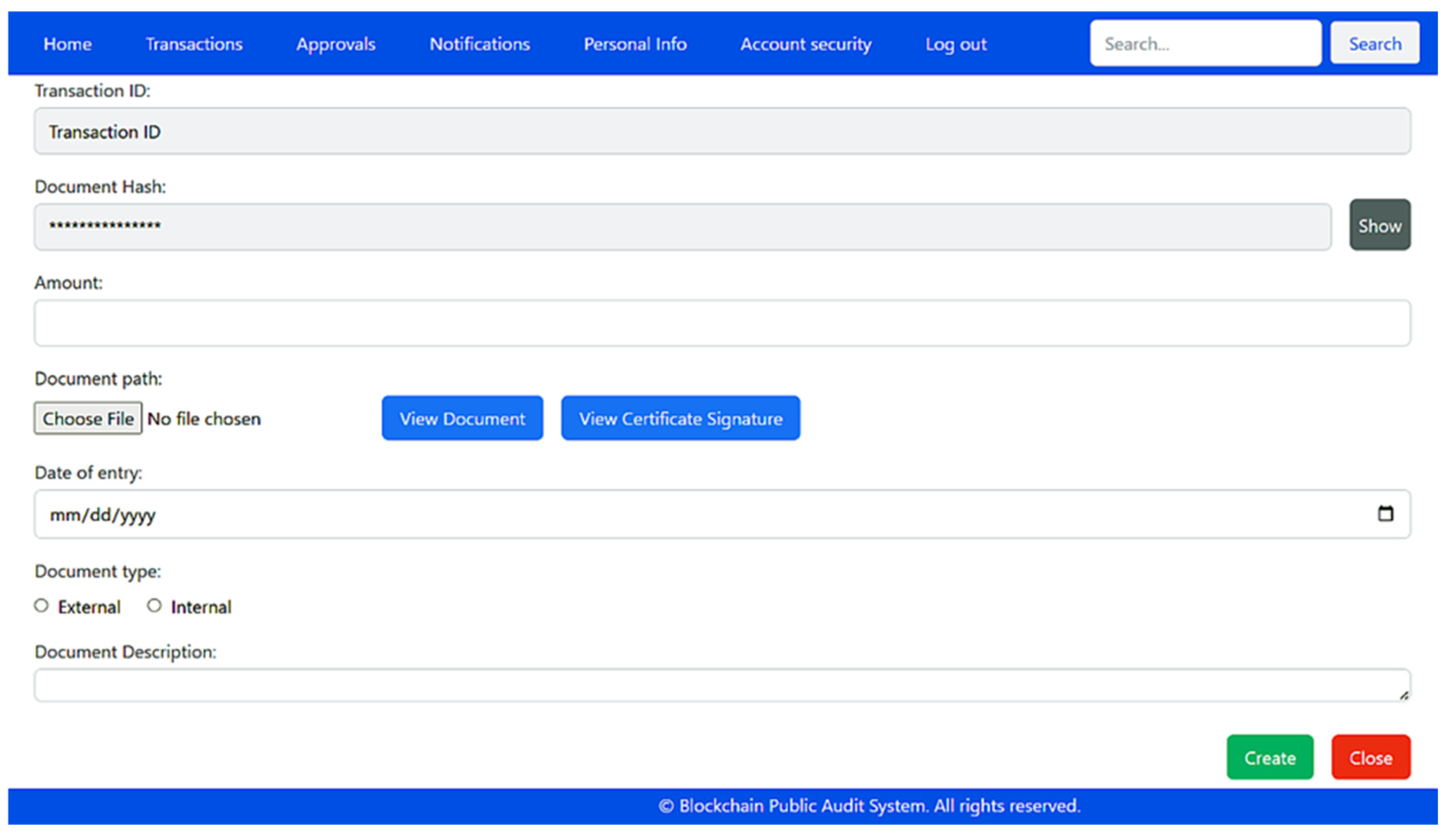
The user interacts with the web interface to fill in the required data (
Figure 10). The user creates a transaction on the blockchain, which is added to an array using the createTransaction() function. A notification is initiated to inform that a transaction has been initiated. To validate a transaction, the user’s identity, their permission level, and the transaction status are checked. If all conditions are met, then the smart contract updates the stats and is added to the blockchain, having a unique hash. Transactions can be audited in real time using the block explorer.
Compared to traditional systems based on centralized databases or optimized ledger databases [
75], the proposed solution allows for ubiquitous verification: any interested party can audit land records in a decentralized and secure manner. However, this model must also be analyzed from a security perspective: the lack of centralized control can introduce risks, such as compromise of private keys, attacks on blockchain explorers, or errors in the smart contract code. Therefore, integrating blockchain with GIS provides an infrastructure for transparency and auditability in land records, but requires a resilient system design from a security and permissions perspective.
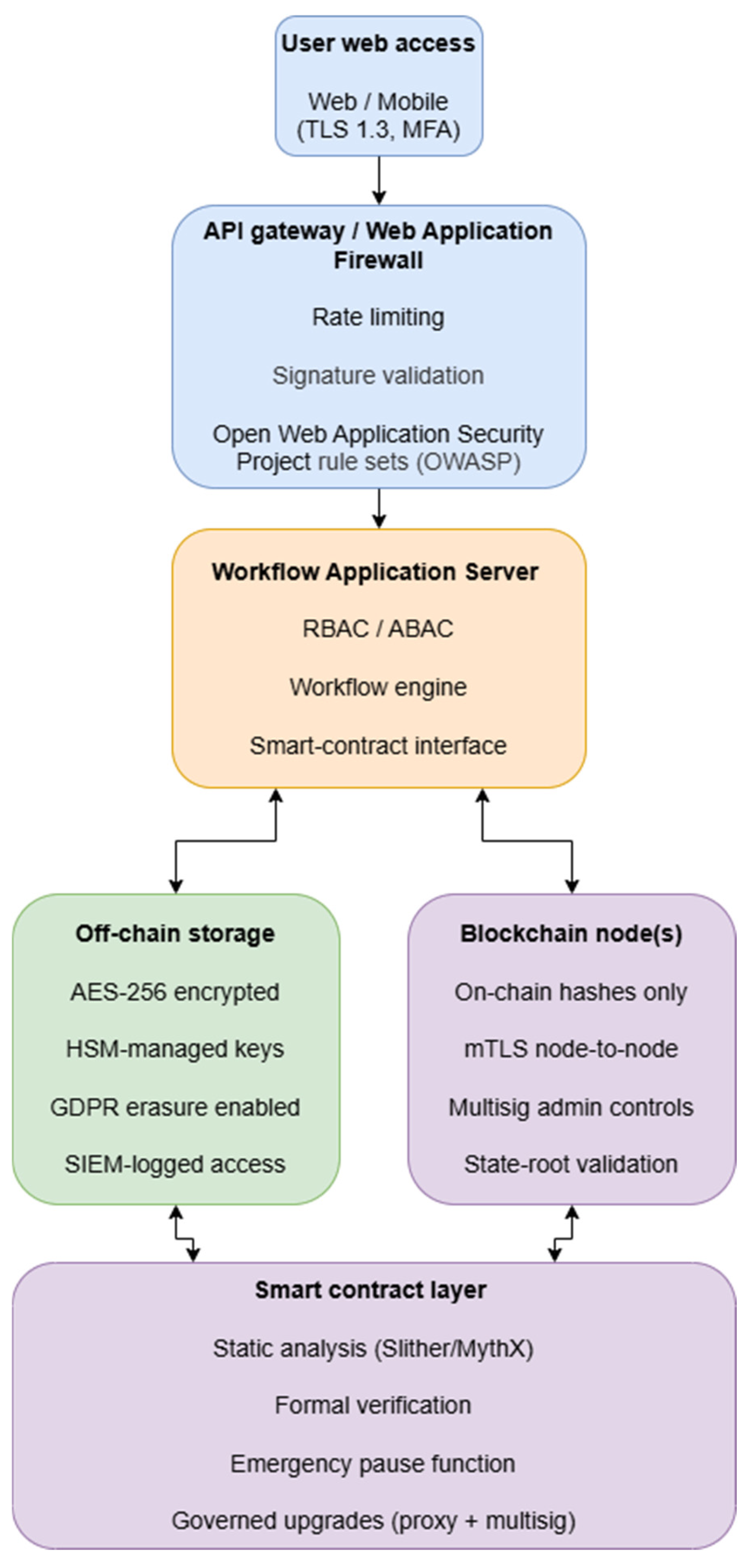
The cornerstones of a resilient protection system focus on three main components: authorization, authentication, and the application of secure coding practices. To best employ these three components, we rely on a defense-in-depth architecture combining network, application, data, and operational controls.
When managing authorization, we define the relevant roles that the users of this application may be, from the basic (public) user, to an official managing a relevant dataset, and finally a supervisor (or supervisory authority) that can confirm the correctness and authenticity of this data. Once these roles are defined, access to different feature sets will be granted based on them. In order to ensure the system’s robustness, the principle of least privilege will be employed, and users will be granted the minimal permissions necessary to perform their activities. It is evident that any validation or confirmation issued by supervisory users, as well as the modifications made by officials, are systematically logged separately in the database.
For authentication, the system implements challenge-response authentication (CAPTCHA), enforces a strong password policy (min. 10-character alphanumeric with symbols), and employs multi-factor authentication (MFA). All cryptographic operations are performed inside a Hardware Security Module/Key Management System (HSM/KMS) so that no private keys are stored in code or in the database at any time.
Smart contracts will be kept minimal and will undergo static/dynamic security testing and third-party audits, as well as include an emergency pause Multi-Signature Scheme (multisig). All documents are stored off-chain and encrypted (AES-256-GCM), with only their SHA-256 hashes and metadata written on-chain to minimize PII exposure.
For the software systems themselves to be robust, several secure coding practices must be enforced, such as input validation, access control, secure configuration management (enforcing security configurations, disabling unneeded services on server components, and all auxiliary software). Moreover, the Continuous Integration (CI) and the Continuous Delivery/Continuous Deployment (CD) pipelines utilized will run Static Application Security Testing (SAST) and Dynamic Application Security Testing (DAST) jobs, as well as scan dependencies and vulnerabilities. Full end-to-end testing will verify how the system responds to errors as well as potentially malicious scenarios.
In our case, the Document Management System (DMS) only handles public documents (like government approvals, land registry entries, or public decisions), and there are still GDPR considerations (especially if the documents include personal data, such as names, addresses, etc.) The GDPR’s “Right to erasure (right to be forgotten)” is still relevant but much more limited.
According to GDPR Art. 17.3(b) and Art. 17.3(d), in circumstances where data processing is necessitated by legal obligations or for the undertaking of activities that serve the public interest, the right to be forgotten does not apply. This is typically the case with government records, land registry entries, public decisions or licenses, decisions of historic or legal significance, public approvals, etc., such as the actions in our system. The system presents on the main page the right to retain documents indefinitely if they serve a public interest, and we rely on legal grounds for retention. GDPR explicitly allows exemptions to erasure in such cases, and we are not obligated to delete this data even if it includes personal data.
As a main approach, we store only hashes on-chain, and we do not store the documents themselves. The full documents are stored off-chain (e.g., a secure public archive). This approach proves the document existed at a certain time and has not been tampered with for public audit purposes.
On-chain, we store metadata, such as document hash (e.g., SHA-256), timestamp, document type, and issuer (e.g., city hall, not the person). We avoid storing on-chain sensitive data and any uniquely identifying data, such as names, addresses, etc.
Here is the workflow to handle the scenario securely and legally:
1. City Hall approves a building permit.
2. The permit document is created (PDF).
3. A hash of the document is generated (e.g., SHA-256).
4. The document is stored in a storage/archive.
5. The hash, timestamp, issuer, and type are stored on-chain.
6. The public (or other systems) can verify that a document is valid by matching the off-chain file to its on-chain hash.
The blockchain layer stores SHA-256 document hashes, timestamps, and pseudonymized workflow identifiers, ensuring that no personal data is ever committed to an immutable ledger. All documents containing personal information are stored off-chain in AES-256-GCM-encrypted archives managed through HSM-secured keys. This design supports GDPR rights, such as access, rectification, and restricted processing, while complying with GDPR Art. 17(3)(b) exceptions for public-interest archival functions. A Data Protection Impact Assessment (DPIA) evaluates risks related to unauthorized access, metadata inference, and key compromise, leading to measures including Role-Based Access Control (RBAC), Attribute-Based Access Control (ABAC), pseudonymization, Security Information and Event Management (SIEM) monitoring, key rotation, and strict data-minimization. As a result, the architecture (presented in
Figure 11) achieves a privacy-by-design balance between institutional transparency, legal compliance, and protection of cultural-heritage documentation.
To mitigate the risks related to private-key compromise, explorer-layer integrity, and smart-contract vulnerabilities, the system adopts a minimum security baseline aligned with NIST SP 800-57, ISO/IEC 27001, and the Ethereum Enterprise Alliance Security Guidelines. All cryptographic keys are generated and stored within Hardware Security Module/Key Management System (HSM/KMS) modules (FIPS 140-2/3), with multi-signature or threshold signing required for administrative actions. Key lifecycle management follows auditable SOPs, including rotation, revocation, and dual control. Smart contracts undergo static analysis framework (Slither) or cloud-based security analysis platform (MythX) and formal verification for critical modules, and incorporate emergency pause and multisig-governed upgrade patterns. Explorer-layer integrity is maintained through API request signing, independent node verification, and tamper-evident logging. Nodes security is provided via Mutual Transport Layer Security (mTLS), network segmentation, and SIEM-monitored event streams.
Together, these controls establish a secure-by-design architecture that addresses the identified blockchain-specific risks.
3.6. Metropolitan Network Integration
In the future implementation of the document management system, a network-based architecture incorporating multiple blockchain nodes will be deployed across key municipal and governmental agencies to ensure trust, transparency, and fault tolerance in the proposed document management system.
For the current prototype and stated research questions, we have not implemented inter-municipal data exchange or a prototype cross-jurisdiction workflow; however, we aim to do them in the future and have added them to future work. For the deployment stage, the system will be executed on an Ethereum PoA network, providing a permissioned yet Ethereum-compatible runtime environment.
This decentralized architecture distributes validation responsibilities across several nodes, mitigating single points of failure and enhancing system resilience against data tampering or unauthorized alterations. Each node maintains a copy of the ledger, ensuring that any document-related transaction—such as creation, access, or modification—is transparently recorded and verified through consensus.
These nodes will be strategically installed within agencies (e.g., the Urban Planning Department, Land Registry Office, City Hall, and the Department of Cultural Heritage), enabling each to independently validate and record transactions related to document access, modification, and approval.
To support secure and high-throughput communication between nodes, the system will leverage the city’s existing metropolitan network infrastructure, ensuring low-latency data exchange and operational continuity across geographically distributed departments.
This approach not only strengthens the integrity and auditability of document histories but also enables scalability and secure inter-organizational collaboration, which is essential for applications involving multiple stakeholders, such as public administration, legal compliance, or urban governance. By employing a multi-node blockchain network, the system aligns with principles of distributed trust while preserving the efficiency and traceability required for long-term document lifecycle management.
4. Discussion
This paper presents a pilot project that contributes to theory by demonstrating how spatial intelligence (as represented by GIS) and distributed trust mechanisms (as enabled by blockchain) can be conceptually integrated to form a new paradigm of geo-trusted governance. This integration suggests how spatial data accuracy and institutional transparency may function as mutually reinforcing dimensions of digital urban management. While the pilot results are promising, broader deployments are still required to empirically confirm the consistency of these effects across diverse institutional settings. The approach introduces a conceptual link between data provenance, territorial accountability, and heritage preservation, extending theoretical understanding of how information infrastructures can mediate trust in smart city ecosystems.
4.1. Best Usage Scenario: Integrated Land Registry System
Given the combination of GIS and blockchain, the best usage for this application is as an Integrated Land Registry System [
76]. This system would serve as a one-stop platform for managing land ownership, title transactions, lease agreements, zoning information, and urban planning. Blockchain would provide the audit trail and legal authenticity, while GIS would provide the geographic data needed for precise land management and planning.
In this scenario, the auditing functionality of blockchain would ensure transparency, security, and accountability in all land-related transactions, while the GIS capabilities would allow users to visualize and analyze the land in spatial terms, helping to ensure better planning, fewer disputes, and a more efficient land management system.
Potential Target Users:
Real Estate Developers and Agencies: Managing property portfolios, transactions, and title verification.
Government Agencies: For land administration, urban planning, public land management, and policy enforcement.
Legal Firms: Involved in property disputes, contracts, and land title verification.
Environmental Organizations: For conservation efforts and land-use monitoring.
Agricultural Stakeholders: Landowners, farmers, and leasing platforms interested in tracking agricultural land use.
Citizens and Homebuyers: Users who can interact with the system for transparency in land transactions and ownership validation.
Land and buildings located within and outside built-up areas that are historical monuments or parts of historical sites and/or monuments are subject to the relevant legal provisions regarding their disposal, division, or annexation. In this regard, buildings that are historical monuments or are part of an archeological site or historical monument are subject to the procedure for exercising the state’s right of preemption; otherwise, the sale and purchase agreement shall be null and void. In the event of the sale or transfer of extra-urban land containing an archeological site or a portion of an archeological site, the transaction may only be executed with the explicit approval of the Ministry of Culture.
The workflow presented in detail in
Section 3.4 shows the steps developed to guide the registration of newly discovered remains, authorize intervention, and facilitate communication with the beneficiary and relevant institutions involved in recording archeological heritage. These steps also cover authorizing interventions in areas with built heritage (historical monuments, archeological sites, areas protecting monuments and archeological sites, and protected built areas). In addition, there is a need to monitor compliance with legal provisions. These measures have been formulated in accordance with prevailing legislation pertaining to the conservation of historical monuments and archeological sites, including the internal provisions imposed by order of the Minister of Culture.
The 20-step long workflow is based on multiple laws and Ministry of Culture accessible at [
77] and presenting: Decision no. 907/29 November 2016 on “the stages of development and the framework content of the technical and economic documentation related to the objectives/investment projects financed from public funds”; Law no. 182 of 25 October 2000 (republished) on “the protection of the movable national cultural heritage; Law no. 350/6 June 2001 on spatial planning and urban planning”; Law no. 422/2001 on “the protection of historical monuments, republished, with subsequent amendments and additions”; Law no. 5/6 March 2000 (updated) on “the approval of the National Spatial Planning Plan—Section III—protected areas”; Law no. 50/29 July 1991 (republished) on “the authorization of the execution of construction works, re-published, with subsequent amendments and additions”; Ordinance no. 43/30 January 2000 on “the protection of archaeological heritage and the declaration of archaeological sites as areas of national interest”; Order of the Minister of Culture no. 1071/30 June 2000 on “the establishment of the Regulation on the organization of archaeological excavations in Romania”; Order of the Minister of Culture no. 2173/28 March 2013 on “the approval of the Regulation on the organization and functioning of the National Commission of Historical Monuments, with subsequent amendments and supplements”; Order of the Minister of Culture no. 2260/18 April 2008 on “the approval of the Methodological Norms for the classification and inventory of historical monuments, with subsequent amendments and supplements”; Order of the Minister of Culture no. 2392/6 September 2004 on “the establishment of Archaeological Standards and Procedures”; Order of the Minister of Culture no. 2518/4 September 2007 on “the methodology for applying archaeological discharge procedures”; Order of the Minister of Culture no. 2682/13 June 2003 on “the approval of the Methodological Norms for the classification and recording of historical monuments, the List of historical monuments, the Analytical Record of Historical Monuments and the Minimum Record of Historical Monuments”; Order of the Minister of Culture no. 3.157/19 July 2022 for “the approval of the Regulation on the organization and functioning of the National Commission for Archaeology”; Order of the Minister of Culture no. 3189/20 September 2020 by which “the Minis-try of Culture delegates to decentralized public services the competence to approve the related PUZ and RLU urban planning documentation”; Order of the Minister of Regional Development and Public Administration no. 233 of 26 February 2016 for “the approval of the Methodological Norms for the application of Law no. 350/2001 on territorial planning and urban planning and for the elaboration and updating of urban planning documentation”; The procedure of 4 October 2010 for “granting archaeological research permits, approved by Order of the Minister of Culture and National Heritage no. 2562/2010, with subsequent amendments and completions”.
Regarding the steps outlined in the documentation workflow in
Section 3.4, the mandatory procedures that were duly implemented include steps 1, 2.1, 2.2, 3, 4, 5, 6, 7, 8, 11, and 13.
4.2. System and Database Design
The design of the database was carried out in accordance with the needs of information storage, documentation and use in procedures, its purpose being the protection of archeological heritage (evidence, acceptance of interventions in archeologically significant places, discharge of archeological load, classification/declassification of sites such as historical monuments), so that the data are organized “stratigraphically”, being able to respond to the needs of various categories of users.
Basically, the database performs, through the implemented site file, a complete radiography of an archeological site from all points of view, both scientific and administrative. The software application is perfectible, now being entered in the database—in different stages of introduction/validation more than 1000 sites, most of them in Constanta County. The database is a dynamic one, the collection and storage of information taking place over time. Furthermore, the database allows the entry of information on the areas of the site that were researched (with the data related to each intervention), the notation of each event that happened in connection with each site (e.g., land sales on site, information transmitted to ATUs in link to the reference site, including notation of offenses of a misdemeanor/criminal nature, etc.).
Within the database, each archeological site is described in a unitary manner, using a rather complex site sheet in terms of the diversity of information it contains that has been designed to meet the needs of evidence and documentation on many levels of interest, both uploading information and searching it in the database in an easy, intuitive way.
4.3. Performance Testing
To evaluate the application’s performance and loading behavior, we used the K6 benchmarking tool on a workstation equipped with a 4.55 GHz Ryzen 7 7435HS processor and 16 GB of RAM. A baseline test in
Table 1 was first conducted using a single virtual user performing 100 iterations to characterize isolated request latency. In contrast, the multi-user evaluations reported in
Table 2 and
Table 3 were executed as sustained 15 min intervals, ensuring that the observed latency distributions reflect steady-state behavior rather than transient warm-up effects. To reduce redundant calls during the test, a method-aware remote procedure call (RPC) caching layer was incorporated. Dynamically evolving endpoints, such as eth_blockNumber, eth_getTransactionCount or eth_getBalance receive short time-to-live (TTLs), while stable, hash-addressed historical elements are eligible for significantly longer caching intervals. This selective caching design minimizes load on the JSON-RPC interface while ensuring semantic correctness throughout the evaluation.
The end-to-end latency of a request is captured by the http_req_duration metric, which provides an accurate measure of system responsiveness under different load conditions. By contrast, iteration_duration reflects the total time required for a virtual user to complete an entire scripted cycle (including client-side processing, pacing delays, and execution overhead) and therefore does not constitute a pure latency metric for performance evaluation.
These statistics in
Table 1 show that the server responds consistently and with very low latency; even in the slowest cases (90th and 95th percentiles), the performance remains below 120 ms, which is excellent for web applications. The lack of errors or significant delays suggests a well-optimized application for this load.
In the second part of the test, we used a PDF document with a size of 186 kB. Multipart requests were executed to the backend to upload documents with the status “CREATED”. A token was used to link the uploaded document to a specific user and to verify whether the user has permission to perform the requested operation. These statistics in
Table 2 show that the average response time remains very low, below 100 ms on average, and below 111 ms in 95% of cases.
A load test with 100 virtual users was performed to observe the scalability of the application. These statistics in
Table 3 show that the average has doubled compared to the 1-user tests, but the values remain below 300 ms, which is acceptable for most web applications. The maximum latency almost reaches 850 ms, which may indicate an occasional overload, and should be monitored in longer scenarios.
The performance metrics in
Table 4 indicate that the system remains stable under the tested moderate concurrent load, with CPU and memory utilization staying within acceptable operational limits even at peak usage levels. Specifically, CPU utilization remained well below saturation levels, peaking at approximately 78% during the 100-user test, which indicates healthy headroom without signs of processor saturation. Although disk and network throughput increased significantly under 100 concurrent users, these values suggest the system can sustain the observed load without saturating critical resources.
Under peak load (100 users), the system handled an average throughput of 310 requests per second with an observed error rate of 0.8%, likely due to occasional slow responses near backend queuing limits. This indicates generally robust performance with minor bottlenecks emerging under high concurrency.
The selection of blockchain technology is primarily determined by domain-specific requirements rather than raw performance metrics such as latency or throughput. In the context of cultural and heritage preservation, the central objective is to guarantee long-term public verifiability, ensuring that digital records remain tamper-evident and independently auditable across generations. While permissioned systems, such as Hyperledger Fabric, offer strong performance [
78] and are well-suited for controlled enterprise settings with stable governance structures, their trust model assumes persistent institutional oversight. An Ethereum-based Proof-of-Authority (PoA) network—though permissioned and reliant on a known validator set—benefits from the broader Ethereum ecosystem and can be periodically anchored to the public Ethereum Mainnet. This anchoring provides an additional layer of durability and institutional neutrality that Hyperledger Fabric cannot natively offer. Even if custodianship changes, governance structures dissolve, or validator institutions cease to exist, the tamper-evident checkpoints stored on Mainnet ensure that the integrity and historical verifiability of heritage assets can still be independently confirmed. This independence from centralized authority makes Ethereum particularly aligned with the preservation goals of authenticity, permanence, and broad public accessibility.
4.4. Questionnaire Results
To validate the usability of our application, we conducted a series of questionnaires targeting key user groups. These questionnaires were designed to evaluate user experience, system usability, and perceived value in terms of data management, transparency, and decision-making support. Feedback gathered from participants allowed us to assess how well the application meets real-world needs, particularly regarding the integration of GIS mapping and blockchain-based document management. The responses also provided insights into potential improvements, user expectations, and the practical challenges faced in current urban management workflows. This user-centered evaluation helped refine the platform’s functionality and confirmed its relevance and applicability in diverse urban contexts.
The questionnaire was completed by 125 respondents, representing all major stakeholder groups expected to interact with the application. Participants included the following:
Archeology and heritage preservation specialists working in universities, museums, or cultural heritage agencies (53 respondents; 42.4%).
Civil servants and public administration staff involved in document processing, land-use planning, or permit assessment (41 respondents; 32.8%).
Members of the general public, information technology specialists involved in data processing, and users involved in real-estate transactions (buying, renting, or evaluating land) or seeking building permits on potentially heritage-sensitive areas (31 respondents; 24.8%).
We used a set of 20 Likert-type statements to assess usability. The purpose of the metric was to measure user satisfaction with various aspects of the application’s performance and user experience. There were five answer options for each question, scored from 1 point to 5 points: “Strongly Disagree, Disagree, Neither Agree nor Disagree, Agree and Strongly Agree”.
There are five statements (
Table 5) in each of the four usability categories:
C1: Content, structure, and clarity.
C2: Links and web navigation.
C3: User interface design.
C4: Privacy.
Table 5.
Usability statements by category.
Table 5.
Usability statements by category.
Statements Regarding the Application’s Usability
Category: Content, Structure, and Clarity (C1) |
|---|
S-04: I can quickly find what I need in the application.
S-06: The application’s content is understandable and straightforward.
S-10: Most of my daily archeological operations are covered by the application.
S-17: The language is well-known and simple to comprehend.
S-19: The application’s features are arranged neatly. |
| Category: Links and web navigation (C2) |
S-02: Every button and link points to the anticipated pages or features.
S-08: I can locate myself in the application with ease.
S-14: When I explore different features, the application does not open too many windows or tabs on my browser.
S-16: All links in the menu and links inside the page work.
S-20: I can easily recognize links and menus thanks to the application’s distinctive link and menu structure. |
| Category: User interface design (C3) |
S-03: The application’s layout remains similar throughout its various components.
S-07: Because of its intuitive design, the app is easy to use.
S-12: When accessing a certain feature, the program only shows the features that are required.
S-13: There are no useless features, such as unnecessary looping animations or flashing or scrolling text.
S-18: The color scheme of the app is well chosen and enhances the user experience. |
| Category: Privacy (C4) |
S-01: I only see my data and not that entered by another user.
S-05: After some idle time, my session automatically ends, and I am logged out.
S-09: When my data is shared with outside parties, I am notified.
S-11: The application has levels of authentication rights.
S-15: The application warns me if data and cookies are collected and used. |
We arranged the statements in a random order to reduce bias and increase the efficiency of the evaluation. This ensured that previous observations in the same category had less impact on the responses. A sample of values, dataset, variables, or population distribution’s standard deviation, which is used in probability and statistics, quantifies how widely distributed (or statistically scattered) are presented in
Table 6.
Respondents who have used similar solutions have experience using such applications, providing relevant feedback on the quality of our project. Details are presented in
Table 6.
The length of time respondents has used the application solution (
Table 7) suggests that they are professional users who use it daily to perform work tasks, and the application must be convenient for them. At the same time, there are occasional users (1–3 days) who require authorization, and for them it is important that the application be intuitive.
Based on responses analysis, it is observed that a strong point is the software user interface of the application, being easy to use and presenting real life data measured by users. The user’s majority is to recommend the application (
Table 8).
According to the findings, the usability of the online application received an average user satisfaction rating of 4.09 out of 5. We can consider this average value as acceptable feedback for the overall usability of the solution compared to the possible scaling ranges.
To evaluate the psychometric robustness of the 20-item usability instrument, we assessed its internal consistency, examined its underlying factor structure, and analyzed differences in usability scores across user roles. Reliability was examined using Cronbach’s α, and dimensionality was evaluated through exploratory factor analysis (EFA). Role-stratified comparisons were conducted using one-way analysis of variance (ANOVA), given the continuous nature of the aggregated category scores.
Cronbach’s α values suggested variable internal consistency across the four usability categories—C1 (α = 0.59), C2 (α = 0.59), C3 (α = 0.48), and C4 (α = 0.61)—with the overall 20-item scale showing acceptable reliability (α = 0.71). This distribution is consistent with expectations for multidimensional usability scales, where category-specific α values tend to be lower due to construct diversity. Accordingly, the category-level results should be interpreted as indicative rather than definitive measures of internal consistency.
Exploratory factor analysis (principal-component extraction with varimax rotation) supported a four-factor solution aligned with the theoretical structure of the instrument, with four components yielding eigenvalues greater than 1 and jointly explaining 59.3% of the variance. Items clustered into meaningful groups representing content clarity, navigation, interface design, and privacy/security, confirming the instrument’s construct validity. While confirmatory factor analysis (CFA) would further validate this structure, the current sample size (N = 125) is below standard requirements for CFA; thus, EFA was selected as the appropriate psychometric approach.
To evaluate differences in usability perceptions across the three respondent roles (archeology/heritage specialists, civil servants, and IT/general-public users), we applied one-way ANOVA to each usability category and to the overall score. ANOVA was used because the category scores represent mean values derived from multiple Likert items, which approximate continuous data suitable for parametric testing. The results showed no statistically significant differences between roles (all p > 0.05), indicating that the system was perceived similarly across stakeholder groups.




 ,
,