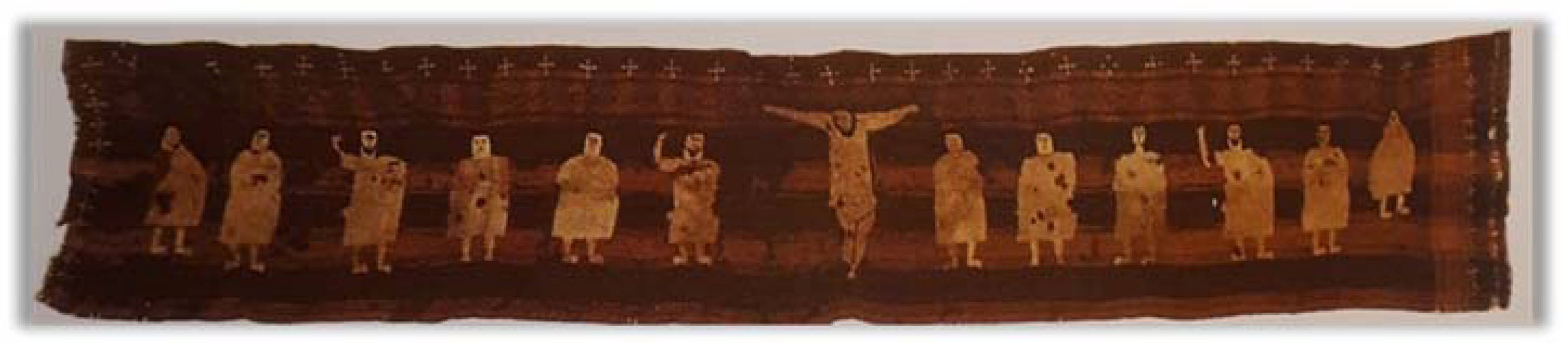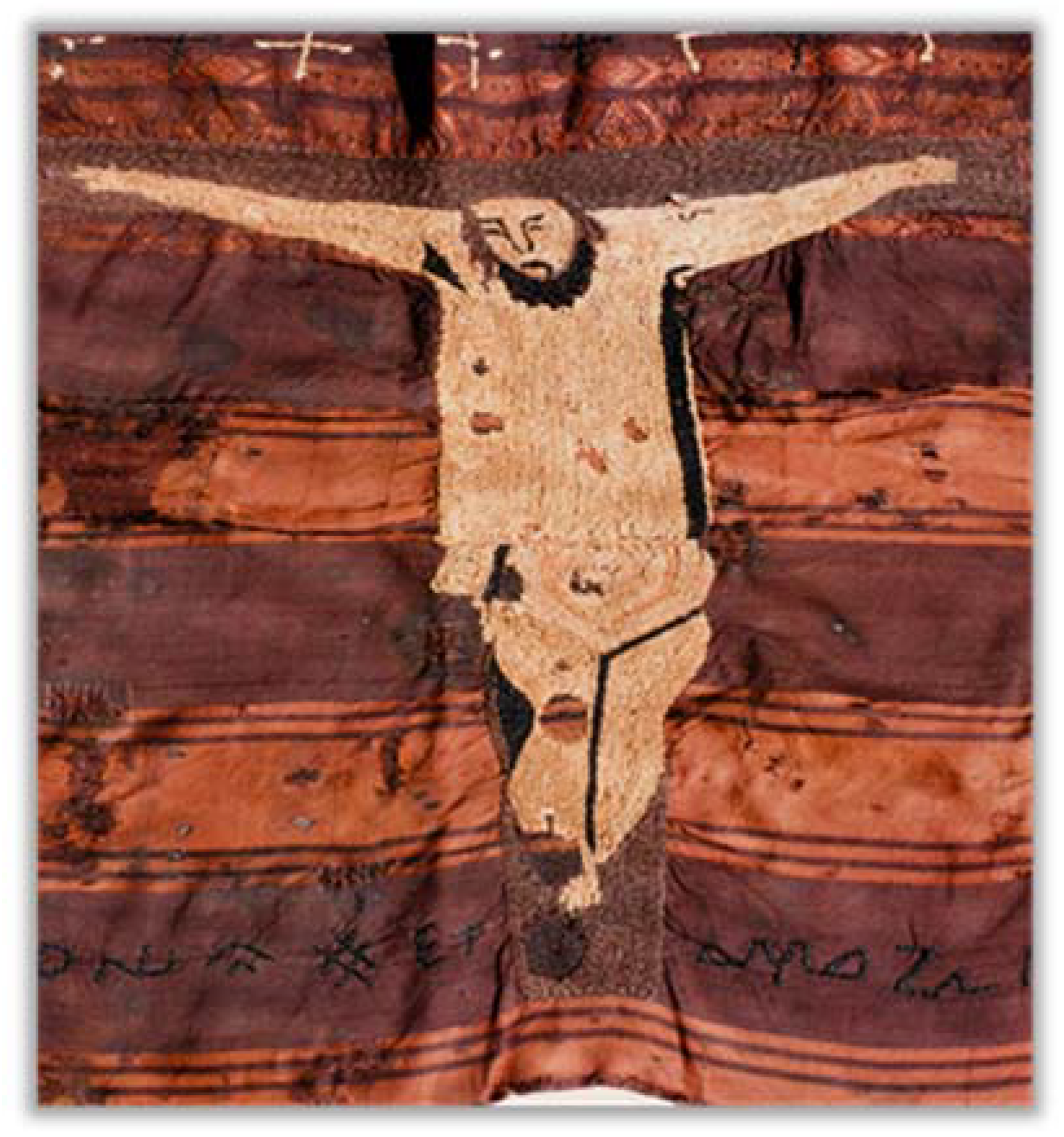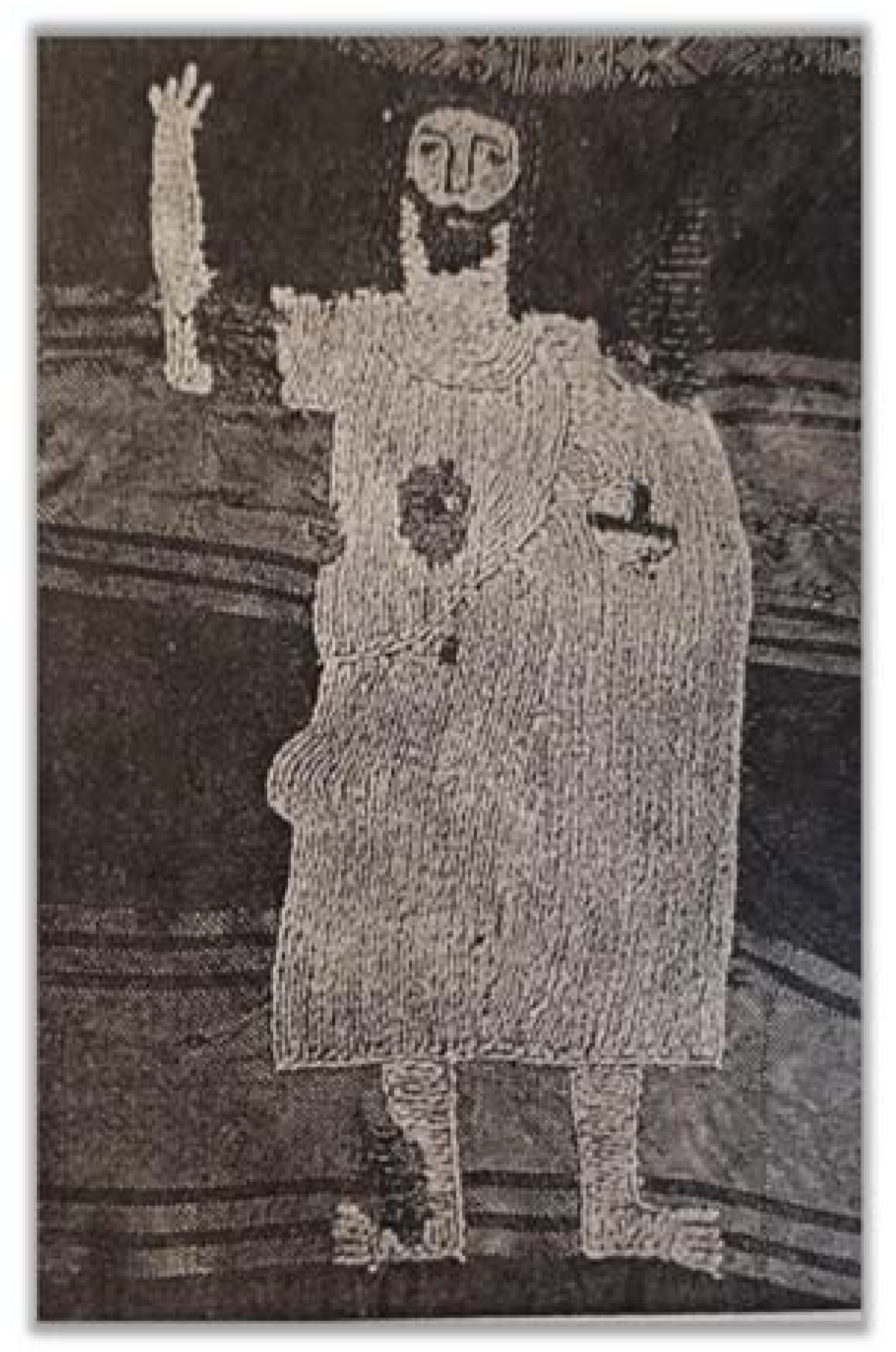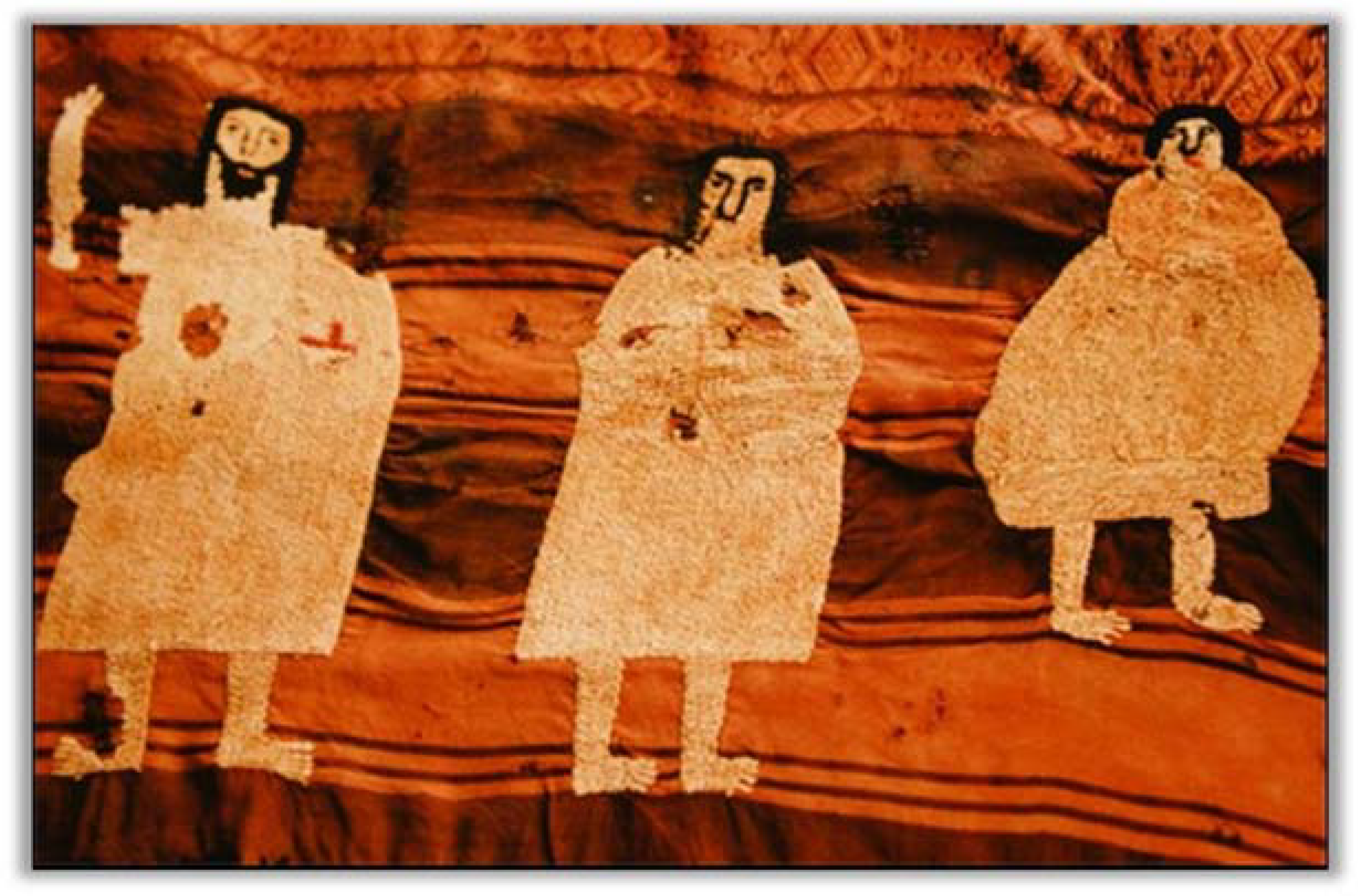

An Investigation on a Coptic Embroidered Panel from the 13th Century “Crucifixion with the Twelve Apostles” (Benaki Museum, Athens)
Abstract
:1. Introduction
2. Technical Context
2.1. Technique of the Textile
2.2. The Technique of Embroidery
3. Stylistic Description and Discussion
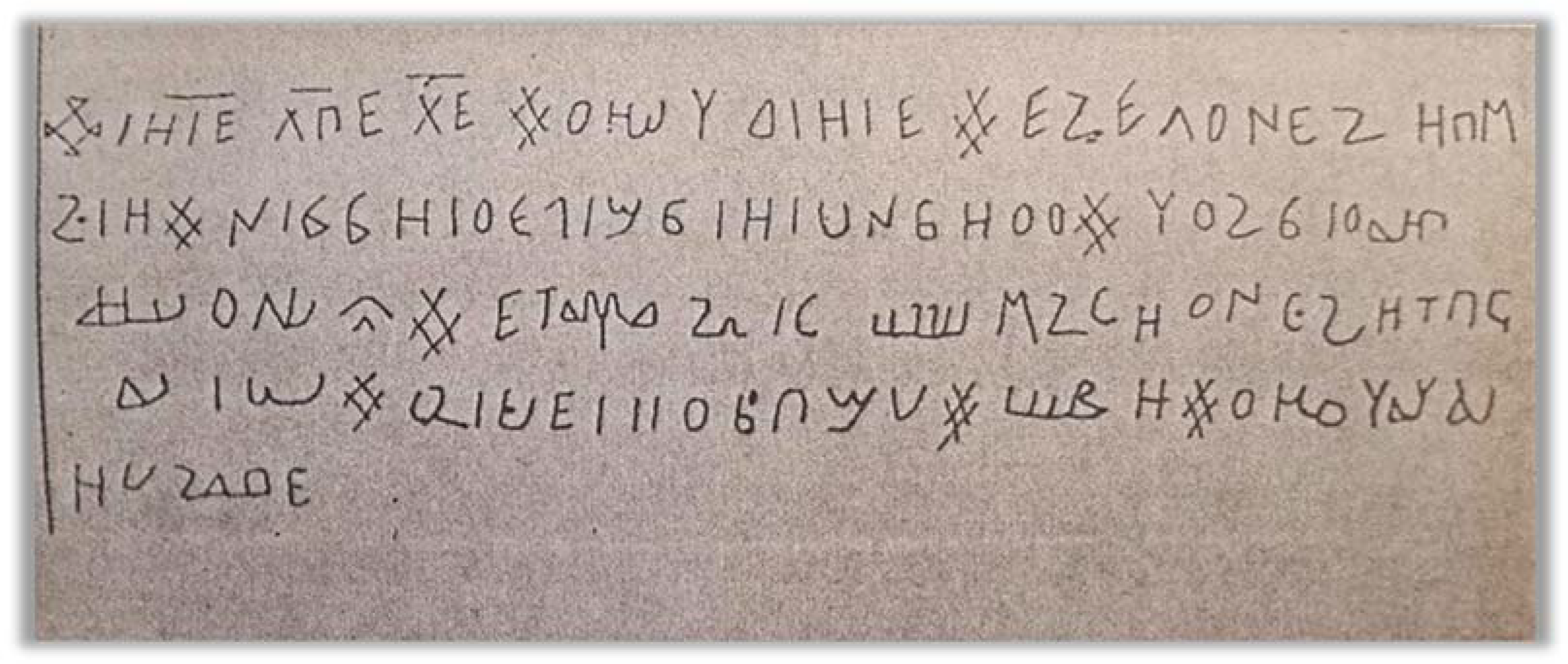
4. The Inscription
 (Figure 6).
 . Tentatively, I recognized a galgolitic one (Q); some other letters are unidentifiable (may be Arabic), such as this one
  . Nevertheless, the first three abbreviations at the beginning of the inscription give us a clue that they are of Greek meaning. The first abbreviation, although misspelled, is referring to the Monogram of Christ IHIE. The second one,
  , adding (E), could be read as (EΛΕHΣΕ/have mercy), and the third (XE) with upper dash is deciphered with a great certitude as XPIΣTE (Oh! Christ). On a 15th century unique icon of the Cretoitalian School, in the Byzantine Museum of Athens (T. 2638), is depicted a most rare representation of both the Crucifixion and the Resurrection in the East (Eις Aδου Κάθοδος = to the netherworld descendance) and western prototypes. The icon underneath has a two-row inscription of a supplicatory troparion and has been a donation. Thus, we are led to the conclusion that this inscription is a Δοξαστικον of either the holy Friday (ΔOΞAΣΤΙΚOΝ of the Crucifixion; that is, the glorious type of hymn found in the Divine Services of the Eastern Orthodox Church) or a ΔOΞAΣΤΙΚOΝ of the twelve Apostles (30th of June). A Coptic inscription with the same chrism, lozenge shaped at intervals, is also traced on a late Coptic tapestry fragment in the Louvre, that P. P. du Bourguet has described as a curtain or an altar hanging, from the Fayoum, 12th century [5] (p. 647). Some single signs remind us of Geʽez writing, the script used as an alpha syllabary for several Afro-Asiatic and Nilo-Saharan languages of Ethiopia and Eritrea in the Horn of Africa. Its origin may have been an abjad (consonant-only alphabet) first used to write the Geʽez language, which today is the liturgical language of the Ethiopian Orthodox. It is also a means of confirming dating [18]. The present textile object is unique, depicting Christian symbols, yet belongs to the wider investigation of Coptic embroideries. One of the biggest characteristics of Coptic textile motifs of the later period is dualistic expressions of Christianity and Islam, which were interpreted as virtue and evil, and civilized world and barbarous world [19], and, in some cases, use of bi- or multilingual aspects is observed [20].
5. Conclusions
Funding
Acknowledgments
Conflicts of Interest
References
- Meinardus, O. The collection of Coptica in the QASR of the Monastery of St. Antony. Bull. Société Archéologie Copte 1980, 18, 272. [Google Scholar]
- Delivorrias, A. Guide to the Benaki Museum; Benaki Museum: Athens, Greece, 1980; p. 34. [Google Scholar]
- Millet, G. Recherches sur L’iconographie de L’évangile; Fontemoing et Cie: Paris, France, 1916. [Google Scholar]
- Schiller, G. Iconography of Christian Art; New York Graphic Society: New York, NY, USA, 1972; Volume 2, figs. 323–324. [Google Scholar]
- du Bourguet, P.R.P. Catalogues des Étoffes Coptes l; Musée National du Louvre: Paris, France, 1964. [Google Scholar]
- Lamm, C.J. Cotton in Medieval Textiles in the Near East; P. Geuthne: Paris, France, 1937. [Google Scholar]
- Thomson, D. Cotton double cloths and embroidered and brocaded linen fabrics from tenth to fourteenth century Egypt: Their relation to traditional Coptic and contemporary Islamic Style. Bull. Liaison CIETA 1985, 61, 1–2. [Google Scholar]
- Paulus, B. Pascasius Radbertus De Corpore et Sanguine Domini: Cum Appendice Epistola ad Fredugardum; Corpus Christianorum, Continuatio Mediaeualis; Turnholti, Brepols: Turnhout, Belgium, 1969; Volume 16. [Google Scholar]
- Child, H.; Colles, D. Christian Symbols—Ancient and Modern; Bell and Hyman: London, UK, 1960. [Google Scholar]
- Soteriou, G.A.; Soteriou, M. Eikones tes Mones Sina/Icones du Mont Sinai; Collection of the French Institute of Athens: Athens, Greece, 1956; Volume 2. [Google Scholar]
- Weitzmann, K. Icons from Southeastern Europe and Sinai; Thames and Hudson: London, UK, 1968. [Google Scholar]
- Soteriou, G.A. The Christ on Art; N. Tzakas: Athens, Greece, 1914. [Google Scholar]
- Butler, F.J. The Ancient Coptic Churches of Egypt; Gorgias Press: Oxford, UK, 1884; Volume 2. [Google Scholar]
- Dionisius from Fourna (Διονυσίου εκ Φουρνά). Interpretation of Art Painting; French Translation Denys de Fourna, Manuel D’iconographie Chretienne par A; Papadopoulos-Kerameus: Saint Petersbourg, Russia, 1909; pp. 298–299. [Google Scholar]
- Grabar, A. La Peinture Byzantine; Bibliothéque Laurentienne: Genéve/Florence, Italy, 1953; p. 164. [Google Scholar]
- Loverance, R. Byzantium; British Museum Press: London, UK, 1988. [Google Scholar]
- White, E. The History of the Monasteries of Nitria and the Scetis; 1931; Metropolitan Museum of Art, Egyptian Expedition: New York, NY, USA, 1975; Volume 8. [Google Scholar]
- Miqdadi, R.H. Abjad numerals as an absolute dating method: Forts from al-Ain, UAE. Mediterr. Archaeol. Archaeom. 2020, 20, 273–289. [Google Scholar] [CrossRef]
- Han, J. A study on the characteristics of the designs on Coptic textiles of Ancient Egypt. J. Fash. Bus. 2011, 15, 112–124. [Google Scholar]
- Richter, T.S. Greek, Coptic and the ‘language of the Hijra’: The rise and decline of the Coptic language in late antique and medieval Egypt. In From Hellenism to Islam: Cultural and Linguistic Change in the Roman Near East; Cotton, H.M., Hoyland, R.G., Price, J.J., Wasserstein, D.J., Eds.; Cambridge University Press: Cambridge, UK, 2009; pp. 401–446. [Google Scholar]



Publisher’s Note: MDPI stays neutral with regard to jurisdictional claims in published maps and institutional affiliations. |
© 2021 by the author. Licensee MDPI, Basel, Switzerland. This article is an open access article distributed under the terms and conditions of the Creative Commons Attribution (CC BY) license (https://creativecommons.org/licenses/by/4.0/).
Share and Cite
de Chaves, L. An Investigation on a Coptic Embroidered Panel from the 13th Century “Crucifixion with the Twelve Apostles” (Benaki Museum, Athens). Heritage 2021, 4, 4335-4343. https://doi.org/10.3390/heritage4040239
de Chaves L. An Investigation on a Coptic Embroidered Panel from the 13th Century “Crucifixion with the Twelve Apostles” (Benaki Museum, Athens). Heritage. 2021; 4(4):4335-4343. https://doi.org/10.3390/heritage4040239
Chicago/Turabian Stylede Chaves, Lila. 2021. "An Investigation on a Coptic Embroidered Panel from the 13th Century “Crucifixion with the Twelve Apostles” (Benaki Museum, Athens)" Heritage 4, no. 4: 4335-4343. https://doi.org/10.3390/heritage4040239
APA Stylede Chaves, L. (2021). An Investigation on a Coptic Embroidered Panel from the 13th Century “Crucifixion with the Twelve Apostles” (Benaki Museum, Athens). Heritage, 4(4), 4335-4343. https://doi.org/10.3390/heritage4040239