


Abstract
The Washington Arms Limitation Treaty 1922 was arguably one the most significant disarmament treaties of the first half of the 20th century. It can be shown that the heritage items associated with this treaty are still extant. Ship’s bells are one of the few moveable objects that are specific to the operational life of a ship and are therefore highly symbolic in representing a vessel. This paper surveys which bells of the ships scrapped under conditions of the Washington Arms Limitation Treaty are known to exist. A typology of ship’s bells has been developed to understand the nature of bell provisioning to vessels newly commissioned into the U.S. Navy. Each of the countries associated with the Washington Treaty have divergent disposal practices with respect to navy property, and this is reflected in both the prevalence and nature of custodianship of ship’s bells from this period. Such procedures range from the U.S. requirement commanding all surplus Navy property to be deemed government property upon ship deactivation, to the British practice of vending ship’s bells to private parties at public sales. However, ship’s bells, like many obsolete functional items, can be regarded as iconic in terms of heritage and therefore warrant attention for future preservation and presentation in the public domain.
1. Introduction
In the past decade, the field of conflict archaeology has moved from being a fringe aspect of heritage management to becoming a sub-discipline in its own right. Much of the work on conflict heritage of the 20th century focusses on a range of military installations and battlefields primarily associated with World War I [1,2,3] and World War II [4,5,6,7,8,9,10,11], as well as associated objects such as ships [12], aircraft [13,14], tanks [15], and gun installations [16,17]. There is also an extensive body of research that deals with submerged shipwrecks, both individual wrecks [18] and of groups of sunken vessels, either derived from single military operations [19,20,21] or as part of organized denial through scuttling [22]. Yet little research has been carried out into the whereabouts of ships that were associated with specific events but that were not sunk in action and thus were disposed of in the normal course of action due to their obsoleteness [23].
Such specific events include arms limitation treaties, which are bi-lateral or multi-lateral agreements designed to prevent an escalation of an arms race and thus defuse conditions that could lead to an open military conflict. Most treaties are designed to limit new construction to mutually agreed levels, such as the Anglo-German Naval Agreement of 1935 [24]. A few treaties are designed not only to limit arms to agreed levels, but also to reduce the overall number of arms in the signatories’ arsenals, such as the Washington Arms Limitation Treaty 1922. Despite consensual agreements limiting military assets such as naval tonnage and the make-up of large ships through acts of scrapping or scuttling, there is evidence that heritage items associated with such treaties are still extant [25]. Guns removed from such ships, for example, were re-installed as part of coastal defence systems in areas including the Pacific Coast of the U.S., Micronesia, Aleutian Islands (Alaska), and Banaba (Kiribati) [25]. However, to date, limited research has investigated the fate of vessels and associated items with limitation treaties, and this study is one of the few that do so.
Alongside tangible objects such as armaments existing despite arms limitation treaties, other objects existed that have both tangible and intangible heritage dimensions, the intangible component existing due to a sound being purposefully emanated through the object’s functional use [26,27]. Such an example is a ship’s bell, an object legally required to be provided on all vessels of 12 m or more in length [28].
Traditionally, ship’s bells fulfilled two functions, one operational and one navigational. On an operational level, the bell audibly signalled the passing of time on a ship. Crew duties, in particular of naval vessels, were divided into watches of four hours’ duration, with the bell signalling the passage of each half hour (with eight bells signalling the end of watch) [29]. In addition, for vessels at anchor in areas of restricted visibility such as fog, the bell would act as a navigational warning aid, being rung rapidly for about five seconds at intervals of no less than one minute to alert other ships of one’s presence [28]. Any vessel aground in similar weather was required to follow the same bell directive, with the addition of three separate and distinct strokes on the bell immediately before and after the rapid ringing of the bell. Land-based fog bells as well as those located on light vessels served a directional navigational purpose, with the pattern of bell ringing at each location having a distinctive number of strokes within a given period [30,31].
At least among larger ships, the ship’s bell carries the name of the vessel, either in relief or more commonly engraved in large letters, with the engraving blackened to make the name stand out. If a ship’s bell is inscribed also with a year, that date reflects the year the ship was formally commissioned rather than the year it was launched.
The bells of naval vessels hold special significance for the men and women who served on them:
“A warship’s bell is something that all onboard are familiar with. In days gone by they were the ‘heart-beat’ of a ship’s routine, marking the passing of watches and other important ceremonies such as the raising of morning colours when in port or at anchor. Every member of a ship’s company is familiar with its ring and as such these bells are important artefacts which, long after a ship is lost in action or decommissioned, form a ‘touchstone’ for former shipmates and relatives of those who served, fought and died in them”.(John Perryman) [32]
Ship’s bells, apart from builder’s plates, are the only (re-)moveable object specific to any given ship1 and therefore are highly sought after by collectors of maritime memorabilia [33,34,35]. The bells are generally removed once a ship is decommissioned and scrapped, with the bells retained or disposed as the owners deem appropriate. Among shipwrecked and sunken vessels, especially in situations where damage to the vessel is extensive due to environmental decay or due to wartime or collision impact, bells can provide conclusive proof of the identity of a shipwrecked vessel [36,37,38,39,40]. Not surprisingly, they are highly sought after by wreck divers [40,41] specifically because they are a single iconic item and therefore endowed with a “trophy” status [42,43]. Consequently, bells are salvaged for personal collections or for profit, even though they are frequently acquired illegally from protected shipwrecks [38,44,45,46].
This paper describes the fate of the ships that each of the signatory powers agreed to disarm and scrap as a result of the Washington Arms Limitation Treaty 1922. It also explores specifications, characteristics, and current locations, custodianships, and dispositions of any surviving ship’s bells associated with these vessels. In doing so, it provides a classification of U.S. Navy and Lighthouse Service bells to create a novel working typology for ship’s bells of this period.
3. The Fate of the Washington Ships
To comply with the conditions, each of the signatory powers agreed to disarm and scrap within 18 months a large number of capital ships based on a scrapping and replacement schedule (Washington Arms Limitation Treaty 1922 Part 3 § 2). Onwards sale of these ships was not permitted. Not surprisingly, of course, it was the old and outdated ships that were struck off the active lists as well as ships that were under construction but were not completed (Table 1, Figure 1 and Figure 2). Although the specific scrapping of existing vessels without replacement (in order to reduce existing tonnage to agreed limits) was restricted to the British Empire, the United States, and Japan, both Italy and France also decommissioned warships that otherwise would have been retained for several years. As they were essentially obsolete, however, they were scrapped in order to free up tonnage for new construction. These vessels, such as the formerly Austrian and later Italian SMS Tegethoff (1912), were excluded from this study.

Table 1.
The details and fate of the warships disposed of under the terms of the Washington Arms Limitation Treaty (for details of shipyards).
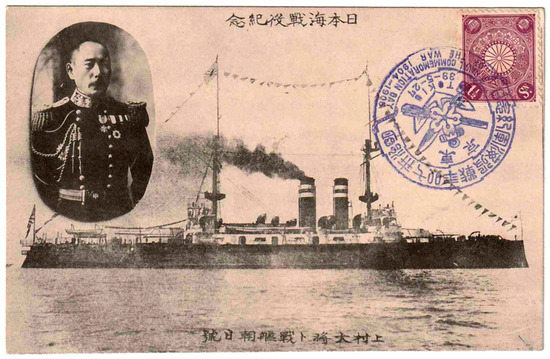
Figure 1.
The Japanese battleship Asahi (朝日) as shown on a contemporary postcard (source: author). (The captions on the card read 日本海戦役記念/Sea of Japan Campaign Memorial and 上村大将と戦艦朝日号/General Uemura and Battleship Asahi).
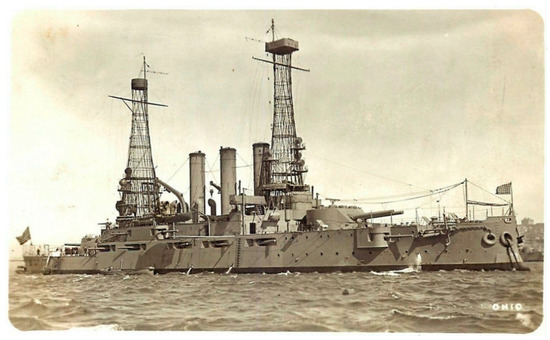
Figure 2.
The U.S. battleship USS Ohio (BB–12) as shown on a contemporary real photo postcard (source: author).
The cultural heritage assets related to the development and signature of the Washington Arms Limitation Treaty, in particular the fate of the vessels and their armament, have been discussed elsewhere [25], so a brief summary may suffice. In principle, the signatory nation was at liberty to dispose of its ships via three options: breaking up the vessel for scrap, scuttling and sinking it, or using it for target practice, with subsequent scrapping or scuttling. In addition, and subject to the acquiescence of the other signatories, a small number of ships could be disarmed and retained for non-combatant purposes, such as training hulks. In the process of disposal, the armament of most vessels was landed and placed in storage for later use as coastal defence guns or on merchant vessels during WWII [25,56,57,58,59]. Given the adjustment in tonnage needed, the scrapping or scuttling only affected the fleets of the Empire of Japan, the United Kingdom, and the United States of America (Table 1).
4. Bells of U.S. Navy Vessels
During the late nineteenth and early twentieth centuries, U.S. Navy vessels had two bells, both inscribed with the ship’s name: the ship’s main bell, usually mounted or near the bridge, and a bell mounted at the quarter deck.
4.1. Specifications
The United States Navy issued general specifications for the manufacture of bells used on ships (Figure 3) [60]. The size and pitch of the bronze bells depended on the size of the vessel. For the U.S. battleships under discussion here, two size classes apply, class C for battleships under 12,000 tons (Indiana class) and class D for battleships over 12,000 tons displacement (Maine class, Connecticut class, Virginia class, South Dakota class). Class C bells were 600 lb (approximately 270 kg) bells of 27 1/8” (689 mm) height with a 31” (787 mm) swing, whereas class D bells were 800 lb (approximately 360 kg) bells of 29 3/4” (756 mm) height with a swing of 34” (864 mm). Class C bells were to be tuned to B natural, whereas class D bells were tuned to B flat [60]. The bell weights (without clapper and fittings) of 600 lbs and 800 Lbs had permissible tolerances ±2%. The U.S. Navy required that the bells be made from “about 78 per cent of best new Lake Superior copper and about 22 per cent of new block tin” and be plain with a bright finish on the outside. The layout and size of the letters (1½” high) was also specified [60].
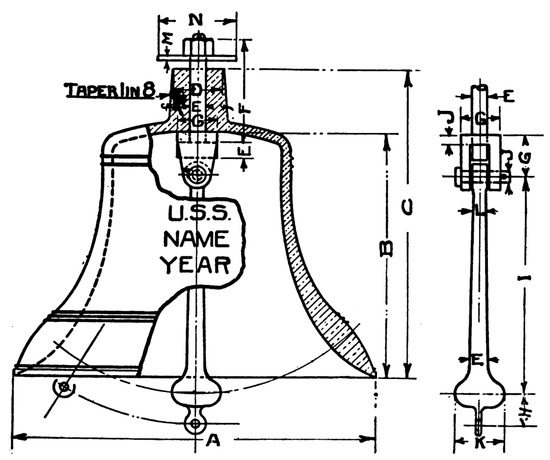
Figure 3.
The U.S. Navy specifications for the manufacture of bells used on ships [60].
Additional, more restrictive specifications could be issued for the construction of specific ships. The U.S. Navy specification for the construction of USS Connecticut (BB-18), for example, clearly stipulated that the watch bell should be “[a] clear sounding bell of composition, weighing not less than 800lb and engraved with name of vessel and date only, to be provided and suitably hung” [61]. A similar specification was issued for the construction of the cruiser USS Washington (ACR-11) [62]. As the actual bell cast for USS Connecticut shows, the specifications were not always followed to the letter (see below).
4.2. Type and Origin of the Bells
A number of bell foundries operated in the United States during the late 19th and early 20th centuries. Although churches and schools were their main clients for larger bells (see, for example, the list of castings in the ledgers of the Meneely Bell Company, Troy, NY, USA) [63], the foundries also cast bells for shipyards and for U.S. government agencies, such as the U.S. Navy and the U.S. Lighthouse Service (for use as fog bells). Major bell foundries were William Blake & Co (Boston, MA, USA), Meneely & Co. (West Troy/Watervliet, NY, USA), Meneely Bell Company (Troy, NY, USA), McShane Bell Foundry Co (Baltimore, MD, USA), Vanduzen & Tiet (Cincinnati, OH, USA), and E.A. Williams (Jersey City, NJ, USA). In the ideal world, it would be easy to correlate the bell of a given ship with the foundry where it was cast, either via records or via inscriptions on the bell itself. This proved not to be the case, as detailed records are hard to come by and most U.S. Navy bells lack foundry marks.
The bells of several U.S. Navy vessels included in the list (Table 2), as well as those of ships of the same vintage, could be examined, but do not exhibit any foundry marks: USS Georgia (BB-15) (commissioned 1906) [64], USS New Jersey (BB–16) (1906) [65], USS North Dakota (BB-29) (1910) [66], USS Rhode Island (BB-17) (1906) [67], USS South Carolina (BB-26) (1910) [68], and USS Vermont (BB-20) (1907) [69].
Table 2.
The functional and decorative characteristics of the types of 500 lb–4000 lb bells used by the U.S. Navy (USN) and the U.S. Lighthouse Service (USLS) (1885–1926) (see Figure 6).
The absence or removal of foundry marks seems to have been a practice for bells of other U.S. capital ships of similar vintage, such as USS Maryland (ACR-8) (1905) (Figure 4), USS Montana (ACR-13) (1908) [70], USS North Carolina (ACR-12) (1908) [71], USS Ohio (BB-12) (1904) (Figure 2) [72], and USS Texas (BB-35) (1914) [73].
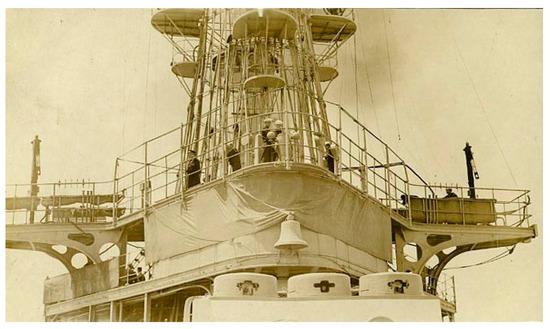
Figure 4.
The bridge of USS Maryland (ACR-8) in 1912, showing the mounting of the bell on a Pennsylvania-class armoured cruiser. The bell is mounted externally on the bridge [74].
Given that some of the bells supplied to the U.S. Lighthouse Service are of the same weight (500 lbs to 1000 lbs) as those supplied to the U.S. Navy, it is worth assessing whether there are foundry-specific patterns in the decoration of bells, in particular whether the placing and nature of decorative belts might aid in the identification of bell foundries on bells that lack a foundry mark. A survey of large bells used by the U.S. Navy and the U.S. Lighthouse Service, drawing on images accessible on the world-wide web (WWW), allowed us to develop a typology (Table 2) based on decoration patterns as well as mounting types (for terminology see Figure 5; for dichotomous key for the identification see Table 3. The principal arrangement of the types is by the number of bands: first those of the shoulder, then those of the waist and sound bow, and finally of the neck. Some of types, as far as they relate to capital ships of the U.S. Navy, are illustrated in Figure 6. It should be noted that the age ranges and foundries are only indicative, as most bells do not carry foundry marks or years of casting. Thus some of the data in Table 3 have to be considered a work in progress.
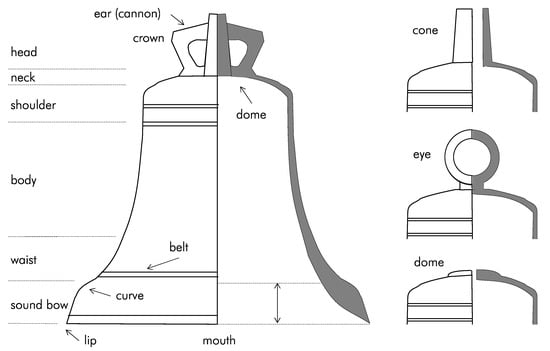
Figure 5.
The terminology of the bells and bell parts used in this paper.
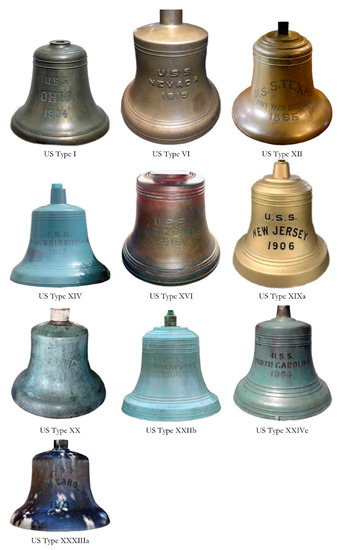
Figure 6.
The types of bells deployed on large U.S. Navy warships (1893–1921) (for typology see Table 3).
Although some of the age ranges included in Table 3 are well outside the range of the World War I-era warships considered in this paper, these bells are included in Table 3 because they were older bells that were on occasion rehung as fog bells in different lighthouse establishments.
U.S. Type XXXIII units are plain bells without any decorative belt lines. They come in three profile shapes, which can be distinguished by the steepness of the waist as well as the curvature of the shoulder (Figure 7). Of these, subtype A bells have been used by the U.S. Navy, for example on USS North Carolina (ACR-12) (Figure 7), whereas subtype B and C bells seem to have been employed by the U.S. Lighthouse Service. Bells with the profile of subtype B are more common, either with engraved or raised lettering. The latter seem to primarily date to 1926, with the lettering as well as the foundry information executed as a template pressed into the form prior to casting (Figure 8).
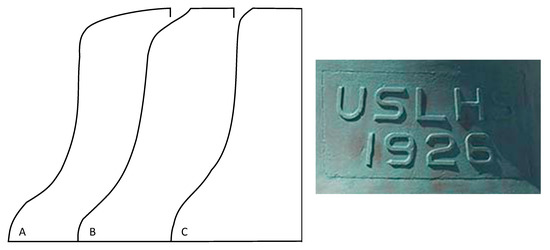
Figure 7.
Type XXXIII bells. Profile shapes of subtypes A, B and C (left) and example of lettering template (right).
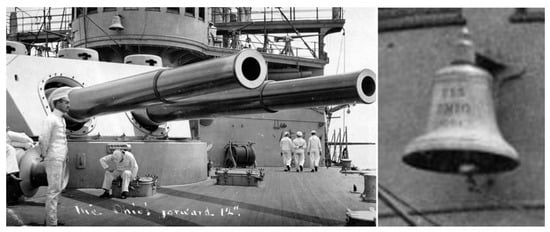
Figure 8.
The bridge of USS Ohio (BB-12) in 1907-1908, showing the mounting of the bell on a Maine-class battleship. The bell is mounted externally on the bridge. Right: detail (U.S. Navy Photo NH 101467).
Ship bells were manufactured by various U.S. foundries, such as McShane Bell Foundry of Baltimore, MD [75], and Meneely Bell Co of Troy, NY [76]. The Meneely Bell Co of West Troy, NY, supplied a range of fog bells to the U.S. Lighthouse Service [76] and bells to shipyards such as Fore River Shipbuilding [76] and William Cramp & Co [63]. In its publicity material, the company reproduced an unnamed U.S. warship, with its flag darkened (possibly to avoid conflicts of interest in advertising), as one of “the kinds of vessels [they had] supplied with bells”2 [76]. The ship appeared to be either the USS Delaware (BB-28), launched in 1908 by the shipyard Newport News in Virginia or, more likely, the USS North Dakota (BB-29), launched by Fore River Shipbuilding in 1908. The Fore River Shipyard also constructed the USS Nevada (BB-36) (1915), which exhibited a Type VI bell comprising raised lettering, although this ship did continue service post-Washington Treaty (Table 4).
Table 4.
The details of the U.S. Navy bells associated with warships disposed of under the terms of the Washington Arms Limitation Treaty (all bells are made of bronze).
Based on available imagery, there were at least seven different forms of U.S. Navy bells (Figure 6). Surveying the surviving bells originally mounted on the vessels eventually scrapped as part of the Washington Arms Limitation Treaty and augmented by other data, we correlated the types of bells with the shipyards where the vessels were built. In all cases, the name of the vessel and the year of commissioning were engraved onto the bell’s surface. This suggests that the bells were supplied by a foundry as a generic casting, with the customisation (naming) most likely carried out by the foundry, as the bell had to be tuned to B natural or B flat as per specifications (see above)3.
Type I bells all seemed to stem from vessels built by Union Iron Works, Mare Island, CA, such as the cruisers USS Milwaukee, USS Olympia, USS South Dakota, USS Tacoma, and the battleship USS Ohio (Figure 2 and Figure 8).
Other bell foundries also supplied the U.S. Navy with manufactured bells. The Type XXII bell of USS New Hampshire (BB-25) (Figure 9), launched in 1906 by the New York Shipbuilding Corporation, in New York, carries a foundry inscription on the back: “E.A. WILLIAMS & SON | BELL FOUNDERS JERSEY CITY N.J. | 1907.” The ship was commissioned in 1908. Williams & Son also provided the Type XVI bells for USS Arizona, built by the Brooklyn Naval Yard in New York (commissioned 1916).
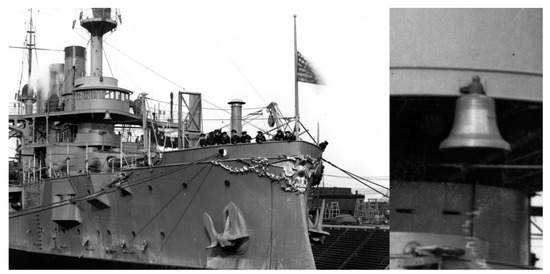
Figure 9.
The Connecticut-class battleship USS New Hampshire (BB-25) photographed on 6 January 1895. The bell is mounted just below the bridge. Right: detail (USN Photo 19-N-4-8-21).
Given that both Type XVI bells of the USS Arizona were marked “E.A. Williams & Son, Jersey City, NJ, USA” one might assume that the other Type XVI pattern bells were also made by the same foundry. Such bells were cast for USS Maryland (BB-46) (1921), USS Mississippi (BB-41) (1917), and USS Pennsylvania (BB-38) (1916), all vessels built at Newport News in Virginia, as well as for USS New Mexico (BB-40) (1918) and USS Tennessee (BB-43) (1920), built at the Brooklyn Naval Yard in New York.
The shipbuilding company of Philadelphia, William Cramp & Sons, launched both USS Minneapolis (C-13) (1894) and USS Sacramento (PG-19) (1914), which harboured bell types XXIX and VIII, respectively. Despite neither of these ships being decommissioned due to the Washington Limitation Treaty, it is interesting to note that the typologies are synonymous with bells used in the USLS, and it is plausible that foundries simultaneously supplied bells to the USLS and the U.S. Navy.
The Lighthouse Service used a wide range of bell manufacturers [79] with weights from 700 lbs to 4000 lbs [80]. The most common manufacturers for USLS fog bells installed over the period ending with the Washington Treaty (1911–1922) were Gamewell Fire Alarm Telegraph Co., NY; Geo. M. Stevens, Boston, MA; McShane Bell Foundry Co., Baltimore, MD, USA; and William Blake & Co., formerly Hooper & Co., Boston, MA, AD [79]. However, as the dates indicated on a large number of these bells do not correlate to the commissioning date of their associated fog signals and precede them by up to four decades in some cases, it would appear that the majority of these bells were initially constructed for another purpose.
4.3. Bell Date Complications
Care needs to be exercised, however, to not generalise from the limited number of documented observations, and there are numerous examples where dates inscribed on the bell run contrary to the expected actuality of the bell. A perusal of the transcribed ledgers of Meneely Bell Co in Troy, NY, USA, showed that the company cast the bells for some of the vessels under discussion. The foundry made the as yet unlocated bell for USS Louisiana (BB-19) (1906), built by Newport News Shipbuilding, which was cast on 8 February, 1907 [63], well after the commissioning of the vessel (2 June 1906) [81]. The post-commissioning date is somewhat confusing, but appears to be connected with later work on the vessel not originally contracted, with this work being undertaken at the navy yard in New York in February 1907 [82]. The reverse is true for the bell of USS Kentucky (BB-6), also built by Newport News Shipbuilding. Although the vessel was launched on 24 March 1898, and commissioned 15 May 1900 [83], the type XXXV bell bears an engraved date of 1898 but was cast by Meneely Bell Co on 29 November 1899 [63].
Some bells were seemingly reused. Meneely Bell Co also cast bells for a number of armoured cruisers, such as with a 670 lb bell cast on 24 March 1893, for USS New York (ACR-2) (1893), a 916 lb bell cast on 17 June 1904, for USS Pennsylvania (ACR-4) (1906), and a 927 lb bell cast on the same day for USS Colorado (ACR-7) (1905), all built by William Cramp & Co [63]. The latter bell was refurbished on 20 June 1907, for use on USS Tennessee (ACR-10) (1906) (also built by Cramp & Co) and in the process of polishing off the vessel’s name, the bell weight was reduced to 870 lb [63].
Of particular peculiarity is the bell of USS Illinois, currently located at Navy Pier in Chicago (Figure 10). Originally created as part of the Columbian Exposition in Chicago in 1893, the bell serviced the replica battleship USS Illinois (made of brick, wood, stucco, cement, and metals to support the illusion of being a floating vessel) (Figure 11) [84]. After the conclusion of the exhibition, when the replica ship was being dismantled, the bell acquired by antique collector Benjamin P. Cheney Jr., who subsequently bequeathed the bell to the operational battleship USS Illinois (BB-7) before its commissioning in 1901 [85]. The bell still bore the original 1893 inscription but with added inscriptions bearing both the name of the new vessel, and references to both Benjamin and Julia Cheney on the opposing face [85]. Because of its display location, the bell is also sometimes erroneously attributed to the USS Chicago [86].
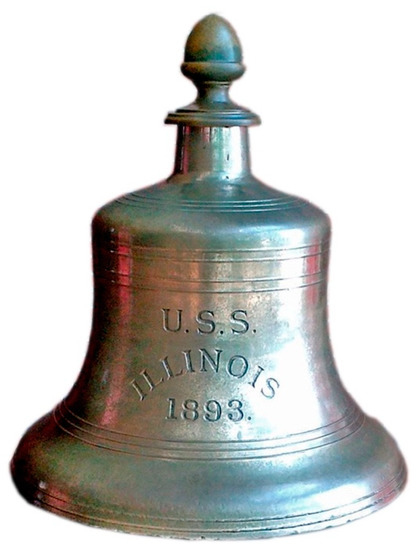
Figure 10.
The type XXIX bell of USS Illinois, initially created for the replica Indiana-class battleship shown at the Columbian Exposition in Chicago in 1893 (source: Metro2).
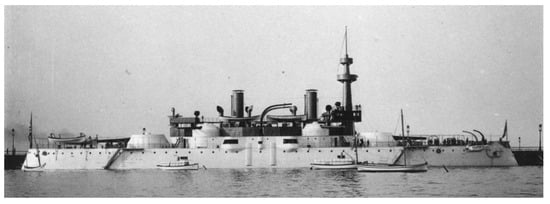
Figure 11.
The replica battleship USS Illinois at its “berth” at the Columbian Exposition (Chicago 1893) [84].
Complications can also be found in some of the U.S. Navy yards that had the capacity to cast their own bells, and care needs to be exercised not to generalise. This is apparent at least for the Philadelphia Navy Yard in 1922, as the case of the Type XX bell of USS Connecticut attests [87]. A surviving bell, held by the museum at Mystic Seaport, is engraved with the four-line inscription “U.S.S. | CONNECTICUT | 1904 | NAVY YARD NEW YORK” (Figure 12). That bell carries not only the vessel and date, but, contrary to issued specifications [61], also the Navy Yard inscription. Other bells show similar inconsistencies (e.g., the bell of USS Vestal (AR-4) (1908), which carries the additional text “NAVY YARD, N.Y.”) [88]. The ledgers of Meneely Bell Co show that a single 838 lb bell was cast by Meneely Bell Co on 13 April, 1905 [63]. The Connecticut was launched on 29 September 1904, and commissioned on the same day two years later [89,90].
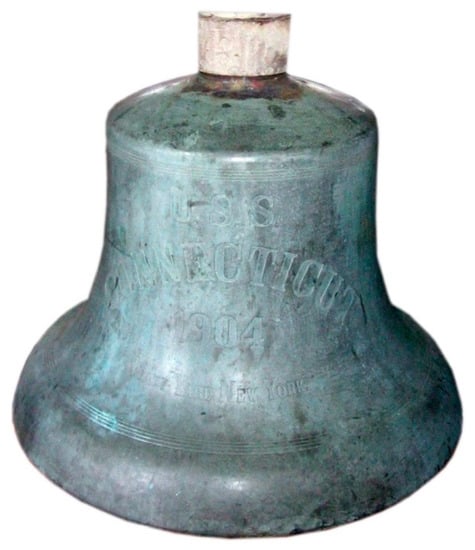
Figure 12.
The type XX bell cast for USS Connecticut (BB-18) (source: Wikimedia, edited by DHRS).
4.4. Current Location and Custodianship of the Bells
The disposal of U.S. Navy property surplus to requirements is governed by the Navy Property Redistribution and Disposal Regulation [91], with revisions and integrations into subsequent policy [92,93,94,95]. The 1949 regulation gave the Curator for the Department of the Navy the authority to retain objects of historic interest, including but not limited to ship’s bells, trophies, and other relics and materials. U.S. Naval Instruction 4770.5B (1964) asserted that commands on deactivation were to keep and send all ship’s bells (as well as other items) to the Curator for the Department of the Navy (now Naval History and Heritage Command (NHHC)). Instruction 4770.5B placed ship, turret, and quarterdeck bells on the top of the list of items to be passed on to the Curator. If the vessel was to be transferred to another U.S. government agency, or a foreign government, then only the ship’s bell had to be transferred to the Curator “[i]f replaceable locally” [93]. Under current provisions, bells “may be provided on loan to new namesake ships; naval commands with an historical mission or functional connection; and to museums and other institutions that are interpreting specific historical themes and displays of naval history” [96].
Prior to 1949 no formal regulation seems to have existed that specifically governed the disposal of a vessel’s main and quarterdeck bells. The NHHC maintains that the bells taken off decommissioned U.S. Navy vessels “remain the permanent property of the US Government and the Department of the Navy” [96] irrespective of how and when they may have been acquired [97]. The NHHC asserts ownership of bells of U.S. Navy vessels in private hands when they appear on the market [33,98]. In the case of the bell of USS Vestal (AR-4), the bell was legitimately acquired at an official surplus sale after the vessel was stripped in 1949 and scrapped in 1950, but the NHHC argued on occasion of an onwards sale in 2016 that the original sale was in error, that the original sale was in contravention of the Navy Property Redistribution and Disposal Regulation of 1949 [91], and that the NHHC therefore retained title over the bell [88,99]. This claiming process, however, is not carried out consistently, as attested by the quarterdeck bell of USS Shangri-La (CV-38), which is privately owned by a school principal in Kaohsiung (Taiwan) who acquired it when the vessel was scrapped at a Taiwanese breaking yard in 1989 [100,101]. The facts that USS Vestal, albeit severely damaged, was a survivor in the Pearl Harbor attack, played a role in the recovery of trapped crew from USS Oklahoma (BB-37) sunk in the same attack, and was the recipient of a Presidential Unit Citation and two battle stars, may have played a role in the persistence and determination displayed by the NHHC to reclaim that vessel’s bell.
Currently, the NHHC has over 1500 bells and bell-related artefacts in its collection [102]. It would appear, however, that the Naval History and Heritage Command has no record of the location of the bells of several vessels scrapped as part of the implementation of the Washington Arms Limitations Treaty: USS Kansas (BB-21), USS Louisiana (BB-19), USS Maine (BB-10), USS Michigan (BB-27), USS Montana (BB-51), and USS Nebraska (BB-14) (Figure 13) [103].
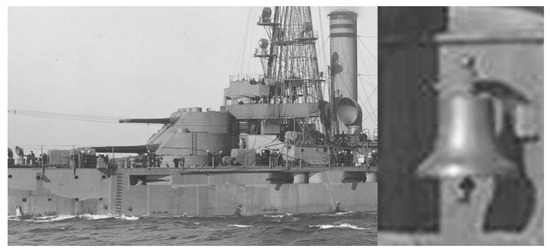
Figure 13.
The Virginia-class battleship USS Nebraska (BB-14) photographed in April 1918. The bell is mounted well below the bridge on the port side, just aft of the forward turret. Right: detail (USN Photo 19-N-4-8-21).
It appears that no bells were issued for the following units, all of which were broken up on their slipways: USS Indiana (BB-50), USS Iowa (BB-53), USS Massachusetts (BB-54), USS North Carolina (BB-52), and USS South Dakota (BB-49). The same applies to the battleship USS Washington (BB-47), which was launched but not completed [103].
At least four of the bells were melted down, with the metal used for other bells owned by the U.S. Navy. When USS Michigan (BB-27) was decommissioned in February 1922, its bell was melted down together with the bells of three decommissioned Indiana-class battleships4 to cast a new bell.
“Bell, in tower of Mahan Hall, U.S.N.A. Cast at Philadelphia Navy Yard from metal of ship’s bells of the USS “Michigan”, “Alabama”, “Indiana” and “Massachusetts,” “U.S.N.A. Rear Admiral Henry B. Wilson, Superintendent, 1922. Cast from metals of, etc.” Installed in tower, April, 1923”.[87]
Whilst it is known that four bells were melted down to be re-cast, it is plausible that other bells were melted down for scrap. Anecdotal evidence suggests that the bell of USS Arizona was scheduled to be disposed in this manner in 1944 until its reputed protection by a college graduate [104,105]. This indicates that despite the requirement of the U.S. government to retain U.S. Navy bells, this may not precisely have been the case in the period during WWII, and some bells may have been subsequently lost in this process.
However, it is known that seven vessels were scrapped while under construction: USS Indiana, USS Iowa, USS Massachusetts, USS Montana, USS North Carolina, USS South Dakota, and USS Washington. Of these, only USS Washington was launched. The others were broken up on the slipways. As the units were never commissioned, it can be surmised that bells had not yet been cast or engraved for them, or if they were, they would have been melted down for other bells.
Of the 21 bells that should be extant since the Washington Arms Limitation Treaty 1922, only 15 have any available record of their current whereabouts (Table 5). There is no knowledge of the whereabouts of any of the bells from USS Kansas, USS Louisiana, USS Maine, USS Nebraska, or USS Washington, with the latter being intriguing, especially as its namesake reflects the Arms Treaty under discussion, nor the bell of USS Oregon, which has since been lost. Of those that remain, 12 are on display, yet only two are known to exist in an actual “ringable” form. Two of the bells have been exhibited for much of their lives since their ship’s decommissioning: The bell of USS North Dakota has been on display since 1930 [66] and the bell of USS Ohio since 1924 [72].
Table 5.
The disposition of U.S. Navy bells associated with warships disposed of under the terms of the Washington Arms Limitation Treaty.
5. Bells of British Navy Vessels
Bells mounted on warships of the Royal Navy tended to follow traditional late eighteenth- and early 19th-century church patterns, with the bell head of the bell comprising a crown staple that was usually cast in. The staple had six cannons into which an argent was inserted that allowed suspension from a headstock (in churches) or a fixed bell mount (on ships). Two Admiralty patterns (8a and 10a) are referenced in the literature, apparently referring to overall bell weight and shape and size of the crown staple.
On occasion, ship’s bells were also cast from trophy material, such as a new bell cast in 1917 for the British Faulknor-class destroyer HMS Broke (1914). The bell was cast from brass salvaged from the torpedo tube of the German destroyer G42, which the Broke sunk by ramming during the Battle of Dover Strait on 21 April 1917 [124].
For ship’s bells cast in the period leading up to the Washington Treaty, there are several typologies. For example, a bell with pattern 8a exhibits the typical crown suspension head, alongside beading on the neck (two), sound bow (one), and lower waist (2), but does not display beading on the shoulder region [125]. This form of patterning is visible on the main bell of HMS Valiant (1914) (not associated with the Treaty (Figure 14)); the maker’s name, “G. CLARK & SONS HULL,” is inscribed on the top section, and has measurements of 410 mm height, 440 mm diameter, and a weight of 77 kg [125]. One can readily assume that other bells of similar patterning were also cast by the same foundry.
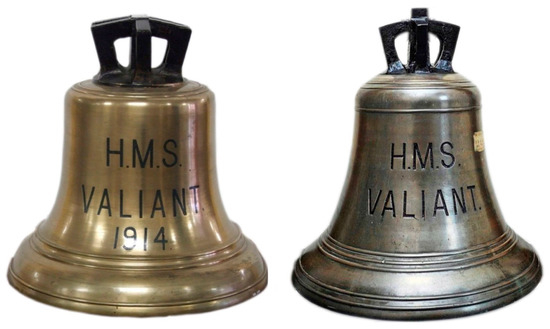
Figure 14.
The main and quarterdeck bells of HMS Valiant (1914) (sources: Royal Maritime Museum Greenwich [EQA0490, left) and Royal Navy (right).
5.1. Royal Navy Bell Disposal Practices
When a ship was decommissioned, the bell was removed for storage, reuse, or, in most cases, onwards sale8. Even if the ship was not scrapped, but rather transferred to another navy, the bell was removed and upon transfer the ship issued with a new bell. There seems to have been no regular practice of “turning” the bell and providing it with a fresh inscription on the obverse side. A case in point is the Leander-class light cruiser HMS Apollo (1934), which was transferred to the Royal Australian Navy in 1938 and renamed HMAS Hobart. Her two bells were placed almost immediately for public sale in December 1938 [128]. On the other hand, the bell of the modified Leander-class cruiser HMS Amphion (1935) was turned and re-inscribed “HMAS Perth 1939” when the vessel was transferred to the Royal Australian Navy [46].
In comparison with ship’s bells of the U.S. Navy, there is scant information available pertaining to bells of British Navy vessels. This is in part due to divergent disposal practices of each service, and also in part likely due to differing public perception of military relics. Unlike the U.S. Navy, which retains the ownership of the bells of all major combatant vessels, the Royal Navy has been amenable to the disposal of ship’s bells to private parties. The bells were sold at nominal prices between GBP 1 and GBP 10 to officers associated with the decommissioned vessel, other ships, or naval establishments. Although preference was given, basically anyone could acquire them, often via a public sale:
“Most of the bells do not retire from active service when the Admiralty dispense with them. They just change their jobs and become a dinner gong in the houses of retired officers who served on the ships from which the bells were taken. …It is only since the cutting own of the Fleet began that ship’s bells have been sold [publicly]”.[129]
That 1929 sale was the third bell sale since the end of WWI [130,131,132]. Thirty years later, bells were still being disposed of in the same fashion [133] and the prices were still low, ranging from GBP 1 to GBP 10 [133]. Consequently, most bells of decommissioned Royal Navy vessels are now in the public hand, complicating the tracing of their whereabouts. The sheer number of naval bells for sale in Britain is illustrated in Figure 15, and although the bells shown here do not specifically pertain to vessels associated with the Washington Treaty, the image does highlight 20th-century British Navy disposal practices. The image also shows the distinctive crown suspension head, which is characteristic of all bells of the Royal Navy. Numerous typologies can also be observed, such as the similarity of the bells of HMS Liverpool (1938), HMS Warrior (1945), and HMS Theseus (1946), and between the bell of HMS Concord (1946) and HMS Peacock (1946), however, as these ships fall outside the period of the Washington Treaty, it is beyond the scope of this paper to discuss them in detail.
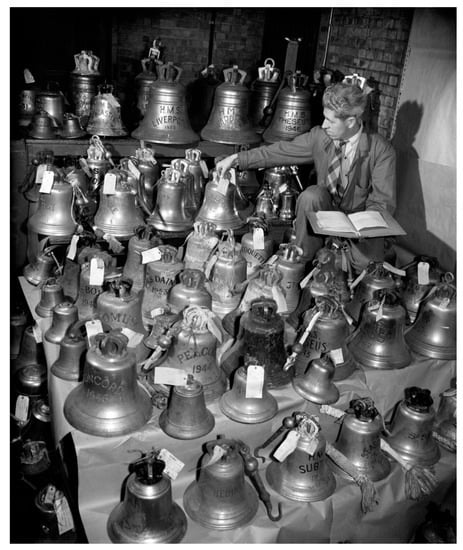
Figure 15.
The sale of British Navy bells ca. 1959 (source: Press Association, via Alamy, with permission).
Despite systematic searches on the WWW as well as specific targeted enquiries to the Royal Navy, the National Maritime Museum, and veteran’s associations of successor vessels with the same name, only three bells pertaining to vessels associated with the Washington Treaty could be located: those of HMS Superb, HMS Australia, and HMS New Zealand, which are discussed in detail below. Information pertaining to the accounts of bells from four other ships was available, namely, the HMS Hercules, HMS Colossus, HMS Dreadnought, and HMS Erin, although their current whereabouts are unknown (Table 6). The pattern 8a bell that had been on board HMS Hercules was ordered to be retained in store at Chatham and was not to be issued without prior Admiralty authority [133]. It was eventually sold to the public in 1934 [134]. However, the pattern 10a bell from the same ship and the pattern 8a bell from HMS Colossus (Figure 16) were available for re-issue to serving ships in priority to new uninscribed bells in stock, under the direction that “where possible, the inscription now on these bells should be erased before issue, but otherwise the inscription is to remain” [133]. Finally, the pattern 8a bell from HMS Erin was described as cracked and without a clear tone, but available for GBP 5 from Portsmouth Dockyard in 1928 [133,135]. In 1934, the Royal Navy disposed of another stock of ship’s bells for sale to the public, including one of the bells from HMS Hercules [134]. One of the bells from HMS Colossus was listed at a price of GBP 10 (it is unknown which one), with priority given to those with “special claims of consideration” due to high levels of sentimental interest attached to the bells [134]. After decommissioning, the bells seem to have been retained in the naval stores for some time before they were eventually offered for sale. The bell from HMS Hercules, for example, was on the sales list in April 1934 [134], even though the vessel had been listed for disposal in October 1921 and physically broken up in 1922 [136]. In the same sale were bells from the cruiser HMS Bacchante, which had been sold for scrap in July 1920, from the battleship HMS Mars (May 1921) and from the battlecruiser HMS Dominion (May 1921) [136].
Table 6.
The details of the bells associated with warships disposed of under the terms of the Washington Arms Limitation Treaty (all bells are made of bronze).
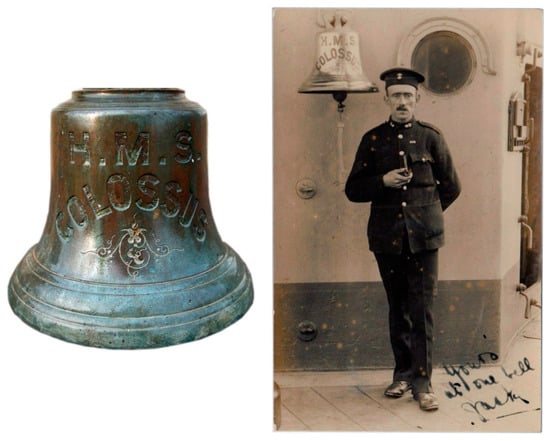
Figure 16.
The quarterdeck bell of HMS Colossus (left) and a British sailor posing next to the bell ca. 1917 (right) (sources: bell photo via Carmen Gunter, card via eBay).
The fate of the bells, once in private hands, is beyond formal control. While some bells are mounted on premises and are sold as fixtures with the premises (e.g., HMS Superb, see below), others stay with the original purchasers and are passed on through generations and may even be exported (e.g., the quarterdeck bell of HMS Valiant) [137]. Other bells, such as the quarterdeck bell from HMS Tiger (1913), were melted down to create a series of smaller commemorative bells. Although the main bell of HMS Tiger is in the Imperial War Museum in London [138], examples of commemorative bells are frequently offered by auction houses [139,140,141].
5.2. Current Location and Custodianship of the Bells
As discussed earlier, of the 21 Royal Navy vessels associated with the Washington Treaty, only three bells could be located: those from HMS Superb, HMS Australia, and HMS New Zealand. The bell of HMS Superb has since been transferred to private ownership, and is currently known to be set upon an external wall of Manor House in Upton Lovell, Wilts [142], whereby it remains as an asset connected with the property, being recently transferred as part of the sale of the estate [143,144]. The bells of both HMS Colossus and HMS Dreadnought are known to be in private hands, but little other information is available, except that the Colossus bell is located in Scotland.
It is interesting to note that each of ships associated with the colonies of Australia and New Zealand returned their naval bells for display to the public, unlike those of strictly British origin. This could be in part due the importance placed on these ships as iconic figureheads of their respective emerging navies, and also due to the manner in which the bells were financed and created.
The HMS New Zealand bell was originally made for the King Edward VII-class battleship of the same name launched in 1904 and commissioned in 1905. That ship was renamed HMS Zealandia on 1 December, 1911, to make way for the Indefatigable-class battlecruiser HMS New Zealand, which formed part of the fleet disposed of under the terms of the Washington Arms Limitation Treaty. Upon the commissioning of the latter vessel, the bell was transferred to the new ship in 1912, partly due to the efforts of Commander R.C. Davenport, who was on board both vessels [143]. When the bell was originally cast, funds were encouraged to be raised by schoolchildren throughout the country, with penny trials taking place as a symbol of support of both the ship and its role in the colony [143]. With dimensions of around 430 × 450 mm (height x diameter) and a weight of 90.72 kg, it is reputed that the bell was cast using some of the metal from the pennies collected, evidenced by the bell being inscribed “TO HMS NEW ZEALAND BY THE SCHOOL CHILDREN OF HER NAMESAME COLONY—1905” [143]. When mounted aboard the ship, the original bell was “suspended from the carved head of a Maori who [held] between his teeth a decorated Maori ring, from [which] the bell [was] hung” [145]. The importance of this battlecruiser to the country, the manner in which its bell was created, and the uniquely New Zealand style of its suspension makes this bell somewhat of an icon for New Zealand military (and sociological) history, hence why the bell takes pride of place on display at the National Museum of the Royal New Zealand Navy—Torpedo Bay Navy Museum in Auckland (Figure 17) [143].
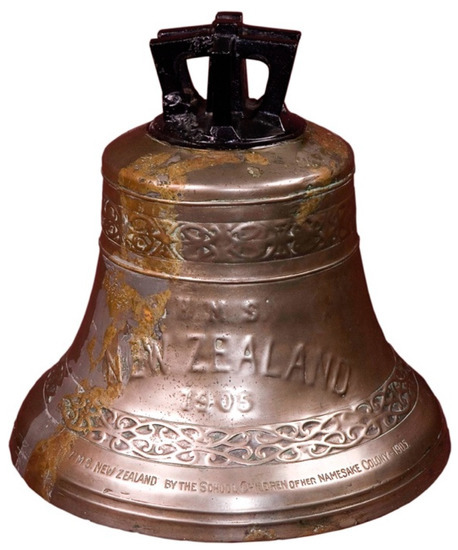
Figure 17.
The highly ornate main bell of HMS New Zealand (source: National Museum of the Royal New Zealand Navy) [146].
On the other hand, the ship’s quarterdeck bell, which is not known to have survived, was a rather plain affair, marked with a large British military arrow. Judging from the grainy image, the bell, which was suspended from a crown head, had no decorative belts on the shoulder and one or two belts on the waist (Figure 18).
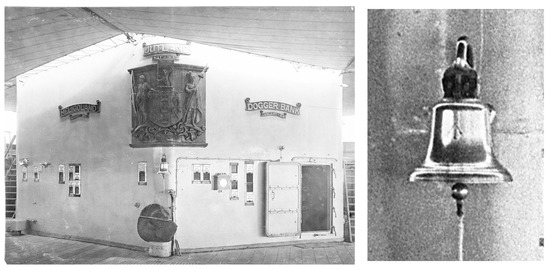
Figure 18.
The quarterdeck of HMS New Zealand (ca. 1919) with detail at right (source: Library of South Australia PRG 280/1/15/316).
In a similar manner, in 1910 the Australian government ordered the construction of HMAS Australia by shipbuilders John Brown & Co Ltd., in Clydebank (Glasgow, Scotland), to defend the British Empire, with the ship not only being the flagship of the fleet, but the acquirement of such a vessel also signalling the Royal Australian Navy’s emergence as a credible operational unit [147]. After operational duties primarily in the Pacific and the North Sea, she returned to Sydney and was paid off into reserve on 12 December, 1921, only one month after her return [147]. At the equivalent time of her scuttling in 1924 to comply with the Washington Treaty, the bell was transferred to Melbourne for inclusion in the Australian War Memorial collection, and by 1927 the bell was used to toll the commencement and conclusion of the traditional two minutes of silence mark of respect for Remembrance Day [148,149]. It is now placed on display at the Australian War Memorial in Canberra, in a “non-ringable” state [150]. The bell displays the typical crown suspension head (Figure 19), similar to other bells of vessels of the same period, such as HMAS Sydney and HMAS Parramatta [151,152], despite slightly different typological characteristics that are probably related to the shipyards of the vessels’ construction (London and Glasgow Engineering Co, Govan, Glasgow, Scotland, and Fairfield Shipbuilding & Engineering Co Ltd., Govan, Glasgow, Scotland, respectively) [153,154]. Interestingly, bells associated with vessels constructed in Australia in a similar period (at Commonwealth Naval Dockyard, Cockatoo Island, Sydney), such as HMAS Huon and HMAS Swan, have a completely different suspension system, and with the bells appearing rather crude in their construction [155,156,157,158].
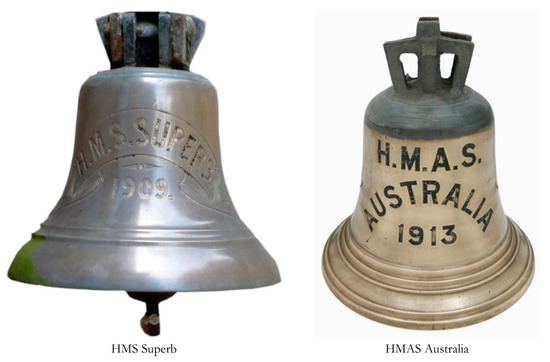
Figure 19.
The bells of HMS Superb and HMAS Australia (source: R Southwell and Australian War Memorial [143,150].
6. Japanese Bells
Data on the nature and fate of the bells associated with the Japanese ships are very limited and nothing has been formally published on the bells in general. The background of the 15 Japanese vessels scrapped under the treaty is complex. Five ships were built at British shipyards as part of the original battleship development of the Japanese Fleet [159]. These were the Asahi (朝日) (1900), built by John Brown & Co. at Clydebank (Figure 1); the Shikishima (敷島) (1900), built by Thames Iron Works, Blackwall, London; the Kashima (鹿島)(1906), built by Armstrong Whitworth, Elswick; and the Mikasa (三笠) (1902) and the Katori (香取) (1906), both built by Vickers, Barrow-in-Furness [159,160]. It can be surmised that these vessels, on commissioning, would have received bells from British castings.
Eight of the ships were built by Japanese yards, with the Aki (安芸) (1911), Ibuki (伊吹) (1907), Ikoma (生駒) (1908), and Settsu (摂津) (1912) built by the Kure Naval Arsenal; the Kurama (鞍馬) (1911) and the Satsuma (薩摩) (1910) built by the Yokosuka Naval Arsenal; and the Amagi (天城) and Tosa (土佐) (1921) built by the Mitsubishi shipyards in Nagasaki. It can be assumed that these Japanese-built vessels, on commissioning, would have received bells from Japanese castings. The construction of the battlecruiser Amagi was halted following the signing of the Washington Treaty, with subsequent conversion into an aircraft carrier. Damaged on the slipway during the Kanto earthquake (September 1923), the Amagi was never completed and was broken up as a part-build [161]. As it was never commissioned, no bells would have been issued.
The origin of the remaining two vessels is even more complex. The Iwami (生駒) was originally the Russian battleship Oryol (Орёл), built at the Galerniy Island Shipyards in Saint Petersburg (Russia) and commissioned in 1904. The vessel was disabled and captured in the Battle of Tsushima in May 1905. Repaired at the Kure Naval Yards, the Oryol was commissioned into the Japanese Navy as the Iwami in 1907 [160]. The Hizen (肥前) was also originally Russian battleship Retvizan (Ретвизан), built by William Cramp & Sons Shipbuilding in Philadelphia (Philadelphia, PA, USA) and commissioned in 1902. Sunk in December 1904 at Port Arthur, the Retvizan was likewise re-floated, repaired at Sasebo Naval Yard, and commissioned into the Japanese Navy as the Hizen in 1908 [160]. We can assume that the Iwami (ex-Oryol) would have been commissioned into the Imperial Russian Navy with a bell of Russian casting, and the Hizen (ex-Retvizan) with a bell of U.S. casting supplied by the shipyard. Given that the Retvizan was launched in October 1900 and commissioned in March 1902, the battleship is synchronous with USS Maine (BB-10), also built by William Cramp & Sons, which was launched in July 1901 and commissioned in December 1902. We can speculate that the bells of these two vessels would have been replaced with bells of Japanese castings once the vessels were repaired and commissioned into the Imperial Japanese Navy.
Surviving Bells of Japanese Vessels
Pre-World War II, HJMS Mikasa (三笠) held a special place in the minds of the Japanese government and people, because, as Japan’s most modern battleship, she served as Admiral Togo Heihachiro’s flagship in the 1904 attack on the Russian fleet at Port Arthur and in the Battle of Tsushima on 27/28 May 1905, when the Japanese Navy decisively defeated the Russian fleet. Soon after the implications of the Washington Arms Limitation Treaty became public, the threat of losing the Mikasa as a symbol of Japan’s rise to a naval power gave rise to a popular movement [162,163] that succeeded in it being preserved as a historic vessel at Yokosuka and opened as a memorial ship in 1926 (Figure 20) [160].
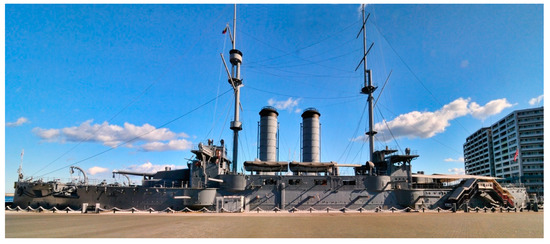
Figure 20.
The Memorial Battleship Mikasa (三笠) at Yokosuka Harbor (three-image composite by DHRS).
The exhibition on board the museum ship Mikasa contains the original bell that was slightly damaged during U.S. air raids on Yokosuka during World War II. The shape of the bell exhibits a strongly carinated, broad beading with two beads on the neck, two widely spaced beads on the waist, and an undecorated sound bow. The bell is suspended with a solidly cast eye with a rounded top. The profile and decoration of the bell do not resemble that of bells of British casting (see above), suggesting that this is Japanese cast. Why the original bell was removed is unclear. A second, undamaged bell is suspended at the quarterdeck and can be rung by visitors to the ship.
One of the bells of the battlecruiser Ibuki (伊吹) (1907), in addition to the ship’s wheel [164] and a model of the vessel [165], were promised to the Australian government in 1923, after the acting Prime Minister, Earl Page, requested a memento of the vessel that was in the process of being broken up [166]. The vessel’s relevance to Australia rests in the fact that in November 1914, in conjunction with HMAS Sydney, the Ibuki escorted the troopships carrying the Australian and New Zealand Auxiliary Corps (ANZAC) across the Indian Ocean to their staging post in Egypt [167]. The bell and wheel arrived in Australia in December 1925 and went on display in the temporary Australian War Memorial in Melbourne until 1935 [166]. The bell is of Japanese casting, possibly manufactured at Kure Naval Yard, where the vessel was built. The profile and decoration of the bell, with its strongly carinated, broad beading (Figure 21), is the same as that of the Mikasa (Figure 22). The bell of the Ibuki measures 480 mm in height and 450 mm in diameter. Its weight has not been documented [168].
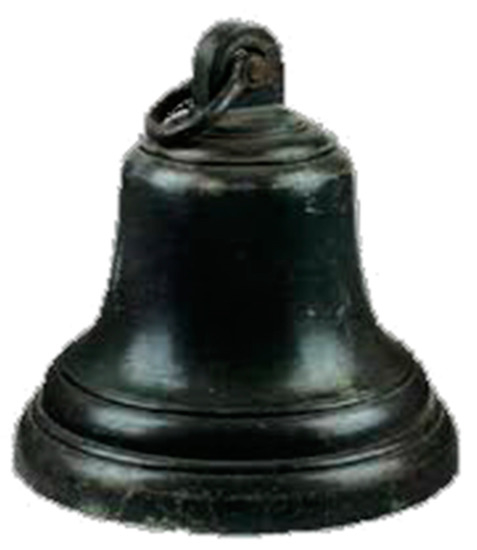
Figure 21.
The bell of the Ibuki (伊吹), held by the Australian War Memorial (RELAWM08239).
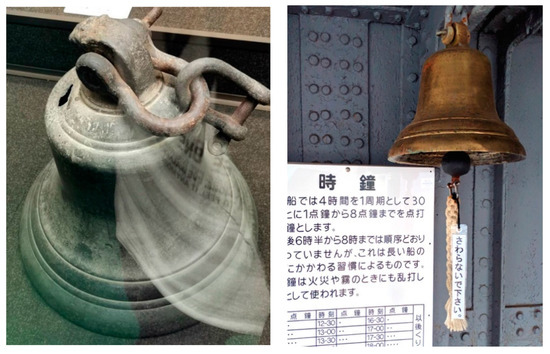
Figure 22.
The bells of the Mikasa (三笠) at the Memorial Battleship museum at Yokosuka. (Left) damaged bell on display. (Right) quarterdeck bell for ringing by visitors (photo hawk26) [169].
There appears to have been no formal process of retention of ship’s bells once vessels were decommissioned. Some of these seem to have been passed into private hands. In addition, there is an indication that bells did not stay with a ship from commissioning to final decommissioning but rather could be changed over mid-career. The bell of the Asahi (朝日) (Figure 1) is very illuminating in that regard. In October 2020 a bell 22 cm in diameter, 23 cm in height, and with an approximate weight of 3 kg was sold at auction on Yahoo Japan (Figure 23) [170]. The size of the bell suggests that this was the quarterdeck bell. The bell carries two inscriptions on its sound bow: “本帝国海軍艦朝日” (i.e., “Imperial Navy Ship Asahi”) and “明治参拾七年調” (i.e., “Meiji 37” (1904))9. The Asahi, which was laid down in August 1898, launched on 13 March, 1899, and commissioned on 28 April, 1900, was placed on the list of ships to be disposed of under the Washington Treaty. The vessel was reclassified as a training and submarine depot ship on 1 April 1923, and completely disarmed three month later [160]. Following a brief career as submarine tender and salvage and repaid ship, as well as a floatplane test ship, the Asahi was mothballed in reserve in 1928. In 1937 she was reactivated as a repair ship and torpedo depot ship, seeing limited service in the Pacific War. She was sunk on 25/26 May 1942, some 160 km southeast of Cape Padaran, Vietnam [160].
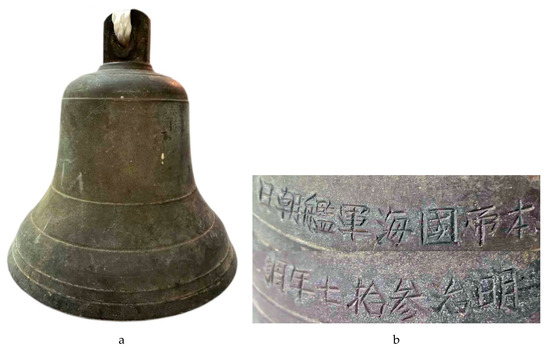
Figure 23.
The quarterdeck bell of the Asahi installed after the 1904 repair. (a) full bell; (b) detail of the inscription. For translation of inscription, see text (source: sutanisurao_0323).
This now raises the question as to the nature of the bell, given that the Asahi was built by John Brown & Co and upon commissioning would have received a bell of British casting, which should have gone down with the ship in 1942.
The Asahi was damaged in the Battle of the Yellow Sea (August 1904) by a Russian shell as well as two of her own shells that exploded prematurely in barrels of the 12 in aft turret [172,173]. She was repaired and headed back to support the blockade of Port Arthur, where she was severely damaged by a Russian mine on 26 October, 1904. Repaired at the Sasebo Naval Arsenal from November 1904 to April 1905, the Asahi re-joined the fleet to participate in the Battle of Tsushima in May 1905 [174]. It would appear that on the occasion of the repair in November 1904, the British-cast bell was replaced by a Japanese cast. It should be noted that the profile and decoration of this bell deviates from the bells of the Mikasa and Ibuki.
7. Discussion
As the preceding assessment has shown, the survival and preservation of bells from the warships disposed of under the terms of the Washington Arms Limitation Treaty varies significantly between the three nations: Japan, the United Kingdom, and the United States of America. Notwithstanding the small number of bells that cannot be located at this time, the majority of the bells derived from U.S. Navy vessels have survived. This can be attributed to the persistence and efforts of the Naval History and Heritage Command to collect these bells, which is exemplified by the great lengths that the U.S. Navy’s Naval History and Heritage Command went to in order to claim title and possession of the bell of USS Vestal [99]. Another factor that should not be discounted, however, is the fact that U.S. Navy battleships were named after the states of the Union, and that the states took great pride in “their” ships, as is evidenced by the silver sets that were often given to the captain’s mess, often accompanied by formal accounts of fundraising and details of the sets [175]. Not surprisingly, then, many of the bells are prominently displayed in or at public buildings in the respective states (see Table 7).
Table 7.
The disposition of the bells associated with warships disposed of under the terms of the Washington Arms Limitation Treaty.
This obsession with claiming ownership over every single main and quarterdeck bells of major U.S. Navy vessels stands in total contrast to the discard program run by the Royal Navy. Here, all bells of decommissioned vessels were sold to the public, with preference given to the officers and ratings who had served on the vessel in question. Consequently, the bells are scattered far and wide, with the overwhelming majority, if they still survive, held in unknown private hands. A few bells are held in public collections, such as the National Maritime Museum in Greenwich and the Imperial War Museum in London. Exceptions are the inscribed bells of HMAS Australia and HMS New Zealand, which are held in the military museums of the respective namesake countries. The preservation of the bells as mementoes of the battlecruisers is a manifestation of the national pride of the nascent nations to fund a battlecruiser each as an Empire contribution to the Royal Navy. As such, then, the preservation can be seen in the same light as the preservation of the bells of the U.S. battleships named after the states of the Union.
The preservation of HJMS Mikasa as a museum ship and national memorial was a matter of national pride, and a cause célèbre for the Japanese delegation when negotiating the terms of the Washington agreement. As noted, Australia and New Zealand retained the bells and their namesake vessels. No such patriotic sentiment extended to the bells of the other decommissioned British and Japanese battleships and battlecruisers.
That the Royal Navy placed so little emphasis on the protection and preservation of naval bells is exemplified in the iconic British warship HMS Dreadnought. Modern naval history uses the launching of the all big-gun HMS Dreadnought in 1906 as a watershed in naval design (Figure 24), noting that ships either belong to the pre-Dreadnought era or are classified as “modern” battleships [178,179]. During the early part of the 20th century, the term “dreadnought” was synonymous with, and a portmanteau for, a modern battleship, akin to “hoover” for a vacuum cleaner or “kleenex” for a paper tissue. Having made all earlier battleships essentially obsolete, the design of HMS Dreadnought sparked an arms race among all major naval powers [178]. Although revolutionary, in the eyes of the British naval architects of the World War I era, HMS Dreadnought was already dated by 1911, when it lost its status as flagship of the Home Fleet, and quite outdated at the outbreak of the war, having been supplanted by “superdreadnoughts” such as HMS Orion (also scrapped as part of the Washington Treaty). As HMS Dreadnought was in refit at the time and saw no action in the major naval battle of World War I (the Battle of Jutland), its wartime service history was limited [136]. Consequently, there was at the time little desire to conserve any meaningful objects as part of the vessel’s heritage. Although the National Maritime Museum in Greenwich owns a bell of the 98-gun second-rate ship of the line HMS Dreadnought launched in 1801, it does not own the bell of the first “real” battleship of the modern era. The only object of the HMS Dreadnought in question known to have been preserved in collections in public hands is an unofficial gun tampion kept by the National Maritime Museum in Greenwich (Inv. Nº AAA1696) [180].
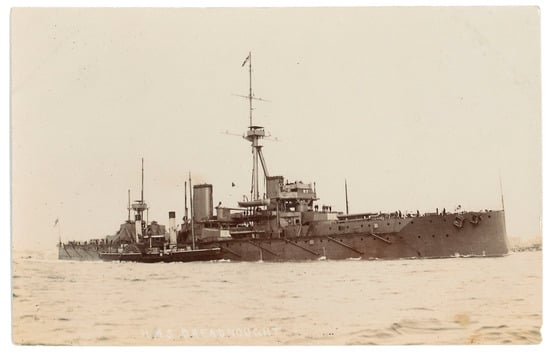
Figure 24.
HMS Dreadnought as depicted on a contemporary real photo postcard (source: author).
In the 1920s, when the vessels were decommissioned and scrapped, the concepts of heritage preservation and values-based significance assessment were unknown. With the benefit of hindsight, the bells of HMS Dreadnought would have been the bells to collect and preserve in public hands. It can only be hoped that it still exists safely in private hands and that its cultural significance is appreciated by its current owner.
When assessing the heritage significance of the bells of the other scrapped British battleships and battlecruisers, we need to consider their service history and involvement in the various naval engagements of World War I (Table 8). A large number of vessels, with the exception of HMS Agamemnon, which at the time was stationed in the Mediterranean, took an active part in the major naval battle of World War I, the Battle of Jutland (31 May–1 June 1916). In most cases, that was the only action they saw. Only four of the ships listed in Table 8 saw action in more than one battle. HMS Lion, Admiral David Beattie’s flagship, and HMS New Zealand were involved the Battle of Heligoland Bight (28 August 1914), the Battle of Dogger Bank (23 January 1915), and the Battle of Jutland. HMS Indomitable saw action in the Battle of Dogger Bank and the Battle of Jutland, and like HMS Inflexible, was also involved in the landings at the Dardanelles (Gallipoli) in the Eastern Mediterranean. The latter battlecruiser had already taken part in the Battle of the Falkland Islands (8 December 1914), where it was involved in annihilating Admiral von Spee’s Pacific squadron.
Table 8.
The combat service during World War I of the British vessels discussed in this paper.
From a cultural heritage and collections perspective, the bells of HMS Lion, for its role as Beattie’s flagship and involvement in three major naval battles in the North Sea, and HMS Inflexible, for its involvement in three theatres of war (Mediterranean, North Sea, and South Atlantic), are the most significant. From a World War I service point of view, of least significance are the bells of HMS Commonwealth, HMAS Australia, and HMS Dreadnought. The latter two vessels have significance, of course, as being the first true modern battleship (HMS Dreadnought, see above) and being the first battlecruiser financed by the nascent Commonwealth of Australia (HMAS Australia).
It is of interest to note that with the exception of the already mentioned bells of HMS New Zealand and HMAS Australia, none of the bells are in public hands. The accessions of the National Maritime Museum in Greenwich and the Imperial War Museum seem to have been opportunistic without clear targeting of significant vessels. Thus, the main bell of HMS Tiger, the oldest battlecruiser retained by the Royal Navy after the fleet reduction subsequent to the Washington Arms Limitation Treaty, is held by the Imperial War Museum [138], but the bells of the significant vessels of World War I are not. It appears inexplicable why the bell of HMS Lion was not retained for public display.
Irrespective of formal significance assessments, ship’s bells may hold a high level of significance today for individuals associated with maritime history, as illustrated by the case of the bell of USS New Jersey (BB-16). The Battleship New Jersey Museum (BB-62) wanted to develop an exhibit about its namesake predecessor. As the original bell of the USS New Jersey is on permanent display in front of City Hall in Elizabeth, NJ, the museum commissioned a 3D-printed full-size replica [181]. The significance of public engagement and ownership of maritime heritage is further exemplified in an account of the movement of the bell of USS Montana. Although referring to the earlier ACR-13 rather than the BB-51, which was scrapped under the Washington Limitation Treaty, the story of two rival fraternities engaging in a 43-year contest over a ship’s bell speaks highly of the pride and significance placed on such objects [70]. This is especially the case here; the USS Montana was renamed USS Missoula, with the victor being a fraternity based in the city of the same name, despite the bell having the inscription of the original ship’s name.
The trophy status of ship’s bells alluded to in the introduction also manifests itself in bells taken off enemy vessels that were captured intact or as wrecks. These bells tend to be in public collections, and often placed on exhibition. An example from World War I are the bells of the Imperial German cruiser SMS Emden, which was destroyed by HMAS Sydney at the Cocos and Keeling Islands in November 1914, and which are now on display in the Australian War Memorial in Canberra [182] and the Imperial War Museum in London [183]. An example of World War II is the bell of the German WWII-era heavy cruiser Prinz Eugen, famous for its role in the Battle of the Demark Strait when the Bismarck sank the British battleship SMS Hood. The Prinz Eugen was surrendered to British Navy at the end of the war, passed to the USA as a war prize, and deployed by the U.S. Navy as a target ship for atomic bomb tests in Bikini Atoll in 1946 [88].
In addition to the bells, and setting aside the guns that had been landed and subsequently used in coastal defence [17,56,57,58,59], there are few other elements of the scrapped vessels that have survived (Table 9). These primarily comprise the celebratory silver service given by the namesake state to the officer’s mess of U.S. battleships, but also include ships’ wheels, a gun tampion, and a foremast (Figure 25).
Table 9.
Some examples of other surviving items of the warships scrapped under the terms of the Washington Arms Limitation Treaty.
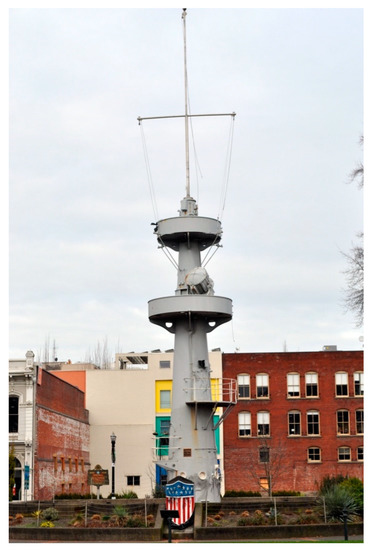
Figure 25.
The foremast of USS Oregon erected in 1956 at Tom McCall Waterfront Park in Portland, OR (photo: Lia Brown).
8. Implications
That some individuals and even countries go to great lengths to retain and display naval bells greatly demonstrates the iconic nature of a ship’s bell: being a trophy of a key battle, or a symbol of past histories or iconic moments, such as the beginnings of an emergence of a country unto its own. That a large number of (particularly British and Japanese) bells are unaccounted for does not suggest disinterest or indifference towards these items. On the contrary, the ownership of many such bells by ex-service personnel suggests a deep connection to past histories and practices. The central issue that presents itself here is the matter of public and private ownership of such items. To what extent should iconic heritage items be accepted exclusively into the private domain? One could be reminded of a Van Gogh or Monet being in the possession of a private collector, but this analogy is delusionary—works of art are often commissioned and usually do not have the ability to be representative icons of a country’s military prowess. Instigating retrospective governmental or public ownership of such items may not only impractical but may well also be disrespectful to any individual who obtained a ship’s bell by legal means and where the custodial chain of legal ownership can be demonstrated. In particular, this applies to the British bells where, as shown above, the Royal Navy intentionally disinvested itself of ownership and irrevocably abandoned any claim to the bells. In the Japanese case the processes are less clear, but as the vessels were disposed of the 1920s, we can assume that illegal transmission in ownership would not have occurred. We may need to differentiate the legal from the moral dimension, however. Clearly, it would be preferable that bells associated with vessels that have a high level of cultural significance be held in public hands. Although heritage value criteria have been developed for heritage structures [189,190], they do not exist for ship’s bells.
In this paper we took some steps when assessing the significance of the bells of British vessels. The question then arises regarding the processes that should be developed to “reclaim” culturally significant bells in private hands. Although there is a body of literature dealing with the repatriation of objects acquired in colonial settings [191,192,193], this is conceptually different and thus has only limited informative value.
The implications of this paper are futures based. Careful thought and planned action needs to be undertaken for any item that may be indicative of being considered worthy as public heritage, representative in the naval domain, or otherwise. This may be critically so with reference to items that are at risk of, or are considered to be, redundant and therefore obsolete, as the scrapping of or cessation of action marks the finality of the item in working order.
Furthermore, the manner of exhibition and presentation of objects such as ship’s bells in public spaces could also be amended to incorporate intangible heritage qualities such as emanated sound. With the history of ship’s bells being utterly entwined as functioning items, fulfilling both operational and navigational functions as well as forming a touchstone for those who have associations, to have a naval bell silently resting as a museum piece misses the heartbeat of the history and presents a dehumanised form of a cold metallurgic body.
Author Contributions
Conceptualization, D.H.R.S.; methodology, D.H.R.S.; formal analysis, D.H.R.S.; writing—original draft preparation, D.H.R.S. and M.P.; writing—D.H.R.S. and M.P.; visualization, D.H.R.S. All authors have read and agreed to the published version of the manuscript.
Funding
This research received no external funding.
Institutional Review Board Statement
This study did not require ethics approval.
Acknowledgments
A study like this would not be possible without the support of a wide range of custodians of the bells and other individuals with pertinent knowledge. We are gratefully indebted to the following for the provision of details or images of their bells and other contextual information: May Ames Booker (Battleship North Carolina Inc., Wilmington, NC, USA); Kate Brett (Naval Historical Branch, HM Naval Base, Portsmouth, UK); David Briska (Dunkirk Lighthouse & Veterans Park Museum, Dunkirk, NY, USA); Erika Broenner (The Verdin Co, Cincinnati, OH, USA); Denise Clemons (Archivist, Historical Society, Lewes, DE, USA); Lia Brown (Washington, DC, USA); Ann Coats (School of Civil Engineering & Surveying, University of Portsmouth, UK); Lea French Davis (Curator Branch, Naval History and Heritage Command, Washington, DC, USA); Cliff Eckle (Ohio History Connection, Columbus, OH, USA); Jessica Eichlin (West Virginia & Regional History Center, West Virginia University, Morgantown, WV, USA); Scarlet Faro (Royal Museums Greenwich, UK); Carmen Gunther (Ashford, Kent, UK); Mark J Halvorson (Battleship Texas Foundation, Bismarck, ND, USA); Ellen J. Henry (Ponce de Leon Inlet Lighthouse Preservation Association, Ponce Inlet, FL, USA); Desiree Heveroh (East Brother Light Station Association, Richmond, CA, USA); Richard Holdsworth (Historic Dockyard Chatham, Kent, UK); Katelyn Kean and Peter Lesher (Chesapeake Bay Maritime Museum, St. Michaels, MD, USA), Ellen Kennedy (National Museum of the Great Lakes, Toledo, OH, USA), John W. Keyes (Hospital Point Range Front Light, USCG); Anne L’Hommedieu (Sodus Bay Lighthouse Museum, Sodus Point, NY, USA); Tony Lovell (Dreadnought Project, Cambridge, MA, USA); Jane Peek (Military Heraldry & Technology, Australian War Memorial, Canberra, ACT), Maribeth Quinlan (Collections Access & Research, Mystic Seaport Museum, Mystic, CT, USA); Cristian Rivera (Battleship Texas Foundation, Elizabeth, NJ, USA); Minoru Shiroyama (Takasago, Hyogo Prefecture, Japan); Richard Southwell (Upton Lovell, Wilts, UK); Lane Sparkman (Rhode Island Department of State, Providence, RI, USA); Kandace Trujillo (Battleship Texas Foundation, Houston, TX, USA); Michael A Ward (Army ROTC, Georgia Institute of Technology, Atlanta, GA, USA); Judith Webberley (Naval Dockyards Society, Waterlooville, Hants, UK); and Jack Zeilenga (Vermont State Curator’s Office, Montpelier, VT, USA).
Conflicts of Interest
The authors declare no conflict of interest.
References
- Stichelbaut, B.; Note, N.; Bourgeois, J.; Van Meirvenne, M.; Van Eetvelde, V.; Van den Berghe, H.; Gheyle, W. The archaeology of world war I tanks in the Ypres Salient (Belgium): A non-invasive approach. Archaeol. Prospect. 2019, 26, 47–56. [Google Scholar] [CrossRef]
- Gheyle, W.; Dossche, R.; Bourgeois, J.; Stichelbaut, B.; Van Eetvelde, V. Integrating archaeology and landscape analysis for the cultural heritage management of a World War I militarised landscape: The German field defences in Antwerp. Landsc. Res. 2014, 39, 502–522. [Google Scholar] [CrossRef]
- Van Hollebeeke, Y.; Stichelbaut, B.; Bourgeois, J. From landscape of war to archaeological report: Ten years of professional World War I archaeology in Flanders (Belgium). Eur. J. Archaeol. 2014, 17, 702–719. [Google Scholar] [CrossRef]
- Carrell, T.; Burns, J.; McKinnon, J.; Krivor, M.; Enright, J.; Roth, M.; Pascoe, K.; Raupp, J.; Arnold, S.; Keusenkothen, M. Peleliu’s Forgotten WWII Battlefield; Ships of Exploration and Discovery Research: Santa Fe, NM, USA, 2020. [Google Scholar] [CrossRef]
- McKinnon, J.F.; Carrell, T.L. Underwater Archaeology of a Pacific Battlefield: The WWII Battle of Saipan; Springer: Berlin/Heidelberg, Germany, 2015. [Google Scholar]
- Spennemann, D.H.R. Using KOCOA Military Terrain Analysis for the Assessment of Twentieth Century Battlefield Landscapes. Heritage 2020, 3, 753–781. [Google Scholar] [CrossRef]
- Spennemann, D.H.R.; Poynter, C. Using 3-D spatial visualisation to interpret the coverage of Anti -Aircraft Batteries on a World War II Battlefield. Heritage 2019, 2, 2457–2479. [Google Scholar] [CrossRef]
- Mushynsky, J. Defining Karst Defenses: Construction and Features. Hist. Archaeol. 2019, 53, 193–204. [Google Scholar] [CrossRef]
- Passmore, D.G.; Harrison, S.; Tunwell, D.C. Second World War conflict archaeology in the forests of north-west Europe. Antiquity 2014, 88, 1275–1290. [Google Scholar] [CrossRef][Green Version]
- Tunwell, D.C.; Passmore, D.G.; Harrison, S. Landscape archaeology of World War Two German logistics depots in the forêt domaniale des Andaines, Normandy, France. Int. J. Hist. Archaeol. 2015, 19, 233–261. [Google Scholar] [CrossRef]
- Gaffney, C.; Gater, J.; Saunders, T.; Adcock, J. D-Day: Geophysical investigation of a World War II German site in Normandy, France. Archaeol. Prospect. 2004, 11, 121–128. [Google Scholar] [CrossRef]
- Van Tilburg, H. Japanese Midget Sub at Pearl Harbor: Collaborative Maritime Heritage Preservation. In Underwater Cultural Heritage at Risk: Managing Natural and Human Impacts; Grenier, R., Nutley, D., Cochran, I., Eds.; UNESCO: Paris, France, 2006; pp. 67–69. [Google Scholar]
- Spennemann, D.H.R. The Last Flight of the “St. Quentin Quail”. Investigations of the Wreckage and History of Consolidated B-24 “Liberator” Aircraft #42-41205 off Jab’u Island, Arno Atoll, Republic of the Marshall Islands; The Johnstone Centre for Parks, Recreation and Heritage, Charles Sturt University: Albury, Australia, 1994. [Google Scholar]
- Lickliter-Mundon, M.; Cantelas, F.; Coble, W.; Kinney, J.; McKinnon, J.; Meyer, J.; Pietruszka, A.; Pilgrim, B.; Pruitt, J.R.; Van Tilburg, H. Identification of a Deep-water B-29 WWII Aircraft via ROV Telepresence Survey. J. Marit. Archaeol. 2018, 13, 167–189. [Google Scholar] [CrossRef]
- Hanks, M. Landing at Saipan: The Three M4 Sherman Tanks That Never Reached the Beach. In Underwater Archaeology of a Pacific Battlefield; Springer: Berlin/Heidelberg, Germany, 2015; pp. 73–84. [Google Scholar]
- Spennemann, D.H.R. The Japanese Short-Barrelled 12cm and 20cm Dual Purpose Naval Guns. Their Technical Details, War-Time Distribution and Surviving Examples; Institute for Land Water and Society, Charles Sturt University: Albury, Australia, 2017; Volume 104. [Google Scholar]
- Spennemann, D.H.R.; Clemens, J. Silent Sentinels. The Japanese Guns of the Kiska WWII Battlefield; US National Park Service Alaska Regional Office: Anchorage, AK, USA, 2014. [Google Scholar]
- Smith, T. Managing an Australian midget: The imperial Japanese navy type a submarine ‘M24’ at Sydney. J. Australas. Inst. Marit. Archaeol. 2008, 32, 79. [Google Scholar]
- Rosenberg, P.A. Shipwrecks of Truk, 2nd ed.; P.A. Rosenberg: Holualoa, HI, USA, 1989. [Google Scholar]
- Lindemann, K. Hailstorm Over Truk Lagoon: Operations Against Truk by Carrier Task Force 58, 17 and 18 February 1944, and the Shipwrecks of World War II; Wipf and Stock Publishers: Eugene, OR, USA, 2005. [Google Scholar]
- Lindemann, K.P. Desecrate 1: Operations Against Palau by Carrier Task Force 58, 30 and 31 March 1944, and the Shipwrecks of World War II; Pacific Press: Belleville, ON, Canada, 1991. [Google Scholar]
- Oxley, I. Scapa Flow and the protection and management of Scotland’s historic military shipwrecks. Antiquity 2002, 76, 862–868. [Google Scholar] [CrossRef]
- Spennemann, D.H.R. The Naval heritage of Project Apollo: A case of losses. J. Marit. Res. 2005, 7, 170–214. [Google Scholar] [CrossRef]
- Anglo-German Naval Agreement. [An exchange of notes]. Note from the UK Secretary of State [Sir Samuel Hoare] for Foreign Affairs to the German Ambassador [Joachim von Ribbentrop], London 18 June 1935.—Note from the German Ambassador, London, to the UK Secretary of State for Foreign Affairs, London 18 June 1935. Leag. Nations Treaty Ser. 1935, 161, 10–20. [Google Scholar]
- Spennemann, D.H.R. Managing the Heritage of Arms Limitation Treaties. Int. J. Hist. Archaeol. in press. [CrossRef]
- Parker, M. The Heritage of Sound in The Built Environment: An Exploration. Bachelor’s thesis, Charles Sturt University, Albury, Australia, 2018. [Google Scholar]
- Spennemann, D.H.R.; Parker, M. Hitting the ‘Pause’ Button: What does COVID tell us about the future of heritage sounds? Noise Mapp. 2020, 7, 265–275. [Google Scholar] [CrossRef]
- International Maritime Organization. Convention on the International Regulations for Preventing Collisions at Sea, 1972 (COLREGs); International Maritime Organization: London, UK, 1972; Volume 35. [Google Scholar]
- Thorne, S.J. For whom the ship’s bell tolls. Legion. 15 May 2019. Available online: https://legionmagazine.com/en/2019/05/for-whom-the-ships-bell-tolls/ (accessed on 21 December 2020).
- Elson, A. Sound and Its Uses. Musical Q. 1918, 4, 250–267. [Google Scholar] [CrossRef]
- Renton, A. Lost Sounds: The Story of Coast Fog Signals; Whittles Publishing: Caithness, UK, 2001. [Google Scholar]
- RAN. HMAS Perth (I). Available online: http://www.navy.gov.au/hmas-perth-i (accessed on 20 November 2020).
- BBC. USS Osprey ship’s bell to be handed to US after mysterious return. BBC News, 3 September 2019. [Google Scholar]
- Antiques Navigator. Antique 16 Solid Bronze Ships Bell WWII U.S. Navy USS Rail Pearl Harbor Ship. Available online: https://www.antiquesnavigator.com/d-746877/antique-16-solid-bronze-ships-bell-wwii-us-navy-uss-rail-pearl-harbor-ship.html (accessed on 20 November 2020).
- Cowan’s Auctions. U.S.S. Woyot Brass Ship’s Bell. Available online: https://www.lotsearch.net/lot/u-s-s-woyot-brass-ships-bell-41842128?searchID=1468297 (accessed on 20 November 2020).
- Grządziel, A. Using Remote Sensing Data to Identify Large Bottom Objects: The Case of World War II Shipwreck of General von Steuben. Geosciences 2020, 10, 240. [Google Scholar] [CrossRef]
- Openshaw, M.; Openshaw, S. Problems in Correctly Identifying a Shipwreck. Mar. Mirror 2013, 99, 327–333. [Google Scholar] [CrossRef]
- Jeffery, B. The future of Chuuk Lagoon’s submerged WW II sites. J. Australas. Inst. Marit. Archaeol. 2012, 36, 15. [Google Scholar]
- Gambin, T.; Licari, J. A Bell Saved! Tessarae Herit. Malta Bull. 2029, 8, 4–11. [Google Scholar]
- Berg, D. Shipwreck Diving: A Complete Diver’s Handbook to Mastering the Skills of Wreck Diving; Aqua Explorers Inc.: East Rockaway, NY, USA, 1991. [Google Scholar]
- Edney, J. A framework for managing diver impacts on historic shipwrecks. J. Marit. Archaeol. 2016, 11, 271–297. [Google Scholar] [CrossRef]
- Steinberg, D.A. A Ship for the Taking: The Wreck of the Brisbane as a Case Study; Charles Darwin University: Darwin, Australia, 2005. [Google Scholar]
- Edney, J. A review of recreational wreck diver training programmes in Australia. J. Australas. Inst. Marit. Archaeol. 2011, 35, 1–8. [Google Scholar]
- Rodrigues, J. An Amnesty Assessed. Human Impact on Shipwreck Sites: The Australian Case. Int. J. Naut. Archaeol. 2009, 38, 153–162. [Google Scholar] [CrossRef]
- Kaoru, Y.; Hoagland, P. The value of historic shipwrecks: Conflicts and management. Coast. Manag. 1994, 22, 195–213. [Google Scholar] [CrossRef]
- Pearson, N. Naval shipwrecks in Indonesia. In Proceedings of the 3rd Asia-Pacific Regional Conference on Underwater Cultural Heritage, Hong Kong, China, 27 November–2 December 2017; Fahy, B., Tripati, S., Walker-Vadillo, V., Jeffery, B., Kimura, J., Eds.; Volume 2, pp. 1152–1184. [Google Scholar]
- Hiery, H.J. The Neglected War. The German South Pacific and the Influence of World War I; University of Hawaii Press: Honolulu, HI, USA, 1995. [Google Scholar]
- Schencking, C. Bureaucratic Politics, Military Budgets, and Japan’s Southern Advance: The Imperial Navy’s Seizure of German Micronesia in World War I. War Hist. 1998, 5, 308–326. [Google Scholar]
- Treaty of Versailles. Treaty of Peace between the Allied and Associated Powers and Germany. Signed at Versailles 28 June 1919. Available online: https://nla.gov.au/nla.obj-2579181373/view?partId=nla.obj-2579475611#page/n0/mode/1up (accessed on 21 December 2020).
- Buckley, T.H. The United States and the Washington Conference; University of Tennessee Press: Knoxville, TN, USA, 1970. [Google Scholar]
- Van Meter, R.H. The Washington Conference of 1921–1922. A New Look. Pac. Hist. Rev. 1977, 46, 603–624. [Google Scholar] [CrossRef]
- Hughes, C.E.; Cabot Lodge, H.; Underwood, O.W.; Root, E. Conference on the Limitation of Armament. Am. J. Int. Law 1922, 16, 159–233. [Google Scholar] [CrossRef]
- O’Connor, R.G. The “Yardstick” and Naval Disarmament in the 1920’s. Miss. Val. Hist. Rev. 1958, 45, 441–463. [Google Scholar] [CrossRef]
- Vinson, J.C. The Drafting of the Four-Power Treaty of the Washington Conference. J. Mod. Hist. 1953, 25, 40–47. [Google Scholar] [CrossRef]
- Washington Arms Limitation Treaty. Treaty between the United States of America, the British Empire, France, Italy, and Japan, Signed at Washington, February 6, 1922. In Proceedings of the Conference on the Limitation of Armament, Washington, DC, USA, 12 November 1921–6 February 1922; League of Nations Treaty Series. Volume 25. [Google Scholar]
- Spennemann, D.H.R. British Naval Guns in Micronesia. Mar. Mirror 1995, 81, 343–347. [Google Scholar]
- Spennemann, D.H.R. The Present and Future Management of the Japanese Guns on Kiska Island, Aleutians, Alaska. The 4.7-Inch Battery on North Head, Kiska Island. Documentation and Condition Report. Study prepared for the US Fish and Wildlife Service, Alaska; Heritage Futures Australia: Shepparton, Australia, 2008. [Google Scholar]
- Spennemann, D.H.R. The Present and Future Management of the Japanese Guns on Kiska Island, Aleutians, Alaska. The 6-Inch Gun Battery on Little Kiska Island. Documentation and Condition Report. Study prepared for the US Fish and Wildlife Service, Alaska; Heritage Futures Australia: Shepparton, Australia, 2008. [Google Scholar]
- Spennemann, D.H.R. The Present and Future Management of the Japanese Guns on Kiska Island, Aleutians, Alaska. The 6-Inch Gun Battery on North Head, Kiska Island. Documentation and Condition Report. Study prepared for the US Fish and Wildlife Service, Alaska; Heritage Futures Australia: Shepparton, Australia, 2008. [Google Scholar]
- Pate, M. The Naval Artificer’s Manual. (The Naval Artificer’s Hand-Book Revised) Text, Questions and General Information for Deck Artificers in the United States Navy; The United States Naval Institute: Annapolis, MD, USA, 1918; 797p. [Google Scholar]
- Bureau of Construction and Repair. Specifications for Building Twin-Screw Armored Battle Ship Connecticut, No. 18, for the United States Navy, Including Specifications for Equipment, and Specifications for the Installation of Ordnance and Ordnance Outfit; Bureau of Construction and Repair, Navy Department, United States: Washington, DC, USA, 1902.
- Bureau of Construction and Repair. Specifications for Building Twin-Screw Armored Cruiser Washington, No. 11, for the United States Navy, Including Specifications for Equipment, and Specifications for the Installation of Ordnance and Ordnance Outfit; Bureau of Construction and Repair, Navy Department, United States: Washington, DC, USA, 1902.
- Brodnax, J. Spreadsheet of Entries in Troy Meneely Ledger Book (Transcribed and Augmented). 2008. Available online: https://hudsonmohawkgateway.org/the-meneely-bells (accessed on 21 December 2020).
- Ward, M.A. The Bell of USS Georgia (BB-15); Spennemann, D.H.R., Ed.; e-mail ed.; Army ROTC, Georgia Institute of Technology: Atlanta, GA, USA, 2020. [Google Scholar]
- Rivera, C. The Bell of USS New Jersey; Spennemann, D.H.R., Ed.; e-mail ed.; Office of Public Information, City of Elizabeth: Elizabeth, NJ, USA, 2020.
- Halvorson, M.J. The Bell of USS North Dakota (BB-29); Spennemann, D.H.R., Ed.; e-mail ed.; Battleship Texas Foundation: Bismarck, ND, USA, 2020. [Google Scholar]
- Sparkman, L. The Bell of USS Rhode Island; Spennemann, D.H.R., Ed.; e-mail ed.; RI Department of State: Providence, RI, USA, 2020.
- Pope, C. USS South Carolina (Navy Ship Bell); Spennemann, D.H.R., Ed.; e-mail ed.; Public Works, City of Florence: Florence, SC, USA, 2020. [Google Scholar]
- Zeilenga, J. The Bell of USS Vermont; Spennemann, D.H.R., Ed.; e-mail ed.; Vermont State Curator’s Office: Montpelier, VT, USA, 2020. [Google Scholar]
- Heaney, J. Artifacts. Mont. Mag. Univ. Mont. 2013. Available online: https://archive.umt.edu/montanan/s13/Artifacts.php (accessed on 21 December 2020).
- Booker, T.W. The Bell of USS North Carolina (ACR-12); Spennemann, D.H.R., Ed.; e-mail ed.; Battleship North Carolina Inc.: Wilmington, NC, USA, 2020. [Google Scholar]
- Eckle, C. The Bell of USS Ohio; Spennemann, D.H.R., Ed.; e-mail ed.; Ohio History Connection: Columbus, OH, USA, 2020. [Google Scholar]
- Trujillo, K. The Bell of USS Texas (BB-35); Spennemann, D.H.R., Ed.; e-mail ed.; Battleship Texas Foundation: Houston, TX, USA, 2020. [Google Scholar]
- Hartwell, J. [Unit History] ACR-8 USS Maryland/USS Frederick. Available online: http://freepages.rootsweb.com/~cacunithistories/military/USS_Maryland_Frederick.htm (accessed on 20 July 2020).
- McShane Bell Foundry. The McShane Bell Foundry: Henry McShane Manufacturing Co., Proprietors, Baltimore, MD., U.S.A., Manufacturers of Chimes and Peals and Bells of All Sizes for Churches, Fire Alarms, Court House, Tower Clocks, &c., &c., Mounted in the Most Approved Manner and Fully Warranted; McShane Bell Foundry: Baltimore, MD, USA, 1900. [Google Scholar]
- Meneely Bell Co. Church Bells, Peals and Church Bell Chimes: Also Bells for All Known Uses, Which are Composed of the Highest Grade of Genuine Copper and Tin Bell-Metal; Meneely Bell Co.: Troy, NY, USA, 1912. [Google Scholar]
- Hibbert, W.A.; Sharp, D.B.; Taherzadeh, S.; Perrin, R. Partial frequencies and Chladni’s law in church bells. Open J. Acoust. 2014, 4, 70–77. [Google Scholar] [CrossRef][Green Version]
- Audy, J.; Audy, K. Analysis of bell materials: Tin bronzes. Overseas Foundry 2009, 5, 199–204. [Google Scholar]
- USLS. Light Station Detail Report. Fog Signal—Bell Signal—Manufacturer. Available online: https://uslhs.org/inventory/bell_signal_detail.php?idx=6&type=station (accessed on 24 July 2020).
- USLS. Light Station Detail Report. Fog Signal—Bell Signal—Weight. Available online: https://uslhs.org/inventory/bell_signal_detail.php?idx=1&type=station (accessed on 24 July 2020).
- Anonymous. Louisiana in Commission. The Sun (New York), 3 June 1906; 6. [Google Scholar]
- U.S. Congress House Committee on Naval Affairs. Work on U.S.S. Louisiana. Congressional Document; U.S. Congress House Committee on Naval Affairs: Washington, DC, USA, 1907.
- Gillig, J.S. The Predreadnought Battleship USS Kentucky. Regist. Ky. Hist. Soc. 1990, 88, 45–81. [Google Scholar]
- Handy, M. The Official Directory of the World’s Columbian Exposition, May 1 to October 23rd, 1893. A Reference Book of Exhibitors and Exhibits; of the Officers and Members of the World’s Columbian Commission, the World’s Columbian Exposition and the Board of Lady Managers; a Complete History of the Exposition. Together with Accurate Descriptions of All State, Territorial, Foreign, Departmental and Other Buildings and Exhibits, and General Information Concerning the Fair; W. B. Gonkey Company: Chicago, IL, USA, 1893. [Google Scholar]
- Johnson, R. Ring in the New Year at Navy Pier with a Bell from The White City. Chicago Now. 2013. Available online: http://www.chicagonow.com/chicago-history-cop/2013/12/ring-in-the-new-year-at-navy-pier-with-a-bell-from-the-white-city/ (accessed on 20 July 2020).
- American Legion. USS Chicago Bell Memorial. Available online: https://www.legion.org/memorials/238181/uss-chicago-bell-memorial (accessed on 20 July 2020).
- Krafft, H.F. Catalogue of Historic Objects at the United States Naval Academy; United States Naval Instutute: Annapolis, MD, USA, 1925. [Google Scholar]
- NHHC. Ship’s Bell USS Prinz Eugen (IX-300). Available online: https://www.history.navy.mil/our-collections/artifacts/ship-and-shore/ShipsBells/ship-s-bell-uss-prinz-eugen--ix-300-.html (accessed on 10 October 2020).
- Anonymous. The Connecticut in commission. New-York Tribune, 30 September 1906; 3. [Google Scholar]
- Anonymous. Big battleship Connecticut is ocean’s bride. The Washington Times, 29 September 1904; 1. [Google Scholar]
- U.S. Navy. Navy Property Redistribution and Disposal Regulation n° 1; Department of the Navy: Washington, DC, USA, 1949.
- U.S. Navy. General Policy for the Inactivation, Retirement, and Disposition of U.S. Naval Vessels; Department of the Navy: Washington, DC, USA, 2014.
- U.S. Office of Naval Operations. General Instructions for Reserve Fleets; U.S. Office of Naval Operations, U.S. Navy: Washington, DC, USA, 1964.
- U.S. Navy. Navy Property Redistribution and Disposal Regulation n° 1; Department of the Navy: Washington, DC, USA, 1958. [Google Scholar]
- U.S. Navy. General Policy for the Inactivation, Retirement, and Disposition of U.S. Naval Vessels; Department of the Navy: Washington, DC, USA, 2009.
- NHHC. Ships’ Bells. Available online: https://www.history.navy.mil/research/library/online-reading-room/title-list-alphabetically/b/bells-on-ships.html (accessed on 19 July 2020).
- Pallas, W.J. The Doctrine of State Succession and the Law of Historic Shipwrecks, The Bell of the Alabama: United States v. Steinmetz. Tulane Marit. Law J. 1992, 17, 343–352. [Google Scholar]
- Ivan, W. USS Osprey II (AM-56) [+1944] [Michelle Mary Fishing & Diving Charters]. Available online: https://wrecksite.eu/imgBrowser.aspx?5522 (accessed on 20 November 2020).
- Jacobs, J.H. Much of What to Know about U.S. Navy Bells. Available online: http://landandseacollection.com/id1189.html (accessed on 20 November 2020).
- JWH1975. Scrapping the Warships of WWII. Available online: https://wwiiafterwwii.wordpress.com/2020/09/07/scrapping-the-warships-of-wwii/ (accessed on 20 November 2020).
- Zhou, Z. The Bell of the US Retired Aircraft Carrier Sounds on Campus. Available online: https://tw.appledaily.com/life/20170630/7RYCI7T7YB5JROIHEFIWANFNPM/ (accessed on 20 November 2020).
- Underwood, A. Ding! Ding! History and Heritage Blog on Ships’ Bells, Arriving! In The Sextant; Naval History and Heritage Command: Washington, DC, USA, 2016; Volume 2020. [Google Scholar]
- Davis, L.F. The Whereabouts of the Bells of the Ships Scrapped as Part of Washington Arms Limitations Treaty of 1922; Spennemann, D.H.R., Ed.; e-mail ed.; Curator Branch, Naval History and Heritage Command: Washington, DC, USA, 2020. [Google Scholar]
- Hsiao, I. Ding dong, the old student union’s dead. Ariz. Wildcat Mag. (online). 2000. Available online: https://wc.arizona.edu/papers/94/74/01_4_m.html (accessed on 20 November 2020).
- Williamson, R. Salvaged Bell to Ring again. Ariz. Wildcat Mag. (online). 2002. Available online: https://wc.arizona.edu/papers/96/4/01_4.html (accessed on 20 November 2020).
- Quinlan, M. The Bell of USS Connecticut; Spennemann, D.H.R., Ed.; e-mail ed.; Mystic Seaport Museum: Mystic, CT, USA, 2020. [Google Scholar]
- Anonymous. Delaware in World War I Exhibit Opens at Archives in Dover. Cape Gaz. 2017. Available online: https://www.capegazette.com/article/delaware-world-war-i-exhibit-opens-archives-dover/146949 (accessed on 20 November 2020).
- Lee, C.U.S., Jr. Battleship Georgia. Description and trials. J. Am. Soc. Nav. Eng. 1906, 18, 802–829. [Google Scholar] [CrossRef]
- Anonymous. Naval 6 Inch 50 Caliber Gun—ROTC, Georgia Tech: Atlanta, GA, USA. Available online: https://www.waymarking.com/waymarks/wm5MPD_Naval_6_Inch_50_Caliber_Gun_ROTC_Georgia_Tech_Atlanta_GA (accessed on 20 July 2020).
- Hall, R.T. U.S.S. Minnesota. J. Am. Soc. Nav. Eng. 1906, 18, 1143–1181. [Google Scholar] [CrossRef]
- Anonymous. USS Minnesota (BB22). Available online: https://www.hmdb.org/m.asp?m=91371 (accessed on 20 July 2020).
- O’Neil, T. Fair Fire. A Look Back Marines Save the Bell as the Missouri Building Burns during 1904 World’s Fair; St. Louis Post-Dispatch: St. Louis, MO, USA, 2019. [Google Scholar]
- Leavitt, W.A., Jr. U.S.S. New Hampshire. J. Am. Soc. Nav. Eng. 1908, 20, 273–339. [Google Scholar] [CrossRef]
- Eger, C. Warship Wednesday July 15, 2015: The Great War’s Granite State. Available online: https://laststandonzombieisland.com/2015/07/15/warship-wednesday-july-15-2015-the-great-wars-granite-state/ (accessed on 19 July 2020).
- Anonymous. U.S. Battleship New Jersey. J. Am. Soc. Nav. Eng. 1906, 18, 845–865. [Google Scholar] [CrossRef]
- Jerseyman. United States Navy Ship’s Bells. A Naval Heritage Tribute. Battleships. USS New Jersey (BB-16). Jerseyman 2006. p. 22. Available online: https://www.history.navy.mil/our-collections/photography/us-navy-ships/battleships/new-jersey-bb-16.html (accessed on 21 December 2020).
- Yasuhara, N. The Bell of USS Oregon; Spennemann, D.H.R., Ed.; e-mail ed.; Oregon Historical Society: Portland, OR, USA, 2020. [Google Scholar]
- RIDS. Rhode Island State House Online Tour. Second Floor. The Battleship Bell. Available online: https://www.sos.ri.gov/divisions/Civics-And-Education/ri-state-house/online-tour/second-floor (accessed on 19 July 2020).
- Edwards, C.B.; Lovell, R.L. U.S. Battleship Rhode Island. J. Am. Soc. Nav. Eng. 1906, 18, 1–21. [Google Scholar] [CrossRef]
- Henry, B. Florence Veterans Park. Available online: https://www.scpictureproject.org/florence-county/florence-veterans-park.html (accessed on 20 July 2020).
- Yarnall, P.R. BB-20 USS Vermont. Available online: https://www.history.navy.mil/our-collections/photography/us-navy-ships/battleships/vermont-bb-20.html (accessed on 19 July 2020).
- Anonymous. U.S.S. Vermont. Description and official trial. J. Am. Soc. Nav. Eng. 1907, 19, 159–195. [Google Scholar] [CrossRef]
- NHHC. USS Virginia Bell. Available online: https://www.dvidshub.net/image/5014810/uss-virginia-bell (accessed on 19 July 2020).
- Anonymous. The Great War. Illus. War News 1917. pp. 2–4. Available online: https://www.gutenberg.org/files/18334/18334-h/18334-h.htm (accessed on 21 December 2020).
- Royal Museums Greenwich. Ship’s Bell [HMS Valiant]. Available online: https://collections.rmg.co.uk/collections/objects/18088.html (accessed on 12 November 2020).
- Colledge, J.J.; Warlow, B. Ships of the Royal Navy: The Complete Record of All Fighting Ships of the Royal Navy; rev. ed.; Chatham Publishing: London, UK, 2006. [Google Scholar]
- Anonymous. Navy, Military and Air Force Ships’ Bells for Sale. The Times (London), 19 September 1931; 3. [Google Scholar]
- Anonymous. Royal Navy. Sale of Ships’ Bells. The Times (London), 17 December 1938; 19. [Google Scholar]
- Anonymous. Cracks that tell tales. 24 Ship’s Bells to be sold. Famous relics. Derby Daily Telegraph, 8 November 1929; 10. [Google Scholar]
- Anonymous. Historic Ship’s Bells. Relics of famous battles. Offered for sale. Dented and cracked instruments. 1929; unprovenanced newspaper clipping. [Google Scholar]
- Morris, E. Where do Ship’s Bells go? The Ringing World, 10 August 1956; 508. [Google Scholar]
- Buswell, A.A.J. Ship’s Bells. The Ringing World, 11 December 1959; 744. [Google Scholar]
- Admiralty. Admiralty Fleet Order 1234/28 1928. Available online: https://www.navy.gov.au/media-room/publications/admiralty-fleet-orders/1910-1937 (accessed on 21 December 2020).
- Anonymous. Royal Navy. Ships’ Bells for Sale. The Times (London), 18 April 1934; 4. [Google Scholar]
- Anonymous. Warships’ Bells: Surplus war relics to be sold. The Times (London), 31 May 1928; 11. [Google Scholar]
- Burt, R.A. British Battleships of World War One: New Revised Edition; Naval Institute Press: Anapolis, Brazil, 2012. [Google Scholar]
- Royal Navy. The Ship’s Bell from the Great War battleship HMS Valiant. In Royal Navy Facebook Page; Navy, R., Ed.; Royal Navy: London, UK, 2014; Volume 2020. [Google Scholar]
- Imperial War Memorial. Accessory, Ship’s Bell (HMS Tiger), British. Available online: https://www.iwm.org.uk/collections/item/object/30003983 (accessed on 13 November 2020).
- Worthpoint. HMS Tiger Ship’s Bell Jutland 1916. Available online: https://www.worthpoint.com/worthopedia/hms-tiger-ships-bell-jutland-1916-454418883 (accessed on 15 December 2020).
- Barnebys. Brass Ships Bell. From HMS Tiger a Battle Cruiser of the Royal Navy. Available online: https://www.barnebys.com/auctions/lot/brass-ships-bell-from-hms-tiger-a-battle-cruiser-of-the-roy-szp3caudmo2 (accessed on 15 December 2020).
- Bonhams. World War I: The Battle of Jutland. A Ships Bell Cast Using Brass from the HMS Tiger. British: C. 1917. Available online: https://www.bonhams.com/auctions/26461/lot/2/ (accessed on 15 December 2020).
- Superb Association. The, H.M.S. Superb (Cruiser) Association. Available online: https://roy935.wixsite.com/hms-superb/before-1943-photo-album (accessed on 20 July 2020).
- Southwell, R. The Bell of HM Superb; Spennemann, D.H.R., Ed.; e-mail ed.; Upton Lovell, UK; Wilts, NC, USA, 2020. [Google Scholar]
- National Museum of the Royal New Zealand Navy. HMS New Zealand’s Ship’s Bell. Available online: https://navymuseum.co.nz/explore/by-collections/ship-items/hms-new-zealands-ships-bell/ (accessed on 13 November 2020).
- Anonymous. HMS New Zealand. The Colony’s Presentation. New Zealand Herald, 6 May 1905; 6. [Google Scholar]
- TBNM. HMS New Zealand’s Ship’s Bell. Available online: https://navymuseum.co.nz/explore/by-collections/ship-items/hms-new-zealands-ships-bell/ (accessed on 20 July 2020).
- Royal Australian Navy. HMAS Australia (I). Available online: https://www.navy.gov.au/hmas-australia-i (accessed on 13 November 2020).
- Anonymous. General News. The Age (Melbourne, Vic.), 12 April 1924. [Google Scholar]
- Anonymous. Striking the bell. The Sun (Sydney, NSW), 11 November 1926; 13. [Google Scholar]
- AWM. Ship’s Bell: HMAS Australia (I) [RELAWM04469]. Available online: https://www.awm.gov.au/collection/C110606 (accessed on 20 July 2020).
- Australian War Memorial. Ship’s Bell: HMAS Parramatta (1910–1928). Available online: https://www.awm.gov.au/collection/C110656 (accessed on 13 November 2020).
- Royal Australian Navy. HMAS Sydney (I) Part 2. Available online: https://www.navy.gov.au/hmas-sydney-i-part-2 (accessed on 13 November 2020).
- Royal Australian Navy. HMAS Sydney (I). Available online: https://www.navy.gov.au/hmas-sydney-i (accessed on 13 November 2020).
- Royal Australian Navy. HMAS Parramatta (I). Available online: https://www.navy.gov.au/hmas-parramatta-i (accessed on 13 November 2020).
- Australian War Memorial. Ship’s Bell: HMAS Huon (1915–1928). Available online: https://www.awm.gov.au/collection/C110657 (accessed on 13 November 2020).
- Australian War Memorial. Ship’s Bell: HMAS Swan (1915–1928). Available online: https://www.awm.gov.au/collection/C110658 (accessed on 13 November 2020).
- Royal Australian Navy. HMAS Swan (I). Available online: https://www.navy.gov.au/hmas-swan-i (accessed on 13 November 2020).
- Royal Australian Navy. HMAS Huon (I). Available online: https://www.navy.gov.au/hmas-huon-i (accessed on 13 November 2020).
- Jane, F.T. The Imperial Japanese Navy; Thacker: London, UK, 1904. [Google Scholar]
- Jentschura, H.; Jung, D.; Michel, P. Warships of the Imperial Japanese Navy 1869–1945; Arms & Armour Press: London, UK, 1977. [Google Scholar]
- Stille, M. Imperial Japanese Navy Aircraft Carriers 1921–1945; Osprey Publishing: Oxford, UK, 2005. [Google Scholar]
- Sydney Morning Herald. Togo’s Flagship. Sydney Morning Herald, 19 July 1922; 11. [Google Scholar]
- Sydney Morning Herald. A War relic. Admiral Togo’s Flagship. Japan’s desire for preservation. Sydney Morning Herald, 19 March 1924; 13. [Google Scholar]
- Australian War Memorial. Ship’s Wheel from HIJMS ‘Ibuki’ (RELAWM08238). Available online: https://www.awm.gov.au/collection/C110619 (accessed on 10 October 2020).
- Australian War Memorial. Model Ship: HIJMS ‘Ibuki’ (RELAWM08039). Available online: https://www.awm.gov.au/collection/C111976 (accessed on 10 October 2020).
- Bullard, S. A Model Gift. Wartime 2008. pp. 28–31. Available online: https://www.awm.gov.au/wartime (accessed on 21 December 2020).
- Swinden, G. White Ensign, Rising Sun: Australian-Japanese Naval Relations during World War I. Signals 2018. pp. 40–44. Available online: https://search.informit.com.au/documentSummary;dn=037532508930601;res=E-LIBRARY (accessed on 12 December 2020).
- Peek, J. Ibuki Bell; Spennemann, D.H.R., Ed.; Australian War Memorial: Canberra, Australia, 2020. [Google Scholar]
- hawk26. Visit to the Battleship “Mikasa”: Togo Heihachiro’s Bedroom is Decorated with Exquisite Decoration, and It Is a Nobleman Style. Available online: https://new.qq.com/omn/20190824/20190824A0AY6C00.html (accessed on 10 October 2020).
- sutanisurao_0323. [Battleship Asahi Ship’s Bell, Imperial Japanese Navy 1904] Auction Yahoo Japan 31 October–5 November 2020. Available online: https://page.auctions.yahoo.co.jp/jp/auction/b512623191 (accessed on 10 November 2020).
- 1stdibs. Japanese Fine Bronze Ships Bell with Fine Patina, Bold Sound & Signed [LU1289214118411]. Available online: https://www.1stdibs.com/furniture/building-garden/garden-furniture/ja…-fine-bronze-ships-bell-fine-patina-bold-sound-signed/id-f_14118411/ (accessed on 20 November 2020).
- Corbett, J.S. Maritime Operations in the Russo-Japanese War, 1904–1905; Naval Institute Press: Annapolis, MD, USA, 1994; Volume 1. [Google Scholar]
- Ichioka, T. The Russo-Japanese War: Naval, By Permission of the Naval Department; Kazumasa Ogawa: Tokyo, Japan, 1905. [Google Scholar]
- Hackett, B.; Kingsepp, S. IJN Repair Ship ASAHI Tabular Record of Movement. Available online: http://www.combinedfleet.com/Asahi_t.htm (accessed on 20 November 2020).
- Anonymous. Indiana’s Gift to the Battleship Indiana; Carlon & Hollenbeck, Printers: Indianapolis, IN, USA, 1896. [Google Scholar]
- Gardiner, R. The Eclipse of the Big Gun: The Warship, 1906–1945. In Conway’s History of the Ship; Conway Maritime Press: London, UK, 1992. [Google Scholar]
- Ross, A. HMS Dreadnought (1906)—A Naval Revolution Misinterpreted or Mishandled? The Northern Mariner/le Marin du Nord 2010, 20, 175–198. [Google Scholar]
- Anonymous. [Visit to the Battleship “Mikasa”: Togo Heihachiro’s Bedroom is Decorated in an Exquisitely Elegant Style]. Available online: http://www.ifuun.com/a2019082420434947/ (accessed on 20 July 2020).
- Lovell, T. Dreadnought Project, Personal communication, e-mail to Dirk H.R. Spennemann, dated Nov 26, 2020.Stille, M. In Imperial Japanese Navy Aircraft Carriers 1921–1945; Osprey Publishing: Oxford, UK, 2005. [Google Scholar]
- Royal Museums Greenwich. Unofficial Gun Tompion of HMS Dreadnought. 1906. Available online: https://collections.rmg.co.uk/collections/objects/1696.html (accessed on 21 July 2020).
- IC3D Printers. Replica Bell of USS New Jersey. Available online: https://twitter.com/ic3d_printers/status/1195443236426440705 (accessed on 28 July 2020).
- Australian War Memorial. Ship’s Bell from SMS Emden. Available online: https://www.awm.gov.au/collection/C158710?image=1 (accessed on 13 November 2020).
- Imperial War Memorial. Accessory, Ship’s Bell (SMS Emden 1916), German. Available online: https://www.iwm.org.uk/collections/item/object/30004080 (accessed on 13 November 2020).
- Marsden, A. Steam Pinnace No 48. Steam Pinnace Newsletter 2020. pp. 1–4. Available online: https://www.navy.gov.au/ (accessed on 21 December 2020).
- Comegno, C. U.S. Navy returns silver service to Battleship NJ. The Tennessean, 26 May 2016. [Google Scholar]
- NDHC. Exhibits-Hall of Honor. Available online: https://statemuseum.nd.gov/exhibits/hall-honors (accessed on 22 July 2020).
- Governor’s Mansion Commission. State Dining Room. South Carolina Governor’s Mansion. Available online: https://www.scgovernorsmansion.org/mansion/?nav=map&show=33 (accessed on 10 October 2020).
- Committee on Naval Affairs. Disposition of Silver Service of U.S.S. Louisiana; Report to Accompany H.R. 13404 submitted by Mr Broussard Jan 7, 1929; Senate Committee on Naval Affairs: Washington, DC, USA, 1929.
- Australia ICOMOS. The Burra Charter. The Australia ICOMOS Charter for Places of Cultural Significance 2013; Australia ICOMOS Inc., International Council of Monuments and Sites: Burwood, Australia, 2013. [Google Scholar]
- NSW Heritage Office. Assessing Heritage Significance; NSW Heritage Office: Sydney, Australia, 2001; Volume 2. [Google Scholar]
- Simpson, M. Museums and restorative justice: Heritage, repatriation and cultural education. Mus. Int. 2009, 61, 121–129. [Google Scholar] [CrossRef]
- Foster, N. Decolonising Artefacts at the British Museum: Decolonising Heritage: Border Thinking, Border Practices. In Proceedings of the association of Critical Heritage Annual Conference, Hangzhou, China, 1–6 September 2020. [Google Scholar]
- Garsha, J.J. Expanding Vergangenheitsbewältigung? German Repatriation of Colonial Artefacts and Human Remains. J. Genocide Res. 2020, 22, 46–61. [Google Scholar] [CrossRef]
| 1 | There are a number of other items that may carry the name of the vessel, such as bands for sailor’s hats carrying the name of the vessel or mess items where the vessel’s name is shown on the décor or engraved on utility as well as decorative tableware. Examples of the latter are listed in Table 9. These are items that constitute part of the moveable cultural heritage associated with a vessel. They do not exist for every vessel and are in a “lesser league” than builder’s plates and ships’ bells. Builder’s plates carry the hull constriction number and represent the formal registration of the vessel, whereas the ship’s bell is the sole item that is associated with the operational history of the vessel, from commissioning to decommissioning. |
| 2 | Among the other vessels depicted is the Great Lakes steamer SS Huronic, launched in 1901 by the Collingwood Shipbuilding Company (Collingwood, Canada). |
| 3 | It needs to be noted that the bell typology advanced in this paper is purely based on visual physical characteristics. The bell profile, and in particular the thickness of the sound bow, has direct effects on the pitch [77]. As shown by Audy & Audy, the nature and admixture rates of the alloys used for bell casting, as well as the purity of the raw metals used for the alloys, will influence the hardness of the bell metal and thus also affect the sound the bell gives [78]. None of the acoustic signatures of the bells examined here were assessed. |
| 4 | Also melted down were the bells of USS Indiana (BB-1) (commissioned 1895, decommissioned 1919); USS Massachusetts (BB-2) (commissioned 1896, decommissioned 1919); USS Alabama (BB-8) (commissioned 1900, decommissioned 1920). |
| 5 | At one point on display in the visitor information area of the Amtrak station Mystic, on loan from Mystic Seaport. |
| 6 | The clapper was removed and is stored separately [66]. |
| 7 | Bell is in the inventory of the Oregon Historical Society in Portland but has not been seen since 1959 [118]. |
| 8 | It would appear that in some instances a bell was removed upon decommissioning, but not reissued to the vessel when it was recommissioned under its original name. A case in point is the C-class light cruiser HMS Canterbury, which spent much of her service career in and out of fleet reserve. She was originally commissioned in April or May 1916, decommissioned in 1922, recommissioned in May 1924, decommissioned in about June 1925, recommissioned in November 1926, decommissioned in March 1931, recommissioned in about August 1932, and decommissioned for the last time in December 1933 and then sold for scrap in July 1934 [126]. Even though her final commission ran from August 1932 to December 1933, one of her bells was for public sale in September 1931 [127]. |
| 9 | If Japanese bells carry inscriptions, they tend to have been added after casting with a punch, essentially writing the Kanji characters stroke by stroke. See also: A Japanese ship’s type bell (30 cm tall, 20 cm diameter, unspecified weight) with an engraved inscription 大正十三年度 卒業記念 (Taisho 13 (or the year 1924), graduation commemoration) [171]. |
Publisher’s Note: MDPI stays neutral with regard to jurisdictional claims in published maps and institutional affiliations. |
© 2020 by the authors. Licensee MDPI, Basel, Switzerland. This article is an open access article distributed under the terms and conditions of the Creative Commons Attribution (CC BY) license (http://creativecommons.org/licenses/by/4.0/).