You are currently viewing a new version of our website. To view the old version click .

Quaternary, Volume 6, Issue 4

December 2023 - 10 articles

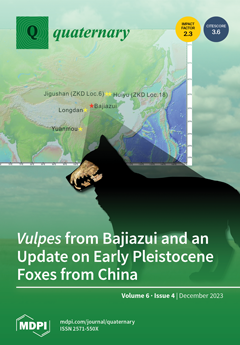
Cover Story: The record of Vulpes is utterly scarce, especially in Asia. The Early Pleistocene Asian form Vulpes chikushanensis is known from very few localities, and its taxonomy has been questioned. The specimens from the site of Bajiazui (1.8–1.2 Ma, Qingyang, Gansu) add valuable information to this problematic taxon, possibly related to Vulpes corsac. Revising the Asian fossil record of Vulpes is crucial in our attempt to understand and reconstruct the evolution of the carnivoran guild during the late Early Pleistocene (1.8–0.8 Ma). Although fragmentary, the fox remains from Bajiazui, adding a valuable piece to our knowledge of V. chikushanensis, a species possibly strongly related to the extant V. corsacView this paper
  • Issues are regarded as officially published after their release is announced to the table of contents alert mailing list .
  • You may sign up for email alerts to receive table of contents of newly released issues.
  • PDF is the official format for papers published in both, html and pdf forms. To view the papers in pdf format, click on the "PDF Full-text" link, and use the free Adobe Reader to open them.

Articles (10)

  • Feature Paper
  • Article
  • Open Access
4 Citations
3,539 Views
25 Pages

14 December 2023

New rhino remains recovered from Cova del Rinoceront (Castelldefels, Barcelona) confirm the presence of Stephanorhinus hundsheimensis (Toula, 1902) at the site and the taxon’s persistence until the late Middle–early Upper Pleistocene in E...

  • Article
  • Open Access
1 Citations
4,189 Views
19 Pages

4 December 2023

This is an updated contribution to the Quaternary geology and paleontology from central-western Argentina, focused on San Luis Province. It is mostly based on unpublished data; only some fossils had previously been briefly mentioned in broader faunal...

  • Article
  • Open Access
1 Citations
2,713 Views
17 Pages

Past and Present Drivers of Karst Formation of Ciénega de El Mangle, Panama

  • Jaime Rivera-Solís,
  • Adolfo Quesada-Román and
  • Fran Domazetović

29 November 2023

Tropical coastal karst areas represent dynamic, fragile, and biodiverse environments. Central America’s karst regions have been scarcely studied, with most of the research focused on the northern part of the region and on several larger cave sy...

  • Article
  • Open Access
1 Citations
3,596 Views
14 Pages

The Fox from Bajiazui (Qingyang, Central China) and an Update on Early Pleistocene Foxes from China

  • Saverio Bartolini-Lucenti,
  • Qigao Jiangzuo,
  • Hao Jiang,
  • Zhaoyu Li,
  • Kun Xie and
  • Joan Madurell-Malapeira

20 November 2023

(1) Background: despite the fact that nowadays the genus Vulpes Frisch, 1775, is the most diverse among extant Canidae, its fossil record is utterly scarce, especially in the Asian Pliocene. The sparse nature of this record further complicates the re...

  • Feature Paper
  • Article
  • Open Access
3 Citations
4,028 Views
27 Pages

6 November 2023

Starting roughly 50,000 years ago, the Arctic region of East Siberia remained continuously populated by groups of anatomically modern humans including the most uncomfortable episodes in the development of the late Quaternary environment; for some of...

  • Article
  • Open Access
1 Citations
2,525 Views
13 Pages

The River Valleys of the Greek Colony of Selinunte: Results of an Offshore Investigation

  • Emanuele Lodolo,
  • Luca Baradello,
  • László Szentpeteri,
  • Michele Deponte,
  • Emiliano Gordini and
  • Dario Civile

19 October 2023

The ancient Greek colony of Selinunte, with its acropolis on a promontory on the south-western coast of Sicily, is flanked by two valleys where two modest rivers flow today: the Modione to the west and the Cottone to the east. Archaeological reconstr...

  • Article
  • Open Access
3 Citations
3,099 Views
14 Pages

10 October 2023

In western Europe, the Middle Pleistocene is marked by Acheulean settlement and their diversification after the MIS 12. The Arago cave recovery of numerous human settlements correlate to MIS 14, 13 and MIS 12 making it an important site for the under...

  • Article
  • Open Access
2,853 Views
16 Pages

The Long-Term Deep Loessal Sediments of Northeast China: Loess or Loessal Paleosols?

  • Zhong-Xiu Sun,
  • Nai-Wen Zhang,
  • Ying-Ying Jiang,
  • Qiu-Bing Wang and
  • Gan-Lin Zhang

7 October 2023

Previous research assumed deep buried loess as the initial composition of the overlying paleosol and failed to address the long-term continuous pedogenic weathering history in the deep loess-paleosol sequence, which was attributed to little understan...

  • Article
  • Open Access
1 Citations
3,634 Views
29 Pages

Heat Treatment of Flint at the Late Neanderthal Site Sesselfelsgrotte (Germany)

  • Aviad Agam,
  • Merlin Hattermann,
  • Iddo Pinkas,
  • Jürgen Richter and
  • Thorsten Uthmeier

7 October 2023

We examined lithic artifacts from the late Neanderthal site Sesselfelsgrotte (Bavaria, Germany) in order to evaluate the possibility of fire use and intentional flint heat treatment performed by late Neanderthals. We analyzed 1113 flint pieces from t...

  • Article
  • Open Access
8 Citations
3,231 Views
12 Pages

1 October 2023

Shaped stone balls (SSBs) were an integral part of human culture across the Old World for nearly 2 million years. They are one of the oldest implements made and used by humans. In this significant era, which was characterised by biological and cultur...

Get Alerted

Add your email address to receive forthcoming issues of this journal.

XFacebookLinkedIn
Quaternary - ISSN 2571-550X