
Article

Fabrication of Phthalocyanine–Polymer Matrix Composites for Bio-Based Sustainable Devices
by
Héctor Iván Sánchez Moore
1,
María Elena Sánchez Vergara
1,*,
Edgar Alvarez-Zauco
2 and
Yazmín Paola Aguirre Macías
1
1
Facultad de Ingeniería, Universidad Anáhuac, Avenida Universidad Anáhuac 46, Col. Lomas Anáhuac, Huixquilucan 52786, Estado de México, Mexico
2
Facultad de Ciencias, Universidad Nacional Autónoma de Mexico, Circuito Exterior s/n, Ciudad Universitaria, Coyoacán 04510, Ciudad de Mexico, Mexico
*
Author to whom correspondence should be addressed.
J. Compos. Sci. 2026, 10(2), 60; https://doi.org/10.3390/jcs10020060
Submission received: 1 December 2025 / Revised: 14 January 2026 / Accepted: 21 January 2026 / Published: 23 January 2026
(This article belongs to the Special Issue Functional Composites: Fabrication, Properties and Applications)

Abstract

This study presents the fabrication of composite photoelectrodes containing halogenated phthalocyanines (F16CuPc and MnPcCl) embedded in polymeric matrices of PEDOT:PSS (poly(2,3-dihydrothieno-1,4-dioxin)-poly(styrenesulfonate)) and PLA (polylactic acid biopolymer). These composites were deposited on PET, palm leaf, and wheat bagasse recyclable substrates, and were morphologically characterized. The reflectance for F16CuPc/PEDOT:PSS is less than 8.5%, and that for MnPcCl/PLA changes depending on the substrate, ranging between 10% and 40%. Additionally, in the case of F16CuPc/PEDOT:PSS, the Kubelka–Munk band gap is 3.7 eV, and in the case of F16CuPc/PEDOT:PSS, the band gap varied between 2.85 and 3.47 eV. The composites were evaluated as electrodes in bio-based sustainable devices, fabricated with commercially available paper towels used as an organic membrane separator. The palm-device showed the best performance throughout its charge and discharge cycle. The device improves its performance at high speeds and reaches its highest peak at 100 mV s−1 with 3.14 × 10⁴ μA. On the other hand, the greatest thermal stability for the composites is for those deposited onto bagasse substrate, reaching up to 220 °C and 357 °C for F16CuPc/PEDOT:PSS and MnPcCl/PLA, respectively. Also, these composites exhibit charge–discharge behavior when studied in bio-based sustainable devices and can be used as electrodes.

1. Introduction

Over the last decades, global energy demand has increased exponentially, with direct repercussions on different environmental, social, and economic sectors. The actual problem not only resides in the need to improve the energy efficiency and performance of current devices, but also in the need to enhance their energy storage capacity [1,2,3]. In turn, another important global problem that cannot be ignored is pollution, which has reached historical highs. A very clear example of this is plastic waste, the amount of which continues to increase year after year; according to the UN Environment Program report, if this trend continues, plastic waste that is thrown into the environment will reach the alarming amount of more than 155 million tons by 2060 [4,5]. All the above lead to a clear goal: to develop sustainable devices that demonstrate good energy efficiency and effective charge storage, as well as a low environmental impact, through the implementation of flexible and recyclable substrates such as wheat bagasse [6] or palm leaf [7], which replace the commonly used PET [8]. In this context, organic photoelectrochemical devices are gaining more relevance due to their great versatility and potential for innovation, making them a key piece in the electronics of the future [9]. Photoelectrochemical devices are systems in which light striking their photoelectrode generates electron–hole pairs. These charge carriers separate and participate in redox reactions, which can generate chemical or electrical energy. In recent years, there has been progress in the study of metallic phthalocyanines (MPcs) as materials for photoelectrodes, due to their optical properties, their great adaptability for processing on flexible substrates, and their contributions to the electronic behavior of devices because of their interesting electrochemical properties. In addition, MPcs are low-cost and amenable to scalable synthesis, making them attractive alternatives to more expensive materials like Metal–Organic Frameworks (MOFs) [10]. Phthalocyanines are conjugated organic macromolecules that have a planar and highly aromatic structure; their electrical conductivity is due to their electronic delocalization and the presence of metal ions in the central part of their molecule [11,12]. Some relevant examples of the use of phthalocyanines in electrochemical devices [13] are as follows: halogenated indium and copper phthalocyanines have been studied for use as electrodes for an organic double-layer supercapacitor [11]; a cobalt phthalocyanine–organic framework nanosheet is prepared and applied as a photocathode in battery [14]; a CuPcTs-doped PANI carbon felt electrode has been studied for the development of an ultra-high-power density supercapacitor [12]; the electrochemical performance of double-decker lutetium and europium phthalocyanines have also been studied to determine their potential as electrode materials [15].
It is primarily due to their redox behavior that metallic phthalocyanines have been studied as electrodes in electrochemical devices, mainly batteries and supercapacitors. However, this behavior, combined with their optical properties, has not been fully exploited for the fabrication of organic photoelectrodes. It is important to consider that improving the long-term stability of the phthalocyanine used in the manufacture of the photoelectrodes is one of the main challenges facing this type of device. The electrodes are in contact with an electrolyte, usually in solution, which affects their stability, operation, and efficiency. One strategy proposed in this study to improve these aspects of phthalocyanines is to integrate them into polymeric matrices that coat and protect them, without affecting their optical or electrochemical properties. So, this work proposes the manufacturing of novel composite photoelectrodes, implementing halogenated copper and manganese phthalocyanines (F16CuPc and MnPcCl, respectively), as the main components for their electrodes. The innovation in this work consists of taking advantage of the chemical resistance and mechanical properties that PEDOT:PSS (poly(2,3-dihydrothieno-1,4-dioxin)-poly(styrenesulfonate)), and PLA (biopolymer polylactic acid) grant to F16CuPc and MnPcCl, for their efficient use in the fabrication of photoelectrodes. The presence of halide radicals in the structure of the metal phthalocyanines F16CuPc and MnPcCl reduces the energy of their lowest unoccupied molecular orbital (LUMO), which consequently decreases their optical band gap, improving absorption in the visible region of the spectrum, even in the near-infrared. The chloride and fluoride in phthalocyanines shift the Q band toward the red, broadening their useful absorption range. This is important since both phthalocyanines will be used in sustainable devices as photoelectrodes and would harness solar radiation to enhance charge transport into the device. Halides also increase resistance to photodegradation, allow for the better coupling of F16CuPc and MnPcCl with electrical conductors such as ITO or metals, which can be used as collectors, and consequently increase charge transport. Some authors of this work previously studied these halogenated phthalocyanines [11] and obtained good performance from them as electrode materials. However, in the reported studies, they were deposited by high-vacuum evaporation and their flexibility was practically zero, which makes it necessary to study them when embedded in polymeric matrices. In this way, not only is their mechanical behavior improved, but also their chemical resistance is increased, since they are protected by the polymeric matrices.
With regard to the polymers used as a matrix, this work proposes the use of PLA and PEDOT:PSS. PLA is a biodegradable thermoplastic that can be synthesized entirely from renewables [16] and has been investigated for many applications because of its ease of processing, biocompatibility, and low environmental impact [17,18]. Depending on its use, the PLA can be processed further into various shapes and forms by molding, electrospinning, extrusion, and 3D printing [16]. While PLA has been investigated for many applications, its exploitation in electronics is less advanced because of the high thermal budgets of several manufacturing processes [15,16,17]. The major drawbacks of PLA that limit its utilization are its low thermal stability and low crystallization rate when compared with petroleum-based polymers [16]. To overcome these limitations, recent research has focused on developing PLA-based composites by incorporating conductive fillers [17]. PLA composites that have been developed through the incorporation of a wide variety of fillers, particularly carbon-based materials such as carbon fibers, graphene, and graphene oxide, carbon nanotubes, and pyrolytic carbon particles, are thermally stable and have better electrical conductivities [16,17,18,19,20,21]. Conductive carbon-based composites with a PLA matrix have seen dynamic development and found many applications in organic electronics like conductive films or electrodes [22,23,24,25,26,27]. On the PEDOT:PSS side, this polymer is also used reinforced with fillers when its use is required in organic electronics. PEDOT:PSS is a conductive polymer, and its advantages include environmental stability, mechanical flexibility, processability in solutions, and tunable electrical conductivity [28]. However, PEDOT:PSS films in optoelectronics suffer drawbacks such as degradation and delamination in humid environments [28,29]. In addition, the excessive presence of PSS, an insulating phase, introduces several drawbacks to pure PEDOT:PSS, including high solution acidity, moisture absorption, irreversible aggregation upon drying, and low electrical conductivity. To overcome these challenges, most research has focused on developing composite materials by incorporating various additives and compounding with organic or inorganic fillers [29,30,31,32,33,34]. However, the current limitation of PLA or PEDOT:PSS matrix composites is that adding a single filler only improves the characteristic properties of the added reinforcement. Sometimes, multiple fillers are required to modify several properties within the same material [17,29,33]. However, adding multiple fillers can lead to segregation and heterogeneity in the material. Therefore, it is necessary to add fillers with diverse properties or multifunctional fillers, such as the halogenated phthalocyanines proposed in this work, which possess both electrical and optical properties. Furthermore, it is intended to manufacture sustainable devices that are easy to process, with adequate performance and low environmental impact, through the implementation of recyclable substrates such as palm leaf and wheat bagasse and the use of commercial paper towels as an organic separator on which the support electrolyte in solution is deposited. The cellulose paper towels were selected for the separator membrane due to their absorbency; they are a very porous material that can absorb and retain liquid electrolytes, allowing for rapid ion transport between the electrodes [35]. They are also a lightweight, flexible, yet mechanically stable material, preventing the electrodes from coming into contact and shorting out the device. The originality of this work lies in the implementation of halogenated metallic phthalocyanines embedded in polymer matrices to produce flexible electrodes employed in novel bio-based sustainable devices with a tandem-type architecture.
Table 1 presents all the abbreviations used in this work.
Table 1. List of abbreviations.
AbbreviationDefinition
Biopolymer polylactic acidPLA
Cyclic voltammetryCV
Chloride manganese (III) phthalocyanineMnPcCl
Copper (II) hexadecafluorophthalocyanineF16CuPc
Highest occupied molecular orbitalHOMO
Indium tin oxideITO
Kubelka–Munk functionF(K-M)
Lowest unoccupied molecular orbitalLUMO
Metal–Organic FrameworksMOFs
Metallic phthalocyaninesMPcs
Poly(2,3-dihydrothieno-1,4-dioxin)-poly(styrenesulfonate)PEDOT:PSS
Polyethylene terephthalatePET
Polylactic acidPLA
Tetrabutylammonium tetrafluoroborateTBA·BF4

2. Materials and Methods

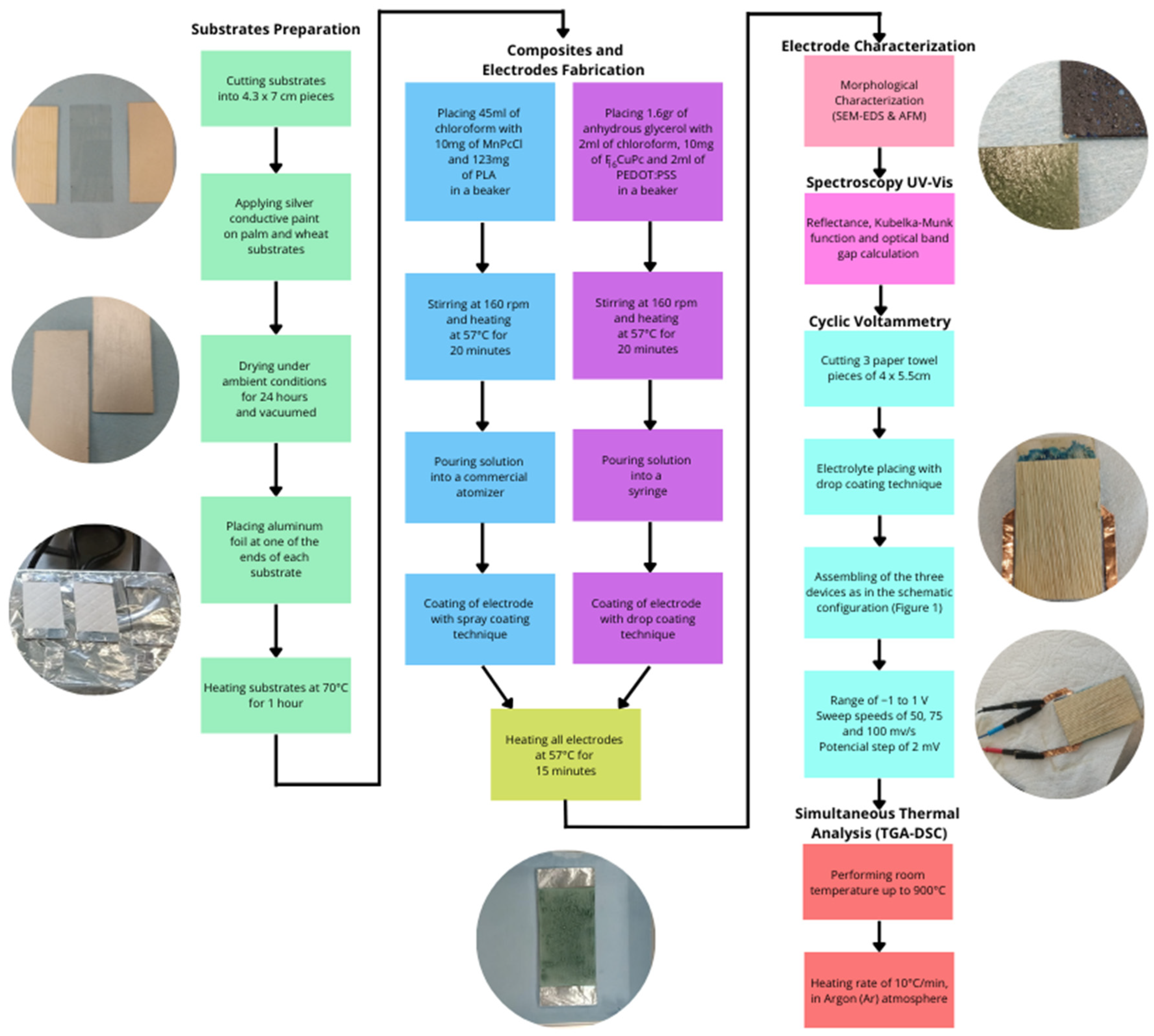
The flow diagram in Figure 1 shows the entire process of obtaining the composite materials, as well as their deposition on the substrates and their characterization. The F16CuPc (copper (II) hexadecafluorophthalocyanine: C32CuF16N8), PEDOT:PSS (poly(2,3-dihydrothieno-1,4-dioxin)-poly(styrenesulfonate)), MnPcCl (chloride manganese (III) phthalocyanine: C32H16ClMnN8), and TBA·BF4 (tetrabutylammonium tetrafluoroborate: (CH3CH2CH2CH2)4N(BF4)), were acquired straight from commercial sources (Sigma Aldrich, Saint Louis, MO, USA). The PLA (biopolymer polylactic acid: (C3H4O2)n) was obtained from commercial sources (Goodfellow Corporation, Pittsburgh, PA, USA). The anhydrous ACS glycerol (C3H8O3) also came from commercial sources (J.T. Baker, Phillipsburg, NJ, USA). The phthalocyanines F16CuPc and MnPcCl were selected for this work as fillers in composite materials due to the limited research as their use as organic photoelectrodes, the combination of their redox properties with their characteristic optical behavior, the presence of halide radicals in their structure, which generate smaller optical band gaps and greater charge transport capacity, and their potential as semiconductor fillers in polymer matrices [11,12,13,14,15]. On the other hand, PEDOT:PSS and PLA were chosen as semiconductor filler matrices due to their ability to function as matrices in the fabrication of composite materials, their ease of processing, their low environmental impact, and their transparency [16,17,18,19,20,21,22,23,24,25,26,27,28,29,30,31,32,33,34].
According to the flowchart in Figure 1, the composite films F16CuPc/PEDOT:PSS and MnPcCl/PLA were manufactured over substrates of palm leaf, wheat bagasse, and polyethylene terephthalate (PET) coated with indium tin oxide (ITO: In2O3·(SnO2)x), (PET-ITO). PET-ITO was used as a reference substrate. Previously, the palm and wheat bagasse were sanded with 200 and 400 grit sandpaper, and blasted to obtain a streak-free surface, on which silver conductive paint (Ag in 10–30% n-butyl acetate, 10–30% 1-methoxy-2-propanol acetate, and 5–10% acrylic resin) was applied. The paint was dried under 25 °C for 24 h to ensure complete solvent removal. The PET-ITO substrate was stripped of its protective layer to expose the ITO layer. All substrates were cut into 4.3 cm × 7 cm pieces, and commercial aluminum foil was placed at one of the ends of each substrate to facilitate its manipulation, leaving a working surface of 4.3 cm × 5.5 cm used for the deposition of the electrode layers. Finally, the substrates were heated for 1 h at 70 °C.
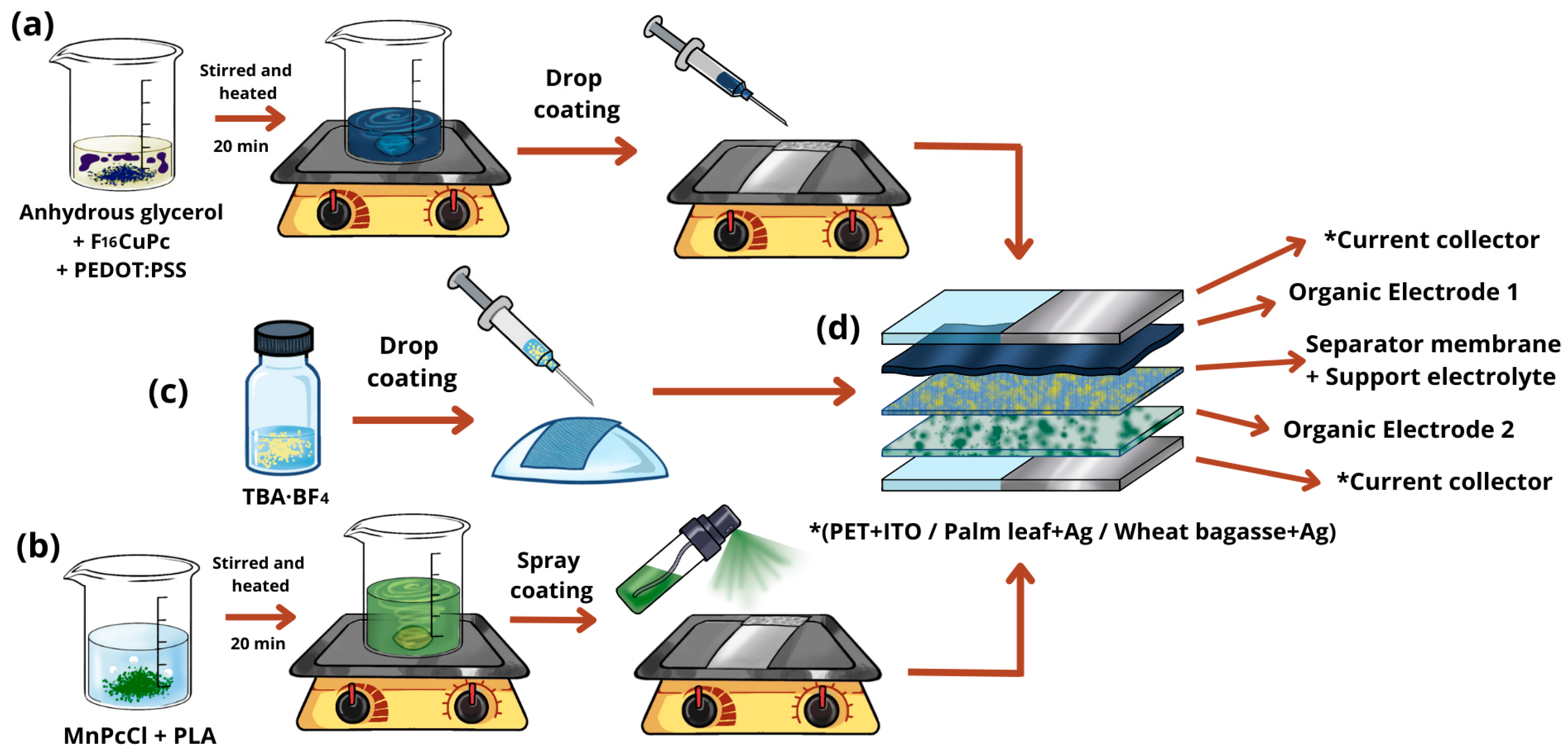
Subsequently, the composite materials F16CuPc/PEDOT:PSS and MnPcCl/PLA were manufactured according to the diagrams shown in Figure 1 and Figure 2a,b. All quantities and parameters used during the manufacture of the composite materials were determined from the experimental determination of the best operating conditions for the process in previous studies on polymeric matrices with phthalocyanines and metallic porphyrins by some of the authors of this work [36,37].
F16CuPc-PEDOT:PSS composite. In a beaker, 1.6 g of anhydrous glycerol was placed with 2 mL of chloroform, 10 mg of F16CuPc, and 2 mL of PEDOT:PSS, stirred with a magnetic stirrer at 160 rpm on a separate electric hot grill, and heated to 57 °C for 20 min. The resulting solution of approximately 5 mL was poured into a syringe, and a layer was applied to each substrate using the drop-coating technique. The thickness of the composite films on the different substrates was as follows: PET→7.4 µm, palm→10.7 µm, and wheat bagasse→8.1 µm.
MnPcCl-PLA composite. In a beaker, 45 mL of chloroform were placed with 10 mg of MnPcCl and 123 mg of PLA, stirred with a magnetic stirrer at 160 rpm on a separate electric hot grill, and heated to 57 °C for 20 min. Subsequently, the solution was poured into a commercial atomizer, obtaining approximately 30 mL of solution, and a layer was applied to each substrate using the spray-coating technique. The thickness of the composite films on the different substrates was as follows: PET→5.4 µm, palm→5.9 µm, and wheat bagasse→7.5 µm.
To complete the fabrication of the electrodes, the substrates that had the F16CuPc-PEDOT:PSS and MnPcCl-PLA composite on their surface were kept on heating plates at 57 °C for 15 min to ensure complete evaporation of the solvents, as well as uniform fixation of the coated composite materials and a reduction in poorly adhered areas. Finally, for the separator membrane (see Figure 2c), a piece of blue paper towel of 4 × 5.5 cm was used. Using the drop-coating technique, 1 mL of distilled water mixed with 3.3 mg of TBA·BF4 was placed over the paper towel, and this was assembled between the two previously manufactured electrode layers, thus obtaining three devices. Between the MnPcCl-PLA and F16CuPc-PEDOT:PSS electrodes and the separator membrane of each device, 6 cm of copper conductive tape folded over itself was used as a collector. The complete structure of the bio-based sustainable devices can be seen in Figure 2d.
The film’s thickness was investigated in contact mode on n-type silicon with a Nanosurf Naio atomic force microscope (Nanosurf AG, Liesta, Erlen, Switzerland) with an NTEGRA platform and Gwyddion 2.66 software. For SEM, a ZEISS EVO LS 10 scanning electron microscope was coupled to a Bruker microanalysis system and operated at a voltage of 20 kV and a focal distance of 25 mm. The Kubelka–Munk function was obtained using a Thermo Scientific Evolution 220 UV-Vis spectrophotometer in a wavelength range from 190 to 1100 nm (Thermo Fisher Scientific Inc., Waltham, MA, USA). Cyclic Voltammetry (CV) was conducted with Metrohm bipotentiostat-galvanostat µStat 400 (Metrohm, México City, México), using a two-electrode arrangement, over a range of −1 to 1 V, with sweep speeds of 50, 75, and 100 mV/s, and a potential step of 2 mV. The assessment of the thermal stability of the samples was carried out with NETZSCH equipment (Erich Netzsch GmbH & Co. KG, Selb, Germany), model Jupiter STA 449 C, with simultaneous TGA-DSC analysis. They were performed from room temperature up to 900 °C, at a heating rate of 10 °C/min, in an argon atmosphere.

3. Results and Discussions

3.1. Morphological Characterization of F16CuPc/PEDOT:PSS and MnPcCl/PLA Composites

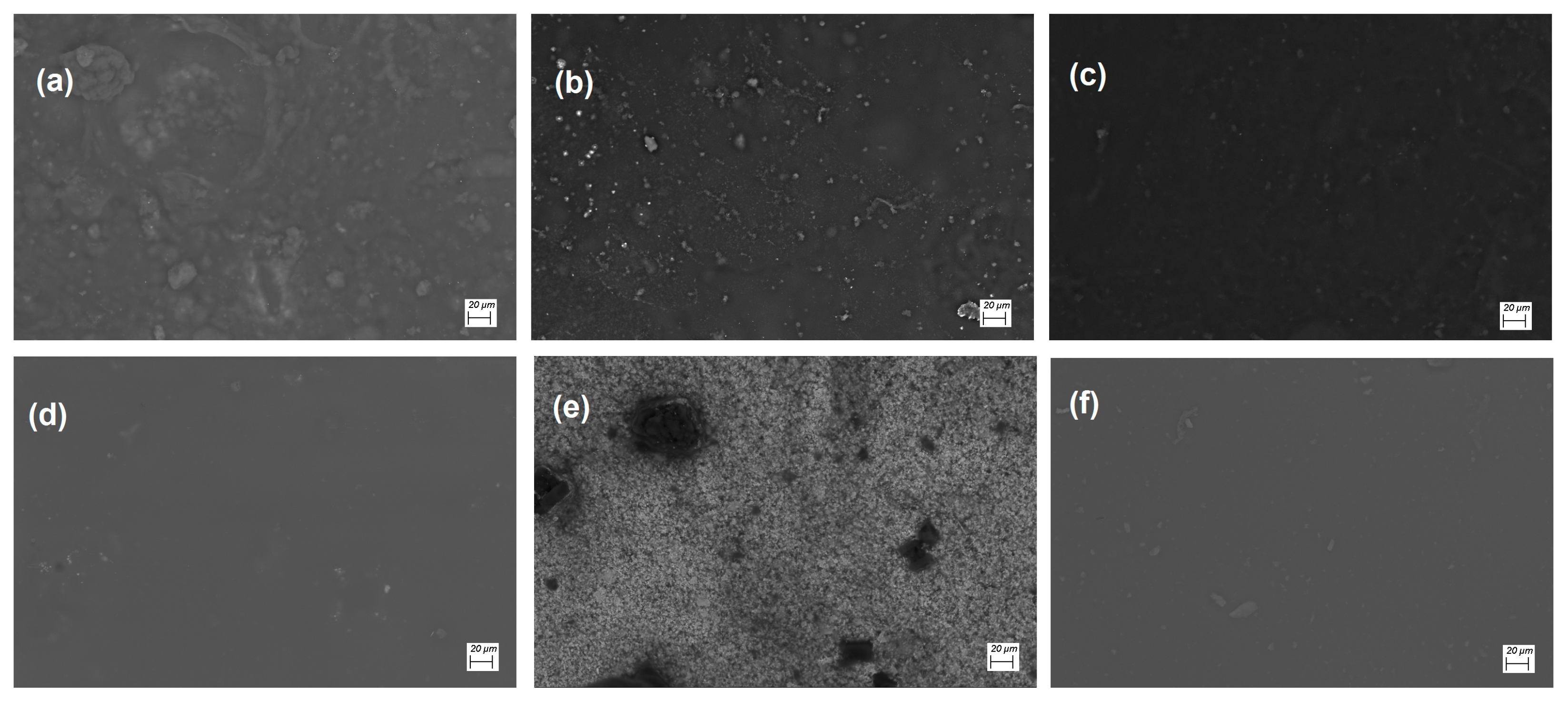
After the F16CuPc/PEDOT:PSS and MnPcCl/PLA composites were manufactured, they were analyzed by SEM to understand the morphology presented on each substrate: wheat bagasse, palm, and PET. In any case, how the particles of halogenated metallic phthalocyanines are integrated into the composites can be observed. The morphology of the composite films is decisive in how the active surface of each electrode interacts with the electrolyte, which is reflected in the efficiency of the device. Figure 3a–c show the SEM images of the F16CuPc/PEDOT:PSS composite, and Figure 3d–f show the images of the MnPcCl/PLA composite. It is evident that both the type of halogenated phthalocyanine and the type of substrate directly influence morphology. As can be observed, the largest heterogeneity on the surface is obtained in the F16CuPc/PEDOT:PSS composite. Detailing the observations on morphology, Figure 3a shows the morphology of F16CuPc/PEDOT:PSS on bagasse, and as with the palm film in Figure 3b, it exhibits a heterogeneous morphology, consisting of particle clusters that give rise to large, elongated, and irregular structures. These structures are smaller in the palm film and even smaller in the PET film (Figure 3c). This is a result of the different nucleation and growth processes of the film, as preferential nucleation sites appear to be generated depending on the substrate type. Phthalocyanines tend to aggregate, even at low concentrations, promoting local nucleation and the growth of aggregates or clusters within the polymer. During drop-coating, the chloroform used as a solvent evaporates, increasing the local concentration of phthalocyanine and exceeding the solubility limit before the system fully solidifies. This leads to heterogeneous nucleation and aggregate growth that also depends on the substrate. For example, the morphology of F16CuPc/PEDOT:PSS on PET is more homogeneous and primarily granular, although randomly distributed particles smaller than 1 μm are also observed. On the other hand, MnPcCl has a more uniform morphology than F16CuPc/PEDOT:PSS. The composite film on bagasse (Figure 3d) and the film on PET (Figure 3f) exhibit a homogeneous morphology with the presence of small particles; however, the film on palm fiber has holes (Figure 3e). This is because, during spray-coating, the phthalocyanine–polymer solution flows into the valleys and pores of the palm surface, creating areas of both local accumulation and depleted zones. As the water used as a solvent evaporates, some areas lack continuous coverage. On wheat bagasse and PET, the surface is more homogeneous, and without pores, which promotes more uniform film nucleation and growth. Although bagasse, like palm leaves, is a lignocellulosic substrate, its microstructure, surface chemistry, and solvent response are very different. Palm leaves have large, open vascular channels that disrupt the film’s continuity, while wheat bagasse has a tighter fibrous network that prevents localized solvent extraction and allows the film to cover the surface continuously. In this work, it is considered that the MnPcCl/PEDOT:PSS film, even with the presence of holes, can be used as a photoelectrode because the holes and rough topography increase the contact area between the electrode and the electrolyte, facilitating diffusion, which can improve photo-assisted faradaic processes. This is useful in electrochemical sensors, photoelectrodes for slow reactions, and systems where the electrode–electrolyte interface is dominant.
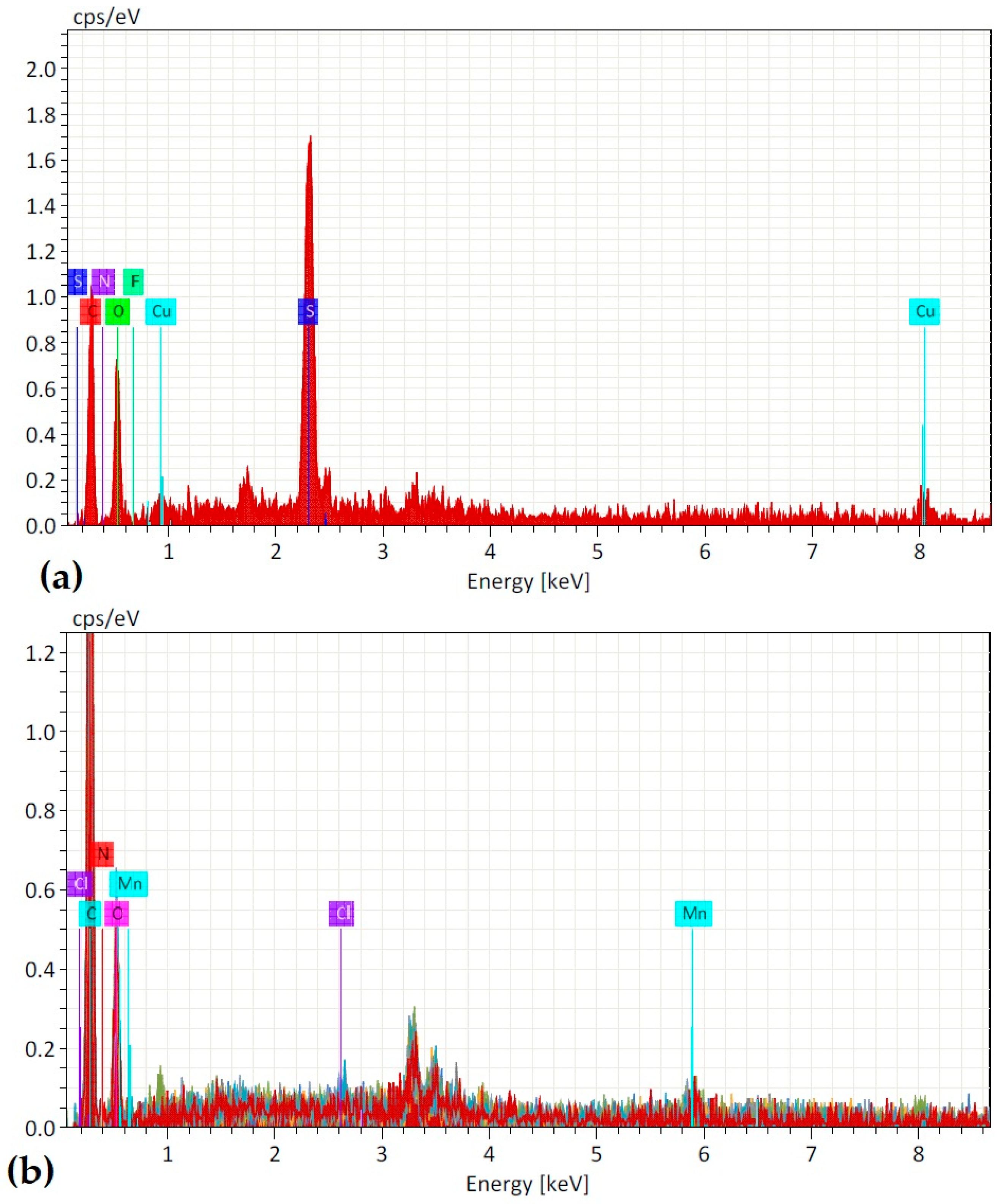
Several points were chosen in the EDS to analyze their composition, and in all cases, the results were the same. Regarding the chemical composition, Figure 4 shows the results of the elemental analysis obtained by EDS, with the aim of verifying that no chemical decomposition took place during the deposition of the phthalocyanines in their respective polymeric matrices. In Figure 4a for the F16CuPc/PEDOT:PSS, the presence of Cu, N, and F, referring to the halogenated phthalocyanine, and the presence of S and O from the PEDOT:PSS matrix can be observed. For the MnPcCl/PLA, Figure 4b shows the presence of Mn, N, and Cl corresponding to the phthalocyanine, and the presence of O from the PLA matrix. From the previous results, it can be deduced that F16CuPc/PEDOT:PSS and MnPcCl/PLA films do not undergo chemical decomposition during deposition by drop-coating and spray-coating, respectively.

3.2. Optical Characterization of F16CuPc/PEDOT:PSS and MnPcCl/PLA Composites

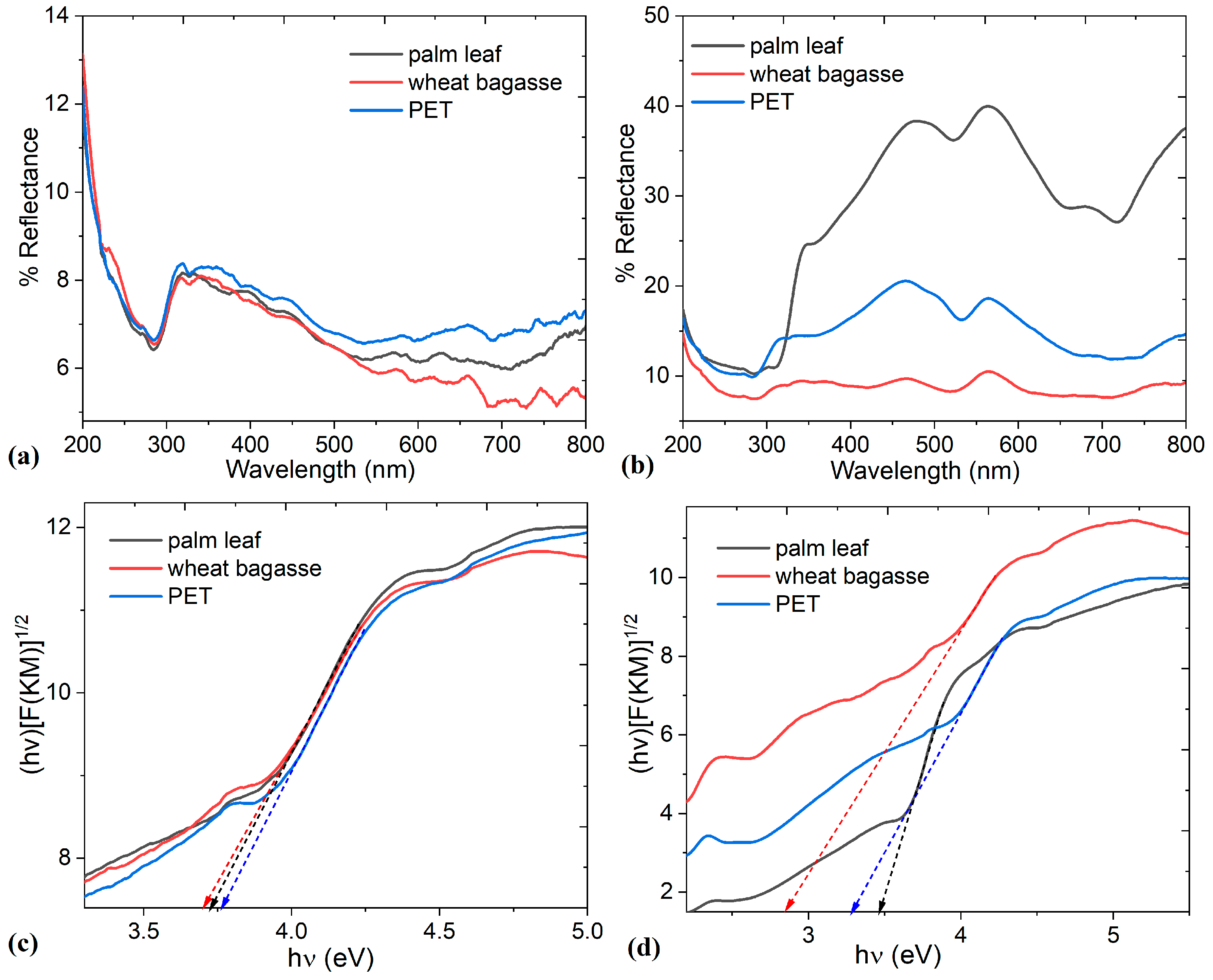
To determine the optical behavior of the composites, a reflectance study was conducted, and Figure 5 shows the spectra for F16CuPc/PEDOT:PSS and MnPcCl/PLA composites. Figure 5a shows that regardless of the substrate type, the reflectance for F16CuPc/PEDOT:PSS is less than 8.5%, which is satisfactory if this material is required to act as an optically active electrode or photoelectrode. The substrate type has no effect on the composite’s reflectance, as all spectra show similar behavior, with a small band between 300 and 380 nm, corresponding to the Soret band of phthalocyanine [38]. On the other hand, MnPcCl/PLA exhibit changes in reflectance (Figure 5b) that depend on the substrate used. The composite spectrum on the palm substrate shows the highest reflectance (~40%), followed by PET (~20%), and finally wheat bagasse (~10%) at wavelengths between 340 and 660 nm. It is precisely in this region that two bands appear for the three spectra, the first between 320 and 530 nm, corresponding to the Soret band, and the second between 530 and 660 nm, corresponding to the Q band of MnPcCl. The Q band is interpreted as a π-π* excitation between bonding and anti-bonding molecular orbitals, and the Soret band suggests π-d transitions due to the partially filled d-orbitals of the metal in the Pc structure [38]. The reflectance of F16CuPc and MnPcCl results from their conjugated π-electron systems, the overlapping orbitals of the central metal, and the effects of film molecular packing [38]. It is necessary to consider the matrix effect; while PEDOT:PSS is dark blue with broad absorption in the visible–NIR spectrum, PLA is transparent. PEDOT:PSS, in conjunction with phthalocyanine, promotes the absorption of F16CuPc/PEDOT:PSS, whereas PLA does not absorb MnPcCl/PLA.
It is important to calculate the optical band gap in the F16CuPc/PEDOT:PSS and MnPcCl/PLA, because their band gap determines the photoelectrode’s ability to absorb light and generate charge carriers. To evaluate the semiconductor capacity of each composite material, the optical band gap was determined using the Kubelka–Munk function, F(K-M), obtained through Reflectance, R, according to Equation (1) [39,40,41]:
F ( K M ) = ( 1 R ) 2 2 R
This is obtained from the Tauc equation [42]:
α ( h ν ) A ( h ν E g ) p
where α is the absorption coefficient; hν is the photon energy (h = Planck’s constant and ν = 1/λ); A is a proportionality constant; and the exponent p depends on the type of electronic transitions. In this case, p = 2 for indirect transitions is related to the amorphous character of F16CuPc/PEDOT:PSS and MnPcCl/PLA. The coefficient α is directly proportional to F(K-M), and in the Tauc equation, it can be replaced by F(K-M):
( h ν × F ( K M ) A ( h ν E g ) p
By plotting (hν × F(K-M))1/2 as a function of hν, the linear portion of this curve is fitted with a straight line, and subsequently, the intersection of this line with the photon energy axis leads to Eg [40,41,42]. Figure 5c,d and Table 2 summarize the band gap calculations obtained for each composite on the different substrates. This optical band gap is the minimum energy required by a photon to excite an electron from the highest occupied molecular orbital (HOMO) to the lowest unoccupied molecular orbital (LUMO) of phthalocyanines and is related to their ability to absorb light and participate in the photoelectronic processes required in the electrodes of photoelectrochemical devices. The obtained values are higher than those previously reported for pristine F16CuPc and MnPcCl films obtained by high-vacuum evaporation [11], because in this case, the phthalocyanines are embedded in the PEDOT:PSS and PLA polymer matrices. However, these composite materials could function as photoelectrodes in the presence of UV radiation from specific sources, such as that generated in molecular biology devices like transilluminators, disinfection systems, or photocatalysis equipment. In the case of F16CuPc/PEDOT:PSS, all three values are around 3.7 eV (see Figure 5c). There is no significant difference in the band gap, which was expected given the very similar behavior of the reflectance spectra observed in Figure 5a for the films on the three different substrates. The optical properties of this composite are dominated by phthalocyanine. MnPc/PLA exhibits slightly different band gaps, the smallest with wheat bagasse substrate, followed by PET, and finally palm leaf (Figure 5d). This change is due to structural, interfacial, and optical effects between the composite material and the substrates. These effects modify the local conditions of the film–substrate hybrid system under which electronic transitions occur. However, the results obtained indicate the appropriateness of the use of F16CuPc/PEDOT:PSS and MnPcCl/PLA and the recyclable substrates, such as wheat and palm.

3.3. Cyclic Voltammetry Analysis of F16CuPc/PEDOT:PSS and MnPcCl/PLA Electrodes

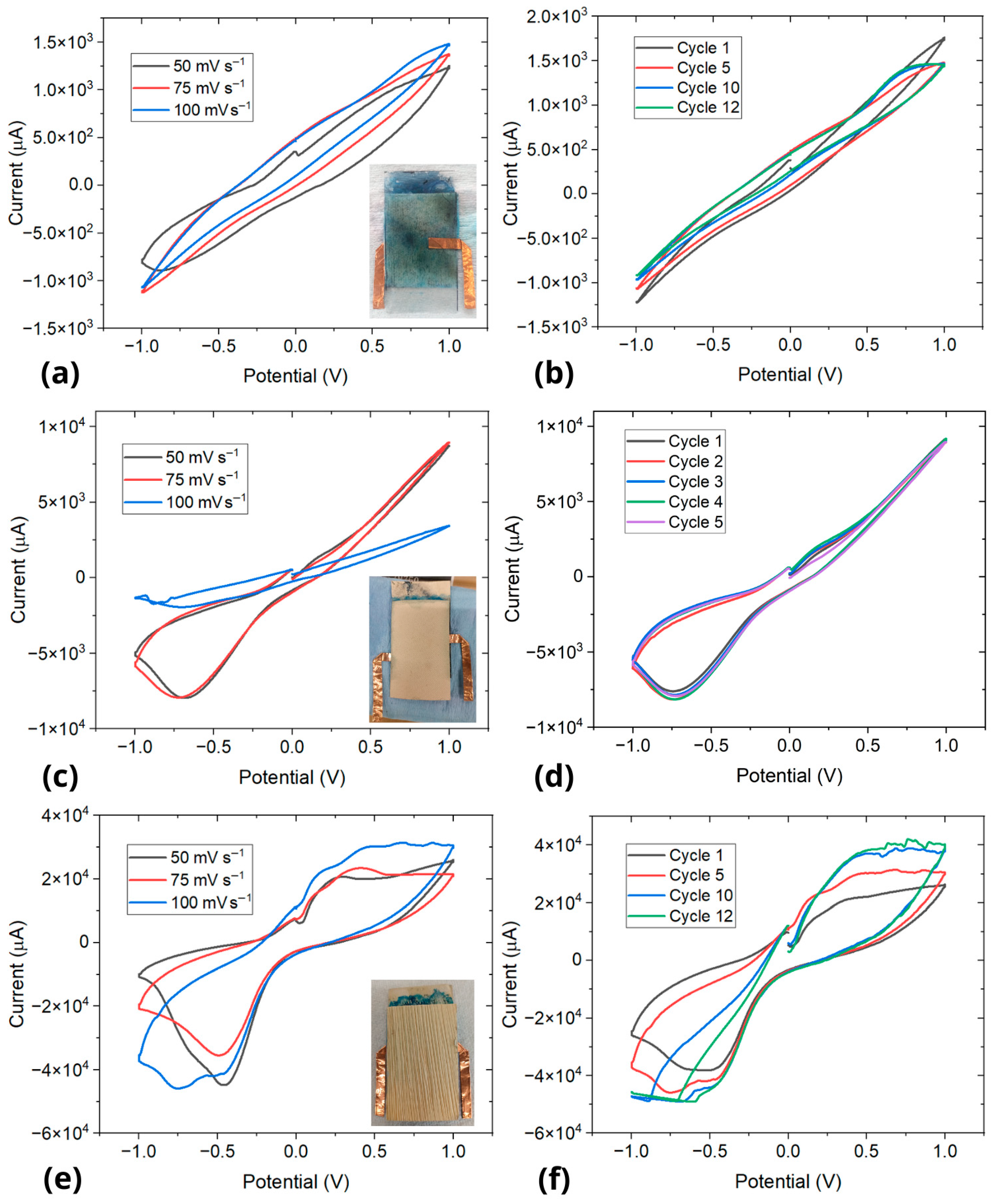
Phthalocyanines have garnered interest concerning energy conversion attributable to their electrochemical activity, stability, and conductivity [43,44,45]. The conjugated nature of MPcs facilitates electron transfer, and the choice of the central metal ion (Cu or Mn) allows for the fine-tuning of electrochemical devices’ voltage [10,46,47,48]. These compounds have extensive redox chemistry, electrochemical reversibility, and adjustable electrochemical properties [41,49,50,51]. For this reason, a CV analysis was conducted, which allows us to understand the electrochemical reactions that occur between the F16CuPc/PEDOT:PSS and MnPcCl/PLA and the electrolyte in the devices [52]. The CV was conducted by the two-electrode configuration with a potential range of −1.0–1.0 V, using measurement probes connected to the collector terminal made of copper conductive tape. Even though the architecture of the devices is quite similar, with the substrate (PET, wheat bagasse or palm) and the anode (ITO or Ag) being the main differentiators, the cyclic voltammograms of the three devices exhibit significant variations in their redox peaks (see Figure 6), corresponding to a Faraday system, in where the chemical interaction between the electrolyte and the electrode directly influences the behavior and charge storage of the devices [53]. Due to their different compositions, each electrode exhibits its own redox behavior, primarily related to the central metal and the phthalocyanine ring. Furthermore, each electrode interacts with the electrolyte. At positive potentials, phthalocyanine is oxidized, and the BF4 anion from the supporting electrolyte enters to neutralize the charge. At negative potentials, phthalocyanine is reduced, and the TBA+ cation from the electrolyte enters to neutralize the charge. This occurs gradually at different electrode sites, with rapid kinetics, accompanied by the movement of the TBA+/BF4 electrolyte, generating a continuous current. This current obtains the oval, peakless, pseudocapacitive shape of the graphs in Figure 6a,b. Upon analyzing each of the graphs in detail, Figure 6a shows the cyclic voltammograms of the device on PET at various scan rates: 50 mV s−1, 75 mV s−1, and 100 mV s−1. The oval shape of the VC is primarily due to the fact that both electrodes are active and generate a pseudocapacitor-like response, in which charge is stored in the F16CuPc/PEDOT:PSS and MnPcCl/PLA films. Thanks to the phthalocyanines, rapid and distributed redox processes are generated in their ring and central metal. At 50 mV s−1 the curve shows signs of smooth shoulders related to redox processes, while at 100 mV s−1 the curve is more capacitive. In Figure 6b, the behavior of the device on PET can be observed in multiple cycles, all performed at a scan rate of 100 mV s−1, showing this as a low loss, passing from maximum values of 1.75 × 10³ μA on its first cycle, to 1.46 × 10³ μA on its twelfth cycle. Figure 6b shows a lower electrochemical response where electrons are stored in the conjugated structures of the phthalocyanines in the electrodes, which have several energetically different active sites, and therefore, the current is almost proportional to the sweep. The device on PET CVs curves was used as a reference to compare their electrochemical performance against the device on wheat bagasse and the device on palm. Figure 6c shows the CVs of the device on wheat bagasse using the same variety of scan rates as the device on PET: 50 mV s−1, 75 mV s−1, and 100 mV s−1. In these measurements, the peculiar shape of the curves is an indication of electrochemical activity during its discharge semi-cycle, but very little activity is observed during the charge semi-cycle. In fact, at 100 mV s−1, the electrochemical activity disappears. This may be due to the passiveness between the wheat bagasse substrate and the electrode of the device possibly forming a polymeric layer, leading to poor ion diffusion and the low electrochemical performance of the device at 100 mV s−1 [54]. Using the device on wheat bagasse, measurements over multiple cycles, as shown in Figure 6d, were carried out at a scan rate of 75 mV s−1. When unaware of the passivity present in the different cycles, a good energy conservation can be appreciated, with a negligible difference between the first and last cycle and a current performance that is much higher than the device on PET, with a maximum recorded value of 9.2 × 10³ μA in the first cycle, and 9.02 × 10³ μA on the fifth.
Figure 6e shows the CVs of the device on the palm at the same variety of scan rates. The shape of the curves evidences the good electrochemical performance of the device, with good redox reactions throughout its charge and discharge cycle. It can even be appreciated that the device improves its performance at high speeds, reaching its highest peak at 100 mV s−1 with 3.14 × 10⁴ μA of current on its positive semi-cycle, and thus having the best electrochemical performance of the three bio-based sustainable devices. When taking several measurements of the device on the palm (see Figure 6f), there is a great difference between the first and last cycle, as well as a considerable deterioration in redox reactions, especially on the negative semi-cycle. This could be due to the rapid deterioration of the electrode or the support electrolyte. However, in addition to showing the low long-term performance of the device, it leaves the door open for a future study aiming at its optimization. This is a result of the better performance that this device presented with respect to the other two devices, which is notable because it is manufactured with a degradable and environmentally friendly substrate. The change in the coefficient of variation in the devices is modified when the substrate is changed because, as observed in the SEM images in Figure 3, the morphology changes in each case. The substrate changes the morphology of the F16CuPc/PEDOT:PSS and MnPcCl/PLA films and, consequently, the interfacial chemistry of the material, its redox processes, its electrical conductivity, and its charging and discharging processes. The PET is relatively smooth, and the film is more homogeneous; electrolyte access to the electrode is primarily superficial, resulting in a more symmetrical CV curve with less hysteresis. Wheat bagasse is rougher and more porous, providing a larger effective electroactive area. The electrolyte penetrates the substrate’s pores, generating a higher current, and the curve exhibits greater irreversibility or distortion. Finally, palm leaf is more heterogeneous and rougher than wheat bagasse, thus offering a larger active area. Although both substrates are fibrous, palm leaf has flatter, more continuous fibers, creating a more favorable electrochemical interface.
Using the data obtained from the voltammograms, the specific capacitance of each device was calculated using Equation (4).
P = A 2 ( V 2 V 1 ) m k
where CP is the specific capacitance, A is the area inside the CV curve, V2 and V1 correspond to the maximum and minimum potential values used during the voltametric sweep, m is the mass of the active material, and k is the scan rate of the CV. For the device manufactured on palm, the capacitance obtained is 5.28 Fg−1, for the one manufactured on bagasse it is 0.665 Fg−1, and finally, for the device manufactured on PET, the capacitance is 0.064 Fg−1. The higher capacitance obtained in the device on palm leaf is due to a combination of different factors: the larger effective area, the penetration of the electrolyte, and the polarization of the substrate. These values are lower than those reported for other types of devices fabricated with phthalocyanines, such as NiTCBPc and nickel [55], or with polymeric matrices such as PEDOT:PSS [56]. However, the electrodes presented in this work are organic, and the effect of the halogenated phthalocyanines MnPcCl and F16CuPc was only studied when embedded in degradable polymers such as PEDOT:PSS and PLA. The photoelectrodes do not have graphene or carbon nanotubes, which are commonly used to increase the charge and discharge capacity of the device.
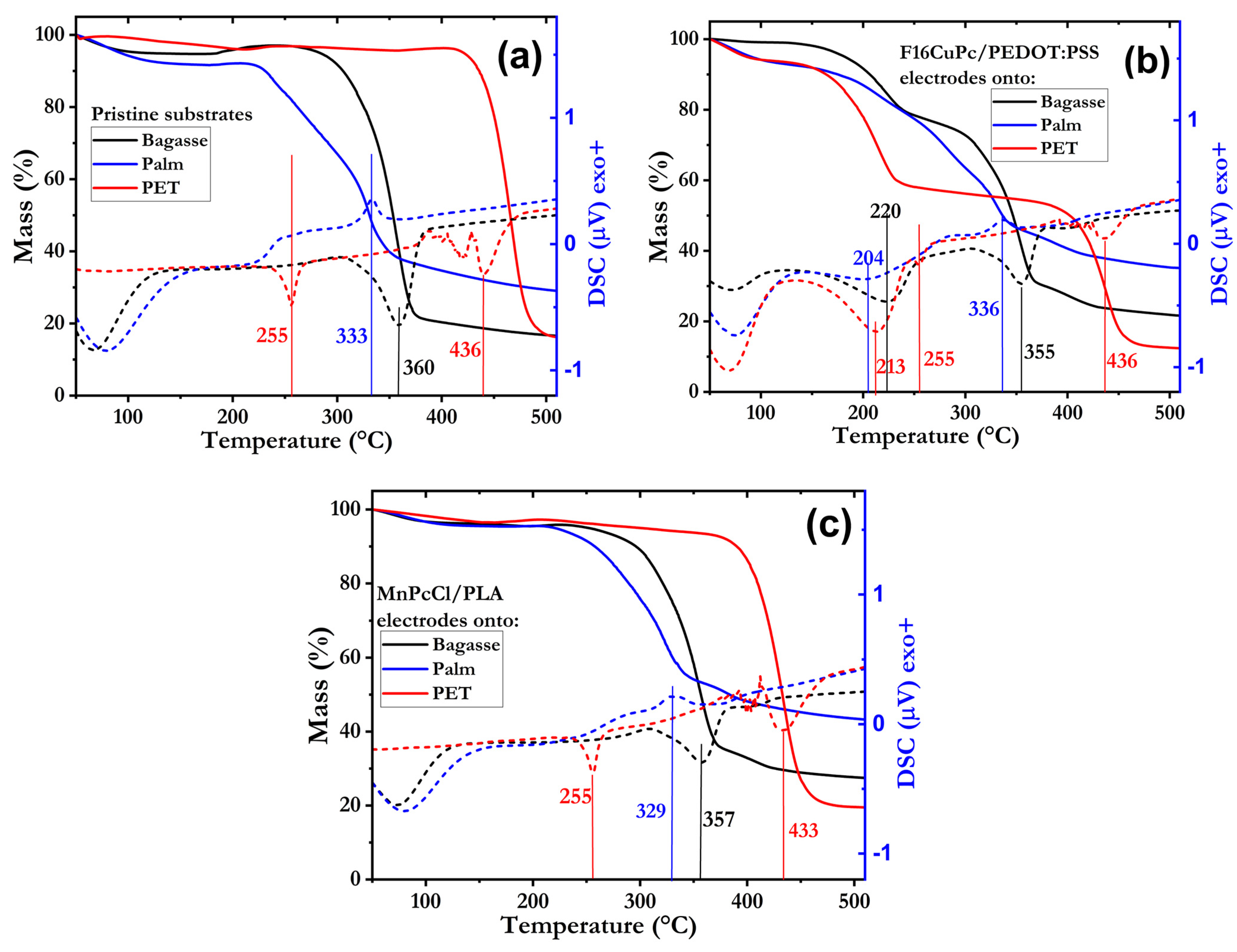
Finally, to study the thermal stability of composites F16CuPc/PEDOT:PSS and MnPcCl/PLA deposited onto bagasse, palm, and PET substrates, a TGA-DSC analysis was carried out. Initially, pristine substrates were analyzed (Figure 7a), and subsequently, the F16CuPc/PEDOT:PSS were analyzed. Pristine bagasse substrate showed a first weight loss at up to 100 °C, which can be ascribed to 7 wt% loss of water; this effect was not present in the substrate + composite (Figure 7b), possibly due to the composite film deposition processes. The second weight loss occurred between 110 and 250 °C, which is consistent with DSC analysis, where a broad endothermic peak is exhibited, which indicates the electrode region’s degradation at a degradation temperature of td = 220 °C, below the temperature reported by Giuri et al. [57]. Finally, the region between 300 and 390 °C is related to substrate degradation, with a td = 355 °C, determined by the peak position of this broad endothermic peak for the pristine bagasse. In addition, the independent behavior of the composite film and substrate degradation suggests a weak interaction between the substrate and the composite. F16CuPc/PEDOT:PSS’s behavior when deposited onto palm substrate shows a similar response up to 140 °C, where degradation begins, while the TGA and DSC curves show two regions where F16CuPc/PEDOT:PSS and substrate degradation occur, from 140 to 280 °C (td = 204 °C) and from 280 to 365 °C (td = 336 °C), respectively, both defined by DSC’s broad peak with a slight overlap; this could be associated with a better interaction between the composite film and the substrate. The PET substrate shows a very similar response, with water weight loss up to 120 °C, composite degradation at td = 213 °C (137 to 235 °C), and a PET melting point at tm = 255 °C, in good agreement with what was reported by Yan et al. [58], and substrate degradation td = 436 °C (380–475 °C); a weak interaction substrate–composite film was reported as well.
The analysis of MnPcCl/PLA revealed a very different behavior (Figure 7c). The electrodes do not present an independent degradation; according to the TGA-DSC curves, one degradation process is carried out in a single temperature range. For bagasse and palm substrates, a dehumidifying process occurred up to 120 °C, and substrate/electrode degradation took place at td = 357 °C (270–390 °C) for bagasse, td = 329 °C (220–370 °C) for palm, and td = 433 °C (340–490 °C) for PET. The curves showed similarity with the pristine substrate, indicating a strong interaction at the composite–substrate interface. However, the degradation temperature for the PET was higher; we must consider its melting point at tm = 255 °C as a stability temperature for the MnPcCl/PLA–substrate system. Considering the values of the temperatures obtained for the TGA-DSC analysis, the stability of F16CuPc/PEDOT:PSS can be achieved at the following temperatures: 220 °C for bagasse, 204 °C for palm, and 213 °C for PET. For MnPcCl/PLA, the substrate with the greatest thermal stability is the one formed with bagasse, since it degrades at 357 °C, a higher temperature than the decomposition of the palm substrate, which begins at 250 °C, and the melting of PET at 255 °C.

4. Conclusions

In summary, we reported novel F16CuPc/PEDOT:PSS and MnPcCl/PLA composites prepared by a facile drop-coating and spray-coating technique, respectively. The composites were placed on degradable and low-environmental-impact substrates such as wheat bagasse and palm leaves. The presence of phthalocyanines in composites provides optical properties related to their Q and Soret bands, which can be combined with the electrochemical behavior of the composites for use in bio-based sustainable devices. The reflectance for F16CuPc/PEDOT:PSS is less than 8.5%, and for MnPcCl/PLA changes, depending on the substrate, between 10% and 40%. Regarding the Kubelka–Munk gap, F16CuPc/PEDOT:PSS has a value of 3.7 eV regardless of the substrate on which it was deposited, while for MnPcCl/PLA, the band gap changes from 2.85 to 3.47 eV depending on the substrate (wheat < PET < palm). The composites were evaluated as electrodes in bio-based sustainable devices and fabricated with commercially available paper towels used as an organic membrane separator. The best composite film performance during the study of device charging and discharging was obtained in the device with the palm substrate. The device performance improved at high speeds and reached its highest peak at 100 mV s−1, with 3.14 × 10⁴ μA. Finally, the thermal degradation of the composites was analyzed, and it was found that the composites on wheat bagasse also had the greatest stability. Specifically, the F16CuPc/PEDOT:PSS had a degradation temperature of 220 °C and a temperature of 357 °C was obtained for the MnPcCl/PLA. The results obtained in this work indicate that the F16CuPc/PEDOT:PSS and MnPcCl/PLA composites can be used in the manufacture of electrodes for bio-based sustainable devices.

Author Contributions

Conceptualization, M.E.S.V., H.I.S.M. and Y.P.A.M.; methodology, M.E.S.V., H.I.S.M., E.A.-Z. and Y.P.A.M.; software, M.E.S.V., Y.P.A.M. and H.I.S.M.; validation, M.E.S.V.; formal analysis, M.E.S.V.; H.I.S.M., E.A.-Z. and Y.P.A.M.; investigation, H.I.S.M.; resources, M.E.S.V.; data curation, M.E.S.V., E.A.-Z., H.I.S.M. and Y.P.A.M.; writing—original draft preparation, M.E.S.V.; H.I.S.M., E.A.-Z. and Y.P.A.M.; writing—review and editing, M.E.S.V., H.I.S.M., E.A.-Z. and Y.P.A.M.; visualization, H.I.S.M. and M.E.S.V.; supervision, M.E.S.V.; project administration, M.E.S.V.; funding acquisition, M.E.S.V. All authors have read and agreed to the published version of the manuscript.

Funding

M.E.S.V. acknowledges financial support from the Anahuac México University, project number PI0000331. E.A.-Z. acknowledges the financial support from the National Autonomous University of Mexico (UNAM), grant No. DGAPA PAPIIT: IN-112523.

Data Availability Statement

The raw data supporting the conclusions of this article will be made available by the authors on request.

Acknowledgments

The authors thank José Miguel Rocha Flores and Aline Hernández García for their technical support at AFM and SEM, respectively. The authors thank Kassandra Sugey Rodríguez Zúñiga for her support in the schemes of this manuscript.

Conflicts of Interest

The authors declare no conflicts of interest.

References

  1. Jiang, W.; Lv, L.; Xiao, Y.; Fu, X.; Deng, Z.; Yue, W. A multi-objective modeling and optimization method for high efficiency, low energy, and economy. Int. J. Adv. Manuf. Technol. 2023, 128, 2483–2498. [Google Scholar] [CrossRef] [Scilit]
  2. Olatomiwa, L.; Idakwo, H.O.; Olusola, W.S.; Ezeh, C. Global energy consumption trends. Majlesi J. Electr. Eng. 2025, 19, 192509. [Google Scholar] [CrossRef]
  3. Ahmad, T.; Zhang, D. A critical review of comparative global historical energy consumption and future demand: The story told so far. Energy Rep. 2020, 6, 1973–1991. [Google Scholar] [CrossRef] [Scilit]
  4. Raj, M.; Ghosh, A.; Ilame, T.; Kumar, S. Plastic waste management strategies: Planning through a sustainable lens and way forward towards circular economy. Discov. Sustain. 2025, 6, 361. [Google Scholar] [CrossRef] [Scilit]
  5. Yang, J.; Hu, X.; Tan, F. The Mapping of Global Plastic Pollution Research: A Bibliometric Analysis of the Progress and Thematic Trends. Sustainability 2025, 17, 1859. [Google Scholar] [CrossRef] [Scilit]
  6. Neudecker, F.; Jakob, M.; Bodner, S.C.; Keckes, J.; Buerstmayr, H.; Gindl-Altmutter, W. Delignification and Densification as a Route to Enable the Use of Wheat Straw for Structural Materials. ACS Sustain. Chem. Eng. 2023, 11, 7596–7604. [Google Scholar] [CrossRef] [Scilit]
  7. Rotich, G.; Dasalegn, A. Mechanical and Water Absorption Properties of Jute/Palm Leaf Fiber-Reinforced Recycled Polypropylene Hybrid Composites. Int. J. Polym. Sci. 2022, 2022, 4408455. [Google Scholar] [CrossRef] [Scilit]
  8. Jiang, C.; Mi, J.; He, Y.; Wang, X. Polyethylene terephthalate composite and foam with superior mechanical properties from the synergistic simultaneous in situ fibrillation of liquid crystal polymer and polytetrafluoroethylene. J. Mater. Sci. 2024, 59, 12476–12501. [Google Scholar] [CrossRef] [Scilit]
  9. Park, H.; Kim, S.; Lee, J.; Lee, I.; Bontapelle, S.; Na, Y.; Sim, K. Organic flexible electronics with closed-loop recycling for sustainable wearable technology. Nat. Electron. 2023, 7, 39–50. [Google Scholar] [CrossRef] [Scilit]
  10. Hou, W.; Araujo-Correa, A.E.; Qiu, S.; Otero Velez, C.; Acosta-Tejada, Y.D.; Feliz-Hernández, L.N.; González-Nieves, K.; Morell, G.; Piñero Cruz, D.M.; Wu, X. Electrochemical Studies of Metal Phthalocyanines as Alternative Cathodes for Aqueous Zinc Batteries in “Water-in-Salt” Electrolytes. Batteries 2025, 11, 88. [Google Scholar] [CrossRef] [Scilit]
  11. Sánchez Vergara, M.E.; Sánchez Moore, H.I.; Cantera-Cantera, L.A. Investigation of Halogenated Metallic Phthalocyanine (InPcCl and F16CuPc)-Based Electrodes and Palm Substrate for Organic Solid-State Supercapacitor Fabrication. Micromachines 2025, 16, 455. [Google Scholar] [CrossRef] [Scilit] [PubMed]
  12. Arvas, M.B.; Yazar, S.; Sahin, Y. An ultra-high power density supercapacitor: Cu(II) phthalocyanine tetrasulfonic acid tetrasodium salt doped polyaniline. J. Alloys Compd. 2022, 919, 165689. [Google Scholar] [CrossRef] [Scilit]
  13. Oni, J.; Ozoemena, K.I. Phthalocyanines in batteries and supercapacitors. J. Porphyr. Phthalocyanines 2012, 16, 754–760. [Google Scholar] [CrossRef] [Scilit]
  14. Wang, J.-H.; Li, S.; Chen, Y.; Dong, L.-Z.; Liu, M.-; Shi, J.-W.; Li, S.-H.-; Lan, Y.-Q. Phthalocyanine Based Metal–Organic Framework Ultrathin Nanosheet for Efficient Photocathode toward Light-Assisted Li–CO2 Battery. Adv. Funct. Mater. 2022, 32, 2210259. [Google Scholar] [CrossRef] [Scilit]
  15. Yabaş, E.; Biçer, E.; Durukan, M.B.; Keskin, D.; Unalan, H.E. Double-decker lutetium and europium phthalocyanine composites with reduced graphene oxide as supercapacitor electrode materials. J. Organomet. Chem. 2020, 980–981, 122509. [Google Scholar] [CrossRef] [Scilit]
  16. Lima dos Santos, A.; Ramos de Souza, F.C.; Martins da Costa, J.C.; Araújo Gonçalves, D.; Ribeiro Passos, R.; Pocrifka, L.A. Development and Characterization of 3D-Printed PLA/Exfoliated Graphite Composites for Enhanced Electrochemical Performance in Energy Storage Applications. Polymers 2024, 16, 3131. [Google Scholar] [CrossRef] [Scilit]
  17. Boonyeun, N.; Rujiravanit, R.; Saito, N. Plasma-Assisted Synthesis of Multicomponent Nanoparticles Containing Carbon, Tungsten Carbide and Silver as Multifunctional Filler for Polylactic Acid Composite Films. Polymers 2021, 13, 991. [Google Scholar] [CrossRef] [Scilit]
  18. Zhang, G.; Liu, X.; Wang, L.; Fu, H. Recent Advances of Biomass Derived Carbon-Based Materials for Efficient Electrochemical Energy Devices. J. Mater. Chem. A 2022, 10, 9277–9307. [Google Scholar] [CrossRef] [Scilit]
  19. Jellett, C.; Ghosh, K.; Browne, M.P.; Urbanová, V.; Pumera, M. Flexible Graphite-Poly(Lactic Acid) Composite Films as Large-Area Conductive Electrodes for Energy Applications. ACS Appl. Energy Mater. 2021, 4, 6975–6981. [Google Scholar] [CrossRef] [Scilit]
  20. González-López, M.A.; González-López, J.A.; Reyes-Morales, Q.L.; Pereyra, I.; Mayen, J. Modifying the Manufacturing Process of High-Graphite Content Polylactic Acid Filament for Advanced Energy and Sensing Applications in 3D Printing. Polymer 2024, 292, 126661. [Google Scholar] [CrossRef] [Scilit]
  21. Kim, I.H.; Jeong, Y.G. Polylactide/Exfoliated Graphite Nanocomposites with Enhanced Thermal Stability, Mechanical Modulus, and Electrical Conductivity. J. Polym. Sci. Part B Polym. Phys. 2010, 48, 850–858. [Google Scholar] [CrossRef] [Scilit]
  22. Bozó, É.; Ervasti, H.; Halonen, N.; Hosseini Shokouh, S.H.; Tolvanen, J.; Pitkänen, O.; Järvinen, T.; Pálvölgyi, P.S.; Szamosvölgyi, Á.; Sápi, A.; et al. Bioplastics and Carbon-Based Sustainable Materials, Components, and Devices: Toward Green Electronics. ACS Appl. Mater. Interfaces 2021, 13, 49301−49312. [Google Scholar] [CrossRef] [Scilit]
  23. Cirillo, C.; Iuliano, M.; Shahzad, M.; Grazia Di Martino, E.; Gallucci, L.; Funicello, N.; Iannone, G.; De Pasquale, S.; Sarno, M. Electrochemical Oxidation Degradation of Methylene Blue Dye on 3D-Printed Anode Electrodes. Polymers 2025, 17, 2499. [Google Scholar] [CrossRef] [Scilit] [PubMed]
  24. Vaněčková, E.; Bouša, M.; Shestivska, V.; Kubišta, J.; Moreno-García, P.; Broekmann, P.; Rahaman, M.; Zlámal, M.; Heyda, J.; Bernauer, M. Electrochemical reduction of carbon dioxide on 3D printed electrodes. ChemElectroChem 2021, 8, 2137. [Google Scholar] [CrossRef] [Scilit]
  25. Hüner, B.; Demir, N.; Kaya, M.F. Ni-Pt coating on graphene-based 3D printed electrodes for hydrogen evolution reactions in alkaline media. Fuel 2023, 331, 125971. [Google Scholar] [CrossRef] [Scilit]
  26. Hüner, B.; Demir, N.; Kaya, M.F. Hydrogen evolution reaction performance of Ni–Co-coated graphene-based 3D printed electrodes. ACS Omega 2023, 8, 5958–5974. [Google Scholar] [CrossRef] [Scilit]
  27. Huener, B.; Demir, N.; Kaya, M.F. Electrodeposition of NiCu bimetal on 3D printed electrodes for hydrogen evolution reactions in alkaline media. Int. J. Hydrogen Energy 2022, 47, 12136. [Google Scholar] [CrossRef] [Scilit]
  28. Alamer, F.A.; Beyari, R.F. Overview of the Influence of Silver, Gold, and Titanium Nanoparticles on the Physical Properties of PEDOT:PSS-Coated Cotton Fabrics. Nanomaterials 2022, 12, 1609. [Google Scholar] [CrossRef] [Scilit]
  29. Chen, S.; Liang, L.; Zhang, Y.; Lin, K.; Yang, M.; Zhu, L.; Yang, X.; Zang, L.; Lu, B. PEDOT:PSS-based electronic materials: Preparation, performance tuning, processing, applications, and future prospect. Prog. Polym. Sci. 2025, 166, 101990. [Google Scholar] [CrossRef] [Scilit]
  30. Wen, N.X.; Zuo, X.Q.; Zhou, J.J.; Sun, C.; Chen, C.; Jiang, D.Y.; Xu, H.; Wang, W.; Pan, L.; Fan, Z. Boosting thermoelectric performance of wet-spun PEDOT:PSS-based organic/inorganic composite fibers via a dual-interfacial engineering approach. Small 2025, 21, e2500866. [Google Scholar] [CrossRef] [Scilit]
  31. Zhang, Z.X.; Liu, X.L.; Luo, Q.; Zhou, X.M.; Zhou, Q.J.; Liu, Y.; Zhou, Y. Morphology of nanometer-sized PEDOT:PSS nanoparticles. Macromol. Rapid Commun. 2025, 46, e2500045. [Google Scholar] [CrossRef] [Scilit]
  32. Dong, J.J.; Liu, J.; Qiu, X.K.; Chiechi, R.; Koster, L.J.A.; Portale, G. Engineering the thermoelectrical properties of PEDOT:PSS by alkali metal ion effect. Engineering 2021, 7, 647–654. [Google Scholar] [CrossRef] [Scilit]
  33. Alamer, F.A.; Althagafy, K.; Alsalmi, O.; Aldeih, A.; Alotaiby, H.; Althebaiti, M.; Alghamdi, H.; Alotibi, N.; Saeedi, A.; Zabarmawi, Y.; et al. Review on PEDOT:PSS-Based Conductive Fabric. ACS Omega 2022, 7, 35371−35386. [Google Scholar] [CrossRef] [Scilit]
  34. Zhu, L.; Liu, Q.; Zhang, Y.; Sun, H.; Chen, S.; Liang, L.; An, S.; Yang, X.; Zang, L. Recent Advances in the Tunable Optoelectromagnetic Properties of PEDOTs. Molecules 2025, 30, 179. [Google Scholar] [CrossRef] [Scilit]
  35. Kweon, S.W.; Ko, Y.C.; Lee, Y.J.; Cha, J.E.; Moon, B.G.; Kim, H.J. Determination of in-use properties of paper towels. BioResources 2024, 19, 7366–7380. [Google Scholar] [CrossRef] [Scilit]
  36. Sánchez-Vergara, M.E.; Hamui, L.; González-Verdugo, D.; Cosme, I. Efficient Film Fabrication and Characterization of Poly(3,4-ethylenedioxythiophene):Poly(styrenesulfonate) (PEDOT:PSS)-Metalloporphine Nanocomposite and Its Application as Semiconductor Material. Polymers 2021, 13, 4008. [Google Scholar] [CrossRef] [Scilit] [PubMed]
  37. Sánchez Vergara, M.E.; Hernández Méndez, J.A.; González Verdugo, D.; Giammattei Funes, I.M.; Lozada Flores, O. Influence of the Polymeric Matrix on the Optical and Electrical Properties of Copper Porphine-Based Semiconductor Hybrid Films. Polymers 2023, 15, 3125. [Google Scholar] [CrossRef] [Scilit] [PubMed]
  38. Cranston, R.R.; Lessard, B.H. Metal phthalocyanines: Thin- film formation, microstructure, and physical properties. RSC Adv. 2021, 11, 21716–21737. [Google Scholar] [CrossRef] [Scilit]
  39. López, R.; Gómez, R. Band-gap energy estimation from diffuse reflectance measurements on sol–gel and commercial TiO2: A comparative study. J. Sol-Gel Sci. Technol. 2012, 61, 1–7. [Google Scholar] [CrossRef] [Scilit]
  40. Kubelka, P.; Munk, F. An Article on Optics of Paint Layers. Z. Tech. Phys. 1931, 12, 259–274. [Google Scholar]
  41. Kubelka, P. New Contributions to the Optics of Intensely Light-Scattering Materials. Part I. J. Opt. Soc. Am. 1948, 38, 448–457. [Google Scholar] [CrossRef] [Scilit]
  42. Tauc, J.; Grigorovici, R.; Vancu, A. Optical Properties and Electronic Structure of Amorphous Germanium. Phys. Status Solidi B 1966, 15, 627–637. [Google Scholar] [CrossRef] [Scilit]
  43. Balogun, S.A.; Thole, D.; Teffu, D.M.; Masekela, D.; Modibane, K.D. Fabrication of CoPcMWCNTs nanocomposite for supercapacitor applications. Mater. Res. Express 2025, 12, 025505. [Google Scholar] [CrossRef] [Scilit]
  44. Kumar, A.; Vashistha, V.K.; Das, D.K. Recent development on metal phthalocyanines-based materials for energy conversion and storage applications. Coord. Chem. Rev. 2021, 431, 213678. [Google Scholar] [CrossRef] [Scilit]
  45. Gorduk, O.; Gencten, M.; Gorduk, S.; Sahin, M.; Sahin, Y. Electrochemical fabrication and supercapacitor performances of metallophthalocyanine/functionalized-multiwalled carbon nanotube/polyaniline modified hybrid electrode materials. J. Energy Storage 2021, 33, 102049. [Google Scholar] [CrossRef] [Scilit]
  46. Zhao, J.; Zhou, M.; Chen, J.; Tao, L.; Zhang, Q.; Li, Z.; Zhong, S.; Fu, H.; Wang, H.; Wu, L. Phthalocyanine-based covalent organic frameworks as novel anode materials for high-performance lithium-ion/sodium-ion batteries. Chem. Eng. J. 2021, 425, 131630. [Google Scholar] [CrossRef] [Scilit]
  47. Wang, H.G.; Wang, H.; Si, Z.; Li, Q.; Wu, Q.; Shao, Q.; Wu, L.; Liu, Y. A Bipolar and Self-Polymerized Phthalocyanine Complex for Fast and Tunable Energy Storage in Dual-Ion Batteries. Angew. Chem. Int. Ed. 2019, 58, 10204–10208. [Google Scholar] [CrossRef] [Scilit]
  48. Chen, J.; Xu, Y.; Cao, M.; Zhu, C.; Liu, X.; Li, Y.; Zhong, S. A stable 2D nano-columnar sandwich layered phthalocyanine negative electrode for lithium-ion batteries. J. Power Sources 2019, 426, 169–177. [Google Scholar] [CrossRef] [Scilit]
  49. Balogun, S.A.; Thole, D.; Masekela, D.; Modibane, K.D. Cobalt Phthalocyanine-Based Photo/Electrocatalysts for Hydrogen Evolution Reaction. Adv. Energy Sustain. Res. 2024, 5, 2400169. [Google Scholar] [CrossRef] [Scilit]
  50. Yenilmez, H.Y.; Budak, Ö.; Öztürk, N.F.; Koca, A.; Boz, A.; Ustamehmetoğlu, B.; Bayir, Z.A. Supercapacitive properties of carbazole-containing cobalt(ii) phthalocyanines/reduced graphene oxide composites. Dalton Trans. 2024, 53, 1766–1778. [Google Scholar] [CrossRef] [Scilit]
  51. Madhuri, K.P.; John, N.S. Metal phthalocyanines and their composites with carbon nanostructures for applications in energy generation and storage. In Design, Fabrication, and Characterization of Multifunctional Nanomaterials; Elsevier: Amsterdam, The Netherlands, 2022; pp. 401–448. [Google Scholar] [CrossRef] [Scilit]
  52. Yamada, H.; Yoshii, K.; Asahi, M.; Chiku, M.; Kitazumi, Y. Cyclic Voltammetry Part 1: Fundamentals. Electrochemistry 2022, 90, 102005. [Google Scholar] [CrossRef] [Scilit]
  53. Mohamad, A.A. Cyclic voltammetry of hybrid supercapacitors: A characterization review. Inorg. Chem. Commun. 2025, 172, 113677. [Google Scholar] [CrossRef] [Scilit]
  54. Heard, D.M.; Lennox, A.J.J. Electrode Materials in Modern Organic Electrochemistry. Angew. Chem. Int. Ed. 2020, 59, 18866–18884. [Google Scholar] [CrossRef] [Scilit] [PubMed]
  55. Praveen Kumar, N.Y.; Mounesh; Sharanakumar, T.M.; Venugopala Reddy, K.R. Tetra chlorobenzoxazolamine nickel (II) phthalocyanine supercapacitor with aqueous electrolyte and MWCNTs. Chem. Pap. 2021, 75, 2683–2694. [Google Scholar] [CrossRef] [Scilit]
  56. Flexible grapheme supercapacitor based on the PVA electrolyte and BaTiO3/PEDOT: Composite separator. J. Mater. Sci. Mater. Electron. 2018, 29, 17432–17437. [CrossRef] [Scilit]
  57. Giuri, A.; Masi, S.; Colella, S.; Listorti, A.; Rizzo, A.; Kovtun, A.; Dell’Elce, S.; Liscio, A.; Corcione, C.E. Rheological and physical characterization of PEDOT: PSS/graphene oxide nanocomposites for perovskite solar cells. Polym. Eng. Sci. 2017, 57, 546–552. [Google Scholar] [CrossRef] [Scilit]
  58. Yan, M.; Yang, Y.; Chen, F.; Hantoko, D.; Pariatamby, A.; Kanchanatip, E. Development of reusable Ni/γ-Al2O3 catalyst for catalytic hydrolysis of waste PET bottles into terephthalic acid. Environ. Sci. Pollut. Res. 2023, 30, 102560–102573. [Google Scholar] [CrossRef] [Scilit]
Figure 1. Flow diagram of the process of obtaining the composite materials, their deposition on the substrates, and characterization.
Jcs 10 00060 g001
Figure 2. Schematic diagram of the manufacturing process for (a) F16CuPc-PLA composite, (b) MnPcCl-PEDOT:PSS composite, and (c) TBA·BF4 separator membrane. (d) Components for sustainable tandem-type devices.
Jcs 10 00060 g002
Figure 3. SEM images at 250× of F16CuPc/PEDOT:PSS on (a) bagasse, (b) palm, and (c) PET. MnPcCl/PLA on (d) bagasse, (e) palm, and (f) PET.
Jcs 10 00060 g003
Figure 4. EDS spectra for (a) F16CuPc/PEDOT:PSS and (b) MnPcCl/PLA composites.
Jcs 10 00060 g004
Figure 5. Reflectance spectrum and graphs with the F(K-M) for (a,c) F16CuPc/PEDOT:PSS and (b,d) MnPcCl/PLA composites.
Jcs 10 00060 g005
Figure 6. Cyclic voltammetry for (a) PET, (c) wheat bagasse, and (e) palm leaf devices measured at a scan rate of 50, 75, and 100 mV/s. Continuous cyclic voltammogram curves for (b) PET and (f) palm leaf devices at a sweep speed of 100 mV/s, and at 75 mV/s for (d) wheat bagasse SC.
Jcs 10 00060 g006
Figure 7. TGA (solid lines) and DSC (dashed lines) curves of (a) pristine substrates, (b) F16CuPc, and (c) MnPcCl deposited onto bagasse, palm, and PET substrates.
Jcs 10 00060 g007
Table 2. Kubelka–Munk gap for F16CuPc/PEDOT:PSS and MnPcCl/PLA on different substrates.
SampleF(K-M) Gap (eV)
F16CuPc/PEDOT:PSS on wheat3.70
F16CuPc/PEDOT:PSS on palm3.73
F16CuPc/PEDOT:PSS on PET3.76
MnPcCl/PLA on wheat2.85
MnPcCl/PLA on palm3.47
MnPcCl/PLA on PET3.28
Disclaimer/Publisher’s Note: The statements, opinions and data contained in all publications are solely those of the individual author(s) and contributor(s) and not of MDPI and/or the editor(s). MDPI and/or the editor(s) disclaim responsibility for any injury to people or property resulting from any ideas, methods, instructions or products referred to in the content.